




Introduction
During the conversion of the Anglo-Saxon kingdoms to Christianity in the seventh century AD—referred to as the Conversion Period—women briefly took centre stage in English history. Written sources—above all, Bede's Ecclesiastical History (HE III.8; Colgrave & Mynors Reference Colgrave and Mynors1969)—record that women were often the first family members to convert and suggest that they possessed a special link with the supernatural that could be used to legitimise familial claims to land and resources. We see this in the well-documented lives of royal women, such as St Hilda, who established and governed major family monasteries. Yet the growing number of female burials dating to this period that were richly furnished and contained precious objects suggest that this special role was not restricted to women from royal households.
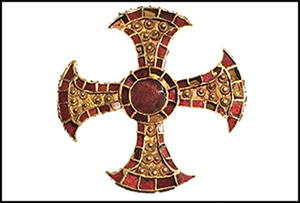
The first female-led monasteries, such as those at Whitby and Ely, were founded in the middle decades of the seventh century and provided a means by which royal dynasties could maintain control of land (Yorke Reference Yorke2003). A few decades earlier, some families had already begun to bury certain female members with precious jewellery, amulets and religious objects, at a time when male graves were largely unfurnished (Bayliss & Hines Reference Bayliss and Hines2013). Over a hundred such well-furnished female burials have been excavated to date; they cannot all have been ‘princesses’, despite a tendency by the media to label them as such (e.g. The Oxford Times, 24 September 2009, ‘Precious Saxon Discovery’). It is likely, nevertheless, that these two developments were linked and that royal abbesses who, like Hilda, found their way into the written record were part of a wider, undocumented phenomenon: women and girls who, even in death, served as intercessors with the supernatural, cementing their family's claim to resources, their bodies instrumentalised for political ends (Hamerow et al. Reference Hamerow, Byard, Cameron and Shortland2015, Reference Hamerow2016, Reference Hamerow, Langlands and Lavelle2020). What set the individuals buried in this ostentatious manner apart? Written sources such as royal genealogies and the poem Beowulf indicate that female exogamy—the marrying of female family members outside of their group/tribe—was sometimes practised and that brides could serve as “peace pledges” between rival families (Yorke Reference Yorke1990, Reference Yorke2003; Alexander Reference Alexander1995: line 2017). Is it possible that these well-furnished burials are connected to this practice? There is prima facie evidence to suggest that this was so, from three well-furnished ‘bed burials’ in Cambridgeshire: one at Trumpington, where an adolescent girl was buried on a bed and accompanied by a garnet-inlaid gold pectoral cross and linked pins (Figure 1, A, B, C), and two at Barrington (Malim & Hines Reference Malim and Hines1998; Evans et al. Reference Evans, Lucy and Patten2018). All three have stable isotope compositions that suggest they did not grow up in England (Leggett Reference Leggett2020). But such a small sample is far from conclusive; long-distance mobility may also have been common among men and among women buried in poorly furnished and unfurnished graves. This article presents the results of isotopic analysis of a large number of seventh-century burials undertaken to establish whether ‘well-furnished’ females were indeed more likely than other members of their communities to be non-local to their place of burial. Increasingly precise radiocarbon dates, improved understanding of the distributions of oxygen and strontium isotopes across Britain and Ireland, and the development of more reliable baselines for the interpretation of geographic origins, make such an analysis possible.
The seventh-century bed-burial at Trumpington, Cambridgeshire. A) The bed-burial during excavation; B) Gold and garnet cloisonné cross, diam. 34.5 mm (photograph by S. Leggett); C) Gold and garnet linked pins. Length is approx. 40mm (photograph by S. Leggett). Photographs reproduced with permission of the Cambridge Archaeological Unit and the University of Cambridge.

Materials and methods
Isotopic analysis of tooth enamel was used to identify individuals whose isotopic compositions are inconsistent with the location in which they were buried; that is, those who grew up in a region with a different climate and underlying geology. It should be emphasised that the term ‘non-local’ need not imply movement over long distances and could involve communities that lay within a day's travel of each other; mobility has therefore been investigated using two different radii for ‘non-local’ designations (see below).
Oxygen (δ18O) and strontium (87Sr/86Sr) isotope analyses are well-established techniques used to provenance skeletons from archaeological contexts (Evans et al. Reference Evans, Chenery and Montgomery2012; Lightfoot & O'Connell Reference Lightfoot and O'Connell2016; Pederzani & Britton Reference Pederzani and Britton2019). The isotopic composition of water varies in a systematic way, tied to local geography and climate; δ18O values vary with altitude, latitude, distance from the coast, humidity and temperature (Rozanski et al. Reference Rozanski, Araguás-Araguás, Gonfiantini, Swart, Lohmann, Mckenzie and Savin2013; Pederzani & Britton Reference Pederzani and Britton2019). When food and drink are sourced locally, the δ18O values of tooth enamel will reflect the climate a person was living in during tooth crown formation. The “brewing and stewing” effect, resulting from the consumption of artificially heated liquids in large amounts, can, however, make people look like they spent time in ‘hotter’ climes (Brettell et al. Reference Brettell, Montgomery and Evans2012).
Strontium isotope analysis is based on the principle that the natural variation of 87Sr in different geological formations enters the food chain through plants and water (Evans et al. Reference Evans, Chenery and Montgomery2012). The strontium isotope values of the geology upon which someone was living (or from which they sourced their food, which, in the seventh century AD, are likely to be the same) during enamel formation can therefore be compared to the geology within which they are buried to test for mobility during an individual's lifetime. As with oxygen, there are complicating factors, such as sea spray, flooding, pollution and fertiliser use, that can alter bioavailable strontium values, making them different from those of the underlying bedrock (Evans et al. Reference Evans, Chenery and Montgomery2012; Bataille et al. Reference Bataille, Klervia, Milano, Trost, Steinbrenner, Crubézy and Colleter2021; Holt et al. Reference Holt, Evans and Madgwick2021). Despite these caveats, it is in principle possible to establish if someone spent periods of their life in a different climatic and geological zone from the one in which they are buried.
Enamel formation (the point at which isotope values are preserved in the mineral structure of the tooth) occurs at specific, predictable intervals dependent on the tooth in question. This is useful as we can then look at residency signatures for specific age ranges within a person's life, which can have implications for distinguishing between different kinds of mobility. Here, second premolars and second molars were preferred due to the similarity in their formation timings and the fact that they represent a post-weaning signature (enamel formation at about 2–8 years of age). The broader dataset (see below) does, however, include isotope data from a variety of teeth, introducing more variation in the age ranges represented. For instance, third-molar enamel formation occurs between approximately 12 and 16 years of age, whereas a first premolar would represent residence from about 1.5– 6 years of age and could include breastfeeding and weaning effects (Scheid Reference Scheid2007; Brettell et al. Reference Brettell, Montgomery and Evans2012).
Eighty-six burials (48 females and 38 males) were isotopically analysed for both oxygen and strontium; five individuals were later excluded following radiocarbon results that showed they pre-dated the seventh century, leaving a core group of 81 individuals (see online supplementary material (OSM) Table S3). Combining the two isotopic proxies provides greater resolution in pinpointing possible origins than analysing either isotope alone. Oxygen is the most abundant type of mobility-related enamel isotope data currently available for early Anglo-Saxon burials. Within a total database of 541 burials, 293 have strontium data (paired or unpaired with oxygen) whereas 510 have some form of δ18O data available; the present project has nearly doubled the number of strontium results for burials from the seventh century (Leggett Reference Leggett2020; Leggett et al. Reference Leggett, Rose, Praet and Roux2021, Reference Leggett, Hakenbeck and O'Connell2022). The 81 core burials come from six cemeteries and one isolated burial; over half come from Kent, where cross-Channel mobility may have been particularly marked (Figure 2; Leggett Reference Leggett2021; Gretzinger et al. Reference Gretzinger2022). The majority come from cemeteries thought to date to the seventh century (although potentially extending into the eighth); some contained closely datable burial assemblages and 18 have been radiocarbon dated, eight as part of this project (Table S1). Phasing of the burials follows that proposed by Leggett and colleagues (Reference Leggett, Rose, Praet and Roux2021), which is based on Bayliss and Hines’ leading artefact types (2013: 460) but also incorporates Brownlee's more recent (Reference Brownlee2021) re-phasing of cemeteries not included in the 2013 study. Slightly modified date categories unifying both chronological frameworks and incorporating other absolute dating evidence (radiocarbon and numismatic) were therefore used. Our focus is on graves falling within date categories C–E (c. AD 580–800). For full details of phasing and date category aggregation, see Table S2.
Map of burial sites analysed and other sites mentioned in the text. Black stars denote sites with new data from this study; dots are sites where previously published data has been included; an asterisk next to a site name indicates sites with published and new data integrated. For all original site data references see Tables S4 & S5 and the online compendium (figure by authors).

For Tables 1–3 and Figure 3, isotope data for burials other than those analysed for this project were included to increase sample sizes, mitigate regional biases, and allow comparison with mobility patterns seen in the fifth and sixth centuries. Numbers of individuals per site and period are summarised in Tables S3–S5, with all sites included shown in Figure 2 (full grave details are available in the online compendium at https://osf.io/ynx3m/). For the Conversion Period this included 259 individuals: 131 females and 128 males; 134 individuals with both strontium and some form of oxygen data, 112 with oxygen data only and 13 with strontium data only. There are 99 females and 73 males from the fifth–sixth century included; 87 with both strontium and some form of oxygen data, 70 with oxygen only and 15 with strontium data only (see OSM section 4). Individuals for which sex determination was not available, or who were not associated with clearly gendered grave goods, were excluded from analysis as our focus is on gendered mobility. Data for these individuals are, however, available in the online compendium.
Raincloud plots of female (blue) versus male (yellow) enamel data from the larger dataset. A: δ18Ophosphate (dashed lines indicate UK range from BGS); B –Δ18Odw-MAP (lines indicate ±2‰ range for ‘locals’); C – 87Sr/86Sr (lines indicate upper limits for England from BGS – 0.7114 for the south and east and 0.7140 maximum around Hereford). For A and B: left graph female n = 77, male n = 74; centre graph female n = 31, male n = 32; right graph female n = 22, male n = 18. For C: left graph female n = 63, male n = 49; centre graph female n = 27, male n = 18; right graph female n = 12, male n = 10 (figure by S. Leggett).

Proportions of non-local individuals dating to c. AD 400–600 (Leggett et al. Reference Leggett, Rose, Praet and Roux2021 phases A–C, A–D, A/B, B, B–D, B/C), by gender. Sample sizes in parentheses.

Proportions of non-local individuals dating to the early (c. AD 580–630) and late Conversion Period (c. AD 630–800) (Leggett et al. Reference Leggett, Rose, Praet and Roux2021, phases C and C/D and phases D, D–F, D/E, E and E/F respectively) by gender, including data from the broader dataset (all data).

To be classed as ‘well furnished’, a female burial had to meet at least two of the following three criteria: contain one or more objects made of precious metals, a ‘relic box’ (Blair & Hills Reference Blair and Hills2020), exotic materials such as cowrie shell and amethyst or a box/casket; be buried under a barrow or in a bed (cf. Bayliss & Hines Reference Bayliss and Hines2013: 538–9); or contain 10 or more grave goods. To avoid what remains to some extent an artificial distinction between well-furnished burials and ‘the rest’, the comparison was restricted to 45 core females for which information regarding associated finds and/or (for poorly furnished and unfurnished burials) radiocarbon dates were available. The larger dataset was drawn from a previous meta-analytical study by Leggett et al. (Reference Leggett, Rose, Praet and Roux2021). This was updated to include more recently published and previously overlooked isotope data (see OSM section 4). Details of the 86 individuals analysed as part of this study are in Table S3 and our online data compendium (see link above), including isotopic measurements and strontium concentration data.
Details of laboratory methods are available in the OSM (section 1) and raw data and R code can be viewed in the online compendium. For ease of comparison between data and for probabilistic isoscape modelling, oxygen isotope values from enamel carbonate (δ18Ocarb (PDB)) were converted to enamel phosphate (δ18Ophosphate (SMOW)), drinking water (δ18Odw) and the difference between drinking water and modelled annual precipitation (Δ18Odw-MAP) values using equations from Chenery and colleagues (2012). For simplicity, only δ18Ophosphate (SMOW) and Δ18Odw-MAP values are reported and visualised here (the full range of oxygen isotope conversions are available in the online compendium).
Details of data analysis can also be found in the OSM (section 2). Owing to issues in defining migrants via statistical outlier approaches—especially if a high degree of mobility in the population is likely—and the fact that outside of our 81 core individuals not all burials had both oxygen and strontium data, we adopted an exploratory data analysis approach (see OSM section 2; Lightfoot & O'Connell Reference Lightfoot and O'Connell2016; Leggett Reference Leggett2021). This negates the need for statistical significance and instead focuses on patterning in the data (Tukey Reference Tukey1977; Tong Reference Tong2019).
To be conservative in our identification of non-locals, we used three statistical and spatial approaches; the outcomes of each are presented below. First, data were compared to established British Geological Survey (BGS) human enamel ranges for the UK: δ18Ophosphate (16.6–18.7‰) and 87Sr/86Sr (0.7079–0.7114 for England with local maxima up to 0.7140, UK max = 0.7221) (Evans et al. Reference Evans, Chenery and Montgomery2012; BGS 2020). This was repeated at a site-specific baseline level on BGS maps for our core individuals for whom we had both oxygen and strontium data. Second, Δ18Odw-MAP values were created for every individual with oxygen data (after Leggett et al. Reference Leggett, Rose, Praet and Roux2021) for a basic measure of isotopic fractionation between the tooth enamel values and local drinking water values. Individuals with values beyond ±2‰ were considered likely to be migrants, with ‘brewing and stewing’ effects (including breastfeeding) considered for individuals with positive fractionation values. There was no consistent offset in early forming teeth to suggest that fractionation from breastmilk affected our results (see OSM section 9). Finally, for individuals with oxygen and strontium isotope data from the same tooth, we undertook double-isotope probabilistic geographic assignment modifying code from Bataille and colleagues (Reference Bataille, Klervia, Milano, Trost, Steinbrenner, Crubézy and Colleter2021) which necessitated the conversion to δ18Odw. This was combined with an exploratory data analysis approach to compare mobility between females and males and also between females from well-furnished and poorly furnished burials.
We sought to distinguish female exogamy from virilocality—the practice of brides moving to live with or near their husband's kin—by considering the distance of a burial from likely place of origin. Individuals originating from a zone with a radius of greater than 10km but less than 100km from place of burial were considered as potentially representing virilocality, while those originating more than 100km from place of burial were considered as potentially representing exogamy (Roper Reference Roper1979; Tobler Reference Tobler1993). Although territories in seventh-century England were probably poorly defined, a broadly contemporary document known as the Tribal Hidage indicates that the size of such territories, while mostly small, varied considerably (Davies & Vierck Reference Davies and Vierck1974). The 100km radius was therefore chosen to filter out virilocality, as at this scale it would be unlikely that the place of burial lay within the territory in which an individual had spent their childhood. The two radii were applied to the georeferenced probabilistic models using buffers in an open source geographic information system (QGIS Development Team. 2022), where the results were not immediately apparent; if an individual's origin model produced a greater than 50 per cent chance of origin within the given radius (excluding areas across major bodies of water or other substantial boundaries, such as the English Channel or the Pennines, covered by the 100km buffer), that individual was classed as probably local.
Given the isotopic baseline similarities in both oxygen and strontium between different regions of the UK, and between the UK and other regions of potential childhood origins such as Ireland, the Low Countries and France, as well as the conservative nature of the spatial modelling applied (Bataille et al. Reference Bataille, Klervia, Milano, Trost, Steinbrenner, Crubézy and Colleter2021), some non-local individuals will appear to be ‘local’ using these methods. It is important to note, therefore, that the estimations presented below are likely to under-represent the true number of non-local individuals.
Results
Table 1 and Figure 3 (first column) indicate that, during the fifth to late sixth century, women were somewhat more likely than men to be non-local to their place of burial and both were equally likely to come from outside the 100km radius. A large degree of isotopic overlap between males and females is apparent in this period, especially in terms of oxygen data, which shows bimodality for both (Figure 3). During the period c. AD 580–630, most people appear local to their place of burial when only oxygen proxies are used (Table 2 & Figure 3A & B). When outliers are excluded, females have a large range of δ18Ophosphate values (Figure 3A) which suggests more diverse origins than males, their marked bimodality suggesting at least two distinctive isotopic origins. Non-local males are more homogeneous, implying that they originate from regions with similar climatic conditions. The strontium data (Figure 3C) show that males have a broader range of values (even when outliers are excluded), and that the genders diverge significantly in their distributions, suggesting different origins.
Proportions of non-local individuals dating to the Conversion Period, c. AD 600–800 (Leggett et al. Reference Leggett, Rose, Praet and Roux2021 date categories B–F, C, C–E, C–G, C/D, D, D–F, D/E, E, E/F) by gender including the broader dataset (all data) and from core 81 individuals. Sample sizes in parentheses.

For the period c. AD 630–700 females again have a larger isotopic range for oxygen, but now accompanied by a larger range for strontium (excluding outliers), and there is a distinctive bimodality for both isotopic systems, again supporting more diverse origins for non-local women. When factoring in a high level of uncertainty using Δ18Odw-MAP values (Figure 3B), males are again more homogeneous than females for both oxygen and strontium (3C), the double-isotope models showing more long-distance male than female mobility (Table 3).
Gender differences were further explored statistically with the Kernal Isotope Niche package (rKIN) and Bayesian Estimation Supersedes the t-test (BEST, see OSM sections 6–8); considerable overlap of isotopic spaces is apparent (approximately half of all people come from isotopically similar regions), but the shape, size and nature of the isotopic spaces occupied by each gender are different. During the period c. 630–700, ‘non-local’ men were more likely to come from cooler climates and women from warmer climates (compared to place of burial), with low bioavailable strontium geologies (e.g. chalk) the dominant signature regardless of gender.
In Figure 4, which compares females from well-furnished and poorly furnished burials, we see the same clear trends as in Figure 3—bimodality in both oxygen and strontium data. Indeed, regardless of whether δ18Ophosphate (SMOW), Δ18Odw-MAP or strontium values are considered (Figure 4A–C), the larger mode or ‘bump’ for females from well-furnished burials is at the opposite end of the scale from those from poorly furnished burials. This indicates that most of the females from well-furnished burials in this study had different geographic origins than those in poorly furnished graves. The data in Figure 4 show that all females fall within known strontium ranges for southern Britain (below the lines on Figure 4C), and only a few fall outside the known oxygen range for the UK (lines on Figure 4A), but the subtle differences in their individual double-isotope probabilistic maps (see online compendium folder ‘Isoscape_Origins_Map’ under ‘Outputs’) hint at more well-furnished females coming from cooler climes and chalkier geologies, with females from poorly furnished burials more likely to have grown up in warmer, non-chalk regions.
Raincloud plots of poorly furnished (n = 18) versus well-furnished (n = 26) females. A: δ18Ophosphate (lines indicate UK range from BGS); B: Δ18Odw-MAP (lines indicate ±2‰ range for “locals”); C: 87Sr/86Sr (lines indicate known upper limits for England from BGS – 0.7114 for the south and east and 0.7140 maximum around Hereford) (figure by S. Leggett).

The rKIN comparisons of the two groups of females confirm that individuals from poorly furnished burials occupy a much larger isotopic space than those from well-furnished burials, suggestive of higher levels of mobility and a greater diversity of childhood origins, which is likely driving the overall trends seen in Figure 3. We further investigated this isotopic divide using hierarchical cluster analysis (Figure 5 and OSM sections 5 & 8). The results reveal three clusters for seventh-century women: Cluster 1 (black) consists of 17 individuals (14 well-furnished and three poorly furnished), mostly local to their place of burial, their δ18Ophosphate and 87Sr/86Sr values suggesting origins on the chalk geology of eastern Britain; Cluster 2 (orange) includes 13 individuals (six well-furnished and seven poorly furnished), most of whom are non-local with isotopic signatures consistent with ‘Atlantic Fringe’ zones not on chalk; and Cluster 3 (blue) includes 14 individuals (six well-furnished and eight poorly furnished), again mostly non-local to their place of burial, with a similar non-chalk strontium range to Cluster 2 but with a δ18Ophosphate range indicative of cooler conditions outside of Britain. These results indicate that females from well-furnished burials are statistically more likely to come from a chalky region (probably biased by our selection of Kentish cemeteries) and to be local to their site and region of burial than poorly furnished females, who are more likely to be non-local and from radiogenic geologies.
Dendrogram showing the outcome of hierarchical cluster analysis on δ18Ophosphate and 87Sr/86Sr data from the core 44 women. Optimal number of clusters = 3 (see OSM section 8) and stars indicate females from well-furnished burials (figure by S. Leggett).

Discussion
While caution is needed in drawing wider conclusions from a comparatively small, regionally biased sample, the findings of the present study have important implications for our understanding of gendered mobility and of the well-furnished burial rite in seventh-century England. First, the proportion of individuals who were non-local to their place of burial increased sharply in the seventh and eighth centuries, especially for the period AD 630–800. It should be stressed, however, that direct comparisons with the fifth and sixth centuries, for which primarily only oxygen isotope values are available, must be treated with caution. Levels of mobility are also likely to have varied in different parts of the country and it would be unsurprising if cemeteries in east Kent—from which more than half of our sample derives—contained an unusually high proportion of ‘non-locals’. The increase could be partly explained if a significant proportion of earlier mobility involved individuals from regions that have similar isotope values (owing to similarities in climate and geology) to southern and eastern England, such as north-west Germany and the Low Countries (cf. Gretzinger et al. Reference Gretzinger2022; Leggett et al. Reference Leggett, Hakenbeck and O'Connell2022), while in the seventh and eighth centuries a higher proportion of individuals from isotopically distinct regions was involved.
As shown in Table 3, similar proportions of males and females were non-local to their place of burial using a radius of greater than 10km. The level of short-distance mobility increased somewhat for both genders during the period AD 630–800 (Table 3), potentially indicating an increase in non-local marriage alliances at a time of growing inter-regional trade and the establishment of formal markets in southern and eastern England (Naylor Reference Naylor2016). While long-distance mobility for females increased during the same period, as originally hypothesised, it also increased for males. Contrary to expectation, men were in fact slightly more likely to have spent their childhood more than 100km from their place of burial during the seventh century (43 per cent of males compared to 37 per cent of females; Table 2). The high incidence of long-distance mobility for males during the seventh and eighth centuries is unlikely to have had a single cause. Exogamy may have been a factor, despite the emphasis in written sources on female exogamy, along with involvement in warfare and the fosterage of boys, a practice widely alluded to in Anglo-Saxon written sources and likely to have been “integral to Anglo-Saxon child-rearing practices” (Crawford Reference Crawford1999: 122).
Patterns of male and female mobility also differed. The distribution of isotope data for females indicates at least two compositional origins, with cluster analysis allowing three isotopically distinct clusters to be identified. Non-local males, in contrast, came either from the same region or from several regions with similar climates and geologies.
Our results also cast important new light on the relationship between the type of burial rite accorded to women in the seventh century—well-furnished versus poorly furnished/unfurnished—and whether they were local or non-local. The bimodal distribution seen in Figure 3 indicates, as originally hypothesised, that most of the females from well-furnished burials in our sample had different origins from those in poorly and unfurnished graves; contrary to expectation, however, 76 per cent (13 out of 17) of females in isotope Cluster 1, associated with the ‘cooler’ Cretaceous chalk regions of southern and eastern England, were well furnished, in contrast to only 45 per cent (12 out of 27) in Clusters 2 and 3, with origins in non-chalk regions or outside of Britain.
Conclusions
If, as is widely assumed, the well-furnished burial rite is a reflection of high status, these results suggest that women of non-local origin were generally of lower status than their local counterparts (with royal women as a notable exception). The non-local females in our sample appear to have come from at least two different regions, one of which is consistent with the ‘Atlantic Fringe’ zone, i.e. south-west England, Ireland and coastal areas of Wales.
An intersectional perspective suggests that not only status, but also institutionalised gender- and age-related mobility such as virilocality played a role in determining burial rites. The geographical distribution of well-furnished graves containing females is relevant here: they are primarily found in cemeteries in east Kent (from which most of the burials in our sample come), East and North Yorkshire, East Anglia and the Upper Thames Valley, a distribution broadly corresponding to that of the earliest female-led monasteries (Yorke Reference Yorke2003; Bayliss & Hines Reference Bayliss and Hines2013; Hamerow Reference Hamerow2016). These regions are isotopically consistent with Isotope Cluster 1. The cemeteries studied also contained a significant number of non-local females belonging to Isotope Clusters 2 and 3, but these were less likely to have been accorded a well-furnished burial rite. This may be partly accounted for by the fact that furnished burial was rarely practiced in the regions, such as south-west England, that are isotopically consistent with Isotope Cluster 2. Identifying the likely origins of these ‘non-local’ women is the subject of a future study, but the results presented here suggest that unfurnished females were more likely than well-furnished females to have originated from western ‘British’ regions or from Ireland. We posit, therefore, that several aspects of a woman's identity determined whether she was accorded a well-furnished burial: her status, whether she was local or non-local and, if non-local, her place of origin.
Acknowledgements
The authors are grateful to Julia Lee-Thorpe and Rick Schulting for their comments on an earlier draft of this paper and to Christopher Day, Phil Janney, Peter Schauer, the Cambridge Archaeological Unit, the Duckworth Laboratory (especially Trish Biers), Cambridgeshire County Council, Corinium Museum, Duncan Sayer and the Oxfordshire Museums Service for facilitating access to and sampling of the material.
Funding statement
This project was supported by the John Fell Fund, University of Oxford.
Supplementary material
To view supplementary material for this article, please visit https://doi.org/10.15184/aqy.2023.203.


 Open access

