

Chapter Highlights
1. The rapid urbanization associated with the Anthropocene provides an imperative for humans to think differently about the future.
2. The “seeds” approach describes how niche experiments can, over time, coalesce to shift the dominant regime onto a more sustainable trajectory.
3. To achieve positive urban futures, it is vital to ensure that more positive narratives inform our lived experience so that, as humans, we are able to act differently in the face of seemingly overwhelming challenges.
4. Novel scenarios can be developed by imagining futures in which seemingly disparate ideas must coexist; fostering this creativity is important if we are to create positive visions of futures that we would like to achieve.
5. Urban transformations are complex phenomena; the seeds approach is a tool that can help us understand how transformations occur and how to nudge them towards more sustainable trajectories.
16.1 Introduction: “Good Anthropocenes” in an Urbanized World
The past two centuries have seen dramatic gains in human well-being, largely achieved through conversion of land to agriculture and the appropriation of natural resources such as timber and fish. However, the extent and cumulative impact of human changes to the Earth have come to rival the great forces of nature, and have inadvertently shepherded us into a new planetary era – the Anthropocene (Steffen et al. Reference Steffen, Broadgate, Deutsch, Gaffney and Ludwig2015). Changes include profound alterations of the Earth’s marine and terrestrial ecosystems and the services they provide to globally interconnected societies and economies (Carpenter et al. Reference Carpenter, Mooney, Agard, Capistrano, DeFries, D’ia and Diet2009). Humans have also radically altered the composition of the Earth’s atmosphere (IPCC Reference Stocker, Qin, Plattner, Tignor, Allen and Boschung2013), the elemental cycles (Steffen et al. Reference Steffen, Andreae, Bolin, Cox, Crutzen, Cubasch and Held2004), and flows of water (Vörösmarty et al. Reference Vörösmarty, McIntyre, Gessner, Dudgeon, Prusevich, Green and Glidden2010). By many measures, the changes humanity has caused in the last 50 years have now met or exceeded the variations seen through the entire Holocene, the geological era that started 10,000 years ago and that provided the relatively stable environment that enabled humanity’s development of agriculture and complex societies (Rockström et al. Reference Rockström, Steffen, Noone, Persson, Chapin, Lambin, Lenton, Scheffer, Folke, Schellnhuber, Nykvist, de Wit, Hughes, van der Leeuw, Rodhe, Sörlin, Snyder, Costanza, Svedin, Falkenmark, Karlberg, Corell, Fabry, Hansen, Walker, Liverman, Richardson, Crutzen and Foley2009).
A central feature of the Anthropocene is the onset of rapid urbanization (United Nations 2009). The decisions made by the majority of the human population now living in cities affect the biophysical dynamics of the entire planet, and the urban demand for environmental goods and services is a major driver behind global environmental change (Seto et al. Reference Seto, Fragkias, Güneralp and Reilly2011; Bulkeley and Betsill Reference Bulkeley and Betsill2005; Grimm et al. Reference Grimm, Faeth, Golubiewski, Redman, Wu, Bai and Briggs2008). The choices urban citizens make are often disconnected from their environmental imprint in distant places; thus, urban lifestyles have altered the way people in cities perceive and interact with the biosphere (Andersson et al. Reference Andersson, Barthel, Borgström, Colding, Elmqvist, Folke and Gren2014).
Despite the new threats, risks, and problems that arise from these changes and that dominate popular and scientific forecasts, the future does not have to be bleak. There are many examples of new thinking, new ways of living, and new ways of connecting people and nature that address aspects of global problems and that could create different trajectories of future change. For example, new, bottom-up processes are producing innovations that are reimagining the smart city concept and reshaping how urban citizens move around and reduce their energy consumption and carbon footprint (see Chapter 48).
Individuals, organizations, and governments have repeatedly stated their desire to create a just, prosperous, and ecologically sustainable world – or “Good Anthropocene.” However, due to the complexity and scale of change required, the scientific community in general and the global change community, in particular, have undertaken very few analyses of positive futures or how to achieve them. A variety of different futures could constitute a Good Anthropocene, but all Good Anthropocene futures likely require dramatic social changes coupled to technological progress to create a future that meets widely held aspirations for equitable human development without undermining the capacity of ecosystems to support future human well-being (See Preiser et al. Reference Preiser, Pereira and Biggs2017). Such changes entail a transformation as radical as the shift from the Medieval period to the Industrial era in Europe – that is, a global scale renaissance that embodies fundamental shifts in underlying values, assumptions, cultures, and worldviews that govern the institutions and behavior of modern society (Bennett et al. Reference Bennett, Solan, Biggs, McPhearson, Norström, Olsson, Pereira, Peterson, Raudsepp-Hearne and Biermann2016).
In this chapter, we present insights from an ongoing research initiative, “Seeds of Good Anthropocenes,” that is at the forefront of approaches for exploring and articulating more positive futures in the Anthropocene. The project is based on a crowd-sourced database of “seeds”: real initiatives that demonstrate one or more elements of a positive future that might contribute to creating a Good Anthropocene. We present a preliminary analysis of urban seeds and the types of projects that are emerging as important to sustainability transformations in this context. We then discuss how we have used seeds to generate creative, radically alternative, desirable visions of a better future. Such participatory exercises provide a platform for addressing and bridging different approaches to knowledge, views of how the world works, and values (Bennett et al. Reference Bennett, Solan, Biggs, McPhearson, Norström, Olsson, Pereira, Peterson, Raudsepp-Hearne and Biermann2016; Wiek and Iwaniec Reference Wiek and Iwaniec2014), and can be important in creating momentum for transformative change.
16.2 Theory of Change: How Seeds Can Create Transformative Change
The Seeds project is grounded in an emerging understanding of how change occurs in complex adaptive social-ecological systems, or SES. The framework that underlies this project is presented in Figure 16.1, and integrates two key existing frameworks: the sociotechnical transitions framework (Geels Reference Geels2002), and the stages of social-ecological transformations (Olsson et al. Reference Olsson, Gunderson, Carpenter, Ryan, Lebel, Folke and Holling2006; Moore et al. Reference Moore, Tjornbo, Enfors, Knapp, Hodbod, Baggio, Norström, Olsson and Biggs2014), which include the panarchy model (Gunderson and Holling Reference Gunderson and Holling2002).
Macroscale systemic change typically emerges from a long period of preparation that entails experimentation, innovation, and the formation of new coalitions at the micro-level. Proto-regimes that emerge from this preparatory phase typically only become institutionalized at a meso-level once a window of opportunity emerges in the form of a crisis or anticipated crisis. Our understanding of how these meso-level regimes can then effect larger-scale systemic change is still limited. The symbols indicate new configurations, where the social and ecological components of the system are connected in new ways.
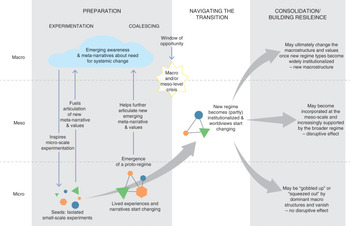
Macroscale change in SES comprises three interconnected phases: preparation, navigating the transition, and consolidation (Olsson et al. Reference Olsson, Folke and Hahn2004). In the first phase (preparation), there is an emerging awareness of some systemic problem at a macro-level, such as the awareness growing since the 1960s, that society is on an unsustainable development trajectory (Meadows et al. Reference Meadows, Meadows, Randers and Behrens1972; Sawyer Reference Sawyer1972). This inspires a diversity of experiments, typically at the micro-level. The examples contained in the Seeds project database constitute such micro-level experiments or initiatives that have emerged as responses to Anthropocene challenges.
The preparation phase can be subdivided into subphases of sense-making, envisioning, and gathering momentum (Moore et al. Reference Moore, Tjornbo, Enfors, Knapp, Hodbod, Baggio, Norström, Olsson and Biggs2014). Sense-making is linked to a growing awareness of a systemic problem and involves an analysis of the structures that are most problematic in shaping the current trajectory. The major global environmental assessments of the past two decades, especially the Millennium Ecosystem Assessment (Millennium Ecosystems Assessment 2005) and the Intergovernmental Panel on Climate Change (IPCC Reference Stocker, Qin, Plattner, Tignor, Allen and Boschung2013) assessments, can be seen as playing this role. The process of envisioning entails generating new innovations and visions for the future. Psychological and sociological research suggests that inspirational visions can be key components of transformations to sustainability (Wiek and Iwaniec Reference Wiek and Iwaniec2014; van der Helm Reference van der Helm2009): they can help shape the future by changing how people understand the world and what they expect from it. Together, visions and innovations can provide the basis for gathering momentum, involving self-organization around new ideas, the creation and mobilization of networks of support, and experimentation in protected niches. Social entrepreneurs or change agents are critical in this subphase, both for creating niches, and for helping to weaken the broader structures that prevent the scaling up or out of innovations (Westley et al. Reference Westley, Tjornbo, Schultz, Olsson, Folke, Crona and Bodin2013).
The preparation and navigation phases are linked by a window of opportunity or the opening up of an opportuity context. As momentum builds in the preparation phase, small-scale experiments become connected or organized into “proto-regimes” (Geels Reference Geels2002) that are amenable to institutionalization at meso-scales. For this to happen, however, there generally needs to be some crisis, or anticipated crisis, that destabilizes the existing regime and creates a window of opportunity for institutional change (for example, a change in government, a financial crisis, or an extreme climatic event). When these crises emerge, the proto-regimes then provide potential “solutions” that can be adopted by decision-makers in need of new strategies (see, for example, Gelcich et al. Reference Gelcich, Hughes, Olsson, Folke, Defeo and Fernández2010). Institutionalization at the meso-scale is critical in the navigation phase in order to move into the consolidation phase and bring about larger systemic change.
Our understanding of how macroscale change emerges from meso- and micro-scale change is still somewhat limited, although there is a growing body of work looking at scaling up (growing bigger), out (replicating), and deep (changing underlying values) (Moore et al. Reference Moore, Riddell and Vocisano2015). In many cases, however, it appears that micro-scale innovations become captured by macroscale systemic structures and lose their innovative edge and potential for disruption. Adaptation and even more fundamental transformation of micro- and meso-scale structures may be required to engage with macroscale structures in a way that can bring about systemic change.
The Seeds project connects explicitly to the preparation phase and has three main objectives: 1) to survey and systematically compare seeds – based on their goals, activities, context, and impact – to identify the features of particularly transformative seeds, and to explore how different types of projects support and interact with one another to create protected niches; 2) to track and analyze particularly transformative seeds in more depth to further our understanding of how transformative processes occur; and 3) to experiment with new approaches for bringing diverse seeds together to stimulate further innovations and facilitate the development of proto-regimes. This experimentation step is being enacted through a process of envisioning, wherein the seeds are used as starting conditions for creating positive alternative visions of the Anthropocene.
16.2.1 The Seeds Database: Coding and Analysis
The starting point for the Seeds project is the development of a database of “seeds” (http://goodanthropocenes.net), which we define as initiatives (that is, a way of doing, an institution, a technology, a business, a project, or an organization) that exist in some form and that someone identifies as having the potential to contribute to a Good Anthropocene, but that are not currently dominant. We asked networks of sustainability scientists and practitioners from around the world to identify initiatives that could, given the correct conditions (for example, acceptability, cost-benefit analysis, ease of implementation), grow and transform to improve environmental conditions and human well-being. Contributors were invited through workshops, conferences, and via networks of sustainability researchers, and were asked to describe key attributes of the suggested seed by filling in an online questionnaire.
The initial seed collection represents a plurality of what types of initiatives could contribute to different concepts of what constitutes a “Good Anthropocene.” This openness was essential to capturing a broad cross-section of initiatives. We wanted to maximize the diversity of seeds in order to expose the plurality of underlying values associated with them, and to explore how very different types of seeds could combine to create radically novel visions of the Anthropocene.
The seed attributes captured in the online questionnaire include the challenges the seed addresses, its innovative aspects, its size and duration, and the types of systems in which it is active. We also collected information about the key actors that are involved in initiating and sustaining the seed, and what types of activities it conducted. Attributes related to seed spread were included mechanisms for spread (growing, replicating, or inspiring); limiting and enhancing factors; globally relevant aspects of seeds (that is, seeds may be inherently local, but may have characteristics that could be relevant elsewhere); and state of implementation. These features are described in a mix of categorical and text statements, and are based on attributes that were iteratively identified as important during several workshops, focus group discussions, and pilot web surveys.
Members of the project team then consistently coded the seeds for analysis. This coding was based on responses to the online questionnaire as well as additional sources, such as websites of the seed initiatives, media articles, reports, and scientific articles. We also used the information from the questionnaire to write short blog posts (See Box 16.1) on some of the seeds for our website in order to engage with a broader audience and to encourage other people to contribute a seed to the database.
Tyisa Nabanye
Tyisa Nabanye is a nonprofit urban agriculture organization growing organic food on the slopes of Signal Hill in Cape Town; it seeks to improve food security, promote sustainable livelihoods, and create employment for its members. Started in 2013 by a group of urban farmers from the townships around Cape Town, Tyisa Nabanye, which means “to feed each other” in isiXhosa (one of the official languages of South Africa), is an urban garden based on the principles of permaculture. The team consists of eight members: Mzu, Lumko, Unathi, Chuma, Lizza, Vuyo, Masi, and Catherine.
The land that Tyisa Nabanye occupies in Tamboerskloof was once used by the army and is now referred to as Erf 81. The land is owned by the South African National Defence Force, or SANDF, and is administered by the Department of Public Works, but the members of Tyisa Nabanye got permission from Andre Laubscher, the de facto caretaker of the property, to start growing some vegetables and moved into an uninhabited military storehouse on the property. At the moment, neither department has a clear plan for the property; as a result, they have not granted Tyisa Nabanye official tenure, although the department tacitly acknowledges their presence.
The urban farm at Tyisa Nabanye now hosts markets every second Sunday of the month, during which people can buy their fresh produce and homemade food from informal traders. Every Wednesday and Thursday, they hold yoga classes for volunteers on the farm and every so often they have a live music performance in the barn. Despite their uncertain status, they continue to innovate and learn, trying to create an environment where food can be grown, stories exchanged, and lives valued.
Urban initiatives such as Tyisa Nabanye have the potential not only to transform the relationships between people and the environment by reconnecting them to their food systems, but also to transform the relationships between people in a city that retains the apartheid legacy of fragmentation across race and class lines. By reappropriating space and integrating socially marginalized groups of people with others marked by affluence and access to resources, the problem of ghettoization and homeless city dwellers is being addressed in new ways.
16.2.2 Analysis of Urban Seeds
There are approximately 400 seeds currently in the database, 120 of which have been coded as urban seeds. To better understand the differences and commonalities among the seeds, we divided these urban seeds into a number of clusters based on their coded social-ecological attributesFootnote 1. We clustered seeds based on how they were constructed socially, what “anthrome” (or anthropogenic biome, see Martin et al. Reference Martin, Quinn, Ellis, Shaw, Dorning, Hallett, Heller, Hobbs, Kraft and Law2014) they worked within, what Anthropocene challenge they addressed, and the extent to which they were social-ecologically integratedFootnote 2.
16.2.3 Preliminary Findings
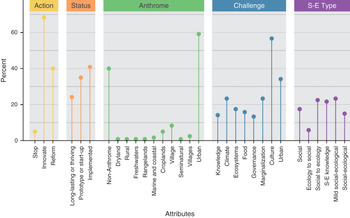
The developing database reveals a rich diversity of seeds relevant to an urban context, ranging from new technologies and urban design that could reduce ecological footprints, to projects reconnecting people to their environment, especially through food systems. Figure 16.2 presents an analysis of the different attributes of the urban seeds.
Attributes of 120 urban relevant seeds from the Seeds of the Good Anthropocene database. These seeds are classified across five categories based on a) what type of action a seed is encouraging (stopping, reforming, or innovating activities); b) the status of the seed (prototype, implemented, or a well-established project); c) which “anthrome” or social-ecological system the seed is oriented towards; d) what types of challenge of the Anthropocene the seed addresses; and e) the type of social-ecological integration the seed represents. The sum is greater than 100 percent because some categories are not mutually exclusive.
A hierarchical cluster analysis of the urban seed traits identified eight clusters, which we have termed as follows: Future Sustainability, Climate Smart Cities, Green Design, Urban Agroecology, Conservation Ecology, Green Innovation, Social & Design, and Political Ecology (Figure 16.3).
Urban seeds clustered into groups based on hierarchical clustering of the Anthropocene challenge(s) they address and their social-ecological type.
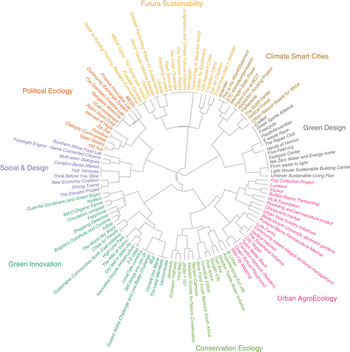
The analysis illustrates that the largest number of seeds initiatives are aiming to innovate to achieve a good future; the analysis identifies culture – understood as everything from people’s perceptions of nature to how they relate to each other – as the Anthropocene “challenge” being addressed by the greatest number of urban seeds (Figure 16.2). The various clusters give a glimpse as to what types of seeds (and their associated traits) people propose as being important for creating more positive urban futures. Notably, design and innovation are as important as more environmentally oriented traits, and social aspects – coded mainly in the political ecology group – are also emphasized.
The clusters we identified among the urban seeds largely correspond to the six main groups of projects identified by Bennett et al. (Reference Bennett, Solan, Biggs, McPhearson, Norström, Olsson, Pereira, Peterson, Raudsepp-Hearne and Biermann2016) in an analysis of the first 100 seeds in the database: (1) “Agroecology” – projects that adopt social-ecological approaches to enhance food-producing landscapes, (2) “Green Urbanism” – projects that improve the livability of urban areas, (3) “Future Knowledge” – projects which foster new knowledge and education that can be used to transform societies, (4) “Urban Transformation” – projects that create new types of social-ecological interactions around urban space, (5) “Fair Futures” – efforts to create opportunities for more equitable decision-making, and (6) “Sustainable Futures” – social movements to build more just and sustainable futures.
Further development of the seeds database will code for additional aspects of the seeds, and will likely identify other groupings. Nevertheless, our initial analysis identifies the substantial differences in approach, location, and activities that exist among the seeds, and suggests opportunities for considering how different types of seeds could interact with one another to enable or block transformations towards different types of futures.
16.3 Using Seeds for Envisioning Alternative Futures
A central goal of the project is to use seeds as elements with which to envision radically alternative scenarios of Good Anthropocenes. The seeds-based scenario approach responds to the need to avoid creating purely dystopian, utopian, or business-as-usual futures, and the need to imagine futures that are at once truly novel and concrete enough to inspire practical action. It also aims to create a scenario approach that is effective at imagining emergent change. In the project, we are experimenting with a range of scenario creation methods for different purposes (analysis, learning, stimulating innovation, and action). These different approaches include:
1. Testing a single seed against a range of Anthropocene challenges or fully formed scenarios, and coding its feasibility in these different futures, as well as how it would change different futures and if it would be successful enough to have a global impact – or, alternatively, what failure would look like. This creates a database of mini-scenarios or scenario elements that can, in turn, be clustered and combined into larger, more multidimensional scenario narratives.
2. Combining, or “mashing up,” different seeds selected by workshop participants, and using these combinations to imagine how different, contrasting seed initiatives could scale (up, out, or deep) and to create new composite ideas.
3. Mashing up different seeds and, simultaneously, pitting them against different Anthropocene challenges or (partial) contextual scenarios, to create composite scenario narratives of combined seed growth or failure. This can be done by mixing up multiple seeds and Anthropocene challenges, either randomly or in a structured fashion, and discussing/describing the resulting narrative.
4. Creating future scenarios via a game process in which players (initiative leaders, researchers, policy-makers) create coalitions of different seeds to take on different, contextual Anthropocene scenarios that are also represented by players in the role of researchers or policy-makers. The game includes a chance system to simulate uncertainty in seed development pathways. The combination of growing and failing coalitions of seeds changes and shapes the scenario context, resulting in a multidimensional scenario narrative.
Each of these options has been implemented in different versions at workshops, scientific conferences, with communities of innovative initiatives, and with students to test the consequences of different ways of designing seed-based scenarios development. In addition, rather than predesigning a given incarnation of a seed scenario development approach, we have also implemented a codesign process in which – in a workshop format – the participants conceptualize and experiment with how best to represent how seeds interact with their contexts and with each other (by designing game or other interaction rules). This codesign approach allows for conversations about the nature of transformative change in the face of the Anthropocene, as well as providing an open approach to incorporating inter- and transdisciplinary perspectives into scenario building methods.
In the following section, we provide a few summarized examples of how these different seed scenario-building methods have been applied to urban settings. The methods employed thus far in the project are experimental and need to be adapted for different situations. However, the results from some preliminary analyses indicate that this could be a useful framework for conceptualizing more positive futures.
16.3.1 Scenarios Created through Mashing Up Urban Seeds with Millennium Ecosystem Assessment Scenarios
We started to explore the possibility for combining different types of seeds in scenarios that explore radically alternative urban futures. Rather than testing single seeds (approach 1) or combining seeds with other seeds only (approach 2), we created more multidimensional futures by combining multiple seeds with each other, as well as with contextual scenarios (approach 3). The research team selected relevant urban seeds from different coded trait groups in the seeds database. In each iteration, we combined two seeds and imagined them within contextual scenarios. We used the Millennium Ecosystems Assessment scenarios (Millennium Ecosystems Assessment 2005) because they are relevant for the seed initiatives, and offer both desirable and challenging contexts. In this design, we present our scenarios in a more structured fashion to make the key questions transparent: What are the strengths and weaknesses of each combination in this context? How can the combination influence/change the scenario and its challenge? This process forces seemingly disparate connections between seeds to create more radical narratives. The time horizon for all scenarios is the year 2045, and the seed initiatives used in the mash-up are described in Box 16.2 as in the database by contributors and Table 16.1.
Vertical Forests
Vertical Forests is a model for a sustainable residential building, a project for metropolitan reforestation that contributes to the regeneration of the environment and urban biodiversity without the implication of expanding the city upon the territory. It is a model of vertical densification of nature within the city that operates in relation to policies for reforestation and naturalization of large urban and metropolitan borders.
The greener architecture will help absorb CO2, oxygenate the air, moderate extreme temperatures, and lower noise pollution. The bio-canopy is not only aesthetically pleasing to the eye, but it helps lower living costs.
Solar Airships
The airship has the potential to contribute to zero carbon development. This is important for developed and developing nations, since it would make growth without carbon pollution possible. Airships would carry payloads of 20,000 to 50,000 kg of cargo and would essentially replace the over-the-road trucks. They could travel to any point on the globe such that ships, trains, and trucks would be replaced by a method of transport capable of being powered by sunlight and a heat engine.
Espinaca
Spinach contains all six major classes of nutrients and it is one of the most highly affordable vegetables in the world. Espinaca Innovations wants to make this nutritious product more easily accessible to poor people. Espinaca Express Bakery is a company that aims to promote the consumption of spinach by producing innovative spinach products that are affordable for the poorest – creating access to nutritious and affordable food in informal settlements. It provides healthy food to people living in locations where healthy food has not always been available to them.
Urban Food Forestry
Urban food forestry, based in cities around the world, brings together elements of urban forestry, urban agriculture, edible landscaping, and agroforestry. It is an emerging form of urban food production visible in the form of community urban orchards, urban food forests, edible parks, and other edible landscape features. The main distinguishing features of urban food forestry from predominant forms of urban agriculture (such as allotment gardens) are a focus on utilizing public space and the planting of perennial crops. These characteristics result in more equitable access to fresh produce, particularly with the help of urban gleaning and fruit mapping projects.
| Name | Place | Challenges seed aims to address | Key actors | Approach | Innovative aspect | ScalabilityFootnote 3 |
|---|---|---|---|---|---|---|
| Vertical Forests | Milan, Italy | Urban disconnect from nature, Climate change, Energy use, Resource management | Architectural firm | Alternative design approaches | Sustainable management of ecosystem services in a high-rise building. It provides a model for future construction. | The model could be replicated elsewhere – scale out |
| Solar Airships | Saint Mary, Jamaica | Poverty eradication; Carbon pollution; Biodiversity loss; Global inequity in trade | International NGO | Adapting existing technologies to meet development needs | The idea makes use of tried and fairly simple technology to bring low-carbon solutions to remote and underdeveloped regions. | The technology can be used in many different locations – scale up |
| Espinaca Express Bakery | Khayelitsha, South Africa | Access to nutritious affordable food in an informal settlement | Social entrepreneur | Social enterprise model | Providing healthy, affordable food to poor people ensures the human right to food while maintaining a profitable business. | It is a business model that can be replicated elsewhere – scale out |
| Urban Food Forestry | Lund, Sweden | Food production shortages; Urban disconnect from nature | Local NGO | Mobilizing citizens to make use of green urban spaces for food production | The knowledge- and information- sharing between citizens and their model of cooperation is globally relevant. | It is replicable in cities around the world – scale out. It also changes citizens’ relationship with green spaces – scale deep |
16.3.2 Mash-Up 1: Vertical Forests and Solar Airships
Under Global Orchestration Scenario Facing Climate Change
The Global Orchestration scenario (Millennium Ecosystems Assessment 2005: 15) entails a “Globally connected society that focuses on global trade and economic liberalization and takes a reactive approach to ecosystem problems, but also takes strong steps to reduce poverty and inequality and to invest in public goods such as infrastructure and education.” The main challenge with which we combine this scenario is extreme climate change.
In the resulting mash-up scenario, trees from the vertical forests provide food and other resources (with value addition in the cities in which they grow); these resources are transported to remote areas in the airships. This will be a lower carbon emissions value chain that is highly innovative and well funded. The problem with this outcome is that it is likely to reinforce our current, dominant model wherein the “periphery” relies on the “core”; that is, commodities being produced in the north or in cities in the south will be providing for the needs of poorer, remote communities, reinforcing their dependence.
This mash-up could be effective in addressing the Anthropocene challenge of climate change – for example, the shift from relying on production in rural areas that are vulnerable to climate variability and extreme events is shifted to more controlled urban contexts, which have access to irrigation and other high-technology inputs.
The overall scenario, while being more ecologically sustainable, does not shift significantly under the presence of this mash-up, which reinforces old models of dependencies.
Under Adapting Mosaic Scenario Facing Biodiversity Loss
The Adapting Mosaic scenario (Millennium Ecosystems Assessment 2005: 15) describes a world where “Regional watershed-scale ecosystems are the focus of political and economic activity. Local institutions are strengthened and local ecosystem management strategies are common; societies develop a strongly proactive approach to the management of ecosystems.” The main challenge with which we combine this scenario is biodiversity loss.
In the mash-up scenario, the local production of vertical tree gardens has the ability to provide resources, such as food and medicine, to cities. However, airships are fundamentally about transport and connectivity, so local patchworks of urban trees’ products will be connected by airships transporting their goods.
The development of tree gardens will improve local urban biodiversity greatly, but patches of biodiversity outside of urban areas (for example, in protected areas) will decrease as biodiversity loss from climate change goes unchecked and these areas remain unconnected.
The increased connectivity opportunities arising from the use of airships as goods transporters has the potential to shift the scenario away from relatively local self-reliance to a more strongly connected world.
16.3.3 Mash-Up 2: Espinaca and Urban Food Forestry
Under Order from Strength Scenario Facing Climate Change
The Order from Strength scenario (Millennium Ecosystems Assessment 2005: 15) describes a “Regionalized and fragmented world, concerned with security and protection, emphasizing primarily regional markets, paying little attention to public goods, and taking a reactive approach to ecosystem problems.”
To combine Espinaca and Urban Food Forestry, the business model of Espinaca can be expanded to many commodities sourced from urban food forests, aiming for the most multidimensional and nutritious commodities.
In an Order from Strength world, the main benefits of a combination of these two seeds relate to self-reliance and resilience at the city level, which would be politically and socially attractive. The main weakness in this social and institutional context would be that the combined Espinaca and Urban Food Forestry practices need open and facilitative regulation, rather than the kinds of restrictive policies that would be more likely under Order from Strength.
However, these combined ideas could contribute to a shifting of activities in the food system to the local level, and provide more nutritional diets for poor people in cities, while potentially playing some role in changing dominant sources of power and organization and introducing elements of a more localized, networked world. This could also lead to greater degrees of urbanization and rewilding.
In the face of climate change, city-level self-reliance could be a benefit or a weakness, partly depending on what (perennial) crops are used. A lack of experience in managing climate extremes could be a key downfall.
Under Technogarden Scenario Facing Biodiversity Loss
The TechnoGarden scenario (Millennium Ecosystems Assessment 2005: 15) describes a “Globally connected world relying strongly on environmentally sound technology, using highly managed, often engineered, ecosystems to deliver ecosystem services, and taking a proactive approach in the management of ecosystems in an effort to avoid problems.”
In this context, the key opportunity that emerges with the combination of Espinaca and Urban Food Forestry is transferring the Espinaca business model to Urban Food Forestry commodities; in this scenario, both the model of food production and the model of delivery would be more open and more replicable in peri-urban areas and outside of cities due to strong management of information, transport, energy sources, natural resources, and so on.
There would be an emphasis on smart, tech-based management of the combined projects, leading to a wealth of data. Learning networks between people who are involved in urban food forestry production and delivery to the poorest would foster innovations.
In the face of biodiversity loss, urban food forests could help supplement crop diversity as well as creating contexts for the enhancement of urban and peri-urban biodiversity more generally.
If the combined initiative were to follow the dominant mode of technology-heavy management too closely, this could create weaknesses through an overreliance on technology and an illusion of control, for instance, in the face of disease outbreaks. Yet, the city-focused and localized nature of the combined projects could also counterbalance this tech dependence to a degree, creating some resilience based on local diversity in a globalized world.
16.3.4 Mashing Up Seeds for a Vision for Urban Agriculture in Eindhoven, the Netherlands
An alternative approach that does not use the MA scenarios was employed in the city of Eindhoven, the Netherlands, where organizations are developing a shared vision for urban agriculture, led by Proeftuin040Footnote 4, a platform that aims to link diverse urban agriculture initiatives and to act in collaboration with the city council and diverse city-level actors, including many innovative urban agriculture projects and businesses.
To foster creative, novel, and concrete thinking about what elements could contribute to this vision beyond current practices and projects alone, we used the seeds approach, facilitated by the EU-funded FP7 TRANSMANGOFootnote 5 project on transitions to better food systems.
In the Proeftuin040 process, our main interest was in combining seeds to foster innovative ideas rather than in testing them against scenarios. To ensure our thinking went beyond present practices, participants identified a mix of Eindhoven-based seeds and urban agriculture seeds from elsewhere in the world. In this exercise, ten participants in the visioning process contributed and combined seeds. We paired participants with one Eindhoven-based seed and one seed from outside of the city, and we conducted multiple seed combination rounds.
Here are examples of resulting ideas:
Polydome greenhouses on rooftops. In this idea, participants mashed up rooftop agriculture (Eindhoven-based seed) and polydome greenhouses (non-city-based seed). Polydome greenhouses on rooftops could increase rooftop production and serve recreational, community, and healthcare purposes if conducted with hospitals and schools, but they would also fit well on business properties and transport hubs. One political party in Eindhoven is currently interested in rooftop gardens.
Combining the London Food Council’s notion that a certain percentage of the city’s food must be produced within a given radius – mixing local and non local supply sources – with the concept of giving large areas of underused public space to entrepreneurs guided towards producing public goods. First, a desired and feasible mix of local and non local food sourcing could be outlined, and then the identification and allocation of public spaces to entrepreneurs could be based on the need for local food production or activities organizing non local food sourcing in a sustainable fashion.
Combining management of public green areas by neighborhood inhabitants with the maintenance, cultivation, and quantitative increase of local plant varieties. This was considered a viable commercial business model. In this scenario, people would organize green area maintenance policy to maximize benefits of this local varieties management scheme. Participants envisioned this combination as having value in enhancing local resilience through diversity, community building, education, and generating new livelihoods.
Reflections on the process by participants were positive – they saw the mash-up of local and non local seeds as providing a useful level of concreteness while stimulating creativity through the use of non local seeds, which also prevented conversations from getting too stuck in the present. This method can be applied across a range of topics that can allow free thinking to generate novel solutions in diverse groups of people – an important tool in addressing many of the complex and uncertain challenges facing urban settings in the future.
16.3.5 Reflections on Experimenting with Seed Scenarios
The above examples are only summaries of several ways in which new scenarios can be created using seeds. These examples are still somewhat limited – in the Millennium Assessment-guided examples, the existing scenarios provide a fairly dominant (and preexisting) top-down context for seed development; in the Eindhoven examples, the focus is only on mashing up seeds to create scenarios that are purely vision oriented – which can be perceived as good or bad, depending on the purpose of the exercise.
A number of ways to move beyond such limitations have been proposed, including:
The use of more randomly combined Anthropocene elements, rather than fully developed scenario worlds to frame the seeds, could break the process out of limitations placed on it by existing scenarios.
The combination of many such smaller scenario narratives in the context of a given preexisting scenario, and the exploration of how these narratives would change that scenario, could create a more emergent process.
Iterations of seeds transforming their contexts and leading to new scenarios, setting the scene for new time periods would also allow greater influence of bottom-up scenario elements.
If the goal is to test the seeds against extreme future conditions, we could introduce “wildcard” scenarios that stretch plausibility, but which would have major impacts (van Notten et al. Reference Van Notten, Sleegers and van Asselt2005).
Finally, researchers in the project organize codesign processes where many games and other methods for seed-based scenario building are created and explored, adding to an increasing understanding of the possibility space for seed-based scenario creation.
The similarity and lack of novelty among existing sets of scenarios is partly a result of their being developed by macro-level drivers or assumptions and being tied to notions of consensus about plausibility (van Vuuren et al. Reference Van Vuuren, Kok, Girod, Lucas and de Vries2012; Ramírez and Selin Reference 350Ramírez and Selin2014). The examples in this chapter provide an indication that the use of existing seeds as a starting point helps to develop concrete and tangible scenarios of future developments, while their combination, under diverse conditions, ensures novelty through recombination. A helpful next step could include the testing of the proposed scenario methods to combine seeds into novel futures, and comparison of the results with existing methods in terms of the novelty of their content.
16.4 Conclusions and a Future Research Agenda
Currently, negative – or even dystopian – visions dominate representations of the future in popular media as well as in scientific documents (see, for example, Chapter 43). We aim, through our seeds project, to bring a positive, realistic, social-ecological perspective to discussions of the Anthropocene, which are typically divided between visions of technological rapture and social collapse. We do this by collecting and analyzing seeds – examples of projects, ways of thinking, or initiatives that can lead towards a better future.
Scientists have long pointed to the urgent need for transformations towards sustainability (Clark Reference Clark2001; Kates et al. Reference Kates, Clark, Corell, Hall, Jaeger and Lowe2001; Raskin et al. Reference Raskin, Banuri, Gallopin, Gutman, Hammond, Kates and Swart2002; Schellnhuber et al. Reference Schellnhuber, Messner, Leggewie, Leinfelder, Nakicenovic, Rahmstorf, Schlacke, Schmid and Schubert2011). These shifts will likely require radical changes in values and beliefs, as well as in patterns of behavior, governance, and management (Olsson et al. Reference Olsson, Galaz and Boonstra2014). Yet despite a growing number of promising conceptual frameworks for studying sustainability transformations, we have little practical, on-the-ground knowledge about how it actually happens. We believe that collections of seeds can be useful in at least four interesting ways:
1. They can be used as part of transformation research projects to analyze how transformation occurs over a period of time. This aspect of our project links to testing and adding to the “Theory of Change” by tracking real-world examples of niche experiments that have the potential to disrupt the dominant regime. By tracking the progress of many seeds in different contexts as they interact, adapt, and scale, our project could bring enlightening new insights regarding how to create enabling environments for sustainability transformations.
2. They can stimulate innovation and discussion, especially through combining and connecting seeds into new global scenarios. In particular, the seeds can be used to develop new, bottom-up scenarios that are concrete and holistic, yet challenging and novel. By creating these novel futures, seeds give decision-makers more creative tools for navigating towards more positive futures than the standard scenario archetypes (see Hunt et al. Reference Hunt, Lombardi, Atkinson, Barber, Barnes and Boyko2012).
3. They can be used to analyze social-ecological diversity and interactions across scales. An analysis of seeds can help us understand where they arise and perhaps why or how they arise, as well as which types of seeds are common in which situations. Linking this understanding to bottom-up scenario processes can also aid in helping to achieve better cross-scale scenario linkages for understanding the relationship between ecosystem services and well-being from the local to the global levels, thereby inspiring new policy actions (see Kok et al. Reference Kok, Kok, Peterson, Hill, Agard and Carpenter2016).
4. They can be used in action research. As seeds are linked to real people making real change on the ground, this provides the opportunity for action research that brings seed initiators together in an innovative, participatory engagement like a “Transformation-lab” or creative scenario process. This space can be designed to achieve a variety of objectives, such as to share insights and ideas on opening up transformative spaces, creating novel visions of the future, or strategic planning of a particular niche group of seeds. Because cities around the world may be more similar to one another than they are to the countryside nearby, this might be an invigorating way to spread positive urban transformation worldwide.
The recognition of a need for more engaged, interdisciplinary research that works with practitioners has been seen as an important shift within the sustainability community, but this requires “safe spaces” in which to experiment (Pereira et al. Reference Pereira, Karpouzoglou, Doshi and Frantzeskaki2015). Our Seeds project is one such experimental space that is constantly adapting as new ideas or opportunities arise. The applicability of the seeds concept spans local to global levels, so the proposed research pathways are relevant to many different contexts. All four of the aspects outlined above have the potential to offer new insights for understanding and enabling sustainability transformations in urban environments in the Anthropocene. As the project continues to grow and learn, we hope that it will contribute significantly to our understanding of how it may be possible to create a “Good Anthropocene.”


 Open access