





Introduction
How parents respond to child distress has important implications for children’s socioemotional development (Bowlby, Reference Bowlby1982). A wealth of empirical work has demonstrated that parental responses that are appropriately attuned and sensitive to children’s support bids are associated with adaptive development outcomes (e.g., Cooke et al., Reference Cooke, Deneault, Devereux, Eirich, Fearon and Madigan2022; Davidov & Grusec, Reference Davidov and Grusec2006; Leerkes et al., Reference Leerkes, Blankson and O’Brien2009). In contrast, parental responses deemed insensitive to child distress are associated with children’s heightened internalizing symptoms (e.g., Jacques et al., Reference Jacques, Sturge-Apple, Davies and Cicchetti2021), externalizing symptoms (e.g., Johnson et al., Reference Johnson, Hawes, Eisenberg, Kohlhoff and Dudeney2017), and social difficulties (e.g., Martin et al., Reference Martin, Sturge-Apple, Davies, Romero and Buckholz2017). However, insensitive parental responses to child distress can take various forms. For example, research in the emotion socialization literature has documented a punitive form of parental insensitivity characterized by parental anger and hostility in response to children’s negative emotion (Eisenberg et al., Reference Eisenberg, Cumberland and Spinrad1998). In contrast, research on the development of childhood anxiety has focused on the risk associated with an overprotective form of parenting reflecting excessive parental protection and control over the child’s behavior (Clarke et al., Reference Clarke, Cooper and Creswell2013; Murray et al., Reference Murray, Creswell and Cooper2009). Although prior work provides evidence that these forms of parental responsiveness to child distress can influence development (e.g., Johnson et al., Reference Johnson, Hawes, Eisenberg, Kohlhoff and Dudeney2017; McLeod et al., Reference McLeod, Wood and Weisz2007), a focus on the form of behavior in categorizing parental responses can mask the inherent function of the parent’s behavior. In these instances, the meaning or function of the parent’s behavior is often evaluated post-hoc based on whether the form of behavior (e.g., anger in response to child distress) is associated with a constellation of child outcomes judged to be positive or negative in their appropriateness (Davies & Sturge-Apple, Reference Davies and Sturge-Apple2024).
In contrast, systems-based perspectives consider both form and function in classifying the parent’s behavior a priori based on how the behavior serves to regulate the interaction between parent and child in a goal-directed manner (Davies & Sturge-Apple, Reference Davies and Sturge-Apple2024). Within this framework, morphological characteristics of parenting behavior (e.g., anger) might have differential impacts on child development depending on the specific function the behavior serves in regulating the interaction between parent and child within distressing contexts. However, few studies have considered both form and function when evaluating parenting behavior. Thus, the present study drew upon a behavioral systems framework to identify higher-order functional patterns of parental caregiving within an observational paradigm specifically designed to evoke child distress. Furthermore, we focused on identifying caregiving patterns in fathers given that very little work has examined fathers’ responsiveness to child distress. Finally, we examined how fathers’ caregiving patterns were associated with different indicators of children’s socioemotional development over a two-year period.
The caregiving behavioral system
Within a behavioral systems framework, the parental caregiving system functions to provide protection and comfort to children in times of need (e.g., danger, illness, etc.) (Bowlby, Reference Bowlby1982; George & Solomon, Reference George, Solomon, Cassidy and Shaver2008). The parental caregiving system is activated by the parent’s perception of danger or by cues of child distress. Once activated, the goal of the system is to increase physical and emotional proximity to the child in the form of mutual gaze, close, bodily contact, and verbal reassurance (Britner et al., Reference Britner, Marvin and Pianta2005; George & Solomon, Reference George, Solomon, Cassidy and Shaver2008). Once children’s distress has been alleviated and/or danger is no longer perceived, caregiving system activation lessens affording children the security to explore their environment within the confines of a watchful and supportive caregiver (Ainsworth et al., Reference Ainsworth, Blehar, Waters and Wall1978; Waters & Cummings, Reference Waters and Cummings2000). Thus, the parental caregiving system serves an important role in both protecting children from harm as well as providing a foundation for children’s exploration which ultimately promotes the development of children’s socioemotional competencies. In support of this premise, parental sensitivity and responsiveness to child distress is consistently linked to adaptive socioemotional outcomes in children, including attachment security, fewer symptoms of psychopathology, and greater social skills (e.g., Davidov & Grusec, Reference Davidov and Grusec2006; George et al., Reference George, Cummings and Davies2010; Leerkes et al., Reference Leerkes, Blankson and O’Brien2009; McElwain & Booth-LaForce, Reference McElwain and Booth-LaForce2006; Woodhouse et al., Reference Woodhouse, Scott, Hepworth and Cassidy2020; Wright et al., Reference Wright, Hill, Sharp and Pickles2018).
However, the effective functioning of the parental caregiving system depends on the parent’s ability to regulate their own emotional responses to child distress. This regulation allows the caregiver to focus on the child’s needs without becoming emotionally overwhelmed (George & Solomon, Reference George, Solomon, Cassidy and Shaver2008; Shaver et al., Reference Shaver, Mikulincer, Shemesh-Iron, Mikulincer and Shaver2010). When parents experience discomfort in responding to a child’s distress, the parameters of the caregiving behavioral system cannot operate optimally, resulting in caregiving behavior that deviates from the system’s ideal functioning in providing close protection and care (Shaver et al., Reference Shaver, Mikulincer, Shemesh-Iron, Mikulincer and Shaver2010). Specifically, a behavioral systems framework posits that the caregiving system can operate in a deactivated state, characterized by parenting behavior that minimizes caregiving system activation, as well as a hyperactivated state, characterized by parenting behavior that maintains or heightens caregiving system activation (Kobak & Bosmans, Reference Kobak and Bosmans2019; Shaver et al., Reference Shaver, Mikulincer, Shemesh-Iron, Mikulincer and Shaver2010). However, no studies, to date, have utilized this behavioral systems framework as a conceptual model in identifying higher-order functional patterns reflecting variation in fathers’ responsiveness to child distress. Thus, the goal of this study was to capture a deactivated pattern of caregiving and a hyperactivated pattern of caregiving in fathers using an observational paradigm designed to elicit child distress in response to a stranger outfitted in strange attire. Furthermore, we examined how these caregiving patterns might be differentially associated with children’s socioemotional adjustment.
Caregiving deactivation
Caregiving deactivation functions to minimize or suppress activation of the caregiving system through parenting behavior that minimizes the threat of the situation or the child’s distress and parenting behavior that is rejecting of close, physical contact. Both a behavioral systems framework and emotion socialization formulations provide a basis for the identification of a deactivated pattern of caregiving. From a behavioral systems perspective, deactivation is theorized to result when parents experience discomfort upon witnessing child distress that results in parents adopting a caregiving orientation that minimizes the need to provide physical and emotional support (George & Solomon, Reference George, Solomon, Cassidy and Shaver2008; Kobak & Bosmans, Reference Kobak and Bosmans2019; Shaver et al., Reference Shaver, Mikulincer, Shemesh-Iron, Mikulincer and Shaver2010). For example, George and Solomon (Reference George, Solomon, Cassidy and Shaver2008) utilized parental interviews to identify a deactivated pattern of caregiving characterized by attitudes reflecting a disdain for clingy children and preferences for emotional and physical distance in the parent-child relationship. In a similar vein, Britner and colleagues (2005) identified a pattern of maternal caregiving during a parent-child separation and reunion paradigm. The authors described a caregiving pattern characterized by little physical contact, a lack of affection between mother and child, and a prioritization of child exploration at the cost of acknowledging the child’s distress.
However, caregiving deactivation also overlaps with emotion socialization formulations of parental insensitivity indicated by non-supportive responses to children’s negative emotions (Eisenberg et al., Reference Eisenberg, Cumberland and Spinrad1998). Non-supportive responses include punitive (e.g., “Stop crying”) reactions to children’s negative emotions as well as minimizing reactions that downplay the significance of the situation (Fabes et al., Reference Fabes, Poulin, Eisenberg and Madden-Derdich2002). Furthermore, empirical research has shown that non-supportive responses to child distress are more likely to occur in the context of heightened parental distress (Fabes et al., Reference Fabes, Leonard, Kupanoff and Martin2001), suggesting that parents who experience discomfort with children’s negative emotions are more likely to minimize children’s distress. However, the parent emotional socialization literature focuses on the form of behavior in categorizing parental responses to child distress, which may overlook the many functions that punitive responses serve in regulating parent-child interactions within threatening interpersonal contexts. Thus, we sought to identify a deactivated pattern of caregiving that functioned to minimize caregiving system activation through behavior that diminished the source of threat, avoided physical contact with children, and dismissed children’s negative emotions.
In turn, caregiving deactivation during the preschool years is theorized to be associated with children’s socioemotional development in the form of externalizing behaviors. The behavioral systems framework posits that caregiving behavior that is dismissive or rejecting of children’s distress is unlikely to meet the child’s fundamental needs for safety and security (Ainsworth et al., Reference Ainsworth, Blehar, Waters and Wall1978; Bowlby, Reference Bowlby1982). Rather, dismissive caregiving may undermine children’s trust in the caregiver’s availability in times of need. Consequently, children may experience anger and frustration that manifests in greater defiance and hostility towards others (Guttmann-Steinmetz & Crowell, Reference Guttmann-Steinmetz and Crowell2006). Attachment research provides indirect support for this premise such that the insecure-avoidant pattern of attachment, which reflects the child’s attempts to limit emotional displays and contact with attachment figures and is thought to develop in the context of insensitive and rejecting caregiving practices (e.g., Britner et al., Reference Britner, Marvin and Pianta2005; George & Solomon, Reference George, Solomon, Cassidy and Shaver2008), is associated with higher levels of children’s externalizing behavior (Groh et al., Reference Groh, Fearon, IJzendoorn, Bakermans-Kranenburg and Roisman2017). More specifically, avoidant children have been found to be at an increased risk for oppositional defiance and hostile behavior towards others (Erickson et al., Reference Erickson, Sroufe and Egeland1985).
Similarly, the emotion socialization literature posits that non-supportive responses to child distress deprive the child of opportunities to process negative emotional experiences and develop self-regulatory strategies for coping with distress (Eisenberg, Losoya, Fabes et al., Reference Eisenberg, Losoya, Fabes, Guthrie, Reiser, Murphy, Shepard, Poulin and Padgett2001, Reference Fabes, Poulin, Eisenberg and Madden-Derdich2002). As a result, a lessened ability to regulate arousal is thought to lead to increases in children’s externalizing behavior over time (Johnson et al., Reference Johnson, Hawes, Eisenberg, Kohlhoff and Dudeney2017). Indeed, there is evidence demonstrating associations between non-supportive responses to children’s negative emotion and children’s externalizing behavior (e.g., Eisenberg et al., Reference Eisenberg, Losoya, Fabes, Guthrie, Reiser, Murphy, Shepard, Poulin and Padgett2001; Johnson et al., Reference Johnson, Hawes, Eisenberg, Kohlhoff and Dudeney2017; Nelson & Boyer, Reference Nelson and Boyer2018). However, there is also evidence that has found that non-supportive responses are not significantly associated with children’s externalizing behavior (Eisenberg et al., Reference Eisenberg, Fabes, Shepard, Guthrie, Murphy and Reiser1999; Engle & McElwain, Reference Engle and McElwain2011). What’s more, a handful of studies have even found that maternal minimizing responses to child distress are associated with decreases in children’s externalizing behavior over time (Klein et al., Reference Klein, Moran, Cortes, Zalewski, Ruberry and Lengua2018; Sturge-Apple et al., Reference Sturge-Apple, Jacques, Davies and Cicchetti2022). However, given that a majority of this work has focused on mothers, we explored whether caregiving deactivation was more strongly associated with children’s externalizing symptoms (i.e., oppositional defiance, hostility) over a two-year period compared to caregiving hyperactivation.
Caregiving hyperactivation
Whereas deactivation functions to minimize caregiving system activation, hyperactivation functions to maintain or heighten caregiving system activation through mismatched or intrusive parenting behavior. The behavioral systems perspective and research on parental overprotection provide the primary basis for the identification of a hyperactivated pattern of caregiving. From a behavioral systems perspective, hyperactivation is thought to function to maintain activation of the caregiving system by providing inappropriate levels of close, protective care (Cassidy & Berlin, Reference Cassidy and Berlin1994; George & Solomon, Reference George, Solomon, Cassidy and Shaver2008; Shaver et al., Reference Shaver, Mikulincer, Shemesh-Iron, Mikulincer and Shaver2010). Hyperactivating parents are thought to experience anxiety when their caregiving system is activated, potentially due to parental doubts regarding their effectiveness in responding to child distress. Consequently, the anxiety experienced by hyperactivating parents may lead to difficulties in recognizing, interpreting, and formulating effective caregiving responses, which results in parenting behavior that is intrusive and mismatched to the child’s needs (George & Solomon, Reference George, Solomon, Cassidy and Shaver2008; Isabella & Belsky, Reference Isabella and Belsky1991; Selcuk et al., Reference Selcuk, Günaydin, Sumer, Harma, Salman, Hazan, Dogruyol and Ozturk2010). For instance, George & Solomon (Reference George, Solomon, Cassidy and Shaver2008) identified a group of mothers who expressed insecurity and anxiety stemming from their ineffectiveness in alleviating child distress, resulting in inappropriate levels of close, protective care. Furthermore, Britner and colleagues (2005) identified a pattern of caregiving characterized by mothers who encouraged the child’s dependence through parenting behavior that was intrusive, undermining of the child’s autonomy, and overly affectionate.
This characterization of caregiving hyperactivation also aligns with research on parental overprotection (Mcleod et al., Reference McLeod, Wood and Weisz2007). In particular, parental overprotection is a construct that reflects the parent’s encouragement of the child’s dependence through excessively controlling and intrusive caregiving behavior in response to child distress (Thomasgard & Metz, Reference Thomasgard and Metz1993). Furthermore, research on the determinants of overprotective parenting has found that greater parental anxiety is associated with higher levels of overprotective parenting, with majority of this research examining mothers (e.g., Clarke et al., Reference Clarke, Cooper and Creswell2013; Jones et al., Reference Jones, Hall and Kiel2021). Thus, we conceived of caregiving hyperactivation as a strategy stemming from parental anxiety that produces parenting behavior that heightens the salience of threat, is overly intrusive and poorly matched to the child’s needs, and provides inappropriate levels of physical proximity that hampers children’s exploration.
From a theoretical standpoint, caregiving hyperactivation is believed to contribute to the development of children’s internalizing symptoms. In particular, attachment theory posits that caregiving hyperactivation is ineffective in meeting the child’s needs for safety and security and can result in the chronic activation of the child’s attachment system (Brumariu & Kerns, Reference Brumariu and Kerns2010; Cassidy & Berlin, Reference Cassidy and Berlin1994). As a consequence, children may become hyper-vigilant to threat and attempt to maintain close proximity to the attachment figure at the cost of engaging in autonomous exploration. Based on this logic, children may develop a view of the world as dangerous and unpredictable, leading to the development of anxiety and social withdrawal. Indirect support for this premise comes from the attachment literature which has found that mothers who are intrusive, limit the child’s autonomy, and exaggerate close contact with their preschool-aged child are more likely to have children classified as insecure-resistant during the Strange Situation procedure (Britner et al., Reference Britner, Marvin and Pianta2005; Isabella & Belsky, Reference Isabella and Belsky1991), a pattern of attachment reflecting heightened activation of the child’s attachment system (Cassidy & Berlin, Reference Cassidy and Berlin1994). In turn, insecure-resistant attachment has been found to be associated with children’s anxiety and social withdrawal (Brumariu & Kerns, Reference Brumariu and Kerns2010; Dallaire & Weinraub, Reference Dallaire and Weinraub2005).
Research in the overprotective parenting literature also provides support for hypothesizing that hyperactivation will be associated with children’s anxiety and social withdrawal (Edwards et al., Reference Edwards, Rapee and Kennedy2010; Rubin et al., Reference Rubin, Coplan and Bowker2009). Conceptually, overprotective parenting is not only thought to limit the child’s autonomy but also restrict the development of children’s self-efficacy. This may ultimately lead children to question their capabilities to function autonomously in their social environment. In supporting this premise, a meta-analysis by McLeod and colleagues (2007) revealed that overprotective and controlling parenting behavior, but less so parental rejection and lack of warmth (i.e., deactivation), in both mothers and fathers were more strongly associated with children’s anxiety. Furthermore, overprotective and autonomy-restricting parenting is also associated with the development of children’s social withdrawal (e.g., Booth-LaForce & Oxford, Reference Booth-LaForce and Oxford2008; Kiel & Buss, Reference Kiel and Buss2011). Thus, we examined whether caregiving hyperactivation is more likely to be associated with the development of preschool children’s anxiety (i.e., general anxiety, separation anxiety) and social withdrawal compared to caregiving deactivation.
The present study
In summary, the present study sought to examine parental responsiveness to child distress in a sample of fathers of preschool-aged children. Utilizing an observational paradigm specifically designed to elicit child distress, we sought to identify unique patterns of caregiving deactivation and hyperactivation based on their higher-order functionality in either minimizing or heightening caregiving system activation, respectively. We focused on fathers because there has been very little research on father’s observed responding to child distress, especially framed within a behavioral systems perspective. Most of the studies described above are based on mothers, despite evidence that fathers hold a unique role in child development (Bögels & Phares, Reference Bögels and Phares2008; Paquette, Reference Paquette2004). Therefore, we examined how fathers’ caregiving was associated with children’s socioemotional development over a two-year period. We expected caregiving deactivation to be associated with children’s externalizing behavior (i.e., oppositional defiance, hostility) over time. However, contrasting accounts on the direction of these associations precluded us from specifying precise hypotheses regarding the nature of these associations. In contrast, we hypothesized that caregiving hyperactivation would be associated with increases in children’s general anxiety, separation anxiety, and social disengagement over a two-year period.
Method
Participants
Participants included 235 families recruited through child-care centers, Head Start programs, and internet sites. Inclusionary criteria included: (1) the target child was around 3 years of age and both parental figures were at least 18 years of age; (2) one of the parents was the biological parent to the child; (3) parents and child had been cohabiting for at least one year prior; (4) the child did not have any cognitive or developmental disabilities; and (5) the family was fluent in English. Families were followed over a two-year period from 2017 until 2020. At the first wave of data collection, fathers averaged 36 years of age (SD = 6.44) and children averaged 2.97 years of age (SD = 0.38) with girls comprising 55% of the sample (N = 130). A majority of fathers identified as White (55%), followed by Black (24%), Mixed race (8%), Asian (2%), or Other (12%) and 13% of fathers considered their ethnicity to be Hispanic/Latino. Father-report of the median household income was between the range of $55,000 to $74,999 with 22% of fathers reporting a household income below $23,000. Of the families participating at the first wave of data collection, 205 (87.2%) returned for the second measurement occasion two-years later.
Procedures
Families visited the laboratory for a single 3-hour visit at each wave of data collection. The laboratory included a room designed to resemble a living room that was equipped with audiovisual equipment to record family interactions. Parents completed survey measures in additional rooms. The study was approved by the institutional review board (Title: Interparental Relationship and Parenting; RSRB00062134) and parents provided written consent before each laboratory visit.
Measures
Caregiving patterns
Patterns of caregiving were observed during a semi-structured observational task designed to activate the child’ attachment system and the parent’s caregiving system. Specifically, father and child were seated in a laboratory room designed to resemble a living room with a couch and a table and chairs. The experimenter told the parent that someone would be entering the room in a minute and that the experimenter was interested in seeing how the child responded. The experimenter left the room and allowed the father and child to engage naturally for one minute. Then, an experimenter unfamiliar to the child entered the room outfitted in either a clown costume or a black trash bag (Kochanska, Reference Kochanska1995). First, the experimenter walked to one corner of the room, positioned their body toward the child, and remained speechless and motionless for 30 s. Second, the experimenter moved to another corner of the room and performed the same procedure for an additional 30 s. Finally, the experimenter walked directly up to the father and child while remaining motionless and speechless for 30 s before exiting the room. The task was video recorded for subsequent behavioral coding of the father’s caregiving behavior.
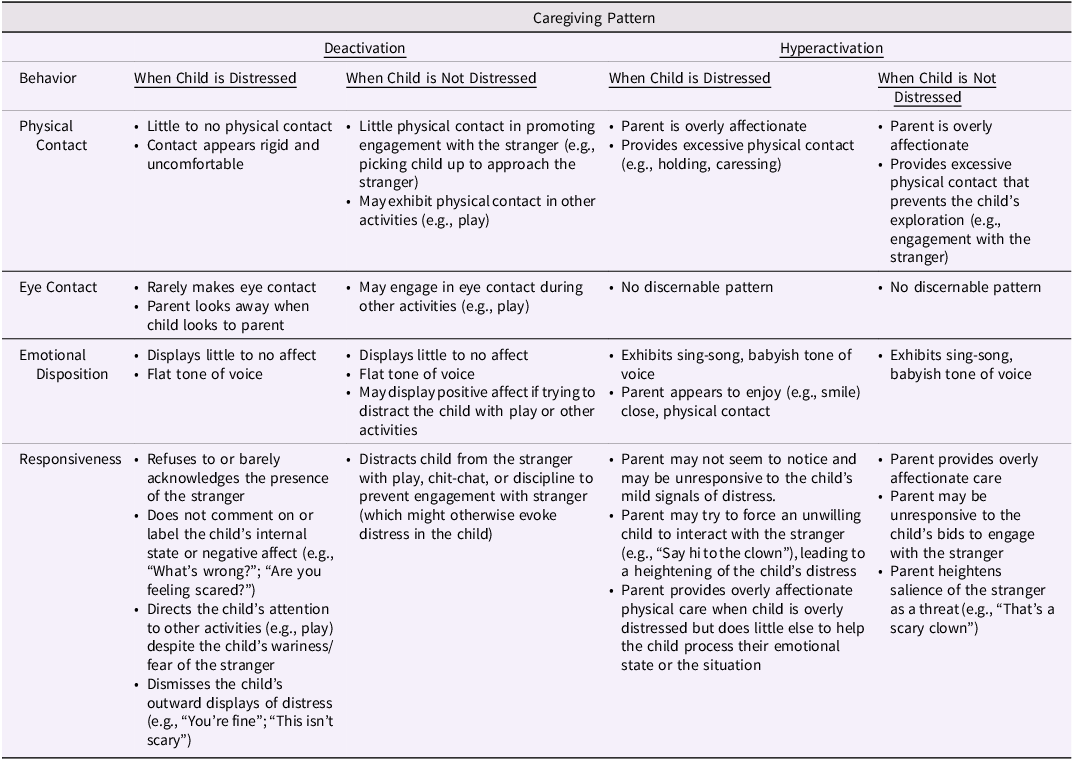
To capture paternal caregiving, we constructed a novel coding system that delineated different patterns of caregiving behavior according to their function. To start, the first author viewed a majority of the videos from the observational task while simultaneously conducting a review of the published literature on parents’ responses to child distress. Based on studies of parenting spanning the parent-child attachment (e.g., Britner et al., Reference Britner, Marvin and Pianta2005; Cassidy & Berlin, Reference Cassidy and Berlin1994; Goldberg et al., Reference Goldberg, MacKay-Soroka and Rochester1994), emotion socialization (e.g., Eisenberg et al., Reference Eisenberg, Cumberland and Spinrad1998; Fabes et al., Reference Fabes, Poulin, Eisenberg and Madden-Derdich2002), and overprotective parenting (e.g., Clarke et al., Reference Clarke, Cooper and Creswell2013) literatures, we utilized a behavioral systems paradigm to incorporate previous findings into a coding system that captured patterns of caregiving in response to child distress. Because the specification of function requires a certain degree of inference, function was specified based on the dyadic interaction between father and child rather than the sole assessment of either parent or child. That is, both the father’s and the child’s behavior were considered in rating the underlying function of the father’s caregiving behavior. Four broad categories of interactional qualities served as the basis for the coding of caregiving deactivation and hyperactivation, including (a) physical contact, (b) eye contact, (c) emotional disposition, and (d) responsiveness. Examples of behaviors in each of these four categories is provided in Table 1 for caregiving deactivation and caregiving hyperactivation. Trained coders rated paternal caregiving patterns on a 9-point Likert scale from 1 (Not at all characteristic) to 9 (Highly characteristic). Interrater reliability was based on one undergraduate coder who coded 100% of the sample and one undergraduate reliability coder who overlapped on 25% of the sample. Intraclass correlation coefficients were estimated using a two-way, mixed effects model with absolute agreement (Syed & Nelson, Reference Syed and Nelson2015).
A synopsis of the coding system utilized to provide behavioral ratings of deactivated and hyperactivated caregiving patterns

Note. This is not an exhaustive list of the behavior considered in rating caregiving patterns.
Caregiving deactivation was reflected by behaviors that functioned to minimize caregiving system activation. Deactivation was identified based on fathers who provided little contact when the child was distressed and fathers who prioritized other activities at the cost of acknowledging the child’s distress/wariness towards the stranger. As seen in Table 1, deactivating fathers often (a) provided little physical contact or physical comforting when children were distressed, (b) made little eye contact when children were wary or distressed, (c) were emotionally flat in tone when responding to children, and (d) often failed to acknowledge the situation and/or provide emotional reassurance to children (e.g., “It’s okay. I’m here.”). However, any and all behavior that was seen as functioning to minimize caregiving in response to child distress was coded under deactivation. Lower scores indicated the absence of deactivation, and higher scores were reserved for parents who were consistently engaging in deactivated caregiving based on the frequency, quality, and intensity of the pattern of minimization/dismissiveness. Interrater reliability was acceptable at .71.
Hyperactivation was characterized by behaviors that functioned to maintain or heighten the caregiving system. Hyperactivation was identified based on parenting behavior that increased the salience of the threat and behavior that was overly intrusive and affectionate. As seen in Table 1, hyperactivating fathers often (a) provided close, physical contact, but little reassurance, when children were distressed, (b) exhibited a sing-song tone of voice, (c) appeared to overly enjoy close contact when the child was distressed (e.g., smiling when hugging the child rather than showing empathy), and (d) engaged in mismatched caregiving behavior that often heightened the child’s distress (e.g., forcing the child to interact with or approach the stranger, despite the child’s protest; telling the child how scary the clown is when the child was curious to interact with the clown). However, any and all behavior that was seen as functioning to heighten the caregiving system was coded under hyperactivation. Overall, lower scores indicated the absence of hyperactivation, and higher scores reflected fathers who were frequently and intensely intrusive and affectionate. Interrater reliability was good at .82.
Children’s psychopathology
At Waves 1 and 2, mothers completed the Health and Behavior Questionnaire (HBQ; Ablow et al., Reference Ablow, Measelle, Kraemer, Harrington, Luby, Smider, Dierker, Clark, Dubicka, Heffelfinger, Essex and Kupfer1999) to assess children’s psychopathology. In particular, general anxiety was assessed with the Overanxious subscale (12 items; e.g., “Nervous, high-strung, or tense”), separation anxiety was assessed with the Separation Anxiety subscale (10 items; e.g., “Worried about being separated from loved ones”), oppositional defiance was rated using the Oppositional Defiant subscale (nine items; e.g., “Argues a lot with adults”) and hostility was measured by the Overt Hostility subscale (four items; e.g., “Does things that annoys others”). All items were rated on a three-point scale from 0 (Never or not true) to 2 (Often or very true). Internal consistencies for the four subscales ranged from .68 to .79 at Wave 1 and .59 to .74 at Wave 2.
Children’s social disengagement
At Waves 1 and 2, mothers completed the Social Skills Improvement System (SSIS; Gresham et al., Reference Gresham, Elliott and Kettler2010) to assess children’s social functioning. The Engagement subscale is rated on a four-point scale from 0 (Never) to 3 (Almost Always) and was utilized as an indicator of children’s social disengagement (seven items; e.g., “Starts conversations with peers”). Internal consistency was .86 at both Waves of data collection. The Engagement subscale was reverse scored with higher scores reflecting greater social disengagement.
Covariates
At Wave 1, parents completed a demographic survey from which information was obtained on child sex, father race, and the biological status of the father. Child sex was coded 1 (Female) and 2 (Male). Father’s race was coded 1 (White) and 2 (Non-White). The father’s biological relationship with the child was coded 1 (Birth parent) or 2 (Non-biological parent) with 24 fathers (10.2% of the sample) indicating that they were not the biological father of the child.
In addition, mothers completed the Child Behavior Questionnaire (CBQ; Putnam & Rothbart, Reference Putnam and Rothbart2006) to provide information on children’s negative emotionality. In particular, mothers completed the Reactivity/Soothability (six items; “e.g., Is easy to soothe when s/he is upset”) and the Anger/Frustration (six items; e.g., “Gets quite frustrated when prevented from doing something s/he wants to do”) subscales of the CBQ. Items were rated on a seven-point Likert scale from 1 (Extremely untrue) to 7 (Extremely True). The Reactivity/Soothability and Anger/Frustration subscales were significantly correlated (r = -.43, p < .001) and evidenced acceptable internal consistencies (.70 and .77, respectively). The Reactivity/Soothability subscale was reverse-scored and summed with the Anger/Frustration subscale to form a measure of children’s negative emotionality with higher scores reflecting greater negative emotionality.
Finally, data collection partially overlapped with the onset of the COVID-19 pandemic. At Wave 2 of data collection, a total of 44 families visited the lab after the onset of COVID-19 lockdown orders. We created a binary variable scored as 1 for families who visited the lab prior to the onset of the COVID-19 pandemic and 2 for families who visited after the onset of the pandemic.
Results
Preliminary analyses
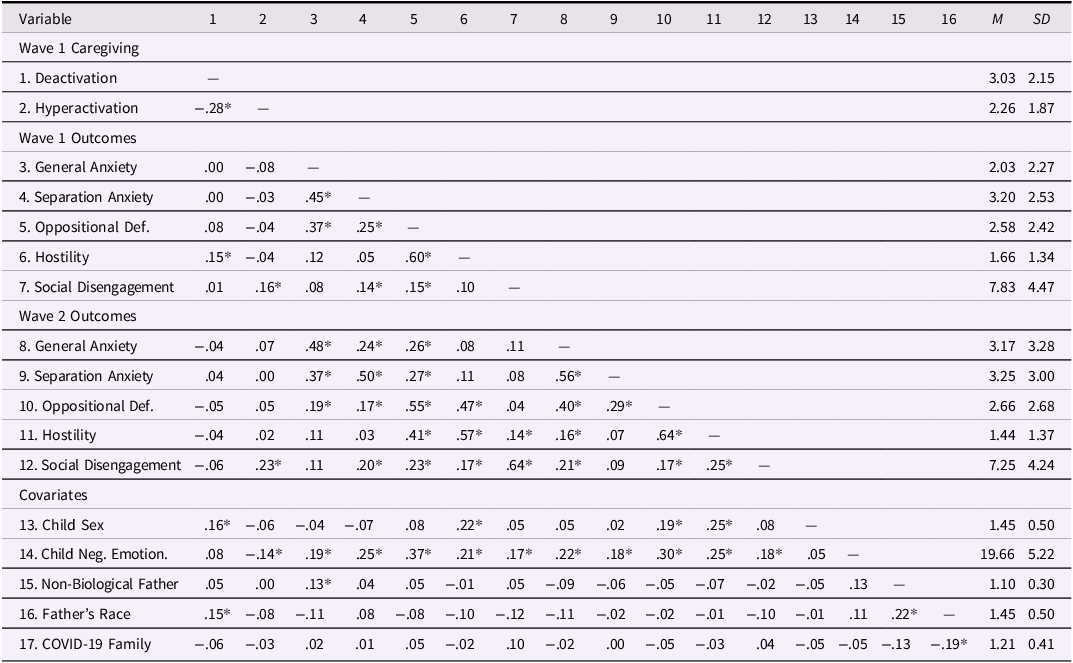
Means, standard deviations, and bivariate correlations between primary study variables can be found in Table 2. Missing data analyses were performed to assess whether data were missing completely at random (MCAR). Little’s MCAR test revealed that missing data in the present study were missing completely at random, χ2(62) = 58.22, p = .613 (Little, Reference Little1988). Data were missing for 5.58% of all data values. To retain the full sample in our primary analyses, missing data were estimated with full information maximum likelihood methods which reduces bias in standard errors and parameter estimates when missing data are less than 20% (Schlomer et al., Reference Schlomer, Bauman and Card2010). All analyses were performed in a structural equation model framework using Mplus (Muthén & Muthén, Reference Muthén and Muthén1998–2021).
Means (M), standard deviations (SD), and bivariate correlations between study variables

Note. Def. = Defiance; Neg. Emotion. = Negative Emotionality; Child Sex coded 1 (Female) and 2 (Male); Non-Biological Father coded 1 (Biological) and 2 (Non-Biological); Father’s Race coded 1 (White) and 2 (Non-White). COVID-19 Family coded 1 for families who visited the lab prior to the COVID-19 pandemic and 2 for families visiting after the onset of the COVID-19 pandemic. *p < .05.
Analysis plan
To examine our hypotheses, we examined caregiving deactivation and hyperactivation as simultaneous predictors of children’s socioemotional outcomes at Wave 2 (i.e., general anxiety, separation anxiety, oppositional defiance, hostility, and social withdrawal) in one single path model. We controlled for Wave 1 assessments of Wave 2 outcomes to examine associations between caregiving patterns and residualized change in children’s socioemotional outcomes over a two-year period. Covariates, including child sex, children’s negative emotionality, and paternal biological status, were included as predictors of children’s outcome. Paternal race and the binary variable reflecting families who completed the lab visit post onset of the COVID-19 pandemic were not included in the final path model as they were not significantly associated with children’s outcomes. Standard model fit criteria within SEM frameworks were used to evaluate model fit with acceptable model fit indicated by a non-significant chi-square statistic, root mean square error approximation (RMSEA) less than .08, a standardized root mean square residual (SRMR) value less than .05, and a comparative fit index (CFI) of .90 or higher (Hu & Bentler, 1999). Finally, we utilized Wald’s tests in Mplus for equivalence testing to determine statistically significant differences in the magnitude of parameter estimates between deactivation and outcomes and between hyperactivation and outcomes.
Primary analyses
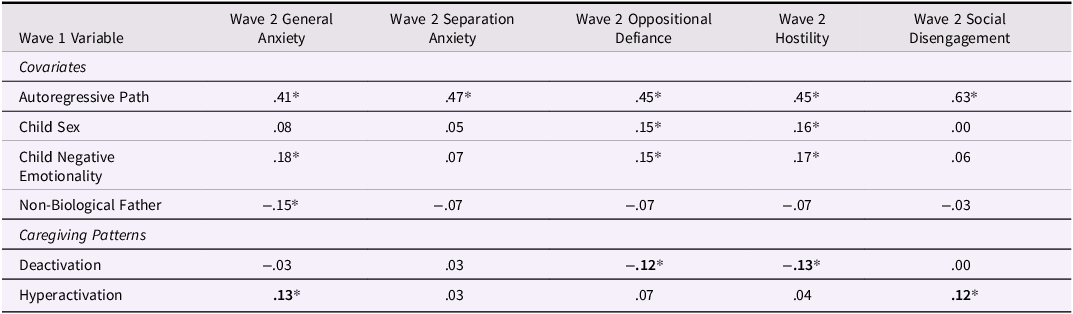
The structural equation model provided an acceptable fit to the data, χ2(20) = 42.964, p = .002, RMSEA = .070, CFI = .960, SRMR = .034. Results of the model are provided in Table 3. Examination of the primary structural paths revealed that caregiving deactivation was associated with decreases in children’s oppositional defiance (β = -.12, SE = .061, p = .047) and decreases in children’s hostility (β = -.13, SE = .061, p = .031) over a two-year period. Furthermore, parameter comparisons revealed that associations between deactivation and children’s oppositional defiance and hostility were significantly different than the same non-significant associations for hyperactivation, Wald = 6.821, p = .009, Wald = 5.693, p = .017, respectively. Deactivation was not significantly associated with general anxiety, separation anxiety, or children’s social disengagement (ps > .647). In contrast, caregiving hyperactivation was associated with increases in children’s general anxiety (β = .13, SE = .064, p = .047) and increases in children’s social disengagement (β = .12, SE = .055, p = .033) over a two-year period. Comparison of parameter estimates revealed that associations between hyperactivation and changes in children’s general anxiety and social disengagement were different than the same non-significant associations for deactivation, Wald = 4.536, p = .033, Wald = 3.447, p = .063, respectively. Hyperactivation was not associated with children’s separation anxiety, oppositional defiance, or hostility (ps > .245).
A simultaneous path model examining associations between caregiving patterns and children’s socioemotional outcomes

Note. All parameters represent standardized estimates. Significant parameter estimates between caregiving patterns and children’s developmental outcomes are bolded for clarity. Covariances were specified between all predictors and outcomes. *p < .05.
Discussion
Although a large corpus of empirical research demonstrates that insensitive responses to child distress are consistently linked to children’s socioemotional outcomes (Davidov & Grusec, Reference Davidov and Grusec2006; Leerkes et al., Reference Leerkes, Blankson and O’Brien2009), relatively few studies have focused on characterizing parental responses according to function based on how the behavior serves to regulate the interaction between parent and child. Furthermore, very few studies have focused exclusively on fathers observed responding to child distress. To address these gaps, the goal of the present study was to identify individual differences in patterns of paternal responsiveness to child distress and examine how these patterns were related to children’s socioemotional outcomes over a two-year period. Based on observational assessments of father-child interaction, we identified a pattern of deactivated caregiving reflecting parenting behavior that functioned to minimize activation of the caregiving behavioral system. In turn, caregiving deactivation was uniquely associated with decreases in children’s oppositional defiance and overt hostility. In contrast, we identified a pattern of hyperactivated caregiving characterized by parenting behavior that functioned to maintain or heighten activation of the caregiving system. Caregiving hyperactivation was uniquely associated with increases in children’s anxiety and social withdrawal two years later.
Based on behavioral systems formulations of parental caregiving (George & Solomon, Reference George, Solomon, Cassidy and Shaver2008; Shaver et al., Reference Shaver, Mikulincer, Shemesh-Iron, Mikulincer and Shaver2010), we utilized observational assessments of father-child interaction to identify a deactivated pattern of caregiving that functioned to minimize activation of the caregiving behavioral system. This pattern of caregiving was reflective of fathers’ efforts to dismiss the threat of the situation, downplay the child’s negative emotion, and avoid close, physical contact with the child. In terms of the implications of this caregiving pattern, deactivation was uniquely associated with decreases in children’s oppositional defiance and overt hostility over a two-year period. There are several possible explanations for this set of findings. First, the Dynamic-Maturational Model of Attachment and Adaptation (DMM) posits that dismissive parenting behavior in response to child distress can lead to the development of an attachment pattern of compulsive compliance to parental authority (Crittenden, Reference Crittenden2016). Specifically, parenting that is rejecting of children’s distress bids can communicate to children that intense emotional displays will not be tolerated, leading children to both conceal expressions of negative emotion and comply to parental authority so as to increase the likelihood of receiving affection from parents (Crittenden & DiLalla, Reference Crittenden and DiLalla1988). In a similar vein, social learning perspectives concerning the development of parent-child attachment propose that children gradually learn when emotional displays and support-seeking attempts are met with rejection from attachment figures. Expressions of negative emotion that are met with rejection are thought to serve as a punishment in lessening the odds that children will display negative emotion in future interactions (Bosmans et al., Reference Bosmans, Bakermans-Kranenburg, Vervliet, Verhees and van IJzendoorn2020). As a consequence, lower levels of noncompliance and overt negative emotion may be an adaptive response such that children learn to inhibit behavior that might be deemed “aversive” by the caregiver in an effort to elicit parental affection and prevent further rejection in times of need. To support this view, there is evidence that harsh parenting is associated with children’s compulsive compliance (Barnett et al., Reference Barnett, Kidwell and Leung1998) and that the insecure-avoidant pattern of attachment is associated with child compliance to fathers during a parent-child storybook interaction (Frosch et al., Reference Frosch, Cox and Goldman2001).
Whereas the DMM and social learning perspectives define children’s development in response to adverse caregiving environments, other theories suggest that deactivation may be perceived as a relatively benign caregiving environment within the context of the father-child relationship. For instance, within specific socialization contexts (e.g., low SES families), mother’s nonsupportive responses to child distress have been found to be associated with lower levels of externalizing behaviors over time (e.g., Klein et al., Reference Klein, Moran, Cortes, Zalewski, Ruberry and Lengua2018; Sturge-Apple et al., Reference Sturge-Apple, Jacques, Davies and Cicchetti2022). In the present study, we focused exclusively on fathers, with little research focusing on fathers responses to child distress. Highlighting the uniqueness of father, theories of gender role socialization suggest that fathers are more likely to endorse less supportive and more non-supportive responses to children’s negative emotion when compared to mothers (Cassano et al., Reference Cassano, Perry-Parrish and Zeman2007; Cherry & Gerstein, Reference Cherry and Gerstein2021). As such, caregiving deactivation among fathers may be more normative in U.S. fathers and have different implications for children’s socioemotional development. However, given that the present study represents a novel exploration on the role of caregiving deactivation in fathers, we want to stress that this interpretation is purely speculatory given the lack of research on fathers. Future work is needed to replicate these results.
The fact that deactivation did not predict increases in children’s externalizing behavior or increases in children’s internalizing symptoms also warrants discussion. First, our assessments of children’s oppositional defiance and hostility were based on parent report that likely captures children’s behavior in the home environment. The use of assessments of externalizing behaviors outside the home within peer or school contexts might reveal a different pattern of findings. For instance, a meta-analysis revealed that associations between insecure-avoidant attachment and externalizing behavior were strongest when externalizing behaviors were assessed in the peer context (Fearon et al., Reference Fearon, Bakermans-Kranenburg, van Ijzendoorn, Lapsley and Roisman2010). This aligns with attachment theory in theorizing that avoidant children are more aggressive towards peers (Erickson et al., Reference Erickson, Sroufe and Egeland1985). Second, caregiving deactivation might allow the child (limited) proximity to the parent that provides a certain degree of confidence in protection. As a result, children may be less likely to develop internalizing symptoms during the preschool years. Given the age range of our sample, future work is needed to understand how deactivation is associated with children’s outcomes in subsequent developmental periods and relational contexts (e.g., school).
In addition to caregiving deactivation, we identified a pattern of hyperactivated caregiving that functioned to maintain or heighten caregiving system activation. Caregiving hyperactivation was characterized by parenting behavior that was mismatched to the child’s signals, intrusive, and overly affectionate. In turn, caregiving hyperactivation was uniquely associated with increases in children’s anxiety and increases in children’s social disengagement two years later. From an attachment perspective, hyperactivation may promote children’s dependency on the parent by keeping the child’s attachment system in a chronically activated state (Cassidy & Berlin, Reference Cassidy and Berlin1994; Shaver et al., Reference Shaver, Mikulincer, Shemesh-Iron, Mikulincer and Shaver2010). As a result, chronic activation of the child’s attachment system may contribute to the child’s perception of the world as threatening and unsafe which ultimately limit’s the child’s willingness to engage in autonomous exploration. For example, the parents of children with an insecure-resistant pattern of attachment often exhibit mismatched caregiving to the child’s needs, thereby heightening the child’s attachment system activation (Isabella & Belsky, Reference Isabella and Belsky1991). In turn, attachment system activation is likely to prioritize safety over exploration resulting in children’s internalizing symptoms and social difficulties (Brumariu & Kerns, Reference Brumariu and Kerns2010). Moreover, the child’s reluctance to engage with the world may be why there was no direct association between hyperactivation and children’s oppositional defiance and hostility, each a marker of psychopathology in relation to others.
Offering a complimentary perspective to this set of findings, research on the development of childhood anxiety has found that overprotective parents indirectly convey threat to the child through social modeling and directly convey threat through communication that highlights the danger posed by unfamiliar adults (Bosmans et al., Reference Bosmans, Dujardin, Field, Salemink and Vasey2015; Nimphy et al., Reference Nimphy, Venetikidi, Elzinga, van der Does and Aktar2023). In turn, the children of these parents are more likely to report greater fear beliefs which are a known mediator in the developmental etiology of children’s social anxiety and withdrawal (Aktar et al., Reference Aktar, Nimphy, Bockstaele and Pérez-Edgar2022; Shortt et al., Reference Shortt, Barrett, Dadds and Fox2001). Particularly noteworthy, we found that hyperactivation was not significantly associated with children’s separation anxiety. One potential reason for this lack of finding is that caregiving hyperactivation tends to increase child distress by virtue of the parent’s ineffective attempts in providing support. In this way, hyperactivating fathers are themselves a source of discomfort for the child which may lessen the chances that children maintain overly close proximity to the parent. However, it will be important to replicate this finding, especially considering that most of the empirical work on the relations between parenting and child anxiety rarely distinguish between different forms of anxiety (e.g., general/trait anxiety, separation anxiety) (McLeod et al., Reference McLeod, Wood and Weisz2007).
The findings of the present study should be considered with several limitations in mind. First, we examined patterns of caregiving among fathers given the predominant focus of prior work on the mother-child relationship. Although numerous studies have examined the influence of maternal caregiving on child development, the addition of mothers would have added additional nuance in the interpretation of our findings. Second, we believe that our observational paradigm was effective in activating fathers’ caregiving system and children’s attachment system. However, given that this is a novel paradigm, it would benefit from additional research supporting its validity. Third, our ratings of distinct caregiving patterns based on the function of the father’s behavior necessarily required a degree of inference as to the meaning of the behavior exhibited. As such, it is possible that this added an additional source of measurement error in the assessment of caregiving patterns. Therefore, our approach that considered both form and function in the assessment of parenting behavior should be regarded as preliminary until efforts have been made to replicate our pattern of results. Fourth, child adjustment was assessed by mothers which may be more likely to reflect how children behave within the home setting. It remains important for future work to examine how caregiving patterns are associated with father reports of children’s outcomes as well as reports of children’s behavior within school and peer contexts. Fifth, some of the HBQ scales evidence lower internal consistency, which could have dampened associations between study constructs. Finally, although we controlled for various sociodemographic characteristics to support the generalizability of findings, future work would benefit from exploring these caregiving patterns in diverse populations.
Despite these limitations, this is the first study to examine functional patterns of paternal responsiveness to child distress. Within an observational paradigm specifically designed to activate the father’s caregiving system, we identified deactivated and hyperactivated patterns of caregiving that functioned to minimize or heighten caregiving system activation, respectively. In turn, each caregiving pattern was uniquely associated with a different constellation of children’s socioemotional outcomes. By providing specificity for the predictive validity of these caregiving patterns, we obtain a better characterization of paternal responsiveness to child distress and provide evidence that how father’s respond to child distress has important implications for children’s socioemotional development.
Data availability statement
This study was not preregistered. Data for this study are available by emailing the corresponding author.
Acknowledgements
This study was conducted at Mt. Hope Family Center. We are incredibly grateful to the parents and children who participated in this project and to the staff and student researchers who helped to make this research possible.
Funding statement
This study was supported by the Eunice Kennedy Shriver National Institute of Child Health and Human Development grant awarded to Melissa L. Sturge-Apple and Patrick T. Davies (R01HD087761). Additional support was provided by the Owen F. Aldis Scholarship from the International Society for Human Ethology awarded to Cory R. Platts.
Competing interests
The authors declare none.

 Open access

