





A large body of research has implicated life stress and adversity as key antecedent factors for the development of mental health problems (Caspi et al., Reference Caspi, Sugden, Moffitt, Taylor, Craig, Harrington and Braithwaite2003; Widom, DuMont, & Czaja, Reference Widom, DuMont and Czaja2007). Mental health problems typically show onset in adolescence, which is related to the vast biopsychosocial changes and environmental pressures that take place during this period (Fuhrmann, Knoll, & Blakemore, Reference Fuhrmann, Knoll and Blakemore2015; Merikangas et al., Reference Merikangas, He, Burstein, Swanson, Avenevoli, Cui and Swendsen2010). There is a paucity of research on adolescent emotional development, particularly in relation to factors predicting positive adaptation following adversity, although research conducted from this resiliency perspective is gaining momentum (Masten, Reference Masten2018). This could partly be explained by the better consensus around the definition of resilience, as well as the promotion of novel statistical methods to measure it (Kalisch et al., Reference Kalisch, Baker, Basten, Boks, Bonanno, Brummelman and Galatzer-Levy2017).
Resilience is described as “a dynamic process encompassing positive adaptation within the context of significant adversity” (Luthar, Cicchetti, & Becker, Reference Luthar, Cicchetti and Becker2000, p. 543), and resilient functioning is depicted by “better than expected” levels of psychosocial functioning in response to negative life events (Kalisch et al., Reference Kalisch, Baker, Basten, Boks, Bonanno, Brummelman and Galatzer-Levy2017; Luthar et al., Reference Luthar, Cicchetti and Becker2000; Masten, Reference Masten2007). Thus, individuals who are able to maintain positive mental health in the face of adversity are considered resilient. Resilience is difficult to measure, because firstly, it needs to be assessed in relation to adverse life events, and secondly, individual responses must be evaluated relative to a normative response. Self-report measures of resilience have been developed and widely used, but have been criticized for lacking a theoretical and empirical basis, and for failing to assess resilience in response to adversity (Kalisch et al., Reference Kalisch, Baker, Basten, Boks, Bonanno, Brummelman and Galatzer-Levy2017; Windle, Bennett, & Noyes, Reference Windle, Bennett and Noyes2011). Future research may benefit from using self-report measures of resilience, although more research is needed to validate these measures in relation to the prediction of positive adaptation following adversity.
The “residuals” method has been gaining popularity in the developmental literature as a useful way to assess resilient functioning (Kalisch et al., Reference Kalisch, Baker, Basten, Boks, Bonanno, Brummelman and Galatzer-Levy2017). This method uses the residual scores from a regression model testing the effect of an environmental stressor on a psychological outcome. It is based on the knowledge that increasing adversity (e.g., stress) predicts increasing maladjustment outcomes (e.g., depression), and therefore residual scores reflect an individual's degree of deviation from the norm. Higher positive scores indicate more resilient functioning, as the individual is functioning above what would be expected, given their level of adversity. Negative scores indicate less resilient functioning, as the individual is showing worse outcomes than expected. This method is particularly useful as the score takes both an individual's level of adversity and the normative effect of the sample into account. The method is also relatively easy to apply, in large cohort studies, which include measures of life events and psychological functioning variables, preferably utilizing longitudinal designs, so that risk and protective factors can be investigated prospectively.
Despite its utility, only a handful of studies have used this method, most of them finding protective effects of social support and self-esteem in promoting resilient functioning (Bowes, Maughan, Caspi, Moffitt, & Arseneault, Reference Bowes, Maughan, Caspi, Moffitt and Arseneault2010; Collishaw et al., Reference Collishaw, Hammerton, Mahedy, Sellers, Owen, Craddock and Thapar2016; Kim-Cohen, Moffitt, Caspi, & Taylor, Reference Kim-Cohen, Moffitt, Caspi and Taylor2004; Miller-Lewis, Searle, Sawyer, Baghurst, & Hedley, Reference Miller-Lewis, Searle, Sawyer, Baghurst and Hedley2013; Sapouna & Wolke, Reference Sapouna and Wolke2013; van Harmelen et al., Reference van Harmelen, Kievit, Ioannidis, Neufeld, Jones, Bullmore and Goodyer2017). A recent study used the residuals method to investigate the role of family and friendship support in relation to resilient functioning in adolescents and young adults (van Harmelen et al., Reference van Harmelen, Kievit, Ioannidis, Neufeld, Jones, Bullmore and Goodyer2017). In this longitudinal study, resilient functioning was taken as the residuals from a regression model of early-life experiences on psychosocial functioning at Time 1 (N = 1,890), and at Time 2 (N = 1,093), which was conducted approximately 1 year later. In a cross-sectional model at Time 1, it was found that both family and friendship were associated with resilient functioning, with stronger effects for friendship. In a longitudinal model, it was found that resilient functioning at Time 1 was the strongest predictor of resilient functioning at Time 2, supporting the stability of resilience. Friendship support remained a positive predictor of resilient functioning, while family support became a negative predictor of resilient functioning. This finding, although small, showed that adolescents with a large amount of family support at Time 1 showed lower resilience at Time 2, suggesting that independence from family may be protective during adolescence.
A cognitive model of psychological resilience has recently been proposed (Parsons, Kruijt, & Fox, Reference Parsons, Kruijt and Fox2016). At the heart of this model, information processing biases, which are automatic and implicit, work to reinforce active cognitions, such as feelings of self-esteem and personal agency, all reflecting cognitive resources that support resilience. This model builds upon previous research, that has focused on psychopathology and shown that negative information processing biases in attention, interpretation, and memory are key mechanisms involved in the development and maintenance of internalizing disorders (Everaert, Duyck, & Koster, Reference Everaert, Duyck and Koster2014; Mathews & MacLeod, Reference Mathews and MacLeod2005; Muris & Field, Reference Muris and Field2008). Adolescence may reflect a critical period when biases develop and become stable characteristics (Lau & Waters, Reference Lau and Waters2016; Platt, Waters, Schulte-Koerne, Engelmann, & Salemink, Reference Platt, Waters, Schulte-Koerne, Engelmann and Salemink2017). More research is needed to investigate the development of information processing biases during adolescence, in particular to find which factors promote resilient functioning.
Evidence for a potential causal role of information processing biases in emotional disorders has come largely from Cognitive Bias Modification of Interpretation (CBM-I) studies, which attempt to train interpretation processing away from negative and towards positive or benign information. CBM-I has shown promise in improving emotional outcomes for both anxious (Lau, Belli, & Chopra, Reference Lau, Belli and Chopra2013) and depressed participants (Joormann, Waugh, & Gotlib, Reference Joormann, Waugh and Gotlib2015). However, a meta-analysis of CBM interventions found small or nonsignificant effects for improving symptoms in clinical samples (Cristea, Kok, & Cuijpers, Reference Cristea, Kok and Cuijpers2015). Yet, it has been shown that greater change in bias is associated with greater outcome improvement (Grol et al., Reference Grol, Schwenzfeier, Stricker, Booth, Temple-McCune, Derakshan and Fox2018). Together, these findings suggest that interpretation bias may play a causal role in the development of emotional disorders. There is also evidence that modifying interpretation bias can have positive effects on memory bias (Joormann et al., Reference Joormann, Waugh and Gotlib2015), which supports the combined cognitive bias hypothesis, suggesting that biases may be inter-connected processes (Everaert et al., Reference Everaert, Duyck and Koster2014).
The current study aimed to investigate the association between a range of cognitive factors and resilient functioning during adolescence. Data were drawn from the CogBIAS longitudinal study, which investigates cognitive and genetic factors associated with the development of emotional vulnerability and resilience in adolescence (Booth et al., Reference Booth, Songco, Parsons, Heathcote, Vincent, Keers and Fox2017). This study represents one of the largest to investigate the development of emotional and cognitive processing across three stages of adolescence. Baseline assessment took place near the beginning of secondary school (age 12–14 years, depending on school type) and each subsequent wave was conducted between 12 and 18 months later. Resilient functioning was computed as the residuals from a regression model of self-reported negative life events (in the preceding 12 months) on concurrent levels of self-reported internalizing symptoms.
A wide range of cognitive factors were investigated across three waves. Information processing biases in attention, interpretation, and memory were assessed using well-established behavioral paradigms. We hypothesized that processing biases towards positive information across all three biases would be associated with greater resilient functioning. However, our attentional bias measure was problematic in terms of internal reliability (Booth, Songco, Parsons, Heathcote, & Fox, Reference Booth, Songco, Parsons, Heathcote and Fox2019) and so was excluded from our analyses. Negative repetitive thinking styles, including worry and rumination, which have been implicated as vulnerability factors for anxiety and depression in adolescents (Muris, Roelofs, Meesters, & Boomsma, Reference Muris, Roelofs, Meesters and Boomsma2004), were assessed by self-report. We hypothesized that low levels of worry and rumination would be related to greater resilient functioning. Positive active cognitions, including self-esteem and trait resilience, were also assessed by self-report. Self-esteem has previously been shown to support greater resilience (Collishaw et al., Reference Collishaw, Hammerton, Mahedy, Sellers, Owen, Craddock and Thapar2016; Masten et al., Reference Masten, Hubbard, Gest, Tellegen, Garmezy and Ramirez1999; Miller-Lewis et al., Reference Miller-Lewis, Searle, Sawyer, Baghurst and Hedley2013). A measure of trait resilience was included, in order to validate its ability to predict dynamic resilience, assessed using the residuals method (Kalisch et al., Reference Kalisch, Baker, Basten, Boks, Bonanno, Brummelman and Galatzer-Levy2017). We hypothesized that all cognitive factors would be associated with resilient functioning and we had no specific hypotheses about independent effect sizes.
We also ran a cross-lagged panel model to investigate the direction of effects between resilient functioning and information processing biases across waves. We predicted that biases and resilient functioning would be stable across time (autoregressive effects), and that biases would predict resilient functioning across time (cross-lagged effects), in line with cognitive models of resilience and psychopathology on the causal role of processing biases in emotional vulnerability (Fox & Beevers, Reference Fox and Beevers2016; Lau & Waters, Reference Lau and Waters2016; Parsons et al., Reference Parsons, Kruijt and Fox2016).
Method
Participants
The sample included 504 adolescents, from ten different school cohorts in the South of England. Twenty percent of the schools who were initially contacted agreed to take part in the study. Students from an entire year group, near the start of secondary school, were invited into the study and followed-up for 4 years (from 2014 to 2018). Written consent was obtained from both parents and adolescents (opt-in design). Testing was conducted across three waves, spaced approximately 12–18 months apart, according to timeline feasibility.
For the total sample at W1, mean age was 13.4 (SD = 0.7), 55% were female, and 75% were Caucasian. Some attrition took place in subsequent waves due to students leaving school or being absent on the day of testing. We observed an 11% drop-out rate at W2 (N = 450), and a 19% drop-out rate at W3 (N = 411). For the participants retained at W2, mean age was 14.5 (SD = 0.6), 56% were female, and 76% were Caucasian. For the participants retained at W3, mean age was 15.7 (SD = 0.6), 58% were female, and 76% were Caucasian. We inferred level of socio-economic status (SES) from an average score of their parent's highest level of education (1 = secondary school, 2 = vocational/technical school, 3 = some college, 4 = bachelor's degree, 5 = master's degree, 6 = doctoral degree). Across the sample, the median level of parental education was 4 (interquartile range = 2). None of the demographic variables were related to attrition across waves, apart from gender, as more female participants were retained in the final sample, χ² (1) = 8.06, p = .005 (see Booth et al., Reference Booth, Songco, Parsons, Heathcote and Fox2019, for a full cohort profile).
Measures
Resilient functioning
The Revised Child Anxiety and Depression Scale—short form (RCADS-SF: Ebesutani et al., Reference Ebesutani, Reise, Chorpita, Ale, Regan, Young and Weisz2012) is a 25-item measure of internalizing symptoms. Depression symptoms are assessed with 10 items (e.g., “I feel sad or empty,” “Nothing is much fun anymore”). Anxiety symptoms are assessed with 15 items (e.g., “I feel scared if I have to sleep on my own,” “I worry that something bad will happen to me”). Respondents are asked to indicate how often they experience each item, using a 4-point scale ranging from 0 (never) to 3 (always). We computed a total score for internalizing symptoms by summing the items. Internal consistency was high at each wave (Cronbach α = .92, .92, .92). Differential stability across waves was also high (ICC₃,₁ = .84), reflecting the stability of individual differences in internalizing symptoms.
The Child Adolescent Survey of Experiences (CASE: Allen, Rapee, & Sandberg, Reference Allen, Rapee and Sandberg2012) was used to asses positive and negative life events. The survey consists of 38 adolescent-typical life events (e.g., “My parents split up,” “I went on a special holiday”). Respondents were asked to indicate whether each event happened to them during the past 12 months, and if so, were asked to rate the event using a 6-point scale (1 = really bad, 2 = quite bad, 3 = a little bad, 4 = a little good, 5 = quite good, 6 = really good). They were also given the option to describe two further life events and asked to rate these using the same scale. A score for positive life events was computed as the number of events experienced and rated as either really good, quite good, or a little good by the respondent. A score for negative life events was computed as the number of events experienced and rated as really bad, quite bad, or a little bad by the respondent. Internal consistency could not be assessed for this count-based measure. Yet, differential stability was found to be high across waves for negative life events (ICC3,1 = .74), and lower for positive life events (ICC3,1 = .57). Negative life events were used to create the resilient functioning score, as this has previously been shown to be a strong predictor of internalizing symptoms (Allen et al., Reference Allen, Rapee and Sandberg2012).
Protective factors
The Connor-Davidson Resilience Scale—short form (CDRISC-SF: Connor & Davidson, Reference Connor and Davidson2003) was used to assess trait resilience. The scale consists of 10 items (e.g., “I believe I can achieve my goals even if there are obstacles,” “I can deal with whatever comes my way”). Respondents were asked to think back over the past month and indicate whether each item applied to them, using a 5-point scale from 0 (not true at all) to 4 (true nearly all the time). Item responses were summed, with high scores indicating greater trait resilience. Internal consistency was high at each wave (Cronbach α = .89, .89, .90). Differential stability was also high across waves (ICC3,1 = .80).
The Rosenberg Self-Esteem Scale (RSE: Rosenberg, Reference Rosenberg1965) was used to assess self-esteem. The scale consists of 10 items measuring self-worth and acceptance (e.g., “I feel that I have a number of good qualities,” “On the whole I am satisfied with myself”). Respondents were asked to indicate how much they agreed with each item, using a 4-point scale ranging from 0 (strongly disagree) to 3 (strongly agree). Item responses were averaged, with high scores indicating better self-esteem. Internal consistency was high at each wave (Cronbach α = .87, .88, .89). Differential stability was also high across waves (ICC3,1 = .81).
The Children's Response Style Scales (CRSS: Ziegert & Kistner, Reference Ziegert and Kistner2002) were used to assess rumination and distraction in response to adverse experiences. The rumination scale is considered negative and consists of 10 items (e.g., “When I feel sad, I think back to other times I have felt this way”). The distraction scale is considered positive and consists of 10 items (e.g., “When I feel sad, I think about something I did a little while ago that was a lot of fun”). Respondents were asked to indicate how true each item is for them, using an 11-point scale ranging from 0 (never) to 10 (always). Item responses for each scale were averaged, with high scores reflecting a greater tendency towards rumination and distraction. Internal consistency was high at each wave for rumination (Cronbach α = .88, .88, .88) and distraction (Cronbach α = .92, .94, .94). Differential stability was high across waves for rumination (ICC3,1 = .70), but slightly lower for distraction (ICC3,1 = .68).
The Penn State Worry Questionnaire for Children (PSWQ-C: Chorpita, Tracey, Brown, Collica, & Barlow, Reference Chorpita, Tracey, Brown, Collica and Barlow1997) was used to assess levels of worry. The scale consists of 14 items designed to measure the tendency to worry in children aged 6–18 years old. Respondents were asked to indicate how true each item was for them (e.g., “My worries really worry me,” “I know I shouldn't worry, but I just can't help it”), using a 4-point scale ranging from 0 (never true) to 3 (always true). Item responses were averaged, with high scores reflecting a greater tendency to worry. Internal consistency was high at each wave (Cronbach α = .92, .94, .93). Differential stability was also high across waves (ICC3,1 = .84).
Self-Referential Encoding Task (SRET) was used to assess memory bias. The task consisted of three phases: an encoding phase, a distraction phase, and a surprise recall phase. In the encoding phase, participants were shown 22 positive (e.g., “cheerful,” “attractive,” “funny”), and 22 negative (e.g., “scared,” “unhappy,” “boring”) self-referent adjectives, sequentially, in a random order. They were asked to indicate whether each word described them, by pressing the “Y” or “N” keys on the keyboard. The 44-item word list had been matched for length and recognizability in adolescents in a previous study (Hammen & Zupan, Reference Hammen and Zupan1984). In the distraction phase, participants were asked to complete three simple maths equations (e.g., “What is 2 × 3?”). Responses did not have to be correct and answers were not given. In the surprise recall phase, a large answer box was displayed and participants were asked to type as many words as they could remember, both good and bad, from the “Describes me?” task. The phase ended after 3 min. A score was computed for the number of “Negative words endorsed and recalled,” the number of “Positive words endorsed and recalled,” and the “Total number of words endorsed and recalled.” A memory bias score was computed as: ((Negative words endorsed and recalled—Positive words endorsed and recalled) / Total number of words endorsed and recalled)). A score of “0” indicates no bias, while negative scores indicate a positive bias, and positive scores indicate a negative bias. The score was computed in this way so that high numbers reflected increased risk for psychopathology, in accordance with our other studies. Internal consistency could not be assessed for this count-based index, but differential stability was high across waves (ICC3,1 = .72).
The Adolescent Interpretation and Belief Questionnaire (AIBQ: Miers, Blöte, Bögels, & Westenberg, Reference Miers, Blöte, Bögels and Westenberg2008) was used to assess interpretation bias. In this task, participants were asked to imagine themselves in 10 different ambiguous scenarios and then rate how likely each of three possible interpretations would be to pop into their mind. Five scenarios were social (e.g., “You've invited a group of classmates to your birthday party, but a few have not yet said if they are coming”) and five were nonsocial (e.g., “You've received bad marks for your last few tests”). After each scenario, participants were asked to rate how likely a negative, positive, and neutral interpretation would be to pop into their mind, using a 5-point scale (1 = doesn't pop up in my mind, 3 = might pop up in my mind” 5 = definitely pops up in my mind). A score for “Positive social”, “Negative social”, “Positive nonsocial”, and “Negative nonsocial” was computed as the average of the respective items (ranging from 1 to 5). A “Social interpretation bias” score (Negative social − Positive social) and a “Nonsocial interpretation bias” score (Negative nonsocial – Positive nonsocial) were computed, whereby high scores indicate greater negative interpretations. Previous research has shown that the “Negative social” subscale reliably predicts social anxiety (Miers et al., Reference Miers, Blöte, Bögels and Westenberg2008; Miers, Blöte, de Rooij, Bokhorst, & Westenberg, Reference Miers, Blöte, de Rooij, Bokhorst and Westenberg2013). Although, we were interested in this measure in a broader sense, relative to the interpretation of positive information, which is why we created a bias index. Internal consistency could not be calculated for the bias indices, but differential stability was high across waves for both social (ICC3,1 = .77) and nonsocial interpretation bias (ICC3,1 = .74).
Procedure
Test sessions lasted 2 hr, which was either completed all at once, or on different days, as sessions could be split into shorter 1-hr sessions. Each test session involved completing some behavioral tasks (programmed in Inquisit version 4.0) and some questionnaires (programmed in Limesurvey version 2.0 and 3.0). The measures presented here are relevant to the current research question, although other measures were collected (e.g., adolescent risk-taking and food-cue sensitivity), which will be reported elsewhere (Booth et al., Reference Booth, Songco, Parsons, Heathcote and Fox2019). Testing was completed in groups, which ranged in size from 6 to 50 participants, depending on the size of the cohort and the testing space. Participants were asked to read and follow the instructions for each task and questionnaire on the computer screen. At least two trained research assistants were always present to answer any questions. Participants were instructed to work in exam conditions throughout the session, which meant not talking to peers or looking at their computer screens. Teachers were also present to support the test sessions. At the end of each session, participants were thanked, debriefed, and given a £10 Amazon voucher.
Data analysis
To create scores for resilient functioning, three regression models were run, testing the association between negative life events and internalizing symptoms at each wave. The standardized residuals from each of these regression models were saved. This score was then reverse coded, so that positive numbers reflected better than expected, and negative scores reflected worse than expected levels of resilient functioning. In order to investigate unique predictors of resilient functioning, we conducted two regression models. The first tested which protective factors at W1 predicted unique variance in prospective resilient functioning at W2. The second tested which protective factors at W2 predicted unique variance in prospective resilient functioning at W3. Gender, school cohort, and SES were controlled for.
We then examined the autoregressive and cross-lagged relationship between information processing biases and resilient functioning across waves, although these analyses were only conducted for factors that were significant in the previous regression models. Analyses were conducted in SPSS Amos version 25.0 (Arbuckle, Reference Arbuckle2017). The cross-lagged panel model tests the causal direction of the relation between two variables over time (Newsom, Reference Newsom2015). We estimated model fit by using the comparative fit index (CFI), Tucker–Lewis fit index (TLI), and the root-mean-square error of approximation (RMSEA). Model fit was considered good if CFI and TLI were greater than 0.95 and RMSEA was lower than 0.08 (Arbuckle, Reference Arbuckle2017). Missing data were handled with maximum likelihood estimation, a common approach used in cross-lagged panel models (Allison, Williams, & Moral-Benito, Reference Allison, Williams and Moral-Benito2017).
Results
Resilient functioning scores
In order to compute resilient functioning W1, we conducted a regression analysis between negative life events W1 and internalizing symptoms W1. Our original analysis showed heteroscedasticity, driven by two extreme values, which were removed. The adjusted model was significant overall, F (1,491) = 63.55, R 2 = .12, p < .001, as increasing negative life events were associated with increasing internalizing symptoms (β = .34, p < .001). The standardized residuals from this model were saved and reverse coded, so that positive numbers reflected better than expected, and negative numbers reflected worse than expected, levels of resilient functioning. This process was repeated with variables collected at W2 and W3. Heteroscedasticity was also observed at W2, driven by two extreme values, which were removed. The adjusted model was significant overall, F (1,446) = 65.76, R 2 = .13, p < .001, as increasing negative life events were associated with increasing internalizing symptoms (β = .36, p < .001). Finally, at W3, the model was significant overall, F (1,390) = 42.59, R 2 = .10, p < .001, as increasing negative life events were associated with increasing internalizing symptoms (β = .31, p < .001), and statistical assumptions were met.
Protective factors
A correlation table is presented in Table 1 showing correlations between the variables at W1. Due to the residuals method, the resilient functioning score showed zero correlation with negative life events and a very high negative correlation with overall internalizing symptoms. In terms of the eight protective factors, resilient functioning showed moderate positive correlations with trait resilience and self-esteem. A small positive correlation was also observed between resilient functioning and distraction (i.e., positive rumination). Resilient functioning showed moderate negative correlations with rumination, worry, memory bias and both interpretation bias indices, which was expected as high numbers on these variables reflected high risk for psychopathology. Finally, the protective factors themselves were highly correlated.
Correlation table for variables at W1 (N = 504)

* Significant at p < .01 level.
Regression analyses
We conducted two regression models to investigate which protective factors explained unique variance in prospective resilient functioning. The first model tested which protective factors at W1 predicted unique variance in resilient functioning at W2. The model was significant overall, F(11,405) = 17.63, R 2 = .33, p < .001. Results are presented in Table 2. Gender, school, and SES were included as control variables, yet only gender was a significant predictor (β = .13, p = .005), as boys showed higher levels of resilient functioning. In terms of the eight protective factors, only memory bias (β = −.18, p = .001), and worry (β = −.13, p = .025), predicted unique variance, as individuals with more positive memory biases and lower levels of worry showed greater prospective resilient functioning.
Regression analysis of protective factors at W1 on resilient functioning at W2
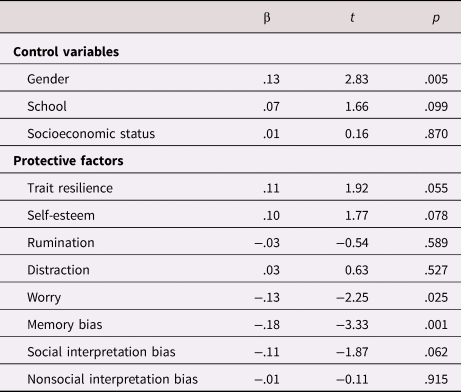
Note: Model was significant overall: F(11,405) = 17.63, R 2 = .33, p < .001.
The second regression model tested which protective factors at W2 predicted unique variance in resilient functioning at W3. The model was significant overall, F(11,364) = 18.73, R 2 = .37, p < .001. Results are presented in Table 3. Gender, school, and SES were included as control variables. Gender was a significant predictor (β = .18, p < .001), as boys showed higher resilient functioning. SES was also a significant predictor (β = .11, p = .017), as higher SES predicted better resilient functioning. In terms of the eight protective factors, rumination (β = −.19, p < .001), worry (β = −.12, p = .029), and memory bias (β = −.21, p = .001), predicted unique variance, as those showing lower levels of rumination and worry and more positive memory biases showed greater prospective resilient functioning.
Regression analysis of protective factors at W2 on resilient functioning at W3

Note: Model was significant overall: F(11,364) = 18.73, R 2 = .37, p < .001.
Cross-lagged panel model
We then tested the autoregressive and cross-lagged relationship between information processing biases and resilient functioning across waves. We chose to examine memory bias, as interpretation bias was not a unique predictor of prospective resilient functioning. Model fit was good, χ2(4) = 11.59, p = .021, CFI = 0.99, TLI = 0.96, RMSEA = 0.06. For the autoregressive effects, the variables showed stability across waves. Memory bias showed moderate stability between W1 and W2 (β = .35, p < .001) and slightly higher stability between W2 and W3 (β = .46, p < .001). Resilient functioning showed higher stability across waves, as stability was high between W1 and W2 (β = .59, p < .001) and was similarly high between W2 and W3 (β = .56, p < .001). For the cross-lagged effects between W1 and W2, negative memory bias predicted lower resilient functioning (β = −.13, p = .003), and resilient functioning predicted more positive memory bias (β = −.23, p < .001). Results were similar between W2 and W3, as resilient functioning predicted more positive memory bias (β = −.19, p < .001), and negative memory bias predicted lower resilient functioning (β = −.15, p = .001). Finally, all cross-sectional associations between memory bias and resilient functioning were significant. Parameter estimates are displayed in Figure 1.
Cross-lagged panel model of negative memory bias and resilient functioning at three waves across early to mid-adolescence (N = 504). Rectangles represent observed variables, values along straight lines are standardized betas, and values along curved lines are correlation coefficients, * P < .005.

Discussion
The current study sought to investigate cognitive factors associated with resilient functioning in adolescence. In our cross-sectional analysis, we found evidence that all of the putative protective factors were associated with resilient functioning, including information processing biases, repetitive negative thinking styles, and positive active cognitions. In our prospective models, we found that memory bias and worry at W1 explained unique variance in resilient functioning at W2. Subsequently, we found that memory bias, worry and rumination at W2 explained unique variance in resilient functioning at W3. A cross-lagged panel model showed that memory bias and resilient functioning were stable across development (autoregressive effects). Further, memory bias and resilient functioning showed cross-lagged associations, suggesting that these are reinforcing mechanisms underpinning positive emotional development during adolescence.
The correlation analysis at W1 found that all putative protective factors were associated with resilient functioning in the hypothesized direction. For the information processing biases, more positive memory bias and social interpretation bias were highly correlated with resilient functioning. More positive nonsocial interpretation bias was also associated with resilient functioning, although to a lesser extent. All repetitive thinking styles were associated with resilient functioning, as worry and rumination both showed high negative correlations with resilient functioning. Distraction, a positive aspect of rumination, showed a small correlation with resilient functioning, suggesting that this construct is not as relevant for emotional resilience in adolescence. As expected, self-esteem was highly correlated with resilient functioning, supporting previous research (Collishaw et al., Reference Collishaw, Hammerton, Mahedy, Sellers, Owen, Craddock and Thapar2016; Miller-Lewis et al., Reference Miller-Lewis, Searle, Sawyer, Baghurst and Hedley2013). Finally, self-reported trait resilience was moderately correlated with resilient functioning, which supports the validity of the questionnaire used. However, this trait measure did not show any unique prospective association with resilient functioning in the subsequent analyses, suggesting that it may not be as useful in predicting future resilient outcomes.
The first prospective regression analysis showed that memory bias and worry at W1 were unique predictors of resilient functioning at W2. The second prospective analysis showed that memory bias, worry, and rumination at W2 were unique predictors of resilient functioning at W3. The similarity of results across time points supports the reliability of the findings, and suggests that these factors may be crucial for supporting resilient functioning in adolescence. Although, there was some indication that rumination may be particularly relevant during mid, as opposed to early adolescence, as it was not a unique predictor at W1.
It was interesting that worry and rumination reflected unique predictors within the same model (at W2), as they are both examples of repetitive negative thinking styles. Previous research using factor analysis has shown that despite being highly correlated, worry and rumination are distinct processes in adolescents (Muris et al., Reference Muris, Roelofs, Meesters and Boomsma2004), with worry typically predicting unique variance in anxiety and depression, over and above rumination. Our study found that worry and rumination were both unique predictors of resilient functioning, supporting the notion that they are distinct processes. This period of mid-adolescence may reflect a period of heightened repetitive negative thinking, due to an interaction between increasing environmental pressures and immature cognitive control, which is thought to contribute to increased vulnerability for the onset of psychiatric disorders (Powers & Casey, Reference Powers and Casey2015). Thus, interventions designed to help adolescents refrain from worrisome and ruminative thoughts may foster greater emotional resilience. For example, mindfulness-based therapies, which aim to enhance cognitive control, have been shown to decrease worry and rumination in adolescents (Ames, Richardson, Payne, Smith, & Leigh, Reference Ames, Richardson, Payne, Smith and Leigh2014; Kuyken et al., Reference Kuyken, Nuthall, Byford, Crane, Dalgleish, Ford and Williams2017).
Memory bias was a consistent unique predictor of resilient functioning and was the strongest protective factor in both models. Thus, an automatic tendency to recall more positive than negative self-referent words supports greater resilient functioning. This is consistent with a recent review of the literature that found that memory bias is highly characteristic of youth depression (Platt et al., Reference Platt, Waters, Schulte-Koerne, Engelmann and Salemink2017). Our study extends this work to show that memory bias can also differentiate between adolescents who are more or less resilient. Therefore, memory bias may reflect a trans-diagnostic cognitive factor that supports positive and negative emotional functioning.
It is important to note that we measured self-referential memory bias, which was highly correlated with self-esteem. Previous studies investigating memory bias not linked to self-referential information have typically found inconsistent results (Platt et al., Reference Platt, Waters, Schulte-Koerne, Engelmann and Salemink2017). It is currently unclear whether self-referential memory bias reflects self-esteem on a behavioral level, or whether other processes are involved. Bower (Reference Bower1981) proposed an associative network theory, whereby mood activates associated information processing; that is, negative mood increases processing of negative information. A recent study found a protective effect of positive memory specificity on the development of negative cognitions and depressive symptoms in adolescence (Askelund, Schweizer, Goodyer, & van Harmelen, Reference Askelund, Schweizer, Goodyer and van Harmelen2019). Therefore, an important focus for future research would be to investigate the role of memory bias on emotional development further, by including other related processes, such as positive memory specificity.
The cross-lagged panel model was used to test whether memory bias may play a causal role in the development and maintenance of resilient functioning. We decided to run the model using memory bias, rather than interpretation bias, as memory reflected a unique predictor in the previous regression analyses. The results showed evidence that memory bias and resilient functioning are reinforcing mechanisms, as they predicted each another at both time lags. Therefore, having a more positive self-referential memory bias supported better resilient functioning, and greater resilient functioning predicted a more positive memory bias. In terms of autoregressive effects, resilient functioning showed high stability within individuals across waves, and memory bias showed moderate stability, which increased slightly at the second lag. Together, these results provide support for the theory of emotional systems as spirals of positivity or negativity (Garland et al., Reference Garland, Fredrickson, Kring, Johnson, Meyer and Penn2010). In this model, negative emotions can spark a self-perpetuating downward spiral encompassing negative thoughts and feelings, withdrawal behavior, and negative appraisals, which can become deeply entrenched processing biases. Whereas, positive emotions can spark a self-perpetuating upward spiral of positive feelings, open social interactions, and more positive processing biases. This model could be used to explain why memory bias and resilient functioning are both stable and reinforcing characteristics. While resilient functioning showed high stability at both lags, memory bias showed lower stability between W1 and W2. This may highlight a potential intervention window in early adolescence, before information processing biases become highly stable characteristics.
Some have argued that by focusing research on resilience and corresponding protective factors, we will be in a better position to inform interventions designed to promote wellbeing and prevent mental health problems (Kalisch et al., Reference Kalisch, Baker, Basten, Boks, Bonanno, Brummelman and Galatzer-Levy2017). There is currently a large-scale research effort taking place in the UK investigating the effect of school-based mindfulness practice on adolescent cognitive and emotional development (Kuyken et al., Reference Kuyken, Nuthall, Byford, Crane, Dalgleish, Ford and Williams2017). Such large-scale research efforts are needed and it is important to also investigate other potential cognitive interventions such as CBM interpretation or memory bias training, which may also promote emotional resilience in adolescents. These interventions may provide a cost-effective and more accessible alternative to traditional therapies (de Hullu, Sportel, Nauta, & de Jong, Reference de Hullu, Sportel, Nauta and de Jong2017). This is particularly pertinent now, given the growing need and pressure on child and adolescent mental health services (NHSdigital, 2017).
Based on the current results, CBM that aims to modify self-referential memory bias could be a key target, to prevent mental health vulnerability and promote resilience. An early study that attempted to modify memory bias showed little promise (Vrijsen et al., Reference Vrijsen, Becker, Rinck, van Oostrom, Speckens, Whitmer and Gotlib2014); however, self-referent information was not targeted, which could be a key mechanism. Modifying self-referent information is likely to be very difficult, as interventions would almost certainly need to be tailored to specific individuals. One possibility is that memory bias might be more easily targeted through modifying processing in another domain, such as interpretation bias (Vrijsen et al., Reference Vrijsen, Becker, Rinck, van Oostrom, Speckens, Whitmer and Gotlib2014). This is in line with the combined cognitive bias hypothesis, which suggests that these processes are inter-connected (Everaert, Koster, & Derakshan, Reference Everaert, Koster and Derakshan2012). This proposal is supported by a CBM-I study, which found that modifying interpretation bias showed beneficial effects in the indirect modification of memory bias (Joormann et al., Reference Joormann, Waugh and Gotlib2015). Previous research has been conducted in adults, although it is possible that cognitive interventions might be especially effective in adolescence given that this is a sensitive period for the development of emotional biases. There is also need for new paradigms to be designed that target positive memory specificity and flexibility, which might also boost resilient functioning (Dalgleish et al., Reference Dalgleish, Bevan, McKinnon, Breakwell, Mueller, Chadwick and Raes2014; Hitchcock et al., Reference Hitchcock, Gormley, Rees, Rodrigues, Gillard, Panesar and Werner-Seidler2018).
Our study should be considered in light of its limitations. Firstly, we used a self-report measure of negative life events, which may not provide a complete picture of adversity. Future research could use composite measures that include levels of childhood maltreatment, parental mental health problems, and childhood poverty (Wadman, Hiller, & St Clair, Reference Wadman, Hiller and St Clair2019). More objective indicators could also be used in future research, such as official court records (Widom et al., Reference Widom, DuMont and Czaja2007). Secondly, as we only assessed internalizing symptoms, we were not able to test resilient functioning in relation to externalizing difficulties or other psychological outcomes. Finally, despite the longitudinal design being a strength of the current study, we were limited to only three time points. More extensive longitudinal data, spanning from childhood to adulthood, would be useful for investigating resilient functioning at different developmental stages and life course effects. Further, it has been argued that cross-lagged panel models benefit from four or more waves of analysis, in order to test whether escalations between lags occur more than once (Long, Young, & Hankin, Reference Long, Young and Hankin2018). Thus, future studies could consider taking yearly assessments across a wider age range.
To conclude, the current study found that cognitive factors, including information processing biases, repetitive negative thinking styles, and positive active cognitions were associated with resilient functioning in a large sample of adolescents. Memory bias, worry, and rumination were key factors that explained unique variance in prospective resilient functioning and could therefore reflect primary treatment targets. Our cross-lagged model found evidence for reinforcing mechanisms, as individuals who displayed a more positive memory bias were in a better position to cope with future stressful and negative life events. Further, those adolescents who displayed greater resilient functioning showed more positive memory biases prospectively. Targeting the development of positive information biases, especially memory biases, in early adolescence may be a key prevention strategy for improving emotional resilience.
Acknowledgment
This work was supported by the European Research Council (ERC) under the European Union's Seventh Framework Programme (FP7/2007–2013)/ERC grant agreement no: [324176].


 Open access

