


The Bali starling Leucopsar rothschildi was on the brink of extinction in 2001, with only six wild individuals remaining (Sutomo et al., Reference Sutomo, Yuni, Iryadi and Etten2023). With West Bali National Park being the only remaining location where the bird persisted, there were concerns about the species’ viability (Squires et al., Reference Squires and Kepakisan2024). In 2004, the NGO Friends of Nature, People and Forests (previously named Friends of National Park Foundation) developed a second location for the Bali starling with the local communities on Nusa Penida Island (Klungkung Regency, Bali Province, Indonesia). With support from The Gibbon and Begawan Foundations, Friends of Nature, People and Forests (represented here by author IGNBW), released 65 captive-bred individuals on Nusa Penida Island during 2006–2009, along with installation of nest boxes to assist reproduction. The NGO collaborated with the local community to incorporate a prohibition on collection of the Bali starling on the island into their Indigenous law (awig-awig). Because of financial limitations, monitoring continued only until 2014. This population declined to < 30 individuals by 2013 (Riany & Aunurohim, Reference Riany2013), prompting international attention and ecotourism initiatives. Assisted reproduction began in 2015, with volunteers installing additional nest boxes, and the population had increased to 80 individuals by 2019.
Building on these earlier conservation efforts, we evaluated the establishment of a new Bali starling population at Besikalung Wildlife Sanctuary, Tabanan Regency, Bali, a site that lies outside the species’ previously recognized dry-climate range (Jarwadi Budi Hernowo & Haquesta, Reference Hernowo and Haquesta2021; Sudaryanto et al., Reference Sudaryanto, Subagja, Pudyatmoko and Djohan2018), in a humid, high-elevation environment. Beginning in 2019, Friends of Nature, People and Forests, together with local stakeholders, initiated releases of captive-bred individuals under Indigenous law (awig-awig) banning hunting and promoting habitat stewardship. From 2019 to 2023, we monitored post-release survival, breeding activity and evidence of wild hatching at the site. Our study provides the first empirical assessment of Bali starling reproduction in a humid environment, addressing earlier concerns regarding climatic suitability (Pereyra, Reference Pereyra2020; Pereyra & Guiaşu, Reference Pereyra and Guiaşu2020; Warren, Reference Warren2023).
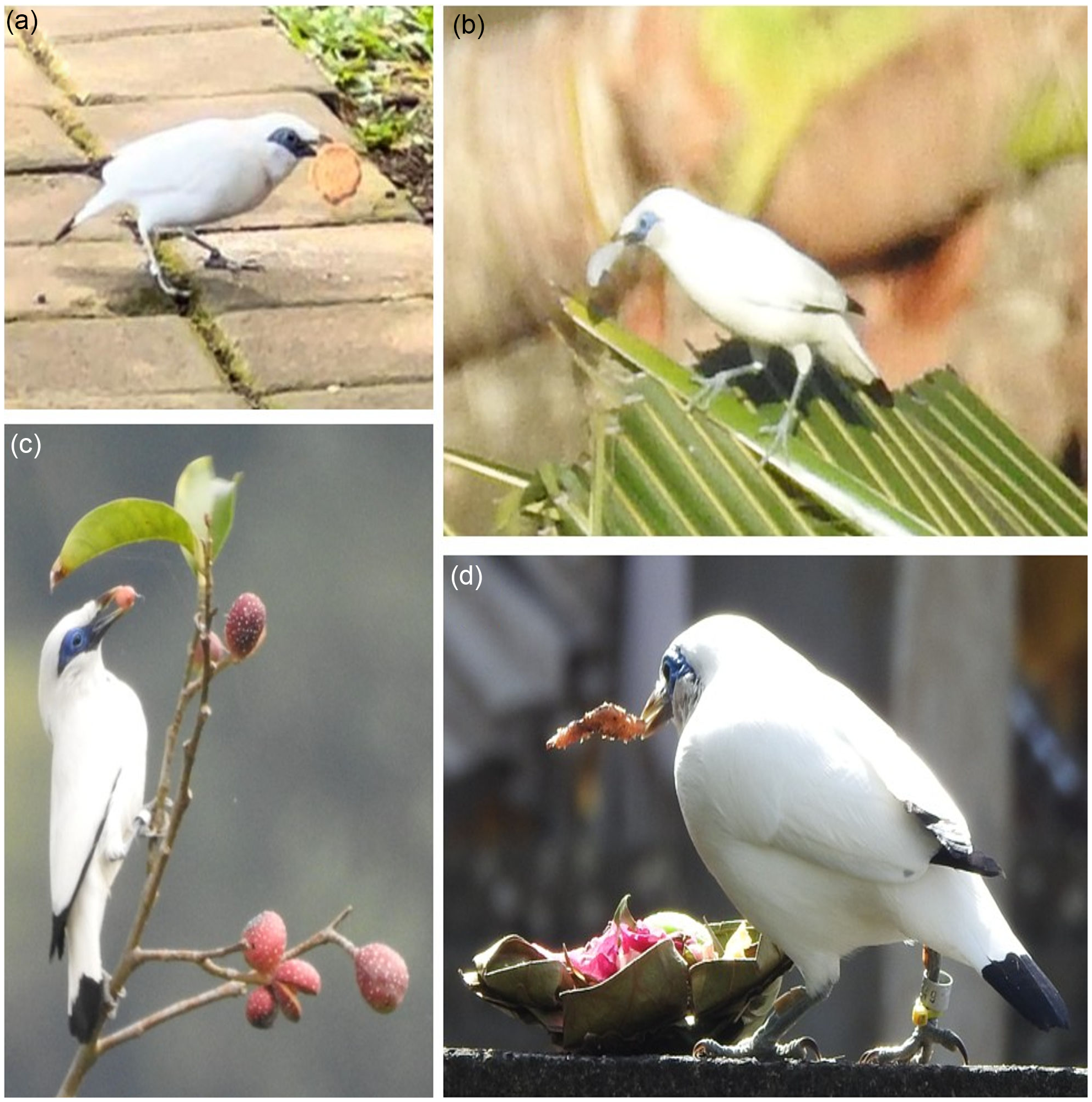
Besikalung Wildlife Sanctuary covers land within a 5 km radius of Besikalung Temple, and includes Babahan Village; the first village to support this local Bali starling conservation programme. Nest boxes were placed in rice fields, settlements and mixed gardens, the latter known in Balinese as tebe (a space used for cultivation of various fruits and vegetables, and often for managing organic waste). During 2019–2023, 60 individuals were released, and a total of 31 installed nest boxes yielded 29 eggs, 16 hatchlings and 14 fledglings, of which 12 survived into wild-hatch adults (Friends of Nature, People and Forests, unpubl. data). Mixed garden habitats were particularly successful, with 50% of nest boxes occupied, compared to 31.6% in rice fields and 25% in settlements. This success may be due to the diverse vegetation in mixed gardens (Ceia et al., Reference Ceia, Lopes and Da Silva2023). In addition, the Bali starlings modified their foraging behaviour to broaden their diet to include locally available food sources, as reported in West Bali National Park (Miller et al., Reference Miller, Garcia-Pelegrin and Danby2022; see Plate 1). They appear to benefit from the permanent water sources in Besikalung, a feature not available in West Bali National Park (Yuliantara et al., Reference Yuliantara, Warpala and Mulyadiharga2018). As there has not been any research on the adaptability of the Bali starling in the wild outside of its modern distribution, research on habitat carrying capacity is crucial for future planning. It has been estimated that Nusa Penida, for example, could support up to 300 Bali starlings because of the consistent availability of food resources in agroforestry areas (Hardini et al., Reference Hardini, Wirayudha, Rosyidi, Rita, Mawanti and Kalih2023).
Bali starlings Leucopsar rothschildi in the Besikalung Wildlife Sanctuary foraging on (a) biscuits from a religious offering (canang), (b) egg of an insect, (c) magnolia Magnolia champaca (L.) fruit, and (d) religious offering. Photographs: Ditro Wibisono Wardi Parikesit.

In July 2023, author DWWP conducted three open-ended interviews with two local leaders and the Chief Executive Officer of Friends of Nature, People and Forests. The interview with the Indigenous Leader (Bendesa Adat) aimed to gain a deeper understanding of the religious perspectives underpinning Bali starling conservation, to assess the alignment between nature conservation and Balinese Hindu beliefs, and to examine how these beliefs shape community behaviour and are practiced in daily life. The interview with the Babahan Village Head focused on the role of local government support, particularly administrative mechanisms and village-level regulations, in strengthening Bali starling conservation through law enforcement and community engagement. The interview with the Chief Executive Officer addressed the motivations behind the conservation programme and explored the approaches used to engage local communities, including strategies to encourage farmers and householders to host nest boxes on their land. Across all interviews, we examined perceptions of Bali starling conservation at Besikalung Wildlife Sanctuary and documented concrete contributions to the programme, such as the enactment of hunting prohibitions, enforcement of local regulations, and community participation in conservation activities. Similarly, on Nusa Penida the prohibition on hunting or collection of Bali starlings since 2007 appeared to have helped the population of birds to increase (Sudaryanto et al., Reference Sudaryanto, Pudyatmoko, Subagja and Djohan2019). In the case of Besikalung Wildlife Sanctuary, community engagement and voluntourism were also seen to bring increased environmental awareness and new economic opportunities (Agoes & Agustiani, Reference Agoes and Agustiani2021).
We found that the increase of the Bali starling population in the Besikalung Wildlife Sanctuary is partly driven by local culture and leadership, with Indigenous law (awig-awig) enforcing protection measures through fines and social penalties for those who would harm or collect the birds (Suwitra et al., Reference Suwitra, Astara, Irianto and Datrini2017). The Balinese community upholds awig-awig as both a spiritual practice and a foundation for mutual agreements, with high credibility as a legal base in Nusa Penida (Sudaryanto, Reference Sudaryanto, Pudyatmoko, Djohan, Subagja, Suana and Kalih2020). Awig-awig applies to various aspects of life, including control of deforestation (Christiawan, Reference Christiawan2015), and is rooted in traditional education, law enforcement and rituals, with positive impacts on forest conservation (Sumarmi et al., Reference Sumarmi, Bachri, Mutia, Yustesia, Fathoni, Muthi and Nuraini2020). It encompasses both physical (skala) and spiritual (niskala) aspects, gaining sacred status through the Pasupati ceremony, which endows the law with supernatural power (Relin, Reference Relin2016). For believers, violating awig-awig brings punishment in both the present world and the afterlife. Perarem is a supplementary, adaptable regulation that complements awig-awig, serving as a detailed guideline that can be modified according to community needs, promoting social awareness and fostering respect for nature (Pinatih & Rahman, Reference Pinatih and Rahman2022).
In our interviews with the Chief Executive Officer, he explained that the protection of the Bali starling was admitted into awig-awig on Nusa Penida Island when he initiated the Bali starling conservation programme in 2006. When he initiated the programme in Besikalung Wildlife Sanctuary in 2019, the community was also willing to integrate the initiatives into their awig-awig. These prohibitions effectively prevent hunting and collection for the pet trade, despite the species’ high market value in the past (USD 900 per pair; Jepson, Reference Jepson2016) posing a threat. This demonstrates the potential for species conservation following a community-based approach that has religious motivations, as noted in research elsewhere (e.g. Gupta et al., Reference Gupta, Kanagavel, Dandekar, Dahanukar, Sivakumar, Mathur and Raghavan2016; Talukdar & Gupta, Reference Talukdar and Gupta2018).
The Balinese community has integrated Bali starling conservation into their religious practices and daily life, rooted in a deep respect for wildlife. The Indigenous Leader highlighted the role of the Balinese-Hindu philosophy Tri Hita Karana (the Three Causes of Happiness), which includes Parahyangan (adherence to awig-awig and conducting rituals), Pawongan (emphasizing collective well-being), and Palemahan (environmental protection). This philosophy forms the foundation for community support in the Bali starling conservation programme in Besikalung Wildlife Sanctuary. The principles of Tri Hita Karana are reflected in awig-awig through three key aspects: sukerta tata parahyangan (regulating the relationship with God through religious practices), sukerta tata pawongan (governing human interactions to maintain harmony) and sukerta tata palemahan (nurture and respect for the environment; Agnes et al., Reference Agnes, Muthia and Christiani2020). For the Balinese, preserving the Bali starling is a source of pride and a way to maintain the balance of nature, directly applying the values of Tri Hita Karana. Such initiatives have wider potential for protecting threatened species in Bali as shown by other initiatives such as preventing the killing of the cattle egret Bubulcus ibis in Petulu Village in Ubud District, Gianyar Regency (Sudaryanto et al., Reference Sudaryanto, Hardini, Kalih and Suana2022).
The successful establishment of the Bali starling in the humid, high-elevation environment of Besikalung Wildlife Sanctuary, outside the species’ known ecological range, contrasts with previous studies indicating the species is adapted to lowland, dry habitats in western Bali. Protecting the Bali starling through local laws and beliefs has been pivotal in fostering community commitment. Guided by the cultural philosophy of Tri Hita Karana, local efforts have successfully established a secure environment for the species. This cultural integration aligns modern conservation goals with local values and underscores the power of community-engagement strategies.
Author contributions
Study design: DWWP, JO, DS, IGNBW, FXS; fieldwork: DWWP; data analysis; DWWP, JO, DS; writing: DWWP, JO, DS, IGNBW.
Acknowledgements
We thank I Made Sukapariana, Village Head of Babahan Village, and I Made Sukawana, the Indigenous Leader, for granting permission to conduct research and for their willingness to be interviewed; and our field assistants Irfan, Yoga and Artha for their support. This research was supported by the Indonesia Endowment Fund for Education Agency. Funding for open access publiation was provided by Wageningen University and Research.
Conflicts of interest
None.
Ethical standards
This research abided by the Oryx guidelines on ethical standards. All necessary permits were obtained through legal permit from the village authority, and free, prior, informed consent was secured from all interviewees. Our findings were presented at the 7th Indonesian Bird Observer and Researcher Conference and to relevant institutions, aligning with IUCN Species Survival Commission guidelines and national conservation priorities.
Data availability
Data are available from the corresponding author (DWWP) upon reasonable request via author JO at Wageningen University, contingent on the consent of author IGNBW.

 Open access

