

The Nochixtlan Valley of the Mixteca region in what is now the state of Oaxaca, Mexico, has accommodated permanent settlements for well over 3,500 years. Throughout its history, the region underwent several social changes that transformed lifeways from the beginnings of early village life to the encounter with Europeans and into present times. Archaeologists’ understanding of this long occupation, however, is fraught by progressivist narratives that presume singular origins at specific points in time when a given phenomenon arose, later to be hampered by radical moments of change that usually occurred during the transitions between major periods (see Spores and Balkansky Reference Spores and Balkansky2013). This type of reasoning obscures how practices are an emergent phenomenon dependent on antecedent social institutions, habitual cultural categories, and the enduring material world (Dawdy Reference Dawdy2016:45). Thus, to comprehend how past actions continue to reverberate into present and future contexts, it is necessary to move beyond assumptions that continuity and change represent separate outcomes. In this article, we present an approach to understanding the enduring history of the Mixtec site of Etlatongo by examining the persistence of domestic practices evident in examples of what we refer to as the extended house. Although we discuss three regional ceramic phases, we contextualize our work in the following larger Mesoamerican calibrated periods: Early Formative (1800–1000 BC), Middle Formative (1000–300 BC), Late/Terminal Formative (300 BCE–AD 300), and Postclassic (AD 1000–1520).
Located at the heart of the Nochixtlan Valley (Figure 1), Etlatongo is one of the few sites in the region and in Mesoamerica that have been occupied without interruption from the Early Formative to the contact period and into the present (Blomster Reference Blomster2004). As such, the site provides a unique opportunity for examining the persistence of domestic practices. The earliest evidence of occupation at Etlatongo dates to the fourteenth century BC, when it rapidly became an important community within the valley, with early public architecture and known ties that extended to Olmec polities in the Gulf Coast (Blomster and Salazar Chávez Reference Blomster and Salazar Chávez2020; Blomster et al. Reference Blomster, Neff and Glascock2005). After the Postclassic period (Blomster Reference Blomster and Jeffrey2008), historical sources mention that during postcontact times Etlatongo was still the center of a Ñuu, an autonomous polity central to local Indigenous organization (Terraciano Reference Terraciano2001). Thus, although major centers in Mesoamerica experienced extensive episodes of depopulation, Etlatongo remained continuously occupied. Certainly, its population underwent multiple social changes, but its occupation persisted.
Map of southern Mesoamerica, showing location of the Nochixtlan Valley (in green) and other sites referenced in text (elaborated by Victor E. Salazar Chávez). (Color online).

We draw from four temporally distinct households at Etlatongo to highlight how focusing too much on linear concepts of continuities and discontinuities obscures both changes in continuities and continuities in changes. Although the households we discuss are separated in time, they are intimately bound not only by their geographic proximity within the site but also by the fact that practices, traditions, and ideas associated with each one intruded into the times of each other and into the present community. In essence, our approach is temporally fluid, pushing back against assigning either progressive or degenerative values to the passage of time. As Law Pezzarossi (Reference Law Pezzarossi, Pezzarossi and Sheptak2019:84) suggests, “The understanding of any one period requires an understanding of not just that which went before, but also that which came after and that which was simultaneous.”
Perspectives on Persistence
Although archaeology is concerned with change, the development and refinement of approaches for its study based on material remains continue to be significant challenges (Crellin Reference Crellin2020). Contemporary approaches tend to favor terminal narratives that use an either/or axis of rupture/stability as a barometer for indexing change, which paint a dichotomous picture of continuity or discontinuity as the only possible outcomes. Even the simplest tool for chronological control, the establishment of phases, reifies the idea of periods of stasis that come to an end at punctuated moments of change. Although resilience theories model how societies adapt to environmental and social transformations, they assume a point of inflection where societies must overcome a shock.
Drawing on decolonial perspectives that critically scrutinize colonial encounters in the Americas, we consider how persistence may be a more suitable framework to understand the multiscalar phenomenon of change. Defined as continuity of existence in the face of opposition, persistence is a dynamic process that involves the reinterpretation and transformation of practices even as they are perpetuated (Panich Reference Panich2013, Reference Panich2020; Silliman Reference Silliman2009). Rather than conceptualizing change as either radical deviations from the past or unbroken stability that passively reproduces it, persistence recognizes change and continuity as dialectical practices that operate in tandem as social actors draw from previous ways of being and alter them as they negotiate new circumstances. This means that what and how actions are (re)configured depend as much on new realities as on already established traditions. Ferris’s (Reference Ferris2009) notion of “changing continuities” captures how persistence is a process by which communities maintain identities and historically understood notions of self while, at the same time, incorporating substantial material changes and revision to those identities. In this way, persistence moves beyond dichotomous perspectives that equate perseverance with stasis or change with rupture, because continuity necessitates constant change (Crellin Reference Crellin2020:234; Panich Reference Panich2013:107)
Persistence approaches have successfully been applied to study Indigenous responses to colonial encounters, but they also have important implications for the study of change in general. Ideas about resilience perpetuate notions of decline—for example, systems that did not adjust—an aspect of the terminal narratives that decolonial approaches are trying so hard to combat (but see Pool and Loughlin [Reference Pool, Loughlin and Ronald2016] for a discussion on resilience without the dichotomy of release and reorganization). A persistence approach instead replaces that terminal narrative with something yet undetermined, where any practice can aid in the continuation of communities or simply become a part of new ways of being (Gnecco Reference Gnecco2012:98; Law Pezzarossi and Sheptak Reference Law Pezzarossi, Sheptak, Pezzarossi and Sheptak2019:8). People live their daily lives, adapt, and persist in the face of changes without necessarily assigning active or reactive resilience to all their practices. Indeed, because our world is constantly in the process of becoming, change is how people retain their historical relations with their land, their predecessors, their traditions, and their values. By underscoring the simultaneity of change and continuity, persistence delinks historical narratives from imposed dichotomies, one of the hallmarks of decolonial thought (Mignolo and Walsh Reference Mignolo and Walsh2018:155).
Persistence, however, should not simply be seen as merely a direct, though modified, unbroken connection between the past and present but as the product of several factors operating through time. In this sense, persistence is intentionally a diachronic framework because it seeks to investigate different points on the continuum between fluid temporalities to better contextualize the endurance of cultural practices reflected in the archaeological record. As Lightfoot (Reference Lightfoot and Timothy2001:242–247) has argued, it is moments of persistent traditions that must be explained, not explained away. In the research we present from Etlatongo, we do not simply assume persistence exists but draw inspiration from Mixtec postcontact sources, which document how persistence permeated both daily and political life. For instance, Mixtec interventions in the Spanish legal system to accomplish traditional goals through changing continuities have been well documented (Hamann Reference Hamann2020; Terraciano Reference Terraciano2001). More relevant to our focus on households, Mixtec builders grafted some Spanish construction techniques onto an Indigenous blueprint for the royal residence (aniñe), or “Casa de la Cacica,” at Teposcolula, complete with a decorative mosaic disc motif on the upper part of the wall that still can be viewed today. Our intention when providing three temporally different case studies is to use strands of each as connective tissue along a continuum that we can connect to richer historic examples, focusing on analyzing the household and certain practices associated with it.
Thinking through Houses
Houses, as architectonic places that center the domestic space of individuals and larger corporate units, provide physical manifestations through which to study persistence. As the stage for domestic actions and relations, houses are fundamental to larger political and economic processes. A house is both a built material thing and an expression of kinship relations, part of and constitutive of the landscape and larger social relationships, both polysemic and multivocal (Hendon Reference Hendon2010:99). Indeed, as the locus of bodily routines such as the intimacy and interplay of people’s foodways and the (re)construction of residential spaces, the house regulates social practices through quotidian actions and creates larger social rules: it is both a medium and arena for the construction of social identity, social differentiation, and political change (Hodder and Cessford Reference Hodder and Cessford2004). From a persistence perspective, houses are particularly important as physical spaces that materialize social memory, a context through which remembering and forgetting occur in daily practice (Hendon Reference Hendon2010).
In addition to the physical remains of an architectonic house, our definition for “household” includes both additional nonarchitectural physical elements and the synchronic social group of individuals who live together and are connected through economic and other quotidian and nonquotidian activities. The household is practice based: it is through these daily interactions and activities that people craft social identities and group membership (Bourdieu Reference Bourdieu1977). In Mesoamerica, these interactions also include ancestors as part of daily practice, often present as corporeal remains, representations, or parts of oral narratives and imaginaries (Blomster and Higelin Ponce de León Reference Blomster and de León2017). For example, the ability of public structures to materialize both consanguineal and political relationships has long been recognized among the Maya, with the large temples of Tikal referencing royal relationships among generations of kings and queens (Harrison Reference Harrison1999). McAnany (Reference McAnany1995) argues that, at all levels of Maya society, the presence of ancestors created and maintained house, home, and lineage.
By incorporating ancestors in a more diachronic sense, the concept of “house society” (Levi-Strauss Reference Levi-Strauss and Modelski1982) or “House” (which is how we reference it) has been useful for rethinking Mesoamerican social organization, especially based on documents from the Postclassic and contact periods, such as the Mexica calpolli, or “Great House,” and the eastern Nahua noble House, or tecalli (Chance Reference Chance2000; Terraciano Reference Terraciano2001). Levi-Strauss (Reference Levi-Strauss and Modelski1982:174) defines a House as a corporate body constituted by both material and immaterial wealth. House members may be related by blood or may reckon kin-like relationships from distant (including fictive) ancestors or through long-term proximity, thus naturalizing them. The deployment of both actual and constructed consanguinity and affinity relationships emphasizes the strategic and pragmatic actions of members (Gillespie Reference Gillespie2000:468). Each House in a house society may be seen as a “moral person” (Gillespie Reference Gillespie2000; Levi-Strauss Reference Levi-Strauss and Modelski1982) with a lifespan that extends beyond the actual inhabitants at any given moment in time: thus, it differs from both the architectonic house and the household. In addition to occupying and marking a place, a House reproduces itself and forges social memory through the transmission of things, titles, structures, practices, and land (Hodder and Cessford Reference Hodder and Cessford2004; Joyce and Gillespie Reference Gillespie2000). In the Mixteca, the aniñe, or palace, as a “big House,” like the Nahua tecalli, served as the origin and basis of fundamental sociopolitical structures and titles (Terraciano Reference Terraciano2001:165).
The combination of living household members and ancestors bound individuals into a larger corporate group, identity, or both that served as an active discourse between past, present, and future House members (McAnany Reference McAnany1995). We refer to this diachronic and spatially expansive entity as the extended house, a concept that aligns well with the ontological orientations that enliven many aspects of quotidian life in Mesoamerican societies and better reflect Indigenous perspectives (Joyce Reference Joyce, Kosiba, Janusek and Cummins2020; Viveiros de Castro Reference Viveiros de Castro2004; Zedeño Reference Zedeño2009). In this sense, the extended house itself may exude a kind of persistent ontological presence and identity different from a House’s “lifespan” that stretched beyond those of both its physical space, which was constantly renovated, and its household (Bloch Reference Bloch and Hodder2010). Although it is still anchored in the landscape, our use of the extended house concept focuses on the more metaphysical and animate aspects of dynamic corporate groups, rather than the frequent deployment of House for establishing land rights (Gillespie Reference Gillespie2000:477). Indeed, we would argue that the burials so frequently placed under or close to the physical house not only maintained connection with those deceased household members but also formed part of the forces that animated the House, a pattern of incorporation of human bodies and body parts known throughout Mesoamerica and beyond. For example, among the Maya, the life cycle and histories of both domestic and public structures were commemorated as part of their significance (Ardren Reference Ardren2015:139). This would suggest that the extended house accrues an identity that may be similar to or divergent from that of the household at a given time. We see fruitful dialogues between the concepts of extended house and memory communities, defined by Hendon (Reference Hendon2010:61) as communities of practice in which learning takes place and knowledge is constructed. We focus here, however, on how the extended house is embedded in different sectors of the Etlatongo landscape, and we see communities of practice as potentially cross-cutting different Houses in any given community.
In Oaxaca, animacy and the life cycles of public structures have been explored through the concepts of feeding and “ensouling” architecture. Although Joyce (Reference Joyce, Kosiba, Janusek and Cummins2020) traces this practice as far back as Middle Formative San José Mogote in the Valley of Oaxaca, extensive data derive from coastal Oaxaca’s lower Verde Valley. At Late to Terminal Formative Cerro de la Virgen, a complex series of offerings animated Structure 1, with great continuity through time in these caching practices that enlivened structures (Brzezinski Reference Brzezinski2024). Supported by ethnographic data, including from Oaxaca (see Monaghan Reference Monaghan1995), and given that all aspects of Mesoamerican life invoked some degree of sacrality, with domestic space serving also as religious space, we argue that similar animating processes informed the placement of the burials in and around the houses, as discussed later. Mixtec ethnohistoric data support the close relationship between certain structures and humans. Documents emphasize the importance of nourishing the dead, and at Yanhuitlan, the supposed placement of the ruler’s second wife under the newly constructed church’s floor may have been interpreted as a dedicatory sacrifice that ensouled it (Hamann Reference Hamann2020:218). The union of dynastic males and females literally embodied the Mixtec city-state, or yuhuitayu, symbolized by the aniñe. Important linguistic connections (Terraciano Reference Terraciano2001:159) between the words for hereditary authority (toniñe) and royal residence or big house (aniñe) support our contention that, in the Teposcolula example of the ceremonies involving the royal couple walking through their new aniñe, their movements not only established their close relationship to it but also animated the physical house and nourished the extended house it materialized.
At Etlatongo, we observe changing continuities in the excavated households from three calibrated phases of the site’s occupation dating to the Cruz B phase (1400–1000 BC) of the Early Formative, the Yucuita phase (500–300 BC) of the Middle to Late Formative, and the Natividad phase (AD 900–1500s) of the Postclassic. As we illustrate later in the article, although the households are separated in time, many of the practices, traditions, and ideas associated with each one persisted throughout the long occupation of the site. The earliest houses show a blueprint—an ideology of the extended house—that persists through time in terms of a general plan but with changes to specific aspects of its configuration. The basic form indicates similar uses of socially constructed and contested space, featuring repeated performances of quotidian activities, such as the construction and remodeling of domestic places, that created and maintained core concepts of society even as they contingently changed. Although we acknowledge the importance of both objects as active agents and household ritual in social identity, memory, and persistence, space compels us to focus on domestic space and activities.
Early Formative Houses in Oaxaca and Etlatongo
Some of the earliest houses in the Mesoamerican highlands were excavated at the Valley of Oaxaca sites of San José Mogote, Tierras Largas, and Hacienda Blanca, with both partial and nearly complete Early Formative houses (Flannery and Marcus Reference Flannery and Marcus2005; Ramírez Urrea Reference Ramírez Urrea1993; Winter Reference Winter1972). In the Nochixtlan Valley, features from three Cruz A houses were excavated at Yucuita (Winter Reference Winter1982). We present a brief synthesis of the general features of typical Early Formative houses, based primarily on the more complete examples excavated in the Valley of Oaxaca; we focus on these examples because the Cruz B occupations from Etlatongo are usually buried between 2 and 3 m of later occupations, which generally precludes exposing entire houses. We then compare how the partial houses excavated at Etlatongo, as well as one nearly complete floorplan, both conform to and differ from those in the Valley of Oaxaca.
Based primarily on the excavation of postholes and floors, Early Formative houses were rectangular, ranging from 3–4 m wide by 5–6 m long, for a total area of 15–24 m2; these early houses were less narrow in their floorplan than later Postclassic examples, including those reported from Etlatongo. Walls consisted of wattle and daub that were anchored by posts; these wooden beams also supported a framework of poles for thatched roofs (a range of wattle-and-daub houses are presented in Flannery [Reference Flannery1976] and Flannery and Marcus [Reference Flannery and Marcus2005]). Stones of various sizes were placed at wall bases to further support the walls and posts. Floors, usually stamped earth, often sloped toward the center of the house through use. Wattle-and-daub houses, observed in contemporary Oaxaca villages, may last between 10 and 25 years (Flannery and Marcus Reference Flannery and Marcus1994:25). Additional features within and outside the house conform to what we referred to earlier as the household, encompassing an area of perhaps 300 m2, and include storage features, exterior pit ovens, middens, and burials often under or close to the house. The exterior area around a house served as the focus for many quotidian activities and usually had a compacted surface, either through use or a result of intentional leveling, that was referred to as a dooryard (Flannery and Marcus Reference Flannery and Marcus1994). At the largest early Valley of Oaxaca village, San José Mogote, several houses were identified as “high status” both because of their more elaborate construction (a stone foundation and walls whitewashed with plaster or clay) and more diversified assortment of artifacts and faunal remains (Flannery and Marcus Reference Flannery and Marcus2005). In our discussion of the details of two Cruz B households, we use the term “higher status,” rather than “high status,” because the available evidence suggests that social differentiation at Cruz B Etlatongo fell along a continuum (Blomster Reference Blomster2004:77).
Households were placed 20–40 m apart from each other, and when a house was vacated, occupation shifted to land adjacent to it; eventually, after generations, it returned to the original site in an analogous way to a corkscrew, which evokes a spiral, circular shape (Flannery and Marcus Reference Flannery and Marcus1994:36). In addition to the abundant examples in Oaxacan archaeology that support this shape (Blomster Reference Blomster2004; Flannery Reference Flannery1976), the term “corkscrew” provides a sense of shifting verticality or a changing continuity. Subsequent houses were constructed nearby but atop a previously leveled/filled-in structure and what we refer to as the household is part of the materialization of the extended house.
Our initial understanding of Etlatongo houses came from two horizontally expansive excavations conducted by the second author in 1992 (hereafter referred as ET92) in the northern portion of a flat, plateau-like section of the site, bounded to the north by the road that cuts through the site from Nochixtlan to San Mateo Etlatongo (Figure 2). Excavation Areas 1 and 2 (EA-1 and EA-2) were placed close together; EA-1’s southwest corner was located 12 m north and 9 m to the east of that of EA-2. EA-1 exposed a series of Yucuita phase houses, and EA-2 documented four Cruz B occupations. More recent excavations by the second and third authors under the auspices of the Formative Etlatongo Project (FEP) documented additional portions of at least seven Early Formative houses south of EA-2, as well as far to the east, including a nearly complete floorplan. The Cruz B occupations are delimited to the south by a large mound where two Cruz B ballcourts were discovered, the earliest in highland Mesoamerica (Blomster and Salazar Chávez Reference Blomster and Salazar Chávez2020).
Aerial view of the site of Etlatongo showing location of excavated structures. The white line represents the known extension of the site during the Early Formative, the pink line represents the known extension of the site during the Classic and Postclassic periods, and the blue line represents the limits of the contemporary community of San Mateo Etlatongo (base image: Google Earth; elaborated by Victor E. Salazar Chávez). (Color online).

Structure 2-4
EA-2 covered 5 × 7 m, with the northeast portions of two Cruz B occupations in the southern part of the excavation and the southwest portions of two Cruz B occupations to the north. The orientation of the topmost house in each part of the unit approximated the orientation of the house below, but its overall size was larger than its predecessor. This pattern of shifting households from north to south (and probably east to west, if EA-2 had been excavated more extensively)—in close horizontal proximity but in an ever-increasing vertical location—epitomizes the “corkscrew” concept, materializing the persistence of this Cruz B extended house across generations. Although the location of the footprint of each house changed, the concept guiding the extended house’s creation and place in the landscape persisted. Given that the two earliest occupations (including the earliest house recovered by ET92, Str. 2–5) from EA-2 have been described (Blomster Reference Blomster2004:100–110), we focus here on the next household, Occupation 3, in this sequence.
Occupation 3 consists of a house (Str. 2–4) represented by a series of five interior floors with the remains of a house wall around them, an external apron, and a feature just to the north of the apron; the excavations exposed about 2.46 m2 of Str 2-4’s interior (Figure 3). Four carbon samples from the occupations below and above Occupation 3 firmly date Str. 2-4 to Cruz B, as does the cultural material recovered (Blomster Reference Blomster2004). An additional 25 cm of fill deposits created a platform that elevated Str. 2-4 atop the debris and the collapsed structure from that initial occupation; an additional 25 cm of fill deposits created a platform that elevated Str. 2-4 atop the debris and the collapsed structure from that initial occupation but at a similar orientation to Str. 2-5.
Plan view of Str. 2-4 from EA-2; note that designations such as F20 refer to numbered features referenced in the text (elaborated by Jeffrey Blomster).

The initial surface (Floor 7) placed atop Str 2-4’s small platform was a compact but irregular sandy loam, 2–5 cm thick, which served as the foundation of a more consistently made surface, Floor 6 (shown in Figure 3). Floor 6, on which most of the associated features were constructed, was a thick (10 cm) compacted silt loam that formed a smooth and level surface. Floor 6 is unusual in that it served as both an interior and exterior surface, forming the apron extending to the north of the structure. Within the house, Floor 6 was resurfaced at least three times in extremely thin layers, some of which had additional patches of sand. No renovations of Floor 6 were detected on the apron.
After laying Floor 6, the builders placed a wall (Feature 20; F20), preserved as one to two courses of a dozen unshaped stones that provided support for a wattle-and-daub wall. This row of stones was preserved only along the house’s northern border; an area of loose soil along the eastern edge of Str. 2-4 probably represents where stones were salvaged to be reused in subsequent houses. Two postholes (F21 and F22), located just against the north wall and partly obscured by displaced wall stones, would have supported the wattle-and-daub wall and thatched roof. Both postholes had diameters of 14 cm, although F22 was exceptionally deep at 70 cm below Floor 6’s surface. Additional evidence of the house’s architecture was an eroded adobe block close to the house’s eastern edge, associated with the final resurfacing (Floor 3). A slightly larger posthole (18 cm in diameter), F23 was located more than a half-meter south of the north wall and descended for 45 cm below Floor 6; F23 may have been placed to support the house’s roof. Additional postholes, such as the shallow F18, were placed to support the wattle-and-daub wall as part of the later resurfacing episodes of Str. 2-4, and a shallow pit (F19) extended down into Floor 6 from Floor 3.
As an apron, Floor 6 sloped down about 10 cm outside the structure, ultimately being bounded to the north by a row of small unshaped stones (F24), which also served to retain the platform fill below. This apron extended farther to the north of Str. 2-4 than did the apron associated with the earlier Str. 2-5 below, suggesting that Occupation 3’s household covered more space than the previous one. Just beyond the row of stones, additional exterior activities are marked by a large circular pit, F25, excavated into bedrock that ultimately was filled by a midden, as was most of the area north of the retaining wall that separated the apron from this growing accumulation of refuse deposits and cooking debris.
Structures 2-13 and 2-14
FEP’s excavations along the sloping eastern limits documented most of a household comprising two adjacent structures, referred to here as Structure 2-13/14. This part of the site, located approximately 155 m east and 60 m south of EA-2 (see Figure 2), had first been explored during the 1992 excavations of ET92, which exposed a 2 × 1 m section of a thick, compact, red surface, interpreted as an occupational surface associated with a higher-status house (Blomster Reference Blomster2004:86). On this surface lay the entrance to a massive bell-shaped storage pit (referred to here as ET92-F3), with a volume of 2.79 m3. Toward the bottom of the pit lay a nearly intact Olmec-style hollow baby figure, an articulated dog skeleton as a possible offering, and polished shell and worked mica fragments, indicating that this feature had been used for more than food storage before the associated house had been abandoned (Blomster Reference Blomster2004:86–96). Both the ceramics and a carbon date place the feature in the later portion of the Cruz B phase.
Through a large excavation block (EA-I1), which explored an area of 74 m2, the FEP archaeologists discovered that this part of the site had undergone a massive landscape transformation during the later portion of the Cruz B phase. Villagers then constructed a terraced landscape made primarily of clay loam and ground bedrock that formed the flat, red, loamy-like material first observed as a surface in ET92. Referred to as “Surface A,” it probably extended over at least 851 m2 and varied in thickness from 1 to 3 m. Both the labor and the use of bedrock, perhaps referencing some of the construction attributes and colors of the Cruz B ballcourt approximately 170 m to the south, as well as other natural features (Salazar Chávez et al. Reference Salazar Chávez, Vidal Guzmán and Blomster2018), further support our interpretation of this household’s higher status.
Structures 2-13 and 2-14 were built atop Surface A, separated from each other by 1.5 m of Surface A; this space comprised an apron or prepared exterior workspace, with six features (including ET92-F3) placed on the surface between these structures (Figure 4a). Compared to the massive and deep ET92-F3, these six features were all wide but shallow pit features; none extended farther than 60 cm below the level of Surface A. They contained a mix of construction fill and redeposited refuse mixed with burned materials. Ash was especially concentrated in the shallow F2, which was interpreted as a possible hearth, from which a radiocarbon sample provided a calendar date range of 2σ between 1385 and 1134 cal BC. A similar Cruz B carbon date was obtained from F9, with a calendar date range of 2σ between 1372 and 1128 cal BC. Based on stratigraphic correlation, as well as proximity, identical orientations, and very similar material inventories, we interpret Structures 2-13 and 2-14 as part of the same household. Both structures and Surface A were severely damaged by later activities in this area, including large intrusive features (Figure 4b).
Etlatongo Structures 2-13/14: (a) plan view of the structures and associated features; (b) preserved segment of the north masonry wall, Feature 10, of Str. 2-13 (looking south); (c) detail of the north and east sides of Str. 2-14, showing the alignment of postholes (looking south), with dotted red lines indicating intrusive non-Cruz B pit features (elaborated by Victor E. Salazar Chávez). (Color online).

Str. 2-14, lying to the north, is the larger and more architecturally preserved of the two structures. Defined by an alignment of postholes on the east and north sides—most of the western edge lay just beyond the excavation, whereas the south side was disturbed by later features—we estimate a dimension of 5 m wide × 6 m long. The postholes, which are more numerous and lie closer together on the eastern side, probably supported a wattle-and-daub wall; a larger posthole in the northwest corner also may have supported the roof. Three stones close to the northeast may have been part of a one-course line of stones that supported the structure’s wall. Like other Cruz B structures, the longer side of the building was oriented 17° west of magnetic north.
To the south lies the slightly smaller Str. 2-13. Built atop a small platform of approximately 40 cm, this structure is defined by the remains of stone walls on its north and south sides. The better-preserved north wall is composed of two courses of unshaped medium to large stones, with a third course of smaller stones (see Figure 4b). Substantial damage precludes determining the exact boundaries of this structure, but we estimate it measured 4 m wide × 5 m long. We did not find a single posthole, although only Str. 2-13’s northern boundary was intact; this structure possibly had neither wattle-and-daub walls nor a roof. In another contrast with Str. 2-14, which exhibited a highly damaged living surface with no resurfacings, this structure did have an initial compact, sandy loam floor atop platform fill that was later resurfaced with another sandy loam floor, with a layer of fill between them.
Str. 2-13/14 expands our knowledge of Cruz B architecture, as we interpret it as a multistructure household. Str. 2-14, interpreted as having wattle-and-daub walls and a roof, was slightly larger and most likely the primary house. Str. 2-13 is raised by a platform, did not have clear evidence of wattle-and-daub walls, and may have been unroofed. We interpret Str. 2-13 as a space for specialized activities. Based on some of the ceremonial paraphernalia found in ET92-F3, perhaps these activities included household- or corporate-level events. Quotidian activities, evidenced by a probable hearth and numerous pit features, occurred on the apron between and around these structures.
We view this multistructured household as similar to contemporaneous San José Mogote Houses 16 and 17 (Flannery and Marcus Reference Flannery and Marcus2005). House 17 was a typical wattle-and-daub residence, although with a whitewash surface indicative of higher status (Flannery and Marcus Reference Flannery and Marcus2005:314). House 16 lacked walls but was a probable work area with a lean-to or roof supported by only a few posts, although postoccupation damage precludes knowing the exact location and frequency of any posts (Flannery and Marcus Reference Flannery and Marcus2005:Figure 18.1). The space around the House 16/17 complex is a dooryard, not an apron.
At Etlatongo, the labor required to construct Surface A throughout this part of the site, the multistructure household, and the wealth of materials in the huge bell-shaped pit suggest that the inhabitants of Str. 2-13/14 exhibited a special or higher status than other Cruz B villagers at Etlatongo. Perhaps the occupants were able to display the large hollow baby deposited in ET92-F3 in ceremonies within and beyond that of the immediate household or the extended house. The figurine’s interment, along with a complete dog, may also have been part of the ritualized practices that animated this space as part of the extended house.
This occupation of Str. 2-13/14 occurred late in the Cruz B phase. Although extensive damage to the living surfaces of both structures makes it difficult to determine the amount of resurfacings and renovations, the lack of additional Cruz B occupations in the stratigraphy indicates a briefer occupation compared to Str. 2-4, which does not suggest the long-lived series of households in a corkscrew pattern observed in EA-2. The lack of a subsequent physical structure after the occupation of Str. 2-13/14 leaves the fate of this extended house unclear. This multistructured household provides an important antecedent to later households, including Postclassic Residence B.
Summary: Early Formative Houses
The consistency in the overall organization of these Cruz B houses suggests shared concepts of how space was constructed in practice at Etlatongo. With a lack of internal differentiation of space into additional cells or rooms, Cruz B houses are open and fluid in the way space could be used. The lack of internal boundaries suggests intimacy and shared social identities and memories, informed by the constant repetition of quotidian practices (Hendon Reference Hendon2010). These identities and remembering persisted in the different households that made up the extended house of Str. 2-4. Houses, however, are also constructed to show difference, as displayed by Str. 2-13/14. Because house forms and their resident social groups are mutually constituting, creating agents out of houses and their residents (Gillespie Reference Gillespie2000; Hendon Reference Hendon2010), the multistructure nature of this house exhibits a different kind of identity and social memory than does Str. 2-4. The lack of subsequent houses after Str. 2-13/14 may indicate a rupture, although the space and social memory of the extended house may have persisted elsewhere.
Both the partially excavated houses of Str. 2-4 and one nearly complete floorplan from Etlatongo generally conform to the dimensions and shape of those from the Valley of Oaxaca, with some notable differences in their layouts and construction materials. There appears to be more of a focus on interior surfaces at Etlatongo, where builders often deployed compact clays of different colors, sometimes achieving an almost plaster-like consistency: frequent resurfacing is visible on most floors. In addition, like the Valley of Oaxaca, Str. 2-4 is the third of four Cruz B occupations of this extended house that shifted through time and space, comparable to the corkscrew pattern seen in our Yucuita phase example discussed later.
In contrast with the contemporaneous Valley of Oaxaca sample, one feature, which is observed only in public structures at San José Mogote, is present in nearly all the Cruz B Etlatongo higher-status households: structures are positioned atop low platforms. These platforms vary in size, with the oldest house excavated at Etlatongo (Str. 2-5 in EA-2) raised more than a half meter by its platform (Blomster Reference Blomster2004:100). We interpret the Etlatongo examples as higher-status households because of these construction techniques and their features, such as large-capacity storage pits and artifact assemblages. In addition, rather than simply representing a “dooryard” area around the exterior of the house, all of the more fully exposed Etlatongo exterior surfaces were more similar to what is referred to as an “apron” in the Valley of Oaxaca—a separate deposit of packed earth, clay, or even a thin plaster-like material that forms a level surface. In the Valley of Oaxaca, aprons occur only outside public buildings.
Another difference at Etlatongo is the lack of burials within Cruz B houses, suggesting the possibility of a dedicated area for burials elsewhere at the site. Burials were found associated with the Cruz A house features excavated at Yucuita (Winter Reference Winter1982:10), so this does not appear to be a regional difference but probably something specific to these Cruz B houses at Etlatongo. Indeed, as detailed later, burials have been found at Etlatongo houses from the Yucuita and Natividad phases.
A final difference with the Valley of Oaxaca samples is that the ET92 recovered only a few possible fragments of lower-status dwellings, defined primarily as those not exhibiting evidence of a platform. Perhaps because of lower-status houses’ less substantial construction techniques, their more ephemeral nature means that they are more difficult to detect archaeologically. There is also the possibility that Etlatongo villagers created different kinds of houses than in the contemporaneous Valley of Oaxaca, and within Etlatongo, there could be substantial differences in what constituted an extended house that persisted through time.
A Yucuita Phase Extended House
EA-1 exposed three iterations of an extended house, with the earliest referred to as Occupation 1 and subsequent Occupations 2 and 3 located above and adjacent to it. EA-1 lay inside the interior core of Occupation 1’s house, with a compacted earth floor (Floor 7; Figure 5a) over bedrock. Because the walls of the house lay beyond EA-1, a structure number was not assigned. Only a small portion of Occupation 2 was exposed in the southwest corner of EA-1; it does not appear on EA-1’s east profile (Figure 5a). Occupation 3 is represented by the northwest corner of a house, referred to as Structure 2-2, in the southeastern quadrant of EA-1; the house’s initial interior surface, Floor 3, is represented in the east profile, as are two subsequent resurfacing episodes. The series of three Yucuita phase houses exposed in EA-1 provide important connective tissue between our Cruz B and Postclassic examples in terms of both construction of the architectonic house and the extended house.
Yucuita phase household from EA-1 at Etlatongo: (a) east profile of EA-1; (b) Burials 1 and 2; (c) looking down into Feature 4 from its entrance on Floor 3 (elaborated by Jeffrey Blomster and Cuauhtémoc Vidal Guzmán).

From Occupation 1, we recovered four burials that contained five primary individuals, one secondary individual, and fragments of at least five other adults (see Blomster and Higelin Ponce de León Reference Blomster and de León2017:Table 1). Although our etic concepts distinguish between primary and secondary burials, for Etlatongo villagers these remains probably represent more of a process or persistence, with physically different bones exhibiting various types of animate energies. Burial 4, an adult placed in a shallow pit on the house floor, was probably the earliest interment during Occupation 1; fragments of another individual lay scattered in the fill atop the primary burial. We focus here on the relationships between Burials 1–3 and how they both made this extended house and connected with later occupants.
Placed in a bell-shaped pit (F7) with an entrance into it from Floor 7 during Occupation 1’s use, Burial 3 included three primary individuals, two adults in their thirties, and one teenager. Two of the individuals were placed in flexed or seated positions, and the third was sprawled in the unoccupied space south of the other two individuals. Fragments of four additional individuals were closely associated with the three primary individuals. One primary and mostly articulated adult male’s skeleton lacked three long bones from his legs, which perhaps were curated as corporeal heirlooms. Where one tibia from this individual should have been located, a tibia from a different individual had been positioned in an approximate anatomical position, as if it served as a replacement for the curated tibia. Removal, curation, and sometimes decoration of bones have been well documented for Postclassic Oaxaca, particularly at Monte Albán’s famous Tomb 7 (Blomster Reference Blomster, Fitzsimmons and Shimada2011). In the Mixteca, evidence of curation similar to our Etlatongo data extends back to the Late Formative. At the site of Huamelulpan, in addition to the crania at the so-called Altar of the Skulls, there is also a curated femur (Blomster Reference Blomster, Fitzsimmons and Shimada2011).
The final two burials associated with Occupation 1, Burials 1 and 2, represent both a termination event of Occupation 1 and the foundation of this extended house (Figure 5b). Parallel to each other, the two burials were placed contemporaneously directly atop Floor 7, rather than under it; their placement effectively concluded the use of the architectonic house, which was then covered by a thick layer of fill. A primary burial, the death of the individual in Burial 1, initiated this house’s final sequence of events, which also included the reinterment of the Burial 2 individual. Burial 2 is interpreted as a secondary burial because it contains scattered bones in approximate anatomical position and broken and incomplete ceramic vessels as offerings. Burials 1 and 2 had the most effort invested of all the Occupation 1 burials: both individuals had been placed in chambers beneath a series of large stone lintels, with those of Burial 1 supported by stone slabs. These individuals, possibly a conjugal couple (the bones are too deteriorated to definitively determine sex), have been interpreted as the founders of this extended house (Blomster and Higelin Ponce de León Reference Blomster and de León2017). The paired burial in separate chambers of men and women, linked as possible conjugal couples, extends as far back as the Early Formative in the Valley of Oaxaca (Flannery and Marcus Reference Flannery and Marcus2005).
As Occupation 1 was being covered in a substantial amount of fill in preparation for Occupation 2, F4 (see Figure 5a) was constructed directly atop the entrance to F7, the bell-shaped pit that contained Burial 3. A cylindrical stone and mortar chamber, F4 had a height of 76 cm and an approximate volume of 0.10 m3. Occupation 3 shifted more to the east above the previous occupations and included two walls of a house, Str. 2-2. Four to five courses of the west wall were preserved, which ran north to south at a magnetic orientation of N10°W. A combination of fill and midden elevated Floor 3 about 75 cm above Occupation 1’s interior floor. Floor 3 included an entrance to F4 (Figure 5c), the top of which was flush with Floor 3’s surface and must have guided the construction of Str 2-2 to ensure this alignment. Feature 4 connected the Structure 2-2 household not only with Burial 3 (within F7) but conceptually also with all the individuals emplaced in the earliest occupation, particularly the probable extended house founders. Additional offerings appeared to have been made as part of ongoing interactions with these ancestors through F4 before its entrance was subsequently sealed with the later renovations and resurfacings of Str 2-2.
Summary: Yucuita Houses
The Yucuita phase houses have similar dimensions and shapes as the Cruz B houses, but rather than having primarily wattle-and-daub walls, the final and most architecturally intact house, Str. 2-2, had a well-made stone wall with mortar that was preserved from four to five courses high. The EA-1 series of houses are another example of a household’s corkscrew movement in time and space, whereas the burials provide an additional avenue to explore social memory beyond architecture. These four burials emplaced ancestors in the initial house, and two subsequent households of this extended house continued to have access to them. The interment of Burials 1 and 2 on the floor of Occupation 1 was a foundational event, with these generative and active ancestors manifested as both bodies and social constructs. The curation and removal of bones in Burial 3 also indicate the partible and dividual nature of social identity (Blomster Reference Blomster, Fitzsimmons and Shimada2011), because the tibia from another individual replaced one that had been removed from an otherwise complete skeleton, perhaps nourishing this individual. These burials’ presence and the continued access to them inscribed relationships and identities on the landscape and the social memory of the occupants, creating the extended house that linked descendants to ancestors, animate beings, and physical holdings.
Through the burials associated with the initial household, EA-1 provides important connective tissue with the Postclassic “House” in a Levi-Straussian (Reference Levi-Strauss and Modelski1982) sense as a corporate body—the extended house—that occupies a location, reproduces itself, and forges social memory through time by transmitting critical elements such as structures, land, relationships, and goods. The emplacement of these ancestors imbued the surrounding landscape with their essence, what some anthropologists refer to as a “deathscape”: an “absent presence” of actively constituted voices and communion with other worlds (Canham Reference Canham2023:29). The interment of bodies made, nurtured, and helped reproduce the extended house.
Building Domestic Spaces at Postclassic Etlatongo
A dense Classic and Postclassic occupation is sited on the immediate hill north of the Early Formative component of the site (see Figure 1). Situated at the hill’s summit is a large plaza surrounded by prominent public architecture, including four mound groups, an I-shaped ballcourt adjacent to one of the mound groups, and a low stone wall that surrounds the civic-ceremonial center (Blomster Reference Blomster2004:58–63; Spores Reference Spores1972:150). In addition, there are numerous terraces on the southern and eastern sides of the hill, which were used for both agricultural and residential purposes. Given the multiple features found in this section of the site, Spores (Reference Spores1972:150) suggested that Etlatongo was one of the most important sites in the Nochixtlan Valley.
Excavations by the first author, conducted under the auspices of the Yucunduchi Archaeological Project (YAP) at one of the residential terraces approximately 90 m southeast of the plaza atop the hill, located the remains of a Postclassic household labeled Residence B. Based on three calibrated carbon samples, Residence B was occupied from the thirteenth to the beginning of the sixteenth century AD, with a calendar date range of 2σ between 1249 and 1525 cal AD. Three rectangular rooms arranged around the west, north, and east sides of a central patio comprised the household, with one smaller room in the northwest corner (Figure 6). Given recent land modifications and agricultural practices, only the North and Northwest rooms were fully excavated. The North Room measures 11.2 × 2 m, whereas the Northwest Room measures 2.8 × 2 m. Partially exposed, the East and West rooms also measure 2 m wide and likely were rectangular structures as well, consistent with other Postclassic domestic architecture excavated elsewhere in Oaxaca, including at Yagul and Mitla (Lind Reference Lind2015:Figures 5.6 and 6.3), Chachoapan (Lind Reference Lind1979:Figures 28 and 31), Nicayuhu (Pérez Rodríguez Reference Pérez Rodríguez2006:Figure 3), and Tututepec (Levine Reference Levine2011:Figure 4). Moreover, architectural and artifact comparisons with contemporary households at Nicayuhu suggest that Residence B may represent a commoner household.
Plan view of Residence B; note that designations such as F4 refer to numbered features referenced in the text (elaborated by Cuauhtémoc Vidal Guzmán). (Color online).

In addition to the formal architecture of Residence B, there were two important features north of the household. The first one is F4, a large circular midden with a 2 m diameter and 0.8 m in depth, carved directly into bedrock. Although there are many documented pit middens of this magnitude in the Mixteca Alta, including at Etlatongo, they are mostly associated with Formative occupations (Blomster Reference Blomster2004; Zárate Morán Reference Zárate Morán1987), with very few examples documented from Postclassic contexts (e.g., Bernal Reference Bernal1949). The second feature associated with Residence B is F8, the burial of one individual with a modest offering that was placed in a small, human-made, cave-like compartment carved into bedrock and covered with adobe blocks. It is likely that there were more features associated with Residence B beyond the limits of the area excavated by the YAP.
Analysis of the stratigraphy and features of Residence B suggests that it was constructed in three separate building episodes. In the first one, all the rooms were built with stone foundations, and walls made of adobe blocks were mortared with plaster. Based on the remains of the North and East rooms, the interior walls for each of the long rooms were covered in stucco and painted red. Similarly, the floors of all the rooms were made of a thick layer of stucco that was also painted red. The floor of the Central Patio was constructed by leveling the local calcium carbonate bedrock and exposing it so that it hardened. Each long room had an entrance located at the center of the side that faced the patio. Based on postcontact sources (Terraciano Reference Terraciano2001:201), each of the long rooms of the house could have been occupied by a nuclear family or an independent adult within the same household complex, depending on the family composition. The smaller Northwest Room could have been used either as additional living or storage space.
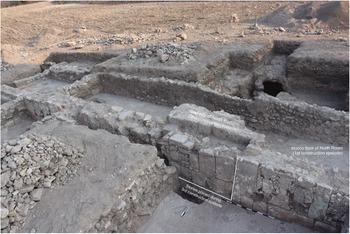
During the second episode of construction, the North Room was adapted into a platform at least 1 m high. Because of postoccupational processes, its exact height and possible uses could not be determined. The previous North Room walls were torn down and used as construction fill. To access the top of the platform, a set of steps made of stones and covered in stucco were placed exactly where the entrance to the room had been (Figure 7). The exterior wall of the platform facing the patio was decorated with an ornamentation of finely carved vertically aligned stones that created spaces filled by smaller carved blocks, some of which formed intricate geometric designs. The modification associated with the second episode of construction was possibly prompted by a generational shift when deceased family members were transformed into venerated ancestors, perhaps House founders: postcontact sources note that specific structures within domestic spaces were dedicated for devotional practices of the household, including ancestral veneration (Terraciano Reference Terraciano2001:200, 309). In addition, during the second episode of construction, the floor of the East Room was resurfaced with a thick layer of stucco and its hearth was enlarged, perhaps to accommodate the changing practices and family size of the household.
Stucco steps associated with the second construction episode of Residence B. The cut stones that cover the steps are associated with the third construction episode (photo by Cuauhtémoc Vidal Guzmán). (Color online).

In the third and final construction episode, the steps leading to the top of the platform were enclosed with similar cut stones as those used for the decoration of the previous episode, but this time they were stacked horizontally. In place of the stairs, a set of smaller and less elaborate masonry steps without any stucco resurfacing was constructed slightly west of the central axis (Figure 8). Additionally, a section of the patio directly in front of the platform was converted to a porch, which was constructed primarily of adobe blocks without any stucco resurfacing, in contrast with previous structures. The porch measures approximately 2 × 7 m for an approximate total area of 14 m2. Several posts were placed in between the walls of the porch to support a probable thatched roof. The final addition to Residence B may have been intended to regulate access to the structure atop the platform; the needs of its residents had changed, thereby shifting the practices taking place there, even as the house remained occupied. No other modifications were registered for any of the other structures.
Masonry steps associated with the third construction episode of Residence B (photo by Cuauhtémoc Vidal Guzmán). (Color online).

Summary: Postclassic Houses
The constant modifications to Residence B represent the material manifestations of changing continuities that ensured a persistent occupation at Etlatongo. In accordance with traditions of building households made of several structures dating back to the Early Formative, Residence B was conceptualized from its inception as a multistructure household. Yet, in contrast to earlier extended houses, structures were modified and reinvented, rather than covered over and constructed adjacently. Despite these changes during its lifespan, the house retained its original floor plan; even when the North Room was transformed from a dwelling space into a platform, the overall arrangement of the domestic space was maintained. Rather than drastically altering the space to accommodate a novel structure, the residents of the household incorporated the building into their preexisting domestic built environment. The physical characteristics of the platform then dictated how the addition of the porch was to be made during the third construction episode. In keeping with the platform’s materiality, the household’s inhabitants chose to seal the previous steps from the second construction with the same type of materials, even though the porch was built from very different ones. Van Dyke (Reference Van Dyke2019:215) suggests, “The material past may be celebrated, ignored, stabilized, or dismantled, but most of all, the material past persists.” In the case of Residence B, even as construction techniques changed, traditions were actively maintained through conscious decisions that took into consideration millenary ideas about floor plans, present material entanglements, and the prospective needs of its inhabitants.
We do not imply that the domestic activities at Residence B were the same as those from previous periods. For instance, the floor plan encompassing additional nonarchitectural physical elements did not remain unchanged. Unlike the more fluid layouts seen during the Formative period, Residence B’s rigid floor plan suggests a stricter notion of what domestic space should look like, a tradition already present in the Mixteca Alta by the Late Formative (Acosta and Romero Reference Acosta and Romero1992). During the Postclassic, formal dwelling space was kept separate from other activity areas, although the latter were maintained close to the household. Features such as middens were placed in the vicinity but were clearly isolated from the rest of the living quarters. Another more pronounced change was the incorporation of burials into the domestic space. Unlike Early Formative households, the occupants of Residence B incorporated their deceased relatives into the landscape of the House. Indeed, placing the burial in F8 was the first action taken before formal construction began. By both physically and symbolically setting deceased ancestors within the confines of a residence, living members and their ancestors were bound up into larger corporate groups and identities that fostered an active discourse between past, present, and future House members: the extended house. The practice of interacting with the physical remains of ancestors was present at Etlatongo since at least the Yucuita phase (Blomster and Higelin Ponce de León Reference Blomster and de León2017).
Moreover, the idiosyncrasies of how domestic practices were performed changed even when traditions persisted. For example, as part of F8, a young dog was buried accompanying a deceased household member. Curiously, the dog had a small projectile point as its own offering, separate from the rest of the burial offerings. The dog deposited in ET92-F3 from Structure 2-13/14’s household appears to be more of an offering, whereas the Residence B dog was treated with more care, reflecting changing ontological orientations about how dogs related to other extended house members. This suggests that even though the specific meanings associated with dogs placed in ritual contexts changed from the Early Formative inhabitants to their Postclassic counterparts, their relevance in cultural schemes associated with the house persisted (Salazar Chávez Reference Salazar Chávez2023).
The variety of construction methods recorded during the three construction episodes indicates a dynamic approach to building practices as people embraced variation. For example, although most walls were made of stone and adobes, the exterior wall of the East Room was adorned with a series of stones intermingling with agglomerations of ceramic sherds. In contrast, the ornamentation of the exterior wall of the North Room during the second and third episodes of construction was made up of finely carved, vertically aligned blocks of stones that created spaces filled by smaller carved blocks. And during the third construction episode, the porch in front of the platform was constructed differently from the other structures of the household: its walls were made primarily of adobe blocks and were never covered in stucco. Although the variety of building practices related to the availability of construction materials, changing circumstances of house wealth, or access to labor, we consider that the diversity indicates an openness to contingently innovate, use new learning configurations, and tailor novel techniques within existing traditions.
Discussion
In our view, a persistence framework is well suited to examining how cultural practices, traditions, and social structures have endured over time, often showing remarkable continuity even when things do change. By considering continuity and change as inseparably related phenomena, persistence acknowledges both that things are never finished and that the changes that emerged are not progressive (Panich Reference Panich2020). Thus, a key advantage of persistence frameworks is that they allow archaeologists to reconsider how we understand change. Instead of viewing cultural change as a passive response to external factors, they underscore the role of communities in actively preserving and transmitting their cultural heritage. In so doing, changing continuities recognize the importance of local agency in shaping cultural trajectories by highlighting how societies actively engage with and reinterpret their past, thereby contributing to the endurance of certain traditions.
As a site that has seen a long and continuous occupation, Etlatongo allows us to consider how houses within communities maintained identities and historically understood notions of self, as expressed in the extended house while, at the same time, incorporating substantial material changes and revisions to those identities. For example, the corkscrew pattern seen in the occupational trajectory of Early and Middle to Late Formative households suggests that when they actively displaced the physical location of their dwellings, they did so in ways that honored all members, living and nonliving, human and other-than-human, of the extended house. Even when artifacts, architecture, and other tangible remains may have changed, the identities associated with the extended house persisted, anchored in place by the physical and symbolic ancestral remains. In the Postclassic period, household structures still underwent significant changes even when they were not geographically relocated. They may have created entanglements where the physical labor required to build and maintain elaborate structures caught people and things in networks of more lasting dependencies (see Hodder Reference Hodder2012:94).
The changing continuities of floor plans at the site suggest that transformations should neither be seen as ruptures with previous traditions nor as the emergence of new ones. Instead, the practice of building a multistructure domestic space with many shared similarities throughout time demonstrates a dynamic yet traceable trajectory from the earliest occupations to the end of the precontact period and beyond. A practice unique to Etlatongo, seen in all three phases considered here, involved covering a previous occupation and using it as a platform for a subsequent structure. In other cases, as with Str. 2-13/14, a small platform was placed directly atop an already constructed surface. Because domestic structures formed an integral part of the extended household, creating these spaces required careful consideration and planning. Rather than being mere coincidence, Mixtec households share many similarities because they represent the physical and symbolic locations that brought people together to create unique expressions that endured over time. Even in historic and contemporary times, many Mixtec households still consist of at least two structures: one where people sleep and conduct other activities and a smaller kitchen hut (Monaghan Reference Monaghan1995:33).
This does not mean, however, that Mixtec domestic life has remained static; the materials with which households were built changed significantly in accordance with a variety of factors, including the availability of construction materials, social status, and transformations within the household. Such changes in materials adhere to a process of contingent continuation, such as the focus on aesthetics of color in surfaces, with red selected from Cruz B to Postclassic houses.
Despite change, Mixtec notions of what an extended house requires persisted. Although focusing on changing continuities may downplay significant social transformations, we propose that a better view is to understand social phenomena as emergent and constantly in motion. As Crellin (Reference Crellin2020:235) suggests, rather than focusing on origins-oriented research or writing histories of revolution, we should reframe our work to consider how phenomena emerge from multiple different factors in different ways in different places at different times. Mixtec extended houses and their cultural practices changed over time, but these changes were intimately connected with long-term historical dynamics in the region.
Conclusion
By exploring the ways in which societies actively maintain and adapt their cultural practices over time, archaeologists can gain a more nuanced understanding of the intricate interplay between tradition and change. It is increasingly clear that both change and continuity are part of the same phenomena operating within specific and contingent social and material conditions. As Panich (Reference Panich2013:115) asserts, the challenge for archaeologists is to resist essentialist notions of cultural identity that equate persistence with unbroken continuities and instead consider the multiscalar contexts of change and adjustment. One way in which archaeologists can do so is by critically embracing decolonial perspectives that have successfully shown how histories of change and continuity cannot be subsumed to a linear narrative of disappearance, assimilation, or even loss.
The House lends itself well to a persistence focus due to its tendency to perpetuate itself (Gillespie Reference Gillespie2000). With this article we hope to contribute to a growing understanding of how domestic practices carry mnemonic valences from the past that help establish strong connections with place and affirmed contingent continuance. By investigating how the persistence of such practices has been a dynamic process, our research challenges teleological narratives that universalized the history of the Mixteca. Finally, we do not see Etlatongo as being exceptional but rather as exemplary of the persistence that many Indigenous communities in Mesoamerica have shown throughout their long histories.
Acknowledgments
The research was made possible by support from the officials and people of San Mateo Etlatongo, as well as permits from the Consejo de Arqueología/INAH, the Centro-INAH-Oaxaca. We want to thank Marijke Stoll and Pedro Guillermo Ramón Celis for organizing the “Diálogos de Oaxaca” and allowing us to present our research. Comments from three anonymous reviewers greatly improved the article.
Funding Statement
The 1992 Etlatongo Project was supported by a Fulbright (HE) Fellowship. FEP was supported by the National Science Foundation, Award BCS 1156373. PAY was supported by the Wenner-Gren Foundation, Grant No. 10247.
Data Availability Statement
The data used in this article are available in the yearly field reports submitted to INAH, Mexico. Reports can be found at this link: https://etlatongo.jimdofree.com/publications-publicaciones/.
Competing Interests
The authors declare none.




 Open access

