




Introduction
Variationist studies have shown how lexical and sublexical features in signed languages are conditioned by internal linguistic constraints and by social characteristics salient to deaf communities, such as age group, region, school affiliation, and sign language acquisition background (Lucas, Bayley, Valli, Rose, & Wulf Reference Lucas, Bayley, Valli, Rose and Wulf2001; Schembri, McKee, McKee, Pivac, Johnston, & Goswell Reference Schembri, McKee, McKee, Pivac, Johnston and Goswell2009; Geraci, Battaglia, Cardinaletti, Cecchetto, Donati, Giudice, & Mereghetti Reference Geraci, Battaglia, Cardinaletti, Cecchetto, Donati, Giudice and Mereghetti2011; McKee, Schembri, McKee, & Johnston Reference McKee, Schembri, McKee and Johnston2011; McKee & McKee Reference McKee and McKee2011; Schembri & Johnston Reference Schembri, Johnston, Pfau, Steinbach and Woll2012; Sagara & Palfreyman Reference Sagara and Palfreyman2020). From the social constructionist perspective that identities are dynamically constructed by linguistic choices in interaction (Bucholtz & Hall Reference Bucholtz and Hall2005), quantitative approaches alone have some limitations in explaining the social meaning of variable language practices (Schillings-Estes Reference Schilling-Estes2004; Gal & Irvine Reference Gal, Irvine, Gal and Irvine2019). This may be especially so for deaf sign language users, whose language repertoires intersect with spoken language (hearing) communities in complex and multimodal ways (Kusters Reference Kusters2019), and many of whom hold intersectional identities. Examples of previous studies that have explored sociolinguistic variation specifically in relation to intersectional deaf identities have focused on Black signers in the US (Maxwell & Smith-Todd Reference Maxwell and Smith-Todd1986; Lucas, Bayley, McCaskill, & Hill Reference Lucas, Bayley, McCaskill and Hill2015; Hill & McCaskill Reference Hill and McCaskill2016; Lucas, Bayley, Hill, & McCaskill Reference Lucas, Bayley, Hill; and McCaskill2023), gay males in the US (Blau Reference Blau2017), and Mexican ASL users in the US (Quinto-Pozos Reference Quinto-Pozos2002). Studies of variable language practices of deaf signers in plurilingual contexts such as Palfreyman (Reference Palfreyman2017) in Indonesia and Hofer (Reference Hofer, Kusters, Green, Moriarty-Harrelson and Snoddon2020) in Tibet highlight the impact of wider linguistic resources and ideologies.
This study examines two variable features in New Zealand Sign Language (NZSL)—pronominal pointing and mouthing of Māori words with signs—and their social meaning in a Māori deaf community of practice (CoP; Lave & Wenger Reference Lave and Wenger1991). Hall-Lew, Moore, & Podesva (Reference Hall-Lew, Moore, Podesva, Hall-Lew, Moore and Podesva2021:4) define social meaning as the inferences drawn about speakers from their use of specific language features in particular interactions, and (following Irvine Reference Irvine, Eckert and Rickford2001) they highlight social differentiation as a motivator of linguistic style choices in particular contexts. This builds on the proposition that style choices constitute acts of identity by enabling speakers to either resemble or distance themselves from members of other groups (Le Page & Tabouret-Keller Reference Le Page and Tabouret-Keller1985, cited in Coupland Reference Coupland2007:109). For example, ethnicity may be signalled by the adoption of contrastive linguistic resources from another code or a style within their own language, such as the use of Māori English in New Zealand (Holmes Reference Holmes2005). For deaf NZSL users, neither spoken Māori nor Māori English are readily available as off-the-shelf resources (Eckert Reference Eckert2018) to enact ethnic identity since they are produced in an aural-oral modality. However, visible Māori paralinguistic features (non-verbal features of speech) can potentially be adopted by signers, as per the multimodal, translingual character of signers’ repertoires posited by Kusters (Reference Kusters2019). In this study, we centre the deaf voice by seeking speaker explanations of their language practices and beliefs.
Sociohistorical context
To contextualise the study, we explain the historical context for Māori NZSL users and the ideologies that have developed around contact between NZSL and te reo Māori, the Māori language.
Following from colonization, MāoriFootnote 1 in New Zealand experience socioeconomic, educational, and health inequities (Chapple Reference Chapple2000; Robson & Harris Reference Robson and Harris2007), which are compounded by deafness. Māori are over-represented in hearing-loss statistics and in deaf education enrolments (Forman Reference Forman2003; Smiler Reference Smiler2014). Historically, Māori deaf children were assimilated into the deaf education system where heritage knowledge was unavailable, and usually also inaccessible in their home environments due to communication barriers with hearing family members (Smiler Reference Smiler2004; Faircloth, Hynds, Jacob, Green, & Thompson Reference Faircloth, Hynds, Jacob, Green; and Thompson2015; Witko Reference Witko2020). The government's role in the alienation of Māori deaf children from cultural identity and structural inequities in life outcomes is the subject of a current claim for restorative justice brought on behalf of Māori deaf people (Waitangi Tribunal 2019; Smiler, Bowden, Gibb, & Kokaua Reference Smiler, Bowden, Gibb and Kokaua2023).
Although the education system was hegemonically European, interaction among Māori and non-Māori deaf children attending residential schools together led to shared adult social domains in which NZSL is a common element of identity (Townshend Reference Townshend1993; McKee Reference McKee2001). Smiler's (Reference Smiler2004) study of Māori deaf perceptions of identity found that their experience echoed Foster & Kinuthia's (Reference Foster and Kinuthia2003) ‘star constellation’ metaphor for deaf ethnic minority identities in the US, in which differing facets of identity (deafness or ethnicity) shine brighter or dimmer in response to particular social contexts. On contemporary (hearing) Māori identity, Paringatai (Reference Paringatai2016) describes a common disjunction between physical appearance, sociolinguistic ethnicity, and knowledge of Māori language when enculturation is incomplete or unavailable within the family. This disjunction is the typical experience of Māori deaf children in hearing families (Smiler Reference Smiler2004), even if their family are among the 20% of Māori who speak Māori in the home (Statistics New Zealand 2020). Smiler's participants described how ‘whānau (family) members were not equipped with the insight and experience to raise a Deaf child, which placed strain on the resulting affiliation participants had with their whānau. These barriers … made it very difficult for Māori Deaf to naturally acquire the cultural knowledge and relationships which underpin a clear sense of Māori identity’ (Smiler Reference Smiler2004:139).
Since deaf people are at least partially excluded from spoken languacultures, sign languages develop through interaction among a collective of deaf people, which in urbanised societies is usually school-based and multi-ethnic. Deaf community (or ‘primary’) sign languages such as NZSL differ from the ‘alternate’ sign languages documented in some indigenous hearing societies, which develop for ceremonial, hunting, or inter-language purposes, for instance, in Australia (Roth Reference Roth1897/2010; Power & Hyde Reference Power and Hyde2013; Green Reference Green and Bowern2023), Papua New Guinea (Reed & Rumsey Reference Reed, Rumsey and Kendon2020), and North America (Davis Reference Davis2010). Such indigenous alternate sign codes tend to be restricted in scope, but are available to deaf members within those communities as a shared semiotic resource (de Vos & Pfau Reference de Vos and Pfau2015). There is no oral or written evidence of an alternate sign language of this nature in pre-colonial Māori society (Forman Reference Forman2003), nor to our knowledge, any contemporary attestation of this by Māori deaf informants or language scholars. While existence is theoretically possible, the modern context for Māori deaf signers is socialisation into NZSL via deaf schools (Smiler et al. Reference Smiler, Bowden, Gibb and Kokaua2023). In the US, historically segregated deaf schools resulted in a Black variety of ASL (Lucas et al. Reference Lucas, Bayley, Hill; and McCaskill2023), and since the shift towards mainstream schooling of deaf students, younger Black deaf signers are observed to incorporate phrases, gestures, and postures characteristic of African American English (AAE) (Terry & Green Reference Terry and Green2023) into their signing style (Lucas et al. Reference Lucas, Bayley, McCaskill and Hill2015; McCaskill Reference McCaskill2020). The New Zealand deaf community has no parallel history of educational segregation that would predict development of ethnically marked variation. A previous quantitative study of variation in a corpus which included a demographically representative proportion of Māori signers found little evidence of ethnicity effects, except for a finding that Māori signers tended to have slightly less phonological and syntactic reduction (i.e. more use of citation or standard form) in two features, and favoured a different variant of the sign marae ‘traditional tribal meeting ground’ (Schembri et al. Reference Schembri, McKee, McKee, Pivac, Johnston and Goswell2009; McKee et al. Reference McKee, Schembri, McKee and Johnston2011). Overall, research and anecdotal evidence indicates that NZSL users comprise a single language community without ethnically marked varieties. This study explores whether this might be changing in a community of practice of individuals who are involved in Māori deaf networks and cultural activities, and have been described as a kaupapa whānau (Smiler Reference Smiler2004), or an affinity group based on common purpose rather than kinship.
Since the late 1980s, progressive recognition of NZSL has expanded deaf community access to participation in society (McKee Reference McKee and Baker2009). Status change for NZSL users has unfolded within an era in which te reo Māori has been progressively revitalised as part of legal processes of reclamation of Māori cultural and economic resources since 1975 (Waitangi Tribunal n.d.). Albury (Reference Albury2015:321) describes a contemporary national linguistic landscape in which ‘the majority group is heavily exposed to the indigenous language. Māori's official status has created an officially bilingual linguistic landscape nationwide and has mainstreamed Māori language into ceremonial practices in order to express a bicultural New Zealand character. … Māori is visible and audible to all New Zealanders’. Early Māori language revitalisation discourse in New Zealand promoted language knowledge as central to ethnoidentity, while contemporary perspectives highlight wider criteria including whakapapa ‘genealogy’ knowledge, participation, and disposition (Durie Reference Durie1998; Te Huia Reference Te Huia2015; Paringatai Reference Paringatai2016; Albury Reference Albury2016). Māori English speaking style is another marker of Māori identity (Holmes Reference Holmes2005), and code-mixing Māori vocabulary is understood to signal support of the Māori language (King Reference King1995). Although spoken Māori and Māori English are not directly accessible to deaf people, recognition of NZSL has empowered Māori deaf people to participate in Māori contexts with NZSL interpreters and to communicate with hearing Māori individuals who have taken opportunities to learn NZSL (Smiler & McKee Reference Smiler and McKee2007; McKee & Awheto Reference McKee, Awheto, McKee and Davis2010; Hynds, Faircloth, Green, & Jacob Reference Hynds, Faircloth, Green and Jacob2014). As a result, some Māori deaf individuals have been increasingly engaged with ideologies that emphasise the significance of language to indigenous identity, contributing to their aspirations to express Māori concepts and identity within NZSL (McKee et al. Reference McKee, McKee, Smiler, Pointon and Quinto-Pozos2007; McKee & Awheto Reference McKee, Awheto, McKee and Davis2010; Dunn Reference Dunn2012; Hynds et al. Reference Hynds, Faircloth, Green and Jacob2014).
In wider society, understanding of the position of Māori deaf people is underpinned by an ‘expected mapping between language and biology or culture’ (Bucholtz & Hall Reference Bucholtz and Hall2005:588), fused with a universally common misunderstanding that signed languages directly correspond with spoken languages. The convergence of these beliefs is apparent in messaging by Māori media, education providers, language promoters, and political parties,Footnote 2 which refer to the construct of ‘Māori sign language’. It is common to see media headlines which conflate the name of a spoken language with sign language, such as, ‘Māori sign language’ (Clarke-Mamanu Reference Clarke-Mamanu2016), ‘te reo sign language’ (Molyneux Reference Molyneux2017), ‘te reo Māori sign language’ (McCaull Reference McCaull2022), and ‘sign language was done in English’ (Armah Reference Armah2022). Below one such headline—‘Reo sign language debuts on Māori TV News’—and an introductory sentence stating that a Māori trilingual interpreter will “translate our news directly into Māori sign language”, the Māori interpreter interviewed for the story explains, “there's a misconception around the term ‘Māori sign language’. What we actually do is translate from te reo directly into New Zealand Sign Language” (Kaire-Melbourne Reference Kaire-Melbourne2016). This juxtaposition captures the tension between an intention of ethnolinguistic inclusion and the knowledge of an NZSL/te reo Māori bilingual of the translational relationship between the languages. Descriptively, NZSL, English, and Māori are three independent languages; that is, the vocabulary and grammar of NZSL do not directly correspond with either spoken English or spoken Māori, but meaning can be translated across languages.
Modern NZSL is closely related to British Sign Language (BSL) and Australian Sign Language (Auslan) (McKee & Kennedy Reference McKee, Kennedy, Emmorey and Lane2000; Johnston Reference Johnston, Baker, van den Bogaerde and Crasborn2002). The familial link to BSL underlies a view sometimes expressed that NZSL is a form of ‘English’, and by extension, aligned with coloniser identity. While the structure and character of NZSL reflects the visual-spatial characteristics of signed languages, and the visually mediated life experience of deaf people, it is also true that contact with English is evident in lexicon and discourse features such as mouthing (McKee Reference McKee2017). Also relevant to note is that Māori loanwords are abundant in New Zealand English (NZE): Macalister (Reference Macalister2005) estimated six out of every 1,000 words to be of Māori origin, and loan usage has increased with revitalisation (Levedis & Calude Reference Levendis and Calude2019). In parallel, NZSL contains signs expressing uniquely Māori conceptual reference which continue to be coined in the deaf community, many of which mirror loanwords in surrounding English (McKee & Vale Reference McKee and Vale2023).
Motivated by the aforementioned beliefs, some organisations engaged in Māori language documentation and education have made proposals to develop signs corresponding with Māori vocabulary and grammar, potentially echoing the way in which artificial sign systems designed to code spoken/written languages were developed (controversially) for pedagogical purposes in many countries from the 1970s (Scott & Henner Reference Scott and Henner2020). While we view such initiatives as linguistically ill-founded because they seek to align signs with spoken language,Footnote 3 they indicate strong aspirations to give agency to Māori deaf identity through differentiated sign language use. This ideology of differentiation is most often articulated outside the deaf community, but some deaf individuals, both Māori and non-Māori, adopt elements of it, as we explore in this study. We next describe the research approach and method.
Kaupapa Māori research approach
A Kaupapa Māori research approach is based in Māori epistemology (Tuhiwai Smith Reference Tuhiwai Smith2021) and lends itself to working with deaf communities (Smiler Reference Smiler, Taylor-Leech and Starks2016; O'Brien Reference O'Brien, Kusters, De Meulder and O'Brien2017). The approach seeks to involve participants in ‘transformative mixed methods research strategies [that] focus on the development of culturally respectful relationships to enhance collaboration between members of dominant and marginalised communities’ (Wilson & Winiarczyk Reference Wilson and Winiarczyk2014:266). Epistemological parameters for this study also include Māori Data Sovereignty principles (Te Mana Raraunga 2018), which require respect, consent, and control relating to Māori participants’ ownership over their own knowledge. Implementing these epistemologies included building relationships with stakeholders before the research (Bishop Reference Bishop1994; Irwin Reference Irwin1994); requesting permission to analyse data, albeit publicly available; working with a Māori deaf facilitator; and engaging participants in analysis. A Kaupapa Māori approach expects research to benefit the community of interest (Tuhiwai Smith Reference Tuhiwai Smith2021); the research project offered participants a forum for reflective discourse which contributes to Māori deaf people's current agenda to strengthen indigenous deaf identity. The research also supports clarification of some prevalent misperceptions about Māori NZSL users which negatively affect them.
Reflexivity about researcher positionality is ethically necessary in research with linguistic minority groups, especially with respect to professional relationships between researcher and participants in which power differentials are inherent (Mellinger Reference Mellinger2020). The first author identifies as a hearing Māori woman, and the second author as a hearing non-Māori woman. We are both fluent in NZSL and English, have some proficiency in te reo Māori, and are both known as professional interpreters. Our personal biographies entail multiplex relationships in the NZSL community spanning thirteen and forty years respectively (McKee Reference McKee, Taylor-Leech and Starks2016). Our interpretation of data in this study is informed by our knowledge of people, events, and perspectives gained through many years of interaction and conversations with Māori deaf (and non-deaf) people in contexts including social and family events, sports, advocacy (with deaf people generally, and Māori deaf people specifically), adult education, interpreting, and research. Nevertheless, we are hearing professionals who hold social privileges relative to Māori deaf research participants. This includes the ability to publish research findings in English-speaking academic spaces which are not equally accessible to deaf researchers or research participants (Hou & Ali Reference Hou, Ali, Charity Hudley, Mallinson and Bucholtz2024). Having ethnic or other identity characteristics in common with research participants does not amount to sharing their intersectional lived experiences, which can affect what participants might choose to share (Braithwaite Reference Braithwaite2020; Johnson Reference Johnson2020). In undertaking this study, the first author's professional identity as one of few Māori NZSL interpreters, mentored by Māori deaf individuals, facilitated rapport with participants, all of whom had previously worked and socialised with her. Finally, we note that in research which entails inter-lingual translation of data, influence can be exercised through translation choices and extrapolating conclusions from that translated data (Johnson Reference Johnson2020). To provide a check on this, translation of data and the researchers’ understanding of key points was double-checked with a Māori deaf facilitator and with the research participants.
Data collection and analysis
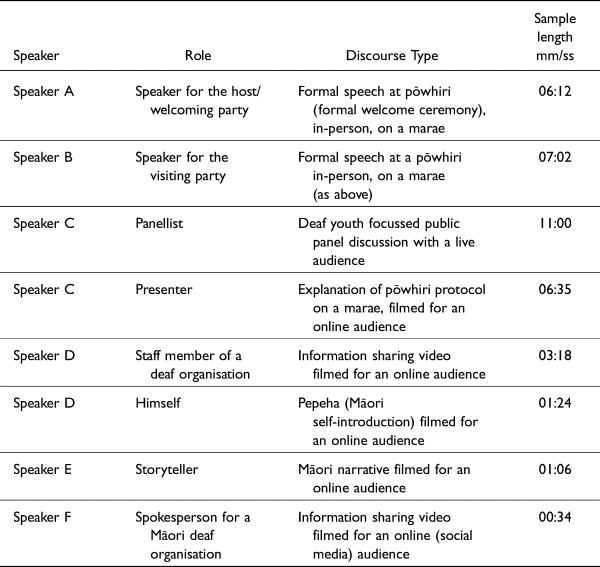
The first step in the research process was to recruit a facilitator from within the Māori deaf CoP to consult on the research questions and selection of discourse samples to be analysed. The second stage, with the facilitator, was to meet with participants to discuss research aims and to seek their approval to analyse (public) video recordings which featured their peers. Analysis of the recordings comprised coding target features in recordings of NZSL produced by Māori deaf signers in authentic events (see Table 1 below). A third step was to convene focus groups in which participants viewed and reflected on excerpts of the recorded language samples. Focus groups comprised eleven individuals, four women and seven men, aged from their late twenties to early sixties, all involved with other Māori deaf people and activities. Signers in the selected recordings were included as focus group participants, enabling those individuals to reflect on their own language practices in the excerpts shown to the group. Three groups of three to four participants were convened on Zoom due to Covid-related restrictions on travel and gatherings at the time of the research. Two rounds of focus group meetings were held. The first round elicited general ideas about ‘Māori signing’, and prompted discussion of the language samples. The purpose of the second round of meetings was to validate summaries (provided in NZSL for accessibility) and key points of the previous focus group discussion.
Details of speaker roles and discourse type in language samples.

Table 1 Long description
The table is intended to report details about speaker roles and discourse type within language samples. However, no rows, columns, labels, or numeric values are included in the provided table data. Because the underlying entries are missing, it is not possible to identify which speaker roles appear, how discourse types are categorized, or how frequently each occurs. No comparisons, trends, or key takeaways can be derived without the actual table contents. If you share the table cells or a screenshot, I can write accurate WCAG-compliant.
Seeking speaker reflections on their language practices is a way to centre deaf voices in Kaupapa Māori research. Analysis of reflexive metapragmatic talk-about-language (Haugh Reference Haugh, Jucker, Schneider and Bublitz2018) may reveal how speakers believe their identity to be enacted or differentiated through language practices (Bucholtz & Hall Reference Bucholtz and Hall2005), although metapragmatic perception does not necessarily match observed usage data (Marra, Vine, & Holmes Reference Marra, Vine, Holmes, Brisard, D'hondt, Gras and Vandenbroucke2022).
Translation of focus group data was checked by the Māori deaf facilitator before the content was thematically coded in NVivo (2020) by the first author. Thematic coding was both deductive (prompted by focus group questions) and inductive (emerging from the data) and iterative (Hennink, Hutter, & Bailey Reference Hennink, Hutter and Bailey2020). This recursive process of data checking enabled relationship building, reduced the risk of participant distrust (Smiler Reference Smiler2006; Hynds et al. Reference Hynds, Faircloth, Green and Jacob2014; Witko Reference Witko2020), and afforded participants agency in checking the integrity of their data and warranting preliminary analysis. With consideration of reciprocity, research findings at the conclusion of the project were presented to research participants and the wider Māori deaf community at two events, including the 6th National Māori Deaf Hui ‘gathering’, a Māori deaf advisory group, and a recording made available online. These presentations were positively received, and the online resource has since been shared within at least one deaf workplace as a professional development resource for staff. Feedback from Māori deaf participants is that they appreciated research attention to their ways of signing and the outcomes being shared with the wider Māori deaf community. They enjoyed a co-presentation style at the National Māori Deaf Hui with the first author and Māori deaf facilitator from the research.
In recorded sign language data, the visibility of participants’ bodies (as well as close social networks) makes anonymity challenging. Both Kaupapa Māori and deaf ethnography research approaches recognise that participants may prefer to be named as owners of their knowledge rather than anonymised (Smiler Reference Smiler2004; Kusters Reference Kusters, Zeshan, de and Vos2012). Ethical approval for this research thus allowed participants to choose whether to be reported by pseudonym or by real name, and this article contains both; however only participants who chose to use their real name appear in figures.
Beliefs about NZSL/ Māori/ English contact
Before introducing the target variables that were examined in video data, we summarise participants’ ideas about the relationship of NZSL with Māori and English as expressed in focus group discussions. Metalinguistic reflection allows for more extensive analysis of language use (Arendt Reference Arendt2021), and viewing excerpts from the language samples analysed for this study prompted participants to comment on the relationship between NZSL, te reo Māori, and English. Some participants suggested an unspecified difference between Māori and non-Māori use of NZSL, for example: “In the deaf community, it's normal and we use NZSL. With Māori deaf, there is similar NZSL, but with some differences”. One participant asserted that NZSL is a language for Pākehā ‘New Zealander/s of European ancestry' deaf people and that (we) Māori deaf “have our own signs”. Other comments mentioned ‘Māori signs’, such as: “He used a few Māori signs and mixed them with NZSL”, referring to signs with Māori conceptual reference (such as kaumatua ‘elder’). Another idea expressed was that fingerspelling handshapes within signs is an English-influenced feature of NZSL vocabulary. The next section introduces the target variables for analysis: mouthing and pointing, which were identified as potential variants by the researchers in NZSL discourse in Māori contexts.
Feature 1: Mouthing of Māori words with signs
Sign language users are in everyday contact with ambient spoken languages, resulting in multimodal, translingual practices that can incorporate features of speech, gesture, and print into sign language repertoires (Kusters Reference Kusters2019). Typical outcomes of this multimodal language contact are mouthing of words with signs, loan translations, fingerspelling, and syntactic influence from spoken languages (Lucas & Valli Reference Lucas, Valli and Lucas1989). Voiceless mouthing of words with signs is a unique type of bimodal code-blend that integrates spoken word form and meaning into sign language discourse (Quinto-Pozos & Adam Reference Quinto-Pozos, Adam, Bayley, Cameron and Lucas2013), also described as a form of ‘double coding’ (Johnston, van Roekel, & Schembri Reference Johnston, van Roekel and Schembri2016). Mouthing is also a productive strategy in signed lexicons for extending or restricting the meaning of existing manual signs (Boyes Braem & Sutton-Spence Reference Boyes Braem and Sutton-Spence2001); for example, mouthing ‘feline’ with CAT extends the sign's usual sense, or mouthing ‘team’ with GROUP restricts reference to a specific type of group. When more than one ambient spoken language is present, the choice to mouth words from a language other than the dominant spoken language with signs can index affiliation with the identity of that speech community. For example, Quinto-Pozos (Reference Quinto-Pozos2002) describes trilingual code-blending among deaf Mexican migrants to the US who regularly pair Spanish mouthing with American signs, and English mouthing with Mexican signs—either combination indexing Mexican deaf identity in a US context. Black ASL signers may construct identity by mouthing certain AAE words with signs (Lucas et al. Reference Lucas, Bayley, McCaskill and Hill2015). Other examples of bimodal code-blending to index local identity include British signers mouthing local dialect words (Schembri & Fenlon Reference Schembri and Fenlon2019, cited in Palfreyman Reference Palfreyman2020), deaf Javanese Indonesians alternating Javanese with Bahasa mouthing (Palfreyman Reference Palfreyman2017), and Welsh mouthing with BSL by deaf signers raised among Welsh speakers (Dai O'Brien, p.c., October 13, 2023). The circumstances for code-blending in NZSL are slightly different from these contexts in that spoken Māori, as a recently revitalised (lesser used) language, has been less present in the natural language acquisition context of adult NZSL users, which suggests that pairing Māori mouthing with NZSL signs is likely to be intentionally signalling Māori knowledge and cultural alignment (McKee Reference McKee2019).
Feature 2: Pronominal pointing
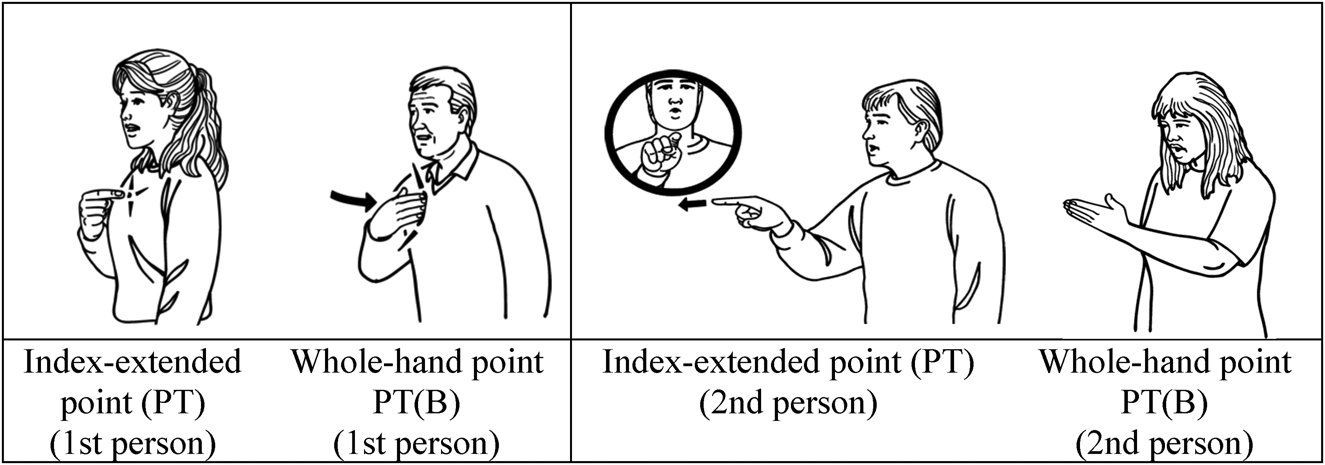
Pronominal person reference in NZSL mainly takes the form of index finger pointing (as in many signed languages). First/non-first person distinction is denoted by fingertip direction toward or away from the signer's body. An open or whole-hand lexical variant also exists (see Figure 1). We refer to the index form as PT and the whole-hand variant as PT(B), (‘B’ being a widely used label in sign linguistics to denote a flat handshape).
Pronominal pointing variants in NZSL.

Figure 1 Long description
A black and white line drawing diagram divided into four sections in a single row, separated by vertical lines. Each section shows one human figure from the waist up with one arm raised to demonstrate a pointing handshape. The first two sections are grouped on the left and the last two sections are grouped on the right. In the first section, the figure faces left with an index finger extended near the upper chest. Text below reads: Index-extended point left parenthesis PT right parenthesis left parenthesis 1st person right parenthesis. In the second section, the figure faces forward with a hand placed on the upper chest. A curved arrow points toward the chest area. Text below reads: Whole-hand point PT left parenthesis B right parenthesis left parenthesis 1st person right parenthesis. In the third section, the figure faces left with an arm extended outward and an index finger pointing horizontally. A small arrow is drawn near the pointing hand. A circular inset symbol appears near the upper left of this section and contains a hand drawing. Text below reads: Index-extended point left parenthesis PT right parenthesis left parenthesis 2nd person right parenthesis. In the fourth section, the figure faces left with an arm extended outward and an open hand held flat. Text below reads: Whole-hand point PT left parenthesis B right parenthesis left parenthesis 2nd person right parenthesis. Language: English.
Pronominal and deictic pointing forms in signed languages overlap with deictic gestures in spoken languages. Gruber, King, Hay, & Johnston (Reference Gruber, King, Hay and Johnston2016) found that hearing Māori individuals, whether speaking English or Māori, favour open (whole-)hand gestures to depict movement paths whilst Pākehā individuals favour index finger pointing. Whilst index finger pointing is widely used by English speakers, pointing directly at a co-present person can be considered impolite (Cooperrider & Mesh Reference Cooperrider, Mesh, Morgenstern and Goldin-Meadow2022). A study of deaf ASL users’ politeness accommodations in the presence of hearing Americans found that a bent index finger or open, palm-up handshape were regarded as polite alternatives to extended index finger pointing; indeed, this open-hand form is conventionalised in a formal/honorific register of ASL (Roush Reference Roush2011) and in NZSL (McKee et al. Reference McKee, Schembri, McKee and Johnston2011). Accommodations by deaf people such as using whole-hand pointing in the presence of a mixed audience reflect that intergroup language practices are often motivated by an intention to distance or align with another group (Bell Reference Bell1984; Le Page & Tabouret-Keller Reference Le Page and Tabouret-Keller1985; Bucholtz Reference Bucholtz1999). Given that conventional and co-speech gestures are recruited into signed languages (Hoyer Reference Hoyer and Quinto-Pozos2007; Kusters Reference Kusters2019), and that hearing discourse norms prevail when deaf participants are in the minority, the whole-hand pointing described for Māori speakers (Gruber et al. Reference Gruber, King, Hay and Johnston2016) is a likely candidate for Māori deaf signers to adopt in the presence of hearing Māori people. In the wider NZSL community, whole-hand pointing is also associated with deference to hearing norms. Anecdotally, both authors whilst working as interpreters in meetings have been advised by deaf individuals not to index-finger point towards hearing participants to indicate which speaker holds the floor (as per normal practice in a deaf context), but rather to indicate their location with a whole-hand pointing gesture.
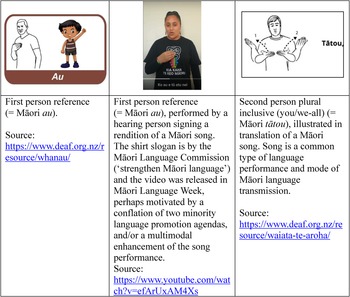
Current promotion of whole-hand pointing as a Māori-aligned style is evident in some new NZSL resources posted online in 2023 which depict whole-hand pronominal pointing paired with Māori pronoun translations, as shown in Figure 2. Since the conventional index-extended pronouns in NZSL have identical referential meaning, this pairing appears to be a socially motivated innovation to associate a variant form of person reference with a (spoken) Māori context. These examples perhaps also reflect a misperception that signs have a fixed correspondence with a spoken code, and therefore different signs are required to translate reference to self and addressees in a Māori-aligned context. We are interested in whether this practice exists beyond the performative contexts such as the second and third illustrations in Figure 2 above (associated with songs).
Whole-hand pointing signs paired with Māori translation.

Figure 2 Long description
The image is a three-panel infographic illustrating Māori sign language references. Each panel includes an image at the top and explanatory text below. The left panel shows a cartoon illustration labeled 'Au' for first person reference, with the source link 'link'. The middle panel features a photo of a person signing a Māori song, with the shirt text 'KIA KAHA TE REO MĀORI' and the caption 'Ko au e tū atu nei'. The source link is 'link'. The right panel displays an illustration with arrows indicating hand movement, labeled 'Tātou' for second person plural inclusive, with the source link 'link'. The panels emphasize the use of sign language in Māori cultural contexts, with visual cues such as hand movements and text labels enhancing understanding.
Selection and analysis of recorded discourse samples
Discourse samples for the study comprised eight excerpts of recordings involving six Māori deaf signers in contexts identifiable as Māori in terms of place, participants, and purpose. They include more formal and less formal settings, and in-person and virtual audiences. Details of contexts are shown in Table 1. Using existing recordings for analysis aimed to eliminate the potential effect of researcher presence on language style, and to capture spontaneous language practices in authentic contexts. Short excerpts were selected for analysis. The likely richest segments were transcribed and coded entirely, with remaining segments annotated only for the features of interest. For example, two language samples entailed two signers making speeches at a pōwhiri on a marae. Discourse in this context is formulaic, structured in accordance with spoken Māori tradition, which potentially prompts the use of NZSL features associated with ‘Māori’ style. The first two minutes of each signer in this context and an additional two minutes later in the event were transcribed entirely, with the remainder of the clip selectively annotated only for instances of target features.
Most of the online texts assume a primary audience of Māori deaf NZSL users. Recordings of live events, such as Speaker C's panel, include a mix of deaf, hearing, Māori, and non-Māori audience members with connection to the deaf community. The live pōwhiri in Speaker A and B's samples, invokes a traditional te reo Māori context, as noted above. Conducting a pōwhiri in NZSL is an innovative use of NZSL which seeks to replicate the procedural elements of a spoken pōwhiri. This pōwhiri occurred at a purpose-built marae within the grounds of a deaf education centre. Speakers A and B are both former students of the deaf education centre and held leadership roles in the development of the marae and its community of practice. The event also included hearing te reo Māori speakers, with NZSL-Māori interpreters working between the languages. Attendees were a mix of deaf, hearing, Māori, and non-Māori people.
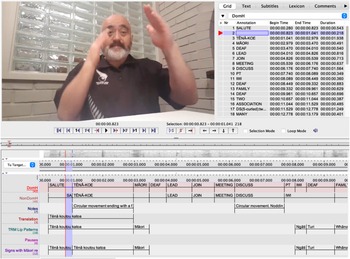
Discourse samples were transcribed and annotated using ELAN (2023). Four target features were coded, two of which are the focus of this article—the addition of Māori language mouthing with specific NZSL signs, and pronominal pointing lexical variants glossed as PT or PT(B). A sample of annotation is shown in Figure 3.
Example of ELAN annotation.

Figure 3 Long description
The image shows a person performing sign language, with their face blurred. The background includes a brick wall and glass blocks. The ELAN software interface is visible, displaying annotations related to the sign language performance. The annotations are listed in a grid format with columns for annotation names, begin time, end time and duration. Examples of annotations include 'SALUTE', 'TĒNĀ-KOE', 'MĀORI', 'DEAF', 'LEAD', 'JOIN', 'MEETING', 'DISCUSS', 'PT', 'IWI', 'FAMILY', 'TWO', 'ASSOCIATION', 'DS' and 'MANY'. Below the grid, a timeline is shown with various tracks labeled 'DomH', 'NonDomH', 'Notes', 'Translation', 'TRM Lip Patterns', 'Pauses' and 'Signs with Māori references'. The timeline includes specific annotations such as 'Circular movement ending with a f', 'Nodding' and translations like 'Tēnā koutou katoa'. The interface includes playback controls and options for selection and loop mode.
We use the term whole-hand to include varying articulations of an open hand, including some with slightly bent fingers or curved palm.
Analysis
In the following sections, we discuss participants’ perceptions about the target variable features, followed by analysis of their use in the recorded language samples.
Mouthing of Māori words with NZSL signs
Perceptions
When focus group participants were initially asked to comment generally about features observed in the video excerpts, mouthing was raised. Whereas we anticipated observations of mouthing Māori words with signs expressing Māori reference (which was visible in the data), participants instead commented on a perceived lack of mouthing, for example: “I saw that [she] didn't use any Māori lip patterns”, and, “[He] didn't use many lip patterns”. Comments regarding a lack of mouthing may indicate their expectation that Māori mouthing would be more present than it was, and/or that they regard reduced mouthing generally in Māori contexts as a point of contrast with NZSL used in everyday contexts. For example, it was said of Speaker A (recorded at the pōwhiri) that “His signing is different when he is with a Māori deaf group. His body language and signing are more Māori, and he doesn't talk [mouthing]. He keeps his mouth shut”. Haamiora expanded on this, saying that “[i]t's how Māori deaf do whaikōrero [Māori speech-making style]. Lip patterns aren't needed”. Given that speeches on the marae are usually spoken in te reo Māori, the reduction of English mouthing with NZSL signs in this context may be a way of approximating a ‘codeswitch’—that is, not using spoken Māori itself, but instead reducing the visibility of mouthing as an English contact feature that is prevalent in NZSL. Whilst some participants suggested that less mouthing was ‘more Māori’, by contrast, a participant commented that for new usages where the meaning of an existing sign or neologism is intended to express a Māori concept, “[i]f there isn't a lip pattern with the sign, people might be unsure what it is”, suggesting that mouthing is considered important to meaning.
Māori mouthing in recorded discourse data
Analysis of discourse samples showed that mouthing a Māori word with an existing NZSL sign is used to both signal a ‘codeswitch’ and to extend semantic sense of a sign to a Māori referent. Māori loanwords are increasingly frequent in contemporary spoken and printed NZE (Levindis & Calude Reference Levendis and Calude2019), and in this data, some more recent loanwords in everyday NZE were matched by novel Māori mouthing with NZSL signs, such as ‘tamariki’ mouthed with the sign CHILDREN (vs. the more conventional mouthing ‘children’). Novel mouthing code-blends are also used to semantically extend a sign's core sense, for instance, mouthing karakia with the sign PRAY extends meaning to incantation, prayer, or chant in te reo Māori; whānau with FAMILY extends the meaning to a wider familial group or sometimes a close group without kinship ties; and pōwhiri with WELCOME references a formal Māori welcome ceremony.
Although this dataset is limited, it suggests that purposeful code-blending (or ‘double-coding’; Johnston et al. Reference Johnston, van Roekel and Schembri2016) by Māori mouthing might be increasing in this CoP. The oldest recorded sample from 2016 featuring Speaker C includes concepts which are now commonly heard loans in spoken NZE, such as wairua ‘spirit’ and karanga ‘call’.Footnote 4 In the 2016 recording, these are expressed in NZSL by the signs SPIRIT and SING with conventional English mouthing of ‘spirit’ and ‘sing’ (rather than a spoken Māori equivalent). However, three years later in 2019, Speaker C produces a Māori mouthing of wairua with the sign SPIRIT. Speaker B's sample from 2019 also shows Māori mouthing of wairua and karanga with these two signs. This suggests signers’ knowledge of Māori vocabulary has grown, along with awareness that such loanwords are used for identity signalling in the surrounding spoken language community. Overall, signs with Māori-specific reference (such as proper nouns and terms such as MĀORI, TE-REO-MĀORI, and MARAE) in the video recordings were used exclusively with Māori mouthing, which accords with the wider NZSL community generally and mirrors the use of equivalent loanwords in spoken NZE.
Pronominal pointing
Perceptions
Co-speech gestures of hearing Māori speakers are consciously accessible as semiotic resources to deaf signers. As Eddie stated, “I only get what I can see, because I don't hear anything”. The recording of a pōwhiri involving deaf and hearing people shows three hearing speakers prolifically using both index-extended and whole-hand pointing gestures. The hearing speakers fairly consistently use index-extended pointing with spoken first-person pronouns, while most other gestures are whole-hand forms. The more extended the arm, the more likely a whole-hand gesture was used. Some gestures appeared to be deictic, and others had ‘beat’ or ‘temporal’ highlighting properties (McNeill Reference McNeill2005). For example, one hearing speaker performed a tauparapara ‘traditional chant’ accompanied by whole-hand beat gestures, and as this was not interpreted into NZSL, only these gestures were accessible for the deaf participants watching.
In the excerpt from a public panel discussion, Speaker C expressed an opinion that index-finger pointing (PT) is avoided by hearing Māori speakers, agreeing with the panel facilitator that whole-hand pointing or the bent index finger—PT(X)—is preferred in his region. One participant in a focus group said, “I see [hearing] Māori people getting up to speak in te reo Māori and the gestures they use …They use a [flat] handshape. I have waited to see if they use an index point, and they don't … Back when there weren't interpreters, I didn't know what was being said. With an interpreter, I've seen interpreters use pointing because they're using NZSL. That's fine … It happens with many Māori deaf that they will point and be quickly reminded that that's not okay. Those who do it haven't learnt about it yet”. Although bent-index pointing—PT(X)—was suggested in the focus-group and by Speaker C in the panel presentation as a Māori style, no instances of spontaneous use by deaf speakers occurred in the recorded samples or in the focus group discussion.
One participant proposed that whereas places or objects can be referred to with an index finger in a Māori context, a whole-hand point is more appropriate for referring to persons, which elicited some agreement within the focus group. Eric mentioned referring to the deceased in a ceremonial speech-making context, saying: “When you want to acknowledge people that have died, their wairua, you wouldn't point [PT]. That's what I've been told”. Eric recounted an experience of being told not to use index pointing saying: “My great-great-grandfather was strongly against pointing [PT]. I was told that people would get a whack and telling off if they pointed [PT]”. Several participants attributed handshape choice to the perceived preferences of hearing elders. One young participant went further, saying “Same with non-Māori. They don't like pointing as well. So I respect those hearing people”. An older participant, Mita, who had the most knowledge of Māori language among the group, took a contrary view, suggesting that Māori deaf people's adoption of PT(B) reflects undue deference to hearing people who are unaware of index-finger pointing as a linguistic norm in NZSL. He explained: “I think it was outside of the deaf community (from 1997) that changed how Māori deaf pointed. I think many Māori deaf were scared of hearing people who didn't know our deaf culture. Growing up in the Pākehā world it's normal to point. That's normal, it's not considered rude. It is important not only for Māori deaf but all deaf people to point. Pointing tells people clearly who is being referred to”.
Participants’ attribution of their pointing practices to hearing Māori preference indicates motivation to align with Māori norms in contexts which have previously excluded them—although this was not unanimous.
However, pointing handshape variation is not solely externally motivated. As previously mentioned, whole-hand, palm-up pointing exists as honorific person reference in NZSL. Awareness of register variation is reflected in Mere's statement, “It's nice and formal to use PT(B)”, giving as an example assigning a turn to someone with an open hand. As for variation in deaf individual's pointing usage, Mere said that it depends whether an individual has ‘learned’ about pointing variations and ‘appropriate’ usage in a Māori context: “They [other Māori deaf people] don't understand when it is right or wrong to use PT versus PT(B) … there are a few older Māori deaf who only use PT, usually those who haven't been on the marae”. This comment frames PT(B) as a contemporary practice of younger, ‘culturally aware’ members of a CoP, who are observant of the co-speech gestures of hearing Māori people. Although Mere claims a personal and general Māori preference to use PT(B), she also suggests contextual variation according to interlocutor familiarity, somewhat at odds with her previous idea about PT(B) indexing formality:
It depends on the [deaf] person. If that person is sensitive [to pointing variations], I would use PT(B) to refer to them. If they don't care, then I'd use PT. So, I would consider the person and adjust my language accordingly. However, if I am with a Māori deaf person I know well, I would use PT(B).
Pronominal pointing in recorded discourse data
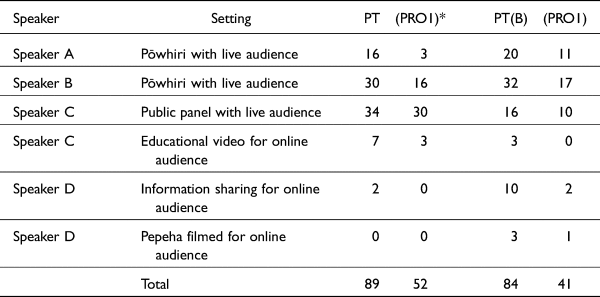
Excluding two samples which contained no instances of pronominal pointing, six discourse samples were analysed. Overall, the two pointing variants occurred with similar frequency, with slightly more index pointing tokens, as shown in Table 2. Approximately half of all instances of both PT and PT(B) variants are first person reference (PRO1).
Frequency of PT and PT(B) variants.
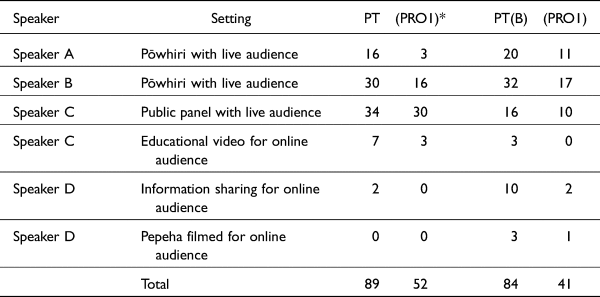
Table 2 Long description
The table is intended to report how often PT variants occur compared with PT(B) variants. However, no rows, columns, counts, or percentages are included in the provided table data. Because the underlying values are missing, it is not possible to identify the most frequent variant, compare PT with PT(B), or describe any trends across variants. Any subset note about PRO1 tokens cannot be interpreted without the corresponding PT token totals. Provide the table entries to enable an accurate summary of key differences and patterns.
*PRO1 tokens are shown as a subset of the PT tokens listed in the column to the left.
Usage varied by individuals. Speaker C, the youngest, was the only signer who consistently used more PT than PT(B), using PT more than twice as frequently. Speaker C's public panel sample, in which first person pronouns were more frequent than other pronouns, showed the PT variant to be three times more frequent than the PT(B) variant; that is, thirty instances of PRO1:PT and ten instances of PRO1:PT(B). Interestingly, while Speaker C used PT far more frequently in the recorded data, he stated in the focus group that he avoids index pointing pronouns and prefers using a PT(B) handshape, as a sign of respect (presumably when referencing others).
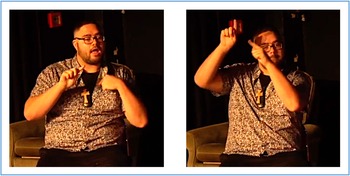
Further examination of the data suggests that Speaker C's first-person pointing handshape choices are often conditioned by phonetic context, as per previous findings that the handshape of index-extended signs often assimilates to match the features of a preceding or following handshape (Lucas et al. Reference Lucas, Bayley, Valli, Rose and Wulf2001:110–11). Examples of likely handshape assimilation of first-person pronouns are illustrated in Figure 4 (for whole-hand PT) and Figure 5 (for index pointing PT(B)).
PRO handshape assimilation with preceding sign: “RESPECT, PRO1:PT(B)”.

Figure 4 Long description
The image contains two side-by-side photographs separated by a vertical gap, each showing a seated person in a chair against a plain background. Left photograph: A medium shot shows the person seated with the torso and arms in frame. One hand is held upright beside the cheek with the palm facing outward. The other hand is held in front of the upper chest with the palm facing upward. Right photograph: A medium shot shows the person seated with the torso and arms in frame. A cross necklace hangs at the center of the chest. One hand is raised near the side of the neck with the thumb extended upward and the other fingers curled. The other forearm rests across the lower torso with the hand near the opposite side.
PRO handshape assimilation with following sign: “PRO1:PT, PT-go-to”.

Figure 5 Long description
The first image shows a person seated in a chair, wearing a patterned shirt and a cross necklace. The person is gesturing with both hands, with one hand pointing towards their chest. The second image depicts the same person in a similar setting, gesturing with both hands raised, one hand pointing upwards. The background is dark and the chair is partially visible in both images.
In contrast to Speaker C's higher use of conventional PT, Speaker D favoured PT(B). The two samples of Speaker D were recorded for an online audience, one comprising an NZSL rendering of a pepeha, a formulaic Māori introduction by naming place and kinship affiliations. Speaker D has leadership status within the CoP as an advocate for Māori deaf identity recognition. The two samples from Speaker D were shorter in length than Speaker C's samples and contained fewer instances of pointing, however PT(B) was used in 83% of his pointing tokens in one clip and 100% in the second (which comprised only three instances). All first-person pronouns were PT(B), although in loosely articulated form. Second-person pronouns were consistently articulated as PT(B). Speaker D's tokens did not appear to be as strongly influenced by the phonetic context, and he has spoken publicly about his preference for PT(B) as a Māori style. For example, at an event some years ago, Speaker D urged author one to use PT(B) as a Māori NZSL interpreter, asserting that Māori deaf people prefer it. Given that his two texts in this data address Māori content, his expressed opinions about pointing variants, and his social status in this CoP, we can say that form and content are working together here to construct a persona as ‘Māori deaf elder’.
Two participants recorded at a pōwhiri, Speaker A and Speaker B, were enacting traditional spokesperson roles for welcoming formalities. In this context, both signers used a slightly higher proportion of PT(B) than PT. Speaker A, the welcoming speaker for the host party, who performs one of the most visible speaker roles in a pōwhiri ceremony, used PRO1:PT(B) in 79% of his tokens. Speaker B, responding for the visiting party, had an almost even split between PRO1:PT and PRO1:PT(B). For both Speaker A and Speaker B, most instances of PT(B) were first-person pronouns. This is also the case with Speaker C in the public panel sample. All of these discourse samples were addressing an audience of mixed ethnic and deaf/hearing identities.
Discussion and conclusions
With respect to mouthing of words with NZSL signs, three points of interest emerged: (i) a belief within the CoP that less mouthing (in general) is characteristic among Māori deaf signers; (ii) evidence that the substitution of Māori mouthing with conventional NZSL signs is a productive strategy for extending or specifying the sense of an NZSL sign to denote Māori reference (reflecting a bimodal lexical expansion strategy in NZSL generally; McKee & Vale Reference McKee and Vale2023); and (iii) evidence that Māori loanwords with recent currency in spoken NZE are being re-mediated into NZSL by adding Māori mouthing to sign equivalents, with similar motivation to affiliate with Māori ethnolinguistic identity (King Reference King1995).
Participants believe that within their CoP of deaf people who engage with Māori contexts there is a preference for whole-hand pointing, especially in formal speaking on the marae. Pointing variants are believed to originate from, or at least accord with, hearing Māori co-speech gestures. Focus group discussions suggest that they regard pointing variation as a signifier of modern Māori deaf identity. This is in contrast to ‘older’ generation Māori deaf people whom Mere described as using only the conventional NZSL index-finger pronoun form and who are considered peripheral to this CoP by being less aware of Māori culture. Analysis of focus group discussion also identifies that PT(B) is associated with specific contexts of use, especially the marae and Māori deaf public events, and within that context, by individuals making formal speeches—and within those texts, for referring to persons present or deceased. These specific usage conditions suggest characteristics of ‘stylised performance’ (Snell Reference Snell2010), as per the song translation examples in Figure 2.
The current study was not designed in a quantitative variation paradigm, but for interest, we compare the findings about pointing variants with a current analysis of a larger corpus of NZSL produced by fifty-three signers (32% Māori; McKee et al. Reference McKee, Vale, Major, Alexander; and Meyerhoff2025). Of 1,573 tokens of pronominal pointing in that corpus, only 198 (12.5%) are the PT(B) variant. Excluding first-person reference, PT(B) is significantly associated with plural non-first person reference, expressing reference to ‘you-all’ or ‘them’, which aligns with focus group evaluations of this variant as a polite form of group address/reference. However, in the larger corpus, Māori ethnicity does not have a significant effect on pointing variation. Overall, however, PT(B) is significantly more frequent in contemporary data (especially in online public-speaking texts) than in recordings made ten years ago, suggesting that this ‘honorific’ form is increasing in modern NZSL generally. Māori usage undoubtedly reflects this wider change, yet is interpreted by these participants in terms of Māori identity and context.
At face value, the non-significance of ethnicity in the larger corpus study as a determining factor in pointing variants is incongruent with participants’ belief that whole-hand pointing is a Māori signing style. However, qualitative data indicate that whole-hand pointing and Māori mouthing may be adopted purposefully in Māori-aligned contexts, especially to perform culturally conventional speech acts, and where interlocutors—including hearing people—are Māori. In such contexts, these variants are seen to align with Māori discourse norms and to construct a ‘Māori deaf’ persona. This picture of situationally contingent variation resonates with the notion of ‘socially strategic stylisation’ in which ‘speaker choice is motivated primarily by immediate interactional and relational goals. Speakers select semiotic resources that fulfil these goals, and in doing so, shape and refine the meaning of those resources’ (Snell Reference Snell2010:651). Emerging practices and ideologies among this Māori deaf CoP also demonstrate how the linguistic repertoires of sign language users draw on multimodal elements of adjacent spoken languages in socially strategic ways.
Participants described experiencing degrees of marginalisation within both Māori (hearing) whānau and deaf community contexts. The valorisation of NZSL and of te reo Māori has led to the development of a Māori deaf CoP in which critical awareness about their historical positioning and the relationship between identity and sign language use is emerging. As Bucholtz & Hall (Reference Bucholtz and Hall2005:606) argue, the use of language is itself an act of agency in constructing identity as a form of social action. For example, participants’ assertion that mouthing is less prevalent among Māori NZSL users suggests an intention to differentiate Māori style by dissociation (Hickey Reference Hickey2000), as a ‘negative identity practice’ (Bucholtz & Hall Reference Bucholtz and Hall2005:212), seeking to minimise a linguistic feature associated with an ‘out-group’—in this case, English mouthing which is a typical feature of NZSL. These ideas about the use of Māori mouthing, although not consistently evident in the filmed data, may parallel Palfreyman's (Reference Palfreyman2020:91) finding that Javanese signers use mouthing codeswitches to assist with forging social identities in relation to the various deaf and hearing language communities they affiliate with.
A limitation of this study is that the focus group data comprising metalinguistic commentary on viewing excerpts of Māori deaf use of NZSL was analysed only for content of the discussion, rather than also examining the form of NZSL used in that discussion. Closer examination of features in that discourse (as per Schillings-Estes (Reference Schilling-Estes2004) analysis of interview data for example) might offer further insights into the linguistic practices of this CoP.
In conclusion, we concur with the observation of Hou & de Vos (Reference Hou and de Vos2021:121) ‘that sign languages and signing communities are adapting to an ever-changing world, thus whatever generalizations are made about them should be not treated as static, but rather snapshots of particular times and spaces’. This study illustrates how language practices may be imbued with intentionality about ethnic differentiation, prompted by changing identity politics, but not necessarily in straightforward or expected ways.


 Open access

