Introduction
The increasing human population and the associated increase in rates of resource use and habitat loss worldwide are, in many areas, forcing wildlife to live in increasing proximity to humans. In such circumstances competition arises between wildlife and people for space and food resources, often leading to human-wildlife conflict. Definitions of the term vary (c.f. Conover, Reference Conover2002; IUCN, 2003; Madden, Reference Madden2004). We define human-wildlife conflict as the situation that arises when behaviour of a non-pest, wild animal species poses a direct and recurring threat to the livelihood or safety of a person or a community and, in response, persecution of the species ensues. Human-wildlife conflicts most commonly involve damage to crops or killing of livestock or game, and occasionally involve attacks on people. They are of particular concern when the animal persecuted in retaliation for these events is a threatened species.
Carnivores are particularly predisposed to conflict with humans because of their large home ranges and dietary requirements (Linnell et al., Reference Linnell, Swenson and Andersen2001; Macdonald & Sillero-Zubiri, Reference Macdonald, Sillero-Zubiri, Loveridge, Lynam and Macdonald2002). Human-carnivore conflict appears to be increasing in frequency in many areas (Treves & Karanth, Reference Treves and Karanth2003), presenting a significant threat to many carnivore species, including many threatened species of wild felids. Human-felid conflict typically occurs when wild cats prey on livestock or game, or even attack people, and the people affected respond by killing or harming felids, either in retaliation or as a preventative measure.
Effective human-felid conflict management is essential given the precarious conservation status of many felid species, yet also highly complex as it must reconcile human needs with those of felid populations. Despite the urgency and importance of resolving these conflicts, there does not yet appear to have been a review of such conflict on a global scale or the success of management techniques worldwide. Our aim was therefore to provide a systematic, cross-taxonomic, review of the state of knowledge and practice of human-felid conflict globally. Specifically, our research questions were: (1) Which cat species are affected by conflict and to what extent? (2) What are the spatial, taxonomic and socio-economic patterns of these conflicts? (3) What are the factors that determine the scale of conflict? (4) What is the scope of the available human-felid conflict literature and what information needs are apparent? (5) To what extent have conflict management strategies been implemented and evaluated?
Methods
Sourcing information and data collation
A comprehensive and systematic review of scientific, secondary and internet-based literature on human-felid conflict was carried out. Information regarding such conflict was sought for the 37 extant felid species (Nowell & Jackson, Reference Nowell and Jackson1996, with the addition of the more recently described Bornean clouded leopard Neofelis diardi; Kitchener et al., Reference Kitchener, Baeumont and Richardson2006).
A literature search was carried out using a pre-defined search protocol, involving a number of filters based around a set of keywords, selected to balance search sensitivity (finding all relevant information) with specificity (the proportion of hits returned that are relevant; Pullin & Stewart, Reference Pullin and Stewart2006). All of the keywords used in our searches were English. Although this will have precluded a number of non-English language literature sources from our review this restriction was necessary to limit the sources obtained to a manageable number. To be selected, a literature source had to include a felid name (common or scientific), and one or more of the following keywords: attacks, attitudes, cattle husbandry or management, coexistence, conflict, depredation, diet, ecology, feeding ecology, human, livestock, mitigation, mortality, perceptions, persecution, prey, retaliatory killing. Scientific literature was sourced from scientific databases such as ISI Web of Science (2007), the IUCN/SSC Cat Specialist Group (2007), and Google Scholar (Google, 2007b), and searches for secondary and internet-based literature were carried out using web-based search engines. A ‘snowball’ reference technique was then used, which resulted in the opportunistic inclusion of some non-English literature. In some cases, particularly for the smaller felid species, no (or no relevant) scientific or secondary literature was available; so information from the most reliable internet sources available was used or expert opinions sought.
Felid body mass data were obtained from Nowell & Jackson (Reference Nowell and Jackson1996), Macdonald (Reference Macdonald2006), Hutchins et al. (Reference Hutchins, Kleiman, Gleist and McDade2003) and the Cat Survival Trust (2007). The average weight for each species was calculated from the minimum and maximum mean weight provided by at least two of these sources. Species were categorized by (1) body mass (≤ 10 kg, 11–49 kg, ≥ 50 kg), (2) the extent of information available, and (3) the scale of conflict (see Table 1 for definitions of the categories used).
Definitions of the categories used to sort the data collated from the literature review.

Where the data allowed, the average annual attack or persecution rate was calculated. Time scales of reports were calculated from the beginning of the first year to the end of the last year documented, unless the article specified otherwise. For example, a report between 2000 and 2002 was calculated as a time period of 3 years. Statistical analyses were carried out using SPSS v. 9 (SPSS, Chicago, USA).
Details of all conflict management techniques mentioned in the literature reviewed were recorded and coded by whether they were implemented or proposed techniques, by whether they had or had not been evaluated scientifically (see Table 1 for definition), and by the felid species involved. The location of each implemented technique was recorded and any anecdotal evidence of a technique's success rate was noted. The implemented conflict management techniques were then categorized by type into 12 groups: financial, livestock husbandry, livestock guarding, education and community development, deterrents, barriers, aversive conditioning, translocation, lethal control, zoning, land use, and attack verification.
Mapping conflict locations
Maps of felid species' ranges were sourced (Appendix 1). Some were available in the required geographical information system (GIS) format, others were converted to JPEG images, imported into the geographical system ArcView v. 9.2 (ESRI, Redlands, USA), georeferenced and digitized to provide species range layers. Where possible, coordinates for conflict presence/absence were obtained from the literature, or acquired from ArcView (using the World Database on Protected Areas, see Appendix 1), Google Earth (Google, 2007a) or Wikipedia (Reference Wikipedia2007). The coordinates obtained varied in accuracy depending on the geographical scale of the report and the resolution of the resource used. Where the coordinates provided by a reference demarked an area, for example a national park, the central point coordinates were calculated. Coordinates were standardized by converting them to decimal degrees using a coordinate converter (COSports, 2007). GIS-compatible global livestock density data were obtained, as was the World Database on Protected Areas (sources detailed in Appendix 1).
Results
Literature quantity and quality
In total 349 literature sources (189 scientific articles, 74 secondary and 86 web pages) were reviewed. The primary and secondary literature was published over 1979–2007, and the number of sources per publication year increased significantly over this period (Spearman's Rank Correlation, rs = 0.763, P < 0.001; Fig. 1). The conflict literature was biased toward large-bodied species (Spearman's Rank Correlation, rs = 0.536, P = 0.001): 67% of sources contained information about large (≥ 50kg) felid species (Fig. 2) and conflict, or a lack thereof, was therefore better documented for these species (Fig. 3 & Table 2).
Publication dates of primary and secondary literature sources reviewed.

Total number of information sources (white and grey literature and website resources) reviewed for each of the 39 felid species; 67% of literature sources reviewed concerned species with an average body mass ≥ 50kg.

Extent of felid conflict knowledge determined by the number and type of literature sources accessible for each species. See Table 1 for full category definitions.

Felid conflict categories, average body mass, extent of conflict knowledge, and threat status.

1 RES, research required; EX, expert opinion; NC, no conflict; CPD, conflict poorly documented; CWD, conflict well documented (see Table 1 for full descriptions of categories)
2 From Nowell & Jackson (Reference Nowell and Jackson1996), Macdonald (Reference Macdonald2006), Hutchins et al. (Reference Hutchins, Kleiman, Gleist and McDade2003), Cat Survival Trust (2007)
3 CR, Critically Endangered; EN, Endangered; VU, Vulnerable; LR/nt, Lower Risk/Near Threatened; LC, Least Concern (IUCN, 1994, 2001)
4 Clouded leopard categorization has been used here as there is no information specifically for Bornean clouded leopard.
Felid conflict species
Felid species were assigned to conflict categories based on the evidence in the literature reviewed (Fig. 4 & Table 2): there was no evidence of conflict for seven species, evidence of a low level of conflict for 20 species, and evidence of a moderate or higher level of conflict for nine species. We categorized the Bornean bay cat Catopuma badia as data deficient because of insufficient information (Table 1). The severity of conflict differed significantly between felid weight groups (Kruskal Wallis, χ2 = 21.021, P < 0.001). Conflict is more severe with large cats than with either medium (Mann-Whitney U, Z = -3.268, P = 0.001) or small cats (Mann-Whitney U, Z = -4.143, P < 0.001), and conflict with medium and small cats is of a similar intensity (Mann-Whitney U, Z = -1.894, P = 0.126). With the exception of the caracal Caracal caracal (17 kg) and Eurasian lynx Lynx lynx (23 kg) all of the species with which conflict is of a moderate or higher level have an average body mass > 50 kg. For the remainder of the analyses and synthesis we focus on the nine species for which conflict is of a moderate or higher level: caracal, cheetah Acinonyx jubatus, Eurasian lynx, jaguar Panthera onca, leopard Panthera pardus, lion Panthera leo, puma Puma concolor, snow leopard Uncia uncia and tiger Panthera tigris.
Scale of human-felid conflict determined by the frequency of livestock depredation, attacks on humans and retaliatory killing of felids reported in the reviewed literature. See Table 1 for full category definitions.

Scale of conflict
Livestock depredation Both livestock depredation and attacks on people may incite human-felid conflict but, of the two, livestock depredation occurs more frequently, with cattle, sheep and goats being most commonly attacked (Table 3). Although well documented, livestock depredation data in the literature are quantified in incomparable ways, for example: the total number of livestock lost, the percentage of livestock holdings lost, the quantity of livestock remains in felid scats, or the percentage of the total number of livestock lost to all predators. Of the total primary and secondary literature sources, 225 concerned the nine conflict felids and of these only 10% contained information on the economic loss resulting from livestock depredation. The data are reported in different currencies as absolute values, percentages of income, or percentage of all monetary loss to predators or wildlife (Appendix 2) making them incomparable. No data were available on the economic loss resulting from depredation by caracals or cheetahs. Appendix 2 summarizes the livestock depredation and economic data available in the literature.
Livestock species attacked by the nine species of felid involved in conflict, as reported in the literature.

1 Includes oxen
2 Domestic buffalo in India
3 Indicates a preference for subadult individuals
Attacks on people Of the nine conflict felids only those with an average body mass > 50 kg show a propensity to attack humans. The three species responsible for most attacks are leopard, lion and tiger; attacks by puma and jaguar are comparatively rare (Beier, Reference Beier1991; Perovic & Herrán, Reference Perovic and Herrán1998; Quigley & Herrero, Reference Quigley, Herrero, Woodroffe, Thirgood and Rabinowitz2005; Altrichter, Reference Altrichter, Boaglio and Perovic2006), and there are no reports of snow leopards or cheetahs attacking humans. Calculation of an average annual attack rate was possible for most locations and indicated that attack rates are not evenly distributed across species’ ranges (Appendix 3). The differing geographical scales of reports make further comparisons difficult but reports suggest that attacks have generally declined over time (Thirgood et al., Reference Thirgood, Woodroffe, Rabinowitz, Woodroffe, Thirgood and Rabinowitz2005), a trend possibly linked with declining felid populations (Nowell & Jackson, Reference Nowell and Jackson1996; Treves & Naughton Treves, Reference Treves and Naughton-Treves1999). However, in some Asian and African locations attacks are still common (Thirgood et al., Reference Thirgood, Woodroffe, Rabinowitz, Woodroffe, Thirgood and Rabinowitz2005). For example, attacks by lions increased significantly in Tanzania over 1990–2005 (Packer et al., Reference Packer, Ikanda, Kissui and Kushnir2005). An increase in attacks by pumas has also been reported in the USA and Canada in recent decades (Beier, Reference Beier1991).
Retaliation against felids Appendix 4 summarizes the reports of the numbers of felids killed in retaliation for livestock depredation and/or attacks on humans. Generally, the data presented in the literature allowed the calculation of the average annual persecution rate for each location but, as with the data for attacks on humans, reports are at differing spatial scales. The extent of retaliation was quantified in various ways, including as a percentage of felid mortality. For example, 47% of cheetah (Marker et al., Reference Marker, Dickman, Mills and Macdonald2003a), 46% of Eurasian lynx (Andrén et al., Reference Andrén, Linnell, Liberg, Andersen, Danell and Karlsson2006), and up to 50% of tiger (Miquelle et al., Reference Miquelle, Nikolaev, Goodrich, Litvinov, Smirnov, Suvorov, Woodroffe, Thirgood and Rabinowitz2005) mortality has been attributed to retaliatory killing in certain regions. Responses from surveys indicate that 39% of respondents in Belize have hunted cats in retaliation for livestock depredation (Brechin, Reference Brechin2003), 88% of ranchers interviewed in the Brazilian Pantanal believe that jaguars are shot by ranchers to prevent cattle losses (Zimmermann et al., Reference Zimmermann, Walpole and Leader-Williams2005), and 14% of herders interviewed in four Mongolian regions have hunted snow leopards (Allen et al., Reference Allen, McCarthy, Bayarjargal, Chapron and Moutou2002).
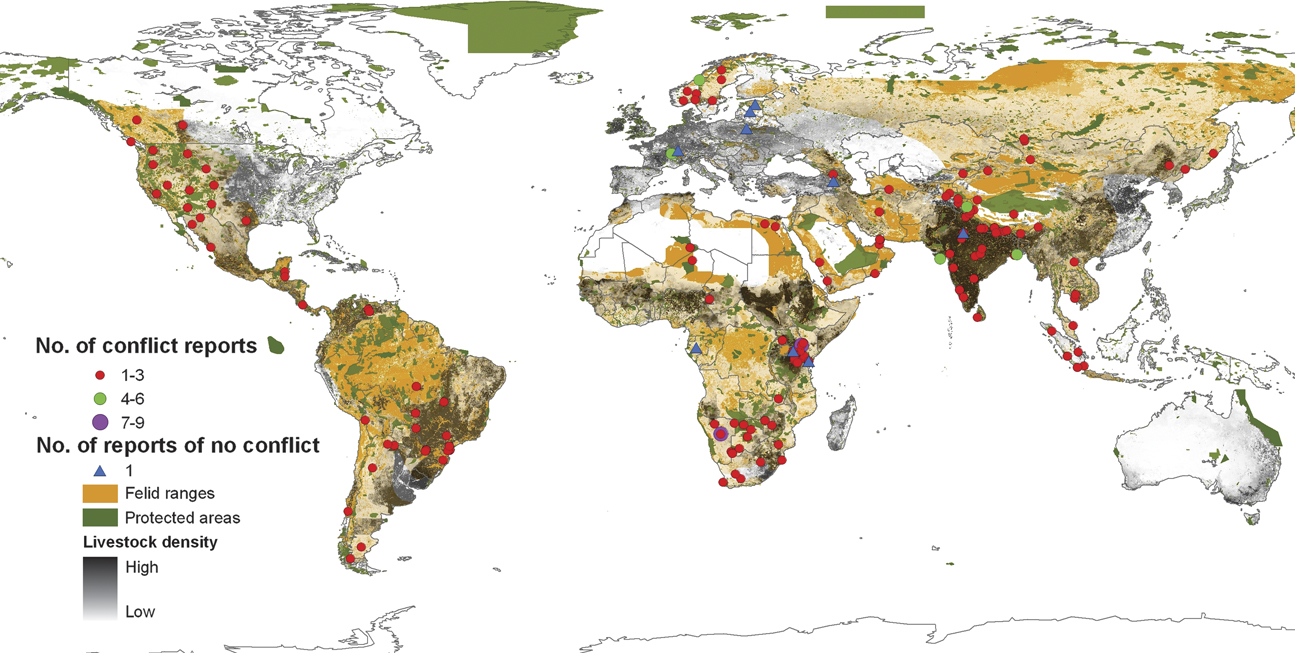
Geographical distribution of conflict Locations at which the presence (n = 176) or absence (n = 9) of conflict with at least one felid species has been reported were identified from the literature and mapped. They are presented for each felid species (Fig. 5) and globally (Fig. 6). Fig. 6 highlights a degree of clustering in the location of research efforts and also provides an illustration of the distribution of felid species and conflict in relation to livestock density and the number and distribution of protected areas.
Locations for which there is evidence of conflict or no conflict in the literature reviewed for each of the nine felid conflict species. Red circles denote conflict locations; yellow diamonds denote locations with no conflict. For details of felid range data sources see Appendix 1.

Global overview of locations for which conflict (circles) or no conflict (triangles) have been reported in the literature reviewed. At each location mapped there may be conflict with more than one felid species and there may be reports of both conflict and no conflict at a given location as these will be for different species. The number of reports per location is detailed to provide an indication of the clustering of research efforts to date. Livestock density data represent the density of cattle and small ruminants globally as these are the most commonly attacked species. For data sources see Appendix 1.

Determinants of conflict
A multitude of factors influence the occurrence and scale of conflict. Because of the extent and complexity of these factors a comprehensive review is beyond the scope of this article, although we present the key findings and conclusions from the literature reviewed.
Habitat availability Increasing competition for space between humans and felids is the core factor underlying the occurrence of conflict. Habitat degradation is currently one of the greatest threats to the survival of large felid species worldwide (Mazzolli et al., Reference Mazzolli, Graipel and Dunstone2002) and certain felids, such as lions, are increasingly restricted to protected areas (Loveridge, Reference Loveridge, Loveridge, Lynam and Macdonald2002). However, few protected areas are of a size sufficient to host viable large carnivore populations (Breitenmoser et al., Reference Breitenmoser, Angst, Landry, Breitenmoser-Würsten, Linnell, Weber, Woodroffe, Thirgood and Rabinowitz2005). Large carnivores, including large felids, have extensive home-ranges that frequently extend beyond reserve borders into human-dominated areas. Consequently, conflict can become particularly acute in reserve border areas and may result in such areas becoming population sinks (Woodroffe & Ginsberg, Reference Woodroffe and Ginsberg1998). Conflict also affects species such as cheetah and Eurasian lynx that, across all or parts of their ranges, are found predominantly outside protected areas (Marker et al., Reference Marker, Mills and Macdonald2003b; Andrén et al., Reference Andrén, Linnell, Liberg, Andersen, Danell and Karlsson2006). In certain locations, for example the Russian Far East, a lack of protected areas is of particular concern for the survival of felids (Miquelle et al., Reference Miquelle, Nikolaev, Goodrich, Litvinov, Smirnov, Suvorov, Woodroffe, Thirgood and Rabinowitz2005) yet, paradoxically, the establishment of protected areas can increase conflict (Johnson et al., Reference Johnson, Eizirik, Lento, Woodroffe, Thirgood and Rabinowitz2005; Wang & Macdonald, Reference Wang and Macdonald2006).
Wild prey availability Availability of wild prey affects the potential for conflict with each of the conflict felids. Depredation rates tend to be higher in areas where, or at a time of year when, wild prey is less abundant (Saberwal, Reference Saberwal, Chellam, Johnsingh and Rodgers1990; Nowell & Jackson, Reference Nowell and Jackson1996; Pedersen et al., Reference Pedersen, Linnell, Andersen, Andrén, Lindén and Segerstöm1999; Polisar et al., Reference Polisar, Maxit, Scognamillo, Farrell, Sunquist and Eisenberg2003; Athreya et al., Reference Athreya, Thakur, Chaudhuri and Belsare2004; Bagchi & Mishra, Reference Bagchi and Mishra2006; Johnson et al., Reference Johnson, Vongkhamheng, Hedemark and Saithongdam2006; Melville & Bothma, Reference Melville and Bothma2006). However, in Norway and the French Jura, high depredation rates by Eurasian lynx on domestic sheep have been linked with an abundance of wild prey (Stahl et al., Reference Stahl, Vandel, Herrenschmidt and Migot2001a; Herfindal et al., Reference Herfindal, Linnell, Moa, Odden, Austmo and Andersen2005). The frequency of attacks on people by lions and tigers has also been linked with low prey availability (Jackson, Reference Jackson1991; Reza et al., Reference Reza, Feeroz and Islam2002; Packer et al., Reference Packer, Ikanda, Kissui and Kushnir2005).
Livestock husbandry and management In many locations poor husbandry and management practices are in part responsible for high levels of livestock depredation (Mishra et al., Reference Mishra, Allen, McCarthy, Madhusudan, Bayarjargal and Prins2003; Thirgood et al., Reference Thirgood, Woodroffe, Rabinowitz, Woodroffe, Thirgood and Rabinowitz2005). Poor guarding or herding practices, the location of grazing pastures, often in close proximity to, or within, felid habitat (Weber & Rabinowitz, Reference Weber and Rabinowitz1996; Rao et al., Reference Rao, Maikhuri, Nautiyal and Saxena2002; Herfindal et al., Reference Herfindal, Linnell, Moa, Odden, Austmo and Andersen2005; Rabinowitz, Reference Rabinowitz, Woodroffe, Thirgood and Rabinowitz2005; Kolowski & Holekamp, Reference Kolowski and Holekamp2006) and inadequate, or a lack of, pens in which to keep livestock at night (Jackson, Reference Jackson1999; Wang & Macdonald, Reference Wang and Macdonald2006) are the primary reasons for this.
Human behaviour and activity patterns The majority of attacks on people occur when they venture into felid habitat (Sanyal, Reference Sanyal, Tilson and Seal1987; Weiler, Reference Weiler1998; McDougal, Reference McDougal1999; Reza et al., Reference Reza, Feeroz and Islam2002; Mukherjee, Reference Mukherjee2003) or when they are tending domestic animals or crops (Vijayan & Pati, Reference Vijayan and Pati2002; Nyhus & Tilson, Reference Nyhus and Tilson2004a). Hunting of felids (Maddox, Reference Maddox2003) and sleeping outside or in makeshift huts during summer months (Vijayan & Pati, Reference Vijayan and Pati2002; Packer et al., Reference Packer, Ikanda, Kissui and Kushnir2005) have been linked with increased risk of attack, and clustering of attacks around Gir Forest, India, has been linked to sites previously used for the baiting of lions for the tourism industry (Saberwal et al., Reference Saberwal, Chellam, Johnsingh and Rodgers1990).
Socio-economic determinants A complex, varied and dynamic combination of socio-cultural factors affect the human dimension of human-felid conflict. Attitudes (Athreya et al., Reference Athreya, Thakur, Chaudhuri and Belsare2004; Rabinowitz, Reference Rabinowitz, Woodroffe, Thirgood and Rabinowitz2005; Zimmermann et al., Reference Zimmermann, Walpole and Leader-Williams2005; Ramoñach et al., Reference Ramoñach, Lindsey and Woodroffe2007), perceptions (Macdonald & Sillero-Zubiri, Reference Macdonald, Sillero-Zubiri, Loveridge, Lynam and Macdonald2002; Marker et al., Reference Marker, Mills and Macdonald2003b; Madden, Reference Madden2004), belief systems (Hussain, Reference Hussain2002; Nugraha, Reference Nugraha2005), educational and value systems (Shivik et al., Reference Shivik, Treves and Callahan2003), religion (Ale et al., Reference Ale, Yonzon and Thapa2007), and the economic importance of livestock to a community (Bagchi & Mishra, Reference Bagchi and Mishra2006) can determine tolerance levels and govern the type and severity of human response to felids. Attitudes and perceptions in particular may distort the scale of conflict (Conforti & Azevezo, Reference Conforti and Azevedo2003; Marker et al., Reference Marker, Dickman, Mills and Macdonald2003a; Silva-Rodríguez et al., Reference Silva-Rodríguez, Ortega-Solis and Jiménez2007) causing people to take retributive action that is disproportionate to the actual scale of the problem. Little information is available regarding the human aspect of conflict in many locations but a number of studies (Oli et al., Reference Oli, Taylor and Rogers1994; Saberwal et al., Reference Saberwal, Gibbs, Chellam and Johnsingh1994; Weiler, Reference Weiler1998; Sekhar, Reference Sekhar1998; Hussain, Reference Hussain2000; Reza et al., Reference Reza, Feeroz and Islam2002; Maddox, Reference Maddox2003; Casey et al., Reference Casey, Krausman, Shaw and Shaw2005; Rabinowitz, Reference Rabinowitz, Woodroffe, Thirgood and Rabinowitz2005; Altrichter et al., Reference Altrichter, Boaglio and Perovic2006; Silva-Rodrigez et al., Reference Silva-Rodríguez, Ortega-Solis and Jiménez2007) indicate significant geographical variation in attitudes towards felid species and their habitats. Wealth may also in part determine the number of livestock lost and consequently how losses are distributed throughout a community. For example, Saberwal et al. (Reference Saberwal, Gibbs, Chellam and Johnsingh1994) found that poorer villagers around the Gir Forest, India, lost substantially more livestock to depredation than wealthier villagers who could afford better husbandry and protective measures for their animals.
Spatial determinants Landscape characteristics that influence the occurrence or scale of conflict have been documented for eight of the conflict species (all except caracal). There is a general consensus that depredation increases with increasing proximity to natural habitat types that provide suitable cover for felids (Mizutani, Reference Mizutani1995; Rao et al., Reference Rao, Maikhuri, Nautiyal and Saxena2002; Stahl et al., Reference Stahl, Vandel, Ruette, Coat, Coat and Balestra2002; Vijayan & Pati, Reference Vijayan and Pati2002; Athreya et al., Reference Athreya, Thakur, Chaudhuri and Belsare2004; Madhusudan, Reference Madhusudan2003; Nugraha, Reference Nugraha2005; Michalski et al., Reference Michalski, Boulhosa, Faria and Peres2006; Woodroffe et al., Reference Woodroffe, Frank, Lindsey, ole Ranah and Romañach2007). Depredation rates also tend to decrease with increasing proximity to human habitation (Sunde et al., Reference Sunde, Overskaug and Kvam1998; Mazzoli et al., Reference Mazzolli, Graipel and Dunstone2002; Rao et al., Reference Rao, Maikhuri, Nautiyal and Saxena2002; Stahl et al., Reference Stahl, Vandel, Ruette, Coat, Coat and Balestra2002; Kolowski & Holekamp, Reference Kolowski and Holekamp2006; Michalski et al., Reference Michalski, Boulhosa, Faria and Peres2006). The effect of other landscape characteristics, for example crop type (Vijayan & Pati, Reference Vijayan and Pati2002) or features for which a felid species may have a particular affinity such as play trees (Marker et al., Reference Marker, Mills and Macdonald2003b), water bodies (Johnson et al., Reference Johnson, Vongkhamheng, Hedemark and Saithongdam2006; Michalski et al., Reference Michalski, Boulhosa, Faria and Peres2006), steep rocky slopes (Stahl et al., Reference Stahl, Vandel, Ruette, Coat, Coat and Balestra2002) or cliffs (Jackson et al., Reference Jackson, Ahlborn, Gurung, Ale, Timms and Crabb1996), on rates of depredation, attacks on humans or retaliatory killing, receive less attention in the literature, making the identification of further trends difficult. However, reports indicate a degree of inter-specific variation in the influence of landscape characteristics, as would be expected from species’ differing ecological habits.
Other determinants of conflict Many species- or location-specific factors influence the scale of conflict but consistent patterns could not be identified. Temporal patterns of conflict, predominantly in livestock depredation, have been described for all of the conflict felids (Oli et al., Reference Oli, Taylor and Rogers1993, Reference Oli, Taylor and Rogers1994; Jackson, Reference Jackson1999; Bauer & Kari, Reference Bauer and Kari2001; Nybakk et al., Reference Nybakk, Kjelvik, Kvam, Overskaug and Sunde2002; Madhusudan, Reference Madhusudan2003; Polisar et al., Reference Polisar, Maxit, Scognamillo, Farrell, Sunquist and Eisenberg2003; Melville et al., Reference Melville, Bothma and Mills2004; Mohd-Azlan & Sharma, Reference Mohd. Azlan and Sharma2006) but they are extremely varied and even differ between populations of the same species. For example, leopard attacks on livestock occur at night around Kenya's Maasai Mara National Park (Kolowski & Holekamp, Reference Kolowski and Holekamp2006) yet in Laikipia they also occur during the day (Woodroffe et al., Reference Woodroffe, Frank, Lindsey, ole Ranah and Romañach2007). Other highly specific conflict determinants include: particular felid behaviours and adaptations (Jobin et al., Reference Jobin, Molinari and Breitenmoser2000), poor anti-predatory behaviour of livestock (Srivastaav, Reference Srivastav1997), environmental phenomena such as drought and floods (Frank & Woodroffe, Reference Frank, Woodroffe, Loveridge, Lynam and Macdonald2002; Hoogesteijn & Hoogesteijn, 2007), and a lack of wildlife knowledge in communities with whom there is conflict (Hunter et al., Reference Hunter, Jowkar, Ziaie, Schaller, Balme and Walzer2007). Unsuccessful mitigation techniques have also been known to exacerbate conflict levels (Athreya et al., Reference Athreya, Thakur, Chaudhuri and Belsare2004).
Human-felid conflict management
A detailed review of conflict management strategies is beyond the scope of this article. However, we observed that 110 conflict management attempts were documented in 74 literature sources; of which 31% had been evaluated and the results documented in the primary literature (Table 4).
Implemented and evaluated human-felid management strategies as documented in the literature reviewed. Each technique employed at a location is classed as an attempt. A literature source may evaluate the success of more than one technique. Seventy-four literature sources included details of implemented mitigation techniques; 21 (28%) provided an evaluation of techniques. Overall, 31% of all implemented techniques were evaluated and the results published in the primary literature.

Discussion
Species affected & the extent of conflict
According to our review and classification, conflict affects 29 of the 37 felid species worldwide. The severity of conflict increases with felid species' body mass and is therefore of greatest significance for the conservation of the larger species. The only anomaly in this pattern is the caracal: despite having an average body mass of 17 kg we found human-caracal conflict to be of a moderate level, yet the slightly heavier bobcat (17.5 kg) is only affected by low levels of conflict. This may be explained by their prey preferences; the Lynx species are thought to have evolved to prey on lagomorphs (Jobin et al., Reference Jobin, Molinari and Breitenmoser2000) and bobcats specialize on cottontails (Sylvilagus spp.) and snowshoe hares (Lepus americanus; Sunquist & Sunquist, Reference Sunquist and Sunquist2002) and rarely attack livestock (Nowell & Jackson, Reference Nowell and Jackson1996; Neale et al., Reference Neale, Sacks, Jaeger and McCullough1998; Luna-Soria & López-González, Reference Luna-Soria and López-González2005). Caracals, while also preferring small mammal prey, have broader diets than bobcat and are capable of killing larger prey such as springbok Antidorcas marsupialis or young kudu Tragelaphus imberbis and T. strepsiceros (Nowell & Jackson, Reference Nowell and Jackson1996). We also classed conflict with both clouded leopard species (21 kg) as being of a low level as we could find few reports on depredation; however, the lack of information about these species makes this a tentative conclusion.
Spatial, taxonomic & socio-economic patterns of conflict
Reviewing conflicts between humans and mammalian and avian predators, Graham et al. (Reference Graham, Beckerman and Thirgood2005) found that resolution of trends was limited by inconsistent and sparse data, and highlighted the need for a consistent framework for assessing and managing human-predator conflicts that involve game and livestock species. Even at the more specific taxonomic level of our review, meta-analysis was not possible because of inconsistent reporting methods and disparity in the spatial scale of reports, making data generally incomparable either within or between felid species. A lack of comparable data particularly hampered our attempts to identify patterns and trends in livestock depredation. It appears, however, that while for some species, such as Eurasian lynx, there is variation in the number of livestock killed across their range, for others such as jaguars or snow leopards, the numbers killed are more consistent. No further trends were identified. Similarly, the varied economic reporting methods meant that comparing economic loss across locations, to identify those communities most greatly affected financially by conflict, was not possible.
The consistency in reporting technique was greater for data concerning attacks on humans and retaliatory killing than for livestock depredation, and again indicates geographical and inter-specific variation in attack and persecution rate. Although it has not been possible to identify further trends in retaliatory killings worldwide, it is apparent that persecution remains a significant threat to the nine conflict felids. For example, conflict is a principal threat to cheetahs in nine range countries in Africa and Asia (Marker, Reference Marker and Penzhorn1998), the lion population in Laikipia, Kenya, is regulated by lethal control in response to livestock depredation, rather than natural mortality rates (Woodroffe & Frank, Reference Woodroffe and Frank2005), and the retaliatory killing of snow leopards by farmers in Baltistan, Pakistan, poses a significant threat to the species' survival in the region (Hussain, Reference Hussain2000). In most parts of species' ranges however, the extent of retaliatory killing is unknown (Hussain, Reference Hussain2003; Breitenmoser et al., Reference Breitenmoser, Breitenmoser-Würsten, Mörschel, Zananashvili and Sylvén2007).
Factors that determine the scale of conflict
The factors that determine the nature of a conflict are diverse. As many of these are location- or species-specific, a unique combination of factors determines the nature of a given conflict. The socio-economic factors fundamental to the human dimension of conflict, and that ultimately determine the scale of a given conflict, can be particularly varied, and identification of these factors is difficult. For example, in Scandinavia, although economic loss provides a proximate reason for killing felids, it is apparent that retaliation results from a general antipathy for the Eurasian lynx (Andrén et al., Reference Andrén, Linnell, Liberg, Andersen, Danell and Karlsson2006), and other cultural or economic influences such as traditional lion hunts, or Olamayio, in Kenya (Frank et al., Reference Frank, Maclennan, Hazzah, Bonham and Hill2006), or the potential to derive income from the sale of tiger body parts (Karanth & Gopal, Reference Karanth, Gopal, Woodroffe, Thirgood and Rabinowitz2005; Nugraha, Reference Nugraha2005), must also be taken into consideration.
The scope of human-felid conflict literature
The amount and quality of human-felid conflict-related literature per species increased with felid body weight and therefore information about the smaller felid species with which conflicts are also likely is scarce. For example, ocelot Leopardus pardalis, margay L. weidi, jaguarundi Herpailurus yagouaroundi and Geoffroy's cat Oncifelis geoffroyi have a propensity to kill poultry but there is no published research to clarify the occurrence, extent or scale of the conflict (T. de Oliveira, pers. comm.).
Research has focused more on livestock depredation than attacks on people, persecution or game depredation, yet the economic impact of livestock depredation is rarely quantified. When it is, only the direct financial costs of livestock depredation are considered. However, it is recognized that economic losses can be catastrophic, particularly as they are often not evenly distributed throughout a community (Thirgood et al., Reference Thirgood, Woodroffe, Rabinowitz, Woodroffe, Thirgood and Rabinowitz2005). There are also few instances in which the impacts of conflict are placed in a wider context through comparison with, for example, other factors that may limit livestock production (Hoogesteijn et al., Reference Hoogesteijn, Hoogesteijn and Mondolfi1993; Schiess-Meier et al., Reference Schiess-Meier, Ramsauer, Gabanapelo and König2007), human deaths caused by other wildlife or domestic dogs (Beier, Reference Beier1991), or natural or accidental (e.g. collisions with cars) causes of felid mortality (Marker et al., Reference Marker, Dickman, Mills and Macdonald2003a; Marker & Dickman, Reference Marker and Dickman2004; Miquelle et al., Reference Miquelle, Nikolaev, Goodrich, Litvinov, Smirnov, Suvorov, Woodroffe, Thirgood and Rabinowitz2005).
A geographical analysis of human-felid conflict research efforts shows that there are vast areas of felid ranges for which no information on conflict is available and also that accurate distribution data for many species are not readily available (e.g. there are discrepancies between the caracal range data we were able to access, and the reported conflict locations for the species; Fig. 5d), which may hinder efforts to target future human-felid conflict research effectively. Additionally, obtaining accurate conflict data can be challenging as people may not be willing or able to report an accurate offtake by felids (A. Zimmermann, unpubl. data) or readily divulge whether they kill felids (Allen et al., Reference Allen, McCarthy, Bayarjargal, Chapron and Moutou2002), and it can be difficult to determine the cause of livestock deaths (Madhusudan, Reference Madhusudan2003).
Conflict management: implementation & evaluation
We grouped the large and diverse number of conflict management techniques into 12 categories depending on the type of technique involved. The effectiveness of techniques varies and, over time, shifts in the types of techniques have occurred. Historically, lethal control was the dominant type of conflict management. It is still used in the USA and Europe to control puma and Eurasian lynx populations respectively, despite questions about the effectiveness of such measures (Sunde et al., Reference Sunde, Overskaug and Kvam1998; Stahl et al., Reference Stahl, Vandel, Herrenschmidt and Migot2001b; Hoogesteijn, Reference Hoogesteijn2003; Herfindal et al., Reference Herfindal, Linnell, Moa, Odden, Austmo and Andersen2005). More recently, compensation schemes have been the most commonly implemented strategy but have largely been unsuccessful. Other financial techniques such as insurance and economic incentive or development schemes are now being more heavily relied upon (Hussain, Reference Hussain2000; Jackson & Wangchuk, Reference Jackson and Wangchuk2004), and preliminary results indicate that economic incentive schemes in particular are achieving success (Mishra et al., Reference Mishra, Allen, McCarthy, Madhusudan, Bayarjargal and Prins2003). The use of guarding or herding dogs is one of the most consistently successful livestock husbandry-related techniques (Vandel et al., Reference Vandel, Stahl, Durand, Balestra and Raymond2001; Ogada et al., Reference Ogada, Woodroffe, Oguge and Frank2003; Marker et al., Reference Marker, Dickman and Schumann2005a,Reference Marker, Dickman and Macdonaldb,Reference Marker, Dickman and Macdonaldc). Conversely, translocations are generally ineffective (c.f. Linnell et al., Reference Linnell, Aanes and Swenson1997) and may even aggravate conflict levels (Athreya et al., Reference Athreya, Thakur, Chaudhuri and Belsare2004).
It is also apparent that little rigorous scientific information about the success and failings of the techniques is available. Thorough monitoring and evaluation of implemented management techniques is essential if practitioners are to identify the most successful and efficient methods of managing conflict, yet by our calculation only 31% of implemented techniques have been thoroughly evaluated and the results made available to the conservation community through publication. This number may in reality be even lower as it is likely that conflict mitigation techniques are being employed in more places than documented in the literature.
Conclusion
Human-felid conflict is a complex and multifaceted issue, the management of which is a key conservation priority for at least nine felid species. Many different conflict management strategies have been implemented worldwide, with varying degrees of success. To address conflict more effectively, practitioners must develop culturally acceptable, sustainable solutions, developed using not only sound scientific research but the practical field experience of other practitioners. Such solutions must aim to accommodate the requirements of both felids and people and reduce the costs incurred by both as a result of conflict.
We have highlighted three needs that are fundamental to the development of successful management strategies. Firstly, the development of standardized reporting techniques to allow comparison of the scale of conflict between locations and between species. This is particularly required for livestock depredation, which is the most commonly reported aspect of conflict but for which there is the greatest disparity in reporting methods. The reporting of livestock losses to a particular predator as a proportion of total holdings, for example, would facilitate comparisons between livestock owners at all economic scales, and would also indicate where losses have the greatest financial impact.
Secondly, although general principles can be applied to conflict management strategies worldwide, variation in the determinants of conflict at each location dictates that strategies must be situation-specific. For example, while the effects of certain conflict determinants, such as habitat availability, appear uniform across species, and other determinants such as wild prey availability are a common influence on conflict severity, variation in the spatial, temporal and socio-economic determinants of conflict is evident, making each conflict situation unique. A thorough exploration of the conflict determinants at each location is therefore essential, and must result in a management strategy tailored to the situation to achieve maximum impact.
Thirdly, implemented management techniques should be evaluated rigorously and the results, even if they are negative, made available through publication. Communication between conflict practitioners is also essential for the transfer of knowledge regarding the successes and failures of applied techniques.
We have also highlighted a number of gaps in knowledge that must also be addressed if conflict management techniques are to become more efficient and effective. We propose that future research efforts should therefore:
• Seek to clarify the extent of conflict with the smaller felid species, and the species for which we currently have little information, such as the clouded leopards.
• Target range areas for which we currently have no information, to provide a range-wide overview of conflict for each species. Such efforts will be aided by accurate distribution data for felid species and, where not already available, efforts should be made to determine current species' distributions and the data made widely available.
• Focus more on understanding the patterns, trends and extent of attacks on people by felids worldwide.
• Investigate the extent to which game depredation by felids incites conflict, and the locations and felid species for which it is of greatest significance.
• Aim to understand better the human dimensions of conflict, and particularly the socio-economics, through greater collaboration with the social sciences.
• Quantify the extent of persecution of felids and assess its impact on felid population dynamics in those areas for which there is currently no information.
If the needs and knowledge gaps identified by this review are addressed, the knowledge gathered will increase our understanding of the scale, occurrence and determinants of conflict worldwide. It will enable the more effective allocation of resources to target those species for which conflict is of greatest threat and/or the particular locations where conflict is having the greatest impact on both humans and felid species. Ultimately, the impact of implemented conflict management techniques will be increased, strengthening conservation efforts for members of the Felidae.
Acknowledgements
Funding for this research was provided by the North of England Zoological Society (Chester Zoo). Our particular thanks go to Scott Wilson for his invaluable GIS tuition and to Drs Lesley Morrell and Paul Johnson for their advice and assistance with statistical analysis. We would also like to thank Dr Alexander Sliwa, Dr Jim Sanderson, James Murdoch, Steve Ross, Tadeu de Oliveira and Anna Barashkova for the information on many of the smaller felid species.
Appendices 1-4
The appendices for this article are available online at http://journals.cambridge.org
Biographical sketches
Chloe Inskip is carrying out research on human-carnivore conflicts in tropical forest habitats. At the time of writing she was based at Chester Zoo, UK, assisting with the development and coordination of the Zoo's felid conservation programmes. She is interested in wild cat conservation, and in particular, human-felid conflict. Alexandra Zimmermann specializes in human-wildlife conflicts, both in theory and practice. Having worked on jaguar conflict in Brazil and developed a successful long-term human-elephant conflict mitigation programme in India, her current research focuses on conflict dynamics, and conceptual models for best practice in conflict mitigation, in particular for large cats and elephants. For the past decade she has developed conservation programmes for Chester Zoo in the UK and is now based at the Wildlife Conservation Research Unit, Oxford University, UK.