

A defining characteristic of American politics, and of many democracies across the globe, is the political under-representation of women (Fox and Lawless Reference Fox and Lawless2023; Persson, Schakel, and Sundell Reference Persson, Schakel and Sundell2024; Thomsen and King Reference Thomsen and King2020). In particular, women are significantly less likely to run for office than their male counterparts. Such disparities have important implications. Indeed, more women holding office is linked with greater attention to issues such as education, childcare, and abortion (Funk and Philips Reference Funk and Philips2019; Swers Reference Swers2001), as well as more collaborative and productive lawmaking (Holman, Mahoney, and Hurler Reference Holman, Mahoney and Hurler2022; Volden, Wiseman, and Wittmer Reference Volden, Wiseman and Wittmer2013). More broadly, a dearth of female politicians can, via diminished descriptive representation, and thus a lack of attention to women’s lived experiences, undermine the legitimacy of policy decisions (Clayton, O’Brien, and Piscopo Reference Clayton, O’Brien and Piscopo2019; Mansbridge Reference Mansbridge1999).Footnote 1
Given the importance of this topic, a vast and insightful literature (primarily, but not exclusively, in the US) has focused on reasons why women do not run for office (e.g., Ashworth, Berry, and Bueno de Mesquita Reference Ashworth, Berry and de Mesquita2024). These include fears about how “ambitious women” may be perceived by voters (Bauer, Harman, and Russell Reference Bauer, Harman and Russell2024; Ditonto, Hamilton, and Redlawsk Reference Ditonto, Hamilton and Redlawsk2014; Saha and Weeks Reference Saha and Weeks2022), pre-adult socialization processes that reinforce the idea that politics is a “man’s domain” (Bos et al. Reference Bos, Greenlee, Holman, Oxley and Lay2022; Clayton, O’Brien, and Piscopo Reference Clayton, O’Brien and Piscopo2024; Fox and Lawless Reference Fox and Lawless2014), women’s self-doubt regarding their qualifications (Bauer Reference Bauer2020; Fox and Lawless Reference Fox and Lawless2011; Fox and Pate Reference Fox and Pate2023), women’s aversion to the competitive nature of elections and politics (Kanthak and Woon Reference Kanthak and Woon2015; Preece, and Stoddard Reference Preece and Stoddard2015; Schneider et al. Reference Schneider, Holman, Diekman and McAndrew2016), and greater unwillingness, be this real or perceived, of political parties to actively recruit and support female candidacies (Butler and Preece Reference Butler and Preece2016; Crowder-Meyer and Cooperman Reference Crowder-Meyer and Cooperman2018; Fox and Lawless Reference Fox and Lawless2010; Thomsen and Swers Reference Thomsen and Swers2017). Relatedly, studies have, often via experiments that vary exposure to stimuli such as media depictions of gender discrimination, portrayals of women lacking political power, and/or signals from elites about the importance of electing more women, considered ways to address this (Clayton, O’Brien, and Piscopo Reference Clayton, O’Brien and Piscopo2023; Haraldsson Reference Haraldsson2022; Karpowitz, Monson, and Preece Reference Karpowitz, Monson and Preece2017).
However, even absent such experimental treatments, a non-trivial number of women are politically ambitious and opt to run for office. Indeed, we know far less about why some women, particularly those in the general population, ultimately do run for office (but see, e.g., Crowder-Meyer Reference Crowder-Meyer2020), relative to, for example, why women exhibit less political ambition than their male counterparts. I contribute to this literature by focusing here on labor union membership, arguing that it is an important, and heretofore, under-explored factor that can spur women’s political ambition and their likelihood of running for office.Footnote 2
I advance a theory of labor unions as a source of political ambition and test this among women, who, as previously noted, are significantly less likely to run for office than their male counterparts. I also conduct my main empirical tests among women, rather than among the full population. I do so because of the importance of gender disparities (in political ambition) for representative democracy and public policy, and because of a long-standing scholarly interest in understanding the drivers of women’s political ambition (or lack thereof).
I test this relationship in the United States, a country where considerable progress has been made, but also one in which gender disparities in political ambition and office holding remain. I do so primarily with data from the 2010–22 Cooperative Election Studies (CES), a large-scale nationally representative internet survey of the American mass public that contains several hundred thousand observations. These data thus permit statistically valid tests of an infrequent outcome — running for political office.
Overall, I find evidence of a positive and substantively significant relationship between labor union membership and women’s likelihood of having run for political office. These findings contribute to the literature by focusing more attention on why some women do run for office, rather than on why many women abstain from doing so. They also help us to better understand the factors that promote political ambition and office-seeking among ordinary women (Crowder-Meyer Reference Crowder-Meyer2020), meaning members of the general population rather than among individuals in elite occupations (Fox and Lawless Reference Fox and Lawless2005). They also underscore the mass-level political consequences of labor unions in the United States, a diminished, but still relevant organization in American politics.
Labor Unions as a Source of Political Ambition
I argue that there are several potential mechanisms through which labor unions can promote office-seeking behavior. These include myriad opportunities to develop civic skills and a stronger sense of political efficacy, as well as explicit recruitment efforts by union leadership organizations. I do not view unions as solely promoting office-seeking behavior via one mechanism over another; indeed, both a sense of self-confidence in one’s abilities and qualifications (e.g., Lawless and Fox Reference Lawless and Fox2010) as well as recruitment efforts and encouragement to run (e.g., Carroll and Sanbonmatsu Reference Carroll and Sanbonmatsu2013) are important drivers of whether women (my population of interest), seek to run for office. Rather, I merely seek to articulate several plausible mechanisms.
Importantly, I do not view labor unions’ ability to facilitate political ambition, and by extension, office-seeking behavior, as being confined to women, nor do I seek to advance a specific “gendered” theory. Rather, I argue that labor unions should be able to promote political ambition in general and seek to test this among women, a group that has long been underrepresented among those individuals who seek and win office in the United States. This approach is not dissimilar from a recent paper that focuses on the mass-level political consequences of labor unions in the United States (Macdonald Reference Macdonald2021b). In that paper, the author examines the relationship between labor union affiliation and partisanship among white Americans. He specifically does this by advancing a theoretical argument, one that applies to Americans broadly, linking labor union affiliation with Democratic Party support and applies it to white people. In a similar vein, I advance a general theoretical argument about how labor unions can serve as a source of political ambition, and by extension lead people to run for office, and apply it to women in the United States.
Labor unions exist (in theory) to increase the wages, benefits, and bargaining power of the working classes, relative to the management class and business interests (Freeman and Medoff Reference Freeman and Medoff1984; Lichtenstein Reference Lichtenstein2002; Rosenfeld Reference Rosenfeld2014). In pursuing these aforementioned objectives, the extent to which they are successful in achieving them notwithstanding, labor unions seek to attain political power. In doing so, labor unions frequently communicate with and mobilize their rank-and-file membership (e.g., Ahlquist and Levi Reference Ahlquist and Levi2013; Flavin and Radcliff Reference Flavin and Radcliff2011; Kerrissey and Schofer Reference Kerrissey and Schofer2018). This can occur throughout the course of high-profile electoral campaigns as unions seek to ensure that their supporters “vote the party line,” as well as on a more daily basis, including via formal meetings, informal discussions, and various communications from leadership to the rank-and-file — for example, newsletters, emails, text messages, etc. (e.g., Macdonald Reference Macdonald2021a).
These various machinations mean that union-affiliated individuals are, relative to their non union-affiliated counterparts, more likely to be exposed to an environment that can foster political ambition. I argue that this can occur through various mechanisms, including more frequent opportunities to develop civic skills, direct appeals from leadership to vote during election years, and efforts by labor unions to specifically recruit and support potential candidates, among their membership, for elected office. While these are certainly not the only ways through which labor unions can cultivate political ambition among their membership, they are certainly plausible avenues through which this can occur. This theoretical argument and the various associated mechanisms also jibe with and build upon work by Kerrissey and Schofer (Reference Kerrissey and Schofer2013, 898) who write that “unions intentionally cultivate organizational and civic skills among their members as a means to achieve both organizational and political goals.” This argument is also consistent with more recent work by Lyon, Hemphill, and Jacobsen (Reference Lyon, Hemphill and Jacobsen2024, 228) who write that “a member’s individual political awareness, ambition, and support develops as unions pursue their own organizational interests.”
In a report for the Economic Policy Institute (EPI), Hertel-Fernandez (Reference Hertel-Fernandez2020) argues that the workplace remains an important place for people to learn and practice civic skills and suggests that these opportunities are more likely to be present for union members. Indeed, data from an associated survey, the 2019 Workplace Political Participation Study, shows that 46% of non unionized workers report ever having “engaged in public speaking” compared to 56% of unionized workers. The differences are broadly similar for several other activities, including: “convincing others of an argument” (47% non union vs. 56% union), “managing a team” (52% non union vs. 64% union), and “fundraising or asking people for money” (21% non union vs. 46% union). Indeed, Hertel-Fernandez (Reference Hertel-Fernandez2020, 3) further writes that “when workers exercise voice and input on the job, workers should gain a greater interest in doing so outside of the workplace in politics.” This echoes work by Budd, Lamare, and Timming (Reference Budd, Lamare and Timming2018), who found, examining survey data from 27 European countries, a positive relationship between participation in decision-making in the workplace and broader political engagement. Such findings are consistent with classic scholarship by Pateman (Reference Pateman1970), who emphasized the potential of the workplace to promote political efficacy, as well as with the resource model of political participation (Brady, Verba, and Scholzman Reference Brady, Verba and Schlozman1995), which identifies labor unions as the type of organization that can cultivate the civic skills necessary for political efficacy and engagement, and by extension, I argue, whether one develops the political ambition necessary to ultimately run for elected office.
In a study of Latino immigrant members of a janitors’ labor union (SEIU Local 1877) in Los Angeles, California, Terriquez (Reference Terriquez2011) finds that participation in union activities gave people the confidence and skills to participate in other activities outside of the union setting. This specifically included greater involvement in local education — for example, engaging in fundraising for school building improvements and voicing their opinions in parent-teacher association (PTA) meetings, something that otherwise similar non union-affiliated individuals were less likely to do. Terriquez attributes these findings to this labor union’s efforts to mobilize its membership for demonstrations, rallies, and protests, in addition to meetings run by union stewards that facilitated discussions and “collective problem solving around shared grievances or other workplace concerns” (Terriquez Reference Terriquez2011, 587). Terriquez also differentiates between “active” and “inactive” union members, finding that both groups were approximately as likely to participate in “plug-in” school activities that allow for more passive engagement, such as attending a school event where their child participated, attending a PTA meeting, and volunteering at their child’s school, but that “active” union members were significantly more likely to participate in “critical engagement” activities such as attending advisory meetings where parents helped make decisions about their children’s schools, and participating in a community meeting where people discussed the need to improve local public schools. Indeed, one woman in an open-ended interview said, “it [the union] has given me confidence, it has helped me defend myself and speak to other people,” while another woman said, “the union has helped me a lot, it’s helped me take charge when something’s wrong at the school,” and a third woman said, “the union teaches you how to work with others to resolve problems.” In short, Terriquez’s study, although not nationally representative, illustrates, in great depth, how labor unions have the potential to foster civic skills, alleviate the burdens of engaging in costly forms of participation, and, by extension, I argue, potentially fostering the kind of political ambition that could eventually lead someone to consider running for office.
Labor unions can also foster political ambition more directly, by recruiting members to run for office and supporting them when they do so. Indeed, one of the simplest reasons why people abstain from political participation is because “nobody asked” (Brady, Verba, and Schlozman Reference Brady, Verba and Schlozman1995; Rosenstone and Hansen Reference Rosenstone and Hansen1993). This should be especially true given the extraordinary costs of running for office. Accordingly, the AFL-CIO, the largest labor union organization in the United States, has, potentially recognizing the benefits of having more people in office with ties to organized labor, stepped up its efforts to do so — that is, to recruit and support more union-affiliated candidates (Terkel Reference Terkel2019).Footnote 3
Lyon, Hemphill, and Jacobsen (Reference Lyon, Hemphill and Jacobsen2024) illustrate these dynamics in-depth, via 32 interviews with teacher candidates for state office in the 2018 US midterm elections (half of whom were women). They find that teachers’ unions acted, via their bargaining activities and electoral mobilization efforts, as “schools of democracy” for these individuals by promoting (1) greater political awareness and information, (2) a sense of political efficacy and belief that running for office is neither impossible nor implausible, and (3) material resources, including formal training and financial support, for these individuals. Indeed, one teacher in this study said, “I would say being on the local union district council made running for political office more plausible for me. It made it something that wasn’t out of reach.” In short, Lyon, Hemphill, and Jacobsen’s study, its lack of a nationally representative sample aside, is insightful and strongly suggestive of labor unions’ capacity to foster political ambition.
Testing Potential Mechanisms
In Table 1, I test two potential mechanisms through which labor union membership and office-seeking behavior may be linked. I do so by using data from a University of Houston module on the 2018 CES (total N = 1,000). I regress two dependent variables, each reflecting a potential mechanism, on a measure of labor union membership (never vs. former/current) and a small set of demographic controls, including gender. I also interact union membership (never vs. former/current) and gender (male vs. female) in order to test whether these mechanisms significantly differ across men and women.
Potential mechanisms linking union membership and running for office
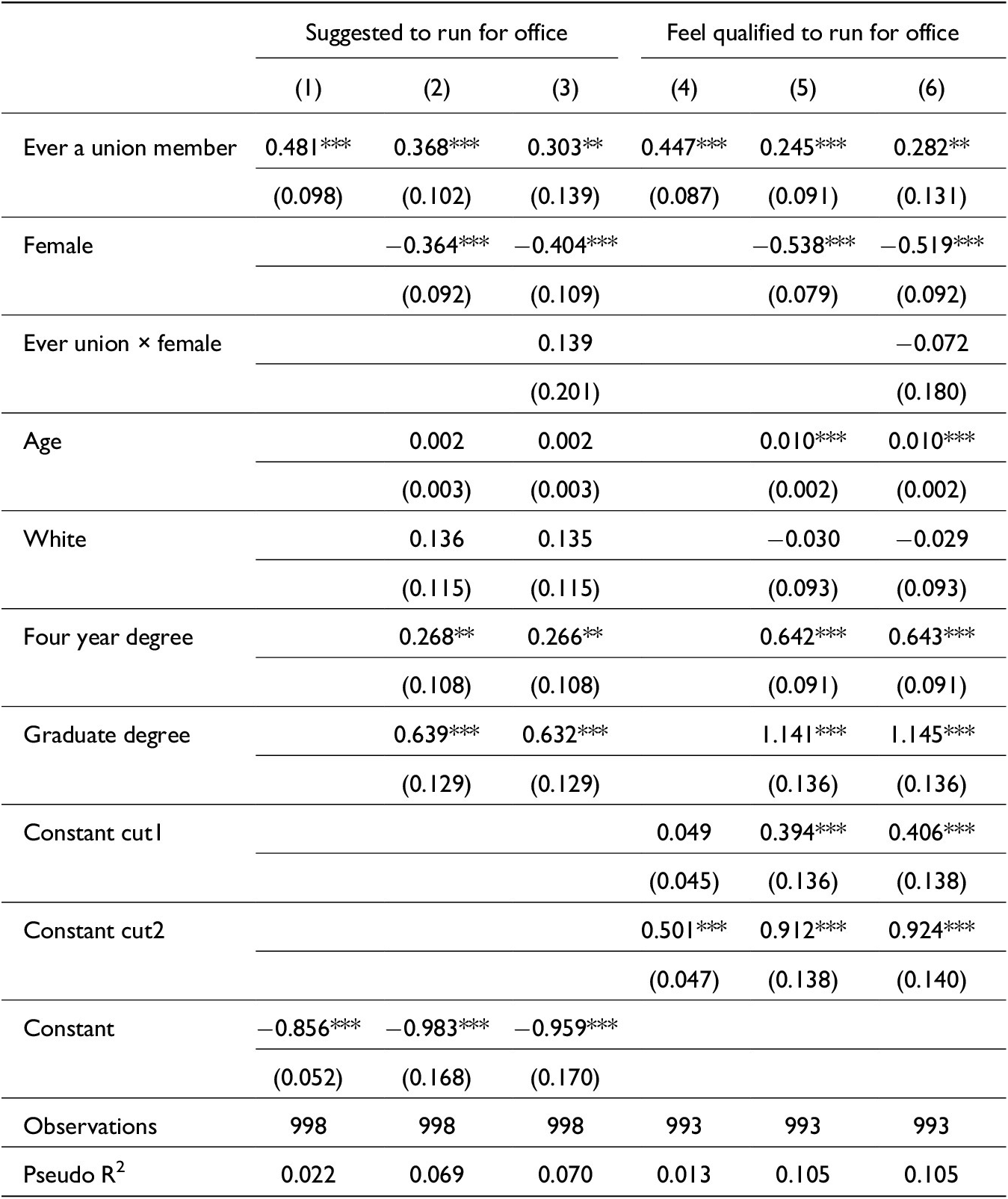
Note: Dependent variables are whether someone suggested the respondent run for office (0 = no; 1 = yes) and whether respondents feel qualified to run for office (1 = disagree; 2 = neutral; 3 = agree). Models 1–3 show probit coefficients. Models 4–6 show ordered probit coefficients. Robust standard errors are in parentheses.
Source: A team module from the University of Houston (total N = 1,000) on the 2018 CES.
*** p < 0.01, ** p < 0.05, * p < 0.1, two-tailed test.
Overall, the results in Table 1 show that union membership is significantly associated with whether anyone in a respondent’s life suggested that they consider running for office, implying a potential “recruitment” mechanism, and significantly associated with whether respondents personally feel qualified to run for political office, implying a potential “civic skill” and/or “political efficacy” mechanism. Moreover, this is true among both men and women, suggesting that the mechanisms linking union membership and running for office operate similarly across the general (US) population.
Collectively, the arguments and findings of past work, combined with the results in Table 1 support my broader theoretical argument — that is, that labor union membership has the potential to, via the cultivation of civic skills and various forms of direct political mobilization, foster political ambition, and, by extension, increase people’s likelihood of running for elected office. I focus here on the potential for labor unions to do this among women in the United States, given scholarly interest in the long-standing gender gap in political ambition and the continued under-representation of women in elected office.
Preliminary Evidence
In Table 2, I provide an initial and preliminary test of my hypothesis. If, as I argue, labor unions can act as a viable source of political ambition, then we should observe statistically significant mean differences in the probability of having run for office among people who have been a labor union member versus among people without such affiliation. I test this with survey data from the 2010–22 Cooperative Election Studies (CES).Footnote 4
Mean differences in having ever run for elective office by gender and labor union affiliation, 2010–22
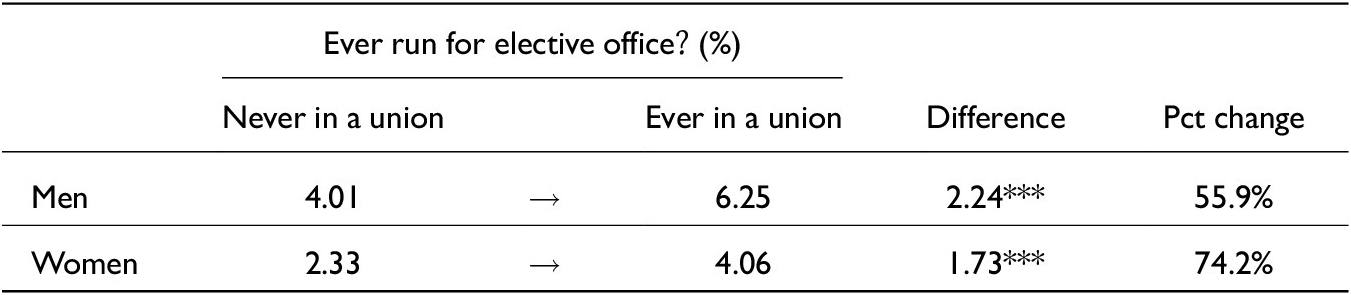
Note: Shows the percentage of respondents who report ever having run for elective office, split by gender and labor union affiliation, survey weights applied. The “Difference” column shows the absolute change (never in a union → ever in a union) for men and women while the “Pct Change” column shows the percent change (never in union → ever in a union) for men and women. Total N = 345,980.
Source: The 2010–22 CES, survey weights applied.
*** p < 0.01, ** p < 0.05, * p < 0.1, two-tailed test.
These data, which span a consequential period in American politics, are uniquely valuable because they ask an exceptionally large nationally representative sample of Americans (more than 300,000) whether they have ever run for elected office and ask about both current and former union membership. This large sample size is important here because (1) a distinct minority of the US mass public are union members (e.g., Rosenfeld Reference Rosenfeld2014), and (2) because even fewer people (less than 5%) choose to run for office (e.g., Motel Reference Motel2014). As such, this sample size permits statistically valid tests of the relationship between labor union membership and the decision to run for office.Footnote 5 Moreover, these CES data permit me to specifically test this relationship among women in the United States. I do so here because of long-standing scholarly interest in the sources of women’s political ambition (or lack thereof), along with the political importance — for example, for descriptive representation and substantive issue attention — that results from women being less likely to running for political office.
In Table 2, I compare mean differences in having ever run for office (0 = no; 1 = yes), split by respondents’ labor union affiliation (0 = never a member; 1 = current/former member) and gender (0 = male; 1 = female). Overall, the results in Table 2 show that labor union membership is positively and significantly associated with the probability of having ever run for office. The exact text asked of CES respondents is as follows: “Have you ever run for elective office at any level of government (local, state, or federal)?”
This is true among both men and women. More specifically, Table 2 shows that men with labor union affiliation are, on average, approximately 2.24 percentage points more likely (6.25% vs. 4.01%) to report having run for office than are their counterparts without any labor union affiliation. The analogous difference among women is approximately 1.73 percentage points (2.33% vs. 4.06%; never a union member vs. current/former union member).
While this appears to suggest that union membership matters more for men, it is important to consider these differences more carefully by focusing on percent changes in probabilities, rather than on absolute changes.Footnote 6 For instance, examining the percent change in the probability of having run for office rather than the absolute change, suggests that union membership matters for both men and women, but also that it appears to matter somewhat more for women. This is because nonunion-affiliated men have a higher baseline probability of having ever run for office (4.01%).
Data and Methods
I test my hypothesis regarding the relationship between labor union membership and women’s political ambition, measured here by whether they have ever run for office, more comprehensively in Table 4 and Figure 1. I do so with survey data from the 2010–22 CES.Footnote 7 I supplement this with data from the 2010–12 CES Panel Study to help address the potential problem of self-selection, and with data from the Cumulative General Social Survey (GSS) to address concerns about unmeasured pre-adult socialization factors. I detail these additional data (the 2010–12 CES Panel Study & the Cumulative GSS) later on in the paper, and focus here on my main data source, the 2010–22 CES.Footnote 8
The CES has been fielded online (since 2006) via YouGov, to sample of US adults. The CES is a non-probability sample, meaning that respondents are not drawn randomly from the general population. Despite this, the CES has been shown to accurately represent the demographics of the US adult population and is widely recognized as a valid data source (Ansolabehere and Rivers Reference Ansolabehere and Rivers2013). The main advantages of the CES are, as previously noted, an exceptionally large sample size, and excellent questions for measuring my variables of interest, those being labor union affiliation, and women’s political ambition.Footnote 9
Relatively few Americans belong to a labor union and far fewer choose to run for political office. As such, it is difficult to test this relationship among the general population. However, the exceptionally large sample size permits valid tests of this relationship among the general US population, with a specific focus on women. As shown in Table 3, even though the large majority of Americans have no personal labor union affiliation, nor have ever run for office, a non-zero proportion of Americans do and have. Importantly, in a dataset with more than 300,000 respondents, these minority categories still yield a statistically valid sample size. In short, the sample size of the CES permits valid statistical tests.
Descriptive statistics for key variables
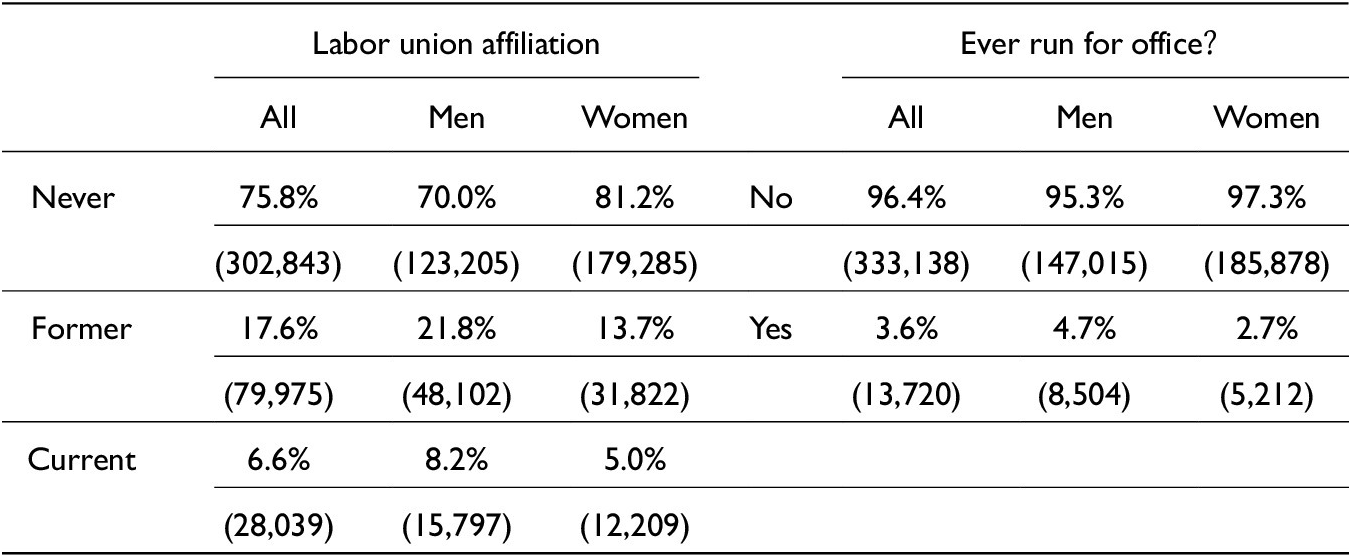
Note: Shows the distribution (percentage rounded to one decimal and number of observations in parentheses) of labor union affiliation (never vs. former vs. current) and whether a respondent has ever run for political office (no vs. yes), among all CES respondents and split by gender (male vs. female).
Source: The 2010–22 CES, survey weights applied.
Dependent Variable
This question is posed to respondents as follows: “Have you ever run for elective office at any level of government (local, state, or federal)?” I code responses to this question as follows (0 = no; 1 = yes). Consistent with existing public opinion surveys — for example, from the Pew Research Center (Motel Reference Motel2014), a small percentage of people (in the CES) report ever having run for office (N = 13,720/346,908 for all respondents, with a weighted mean of 0.036 for all respondents; N = 5,212/191,090 for women, with a weighted mean of 0.027). However, the exceptionally large sample size of the 2010–22 CES means that I can overcome this limitation and reliably test the relationship between labor union membership and political ambition among women.
While there are numerous ways to potentially measure the concept of political ambition, such as questions about whether someone would consider running for office and/or if they feel qualified to do so, I argue for a focus on whether people actually report having run for office. One reason for doing so is because this was the only appropriate question included in the CES. But beyond data availability motivations, I argue that this question is valuable because it reflects the behavior — running for office — that is of interest to scholars and political observers, rather than the attitudes that may underlie such behavior.Footnote 10
Main Independent Variable
My main independent variable of interest is a measure of labor union membership. While it seems likely that the relationship between labor union membership and office-seeking will be strongest among women who are current labor union members (Lyon, Hemphill, and Jacobsen Reference Lyon, Hemphill and Jacobsen2024), it is also plausible that, owing to the civic skills people can pick up in labor unions (Hertel-Fernandez Reference Hertel-Fernandez2020; Terriquez Reference Terriquez2011), and assuming that such skill development does not substantially atrophy after leaving a union, combined with former union members being contacted during electoral mobilization efforts (e.g., Asher et al. Reference Asher, Heberlig, Ripley and Snyder2001; Flavin and Radcliff Reference Flavin and Radcliff2011; Lyon and Schaffner Reference Lyon and Schaffner2021), that women who are former union members may also be more likely to have run for office than their never-unionized counterparts.
As such, for my main analysis, I examine the relationship between different types of union membership (never vs. former vs. current) and women’s probability of having ever run for office. I specifically code this variable as follows (base category = never a union member vs. former union member vs. current union member) and treat it as a categorical variable in my main regression model.
Control Variables
To help mitigate omitted variable biases, I include a battery of relevant demographics that may correlate with both women’s labor union membership and whether they have ever run for political office.Footnote 11 I specifically control for age (in years) and racial/ethnic identity (White vs. Black vs. Hispanic vs. other) to help account for general life experiences and socialization processes — that is, important factors that shape how people experience the world. I also account for socioeconomic status, an important correlate of political engagement and participation (Brady, Verba, and Schlozman Reference Brady, Verba and Schlozman1995; Leighley and Nagler Reference Leighley and Nagler2014), as well as of the more costly and time-intensive decision to seek office (Crowder-Meyer Reference Crowder-Meyer2020), by accounting for the following factors: family income (less than $100,000 vs. at least $100,000 vs. a “prefer not to say” option), formal education (less than a four-year college degree vs. four-year college degree vs. graduate degree), and home ownership (own vs. not). In particular, formal education can be a way of accounting for respondents’ occupation and whether women belong to a private versus public sector union (e.g., Rosenfeld Reference Rosenfeld2010). This can help to control, albeit imperfectly, for whether respondents are affiliated with an especially active and well-organized labor union, such as those representing teachers (Hartney Reference Hartney2022).
Additionally, I account for factors that may shape the extent to which women have household responsibilities that may preclude them from running for office (Bernhard, Shames, and Teele Reference Bernhard, Shames and Teele2021; Silbermann Reference Silbermann2015). I do so here by controlling for whether female CES respondents are homemakers (vs. not), whether they are married (no vs. yes), and whether they have any young children at home (no vs. yes). Finally, I control for frequency of church attendance (never vs. occasionally, but less than once per week vs. at least once a week) to help account for general participatory behavior and membership in an organization that may also promote political engagement and the development of civic skills (Djupe and Gilbert Reference Djupe and Gilbert2006), and whether a respondent has personally served in the military or resides in a household with someone who has (no vs. yes), given that such individuals may be more likely to overcome barriers — for example, questions about leadership ability — that women candidates may face when running for office (Schroeder, Best, and Teigen Reference Schroeder, Best and Teigen2023).
Beyond these various demographics, I also include state fixed effects (dummy variables for each respondent’s state of residence) and year fixed effects (dummy variables for each survey year). State fixed effects help to account for factors such as women being systematically more likely to run for political office in states where there are more high-profile female politicians (Campbell and Wolbrecht Reference Campbell and Wolbrecht2006; Ladam, Harden, and Windett Reference Ladam, Harden and Windett2018).
Year fixed effects not only control for whether a survey was conducted during a midterm or presidential election year, but also help to account for national-level factors, such as Hillary Clinton’s 2016 nomination as the first woman to head a major-party presidential ticket, the feminist backlash to Donald Trump’s 2016 election (DeMora et al. Reference DeMora, Lindke, Long, Merolla and Osorio2023), Kamala Harris’s 2020 election as the country’s first female vice president (Greene, Matos, and Sanbonmatsu Reference Greene, Matos and Sanbonmatsu2022), as well as the salience of abortion — for example, following the US Supreme Court’s decision in Dobbs v. Jackson that repealed the guarantee of abortion rights provided by Roe v. Wade (Clark et al. Reference Clark, Paluck, Westwood, Sen, Malhotra and Jessee2024; VanSickle-Ward et al. Reference VanSickle-Ward, Pantoja, Liedke and Nothnagel2023), that may have potentially encouraged women to engage in the political process and/or to consider running for office.
Main Results
In Table 4, I present the results from my main probit regression model. This model, which uses 2010–22 CES data and solely examines women, regresses my dependent variable of having ever run for political office (0 = no; 1 = yes) on a categorical measure of labor union membership (base category = never a member vs. former union member vs. current union member), and the aforementioned set of control variables. Overall, I find that labor union membership, both current and former, is significantly associated with having run for political office. Indeed, the magnitude of this relationship is also substantively significant, with the “effect” of union membership (relative to the base category of never having been a member) approximating the “effect size” of formal education, a well-established determinant of political interest, participation, and ambition. Importantly, the relationship between labor union membership and running for political office (among women) holds (see the third/fourth columns of Table 4) even when accounting for Democratic partisanship (Democrat vs. Republican/Independent), something that may correlate with both labor union membership (e.g., Macdonald Reference Macdonald2021b) and whether women are recruited and/or choose to run for office (e.g., Karpowitz et al. Reference Karpowitz, Monson, Preece and Aldridge2024).
Union membership and women’s likelihood of having run for office, 2010–22
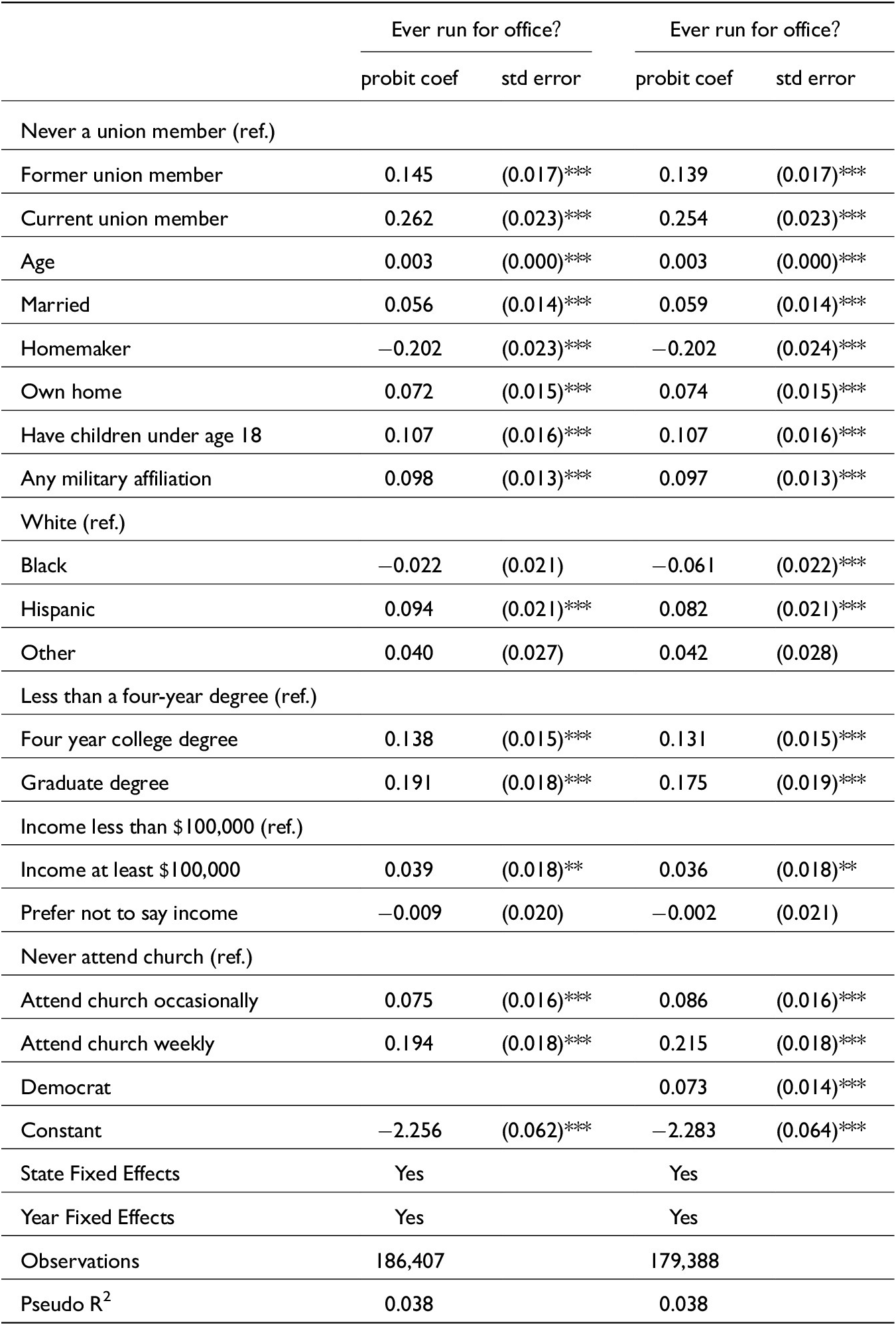
Note: Dependent variable is whether a respondent reports having ever run for political office (0 = no; 1 = yes). The (ref.) abbreviation indicates the omitted reference category for various independent variables. Probit coefficients with robust standard errors in parentheses.
Source: The 2010–22 CES.
*** p < 0.01, ** p < 0.05, * p < 0.1, two-tailed test.
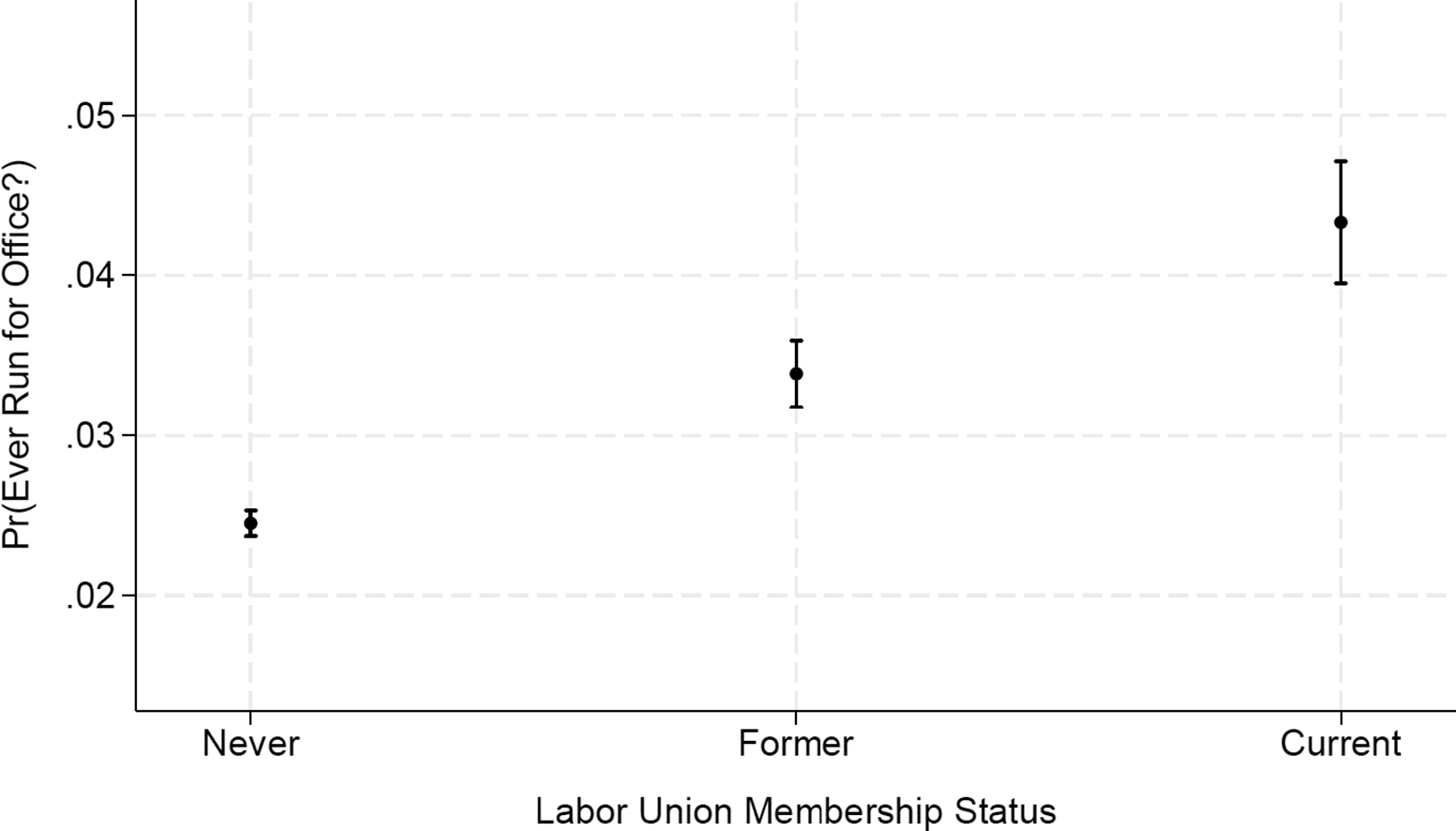
Given that probit coefficients are not directly interpretable, I present predicted probabilities (based on the first model in columns one/two in Table 4) for my main variables of interest in Figure 1. Overall, these results show, on average, holding the control variables constant, that women who report never having been a labor union member have an approximately 2.45% probability of having ever run for office. This increases to approximately 3.39% among women who were former members, and to approximately 4.33%, among women who are current labor union members. While running for elective political office is quite uncommon, particularly among women in the general population, the likelihood of doing so is, net of a battery of sociodemographic factors, significantly higher with labor union affiliation than without. In short, running for office is, particularly for women, an uncommon activity. Labor union membership appears to make it more commonplace.
Labor union membership status and women’s probability of having ever run for elective office, 2010–22.
Note: Shows the probability of having ever run for office (0 = no; 1 = yes) by labor union membership status. Sample is restricted to women (gender = female). Based on a probit regression model that also controls for: age, race, education, family income, marital status, employment status, home ownership, parenthood, church attendance, military affiliation, state fixed effects, and year fixed effects. All of these control variables are held constant at their observed values. Point estimates are predicted probabilities; bars are 95% confidence intervals (robust standard errors, two-tailed test).
Source: The 2010–22 Cumulative CES (even years only). N = 186,407. Based on the regression model in the first column of Table 4.
What about Men?
As previously discussed, I view my theoretical argument linking labor union membership and political ambition as applying broadly, but seek to test it among women, given this group’s long-standing under-representation in American politics and scholarly interest in understanding reasons for this phenomenon. That said, it is still interesting and worthwhile to test the relationship between labor union membership and office-seeking behavior among men in order to more fully test whether labor union affiliations can spur political ambition broadly, and whether it disproportionately benefits one gender over another.
In the Supplemental Appendix (see Table B3), I replicate my main analyses (the same design and variables as in the first/second column of Table 4) among men, using data from the 2010–22 CES. Overall, I find that the relationship between labor union membership and running for office is statistically and substantively significant among men. In terms of the “effect sizes,” I find, similarly to my preliminary analyses, that the relationship (between union membership and running for office) is slightly larger in absolute terms among men (vs. women), but when measured in percent changes, is slightly larger among women (vs. men), owing in part to their lower baseline probability of seeking office. In short, my main analyses focus, for good reason, on women’s political ambition, but it is worth noting that labor unions also appear capable of spurring office-seeking behavior among men.
Heterogeneity in the Relationship
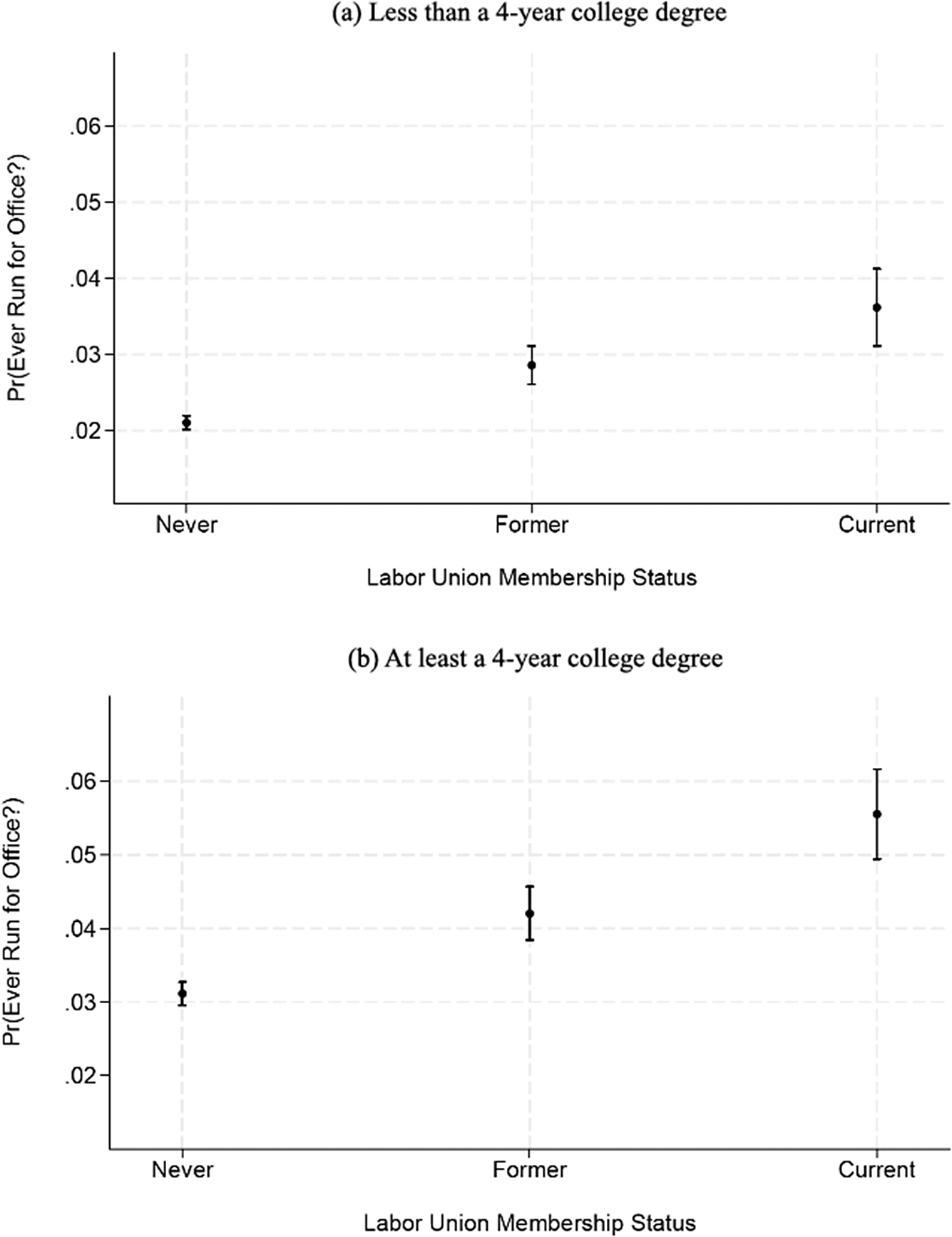
In Figure 2, I test whether the observed relationship between labor union membership and women’s likelihood of ever having run for office is conditioned by educational attainment, a factor that powerfully shapes how people perceive and experience the socio-political world. I specifically differentiate between women with less than a four-year college degree versus women with a four-year college degree or higher.Footnote 12
Labor union membership, educational attainment, and women’s probability of ever having run for elective office, 2010–22.
Note: Shows the probability of having ever run for office (0 = no; 1 = yes) by labor union membership status and educational attainment. Sample is restricted to women (gender = female). Based on two probit regression models, both of which also control for: age, race, education, family income, marital status, employment status, home ownership, parenthood, church attendance, military affiliation, state fixed effects, and year fixed effects. For both models, all control variables are held constant at their observed values. Point estimates are predicted probabilities; bars are 95% confidence intervals (robust standard errors, two-tailed test).
Source: The 2010–22 Cumulative CES (even years only). N = 120,941 (Less than a four-year degree); N = 65,466 (At least a four-year degree). See Appendix Table B1 for the full models.
I do so because formal education is a powerful correlate of political participation in general (e.g., Willeck and Mendelberg Reference Willeck and Mendelberg2022), and because the drivers of political ambition among women can be conditioned by their level of education (Crowder-Meyer Reference Crowder-Meyer2020). Furthermore, formal education serves as a proxy measure for the type of labor union — for example, private versus. public — to which someone might belong (e.g., Macdonald Reference Macdonald2021b). As such, this provides a way of testing, albeit imperfectly, whether public sector unions, which tend to be comprised of more highly educated individuals (e.g., Rosenfeld Reference Rosenfeld2010), are significantly better able to foster political ambition and office-seeking behavior among their (female) membership, or whether the opposite is true, and private sector unions, which tend to be comprised of less highly educated individuals, are better able to foster political ambition among women.
Moreover, testing whether labor union membership predominantly spurs office-seeking and political ambition (among women) in highest educational strata versus among the majority who have less than a four-year college degree, could also have implications for whether political agendas tilt more in favor of the less affluent “blue-collar” class, relative to the more affluent, and politically dominant, “white-collar” class (Carnes Reference Carnes2013).
One possibility is that more highly-educated women belong to the types of labor unions — for example, those representing teachers — that are highly active, engage in frequently mobilization efforts, and meaningfully impart civic skills, all of which can, I argue, foster political ambition, and potentially spur a run for office. As such, the link between union membership and running for office could be stronger among such women, relative to their counterparts with less formal education. Alternatively, it could be the case that labor union membership makes more of a difference in terms of cultivating political ambition and facilitating office-seeking for women with less formal education due to such individuals otherwise feeling less politically ambitious and more apprehensive about running for office, potentially as a result of lower political knowledge, interest, and/or efficacy (e.g., Delli Carpini and Keeter Reference Carpini, Michael and Keeter1997).
I test these competing possibilities in Figures 2a and 2b, presenting results from two probit models. The first consists of women with less than a four-year college degree and the second consists of women with a four-year college degree or higher. In both models, I regress my dependent variable of whether (female) respondents have ever run for office (0 = no; 1 = yes) on labor union membership (base category of never vs. former membership vs. current membership), and the same set of control variables as in my main analyses (Figure 1).
Overall, the results in Figure 2 show that the relationship (among women) between union membership and having ever run for political office is positive and statistically significant across the educational divide, even though, as expected, more (less) well-educated women have a higher (lower) baseline probability of running for office. For women with less than a four-year college degree (Figure 2a), labor union membership is, net of a battery of control variables, associated with a statistically significant increase in the probability of ever having run for office, from 2.11% (never a member), to 2.85% (former member), to 3.57% (current member). For women with a four-year college degree or higher (Figure 2b), labor union membership is similarly associated (positively and significantly) with having ever run for office, from 3.11% (never a member), to 4.20% (former member), to 5.63% (current member).
In short, the results in Figure 2 suggest that labor unions appear to matter broadly — for example, not solely in the comparatively well-organized and powerful public sector (here, proxied via college education) — and that union membership has the potential to foster political ambition and spur office-seeking for women writ large, not just among a select few.Footnote 13
This can matter because more women running for political office with a labor and/or “working-class” background can add to legislative diversity and help to re-shape ideas about “who belongs” in political office (Barnes and Holman Reference Barnes and Holman2020) and affect the kinds of issues that are considered and ultimately enacted by policymakers (Barnes, Beall, and Holman Reference Barnes, Beall and Holman2021). This could also yield a “feedback” effect, with an increase in “the working class’s share” of elected offices helping to boost political efficacy among non-affluent members of the mass public, particularly among working-class women (Kweon Reference Kweon2024). Of course, this might be difficult to achieve given that working-class candidates, particularly women, appear to face an electoral penalty (Kim and Kweon Reference Kim and Kweon2024; Matthews and Kerevel Reference Matthews and Kerevel2022; but see Carnes and Lupu Reference Carnes and Lupu2016), but it seems likely, based on the findings here, that stronger and more prevalent labor unions could help make progress on these fronts.
Addressing Self-Selection and Reverse Causality
Thus far, I have demonstrated a robust and statistically significant relationship between labor union membership and women’s likelihood of running for office. However, it is possible that the relationship actually goes in the opposite direction — that is, that politically ambitious individuals “select into” labor unions, rather than, as I have argued, labor union membership promoting political ambition. I test this in Table 5 with panel data from the 2010–12 CES, meaning that the same individuals are interviewed at multiple points in time.
Testing whether people who previously ran for office are more likely to join a labor union vs. remain a non-member, 2010–12
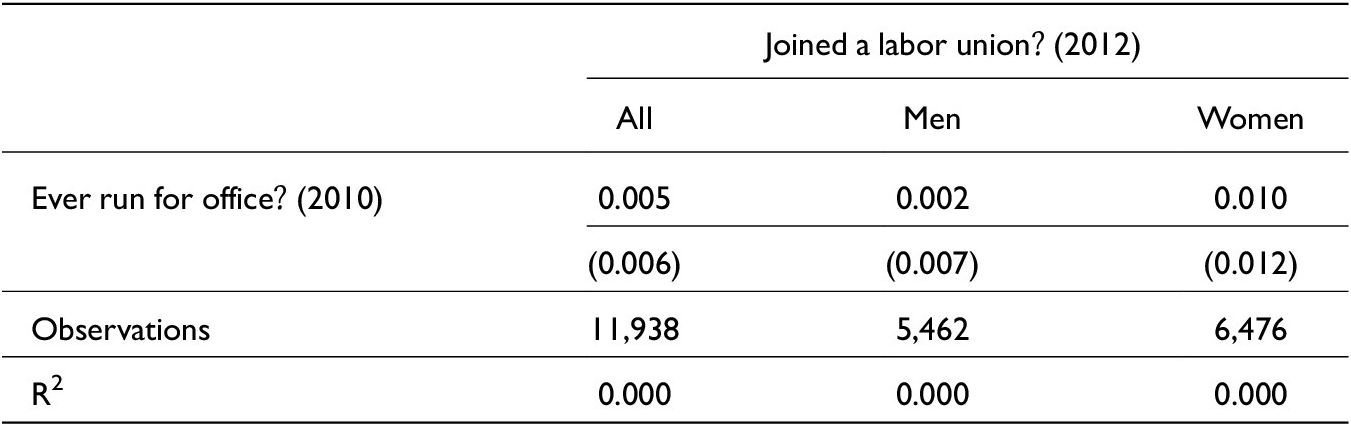
Note: Shows the relationship between having ever run for political office (0 = no; 1 = yes) and the decision to join a labor union vs. remain a non-member (0 = never a union member in both 2010 and 2012; 1 = joined a union between 2010 and 2012), by gender. Constant terms are not displayed here. OLS coefficients from three linear probability regression models with robust standard errors in parentheses. Probit models yield very similar results.
Source: The 2010–12 CES Panel Study.
*** p < 0.01, ** p < 0.05, * p < 0.1, two-tailed test.
My dependent variable here is whether respondents joined a labor union between 2010 and 2012 or whether they remained a non-member during this time period. As such, this variable is coded “1” if respondents reported that they were “never” a union member in 2010, but that they were a “current” union member in 2012. It is coded “0” if respondents reported that they were “never” a union member in both 2010 and 2012.Footnote 14 My main independent variable of interest is whether respondents reported having ever run for elected office when they were interviewed in 2010 (0 = no; 1 = yes); importantly this is measured before any potential change (never → current) in people’s labor union membership.Footnote 15
Overall, the results in Table 5 show that prior office-seeking is not significantly associated with the decision to join a labor union. This is true among all respondents, among men, and among women, my population of interest here. This is evidenced by the substantively small and statistically non-significant coefficients. In short, these results suggest that my main findings are unlikely to simply be driven by “self-selection.” Rather, I argue, there appears to be something about labor union membership that matters for political ambition.
Accounting for Pre-Adult Socialization Factors
Thus far, I have demonstrated a substantively significant relationship between labor union membership and women’s decision to run for office. I have also made efforts to rule out potential threats to inference. However, even despite a battery of controls to address omitted variable bias and panel data to address self-selection bias, it is possible that any observed relationship between labor union membership and women’s likelihood of running for office is being driven by pre-adult socialization factors that I cannot (in the CES) properly measure. While I cannot fully dismiss this possibility, I can attempt to address such concerns. I do so with data from the 1974–2022 Cumulative GSS.
Unlike the CES, the GSS does not include any questions about running for political office. It does, however, include a reasonable proxy. This question captures a relevant attitude that theoretically underlines women’s political ambition. This is whether women or men are more emotionally suited for politics. Presumably, women who believe that women are suited for politics will also believe that it is appropriate and possible for women, potentially even themselves, to run for office. This question is posed to GSS respondents as follows: “Tell me if you agree or disagree with this statement: most men are better suited emotionally for politics than are most women.” I code responses so that higher values indicate disagreement with this statement, and thus a belief that women are just as emotionally suited for politics as men (0 = agree men are better suited; 1 = disagree men are better suited). The GSS also asks a variety of demographic questions, including about respondents’ labor union membership (0 = not a current member; 1 = current member) and has, when pooling across years, a sufficiently large sample size to examine variation in beliefs among female respondents, about whether they think women are, as a group, emotionally suited for political office.
Moreover, and most relevant here, the GSS also includes questions to measure pre-adult socialization, asking several questions about respondents’ upbringing. I focus on two here, both of which ask respondents about their mothers, specifically their level of formal education and work history. I re-code responses to both questions to be dichotomous (0 = mother has no post-high school education; 1 = mother has post-high school education & 0 = mother has never worked outside the home; 1 = mother has worked outside of the home).
My assumption is that women whose mothers worked and/or who had any post-high school education, would be more likely to have had a female role model who signaled that life outside of the home is both appropriate and possible for women (e.g., Dryler Reference Dryler1988). In short, such an upbringing, which I cannot measure in the CES, might be what is driving contemporary women’s decision to both join a labor union and to run for office. If this is the case, then we should observe that the relationship between labor union membership and women’s political ambition will go from being positive and statistically significant to being null, or at least reduced substantially, when controlling for pre-adult socialization factors, measured here via their mothers’ work and education histories. I test this in Table 6, using data from the 1974–2022 Cumulative GSS.
Labor union membership, pre-adult socialization, and women’s belief that they are emotionally suited for political office, 1974–2022
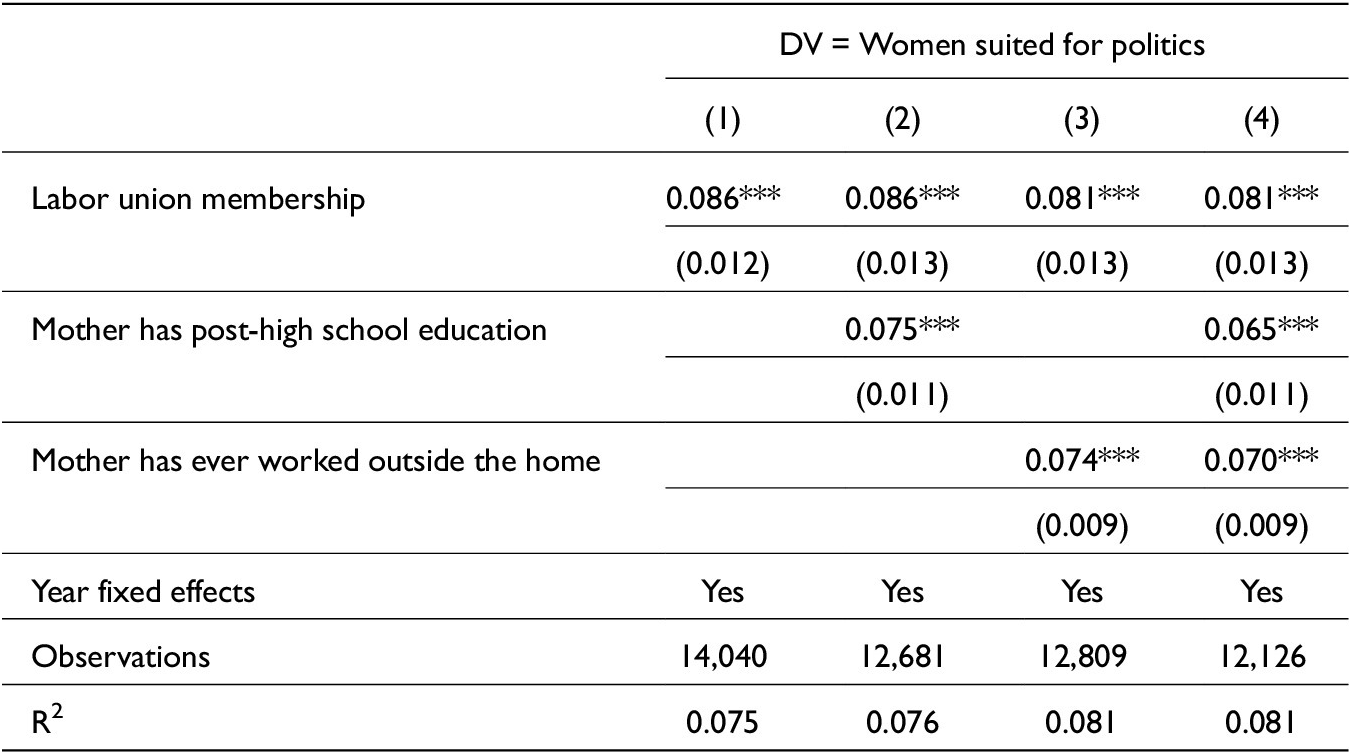
Note: Shows the relationship between union membership (0 = not a current member; 1 = current member) and attitudes regarding whether men and women are equally emotionally suited for politics (0 = disagree; 1 = agree). Characteristics of respondents’ mothers are dichotomous (0 vs. 1). Sample is restricted to women. Constant terms are not displayed here. OLS coefficients from four linear probability models with robust standard errors in parentheses. Probit models yield very similar results.
Source: The Cumulative GSS.
*** p<0.01, ** p<0.05, * p<0.1, two-tailed test.
Overall, the results in Table 6 show that the relationship between labor union membership and political ambition among women remains positive and statistically significant even when controlling for characteristics about respondents’ mothers, which are intended to capture a relevant aspect of women’s upbringing. Indeed, the coefficient for union membership is only slightly attenuated when accounting for these pre-adult socialization variables, and its effect size does not significantly differ across the model specifications. This is true even when controlling for year fixed effects, which can help account for changing societal norms regarding women and politics.
In short, the results in Table 6 suggest that the observed relationship between labor union membership and women’s political ambition seems unlikely to simply be driven by female respondents’ upbringing. Rather, labor union membership in and of itself appears to matter for women’s political ambition.Footnote 16
Conclusion and Political Implications
Women’s political under-representation and gender disparities in terms of who runs for and who ultimately holds elected office have long been of interest to scholars and political observers. Here, I have made a novel contribution to a robust literature on this topic. I have done so by focusing labor unions, arguing that they can fuel political ambition and promote office-seeking, testing this among women in the United States. I have also shown, via analyses of a variety of survey data, that labor union membership is linked, to a substantively significant degree, with women’s likelihood of running for political office, a relationship that is highly unlikely to be driven by self-selection or omitted variable biases.
Labor union membership, unlike other demographic characteristics or personality traits that may drive women’s political ambition, is something over which government has some modicum of control (Bucci Reference Bucci2023; Chun Reference Chun2023; Murphy Reference Murphy2023). Indeed, the passage of new labor laws by various legislatures, and how executive branch officials choose to enforce, and judicial branches choose to interpret, such laws, can potentially “feed back” into the political system and “create new politics” (Campbell Reference Campbell2012; Mettler Reference Mettler2002), by strengthening (or weakening) organized labor. The could, in turn, incentivize (or dissuade) more working-class individuals, including women, to run for office.
For interest groups and activists seeking to mobilize the working classes and/or to spur more women to run for office, particularly among the general population, these findings suggest that such actors would do well to focus on halting and/or reversing decades of labor decline (Rosenfeld Reference Rosenfeld2014). In terms of academic research, these findings suggest that we should look beyond political parties as the primary means of recruiting women to run for office (e.g., Karpowitz, Monson, and Preece Reference Karpowitz, Monson and Preece2017), recognizing that other organizations such as labor unions (Lyon, Hemphill, and Jacobsen Reference Lyon, Hemphill and Jacobsen2024) are also capable of filling this role. By focusing on such organizations, we can better understand the drivers of political ambition and the factors that can help increase the supply of women who enter the political arena.
Future research would do well to recognize that these findings are based on data from the early 21st century United States. Comparatively, the US has, in contrast to Western Europe, for example, relatively weak labor unions. The US also lacks a quota system mandating that women and other underrepresented groups receive a certain proportion of seats, unlike, for example, various countries in Latin America and Africa. Thus, future work should carefully theorize about how such institutional variation might condition the relationship between labor union membership and women’s political ambition.
Future research would also do well to move beyond the decision to run for office (vs. not), perhaps by testing whether candidates (men and women) with a labor background, behave differently — for example, in terms of the positions they take during campaigns and/or the policies they support when in elected office — than do their counterparts without such a background (Grumbach Reference Grumbach2015; Lamare Reference Lamare2016). Future work would also do well to explore this relationship (between union membership and political ambition), across different offices — for example, local versus state versus federal. Future work in the United States would also do well to focus on how the relationship between labor union membership and political ambition may differ among White women versus women of color (e.g., Holman and Schneider Reference Holman and Schneider2018) and also among women who have time-consuming and stressful familial responsibilities versus those who do not (e.g., Bernhard, Shames, and Teele Reference Bernhard, Shames and Teele2021). It would also be worthwhile to test this relationship across different industries and thus examine which unions are better able to promote political ambition. The CES, with its exceptionally large sample size, could be valuable for testing such questions and thus better understanding the drivers of mass-level political ambition.
Overall, these findings make several important contributions. Primarily, they help us to better understand the sources of political ambition and to consider additional ways, specifically one over which government has some modicum of control, to help ameliorate women’s political under-representation in terms of running for, and by extension, holding elected office. These findings also underscore the consequences of organized labor, suggesting that labor unions matter broadly for American mass politics.
Supplementary material
The supplementary material for this article can be found at http://doi.org/10.1017/S1743923X2400045X.
Acknowledgments
I would like to thank my wife (and fellow political scientist) Teresa Cornacchione for her helpful advice and careful reading of several versions of this paper. I also wish to thank the anonymous reviewers and editor for their invaluable feedback and support throughout this process.
Competing interest
The author reports there are no competing interests to declare.


 Open access

