

Past research on political campaigns in the U.S. has considered gender bias in media coverage, including studies that look at gender differences in the quantity of coverage received, differences in the framing of male and female candidates, and whether coverage reinforces gender stereotypes, traits, and issues (See Van der Pas and Aaldering Reference Van der Pas and Aaldering2020 for a meta-analysis). Evidence of gender bias in media coverage is mixed and varies across political contexts by office level (federal, state; legislative, executive) and election type (general election, primary election). While some studies point to an attenuation of gender bias in media coverage over time in the U.S. (e.g., Hayes and Lawless Reference Hayes and Lawless2016; Lawrence Reference Lawrence and Ridout2018), other recent studies find evidence of ongoing gender bias (e.g., Bauer and Taylor Reference Bauer and Taylor2023; Lay et al. Reference Lay, Holman, Bos, Greenlee, Oxley and Buffett2021). Studies that find less hostile media environments for women over time have largely focused on legislative races; therefore, it is unclear whether reduced gender bias tracks for executive offices (and their primaries), given the paucity of cases to draw on, and the degree to which analysis of Hillary Clinton dominates studies of women who run for the U.S. presidency (Lawrence and Rose Reference Lawrence and Rose2008, Reference Lawrence and Rose2011; Heldman et al. Reference Heldman, Conroy and Ackerman2018; Uscinski and Goren Reference Uscinski and Goren2009; but see Falk Reference Falk2010 for a review of women’s historical presidential bids).
In this study, we look for evidence of gender bias in candidates’ media coverage by applying the stereotype content model (SCM) framework, which argues that people are judged along two dimensions – warmth and competence. We apply this framework to a single election – the 2020 U.S. Democratic Party’s presidential primary. This race was unprecedented among American presidential primaries in terms of the gender and racial diversity of the candidate pool. A U.S. primary race is also optimal for analysis of gender differences in media coverage because party identification is not a useful heuristic in these races, given that all candidates are members of the same party (Hayes Reference Hayes2011). This means that the media must search for frames that do not rely on party differences when covering the contest, and other characteristics like race and gender may rise to the fore (Farnsworth & Lichter Reference Farnsworth, Lichter and Benoit2016). We analyze media coverage of the candidates during the “invisible primary” period of the 2020 Democratic presidential primary race, which refers to the period before voting when candidates compete for endorsements, media attention, and financial support (Cohen et al. Reference Cohen, Karol, Noel and Zaller2008). This time period is when the race is most crowded, because candidates haven’t yet withdrawn from the race, as they do once sequential voting begins. Therefore, it is the point in the campaign where the media is covering the largest and most diverse set of candidates and focuses on their viability and personal character.
We also consider how gender intersects with candidates’ race to jointly shape their coverage during presidential primaries, given the racial diversity of the 2020 Democratic primary. Existing studies of leadership perceptions find white women, white men, women of color, and men of color often face distinct stereotypic profiles on the dimensions of warmth and competence (Rosette et al. Reference Rosette, Koval, Ma and Livingston2016; Livingston et al. Reference Livingston, Rosette and Washington2012; Dupree Reference Dupree2024). Therefore, this study also compares the coverage of white male candidates to male candidates of color, and white female candidates to female candidates of color.
Our analysis finds that mainstream media covered male and female candidates differently in the 2020 Democratic presidential primary. While competence dominated trait coverage for both men and women relative to warmth coverage, women candidates faced significantly more critical warmth coverage than male candidates. But trait coverage also varied across female candidates in meaningful ways. Female candidates of color received significantly more negative competence coverage compared to white female candidates, while both white women and women of color received more negative warmth coverage, on balance. Male candidates of color, however, did not face this coverage deficit, relative to their white male counterparts. We conclude by discussing the potential consequences of gendered trait coverage on perceptions of candidate viability, which takes on new importance in light of Kamala Harris’s ascension to the top of the Democratic presidential ticket in 2024 as the second female nominee, and first women of color nominee, for a major political party in the U.S.
Executive Offices and Gendered Media Coverage
Studies of gender differences in coverage of candidates at the executive level (gubernatorial and presidential races) suggest media coverage tends to emphasize masculine gendered traits and masculine gendered issues by focusing on masculine bona fides or issues stereotypically associated with men, therefore disadvantaging women (e.g., Chang et al. Reference Chang, Brichta, Ahn and de Vight2023; Carlin and Winfrey Reference Carlin and Winfrey2009; Conroy Reference Conroy2015; Duerst-Lahti Reference Duerst-Lahti2008; Heldman et al. Reference Heldman, Carroll and Olson2005; Bystrom et al. Reference Bystrom, Robertson and Banwart2001; Kahn Reference Kahn1994; Gidengil and Everitt Reference Gidengil and Everitt2003). However, given the limited number of women running for president in U.S. history, our understanding of gendered media bias for this office is slim. That said, since 2018 in the U.S., more women have been running for office, including gubernatorial races and presidential primaries, which provides new opportunities to study gender bias in media coverage at the executive level.
Evidence from studies of media coverage of women heads of state in democratic governments outside the U.S., where there are more cases to draw from, such as in Canada, Australia, Latin America, and Germany, shows that women are often covered differently by news media, such as more coverage about their clothing (Thomas et al. Reference Thomas, Harell, Rijkhoff and Gosselin2021). Even when coverage for male and female candidates is similar, it tends to focus on topics that favor men by emphasizing masculine issues and experiences (Wagner et al. Reference Wagner, Trimble, Curtin, Auer and Woodman2022). For an example of the latter point, Gerris et al. (Reference Garrits, Trimble, Wagner, Raphael and Sampert2017) found that three women running for prime minister in Canada were subject to gendered mediation (which is the use of gendered metaphors in campaign coverage) that favored male candidates. For an example of the former point, Trimble (Reference Trimble2017) analyzes media coverage of four female prime ministers across three countries to discuss how coverage delegitimizes female leaders. Taken together, there is good reason to expect that gender biases in media coverage of heads of state observed in non-U.S. countries will emerge in the coverage of 2020 Democratic presidential primary candidates. Heads of state, regardless of the country, are expected to demonstrate leadership that is usually defined by norms traditionally associated with masculinity (Smith Reference Smith2017; Garrits et al. Reference Garrits, Trimble, Wagner, Raphael and Sampert2017). In addition, the U.S. is one of just a few industrialized democracies that has never elected a female head of state (Thames and Williams Reference Thames and Williams2013), and as such, female candidates’ media coverage is likely to differ from that of male candidates. That said, studies of Latin America find the context of the race to matter. For example, where a history of corruption is salient, female candidates can have an advantage in terms of congruency with leadership perceptions, due to the stereotype that women are more honest (Le Foulon and Reyes-Householder Reference Le Foulon and Reyes-Housholder2021; Funk et al. Reference Funk, Hinojosa and Piscopo2021; Lucciola Reference Lucciola2023).
Anecdotal accounts of the 2020 Democratic presidential primary suggest gender bias was present in campaign coverage (see Siddiqui [Reference Siddiqui2019] for overview), and journalists wrote about whether some of their peers’ emphasis on female candidates’ “likability” was sexist (Lerer Reference Lerer2019). Stories like this suggest there is more awareness about the gendered double standards in campaign coverage at the presidential level among some in the press, but that it persists. However, whether gendered coverage broadly permeated the 2020 Democratic primary race is an open empirical question.
In the next section, we review existing approaches to studying media coverage of presidential candidates’ character and traits through a gendered lens and discuss how these approaches apply to contests where men and women are competing against each other. We also elaborate on our approach for categorizing descriptions of presidential character and traits — the stereotype content model (SCM) — and how it applies at the intersection of race and gender.
Gendered Trait Coverage in Political Campaigns
Analyses of media coverage of presidential character and traits have employed numerous frameworks. For instance, some studies have employed Kinder et al.’s (Reference Kinder, Peters, Abelson and Fiske1980) approach, which argues for four basic presidential trait dimensions: leadership, competence, integrity, and compassion (Conroy Reference Conroy2015). There is some overlap between these traits and those explored in research on gender stereotypes. For instance, compassion is a stereotypically feminine trait, whereas competence and leadership are stereotypically associated with masculinity (Schneider and Bos Reference Schneider and Bos2014). Other studies that have focused on women running for the presidency have looked explicitly at feminine and masculine attributes (Falk Reference Falk2010; Meeks Reference Meeks2013). Each of these frameworks is useful for conceptually consolidating descriptions of presidential character to draw conclusions about gendered trends in media coverage. In this study we apply a traits approach known as the stereotype content model.
In psychology, researchers often employ a two-dimensional framework called the stereotype content model (SCM), which maintains that intergroup attitudes and perceptions of individuals stem from evaluations of warmth and competence traits (Fiske et al. Reference Fiske, Xu, Cuddy and Glick1999, Reference Fiske, Cuddy, Glick and Xu2002; Cuddy et al. Reference Cuddy, Fiske and Glick2008). Some scholarship on voter decision making has utilized this framework, analyzing the relative influence of voters’ warmth and competence ratings of candidates on electoral outcomes, but the results have been mixed (Laustsen and Bor Reference Laustsen and Bor2017; McAllister Reference McAllister2016; McGraw Reference McGraw, Druckman, Green, Kuklinski and Lupia2011), or found that it varies on whether the candidate is an out- or in-partisan (Bor and Laustsen Reference Bor and Laustsen2022). This work has focused on the perceptions of individual voters and has not considered the relative prevalence of these traits in media coverage of male and female presidential primary candidates’ campaigns.
The SCM attributes of warmth and competence also overlap with the agency-communion framework (Abele et al. Reference Abele, Hauke, Peters, Louvet, Aleksandra and Yanping2016), which has been applied in political science research to understand political behaviors, evaluations, and goals (Conroy and Green Reference Conroy and Green2020; Liebenow et al. Reference Liebenow, Boucher and Cassidy2022; Bauer Reference Bauer2024). Like the SCM, the agency-communion framework centers on two higher order traits (agency and communion), which subsume competence (agency) and warmth (communion) (Abele and Wojciszke Reference Abele, Wojciszke, Abele and Wojciszke2018). Ultimately, the SCM is one of several frameworks for explaining social perception in terms of a limited set of trait dimensions that are considered to cover broad (but similar) elements of human perceptions and behaviors. Given the similarity in these frameworks, there has been an effort to consolidate these (and other related frameworks) into a distinction between vertical traits and horizontal traits, with vertical traits including characteristics like agency and competence and horizontal traits reflecting characteristics like warmth and communion. Said differently, vertical traits are oriented around “getting ahead,” whereas horizontal traits focus on “getting along” (Abele et al. Reference Abele, Ellemers, Fiske, Koch and Yzerbyt2021). Given that we developed our dictionaries with a focus on warmth and competence, drawing on prior scholarship on the SCM (especially the SCM dictionary created by Nicolas et al. Reference Nicolas, Bai and Fiske2020), we rely on the SCM framework language for outlining our expectations about trait coverage and discussing our results. However, these trait dimensions are subsumed within the broader integrated agency-communion framework described by Abele et al. (Reference Abele, Ellemers, Fiske, Koch and Yzerbyt2021).
The SCM has been used to explain gender bias against “career women,” broadly finding that career women as a group tend to be stereotyped as competent but not warm, while “housewives” are warm but not competent (Fiske et al. Reference Fiske, Xu, Cuddy and Glick1999). Warmth includes dimensions of friendliness and trustworthiness, while competence includes dimensions of capability and assertiveness. Capability competence traits are related to ability, such as “intelligent,” “effective,” or “smart,” while assertiveness competence traits are related to motivation, such as “ambitious,” and “self-confident.” Friendliness facets of warmth are related to getting along and maintaining social relationships, such as “kind,” and “compassionate,” while trustworthiness facets of warmth are related to morality and social values, such as “honest,” and “fair.”
Although women in the abstract are perceived as warm, there are limitations to this association. First, research on perceptions of professional women and “feminists” found that their stereotype profile diverges from that of “women,” in that they are competent, but not warm. In short, stereotypes about women broadly in the abstract do not overlap with stereotypes about women in positions of power, or working women; moreover, perceptions of the warmth and friendliness of women in positions of power are largely negative (Schneider and Bos Reference Schneider and Bos2014; Cuddy et al. Reference Cuddy, Fiske and Glick2004; Fiske et al. Reference Fiske, Xu, Cuddy and Glick1999). These patterns also reflect the “double-bind” (Tolley, Lawlor, and Fortier-Chouinard Reference Tolley, Lawlor and Fortier-Chouinard2023). The double bind is the phenomenon where female candidates who conform with stereotypes about what it means to be a “good woman” are characterized as weak and insufficient for politics; on the other hand, if they conform with stereotypes about what it means to be a good political leader, female politicians can be characterized as insufficiently feminine, resulting in negative evaluations either way (Eagly and Karau Reference Eagly and Karau2002; Jamieson Reference Jamieson1995; Ritter and Yoder Reference Ritter and Yoder2004). Additionally, Teele, Kalla, and Rosenbluth (Reference Teele, Kalla and Rosenbluth2018) find that women who fit traditional notions of womanhood (married with children) are perceived as better candidates than women who do not, which they characterize as a double bind because familial roles are a larger hurdle for women than men, when it comes to running for office. These studies are examples of how external groups penalize female candidates when they fail to uphold gender stereotypes, but also when they fail to uphold leadership stereotypes. Political campaigns and political strategists are aware of the double bind (Dittmar Reference Dittmar2015) and encourage female candidates to follow a “balancing strategy,” by which they work to portray the appropriate balance of warmth and competent traits, so as to not alienate voters who subscribe to traditional gender norms, and to avoid priming sexist attitudes about women in power (Bauer Reference Bauer2020; Bauer and Santia Reference Bauer and Santia2022).
Gender also intersects with other social categories, such as race and ethnicity, in ways that moderate the application of gender stereotypic traits linked to warmth and competence by audiences or potential voters (Fiske et al. Reference Fiske, Cuddy, Glick and Xu2002; Rosette et al. Reference Rosette, Koval, Ma and Livingston2016; Gershon and Lavariega Monforti Reference Gershon and Lavariega Monforti2019; Cargile Reference Cargile2023; Dowe Reference Dowe2020; Pao and Rajan Reference Pao, Akhil, Brown and Gershon2023; Bejarano et al. Reference Bejarano, Brown, Gershon and Montoya2021). For instance, compared to women of color, white women are more commonly described in gender stereotypic terms, emphasizing warmth (Coles and Pasek Reference Coles and Pasek2020; Donovan Reference Donovan2011; Purdie-Vaughns and Eibach Reference Purdie-Vaughns and Eibach2008). By contrast, Black and Asian women are often perceived as less warm than white women, leading to descriptions that prioritize agentic qualities linked to competence, such as dominance (for Black women) and expertise (for Asian women) (Galinsky et al. Reference Galinsky, Hall and Cuddy2013; Lin et al. Reference Lin, Kwan, Cheung and Fiske2005). Some studies suggest the more agentic stereotype profile for women of color in leadership roles may be due to their anticipation of greater scrutiny of their qualifications, so they work harder to shore up doubts about their competence by emphasizing experience and credibility (Dittmar Reference Dittmar2015; Garcia Bedolla Reference Bedolla2007; Koenig and Eagly Reference Koenig and Eagly2014). Either way, there is evidence that white women and women of color experience different warmth and competence trait expectations (Bauer and Santia Reference Bauer and Santia2022; Dupree Reference Dupree2024).
Men of color in leadership roles also face stereotypes on the dimensions of warmth and competence that are distinct from white men. Broadly, men of color in leadership roles, like women of color, anticipate heightened scrutiny of their competence (Rosette et al. Reference Rosette, Leonardelli and Phillips2008). Stereotypes that Black men are dominant and aggressive limit perceptions that they are warm, while also being perceived as less competent than white men (Walzer and Czopp Reference Walzer and Czopp2011). Asian and Latino men are often presumed more warm or communal than white men, which can contribute to the belief that they are not assertive or dominant enough for leadership roles (Rosette and Tost Reference Rosette and Tost2013). However, Asian men are often perceived as more competent in certain professions, such as engineering (Sy et al. Reference Sy, Shore, Strauss, Shore, Tram, Whiteley and Ikeda-Muromachi2010).
Given the racial and gender diversity in the 2020 Democratic primary candidate pool for president, and past work suggesting these factors jointly influence candidate evaluations, we also consider the intersection of gender and race when interpreting the analysis of trait coverage in 2020. While grouping all women of color and all men of color together for the analysis is not optimal, for identifying whether white women and white men are distinct from women of color and men of color, this will allow us to observe broad patterns in how race and gender jointly shape candidate characterizations in media. We recognize this approach may mask important racial group differences but adopt it here to capture potential disparities at a high level. As more candidates of color run for president, there should be further disaggregation in analysis at the intersection of race and ethnicity.
In the analysis that follows, we consider the relative balance of warmth and competence coverage during the 2020 invisible primary period for male and female candidates overall, and at the intersection of race. Our goal is to describe the nature of this coverage and determine whether patterns are apparent when taking into consideration candidates’ gender and racial identification. We are working from the perspective that balanced coverage of warmth and competence is preferred for white women and people of color, given prior work establishing the importance of a balancing strategy for candidates who are not white or men, because reception from audiences may be more sensitive to leadership trait deficits for white women and people of color (Bauer Reference Bauer2020).
Hypotheses
Based on existing research that analyzes candidate gender and media coverage, we expect to see that coverage of female candidates stresses different personal traits compared to male candidates along the lines of warmth and competence. Specifically, we expect that overall, female primary candidates’ trait coverage is more focused on warmth than competence, compared with male primary candidates, whose trait coverage will be more focused on competence than warmth. (Hypothesis 1). This pattern of coverage is expected to disadvantage women, because warmth in isolation (e.g., without competence coverage, and therefore “balance”) is incongruent with political leadership, and coverage that invokes warmth, even if positive, can harm perceptions that the candidate is a viable presidential nominee.
Beyond this, we expect that the valence of warmth and competence descriptions to also be gendered. For instance, “likable” would be an example of warm coverage that is positively valenced, whereas “unlikeable” would be an example of warmth coverage that is negatively valenced, or critical. We expect that female primary candidates’ warmth coverage will be more expressly negative in tone than male primary candidates’ warmth coverage. We expect warmth coverage for female primary candidates will more often be invoked to criticize their apparent lack of this trait. Similarly, we expect that female primary candidates’ competence coverage will be more critical than male primary candidates’ competence coverage, raising doubts about women’s qualifications or readiness for office more so than their male counterparts. In short, we hypothesize that the valence of warmth and competence coverage for female candidates is significantly more negative than for male candidates (Hypothesis 2).
Finally, we expect the balance of warmth and competence traits in terms of valence to vary at the intersection of gender and race, given prior work on intersectional stereotyping (for a review, see Cassese Reference Cassese, Redlawsk and Oxley2019). This scholarship suggests that the conventional female stereotype profile of high warmth and low competence applies not to all women but specifically to white women. By contrast, women of color are more commonly stereotyped as low on warmth and high on competence and therefore may receive less negative warmth coverage than white women, due to this lowered expectation of warmth for women of color (Livingston et. al 2012). Therefore, we expect white women to receive more warmth coverage relative to their competence coverage than women of color (Hypothesis 3). There is also some evidence of stereotype inversion for men of color, though this may stem in part from intentional self-presentation strategies aimed at softening group-based stereotypes about violence and aggression (Entman and Rojecki Reference Entman and Rojecki2000; Stephens-Dougan Reference Stephens-Dougan2020). We anticipate men of color will receive more warmth coverage relative to competence coverage, compared with white men (Hypothesis 4).
We also consider the role of trait valence in candidate coverage at the intersection of race and gender. We expect that women of color will receive more positive competence coverage than white women (Hypothesis 5) due to compensating strategies, and stereotypes about women of color in leadership roles (as we noted elsewhere). Expectations regarding warmth for white women and women of color are less clear. White women who run for office violate stereotypic expectations about hypothetical women and warmth, and this expectation is reduced for women of color, who (as we note elsewhere) are associated with a distinctive stereotype profile, where they are perceived as lacking warmth. Therefore, we expect warmth coverage will be on balance more negative than positive for both white women and women of color (Hypothesis 6). For male candidates, we expect men of color will receive more positive warmth trait coverage relative to white men due to compensating strategies by the candidates (Hypothesis 7). Yet, we expect men of color will receive more negative competence coverage than white male candidates (Hypothesis 8) due to the persistence of racial stereotypes that question their qualifications and leadership abilities, as well as implicit biases that associate white men with authority and competence more readily than men of color. In addition to testing these hypotheses, we also present an analysis of the specific warmth and competence traits that are more likely to be used to describe female candidates and male candidates to offer deeper insights into the application of warmth and competence in candidate coverage.
The 2020 Democratic Primary
The 2020 Democratic presidential primary was a highly contested race that featured a large field of viable candidates competing for the nomination to challenge the incumbent President, Donald Trump. Senator Elizabeth Warren of Massachusetts declared her candidacy on February 9, 2019, and Senator Bernie Sanders of Vermont announced ten days later. Former Vice President Joe Biden did not officially announce that he was running until April 2019. Other Democrats who entered the race included Kamala Harris (California Senator), Cory Booker (New Jersey Senator), Amy Klobuchar (Minnesota Senator), Pete Buttigieg (mayor of South Bend, IN), Julian Castro (former Secretary of Housing and Urban Development), Kirsten Gillibrand (New York Senator), Tulsi Gabbard (Hawaii Representative), Michael Bennett (Colorado Senator), Steve Bullock (Montana Governor), Bill de Blasio (New York City mayor), John Hickenlooper (Colorado Senator), and Beto O’Rourke (former Texas Representative). Michael Bloomberg, former New York City mayor, entered the race eventually, too, but not until November 2019. Several candidates without political experience also ran, such as Tom Steyer, Marianne Williamson, and Andrew Yang. All Democratic candidates who appeared at least once on a Democratic primary debate stage are included in this analysis.Footnote 1
One major wedge issue in the primary was support for “Medicare for All,” which was championed most aggressively by Sanders. Issues of racial justice, issues related to the #MeToo movement, and the climate crisis were also top of the Democratic primary agenda. However, most Democratic primary voters prioritized beating Trump over their issue priorities, according to polls (Santhanam Reference Santhanam2019). During the period of our data collection, there were numerous televised debates, and some movement in the polls as a result (Skelley Reference Skelley2019); however, Biden was the most consistent leader in the polls during the invisible primary period. At various moments in the campaign, Warren and Harris were competitive, but Sanders was the most consistently in reach of Biden. Altogether, the field was large, diverse, and competitive enough to warrant dynamic media coverage the year before the first primary contest in Iowa.
Data Collection and Processing
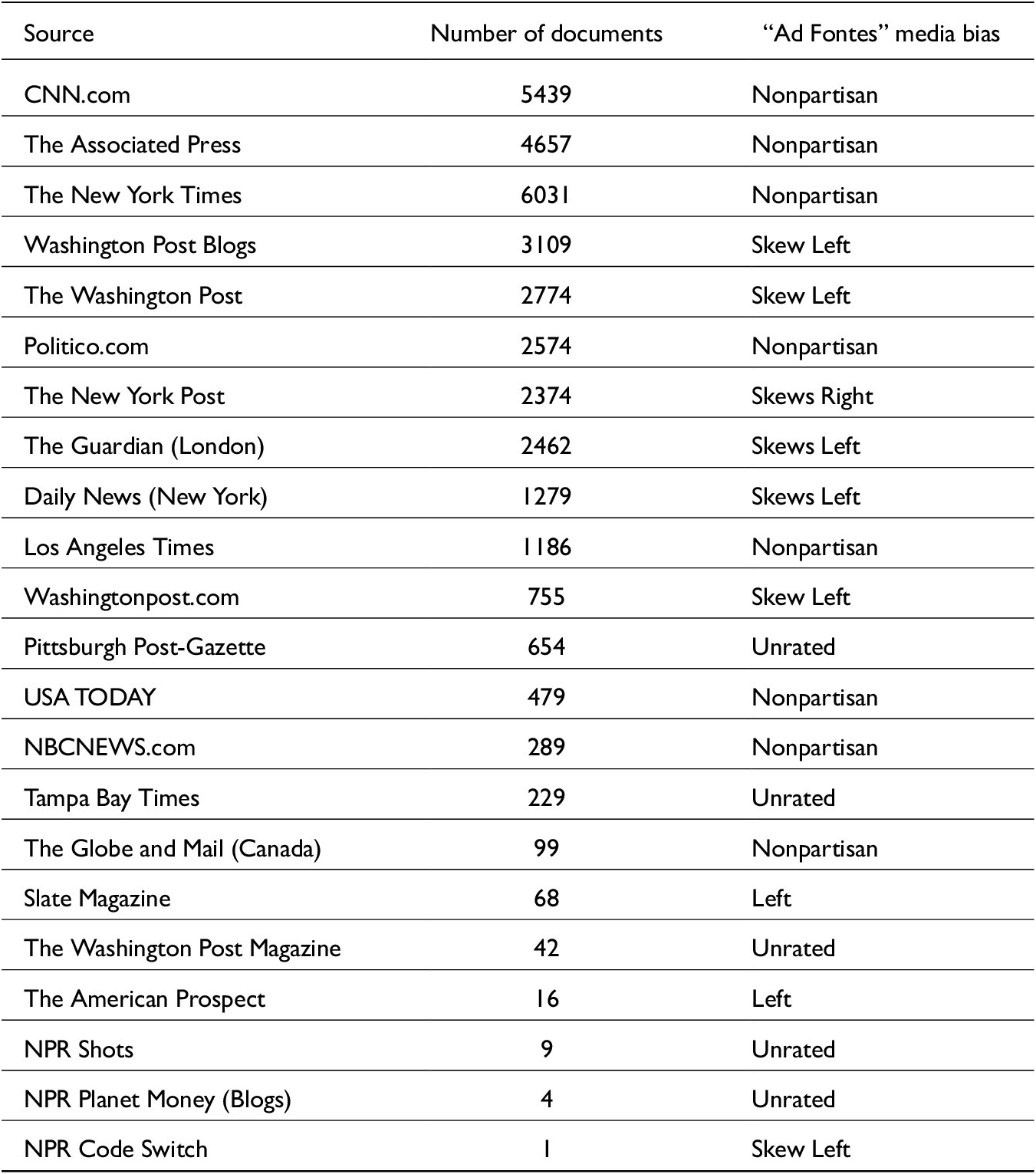
The data for our analysis were collected from the LexisNexis BulkAPI, accessed through the University of Pennsylvania. We considered print articles from January 1, 2019 through January 31, 2020, mentioning a Democratic primary candidate’s name one or more times, from various national and regional sources. Each article is a “document.” The LexisNexis BulkAPI included a broad range of sources, from which we selected articles (or “documents”) from major national newspapers (e.g., The New York Times, The Washington Post), newswires (Associated Press), large online news sites (e.g., Slate, Politico), major tabloids (e.g., The New York Post, Daily News), regional newspapers (e.g., LA Times, Tampa Bay Times), and some international publications that cover American politics (e.g., The Guardian, The Globe and Mail) (see Table A1, Appendix). Our goal was to capture a comprehensive mix of mainstream political news outlets, including a balance of partisan and nonpartisan sources.
Given the polarized U.S. political context during the campaign period covered, we recognize that media coverage could vary widely across outlets, potentially introducing bias into our sample. However, given that all candidates are running as Democrats, we were less concerned that our selection of outlets would favor a particular candidate’s ideology over another candidate’s ideology. We selected sources that mostly skew left or are nonpartisan to reflect the most relevant audience. This approach allows us to capture a representative view of media discourse surrounding the Democratic primary. In Table A1 in the Appendix, we indicate which sources are partisan (and in which ideological direction), according to the Ad Fondes Media Bias Chart.
To analyze warmth and competence coverage of the 2020 Democratic presidential primary candidates, we identify relevant snippets for analysis from all documents using the following preprocessing steps, which we elaborate on below:
-
1. Remove duplicate documents
-
2. Tokenize documents
-
3. Tag adjectives in documents
-
4. Carryout dependency parsing
-
5. Identify candidates in documents by name
-
6. Identify candidates in documents by their pronouns
-
7. Resolve adjectives to the candidates within the same documents
For step 1, we removed duplicate articlesFootnote 2 and were left with 34,530 documents. In step 2, the documents are “tokenized” in order to be tagged. In step 3, all adjectives are flagged using spaCy’s part of speech tagging. In step 4, we apply spaCy’s dependency parsing tool.Footnote 3 Dependency parsing identifies the structure of sentences based on dependencies, which are relationships between words. This is a necessary step to link the adjectives to the candidates in the documents. In step 5, we use spaCy’s named entity recognition system to identify the candidates in the articles (e.g., “Bernie Sanders”). In step 6, we use HuggingFace’s NeuralCoref (coreference resolution) to account for references to the candidates by pronouns (e.g., he/she/him/her).Footnote 4 And in step 7, we applied an algorithm to navigate the dependency tree starting with each adjective. If the adjective had a “child node” in the dependency tree that was identified as a noun or pronoun, we identified that noun or pronoun as a referent of the adjective; otherwise, we navigated to the “parent node” of the adjective and ran the algorithm again to search for the nearest “child node” that was a noun or pronoun. If the noun or pronoun that was identified by this algorithm had already been resolved to a candidate (“entity”), we marked that candidate as the referent of the adjective. We refer to the outcome of this process as “referent-adjective pairings.”
Next, we manually checked each referent-adjective pairing to correct any instances where the algorithm erroneously identified the wrong candidate (and corrected it), or to remove referent-adjective pairings that were irrelevant or otherwise inaccurate. In total, 25% were removed due to this process, which left us with 4,735 snippets. Because we rely on the pipeline outlined above to identify snippets containing adjective-referent pairs, we cannot explicitly account for adjective-referent pairings that are missing, but our manual process ensures that those that are included are accurate.
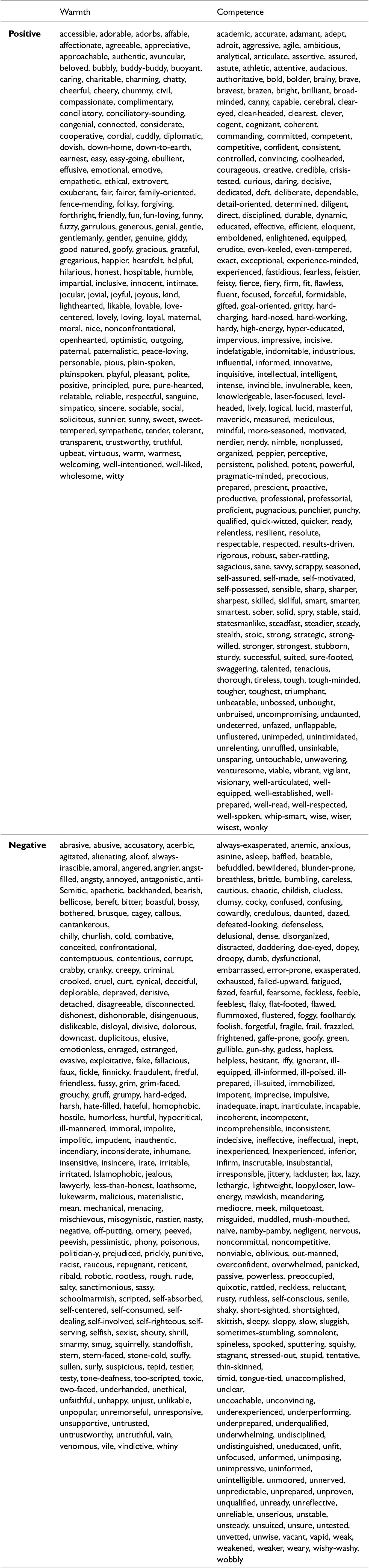
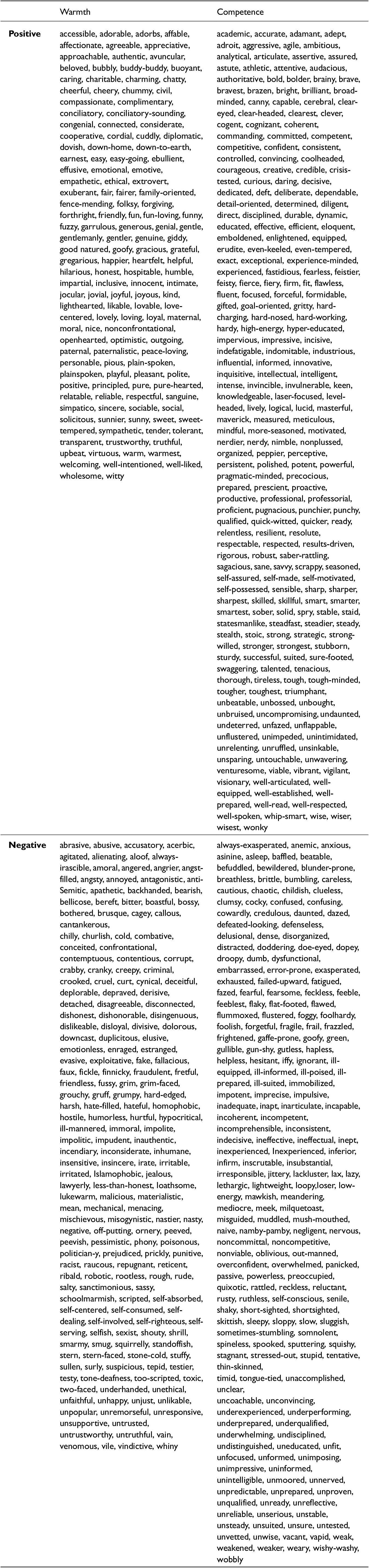
Adjectives in the adjective-referent pairings were then categorized as warmth attributes (positive or negative), competence attributes (positive or negative), or neither, in order to apply the stereotype content model to the candidates’ coverage. For this process, we first classified the traits based on existing dictionaries developed to capture the dimensions of warmth and competence dimensions of the SCM (Nicolas et al Reference Nicolas, Bai and Fiske2020). Two of the authors then independently categorized all the adjectives according to valence, so that each fell within one of the following five categories: positive warmth (e.g., “approachable”), positive competence (e.g., “intelligent”), negative warmth (e.g., “cold”), negative competence (e.g., “inarticulate”), or none of these. For all traits where there was disagreement, the authors met to come to a consensus to determine which category the adjective belongs to. This process produced the list of traits in the Appendix (Table A2).
Together, this process identified all sentences (which we refer to as “snippets”) that mention a warmth or competence trait (positive or negative) that is associated with a candidate, by their name or their pronouns (the adjective-referent pairings). For example, some warmth snippets identified within the media sample by our process include “In our short time watching, she was affable and at ease,” where “she” is Klobuchar, and “affable” is the warmth trait. Another example is, “It’s part of who he is and it’s why people think he’s accessible or approachable,” where “he” is Biden, and “accessible” and “approachable” are warmth attributes. Another example is, “One of the main drivers of Buttigieg’s appeal is how authentic he appears in word and manner,” where “authentic” is a warmth trait describing Buttigieg. Some competence snippets identified in the media sampled by our process include, “She is competitive. She is a fighter,” a description of Gillibrand, and “On the campaign trail, Mr. Castro appears confident,” a description of Castro. Our processes identified 747 positive warmth, 2,255 positive competence, 649 negative warmth, and 1,084 negative competence snippets for a total of 4,735.
After a training session detailing the content analysis process, four of the authors were assigned a subset of all snippets for an interrater reliability assessment. A sample size calculator was used to determine an appropriate sample size (95% confidence with +/- 3% margin of error), yielding a sample of 644 snippets. Given that a snippet could refer to an adjective as a negation (e.g., “Klobuchar lacked warmth”), we assess interrater reliability for referent-adjective pairing matches, and referent-adjective pairing negations. For the former, interrater reliability was .73, and for the latter, it was .78 (Fleiss’s kappa), which meets the conventional standard for “substantial agreement” (Landis and Koch Reference Landis and Koch1977).
The hand-coding team read every snippet to verify that the adjective referenced in a snippet was in fact describing the identified candidate and referred to their personal character. If the adjective in the snippet did not describe the identified candidate (due to error or context), it was removed. Therefore, the analysis does not assume the referent-adjective pairings identified by the automated process are correct; hand-coding affirms the accuracy of the referent-adjective pairings and the referent-adjective descriptions.
Having achieved substantial interrater agreement, the full set of snippets was divided among the team of four experts who then carried out the process of identifying whether the adjective in the snippets applied to the identified candidate, and if so, whether the application was positive (“Biden’s speech was warm”), or negative (“Biden’s speech was not warm”). Any snippets that seemed ambivalent (e.g., “Some people thought Biden’s speech was warm but other people said it was not warm”), were marked as “other” and read by a committee of two researchers to determine if the description fit into the positive or negative categories. Capturing trait valence in this way was necessary to effectively evaluate critical candidate coverage. Not all warmth coverage, for instance, characterized a candidate as warm. Instead, some commented on a candidate’s apparent lack of warmth. As noted above, we anticipated that this phenomenon was related to candidate gender, with women more likely to be characterized as “unlikable” (a negatively valenced warmth trait) compared to men, and by coding valence it allows us to evaluate this possibility. Through the process outlined here, we built a database of candidate media representations through an SCM lens.
Findings
Balance of Warmth and Competence Coverage for Male and Female Candidates
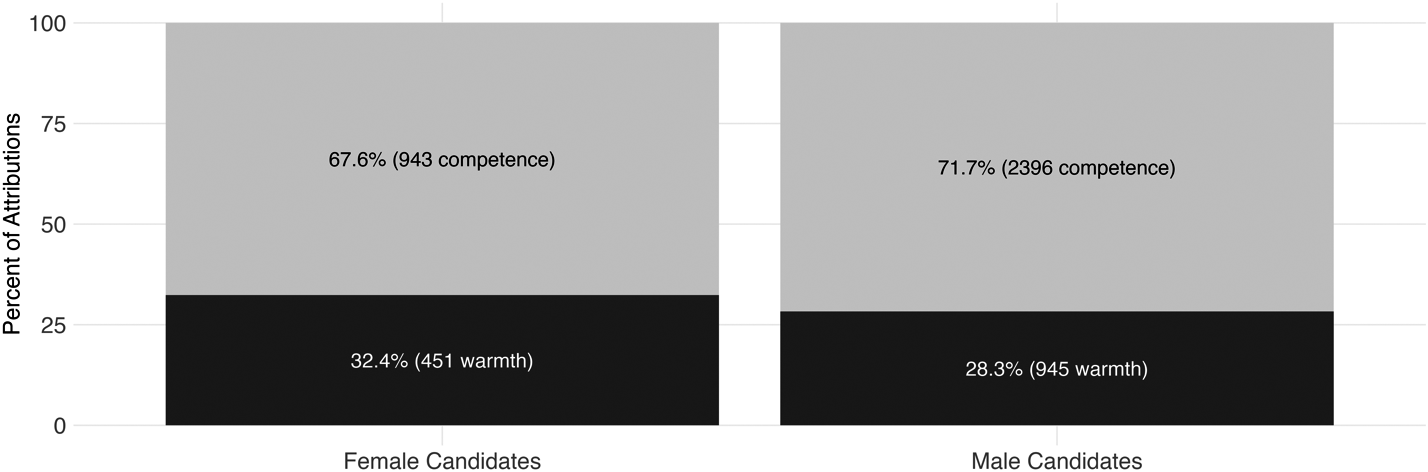
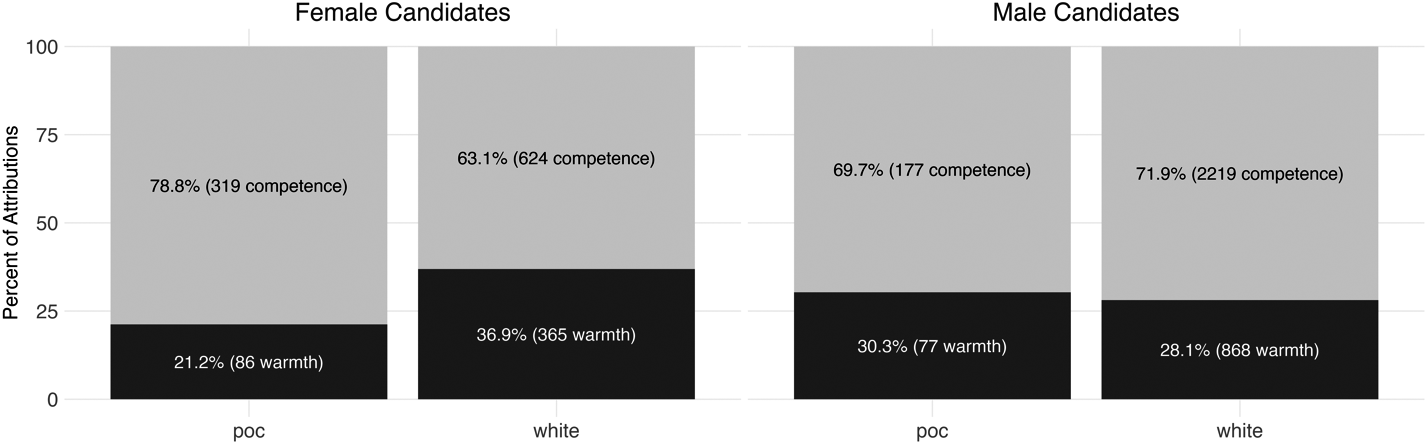
To assess our first hypothesis, we analyze the proportion of warmth and competence traits for all men and all women running in the 2020 Democratic primary in Figure 1. Raw counts are also included for context, because they provide a sense of the volume of coverage on each of the trait dimensions. Notably, trait coverage in 2020 revolves around competence more than warmth. Of the 4,735 trait mentions in our dataset, 70.5% were competence traits. Recall that our first hypothesis laid out an expectation that women would receive coverage that was more focused on warmth and less focused on competence relative to male candidates. Both women and men received less warmth coverage compared to competence coverage. However, the share of the traits associated with warmth as opposed to competence was slightly higher for women compared with men and the difference is statistically significant, (χ2(1) = 7.63, p = .006); therefore Hypothesis 1 is confirmed. This finding might reflect a slight advantage for male candidates, in that coverage of the presidential leadership contest favors a trait that is more often attributed to men. However, to better understand this balance, the tone of that coverage needs to be assessed.
Warmth and competence traits in media coverage of male and female presidential candidates

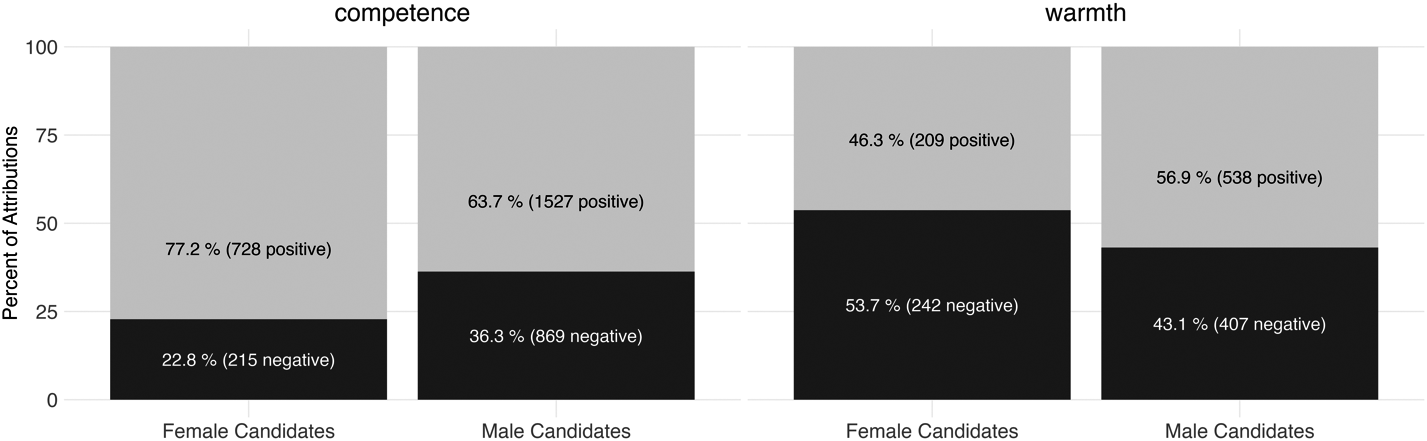
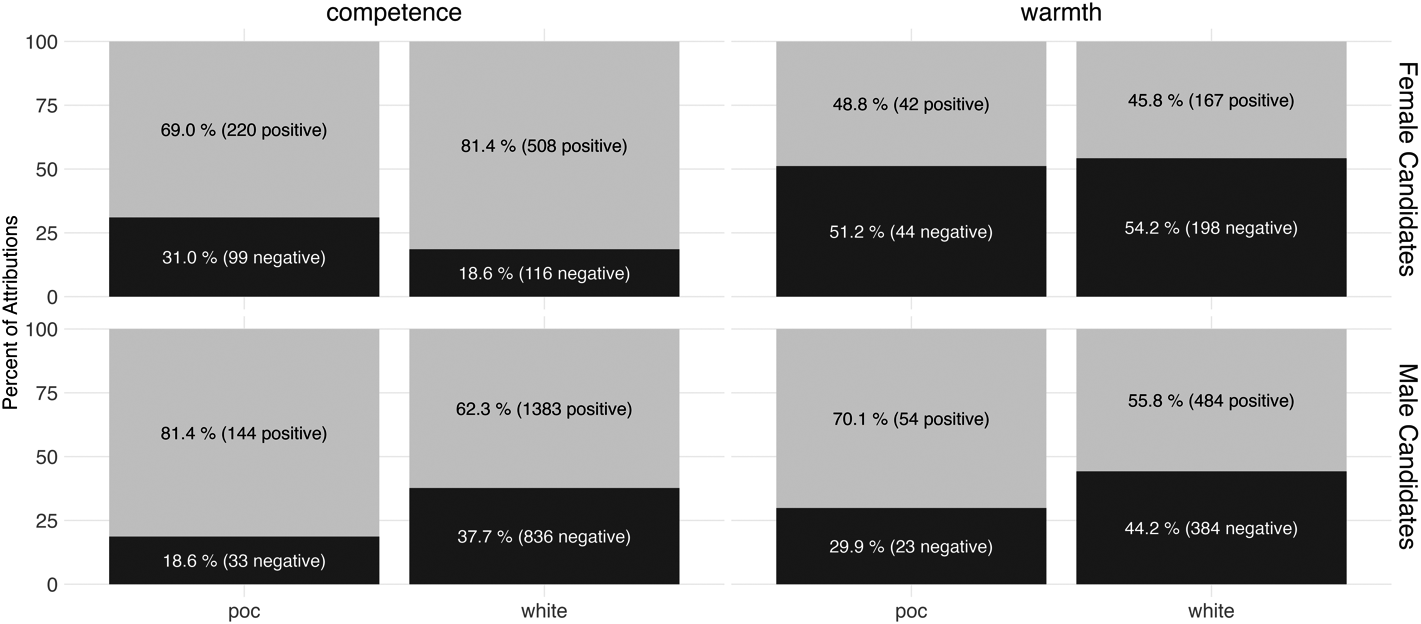
Our second hypothesis posits that gender differences in trait coverage may manifest in the positive and negative valence of coverage and not merely the relative proportion of warmth and competence traits attributed to the candidates. If women receive more critical warmth and competence coverage, they may face an electoral disadvantage. Figure 2 displays the proportion of positive and negative trait coverage for competence and warmth separately, with negative coverage rendered in black and positive coverage rendered in gray. The results qualify our previous finding in an important way. Though men received slightly but significantly more competence coverage than women, the competence coverage women do receive is, on balance, more positive than competence coverage for men. About 77.2% of competence descriptions ascribed to women were positive while only about 63.7% of those ascribed to men were positive. A chi-squared test indicates that this difference in proportions is statistically significant (χ2(1) = 55.68, p< .001).
Warmth and competence trait coverage by valence and candidate gender

This result runs counter to our Hypothesis 2 expectations about competence coverage and suggests mixed results when it comes to gender and competence traits, given that the slight disadvantage in competence coverage quantity for women may be offset by the more positive valence of this coverage. Existing studies suggest this could be a reflection of supply-side factors related to female candidate emergence; for instance, a qualifications gap in which the women who run for office tend to be more qualified than men who run (Fulton Reference Fulton2012; Fulton & Dhima Reference Fulton and Dhima2021; Anzia and Berry Reference Anzia and Berry2011; Bauer Reference Bauer2020), especially at higher levels such as the presidency. Indeed, a common theme in 2020 coverage was that many of the women on the debate stage had never lost an election.
For warmth descriptions, unlike competence descriptions, the gender differences laid out in Hypothesis 2 do emerge. Over half of the descriptions of female candidates that invoke warmth are negative (53.7%), while descriptions of male candidates that invoke warmth are positive on balance (56.9%). This gender difference is statistically significant (χ2(1) = 13.95, p< .001). This result suggests that female candidates’ warmth is drawn into question or criticized more often and tracks with prior scholarship that finds female leaders and professional women to be perceived as lacking warmth (Cuddy et al. Reference Cuddy, Fiske and Glick2004, Reference Cuddy, Glick and Beinger2011; Schneider and Bos Reference Schneider and Bos2014).
What are the consequences of differential warmth coverage? Existing studies find a lack of warmth does not diminish male leaders’ appeal or the perception of their capacity for leadership, whereas it does diminish female leaders’ appeal (e.g., Fiske et al. Reference Fiske, Cuddy, Glick and Xu2002; Cuddy et al. Reference Cuddy, Fiske and Glick2008), and therefore the negative warmth portrayals for women may have disproportionately more negative effects on their candidacies. Additionally, our finding that women face more negative warmth coverage is especially interesting given scholarship that finds warmth evaluations to have mental primacy (Wojciszke and Abele Reference Wojciszke and Abele2008), and warmth to be critical to examinations of candidate character and leadership (e.g., Laustsen and Bor Reference Laustsen and Bor2017). This suggests an election environment that reinforces the double bind, where women are expected to uphold existing gender norms, wherein they are warm in scenarios where warmth may be more difficult to project, such as a political contest. For women who do not fit into a “warm” (feminine) mold (such as women running for high political office) the media may be (inadvertently or not) telling a story about how women fall short of upholding trait expectations associated with their gender, while being successful at upholding trait expectations associated with the role, given the competence findings.
Trait Coverage by Candidate Gender and Race
In addition to average gender differences in the type and valence of trait coverage, we also considered whether candidates’ gender intersects with their racial identification to shape coverage, by comparing white candidates to candidates of color. Our third hypothesis laid out an expectation that female candidates of color would receive less warmth coverage, and more competence coverage compared to white female candidates, and our fourth hypothesis indicated that male candidates of color would receive more warmth coverage and less competence coverage than white men. Although stereotypes about Black men suggest they lack warmth, and stereotypes about Asian men suggest they are exceptionally competent, our hypotheses reflect an expectation that white men will have an advantage in election coverage, where competence is typically privileged to warmth. To evaluate these claims, we reported the proportion of warmth and competence traits for each candidate group in Figure 3. Consistent with our expectations, the media coverage of white women and women of color differs significantly in how it emphasizes warmth and competence (χ2(1) = 31.53, p<.001). White women candidates are more likely to receive warmth coverage (36.9%) than women of color (21.2%), while women of color are more likely to receive competence coverage (71.9%) than white women (63.1%). These differences reflect distinct patterns of representation that align with racialized gender stereotypes about women in the abstract. This finding squares with prior research discussed above about a warmth deficit facing women of color that white women in the abstract do not face. Hypothesis 4, however, was not supported. Male candidates of color did receive slightly more warmth relative to competence coverage, compared with white men, but this difference was not statistically significant (χ2(1) = 0.45, p < .4). Collectively, this analysis suggests that race moderates trait coverage for female candidates, but significant differences did not emerge for the male candidates in the 2020 Democratic primary.
Quantity of warmth and competence coverage by candidate gender and race

Trait valence based on candidates’ race and gender identifications is depicted in Figure 4. Here, it’s evident that while women of color received more competence coverage overall than white woman (Figure 3), this coverage was significantly more negative for women of color compared to white women (31.0% negative compared with 18.6% negative) (χ2(1) = 17.87, p = <.001). This finding runs counter the expectations laid out in Hypothesis 5 and suggests competence discussions were not a boon to female candidates of color. In addition to this, we expected white women and women of color candidates would receive more negative than positive warmth coverage, albeit due to different stereotypic profiles (Hypothesis 6). We find that the tone of the warmth coverage didn’t vary significantly by race among women (χ2(1) = .16, p = .69), but was more negative in tone for both white women and women of color, confirming Hypothesis 6.
Valence of warmth and competence coverage by candidate gender and race

Turning to male candidates, the analysis found white men received significantly more negative coverage relative to male candidates of color, both in terms of warmth (χ2(1) = 5.38, p < .01) and competence (χ2(1) = 24.87, p < .001). This comports with our expectation regarding warmth traits (Hypothesis 7), based on prior research about strategic self-presentation aimed at disrupting stereotypes about men of color and aggression (Entman and Rojecki Reference Entman and Rojecki2000; Stephens-Dougan Reference Stephens-Dougan2020). However, we also hypothesized that white men would receive more positive competence coverage than men of color but did not find support for this expectation (Hypothesis 8).
Thus, the results suggest men of color face a different pattern of trait coverage relative to women of color. Rather than facing an obstacle of negative trait coverage, they are advantaged in terms of trait coverage relative to white men in the race on both trait dimensions. It’s worth noting that male candidates of color were not particularly competitive in this race, and that much of the critical competence coverage observed for women of color may have been driven by Harris, the most competitive of the candidates of color in 2020. In the next section, we dig deeper into candidate-level trait coverage.
Candidate-Level Trait Coverage Analysis
The analysis so far suggests that media coverage emphasizes certain traits differently based on candidates’ gender and race. One limitation of this analysis is that the data is drawn from a small set of candidates, meaning its possible distinctive coverage for any one candidate might exert a disproportionate influence on trait coverage for any of the race-gender groups. Disaggregating by candidate allows us further insight into the nature of candidate coverage. Though this analysis is exploratory and not hypothesis driven, it offers more context to the group differences reported in the previous section and allows us to identify outlier candidates in terms of trait coverage.
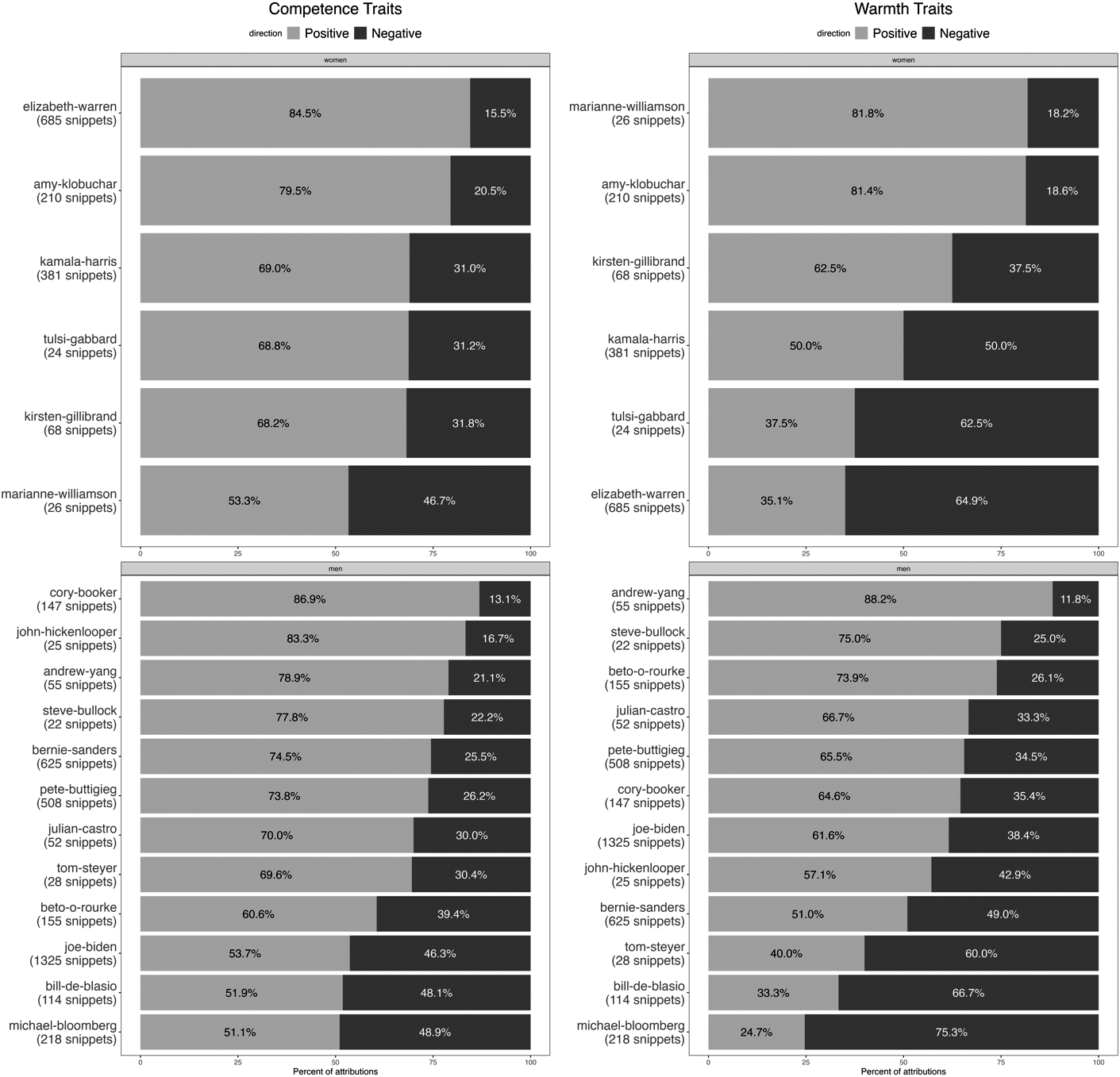
Figure 5 presents the balance of warmth and competence coverage for each candidate, excluding candidates with fewer than 20 trait mentions total. Looking first at competence coverage for female candidates, one can see that on balance, competence coverage was positive for most female candidates, but the proportion of positive coverage did vary across candidates. The range was from 53% positive for Marianne Williamson to 85% positive for Elizabeth Warren. Of the three female candidates receiving the most coverage (Warren, Harris, and Klobuchar), a factor likely related to their greater competitiveness in the race, Harris received markedly more negative coverage – 31% compared to 16% for Elizabeth Warren and 21% for Amy Klobuchar. Maryanne Williamson received a higher proportion of negative competence coverage compared to the other women in the race (47% negative), but because of her lack of competitiveness, she received very little coverage overall. Tulsi Gabbard’s competence coverage was 69% positive, while Kirsten Gillibrand’s competence coverage was 62% positive.
Warmth and competence traits disaggregated by candidate

In terms of female candidates’ warmth, of the three most covered (Warren, Harris, and Klobuchar), Warren and Harris received the most negative warmth coverage – 65% of Warren’s warmth descriptions and 50% of Harris’s warmth descriptions were negative. Just 19% of Klobuchar’s warmth coverage was negative. Among the other women running, Gabbard’s warmth coverage was also mostly negative (63%), but overall, her personal character received very little attention in the corpus of campaign coverage. For the remaining women, warmth coverage was more positive than negative: only 38% of Gillibrand’s and 18% of Williamson’s warmth descriptions were negative. Of the women in the race, Warren and Harris arguably were the most competitive, which explains their greater media attention, and possibly why their personal warmth received more scrutiny. Both women of color in the race – Harris and Gabbard – are also largely on the losing end of warmth descriptions, and this is consistent with studies that show women of color in leadership face additional hurdles when it comes to perceptions of warmth (Dupree Reference Dupree2024; Cooley et al. Reference Cooley, Winslow, Vojt, Shein and Ho2018).
Turning to the male candidates, Biden’s competence descriptions are among the least positive of any candidate (54% positive, 46% negative). This was largely due to frequent attention in articles to Donald Trump’s characterization of Biden as “sleepy” and “weak,” which were coded as negative competence traits. Additionally, there were many news articles written about Biden’s performance in the first Democratic debate that questioned whether he was “prepared.” For example, “Certainly Biden didn’t seem entirely prepared to defend himself from what should have been an obvious line of criticism of his record, given recent news cycles…” and “Biden alternated between forceful defenses of his record and stumbling answers that suggested he wasn’t fully prepared for the intensity of the attacks.” Most of the other men in the race received more positive than negative competence descriptions: Booker (87% positive), Hickenlooper (83% positive), Yang (79% positive), Bullock (78% positive), Sanders (75% positive), Buttigieg (74% positive), Steyer and Castro (70% positive), and O’Rourke (61% positive). The male candidates with the least positive competence coverage were de Blasio and Bloomberg (52% and 51% positive). Recall from the analysis in the previous section that white men received significantly more negative competence coverage compared to men of color. Critical coverage of Biden, de Blasio, and Bloomberg likely contributed much to this difference.
On warmth, Bloomberg (25% positive) and de Blasio (33% positive) received the least positive descriptions. The candidates with the most positive warmth coverage are: Yang (88% positive), Bullock (75% positive), O’Rourke (74% positive), Castro (67% positive), Buttigieg (66% positive), and Booker (65% positive). Biden’s warmth descriptions were 62% positive, Sanders’s just 51% positive, and Hickenlooper’s were 57% positive. This finding that the men of color in the race are among the candidates with the most positive warmth coverage may be evidence that men of color lean into warmth to combat widely held negative stereotypes about racial minorities and violence, especially Black and Latino men (Entman and Rojecki Reference Entman and Rojecki2000), as a deracializing strategy (Stephens-Dougan Reference Stephens-Dougan2020); media coverage might reflect these self-presentation strategies. Collectively, this candidate-level analysis contributes a more nuanced understanding of trait coverage in the 2020 Democratic Presidential primary.
Unpacking the Warmth and Competence Trait Dimensions
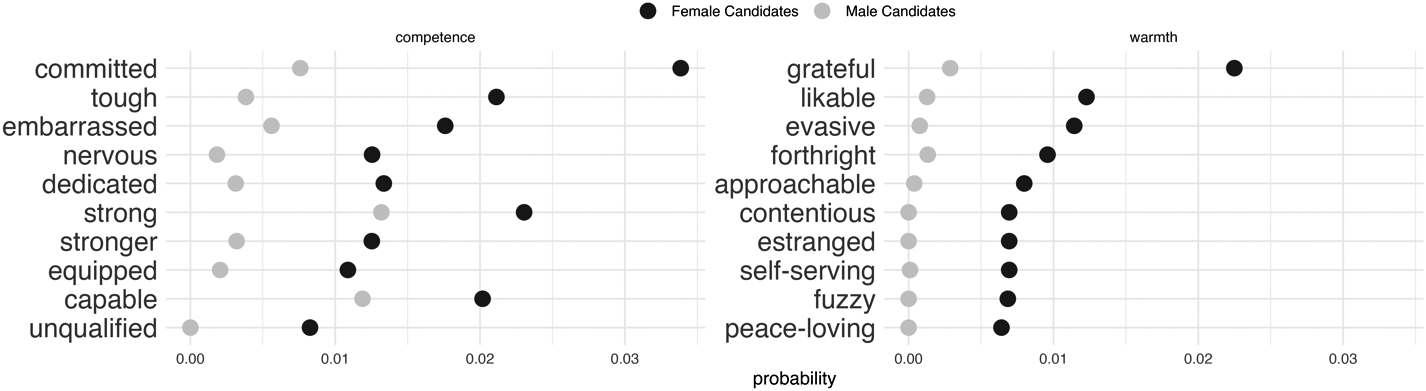
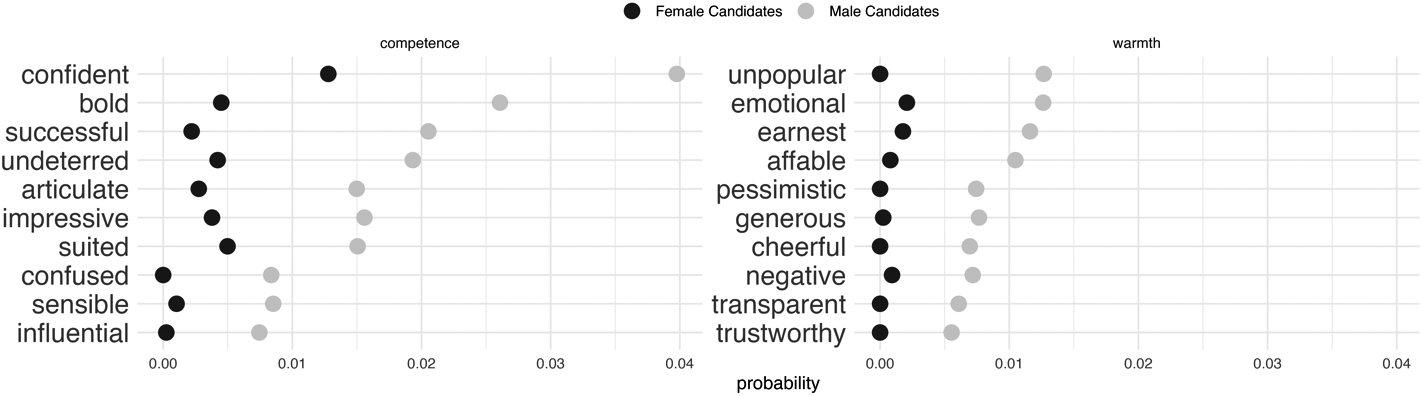
To gain further insight into the nature of warmth and competence coverage, we present some additional descriptive analysis that disaggregates the individual facets composing the SCM’s two primary trait dimensions of warmth and competence. This analysis is exploratory and intended to add more granularity to our understanding of these higher order traits for social perception and how they relate to candidate gender. First, we calculated the relative probability each trait was used to describe each candidate – i.e., p(trait | candidate). We then averaged the probabilities for each trait for all male candidates and all female candidates. We took the difference of these averaged probabilities [i.e., p(trait | candidate)WOMEN - p(trait | candidate)MEN] and plotted the most distinctive traits, those with the largest differences. In Figure 6, we present the top ten facets of warmth and competence traits that were most likely to identify female candidates relative to male candidates. Figure 7 presents the top ten facets used to identify male candidates relative to female candidates. By contrast, terms that do not appear on these lists are applied to male and female candidates with more comparable frequency.
Distinctive trait coverage for female candidates

Distinctive trait coverage for male candidates

Facets of competence distinctively applied to female candidates in Figure 6 imply reliability (e.g., committed, dedicated) and physical stamina or dominance (e.g., tough, strong, stronger). Only one competence trait is explicitly about expertise (capable). These distinctive facets of competence are mostly positive, except for “embarrassed,” “nervous,” and “unqualified” are critical comments disproportionately applied to female candidates.
Facets of warmth distinctively applied to female candidates in Figure 6 invoke trustworthiness or the lack thereof (e.g., evasive, forthright), and friendliness (e.g., approachable). “Likable” is also on this list, which is more evidence that women, more so than men, face the likability question when running for office. This analysis suggests that feminine frames are also evoked for women, but not men, when the media is more likely to describe them as “grateful” and “peace-loving,” traits not usually expected or demanded of men with power or passion for a cause.
For traits that favor men in Figure 7, we see facets of competence that imply assertiveness and dominance (e.g., confident, bold, undeterred), and capability (e.g., successful, impressive, suited). Three facets of competence are explicitly about mental facilities, and one is negative (e.g., sensible, articulate, confused). By comparison, warmth coverage uniquely characterizing male candidates imply friendliness (e.g., affable, earnest, generous), and trustworthiness (e.g., transparency, trustworthy). “Emotional” is on this list, suggesting that men’s emotional states or reactions are more newsworthy than women’s, possibly because it reflects instances of gender stereotype violations. By comparison, women were more likely to be depicted as “embarrassed” or “nervous,” traits that only imply negative emotionality. The only negative trait with a gender gap for men was “unpopular,” an externalized description of others’ reaction to them, but not a projection of their own emotions or how the media thought they should feel.
Conclusion
The analysis reported here suggests media coverage of candidates running in the 2020 Democratic presidential primary was gendered and racialized in some respects, and dimensional social perception frameworks like the stereotype content model proved to be a useful tool for highlighting differences in trait coverage between male and female candidates (Abele et al. Reference Abele, Ellemers, Fiske, Koch and Yzerbyt2021). We found that, on the whole, the Democratic female candidates covered in 2020 overcame competence doubts that plagued women in earlier decades because they received more positively valenced competence, on average, compared to male candidates. However, our trait-level analysis showed large gender gaps in competence traits like “successful,” “suited,” and “influential” (more likely to be attributed to the men in the field), and the disproportionate use of these terms could imply women are working from a qualification (or preparedness) deficit (particularly given we find they are uniquely likely to be described using the term “unqualified”). In short, qualitative analysis of even positive competence traits may still reflect interesting and impactful gender differences.
Although women received favorable competence coverage on the whole, warmth coverage emerged as an important battleground. For male candidates, it was relatively straightforward and affirmative, while for the top-performing women in the race, a majority of this coverage (53.7%) was critical and characterized them as lacking in warmth. Moreover, while the analysis of distinctive traits describing female candidates found that words like “approachable” and “forthright” were used more often to describe women than men, consistent with prior research on voter attribution; even some of their positive qualities of warmth highlight differing gender expectations. Men are not described as “grateful” or “peace-loving,” but women are.
Additionally, we found that the women of color in the race faced a noticeable competence deficit, compared to the white women in the race. Although their competence coverage was overall more positive than negative, it was less positive than white women’s competence coverage. For both white women and women of color, their warmth coverage was more negative than positive, on balance.
This finding about the distinctive trait coverage facing women of color potentially situates us to understand media coverage of Kamala Harris’s 2024 presidential bid. At the very least, it provides an important point of comparison for future work investigating differences in primary and general election coverage, given that we will soon have a corpus of coverage for the same candidate in a primary and a general election.
For the men of color in the race, they were described in positive warmth terms more than negative, and largely more so than white men in the race on average, which further points to the need for an intersectional analysis of trait coverage in campaigns.
Whether these findings for male and female candidates, especially at the intersection of race, are generalizable to Democratic primaries more broadly, is an open question. While the 2020 Democratic primary was relatively diverse, the candidates of color in the race still saw a fraction of the coverage of white candidates, and thus additional research of diverse Democratic primaries should apply the SCM to examine whether the patterns observed in this study hold with other candidates. Such research could help determine if the stereotype content associated with male and female candidates of different racial backgrounds remains consistent across different electoral settings, or if these patterns vary depending on candidates themselves, or aspects of the specific contest. Expanding the application of the SCM in this way would contribute to a deeper understanding of gender, the presidency, and media coverage.
The study also delved into the individual profiles of male and female candidates, shedding light on specific patterns of coverage. Notably, highly competitive female candidates, like Warren and Harris, faced the most negative warmth descriptions, possibly due to increased scrutiny. This finding suggests a dichotomy for competitive women, where positive attributes in warmth or competence are emphasized, but rarely both, which aligns with broader discussions on gender biases in leadership perceptions, and the double bind.
Our results also raise directions for future research. First, our analysis aggregates across news sources with different ideological orientations. Closer attention to news sources might reveal further differences in candidate coverage, with certain outlets or sets of outlets with common political leanings covering candidates in more or less stereotypic terms. Such analysis would offer insights into the extent to which depictions of candidates are media-driven versus campaign-driven. Candidates’ efforts to control their images only go so far. Carefully crafted campaign communications interact with opponents’ messaging as well as media coverage of the race. As a result, candidates only have limited control over how their personal character and leadership potential is described. In some respects, this complicates the interpretation of gender and race-based differences in coverage as bias, given that candidates do differ in their experiences and personalities, and campaign strategies.
Second, our results raise questions about how voters weigh qualities like warmth and competence in their voting calculus. Some research suggests competence, more so than warmth, shapes electoral outcomes (i.e., McAllister Reference McAllister2016; McGraw Reference McGraw, Druckman, Green, Kuklinski and Lupia2011), while other work finds the centrality of warmth traits depend on partisanship (Bor and Laustsen Reference Bor and Laustsen2022); but this work does not evaluate whether the relative importance of these traits for voters varies by candidate gender, race, or the intersection of the two. Further research could also investigate double standards surrounding warmth, where certain actions and behaviors are interpreted differently when exhibited by women and men on the campaign trail. For example, if male and female candidates act similarly on the campaign trail but certain actions are viewed as uncharacteristic of women (such as lacking warmth), that can result in more attention to the negative behavior for women, because it is not seen as expected of men. Other cross-national work shows that a focus on communal traits, like warmth, in candidate coverage can disadvantage women candidates’ viability across settings (Rohrbach, Aaldering and Van der Pas Reference Rohrbach, Aaldering and Van der Pas2023). Voters (and journalists) may also have different traits and role expectations for different offices, such as a President or executive office versus a seat in a deliberative body (Huddy and Terkildsen Reference Huddy and Terkildsen1993). Further work probing gender stereotypes in media coverage of political campaigns across institutional settings and across political contexts is necessary to establish the generalizability of the patterns uncovered here, given that our analysis relies on a single American presidential primary. Ultimately, this is an area ripe for further investigation, and the approach developed here is one that can be adopted for various races, offices, and settings as a useful framework for understanding the prevalence of gendered trait coverage of candidates.
Acknowledgements
The authors would like to thank Cameron Espinoza and Jiwon Nam for their research assistance, and the editor and anonymous reviewers for their valuable feedback on earlier drafts of this article.
Appendix
Media sources and number of documents

Warmth and competence attributes in campaign coverage

 Open access

