

Introduction
Globally, discriminatory attitudes toward women persist. As prior studies reveal, various factors shape attitudes toward women and other marginalized groups. Amidst this extensive scholarship, studies focusing on group identity and belonging as sources of moral values stand out (Rutland, Killen and Abrams, Reference Rutland, Killen and Abrams.2010; Chalik and Rhodes, Reference Chalik and Rhodes.2020).
Value-oriented collective enterprises – i.e., such as political parties, religious denominations, and social movements, which have at their core established guiding principles about “right, wrong, morality, and immorality” (Skitka and Wisneski, Reference Skitka and Wisneski.2011, p.328) – are sources of social group identities (e.g., Greene, Reference Greene1999; Ysseldyk, Matheson and Anisman, Reference Ysseldyk, Matheson and Anisman.2010; Polletta and Jasper, Reference Polletta and Jasper.2001). Critically, such collectives not only attract individuals with similar values but may also signal moral preferences and, consequently, prompt attitudinal change among their members.
For example, by taking explicit positions on the issue, party elites may reduce expressed anti-foreigner sentiments among their party members (Sønderskov and Thomsen, Reference Sønderskov and Frølund Thomsen.2015); through public declarations that signal their stance, religious leaders may similarly increase declared support for immigrants’ rights among their followers (Nteta and Wallsten, Reference Nteta and Wallsten.2012). In turn, prejudicial position-taking may have the opposite effect: for example, political leaders’ patriarchal statements may reduce gender-egalitarian attitudes, particularly among partisans (Bulut and Yildirim, Reference Bulut and Yildirim.2023).
While the impact of value-oriented collectives on expressed socio-political attitudes is well documented, less is known about whether non-value-oriented collective identities – such as those tied to leisure activities (Bačovský, Reference Bačovský2024) – can achieve similar effects. Yet, as demonstrated by Arsenal FC’s “Arsenal for Everyone,” FC Bayern Munich’s “Reds Against Racism,” and Juventus FC’s “Differences Make the Difference,” sports teams from across the world increasingly attempt to do just that.
Given the global strength of football fandom (Nielsen Sports, Reference Sports.2018), examining its potential to address prejudicial attitudes is crucial, especially amidst ongoing discriminatory practices in sports (Gentile, Boca and Giammusso, Reference Gentile, Boca and Giammusso.2018). In this paper, we ask: can football team fandom be leveraged to promote gender-egalitarian attitudes?
We answer this question in two steps. First, we analyze original data from a national survey in Brazil (N = 2,015) to assess the salience of football fandom. Second, partnering with Bahia Football Club – which has one of Brazil’s largest fan bases – we conduct a novel survey experiment (N = 2,143) to estimate whether Club fandom can be leveraged to change expressed misogynistic attitudes.
Our findings indicate that, in Brazil, football fandom competes with other documented sources of group membership – such as partisanship or identification with social movements – and is thus a plausible driver of change in attitudinal expression. Analyses from our survey experiment reinforce this: fans are more responsive to campaigns sponsored by their Club than initiatives carried out by another sports organization. Thus, football team fandom can be leveraged to affect social attitudes. But not necessarily for the better.
On the one hand, we find that exposure to their Club’s anti-sexism campaign increases declared prejudice toward women in football among men. Additionally, male fans exposed to the gender equality campaign display reduced support for their Club’s involvement in other social issues, such as racial equality. Increased displayed misogyny may reflect male fans’ efforts to protect their space, aligning with literature on backlash and status threat (e.g., Mansbridge and Shames, Reference Mansbridge and Shames.2008; Coffe et al., Reference Coffe, Marta Fraile, Fortin-Rittberger and Banducci.2023). On the other hand, our exploratory analyses suggest that women exposed to the campaign evaluate the Club as more responsive to fans, suggesting the initiative may have improved women’s institutional trust and sense of belonging.
Is football team fandom a salient identity?
In political science, membership in political parties (Greene, Reference Greene1999), social movements (Polletta and Jasper, Reference Polletta and Jasper.2001), and religious denominations (Ysseldyk, Matheson and Anisman, Reference Ysseldyk, Matheson and Anisman.2010) has been widely established as a source of collective social identity influencing individuals’ attitudes and behaviors. In other disciplines, sports teams have also been identified as a critical source of collective identity (e.g., Dietz-Uhler and Lanter, Reference Dietz-Uhler and Lanter.2008). As this literature shows, similarly to other collective identities, sports fandom can shape attitudes and behaviors, such as fans’ willingness to donate to charity (Platow et al., Reference Platow, Durante, Williams, Garrett, Walshe, Cincotta, Lianos and Barutchu.1999) and perceptions of self-worth (Branscombe and Wann, Reference Branscombe and Wann.1991).
Political science now increasingly investigates how identification with leisure activities, particularly sports (Bačovský, Reference Bačovský2024), affects socio-political attitudes (Mousa, Reference Mousa2020; Rubenson and Dawes, Reference Rubenson and Dawes.2022). As Thorson and Serazio (Reference Thorson and Serazio2018) show, sports fandom is linked to various preferences, including support for the military; the outcome of games may also influence attitudes, such as presidential approval (Busby and Druckman, Reference Busby and Druckman.2018). Notably, examining the role of football team fandoms more directly, Alrababa’h et al. (Reference Alrababa’h, Marble, Mousa and Siegel.2021)’s study shows that Liverpool fans’ exposure to Mohammed Salah fostered positive feelings toward Muslims and reduced hate crimes near the stadium.
This emerging literature indicates that examining sports team identity may be a valuable research avenue in political science. Before exploring whether football team identity can help reduce prejudicial attitudes toward women in sports, we assess the relevance of this identity.
Data
We employ data from a national survey of Brazilian respondents to conduct this assessment. The sample of 2,015 respondents was recruited by Opinion Box between 22 September and 04 October 2022Footnote 1 and mirrors the Brazilian adult population in terms of gender, age, region, and socioeconomic status.
We employ two sets of questions to compare the salience of football team identity with those of other established collective identities. The first set asks respondents whether they identify with any 1) political party, 2) social movement, 3) religion, and 4) football team. These questions yield four binary variables in which 0 indicates no identification, and 1 indicates identification with the above collective enterprises.
Those who declared identification with any of the four types of collective enterprise were subsequently asked to rate the importance of that political party, social movement, religion, and/or football team to their life. From these questions, we create four binary variables, for which 0 corresponds to “Not at all important” and 1 corresponds to “Somewhat or very important”.
Results
Given that, at this stage, we are concerned with how the salience of football team identity compares with others, we report descriptive statistics of the share of respondents who identify with each of the four types of collective enterprises and their respective importance in respondents’ lives.Footnote 2
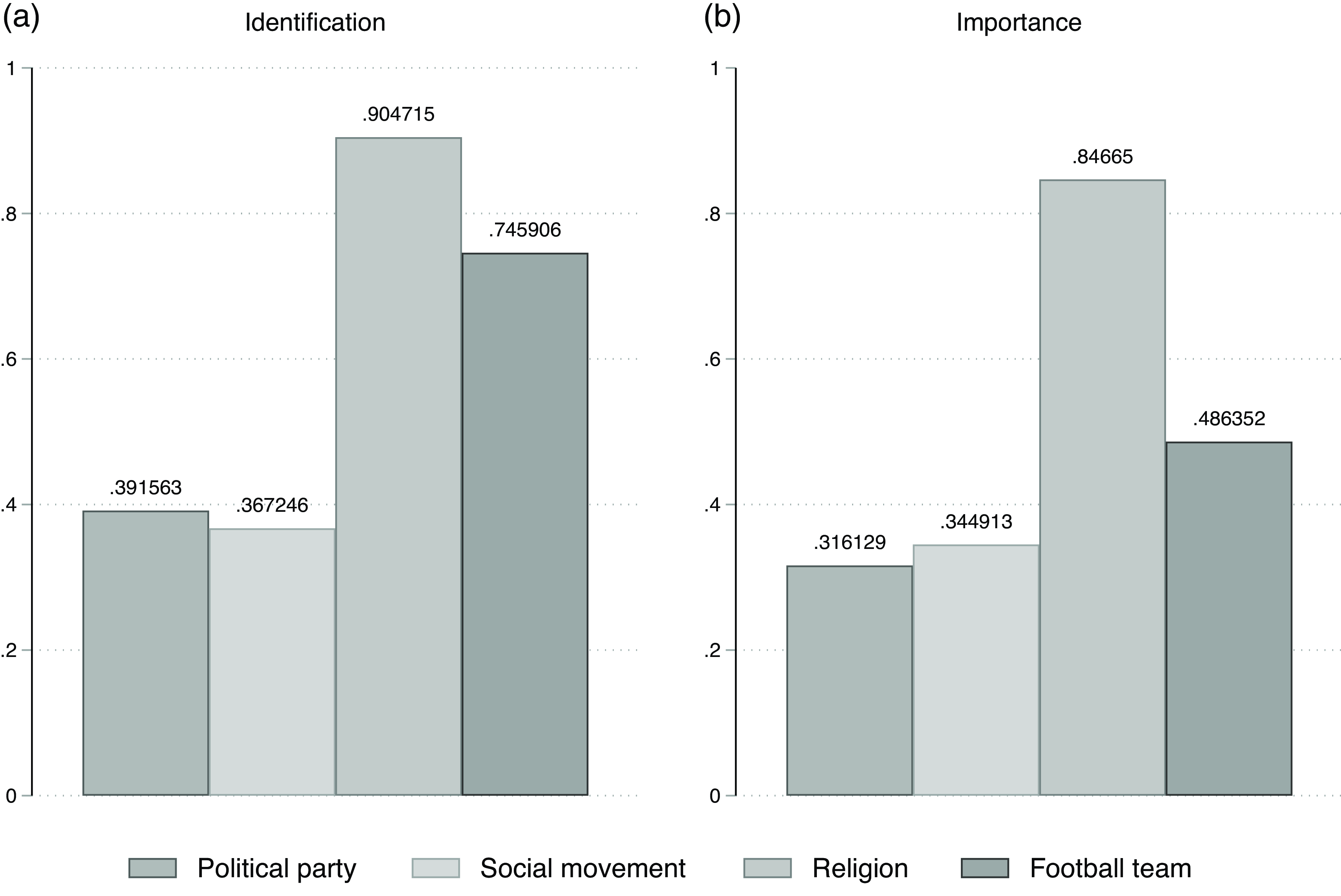
As Figure 1 (panel A) indicates, 74.6% of respondents declare identification with a football team. In other words, a substantially larger share of the Brazilian population identifies with a football team than with a political party or social movement. Of the four sources of identity we examine, the share of people who identify with a football team is only lower than those who identify with a religion.
The share of respondents who identify with a football team and consider it important in their life compared to other types of established identities (a) Identification (b) Importance.
Note: The unit of analysis is the respondent (N = 2,015).
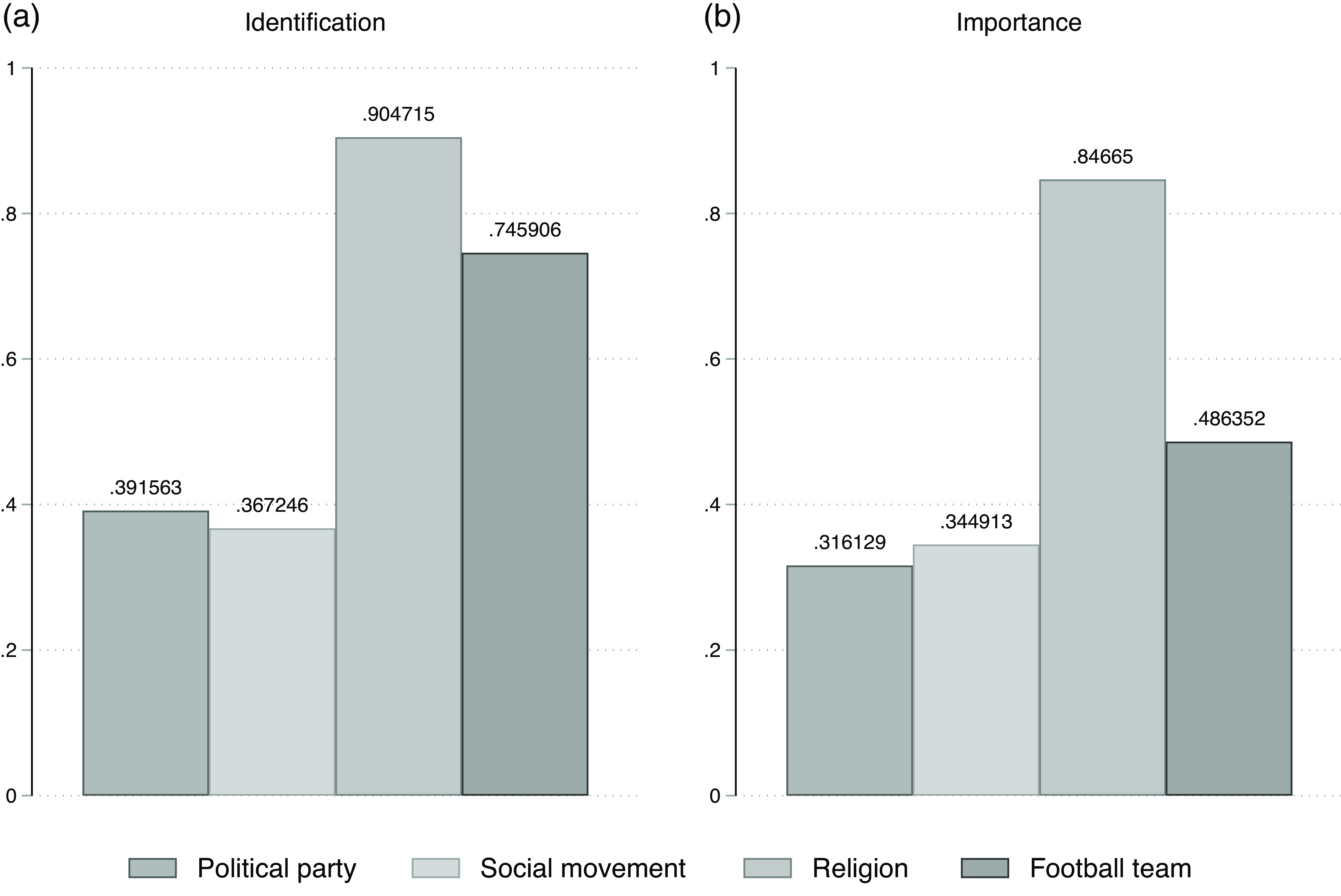
Figure 1 Long description
The bar graph compares the share of respondents who identify with a football team and consider it important in their life compared to other types of established identities. The graph has two panels: (a) Identification and (b) Importance. Each panel features four vertical bars representing different categories: Political party, Social movement, Religion, and Football team. The x-axis labels the categories, while the y-axis measures the share of respondents on a scale from 0 to 1. In panel (a), the bars for Social movement and Football team are the highest, with values around 0.90 and 0.75, respectively. Political party and Social movement have lower values around 0.39 and 0.37. In panel (b), the Football team bar is the highest at approximately 0.85, followed by Religion at around 0.49. Political party and Social movement have lower values around 0.31 and 0.34. The color scheme uses different shades of gray to distinguish the bars. All values are approximated.
Perhaps more critically, football teams also seem central to people’s lives. As shown in Figure 1 (panel B), 48.6% of respondents consider their football team important; this may seem low when compared to the 84.7% of those who deem their religion important, but it is considerably higher than the share of respondents who consider their social movements (34.5% or political parties (31.6%) important.
These analyses suggest that identification with a football team – largely non-value-oriented organizationsFootnote 3 – may be a relevant (and overlooked) source of collective identity. Next, we examine whether this identity can also be leveraged for changing expressed attitudes.
Can football team fandom be leveraged to promote gender-egalitarian attitudes?
Competing as part of or supporting a team can create a sense of group belonging and unite individuals despite their differences in other dimensions; membership in a football team may therefore be a source of collective identity (e.g., Dietz-Uhler and Lanter, Reference Dietz-Uhler and Lanter.2008). Developing a sense of belonging is restricted to individuals supporting or playing for the same team (i.e., not all fans of the same sport). For example, Manchester City and Manchester United fans are all football fans, but Manchester City fans are unlikely to feel like part of Manchester United (and vice versa).
As specified in our pre-analysis plan,Footnote 4 to examine whether football team identity can be leveraged for reducing expressed prejudice, we hypothesize that campaigns carried out by their club will be more successful in reducing respondents’ display of sexist attitudes than campaigns carried out by sports organizations of which they are not members. Critically, we also deem that the impact of the campaign may be heterogeneous: since, at baseline, men are more likely to display sexist attitudes than women, we expect the club’s campaign will have a greater impact in suppressing the expression of sexist attitudes among men respondents.Footnote 5
Experimental setting
We test our expectations using data from an original online survey experiment conducted in collaboration with Bahia Football Club (Esporte Clube Bahia, ECB).Footnote 6 Among the social initiatives, the Club has promoted since 2018 is a campaign against sexism in football – an issue that remains prevalent in Brazil and beyond (Gentile, Boca and Giammusso, Reference Gentile, Boca and Giammusso.2018). Our survey aimed to evaluate the impact of this campaign.Footnote 7 See Appendix Q for information about the correspondence between the manuscript and the pre-registration document.
Based in the northeastern state of Bahia, ECB competes in Brazil’s top football league and has a supporter base of approximately 2 million fans (Murito and Zarko, Reference Murito and Zarko.2023). As shown in Appendix A, ECB fans, like those of other Brazilian football teams, stem from across the left-right ideological spectrum and are plausibly similarly responsive to the campaign.
Fielded online from November 14 to 30, 2020, we recruited participants via the Club’s mailing list of about 40,000 members and its official Twitter profile, which had 1.4 million followers. Our sample includes 2,143 valid responses. In line with the general profile of Brazilian football fans (Appendix J), the sample is 90.5% male. Appendix D includes further information on sample characteristics.
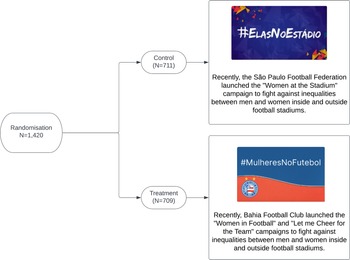
Our main objective was to determine whether identifying with the campaign’s sponsor (the Club) made individuals more receptive to its message, thereby testing if football team identity can be leveraged to change expressed socio-political attitudes. To this end, the experimental design varied the campaign’s sponsor while keeping its content constant. Specifically, participants were randomly assigned to initiatives from either a non-membership-based organization, the São Paulo Football Federation, our control group, or their own club, the ECB, our treatment group.Footnote 8
To ensure realism and ethics, we based our campaign primes on real initiatives. To design comparable primes, we highlighted common aspects of these real campaigns. To increase attention, primes also included campaign images. Figure 2 depicts the randomization set-up and the text and images employed. As balance tests reported in Appendix E indicate, there is no evidence of randomization failure.
Randomization set-up condition does not produce substantively meaningful effects in any of our outcome variables.
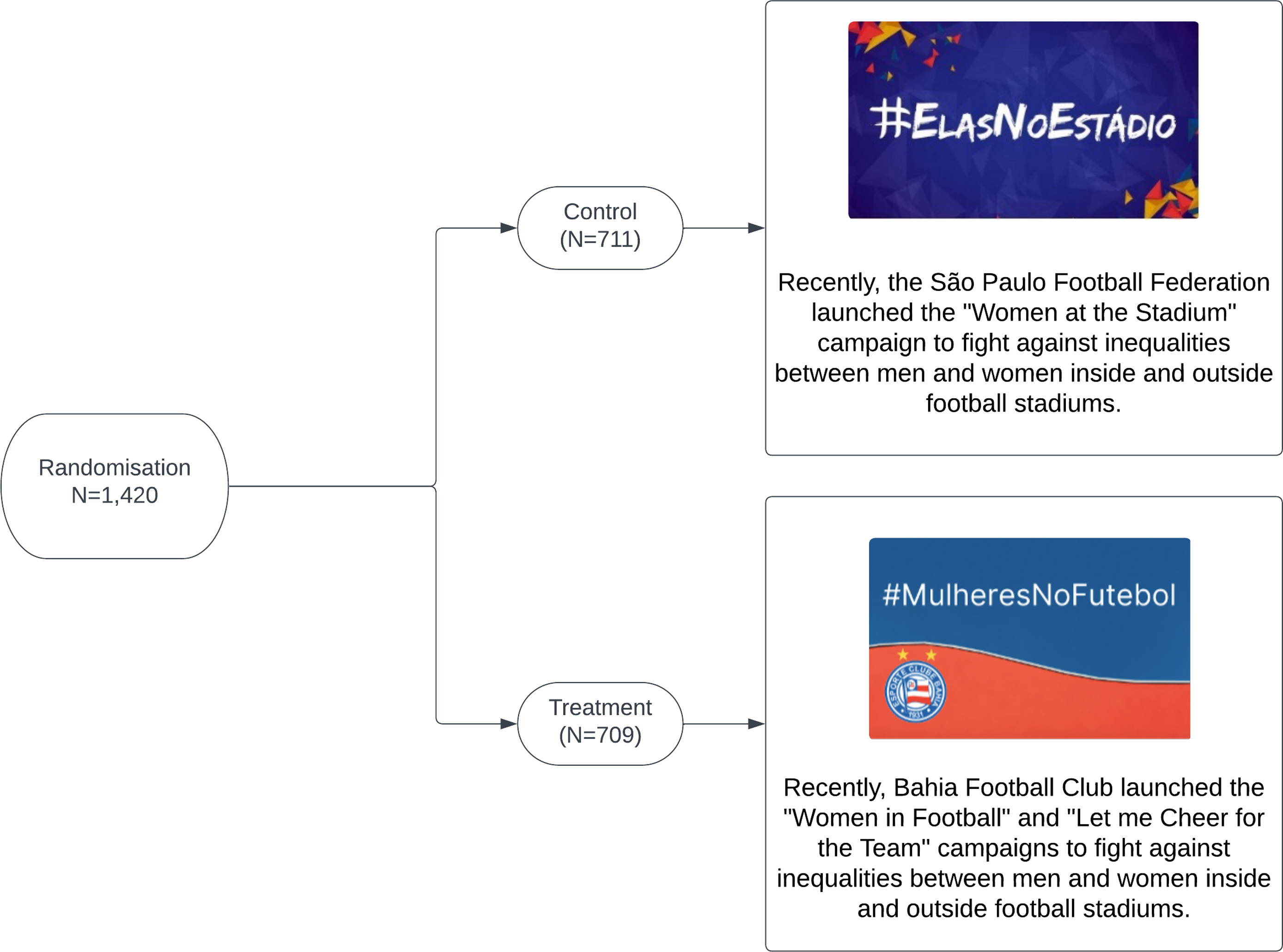
Figure 2 Long description
The diagram illustrates the randomization process for a study examining the effects of different conditions on attitudes toward women. It begins with a pool of 1,420 participants, which is split into two groups: a control group with 711 participants and a treatment group with 709 participants. The control group is associated with a campaign by the São Paulo Football Federation, while the treatment group is linked to campaigns by Bahia Football Club. The diagram visually represents the flow and division of participants into these groups, highlighting the structure of the experimental setup.
Outcome variables
As specified in our pre-analysis plan, our main goal is to examine whether the Club’s campaign can effectively reduce fans’ display of misogynistic attitudes. To measure attitudes toward women in football, our primary outcome of interest, we employ a summative index based on respondents’ agreement with six statements about the abilities of women players, coaches, and referees. The scale of agreement with each statement ranges from 1 to 7, where 1 corresponds to “strongly disagree” and 7 to “strongly agree”. Adding the six items, we derive an index that ranges from 6 to 42 and has a mean of 16.592. In all statements, men players/coaches/referees are portrayed as superior to their women counterparts. As such, higher values of the index indicate more sexist attitudes.
In addition to the anti-sexism campaign, the ECB also promoted other social issues. We explore whether the Club’s sponsorship of an anti-sexism campaign influences broader attitudes by measuring respondents’ support for the Club’s involvement in six areas – racial inequality, gender inequality, sexual harassment, LGBT-phobia, social inclusion, and environmental protection – using a similar 7-point scale.
Albeit not the main goal of our study, we also conduct exploratory analyses of the campaign’s effect on respondents’ perceptions of the initiative and the Club’s responsiveness to fans – which we interpret as proxies for institutional trust and belonging. We measure the first of these variables with a summative index composed of respondents’ answers to two questions: 1) “How do you evaluate this campaign promoted by the São Paulo Football Federation/the ECB?” 2) “Through this initiative, the São Paulo Football Federation/the ECB made a public commitment against gender discrimination. What do you think about the São Paulo Football Federation/the ECB making a public commitment to this issue?” The variable ranges from 2 to 10 and has a high mean of 9.510.
Finally, we measure perceptions of the Club’s responsiveness with a summative index of respondents’ agreement with three statements, such as “The ECB board is interested in what fans think”. Adding the three items, we derive an index that ranges from 3 to 21 and has a mean of 16.026. Appendix D provides descriptive statistics for all our outcome variables for the whole sample, as well as for each treatment condition.
Our discussion focuses on the heterogeneous treatment effects of the assigned prime, specifically examining how the effects differ between female and male respondents in the treatment and control groups. These effects are captured using ordinary least squares regression models, with and without pretreatment controls. We report average treatment effects in Appendices F, K, and M.
Results
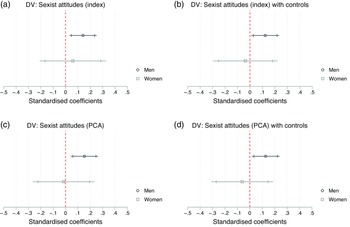
We begin by examining the impact of the Club’s campaign on fans’ sexist attitudes. Our results suggest that football identity can be leveraged to change prejudicial attitudinal expression, albeit not necessarily in the hypothesized direction. As shown in Figure 3, exposure to their Club’s campaign indeed moves the expressed preferences of some respondents. However, contrary to our expectations, the displayed preferences of women primed to their Club’s anti-gender discrimination campaign remain unchanged, while the expressed preferences of men are more sexist than those in the control group (panel A: coefficient = 0.141, p-value = 0.013)Footnote 9 . These results are robust to the inclusion of pretreatment controls (panel B).Footnote 10
The effect of ECB’s campaign on fans’ sexist attitudes (a) DV: Sexist attitudes (index) (b) DV: Sexist attitudes (index) with controls (c) DV: Sexist attitudes (PCA) (d) DV: Sexist attitudes (PCA) with controls.
Note: The unit of analysis is the respondent (N = 1,420). We run OLS models with robust standard errors and report confidence intervals at the 90% and 95% levels. The X-axis is expressed in standard deviations. Across panels (A–D), higher values of our outcome variables indicate attitudes that are more sexist. We interpret our results in terms of their deviation from the mean (i.e., zero). For example, a coefficient of 0.1 means the treatment has increased sexist attitudes by 0.1 of the standard deviation. Appendix I reports tables of results with raw coefficients.
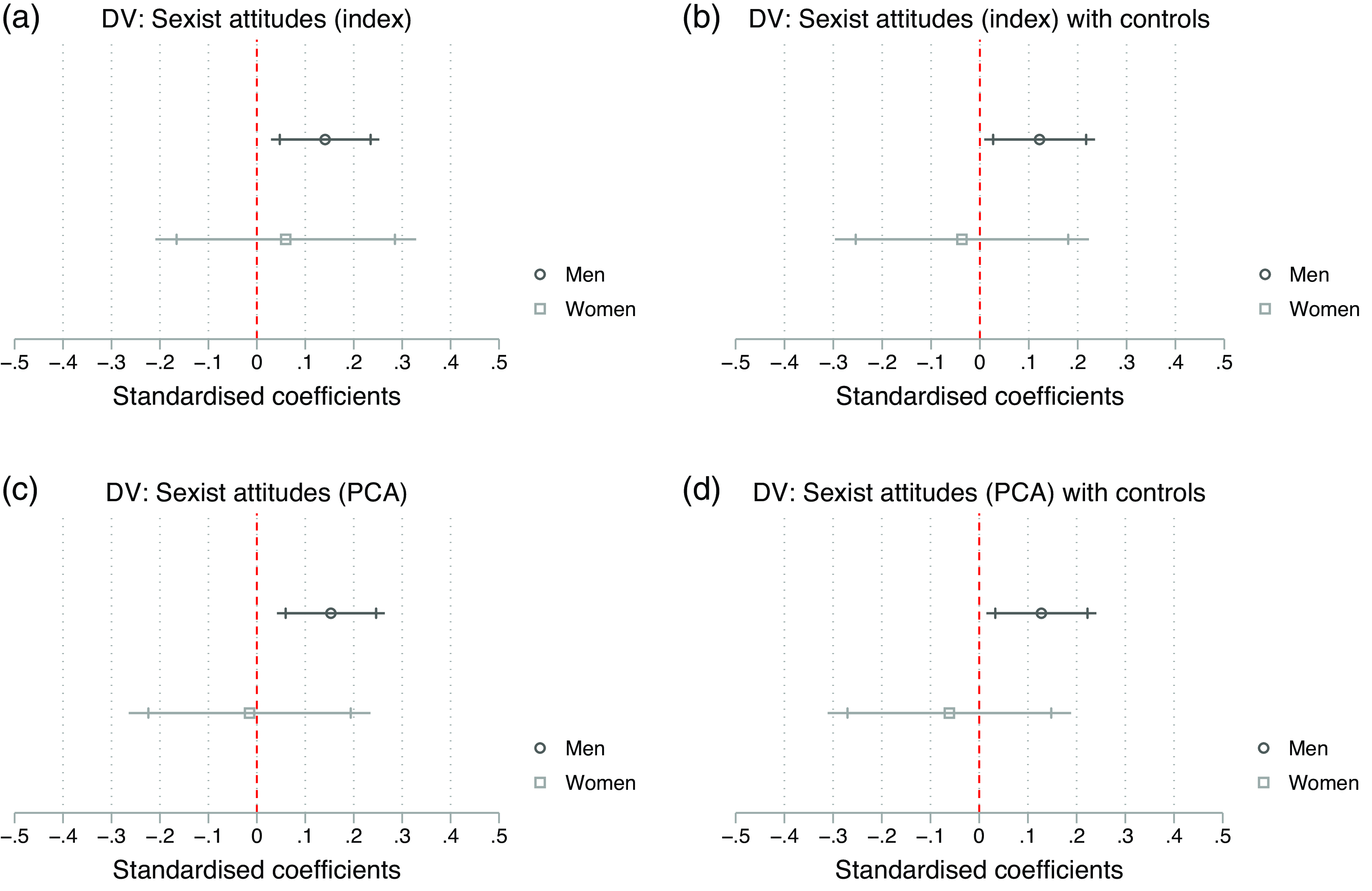
Figure 3 Long description
The image contains four separate graphs labeled (a) through (d), each depicting the effect of ECBs campaign on fans' sexist attitudes. Each graph uses standardized coefficients on the x-axis, ranging from -0.5 to 0.5. The y-axis is not explicitly labeled but represents the dependent variable (DV) of sexist attitudes. Graph (a) shows sexist attitudes using an index for men and women, with men having a positive coefficient around 0.2 and women having a negative coefficient around -0.1. Graph (b) includes controls and shows similar trends with men around 0.2 and women around -0.1. Graph (c) uses principal component analysis (PCA) for sexist attitudes, with men around 0.2 and women around -0.1. Graph (d) includes controls with PCA, showing men around 0.2 and women around -0.1. Each graph includes confidence intervals at the 90% and 95% levels, indicated by horizontal error bars. Higher values on the x-axis indicate more sexist attitudes. The unit of analysis is the respondent with a sample size of 1,420. The results are interpreted in terms of their deviation from the mean, where a coefficient of 0.1 means the treatment has increased sexist attitudes by 0.1 of the standard deviation.
Since the six items that compose our index are likely correlated, we employ a principal component analysis (PCA) to produce a factor resuming the common variation in the dimensions used to derive the original index (Appendix H). We use this as an alternative outcome variable. As reported in panels C and D, our results remain robust, regardless of whether or not we include pretreatment controls. We interpret backlash to their Club’s anti-gender discrimination campaign as men’s effort to protect their space.
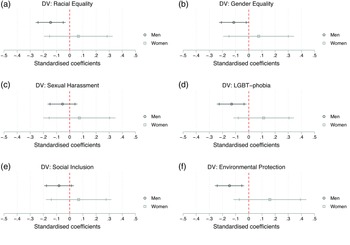
Male respondents’ attitudes toward their Club’s social role in other areas further reinforce our interpretation. Figure 4 displays estimates from our analyses of the impact of our treatment on female and male respondents’ levels of support for their Club carrying out social campaigns in six areas. In addition to displaying reduced support for future initiatives to tackle gender inequality (coefficient = −0.114, p-value = 0.047), men primed to their Club’s anti-sexism campaign are also less supportive of their Club’s involvement in other areas, namely racial discrimination (coefficient = −0.145, p-value = 0.012), LGBT rights (coefficient = −0.131, p-value = 0.023), and environmental protection (coefficient = −0.147, p-value = 0.010).
The effect of ECB’s anti-sexism campaign on fans’ support for the Club’s social role (a) DV: Racial Equality (b) DV: Gender Equality (c) DV: Sexual Harassment (d) DV: LGBT-phobia (e) DV: Social Inclusion (f) DV: Environmental Protection.
Note: The unit of analysis is the respondent (N = 1,420). We run OLS models with robust standard errors and report confidence intervals at the 90% and 95% levels. The X-axis is expressed in standard deviations. Across panels (A–F), higher values of our outcome variables indicate greater support for the Club’s social role. We interpret our results in terms of their deviation from the mean (i.e., zero). For example, a coefficient of -0.1 means the treatment has decreased support for the Club’s social role by 0.1 of the standard deviation. Appendix L reports tables of results with raw coefficients.
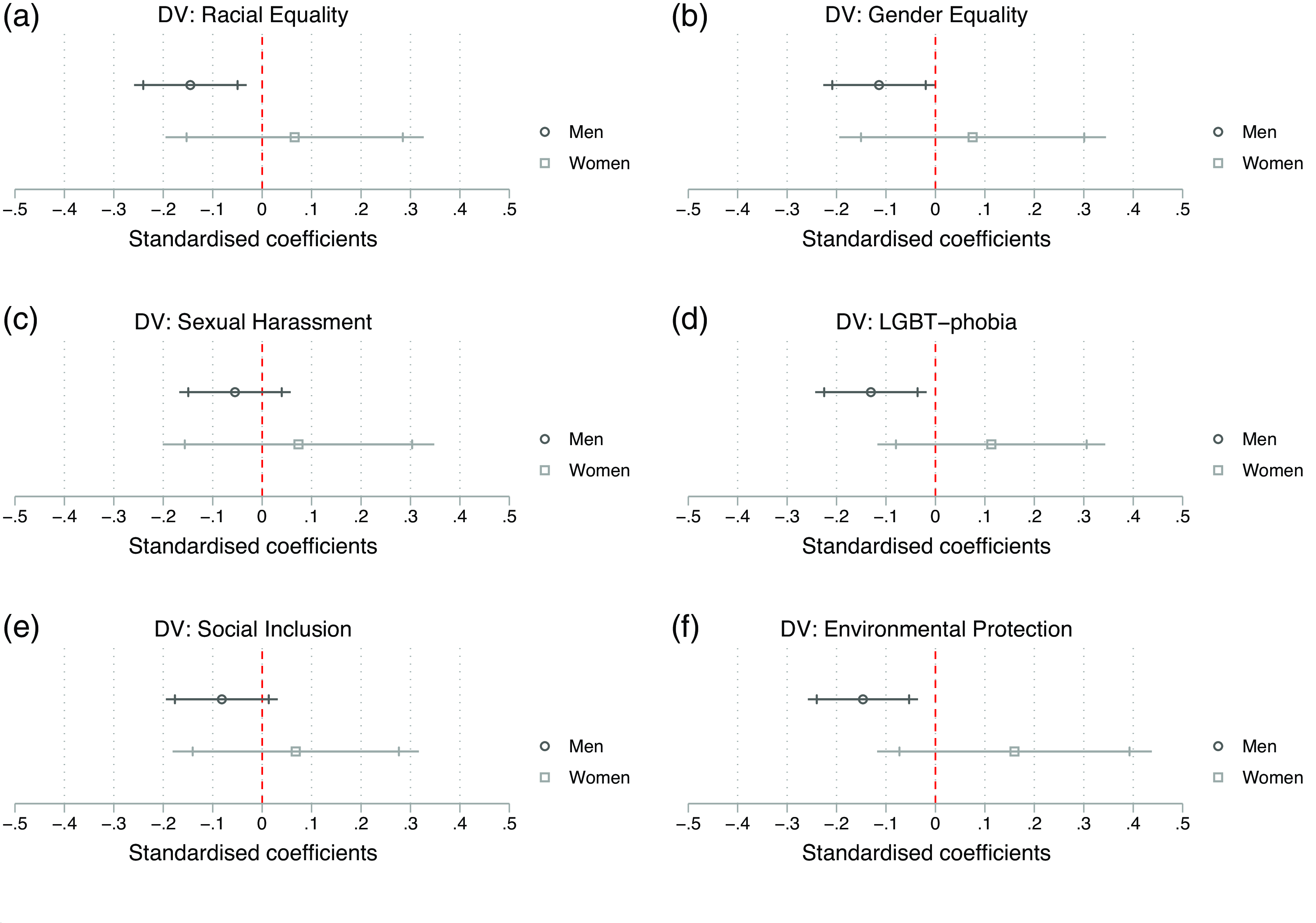
Figure 4 Long description
The image contains six separate graphs, each representing the impact of ECBs anti-sexism campaign on fans support for the Clubs social role across different dimensions. The graphs are labeled (a) through (f) and measure different dependent variables: Racial Equality, Gender Equality, Sexual Harassment, LGBT-phobia, Social Inclusion, and Environmental Protection. Each graph shows standardized coefficients on the x-axis, ranging from -0.5 to 0.5. The unit of analysis is the respondent, with a sample size of 1,420. The models used are OLS with robust standard errors, and confidence intervals are reported at the 90% and 95% levels. The data points are differentiated by gender, with circles representing men and squares representing women. Higher values on the x-axis indicate greater support for the Clubs social role. The results are interpreted in terms of their deviation from the mean, with a coefficient of -0.1 indicating a decrease in support by 0.1 of the standard deviation. The graphs show varying levels of support across the different dimensions, with some showing more significant impacts than others. All values are approximated.
These analyses corroborate our interpretation that male fans’ reprisal of their Club’s anti-sexism campaign is an effort to maintain the status quo and protect their space within their Club. While anti-sexism campaigns sponsored by football associations (as in the case of our baseline group) would be reasonably unlikely to promote change within any particular club, male fans could perceive the ECB’s efforts to bolster women in football as a credible threat to their status within the Club, such as their experiences in the stadium. These results are also consistent with the wider context of football fan demographics: data from our national sample of Brazilian respondents indicate that women are significantly less likely to have a football team and to consider the sport important (Appendix J); our results suggest that the overwhelmingly male group of Club fans seeks to maintain it this way. Since our survey was conducted in partnership with ECB and disseminated by the Club, male fans may have used the survey to express their discontentment with the Club’s plan to make the stadium more gender inclusive.
This is consistent with the literature on backlash, which considers it a form of “dynamic resistance” employed by dominant groups as a strategy to reverse or delegitimize policy advances when their status is under threat (Mansbridge and Shames, Reference Mansbridge and Shames.2008). As a large scholarship shows, men’s resistance to efforts to challenge gendered hierarchies span various areas, from the enforcement of property rights (Brulé, Reference Brulé2020), to gender quotas (Gatto, Reference Gatto2025; Kim and Kweon, Reference Kim and Kweon.2022), women’s participation in politics and public service (Gottlieb, Reference Gottlieb2016; Krook, Reference Krook2017; Mansell et al., Reference Mansell, Harell, Thomas and Gosselin.2022), and women’s empowerment in society (Coffe et al., Reference Coffe, Marta Fraile, Fortin-Rittberger and Banducci.2023). Our findings are also consistent with studies that reveal football fans’ explicit efforts to protect their teams from outsiders (Nobis et al., Reference Nobis, Gomez-Gonzalez, Nesseler and Dietl.2022) and men’s concerns about football becoming “over-feminized” (Cleland, Pope and Williams, Reference Cleland, Pope and Williams.2020).
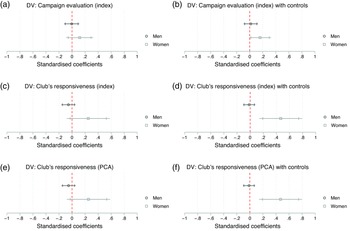
The effects of the campaign are not all be negative, however. As shown in Figure 5, while the treatment does not affect men’s attitudes in this dimension, our exploratory analyses suggest women exposed to their club’s campaign better evaluate the anti-sexism initiative (panel B, coefficient = 0.158, p-value = 0.065) and, critically, are more likely to view the Club as responsive to fans’ preferences (panel D, coefficient = 0.466, p-value = 0.006). Unsurprisingly, models with more precision that include controls tend to reach higher levels of statistical significance. These findings align with scholarship suggesting that positive institutional recognition of marginalized groups may foster trust and group belonging (e.g., Allen et al., Reference Allen, Kern, Rozek, McInerney and Slavich.2021).
The effect of ECB’s campaign on fans’ campaign evaluations and perceptions of the Club’s responsiveness (a) DV: Campaign evaluation (index) (b) DV: Campaign evaluation (index) with controls (c) DV: Club’s responsiveness (index) (d) DV: Club’s responsiveness (index) with controls (e) DV: Club’s responsiveness (PCA) (f) DV: Club’s responsiveness (PCA) with controls.
Note: The unit of analysis is the respondent (N = 1,420). We run OLS models with robust standard errors and report confidence intervals at the 90% and 95% levels. The X-axis is expressed in standard deviations. Higher values of our outcome variables indicate attitudes more positive evaluations of the campaign (panels A–B) and higher satisfaction with the Club’s responsiveness (C–F). We interpret our results in terms of their deviation from the mean (i.e., zero). For example, a coefficient of 0.4 means the treatment has increased satisfaction with the Club’s responsiveness by 0.4 of the standard deviation. Appendix N reports tables of results with raw coefficients.
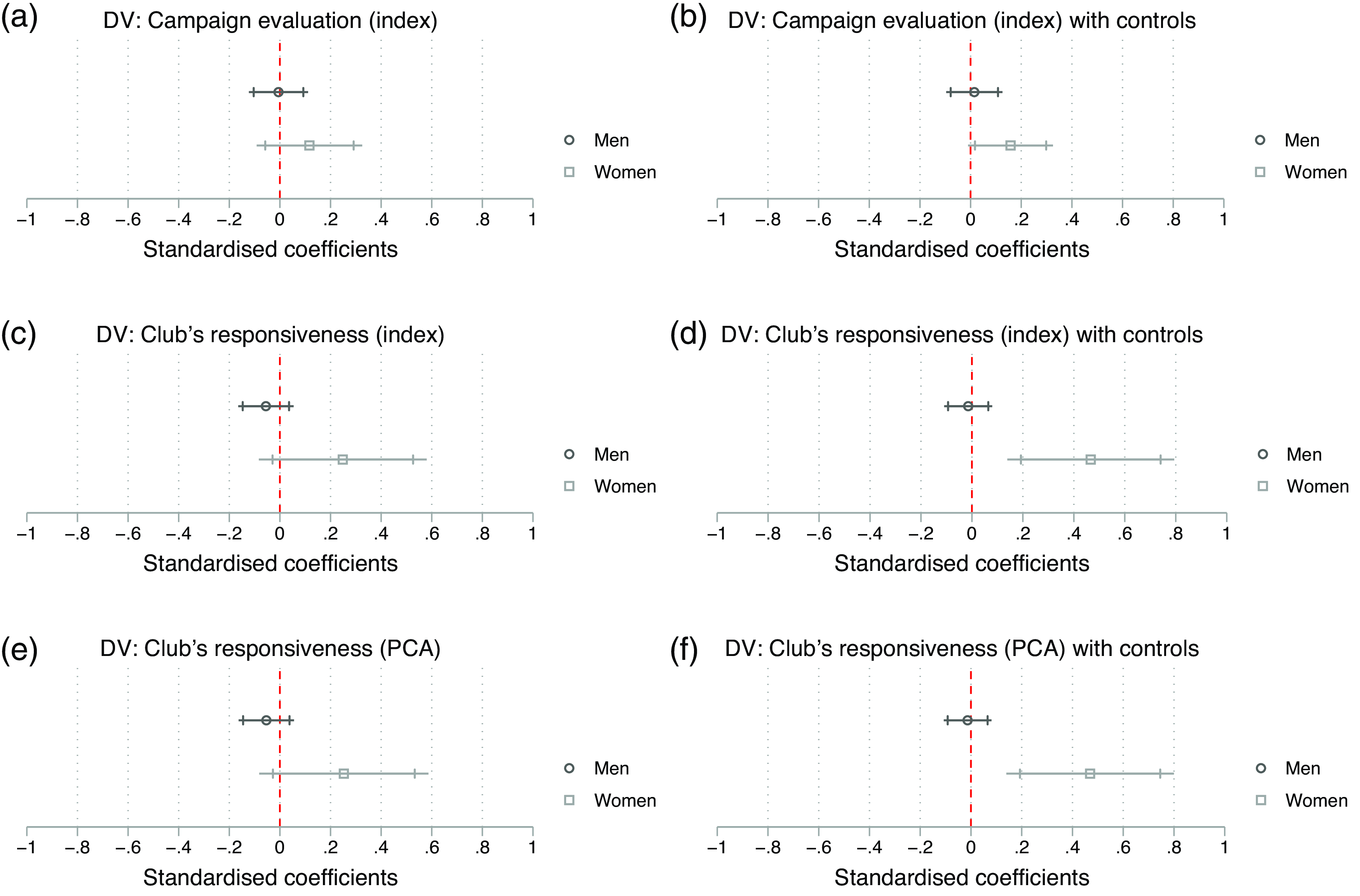
Figure 5 Long description
The image contains six graphs, each representing different dependent variables related to the effect of ECBs campaign on fans campaign evaluations and perceptions of the Clubs responsiveness. The graphs are labeled (a) through (f). Each graph displays standardized coefficients on the x-axis, ranging from -1 to 1. The dependent variables include campaign evaluation (index), campaign evaluation (index) with controls, club's responsiveness (index), club's responsiveness (index) with controls, club's responsiveness (PCA), and club's responsiveness (PCA) with controls. The data points are differentiated by gender, with circles representing men and squares representing women. The red dashed vertical line at zero indicates the mean value. Higher values on the x-axis indicate more positive evaluations of the campaign and higher satisfaction with the club's responsiveness. The graphs show confidence intervals at the 90% and 95% levels, with the unit of analysis being the respondent (N = 1,420). The results are interpreted in terms of their deviation from the mean, where a coefficient of 0.4 means the treatment has increased satisfaction with the club's responsiveness by 0.4 of the standard deviation.
Conclusion
Our study indicates that football fandom can influence attitudes, with fans being more responsive to campaigns by their club than other football organizations. Although the Club’s anti-sexism campaign prompted men to display greater levels of prejudice toward women in football and reduced support for the club’s involvement in other social issues, it also improved women’s perception of the club’s responsiveness to fans, which is suggestive of their greater levels of institutional trust and belonging. These mixed results suggest that football can be a powerful tool for social change, but that how campaigns impact social change deserves further examination.
Supplementary material
To view supplementary material for this article, please visit https://doi.org/10.1017/XPS.2025.10009
Data availability
The data, code, and any additional materials required to replicate all analyses in this article are available at the Journal of Experimental Political Science Dataverse within the Harvard Dataverse Network, at: https://doi.org/10.7910/DVN/OS4PSG.
Acknowledgments
We thank Bahia Football Club for the collaboration that has allowed us to estimate the impact of the Club’s anti-prejudice campaigns. For comments and suggestions on prior drafts, we thank seminar participants at the London School of Economics, King’s College London, Durham University, the 2023 meeting of the European Political Science Association, and the gender and politics workshop organized by Jennifer Piscopo.
Competing interests
The authors declare none.
Ethics statement
The observational study was reviewed by the Ethics Board of University CollegeLondon (approval number: 10731/002). The experimental study was reviewed by the Ethics Boards of University College London (approval number: 18877/003) and the University of Zurich (approval number: 20.12.1).


 Open access

