


Introduction
The World Health Organisation’s (WHO) Commission on Social Connection 2024–2026 argued that finding solutions to loneliness is an international public health and policy priority due to its negative impact on physical and mental health, well-being of communities and societies, and its association with reduced life-expectancy (Courtin and Knapp, Reference Courtin and Knapp2017; Fried et al., Reference Fried, Prohaska, Burholt, Burns, Golden, Hawkley, Lawlor, Leavey, Lubben, O’Sullivan, Perissinotto, van Tilburg, Tully and Victor2020; WHO, 2024). Recognising these negative effects, in 2018 the UK resourced a ministerial position and several commissions specifically exploring loneliness, and addressing loneliness amongst older people is a claimed priority (HM Government, 2021; NHS, 2021). Yet, despite a burgeoning body of research, particularly relating to older adults, identifying effective solutions remains a challenge because loneliness is complex, personal, and multidimensional (Prohaska et al., Reference Prohaska, Burholt, Burns, Golden, Hawkley, Lawlor, Leavey, Lubben, O’Sullivan, Perissinotto, van Tilburg, Tully, Victor and Fried2020).
Most policies and interventions frame loneliness as an individual problem to be resolved through reducing isolation through increasing social connection. However, whilst they are related, isolation and loneliness are distinct concepts. Isolation refers to the objective state of having limited social contact and being physically isolated from others, whereas loneliness refers to a personal and subjective feeling that your connections are either too few and/or lack meaning (Weiss, Reference Weiss1973; Wigfield et al., Reference Wigfield, Turner, Alden, Green and Karania2022). Consequently, you can be physically isolated and not lonely, and you can be lonely whilst having an abundance of connections (Wigfield et al., Reference Wigfield, Turner, Alden, Green and Karania2022). The perception that opportunities for increased social participation will lead to a reduction in loneliness is problematic (Oman, Reference Oman2021) because there are other factors involved, including social exclusion (Walsh et al., Reference Walsh, Scharf and Keating2017; Dahlberg et al., Reference Dahlberg, McKee, Lennartsson and Rehnberg2022).
The relationship between social exclusion and loneliness is the focus of this article, which furthers our understanding of the policies and socio-cultural attitudes that lead to increased levels of emotional, social, and existential loneliness amongst older people in deprived communities. The article presents qualitative research that explored the perceptions of drivers of loneliness with older people and service providers in an underprivileged community in South Wales. In doing so, the paper presents structural and socio-cultural strategies to overcome loneliness that may complement existing efforts to encourage social participation.
Loneliness amongst older people
Loneliness and isolation affect people of all ages, but ageing is associated with known risk factors including experiencing declining health, bereavement, living alone, retirement, and reduced mobility (Courtin and Knapp, Reference Courtin and Knapp2017). The World Health Organisation estimates that globally up to one in four older adults is lonely (WHO, 2024). A Campaign to End Loneliness survey found similar rates in the UK where it is estimated 20 per cent of the older population is mildly lonely with another 8–10 per cent being intensely lonely. However, there is also a stereotype that old age in the UK is a particularly lonely time, which can result in ageist assumptions (Hagan, Reference Hagan2020). For example, stakeholders and service providers in the UK have been shown to overestimate loneliness amongst older people (Fried et al., Reference Fried, Prohaska, Burholt, Burns, Golden, Hawkley, Lawlor, Leavey, Lubben, O’Sullivan, Perissinotto, van Tilburg, Tully and Victor2020). Regardless of risk or population prevalence, the negative consequences of loneliness mean that researching older people’s experiences remains important (Naughton-Doe et al., Reference Naughton-Doe, Barke, Manchester, Willis and Wigfield2022; Victor and Pikhartova, Reference Victor and Pikhartova2020).
Loneliness
Despite their differences, loneliness and isolation are often used as catch-all terms resulting in a simplified understanding that ignores different presentations of loneliness (Smith and Victor, Reference Smith and Victor2019). Loneliness is more recently conceptualised in research and policy within three domains: social, emotional, and existential (Victor et al., Reference Victor, Barreto and Qualter2022; McKenna-Plumley et al., Reference McKenna-Plumley, Turner and Yang2023). It is important to unpack these dimensions of loneliness that could identify social policies and interventions that will prevent or reduce them (Cotterell et al., Reference Cotterell, Buffel and Phillipson2018).
Emotional loneliness refers to the absence of close meaningful relationships whereas social loneliness is the absence of a fulfilling range of social relationships (Weiss, Reference Weiss1973; Wigfield et al., Reference Wigfield, Turner, Alden, Green and Karania2022). Existential loneliness, which has been less explored, refers to a fundamental sense of separation from others and the world (McKenna-Plumley et al., Reference McKenna-Plumley, Turner and Yang2023) and manifests in feelings of alienation derived from loss of purpose or identity in a society where people no longer feel valued (Bolmsjö, et al., Reference Bolmsjö, Tengland and Rämgård2019; Kitzmüller et al., Reference Kitzmüller, Clancy, Vaismoradi, Wegener and Bondas2018; van Tilburg, Reference van Tilburg2020). Most existential loneliness research focusses on very old and/or seriously ill individuals, but the concept is relevant across the life-course, and Victor et al. (Reference Victor, Barreto and Qualter2022) have argued it should be explored more in the over fifties population (Bolmsjö, et al., Reference Bolmsjö, Tengland and Rämgård2019).
Individual, socio-cultural, and structural drivers of loneliness
There is an extensive quantitative literature exploring associations with, causes of, and risk factors for, isolation and loneliness (Fried et al., Reference Fried, Prohaska, Burholt, Burns, Golden, Hawkley, Lawlor, Leavey, Lubben, O’Sullivan, Perissinotto, van Tilburg, Tully and Victor2020; Prohaska et al., Reference Prohaska, Burholt, Burns, Golden, Hawkley, Lawlor, Leavey, Lubben, O’Sullivan, Perissinotto, van Tilburg, Tully, Victor and Fried2020), but research has rarely explored these qualitatively, nor has it explored how these causes and risk factors relate to the specific dimensions of existential, social, and emotional loneliness (Cotterell et al., Reference Cotterell, Buffel and Phillipson2018). Most research into the causes of loneliness has focussed on individual drivers (micro-level factors) (Victor and Pikhartova, Reference Victor and Pikhartova2020) that include the personalities and characteristics of individuals, such as their resilience, and how these interact with life events such managing transitions such as becoming a parent, job changes, changes to health status, retirement, and bereavement. This approach has been criticised for appearing to ‘blame’ individuals for being lonely, which can lead to stigma if loneliness is perceived as a personal failing (Agren and Cedersund, Reference Agren and Cedersund2020; Oman, Reference Oman2021; Malli et al., Reference Malli, Ryan, Maddison and Kharicha2023).
Acknowledging that wider structural and socio-cultural (macro level) factors also drive loneliness (Burholt et al., Reference Burholt, Winter, Aartsen, Constantinou, Dahlberg, Feliciano, De Jong Gierveld, Van Regenmortel and Waldegrave2020; Prohaska et al., Reference Prohaska, Burholt, Burns, Golden, Hawkley, Lawlor, Leavey, Lubben, O’Sullivan, Perissinotto, van Tilburg, Tully, Victor and Fried2020; Victor and Pikhartova, Reference Victor and Pikhartova2020), Walsh et al. (Reference Walsh, Scharf and Keating2017), and Burholt et al. (Reference Burholt, Winter, Aartsen, Constantinou, Dahlberg, Feliciano, De Jong Gierveld, Van Regenmortel and Waldegrave2020) have argued that we can better understand the causes of and solutions for loneliness experienced by older people through a wider lens of social exclusion. Walsh et al.’s (Reference Walsh, Scharf and Keating2017) framework argues that loneliness (one manifestation of exclusion from social relations) is related to income (economic exclusion), access to services and transport (structural exclusion), how people feel about their community and neighbourhoods (community exclusion), how accepted they feel in society (socio-cultural exclusion), and how much influence they have through local and national democratic systems (civic exclusion). This article will focus on how two of these overlapping domains: socio-cultural exclusion and structural exclusion interact with loneliness.
Socio-cultural exclusion describes the societal norms and values which exclude those who are different (Walsh et al., Reference Walsh, Scharf and Keating2017). For example, ageism is discrimination against older people based on prejudiced stereotypes about their competencies. Ageism can lead to existential and social loneliness through the internalisation of negative stereotypes, such as the conflation of older age with frailty (Barke, Reference Barke2017). This may then lead to their avoidance of community spaces where they either don’t feel welcomed or accepted, or able to participate (Barke, Reference Barke2017; Shiovitz-Ezra et al., Reference Shiovitz-Ezra, Shemesh, Naughton, Ayalon and Tesch-Römer2018). Another example of a socio-cultural attitude leading to exclusion the political and cultural ideology of individualism which emphasises self-reliance, as opposed to collectivism, which values interdependence (Baratto et al., Reference Barreto, Victor, Hammond, Eccles, Richins and Qualter2021). Loneliness is more common in individualistic societies, like the United Kingdom (UK), because citizens have fewer social networks, less family ties, and are expected to be responsible for themselves and not ask others for help (Baratto et al., Reference Barreto, Victor, Hammond, Eccles, Richins and Qualter2021).
Structural exclusion refers to having limited access to resources and services and is associated with loneliness (Burholt et al., Reference Burholt, Winter, Aartsen, Constantinou, Dahlberg, Feliciano, De Jong Gierveld, Van Regenmortel and Waldegrave2020; Prohaska et al., Reference Prohaska, Burholt, Burns, Golden, Hawkley, Lawlor, Leavey, Lubben, O’Sullivan, Perissinotto, van Tilburg, Tully, Victor and Fried2020; Victor and Pikhartova, Reference Victor and Pikhartova2020; Myck, Waldegrave and Dahlberg, Reference Myck, Waldegrave, Dahlberg, Walsk, Scharf, Van Regenmortel and Wanka2021). Loneliness is more prevalent where there are fewer statutory services and limited access to public transport, which result in fewer opportunities for people on lower incomes to maintain relationships and access health and care and leisure activities (Pratley, Valtorta, and Hanratty Reference Valtorta and Hanratty2012; Urbaniak and Walsh, Reference Urbaniak and Walsh2021). Cuts to public transport have a particularly detrimental effect on loneliness in rural areas especially amongst people who do not drive (National Assembly for Wales, 2017).
Addressing loneliness amongst older people
Most support to reduce loneliness amongst older people aims to provide opportunities for social participation through one-to-one or group interventions such as offering social activities, befriending, and peer support (O’Rourke et al., Reference O’Rourke, Collins and Sidani2018). Psychological interventions (Robertson, Reference Robertson2019; Hagan, Reference Hagan2020) and courses targeting tailored interventions for dealing with critical life transitions, such as retirement (Barke, Reference Barke2017), have also been explored. However, very few of these interventions have been evaluated, or found to work, and consequently many statutory services, voluntary sector organisations and charities are running projects to reduce loneliness in the UK without a supportive evidence base (Fakoya et al., Reference Fakoya, McCorry and Donnelly2020; Fried et al., Reference Fried, Prohaska, Burholt, Burns, Golden, Hawkley, Lawlor, Leavey, Lubben, O’Sullivan, Perissinotto, van Tilburg, Tully and Victor2020).
Oman (Reference Oman2021) has problematised the prevailing policy narrative that loneliness can be resolved through increased social participation as it unhelpfully conflates social isolation with loneliness and ignores the wider causes including discrimination and poverty. Conceptualising loneliness within social exclusion changes our understanding of potential policy and practice solutions. If loneliness is linked to wider social exclusion, then a more holistic approach is needed, that moves the focus away from individual interventions for social connection (Walsh et al., Reference Walsh, Scharf and Keating2017; Hagan, Reference Hagan2020; Fried et al., Reference Fried, Prohaska, Burholt, Burns, Golden, Hawkley, Lawlor, Leavey, Lubben, O’Sullivan, Perissinotto, van Tilburg, Tully and Victor2020; Malli et al., Reference Malli, Ryan, Maddison and Kharicha2023). This could include investment in mental and physical health, social services to improve health and well-being (Courtin and Knapp, Reference Courtin and Knapp2017), and better public transport (National Assembly for Wales, 2017). Other ideas include developing age-friendly spaces (Dahlberg, Reference Dahlberg2020) and interventions to address negative age-related stereotypes (Shiovitz-Ezra et al., Reference Shiovitz-Ezra, Shemesh, Naughton, Ayalon and Tesch-Römer2018). Challenging stigma and negative cultural associations with loneliness may reduce self-stigma (Barke, Reference Barke2017) and encourage people to access support (Goll et al., Reference Goll, Charlesworth, Scior and Stott2015) and health care (Jovicic and McPherson, Reference Jovicic and McPherson2020). However, there is limited research exploring these approaches.
This article sought to understand the perspectives of what causes loneliness in one underpriveledged community for the purpose of better understanding how to address it, and coproducing community-driven solutions. The seldom-heard perspectives of residents and service providers contributes to a gap in the empirical research, which has rarely asked these communities for their input.
The study
This article presents findings from the Isolation and Loneliness Experienced by Older People (ILOP) project, which explored the drivers of loneliness in the over fifties (Naughton-Doe, Manchester and Boam, Reference Naughton-Doe, Manchester and Boam2016; Manchester and Barke, Reference Manchester and Barke2020). The article explores the data collected in 2016 from a community in South Wales, which is a former mining town with high levels of deprivation, unemployment, ill-health, and high numbers of people claiming welfare benefits. In 2024, the area still contains some the most materially deprived geographical communities both in Wales and Europe. The low threshold for ‘older person’ reflects the gap in life expectancy (nine years) and healthy life expectancy (sixteen years) between the Welsh Valleys and the rest of the UK at the time of the research (Public Health Observatory Wales, 2011).
Research methods
Between April 2015 and August 2016, two embedded researchers were co-located between the University of Bristol, and a voluntary sector organisation funded by Communities First, the Welsh Government’s fifteen-year anti-poverty programme that ran between 2002 and 2017. Embedded research improves knowledge production and dissemination through researcher and practitioner networks and experience (Cheetham et al., Reference Cheetham, Wiseman, Khazaeli, Gibson, Gray, Van der Graaf and Rushmer2018). In this case, the ‘embeddedness’ enabled the researchers to gain a deep understanding of the local area through working closely with the Communities First team, map services, meet community leaders, and speak with residents.
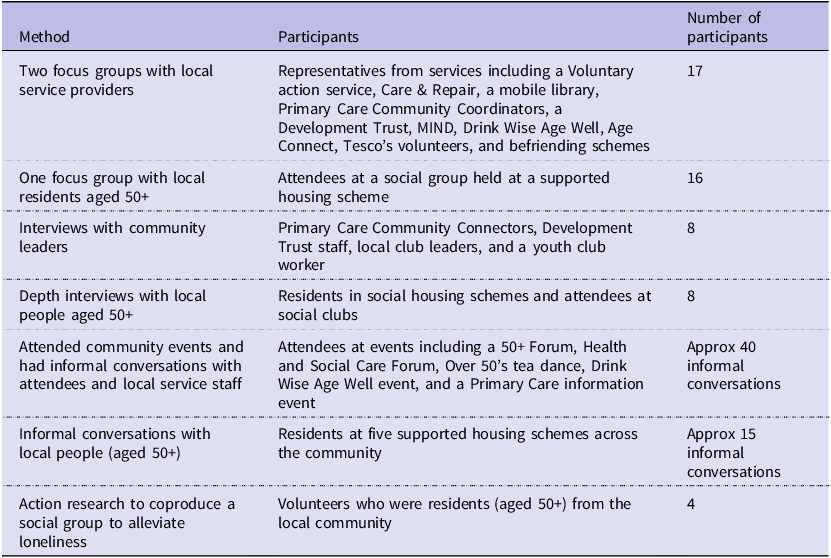
The project had three iterative methods. As Table 1 reports, the first phase of the project involved working with local community groups and commissioned artists to understand the experiences of loneliness amongst older people. The second stage recruited local older people with lived experience to develop community-based solutions through action research. This article reports the third phase, led by the author, that developed a community-wide strategy for solutions to isolation and loneliness (Naughton-Doe et al., Reference Naughton-Doe, Manchester and Boam2016).
Data collection methods and participants across the project
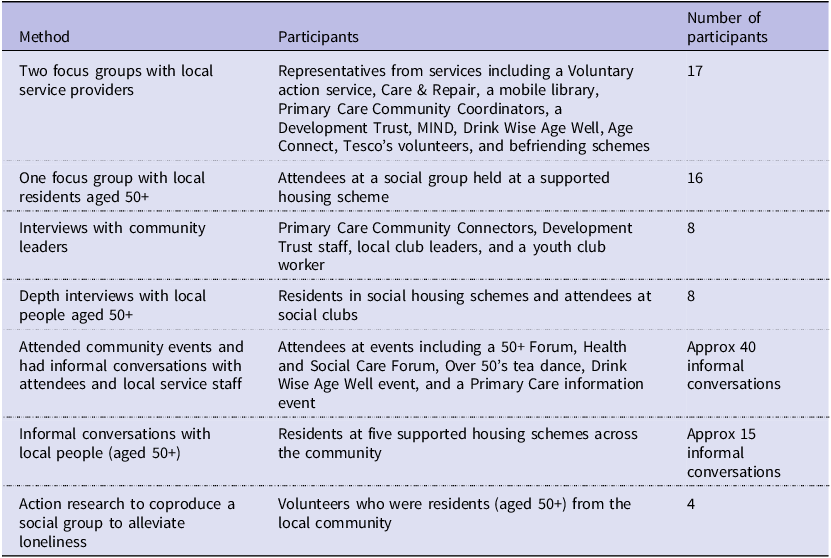
Table 1 Long description
A table detailing data collection methods and participants in a community project. The table has six rows and four columns. The columns are labeled Method, Participants, and Number of participants. Row 1: Method: Two focus groups with local service providers; Participants: Representatives from services including a Voluntary action service, Care & Repair, a mobile library, Primary Care Community Coordinators, a Development Trust, MIND, Drink Wise Age Well, Age Connect, Tesco's volunteers, and befriending schemes; Number of participants: 17. Row 2: Method: One focus group with local residents aged 50+; Participants: Attendees at a social group held at a supported housing scheme; Number of participants: 16. Row 3: Method: Interviews with community leaders; Participants: Primary Care Community Connectors, Development Trust staff, local club leaders, and a youth club worker; Number of participants: 8. Row 4: Method: Depth interviews with local people aged 50+; Participants: Residents in social housing schemes and attendees at social clubs; Number of participants: 8. Row 5: Method: Attended community events and had informal conversations with attendees and local service staff; Participants: Attendees at events including a 50+ Forum, Health and Social Care Forum, Over 50s tea dance, Drink Wise Age Well event, and a Primary Care information event; Number of participants: Approx 40 informal conversations. Row 6: Method: Informal conversations with local people (aged 50+); Participants: Residents at five supported housing schemes across the community; Number of participants: Approx 15 informal conversations. Row 7: Method: Action research to coproduce a social group to alleviate loneliness; Participants: Volunteers who were residents (aged 50+) from the local community; Number of participants: 4.
Between February and August 2016, opportunistic and purposive strategy enabled us to reach community members who felt lonely and the professionals and practitioners that supported them. Local service leaders were invited to participate in face-to-face focus groups to explore the causes of and solutions for loneliness amongst older people. Two focus groups lasting two hours each were facilitated by two researchers following a semi-structured topic guide that included questions about what caused loneliness locally, available services and the barriers to accessing them, as well as ideas for support. Professionals who could not attend the focus groups were invited to one-to-one interviews that used an adapted topic guide.
Older people who were experiencing loneliness were recruited to semi-structured interviews by the researcher and local people from phase two of the research, who advertised and explained the research at stalls set up in the communal areas of supported housing schemes, outside a health centre, and at a community event for older people. It was difficult to recruit people to interview due to the timescale and possibly the stigma of loneliness. Looking for ways to involve more participants, a supported housing manager was approached to act as a gatekeeper to recruit people attending a coffee morning. The group opted for a focus group rather than be spoken to separately. In addition to focus groups and interviews, throughout the research, informal conversations and researcher reflections were recorded in a field diary and included as data.
The data were transcribed verbatim and fieldnotes were typed up before being entered in the data analysis package, NVivo. Transcripts were analysed using Ritchie and Lewis’ (Reference Ritchie and Lewis2003) Thematic Analysis Framework to identify key themes in the responses that could answer the research question about the causes and solutions to loneliness. Codes and categories were developed by the author by considering each line, phrase, and paragraph of the transcripts to summarise what the participants were describing. Similar codes were developed into a coding framework, which was reviewed by the wider ILOP team to ensure rigour. The transcripts were then re-analysed using the agreed framework, and findings were organised into themes with the ILOP team in an iterative process.
Ethical approval was obtained from the University of Bristol Ethics Committee. Participants gave verbal or written informed consent. All participant’s data has been anonymised, and pseudonyms are used throughout to protect confidentiality. The author and research team have written about the complex ethical challenges of researching loneliness with older people elsewhere (Manchester and Barke, Reference Manchester and Barke2020; Naughton-Doe et al., Reference Naughton-Doe, Barke, Manchester, Willis and Wigfield2022).
Findings
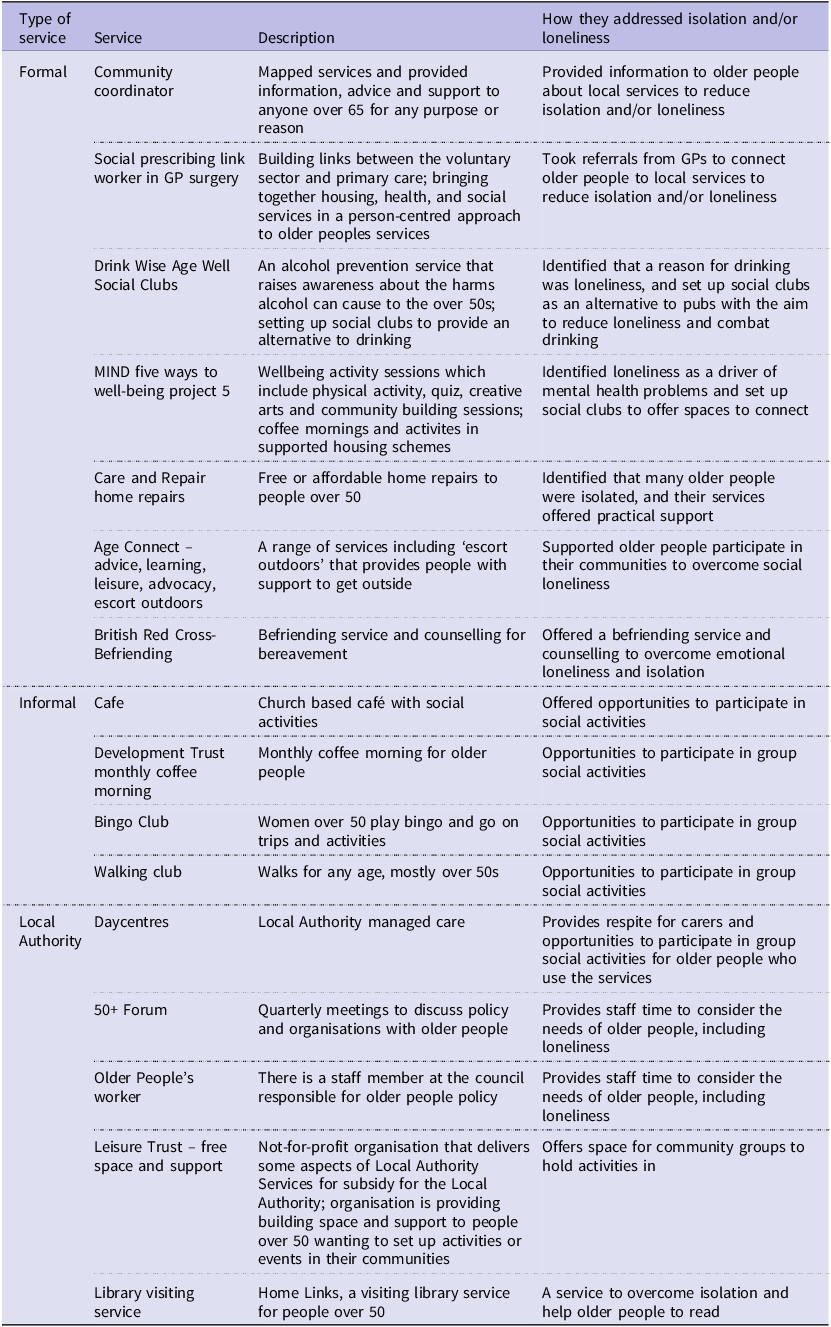
Many statutory and voluntary sector services and informal community groups identified that they were either directly or indirectly addressing isolation and/or loneliness amongst older people (see Table 2 for a full list). Two services – one in primary care and one in the community – mapped local support and provided information about available support and activities to older people who may be isolated and/or lonely. Two voluntary sector organisations promoting mental health set up social groups for older people and a separate service provided counselling and befriending. Others aimed to reduce isolation by helping older people to get outside, or by bringing services into their homes, such as a visiting library or repair service. There were also four social clubs that were run by locals, including a bingo club, a walking club, and two coffee mornings.
Services in the community
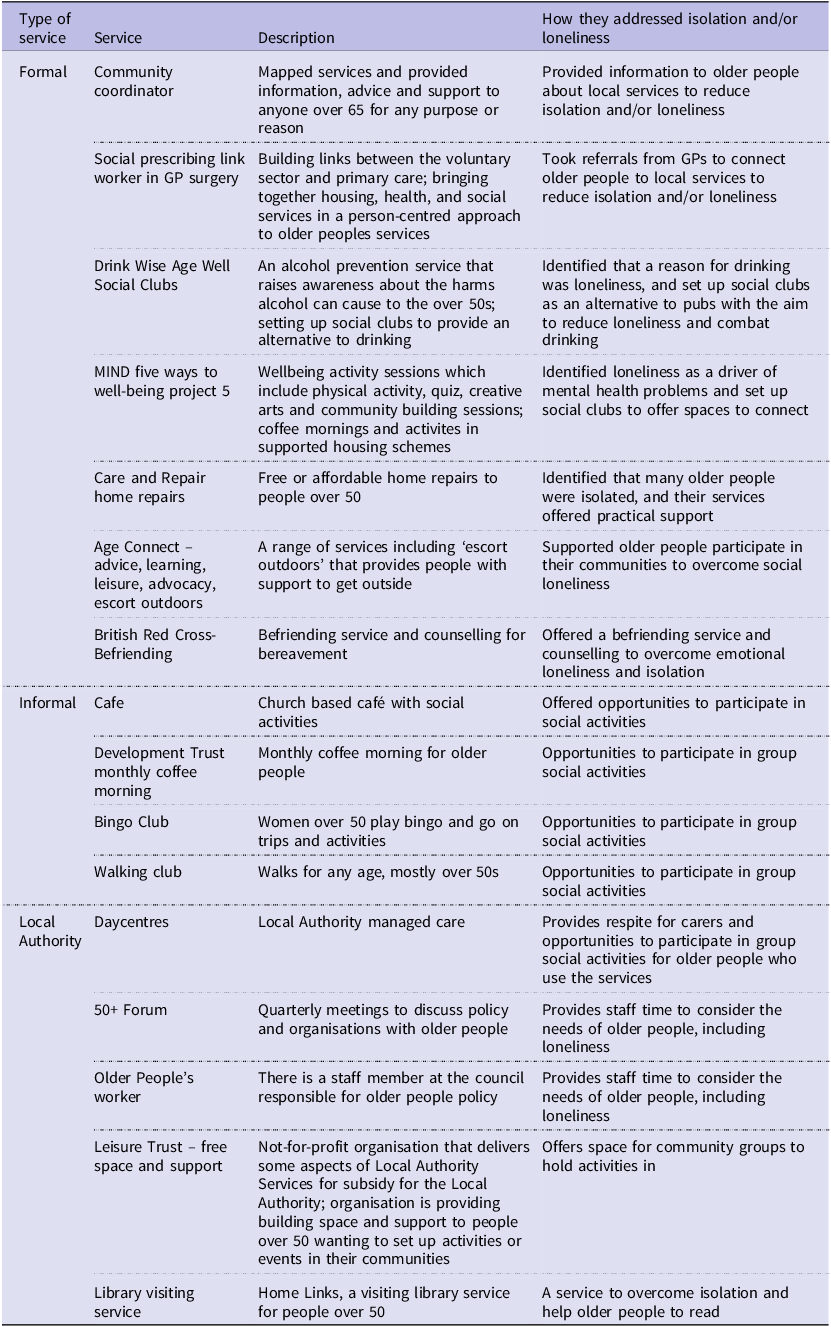
Table 2 Long description
A table with four rows and five columns. The columns are labeled Type of service, Service, Description, and How they addressed isolation and/or loneliness. The table lists various services categorized into formal, informal, and local authority types. Each row describes a specific service, its type, a brief description, and how it addresses isolation and loneliness among older people. The services include community coordinators, social prescribing link workers, social clubs, wellbeing activity sessions, home repairs, befriending services, cafes, coffee mornings, bingo clubs, walking clubs, day centres, forums, older people's workers, leisure trusts, and library visiting services.
Two focus groups were attended by seventeen practitioners from a wide range of these services including those working in the statutory, informal, and formal voluntary sector (see Table 1). Three professionals were also interviewed one-to-one, including senior management from the Community Development Organisation where the research was embedded, and two primary care link workers. Five older people who identified as lonely participated in interviews, including four men (aged between sixty and eighty-five) who lived in supported housing and one disabled woman who lived in the community (aged sixty to seventy). Demographic information was not collected from the fourteen participants in the focus group at the supported housing coffee morning due to it being spontaneous; however, they were all white females aged sixty plus.
Participants in the practitioner focus groups identified that despite some support being available, including information services and group activities, loneliness was still an issue for the older residents they supported. This section will now present their reflections on the causes of loneliness summarised into four themes; limited availability of services; mobility and transport; ageism; and stigma.
Limited availability of services
When asked about what caused loneliness, service providers, health professionals, and older people commonly reported that local service provision was inadequate. There was a perception that reduced funding for statutory and voluntary sector services had adversely impacted availability, which affected social care, access to doctors such as General Practitioners(GPs), informal community-led provision, and housing. Professionals perceived that most statutory day centre facilities where frailer older people could meet, or provide respite to give carers opportunities for socialising, had either been closed, or long waiting times prevented access. A social housing manager explained:
The other day [we rang a] day centre, because my friend’s mother had dementia, and…you had a list…You had to wait for a space to become available.
Voluntary sector services also had waiting lists. For example, a popular befriending scheme that relied on volunteers could not keep up with demand. The manager explained that staff perceived waiting for support could intensify older people’s loneliness and worsen their mental health:
I’ve usually got about six people on a waiting list with each befriending project. It just has such a negative impact on their health and wellbeing.
Similarly, when considering access to psychological therapy, a community link worker reflected on the difficult process of asking the GP for support with mental health:
If you are referred for any mental health issues, because loneliness is a mental health issue, right – no chance. You’re talking possibly eighteen months to two years. God, it takes you a year to see a cardiologist with your heart.
The fear of the waiting list also created barriers for people, preventing them from accessing support, as a service provider explained in a focus group:
I wonder if that is one of the motivating factors behind people saying, ‘No, I’m not lonely,’ or not, perhaps, identifying that need in themselves, because, if you are aware, even if you do admit, ‘Yes, this is a problem for me, I’m still not going to be able to access the services,’ or, I’m going to be on a waiting list,’ or, ‘I’m not going to be able to get to somewhere, even if I do admit it’.
Residents in the supported housing focus group and the manager of the scheme noted that the numbers of wardens in supported housing had been reduced during a transfer from the council to the private sector. Where wardens had once organised social activities, their roles now centred on administration, which reduced the opportunities for social interactions between residents. An excerpt from the fieldnotes explains:
[The warden] told me she was supposed to sit in the office now, during the group activities, and not participate. She felt this was totally inappropriate and took away from the fact her job was about interaction and building relationships.
Although there were many voluntary sector services, professionals reported that funding for these organisations had been reduced or cut. This was confirmed by residents in the supported housing focus group who explained that a cooking group, a Zumba group, supported housing social activities, and the local bowls club had all recently closed. It was perceived that services were not being cut due to lack of interest or need, but due to a shortage of funding. The Communities First manager explained ‘at the end of the day, it’s always connected to money’. Similarly, the supported housing manager explained that services were shutting down because:
There’s not even enough money to keep them going. It’s all down to money, the same with the GPs, and everything else. It’s all down to money.
At the time of the research in 2016, an announcement that funding for the Communities First anti-poverty programme in Wales was ending in 2017 caused concern this would worsen the problem.
Mobility and transport
Participants identified limited mobility and poor transport as key contributors to loneliness in their town. The town has a higher-than-average proportion of disability allowance claimants and a lower life expectancy compared to the UK. Mobility issues affect a high proportion of older residents, and the topography of the town always makes it more challenging to walk, as it is hilly and spread across a valley. The inability to travel places including local amenities, shops, and health and care services reduced personal agency. Further, people found it hard to meet friends and family. Summarising these issues, a service provider in the focus group explained:
I think the difference with older people is, quite often with younger people they are able to access transport and to be able to get out and things, whereas, perhaps, with older people, because of health problems and mobility problems, and because of the nature of the valleys, the topography [they cannot get out as easily].
Local transport was also perceived as inadequate, with participants reporting that the local bus services had been reduced, which further exacerbated mobility issues. In some cases, regular buses had been replaced with services where people had to arrange in advance to for a bus to call at their stop:
There is no [regular] bus service at all. You have to book a service a day ahead. [Participant in service provider focus group]
This created an additional task to complete before going out and removed a spontaneity.
Car access was also an issue. Service providers and interview participants explained that very few older women in their community had learnt to drive, made evident by only one out of six women in the action research project having a licence. Many women were bereaved, and their spouse had been the only driver, which was also the situation of a participant in the interviews. Sheila (aged sixty to seventy) explained her frustration at being told to go to groups by her mental health team, but not having transport:
Again, I’m saying to people, and I don’t seem to be getting through, I’ll go anywhere, but how do I get from A to B? It’s alright saying, ‘Yes, you can go here and you can go to this centre and you can go up here, we do this, we do arts and crafts and all that.’ Yeah, great, I’d love to go, but how do I get from this house without myself paying for a taxi, and, when you’re on a limited income, forty pounds-a-month coming out of your money is a heck of a lot of money.
Compounding this, there were few local shops, and most post offices and other services were located only in the centre of town, meaning those on the outskirts could not access them without cars or using the inadequate public transport.
Ageism
Older residents and service providers both raised age-related discrimination as a cause of loneliness in their community. Participants in the focus groups explained that older people felt excluded because they were sometimes spoken to differently as a direct result of their age. A conversation in the service providers focus group, which included some professionals who identified as older people such as Mary, highlighted that assumptions were often made about older adults’ sensory and cognitive function:
Maureen: [Older people] are not going to bite you, they are not going to hit you, they are not scary people.
Sarah: Yes, because I think some people are genuinely afraid of older people.
Mary: Yes, they don’t know where we come from or what we do.
Kelly: They don’t know how to speak to people.
Sarah: No, they think they are hard of hearing.
Kelly: Yes, they must be deaf or batty, so we will treat them like a fool.
Sarah: And treat them all the same, regardless.
Mary: Talk in a very loud voice and very slowly.
Participants perceived that this discrimination contributed to loneliness because older people were being treated differently by other age groups, including by shop workers and professionals. For example, older people who took part in interviews perceived that they were ignored or avoided by other people:
Old age is a lonelier time as the body starts to fail you. Some people avoid you. Some people do not like to chat to you anymore. [Graham, aged eighty to ninety]
People just forget you when you get old. They just don’t think you count, which is awful. [Barry, aged seventy to eighty]
This exclusion was also felt by women who took part in the focus group in the supported housing coffee morning. They felt that their age had resulted in them being treated differently by their GP. For example, when talking about an initiative to encourage GPs to refer older people to social prescribers, the women discussed:
Rita: But, when you say that GPs are going to be involved in it, that’s a laugh, that is, because you can’t get an appointment to see a GP.
Lorraine: Because they just don’t care. They don’t…do they? I’m not being facetious.
Rita: No, they don’t.
Coral: They don’t care.
Lorraine: Once you reach sixty, that’s it.
Tina: You can shoot yourself, as far as they’re concerned.
Interviewer: Is that something that everyone agrees with?
[Nodding]
Several: Yes.
When ageism was explored with service providers, they blamed negative associations with older people on the media:
When do we see anything other than older people, the fact that everyone’s living longer is crippling social services, or the fact that they’ve had to increase retirement age because older people are crippling the pension system? When do we ever see anything about how much have they contributed? [Participant in service provider focus group]
Here we see how a prevailing culture of ageism could result in existential loneliness, as older people are regarded as no longer contributing to society.
Older people were also experiencing indirect ageism as services designed for them were often based on ageist stereotypes. Many of the activities organised to combat loneliness were based on assumptions of what older people may like, without asking them. These included tea dances, bingo groups, or ‘knit and natter’ groups, and socialising with other older people. Following attending a tea dance and talking to some attendees, the researcher reflected:
Several older people noted this activity was the stereotype of what people thought older people wanted, but in reality, they craved some variety. My gut reaction was it was very stereotypical. There was bingo, quizzes, primary school children singing, and tea and cake. [Researcher field diary]
Whilst some older people enjoyed these activities, older people are not a homogenous group and many practitioners felt that activities should be more diverse and coproduced to meet different needs. This perception that older people wanted these activities, without asking them first, is an example of ageism that can lead to social loneliness if older people do not attend activities and/or existential loneliness if they feel patronised.
Stigma
The stigma of loneliness was raised as a contributing factor to explain why people remained lonely despite some help being available. A prevailing socio-cultural attitude that loneliness is a problem brought on by an individual’s personal shortcomings was evident throughout the research. When participants in the social housing focus group were asked why people might feel lonely, they replied:
Kate: Because they won’t get off their backsides and do anything, because it’s a spiral, isn’t it? The more depressed you get, the less you want to do, and it’s like, because it is an effort.
Tina: Well, not us, because, obviously, we are here today, because we do get off our backsides and do things.
When asked what might help people feel less lonely, participants often replied with variants of ‘It’s up to them. They’ve got to do it themselves’ [participant in service provider focus group]. As is evident from the findings presented so far, many respondents did also identify other wider factors contributing to loneliness, but the rhetoric that people had control over feeling lonely was a commonly held belief. When this was explored in interviews and focus groups with professionals, participants related this to a culture of pride and self-reliance:
These people are proud and strong, they come from the miner’s tradition. A shut up and get on with it mentality. Don’t talk about your feelings, especially the men. [Participant in focus group]
This contributed to a culture where people valued being independent and not asking others for help. For example, a respondent in the professionals focus group who had lived experience of feeling lonely as a bereaved older person explained:
Maureen: I am resilient because I have learnt I have to be resilient. If I don’t do things for me, nobody is going to do them for me… I mean, lots of things have happened in my life, I don’t go round with a barrier on my head. I have overcome them, because I have got to, because otherwise I would have locked myself in the house and have been there.
Whilst no one overtly criticised people who are lonely, attitudes that indirectly blame an individual for feeling lonely partly explains the stigmatising nature of loneliness. If being lonely is something that is a personal responsibility to manage, then feeling lonely is a personal failing, and helps to explain why people may not want to ask for or access support.
Discussion and conclusion
The research explored perceptions of drivers of loneliness amongst older residents in an underprivileged community in South Wales through a qualitative study exploring the seldom heard perspectives of service providers and isolated older residents. Participants in focus groups, interviews, and informal conversations identified many causes of loneliness that went beyond isolation, an individual’s personality or life circumstances. Instead, the findings support the more complex view of Walsh et al. (Reference Walsh, Scharf and Keating2017) that loneliness cannot be viewed separately to social exclusion, including structural and socio-cultural exclusion, which will now be explored.
Structural exclusion and loneliness
Participants in the research identified examples of structural exclusion (Walsh et al., Reference Walsh, Scharf and Keating2017) as key drivers of loneliness in their materially deprived community, including a reduction of statutory services and inadequate access to transport. These findings support Courtin and Knapp (Reference Courtin and Knapp2017) who argued that access to transport, health, community, and social services are essential if we are to avoid isolation and loneliness. The empirical qualitative data in this study helps to explain quantitative data that has identified that loneliness is more prevalent in deprived areas (Prattley et al., Reference Prattley, Buffel, Marshall and Nazroo2020; Victor and Pikhartova, Reference Victor and Pikhartova2020; Urbaniak and Walsh, Reference Urbaniak and Walsh2021). For example, older people on lower incomes who are less mobile, cannot access a car, and cannot afford taxis, face barriers to accessing services, or visiting family and friends. Although there were some services that aimed directly or indirectly to reduce loneliness, locals perceived there were few opportunities, and that older people could not easily access them either through waiting lists or mobility challenges.
The austerity policies of the Conservative and Coalition governments since 2010 may explain the perception that there are less services available because their cuts have directly led to a reduction of public services (Irving, Reference Irving2021). Whilst the fieldwork was conducted in 2016, the findings are still relevant today and furthermore, the issues facing communities across the UK have worsened. For example, many communities in South Wales, including the community in this research, lost vital regeneration funding when the UK left the European Union (Hunt et al., Reference Hunt, Minto and Woolford2016). Despite recognition that good transport is essential for tackling loneliness in Welsh Valleys, services have been further reduced (Williams et al., Reference Williams, McHale and Chow2021; Age Cymru, 2023). Austerity policies have continued, which meant the UK’s public sector is weakened and was less able to respond to the challenges of the Covid-19 pandemic (McKee et al., Reference McKee, Hiam and Dorling2023). Social distancing policies during the pandemic also increased loneliness, meaning there was more demand on these services, particularly for older people who were asked to shield (Wong et al., Reference Wong, Zhang, Sit, Yip, Chung, Wong, Chan, Sun, Kwok and Mercer2020; Naughton-Doe et al., Reference Naughton-Doe, Wigfield and Martin2023). The cost-of-living crisis and heating bills have reduced the incomes of many, further reducing their capacity to pay for social activities (Hill and Webber, Reference Hill and Webber2022).
Whilst loneliness has been higher on the political agenda through subsequent loneliness strategies and reports (HM Government 2018; 2021), this has not yet led to an understanding that drivers of loneliness include austerity and continued lack of investment in infrastructure in communities. Transport is mentioned as a priority in these strategies, and yet investment in local services has not materialised. The data presented in this article suggests that to address loneliness, more attention should be paid to structural exclusion to provide more support and better ways to access it.
Socio-cultural exclusion and loneliness
The findings show that socio-cultural exclusion is a main driver of loneliness through prevailing attitudes, including ageism and a culture that values self-reliance and individual responsibility. The experiences of exclusion felt by participants in this study supports Shiovitz-Ezra et al.’s Reference Shiovitz-Ezra, Shemesh, Naughton, Ayalon and Tesch-Römer2018, Reference Shiovitz-Ezra, Erlich and Ayalon2023 conclusion that ageism can lead to loneliness if people stop talking to older people, and/or make negative assumptions about them, undermining the possibility of meaningful interaction. In addition to this social loneliness, older people’s experiences also aligned with existential loneliness as they felt separate and undervalued. The ageist failure to understand older people as a diverse group of people also contributed to loneliness.
Since the research was conducted, there has been increased exposure to ageist narratives that may have worsened existential loneliness (Shiovitz-Ezra et al., Reference Shiovitz-Ezra, Shemesh, Naughton, Ayalon and Tesch-Römer2018). For example, the UK Government’s Covid-19 pandemic social distancing policies during 2020–2021 may have contributed to ageism. During the pandemic, anyone over fifty, regardless of individual circumstance, was categorised as clinically vulnerable and advised to shield (Brooke and Jackson, Reference Brooke and Jackson2020; Jeong et al., Reference Jeong, Jen, Kang and Riquino2020). This is a perception that those campaigning against ageism had previously worked hard to challenge (Naughton-Doe et al., Reference Naughton-Doe, Wigfield and Martin2023). Echoing the concerns of participants who suggested GPs did not prioritise people over sixty, the rationing of health services in favour of younger people was frequently discussed during the pandemic (Rockwood, Reference Rockwood2021). The 2023 Covid-19 Enquiry found that the UK Prime Minister believed older people should ‘accept their fate’ (BBC News, 2023). Consequently, the pandemic may have further exacerbated loneliness through contributing to contributing to ageist narratives.
This research supports arguments by Kitzmüller et al. (Reference Kitzmüller, Clancy, Vaismoradi, Wegener and Bondas2018) that loneliness is driven by prevailing socio-cultural norms of individualism. People over fifty who participated in interviews and focus groups were often heard to blame individuals for their feelings. Many felt that the older person was responsible for tackling their loneliness, and this was mirrored in policy and practice through approaches that offered opportunities to participate in social groups or befriending, rather than exploring structural and/or socio-cultural determinants. This is perhaps an impact of the individual responsibility narrative that has dominated since Thatcher and the New Labour ‘Third Way’, that has encouraged citizens to take greater control over themselves, their families, and communities, without acknowledging the role of wider structural disadvantages (Levitas, Reference Levitas2005). Agren and Cedersund (Reference Agren and Cedersund2020) have noted a similar process in Sweden, whereby older citizens were encouraged to be autonomous and independent in juxtaposition with the ideological withdrawal of the welfare state. This shift has created a narrative of individual responsibility which contributes to the fallacy that individuals are to blame for their disadvantages. Feeling lonely, like being mentally ill, is associated with personal failure which results in stigma that prevents people being able to speak up and ask for support (Goll et al., Reference Goll, Charlesworth, Scior and Stott2015).
Implications for policy and practice
The WHO Commission for Social Connection (2024–2026) recognises the importance of addressing loneliness owing to its detrimental impact on health and well-being. An announcement in 2024 of closure for the Campaign to End Loneliness, which is partially funded by the UK Government, may be a signal that addressing loneliness will be deprioritised. In this climate, the importance of preventing and reducing loneliness must be emphasised, and this should be with a focus on socio-cultural and structural drivers in addition to individual support.
Funding programmes to create social opportunities are often simpler and cheaper than addressing complex structural determinants. As Oman (Reference Oman2021) argued, we cannot address loneliness solely through encouraging participation in society without also considering its wider causes. We need greater investment in health, social care, and community services, and an awareness of the structural drivers. Comprehensive, free, and non-stigmatised public transport can also help alleviate loneliness (Green et al., Reference Green, Jones and Roberts2014).
Ageism as a form of socio-cultural exclusion exacerbates loneliness and can be addressed through challenging age-related stereotypes and service-coproduction with older people (Shiovitz-Ezra et al., Reference Shiovitz-Ezra, Shemesh, Naughton, Ayalon and Tesch-Römer2018; Naughton-Doe et al., Reference Naughton-Doe, Wigfield and Martin2023). Initiatives to challenge ageism could include age-positive campaigns and support to overcome internalised ageism (Naughton-Doe et al., Reference Naughton-Doe, Wigfield and Martin2023).
Limitations
This paper is the perspective of one, white, female researcher, and the participants in the research were also white and predominantly female. Consequently, the author acknowledges that important perspectives may have been missed, including from further marginalised older residents in the community, such as those too isolated to participate in research. Loneliness can be compounded by intersectional inequalities (Taylor et al., Reference Taylor, Howard, Jackson, Johnson, Mantovani, Nath, Sokolova and Sweeney2021) and future research should include diverse perspectives. Further, the fieldwork was conducted in 2016, and the context has changed. More research is needed to explore the impact of Covid-19, Brexit, and the cost-of-living crisis and related social exclusion on the loneliness experienced by older people in deprived communities. Further research could also untangle the impact of ageism on loneliness and particularly existential loneliness, which has been less researched.

 Open access

