





Introduction
This paper examines the significance of market conditions in shaping innovation trajectories, using the case of Genoese emigration as a lens to understand knowledge and technology transfer within the Spanish kingdoms during the early modern period. The Genoese played a particularly prominent role in Andalusia, contributing to advancements in trade, navigation, and various manufacturing sectors. During the eighteenth century, the decline of Genoa’s manufacturing system compelled craftsmen to emigrate, and the Spanish industrial sector provided new opportunities for these skilled workers. Concurrently, Spanish Crown policies actively encouraged Genoese entrepreneurs to relocate their production facilities to Spain. More broadly, Genoese migration benefited from the Spanish guild system’s relaxation of entry barriers. A comparative and relational analysis with colonial Buenos Aires reveals that, in frontier societies where corporate structures were traditionally weaker than in Spain, efforts by Genoese and other immigrant craftsmen to prosper in the host society largely failed.
The Genoese case highlights artisan mobility within a framework where guilds were minimally effective in either hindering or promoting knowledge transfer. In early modern Genoa, the corporate world did not have rigid barriers to entry and was unable to retain skilled workers, who often sought opportunities abroad. Similarly, in Spain, the guild system posed limited resistance to the establishment of foreign masters, and when such resistance occurred, it was frequently overridden by central authorities. In the Spanish monarchy’s frontier territories, the relatively weak corporate structures failed to attract and retain skilled foreign labor. When guilds did exist, they functioned less as communities fostering product quality and knowledge exchange and more as legal instruments to secure individual privileges. In colonial Buenos Aires, the commercial exploitation of the viceroyalty, ethnic tensions among artisans, and widespread reliance on enslaved labor undermined attempts to assert these privileges. Despite their reputation as knowledge workers, Genoese craftsmen in late colonial Buenos Aires struggled to achieve social status. As in medieval and early-modern Europe, distinctions between low- and high-quality products were not necessarily decisive for the acceptance of new products or processes; instead, labor availability and market conditions played equally critical roles.Footnote 1
The transfer of production technology and tacit knowledge in the Spanish monarchy was not solely contingent on local guilds and their regulations. As in other European contexts, state intervention and support often acted as significant drivers of skilled migration.Footnote 2 The presence of a “facilitating environment,” characterized by favorable fiscal policies and market regulations, was an essential precondition for the transfer of knowledge and technology. However, the economic, social, institutional, and cultural conditions of the receiving country were equally pivotal for ensuring the successful implementation and sustainability of such innovations.Footnote 3
The Genoese Manufacturing System
The republic of Genoa’s productive system was mainly export oriented and heavily depended from the investments of the great noble families.Footnote 4 The development of the silk and paper industries in particular was greatly affected by the allocation of profits from the economic activities of the aristocracy, whose preference towards financial speculations in times of crisis ended up determining the sectors’ progressive decline. From the end of the seventeenth century, both silk and paper manufactures lost their traditional quality and remained competitive thanks to the wage compression and the decentralisation of production to the countryside. Silk production, from a predominantly urban corporate art nurtured by contributions of capital and skilled labour from other Italian cities such as Milan, Lucca, and Florence,Footnote 5 became a sector dominated by the figure of the merchant-entrepreneur, supported by large portions of Liguria’s rural population, and mainly devoted to the production of niche products, such as black velvets and damasks, which were not subject to fashion changes.Footnote 6 This organisational evolution spread the “prescriptive knowledge” (knowing what without necessarily knowing why)Footnote 7 linked to the production process of highly sought-after goods but only generated meagre incomes to the workers, who in many cases went in search of better conditions abroad.Footnote 8
The paper industry, although less decentralised, also underwent progressive control by great investors from the seventeenth century onwards, obliging the masters to piece working and increasing the number of women employed – with notably lower salaries – in the sector. Towards the end of the eighteenth century, the city of Voltri, the main centre for paper production in the republic, saw the emergence of the figure of the master merchant, who enjoyed merchant positions as owner or tenant of paper mills. In general terms, the sector remained competitive thanks to the segmentation of the production process and the salary compression.Footnote 9 What had started as a family business, where the householder involved women and children in paper production, reached an exemplary level of division of labour.Footnote 10 In this context, the phenomenon of indebtedness of the master to the merchant-entrepreneur became generalised in the republic, leaving the indebted with little alternative but to flee.Footnote 11
To a great extent, the preference of Genoese capitalists towards secure financial employment led to the rejection of new technologies and innovations in manufacturing. This is why, by the end of the eighteeenth century, the Ligurian production system centred on the silk and paper industries was downsized and not much more efficient than that of the previous decades.Footnote 12 Despite these limitations, the Spanish monarchy continued to be the main end market for Genoese manufactures and one of the main recipients of the Genoese technological transfer through skilled migration.
Genoese Skilled Migration in the Spanish Monarchy
The Genoese participated in the development of the Spanish manufacturing sector with capital, technology, and manpower since the fifteenth century, being particularly relevant in the production of paper and silk. The migration of Genoese masters followed the greater migration generated by the merchant privileges the Genoese obtained in Castile and especially in Andalusia, where they represented the largest foreign group even before the reconquest of the region.Footnote 13 Such privileges went hand in hand with the substantial favour with which the host society looked at “competent” or particularly deserving foreigners, who could follow integration rationales based both on the endorsement of local community and on the obtention of a Crown privilege.
By virtue of these favourable conditions, the Genoese gave a relevant contribution to the development of the silk industry in Valencia by introducing the North Italian technology for the production of velvet and more aggressive entrepreneurial techniques.Footnote 14 Towards the mid-sixteenth century, while Charles V implemented a policy of curtailing guilds’ power, along with the power and independence of cities,Footnote 15 some opulent Genoese businessmen established in Spain managed to displace the local silk production inherited from the Muslim tradition.Footnote 16 They also contributed to the silk production’s expansion in Castile, particularly in Toledo, but their presence ended up limiting the development of the Spanish production in favour of foreign manufactures. At the end of the seventeenth century, the silk imported from Italian states represented 60 per cent of the total silk exports from Spain to the Indies and were largely commercialized by Genoese intermediaries. Some exponents of these commercial dynasties prospered by integrating themselves in the host society and commercial élite: from importers of foreign manufactures, they became owners of productive plants in Valencia and also leaders in the technological innovation related to the Industrial Revolution.Footnote 17
The same can be said about the paper industry. The presence of Genoese paper masters in Spain is attested from the fifteenth century. During the early modern period, migrations of Genoese paper masters throughout Europe became increasingly worrying, but the problem remained unsolved even after 1770, when a special magistrate was established for the census and control of the artisans operating in Voltri, Pegli, Arenzano, and Varazze. In parallel, the Spanish monarchy became the main end market of the Genoese paper, which was appreciated for its quality and widely used both in Spain and in the Indies. In the 1630s, Genoese manufacturers monopolised the supply of sealed paper in Spain and controlled the supply of paper for the Spanish tobacco industry. In the second half of the century, large shipments of Genoese paper left the port of Cadiz to the Indies, where New Spain alone absorbed around 65 per cent of these exports.Footnote 18 In 1673 the Genoese aristocracy with powerful entanglements in Spain attempted to consolidate its dominant position in this trade by proposing to the Court the granting of a paper supply monopoly in return for the organisation of a special armed fleet to counteract privateers in the Mediterranean. The proposal, which established a fixed price for the paper and limited the freedom to trade a highly demanded good, was rejected and negotiated under other terms by the Spanish merchant corporation.Footnote 19
In synthesis, for a long time Spain depended on foreign technology and manpower, and the Genoese contributed to meeting the productive needs of the monarchy in the most strategic and lucrative sectors. A reversal of the trend was only possible with the bolder mercantilist policy adopted in the last years of Charles II’s reign, which began in 1699 with a decree prohibiting export that, however, was subsequently softened through numerous exemptions. As the Italian peninsula turned from being an exporter of silk fabrics into an exporter of raw silk, Spain and other countries in Europe such as England, France, and Portugal devoted more effort to the production of silk fabrics.Footnote 20 During the eighteenth century, Spain became a major importer of raw silk from northern Italy.Footnote 21 At the same time, European states strengthened their interest towards the import of the northern Italian silk reeling system, which, at the time, was considered as the most advanced technology of reeling silk.Footnote 22 In this context, Genoese merchants and artisans were able to take advantage of the spaces generated by the Spanish mercantilism by inserting themselves at various levels in the enterprises created in the monarchy, particularly in the bay of Cadiz, for the production of import substitutes.
The Bourbon Reforms and the Genoese Contribution to the Industry of Cadiz
In the eighteenth century, with the emergence of Cadiz as new hub for the Spanish trade to America, Spain’s economic élite put up a struggle against the competition of foreign manufacturers, especially those from Genoa, by employing Genoese embodied skills and tacit knowledge to foster the production of the same goods in the port. These were generally privately led initiatives taken from merchants of Spanish but also Genoese origin, and supported from local authorities.
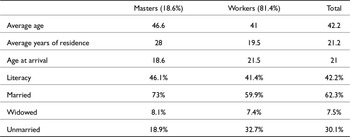
Cadiz’s population underwent an almost uninterrupted growth and foreign emigration to the port followed the same trend. Among the Italians, the largest foreign community, the Genoese were the most numerous over the course of the century.Footnote 23 A 1794 census of the city shows that 42 per cent of Genoese householders were employed in commercial enterprises at different levels, and 37 per cent were craftsmen (either masters or workers, Table 1).
Genoese Artisans in the 1794 Census of Cádiz

Source: Carlo Molina, “L’emigrazione ligure a Cadice (1709–1854),” Atti della Società Ligure di Storia Patria 34:2 (1994), 285–377, 336.
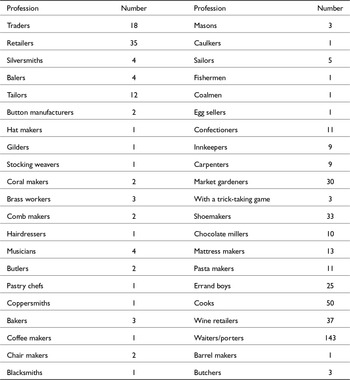
Although not statistically accurate, a list elaborated in 1771 by the Genoese consulate in Cadiz allows us to look into the variety of professions of this expatriated community lead by merchants and retailers, in which shoemakers stood out among craftsmen (Table 2).
Individuals Registered in the Genoese Consulate of Cádiz (1771)

Source: Archivo Histórico Nacional, Madrid, Estado, 629 (3), Exp. 58.
The Genoese entered some of the main craft guilds of the city at a very early stage. They were particularly influential in the production of shoes, which were sold both in the local and the American markets. In this sector, they achieved such a prominent position that in 1723 they obtained the control of some of the guild’s executive offices after threatening the creation of a separate guild along with the French masters.Footnote 24 This evidence confirms the marked openness of shoemaker guilds to foreign elements – observed in other case studiesFootnote 25 – and their capacity to reform and adapt themselves to the market needs.
The available sources don’t allow us to assess the importance of the artisans installed in the surrounding manufacturing centresFootnote 26 and particularly the Genoese presence in the shipbuilding industry, which represented one of their main fields of expertise. In the sixteenth and seventeenth centuries, the Genoese were key providers of vessels for trade, communication, and the safe transportation of financial and military resources along the Mediterranean routes.Footnote 27 They also made a relevant contribution to the development of the shipbuilding sector in Spain, being responsible of the construction of the arsenal of Seville during Alfonso X’s reign and helping to fill the voids left by Islamic workforce for the renovation of the Castilian navy under the Catholic kings.Footnote 28 Similar initiatives followed at the end of the Habsburg rule. In order to solve Spain’s chronic lack of vessels, the Bourbons invested more heavily in the local shipbuilding industry by setting up the Carraca arsenal in the bay of Cadiz; in 1752, the Genoese consul in Cadiz reported on the arrival of 120 Genoese shipwrights and caulkers in the arsenal to build vessels for the Crown, many of whom had been hired in Genoa, while others had volunteered.Footnote 29 Equally important was the Genoese presence in the great Mediterranean shipyard of Cartagena, where in addition to a considerable number of immigrant workers employed in port activities,Footnote 30 a Genoese military officer, Benito Antonio Spinola, was in charge of the Maritime Department.Footnote 31
Besides playing a major role in the Bourbon’s projects for the construction of a competitive Spanish navy, the Genoese contributed to the development of a private shipbuilding sector in and around Cadiz, either as owners of shipyards or as workforce. In parallel, the chronic shortage of seamen to support colonial trade led the Crown to enact successive laws that progressively opened transatlantic shipping to foreign sailors, captains, shipwrights, and caulkers; these regulations, which all but recognised a much wider de facto reality, allowed the Genoese seamen to make extensive contact with the colonial world and in some cases to settle there on a more or less stable basis.Footnote 32 The role of these “organizational migrants”Footnote 33 and their embodied expertise in knowledge and technology transfer across the Atlantic basin is still poorly investigated and would require a systematic research.
The Genoese migrants also contributed to the development of Cadiz as a manufacturing centre in the sectors – paper and silk – at the heart of the Genoese export-oriented industry. Around 1750 Spain and the Indies still consumed between half and two thirds of the paper produced in Genoa. To cope with competition, in the light of the setting up of royal factories and privileged manufactures, a group of merchants from Cadiz conceived the idea of setting up a large manufacturing centre in El Puerto de Santa María for the production of paper. In 1751 they established the Cossío, Arco Company and entrusted Luis de Armelín y Barsi, a technician from Valencia with clear Italian origins and owner of two paper mills in El Puerto de Santa María, with the project to build six new paper mills.Footnote 34 For the recruitment of foreign skilled workers, the company received a key support from the Spanish authorities: Joseph de Carbajal y Lancaster, the president of the Real Junta de Comercio (the institution responsible for the encouragement of commerce and industry in the Spanish monarchy), asked Luis Martínez Beltrán – the secretary and general commissioner to His Majesty’s armies with a long-established experience in GenoaFootnote 35 – to find a paper mill master who would be willing to relocate to Spain. After waiting in vain for a contact from Voltri, Beltrán found a master who was born in Voltri but worked in FinaleFootnote 36 and was ready to negotiate his collaboration. The master took it upon himself to find the necessary workers of both sexes, established their payment method,Footnote 37 prepared a quotation for the production of a bale of ten reams, and demanded the payment of the workers’ journey from Genoa to Spain. He also dictated the time frame for closing the deal, which would not exceed two months, so that he could, if necessary, renew the lease on the mill he was running in Liguria.Footnote 38 These negotiations attest to the role of master papermakers not only as repositories of technical knowledge but also as experts in production organization and management.
Having reached an agreement, in 1752 two paper mill masters and fourteen women left Genoa to work in the Spanish company’s existing mills and instruct other workers in view of the project completion, which devised the construction of thirty buildings. The project’s magnitude, of which the Genoese Senate was informed by its consular agent in Cadiz, led to fears about new possible outflows of manpower and a competition that would seriously harm the paper production in the Republic.Footnote 39 This ominous prediction did not come true, certainly not because of the intervention of the Senate – who had no choice but to wait helplessly for its development – but because of internal issues: Luis de Armelín, who had designed the paper mills and therefore joined the company without putting up any capital, was not content with the lavish earnings he received but appealed to the Real Junta de Comercio for an exclusive privilege, preventing the company from manufacturing other mills without his permission;Footnote 40 this conflict, combined with an even more decisive lack of funds, led one of the most ambitious industrial projects registered in the bay of Cadiz in the eighteenth century to stall.
In the following years, the crown persisted in its attempts to foster skilled migration to Spain. In 1757 it went as far as to ban the import of Genoese paper, but the measure was withdrawn in 1760. Twenty years later Charles III offered fiscal exemptions to strengthen the Spanish paper industry, but the mills it managed to see spring up in Andalusia, Catalonia, and Valencia were never enough to cover the monarchy’s needs.Footnote 41
In 1778 the commercial reform of the Comercio LibreFootnote 42 gave the Genoese the opportunity to set up their own factories in Spain, especially those devoted to silk manufactures. In an attempt to stem contraband and to develop local production, the Bourbons abolished a number of taxes levied on transoceanic shipping and on the exports of Spanish textiles. While duty thresholds on foreign manufactures were kept high, the law prescribed that textiles produced by foreign merchants and craftsmen who had immigrated to Spain should be treated as local products; foreign merchants were solely forbidden from exporting goods to America on their own account (art. 23). The reform also prescribed that even textiles that had been spun abroad but were subsequently dyed or otherwise modified in Spain could be considered as Spanish goods once they had been introduced into the monarchy’s territories. These regulations supplemented others that aimed to boost foreign productive ventures in Spain, such as the obligation imposed on the artisan guilds to admit foreign Catholic masters (1777), a greater tolerance in the regulation of textile productive processes, and, above all, the liberalization of the number of looms that each entrepreneur was allowed to possess (1787).
On the strength of their experience, Genoese traders and producers secured a dominant place for themselves in the silk industry of Cadiz. The main textile production centre in the bay was Puerto de Santa María, which mainly produced for the American market. As is made clear in the memoir of the Economic Society of Cadiz redacted by Gaspar Procurante in 1784, the Genoese owned most of the textile plants in the port. Procurante himself was a leading figure in the Genoese community of Cadiz: along with other Genoese associates, he owned the largest silk stocking and belts factory of the area. The factory had 80 looms, employed 203 workers, and produced 55,000 units per year. The company’s associates Josef Alberti and Vico-Conti in 1791 enlarged the enterprise by opening a factory with 101 looms for the production of silk stockings in Puerto Real. The factory of José Pedemonte, a member of an important family of Genoese traders, stood in second place after Vico-Conti, with its looms producing 8,000 units of stockings, trousers and gloves in 1798. The Pedemonte family also established a company in Genoa for the import of raw silk from southern Italy.Footnote 43 Other minor stocking factoriesFootnote 44 cooperated among them and with Spanish entrepreneurs. By virtue of such collaboration, the factory of the Spanish trader Rafael Vicario de Íñigo employed 54 specialised workers of both sexes who had been hired in Genoa.Footnote 45
The enduring competition of goods imported from abroad and the fall in sales which occurred in the 1780s due to the saturation of the colonial markets and to the crisis provoked by the war against England prevented any form of consolidation in the bay of Cadiz’s textile industry. As shown above, paper production suffered a similar fate, and the paper manufactured in Genoa continued to be shipped to Spain and to the Americas by widely resorting to contraband.
In summary, the upcoming industry in Bourbon Spain offered new prospects to the workers and craftsmen who were ready to leave the republic in search of better opportunities; the Crown’s policy also encouraged Genoese businessmen to establish their own production plants in Spain, which further stimulated migration of skilled workers. On the one hand, the corporate and manufacturing system in Genoa was traditionally open to the foreign contribution and generally unable to prevent – or, as in the case of glass industry,Footnote 46 not interested in limiting – migration of specialised manpower; on the other hand, the barriers to entry of the Spanish productive system were low and further relaxed under the Bourbon kings in order to attract foreign skilled migrants. These initiatives had more modest results than expected due to the lack of capital in the hands of the Spanish economic élite and the unbeatable competition from foreign goods, including those that were produced in the republic.
Genoese Craftsmen in the Monarchy’s Frontier
Although historical studies of technology, exchange, and innovation during the early modern period have traditionally overlooked the Americas,Footnote 47 emerging literature on the topic increasingly aligns with observations made in other geographical and political contexts. Specifically, it demonstrates that imperial entities did not facilitate a seamless and universal diffusion of science and technology from the “centre” to the “periphery.”Footnote 48 For instance, the introduction of European technology for extracting silver from low-grade ore using mercury amalgamation was crucial to the development of the mining economies in New Spain and Peru.Footnote 49 However, other strategic industries failed to consolidate due to overwhelming foreign competition. This was the case with silk production: despite initial successes in transplanting sericulture to New Spain, the abundance of European and Chinese silks ultimately thwarted efforts to establish an American silk industry.Footnote 50 Similar failures occurred in the British colonies, where attempts to establish silk production in early eighteenth-century Georgia using Piedmontese mills and skilled labour failed.Footnote 51 These failures underscore the dependence of such industries on legal and economic systems that were difficult to replicate in colonial settings.
The experiences of Genoese migrants to the Indies further illustrate these dynamics. Spanish mercantilist policies and the structure of the Atlantic economy discouraged the establishment of large expatriate communities and manufacturing enterprises, but such policies did not prevent individual Genoese migrants from prospering. Those who crossed the Atlantic in search of fortune were generally welcomed by host societies. Throughout the eighteenth century, colonial authorities issued repeated expulsion decrees targeting foreigners in the Indies, often under pressure from local merchant guilds. Nevertheless, the recurrence of these decrees highlights the lack of consensus needed for their enforcement. This explains why late colonial Lima – despite intense campaigns against contraband trade in imported goods and silver – remained a hub for Genoese expatriates, many of whom were active in trade.Footnote 52
Similar patterns were evident in the Río de la Plata, a frontier region deeply involved in the Atlantic exchange system due to Portuguese, Dutch, and English activities in the slave and silver trades.Footnote 53 Throughout the eighteenth century, municipal authorities in Buenos Aires often supported foreign merchants against opposition from governors and viceroys, emphasizing their contributions to the public good.Footnote 54 This favourable disposition, particularly following the creation of the Río de la Plata viceroyalty in 1776, enabled a small but socially recognized group of Genoese migrants to prosper in Buenos Aires. These migrants engaged in diverse sectors such as food production, construction materials, river navigation, and, most notably, retail trade.Footnote 55
Several factors impeded the consolidation of regulatory systems governing access to productive and mercantile professions in this region. These included the delayed establishment of the viceroyalty, the limited scale of local manufacturing, ethnic tensions among artisans, the growing presence of enslaved urban workers, and divergent interests between wealthy and less affluent producers and vendors.Footnote 56 While Genoese immigrants benefited from the relative openness of the Río de la Plata market, they did not entirely oppose regulatory organizations. In the shoemaking sector, for example, they advocated for the establishment of guilds. In 1788 some Spanish and Genoese masters sought to control the production and sale of shoes in Buenos Aires, where the constant population growth guaranteed a high demand for footwear,Footnote 57 citing the need to protect the profession and product quality standards from competition posed by unskilled local artisans, many of whom were enslaved Africans. Their petition, inspired by Spanish guild systems, proposed differentiating members by expertise while avoiding other forms of discrimination, apart from excluding “low-rank” masters from access to the guild’s offices.
The city council endorsed the petition, recognizing the utility of foreign expertise, while local artisans vehemently opposed it. The council also expressed a desire to regulate foreign skilled labour in other sectors and encouraged immigrants to marry locally, linking their presence to population growth and economic development. Despite these endorsements, ethnic tensions and economic rivalries led to a 1794 royal decree denying the guild’s establishment.
Local artisans successfully opposed the guild by aligning with retailers, offering them access to the footwear trade – a sector the proposed guild sought to monopolize.Footnote 58 Genoese shoemakers, as they had done in Spain, allied with other foreigners to leverage the favourable disposition of local authorities. However, their efforts failed due to resistance from local artisans and merchants, who viewed the guild as a threat to their economic interests. The support of local authorities and the expertise of foreign masters proved insufficient for the successful dissemination of technical knowledge. As observed in other geographical and productive contexts, technology transfer depended on multiple intermediaries, and the absence of connections with local merchants, artisans, and practitioners could significantly impede the diffusion of knowledge between regions.Footnote 59
The failure of the shoemakers’ guild highlighted broader changes in labour organization in late colonial Buenos Aires. Skilled workers lost control over recruitment, training, standards, and prices, while enslaved individuals increasingly participated in various professions. In Europe, by the mid-eighteenth century, guilds had undergone processes of oligarchization, which marginalized new entrants.Footnote 60 By contrast, Buenos Aires lacked the corporative spirit of medieval guilds, and attempts to establish manufacturing hierarchies repeatedly failed. Instead, the region developed a more entrepreneurial economy that continued to view foreign expertise as a resource for economic development. After independence, this openness to foreign labour transformed the Río de la Plata into a destination for large numbers of European migrants.
In 1799, Cornelio Saavedra, an attorney for the city council, criticized guild privileges for exacerbating the region’s economic difficulties. A decade later, jurist and political leader Mariano Moreno used the shoemakers’ guild failure as an example of the harm caused by such privileges, advocating for the liberalization of trade and the admission of foreign ships to the Río de la Plata as the sole method to enhance economic and demographic growth. Following independence, the removal of Spanish trade restrictions had an immediate impact on technology transfer. Genoese migrants contributed significantly to the development of the local commercial fleet from the 1820s onward, both through the sale of ships from Liguria and the establishment of shipyards for river and sea trade. These enterprises, led by Genoese owners and workers, formed the nucleus of a growing expatriate community that eventually surpassed the one in Cádiz in both size and diversity.Footnote 61
Conclusion
The case examined here illustrates artisan mobility as a complex phenomenon whose dynamics transcend both the well-known advantages and limits of the guild system.Footnote 62 In the eighteenth-century Spanish monarchy, as elsewhere in Europe,Footnote 63 guild-based artisans did not simply confront elites aiming to abolish their privileges, nor did labourers necessarily encounter economic or juridical barriers that limited their access to skills and knowledge. Within the framework of Spanish mercantilism, the Genoese found an institutional environment conducive to the establishment of commercial and manufacturing activities, which also facilitated the immigration of skilled workers. This process, which influenced the principal industrial activities of the republic and its core foreign exports, ultimately contributed to a decline in the traditional quality of Genoese manufactures. While foreign production discouraged new investments in technological innovation in Genoa,Footnote 64 Genoese traditional manufactures managed to remain competitive in the same markets where skilled migrants had disseminated their expertise. The emergence of more integrated economies in the eighteenth century fostered exchanges between Genoa and the Spain, where the republic exported semifinished goods. Through Genoese contributions, highly lucrative industries in Cadiz – such as shipbuilding, silk, and paper – experienced growth, benefiting both Spanish and Genoese entrepreneurs in the region. However, these ventures failed to consolidate due to a lack of capital, increasing competition from foreign manufacturers, and, at last, the disruption of the Spanish colonial trade, which deprived Spanish production of its primary market.
At the frontier of the monarchy, where Spanish rule and the conditions of the local market offered more limited profit-making opportunities to foreigners seeking to establish themselves within the host society, Genoese immigration and its impact on the local economy remained comparatively modest until the wars for independence, despite the good disposition of local authorities towards the creation of guilds led by foreign masters. After emancipation, the region’s opening to international trade, coupled with new policies aimed at attracting skilled labourers, transformed the Río de la Plata provinces into a favoured destination for modern migrations from Liguria. These developments generated significant technological advancements in key economic sectors, underscoring the transformative potential of skilled immigration in shaping regional economies.

 Open access

