





Introduction
Disruptive behaviors (DBs) are some of the most common problems seen in children (2–16%) and show an increasing prevalence in Western societies (American Psychiatric Association, 2013; Erskine et al., Reference Erskine, Ferrari, Polanczyk, Moffitt, Murray, Vos, Whiteford and Scott2014; Maughan et al., Reference Maughan, Rowe, Messer, Goodman and Meltzer2004; Nock et al., Reference Nock, Kazdin, Hiripi and Kessler2006). When these patterns of behavior persist across childhood, they are associated with costly social, economic, and both physical and mental health difficulties (Cohen & Piquero, Reference Cohen and Piquero2009; Jaffee & Odgers, Reference Jaffee, Odgers, Koenen, Rudenstine, Susser and Galea2013; Moffitt, Reference Moffitt and McGee2015). Thus, understanding the developmental origins of DB is of great theoretical and practical importance. Defined as disruptive acts and attitudes that violate societal norms and the personal or property rights of others, these DB range from normative behaviors, such as defiance of authority and lying, to rarer but more severe behaviors, such as animal cruelty, theft, and assault (Connor, Reference Connor2012). Given this continuum of severity among several heterogeneous behaviors, researchers have long tried to subcategorize DB using a dimensional approach. One early model hypothesized that aggressive (traditionally referred to as overt behavior) and nonaggressive (or covert behavior) DB constitute separable though correlated behavioral dimensions within the broader construct of DB (Quay, Reference Quay, Quay and Werry1986). Reviews and studies have since consistently supported this distinction (Burt, Reference Burt2012; Lacourse et al., Reference Lacourse, Baillargeon, Dupéré, Vitaro, Romano and Tremblay2010; Loeber et al., Reference Loeber, Burke, Lahey, Winters and Zera2000; Loeber & Schmaling, Reference Loeber and Schmaling1985; Tackett et al., Reference Tackett, Krueger, Sawyer and Graetz2003), but most studies have focused on adolescent and adult samples. Developmental trajectory analyses of very early cohorts using repeated measures of behavior problems in preschool and early childhood resulted in more specific subtypes of early-onset DB: physical aggression, opposition-defiance, rule breaking, and theft-vandalism (see Séguin & Tremblay, Reference Séguin, Tremblay and Zelazo2013; Tremblay, Reference Tremblay2010 for a review).
More and more, research has focused on the development of DB during the preschool period because this is a time of significant transformation of child participation in social interactions, in part due to very rapid development of verbal skills, including vocabulary. Rapid advances in verbal skills are observed during the preschool years (Conti-Ramsden & Durkin, Reference Conti-Ramsden and Durkin2012); while delays or dysregulation in their patterns of acquisition are indicative of later social, behavioral, and academic difficulties (Cohen, Farnia, & Im-Bolter, Reference Cohen, Farnia and Im-Bolter2013; Durkin, Mok, & Conti-Ramsden, Reference Durkin, Mok and Conti-Ramsden2015; St Clair, Pickles, Durkin, & Conti-Ramsden, Reference St Clair, Pickles, Durkin and Conti-Ramsden2011). Poor verbal skills, including delays in vocabulary acquisition, have been repeatedly associated with childhood and adolescent DB and later antisocial outcomes (Hill, Reference Hill2002; Moffitt & Caspi, Reference Moffitt and Caspi2001; Nigg & Huang-Pollock, Reference Nigg, Huang-Pollock, Lahey, Moffitt and Caspi2003; Petersen et al., Reference Petersen, Bates, D’Onofrio, Coyne, Lansford, Dodge, Pettit and Van Hulle2013; Séguin, Pinsonneault, & Parent, Reference Séguin, Pinsonneault and Parent2015; Yew & O’Kearney, Reference Yew and O’Kearney2013). Some evidence of reciprocal influences of DB on later verbal skills are also found (e.g., Bichay-Awadalla, Qi, Bulotsky-Shearer, & Carta, Reference Bichay-Awadalla, Qi, Bulotsky-Shearer and Carta2020; Bornstein, Hahn, & Suwalsky, Reference Bornstein, Hahn and Suwalsky2013; Girard et al., Reference Girard, Pingault, Falissard, Boivin, Dionne and Tremblay2014; Petersen et al., Reference Petersen, Bates, D’Onofrio, Coyne, Lansford, Dodge, Pettit and Van Hulle2013). Although research indicates that these relations may be observed as early as the preschool years (e.g., Qi, Van Horn, et al., Reference Qi, Van Horn, Selig and Kaiser2020; Qi, Zieher, et al., Reference Qi, Zieher, Lee Van Horn, Bulotsky-Shearer and Carta2020), relatively little is known about the emergence and the direction of the relation between verbal skills and DB during early childhood. Moreover, major life events like the transition from preschool to formal schooling are characterized by changing adjustment pressures on children’s behavior and may thus generate rapid changes in strength or direction of associations across time (Pinsonneault et al., Reference Pinsonneault, Parent, Castellanos-Ryan, Séguin, Beauchaine and Hinshaw2016). A better understanding of the dynamic changes in the nature of the relation between verbal skills and DB across early development is necessary to inform the design of preventions and interventions that take these mechanisms into account.
Prospective associations between verbal skills and DB
Studies in developmental science, criminology, psychiatry, educational psychology, and psycholinguistics have long been suggesting comorbidity between verbal skills deficits and DB at various developmental periods (Beitchman et al., Reference Beitchman, Wilson, Johnson, Atkinson, Young, Adlaf, Escobar and Douglas2001; Bornstein et al., Reference Bornstein, Hahn and Suwalsky2013; Brownlie et al., Reference Brownlie, Beitchman, Escobar, Young, Atkinson, Johnson, Wilson and Douglas2004; Dionne, Reference Dionne, Tremblay, Hartup and Archer2005; Fujiki et al., Reference Fujiki, Brinton and Clarke2002; Hirschi & Hindelang, Reference Hirschi and Hindelang1977; Moffitt, Reference Moffitt1993; Stattin & Klackenberg-Larsson, Reference Stattin and Klackenberg-Larsson1993; Van Daal et al., Reference Van Daal, Verhoeven and Van Balkom2007). Three theoretical models have been proposed to explain the associations between verbal skills and DB: (1) verbal skills impairment leads to the onset of DB through limited communication abilities in social situations, (2) DB leads to delayed verbal skills through fewer learning opportunities, and (3) an underlying third variable is involved in the association between verbal skills and DB (Pinsonneault et al., Reference Pinsonneault, Parent, Castellanos-Ryan, Séguin, Beauchaine and Hinshaw2016). The first model assumes poor verbal skills as factors underlying the manifestation of DB. Longitudinal studies with both clinical and nonclinical samples have supported the link from early verbal skills impairment to increased behavior problems in early childhood/preschool (Dionne et al., Reference Dionne, Tremblay, Boivin, Laplante and Perusse2003; Girard et al., Reference Girard, Pingault, Falissard, Boivin, Dionne and Tremblay2014), childhood (Ayduk et al., Reference Ayduk, Rodriguez, Mischel, Shoda and Wright2007; Beitchman et al., Reference Beitchman, Brownlie, Inglis, Wild, Ferguson, Schachter, Lancee, Wilson and Mathews1996; Lindsay et al., Reference Lindsay, Dockrell and Strand2007; Menting et al., Reference Menting, Van Lier and Koot2011; St Clair et al., Reference St Clair, Pickles, Durkin and Conti-Ramsden2011), and adolescence/adulthood (Petersen et al., Reference Petersen, Bates, D’Onofrio, Coyne, Lansford, Dodge, Pettit and Van Hulle2013; Snowling et al., Reference Snowling, Bishop, Stothard, Chipchase and Kaplan2006; Stattin & Klackenberg-Larsson, Reference Stattin and Klackenberg-Larsson1993). These studies consider that verbal skills impairments directly or indirectly lead to DB, and several mechanisms have been suggested to explain how poor verbal skills might lead to increased DB. For example, impairments in verbal skills can impede children’s developing self-regulation of behavior and problem-solving (e.g., Zelazo, Reference Zelazo2004), increasing the likelihood of using physical aggression and nonaggressive DB as alternative forms of problem-solving in social situations (Séguin & Zelazo, Reference Séguin and Zelazo2005). Also, poor verbal skills might increase the likelihood of academic failure, which could in turn encourage affiliation with deviant peers, thus providing increased opportunities for DBs (e.g., Dishion & Patterson, Reference Dishion and Patterson2006). At least one experimental study suggested that verbal skills impairments may be causally related to future externalizing behavior problems during early preschool (Curtis et al., Reference Curtis, Kaiser, Estabrook and Roberts2019).
A second model considers DB, and particularly aggressive behaviors, as a direct or indirect cause of verbal skills deficit, where behavior problems interfere with verbal development through different mechanisms including hindered school participation, low motivation, or high impulsivity. Far fewer longitudinal studies have examined the association between early problem behavior and later difficulties with verbal skills, and most studies are limited to school age, but the extant data do provide some support for the prospective link from behavior problems to verbal skills impairments (Oliver et al., Reference Oliver, Dale and Plomin2004; Ripley & Yuill, Reference Ripley and Yuill2005; Séguin et al., Reference Séguin, Nagin, Assaad and Tremblay2004, Reference Séguin, Parent, Tremblay and Zelazo2009).
Finally, a third model has been proposed in which the associations between verbal skills impairments and DB are the result of their association to a third variable that is responsible for the co-occurrence of these two characteristics. Several “third variables” have been suggested but only a few have received some empirical support, such as SES and family adversity (Poehlmann et al., Reference Poehlmann, Hane, Burnson, Maleck, Hamburger and Shah2012; Pungello et al., Reference Pungello, Iruka, Dotterer, Mills-Koonce and Reznick2009), peer acceptance (Menting et al., Reference Menting, Van Lier and Koot2011), and impulsivity (Speltz et al., Reference Speltz, DeKlyen, Calderon, Greenberg and Fisher1999).
In contrast to these three rather unidirectional explanations or models, one relevant conceptual framework that has emerged during the past decades for the study of developmental psychopathology highlights the organizational and transactional nature of developmental processes (see, e.g., Beauchaine & McNulty, Reference Beauchaine and McNulty2013; Cicchetti, Reference Cicchetti1984; Sameroff, Reference Sameroff2009). From this perspective, the developmental associations between verbal skills and DB are most likely bidirectional, both verbally driven and behaviorally driven, and probably change over time, dynamically. Only three studies so far tested these dynamic reciprocal associations in preschool: One examined physical aggression and language ability from 17 to 72 months (Girard et al., Reference Girard, Pingault, Falissard, Boivin, Dionne and Tremblay2014), another one examined an overall conduct problem scale and expressive language from 3 to 5 years (Girard et al., Reference Girard, Pingault, Doyle, Falissard and Tremblay2016), and a last one examined a global externalizing problem scale and both receptive and expressive vocabulary from fall to spring of a Head Start year, from 3.5 to 4 years (Bichay-Awadalla et al., Reference Bichay-Awadalla, Qi, Bulotsky-Shearer and Carta2020). While this last study did not find any predictive path, the first two revealed modest reciprocal associations, supporting the hypothesis of bidirectional links. Early transactional associations still need to be examined between specific verbal skills (e.g., receptive vocabulary) and both physical aggression and nonaggressive DB, especially during key developmental transitions, to clarify how these reciprocal relations emerge and change over the course of early childhood.
Transition from preschool to formal schooling
One key strength of the transactional process framework is the recognition that patterns of associations between different variables could very well change as a function of the developmental period under study. Thus, verbal skills and behavior problems might be contributing to each other dynamically, and the direction of associations might be influenced by other developmental processes or events. Accordingly, it has been suggested to examine longitudinally and dynamically the verbal skills and DB associations across developmentally salient transitions (Pinsonneault et al., Reference Pinsonneault, Parent, Castellanos-Ryan, Séguin, Beauchaine and Hinshaw2016). The transition to formal schooling is considered as an important developmental transition in early childhood (Eckert et al., Reference Eckert, McIntyre, DiGennaro, Arbolino, Begeny, Perry and Molina2008), particularly because of its implications for later school adjustment and achievement (Rimm-Kaufman & Pianta, Reference Rimm-Kaufman and Pianta2000; Vitaro et al., Reference Vitaro, Brendgen and Tremblay2014). Recognized as both stimulating and challenging, this transition involves negotiating and adjusting to a number of changes including the physical environment, learning expectations, rules and routines, social status, identity, and relationships (Boivin & Bierman, Reference Boivin and Bierman2013; Rimm-Kaufman & Pianta, Reference Rimm-Kaufman and Pianta2000). For children who exhibit verbal skills delays and/or DB, the transition to formal schooling may pose a particularly significant challenge (Conduct Problems Prevention Research Group, 2002; Justice et al., Reference Justice, Bowles, Pence Turnbull and Skibbe2009; Ponitz et al., Reference Ponitz, McClelland, Matthews and Morrison2009). Given the stability of individual differences in both verbal skills and behavioral problems beyond the early school years, and the potential for early transitions to influence later outcomes, the preschool to school transition represents an important period to examine transactional processes between cognition and behavior. Furthermore, we might expect a change in the direction of the verbal skills-DB association during this key transition, given the steep increase in social interactions and cognitive demands during this period.
Comorbidity with externalizing behaviors
Although this study focuses on DB, many of the processes reviewed above may also be linked to comorbid externalizing behaviors and disorders. One study showed that attention deficit with hyperactivity disorder (ADHD) with comorbid symptoms of oppositional defiant disorder (ODD) and conduct disorder (CD) was linked to greater verbal impairments when compared to ADHD symptoms alone (Nigg et al., Reference Nigg, Hinshaw, Carte and Treuting1998). However, another study found that verbal impairments were specifically associated with aggressive DB and not hyperactivity/impulsivity/attention (HIA) in preschoolers (Séguin et al., Reference Séguin, Parent, Tremblay and Zelazo2009). These apparent inconsistencies may be due to factors such as age and DB criteria by which children or adolescents were selected for inclusion. Because comorbidity is the norm rather than the exception (Beauchaine & McNulty, Reference Beauchaine and McNulty2013), comorbid behaviors need to be taken into account to better understand what is unique to physical aggression and nonaggressive DB as well as what is common across different externalizing problems.
Current study
Using a transactional conceptualization of development (e.g., Sameroff, Reference Sameroff2009), the current study was a longitudinal investigation of relations between receptive vocabulary and DB across the transition to formal schooling in a community sample of children. First, despite theoretical and empirical support for bidirectional associations between verbal skills and DB (see Séguin et al., Reference Séguin, Pinsonneault and Parent2015 for a review), the majority of research has examined the prospective link from verbal skills to behavior. Furthermore, these studies typically focused on brief periods of time, leading to uncertainty about the stability of the associations. Thus, we examined transactional relations between receptive vocabulary and DB across a 4-year transition from preschool to elementary school, with repeated measures. Second, a great proportion of longitudinal studies have focused on boys only. In the current study, relatively equal numbers of boys and girls were included. Third, previous studies mostly focused on physical aggression or an overall measure of externalizing behaviors and did not consider nonaggressive DB nor controlled for comorbid HIA behaviors. Thus, in the present study, we included separate assessments of physical aggression and nonaggressive DB, as well as behavioral measures of comorbid HIA behaviors.
Our main goal was to examine the associations between vocabulary and both aggressive and nonaggressive DB (physical aggression and opposition/rule breaking/theft and vandalism) across the transition from preschool to formal schooling. More specifically, we examined reciprocal and longitudinal associations between receptive vocabulary and DB from 42 to 84 months, separately for physical aggression and nonaggressive DB (opposition/rule breaking/theft and vandalism). It was hypothesized that poor vocabulary would be related to higher levels of DB (i.e., a slower decline in DB across this period), but in turn, that DB would reciprocally be related to low growth in vocabulary. We also examined whether the direction of these associations varied during the transition to formal schooling, which occurred between the 60 months and 72 months assessments for most children in the current sample. Based on the review of the literature examining verbal skills and DB, we might expect to observe changes in the direction of the associations across this critical transition period. No other specific predictions were made with regards to directionality, as limited studies with repeated measures have looked at these associations longitudinally, and across major life transitions. Finally, because of a lack of developmental studies taking into account the high comorbidity between both DBs and HIA problems, we also examined the specificity of these associations controlling for HIA behaviors.
Method
Participants
The sample includes children from the first cohort of the Quebec Longitudinal Study of Child Development (QLSCD; Jetté et al., Reference Jetté, Desrosiers and Tremblay1998), an epidemiological sample of singletons representing approximately 97% of the urban population of infants born in the Greater Montreal and Québec City areas in 1996 in Québec, Canada. The initial sample of 1,000 newborns for the first cohort was selected via Québec’s Master Birth Registry and participation was solicited by sending a letter explaining the study, followed by a phone call. Five hundred and seventy two mothers agreed to participate in the first data collection when their baby was 5 months old (293 boys, 279 girls) and have since taken part in several assessments, including 42, 60, 72, and 84 months. The detailed profile, stratification plan, exclusion criteria, and accounts for the participation rate at 5 months of this cohort are documented elsewhere (Jetté et al., Reference Jetté, Desrosiers and Tremblay1998). In the current sample, 12% of mothers were of immigrant status, 80% were Native French speakers, 8% were Native English speakers. Most children were living in a family with sufficient income and the majority of mothers had a high-school diploma. At the 60 mo. data collection time, only a minority of the children were attending full time public or private preschool (less than 15%), whereas 97% of them attended full time kindergarten at the 72 mo. data collection time. All data were collected during home visits and informed written consent was obtained from the primary caregiver every year. Ethics approval was obtained by the Québec Institute of Statistics Research Ethics Committee, the Research Ethics committee of the Institut Universitaire de Santé Mentale de Montréal, the Research Ethics committee in Arts and Sciences of the University of Montreal and the Sainte-Justine University Hospital Research Center Ethics committee.
Measures
Receptive vocabulary
Children’s receptive vocabulary was assessed using the French and English versions of the Peabody Picture Vocabulary Test – Revised (PPVT-R; Dunn & Dunn, Reference Dunn and Dunn1981; Dunn et al., Reference Dunn, Thériault-Whalen and Dunn1993), a widely used standardized measure of receptive language that features multiple choice items in which four pictures are shown for each vocabulary word. The participant was instructed to select the picture that best illustrated the definition of the word that was read aloud by a research assistant, who then scored the response as correct or incorrect. The PPVT-R has been well validated, and the psychometric properties are excellent. Scores were standardized for age and within language.
Disruptive behaviors
Maternal ratings of externalizing behaviors were obtained using the Social Behavior Questionnaire (SBQ), which was drawn partly from the Child Behavior Checklist (Achenbach & Edelbrock, Reference Achenbach and Edelbrock1983) and the Preschool Behavior Questionnaire (Behar & Stringfield, Reference Behar and Stringfield1974; SBQ; Tremblay et al., Reference Tremblay, Desmarais-Gervais, Gagnon and Charlebois1987). The SBQ includes items assessing physical aggression, opposition, rule breaking, thefts/vandalism and inattentive/hyperactive behaviors. In the current study, DB items were grouped into 2 scales: physical aggression (1 – hits, bites, kicks; 2 – fights; and 3 – bullies others) and nonaggressive DB (1 – is rebel, refuses to obey, 2 – has no remorse after misbehaving, 3 – does not change behavior after being punished, 4 – steals things in the house, 5 – damages things that belong to others, and 6 – lies or cheats). Mothers reported on the frequency of behavior items as never (1), sometimes (2), or often (3). The questionnaire was completed by mothers during phone interviews at 42, 60, 72, and 84 months. Maternal reports were used as the statistical models required an informant that would be constant across the four assessments (from 42 to 84 months) in order to be able to examine child behavior change across time. Cronbach alphas for physical aggression, and for opposition/rule breaking/theft and vandalism at 42 months were .77 and .59, respectively, and were maintained across time.
Hyperactivity/Impulsivity/Attention
Using the SBQ, mothers also reported on the frequency of 10 hyperactivity, impulsivity, and inattention behaviors : (1) easily distracted, (2) lacks concentration, (3) inattentive, (4) gives up easily, (5) can’t sit still, is restless (or hyperactive), (6) fidgets, (7) gives up easily, (8) is impulsive, acts without thinking, (9) has difficulty waiting for turn in games, and (10) cannot settle down to do anything for more than a few moments. Cronbach’s alpha for HIA behaviors at 42 months was .83 and was stable across time. These scales have been used in several studies, showing their validity as behavioral measures of HIA (e.g., Pagani et al., Reference Pagani, Fitzpatrick and Parent2012; Rioux et al., Reference Rioux, Murray, Castellanos-Ryan, Séguin, Tremblay and Parent2020; Séguin et al., Reference Séguin, Parent, Tremblay and Zelazo2009)
Covariates
Child sex, mother’s level of education, and family income at birth were included as covariates in the current study.
Statistical analysis
To better understand longitudinal bidirectional paths between vocabulary and DB, cross-lagged analyses were performed (one for each subcategory of DB) to answer research questions. Cross-lagged models were estimated using Mplus 7.0 (Muthén & Muthén, Reference Muthén and Muthén1998–2012). Model fit was assessed using the Comparative Fit Index, the Tucker–Lewis index (CFI and TLI; acceptable fit determined as ≥ .90), and the root-mean-square error of approximation (RMSEA acceptable fit determined as ≤ 0.08; Hu & Bentler, Reference Hu and Bentler1999). Both vocabulary and DB were treated as dependent variables allowing for the possibility of changes in the direction of associations at different points in development rather than constraining directionality in the model. Autoregressive, concurrent, and cross-lagged paths of associations were evaluated. Covariates were entered at the first time point in the model (42 months) and the HIA behaviors variable was entered as a time varying variable (at 42, 60, 72, and 84 months). Missing data were treated as missing at random using Full Information Maximum Likelihood (FIML). Standardized betas (β) are included in the Figures and text.
Results
Descriptive statistics for vocabulary, physical aggression, and nonaggressive DB from 42 to 84 months are summarized in Table 1. The mean values indicate an increase in vocabulary over time and a decrease in both physical aggression and other nonaggressive DB. Bivariate correlations between the variables in the model are summarized in Table 2.
Descriptive statistics

a EVIP: standardized French adaptation of the Peabody Picture Vocabulary Test – Revised (PPVT-R); SBQ: subscales of the Social Behavior Questionnaire.
Bivariate correlations between variables at each time point

a Physical agg.: physical aggression; Non-agg. DB: nonaggressive disturbing behaviors.
*p < .05; **p < .01; ***p < .001.
The first cross-lagged path model tested receptive vocabulary and physical aggression, controlling for child sex and family SES. Overall, the model demonstrated acceptable fit, χ2(30) = 121.81, p < .001; CFI = 0.90; RMSEA = 0.07. Standardized regression weights for the model paths are presented along with the path diagram in Figure 1. Note that variables after 42 months should be interpreted as change scores (residuals) from the previous assessment time. All autoregressive coefficients were large for language and moderate for physical aggression, indicating relatively high stability of the assessed constructs. Two cross-lagged path coefficients emerged as significant in the model. First, lower vocabulary growth from 42 to 60 months was predictive of higher physical aggression change scores from 60 to 72 months (β = −.11, p < .05), and higher physical aggression change scores from 60 to 72 months predicted lower vocabulary growth from 72 to 84 months (β = −.12, p < .01). In other words, a slower vocabulary growth between 42 and 60 months predicted a slower decline in physical aggression between 60 and 72 months. And a slower decline in physical aggression between 60 and 72 months predicted slower vocabulary growth between 72 and 84 months.
Crossed-lagged model for physical aggression.

Overall model fit for the second model, testing associations between vocabulary and nonaggressive DB, was also acceptable, χ2(30) = 190.42, p < .001; CFI = 0.87; RMSEA = 0.10. Standardized regression weights for the model paths are presented along with the path diagram in Figure 2. All autoregressive coefficients indicate relatively high stability of the assessed constructs. For nonaggressive DB, three cross-lagged paths emerged as significant in the model. Specifically, lower vocabulary scores at 42 months were predictive of higher nonaggressive DB change scores from 42 to 60 months (β = −.09, p < .05) and lower vocabulary growth from 60 to 72 months were predictive of higher nonaggressive DB change scores from 72 to 84 months (β = −.12, p < .05). In turn, higher nonaggressive DB change scores from 60 to 72 months predicted lower vocabulary growth from 72 to 84 months (β = −.10, p < .05). In other words, while lower vocabulary at 42 months predicted an increase in nonaggressive DB between 42 and 60 months, slower vocabulary growth between 60 and 72 months also predicted an increase in nonaggressive DB between 72 and 84 months. Conversely, an increase in nonaggressive DB between 60 and 72 months predicted a slower vocabulary growth between 72 and 84 months.
Crossed-lagged model for non-aggressive DB.
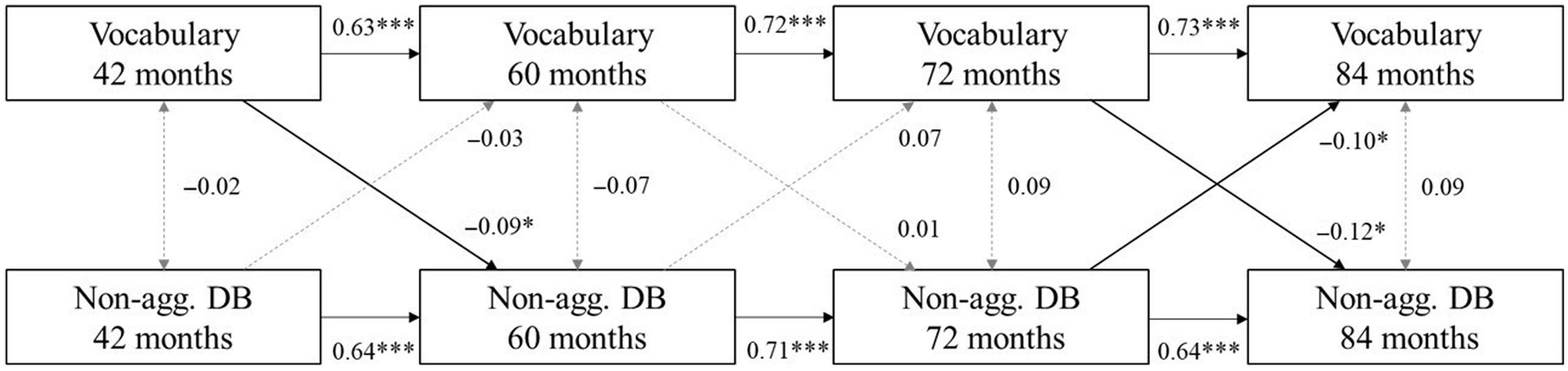
Finally, when controlling for HIA behaviors, only one cross-lagged path remained significant in both models. Specifically, higher physically aggressive and nonaggressive DB change scores from 60 to 72 months were predictive of lower vocabulary growth from 72 to 84 months (physical aggression change scores: β = −.12, p < .01; nonaggressive DB change scores: β = −.10, p < .05). All the cross-lagged paths from vocabulary to DB became nonsignificant.
Discussion
This study addressed novel questions about the directionality and specificity of developmental associations between vocabulary and DB during a key transition. The results contribute to the literature in several ways. First, the use of repeated measures and cross-lagged models suggest a change across time in the direction of the predictive relations between vocabulary and DB, coinciding with a key transition period between preschool and middle childhood. Second, although patterns were similar, comparing physical aggression to other nonaggressive DB highlighted a recurrence of the cross-lagged association from vocabulary to nonaggressive DB that was not observed for physical aggression. Finally, controlling for comorbid HIA allowed us to identify which paths were specific to DB versus paths that were associated with the shared variance among all those externalizing behavior symptoms.
The change in direction of paths over time suggests transactional associations between DB and vocabulary, where developmental changes in vocabulary and behaviors are sequentially and reciprocally related to each other. Poor vocabulary in preschool predicted a slower decrease in physical aggression in kindergarten, which in turn predicted a lower growth of vocabulary score in 1st grade. These bidirectional associations were also observed for nonaggressive DB, suggesting a contribution of vocabulary growth to both aggressive and nonaggressive DB regulation. However, the pattern of association was observed twice for nonaggressive DB: Once during preschool and again during the early school age period.
Differences in the timing of the observed predictive associations from vocabulary to behavior might be partially explained by differences in aggressive versus nonaggressive DB normal trajectories during the preschool to early school age period (Séguin & Tremblay, Reference Séguin, Tremblay and Zelazo2013). For example, while a normal declining trajectory of physical aggression is typically observed for most children during the preschool to school age period after a peak of these behaviors between 2 and 4 years of age (Tremblay, Reference Tremblay2010; Tremblay et al., Reference Tremblay, Nagin, Seguin, Zoccolillo, Zelazo, Boivin, Perusse and Japel2004), nonaggressive DB such as opposition and rule breaking show stable mean levels between 2.5 and 6 years of age, and no clear peak in any of the trajectories (Petitclerc & Tremblay, Reference Petitclerc and Tremblay2009). Thus, our results suggest that a delay in vocabulary growth in late preschool, once the normally observed peak in physical aggression is over, is likely to interfere with the steadily declining typical trajectory of these behaviors, resulting in a more frequent or chronic pattern of aggressive behavior. As there is no peak in the typical trajectory of nonaggressive DB during the preschool to early school age period, these behaviors remain steadily sensitive to children’s rate of progress in vocabulary acquisition, with significant predictive paths at both 42 to 60 months and 72 to 84 months.
The later longitudinal path from vocabulary to nonaggressive DB, where slower vocabulary growth in kindergarten predicted higher nonaggressive DB change scores in 1st grade, coincides with a period of increasing social expectations for child autonomous respect of rules and collaboration with adults (Chow & Wehby, Reference Chow and Wehby2019). Children who did not fully benefit from the learning experiences in kindergarten, which would have allowed them to increase their vocabulary, entered 1st grade less prepared for the cognitive and social demands that await them: learning to read, gaining autonomy, following rules, etc. This would leave them struggling with the acquisition of literacy, experiencing difficulties in understanding parents or teachers’ rules or instructions, and less likely to skillfully deal with complex social demands. Thus, their collaboration with adults may become increasingly difficult or characterized by opposition, defiance, and rule-breaking. Although this interpretation would lead one to expect concurrent associations between vocabulary and behavior, we only found a concurrent correlation for vocabulary and physical aggression at age 42 months. Instead, in line with results from Cashiola et al. (Reference Cashiola, Bulotsky-Shearer and Greenfield2020), what seemed to be most sensitive were associations across time with the residual “change” scores in the model. Lack of concurrent associations between change scores could be due to important differences in mean developmental rates of vocabulary and behavior, at least in this age range. Mean raw vocabulary scores increased rapidly between each time point, showing a declining vocabulary developmental spurt (see Table 1 – see also MacLeod et al., Reference MacLeod, Castellanos-Ryan, Parent, Jacques and Séguin2017). In contrast, mean physical aggression and nonaggressive DB scores decreased slowly or remained stable across each time point.
When controlling for comorbid HIA behaviors, two longitudinal paths remained significant: Higher physical aggression and nonaggressive DB change scores between 60 and 72 months both remained predictive of a slower vocabulary growth between 72 and 84 months. Thus, DB, whether aggressive or nonaggressive, uniquely contributed to the predictive association from behavior to vocabulary. In contrast, the predictive associations from vocabulary to behavior were nonspecific and relied on the shared variance with all externalizing behavior symptoms measured. Although our understanding about the behavioral specificity of the associations between vocabulary and different externalizing behaviors in preschool and early childhood remains limited and fragmented due to the frequent grouping of symptoms of ADHD with ODD/CD into a global measure of externalizing behavior problems, our results clearly support the relevance of separating subtypes of externalizing symptoms when examining how they relate to other child skills such as vocabulary. Because of a high comorbidity between these otherwise heterogeneous patterns of behavior, it is hard to disentangle their specific contributions (Castellanos-Ryan et al., Reference Castellanos-Ryan, Brière, O’Leary-Barrett, Banaschewski, Bokde, Bromberg, Büchel, Flor, Frouin, Gallinat, Garavan, Martinot, Nees, Paus, Pausova, Rietschel, Smolka, Robbins, Whelan, Schumann and Conrod2016).
Future studies into the role that vocabulary growth in preschool years might play in the emergence of comorbidity between symptoms of ADHD and DB might be helpful and lead to a better understanding of the dynamic relations between these different externalizing disorders and language acquisition during a period when social expectations toward children change very rapidly. For example, studies have shown that positive, sensitive parent–child interactions contribute to better behavior regulation in preschool children (e.g., Rioux et al., Reference Rioux, Murray, Castellanos-Ryan, Séguin, Tremblay and Parent2020). In these interactions, parents rely on a mixture of supportive strategies, including verbal demands, both direct and indirect, basic and advanced questions and guidance in order to support child active participation (Lorang & Sterling, Reference Lorang and Sterling2021). Child receptive vocabulary may moderate the extent to which they can benefit from these interactions (e.g., McDonnell, Fondren, Speidel, & Valentino, Reference McDonnell, Fondren, Speidel and Valentino2020). This contribution of child receptive vocabulary as a support for active participation in adult–child interactions bears some relevance to the Vygotskian idea that language acts as a cognitive tool (Vygotsky, Reference Vygotsky, Cole, John-Steiner, Scribner and Souberman1978, Reference Vygotsky, Rieber and Carton1987) and mediates the acquisition of other skills, such as social reasoning and regulatory skills. For example, parents or teachers may support child construction of social knowledge or skills by using specific words to guide child attention toward relevant emotional or relational aspects of the situation, or as verbal cues to self-regulation strategies (Bodrova & Leong, Reference Bodrova, Leong, Roopnarine and Jones2012). Future studies should explore how parent–child interactions may mediate the observed associations during the preschool years from receptive vocabulary to shared variance in DB and HIA.
An important contribution of our results, however, was the focus on the predictive path from behavior to verbal skills, which raises the possibility that DB may also interfere with children’s positive participation in social learning situations, for example, parent–child reading activities or homework completion, therefore limiting children’s opportunities for further developing their vocabulary (Pinsonneault et al., Reference Pinsonneault, Parent, Castellanos-Ryan, Séguin, Beauchaine and Hinshaw2016). Indeed, in order to benefit from the highly structured school learning environment, compared to the more informal preschool environment, much more self-regulation of complex social interactions may be necessary, both at home and in the classroom. Although evidence of the contribution of child DB to participation in learning activities or learning behaviors is scarce, studies suggest that other indicators of behavioral regulation (for example, effortful control) predict the quality of parent–child interactions during challenging tasks (e.g., an increase in intrusive parental behaviors, see Eisenberg, Taylor, Widaman, & Spinrad, Reference Eisenberg, Taylor, Widaman and Spinrad2015) or learning behaviors at school (e.g., Sánchez-Pérez, Fuentes, Eisenberg, & González-Salinas, Reference Sánchez-Pérez, Fuentes, Eisenberg and González-Salinas2018). Interestingly, studies have found that emotional support from teachers may moderate this negative association from disturbing behaviors to verbal skills and help socially challenging children benefit from the classroom environment (Bulotsky-Shearer et al., Reference Bulotsky-Shearer, Bichay-Awadalla, Bailey, Futterer and Qi2020).
Overall, results suggest transactional associations between vocabulary and behavior during the transition to formal schooling. Before school entry, vocabulary acquisition reflects mainly incidental learning and may largely reflect exposure to language in the family or childcare context. Although the more structured forms of childcare enhance vocabulary development (Geoffroy et al., Reference Geoffroy, Côté, Borge, Larouche, Séguin and Rutter2007; Geoffroy et al., Reference Geoffroy, Côté, Giguère, Dionne, Zelazo, Tremblay and Séguin2010), once children enter formal schooling they are all exposed to a structured and systematic approach to vocabulary development and they need to be able to partake positively in this new social environment to benefit from it. School-induced learning activities taking place in the classroom and at home require that children be able to regulate their emotions (anger, frustration) and collaborate with adults in order to benefit from their guidance toward acquisition of increasingly complex and abstract vocabulary.
The observed pattern of results has important implications for future research and practice. It suggests possible patterns through which the association between vocabulary and DB becomes consolidated during the transition to formal schooling as social interactions and expectations are increased. It also suggests a different timing of these associations for physical aggression and nonaggressive DB. Finally, results suggest that at the time of the school transition, the link from behavior to verbal skills becomes specific to aggressive and nonaggressive DB and not based on shared variance with HIA behaviors.
Practical implications of these results are twofold. First, during the preschool years, providing support for children’s vocabulary development, either through parent training (e.g., Curtis et al., Reference Curtis, Kaiser, Estabrook and Roberts2019; Kartushina et al., Reference Kartushina, Mani, Aktan-Erciyes, Alaslani, Aldrich and Almohammadi2021; Mol et al., Reference Mol, Bus, de Jong and Smeets2008), or through daycare programs (Duncan et al., Reference Duncan, King, Finders, Elicker, Schmitt and Purpura2020; Geoffroy et al., Reference Geoffroy, Côté, Giguère, Dionne, Zelazo, Tremblay and Séguin2010; Hirsh-Pasek & Burchinal, Reference Hirsh-Pasek and Burchinal2006), has the potential to help children in their behavioral development, including the shared variance among aggressive and nonaggressive DB and HIA. While parent training programs aimed at managing child difficult behaviors (e.g., Cunningham, Bremner, & Boyle, Reference Cunningham, Bremner and Boyle1995; Thorell, Reference Thorell2009; Webster-Stratton, Reid, & Hammond, Reference Webster-Stratton, Reid and Hammond2001; Webster-Stratton & Reid, Reference Webster-Stratton, Reid, Weisz and Kazdin2018) have been shown to be effective (with a mean effect size of .39, see Piquero et al., Reference Piquero, Jennings, Diamond, Farrington, Tremblay, Welsh and Gonzalez2016) in reducing externalizing behaviors, delinquency or antisocial behaviors, integrating stimulation of vocabulary acquisition and verbal skills to these programs might contribute to enhance their efficacy. Interestingly, recent studies show that parent-implemented language intervention during preschool years help reduce both externalizing and internalizing problems, reported by both parents and teachers (e.g., Curtis, Kaiser, Estabrook, & Roberts, Reference Curtis, Kaiser, Estabrook and Roberts2019; Davis & Qi, Reference Davis and Qi2020). Second, once school has started, children who lag behind their peers with regard to their reliance on disturbing behaviors in social interactions are now also at risk for delays in new vocabulary acquisition. As research suggests that high quality classrooms, with high instructional and emotional support from teachers, may buffer that risk (e.g., Bulotsky-Shearer et al., Reference Bulotsky-Shearer, Bichay-Awadalla, Bailey, Futterer and Qi2020; Burt & Roisman, Reference Burt and Roisman2010; Hamre & Pianta, Reference Hamre and Pianta2005), another practical implication involves increasing teachers’ awareness of their emotional role, especially with disturbing children, and supporting them in implementing well-organized, stimulating, and supportive classrooms.
Limitations and future directions
Several limitations of this study need to be considered. First, the current study provides some support to transactional associations between receptive vocabulary and both physical aggression and nonaggressive DB, but the conclusions are limited to an urban and normative sample. Similar prospective studies with more diverse samples are needed to further support this pattern of association. For example, sex, gender or ethnicity differences could not be tested in this study due to small sample size. Although previous studies suggested the associations are the same for boys and girls, and independent from ethnicity (Qi, Van Horn, et al., Reference Qi, Van Horn, Selig and Kaiser2020), future studies should further explore how generalized these patterns are. Second, while the vocabulary measure in this study was well validated, it was limited to receptive vocabulary. Future studies should assess and consider modeling multiple domains of verbal skills such as expressive vocabulary and other areas of language ability such as pragmatic language, semantics, syntax or conversational skills (see e.g., Hamo & Blum-Kulka, Reference Hamo, Blum-Kulka, Valsiner and Rosa2007), as well as other cognitive domains which may also be associated with DB (e.g., executive function, see Pinsonneault et al., Reference Pinsonneault, Parent, Castellanos-Ryan, Séguin, Beauchaine and Hinshaw2016). Modeling such developmental complexity will also be a worthy challenge.
A third limitation is related to the measure of behavior as the data used in this study was entirely dependent on parent reports. Parent reports are widely used in developmental psychopathology and a large number of studies support their validity. For example, parent reports of behavior may tend to give a better overview of the general disposition of a child than short duration direct observations of child behavior. Further, parent informants may help us understand change and stability in child behavior during transitions, such as the preschool to formal schooling transition. However, teacher’s reports are also a good source of information that can address not only child behavior but also the school’s social environment. Concordance and discrepancies between informants can be very informative as well (e.g., Andres De Los Reyes, Cook, Gresham, Makol, & Wang, Reference De Los Reyes, Cook, Gresham, Makol and Wang2019; A. De Los Reyes, Thomas, Goodman, & Kundey, Reference De Los Reyes, Thomas, Goodman and Kundey2013; Talbott, Karabatsos, & Zurheide, Reference Talbott, Karabatsos and Zurheide2018). In sum, we need further prospective studies with repeated measures during preschool years that include assessments of multiple domains of verbal skills and multiple informants of child’s DB, while taking into account the shared variance between DB and HIA.
Finally, the control variables used in the current study were by no means exhaustive. Although SES indicators (mother education and parental income) did not explain observed paths, it is possible that other environmental factors could contribute to both the development of verbal skills and DB and may thus explain part of the observed pattern of associations. For example, the contribution of parenting behaviors to both vocabulary development and DB have been well documented (e.g., Curtis et al., Reference Curtis, Kaiser, Estabrook and Roberts2019; Kochanska & Kim, Reference Kochanska and Kim2013; Landry et al., Reference Landry, Smith and Swank2006; Mol et al., Reference Mol, Bus, de Jong and Smeets2008), as have daycare experience and preschool teacher behaviors (Côté et al., Reference Côté, Boivin, Nagin, Japel, Xu, Zoccolillo and Tremblay2007; Geoffroy et al., Reference Geoffroy, Côté, Giguère, Dionne, Zelazo, Tremblay and Séguin2010; Qi, Zieher, et al., Reference Qi, Zieher, Lee Van Horn, Bulotsky-Shearer and Carta2020), and all three should be considered as possible third variables implicated in the transactional association. Furthermore, to better understand how parenting behaviors are implicated in the context of cross-lagged associations between verbal skills and DB, further studies that directly test for possible moderation and mediation effects should be conducted using multiple assessments of verbal abilities, child DB, and parenting behaviors from preschool to early childhood, during the transition to formal schooling.
Acknowledgments
The authors thank all the parents and children for their generous participation in the study, as well as anonymous reviewers for their thoughtful comments and suggestions. The authors are grateful to Charles-Édouard Giguère, Amélie Rivest, and Maria Rosa for data management, and to the Institut de la Statistique du Québec and its partners.
Author contributions
Michelle Pinsonneault: Conceptualization, Methodology, Formal analyses, Writing – Original draft. Sophie Parent: Conceptualization, Methodology, Investigation, Writing – Review and editing, Supervision, Project administration, Funding acquisition. Natalie Castellanos-Ryan: Conceptualization, Methodology, Writing – Review and editing, Funding acquisition. Philip David Zelazo: Conceptualization, Methodology, Writing – Review and editing, Funding acquisition. Jean R. Séguin: Conceptualization, Methodology, Investigation, Writing – Review and editing, Supervision, Project administration, Funding acquisition. Richard E. Tremblay: Methodology, Supervision, Funding acquisition.
Funding statement
This study was funded by the Fonds de Recherche du Québec–Société et Culture through a fellowship (to M.P.) and through Grants 2021-RG11-281152, 2015-RG-178735, 2009-RG-124779, 2002-RS-79238, the Fonds de Recherche du Québec–Santé through research career awards (to N.C.R. and to J.R.S.), and Grants 991027 and 981055; the Canadian Institute of Health Research through grants MOP-44072 and MOP-97910 and a research career award to J.R.S.; the Social Sciences and Humanities Research Council of Canada through Grants 412-2000-1003, 839-2000-1008 and #752-2001-1425; Valorisation Recherche Québec through Grant 2200-026; the National Science Foundation through Grant SBR 9513040; and the Canadian Language & Literacy Research Network through Grant 27040500.
Conflicts of interest
Authors certify that they have no conflicts of interest.


 Open access

