

“Fear first made gods in the world” — Statius (c. 45 AD – c. 96 AD)
Introduction
Do the most secular and the most religious feel less threatened by terrorism than those in between? Existing research offers conflicting answers. Some studies suggest religiosity buffers perceived threat, others find the opposite, and still others report no relationship (Adamczyk and LaFree, Reference Adamczyk and LaFree2015; Fischer et al. Reference Fischer, Greitemeyer, Kastenmüller, Jonas and Frey2006; Shechory-Bitton and Silawi, Reference Shechory-Bitton and Silawi2019).
Terrorism threat perception (TTP), defined as concern about harm to oneself or close others (Huddy et al. Reference Huddy, Feldman, Taber and Lahav2005), is closely linked to political attitudes and behavior (Canetti et al. Reference Canetti, Hall, Rapaport and Wayne2013; Cohen et al. Reference Cohen, Canetti-Nisim and Waismel-Manor2007). We argue that inconsistencies in the literature stem in part from an implicit assumption of linearity. Rather than increasing or decreasing uniformly, TTP may follow a nonlinear pattern across the religiosity spectrum, with vulnerability concentrated at intermediate levels. Prior work often treats religiosity as dichotomous or collapses variation of categories, obscuring the middle of the distribution where important differences may lie.
We propose that this pattern reflects variation in what we term existential clarity, defined as the degree to which a worldview provides coherent meaning and stable interpretive guidance in the face of threat. Both strong religious commitment and firm secular orientations offer relatively coherent frameworks for interpreting insecurity, whereas intermediate positions may involve greater ambiguity and weaker belief-system coherence. Consistent with this argument, we find evidence of an inverted U-shaped relationship between religiosity and TTP, with perceived threat peaking among individuals at intermediate levels of religiosity. By highlighting this nonlinear pattern, the study reconciles mixed findings in the literature and introduces a coherence-based account of how religiosity structures responses to threat.
Literature review
Terrorism and threat perception
Terrorism poses a strategic threat to democracies by manipulating public opinion and influencing policy (Ganor, Reference Ganor2004). Hoffman (Reference Hoffman2006, 40) defines terrorism as the use or threat of violence to instill fear for political change. Unlike conventional warfare, terrorism aims to erode individuals’ sense of safety and order by targeting civilians and provoking strong collective emotions (Bar-Tal, Reference Bar-Tal2007; Canetti-Nisim et al. Reference Canetti-Nisim, Halperin, Sharvit and Hobfoll2009; Snider et al. Reference Snider, Shandler, Matzkin, Canetti, Huddy, Sears, Levy and Jerit2023).
Because threat interpretation is subjective, the same objective danger may be appraised differently. As the Stoic philosopher Epictetus observed, “It is not events that disturb people, but their judgments concerning them.” This insight aligns with political psychology research showing that perceived threat, rather than objective risk, often shapes psychological responses and political behavior (Canetti et al., Reference Canetti, Hall, Rapaport and Wayne2013). Such perceptions foster xenophobia, prejudice, and political intolerance (Canetti et al. Reference Canetti, Hall, Rapaport and Wayne2013; Cohen et al. Reference Cohen, Canetti-Nisim and Waismel-Manor2007). They reflect cognitive assessments shaped by group identity and outgroup attitudes (Campbell, Reference Campbell1992; Canetti-Nisim et al. Reference Canetti-Nisim, Halperin, Sharvit and Hobfoll2009), while remaining intertwined with emotional responses.
We conceptualize TTP as a cognitive appraisal of vulnerability to terrorism that retains affective elements. Following Huddy et al. (Reference Huddy, Feldman, Taber and Lahav2005), we distinguish perceived threat from emotional states such as anxiety or fear and treat it as concern about the likelihood of harm to oneself or close others. The INES item used in this study captures this appraisal and is comparable to measures employed in other national election studies. As an ordinal outcome, it is analyzed using models appropriate for ordered categorical data. Additional discussion of item wording, translation, and comparability with other surveys appears in the Online Supplementary Material, Appendix A.
Religiosity across the spectrum
Religion provides meaning, order, and social cohesion. Classic definitions emphasize its role in organizing belief and practice into a shared moral framework (Durkheim, Reference Durkheim1915) and in orienting individuals toward a perceived underlying order (James, 1902/Reference James1958). Religiosity refers to the degree of engagement with religious beliefs, practices, and experiences (Glock and Stark, Reference Glock and Stark1965). Intrinsic religiosity reflects deeply internalized faith guiding life choices, whereas extrinsic religiosity involves a more instrumental orientation (Allport and Ross, Reference Allport and Ross1967; Batson, Reference Batson1976). Religiosity also functions as a social identity, shaping group belonging and intergroup attitudes (Shamir and Sagiv-Schifter, Reference Shamir and Sagiv-Schifter2006; Ysseldyk et al. Reference Ysseldyk, Matheson and Anisman2010). Ben-Nun Bloom et al. (Reference Ben-Nun Bloom, Arikan and Courtemanche2015) further distinguish religious social identity from religious belief, linking the former to behavior and belonging and the latter to fundamental values about the divine.
This multidimensionality is evident in the Israeli case, where religiosity is not reducible to a purely theological position. Rather, it encompasses belief, practice, and social belonging, and structures social identity, political attitudes, and responses to threat. Prior work suggests that religiosity should be examined not only as a group-based marker but also as a psychological orientation shaping threat perception (Ben-Nun Bloom et al. Reference Ben-Nun Bloom, Arikan and Courtemanche2015; Canetti-Nisim, Reference Canetti-Nisim2004).
Secular orientations can likewise provide meaning and order. Secular individuals often interpret terrorism as a political or security problem that can be managed through institutions, policy, and collective action. Research on compensatory control suggests that when individuals face uncertainty, they seek order in external systems, turning either to belief in a controlling God or to trusted institutions and authorities (Kay et al. Reference Kay, Gaucher, Napier, Callan and Laurin2008; Reference Kay, Whitson, Gaucher and Galinsky2009; Rothbaum et al. Reference Rothbaum, Weisz and Snyder1982). In this sense, secularism functions not merely as the absence of religion but as an alternative worldview offering psychological stability, grounded in rationalist and empirical sources of knowledge and expressed as an affirmative secular identity (Layman et al., Reference Layman, Campbell and Allen2024).
Between strong religiosity and firm secularity lies intermediate religiosity, often labeled moderate or extrinsic religiosity, characterized by selective engagement with religious beliefs and practices (Allport and Ross, Reference Allport and Ross1967; Ellis and Wahab, Reference Ellis and Wahab2013; Florian and Kravetz, Reference Florian and Kravetz1983). This orientation has been associated with more defensive forms of religious coping and higher psychological distress (Pargament, Reference Pargament2001). Unlike individuals with deeply internalized faith or a firmly secular worldview, those in this category may lack belief system coherence, making them more vulnerable to heightened threat perception (Jonas and Fischer, Reference Jonas and Fischer2006).
Among Jewish Israelis, intermediate religiosity is often expressed through the traditional category, situated between secular and religious extremes (Pew Research Center, 2016; Yadgar, Reference Yadgar2011). Prior studies associate this group with greater support for political violence and elevated markers of post-traumatic stress disorder, highlighting its distinctiveness from both secular and religious populations (Chipman et al. Reference Chipman, Palmieri, Canetti, Johnson and Hobfoll2011; Hall et al. Reference Hall, Hobfoll, Palmieri, Canetti-Nisim, Shapira, Johnson and Galea2008; Hobfoll et al. Reference Hobfoll, Hall, Canetti-Nisim, Galea, Johnson and Palmieri2007; Reference Hobfoll, Canetti-Nisim, Johnson, Palmieri, Varley and Galea2008; Zaidise et al. Reference Zaidise, Canetti-Nisim and Pedahzur2007). Together, these perspectives suggest that religiosity and secularity represent distinct sources of existential clarity, potentially leaving those positioned between them especially vulnerable to TTP.
Psychological theories of coping
Terror management theory (TMT) provides the primary theoretical foundation for this study. It posits that individuals rely on cultural worldviews, whether religious or secular, to buffer existential anxiety by providing meaning, order, and self-worth (Solomon et al. Reference Solomon, Greenberg, Pyszczynski and Zanna1991; Vail et al. Reference Vail, Rothschild, Weise, Solomon, Pyszczynski and Greenberg2010). Religious worldviews offer reassurance through faith, divine order, and community, while secular worldviews provide alternative sources of stability grounded in institutions, rationality, and collective efficacy. In both cases, coherent belief systems can reduce perceived threat by supplying clear interpretive frameworks.
Studies show mixed findings regarding religiosity and TTP. A German study found religiosity reduced anxiety after a terrorist attack, consistent with TMT, though the effect was temporary and depended on how religiosity was classified (Fischer et al. Reference Fischer, Greitemeyer, Kastenmüller, Jonas and Frey2006). A Belgian study, however, reported no association between religiosity and TTP (De Coninck, Reference De Coninck2022). By contrast, several studies in Christian-majority contexts found positive associations, with more religious individuals reporting higher perceived threat (Adamczyk and LaFree, Reference Adamczyk and LaFree2015; Elmas, Reference Elmas2021; Guler et al. Reference Guler, Onat and Bastug2024; Haner et al. Reference Haner, Sloan, Cullen, Kulig and Lero Jonson2019; Plante and Canchola, Reference Plante and Canchola2004). Large-scale WVS analyses likewise reported higher TTP among very religious individuals (Dillon et al. Reference Dillon, Hayes, Freilich and Chermak2019; Leite et al. Reference Leite, Ramires, Dinis and Sousa2019). Many of these findings appear shaped by methodological choices, such as binary classifications of religiosity, sampling decisions, or reliance on church attendance, which may obscure important variation in religious commitment. For example, Plante and Canchola’s (Reference Plante and Canchola2004) study relied on a Catholic university sample, limiting generalizability.
In Israel, studies suggest religiosity may serve as a coping mechanism reducing threat-related distress. One study found lower demoralization after terrorist attacks among Jewish settlers in Gaza and the West Bank (Levav et al. Reference Levav, Kohn and Billig2008). However, this population blends religious and nationalist ideologies (Newman, Reference Newman2005; Scham, Reference Scham2018). While this fusion may strengthen resilience through collective identity, it may also reinforce an ethos of conflict, potentially increasing TTP in politically charged settings (Lavi et al. Reference Lavi, Canetti, Sharvit, Bar-Tal and Hobfoll2014). Other studies identified a negative association between religiosity and TTP (Shechory-Bitton and Cohen-Louck, Reference Shechory-Bitton and Cohen-Louck2018, Reference Shechory-Bitton and Cohen-Louck2020). In contrast, one study reported no significant relationship (Shechory-Bitton and Silawi, Reference Shechory-Bitton and Silawi2019). All three studies used binary religiosity classifications, potentially obscuring variation.
As a whole, these findings suggest religiosity does not exert a uniform effect. Deeply internalized faith may buffer existential concerns, whereas partial forms of religiosity may heighten or fail to reduce them, and simplistic operationalization can mask these dynamics altogether. If both religious and secular individuals draw on distinct coping mechanisms that reduce perceived threats, the highest TTP may be found among those with intermediate religiosity levels. This would reflect an inverted U-shaped relationship, consistent with TMT, which proposes that both religious and secular worldviews buffer against existential concerns (Solomon and Thompson, Reference Solomon, Thompson, Routledge and Vess2019; Vail et al. Reference Vail, Rothschild, Weise, Solomon, Pyszczynski and Greenberg2010).
Intermediate religiosity and vulnerability
Individuals in the middle ground may find themselves caught between incomplete frameworks. Their worldviews, as anxiety-buffering systems, often combine limited religiosity with partial secular orientation, leaving them more vulnerable to TTP. Lacking firm anchoring, they draw selectively from both religious and secular sources without fully embracing either.
Religious individuals often draw on faith, communal norms, and divine authority for reassurance in the face of threat. Secular individuals, by contrast, are more likely to rely on institutional trust, policy capacity, and collective efficacy (Kay et al. Reference Kay, Gaucher, Napier, Callan and Laurin2008, Reference Kay, Whitson, Gaucher and Galinsky2009). Reflecting a worldview orientation rather than political ideology. Individuals with intermediate religiosity may occupy a position between these orientations. They may not fully anchor themselves in either a faith-based or institution-based system of meaning. As a result, they may neither trust that divine authority alone can resolve threat nor hold stable expectations about the capacity of state institutions to contain it. This uncertainty may reflect lower belief-system coherence and reduced existential clarity, which can heighten perceived vulnerability to terrorism.
Individuals at intermediate levels of religiosity may derive partial reassurance from both religious and secular sources without fully internalizing either. Ritual participation without doctrinal certainty and institutional trust without strong secular identification may provide only limited symbolic or literal buffers against mortality concerns. Uncertainty about the afterlife and ambivalence about institutional protection can weaken confidence in both transcendent and worldly systems of control. When neither anchor offers durable reassurance, individuals may turn to collective substitutes such as national identity or strong leadership. These sources may offer continuity, but not fully coherent existential grounding. As belief-system coherence declines, existential clarity weakens, potentially heightening perceived vulnerability to terrorism.
We therefore emphasize existential clarity. Coherent worldviews buffer threat by providing stable meaning and predictable guidance. TTP is shaped less by religiosity per se than by the coherence of the worldview it sustains. Individuals in the middle of the religiosity spectrum may feel as if they are riding two horses, suspended between secular trust in institutions and religious faith. Lacking full anchoring in either system, they may experience higher threat perception not despite their mixed orientation, but because of it.
An alternative interpretation is that individuals at intermediate levels of religiosity may exhibit greater tolerance for ambiguity, which could reduce perceived threat. Existing evidence, however, provides limited support for this expectation. Intermediate positions are often associated with weaker belief-system coherence (Allport and Ross, Reference Allport and Ross1967). Consistent with this, research on death anxiety also finds higher levels of existential distress among individuals at intermediate levels of religiosity (Ellis and Wahab, Reference Ellis and Wahab2013; Florian and Kravetz, Reference Florian and Kravetz1983). This pattern aligns more closely with reduced coherence than with enhanced ambiguity tolerance.
Very religious and secular individuals may rely on consolidated systems of meaning that stabilize threat appraisal, whereas those at intermediate levels may lack fully integrated interpretive frameworks. If existential clarity varies systematically across the religiosity spectrum, the relationship between religiosity and TTP should be curvilinear, with heightened threat concentrated in the middle.
Nonlinearity: Evidence from death anxiety research
The proposed inverted U-shaped relationship between religiosity and TTP aligns with longstanding research on death anxiety, a closely related form to existential vulnerability (Becker, Reference Becker1973; Yalom, 1980/Reference Yalom2020). Across decades, studies consistently documented a curvilinear pattern in which individuals at intermediate levels of religiosity report higher death anxiety than those who are either very religious or secular (Downey, Reference Downey1984; Florian and Kravetz, Reference Florian and Kravetz1983; Wink and Scott, Reference Wink and Scott2005). This suggests that both deeply internalized religious commitment and stable secular worldviews can serve as psychological buffers, whereas more ambivalent orientations provide weaker protection.
A meta-analysis of 84 studies by Ellis and Wahab (Reference Ellis and Wahab2013) found that evidence for curvilinear effects is more likely to emerge in larger and more diverse samples, while studies reporting linear relationships often omit nonreligious participants, potentially masking nonlinear dynamics. Early work by Allport and Ross (Reference Allport and Ross1967) similarly showed that individuals at intermediate levels of religiosity exhibited distinct patterns of prejudice relative to both very religious and secular individuals, underscoring the importance of examining the middle of the religiosity spectrum. Despite repeated calls to move beyond linear assumptions in religiosity research (Ellis and Wahab, Reference Ellis and Wahab2013; Florian and Kravetz, Reference Florian and Kravetz1983), this insight has rarely been applied to TTP. Extending nonlinear theorizing in this area therefore constitutes both a conceptual and methodological contribution.
All together, this body of work suggests that existential vulnerability is not evenly distributed across levels of religiosity but instead concentrates among individuals whose worldviews lack coherence. The middle of the religiosity spectrum thus emerges not as a point of moderation but as a zone of heightened vulnerability. Applying this insight to TPP provides a theoretically grounded explanation for the nonlinear pattern identified here.
Political and demographic predictors of threat perception
In addition to religiosity, several political and demographic factors have been consistently linked to variation in TTP: political orientation, gender, education, and age. Each may influence TTP directly or interact with religiosity to shape individual responses. Political orientation consistently associates with TTP, with right-leaning individuals exhibiting higher perceived threat than those on the left (Canetti-Nisim et al. Reference Canetti-Nisim, Halperin, Sharvit and Hobfoll2009; Guler et al. Reference Guler, Onat and Bastug2024).
Gender differences are also well documented. Women typically report higher perceived threat, fear of crime, and death anxiety than men (Davis, Reference Davis2007, 66; Guler et al. Reference Guler, Onat and Bastug2024; Pierce et al. Reference Pierce, Cohen, Chambers and Meade2007). These differences have been linked to factors such as greater emotional expressiveness, more frequent contact with the dying due to caregiving roles, and a greater willingness to acknowledge fear (Russac et al. Reference Russac, Gatliff, Reece and Spottswood2007). The same study found that death anxiety tends to peak in early adulthood for both genders, decline in middle age, and rise again among women in their fifties.
Education and age also shape TTP. Higher education is generally associated with lower TTP and anxiety (Davis, Reference Davis2007, 66; Guler et al. Reference Guler, Onat and Bastug2024). Age-related differences in mortality concerns have also been observed, with younger adults often expressing more concern than older adults, possibly reflecting developmental and cognitive shifts over time (Russac et al. Reference Russac, Gatliff, Reece and Spottswood2007). These variables are not only relevant for religiosity and TTP but are also frequently examined in political psychology studies of political behavior and voting patterns (Harsgor et al. Reference Harsgor, Yakter and Shapira2023; Pedahzur and Yishai, Reference Pedahzur and Yishai1999; Waismel-Manor et al. Reference Waismel-Manor, Kaplan, Shenhav, Zlotnik, Dvir Gvirsman and Ifergane2023).
Guided by theory and prior evidence, our hypothesized model is a curvilinear pattern between religiosity and TTP, specifically an inverted U shape, with threat minimized at both spectrum ends and maximized in the middle (Figure 1).
Hypothesized curvilinear relationship between religiosity and terrorism threat perception.

Case selection and context
Israel provides a particularly suitable setting for examining the relationship between religiosity and TTP. Terrorism has remained chronically salient within a context of sustained security threat, shaping political discourse, electoral competition, and public opinion over multiple decades. Although the October 2023 terrorist attacks fall outside the temporal scope of this study, they underscore the continuing salience of terrorism in Israeli society. More broadly, research on conflict settings shows that perceived threat often shapes political attitudes and policy preferences, particularly where security concerns intersect with prior beliefs and ideological worldviews. This context highlights the importance of examining how individuals interpret threat through the lens of underlying belief systems, including religiosity.
How societies interpret collective trauma shapes both its psychological effects and long-term political consequences. Whether events are framed as threats to be feared or challenges to be managed is central to this process (Li et al. Reference Li, Leidner, Hirschberger and Park2022). This study focuses on Jewish citizens of Israel, where terrorism has persisted amid conflict.
Israeli society is also structured around clearly defined religiosity categories that carry strong social and political meaning (Yishai, Reference Yishai2002). As of 2023, approximately 44% of Jewish citizens identified as secular, 21% as traditional but not religious, 12% as traditional-religious, 12% as religious, and 11% as very religious (Central Bureau of Statistics, 2023). The sizable traditional population occupies the middle of the religiosity spectrum, providing meaningful variation across the distribution.
Methodology
Data and sampling
This study primarily analyzes data from the 2022 Israel National Election Study (INES), conducted before and after the national elections (Israel National Election Studies, 2022). To assess robustness, we also draw on the 2015 and 2019 INES waves.
INES is based on a probabilistic sample drawn from the Ministry of the Interior population registry, with respondents recruited by telephone and mail. The survey employs a pre- and post-election panel design and is widely used to study political attitudes among the Israeli electorate.
Because the focus of this study is the relationship between religiosity and TTP within a context where religiosity categories are clearly structured, the analysis is restricted to Jewish respondents with complete data on key variables. After listwise deletion, 640 Jewish respondents were retained in 2022. Parallel filtering procedures yielded 585 Jewish respondents in 2015 and 623 in 2019. The pooled sample across waves totals N = 1,848. Non-Jewish respondents were excluded given the study’s focus on the Jewish Israeli context, where religiosity categories are clearly structured and socially meaningful. In addition, there was insufficient variation across religiosity categories among non-Jewish respondents after filtering for complete cases.
Measures
The dependent variable—TTP, was measured on a four-point Likert scale: “To what extent are you worried or not worried that you or one of your family members are likely to be harmed by terrorists in your everyday life?” Response options were: 1. Not at all worried; 2. Not worried; 3. Worried; 4. Very worried. The scale was inverted so higher scores reflect greater TTP. As a single-item ordinal measure, it lacks equal intervals between categories, requiring statistical methods designed for ordinal data (Bürkner and Vuorre, Reference Bürkner and Vuorre2019).
The independent variable was measured on a five-point scale: “In terms of religion, how do you define yourself?” Response options were: 1. Nonreligious, secular; 2. Traditional, not so religious; 3. Traditional religious; 4. Religious; 5. Very religious, Haredi. The scale was inverted so higher values reflect stronger religiosity. This ordinal, identity-based measure, referred to here as self-religiosity, captures variation in religious self-identification among Jewish respondents. It is widely used in Israeli political studies and strongly correlates with other Jewish religiosity indices, capturing a socially embedded form of religious identification rather than a purely ideological classification (Canetti et al. Reference Canetti, Halperin, Hobfoll, Shapira and Hirsch-Hoefler2009). While the theoretical discussion refers to three broad zones (secular, intermediate, and very religious), the empirical analysis retains the full five-category ordinal structure; intermediate religiosity thus refers to positions in the middle of the scale rather than to a single category.
We also considered a behavioral indicator, religious observance, as an alternative measure; item wording and coding appear in the Online Supplementary Material, Appendix A. Although not theoretically central to the argument, we additionally report an exploratory composite index combining self-religiosity and religious observance. This index provides greater measurement resolution than either item alone and facilitates testing curvilinear patterns. Its empirical performance accords with the main results (see Online Supplementary Material, Appendix F).
Four covariates are included: political orientation, gender, higher education, and age group. Full question wordings and coding schemes are provided in the Online Supplementary Material, Appendix A.
Political Orientation: The original 7-point left-right scale was recoded into three categories: 1 = Right (responses 1–3), 2 = Center (response 4), and 3 = Left (responses 5–7). This coding follows Hebrew’s right-to-left reading direction (Waismel-Manor et al. Reference Waismel-Manor, Kaplan, Shenhav, Zlotnik, Dvir Gvirsman and Ifergane2023).
Gender: Coded as a binary variable: 0 = Male, 1 = Female.
Education: The original 9-category education scale was recoded into a binary variable: 1 = Yes (academic degree or higher), 0 = No. This recoding simplifies interpretation and expands the number of observations per category, thereby increasing statistical power.
Age: The original eight age categories were collapsed into four: 18–29, 30–49, 50–59, and 60+. These groupings follow Pew Research Center conventions (2019) and align with known peaks in death anxiety (Russac et al. Reference Russac, Gatliff, Reece and Spottswood2007).
Analysis strategy
To test the hypothesized curvilinear relationship, we estimated a cumulative link model (CLM) with self-religiosity, its quadratic term, and four covariates as the main model. Because both TTP and self-religiosity are ordinal measures, pairwise associations were summarized using Spearman’s correlation. Model fit was compared across link functions (logit, probit, and cloglog), with the probit link selected based on lower AIC and BIC.
We also examined simpler models: an ordinary least squares (OLS) regression with a quadratic term (not suitable for ordinal outcomes but used as a visual benchmark), a quadratic CLM without covariates, and a linear CLM without the quadratic term, to assess whether the pattern held under less complex specifications. In addition, exploratory visualization techniques, including observed means and LOWESS smoothing, provided preliminary insight into the relationship’s shape.
CLM, widely used in social sciences and prior INES studies (Agresti, Reference Agresti2010; Oshri et al. Reference Oshri, Yair and Huddy2022), treats ordinal responses as categorized latent continuous variables. The proportional odds assumption was tested using a nominal test in R (Gao and Soranzo, Reference Gao and Soranzo2020). Bayesian alternatives (Bürkner and Vuorre, Reference Bürkner and Vuorre2019) were considered but set aside due to the absence of prior information on predictor effects and their higher computational demands. A Frequentist approach was therefore adopted, enabling a systematic test of the curvilinear hypothesis while addressing potential model limitations.
Results
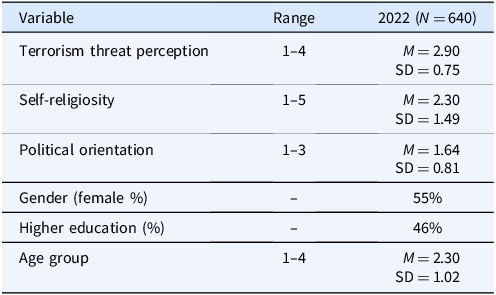
Summary statistics for the study variables appear in Table 1. Descriptives for 2015, 2019, 2022, and the pooled sample are reported in the Online Supplementary Material, Appendix B.
Descriptive statistics for key variables (INES 2022, N = 640)

Table 1. Long description
A table with six rows and three columns presenting descriptive statistics for key variables in a study from 2022 with 640 participants. The columns are labeled Variable, Range, and 2022 (N = 640). The rows are labeled Terrorism threat perception, Self-religiosity, Political orientation, Gender (female %), Higher education (%), and Age group. Each row provides the range and mean (M) with standard deviation (SD) for the variables. Terrorism threat perception ranges from 1-4 with M = 2.90 and SD = 0.75. Self-religiosity ranges from 1-5 with M = 2.30 and SD = 1.49. Political orientation ranges from 1-3 with M = 1.64 and SD = 0.81. Gender (female %) is 55 percent. Higher education (%) is 46 percent. Age group ranges from 1-4 with M = 2.30 and SD = 1.02.
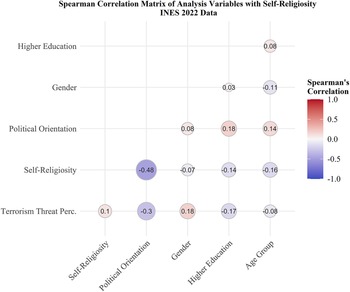
Figure 2 shows only a weak pairwise correlation (ρ ≈ 0.10) between self-religiosity and TTP, highlighting the need to test for nonlinear effects.
Spearman’s correlation matrix of key variables (INES 2022, N = 640).

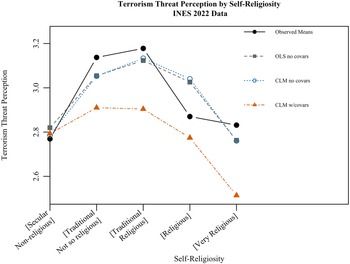
Across models, we observed a robust inverted-U pattern: TTP peaked at intermediate religiosity and declined at both extremes (Figure 3). This relationship held in both CLMs with quadratic terms and in quadratic OLS regressions. The best-fitting model, a quadratic CLM with covariates, confirmed the nonlinear association and showed improved fit based on lower AIC and BIC values. The linear CLM, estimated without the quadratic term, consistently fit worse and in some cases did not produce significant effects. Formal specifications for the CLMs, including linear, quadratic, and quadratic with covariates, are provided in the Online Supplementary Material, Appendix C. Results were robust across model specifications that included quadratic terms, as well as across alternative religiosity measures and survey waves, as reported in the Online Supplementary Material, Appendices D–F.
Terrorism threat perception by religiosity across model specifications: observed means, OLS without covariates, CLM without covariates, and CLM with covariates (INES 2022, N = 640).

In the 2022 quadratic CLM with covariates, both linear (b = .48, p < .01) and quadratic (b = −.10, p < .001) terms were significant, placing the vertex at 2.45, near the midpoint of the 5-point self-religiosity scale. Political orientation, gender, and education significantly predicted TTP. Right-leaning respondents and women reported higher TTP, while higher education predicted lower levels.
Substantively, this vertex corresponds to respondents identifying as traditional or traditional-religious, rather than fully secular or fully religious. Predicted probabilities indicate that individuals in these intermediate categories are more likely to report being “very worried” about terrorism than those at either extreme of the religiosity scale. The magnitude of this difference is not trivial: the probability of high threat perception increases markedly from the secular category to the middle of the scale and then declines again toward the very religious category. This symmetric curvature is consistent with an inverted U-shaped pattern rather than a monotonic linear trend.
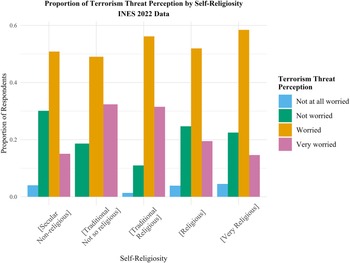
Observed proportions (Figure 4) and model-based predicted probabilities (Figure 5) converge on the same conclusion: TTP is highest among respondents positioned in the middle of the religiosity spectrum and lower at both ends. Figure 4 presents the distribution for the 2022 sample; corresponding distributions for the 2015 and 2019 waves are reported in the Online Supplementary Material. Figure 5 shows that this curvilinear pattern appears across response categories, with higher concern more common in the middle and lower concern more common at the extremes. This pattern is substantively meaningful, statistically robust, and replicates across waves and operationalizations of religiosity, supporting the coherence model’s expectation of nonlinear vulnerability.
Observed proportions of terrorism threat perception response categories by religiosity (INES 2022, N = 640).

Figure 4. Long description
A bar graph compares the proportion of respondents’ terrorism threat perception across different levels of self-religiosity. The horizontal axis represents self-religiosity categories: Secular Non-religious, Traditional Not so religious, Traditional Religious, Religious, and Very Religious. The vertical axis represents the proportion of respondents, ranging from 0.0 to 0.6. The graph includes four vertical bars for each self-religiosity category, representing different levels of terrorism threat perception: Not at all worried (blue), Not worried (green), Worried (yellow), and Very worried (pink). Notable trends include a higher proportion of respondents being worried or very worried as self-religiosity increases. The color scheme indicates the level of worry, with blue representing the least worried and pink representing the most worried. The data is from the INES 2022 survey with 640 respondents.
Predicted probabilities of terrorism threat perception response categories by religiosity, estimated with and without covariates in a quadratic CLM (INES 2022, N = 640).

Full model statistics for self-religiosity are reported in the Online Supplementary Material, Appendix D, including estimates for all covariates. To assess whether the observed pattern extends beyond identity-based measures, we estimated parallel models using religious observance and a composite religiosity index. These specifications yield substantively similar nonlinear patterns, indicating that the curvilinear relationship is not specific to self-reported religiosity but also appears when religiosity is measured behaviorally, as reported in Appendices E and F. Additional measurement details are provided in Appendices A and B.
Discussion
This study tested a coherence model of religiosity and TTP. Using national survey data from Israel across multiple election cycles, we identified a robust inverted U-shaped relationship: TTP peaks at intermediate religiosity and declines among both very religious and secular individuals. The findings suggest that religiosity structures TTP through the coherence of the worldview it sustains, rather than through its intensity alone.
The coherence model proposes that very religious and secular orientations provide stable interpretive frameworks for making sense of insecurity. These frameworks may anchor expectations about divine authority, institutional capacity, or collective resilience, thereby buffering perceived vulnerability. Intermediate religiosity, by contrast, may reflect less consolidated belief systems, yielding weaker existential clarity and heightened threat appraisal. The nonlinear pattern observed in the data is consistent with this structural account. Some of the factors discussed, such as social identity, communal belonging, and shared norms, may be more visibly expressed among highly religious individuals. In the present framework, these factors are not treated as independent explanations, but as illustrative of how coherent worldviews can stabilize threat appraisal.
The findings suggest that individuals at intermediate religiosity levels exhibit a distinct psychological orientation and constitute a pivotal political group. Their elevated threat perception makes them especially responsive to security concerns and fear-based rhetoric, positioning them as a pivotal constituency in shaping political attitudes under sustained security threat. This pattern aligns with the existential clarity hypothesis: individuals at the secular and very religious ends draw on coherent worldviews that buffer insecurity, whereas those in the middle experience lower existential clarity, which elevates TTP. Taken together, the results contribute to a growing body of evidence portraying the intermediately religious as a distinct psychological and political group within modern democracies (Allport and Ross, Reference Allport and Ross1967; Chipman et al. Reference Chipman, Palmieri, Canetti, Johnson and Hobfoll2011; Zaidise et al. Reference Zaidise, Canetti-Nisim and Pedahzur2007).
By documenting this nonlinear pattern, the study advances understanding of how religious identity structures psychological responses to terrorism and helps reconcile inconsistencies in the religiosity-TTP literature. Studies using dichotomous religiosity or assuming a linear relationship with TTP may have obscured the curvilinear trajectory revealed here. Importantly, the same curvilinear pattern emerges when religiosity is measured using behavioral indicators such as religious observance, suggesting that the findings are not limited to identity-based classifications specific to the Israeli context.
Political orientation, gender, and education also predicted TTP, with higher levels observed among right-leaning individuals, women, and those with lower education. Notably, the effect size of religiosity is comparable to that of political orientation and larger than that of age, underscoring its substantive importance. However, these variables do not explain away religiosity’s curvilinear effect. These findings carry practical implications for domestic policy communication. Policymakers who are secular or very religious may underestimate perceived threat intensity among the intermediately religious. This gap may be especially pronounced among highly educated, left-leaning policymakers. Recognizing such disparities is critical, as elevated TTP among the intermediately religious may increase receptivity to exclusionary or authoritarian appeals, with implications for democratic politics.
Religiosity strongly links to political and psychological outcomes, yet these associations are frequently modeled linearly, potentially obscuring structurally nonlinear dynamics. A nonlinear lens may yield fresh insights into religiosity’s role in political orientation (Harsgor et al. Reference Harsgor, Yakter and Shapira2023), authoritarianism and exclusionism (Canetti et al. Reference Canetti, Halperin, Hobfoll, Shapira and Hirsch-Hoefler2009; Malka, Reference Malka, Osborne and Sibley2022), democratic values (Ben-Nun Bloom and Arikan, Reference Ben-Nun Bloom and Arikan2012; Canetti-Nisim, Reference Canetti-Nisim2004; Malka, Reference Malka, Osborne and Sibley2022), and support for radical action (Hirsch-Hoefler et al. Reference Hirsch-Hoefler, Canetti and Eiran2016). Indeed, Canetti-Nisim (Reference Canetti-Nisim2004) showed that religiosity per se has negligible direct effects on support for democratic values, with any negative association largely mediated by authoritarianism. The methodological framework used here could be extended to explore how religiosity intersects with other threat perceptions, such as concerns about cyberterrorism or physical safety, and their broader sociopolitical consequences.
Several avenues remain for future investigation. First, studies may benefit from more granular and multidimensional indicators of religiosity to better capture variation among secular respondents. Second, as with any cross-sectional design, causal inference is limited and reverse causality cannot be ruled out. Elevated TTP may influence religiosity, not just vice versa. Indeed, prior work suggests that religiosity itself may emerge in response to existential insecurity (Norris, Reference Norris2011; Norris and Inglehart, Reference Norris and Inglehart2011). Third, although INES is nationally representative, survey-based data may underrepresent certain populations, limiting the scope of inference. In addition, TTP was measured using a single survey item, which may not capture the full multidimensionality of perceived threat, although the observed curvilinear relationship remained stable across election waves and alternative operationalizations of religiosity. Fourth, the analysis does not directly incorporate measures of general anxiety or fear, socioeconomic status, geographic vulnerability, or differential exposure to terrorism, all of which may contribute to variation in perceived threat. While these factors are important, the focus here is on isolating the relationship between religiosity and TTP. Future research could extend this framework by integrating such psychological and contextual dimensions. Fifth, the analysis focuses on the Jewish Israeli population, where religiosity categories are clearly structured and socially meaningful. This scope limits the generalizability of the findings to other religious and sociopolitical contexts. Finally, refined frameworks are needed to examine how worldview coherence and related perceptions of personal and collective efficacy shape TTP and political behavior.
TTP is closely tied to political behavior, shaping public opinion, voting patterns, and support for exclusionary or security-focused policies (Hirsch-Hoefler et al. Reference Hirsch-Hoefler, Canetti and Pedahzur2010; Huddy et al. Reference Huddy, Feldman, Taber and Lahav2005; Merolla and Zechmeister, Reference Merolla and Zechmeister2009; Snider et al. Reference Snider, Shandler, Matzkin, Canetti, Huddy, Sears, Levy and Jerit2023). The curvilinear relationship identified here aligns with long-standing research on death anxiety, which similarly points to intermediate religiosity as a zone of heightened vulnerability. Much of this foundational work derives from American samples, suggesting that the pattern observed here could plausibly emerge elsewhere.
Although grounded in data from one country, results may be most relevant to democracies with sizable populations positioned between strong religious commitment and firm secularity. Countries such as the United States, Brazil, and India, where identity-based faith coexists with varying observance degrees, have experienced rising polarization and shifting threat perceptions, frequently shaped by religious identity and worldview ambiguity (Pew Research Center, 2021; 2025). These dynamics suggest that the curvilinear pattern may extend beyond this case.
The coherence model does not imply that strong religiosity universally reduces perceived threat. Rather, it emphasizes the stabilizing role of belief-system coherence within a given worldview.
Policymakers and scholars should examine whether intermediately religious individuals elsewhere also exhibit elevated threat perceptions, which may heighten their responsiveness to fear-based, threat-centered messaging and exclusionary framing (Pyszczynski et al. Reference Pyszczynski, Solomon, Greenberg, Olson and Zanna2015). Understanding how religiosity structures perceived insecurity may therefore contribute to broader debates about the stability of democratic attitudes in contexts marked by persistent threat. Strengthening democratic institutions therefore requires addressing not only objective threats but also perceived insecurity.
By advancing a coherence model of religiosity and threat perception, this study reframes how scholars understand the political consequences of religious identity under conditions of sustained insecurity. Rather than treating religiosity as uniformly protective or uniformly threat-amplifying, the findings demonstrate that its effects depend on the coherence of the worldview it sustains. Recognizing nonlinear dynamics in religiosity sharpens theoretical debates in the religion–politics literature and underscores the importance of modeling belief-system structure, not merely religious intensity, when examining political attitudes in democracies facing persistent threat.
Supplementary material
The supplementary material for this article can be found at https://doi.org/10.1017/S1755048326100455.
Data availability statement
Raw data used in this study are available from INES website at https://socsci4.tau.ac.il/mu2/ines/data/our-data/. Analysis code is available from the corresponding author, [D.G.], upon reasonable request.
Acknowledgements
We thank the members of the Political Psychology Lab for their valuable comments and discussions throughout this project. We are particularly grateful to Pazit Ben-Nun Bloom and Yael Yishai for their insightful comments and thoughtful guidance during the development of this study. We also thank Michal Shamir for generously granting access to the Israel National Election Study (INES) data, without which this research would not have been possible.
Financial support
N/A.
Competing interests
The authors declare none.
Ethical statement
N/A.



 Open access

