

I. INTRODUCTION
In the eighteenth century, as the age of commerce dawned, the relationship between international trade and the questions of war and peace became a central concern. Encapsulated in the conceptual pair of commerce and peace, overlaid with a deep-seated anxiety connected to the “subsistence problem” (Kaplan Reference Kaplan1976, p. xvi), this issue played a pivotal role in the political economy of a century marked by continuous warfare. However, contemporary perspectives on this problem during the war-torn decade of the French Revolution have received scant attention, overshadowed by the scholarly focus on the internal political struggles in France and the republican military conquests in the German states, Italy, Switzerland, and the Netherlands. This study seeks to address this gap by offering a new entry point into the intellectual history of commerce and peace in revolutionary France.
In 1796, Year IV of the French First Republic, the former diplomat and Jacobin Étienne d’Audibert-Caille argued that an “absolute and unlimited freedom of commerce” was sure to cause famine due to grain merchants’ cornering and hoarding. He warned that such a freedom would destroy the Republic and throw France back into “slavery” (d’Audibert-Caille Reference Audibert-Caille1796, p. 6). Views of this type were commonplace during the eighteenth century, particularly since the debate on grain commerce and food supply grew into a central issue with the rise of Physiocracy in the mid-century. The question of commerce and agriculture, particularly whether complete freedom of commerce would be detrimental to national grain supply, was crucial for political economists. This question was difficult to address, however, as any answer would have to pander both to ideas of rational reform and to the pressure of popular subsistence. The great debate that took place between the 1750s and the Flour War of 1775, particularly around 1768 to 1770, unleashed a flood of pamphlets either supporting or opposing the minister Anne Robert Jacques Turgot’s “liberalization” of grain commerce (Kaplan Reference Kaplan1976; Gauthier and Ikni Reference Gauthier and Ikni1988; Bouton Reference Bouton1993; Cohen Reference Cohen2006). Important claims, which were later formulated theoretically, appeared first in this debate. Most crucially, on Claude-Jacques Herbert’s pioneering account, grain trade needed to be liberalized rather than regulated in order to bring food into the market. In Jean-Gabriel Montaudouin’s opinion, the application of this idea should be extended to the realm of foreign trade (Herbert Reference Herbert1753; Montaudouin de La Touche Reference Montaudouin de La Touche1757). For François de Vivens, the circulation of grain could not be “rendered too easy and too free” (Labat de Vivens Reference Vivens1756, pp. 49–50). The key here was to recognize and trust the convergent mechanism of diverse private interests in free trade, without losing sight of the dynamics of the balance of power and trade (Herbert Reference Herbert1759).
France in the 1790s, as in the earlier decades of the eighteenth century, was not short of arguments for and against the liberalization of grain commerce: in terms of economic theorization, there were visible continuities between what was later termed the Old Regime and what came after the stormy events of 1789, notwithstanding John Robertson’s contention that the Enlightenment’s spirit of political economy had been “swept aside … by the Revolution of 1789” (Robertson Reference Robertson2015, p. 13). This article explores one of the most prescient and profound analyses put forth in support of the “freedom of commerce” in connection with war and peace during the French Revolution. It was contained in a work published in early 1797 by Jean-Baptiste Rougier-Labergerie (1757–1836), titled Essai politique et philosophique sur le commerce et la paix, considérés sous leurs rapports avec l’agriculture (hereinafter EPP), about 500 pages long in octavo, written with the intention of supplying the Executive Directory with “useful” policy guidelines (Archives nationales de France, AF/III/440, plaquette 2561, pièce 14). Rougier-Labergerie’s political economy of commerce and peace in the Essai has rarely been examined to this day. This neglect seems to stem from the fact that he has been studied as an agricultural theorist (“the rising star of the Paris agricultural society”) under the Ancien Régime (Shovlin Reference Shovlin2007, p. 177), one of “the agrarian publicists” of the Directory (Livesey Reference Livesey2001, p. 104), and an “influential agronomist” in post-revolutionary France (Davis Reference Davis, Behnke and Mortimore2016, p. 210). During the Revolution and under Napoléon, Rougier-Labergerie was active as a deputy, a commissary, a préfet, and above all as a writer on agricultural improvement and forestry (Arnault et al. Reference Arnault, Bazot, Jay, de Jouy and de Montbreton Norvins1827, pp. 250–251). His best-known works on this subject are Recherches sur les principaux abus qui s’opposent aux progrès de l’agriculture (Reference Rougier-Labergerie1788), Traité d’agriculture pratique (Reference Rougier-Labergerie1795), Mémoires et observations sur les abus des défrichemens et la destruction des bois et forêts (Reference Rougier-Labergerie1800), Géorgiques françaises (Reference Rougier-Labergerie1804), Histoire de l’agriculture française (Reference Rougier-Labergerie1815), and Les forêts de la France (Reference Rougier-Labergerie1817), which, unlike the Essai politique et philosophique sur le commerce et la paix, have attracted the attention of numerous historians of agronomy and forestry (Lefebvre et al. Reference Lefebvre, Bourgenot, Grand-Mesnil, Badré and Gadant1987, pp. 267–325; Derex Reference Derex2001; Matteson Reference Matteson2015, pp. 147, 173, 216–217; Ford Reference Ford2016, pp. 47–57; Jones Reference Jones2016, pp. 64, 90; Mellah Reference Mellah2019, Reference Mellah2020; Fressoz Reference Fressoz2020; Vincent Reference Vincent2020; Renard Reference Renard2024).
In the realm of economic thought, arguments in favor of free grain trade during the Revolution were not in themselves rare. Physiocratic ideas, including the emphasis on free trade, were deeply inscribed in the political economy of the 1790s, although the changes in the political context must be duly noted. As has been richly documented in the collection of essays on the economic ideas and practices of the French revolutionaries by Gilbert Faccarello and Philippe Steiner, many of them eclectically or wholeheartedly followed the Physiocrats and sometimes opposed their ideas in appearance while accepting without acknowledgment crucial parts of their doctrines—which were “at the heart of the theoretical debates” in the 1790s (Faccarello and Steiner Reference Faccarello and Steiner1990, pp. 13–39; Albertone Reference Albertone2021). In 1797 Jean-Girard Lacuée also argued in the Council of Elders for the freedom of grain commerce on the grounds that lifting the prohibitive barriers was the only means of improving agricultural production and assuring population growth. However, Lacuée did not tie his appeal to the question of war and peace (Lacuée Reference Lacuée1797). In contrast, the logical connection between the question of commerce and that of war was the main thread of Rougier-Labergerie’s essay, which took an excursion from his primary area of expertise to argue for a system of pan-European peace that would be predicated upon free trade and multilateral peace. These two fundamental orientations are important for our understanding of his ability to approach the problem of war and peace from the angle of political economy rather than from that of “a moral discourse.” Like most other eighteenth-century intellectuals who witnessed grand-scale wars waged on the basis of public debt in the name of national interest, he knew, to quote the editors of Commerce and Peace in the Enlightenment, “that perpetual peace could never be established without dealing with the realities of economic competition among rival states and empires” (Kapossy et al. Reference Kapossy, Nakhimovsky, Whatmore, Kapossy, Nakhimovsky and Whatmore2017, p. 2). In the face of the economic and cultural devastation caused by ceaseless wars during the French First Republic, Rougier-Labergerie felt an urgent need to assuage the jealousy of trade that plagued Europe.Footnote 1 On his account, the correct way to achieve “the interest and tranquility of nations and the happiness and prosperity” (EPP, p. xix) of France was to reject the model of the “closed commercial state” (Nakhimovsky Reference Nakhimovsky2011) and embrace complete freedom of commerce. In a bid to assert the viability of a political and commercial strategy different from that of the Revolutionary Government of Year II, he marshaled his agronomist knowledge in support of his proposition that the fear of hoarding was unfounded and that the liberalization of grain commerce was therefore a workable path forward for France. To refute the economic ideas underpinning the Jacobin policy, Rougier-Labergerie drew on the ancient and modern history of Europe as well as on the non-republican language of natural jurisprudential political economy: although the language of jurisprudence and the civic humanist republican language had been intertwined to a considerable degree by the time of the Revolution, the former still retained a part of its idioms—along with its rejection of radical popular politics—that placed it apart from the latter (Kim Reference Kim2024).
In the Essai, Rougier-Labergerie urged French writers to strive with all their might to oppose “war and conquests,” asserting that this was the only way to give their works “the stamp of immortality” (EPP, p. 473). He noted that such immortality was accorded to writers of perpetual peace such as Michel de Montaigne, Maximilien de Béthune, duc de Sully, François de Salignac de La Mothe-Fénelon, Charles Louis de Secondat, baron de Montesquieu, abbé de Saint-Pierre, Voltaire, Jean-Jacques Rousseau, and a dozen others (EPP, pp. 474–475). Immanuel Kant was not mentioned. We can only guess, without certainty, that Rougier-Labergerie had not read Kant’s Zum ewigen Frieden. Ein philosophischer Entwurf (Reference Rougier-Labergerie1795) because its French translation, Projet de paix perpétuelle (Reference Kant1796), appeared just before the publication of the Essai. Despite Rougier-Labergerie’s claim of immortality for writers of peace projects, his own Essai ironically received few reviews at the time of its publication. However, the Essai received “remerciements” from the Directory on 31 March 1797 (Archives nationales de France, AF/III/440, plaquette 2561, pièce 13), and it was noted by French, German, and Spanish publications contemporary with its publication and in the nineteenth century (Intelligenzblatt Reference Rougier-Labergerie1797, p. 684; Mémoires 1803, p. 6; Hidalgo Reference Hidalgo1847, p. 300; Guillaumin et al. Reference Guillaumin, Coquelin and Clément1854, p. 553; Bulletin 1877, p. 88). What follows is a close examination of the Essai in context and its historical significance.
II. WAR, MILITARY CULTURE, AND THE JEALOUSY OF TRADE
For Rougier-Labergerie in 1797, the lessons of the Terror were pressing. His diagnosis of Year II was that the dissemination of “rash” Jacobin politics had triggered the popular “frenzy” that came to destroy mœurs and institutions (EPP, p. 451). His key point was that the Committee of Public Safety had been a war government. War was the root evil that had to be eradicated. Due to the ongoing war, too many lives had been sacrificed, and too much of French culture had become militarized. In the theater, everything that was staged concerned heroes and victories even though these victories often entailed the death of “thirty thousand men.” Balls, hymns, and feasts were excessively militarized. History showed Rougier-Labergerie that cultural militarization in times of endless war led to the annihilation of states and civilizations. Still worse under the Directory, luxury and debauchery were spreading like germs in a world where the high unpredictability of the future compelled men to abandon diligence and honesty. He worried that Europe would “share the fate of Egypt, Persia, Greece, Carthage, and Rome” (EPP, pp. 453–455).
The historical contemplations of the Enlightenment had been preoccupied with the effect of liberty, mœurs, and war on the rise and fall of states (Pocock Reference Pocock1999, Reference Pocock2003). A wrong combination of war, public debt, and despotism could return modern states to the “Dark Age” (Sonenscher Reference Sonenscher2007). In Rougier-Labergerie’s opinion, the nature of the revolutionary war was such that it would ultimately turn Europe into “nothingness” at the least expected moment and “by unforeseeable causes” (EPP, p. 459). The destruction of ancient states and their “arts and sciences” by the “scourge of war” meant that progress was possible “only during peace.” Rougier-Labergerie recalled the deaths of Jean Sylvain Bailly, André Marie de Chénier, Antoine-Laurent de Lavoisier, Guillaume-Chrétien de Lamoignon de Malesherbes, and Jean-Antoine Roucher to criticize the “barbarity” of the “furious revolutionaries” that was unleashed in the name of saving the fatherland (EPP, p. 464). War failed to make any ruler truly “happy”—the examples discussed were Alexander the Great, Caesar, and Louis XIV. Instead, war turned people blind and forced soldiers to kill others for the sake of kings whom they did not know (EPP, pp. 467–469). At a time when France was waging war on all fronts against coalition after coalition of other European powers and when republicans and royalists alike were seeking means, whether military or commercial, of annihilating each other, Rougier-Labergerie dreamed of a peaceful Europe in which poets and painters would stop glorifying conquests (EPP, pp. 465–466) and where “more than four million [soldiers] are employed in agriculture and the arts” instead of warfare (EPP, pp. 469–470). This view was shared by other commentators of the time, such as the prominent slave-trade abolitionist and moderate deputy André-Daniel Laffon de Ladébat, who in 1796 expressed hope that peace would revive credit and industry:
The situation of Europe, the circumstances, the interest of all governments, your wish well pronounced, must give France the greatest hope that general peace is advancing and will soon console the earth; malheur au barbaric génie which will destroy these hopes.… Thus our means, our political situation, the march of the government, all must revive the confidence of the nation, all must bring public spirit back to life, without which the most brilliant financial systems, the institutions best designed to re-establish credit, will fail. (Laffon de Ladébat Reference Laffon de Ladébat1796, p. 14)
Rougier-Labergerie observed, quoting Fénelon with reverence, that the road map to peace was “reciprocal communication.” Commerce could promote mutual understanding and even fraternity among nations whereas diplomatic intrigues only fostered hatred and belligerence (EPP, pp. 470–471). What obstructed this Montesquieuan vision was the deep-rooted jealousy of trade that caused states to remain steadfast in their policy of mercantilist “protectionism” (prohibitisme) (Howse Reference Howse2006; Nixon Reference Nixon, Breuninger and Burrow2012; Radasanu Reference Radasanu2013; Rosow Reference Rosow1984). As Louis-Alexandre de la Rochefoucauld had anxiously remarked, it was important to prevent “a small dispute over commerce” from “troubl[ing] peace” (La Rochefoucauld 1790).Footnote 2 The problem for Rougier-Labergerie was that although “freedom of commerce [was] the most important question of political economy” and although its merits were “the easiest to demonstrate,” the fact remained that it was an unpopular idea (EPP, p. 1). From the mid- to late eighteenth century, indeed, the grip of anti-Physiocracy’s opposition to free trade was substantial in economic discourse, as demonstrated in numerous studies on political economy led among others by Steven L. Kaplan, Loïc Charles, Gilbert Faccarello, Arnaud Orain, Muriel Dal Pont Legrand, and Jürgen Georg Backhaus (Backhaus Reference Backhaus2011; Demals and Hyard Reference Demals and Hyard2015; Klotz et al. Reference Klotz, Minard and Orain2017; Kaplan Reference Kaplan2015, p. 285; Kaplan and Reinert Reference Kaplan and Reinert2019).
Trapped in this predicament, Rougier-Labergerie deployed the discursive strategy of labeling free trade as republican and denouncing protectionist principles as royalist, “the principles of kings, emperors, and despots.” Kings could make foolish decisions out of avarice but republics should not. This, however, must not lead us to regard Rougier-Labergerie as a “republican” thinker. His language throughout the Essai does not reveal a republican concerned with civic virtue. Rather, he adopts the stance of a natural jurist or a “liberal” (if this anachronism can be forgiven) political economist seeking to persuade republicans of the benefits of free trade for perpetual peace. Rougier-Labergerie appealed to the Republic’s savants and legislators, “hommes profonds et éclairés,” and to their republican pride, telling them that protectionism brought revolutions, blood, and decline (EPP, pp. 3, 25, 192). This had at least the virtue of conformity with the dominant language of the Republic, which was a strategy of ensuring readers’ goodwill. Regarding monarchy as a regime of permanent servitude and stubborn stupidity was a common trope of the contemporary republican language.Footnote 3 In this context, Rougier-Labergerie’s denunciation of monarchy is to be read less as an attack on that form of government in general than as a specific criticism aimed at the French past. Considering the Essai as a whole, where the author insisted that France should stop following the old royal ways “slavishly and exactly” now that it was “constituted as a republic” (EPP, p. 2), he was referring to the mercantilist policies of the seventeenth and eighteenth centuries and the eventual failure of Louis XVI to support Turgot, who had “fought with courage” in the Flour War (EPP, p. 128). Jealousy of trade was a baseless “fixation” of kings; protectionism, an “exorbitant system” that fruitlessly pursued “isolating itself and giving up the products of other nations” (EPP, p. 36). War could be carried out and maintained because greedy rulers had deceived and isolated their nation from others to perpetuate their tyranny. They had fostered the jealousy of trade to “increase their fortune at the expense of other states.” Hence the endless stream of wars waged to destroy the commercial capacity of rival powers (EPP, pp. 4–6, 9). The notion of a “balance of trade” (balance de commerce) acted here as a “talisman of protectionists,” he argued, just as the idea of “balance of Europe had been, among kings, a perpetual pretext to wage wars” (EPP, p. 37). In fact, “balance of trade” had not always been exclusively deployed by “protectionists,” as can be seen from the example of the Gournay circle (Charles et al. Reference Charles, Lefebvre and Théré2011). Rougier-Labergerie, however, identified a dismal link between the theories of the balance of trade and those of the balance of power, and thereupon proposed an alternative vision of the balance of power, in an effort that “one should not dismiss too quickly … as naïve,” as Peter Schröder points out (Schröder Reference Schröder2017, p. 7).
The protectionism of one state gave rise to another’s (EPP, p. 34). Two centuries of commercial competition and armed conflict among Britain, France, Holland, and Spain had demonstrated for Rougier-Labergerie the deadly link between the jealousy of trade, protectionism, and war (EPP, p. 8). The continuation of this vicious commercial cycle would lead to the dwindling of agricultural production and population (EPP, pp. 55–56). Thanks to Mediterranean commerce, before the outbreak of war against Britain—“the bitter enemy of the French empire” (Arnould Reference Arnould1797, p. 290)—in 1793, French seaborne trade had not been under a catastrophic condition, the slave rebellion in Saint-Domingue notwithstanding (Eldem Reference Eldem1999, pp. 13–16). If war could be halted and the large and the small states of Europe could coexist peacefully (EPP, pp. 297–298), France could return to its pre-war state of 1792 and become a commercial “entrepôt,” utilizing its agricultural capacity and its geographical position linked to the European Continent, the Atlantic, and the Mediterranean (EPP, pp. 197–199). For Rougier-Labergerie the cardinal task was to persuade French legislators of the imperious need for the country to reject protectionism and turn France into a free-trading state in all its interpenetrating aspects—political, economic, legal, and cultural. Plans for a multilateral peace treaty could then complement the fundamental remedy of free trade.
III. FREE TRADE AND THE SUBSISTENCE OF THE POOR
The world view of the Essai was articulated in the “the long-established vocabulary of natural jurisprudence,” which, unlike the language of neo-Roman republicanism, focused more on “justice” than on liberty. In other words, natural jurisprudence cherished liberty as a “right” protected by legal institutions rather than as an expression of a natural “virtue” of a “political animal.” Natural jurisprudence was of course not a concrete or fixed system of ideas. It was rather a mode of thinking that offered a wide array of linguistic and conceptual tools for the formulation of a system of law and politics that could bring prosperity to states and subsistence to the poor. In traditions of natural jurisprudence, property was recognized as a “perfect right” (jura perfecta), whereas subsistence was considered an “imperfect right” (jura imperfecta). Infringement of property would therefore normally constitute an act of “injustice” (Smith Reference Smith1978, p. 9; Pocock Reference Pocock1981; Hont and Ignatieff Reference Hont, Ignatieff, Hont and Ignatieff1983; Himmelfarb Reference Himmelfarb1984, p. 42; Haakonssen Reference Haakonssen1996). The Essai furthermore presented the “social contract” as giving all citizens “the right to enjoy … the fruit of his labor and industry.” In accordance with the language of 1789, Rougier-Labergerie regarded taxation based on injustice as being tantamount to “tearing these sacred lines apart.” On his account freedom of commerce was the guardian of the social contract, as it guaranteed the right to property and “equal” taxation. By equal taxation he referred not to an egalitarian taxation that aimed at fostering republican equality (Kim Reference Kim2025) but to a “natural,” unmanipulated taxation. “Unnatural” taxation appeared when protectionist policies conferred, directly or indirectly, benefits upon specific groups of producers and merchants at the expense of the rest of the nation. Protectionism thus broke the sacred laws of social contract and natural justice (EPP, pp. 10–11): it was “unjust” to the point of being “tyrannical” (EPP, p. 158). However, Rougier-Labergerie stated that the right to subsistence vociferously defended in Year II by Maximilien Robespierre under the pressure from radical activists of the Left was no more than an imperfect right without any justifiable claim to override property rights. In his eyes the right to subsistence was not clearly established, while the right to property, to be simultaneously placed in the context of Rafe Blaufarb’s study of the evolving notion of property in the Revolution (Blaufarb Reference Blaufarb2016), was held to be “sacred” in the name of the “social pact” that emanated from the “sovereign people.” There was a “tacit” agreement—a clear sign of natural jurisprudential language—among all social beings that they would work to make a living (EPP, p. 179). One had therefore the right to demand work, Rougier-Labergerie argued, but not food (EPP, p. 180). This right to work was different from that which Johann Gottlieb Fichte later affirmed in 1800 in Der geschlossene Handelsstaat (The Closed Commercial State) in that the market, not the government, was the last responsible provider of work in Rougier-Labergerie’s case (Nakhimovsky Reference Nakhimovsky2011, p. 111).Footnote 4 From Rougier-Labergerie’s anti-Jacobin viewpoint, the “deadly populomanie” of sans-culottes formed an attack on natural law and social contract. He was surprised, rhetorically, to note the resurgence of “such a delirium of popularisation” in France after Europe had for more than a century been “forced to witness the happy effects of the freedom of commerce in Britain, Holland, Switzerland, and the United States” (EPP, p. 180).
Since the time of Samuel Pufendorf, natural jurisprudence had been closely connected to political economy, forming together with moral philosophy the “science of a legislator” (Haakonssen Reference Haakonssen1981; Sæther Reference Sæther2017). Rougier-Labergerie’s science of the legislator asserted that the business of the government was justice and that the livelihood of the people was the business of political economy. It was true, he remarked, that the price of grain needed to be kept low for the subsistence of the people (EPP, p. 139). However, in his view, the goal could be much better achieved by free trade than protectionism (EPP, pp. 140–141)Footnote 5 or a policy akin to the Maximum of 1793 (EPP, p. 181). The liberalization of grain commerce would stabilize food prices. Thereafter, stable and relatively low grain prices would not only let people survive: they would also support the growth of other economic sectors through the protection of wages from extreme fluctuations, thereby enabling laborers and producers alike to plan for the future. Here, it could be said, Rougier-Labergerie was drawing on both Physiocratic and anti-Physiocratic sides from the debates of the 1760s and the 1770s. A high price of grains was not altogether bad for the whole economy, according to the Physiocrats, because it would induce the farmers to strategically invest in improvements and enhance grain production. However, it could also happen that the profit from the high price in grain would be assimilated almost solely by merchants rather than farmers, and the laborers could end up gaining little, according to the anti-Physiocratic critique. In the spirit of this line of thinking on how to keep the grain price within a band reasonable for both farmers and consumers by means of free international trade, Rougier-Labergerie claimed commerce to be the key to an industrious and future-oriented political economy without the Maximum or revolutionary wars (EPP, p. 152; Steiner Reference Steiner1994, Reference Steiner2002, Reference Steiner, Grégoire and Miny2022; Delmas et al. Reference Delmas, Demals and Steiner1995; Vaggi Reference Vaggi2002).
Rougier-Labergerie was also a devoted student of Adam Smith,Footnote 6 and his critique of mercantilism was in line with that found in Book IV of The Wealth of Nations (1776). Following Smith, he claimed that “the wealth of a state consisted in the wealth of citizens and not in that of the heads of state” (EPP, p. 22). The wealth of citizens, in turn, consisted in the growth of the production and distribution of “food and merchandise by international commerce.” This was possible only with freedom of commerce because “protectionism constrict[ed] and neutralize[d] industry” by lowering the price of prohibited goods and thereby discouraging their producers (EPP, p. 23). This was the principal harm to industry caused by a ban on export (EPP, p. 45). Who would raise sheep if wool was cheap? Farmers would raise cattle and pigs if the price of beef or pork increased (EPP, pp. 24, 47–48). The proud quality of the French vineyard was the result of free exportation of wine (EPP, p. 33). Export kept the prices from falling too low and stabilized the wages, thus “prevent[ing] bankruptcies and the misery of laborers” (EPP, p. 62). The ban on exports was furthermore an infringement upon the property rights of the owner of the products and therefore constituted an injustice (EPP, p. 11). A ban on imports, however, was in the first place simply unrealistic because of the omnipresent and unstoppable smuggling linked to the global economy (Gottmann Reference Gottmann2016, p. 55; Kwass Reference Kwass2014, p. 68). The banned “foreign” product could also have been a vital raw material for the production of important “national” manufactures. Commerce was too complex, in Rougier-Labergerie’s view, for a single group of people (such as policy-makers) to regulate properly (EPP, p. 35). Commerce was an exchange. That there could be “unfair market prices” was nothing more than a myth, a “gruesome maxim” propagated by the “protectionist ministers [like] the too famous Jacques Necker” (EPP, pp. 37–38).Footnote 7 Import implied the existence of just as much export, and all the better if the import was raw material (EPP, pp. 41–44). A ban on import could only help the “foreign merchants” and “national fraudsters.” Besides, more indirect but lasting damage followed in the form of abrasion of the authority of laws and ensuing “demoralization.” In the larger picture, Rougier-Labergerie continued, protectionism was even worse because it destroyed “commercial reciprocity” and thereby rendered the foreign markets hostile to French merchants, not to mention the huge cost of actually administering the policy (EPP, pp. 12–13). Mercantilist policies were therefore “vexatious and ruinous” for the French (EPP, p. 17).
In contrast to protectionism, Rougier-Labergerie claimed, free trade fostered domestic industry. The quality of European textiles had advanced thanks to the imports from China and India. Fine Spanish wool enabled the “famous manufactures in Louviers, Elbeuf, Sedan, etc” (EPP, pp. 25–26). The French revolutionary reforms that had abolished the guilds were of immense help in destroying the “indolence” of French artisans and fostering domestic and international “emulation,” which on Rougier-Labergerie’s account facilitated the “perfection” of the best of Parisian handicrafts such as “varnishing, furniture, embroidery, clockmaking, goldsmithery, etc.” The example of Paris could be applied to “other cities of France and equally to all commercial nations.” For artisans, isolation meant “working like their fathers” whereas commerce meant “improvement” (EPP, pp. 26–28). Like the Dutch who sought liberty in free trade rather than in protectionism, the Directory needed to part completely with the mercantilism of the Ancien Régime (EPP, pp. 25–31).Footnote 8
IV. GRAIN TRADE AND THE ROLE OF GOVERNMENT
France in the early years of the Revolution had been unable to do away with the Bourbon monarchy’s regulations on grain trade (Miller Reference Miller1999, pp. 137–150). Rougier-Labergerie criticized the Legislative Assembly’s committees of agriculture and commerce (to which he had belonged) for failing to overcome “the echoes of the vulgar” and surrendering principles to “circumstances” (EPP, p. 106). All of the time-honored opinions notwithstanding, Rougier-Labergerie affirmed that grain was merely another “object of commerce” and not the business of the “ministerial police”: it was in the “sovereign,” perfect, and absolute rights of the grain owners to sell it at market prices (EPP, pp. 105, 111–112). France had been subjected since Louis XIV to regular fluctuations between the “greatest scarcity of grain” and the “greatest abundance of grain”; how could this happen in “this vast and rich empire, famous for its fertility” and linked to all corners of the commercial world of the Mediterranean, North America, Britain, Poland, and Russia? Protectionism was to blame (EPP, p. 186). Free trade in grain would, his argument ran, have logically and practically secured the stability of grain circulation, grain prices, general prices, wages, labor supply, and therefore credit, economic prosperity, and political liberty (EPP, pp. 160–173, 240). This assertion earned Rougier-Labergerie the praise of a nineteenth-century reviewer who remarked in 1855 that such a view had been very “advanced,” perhaps too much for 1797 (Lebeuf Reference Lebeuf1855, p. 443). Freedom of commerce entailed for Rougier-Labergerie that subsistence and prosperity were in the market’s hand and the government had nothing to do (EPP, p. 178). The liberalization of grain trade would allow for the recovery of “credit, commerce, and agriculture of France” destroyed by war (EPP, p. 188). Citing Adam Smith, he argued that the rapid growth of British commerce was also due to the freedom of commerce in grain, which stabilized the price of bread, rather than to protectionist measures (EPP, pp. 74–75).
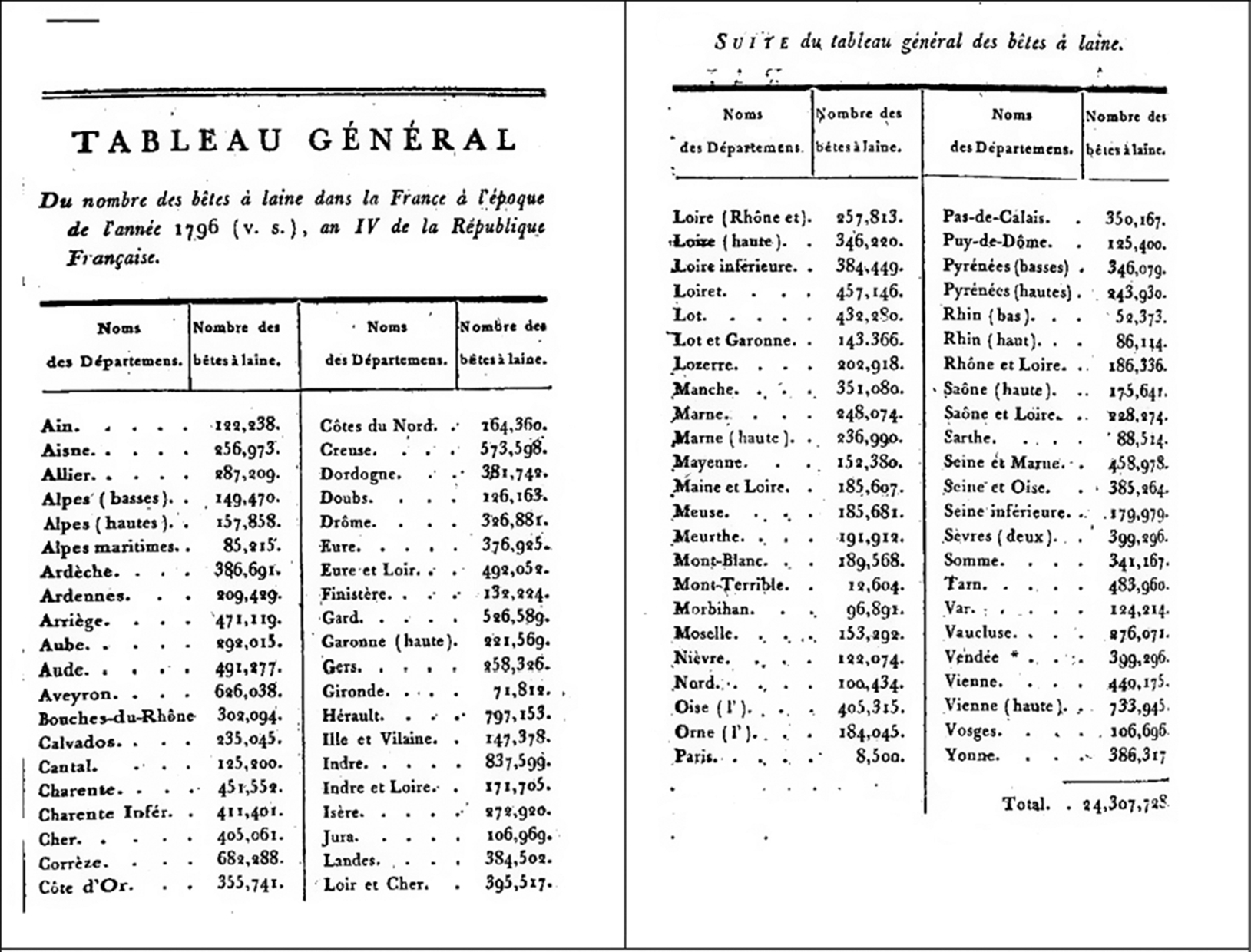
Rougier-Labergerie was aware that this argument could sound overly optimistic and counterintuitive. He felt the need to make a convincing argument in order to “disabuse a large number of men” of prejudice and to “lead them to reason and justice” (EPP, pp. 113–114). The single most powerful argument during the eighteenth century and well into the revolutionary decade against the complete freedom of commerce, especially against the liberalization of grain trade, had been the high probability of cornering and hoarding, which would bring about the upsurge of bread prices (Kaplan Reference Kaplan1976, pp. 164–214; Miller Reference Miller1999). This could not be risked, since the people had to be fed, and no argument based on long-term effects of free trade could override this imperious short-term necessity of avoiding food crises. According to Rougier-Labergerie’s critique of this widespread belief, however, France had all the reasons to embrace free trade (EPP, p. 142). The Republic had competitive advantage in agriculture and manufacture, and above all its market was too large for cornering and hoarding to have much of an effect: “the fear of foreign hoarding is nothing but a phantom” (EPP, p. 18). The crucial proof for this argument was provided by the “authentic facts” collected by the government. It was necessary to take into account, he asserted, “the new light that the Revolution and the times of Terror [had] thrown on this important question” (EPP, p. 105). The development of state statistics during the eighteenth century and the French Revolution empowered him to argue against the widespread fear of cornering and hoarding (Brian Reference Brian1994). In his calculation the number of sheep in all French départements in 1796 added up to 24,307,728 (EPP, pp. 59–60; see Figure 1).Footnote 9 Buying up all the wool coming from this huge number of sheep would be impractical, owing to the high cost. Moreover, hoarders would most likely undergo a serious liquidity crisis even if they did buy all the wool (which was nearly impossible in the first place), as they would have to wait for the prices to go up. France was not the only country in Europe that produced wool, which meant that merchants could not make huge profits from exports. Not even the governments of rival states could aspire to a successful hoarding of such a huge amount of raw material. Cornering and hoarding was unprofitable precisely because international commerce existed (EPP, pp. 63–65). Unlike China, which was itself the size of Europe, France needed and had much to gain from international trade (EPP, p. 187). It was time, he affirmed with urgency, for France to lose its fear of hoarding, liberalize commerce, and revive the pre-war commercial ties with the Levant, Nordic Europe, and its Caribbean colonies minus the Exclusif. The commerce of Lyon, which had been destroyed following the Federalist Revolt of 1793, was also listed as an important asset to recover (EPP, pp. 268–269; Tarrade Reference Tarrade1972; Covo Reference Covo, Régent, Niort and Serna2014).Footnote 10
A table showing the number of sheep (standing for wool) in 1796 in the départements of the French Republic. Source: Printed in EPP, pp. 59–60.

Figure 1. Long description
The document is split into two pages.
Left Page:
At the top, a title reads TABLEAU GÉNÉRAL followed by a subtitle stating the count of wool-bearing animals in France for the year 1796, Year I V of the French Republic. Below the title is a table with four columns, organized into two repeating pairs of Noms des Départemens and Nombre des bêtes à laine.
- The first column pair starts with Ain at 122,238 and ends with Côte d'Or at 355,741.
- The second column pair starts with Côtes du Nord at 164,360 and ends with Loir et Cher at 395,517.
Right Page:
The header reads SUITE du tableau général des bêtes à laine. The table continues with the same four-column structure.
- The third column pair starts with Loire (Rhône et) at 257,813 and ends with Paris at 8,500.
- The fourth column pair starts with Pas-de-Calais at 350,167 and ends with Yonne at 386,317.
- At the bottom right, a Total is listed as 24,307,728.
Data points are separated by leader dots between the department name and the numerical value. Some department names include parenthetical notes or abbreviations like Infér. for Inférieure.
The government had no direct role to play in commerce, not even in grain trade. Rougier-Labergerie made it clear that commerce was the business of private hands. The virtuous ripple effects of commerce, such as the development of shipbuilding or the increase in sailors, would diminish once the government granted exclusive trading patents to a handful of companies (EPP, p. 175). However, the government played an important role in Rougier-Labergerie’s political economy: it had to provide a robust financial infrastructure to enhance market confidence, facilitate transactions, and increase the velocity of money. To this end, he argued in favor of the use of paper money, which had long been demonized during the eighteenth century and well into the Revolution as a “calamity” for economic stability (EPP, p. 220; Spang Reference Spang2015). “False and exaggerated ideas” concerning gold and silver had ruined Portugal, which lagged behind British “agriculture, commerce, public happiness, and power.” For Rougier-Labergerie, this seemed significant since a quasi-paper form of money was generally circulated in Britain. This contrast demonstrated that paper money was not necessarily inferior to gold or silver (EPP, pp. 221–222). Money had to be circulated quickly in order to contribute to national wealth. Gold and silver were insufficient for this “free and active circulation” of money, which required the use of paper forms of money including letters of credit and promissory notes. They were “necessary to all commercial states” (EPP, pp. 223–225). This was such an important consideration for Rougier-Labergerie that he endorsed the earlier experiment with assignats for the reason that it doubled the “movement of manufactures” by “multiplying monetary signs.” He dubbed it a “happy degree of activity” and argued that assignats and paper money in general, as long as they did not exceed the reasonable limit of total printed amount, could be beneficial to manufactures (EPP, pp. 197, 220–221, 228–229). It was the job of the government to ensure the safety of these volatile forms of value by establishing and superintending such institutions as the Public Treasury, banking associations, and bank letters of exchange. The state would also have to reduce public debt to boost its market confidence. The rest was up to the complete freedom of commerce (EPP, pp. 227, 233–236).
V. LESSONS OF HISTORY AND THE FUTURE OF EUROPE UNDER MULTILATERAL PEACE
A unilateral free trade policy, however, was not enough. The Essai was not simply a free trade pamphlet. It was a project for a specific kind of European peace. Without peace, Rougier-Labergerie asserted, there would be no agriculture, commerce, or prosperity. The conservation of the acquis of the French Revolution had to be sought less in the “republicanization” of Europe than in the search for peace and economic growth (EPP, p. 271). For him the republican dream of uniting Europe within a single political system under the flag of French liberty of the “Great Nation”—a loose version of which would be proffered by Bertrand Barère in La Liberté des mers (1798), which argued for the unity and mutual defense of all the “continental and maritime powers” of Europe against the British “thalassocracy”—seemed unattainable at present and dangerous for the future (Barère Reference Barère1798, pp. 21–26, 287–297, 381–385; Vovelle Reference Vovelle2000; Chappey Reference Chappey and Bourdin2008, Reference Chappey, Antoine, Jessenne, Jourdan and Leuwers2014, Reference Chappey, Caron and Luis2015; Gainot Reference Gainot and Serna2009).Footnote 11 Speaking out against the republican and sometimes even democratic currents of political designs of the 1790s (Kim Reference Kim2018a), the Swiss political economist Jean Herrenschwand professed in Du vrai principe actif de l’économie politique (1797) the view that the job of the government of commercial states was to lead their nations toward prosperity, not toward republican liberty (Herrenschwand Reference Herrenschwand1786, Reference Herrenschwand1796; Poulalion Reference Poulalion2008). This was because, in his view, there was a clear economic limit to politics that stipulated that under modern conditions no political liberty could last without “corruption” or “decline” unless the economy “prosper[ed] unshakably” (Herrenschwand Reference Herrenschwand1797, pp. 98–99). The surest way to give “true liberty” to the people and avoid the “greatest corruption” and the “most hideous slavery” was, remarkably, public debt. For Herrenschwand, public debt was the magic wand that stabilized credit, promoted economic activities, and eventually neutralized wars. It was his transition mechanism to a world of prosperity and peace (Herrenschwand Reference Herrenschwand1797, pp. 100–104; Sonenscher Reference Sonenscher2007, pp. 255–257). Although Rougier-Labergerie held a view different from that of the Swiss political economist on public debt and granted less importance to the issue, he agreed that the road to peace and the consolidation of the Revolution was to be found in commercial, agricultural, and industrial development, not in the republican vita activa (EPP, p. 149).
Peace, however, was not easy in coming. Complete freedom of commerce, in Rougier-Labergerie’s opinion, was a fundamental yet insufficient motor of peace, and politics had to play the initial role of setting peace in place so that the economic forces could work to perpetuate it. But there was such a great diversity among the laws and customs of European nations that any plan for the unification or “universal” domination of Europe seemed impractical and unsustainable to Rougier-Labergerie (EPP, p. 300). Hence the important place accorded to the notion of a multilateral peace treaty in the Essai. Until the present, he pointed out, peace treaties between monarchs had been nothing more than ceasefire agreements, truces made for rulers to prepare for another war. Due to their temporary nature, these false peace treaties were unable to lead people into “industry and commerce” and therefore could not engender a durable peace (EPP, p. 300). Princes thus needed to learn first of all that the policy of war and jealousy of trade was incompatible with national interest, both in terms “of public prosperity and of maintaining the power of rulers.” This was the “logic that would be better received” by rulers than one based on justice and rights (EPP, p. 11). There was no use in crafting a moral and normative discourse in favor of making peace and renouncing war: it simply would not work because man was an animal of passion and greed (EPP, p. 291). It was better to persuade the rulers of their “interest” in establishing peace. Interest was what had brought the powers against France into a wartime coalition. Why then could they not be brought together with France into a peace coalition? It was entirely conceivable because (and only because) their common interest lay in the establishment of peace (EPP, p. 301–303).
“Civilized nations” had no choice but to trade with each other. This was Rougier-Labergerie’s historical verdict. There was no such option as the closed commercial state on the table (EPP, pp. 292–293). Fully accepting David Hume’s criticism on the “jealousy of trade” and his affirmation of the beneficial relationship between “domestic industry” and “foreign commerce,” Rougier-Labergerie was also in complete agreement with his conclusion that modern commercial nations had no reason to fear the “greatest prosperity of their neighbors” (Hume Reference Hume1760, pp. 106–107). What must be made clear in order to persuade European rulers was that there existed “a unity of interest between nations.” Commerce was the sociability between nations, the “reciprocal link between peoples.” It was the motor behind the upkeep of peace, and it would work as long as peace was once established between rulers with this wisdom in mind (EPP, p. 291). Specific arrangements should be left to the contracting parties of the treaty, but they could perhaps use, he suggested, the example of Switzerland as a “material for the new confederation” (EPP, p. 304).
The menace of a general destruction was imminent. In Rougier-Labergerie’s view there was no future for Europe if its rulers did not learn from history (EPP, p. 277). Adopting a distinctively Volneyan voice (Kim Reference Kim2018b; Volney Reference Volney1791, Reference Volney and Kim2019; Kidd Reference Kidd and Kidd2024), he sounded a melancholy alarm of the decline of ancient states:
The ambition and interest of some men overthrew the empires of Egypt and of Asia, annihilated Greece and Italy, made revolutions of states: the names of Tyre, Thebes, Persepolis, Rhodes, Athens, Corinth, Carthage, and Rome suffice as authentic proofs of this.… What has become of this ancient Egypt, so famous for its fertility, for the splendor of its arts and monuments? What people on earth had greater things [than the Egyptians]? (EPP, pp. 279–280)
Rougier-Labergerie contrasted the “slow formation of states” with “their hasty destruction.” Peoples and kings needed to find in the history of the fall of states “glaring evidence of the fate that threatened them.” They would then be impelled to make peace (EPP, p. 279), since war had been the principal cause of the decline in ancient and modern states (EPP, pp. 287–296). On this account Carthage fell for three reasons: “the thirst for conquest, the plan for the possession of the empire of seas, and the jealousy against Rome” (EPP, p. 294; Brooke Reference Brooke, Kapossy, Nakhimovsky and Whatmore2017). Rome also fell for three reasons: it “risked all its power and soldiers … to destroy Carthage,” it “neglect[ed] agriculture and commerce” while building an empire, and it relied heavily on glory and the military (EPP, p. 295). In modern times, French revolutionary wars have demonstrated that war destroyed even well-governed and strong states. War benefited only “the purveyors [to the army] and the leeches of the people” (EPP, p. 289).
Rougier-Labergerie defined his science of the legislator, following “Grotius, Pufendorf, Wolff, Bielfeld, Montesquieu, and Bolingbroke,” as the “art of governing a state well, or the science of the means to render a state formidable and its citizens happy.” He was not sparing of what he regarded as the serious shortcoming of the cited theorists of natural jurisprudence: that they had condoned warfare. The true basis for government, he argued, was not a strong army but a flourishing commerce (EPP, p. 297). A large standing army was “dangerous” in monarchies because the ambitious kings and ministers were tempted to make use of it, as the examples of “Caesar, Alexander, Mahomet, Cromwell, Peter the Great, Turenne, and Frederick II” had demonstrated. However, the danger of an army was even larger in republics: there the state itself was at stake, he claimed, because demagogues could take advantage of the “popular credulity” and lead the country into the abyss of dictatorship or military government (EPP, pp. 298–299). For the sake of the happiness of peoples and the future of Europe, war had to be avoided and commerce had to be encouraged. Protectionism weakened states whereas free trade strengthened them. Rougier-Labergerie found a model to follow in Venice: the city could “enjoy the wisdom of its ancient laws” while avoiding all political upheavals and foreign invasions because its leaders focused on “commerce and culture” and were satisfied with “modest and peaceful existence” (EPP, p. 295–296). It is ironic that Venice fell to French arms only months after the publication of the Essai and was traded off to Austria five months later.Footnote 12
VI. CONCLUSION
When read alongside his case for free trade, the reverence for Turgot found in Rougier-Labergerie, the agronomist’s contemplations may be seen as suggesting a kind of “Physiocratic lineage” at work. A large part of the Essai was in fact conspicuously Physiocratic in stressing the importance of government’s refrainment from interfering with the market and the positive role played by unshackled commerce in the political economy of a large agricultural state. This was a view noticeably reminiscent of François Quesnay’s support for free trade in his Encyclopédie article on grain (Quesnay Reference Quesnay, Théré, Charles and Perrot2005, pp. 327–328)—a position shared in 1770 by Turgot in his Lettres sur le commerce des grains, adressées au contrôleur-général and by Pierre-Paul Lemercier de la Rivière in his L’intérêt général de l’État, ou la liberté du commerce des blés (Turgot Reference Turgot and Daire1844, vol. 1, pp. 155–256; Lemercier de la Rivière Reference Lemercier de la Rivière1770). Rougier-Labergerie’s Essai also reminds us of Turgot’s criticism on market distortions by government in Éloge de Gournay (Turgot Reference Turgot and Daire1844, vol. 1, pp. 262–291).
There is, however, no direct reference to the Physiocrats on Rougier-Labergerie’s part, and the Essai is too generous in its evaluation of the intrinsic worth of manufacture in relation to agriculture to be labeled a strictly Physiocratic work. In economic terms, the Essai can rather be said to have belonged to a wider trend in the free trade literature of the period that gave broad-brushed credit to Fénelon, Montesquieu, the Physiocrats, and Adam Smith, the most obvious example being Benjamin Vaughan’s pamphlets of the 1780s, which contained tirades against “violent laws for regulating trade” (Vaughan Reference Vaughan1788, p. 8). But the most significant point to note is that the Essai was not limited to an economic tract arguing for free trade; it was more importantly a proposal for an international order of commerce and peace in times of war and revolution.Footnote 13
This picture of a multi-faceted argument in favor of commercial peace fills a lacuna in the literature on the history of French revolutionary thought by showing how the kind of political economy based on natural jurisprudence could deal with the exigences of subsistence, war, and peace during the still-turbulent times after the Terror.Footnote 14 This means that the current categories of historical inquiry into the international political economy of the revolutionary period needs to be revised. The most authoritative study at present concerning this question is found in Marc Belissa’s two volumes: Fraternité universelle et intérêt national (1713–1795) and Repenser l’ordre européen (1795–1802). Belissa divided the international thought of the eighteenth century and the first half of the revolutionary decade into two camps: that of “universal fraternity” and that of “national interest” (Belissa Reference Belissa1998). However, Rougier-Labergerie’s political economy combined both. His work was a product of his century, which, as articulated in the powerful insight of István Hont, allowed for the coexistence of “a cosmopolitan theory of commercial globalization” and “a competitive globalization strategy” in a single frame of thought (Kapossy et al. Reference Kapossy, Nakhimovsky, Whatmore, Kapossy, Nakhimovsky and Whatmore2017, p. 3). Freedom of commerce was at once an engine of cosmopolitan peace for all states and a strategy of national advantage for France. Rougier-Labergerie placed his bet on an argument devised to ensure the ruling republicans of the national and cosmopolitan merits of free trade. He drove this point home: France had nothing to fear, nothing to lose, and everything to gain from free international commerce, even that of grain, even during wartime. Belissa divided international thought during the second half of the revolutionary decade and during the early days of the Consulate into three groups: democratic, royalist, and moderate. On his account the first group envisioned a Europe of republics whereas the second tried to restore monarchy, civilization, and order. The final group was comprised of Directorial republicans and moderate monarchists who opted for “glorious peace” and “natural frontiers,” seeking stability within the given European order (Belissa Reference Belissa2006). Here, Belissa’s system of categories again fails to account for Rougier-Labergerie’s natural jurisprudence, which proffered a system of thought that was alien to the above divisions but, to a certain degree, cohesive and persuasive by the standards of contemporary political discourse. Rougier-Labergerie’s case indicates a strand of thought that evaded Belissa’s categories in French international thought during the Revolution.
Rougier-Labergerie agreed with Fénelon’s criticism of the reason of state (Fénelon Reference Fénelon1699) but did not share abbé de Saint-Pierre’s idea of a supra-state institution for the imposition of doux commerce (Saint-Pierre Reference Saint-Pierre1713). In this sense his political economy can be said to have resembled, not without differences in the operating political forms (republic versus monarchy), Voltaire’s vision in Anti-Machiavel (Reference Voltaire, Bahner and Bergmann1740), which, in Isaac Nakhimovsky’s summary, had been “animated by a vision of independent states capable of substituting commerce for war without relying on the degree of consensus required to establish an institutional order above themselves” (Nakhimovsky Reference Nakhimovsky, Kapossy, Nakhimovsky and Whatmore2017, p. 77). To sum up, Rougier-Labergerie identified two logical tendencies behind war and commerce: mercantilist protectionism precipitated war, and freedom of commerce fostered conditions favorable to peace. Differences in the natural distribution of resources had led to commerce between nations, which in this sense was a sign of “sociability” and “fraternity” (EPP, p. 36). Note the striking similarity between this view and Hume’s formulation in the essay “Of the Jealousy of Trade” (1760):
Nor need any state entertain apprehensions, that their neighbors will improve to such a degree in every art and manufacture, as to have no demand from them. Nature, by giving a diversity of geniuses, climates, and soils to different nations, has secured their mutual intercourse and commerce, as long as they all remain industrious and civilized. Nay, the more the arts increase in any state, the more will be its demands from its industrious neighbors. The inhabitants having become opulent and skilful, desire to have every commodity in the utmost perfection; and as they have plenty of commodities to give in exchange, they make large importations from every foreign nation. The industry of the nations from whom they import it, receives encouragement: Their own is also increased, by the sale of the commodities which they give in exchange. (Hume Reference Hume1760, pp. 107–108)Footnote 15
The same story had also been repeated in Benjamin Vaughan’s New and Old Principles of Trade Compared (Reference Vaughan1788, p. 4). But even this configuration was insufficient in itself to guarantee perpetual peace. Rougier-Labergerie was aware of the practical limits of the purely economic arguments and suggested that a peace treaty be signed between all major states of Europe. The initiative for diplomatic persuasion, however, had to come from demonstrating the political and economic interest of all European nations in establishing a multilateral pact of peace and free trade. It was time the French republicans laid down their belligerent flag of virtuous liberty and accepted his science of the legislator that embraced “private interests” to make men, including kings and emperors, better conduce to peace and prosperity of all humankind (EPP, p. 154). A different story would follow after Napoléon’s ambitions put an end to “established hopes for a world purged of war through commerce” (Whatmore Reference Whatmore, Kapossy, Nakhimovsky and Whatmore2017, p. 219). Appointed by the First Consul as the Prefect of Yonne (1800 to 1813), Rougier-Labergerie thenceforth restricted his voice to questions of agronomy and forestry. His grand project for peace based on commerce and interest was to remain irrelevant under the war hero’s rule.
COMPETING INTERESTS
The author declares no competing interests exist.

 Open access

