The public’s desire for information on nutrition is increasing(Reference Ayoob, Duyff and Quagliani1), yet we have little knowledge regarding public attitudes towards what information is presented by the media nor how accurate the reporting is in relation to the research to which it refers. Tabloid newspapers are a popular form of mass media within the UK. The public has quoted the print media as a key source of information on nutrition(Reference Grilli, Ramsay and Minozzi2, (Reference Holgardo, Martinez-Gonzalez, De Irala-Estevez, Gibney, Kearney and Martinez3). However, there is a lack of empirical research that has examined the quality of nutrition research reported in the media. For the purpose of this study, ‘quality’ of reporting is judged on whether the report concurs precisely with the original research study, if it remains unbiased not giving a misleading view of the research, and whether it provides practical contextual information for the public. The present qualitative study examined the quality of tabloid articles reporting on nutrition research, and public attitudes towards them.
Literature review
Tabloids account for 75 % of all daily UK newspaper sales(Reference Alden4). A UK Food Standards Agency consumer survey(5) and a European study(Reference Holgardo, Martinez-Gonzalez, De Irala-Estevez, Gibney, Kearney and Martinez3) stated that the public identified the media (press) within its top two sources of information on food and healthy eating. Bubela and Caulfield’s research(Reference Bubela and Caulfield6) concluded that the media provides an accurate reflection of what is conveyed by the research community, whereas Henderson et al.(Reference Henderson, Kitzinger and Green7) and Philo et al.(Reference Philo, Secker, Platt, Henderson, McLaughlin and Burnside8) suggested that the media can be inaccurate. Stryker(Reference Stryker9) stated that ‘inaccuracies resulting from the decontextualised and sensationalised manner in which stories are reported are conceptually distinct from, and occur with greater frequency than, actual errors contained within the story’. McBean(Reference McBean10) and Wellman et al.(Reference Wellman, Scarbrough, Ziegler and Lyle11) proposed that newspapers favour reporting preliminary research which, without supplementary explanation, can oversimplify/overstate inconclusive findings. Guidelines on communicating scientific findings state it is vital to convey that research is evolutionary and not revolutionary, i.e. highlight where a single study falls on the research continuum(12). Including the expert opinion of a third party is recommended to support journalistic balance when reporting research(13).
Borra et al.(Reference Borra, Earl and Hogan14) concluded that ‘most nutrition news failed to provide contextual information’. McBean(Reference McBean10) argued that a lack of context is largely responsible for the public’s confusion over what they should eat. Registered dietitians are equipped to interpret emerging nutrition research for the media(Reference Ayoob, Duyff and Quagliani1). Possible inaccuracies and insufficient practical context questions the value of nutrition information via the print media in terms of health literacy, i.e. the capacity of individuals to obtain, interpret and understand health information in ways that are health-enhancing(Reference Sihota and Lennard15).
There is a lack of information regarding the public’s attitude towards nutrition information featured by the print media. Attitudes are constructed via three components: cognitive, affective and conative(Reference Albery16). Briefly, these components cover thoughts regarding an object, feelings towards the object, and disposition to action regarding the object. With regard to the cognitive component, views within the literature(Reference McBean10, (Reference Reah17, (Reference Patterson, Satia, Kristal, Neuhouser and Drewnowski18) suggest the public is commonly confused by health-related information conveyed by the media. For the affective component, a consumer survey(Reference Ward19) found that 75 % of respondents reported that sensationalism in the media affected their trust in the news. Distrust might be linked to the public’s unfamiliarity with the scientific process(Reference McBean10). Frewer et al.(Reference Frewer, Scholderer and Bredahl20) suggested that an individual’s attitude towards a topic, prior to reading a report, will also influence trust and opinion. In respect of conation, Russell(Reference Russell21) suggested that attitudes might be considered a poor predictor of behaviour, but Goldberg(Reference Goldberg22) believed media influences to have largely contributed towards some changes in public food consumption patterns.
US guidance on cascading nutrition research to the public was issued in 1998(23), updated in 2005(12). Currently the UK has no guidance documentation in place.
Design and methods
Two research questions were addressed in the present study:
1. How accurately do tabloid newspapers report scientific findings on nutrition?
2. What are the attitudes of a key readership group to tabloid reporting of scientific findings on nutrition?
These questions were addressed through two studies. The first comprised a systematic analysis of tabloid newspaper clippings to determine the accuracy of reporting and the second involved focus group discussions held with members of the general public who were presented with original tabloid articles to assess their attitudes to this reporting.
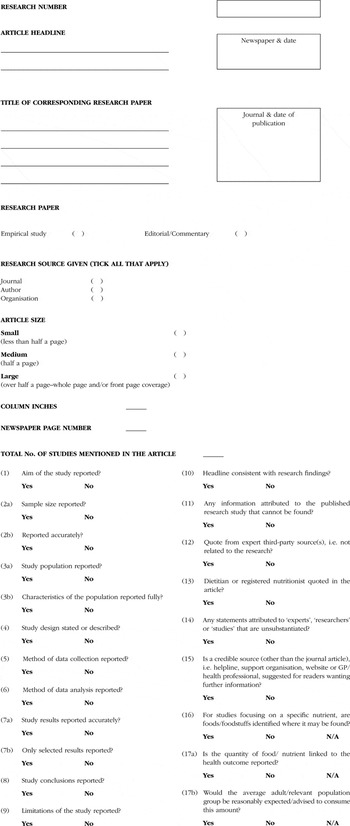
Tabloid reporting of scientific nutrition research articles was assessed for accuracy using a specially devised tool, the Tabloid Analysis Tool (TAT) (see Appendix). No existing tools were fit for the purpose of assessing the accuracy, balance and contextual information of tabloid reporting of nutrition research articles. A tool devised by Hackman and Moe(Reference Hackman and Moe24), and guidance issued by the Harvard School of Public Health and the International Food Information Council (IFIC)(Reference Goldberg22) and the IFIC and the Institute of Food Technologists (IFT)(12), provided some direction on elements for inclusion.
The TAT was devised to conduct the systematic analysis of tabloid articles. Questions were specifically targeted at determining whether tabloid reports were accurate (with respect to original research), maintained journalistic balance, and contained sufficient practical dietary context. A standard instrument was preferred to facilitate a systematic, unbiased approach to the analysis. Tabloid articles and their related research papers were read fully, and then assessed individually using the TAT tool. The TAT was piloted on ten test articles prior to the main study and was trialled by two impartial parties (registered dietitians) to ensure reliability and validity.
Focus groups are accepted as an appropriate qualitative measure for collecting attitudinal data(25, (Reference Morgan26) and the groups were planned and conducted according to best practice guidelines(Reference Krueger and Casey27). Two tabloid articles were selected for the focus group sessions. These gave examples of very poor and the least poor in terms of reporting quality (determined by TAT assessment). Focus group participants were not informed of the origins of the articles. Following a welcome and introduction, participants were presented with the tabloid articles in turn, and were asked three standard questions for each: (i) If you were to tell a friend/relative about the article, how would you describe its contents? (ii) What do you think of the article? (iii) Would you consider acting upon the advice/following the information? Focus group sessions were conducted over one hour.
Sampling
All UK tabloids (‘red tops’, i.e. The Sun, Daily Mirror and Daily Star; and ‘mid-markets’, i.e. Daily Mail and Daily Express) were sampled over a full calendar month (January 2005) and scanned for reporting of nutrition research. Tabloids were selected owing to their wide readership and mass appeal(Reference Alden4, (Reference Bubela and Caulfield6).
For the focus groups, participants were recruited via a purposeful and convenient sampling using the inclusion criteria of adult, willing to participate, non-specialists in food/nutrition, and likely to purchase a tabloid newspaper, given readership characteristics(Reference Alden4). Readership characteristics show that mid-market tabloids are read predominantly by women(Reference Bell and Alden28). A quarter of Daily Mail and a third of Daily Express readers are aged 65 years or over(29). Therefore a key group approached for inclusion was the Women’s Institute, where both characteristics would be present.
Data collection
Newspapers were purchased and examined daily for the period January 2005. Articles reporting on nutrition research and providing a traceable source to the original research (journal name, author and/or organisation) were clipped. Where the original research could not be obtained, reports were excluded from the study.
A questioning guide was used within the focus groups to elicit attitudes towards the tabloid articles presented. Participants were allocated time to read articles, and were asked three open-ended questions to generate discussion. An assistant moderator made contemporaneous notes. Focus group data were audio-recorded with digital equipment, and computer software was used to download the data for transcribing purposes. Participants were informed of the audio recording prior to the sessions, and were assured that data would be anonymous and dealt with confidentially.
Analysis
Tabloid articles were assessed individually by the principal researcher (a registered dietitian) using the TAT. The TAT was used once for every reference made to a piece of research. Data were recorded sequentially on an Excel spreadsheet, and were analysed question-by-question or grouped in order to address one of the three specific parameters (accuracy, balance and context). Focus group data were analysed using a transcript-based method that is accepted as the most rigorous method(Reference Litosseliti30). A ‘long table approach’(Reference Krueger and Casey27) was selected to identify emerging themes.
Results
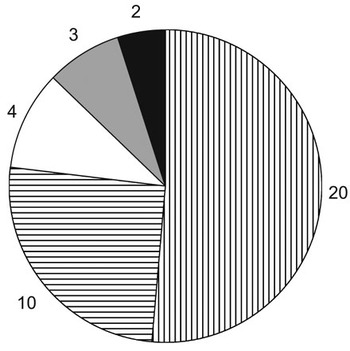
Thirty-two tabloid articles formed the original study sample; twenty-nine met the inclusion criteria for the study. A number of articles referred to more than one nutrition research study and therefore the TAT was used a total of thirty-nine times, once for each reference made to a locatable research study. Figure 1 shows the number of occasions that the TAT was used throughout the study stratified according to origin.
Number of articles (n 39) assessed with the Tabloid Analysis Tool by origin ( , Daily Mail;
  , Daily Express; □, The Sun; ▓, Daily Star; ▪, Daily Mirror)
Accuracy
Twenty-six articles did not accurately convey the original research results. Fourteen reported the study’s sample size but only five did so accurately. Twenty-seven articles used headlines that were inconsistent and therefore deemed inaccurate with respect to the original research, e.g.
Headline: ‘Nuts: Better for you than fruit?’
Research: Polyphenolic content and sensory properties of normal and high oleic acid peanuts
Nineteen articles attributed information to the research that could not be found within the original manuscript.
Balance
Twenty-five articles selectively reported the original research results. Thirty-six gave no mention of research limitations. Five articles provided a third party quote/comment on the research reported, while six made specific statements that were not qualified by a valid professional/academic source.
Context
One article quoted a registered dietitian and one quoted a nutritionist (though not identified as registered). Five articles stated the name of an organisation or suggested seeking further information from a health/medical professional. Twenty-two articles reported preliminary studies and did not explain how the results related to practical nutrition and dietary recommendations.
Attitudes
Two focus groups were conducted, each with eight participants. The focus group data are illustrated as key themes that emerged within the three recognised domains of attitude formation (Fig. 2).
Attitudes expressed by the focus group participants
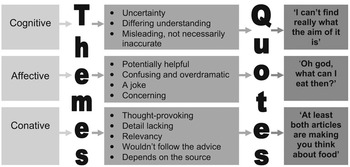
Some differences in participant comprehension were observed. There was widespread agreement in both groups that the information was potentially misleading, but not necessarily inaccurate. Participants’ feelings were largely negative, although several agreed there is value in newspapers reporting nutrition information. Participants’ intentions to act on the information were negligible, due to a lack of conviction regarding the material, its source, or lack of individual applicability. The articles carried some interest for participants, but mainly as general interest.
Discussion
The present study supports the perception that tabloids are sensationalistic to the point whereby the information given is rarely balanced or sufficiently contextualised to be of practical or evidenced use. The majority of research results were reported inaccurately, and headlines were inconsistent with the true nature of the original research reported. This challenges journalistic ethical responsibility outlined by Keeble(Reference Keeble31), and supports arguments which uphold that media coverage of medical science is characterised by inaccuracies(Reference Stryker9, (Reference Condit32).
Opinions within the literature suggest the public is confused by the media’s portrayal of health messages(Reference McBean10, (Reference Patterson, Satia, Kristal, Neuhouser and Drewnowski18). Public attitudes towards the reporting of nutrition research observed in the present study were not particularly favourable. Focus group participants expressed uncertainty in their understanding of the tabloid articles; an unsurprising finding given that analysis from the TAT highlighted deficiencies in the provision of practical context.
In contrast to the findings from the TAT, focus group participants did not question or mistrust the factual accuracy of the information presented, although they did believe information could be presented misleadingly. Some value was expressed towards the provision of nutrition information via the print media, but dramatic headlines and sensationalism clearly limited the application of this information beyond a point of general interest. The relationship between the three attitudinal domains was widely apparent, supporting findings within the literature(Reference Patterson, Satia, Kristal, Neuhouser and Drewnowski18) that those who express confusion or negative feelings towards media articles are most likely to disregard them.
Although the majority of research reported in the tabloids was preliminary and not conclusive, focus group members did not appear to comprehend the evolving nature of research. Expression of the conditional nature of most research findings is perhaps incompatible with the tabloid disposition to print sensational certainties. Newspapers are not medical journals, but journalists could employ simple measures to aid the public’s comprehension here.
Data generated from the TAT and focus groups identified a lack of practical dietary guidance. Dietitians and other expert third-party sources were poorly utilised, and could have added valuable context. The IFIC and IFT(12) recommend journalists translate the latest nutrition research into what is on the public’s dinner plate, a fundamental skill practised by all dietitians. Providing context in reports may be limited by available column inches; however, journalists could signpost to relevant organisations/health professionals.
A limitation of the present study was that it did not distinguish whether journalists base their reports on original research manuscripts or press releases. Journalists are encouraged to obtain the full manuscript(Reference Entwistle33), as press releases are noted to fail in reporting study limitations and exaggerate study findings(Reference Woloshin and Schwartz34). Although this information may have been helpful in appreciating where inaccuracies occurred, it does not diminish the key findings of the study. The data collection period for the tabloid articles coincided with a global disaster, which may have reduced the volume of reporting related to this topic area. A further limitation of the present study was that it did not explore possible diversity in readership between ‘mid-market’ and ‘red top’ tabloids. The articles obtained were largely from ‘mid-market’ tabloids, noted to have readership from a wide spread of social classes; however ‘red top’ tabloids have a greater proportion of readers from the lower social classes(29).
Within the qualitative literature there is no numerical consensus regarding how many focus groups are required to make data viable(25). The multi-method nature of the present research, available time and resources restricted the number of focus groups run; however the key themes that emerged were widely evident in both groups, indicating that a saturation point was reached(Reference Krueger and Casey27).
The present study highlights cause for concern regarding the quality of tabloid reporting on nutrition research. Furthermore, it illustrates that attitudes expressed by members of the public are not favourable. There is some value attached to newspapers providing nutrition information; inferring that efforts to more effectively use this media would not be in vain.
The British Dietetic Association recently launched a media ‘hotline’ for journalists and a ‘hot topics’ section on its website. Both will strengthen links between dietitians and the media. However, the present study shows that best practice guidelines need be developed for the British press to improve the quality of reporting on emerging nutrition research.
Conclusion
Tabloid newspapers are a popular form of mass media in the UK, offering a significant opportunity to reach the wider public with key nutrition and health messages(Reference Whitehead35). The present study highlights that the current quality of reporting nutrition research is inadequate, and public attitudes towards it are not favourable. Despite these criticisms, members of the public believed there is value in newspapers conveying such information, inferring that future opportunities to more effectively use this medium are worthy of attention.
There is a missed opportunity in tabloid reporting to give authentic dietary advice to the public. Registered dietitians could be more readily accessed by journalists to comment on the intended public release of controversial dietary findings.
The present article describes an exploratory study and clearly the research questions should be investigated on a larger and more representative sample. The TAT has proved to be a functional tool and could be used to examine, for example, other UK newspapers (broadsheets) to explore whether similar inaccuracies exist there.
The motivations and competencies of journalists are under-researched. A research question worthy of exploration would be ‘Are journalists who are tasked with reporting scientific research sufficiently knowledgeable/trained to précis and represent scientific articles?’ Public responses to sensational and inaccurate reporting could be explored on a more representative sample through a questionnaire survey.
Acknowledgements
There are no conflicts of interest. The Food Standards Agency Wales kindly funded book vouchers as incentives to encourage focus group participant attendance. The first author wishes to acknowledge Professor Hogard for her guidance as supervisor for the study, and also the North East Wales NHS Trust Dietetics Department for their support and allocation of employment time to undertake this research.
Appendix – Tabloid Analysis Tool (TAT)