

Reductionism about color comes in two main varieties. On one hand, colors reduce to sets of surface spectral reflectances, functions to reflect light at every wavelength across the visible part of the electromagnetic spectrum. On the other hand, colors are dispositions to reflect varying combinations of extremely coarse-grained intensities of light, are what in colorimetry are called “object colors.” In this article I argue these positions are not mere nominal variants. It will not do cooly to vacillate between reducing colors to sets of surface spectral reflectances and “object colors.”Footnote 1 Very much hangs, I argue, on getting the right reductionism in place. Namely, making good on the hue-magnitudes account of the unary/binary distinction (Bradley and Tye Reference Bradley and Tye2001; Byrne and Hilbert Reference Byrne and Hilbert2003a); avoiding the charge of structural mismatch (e.g., Hardin Reference Hardin1988; Pautz Reference Pautz2006a); and accommodating experiences as of certain “impossible colors” (Macpherson Reference Macpherson2003, Reference Macpherson, Macpherson and Brown2021; Sharp Reference Sharp2022). Only the latter version of reductionism accommodates these things. The reductionist, then, should reduce the colors specifically to “object colors.”
To show this, I structure the article as follows. In the first section, I present the two main versions of reductionism, giving their motivations along the way. In the second, I present the noted three putative problems for reductionism. Each problem, I show in section 3, is readily handled by the reductionism on which colors are “object colors” but not by the reductionism on which colors reduce to sets of surface spectral reflectances. Section 4 gestures toward solutions to residual problems for the view: Whether relevant dispositional properties are genuinely causal, and whether any existing psychosemantics can accommodate their representation. The final section concludes.
1. Whence reductionism, fine and coarse
Reductionism about color (hereinafter “reductionism”) is the view that surface colors are reflectance properties of a certain sort. The view’s initial attraction comes from its fidelity to the commonsense thought that it is apples, tomatoes, and firetrucks that are red and not, say, our mental or neural states of them. A clutch of theories of color, however, accommodate the location of colors at the surfaces of objects.Footnote 2 To get to reductionism from here, one might appeal to the platitude that colors are the surface properties causal of color experience, paired with the empirical observation that reflectance properties are the surface properties causal of experience (cf. Sharp Reference Sharp2023). Or one may, following Byrne and Hilbert (Reference Byrne, Hilbert, Macpherson and Brown2021), note that because “color vision systems across the animal kingdom appear to be well-suited to detect ways in which objects alter light … the natural hypothesis is that colours are ways of altering light (289; italics in original).
There are two prominent versions of reductionism. They differ in the sorts of reflectance properties to which they reduce colors. The first reduces colors to sets of surface spectral reflectances. An object’s spectral surface reflectance (SSR) is the measure of how much light at every wavelength in the range of (usually) 400 to 700 nm is reflected by an object.Footnote 3 And colors here reduce to sets of SSRs. Which sets, exactly? The ones which include all and only those SSRs which are metamers or are mutually metameric. Two or more SSRs are metamers just in case they are physically distinct and yet, under a given illuminant, (certain standardized) subjects cannot tell apart with respect to color the objects instantiating the SSRs.Footnote 4 In modern settings, we are not unlikely to encounter metamers. The SSR of a green textile will probably not be the SSR of the green part of a pointillist painting nor the SSR of the green part of a printed picture, where the green instantiated in each case is the same determinate shade.Footnote 5 The involved industries commonly exploit metamerism to produce specific colors through differing means and with different ingredients.
With rare exceptions, there are an infinity of possible metamers corresponding to each color (Stiles and Wyszecki Reference Stiles and Wyszecki1962, 313).Footnote 6 And there is no obvious principled reason to select any one of the infinitely many metamers associated with a color as the reducer of the color. Because metamers are physically distinct, and because none recommends itself as sole reducer, no metamer reduces a given color. Reductionism, therefore, needs either to reduce the colors to sets of metamers, or to unifying features thereof.
The first prominent iteration of reductionism plumps for the former option. On it, to be green, for example, is to have a SSR that is a member of what we might call the “green”-region of reflectance space, S.Footnote 7 S is an infinity-dimensional space, with dimensions corresponding to each of the continuum-many wavelengths about which SSRs may differ. SSRs are accordingly canonically taken to be vectors in S (Grassmann Reference Grassmann1853, cited in Koenderink and van Doorn Reference Koenderink, van Doorn, Mausfeld and Heyer2003; cf. Centore Reference Centore2017, ch. 3). And the “green”-region of S is (exhaustively) comprised of the SSRs that, ceteris paribus and in normal viewing conditions, cause experience of green in normal subjects.Footnote 8 The green region is a highly anthropocentric region, then, given the way it is picked out, but is no less objective for it (Hilbert Reference Hilbert1987, 11ff). The rest of the colors get reduced similarly. They are all regions of S.
On the second iteration of reflectance physicalism, extensionally the same as the former but with, as we will see, importantly different emphases, to be green is to be disposed in normal viewing conditions to reflect substantially more medium-wavelength light than either long- or short-wavelength light (for important defenses, see Tye Reference Tye2000; and Bradley and Tye Reference Bradley and Tye2001; Byrne and Hilbert Reference Byrne and Hilbert2003b express openness at least to a colorimetric version of the view; cf. also Byrne and Hilbert Reference Byrne and Hilbert2003a, esp. 15). Here, the reducing reflectance property is extremely coarse-grained and is defined in terms of dispositions to reflect varying proportions of extremely coarse-grained intensities of light, what Tye calls “L*, M*, and S*,” corresponding to activations of the L, M, and S cones of human retina (Tye Reference Tye2000, 160–66). The rest of the colors get reduced similarly. A surface is blue just in case it is disposed in normal viewing conditions to reflect mostly S*; purple just in case it is disposed in normal viewing conditions to reflect lots of L* and S* light but very little M*; and so forth.Footnote 9 It will be important to complicate this picture in the following text, but we can make do with this simplified picture for now. Colors here are dispositions to reflect varying combinations of extremely coarse-grained intensities of light.
In the preceding text I said that reductionism needs either to reduce the colors to sets of metamers or to unifying features thereof. This second iteration of reductionism, we see, plumps for the latter. All SSRs that are mutually metameric (in daylight) reflect identical proportions of L*, M*, and S* (ditto for whatever other coarse-grained intensities of light one may use to define reflective dispositions informationally equivalent to those defined in terms L*, M*, and S*—like those defined in terms of CIE XYZ or RGB matching-functions).
Because on the first version of reductionism colors reduce to sets of extremely fine-grained (infinity-dimensional) reflectance properties (metamer-classes), for ease of reference I will call that version fine-reductionism. And because on the second version colors reduce to comparatively extremely coarse-grained (three-dimensional) reflectance properties (“object colors”), for ease of reference I will call it coarse-reductionism.
In the next section, we will review problems which putatively arise for reductionism in general. And in the section after, I will argue these are not problems for reductionism in general, but just for fine-reductionism.
2. Three problems for reductionism
I present here three problems for reductionism. I start with reductionism’s alleged inability to accommodate the unary-binary distinction.
The colors, as we know them, are either mixtures of two hues, or involve just one hue without a tinge of any other. Orange, purple, and teal are examples of colors that are mixtures of hues. Such colors are called binary. The colors red, green, yellow, and blue, however, are the unary colors (and exhaustively comprise the class of such colors) because there is a determinate shade of each which involves no tinge of any hue but (respectively) red, green, yellow, and blue.
The first challenge for reductionism, first raised in Hardin (Reference Hardin1988), faults reductionism for being unable to accommodate the previously mentioned distinction. Colors like orange, purple, and teal are essentially binary, goes the objection. And no candidate reducer of, for example, orange that does not essentially involve two hues is orange properly so-called. But on the version of reductionism popular at that time, colors were just metamer-classes. And the metamer-class that reduces orange, for example, does not involve redness or yellowness. It involves just “orange”-SSRs—just the SSRs which comprise the “orange”-region of S. Hence, colors do not reduce to regions of S.
Here is a second problem. Sharp (Reference Sharp2022; cf. Macpherson Reference Macpherson, Macpherson and Brown2021) raises the following challenge for reductionism.Footnote 10 A prediction of the Hurvich–Jameson neurocognitive model of color experience is that normal human perceivers can enjoy afterimage experiences as of colors that are maximally dark (i.e., dark-as-black) and yet distinctly hued (or chromatic). We can, for instance, enjoy a maximally dark and yet yellow afterimage. According to Churchland (Reference Churchland2005; see also his 2007 and 2012), we do enjoy such experiences.Footnote 11 Churchland dubs these afterimages the stygian hues. For precision, I will variously refer to the relevant experiences “experience as of stygian [color].”
The problem (for now) for reductionism starts with the following observation. There are no reflectance properties matching the preceding descriptions. All SSRs answering to the description “dark as black” comprise the “black”-region of S. And all SSRs answering to the description “distinctly hued” belong to the regions of S corresponding to the multitude of hues that exist. There is no overlap of these regions. The “black”-region, if more needs saying, consists of those SSRs that in daylight excite human cones not at all. Whereas any region that reduces a chromatic color, or hue, does excite the cones. These facts contribute to the delineation of these regions. There cannot be overlap.
This matters because the perceptual theses most naturally coupled with reductionism are intentionalist, theses according to which color experience fundamentally consists in the representation, or presentation, of colors. If colors are reflectance properties, and color experience consists in their (re)presentation, then experience as of the stygian hues consists in the (re)presentation of some part of the environment as exhibiting a reflectance property. Tying things together: Because there is no region of S, nor any SSR, answering to the descriptions of the stygian hues, intentionalist theses of color experience cannot accommodate experience as of stygian hue. They thus serve as counterexamples to such theses, revealing their extensional inadequacy. This is problematic, finally, from the perspective of reductionism because (again) intentionalist theses are the accounts of perceptual experience ostensibly best suited to accommodate reductionism. Without them, reductionism is a car without a key to start it.
I turn now to the last problem for reductionism, structural mismatch. Also, with origins in Hardin (op. cit.), the problem starts with the observation that SSRs do not stand in relations of similarity that mirror those borne out by the manifest qualities, the colors, they are meant to reduce. This is a problem, the thought goes, because reducers must share all structural features of whatever properties they reduce. And, so, because SSRs do not share the noted structural features with the colors, SSRs are not the colors.
This alleged failure of mismatch is usually illustrated as follows. It is easy to find a SSR of a purple object that is not more like the SSR of a blue object than that of a green object. (For reflectance curves which illustrate the claim, see, for instance, Pautz Reference Pautz2006a, or Byrne and Hilbert Reference Byrne and Hilbert2003a). But purple is more like blue than green. So again, the colors of the objects with those SSRs cannot reduce to those SSRs.
The wary reader may have noticed a strange feature of the argument. It is regions of S —infinite subsets of vectors in S—not individual SSRs, which reduce the colors. What do similarities borne or not borne out by individual SSRs have to do with whether blue, purple, and green reduce to regions of S?Footnote 12 This is an important point of contention that I have not yet seen made in the literature. I suspect it can be developed. But I want to (or think we can) sidestep it here by making the following (contentious) assumption. Even if colors are regions of S, instances of colors are presumably identical to the individual SSRs instantiated by external objects. If this is an appropriate assumption, then one presumably can fault reductionism for being unable to accommodate that this instance of purple is more like this instance of blue than this instance of green, notwithstanding their SSRs not being so similar.Footnote 13
Let us recap, then. Reductionism faces these three problems: It cannot accommodate the unary/binary distinction; it won’t, in tandem with its most natural bedfellow, intentionalism about color experience, accommodate experience as of stygian hue; and it fails to secure structural match.
2.1. The hue-magnitudes proposal
There is a popular proposal for getting around the previously mentioned problems,Footnote 14 the hue-magnitudes account of color experience.Footnote 15 In this subsection, I present how it is meant to get around the problems, before explaining why it doesn’t. It doesn’t, anyway, without adoption of a specific version of reductionism, and perhaps further novel machinery to boot—which is the topic of the next section.
According to the hue-magnitudes account, in seeing color, we represent objects as being variously hued. In seeing a purple thing, as purple (I hereinafter take the qualification as read), we represent is as being bluish and reddish. In seeing a teal thing, we represent it as being greenish and blueish. In seeing a (unique-)yellow thing, we represent it as being (just) yellowish. According to the account, the “hues” are just these: bluish, yellowish, greenish, reddish—corresponding to the information channels constitutive of the Hurvich–Jameson model of color experience. And all seen colors are experienced as exhibiting one or two hues.
On the proposal, to represent something as having a hue is to represent it as disposed in daylight to reflect varying combinations of long-, medium-, and short-wavelength light—or (again) for short, L*, M*, S*. Following Sharp (Reference Sharp2023), who takes his cue from Byrne and Hilbert (Reference Byrne and Hilbert2003a, fn. 44), I will assume L*, M*, and S* are to be calculated by multiplying, in matrix-form, the object’s SSR, the spectral power of daylight, and the human cone sensitivity functions. This is just the standard calculation of “object colors” in colorimetry (e.g., Centore Reference Centore2017, ch. 4.4.1, esp. 94; Koenderink Reference Koenderink2010, 48–49).
Let’s focus on the example of an object’s being orange. In seeing an orange thing (as orange), we represent it as being yellowish and reddish. On the hue-magnitudes account, to represent something as yellowish is to represent it as disposed in daylight to reflect a signal for which the sum of L* and M*, minus S*, is greater than 0 (Byrne and Hilbert Reference Byrne and Hilbert2003a, 15). To represent something as reddish is to represent it as disposed in daylight to reflect a signal for which L* minus M* is greater than 0 (ibid., 14). Accordingly, to represent something as orange is to represent it as disposed in daylight to reflect a signal for which sum of L* and M*, minus S*, is greater than 0 and L* minus M* is greater than 0.
That is the proposal. I want here to consider how it is meant to get around just one of the problems discussed in section 2, structural match. (The issue it immediately runs up against prescribes deferring the rest of the exposition to later.) The proposal is meant to vindicate that purple is more like blue than green as follows. Glossing over details, something is purple exactly when it is disposed to reflect combinations of L*, M*, and S* that are more like the combinations characteristic of beams reflected (in daylight) just in case something is blue than those characteristic of beams reflected (in daylight) just in case something is green. It is in that way that relevant similarities are borne out. The locus of similarity is in the combinations of L*, M*, and S* (which the surfaces are disposed in daylight to reflect).
2.2. But what about S?
It doesn’t seem, though, that this will work. We must ask:Footnote 16 To what do the color properties, the hues, predicated in color experience reduce? If they reduce to sets of SSRs, then color experience systematically misrepresents binary colors. Consider perception of orange again. Orange here is the “orange”-region of S. And the hue-magnitudes proposal says experience as of orange predicates of surfaces that they are yellowish and reddish. On one reading, this means the experience predicates of the seen surface that it has a SSR in the “yellow”-region of S and the “red”-region of S, given those are the properties which reduce yellow and red. But the object does not have that. It has a SSR in the “orange”-region of S. The “orange”-region is just—is all and only—those SSRs which cause the particular experience in question (in daylight, ceteris paribus). And none of the SSRs in the “yellow”- or “red”-regions of S do that. So, the experience gets the object’s color wrong. This same thing goes, mutatis mutandis, for experience as of any other binary color.
I’ve just said none of the SSRs in the “yellow”- or “red”-regions of S cause experience of orange. This is because those regions consist just of the SSRs that in daylight (and ceteris paribus) cause respectively experience as of yellow and red. But given how the hue-magnitudes account is framed, perhaps it is more appropriate to think not of “yellow”- and “red”-regions of S but instead “yellowish”- and “reddish”-regions of it. These will not consist just of those SSRs that in daylight cause respectively experience as of yellow and red. They will instead consist, we can stipulate, just of those SSRs that in daylight cause (ceteris paribus) respectively experience as of something’s being yellowish and reddish. (If this is what the hue-regions are, then there are plausibly just four of them.) More importantly, it will turn out true that something is orange iff its SSR resides in the overlap in S of the “yellowish”- and “reddish”-regions. Perhaps these regions, then, reduce the qualities predicated of objects in color-experience.
Promising as this may at first blush seem, it will not work, either. The hue-magnitudes account needs to be able to account for such facts as that (e.g.) this orange surface is redder (more reddish) than that one.Footnote 17 This works in the original terms of the account: For something to be redder than something else is just for it to be disposed to reflect a signal for which the difference between L* and M* is greater than the difference between L* and M* in the signal the other object is disposed to reflect. But there is no way to cash this idea out in terms of the four regions of infinity-dimensional S we are supposing reduce reddishness, yellowishness, bluishness, and greenishness. There is no sense to be made of some object’s exhibiting, or having, more of the “reddish”-region of S than another. (But even if there were, we already know that the SSRs we want to reflect the similarity relations of the colors do not reflect those similarities. S is simply not the place to look for the similarities we want colors, or aspects of them, like hue, to bear to each other.)Footnote 18
The upshot is the hue-magnitudes proposal will not, without further ado, get the reductionist around the problems discussed in section 2. In the following section, I detail what the reductionist must do to secure the benefits promised by the hue-magnitudes account. She must, I will argue, adopt, full-throatedly, coarse-reductionism.
3. Only fine-reductionism feels the sting
A lesson will have begun to emerge. The hue-magnitudes proposal represented the beginning of a resolution to the problems discussed in section 2. But that proposal, we just saw, fails to gibe openly with that understanding of colors on which they are reducible to regions of S. What this signals is the following: The problems discussed in section 2 apply just to the first iteration of reductionism. It is just fine-reductionism that cannot accommodate the unary/binary distinction (for being unable to make good on the hue magnitudes proposal). Just fine-reductionism cannot accommodate the stygian hues. And just fine-reductionism fails to secure structural match. The goal of this section is to demonstrate the ease with which these issues dissolve on adoption of coarse-reductionism. It does not, I argue, feel the sting of the problems of section 2.
To do that, however, I need first to complicate coarse-reductionism, taking my cue from extant presentations of it. There is an issue with its simple presentation, the one given in section 1. According to it, colors are dispositions to reflect varying combinations of L*, M*, and S*. But amounts of L*, M*, and S* relate too complexly to the opponent-neural sensitivity functions many in the debate think of as reflecting the structure of perceptual color space (Bradley and Tye op. cit.; Pautz Reference Pautz2003; Sharp Reference Sharpin prep.; cf. Churchland Reference Churchland2005). The problem, as Sharp (Reference Sharp2023) briefly puts it, is this:
[T]he external color space to which [the reducers of coarse-reductionism] belong puts [the reducers] corresponding to differently saturated yellows at distances those yellows do not exhibit in perceptual color space. And, so, for instance, it may be that of the causes, v 1,…v 3 of, respectively, perceived yellows Y 1,…Y 3, the cause of Y 2, v 2, is equidistant in its containing space from v 1 and v 3, whilst it is not true that Y 2 is equidistant in perceptual color space to Y 1 and Y 3 (§5.3).Footnote 19
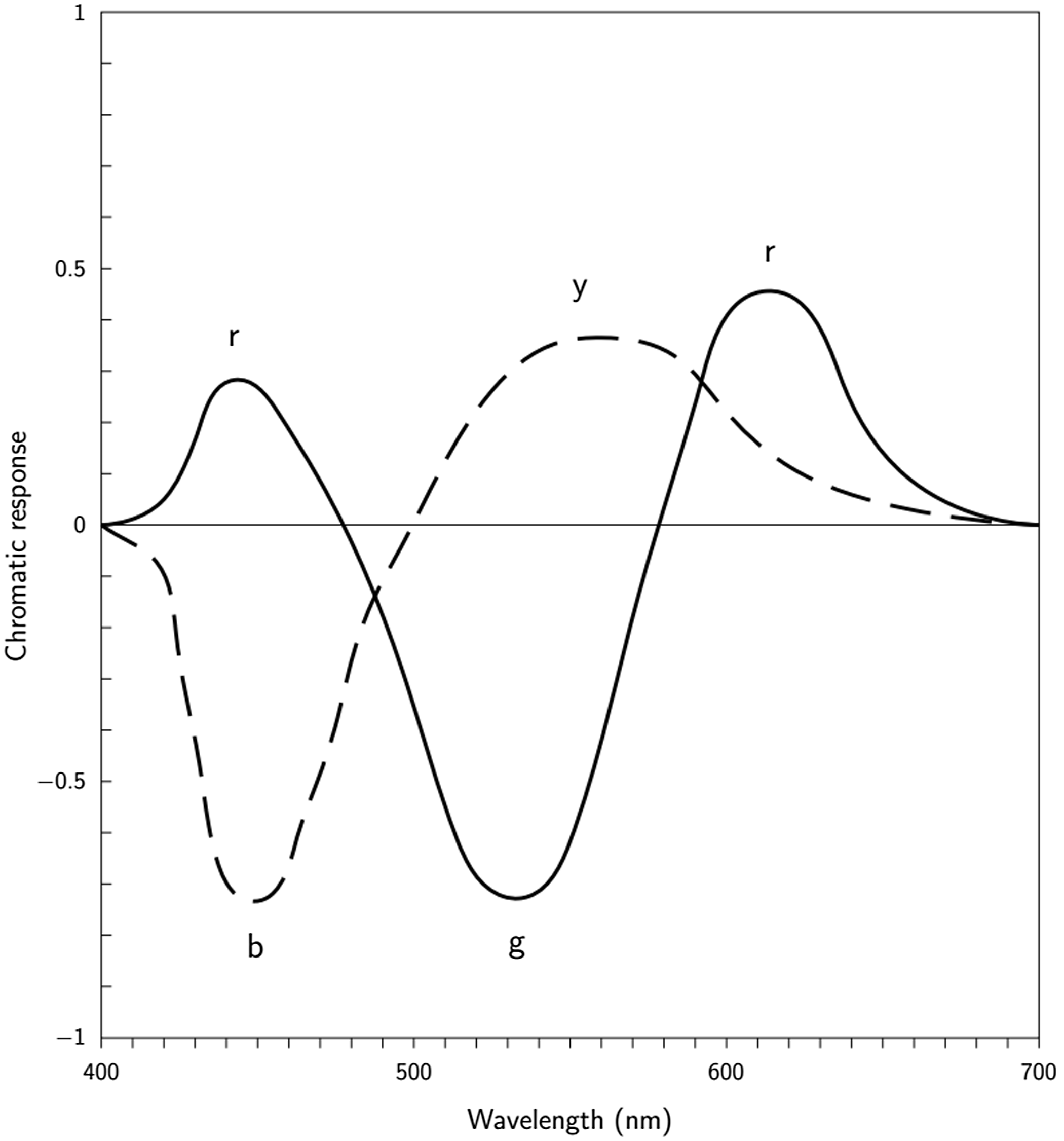
To get around this problem, and to sidestep important issues raised in Pautz (Reference Pautz2003) and (Reference Pautz2013),Footnote 20 I want to adopt the characterization of colors provided in Sharp (Reference Sharpin prep.). On it, colors reduce to so-called HJ-reflectances. These are dispositions to reflect varying combinations of HJ-intensities. And HJ-intensities, like their forebears L*, M*, and S*, get calculated by multiplying SSRs with the spectral power of daylight and the opponent-neural sensitivity functions provided in Hurvich (Reference Hurvich1981).Footnote 21 We can focus for the moment on the familiar opponent functions B/Y and G/R, which I reproduce in Figure 1.Footnote 22 To calculate reflected B- or Y-intensity, one multiplies the object’s SSR (first with daylight and then) with the B/Y function. If the resultant number is positive, then the object is disposed to reflect Y- but not B-intensity. If negative, then the object is disposed to reflect B- but not Y-intensity. Mutatis mutandis for G- and R-intensities.
Opponent-neural sensitivity profiles, adapted from Pridmore (Reference Pridmore2021).

Here is an example. To be such and such shade of purple is to be disposed in daylight to reflect so much B-intensity and so much R-intensity. Experience as of purple predicates of some part of the environment that it is disposed to reflect so much B-intensity and so much R-intensity. We see straightaway, then, that there is no awkward fit between what experience predicates in color experience, on the one hand, and what color is, on the other hand, as we did before in trying to cram a hue-magnitudes peg through a fine-reductionist shaped hole. So, coarse-reductionism can make good on the hue-magnitudes proposal. Which means it can accommodate the unary/binary distinction, too.Footnote 23
(It is crucial to flag that this is what coarse-reductionism looks like where the Hurvich–Jameson model of color experience is assumed. That is, this is what it looks like where the functions of Figure 1 are taken to be the appropriate matching-functions—are taken to appropriately coordinatize perceptual color space. If we think instead that, say, RGB functions are more appropriate, then the coarse-reductionist has just to swap those functions in for the ones used here. This would give us RGB-reflectances instead of HJ-reflectances, dispositions to reflect RGB-intensities, which we calculate in the expected way. The coarse-reductionist picture in full generality, then, is committed to the reduction of colors to dispositions to reflect varying combinations of intensities calculated by appeal to whatever matching-functions are deemed, by colorimetrists, probably, most appropriate for coordinatizing perceptual color space. With that said, for the sake of concreteness and familiarity I will in the rest of what follows continue to assume the functions of Figure 1 are the appropriate ones, but I will flag where their replaceability is important.)
What about structural match? If colors are HJ-reflectances, then color similarities are plainly reflected by the similarities borne out by their reducers. This is most easily seen where we write the reflectances as coordinates: An example purple object may be denoted <–90, 90>. This means it is disposed to reflect lots of B-intensity and lots of R-intensity. A blue object may be denoted <–90, 0>. And a green object may be denoted <0, –90>. The HJ-reflectance of the purple object is plainly more like the HJ-reflectance of the blue object than that of the green object.Footnote 24 Structural match, then, is straightaway secured where we adopt coarse-reductionism.Footnote 25
These are straightforward perks of coarse-reductionism that on their own demonstrate its puzzle-resolving prowess. On their own they recommend coarse-reductionism over fine-reductionism. But the puzzle-resolving prowess of the view goes further still. Coarse-reductionism should also be able to accommodate experience as of stygian hue. How it does so, however, is less straightforward than its accommodation of the previous aspects of color. Still, it is an important virtue of coarse-reductionism that, if with a bit more apparatus (which we will turn to shortly), it accommodates experience as of stygian hue as well.
Recall that the stygian hues posed a problem for reductionism because no region of S answered to the descriptions we give of the stygian hues. This makes it so that experience, as per the theories so far in play, cannot predicate of any part of the environment that it has a SSR that is a member of any possible region of S. Can the hue-magnitudes proposal skirt this worry? (Keep in mind that we must keep in place the hue-magnitudes proposal because it resolves, in a way that allows for the colors and color visual content to fit, the previous two problems.) We must ask what a surface’s being maximally dark—or, simply, black—amounts to on the proposal. When we undergo experience as of maximally dark surfaces, what do our visual systems predicate of them?
Consider, first, this option: We represent the surface as disposed to reflect no HJ-intensities. That that this option maintain the fit between color and color visual content so far enjoyed by coarse-reductionism, to be black/maximally-dark would in turn amount to being disposed in daylight to reflect no HJ-intensities.
If that is what our visual systems predicate of maximally dark (black) surfaces, then the hue-magnitudes proposal is inadequate to the task of accommodating experience as of stygian hue. For then experience as of, for instance, stygian yellow will represent some part of the environment as reflecting no HJ-intensities and also reflecting some (as reflecting no Y-intensity and reflecting some Y-intensity). This is a problem because it introduces an Escher-style worry. An Escher-style worry is one in which experience attributes an impossible property, like the property being of finite height yet forever-ascending (and, here, the property reflecting some, and no, HJ-intensities).Footnote 26 Because impossible properties like these are not physical, they may not be available to constitute relevant contents. This is a problem because it leaves us with identical contents grounding phenomenally distinct experiences. It leaves us, that is, with counterexamples to the popular externalist versions of intentionalism. These are, namely, those on which color visual content is constituted (in part) by the very properties represented in color-experience (this is the Russellian representationalism endorsed by Tye Reference Tye2000, Reference Tye2009; cf. Byrne and Hilbert 2003, fn. 7; cf. Byrne Reference Byrne2009, 436—the color-reductionists who have featured prominently throughout the discussion so far),Footnote 27 and those on which contents are sets of possible worlds (e.g., Lycan Reference Lycan1996).
The upshot, accordingly, is the coarse-reductionist should not gloss the visual representation of maximal darkness as in the preceding text. By my lights, a promising way forward is to characterize the relevant representation as follows. The reductionist should calculate darkness/lightness contributions to color content analogously to how she handled B-, Y-, G-, and R-intensities. Darkness/lightness color content should be calculated by multiplying SSRs with the spectral power of daylight and the colorimetric matching-functions that characterize darkness/lightness perception. Let’s call the information-channel(s) which realize this function the K/W-channel(s) (for blacK/White).Footnote 28 Then, we can say that to visually represent a surface as dark-in-color is to predicate of the surface its being disposed in daylight to have so much K-intensity. K-intensity is calculated by multiplying the object’s SSR with the spectral power of daylight and the colorimetric matching-function corresponding to K/W. If we use the functions plotted in Hurvich (Reference Hurvich1981), then a K-intensity of 0 denotes maximal darkness, and excursions from 0 denote comparative lightness. (And 100 denotes maximal lightness.)
Here is where this leaves us. Experience as of (e.g.) stygian orange represents a part of the environment as disposed to have maximal K-intensity, so much Y-intensity, and so much R-intensity. Example coordinates for one such reflectance would be <70, 70, 0>. Now, it is correct that no SSR can realize a color with those coordinates. But this is immaterial in the present context. What we wanted was to avoid the constitution of the experience’s content by impossible properties. But a surface’s having a K-intensity coordinate of 0 is physically possible; black objects instantiate the property. And obviously a surface’s having Y- and R-intensity coordinates of 70 and 70 is possible: Yellow things, red things, and orange things will have one or both of those coordinates. Each relevant property is therefore available to constitute the content of the experience. The problem posed by experience as of stygian hue thus dissolves.Footnote 29
With the three problems of section 2 thus resolved, it may seem that coarse-reductionism’s bona fides are unparalleled, that the colorimetrist’s “object colors,” and HJ-reflectances in particular, constitute a reductionist panacea. This may be. In the following, penultimate, section, I consider residual problems for the view and suggest ways to resolve them.
4. Looming discontents
I want to close by warning of two important discontents of coarse-reductionism. The first is this: The causality of color is difficult to square with the tight connection between HJ-reflectances (and “object colors” under certain other characterizations too), on the one hand, and the opponent-neural activations for which colors are causally responsible, on the other hand. The second is the apparent lack of any mainstream psychosemantics fit for explaining how our postreceptoral states come to represent hue-magnitudes (here HJ-intensities).Footnote 30
To get a keen sense of the first worry, start by considering a discontent of reductionism-in-general. Part of what motivates reductionism, I said in section 1, is consideration of the causality of color. But on reductionism, colors are dispositions, and many philosophers think dispositions are not causal.Footnote 31 Many philosophers, then, may be struck that reductionism is unable to accommodate a core, or commonsense, feature of color.
Note that this is not a problem unique to reductionism. Most theories of color construe colors as dispositions to cause things for which we typically think of them as causally responsible. The most popular alternative to reducing colors to reflective dispositions is to identify them with dispositions to cause certain experiences (this is traditional dispositionalism, but it is also the preferred spelling-out of the relationalism of Cohen Reference Cohen2009, see esp. ch. 7). Moreover, the most promising neural candidates to reduce the colors on subjectivist views of color, according to which colors are neural states (or are qualia that reduce to neural states) are highly mathematized regions of neural activation spaces (like clusters in V4 activation space: Bohon et al. Reference Bohon, Hermann, Hansen and Conway2016). But clusters in neural activation space are defined in terms of their outputs (see Shea Reference Shea2007, for helpful discussion). That is, they are functions defined in terms of the states they bring about. And dispositions are no less causal than functions.
The problem, we see, is not unique to reductionism. We may think, however, that the reducing dispositions of coarse-reductionism are in worse shape than SSRs (the reducers of fine-reductionism) or clusters in neural activation space. For the reducing properties on coarse-reductionism, HJ-reflectances (or something thereabouts), can be construed just as dispositions to cause the very neural states in terms of which they are calculated. But these, we might have thought, are the neural states they cause in causing color-experiences. Redness, for example is just the disposition (in daylight) to reflect R-intensity. Given R-intensity is calculated in terms of the G/R sensitivity function (provided in Figure 1), we might read R-intensity as being just the disposition to cause (excitatory) activations of the G/R-channel. But if R-intensity is just this disposition, then it is too tightly related to the effects it purportedly causes to be appropriately thought of as genuinely causing those effects after all. This goes mutatis mutandis for the rest of the hue-magnitudes (= HJ-intensities) definitive of the reflectance dispositions which reduce the colors on coarse-reductionism.
I want to make a couple points in reply. First, as before, other prominent theories of color face an exactly analogous worry. Dispositionalist theories, according to which color C is the disposition to cause experience-of-C, face the same worry. Coarse-reductionism is again not alone, then, in positing colors causally responsible for states definitive of the colors.Footnote 32
Second, I wonder whether the causal worry is merely prima facie deep. The platitude that needs saving is that colors cause color-experience. There are no (pretheoretic) platitudes regarding the mechanism of that causation. Colors reduce to HJ-reflectances here. But color experience certainly does not need similarly to be reduced to opponent-channel activations. In keeping with the perceptual theses so far intimated, we are entitled to maintain that color experience consists fundamentally in being visually related to a proposition. Or we might maintain that it consists fundamentally in relations of acquaintance to visual facts, or to the truth-makers of such facts. If that is what color-experience is, then the causation of color-experience by HJ-reflectances is not openly, but just prima facie, problematic.
I turn now to the second problem, that of squaring coarse-reductionism with mainstream psychosemantics. Shoemaker (Reference Shoemaker2003), Pautz (Reference Pautz2006b), and Cohen (Reference Cohen2009) have each argued that there are possible subjects who, thanks to differences in their postreceptoral sensitivities, experience (e.g.) the physical property that according to the reductionist reduces blue as a mixture, in contrast with normal subjects, who do not. (Probably importantly, these possible subjects share our cone sensitivities). They say no existing psychosemantics accommodates this if colors are (anything like) HJ-reflectances.
Instead of proposing how I think the problem should be resolved, I want to diagnose the problem. And that diagnosis should, if its consequences are palatable enough, point in the direction of a solution.
To start, note that on the view as developed in the preceding text, there is an HJ-intensity that answers to each of the unary colors (for being calculated with the opponent-neural functions). The challenge, then, is to show that a psychosemantics can deliver that normal subjects represent HJ-intensities, while other possible subjects (those who represent what for us are unary as binary, and vice versa) represent (what we might call) schmaichJ-intensities. These are calculated exactly like HJ-intensities, but with the possible subject’s opponent functions replacing ours.
This fact is crucial. It points us in the direction of why it is so difficult to locate the physical differences that would ground differences in content like those between the previously mentioned subjects. On the hue-magnitudes proposal, the content of individual vectors (or their tokenings) in opponent-neural activation space is determined by how far along each axis the vector is. This strongly suggests that, for treating color-representation as consisting in the predication of HJ-intensities, the hue-magnitudes proposal treats the axes of opponent-neural space as the original bearers of content, treats them, in other words, as what alone is in the first instance possessive of color representational content. But that it is the axes of neural activation spaces that are the original bearers of content is an idea that was only popular around the turn of the century (see, e.g., the discussion in Shea Reference Shea2007, 248–50). At least since Shea (op. cit.), philosophers of mental representation all seem to have accepted that it is regions of vectors (or individual vectors) in neural activation space that are the original bearers of content (in content-based explanations of human behavior and cognition). This is, I think, the central psychosemantic issue for the hue-magnitudes proposal. It asks us to revert to ways of thinking about network-based representations that are out of fashion. And where content is determined in line with those commitments, no mainstream psychosemantics is fit for the job of explaining how opponent-neural activations could represent HJ-intensities (and thereby represent the colors).
Now, if proponents of the hue-magnitudes account do want to treat content as being had—at least in the case of color, but probably also in other cases of perceptual content—in the first instance by the axes of color space rather than by regions (or individual vectors) of it, then resolving the Pautz–Cohen–Shoemaker challenge should be straightforward. A simple information semantics will do. The axes of subjects’ opponent-neural activation spaces (or, if one likes, the cells whose sensitivities are constitutive of those axes) are magnitude representations that have as content the intensities about which they carry the most information. And these are different across the previously mentioned unary/binary–inverted subjects. That is why the subjects are able to predicate distinct intensities of the same surface.
For my own part, assigning contents in the preceding way is not obviously unappealing where perceptual or subpersonal processes are at issue.Footnote 33 Still, we should anticipate some reductionists will balk at the proposed reversion to the noted out of fashion thinking. And, so, what is there to say for them? Because I think the preceding diagnosis is correct, by my lights their best bet is to hope that the Hurvich–Jameson model of color experience is the wrong one, that there are no unique hues, and that the unary-binary objection is a nonissue. That way, there will be no psychosemantic challenge to discharge. (And it is not clear to me that an analogous problem would arise in the case that the matching-functions deemed fittest to coordinatize color space are something like CIE XYZ or RGB, which are nonopponent. For no unary-binary challenge should arise in the case that they are. At any rate, it can be left to the anti-reductionist to show how deep the psychosemantic challenge goes.)
5. Conclusion
I have argued that those attracted to reductionism should specifically endorse coarse-reductionism, the view on which colors reduce to dispositions to reflect extremely coarse-grained intensities of light, or to “object colors.” Only by endorsing coarse-reductionism can the reductionist resolve the problems of structural mismatch, the unary/binary distinction, and experience as of stygian hue. In so doing she can, moreover, make easy work of these problems.
An upshot of the foregoing is reductionists should not waffle (in the American sense), one day speaking of colors as reducing to vectors in one or another CIE space (like CIEL*a*b*), then to regions of S the next. We need to characterize our reducers with more care. Coarse- and fine-reductionism are not mere nominal variants of each other.
Acknowledgments
I need first to thank my friend, quondam spectroscopist Furkan Çengel, for drawing the figure. And I want to thank two anonymous referees for their insightful comments.
Funding
This research was supported by the Israel Science Foundation (grant No. 916/21).
Competing interests
The author declares none.

 Open access

