



During the last decade, the Internet has become a major source of health and nutrition information( Reference Baker, Wagner and Singer 1 , 2 ). More than 70 % of European( Reference Andreassen, Bujnowska-Fedak and Chronaki 3 , Reference Nolke, Mensing and Kramer 4 ) and American citizens( Reference Fox 5 ) regularly use the Internet for health-related purposes. In a nationally representative US survey, when asked where they went for specific disease information (e.g. cancer), the majority of respondents reported going to the Internet first( Reference Hesse, Moser and Rutten 6 ). This phenomenon is occurring in parallel with the increased access to the Internet in developed countries. In France, 78 % of the population had access to the Internet in 2012( 2 ), with the proportion being higher in young adults (96 % among those under 30 years) than in their older counterparts (62 % among those aged between 60 and 74 years and 23 % among those aged 75+ years).
Several studies have investigated the association between socio-demographic characteristics and the use of the Internet for health purposes, mainly in the USA( Reference Chung 7 – Reference Zulman, Kirch and Zheng 15 ), and to a lesser extent in Europe( Reference Andreassen, Bujnowska-Fedak and Chronaki 3 , Reference Nolke, Mensing and Kramer 4 , Reference Bianco, Zucco and Nobile 16 – Reference Beck, Richard and Nguyen-Thanh 21 ) and Asia( Reference Takahashi, Ohura and Ishizaki 22 , Reference Wang, Viswanath and Lam 23 ). These studies have consistently shown that women and people with higher socio-economic status were more likely to use the Internet for health purposes( Reference Andreassen, Bujnowska-Fedak and Chronaki 3 , Reference Bianco, Zucco and Nobile 16 , Reference Renahy, Parizot and Chauvin 18 , Reference Beck, Richard and Nguyen-Thanh 21 , Reference Wang, Viswanath and Lam 23 , Reference Lee, Hoti and Hughes 24 ). Results were more conflicting regarding the role of age( Reference Renahy, Parizot and Chauvin 17 , Reference Beck, Richard and Nguyen-Thanh 21 – Reference Wang, Viswanath and Lam 23 ). A possible explanation is that most of the studies investigated general health-related use of the Internet, whereas only a few studies( Reference Baker, Wagner and Singer 1 , Reference Andreassen, Bujnowska-Fedak and Chronaki 3 , Reference Fox 5 , Reference Cohen and Stussman 8 ) provided information on specific use such as searching for health-related information, reading or posting messages on health forums or using a coaching website. Besides, very few studies specifically investigated nutrition-related use of the Internet( Reference McCully, Don and Updegraff 13 , Reference Bianco, Zucco and Nobile 16 ).
The Internet is a valuable platform for the diffusion of reliable and valid health and nutrition information by public health institutions. However, the Internet also hosts a large number of websites and forums related to health and nutrition issues( Reference Wantland, Portillo and Holzemer 25 ) with content that is not always trustworthy or certified by experts and quality labels( Reference Nabarette, Romaneix and Boyer 26 ). A few studies have provided information about the reliability of health/nutrition information found on the Internet( Reference Lawrentschuk, Abouassaly and Hackett 27 – Reference Scullard, Peacock and Davies 30 ), and to our knowledge no previous study has quantified the proportion of institutional v. non-institutional websites consulted by the public along with the respective socio-demographic profiles. In addition, limited information is available about whether individuals discuss the health information found on the Internet with a healthcare professional (HCP)( Reference Chung 7 , Reference Fox 9 , Reference Takahashi, Ohura and Ishizaki 22 , Reference AlGhamdi and Moussa 31 – Reference Fox 33 ).
The aim of this study was to investigate health- and nutrition-related Internet use (overall and specific use) in a large French population-based study. We also aimed to assess the proportion of institutional v. non-institutional consulted websites, as well as the tendency of subjects to discuss with a HCP the health and nutrition information they found on the Internet.
Our hypotheses were that the Internet would be largely used for health- and nutrition-related purposes, institutional websites would be less visited than non-institutional websites, a substantial proportion of subjects would not discuss with a HCP the information found on the Internet, and all these behaviours would depend on socio-demographic factors, nutritional knowledge and computer literacy.
Methods
Subjects
The ongoing NutriNet-Santé study is a large, web-based, general population cohort launched in France in May 2009 in order to evaluate the determinants of eating behaviour and the relationships between nutrition and chronic disease risk( Reference Hercberg, Castetbon and Czernichow 34 ). Participants are recruited by a vast multimedia campaign. Inclusion criteria are as follows: age≥18 years and access to the Internet. Registration and participation take place online using a dedicated and secure website (www.etude-nutrinet-sante.fr). Participants receive regular emails informing them about a new questionnaire to complete. The study website also provides general information on health and nutrition topics and on scientific publications related to the study. Participants receive no compensation for their participation in the study. This study was approved by the Institutional Review Board of the French Institute for Health and Medical Research (IRB Inserm no. 0000388FWA00005831) and the ‘Commission Nationale de l’Informatique et des Libertés’ (CNIL no. 908450 and no. 909216).
Data collection
Participants completed a baseline set of five self-administered, web-based questionnaires on socio-demographic and lifestyle characteristics, anthropometrics, dietary intake (3 24-h dietary records), physical activity and health status. Thereafter, these questionnaires are re-administered each year for information update purposes. All these instruments have been tested against traditional assessment methods (paper-and-pencil questionnaires or interview by a dietitian)( Reference Touvier, Mejean and Kesse-Guyot 35 – Reference Vergnaud, Touvier and Mejean 37 ). Data on socio-demographic characteristics included age, sex and educational level. The most current data were used for the present analysis.
One month after baseline, participants completed a questionnaire to assess their knowledge of official nutritional recommendations from the French National Nutrition and Health Program (PNNS) regarding the following food groups: fruits and vegetables, dairy products, starchy foods, meat, fish and eggs, and seafood.
In October 2013, all subjects were sent a computer literacy questionnaire, to be completed online( Reference Pouchieu, Mejean and Andreeva 38 ), which aimed to gather information on the use of the Internet for health and/or nutritional purposes. Specifically, participants were asked whether they used the Internet to search for health/nutrition information, whether they discussed this information with a HCP, whether they bought dietary supplements online, whether they read/posted messages on health/nutrition forums, whether they used health/nutrition coaching websites and whether they used the Internet to find or to communicate with a HCP. Subjects were also asked to report the name of websites they most frequently used to find health/nutrition information. This questionnaire was not mandatory, and no reminder was sent to non-responders.
Statistical analyses
Multivariate unconditional logistic regression analyses were used to assess the associations between specific health- and nutrition-related use of the Internet and socio-demographic characteristics (sex: female v. male, age: >50 years v. ≤50 years, educational level: >12 years v. ≤12 years of schooling, which corresponds to the French Baccalaureate), self-rated computer skills (experienced/expert v. novice/inexperienced) and level of knowledge of nutritional recommendations (≥3 v. <3 known recommendations).
The websites cited by participants were classified into two categories: ‘institutional’ or official (run by public research institutes, governmental institutions, the Ministry of Health, etc.) and ‘non-institutional’ websites. The top 10 most-cited websites were computed overall and separately for institutional and non-institutional websites.
The proportion of non-institutional websites cited by participants was compared across categories of socio-demographic characteristics, self-rated computer skills and level of nutritional recommendation knowledge using χ 2 tests (univariate model) and multivariate unconditional logistic regression models.
P<0·05 was considered to be statistically significant. All tests were two-sided. Analyses were carried out using SAS version 9.3 (SAS Institute Inc.).
Results
Of the 123 984 participants included in the NutriNet-Santé study between May 2009 and October 2013, 43 028 individuals (34·7 %) returned this optional questionnaire on computer skills and Internet use. Among them, 42 113 subjects (97·9 %) had available data on all studied covariates, and were thus included in the present study. Characteristics of the study population are presented in Table 1. In all, 76·0 % of the participants were women, 56·4 % were aged 50 years and older, 36·9 % had completed 12 years of schooling or less, 23·8 % considered themselves as novice/inexperienced in computer use and 29·2 % knew fewer than three official nutritional recommendations. The proportions of subjects according to sex, age and educational level categories are presented in the online Supplementary Table S1 and compared between the French adult population (National census 2014( 39 )), the overall NutriNet-Santé cohort and the present study population.
Baseline characteristics of the study population, NutriNet-Santé study, France, 2013 (Numbers and percentages; n 42 113)
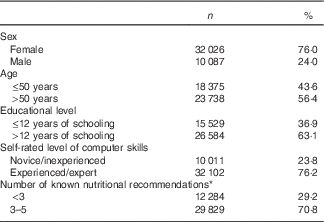
* Official recommendations of the French National Nutrition and Health Program: fruits and vegetables: at least 5 servings/d; starchy foods: at each meal (i.e. 3–4 servings/d); dairy products: 3–4 servings/d; meat, fish and eggs: 1–2 servings/d; seafood: at least twice a week.
Results regarding specific usage of the Internet for health and nutrition purposes and the correlates are presented in Table 2. A large proportion of subjects used the Internet to search for health and/or nutrition information (85·1 %). This proportion was higher in women (OR 1·55; 95 % CI 1·46, 1·65), in older subjects (OR 1·42; 95 % CI 1·34, 1·50) and in those with lower educational level (OR 1·14; 95 % CI 1·08, 1·2), and the proportion was lower in participants with lower computer skills (OR 0·79; 95 % CI 0·74, 0·84) and in those with lower nutritional knowledge (OR 0·83; 95 % CI 0·78, 0·88).
Multivariate associations between health- and nutrition-related use of the Internet and sex, age, education, self-evaluated computer skills and knowledge of nutritional recommendations, NutriNet-Santé study, France, 2013 (Numbers, percentages, odds ratios and 95 % confidence intervals; n 42 113)Footnote *

HCP, healthcare professional.
* From unconditional logistic regression models adjusted for sex, age, educational level, self-rated level of computer skills and knowledge of nutritional recommendations.
† Official recommendations from the French National Nutrition and Health Program (PNNS). (five recommendations assessed).
‡ Only completed by participants who answered ‘yes’ to at least one of the questions, no. 1, 2, 3 or 4 (n 36 988).
About a quarter of the study population (23·6 %) used the Internet to read or post messages on health/nutrition forums. This proportion was higher in women (OR 1·18; 95 % CI 1·12, 1·25) and in subjects with lower educational level (OR 1·08; 95 % CI 1·02, 1·12), whereas the proportion was lower in older subjects (OR 0·82; 95 % CI 0·78, 0·86) and in those with lower computer skills (OR 0·68; 95 % CI 0·64, 0·72).
About 12·0 % of the subjects used the Internet to purchase dietary supplements online, 41·5 % used the Internet to find a HCP and 9·5 % to communicate with a HCP. The use of a health/nutrition ‘coaching’ website was relatively limited (7·6 % of the subjects).
Only 16·0 % discussed the information obtained from the web with a HCP. This proportion was even lower in subjects with lower educational level (OR 0·77; 95 % CI 0·72, 0·82) and lower computer skills (OR 0·70; 95 % CI 0·65, 0·76).
The 10 most-cited health/nutrition websites are presented in Table 3. In all, 8038 names of websites were cited by 7237 participants (several responses possible per subject). By far, the most frequently cited website was Doctissimo (45·5 % of the responses), a French, non-institutional website dedicated to general health. Institutional websites only represented 12·9 % of the responses. Among the top 10 websites, the only institutional website was www.MangerBouger.fr, which is the official website of the PNNS run by the Ministry of Health. However, it only represented 1·4 % of the responses.
Top 10 of the health- and/or nutrition-related websites cited by the participants of the NutriNet-Santé study, France, 2013 (n 8038 cited websites)Footnote *

HAS, Haute Autorité de Santé; ANSES, Agence Nationale de Sécurité Sanitaire de l’Alimentation, de l’Environnement et du Travail; INPES, Institut National de Prévention et d’Education pour la Santé; AFDN, Association Française des Diététiciens Nutritionnistes; ANSM, Agence Nationale de Sécurité du Médicament et des produits de santé.
* Cited by 7237 subjects who declared a specific health/nutrition website. Several possible responses per subject.
As shown in Table 4, older subjects (OR 1·49; 95 % CI 1·28, 1·74), those with lower educational level (OR 2·08; 95 % CI 1·75, 2·50) and those with lower nutritional knowledge (OR 1·33; 95 % CI 1·12, 1·59) were more likely to cite non-institutional websites. Sex was not associated with the type (institutional v. non-institutional) of consulted websites (P=0·5).
Multivariate associations between the type of cited websites (non-institutional v. institutional) and sex, age, education, self-evaluated computer skills and knowledge of nutritional recommendations, NutriNet-Santé study, France, 2013 (n 8038 cited websites) (Numbers, percentages; odds ratios and 95 % confidence intervals)

* P value for the comparison of the proportion of institutional/non-institutional websites cited across categories of participants, by χ 2 test.
† P value from multivariate unconditional logistic regression models adjusted for sex, age, educational level, self-rated level of computer skills and knowledge of nutritional recommendations. The probability to cite non-institutional websites (rather than institutional websites) is modelled.
‡ Official recommendations from the French National Nutrition and Health Program (PNNS) (five recommendations assessed).
Discussion
In this large, population-based study, a substantial proportion of subjects declared using the Internet for health and/or nutrition purposes, with notable socio-demographic disparities. A relatively small proportion of participants discussed the information obtained from the web with a HCP. Institutional websites represented only a small proportion of the >8000 cited websites, with only one institutional website being in the top 10. It should be noted that subjects with a lower educational level were more likely to search for health/nutrition information on the Internet and to read/post messages in dedicated forums, but were less inclined to discuss that information with a HCP or to consult institutional websites.
In all, 85 % of the subjects in this study declared using the Internet to search for information on health and/or nutrition. This proportion is higher than the one reported by the 2011 survey on Internet-based health information seeking in a representative sample of the French population (46 %)( 40 ). In the USA, the corresponding proportion was 80 % in a 2010 representative survey( Reference Fox 5 ). However, in those studies, the questions only referred to health and not to health and nutrition. To our knowledge, the few studies that investigated the use of the Internet to search for nutrition information have reported a prevalence of about 43 % in the USA( Reference McCully, Don and Updegraff 13 ) and 41 % in Italy( Reference Bianco, Zucco and Nobile 16 ).
In line with previously published data in France( 2 , Reference Renahy, Parizot and Chauvin 18 , Reference Beck, Richard and Nguyen-Thanh 21 ) and abroad( Reference Chung 7 , Reference Cohen and Stussman 8 , Reference Bianco, Zucco and Nobile 16 , Reference Siliquini, Ceruti and Lovato 19 , Reference Anderson-Bill, Winett and Wojcik 41 – Reference Powell, Inglis and Ronnie 43 ), women were more likely to use the Internet for health and nutrition purposes. Results regarding age trends are more contrasted in the literature, with some studies indicating higher Internet use among older subjects( Reference Zulman, Kirch and Zheng 15 , Reference Renahy, Parizot and Chauvin 18 ), while others reported the contrary( Reference Andreassen, Bujnowska-Fedak and Chronaki 3 , Reference Ybarra and Suman 14 , Reference Wang, Viswanath and Lam 23 ). These inconsistencies could partly be explained by the fact that most studies evaluated health-related Internet use overall. Indeed, in our study, the associations between nutrition/health-related Internet use and age and educational level varied according to the purpose of usage: older participants were more likely to use the Internet to purchase dietary supplements online, whereas younger subjects were more inclined to read or post messages on heath/nutrition forums. Next, educational level was correlated with higher health-related Internet use in previous studies( Reference Chung 7 , Reference Renahy, Parizot and Chauvin 18 , Reference Beck, Richard and Nguyen-Thanh 21 , Reference Takahashi, Ohura and Ishizaki 22 , Reference Lee, Hoti and Hughes 24 , Reference Anderson-Bill, Winett and Wojcik 41 ). However, our results suggest that the association between educational level and health-related Internet use may depend on the specific use. Indeed, people with lower educational level were more likely to search for health/nutrition information on the Internet and to visit health forums, but were less likely to use the Internet to communicate with or find a HCP, compared with their counterparts with a higher educational level.
Although the Internet could be strategically used to relay validated health and nutrition information to help with disease prevention( Reference Beck, Richard and Nguyen-Thanh 21 ), our study showed that institutional (official) websites only represented a small proportion (12·9 %) of all cited health/nutrition websites. The first cited institutional website was the official website of the PNNS; it only represented 1·4 % of the responses. This is worrisome because the majority of people trust the information obtained on the Internet( Reference Beck, Richard and Nguyen-Thanh 21 ), where the quality and reliability of health information of non-institutional websites may vary substantially( Reference Lawrentschuk, Abouassaly and Hackett 27 , Reference Scullard, Peacock and Davies 30 ). This was illustrated by a recent UK study, which showed that correct paediatric information was only provided by four out of ten consulted websites( Reference Scullard, Peacock and Davies 30 ).
Another important concern is the fact that people with lower educational levels and lower nutritional knowledge (i.e. potentially more vulnerable individuals when confronted with misleading information) were more likely to refer to non-institutional websites. A recent survey( Reference Feufel and Stahl 44 ) showed that skilled web users effectively filtered information according to search intentions and data sources, whereas less-skilled users were easily distracted by unrelated information.
In contrast, young adults more frequently cited institutional websites than did their older counterparts. This result is encouraging, as the young represent the new generation and as they also are the ones with increased access to the Internet( 2 ).
In France as in other countries, strategies should be implemented to develop and promote the use of reliable institutional websites via different tactics such as search marketing, digital marketing, Search Engine Optimization or social media marketing. Besides, targeting within those communication channels could contribute to address some of the socio-demographic and economic discrepancies observed in this study. In France, the National Institute for Prevention and Health Education (INPES) has provided many reliable information resources on the Internet (including social networks) during the last decade( Reference Beck, Richard and Nguyen-Thanh 21 ). Existing institutional websites should be made known, and new ones should be created, where the provided health information is clearly referenced and controlled. The use of quality labels (such as the ‘Health On the Net’ label( Reference Fox 33 )) should be generalised. This process is already in place in the USA and Australia( Reference Burns, Davenport and Durkin 45 , Reference Burns and Rapee 46 ).
In our study, only 16 % of the participants discussed health/nutrition information found on the web with a HCP. A similar proportion (17 %) was observed in Japan( Reference Takahashi, Ohura and Ishizaki 22 ), about 35( Reference Chung 7 ) and 50 %( Reference Fox 9 , Reference Seçkin 32 ) were reported in US studies and 73 % in Saudi Arabia( Reference AlGhamdi and Moussa 31 ). Renahy et al.( Reference Renahy, Parizot and Chauvin 18 ) showed that people who were more likely to search for health information on the Internet were those who would appreciate more attention from their physician and who were more inclined to think that physicians did not tell them everything about their health. AlGhamdi et al. ( Reference AlGhamdi and Moussa 31 ) showed that some of the reasons for searching for health information on the Internet were not getting enough information from the physician (59 %) and not trusting the information given by the physician (28 %).
Subjects with lower educational level and lower computer skills were even less inclined to discuss with a HCP the information obtained on the Internet. Similar results have been reported by Seçkin et al. ( Reference Seçkin 32 ) regarding educational level. Those subjects were also the ones more likely to consult non-institutional websites in our study.
Strengths of this study pertain to the use of a large population-based e-cohort and detailed information on health- and nutrition-related use of the Internet, including type of consulted websites (institutional or not) and purpose (information search, participation in web forums, use of coaching websites, etc.), and data on discussing the information found on the Internet with a HCP.
Several limitations should be acknowledged. First, caution is needed in extrapolating our results to the general French population, as the NutriNet-Santé study involved a sample of volunteers who accepted to participate in a survey on nutrition and health. As shown in Supplementary Table S1 and in previous publications( 39 , 47 ), the NutriNet-Santé study included more women and more individuals with higher educational level, as compared with national estimates. Besides, the response rate to this specific non-mandatory questionnaire was 35 %. Non-response to this questionnaire did not alter the enrolment status of the participants. Compared with non-responders for this specific questionnaire, responders were more likely to be men, older and better educated, but except for age these differences were small. As non-institutional websites are more frequently cited by subjects with lower educational level and lower nutritional knowledge, we can hypothesise that the proportion of consulted institutional websites is even lower in the French general population than the one observed in this study (which is already very low).
Second, even if participants of this observational nutrition cohort do not receive explicit nutritional advice, the link to the PNNS website (www.mangerbouger.fr) is provided on the NutriNet-Santé website. This may have artificially increased the citation of this website. However, despite this potential bias, www.mangerbouger.fr was only cited by 1·4 % of the responses in this study, and we can hypothesise that this proportion is even lower in the general population.
Third, the questions asked to the participants included nutrition and health together; thus, it was not possible to disentangle these two points in this data set.
Finally, the available data did not allow us to find out whether the subjects searched for a particular website to then search for that information there, or if they searched for health terms via a search engine and simply clicked on the result. In the first case (a priori selection of websites by the individual), the question raised pertains to consumers’ understanding of what constitutes reliable health information. In the second case (use of search engines), our results suggest that institutional websites are not being found easily by citizens in the top search results, which underlines the issue of how institutions build and market their websites.
In conclusion, this large study provided an important insight into the use of the Internet for health and/or nutrition purposes. Key findings were that institutional (official) websites with reliable and valid information constituted only a small portion of all consulted websites, and that relatively few participants discussed with their HCP the information found on the Internet. Our results also highlighted the fact that individuals who were more vulnerable regarding potentially misleading health/nutrition information (e.g. subjects with lower educational level) were more likely to use non-institutional websites and less likely to confront the information found on the Internet with a HCP. These results support the need to develop, maintain and increase awareness of user-friendly, well-referenced websites and web-based tools (e.g. Facebook pages, videos), run by public health stakeholders, in order to improve the access to high-quality health- and nutrition-related information at the population level, including individuals with low educational level and computer skills.
Acknowledgements
The authors thank Younes Esseddik, Paul Flanzy, Mohand Ait Oufella, Yasmina Chelghoum and Than Duong Van (computer scientists); Dr Nathalie Pecollo (operational coordinator); and Nathalie Arnault, Véronique Gourlet, Dr Fabien Szabo, Charlie Ménard, Laurent Bourhis and Stephen Besseau (statisticians) for their technical contribution to the NutriNet-Santé study.
P. F. was funded by a PhD grant from the Cancéropôle Ile-de-France (public funding from the Paris region). C. P. was funded by a PhD grant from the French Ministry of Research and Higher Education (no. 11/ED G/UREN/2011). The NutriNet-Santé study was supported by the following public institutions: Ministère de la Santé, Institut de Veille Sanitaire, Institut National de la Prévention et de l’Education pour la Santé, Fondation pour la Recherche Médicale, Institut National de la Santé et de la Recherche Médicale, Institut National de la Recherche Agronomique, Conservatoire National des Arts et Métiers and Université Paris 13.
Contributors P. F. and M. T. designed the study; P. F., C. P., A. S. C., M. T. and S. H. conducted the study; P. F., A. S. C. and C. P. analysed the data; P. F. led the writing; M. T. supervised the study; P. F., A. S. C., V. A. A., S. H., P. L. M., C. P. and M. T. contributed to data interpretation and revised each draft for important intellectual content; M. T. had primary responsibility for the final content. All the authors read and approved the final version of the manuscript.
The authors declare that there are no competing interests.
Supplementary material
For supplementary material/s referred to in this article, please visit http://dx.doi.org/doi:10.1017/S0007114516001355



