





1. Introduction
The ability to flexibly form and master concepts and categories enables us to give meaning to the world (Smith & Medin, Reference Smith and Medin1981). We use concepts to draw inferences about objects and people, adapting our behavior to be consistent with our expectations and knowledge (Murphy, Reference Murphy2002). Social concepts, in particular, are interesting as they lie at the border between abstract and concrete concepts (see Conca et al., Reference Conca, Borsa, Cappa and Catricalà2021; Diveica et al., Reference Diveica, Pexman and Binney2023; Pexman et al., Reference Pexman, Diveica and Binney2023), with concreteness (i.e., the extent to which a concept is related to sensory experience) being a pivotal dimension for conceptual representation (Paivio, Reference Paivio1986). Some scholars suggest both concrete and abstract concepts are themselves composed of several components varying in their degrees of abstractness (e.g., Barsalou et al., Reference Barsalou, Dutriaux and Scheepers2018; Borghi et al., Reference Borghi, Barca, Binkofski, Castelfranchi, Pezzulo and Tummolini2019), any of which may differ depending on the context in which they are retrieved (e.g., Borghi, Reference Borghi2022; Kiefer & Harpaintner, Reference Kiefer and Harpaintner2020; Majid et al., Reference Majid, Burenhult, Stensmyr, De Valk and Hansson2018; Villani et al., Reference Villani, Lugli, Liuzza and Borghi2019; for reviews, see Conca et al., Reference Conca, Borsa, Cappa and Catricalà2021; Mazzuca et al., Reference Mazzuca, Fini, Michalland, Falcinelli, Da Rold, Tummolini and Borghi2021).
From a broader perspective, the cultural context is a critical source of variation that also impacts the way certain categories are conceptualized, and this seems to be particularly relevant for social categories. For instance, children from both politically conservative and liberal US communities believe natural categories (e.g., animals) reflect the objective structure of the world, that is, as indicating fixed groups of things, with absolute boundaries represented by perceptual features, but they differ in their beliefs about social categories (e.g., race), where cultural context affects whether these are conceptualized as more natural or conventional (Rhodes & Gelman, Reference Rhodes and Gelman2009). Indeed, cultural practices and language provide critical input for the structure of categories (Gelman & Roberts, Reference Gelman and Roberts2017; Malt & Majid, Reference Malt and Majid2013).
In this study, we explore how people in different cultures conceptualize “gender,” particularly with respect to how abstractly or concretely it is conceived. The concept of gender is of widespread relevance today, due to changing understandings of gender/sex configurations (American Psychological Association (APA), 2015), and studies investigating the relation between different gender systems and attitudes toward transgender individuals across cultures are becoming increasingly relevant (Elischberger et al., Reference Elischberger, Glazier, Hill and Verzduco-Baker2018; Monro, Reference Monro2007). Still, what counts as “gender” is a matter of public and academic debate since it encompasses both biological features (such as genitalia and hormones) and performative and psychological aspects. Moreover, addressing gender from a cross-cultural perspective can contribute to our understanding of concepts in a novel way. Currently, it is unclear whether gender should be considered mainly a concrete and “universal” concept or an abstract and culturally relative concept.
Lay theories of the ontological status of gender might be broadly distinguished into two main classes (Saguy et al., Reference Saguy, Reifen-Tagar and Joel2021). On the one hand, gender has been linked to biological sex differences that are reflected in behavioral and cognitive differences between women and men (Baron-Cohen, Reference Baron-Cohen2003; Ingalhalikar et al., Reference Ingalhalikar, Smith, Parker, Satterthwaite, Elliott, Ruparel and Verma2014). According to this perspective, gender is an “essential” category (i.e., objective, natural, and stable across time), whose members share an innate “essence” (Haslam et al., Reference Haslam, Rothschild and Ernst2000; Roberts et al., Reference Roberts, Ho, Rhodes and Gelman2017). If gender is conceptualized primarily as a concrete concept, then it could be argued that its conceptualization should be minimally affected by cultural–linguistic variability (Borghi, Reference Borghi2019; Thompson et al., Reference Thompson, Roberts and Lupyan2020). On the other hand, socio-culturalFootnote 1 theories claim that gender is “an emergent feature of social situations” (West & Zimmerman, Reference West and Zimmerman1987), rather than an innate property of individuals, and as such, its boundaries are flexibly shaped by cultures and societies (Butler, Reference Butler1990; Herdt, Reference Herdt1993; Monro, Reference Monro2007; Risman & Davis, Reference Risman and Davis2013). Arguably, then, if gender is conceptualized primarily as an abstract concept, we should observe more variation across cultures (Borghi & Mazzuca, Reference Borghi and Mazzuca2023).
Here, we test whether the conceptual representation of gender varies across three different cultural and linguistic communities – Italian, Dutch, and Anglo (English speaking) – in three studies using different tasks: a semantic fluency task, typicality ratings, and a questionnaire assessing people’s explicit beliefs about gender. We ask whether the conceptual representation of gender varies according to specific cultural and linguistic experiences – as suggested by social constructionist proposals – or alternatively whether there is a shared conceptualization of gender across cultures.
1.1. The cultural treatment of gender across three western groups
Although the notion of culture is “volatile” and contested (Hirschfeld, Reference Hirschfeld2018; Swidler, Reference Swidler1986), here, we rely on specific socio-cultural indices concerning gender-related issues to identify our three communities of interest.
The latest Global Acceptance Index (Flores, Reference Flores2021) – which measures social acceptance of LGBT people – shows that the Netherlands is the second most accepting of 175 countries (number one is Iceland). Similarly, countries in the Anglosphere (i.e., United States, United Kingdom, Canada, Australia, and New Zealand)Footnote 2 are also generally positive toward LGBTQI people, ranking in the top 23 countries. Italy, on the other hand, scores lower on the Global Acceptance Index and secures the 27th place – ranked in the middle among European countries. Overall, the public opinion on gender-related issues in the Netherlands indicates greater social acceptance than Italy. For example, non-binary genders are legally recognized and appear on official documents in the Netherlands, while this is not possible in Italy. The Anglosphere countries differ among themselves in the treatment of non-binary genders: the UK legal system does not currently allow for non-binary/third gender, and as we are writing, only some US states permit this; but in Canada, Australia, and New Zealand, non-binary/third gender options are available.
In addition, there are differences in the spread and adherence to the so-called anti-gender movements or campaigns across the three socio-cultural communities (Kuhar & Paternotte, Reference Kuhar and Paternotte2017). In Italy, “anti-gender” movements mobilized big groups of protesters against the “ideology of gender” (Bernini, Reference Bernini2016), supported by right-wing populist parties and fueled by the Catholic social doctrine that prevented Italy from approving same-sex marriages until 2016 (Garbagnoli, Reference Garbagnoli, Kuhar and Paternotte2017). In the Netherlands, on the other hand, the official positions of Dutch populist parties like Partij voor de Vrijheid – the second largest party in the Netherlands at the time of data collection – emphasized the role of gender and sexual equality as a constitutive Dutch social value opposing processes of “Islamization” (Verloo, Reference Verloo2018). In this narrative, additional gender measures were not thought to be required because gender equality had already been achieved in the Netherlands. The situation in the UK and the US – i.e., countries that make the bulk of our Anglo sample – was more heterogeneous, with different social forces and actors coming into play. In the US, the Trump administration was determined to change the Title IX amendment to the Education Act, which would have defined gender as determined by biological sex, and biological sex as immutable and determined by genitalia at birth (Phipps, Reference Phipps2020), hence legally delegitimizing transgender people’s lives and experiences. These anti-transgender arguments were also embraced by some groups in the UK – although the public opinion toward transgender individuals across UK seemed to be consistently positive (McLean, Reference McLean2021).
If gender is represented as a complex social category, we hypothesized that being embedded in Italian, Dutch, or Anglo cultural context might have an effect on the conceptualization of gender. According to current cultural and social norms related to gender, Italian and Dutch participants can be considered as the most distinct groups in our sample. English-speaking participants would be somewhere in the middle of this continuum. Given the correlation between gender binarism and essentialist beliefs with transgender prejudice (Broussard & Warner, Reference Broussard and Warner2019; Saguy et al., Reference Saguy, Reifen-Tagar and Joel2021; Tebbe & Moradi, Reference Tebbe and Moradi2012), one might hypothesize that countries with lower levels of acceptance toward LGBTQI people (i.e., Italy) would conceptualize gender in more essentialist, concrete, and binary terms (e.g., referring to specific bodily referents). On the other hand, participants from more gender-inclusive countries (i.e., the Netherlands) perhaps conceptualize gender in more abstract, social, and constructivist terms (e.g., processes of socialization, performativity, cultural norms, and beliefs). On this logic, participants from the Anglosphere would be more likely to lie in the middle and represent gender as a mix of concrete, biological, and physical attributes, as well as more abstract, social, and cultural features. Alternatively, if gender is considered an essential category universally, we should observe little variation across the three groups, and participants should agree on a consistent set of features.
In line with Oyèwùmí’s (Reference Oyèwùmí1997) suggestion that “because gender is pre-eminently a cultural construct, it cannot be theorized in a cultural vacuum” (p. 21), we ask whether there are differences in the conceptualization of gender between these three cultural–linguistic communities that vary on both cultural and linguistic parameters related to gender. To test this, we adopted three different methods targeting different aspects of conceptual knowledge. In Study 1, we used a semantic fluency task to compare speakers of Italian, Dutch, and English. Data from this task are understood as a measure of psychological similarity of concepts and are often used to uncover the conceptual organization of a given domain. Study 2 focuses on Italian and Dutch participants who were asked to judge how typical biological and socio-cultural features were for “gender,” as well as how abstract or concrete those features were. Finally, in Study 3, we asked Italian and Dutch participants explicitly about their beliefs about gender, employing a validated questionnaire measuring essentialism~constructivism.
2. Study 1: semantic associations of gender for Italian, Dutch, and English
Among the methods used to test conceptual knowledge, property (or feature) generation tasks are often employed. In this task, participants are presented with a target word (a concept) and are asked to list properties or features that characterize it. This family of methods are frequently employed by cognitive psychologists and anthropologists to shed light on category structure (e.g., McRae et al., Reference McRae, Cree, Seidenberg and McNorgan2005; Wu & Barsalou, Reference Wu and Barsalou2009; for a discussion, see Chaigneau et al., Reference Chaigneau, Canessa, Barra and Lagos2018) and have been used to study a variety of concepts across cultures (e.g., Medin et al., Reference Medin, Waxman, Woodring, Ross and Winkler-Rhoades2010; van Putten et al., Reference van Putten, O’Meara, Wartmann, Yager, Villette, Mazzuca, Bieling, Burenhult, Purves and Majid2020; Vivas et al., Reference Vivas, Montefinese, Bolognesi and Vivas2020; Wnuk & Majid, Reference Wnuk and Majid2014).
Here, we asked participants to produce features related to gender (Italian: genere; Dutch: geslacht Footnote 3) in their native language. In addition, all participants completed a feature rating task and provided information about their sexual orientation (Kinsey et al., Reference Kinsey, Pomeroy and Martin1948), adherence to gender roles (Kachel et al., Reference Kachel, Steffens and Niedlich2016), interoceptive awareness (Mehling et al., Reference Mehling, Price, Daubenmier, Acree, Bartmess and Stewart2012), and other demographic and linguistic backgrounds to provide further contextualization.
2.1. Participants
A total of 201 speakers of Italian, Dutch, and English took part in the experiment. Ethical approval was provided by the Ethics Committee of the Institute of Cognitive Science and Technologies of the National Research Council of Italy (Ethical approval n. 0000315). We excluded 9.4% of participants from the study either because their nationality was other than targeted or because they did not understand the task (e.g., they produced full sentences instead of single words). Participants were recruited through social media and focused solicitation of LGBTQI participants in collaboration with LGBTQI associations. Sociodemographic information can be found in the Supplementary Materials.
2.1.1. Italian
A total of 55 native speakers of Italian were tested, excluding one participant who did not understand the task, resulting in 54 Italian participants. All participants were recruited from Italy and indicated Italian as their native language.
2.1.2. Dutch
A total of 52 native speakers of Dutch were tested, but one was excluded because they indicated Italy as their birth nation. Participants considered eligible for the study (N = 51) were participants from the Netherlands (n = 48), Belgium (n = 2), and Germany (n = 1). All participants were recruited in the Netherlands and indicated Dutch as their native language, except for one participant who indicated LimburgishFootnote 4 as a first language and Dutch as second language.
2.1.3. Anglosphere
A total of 94 speakers of English were tested. We excluded 17 participants who were not native of English-speaking countries (Germany, n = 14; China, n = 1) or whose cultural background was not Anglosphere (Ghana n = 1; India, n = 1). Participants considered eligible for the study (N = 77) were from the US (50.6%, n = 40), UK (30.2%, n = 23), Canada (11.8%, n = 9), Australia (5.2%, n = 4), and New Zealand (1%, n = 1) whose native language was English. Participants were rewarded with Amazon vouchers worth 5 euros for their participation.
The three groups differed in terms of age, F(2) = 4.43, p = .013, with Italian participants being, on average, around 5 years younger (M = 28.87; SD = 6.62; age-range = 20–59) than both Dutch (M = 33.9; SD = 12.85; age-range = 18–70), p = .033, and English participants (M = 33.72; SD = 10.28; age-range = 18–63), p = .021. There was also a difference in educational levels, $ \chi $
2(10, N = 182) = 45.62, p = .004. Although all groups were highly educated, the majority of Dutch- (62%) and English-speaking (57%) participants had postgraduate or PhD education, and the majority of Italian participants (59%) had either a bachelor or a master degree (see Supplementary Tables S2, S6, and S8 for further details).
$ \chi $
2(10, N = 182) = 45.62, p = .004. Although all groups were highly educated, the majority of Dutch- (62%) and English-speaking (57%) participants had postgraduate or PhD education, and the majority of Italian participants (59%) had either a bachelor or a master degree (see Supplementary Tables S2, S6, and S8 for further details).
2.2. Materials
The Kinsey Scale (Kinsey et al., Reference Kinsey, Pomeroy and Martin1948) is a self-report measure of sexual orientation where participants define their sexual orientation choosing one definition on a 7-point scale, ranging from “exclusively heterosexual” to “exclusively homosexual” – so not considering sexual behavior a strict dichotomy. To avoid potential discrimination of different sexual identities (cf. Galupo et al., Reference Galupo, Mitchell and Davis2018), we added to the 7-point scale an eighth point labeled “other” accompanied by a blank box that participants could fill with their response.
Gender identity was measured by asking participants to choose one self-describing label among “woman,” “man,” “transgender,” and “queer.” We added a fifth choice labeled “other” accompanied by a blank box that participants could fill with their response.
The TMF scale (Kachel et al., Reference Kachel, Steffens and Niedlich2016) is a 6-item scale constructed to measure the degree of attainment to traditional gender roles. It is structured as a bipolar, one-dimensional scale, in which participants respond to six statements with ratings ranging from 1 “totally masculine” to 7 “totally feminine,” describing their preferences and behaviors. The scale “is about how people relate or conform to social standards (how feminine/masculine do they believe themselves to be), but not about social norms appropriate for women and men (i.e., what people consider as feminine/masculine)” (Kachel et al., Reference Kachel, Steffens and Niedlich2016, p. 16).
The MAIA survey (Mehling et al., Reference Mehling, Price, Daubenmier, Acree, Bartmess and Stewart2012) is a 32-item survey covering 8 general dimensions of interoceptive awareness (e.g., the capacity to notice internal bodily states, or the connection between body sensations and emotions). Participants respond on a 6-point scale ranging from “never” to “always” to statements concerning each of the eight dimensions. Since these data are not relevant to the research questions sketched in this article, we do not discuss it further within this article.
2.3. Procedure
The study was implemented as an on-line questionnaire in Qualtrics and consisted of six parts: (1) a free-listing task, (2) a rating task, (3) the Kinsey sexual orientation scale (Kinsey et al., Reference Kinsey, Pomeroy and Martin1948), (4) the TMF scale (Kachel et al., Reference Kachel, Steffens and Niedlich2016), (5) the MAIA scale (Mehling et al., Reference Mehling, Price, Daubenmier, Acree, Bartmess and Stewart2012), and (6) demographic and linguistic questions.
In the free-listing task, participants were asked to type up to ten features they thought were related to the concept of gender in their native language (Italian genere; Dutch geslacht; English gender). They were also asked to rate on a 7-point scale ranging from “not confident at all” to “extremely confident” their confidence about the features they produced. Finally, they were asked to provide a brief explanation motivating the features they produced in the free-listing task. For space reasons, we do not report these data here.
In the rating task, participants were presented with 30 features that were most frequently associated with the concept gender by Italian participants in a previous study (Mazzuca et al., Reference Mazzuca, Majid, Lugli, Nicoletti and Borghi2020). We asked participants to indicate on a scale from 1 (“not at all related”) to 7 (“highly related”) how much they thought the features, presented in a randomized order, were related to the concept of gender. Target features were translated from Italian to English and Dutch. We presented the rating task after the free-listing task to avoid potential spill-over effects.
The last sections of the questionnaire contained the Kinsey Scale (Kinsey et al., Reference Kinsey, Pomeroy and Martin1948), Traditional Masculinity and Femininity (TMF) scale (Kachel et al., Reference Kachel, Steffens and Niedlich2016), and Multidimensional Assessment of Interoceptive Awareness (MAIA) (Mehling et al., Reference Mehling, Price, Daubenmier, Acree, Bartmess and Stewart2012). Finally, participants provided demographic information such as education level and linguistic background.
2.4. Data analysis
All data were analyzed using R (version 3.6.2, R-Core Team, 2019) and RStudio (version 1.2.1335, RStudio Team, 2018). Data processing was also carried out using “tidyverse” (Wickham et al., Reference Wickham, Averick, Bryan, Chang, McGowan, François, Grolemund, Hayes, Henry, Hester and Kuhn2019) and “dplyr” (Wickham et al., Reference Wickham, François, Henry and Müller2020), and data visualization was implemented using “ggplot2” (Wickham, Reference Wickham2016) and “ggpubr” (Kassambara, Reference Kassambara2020).
We analyzed the free-listing data from each group first by computing the Cognitive Salience Index for the most frequently produced associates to “gender” (see Table 1). Cognitive salience is an index combining two critical parameters in free-listing data, that is, frequency and item position. The index ranges from 0 to 1, where items with higher scores are deemed as more cognitively salient for a given concept, and is calculated as follows: F/(N × mP) (Sutrop, Reference Sutrop2001; van Putten et al., Reference van Putten, O’Meara, Wartmann, Yager, Villette, Mazzuca, Bieling, Burenhult, Purves and Majid2020), where F is frequency, N is the total sample of participants, and mP is the mean position of the item (see Vivas et al., Reference Vivas, Montefinese, Bolognesi and Vivas2020 for similar semantic measures).
Features of “gender” produced by at least 10% of participants in each culture ordered by frequency and the corresponding cognitive salience index (rounded)
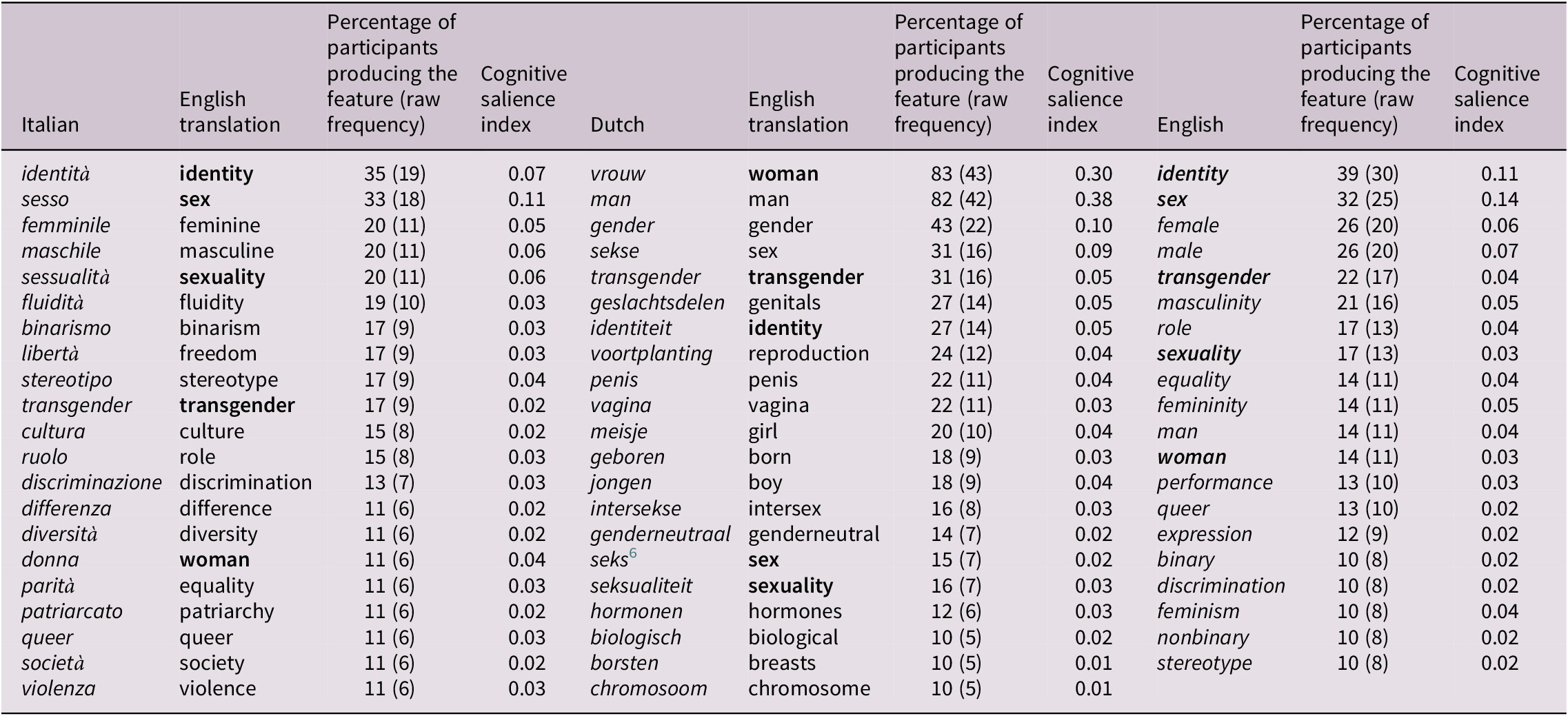
Note: Terms produced by all three groups are in bold.
To explore the structure of the concept of “gender” in more detail, we computed feature dissimilarity matrices for each group relying on a measure developed by Crowe and Prescott (Reference Crowe and Prescott2003) that takes into account both within- and between-participant distances between features and used these as input for hierarchical cluster analysis (HCA). Specifically, the measure is composed by two component measures, that is, $ \alpha $
and
$ \alpha $
and $ \beta $
w, the former accounting for within-list proximity and the latter accounting for across-list word co-occurrence. The two measures are then combined to obtain a metric of overall inter-item similarity (
$ \beta $
w, the former accounting for within-list proximity and the latter accounting for across-list word co-occurrence. The two measures are then combined to obtain a metric of overall inter-item similarity ( $ \alpha \beta $
w; see also Mazzuca et al., Reference Mazzuca, Majid, Lugli, Nicoletti and Borghi2020).
$ \alpha \beta $
w; see also Mazzuca et al., Reference Mazzuca, Majid, Lugli, Nicoletti and Borghi2020).
Data clusterability was assessed using Hopkins’s statistics (Lawson & Jurs, Reference Lawson and Jurs1990), with the “factoextra” R package (Kassambara & Mundt, Reference Kassambara and Mundt2019). HCA was carried out using Ward’s method, which minimizes the total within-cluster variance by merging pairs of clusters with minimum between-cluster distance at each step (Murtagh & Legendre, Reference Murtagh and Legendre2014; see also Harpaintner et al., Reference Harpaintner, Trumpp and Kiefer2018). The outcome is represented in dendrograms, obtained using the “dendextend” R package (Galili, Reference Galili2015), where features more frequently listed in succession are clustered together linked by short branches. To determine the number of clusters in each dendrogram, we relied on the most commonly used indices (Silhouette, Dunn, C-Index, and McClain) using the “NbClust” R package (Charrad et al., Reference Charrad, Ghazzali, Boiteau and Niknafs2014) and followed the “majority rule” where possible, or opted for indices considered to be the most reliable (Chouikhi et al., Reference Chouikhi, Charrad and Ghazzali2015). All data and scripts are available at https://osf.io/zdnhb/.
2.5. Results
Before turning to the key data about how Italian, Dutch, and English speakers conceptualize gender, we first report the group characteristics in terms of gender identity, sexual orientation, and attainment to traditional feminine and masculine social norms, as measured by the questionnaires outlined previously. The three cultural groups did not differ significantly in terms of gender identity composition, $ \chi $
2(8, N = 182) = 14.42, p = .071, sexual orientation,
$ \chi $
2(8, N = 182) = 14.42, p = .071, sexual orientation, $ \chi $
2(14, N = 182) = 17.88, p = .212 (Kinsey et al., Reference Kinsey, Pomeroy and Martin1948), or scores of TMF, F(2, 176) = 0.189, p = 0.827 (see Supplementary material S1 for further details).
$ \chi $
2(14, N = 182) = 17.88, p = .212 (Kinsey et al., Reference Kinsey, Pomeroy and Martin1948), or scores of TMF, F(2, 176) = 0.189, p = 0.827 (see Supplementary material S1 for further details).
2.5.1. The concept of “gender” across cultures
Overall, Italian participants (n = 54) produced a total of 254 features, Dutch participants (n = 51) produced 181 features, and English-speaking participants (n = 77) produced 276 features. After completing the free-listing task, we also asked participants from all three groups to rate on 7-point scale their level of confidence about the features they listed (1 = “not confident at all”; 7 = “extremely confident”). Italian (M = 5.05; SD = 1.32), Dutch (M = 5.11; SD = 1.54), and English (M = 5.63; SD = 1.17) participants were all moderately confident about the features they produced, with no differences across groups, F(2, 176) = 2.31, p = .101.
Within groups, there was, in fact, low coherence in the features produced, that is, 69% (n = 177) of features were produced only once by one individual for Italian, 63% (n = 115) for Dutch, and 59% (n = 163) for English (see Table 1). This heterogeneity suggests gender is composed of multiple, different, and sometimes idiosyncratic components.
There was a little overlap in the features produced for “gender” in Italian, Dutch, and English. Only 5 features (identity, sex, sexuality, transgender, and woman) were produced by at least 10% of participants across all three groups. Dutch participants showed most unanimity within group such that woman and man were produced by more than 80% of participants, whereas in Italian and English, the two most frequently produced features – identity and sex – were only produced by ~30% of participants. Table 1 also indicates Dutch participants mainly focused on physical and biological features (e.g., genitals, penis, vagina, and breasts), whereas Italian and English-speaking participants produced features more related to political and social aspects (e.g., discrimination, equality, and stereotype).
For illustrative purposes, we focus on the top five cognitively salient features of each group. Sex and identity were the most salient features for Italian participants (0.11 and 0.07, respectively), followed by masculine, sexuality (0.06), and feminine (0.05). For the Dutch sample instead, the two top salient associates were woman (0.30) and man (0.38), followed by gender (0.10), sekse (0.09), and genitals (0.05). Finally, for the English-speaking sample, we found the top two salient features were sex (0.14) and identity (0.11) – similarly to Italian – followed by male (0.07), female (0.06), and masculinity (0.05). It is interesting to note that although many of the most cognitively salient features for each culture rest on the opposition between femininity and masculinity (feminine and masculine, woman and man, female and male), Dutch participants distinctively underline the biological component of gender (genitals).
We found there were good clusterability tendencies in our data (Italian H = 0.54; Dutch H = 0.63; English H = 0.60). We performed hierarchical cluster analyses on each group’s data. For the Italian dendrogram, we opted for a five-cluster solution (SI = 0.40; Dunn = 0.13), while for the Dutch and the English dendrograms, we adopted a six-cluster solution (Dutch: SI = 0.41; English: Dunn = 0.21; SI = 0.45) as these best fit the data.
We give a qualitative interpretation of the associations emerging from the cluster analyses referring to a coding scheme implemented in Schudson et al. (Reference Schudson, Beischel and van Anders2019). The authors coded the content of participants’ definitions of gender/sex-related terms into socio-cultural content (e.g., identity, roles, social power, behaviors, physical presentation, and traits), biological content (e.g., genitals, gonads, hormones, chromosomes, reproduction, body, and other sex characteristics), and content whose origin is both socio-cultural and biological (see Schudson et al., Reference Schudson, Beischel and van Anders2019, p. 5).
From left to right of the Italian dendrogram (Fig. 1), Cluster 1 (fluidity, freedom, violence) and Cluster 2 (equality, sex, patriarchy, binarism, discrimination) cover socio-cultural features, including emotionally laden features, referring both to negative and positive experiences (discrimination, violence, freedom) and social constructs (patriarchy, binarism, equality). Cluster 3 (queer, feminine, masculine, culture, and transgender) included mainly socio-cultural aspects of gender presentation and features challenging strict bigenderist conceptions (Gilbert, Reference Gilbert2009); Cluster 4 (identity, woman, role, and stereotype) and Cluster 5 (difference to society) included both socio-cultural features and miscellaneous content (sexuality, difference), suggesting a close relationship between gender and society.
The concept of “gender” in Italian, Dutch, and English. Dendrograms depict (translated) features produced by at least 10% of participants for each cultural–linguistic group.
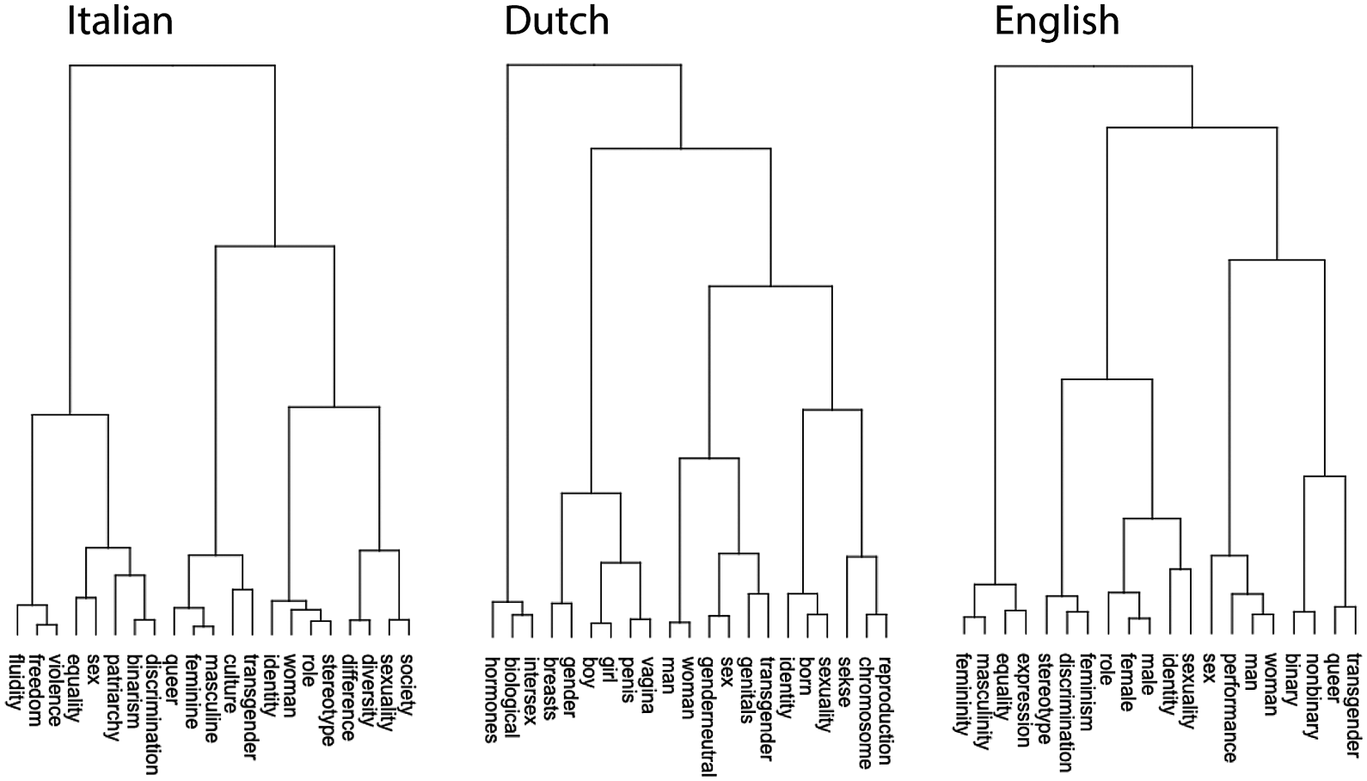
Notably the feature man did not appear here or elsewhere in the dendrogram. In Italian mainstream discussions, the term genere (gender) is often employed to refer to phenomena involving women (e.g., violenza di genere and “gender-based violence”), in keeping with Hegarty and Bruckmüller’s (Reference Hegarty and Bruckmüller2013) proposal that asymmetric explanations of group differences often focus on lower status groups (a notion related both to Foucault’s, Reference Foucault1978 idea of “disciplinary power” and “androcentrism,” Bailey et al., Reference Bailey, LaFrance and Dovidio2019). Overall, the concept of “gender” in Italian makes salient political features and emphasizes the social and cultural context (society, difference, culture, violence, patriarchy), as well as their consequences on personal experience (discrimination, freedom).
In the Dutch dendrogram, from left to right, Cluster 1 was the most explicitly biological cluster, including hormones, biological, and intersex. Cluster 2 (from breasts to vagina) is composed of miscellaneous associations, pointing to exterior gender presentation, such as boy and girl paired with sexual organs (penis and vagina), linked further to gender and breasts. Cluster 3 contained socio-cultural identities, that is, woman and man (see Schudson et al., Reference Schudson, Beischel and van Anders2019). Cluster 4 (gender-neutral to transgender) and Cluster 5 (identity, born, sexuality) presented heterogeneous features related to both social discourses concerning different gender identities (e.g., gender-neutral), and perceptual-biological features (genitals and sex). Finally, Cluster 6 centered around sekse and included reproduction and chromosome, marking the biological domain of gender/sex. Overall, the Dutch dendrogram revealed embodied aspects of gender/sex, stressing biological, physical, and perceptual features, but also including features diverging from a binary conception of gender/sex (transgender, gender-neutral, intersex).
In the English dendrogram, from left to right, Clusters 1 (femininity to expression) and 2 (stereotype to feminism) were predominantly socio-cultural, related to societal impacts of gender-related features and gendered expressions. Cluster 3 was a heterogeneous cluster, including biological (male, female), socio-cultural (role, identity), and miscellaneous features (sexuality). Cluster 4 could also be interpreted in socio-cultural terms as it had features related to social gender identities and their construction (woman, man, performance) connected to sex in the overarching cluster. Clusters 5 and 6 included features referring to and challenging a binary perspective on gender (binary, nonbinary, queer, transgender). Overall, the English dendrogram aligns well with the notion of gender/sex (Fausto-Sterling, Reference Fausto-Sterling2019; van Anders, Reference van Anders2015), according to which both biological~physical (male, female, sexuality) and socio-cultural (feminism, discrimination, performance, stereotype) factors were entrenched.
To summarize briefly, the cluster analyses of the free-listing data show differences in how people from different cultures conceptualize gender, consistent with social constructivist perspectives. However, contrary to our initial predictions, Italians were not more focused on biological features and Dutch on social features. The data suggest the opposite pattern; we return to this later.
2.5.2. Ratings of gender-related features
After listing features, participants from all groups rated how well another standardized set of features related to gender (see Supplementary material S4). Ratings across the three groups were positively correlated: Italian and Dutch ratings were least similar, r(28) = 0.63, p < .001, R 2 = .40, English and Dutch ratings were most similar, r(28) = 0.78, p < .001, R 2 = .60, leaving Italian and English ratings intermediate, r(28) = 0.69, p < .001, R 2 = .47. A visual inspection of the data (Fig. 2) indicates some features in particular differed across groups (see Supplementary material).
Scatterplot of ratings of gender relatedness in Italian, Dutch, and English.
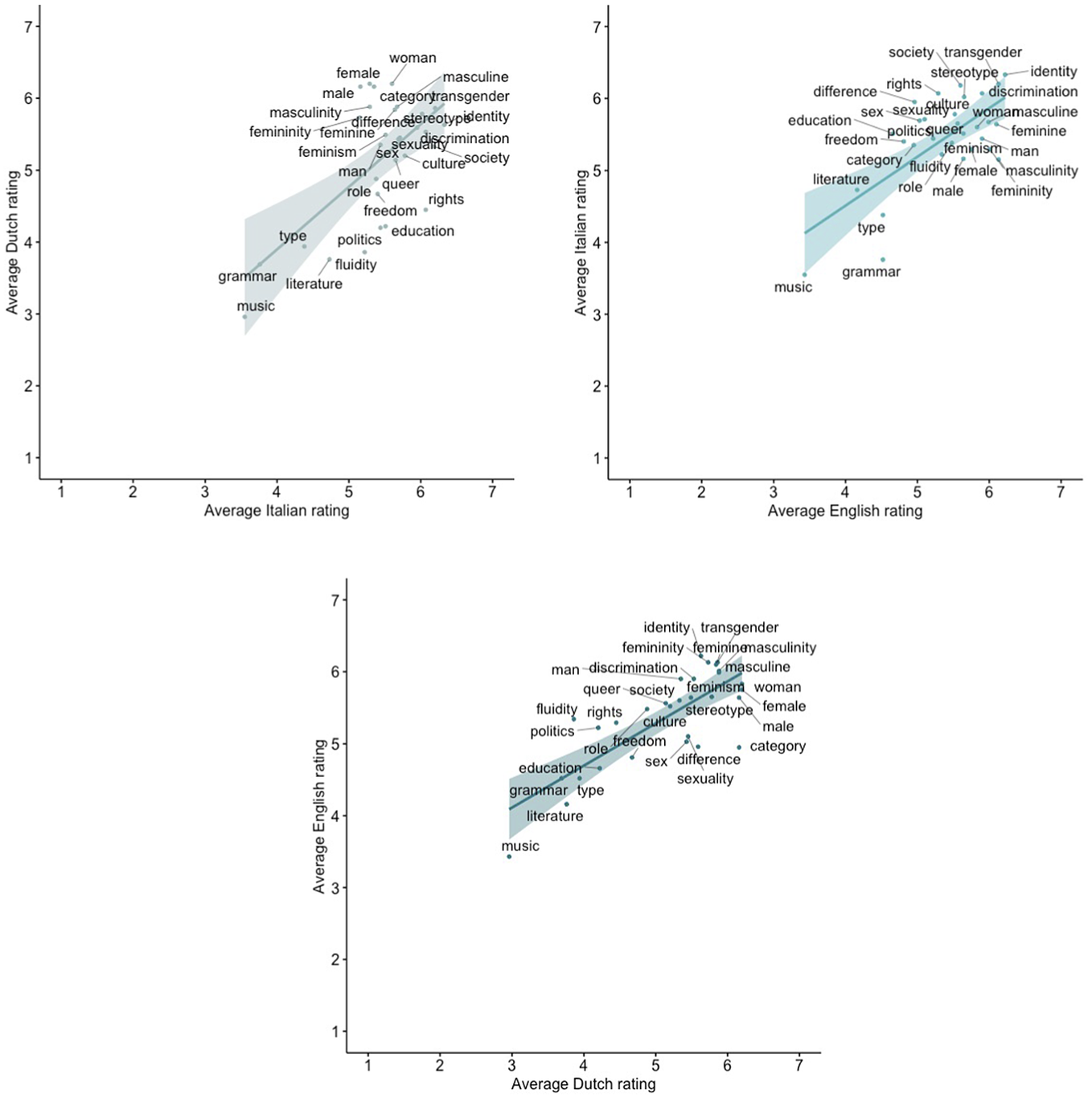
To summarize, the explicit rating data seem to recapitulate the qualitative patterns we found in the cluster analyses of the free-listing data in §2.5.1. Overall, it seems Italian participants rated socio-cultural features as more related to gender than Dutch participants, who instead rated features related to the physical sphere as more related to gender than Italian participants.
2.6. Discussion
Study 1 showed that “gender” is not conceptualized the same way across Italian, Dutch, and English participants. In the free-listing task, Italian participants mainly produced socio-cultural features (fluidity, binarism, freedom), whereas Dutch participants produced more biological features (reproduction, penis, vagina), with English-speaking participants lying in the middle. These results were also evident in the rating task.
Taken together, the data suggest there are cross-cultural differences in how people conceptualize gender, consistent with socio-cultural proposals. However, the content of the conceptual features in Italian and Dutch responses was surprising. Based on national survey data, we had predicted Italians would be more essentialist in their responses and draw more on biological features of gender, while the Dutch would be more oriented toward social features. We found the opposite pattern. To establish whether this was a stable finding, in Study 2, we sought to replicate and extend this work by focusing on the differential weighting of socio-cultural and biological features of gender in Dutch and Italian where the differences where most stark.
3. Study 2: typicality ratings for gender of biological and sociocultural features from Italian and Dutch
In Study 2, we took features generated from the free-listing task in Study 1 and asked a new sample of Italian and Dutch participants to provide typicality ratings and abstractness ratings. Typicality ratings are widely used to identify the best, most central – and thus more similar to the prototype – examples of a given category (Malt et al., Reference Malt, Gennari, Imai, Ameel, Tsuda and Majid2008; Rosch, Reference Rosch1975). While most commonly used for concrete categories (e.g., fruits and birds), typicality-like effects were also reported for abstract concepts (Hampton, Reference Hampton1981).
Based on the results of Study 1, we predicted that typicality ratings for gender should differ in Italian and Dutch. Moreover, we predicted there would be a concomitant difference in how abstract features associated with gender are deemed to be across groups. Specifically, we predicted a difference in the relation between typicality judgements and abstractness ratings for Italian and Dutch participants.
3.1. Participants
A new group of 55 speakers of Italian and Dutch took part in the experiment. We excluded 7.2% of participants from the study because they indicated a native language other than Italian or Dutch. A total of 25 native speakers of Italian were tested, all recruited from Italy and indicated Italian as their native language. Thirty native speakers of Dutch were tested, but four were excluded because they indicated Dutch was not their native language. Italian participants were recruited via social media and through the University of Bologna student pool; Dutch participants were recruited through the SONA system and were given course credit for participating.
The two groups did not differ in terms of age, F(1) = 0.63, p = .43, Italians, M
age = 25.44; SD
age = 3.06; age-range = 22–35, Dutch M
age = 27.23; SD
age = 10.83, age-range = 20–68, but did differ by educational level, $ \chi $
2(3, N = 51) = 23.09, p = .026. Although all were highly educated, the majority of Italian participants (92%) only had a bachelor or master degree, while the majority of Dutch participants (61%) had postgraduate/PhD-level education (see Supplementary material Supplementary material S6 for further details).
$ \chi $
2(3, N = 51) = 23.09, p = .026. Although all were highly educated, the majority of Italian participants (92%) only had a bachelor or master degree, while the majority of Dutch participants (61%) had postgraduate/PhD-level education (see Supplementary material Supplementary material S6 for further details).
3.2. Materials
Gender identity and sexual orientation were measured as in Study 1 (see §2.2). Stimuli for the typicality rating task and abstractness rating tasks were selected from the list of features produced by participants in the free-listing task in Study 1. Specifically, we selected the top 10 socio-cultural features produced by Italian participants (identity, feminine, masculine, fluidity, binarism, freedom, stereotype, culture, role, and discrimination) and the top 10 biological features produced by Dutch participants (genitals, reproduction, penis, vagina, born, intersex, hormones, biological, breasts, and sex).
3.3. Procedure
The study was implemented as an on-line questionnaire in Qualtrics and consisted of three parts: (1) typicality rating task, (2) abstractness rating task, and (3) demographic and linguistic questions, including the Kinsey sexual orientation scale (Kinsey et al., Reference Kinsey, Pomeroy and Martin1948). In the typicality rating task, participants were presented with the twenty features in a randomized order and asked to rate on a 7-point scale how much these features were typical for the concept of gender, in their native language (1 = “not at all typical”; 7 = “extremely typical”).
In the abstractness rating task, participants were presented with the same features and were asked to indicate on a scale from 1 (“extremely concrete”) to 7 (“extremely abstract”) how much they thought the features, presented in a randomized order, were concrete or abstract. In the final section of the study, participants completed the Kinsey Scale measuring sexual orientation (Kinsey et al., Reference Kinsey, Pomeroy and Martin1948) and answered questions about their demographic background.
3.4. Data analysis
Typicality data were analyzed using a linear mixed-effects model (Baayen et al., Reference Baayen, Davidson and Bates2008; Winter, Reference Winter2020) fit by maximum likelihood to assess the impact of Culture (Italian, Dutch), Features (Sociocultural, Biological), and their interaction on ratings of “gender typicality,” with random intercepts for Participants and Items. Statistical significance of fixed effects was determined using the type III ANOVA test with the “mixed” function from the “afex” R package (Singmann et al., Reference Singmann, Bolker, Westfall, Aust and Ben-Shachar2023); p-values were calculated with likelihood ratio tests comparing the model including the interaction term to models varying for the complexity of fixed effects. Post-hoc comparisons were performed with the “emmeans” R package (Lenth, Reference Lenth2020) and Tukey correction for multiple comparisons.
To assess whether Italian and Dutch participants also differ in how abstractly they construe “gender,” we fit a linear mixed-effects model testing the impact of Abstractness ratings, Culture (Italian, Dutch), and their interaction on ratings of gender typicality, with random intercepts for Participants and Items. Abstractness ratings were entered in the model as a mean-centered continuous predictor.
3.5. Results
The two groups did not differ significantly in terms of gender identity composition, $ \chi $
2(2, N = 51) = 3.89, p = .142, or sexual orientation,
$ \chi $
2(2, N = 51) = 3.89, p = .142, or sexual orientation, $ \chi $
2(6, N = 51) = 11.55, p = .072.
$ \chi $
2(6, N = 51) = 11.55, p = .072.
3.5.1. Typicality ratings for gender-related features in Italian and Dutch
We predicted that Italian and Dutch participants would vary in their typicality ratings such that Italians would rate socio-cultural features as more prototypical for “gender,” whereas Dutch participants would rate biological features are more prototypical.
There was a main effect of Culture $ \chi $
2(1) = 3.98, p = .04, but no main effect of Features,
$ \chi $
2(1) = 3.98, p = .04, but no main effect of Features, $ \chi $
2(1) = .02, p = .90, on typicality ratings. Critically, there was a significant interaction between Culture and Features,
$ \chi $
2(1) = .02, p = .90, on typicality ratings. Critically, there was a significant interaction between Culture and Features, $ \chi $
2(1) = 49.97, p < .0001. Post-hoc comparisons revealed, as predicated, that Italian participants rated socio-cultural features as more typical of gender than Dutch participants, t(73.2) = 4.667, p < .0001. There was, instead, no significant difference in ratings of biological features between Italian and Dutch participants, t(73.2) = .979, p = .330.
$ \chi $
2(1) = 49.97, p < .0001. Post-hoc comparisons revealed, as predicated, that Italian participants rated socio-cultural features as more typical of gender than Dutch participants, t(73.2) = 4.667, p < .0001. There was, instead, no significant difference in ratings of biological features between Italian and Dutch participants, t(73.2) = .979, p = .330.
3.5.2. Relation between abstractness and typicality ratings for gender-related features in Italian and Dutch
We again found a significant effect of Culture $ \chi $
2(1) = 4.27, p = .03 on typicality ratings. Importantly, there was also an effect of Abstractness,
$ \chi $
2(1) = 4.27, p = .03 on typicality ratings. Importantly, there was also an effect of Abstractness, $ \chi $
2(1) = 9.55, p = .002 and a significant interaction between Culture and Abstractness,
$ \chi $
2(1) = 9.55, p = .002 and a significant interaction between Culture and Abstractness, $ \chi $
2(1) = 37.59, p < .001 (see Fig. 3).
$ \chi $
2(1) = 37.59, p < .001 (see Fig. 3).
Interaction of Culture (Italian and Dutch) and Abstractness in ratings of gender typicality. Shaded regions represent confidence intervals of 95% for regression slopes.

Post-hoc comparisons revealed that abstractness ratings negatively predicted typicality ratings for Dutch participants, t(786) = −6.306, p < .0001, but did not predict Italian participants typicality ratings, t(775) = 1.006, p = .314.
3.6. Discussion
Study 2 provides converging evidence that Italian and Dutch participants differ in their conceptualization of gender. In the typicality rating task, Italian participants judged socio-cultural features to be more typical of gender than Dutch participants. In addition, we found features that were rated as more abstract by Dutch participants were also deemed to be less typical of the concept of gender. Taken together with the results of Study 1, this suggests that the conceptual representation of “gender” differs across cultures.
4. Study 3: essentialist ~ constructivist beliefs about gender among Italian and Dutch participants
Both studies 1 and 2 demonstrated that Italian and Dutch participants differ in their conceptualization of “gender,” but the results seem to contradict the expectation based on previous national survey reports that Dutch participants endorse more constructivist approaches toward gender, and Italian participants more essentialist approaches. These differences could be the result of methodological differences: Studies 1 and 2 used methods taken from the concept literature to understand the underlying representation people have for “gender.” However, previous studies have relied on explicit judgements using questionnaires. So, in Study 3, we probed Italian and Dutch participants’ explicit beliefs about gender-related issues using a previously established questionnaire measuring essentialist~constructivist beliefs about gender, sex, and sexual orientation (Lloyd & Galupo, Reference Lloyd and Galupo2019). In doing so, we ask whether in their explicit beliefs, Italians are also more constructivist about gender and Dutch more essentialist, in line with Studies 1 and 2. Alternatively, in line with evidence from international reports on attitudes toward LGBTQI people (Flores, Reference Flores2021) and studies on its relation with gender essentialism (Saguy et al., Reference Saguy, Reifen-Tagar and Joel2021), we might expect Italians to be more essentialist about gender, and Dutch more constructivist.
4.1. Participants
A new group of 51 speakers of Italian and Dutch took part in the experiment. We excluded one participant from the study because they indicated a native language other than Italian. This meant a total of 25 native speakers of Italian were tested and 25 native speakers of Dutch were tested. As in Study 2, Italian participants were recruited via social media and through the University of Bologna student pool; Dutch participants were recruited through the SONA system and were given course credit for participating.
The two groups differed in terms of age, with Dutch participants being, on average, slightly younger (M = 18.92; SD = 1.49; age-range = 17–23) than Italian participants (M = 26.16; SD = 3.59; age-range 23–39), F(1) = 86.59, p = .010, and less educated, $ \chi $
2(2, N = 50) = 29.10, p = .004: the majority of Dutch participants (52%) completed high school, whereas Italian participants (92%) had a bachelor or master degree (see S8 for further details).
$ \chi $
2(2, N = 50) = 29.10, p = .004: the majority of Dutch participants (52%) completed high school, whereas Italian participants (92%) had a bachelor or master degree (see S8 for further details).
4.2. Materials
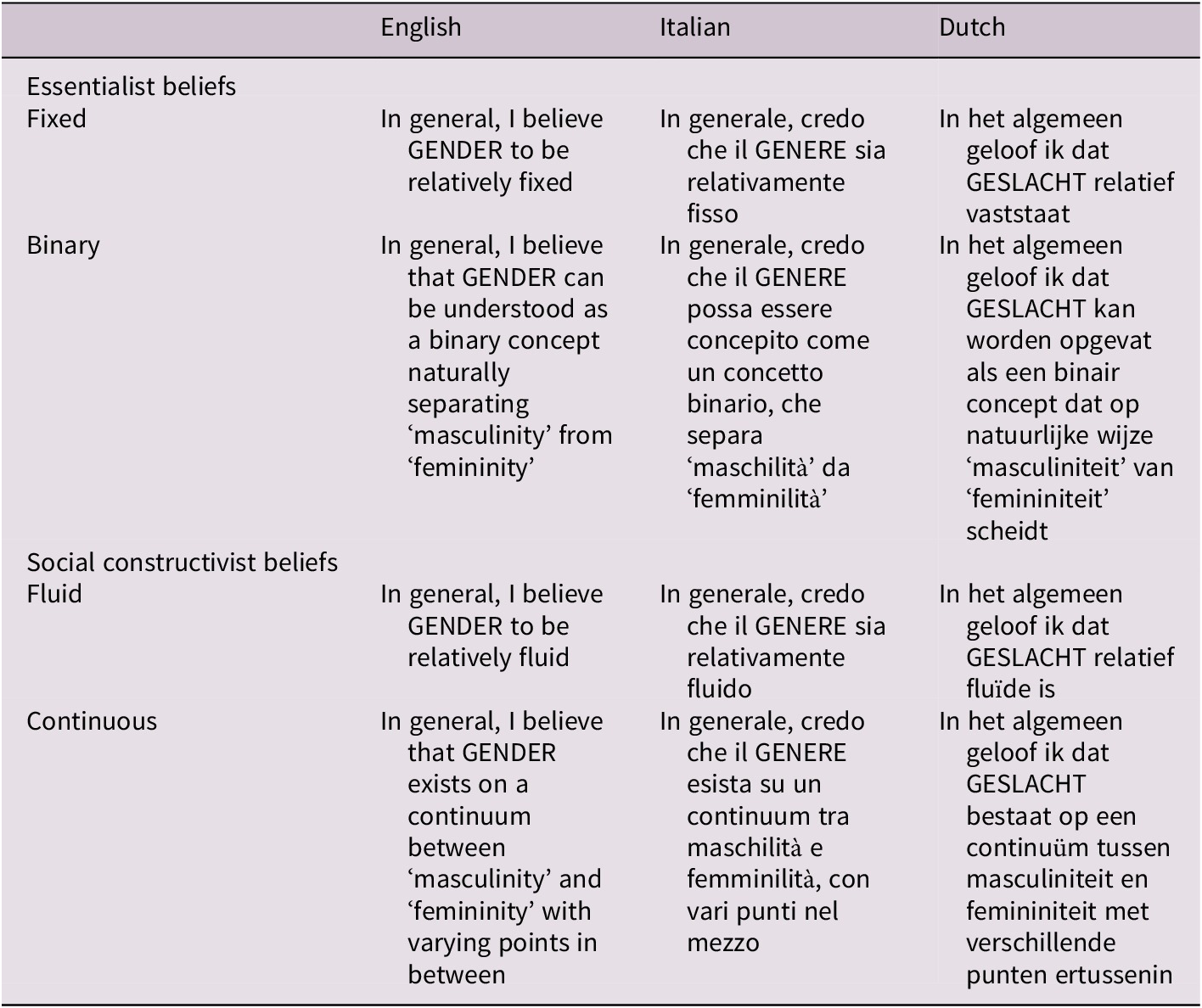
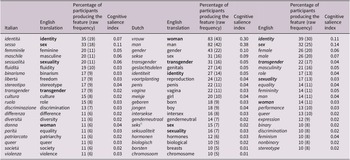
The essentialist~constructivist questionnaire by Lloyd and Galupo (Reference Lloyd and Galupo2019) was translated from the original English to Italian and Dutch by the first and the third authors, native speakers of Italian and Dutch, respectively, and back-translated to English to check the accuracy of the translation. The questionnaire measures participants’ agreement with four statements assessing essentialist~constructivist beliefs about gender, sex, and sexual orientation. Specifically, essentialist beliefs are represented by “fixed” and “binary” prompts (e.g., “In general, I believe sex to be relatively fixed”), whereas constructivist beliefs are represented by “fluid” and “continuous” prompts (e.g., “In general, I believe sex to be relatively fluid”). Table 2 reports original statements assessing essentialist and constructivist beliefs about gender along with their Italian and Dutch translations (see Supplementary material for the complete questionnaire and its translation). Participants’ gender identity and sexual orientation were assessed as in Studies 1 and 2.
Statements targeting essentialist and constructivist beliefs about gender from the Lloyd and Galupo (Reference Lloyd and Galupo2019) with their Italian and Dutch translations
4.3. Procedure
The study was implemented as an on-line questionnaire in Qualtrics and consisted of two parts: (1) essentialism~constructivism questionnaire and (2) demographic and linguistic questions, including the Kinsey sexual orientation questionnaire (Kinsey et al., Reference Kinsey, Pomeroy and Martin1948). In the essentialism~constructivism questionnaire, participants were presented with four statements about sex, gender, and sexual orientation expressing their agreement regarding fixed, binary, fluid, and continuous beliefs about each identity construct (see Lloyd & Galupo, Reference Lloyd and Galupo2019). Participants were asked to rate their agreement with each statement on a scale from 1 (“strongly disagree”) to 5 (“strongly agree”).
The last section of the questionnaire contained the Kinsey questionnaire measuring sexual orientation (Kinsey et al., Reference Kinsey, Pomeroy and Martin1948) and questions about participants’ demographic information such as education level and linguistic background.
4.4. Data analysis
To assess whether Italian and Dutch participants differed, we compared rating scores using independent t-tests.
4.5. Results
Our main interest is in possible cross-cultural differences in people’s beliefs about gender, so here, we focus on responses to gender specifically (see Supplementary material for analyses of sex and sexual orientation beliefs). Before performing our main analyses, we established that Italian and Dutch groups did not differ significantly in terms of gender identity composition, $ \chi $
2(1, N = 50) = 0, p = 1, or sexual orientation,
$ \chi $
2(1, N = 50) = 0, p = 1, or sexual orientation, $ \chi $
2(6, N = 50) = 5.966, p = .427.
$ \chi $
2(6, N = 50) = 5.966, p = .427.
4.5.1. Italian and Dutch essentialist beliefs about gender
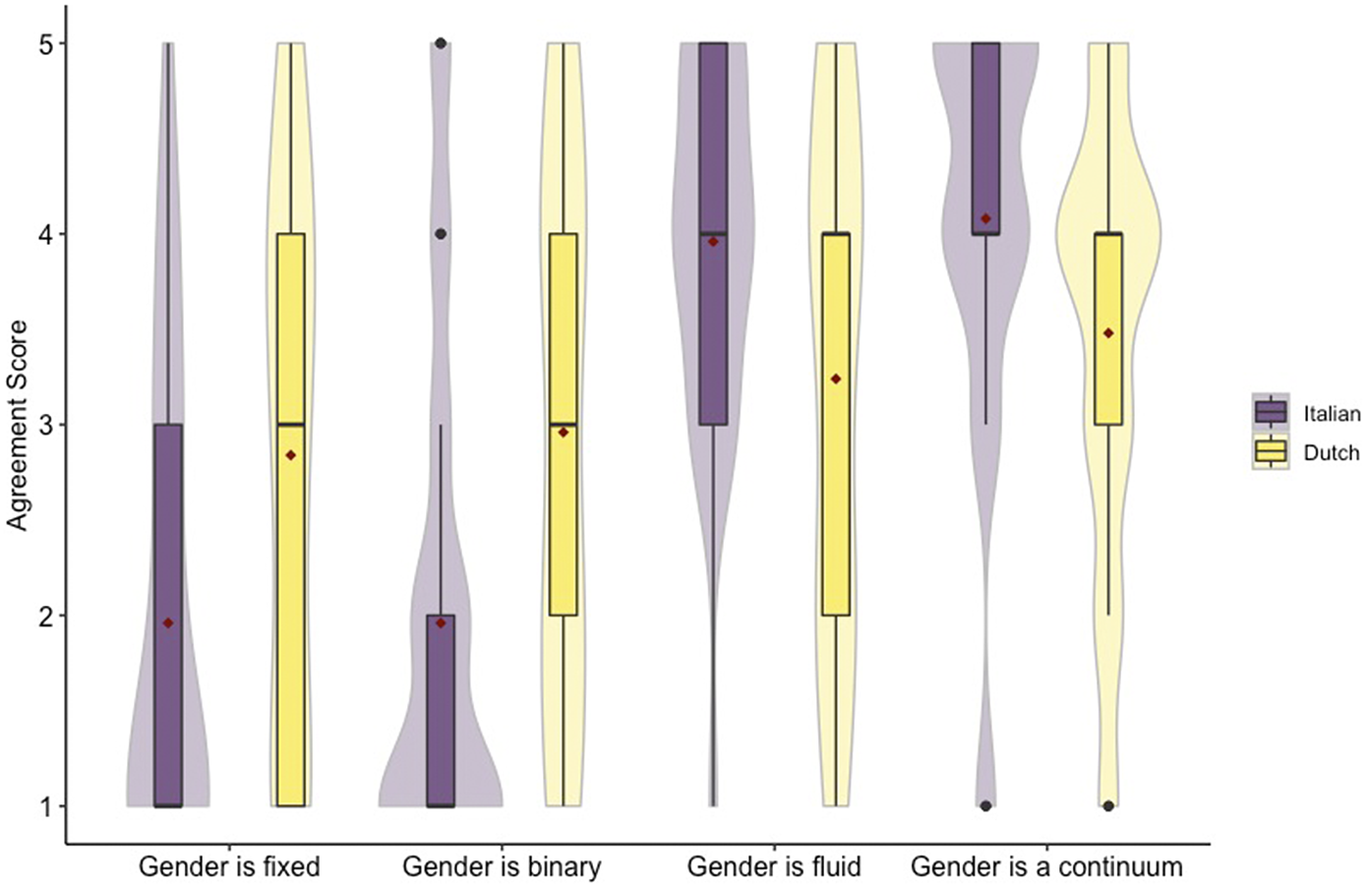
Italian and Dutch participants differed in their ratings to whether gender is fixed, t(47.34) = −2.293, p = .026, with Italians judging it as less fixed than Dutch (Italian M = 1.96; Italian SD = 1.27; Dutch M = 2.84, Dutch SD = 1.43). Similarly, they differed in how binary they considered gender to be, t(47.62) = −2.583, p = .012, with Italians judging it as less binary than Dutch (Italian M = 1.96; Italian SD = 1.31; Dutch M = 2.96, Dutch SD = 1.43). Overall, then, Dutch participants endorsed more essentialist beliefs about gender.
4.5.2. Italian and Dutch constructivist beliefs about gender
Italian and Dutch participants also differed in how fluid they considered gender to be, t(43.54) = 2.146, p = .037, with Italians judging it as more fluid than Dutch (Italian M = 3.96; Italian SD = 0.97; Dutch M = 3.24, Dutch SD = 1.36). However, there was no significant difference in how continuous the two groups considered gender to be, t(47.99) = 1.836, p = .072, although the means were in the same direction (Italian M = 4.08; SD = 1.15; Dutch M = 3.48; SD = 1.15) (see Fig. 4). Overall, there was more endorsement by Italians of constructivist beliefs about gender.
Agreement scores for statements relating to Essentialist (Fixed, Binary) and Constructivist (Fluid, Continuous) beliefs about gender for Italian and Dutch participants. Red dots represent means, black dots represent extreme values, and black bars represent medians.
4.6. Discussion
When explicitly questioned about their explicit beliefs about gender, we found Dutch participants held more essentialist beliefs than Italian participants, whereas the Italians endorsed more constructivist beliefs. Overall, these results are consistent with Studies 1 and 2, indicating Dutch participants lean more on biological, concrete, and essentialist components of gender, and Italian participants lean more on socio-cultural, abstract, and constructivist components.
5. General discussion
Across three studies, we found people from different cultures have different conceptualizations of “gender.” Study 1 showed that for the term “gender,” Italian participants found features related to social, political, and cultural spheres more salient (e.g., binarism, freedom, stereotype, discrimination, and patriarchy), whereas Dutch participants were more likely to report features referring to the embodied and physical spheres (e.g., genitals, reproduction, penis, vagina, and hormones). English participants displayed more heterogeneous associations, including bodily and biological components (e.g., sex, female, and male) as well as social and cultural features (e.g., discrimination, equality, feminism). Similarly, Study 2 found Italian participants judge socio-cultural features to be more typical of the concept “gender” than Dutch participants. Finally, Study 3, which probed people’s explicit beliefs, confirmed the same distinction: whereas Italians are more constructivists about gender, the Dutch are more essentialist.
Italian, Dutch, and English representations of “gender” varied, but in an unexpected direction. According to some studies, prejudicial attitudes toward transgender people are correlated with gender binary beliefs (Broussard & Warner, Reference Broussard and Warner2019; Tebbe & Moradi, Reference Tebbe and Moradi2012) and essentialist beliefs (Saguy et al., Reference Saguy, Reifen-Tagar and Joel2021). So, we expected Dutch participants would rely more on features related to social and cultural aspects of gender (based on gender equality and LGBTQI acceptance indices, see §1.1), and Italian participants would rely on associations related to physical and biological aspects. We found the opposite pattern when we probed people’s concept of “gender” using tasks from the concept formation literature in Studies 1 and 2 and explicit questionnaires targeting essentialist~constructivist beliefs in Study 3.
In Italy, gender-related issues are often the purview of political struggles (Arfini et al., Reference Arfini, Ghigi and Magaraggia2020; Garbagnoli, Reference Garbagnoli, Kuhar and Paternotte2017), and this may have affected the associations of Italian speakers, making certain features related to political debate more salient (see Rabb et al., Reference Rabb, Fernbach and Sloman2019; Shea, Reference Shea2018). The situation in the Netherlands is different, given the broader consensus regarding an inclusionary approach toward LGBTQI rights. In this context, terms that were previously used only in restricted communities (e.g., political activism, and academia) such as binarism, patriarchy, and performance might become more commonly used. This points to the importance of keeping in mind the historical and cultural embeddedness of concepts such as “gender” – embodied social concepts evolve as society changes.
Our results add a new perspective to the literature on the encoding of grammatical gender and its impact on society (Gygax et al., Reference Gygax, Zufferey, Elmiger, Garnham, Sczesny and von Stockhausen2019). Countries with gendered languages (e.g., Italian),or with languages combining natural and grammatical gender (e.g., perhaps surprisingly, Dutch) exhibit lower levels of gender equality than countries with natural gender languages (e.g., English) or genderless languages (e.g., Estonian; Prewitt-Freilino et al., Reference Prewitt-Freilino, Caswell and Laakso2012; see also Pérez & Tavits, Reference Pérez and Tavits2019). Indeed, according to Ansara and Hegarty (Reference Ansara and Hegarty2014), most gendered languages imply binary distinctions or implicitly convey forms of androcentric thinking (Bailey et al., Reference Bailey, LaFrance and Dovidio2019; Bem, Reference Bem1993) – for instance, through the use of masculine generics (Misersky et al., Reference Misersky, Majid and Snijders2019; Stahlberg et al., Reference Stahlberg, Braun, Irmen, Sczesny and Fiedle2007). This has been recently challenged in some countries by the introduction of linguistic strategies such as the promotion of inclusive language. In Sweden, for example, the gender-inclusive pronoun hen can be used both as a generic pronoun and to refer specifically to non-binary gender identities (Renström et al., Reference Renström, Lindqvist and Sendén2022). Recent evidence shows that using gender-inclusive or gender-neutral pronouns favors tolerance for marginalized gender/sex groups and reduces patterns of androcentrism (Tavits & Pérez, Reference Tavits and Pérez2019). Our study shows that even the notion of “gender” itself, encoded as a lexical item, can impact conceptualizations.
We also found the concept of gender varied in how abstractly or concretely it was conceptualized across groups. Study 2 probed abstractness directly by collecting new ratings for the same set of socio-cultural and biological features related to gender in Italian and Dutch. Abstract features were judged as less typical of “gender” in Dutch than in Italian (see also Supplementary material). These findings are in line with recent perspectives on abstract knowledge that suggest that abstract or concrete aspects of a given concept might be more salient depending on specific situations and cultural contexts (Barsalou et al., Reference Barsalou, Dutriaux and Scheepers2018; Borghi et al., Reference Borghi, Barca, Binkofski, Castelfranchi, Pezzulo and Tummolini2019; Majid et al., Reference Majid, Burenhult, Stensmyr, De Valk and Hansson2018). In addition, these results align well with recent proposals suggesting the saliency of more abstract components of a concept in a given socio-cultural setting might also be considered as a proxy for the concept’s degree of politicization (Mazzuca & Santarelli, Reference Mazzuca and Santarelli2022). According to this approach, because abstractness implies partial indetermination and vagueness, it allows for the contestation, negotiation, and redefinition of a concept – that is, for key aspects of politicization.
More broadly, our results are in line with contemporary understandings of gender – or gender/sexFootnote 5 – which consider it to be both biologically and socially constructed (e.g., Fausto-Sterling, Reference Fausto-Sterling2019; Hyde et al., Reference Hyde, Bigler, Joel, Tate and van Anders2019; van Anders, Reference van Anders2015). In this perspective, gender can be considered an embodied social concept, in which both concrete, physical, and biological factors (i.e., referring to a specific bodily referent; e.g., chromosomes, hormones, and genitalia), and more abstract, social, and cultural factors (i.e., features spanned over different situations, e.g., processes of socialization, performativity, and cultural norms and beliefs; see Davis et al., Reference Davis, Altmann and Yee2020; McRae et al., Reference McRae, Nedjadrasul, Pau, Lo and King2018; Wiemer‐Hastings & Xu, Reference Wiemer‐Hastings and Xu2005) are relevant. Our work shows that although both sorts of features are important, they may be weighted differently in one culture than another.
5.1. Future studies and limitations
It is perhaps worth mentioning that intrinsic semantic differences of the targeted terms (genere, geslacht, and gender) might account, to some extent, for the differences we found. In Italian, the translation equivalents for the English terms sex (sesso) and gender (genere) are frequently used interchangeably. In Dutch, the indigenous term for gender is geslacht, although in more recent times, the loan from English gender is also found in popular discourse. Here, we focused on geslacht. Geslacht and sekse are used interchangeably to describe both social differences and sexual differences derived from biology (Vonk, Reference Vonk, Braidotti, Vonk and van Wichelen2012, p. 79). Although the data from our translation survey suggest geslacht could be confidently used as a translation equivalent for the English word gender, they also underline the fact that Dutch has evolved, borrowing the English form and incorporating it into common discourses – similarly to Italian, where, on the other hand, it appears the English form has a connotation that is often considered derogative (Bernini, Reference Bernini2016; Garbagnoli, Reference Garbagnoli, Kuhar and Paternotte2017). Future studies might assess whether the differences we found hold across different terms, for example, when presenting Italian and Dutch participants with English forms. These different sense systems in each language may have contributed to some of the differences we uncovered.
Nevertheless, given that language is a primary vehicle for discussions about gender in everyday talk and policy-making, these results provide evidence that even in closely related Western cultures with strong historical and geographic ties, there can be striking differences in how gender is conceptualized.
Finally, caution is needed in the scope of conclusions. Our results might not be generalizable to the entire Italian and Dutch populations as the studies reported here targeted young adults primarily. Whether the results hold across cohorts, especially over older generations who may have a more conservative conception of gender-related issues, is still an open question (see e.g., Baiocco et al., Reference Baiocco, Nardelli, Pezzuti and Lingiardi2013).
6. Conclusions
Overall, our results show that gender is conceptualized differently across cultures. Indeed, some anthropologists and sociologists have urged caution in applying the same conceptual categories of gender/sex across diverse cultural and social settings as this leads to oversimplifications (Hegarty et al., Reference Hegarty, Ansara, Barker, Dess, Marecek and Bell2018; Morris, Reference Morris1995). As Oyèwùmí (Reference Oyèwùmí1997) puts it, “I argue that concepts and theoretical formulations are culture-bound and that scholars themselves are not merely recorders or observers in the research process; they are also participants. […] by writing about any society through a gendered perspective, scholars necessarily write gender into that society. Gender, like beauty, is often in the eye of the beholder.” (p. xv). While investigating gender conceptualizations from a non-WEIRD perspective (Henrich et al., Reference Henrich, Heine and Norenzayan2010; Muthukrishna et al., Reference Muthukrishna, Bell, Henrich, Curtin, Gedranovich, McInerney and Thue2020) and across speakers of different languages (Blasi et al., Reference Blasi, Henrich, Adamou, Kemmerer and Majid2022) is important to pursue in future investigations, our studies show that even across Western cultures and related languages, the conceptualization of gender is varied and certain aspects are more salient depending on specific cultural settings.
These findings contribute to a broader understanding of concepts that takes conceptual knowledge to be a dynamic system that is responsive to unfolding situations (e.g., Barsalou, Reference Barsalou2016; Borghi et al., Reference Borghi, Barca, Binkofski, Castelfranchi, Pezzulo and Tummolini2019), and which is modulated by a variety of factors (for a review see Yee & Thompson-Schill, Reference Yee and Thompson-Schill2016), including culture (Markus & Kitayama, Reference Markus, Kitayama, Strauss and Goethals1991; Medin et al., Reference Medin, Waxman, Woodring, Ross and Winkler-Rhoades2010; Mesquita, Reference Mesquita2022) and language (Boroditsky, Reference Boroditsky2018; Lucy, Reference Lucy2016; Majid et al., Reference Majid, Burenhult, Stensmyr, De Valk and Hansson2018).
Supplementary material
The supplementary material for this article can be found at http://doi.org/10.1017/langcog.2023.40.
Data availability statement
The data, materials, and codes for all experiments are available at https://osf.io/zdnhb/. None of the experiments was preregistered.
Acknowledgements
Thanks to Henk van den Heuvel and Erwin Komen at the Humanities Lab, Centre of Language Studies, Radboud University, for technical support, and Hasan Erkan at the Radboud University Medical Center and Ludy Cilissen at the Max Planck Institute for Psycholinguistics for their help with translations.




 Open access

