


Introduction
Members of the class Ascidiacea (aka sea squirts) are highly prolific introduced marine species (Lambert, Reference Lambert2007; Lynch et al., Reference Lynch, Darmody, O’Dwyer, Gallagher, Nolan, McAllen and Culloty2016; Yamaguchi, Reference Yamaguchi1975) and common members of the fouling community, particularly on floating substrates (e.g., docks, aquaculture gear) with limited benthic predation (Airoldi et al., Reference Airoldi, Turon, Perkol‐Finkel and Rius2015; Dumont et al., Reference Dumont, Gaymer and Thiel2011; Giachetti et al., Reference Giachetti, Battini, Castro and Schwindt2020; Glasby et al., Reference Glasby, Connell, Holloway and Hewitt2007). Ascidians are filter feeders and strong competitors for space due to their rapid growth, long reproductive periods (Casso et al., Reference Casso, Navarro, Ordóñez and Fernández-Tejedor2018; Lambert, Reference Lambert2005; Pineda et al., Reference Pineda, López-Legentil and Turon2013), and production of defensive secondary metabolites (Pisut and Pawlik, Reference Pisut and Pawlik2002; Tarjuelo et al., Reference Tarjuelo, López-Legentil, Codina and Turon2002). Ascidians are also well-known nuisances in aquaculture facilities around the world, overgrowing cages, smothering farmed animals, or dislodging them from the substrate (Bullard et al., Reference Bullard, Davis and Shumway2013; Casso et al., Reference Casso, Navarro, Ordóñez and Fernández-Tejedor2018; Rius et al., Reference Rius, Heasman and Mcquaid2011).
In the marine environment, introductions are frequently accidental via hitchhiking on ships or during aquaculture transfers (Lambert, Reference Lambert2002; Zvyagintsev et al., Reference Zvyagintsev, Sanamyan and Kashenko2007). Thus, the first challenge in managing a newly introduced marine species is discovering its arrival. Knowledge of the economic and ecological damage caused by invasive species (Pimentel et al., Reference Pimentel, Lach, Zuniga and Morrison2000, Reference Pimentel, Pimentel, Wilson and Nentwig2008) has resulted in considerable effort towards preventing their introduction and monitoring their arrival and spread. Besides regular inspections of species present in sea chests, ship and boat hulls, and aquaculture gear (Gewing and Shenkar, Reference Gewing and Shenkar2017; Pinochet et al., Reference Pinochet, Leclerc, Brante, Daguin-Thiébaut, Díaz, Tellier and Viard2017; Rosa et al., Reference Rosa, Holohan, Shumway, Bullard, Wikfors, Morton and Getchis2013), regular surveys of the fouling communities in harbors and marinas (the most common entry points for newly introduced species) should be conducted regularly (e.g., Hutchings et al., Reference Hutchings, Stiles and López-Legentil2023; López-Legentil et al., Reference López-Legentil, Legentil, Erwin and Turon2015; Moore et al., Reference Moore, Vercaemer, DiBacco, Sephton and Ma2014; Nydam et al., Reference Nydam, Stefaniak, Lambert, Counts and López-Legentil2022b; Reinhardt et al., Reference Reinhardt, Stefaniak, Hudson, Mangiafico, Gladych and Whitlatch2010; Streit et al., Reference Streit, Lambert, Erwin and López-Legentil2021). For instance, a Rapid Assessment Survey (R.A.S., Campbell et al., Reference Campbell, Gould and Hewitt2007) of fouling species in North Carolina marinas led to the discovery of the solitary ascidian Styela canopus in several marinas (Hutchings et al., Reference Hutchings, Stiles and López-Legentil2023). Similarly, the colonial ascidian Clavelina lepadifomis (native to the eastern Atlantic) was first reported in the northwest Atlantic during a survey conducted by Reinhardt et al. (Reference Reinhardt, Stefaniak, Hudson, Mangiafico, Gladych and Whitlatch2010). Increasingly, molecular tools are also being used to identify species from environmental DNA (Larson et al., Reference Larson, Graham, Achury, Coon, Daniels, Gambrell, Jonasen, King, LaRacuente, Perrin‐Stowe and Reed2020; LeBlanc et al., Reference LeBlanc, Belliveau, Watson, Coomber, Simard, DiBacco, Bernier and Gagné2020; Thomas et al., Reference Thomas, Tank, Nguyen, Ponce, Sinnesael and Goldberg2020) and to elucidate their potential origin (Dupont et al., Reference Dupont, Viard, Davis, Nishikawa and Bishop2010; López-Legentil et al., Reference López-Legentil, Turon and Planes2006; Nydam et al., Reference Nydam, Giesbrecht and Stephenson2017; Pineda et al., Reference Pineda, López-Legentil and Turon2011; Rius et al., Reference Rius, Pascual and Turon2008; Stefaniak et al., Reference Stefaniak, Zhang, Gittenberger, Smith, Holsinger, Lin and Whitlatch2012).
For the past 30 years, marinas in Southern California have been a focus for ecological monitoring due to their proximity to the international shipping terminals in Los Angeles and Long Beach Harbors (Cohen et al., Reference Cohen, Harris, Bingham, Carlton, Chapman, Lambert, Lambert, Ljubenkov, Murray, Rao and Reardon2005; Lambert and Lambert, Reference Lambert and Lambert1998, Reference Lambert and Lambert2003; Nichols et al., Reference Nichols, Lambert and Nydam2023). With regards to finding non-native ascidians, this monitoring continues to pay off. Three solitary ascidians were recorded for the first time in Southern California by Lambert and Lambert (Reference Lambert and Lambert1998) and Nydam et al. (Reference Nydam, Nichols and Lambert2022a) in Los Angeles and Long Beach Harbors. Here, we report on the first record in the eastern Pacific of an ascidian in the family Corellidae found at the Newmarks Yacht Centre in Los Angeles Harbor. We provide a detailed description of the morphology of the species as well as its genetic barcode.
Materials and methods
Sample collection
On June 4, 2023, while collecting ascidians for a taxonomy workshop at Newmarks Yacht Centre in Wilmington, CA (33.764481°N, −118.249894°W), many individuals of a solitary phlebobranch ascidian with a distinctive bright pink body were noticed. These individuals were identified as Corella sp. based on the position of the gut to the right of the branchial sac. Ten individuals were relaxed in menthol for several hours. After relaxation, six individuals were preserved in 10% buffered formalin in seawater for later morphological examination, and four were preserved in 95% ethanol for later sequencing of a fragment of the mitochondrial cytochrome oxidase I (mtCOI) gene, also known as the barcoding gene, and a fragment of the 18S rDNA gene.
Morphological identification
The following morphological characteristics were examined and recorded for each of the six individuals preserved in formalin: 1) appearance of the tunic; 2) appearance of tunic projections; 3) body color in life; 4) body color when preserved; 5) body shape; 6) length and width of the tunic and body; 7) Orientation of the siphons; 8) distance between siphons; 9) number of lobes in oral and atrial siphon; 10) appearance and location of circular muscles on the siphons; 11) appearance and location of longitudinal body muscles; 12) appearance and location of transverse body muscles; 13) appearance of the muscles around the outer edge of the body; 14) appearance, number, and order of oral tentacles; 15) shape of dorsal tubercle; 16) appearance of dorsal lamina; 17) appearance and number of dorsal languets; 18) appearance and number of longitudinal vessels on each side of the body; 19) appearance and location of branchial papillae; 20) appearance of stigmata; 21) number of stigmatal rows on right and left sides; 22) position of the gut with respect to the branchial sac; 23) shape of the stomach and intestine; 24) number of longitudinal folds of stomach; 25) shape of anus; 26) shape of ovaries and testes; 27) shape and location of oviduct and spermiduct.
Species identification, based on the 27 morphological characters listed above, was conducted using published descriptions of all 11 Corella species described so far (Herdman, Reference Herdman1880, Reference Herdman1882, Reference Herdman1898; Kott, Reference Kott1951, Reference Kott2009; Lambert, Reference Lambert2004; Lambert et al., Reference Lambert, Lambert and Abbott1981; Monniot, Reference Monniot2013; Nishikawa, Reference Nishikawa1991; Nishikawa and Tokioka, Reference Nishikawa and Tokioka1976; Oka, Reference Oka1931, Reference Oka1935; Tokioka, Reference Tokioka1967; Tokioka and Nishikawa, Reference Tokioka and Nishikawa1975; Van Name, Reference Van Name1945). Between 1931 and 1991, a variety of Corella japonica Herdman, Reference Herdman1880 reported by Oka Reference Oka1931 (C. japonica var. asamushi Oka, Reference Oka1931) was also reported; however, Nishikawa (Reference Nishikawa1991) found the distinction unjustified, and here all have been treated as C. japonica.
DNA extraction, amplification, and sequencing of the COI and 18S rDNA genes
Genomic DNA was extracted from the siphonal tissue of four C. japonica individuals using the Nucleospin Tissue Kit (Macherey Nagel). To amplify a fragment of the mitochondrial Cytochrome Oxidase I (COI) gene, PCR amplification reactions were as follows: 20.0 μl total reaction volume with 10.8 μl H20, 4.0 μl HF buffer, 0.2 mM dNTPs, 0.6 μl of 100% DMSO, 0.2 U of Phusion High-Fidelity DNA Polymerase (New England Biolabs), and 2.0 μl template DNA. Each DNA sample was amplified with one or both of the following PCR primer pairs: dinF/Nux1R (Brunetti et al., Reference Brunetti, Manni, Mastrototaro, Gissi and Gasparini2017), cat1F/ux1R (Lannelli et al., Reference Lannelli, Griggio, Pesole and Gissi2007; Salonna et al., Reference Salonna, Gasparini, Huchon, Montesanto, Haddas-Sasson, Ekins, McNamara, Mastrototaro and Gissi2021). The amplification protocol was 98°C for 30 sec, 35x (98°C for 10 sec, 46°C for 30 sec, 72°C for 30 sec), 72 °C for 5 min. cat1F/ux1R are nested primers that amplify the PCR products obtained with dinF/Nux1R. 1:100 dilutions of dinF/Nux1R products were used as templates for cat1F/ux1R (Salonna et al., Reference Salonna, Gasparini, Huchon, Montesanto, Haddas-Sasson, Ekins, McNamara, Mastrototaro and Gissi2021). To amplify a fragment of the 18S rDNA gene, PCR amplification reactions were the same as for mtCOI. Each DNA sample was amplified with three primer pairs, each amplifying a different region of the 18S rDNA: 18S1F/18S5R (Giribet et al., Reference Giribet, Carranza, Baguna, Riutort and Ribera1996), 18S3F/18SBi (Giribet et al., Reference Giribet, Carranza, Baguna, Riutort and Ribera1996; Whiting, Reference Whiting2002), and 18SA2/18S9R (Giribet et al., Reference Giribet, Carranza, Baguna, Riutort and Ribera1996; Whiting, Reference Whiting2002). The amplification protocol for 18S1F/18S5R and 18SA2/18S9R was 95°C for 3 minutes, 40x (95°C for 30 sec, 50°C for 30 sec, 72°C for 1 min 30 sec), 72°C for 8 minutes. The amplification protocol for 18S3F/18SBi was 95°C for 3 minutes, 40x (95°C for 30 sec, 52°C for 30 sec, 72°C for 1 min 30 sec), 72°C for 8 minutes. Using industry-standard protocols, PCR products were cleaned and sequenced in both directions using the Sanger method at Eurofins Genomics (Louisville, KY). Forward and reverse COI and 18S rDNA sequences were edited and combined into consensus sequences using Codon Code Aligner (CodonCode Corporation).
Phylogenetic analyses were carried out in MEGA 10 (Kumar et al., Reference Kumar, Stecher, Li, Knyaz and Tamura2018) Our COI sequence was aligned with Corella spp. COI sequences from GenBank along with a sequence from Rhodostoma turcicum (Accession Number MW286135) as an outgroup using ClustalW. Alignment ends were trimmed to equal length. The Tamura-Nei nucleotide substitution model (Tamura and Nei, Reference Tamura and Nei1993) with gamma distributed rates was selected using ModelTest. Maximum likelihood analysis included 1000 bootstrap replicates. Our 18S sequences were aligned with the three Corella spp. sequences available on GenBank: Corella eumyota (FM244846), C. inflata (AY903930), and C. japonica (AF165822) using ClustalW. Alignment ends were trimmed to equal length, and the number of substitutions between sequences enumerated.
Results
Morphological description
Animal in the tunic
Animals attach to the substrate by the posterior half of the ventral and right sides, resulting in a prone or prostrate orientation with both the oral and atrial siphons pointing away from the substrate. The tunic is colorless and translucent both in life and preservation, with the body clearly visible through it.
The tunic is frequently fouled to varying degrees with ascidians such as juvenile Ciona savignyi and Diplosoma listerianum, caprellid amphipods, hydroids, mussels and their byssal threads, as well as sediment. The sediment is most often found on the section of the tunic where it attaches to the substrate. Where it is not fouled, the tunic is translucent. Tunic papillations exist on the left and dorsal sides of the animal. As the right and ventral sides of the tunic are frequently covered by sediment, papillations are generally not visible. Including the tunic, the animals are 1.5-3.2 cm long and 0.9-2.6 cm wide. The tunic usually extends past the body on the ventral and right side of the animal, so that the attachment point of the animal to the substrate is on the ventral and right side of the animal, in the posterior half of the animal. The amount of tunic that extends past the body varies by individual (Figure 1A).
Whole body. (A) Left side of a live specimen. Note how tunic extends past well beyond the margins of the body especially on the ventral and posterior edges. (B) Left side of body out of tunic showing mantle musculature and pigmentation. (C) Right side of body out of tunic showing mantle musculature and pigmentation and location of the digestive system and gonads. (D) Oral siphon showing pigmented ocelli and circular muscles. Scale bars: a, b, c ≈ 1 cm; d ≈ 1 mm.

Mantle (pigmentation and musculature)
Once removed from the tunic, the animal body is oblong, ranging from 1.3 to 2.2 cm long and 0.9 to 1.5 cm wide, including the siphons. In larger animals, the dorsal side is straight, and the ventral side is curved. In smaller animals, both sides are straight. The oral siphon has the same orientation as the anterior/posterior body axis, while the atrial siphon is nearly perpendicular to the anterior/posterior body axis. The atrial siphon is 1/3 down the length of the body, in one larger animal, slightly less than halfway down the length of the body. The distance between the siphons is 3 mm to 1 cm (Figure 1B, C). There are eight easily visible lobes on the oral siphon and six subtle lobes on the atrial siphon.
When the animal is alive, the body color through the tunic is bright pink. When examined more closely, the anterior portion of the animal (just posterior to the siphons) is bright pink, but the rest of the animal (including both siphons) has a bright pink color overlain by a network of cream-colored pigment clusters (Figure 1A). The atrial siphon, in particular, is cream-colored, with pink ocelli demarcating the lobes of the atrialsiphon. The oral siphon also has pink ocelli, demarcating the lobes of the oral siphon (Figure 1D).
When the animal is preserved in formalin, the bright pink color starts to fade, with most of the examined animals presenting as bright orange after just 7 to 10 days of preservation. As in life, the densest pigmentation is on the anterior portion and dorsal margin of the left side of the body. On the right side of the body, pigmentation is restricted to the base of the siphons and the anterior and dorsal margins. The remainder of the right side of the body is usually colorless and transparent (Figure 1C). The distal ends of the siphons are colorless. Red ocelli, marking the siphonal lobes, are visible on oral and atrial siphons. Sometimes, these ocelli are visible to the naked eye; other times, they are only visible at magnification (Figure 1D).
White longitudinal and circular muscles are visible on both siphons underneath the pigment cells. Circular muscle bands on both siphons are thin at the distal end of each siphon and slowly gain thickness towards the proximal end of the siphon. On larger animals, the circular muscle bands on the atrial siphon extend down into the main part of the body. There are 17-24 and 11-22 circular muscle bands visible on the oral and atrial siphon, respectively. These muscle bands often branch into two, but branches were not counted as separate bands (Figure 1D).
On the left side, a few short longitudinal muscles extend from the oral siphon. Prominent transverse muscle bands extend from the atrial siphons and the margins of the body towards the center. Thinner muscle bands extend from the body margins, often coalescing into thicker bands in the center of the animal’s left side, where some of the muscles appear to cross each other. The overall effect is a crisscross pattern, which is consistent in all animals examined. (Figure 1B). On the right side, short muscles extend from the dorsal and anterior margins, but most of the right side of the body is devoid of muscles (Figure 1C).
Oral tentacles
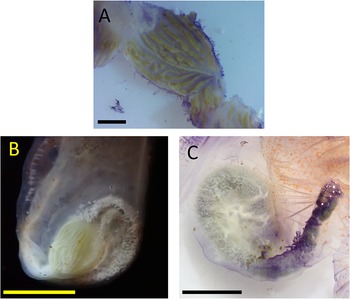
The oral tentacles are unbranched, thin, often curled, and look like human eyelashes. They are slightly wider at the base than at the tips. There are 19-28 oral tentacles on the left side of the body and 19-35 on the right side. There are at least three orders, with shorter tentacles sometimes distal to longer tentacles (Figure 2A).
Oral tentacles and branchial sac. Tissue has been stained with hematoxylin to increase contrast. (A) Oral tentacles. (B) Dorsal languets in a line along dorsal edge of the branchial sac. (C) Variation in longitudinal vessels and papillae on the branchial sac from fully connected longitudinal vessels to separated t-shaped papillae. (D) Spiral stigmata consisting of a single stigmatal opening spiraling either clockwise or counterclockwise. Scale bars: a, b, c ≈ 1 mm; d ≈ 0.5 mm.

Dorsal tubercle
The dorsal tubercle is U-shaped.
Dorsal languet
The dorsal lamina consists of 19-23 transparent, diaphanous languets that are wider at the proximal end than at the distal end. The size of the languets varies within the same individual: dorsal languets  ${\#}1{-}10$ are medium-sized and then get successively longer, with the length peaking at dorsal languets ${\#}17{-}20$ and then getting successively shorter. This is not a perfect pattern; however, one or two of the dorsal languets ${\#}12{-}15$ are often smaller than dorsal languets ${\#}1{-}10$. The longest languets are thin and curled at the tips (Figure 2B).
Branchial sac
Transverse vessels divide the branchial sac into 24-33 rows of stigmata on the right side and 25-28 on the left side. Transverse vessels can be irregular, either terminating prematurely or merging into another vessel. There are 16-26 longitudinal vessels on the left side of the branchial sac and 15-28 on the right side. Variability in the number of transverse and longitudinal vessels appears to be related to the size of the individual, with larger individuals having more vessels. Longitudinal vessels sit atop triangular papillae projecting from the transverse vessels. Longitudinal vessels are sometimes interrupted. At the most extreme, longitudinal vessels may be reduced to short projections from a single papilla, forming a “T” shape or consisting of a simple papilla with no projections (Figure 2C). The spiral stigmata are located in small, longitudinally oriented rectangles in the mesh of transverse and longitudinal vessels. The spirals, consisting of a single stigma, are irregular, with 2-4 coils often interrupted by radial vessels. The direction of the spirals is variable, with some coiling counter-clockwise and others clockwise. Sometimes, the stigmatal spirals extend beyond the longitudinal vessels, termed “exo-spirals” (Monniot, Reference Monniot2013). Transverse vessels rarely interrupt the spiral (Figure 2D).
Gut
The gut loop is positioned on the right side of the branchial sac, which is a diagnostic character for the Family Corellidae. The digestive tract is large, often covering the posterior half of the right side. The stomach is ovoid (3-5 mm long in smaller animals), yellow when empty, and has several longitudinal folds. Internally, there are ∼ 16 complete folds and ∼ 4 incomplete folds, although the stomach folds of only two of the six animals were counted. A typhlosolis running the length of the stomach between oblique folds is visible from inside the stomach (Figure 3A). The stomach is usually oriented at a 45-degree angle with respect to the anterior/posterior axis of the body, with the cardiac end pointing posteriorly and dorsally. In one larger animal, the stomach is parallel to the anterior/posterior axis of the body, with the cardiac end pointing posteriorly. The intestine rises anteriorly from the stomach, curving towards the ventral margin of the animal to make a tight first loop to the posterior end of the animal and then rises anteriorly along the dorsal margin (Figure 3B). The anus has ∼ 12 lobes around the margin.
Stomach and digestive tract. (A) Dissected stomach showing typhlosolis and oblique folds from the inside. (B) Digestive tract, including the stomach and intestine, as seen through the body wall on the right side. Note the numerous testes lobes covering the intestine. (C) The digestive tract, including the stomach and intestine, as seen after removing the branchial sac. Note the ovaries covering the inside of the gut loop and the branches of the spermiduct converging into a single duct in the center of the gut loop. Scale bars: a ≈ 1 mm; b & c ≈ 5 mm.

Gonads
Ovaries and testes were present in all animals examined. The ovaries contain numerous white, circular eggs. Viewed through the body wall, they line the anterior edge of the first intestinal loop (as Monniot, Reference Monniot2013 describes for C. brewinae) and are visible in the center of the primary intestinal loop (as Monniot, Reference Monniot2013 describes for C. brewinae). The ovaries are also visible from the interior, covering the stomach (Figure 3C). The oviduct was not visible in these animals.
The testes consist of numerous small, elongated, irregularly branching lobes covering the primary intestinal loop (Figure 3B). Many small ducts connect the testes’ lobes to larger ducts that run to the center of the intestinal loop, merging into a single large spermiduct (Figure 3C). The spermiduct runs parallel to the rectum, ending at the anus, which is immediately posterior to the atrial siphon (Figure 3B).
Larvae
No larvae were found.
Molecular identification
Of the four animals preserved for molecular analysis, two amplified successfully and provided high-quality sequences for the Cytochrome Oxidase I gene: NYC2 and NYC3. These two sequences had 99% query cover and 100% identity along that alignment so only one sequence was submitted to GenBank (GenBank Accession number PQ056055). COI sequences were only available for three species of Corella: C. antarctica, C. aff. inflata, and C. eumyota on GenBank. The final COI alignment was 531 bp in length. Overall support on the maximum likelihood tree was low (Figure 4), however, C. eumyota and C. antarctica each formed their own independent monophyletic clades. Our sequence (PQ056055) was on an unsupported branch outside either of these clades (Figure 4).
Maximum likelihood tree of Corella spp. Cytochrome c oxidase subunit i (COI, 531 bp). One thousand bootstrap replicates were run using the tamura-nei nucleotide substitution model plus gamma distributed rates. All nodes with greater than 50% bootstrap support are labeled. The sequence generated in the present study is highlighted in bold.

For the 18S rDNA gene, 2 sequences were obtained (GenBank Accession numbers PQ787777-PQ787778): NYC3 and NYC4. These two sequences had 100% query cover and 99.79% identity along that alignment (951 bp). Once aligned with the Corella spp. 18S sequences available on GenBank, the final alignment was 361 bp in length. NYC4 18S (PQ787778) was identical along the entire alignment with the C. japonica 18S sequence previously published in GenBank (AF165822), with both varying only a single base substitution (99.7% identity) from the NYC3 18S sequence (PQ787777). Corella eumyota 18S (FM244846) and C. inflata 18S (AY903930) averaged 93.2% and 97.1% identity with NYC4 (PQ787778), NYC3 (PQ787777), and C. japonica (AF165822) 18S sequences, respectively.
Diagnosis
Upon removal of the body from the tunic, one diagnostic characteristic is immediately apparent: strong musculature of the body wall (Figure 2A). There are only five Corella species with this characteristic: C. antarctica Sluiter, 1905; C. brewinae Monniot, Reference Monniot2013; C. eumyota Traustedt, 1882; C. japonica Herdman, Reference Monniot1880; and C. parallelogramma (Muller, 1776) (Herdman Reference Monniot1880; Lambert, Reference Lambert2004; Monniot, Reference Monniot2013). Morphological diagnostic characters for all five species are shown in Table 1.
Comparison of diagnostic characters between Corella spp. with strong body musculature

ND = not described in the literature.
Corella antarctica’s size (up to 25cm), spermiduct length (terminating past the anal margin), number of stomach folds (10), smooth tunic surface, and number of coils in the spiral stigmata (4-7, Monniot, Reference Monniot2013) does not match the present specimens: up to 4.5 cm in length, spermiduct terminating at the anal margin, 16 stomach folds, papilated tunic surface, and 2-4 coils in the stigmata. Corella brewinae’s number (52) and equal size of dorsal languets, number of stomach folds (8-9) and body color (yellow, Monniot, Reference Monniot2013) did not match the present samples. Corella eumyota has uniquely short oviducts and spermiducts that open in the atrium far from the atrial siphon (Lambert, Reference Lambert2004). The oviduct was not visible in the California samples, but the spermiduct parallels the rectum and ends at the anus margin (immediately posterior to the atrial siphon, Figure 3B). Corella parallelogramma’s seven regular stigmatal coils, interrupted transverse muscles on the left side, and 10 stomach folds (Monniot, Reference Monniot2013) did not match these samples.
Corella japonica was first described by Herdman from samples collected near Kobe and Yokohama, Japan during the Challenger expedition (Herdman, Reference Herdman1880, Reference Herdman1882). The species has been repeatedly revised and revisited by Japanese taxonomists (Nishikawa, Reference Nishikawa1991; Nishikawa and Tokioka, Reference Nishikawa and Tokioka1976; Oka, Reference Oka1931, Reference Oka1935; Tokioka, Reference Tokioka1967; Tokioka and Nishikawa, Reference Tokioka and Nishikawa1975) working with samples collected from locations ranging from Hakodate in the north (Tokioka, Reference Tokioka1967) to Okinawa in the south (Tokioka and Nishikawa, Reference Tokioka and Nishikawa1975). Based on the compilation of these descriptions (Table 1), the samples collected in Wilmington, CA correspond well with C. japonica across 24 of the 27 characters examined. Particularly, the characteristics that distinguish our specimens from the other Corella species considered here (number and size of dorsal languets, length of the spermiduct, disposition of transverse muscles on the left side of the body, body color, tunic surface, overall size, and number of stomach folds) agree between our specimens and C. japonica (Table 1). The exception is the number of coils in the stigmata, however, like the distance between siphons, it is not that the descriptions disagree, but that these two characters are not well described in any of the C. japonica descriptions examined. The variation in preserved body color can be attributed to the age of the specimens. Tokioka (Reference Tokioka1967) and Nishikawa (Reference Nishikawa1991), who described C. japonica as having reddish-brown muscles in the mantle, were examining specimens that had been preserved up to 67 years before publication, while the vibrant pink/orange mantle coloration was observed less than one week after preservation in 10% formalin. The “beautiful orange red colour of the mantle” described by Oka (Reference Oka1935) was from samples preserved for only a few years (Oka, Reference Oka1935) or even from live specimens (Oka, Reference Oka1931).
Discussion
The phlebobranch Corella japonica was observed here for the first time in the eastern Pacific at the Newmarks Yacht Centre in Los Angeles Harbor. The species was identified morphologically and genetically using two molecular markers (COI, 18S rDNA). Morphological characterization revealed negligible differences with previous descriptions of C. japonica as expanded over time by Herdman, Oka, Tokioka, and Nishikawa (Herdman, Reference Herdman1882; Nishikawa, Reference Nishikawa1991; Nishikawa and Tokioka, Reference Nishikawa and Tokioka1976; Oka, Reference Oka1931, Reference Oka1935; Tokioka, Reference Tokioka1967; Tokioka and Nishikawa, Reference Tokioka and Nishikawa1975).
Newmarks Yacht Centre, where C. japonica was collected, is at the intersection of the Port of Los Angeles and the Port of Long Beach, the site of the first record for three other introduced solitary ascidians: Ascidiella aspersa (Nydam et al., Reference Nydam, Nichols and Lambert2022a), Ascidia zara (Lambert and Lambert, Reference Lambert and Lambert1998), and Ciona savignyi (Lambert and Lambert, Reference Lambert and Lambert1998). In 2022, 71% of the trade routes into the Port of Los Angeles originated in Northeast Asia (China/Hong Kong, Japan, Korea, and Taiwan), with Japan being the second largest trading partner after China (Port of Los Angeles, 2023). East Asian countries account for 90% of the trade through the Port of Long Beach, but Japan is not one of the top 10 importing countries for this port (Port of Long Beach, 2023). A. zara and C. savignyi were first spotted in the Port of Long Beach in 1984 and 1985, respectively. A. zara has now been found as far north as Bodega Bay, CA, and Ciona savignyi as far north as Puget Sound, WA (Simkanin et al., Reference Simkanin, Fofonoff, Larson, Lambert, Dijkstra and Ruiz2016). Ascidiella aspersa was first found in the Port of Los Angeles in 2019, and as of Summer 2024, it is common from Ventura south to San Diego Bay (Nydam, pers. obs.). In the 14 months since it was first discovered, C. japonica has not expanded its range (Nydam, pers. obs.). A thorough survey of 35 sites from Santa Barbara to San Diego Bay in August-September 2024 was conducted by M. Nydam, and C. japonica was only found in a single location: Newmarks Yacht Centre, the same place where it was found in 2023 (unpublished data). Seasonal changes of C. japonica populations have not been described but two other species native to Japan and introduced to southern California (Ascidia zara and Ciona savignyi) have greater abundances in the spring than in the fall (Lambert and Lambert, Reference Lambert and Lambert2003). Further research should characterize C. japonica biological cycles and continue to monitor its presence in Californian harbors and marinas. Early detection of spread beyond the species entry point will allow for a quick response and the development of an efficient management strategy as necessary.
Data availability statement
The authors confirm that the data supporting the findings of this study are available within the article and its supplementary materials. COI and 18S rDNA sequences are available on GenBank.
Acknowledgements
The authors would like to thank the staff at Newmarks Yacht Centre for allowing us access to their docks and G. Lambert and R.M. Rocha for providing access to the Herdman 1882 description of Corella japonica. The authors would also like to thank two anonymous reviewers for their comments which strengthened this paper.
Author contributions
L.M.S. and M.L.N. collected the live samples. S.L.L. photographed the live samples. L.M.S., M.L.N., and S.L.L. preserved the samples. M.L.N. characterized the morphology of the samples, photographed the samples after preservation, and conducted the molecular work. L.M.S. and M.L.N. wrote the first manuscript draft, and all authors commented on previous versions of the manuscript. All authors read and approved the final manuscript.
Funding
This study was funded by NSF DEB  ${\#}$2122475 (R.U.I.: Development and application of genomic resources for ascidian taxonomy and holobiont evolution).
Competing interests
The author(s) declare none.




 Open access

