


Statement of Research Significance
Research Question(s) or Topic(s): Does pre-injury sleep disturbance moderate cognitive outcomes in children (age 8–16) with mild traumatic brain injury or orthopedic injury across the first 6 months of recovery? Main Findings: Injury group differences in cognitive functioning on certain National Institutes of Health Toolbox Cognition Battery fluid cognition subtests were moderated by pre-injury sleep disturbance. Specifically, on the Flanker Inhibitory Control and Attention Test, the mild traumatic brain injury group had significantly slower reaction times than the orthopedic injury group at 10 days post-injury when children had higher pre-injury sleep disturbance. Higher pre-injury sleep disturbance was also associated with worse performance on other subtests independent of injury group. Study Contributions: The study contributes new information on the significant independent and moderating effects of pre-injury sleep disturbance on cognitive functioning in children with mild traumatic brain injury or orthopedic injury.
Introduction
Pediatric traumatic brain injury (TBI) is a growing public health concern. In the United States, nearly 640,000 children 14 years old and younger presented to emergency departments (ED) with traumatic brain injury in 2013 (Taylor et al., Reference Taylor, Bell, Breiding and Xu2017). Most TBIs sustained by children are mild in severity (mTBI), and rates of children presenting to the ED with mTBI have steadily increased in recent years (Thurman, Reference Thurman2016; Zemek et al., Reference Zemek, Grool, Rodriguez Duque, DeMatteo, Rothman, Benchimol, Guttmann and Macpherson2017). Past research suggests that children are especially vulnerable to mTBI and may take longer to recover from the negative effects of mTBI compared to adults (Field et al., Reference Field, Collins, Lovell and Maroon2003; Williams et al., Reference Williams, Puetz, Giza and Broglio2015; Zuckerman et al., Reference Zuckerman, Lee, Odom, Solomon, Forbes and Sills2012). Following mTBI, children commonly experience post-concussive symptoms (PCS), which include a wide range of somatic, cognitive, emotional and behavioral symptoms, some of which can persist for weeks or months (Babcock et al., Reference Babcock, Byczkowski, Wade, Ho, Mookerjee and Bazarian2013; Zemek et al., Reference Zemek, Farion, Sampson and McGahern2013).
Cognitive symptoms can persist after other symptoms have resolved (Lovell et al., Reference Lovell, Collins, Iverson, Field, Maroon, Cantu, Podell, Powell, Belza and Fu2003; McInnes et al., Reference McInnes, Friesen, MacKenzie, Westwood and Boe2017). This finding is of particular interest in the pediatric population, as children’s brains and cognitive abilities are rapidly developing (Giza & Hovda, Reference Giza and Hovda2014). Recent studies suggest that mTBI has a significantly greater impact on children’s cognition than previously thought, although the effect depends on which aspects of cognition are measured (Taylor et al., Reference Taylor, Kioumourtzoglou, Clover, Coull, Dennerlein, Bellinger and Weisskopf2018; Ware et al., Reference Ware, McLarnon, Lapointe, Brooks, Bacevice, Bangert, Beauchamp, Bigler, Bjornson, Cohen, Craig, Doan, Freedman, Goodyear, Gravel, Mihalov, Minich, Taylor and Zemek2023). In a recent study, IQ scores were not associated with pediatric mTBI (Ware et al., Reference Ware, McLarnon, Lapointe, Brooks, Bacevice, Bangert, Beauchamp, Bigler, Bjornson, Cohen, Craig, Doan, Freedman, Goodyear, Gravel, Mihalov, Minich, Taylor and Zemek2023). Using the same sample examined in the current paper, we previously reported on fluid and crystallized cognitive skills following pediatric mTBI as measured using the National Institutes of Health Toolbox Cognition Battery (NIHTB-CB) (Chadwick et al., Reference Chadwick, Roth, Minich, Taylor, Bigler, Cohen, Bacevice, Mihalov, Bangert, Zumberge and Yeates2021). At approximately 10 days post-injury, children with mTBI exhibited significantly lower fluid cognition than those with orthopedic injury (OI), but the groups did not differ significantly in crystallized cognition (Chadwick et al., Reference Chadwick, Roth, Minich, Taylor, Bigler, Cohen, Bacevice, Mihalov, Bangert, Zumberge and Yeates2021). Deficits remained present as long as 3 months after mTBI on fluid cognition subtests, specifically on timed measures of attention and executive function (e.g., cognitive flexibility, inhibitory control).
Regardless of injury history, sufficient, good quality sleep promotes cognitive functioning of children and adolescents (Astill et al., Reference Astill, Van der Heijden, Van IJzendoorn and Van Someren2012; Chaput et al., Reference Chaput, Gray, Poitras, Carson, Gruber, Olds, Weiss, Connor Gorber, Kho, Sampson, Belanger, Eryuzlu, Callender and Tremblay2016; Dewald et al., Reference Dewald, Meijer, Oort, Kerkhof and Bögels2010). Sleep disturbance following mTBI has been associated with prolonged recovery, increased symptom burden, and worse acute cognitive functioning in children and adolescents (Kostyun et al., Reference Kostyun, Milewski and Hafeez2015; Tham et al., Reference Tham, Palermo, Vavilala, Wang, Jaffe, Koepsell, Dorsch, Temkin, Durbin and Rivara2012; Theadom et al., Reference Theadom, Starkey, Jones, Cropley, Parmar, Barker-Collo and Feigin2016). A major limitation of existing research is that, compared to post-injury sleep disturbance, pre-injury sleep disturbance is rarely considered as a predictor of post-injury cognitive functioning. A recent systematic review and meta-analysis of sleep disturbance and pediatric mTBI (Djukic et al., Reference Djukic, Phillips and Lah2022) found that of 44 included articles, only 3 reported on pre-injury sleep and cognitive symptoms and of those, only 2 reported on the relationship in school-age children (Howell et al., Reference Howell, Potter, Provance, Wilson, Kirkwood and Wilson2021; Sinnott et al., Reference Sinnott, Kontos, Collins and Ortega2020). In one study, pre-injury sleep (self-reported trouble falling asleep, fatigue, sleeping less and drowsiness) failed to predict post-concussion symptoms at 7 days post-injury (Sinnott et al., Reference Sinnott, Kontos, Collins and Ortega2020). A limitation of this study is that cognitive symptoms were grouped together with migraine and fatigue symptoms, making it difficult to isolate the effects of pre-injury sleep on cognitive symptoms. In the other study, after controlling for pre-injury sleep (self-reported retrospective sleeping more than usual, experiencing sleep disruptions, trouble falling asleep or other unspecified sleep problems), post-injury sleep significantly predicted post-injury PCS, including cognitive symptoms, at 7 and 23 days post injury (Howell et al., Reference Howell, Potter, Provance, Wilson, Kirkwood and Wilson2021). However, the authors did not investigate the association of pre-injury sleep with cognitive symptoms.
Some evidence suggests that greater pre-injury sleep disturbance is associated with worse sleep, PCS, and cognitive functioning post-injury. In a previous analysis also based on the same sample examined in the current paper, children with mTBI showed modestly but not significantly higher post-injury sleep difficulties compared to children with OI, and the group difference was not moderated by pre-injury sleep disturbance (i.e., parent reported retrospective sleep disordered behavior), which instead was strongly associated with post-injury sleep disturbance and more severe PCS (including cognitive symptoms) as a main effect for both groups (Luszawski et al., Reference Luszawski, Minich, Bigler, Taylor, Bacevice, Cohen, Bangert, Zumberge, Tomfohr-Madsen, Brooks and Yeates2025). A second study of a different sample found that parent-reported pre-injury sleep disorders were marginally predictive of cognitive inefficiency (defined as scores at least 1.0 SD below the mean on 2 or more cognitive subtests) 3 months post pediatric mTBI (Beauchamp et al., Reference Beauchamp, Aglipay, Yeates, Désiré, Keightley, Anderson, Brooks, Barrowman, Gravel, Boutis, Gagnon, Dubrovsky and Zemek2018). In a third study, adolescents and adults with pre-injury sleep difficulties (i.e., pre-injury self-reported difficulties falling asleep and/or sleeping less than usual) reported significantly higher symptom burden and performed significantly worse on neurocognitive tests compared to those without pre-injury sleep difficulties (Sufrinko et al., Reference Sufrinko, Pearce, Elbin, Covassin, Johnson, Collins and Kontos2015). Together, these findings suggest that pre-injury sleep may be a significant predictor of post-injury cognitive functioning. However, to our knowledge, no study has assessed pre-injury sleep using a validated measure and examined it as a predictor of post-injury performance on a standardized cognitive test battery. Thus, further investigation of whether pre-injury sleep predicts post-injury cognitive test performance is warranted.
The current study sought to investigate the role of pre-injury sleep disturbance as a possible predictor or moderator of cognitive test performance within the first 6 months post-injury in school-aged children and adolescents with mTBI or OI. Specifically, we investigated performance on the NIH Toolbox Cognition Battery, including crystallized and fluid cognitive composite scores as well as specific subtest measures. As noted above, previous analyses based on the same sample revealed that children with mTBI performed worse than children with OI on tests of fluid but not crystallized cognition (Chadwick et al., Reference Chadwick, Roth, Minich, Taylor, Bigler, Cohen, Bacevice, Mihalov, Bangert, Zumberge and Yeates2021). Children with mTBI also showed modest but not significantly worse post-injury sleep than those with OI; pre-injury sleep did not moderate group differences in post-injury sleep but was associated with worse post-injury sleep and PCS for both injury groups (Luszawski et al., Reference Luszawski, Minich, Bigler, Taylor, Bacevice, Cohen, Bangert, Zumberge, Tomfohr-Madsen, Brooks and Yeates2025). Building on these results, we hypothesized that worse pre-injury sleep would moderate group differences on tests of fluid cognition (i.e., abilities used to solve novel problems, learn and process information) but not crystalized cognition (abilities such as verbal knowledge that are acquired over time) (Akshoomoff et al., Reference Akshoomoff, Newman, Thompson, McCabe, Bloss, Chang, Amaral, Casey, Ernst, Frazier, Gruen, Kaufmann, Kenet, Kennedy, Libiger, Mostofsky, Murray, Sowell, Schork and Jernigan2014; Horn & Cattell, Reference Horn and Cattell1967), with more pronounced deficits in fluid cognition after mTBI in children with poorer pre-injury sleep.
Methods
Study design and procedure
Data were drawn from the Mild Injury Outcomes Study, a prospective, concurrent cohort study with longitudinal follow-up (McNally et al., Reference McNally, Bangert, Dietrich, Nuss, Rusin, Wright, Taylor and Yeates2013). Participants were 8 – 16 year old children and adolescents with mTBI or OI not including the head who were recruited during visits to two Emergency Departments in Ohio, United States. Selecting children with other bodily injuries for comparison is a strength of the study and helps to account for preinjury behaviors that could predispose youth to injury, as well as for other non-specific factors such as pain, traumatic stress following the injury, and the possibility of other complications, that could engender PCS. Children and their caregivers returned for face-to-face assessments at 10-days and at 3- and 6-months post-injury. The larger parent study that provided the data used in the present study was conducted in accordance with the Helsinki Declaration and was approved by the Institutional Review Board for the Nationwide Children’s Hospital (IRB ID: CR00001432) for a project entitled “Predicting Outcomes in Children with Mild Traumatic Brain Injury.”
Participants
Children with mTBI sustained a blunt head trauma resulting in at least one of the following criteria, consistent with the WHO definition of mTBI (Carroll et al., Reference Carroll, Cassidy, Holm, Kraus and Coronado2004): 1) an observed loss of consciousness (LOC) of less than 30 minutes; and 2) a Glasgow Coma Scale (GCS) score of 13 or 14 (Teasdale & Jennett, Reference Teasdale and Jennett1974) or 3) at least two acute signs or symptoms of concussion as noted by ED medical personnel on a standard case report form. Children with mTBI remained eligible if they had a co-occurring OI, were hospitalized, or had intracranial lesions or skull fractures detected on CT scan, which was only completed upon physician referral for clinical indications. Children were excluded if they experienced delayed neurological deterioration, neurosurgical intervention, LOC >30 min, or GCS score <13.
Children with OI not involving the head sustained an upper or lower extremity fracture associated with Abbreviated Injury Scale (AIS) (Greenspan et al., Reference Greenspan, McLellan and Greig1985) scores of 4 or less. Children were excluded from the OI group if they displayed any evidence of head trauma or concussion in the ED.
Children from both groups were also excluded if they had: (1) any other injury with an AIS score greater than 4 (Greenspan et al., Reference Greenspan, McLellan and Greig1985); (2) any injury likely to interfere with neuropsychological testing (e.g. preferred upper extremity fracture); (3) hypoxia, hypotension, or shock during or following the injury; (4) alcohol or drug ingestion involved with the injury; (5) a history of previous TBI requiring hospitalization; (6) a premorbid neurological disorder or intellectual disability; (7) an injury resulting from child abuse or assault; (8) a history of severe psychiatric disorder requiring hospitalization; or (9) any contraindication to MRI. Children administered analgesic medication, including narcotics, in the ED were included. Children with a history of ADHD were also included given they are at an increased risk of traumatic injury (Lee et al., Reference Lee, Harrington, Chang and Connors2008).
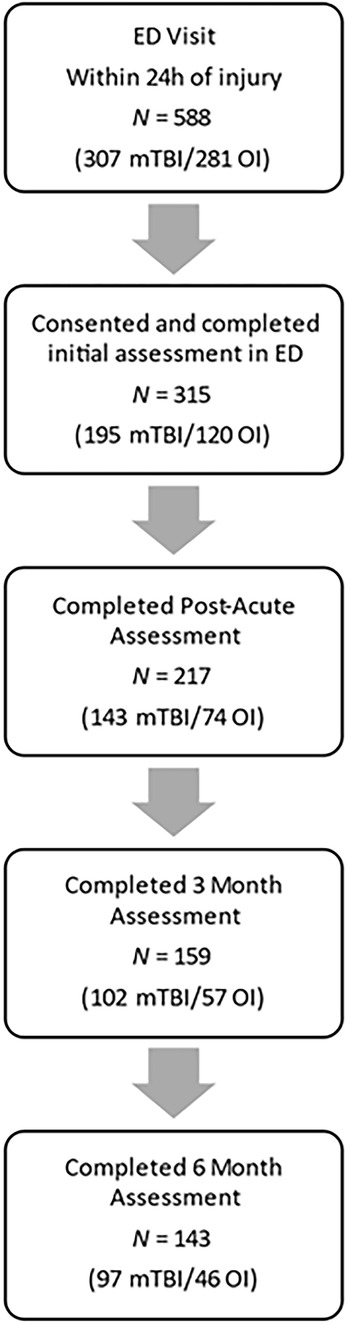
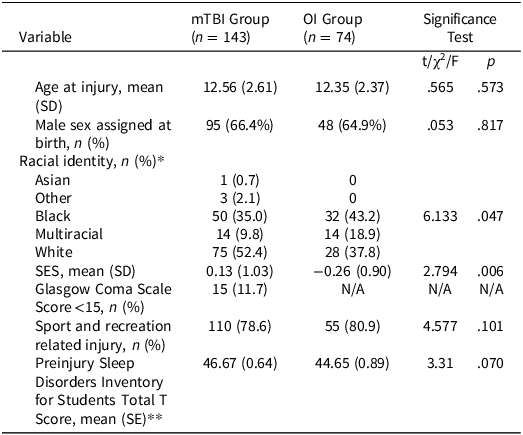
A participant flowchart is presented in Figure 1. Details of consent rates based on race and socioeconomic status (SES) have been described previously (Chadwick et al., Reference Chadwick, Roth, Minich, Taylor, Bigler, Cohen, Bacevice, Mihalov, Bangert, Zumberge and Yeates2021; Wells et al., Reference Wells, Galarneau, Minich, Cohen, Clinton, Taylor, Bigler, Bacevice, Mihalov, Bangert, Zumberge and Yeates2022) Demographic and clinical information of the participants is reported in Table 1.
Participant flowchart showing total sample completing each assessment. Of the 217 participants that completed the 10 day visit assessment, 204 were included in the analyses. They all completed at least one assessment, had data on SES and sex assigned at birth, and had valid MSVT performances without indication of memory deficit.

Demographic and clinical characteristics of mTBI and OI groups

Note. *A chi-square test of independence showed a significant association between racial identity (Black, Multiracial and White) and injury group (mTBI or OI), χ2(2, N = 213) = 6.133, p = .047. The mTBI group had the highest percentage of White children, whereas the OI group had the highest percentages of Black and multiracial children.
**A one-way ANCOVA was conducted to compare pre-injury SDIS scores of the mTBI and OI groups while controlling for sex assigned at birth, age at injury, SES, and race. The groups did not differ significantly, F (1, 208) = 3.31, p = .070.
Measures
National Institutes of Health (NIH) toolbox for assessment of neurological and behavioral function – cognition battery
Cognitive functioning was measured using the NIH Toolbox Cognition Battery (Gershon et al., Reference Gershon, Cella, Fox, Havlik, Hendrie and Wagster2010). The battery provides age-corrected composite standard scores for Fluid and Crystalized cognition. The subtests constituting the Fluid Composite score include the Dimensional Change Card Sort Test, Flanker Inhibitory Control and Attention Test, Picture Sequence Memory Test, Pattern Comparison Processing Speed Test, and List Sorting Working Memory Test. The subtests constituting the Crystallized Composite score include the Oral Reading Recognition Test and Picture Vocabulary Test. Each subtest generates age-corrected standard scores; median reaction time is also recorded for the Dimensional Change Card Sort Test and Flanker Inhibitory Control and Attention Test. The NIH Toolbox Cognitive Battery has been previously used in this sample to examine the cognitive functioning of children following mTBI (Chadwick et al., Reference Chadwick, Roth, Minich, Taylor, Bigler, Cohen, Bacevice, Mihalov, Bangert, Zumberge and Yeates2021). The battery has been validated in adults (Heaton et al., Reference Heaton, Akshoomoff, Tulsky, Mungas, Weintraub, Dikmen, Beaumont, Casaletto, Conway, Slotkin and Gershon2014; Weintraub et al., Reference Weintraub, Dikmen, Heaton, Tulsky, Zelazo, Slotkin, Carlozzi, Bauer, Wallner-Allen, Fox, Havlik, Beaumont, Mungas, Manly, Moy, Conway, Edwards, Nowinski and Gershon2014) and in children and adolescents (age 3–20) (Akshoomoff et al., Reference Akshoomoff, Newman, Thompson, McCabe, Bloss, Chang, Amaral, Casey, Ernst, Frazier, Gruen, Kaufmann, Kenet, Kennedy, Libiger, Mostofsky, Murray, Sowell, Schork and Jernigan2014). In the current sample, the two composite scores showed significant test–retest reliability from 10 days to 3 months and 3 months to 6 months in both the mTBI (Fluid Composite, r = .737 and r = .658, both p < .001; Crystallized Composite, r = .853 and r = .840, both p < .001) and OI groups (Fluid Composite, r = .801 and r = .888, both p < .001; Crystallized Composite, r = .789 and r = .789, both p < .001). Data on test–retest reliability for specific subtests are presented in Supplemental Tables 1S–4S.
Medical symptom validity test (MSVT)
Performance validity was measured using the MSVT (Green, Reference Green2004). The MSVT is a computerized test that displays 10 word pairs in two trials and assesses immediate and delayed recognition. Performance on the MSVT explains substantial variance in cognitive test performance among children with mTBI (Kirkwood & Kirk, Reference Kirkwood and Kirk2010). The traditional MSVT cutoff was used to initially classify performance as invalid (i.e., a score of ≤ 85% on all three easy subtests). Some children meeting that criterion displayed substantially worse performance on difficult subtests than on easy ones (difference of >20%), suggesting cognitive impairment or memory deficit rather than performance invalidity.29
Sleep disorders inventory for students (SDIS)
The SDIS consists of 30 items that screen for major sleep disorders including obstructive sleep apnea, periodic limb movement disorder, delayed sleep phase syndrome, excessive daytime sleepiness, and narcolepsy (Luginbuehl et al., Reference Luginbuehl, Bradley-Klug, Ferron, Anderson and Benbadis2008). In this study, we used the total Sleep Disturbance Index, rather than the individual disorder scales. Higher scores on the total Sleep Disturbance Index are indicative of greater sleep disturbance. The SDIS includes an Adolescent form for rating children aged 11–18 and a Child form for rating children aged 2 through 10 years. Parents rated pre-injury sleep behavior retrospectively at the 10 day visit. The SDIS has previously demonstrated acceptable reliability and validity (Luginbuehl et al., Reference Luginbuehl, Bradley-Klug, Ferron, Anderson and Benbadis2008). Internal consistency was good for the current administration of both the SDIS-Adolescent Total Score (Cronbach’s α = .90) and SDIS-Child Total Score (Cronbach’s α = .92).
Data analysis
Descriptive analyses were conducted using IBM Statistics SPSS Statistics for Windows, version 29.0 (IBM Corp. (2019) IBM SPSS Statistics for Windows, Version 26.0. IBM Corp: Armonk, NY.). Mixed model analyses were conducted using SAS, version 9.4. (SAS Version 9.4. SAS Institute, Inc., Cary, NC, USA.) to examine group and pre-injury sleep disturbance (SDIS total T scores) as predictors of cognitive scores across the three assessment time points (coded continuously as days post-injury). Sex and SES (estimated using a composite z score based on years of maternal education, occupational status, and median census tract income) explained a significant amount of variance in the outcome variables and were therefore covaried in the analyses. Analyses excluded 10 participants (9 mTBI and 1 OI) who failed the MSVT without indication of memory problems (Green, Reference Green2004; Kirkwood & Kirk, Reference Kirkwood and Kirk2010). Three other participants who had no NIH-Toolbox Cognition Battery data or no SDIS data were also excluded.
Mixed model analyses initially included a three-way interaction involving injury group, pre-injury SDIS score, and time since injury. If this interaction was not significant, it was removed and the model was re-estimated to examine two-way interactions (injury group by pre-injury SDIS score, pre-injury SDIS score by time since injury, injury group by time since injury). If no two-way interactions were significant, the model was re-estimated including only main effects. Time since injury and pre-injury sleep disturbance were treated as continuous variables in all mixed models.
To assist with interpretation of significant 3-way interactions of injury group, pre-injury SDIS scores, and time since injury, we generated model-based estimates of mean cognitive test performance and their 95% confidence intervals at 0, 90, and 180 days post-injury for each injury group (mTBI, OI), assuming pre-injury SDIS scores of 60 and 40 (i.e., +1 SD and −1 SD from an average Total t-score of 50) to represent higher versus lower pre-injury sleep disturbance. The estimates and confidence intervals were generated based on the final model parameters, holding SES and sex constant (i.e., total sample mean for SES and average proportion male for sex). The estimates were then used to conduct tests of simple effects and to generate illustrative Figures.
Results
Fluid cognition
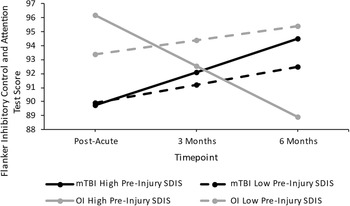
The three-way interaction of injury group, pre-injury sleep disturbance, and time since injury was significant for overall performance on the Flanker Inhibitory Control and Attention Test (F (1, 164) = 4.09, p = .045) (see Figure 2 and Supplemental Table 5S). Tests of simple effects based on model-based estimates indicated that the mTBI and OI groups did not differ significantly at any timepoint at lower or higher levels of pre-injury sleep disturbance. At the higher level of pre-injury sleep disturbance, the slopes of scores across time for mTBI and OI groups differed significantly (t(165) = 2.60, p = .010), such that scores increased modestly but not significantly for the TBI participants across time (t(165) = 1.76, p = .081), and decreased modestly but not significantly for the OI group (t(165) = −1.93, p = .055). In contrast, at the lower level of preinjury sleep disturbance, the mTBI (t(161) = 1.66, p = .100) and OI groups (t(167) = 1.01, p = .312) both showed small, non-significant increases across time, and the slopes for the two injury groups did not differ significantly ((t (165) = 0.20, p = .844). Bivariate correlations for pre-injury SDIS total T scores, covariates (sex and SES), and Flanker Inhibitory Control and Attention Test standard scores at the 3 timepoints are presented separately for the mTBI and OI groups in Supplemental Table 1S.
Model-based estimates of Flanker Inhibitory Control and Attention Test mean standard scores given a significant interaction of injury group, pre-injury SDIS Total t-score, and time since injury. Pre-injury SDIS is modeled at scores +1SD (High) and −1SD (Low) from a SDIS Total t-score of 50 (i.e., at T scores of 60 versus 40). The Y axis has been truncated.

The interaction of injury group, pre-injury sleep disturbance, and time since injury also was significant for median reaction time on the Flanker Inhibitory Control and Attention Test (F (1, 173) = 7.89, p = .006) (see Figure 3 and Supplemental Table 6S). Tests of simple effects based on model-based estimates indicated that, at the high level of pre-injury sleep disturbance, the mTBI group had significantly slower reaction times than the OI group at 10 days (t (204) = 2.08, p = .038). In contrast, at the low level of pre-injury sleep disturbance, the reaction times of the mTBI and OI groups did not differ at 10 days (t (210) = −0.14, p = .887). Additionally, the mTBI and OI groups did not differ significantly at 3 and 6 months at either level of pre-injury sleep disturbance. Thus, group differences in reaction time at 10 days were moderated by pre-injury sleep disturbance.
Model-based estimates of Flanker Inhibitory Control and Attention mean reaction time given a significant interaction of injury group, pre-injury SDIS total score, and time since injury. Pre-injury SDIS is modeled at scores +1SD (High) and -1SD (Low) from an SDIS total T score of 50 (i.e., at T scores of 60 versus 40). The Y axis has been truncated.

The trends in reaction time over assessments also varied by group and pre-injury sleep disturbance. In the mTBI group, reaction times decreased significantly at both higher (t (175) = −3.37, p < .001) and lower (t (171) = −2.84, p = .005) levels of pre-injury sleep disturbance, and the slope of reaction times across time did not differ significantly at the two levels (t(173) = −1.38, p = .169). In contrast, in the OI group, reaction times decreased significantly at the lower level of pre-injury sleep disturbance (t (176) = −2.49, p = .014) but did not change significantly at the higher level of pre-injury sleep disturbance (t (173) = 1.67, p = .097); and the slope of reaction times across assessments differed significantly at higher versus lower pre-injury sleep disturbance (t(173) = 2.47, p = .014). Put differently, the mTBI and OI groups showed significantly different trends in reaction time over assessments at the higher level of sleep disturbance (t (174) = −3.32, p = .001), but not at the lower level (t (174) = 0.25, p = .802). Bivariate correlations for pre-injury SDIS total T scores, covariates (sex and SES), and Flanker Inhibitory Control and Attention Test reaction time at the 3 timepoints are presented separately for the mTBI and OI groups in Supplemental Table 2S.
Neither the three-way interaction of injury group, pre-injury sleep disturbance, and time since injury nor any two-way interactions were significant for the Fluid Cognition composite or other Fluid Cognition subtests. In main effects models, pre-injury sleep disturbance was a significant predictor of the Dimensional Change Card Sort Test reaction time (F (1, 199) = 7.04, p = .009, B = 94.55, SE = 35.64) and Picture Sequence Memory Test (F (1, 207) = 5.51, p = .02, B = −3.15, SE = 1.34), with greater pre-injury sleep disturbance associated with slower reaction times and lower scores, respectively. These results document independent effects of pre-injury sleep on cognitive functioning in both groups. Bivariate correlations for the pre-injury SDIS total T scores, covariates (sex and SES), and Dimensional Change Card Sort Test reaction time at the 3 timepoints are presented separately for the mTBI and OI groups in Supplemental Table 3S, and those for the Picture Sequence Memory Test are presented in Supplemental Table 4S. Time since injury predicted the Fluid Cognition composite (F (1, 157) = 50.30, p < .001, B = 0.04, SE = 0.01), Picture Sequence Memory Test (F (1, 167) = 10.86, p = .001, B = 0.03, SE = 0.01), and Pattern Comparison Processing Speed Test (F (1, 156) = 101.57, p < .001, B = 0.08, SE = 0.01), with scores on all improving over time. No other significant main effects were found.
Sex was not significantly associated with the Fluid Cognition composite. Males performed significantly better than females on the Flanker Inhibitory Control and Attention Test (F(1, 207) = 4.23, p = .041) and List Sorting Working Memory Test (F(1, 208) = 6.82, p = .010), but sex was not associated with performance on any other Fluid Cognition subtest. SES was significantly positively associated with the Fluid Cognition composite, (F (1, 197) = 13.22, p < .001), as well as with higher scores on all Fluid Cognition subtests except for the Pattern Comparison Processing Speed Test (F(1, 203) = 0.10, p = .750). SES also was associated with significantly faster median reaction times on the Dimensional Change Card Sort Test and Flanker Inhibitory Control and Attention Test.
Crystalized cognition
Neither the three-way interactions of injury group, pre-injury sleep disturbance, and time since injury nor any two-way interactions were significant for the Crystalized Cognition composite or Crystalized Cognition subtest scores. In main effects models, pre-injury sleep disturbance was significantly negatively associated with scores on the Oral Reading Recognition Test (F (1, 209) = 6.32, p = .013, B = −3.61, SE = 1.43), such that greater pre-injury sleep disturbance was associated with worse performance. No other main effects were significant.
Sex was not significantly associated with the Crystalized Cognition composite or with Oral Reading Recognition Test or Picture Vocabulary Test scores. SES was significantly positively associated with Crystalized Cognition composite scores (F (1, 204) = 61.80, p < .001), as well as with performance on both the Oral Reading Recognition Test and the Picture Vocabulary Test.
Discussion
This study examined pre-injury sleep disturbance as a potential moderator of the effect of mTBI on cognitive outcomes across 6 months post-injury. Our hypothesis that group differences in fluid cognition would be more pronounced in children with worse pre-injury sleep was partially supported. On the Flanker Inhibitory Control and Attention Test, the mTBI group had significantly slower reaction times than the OI group at 10 days post-injury at a higher level of pre-injury sleep disturbance, but the injury groups did not differ at that time at a lower level of pre-injury sleep disturbance. More broadly, in both groups, pre-injury sleep disturbance was a significant predictor of the Dimensional Change Card Sort Test reaction time and Picture Sequence Memory Test scores, with greater pre-injury sleep disturbance associated with lower scores and slower reaction times.
These results suggest that pre-injury sleep disturbance significantly impacts measures of fluid cognition in children with mTBI and OI, and differentially affects the reaction times of children with mTBI versus OI on a timed test of executive function. Interestingly, we found that reaction time decreased significantly in the mTBI group at both levels of pre-injury sleep disturbance; in the OI group, reaction time also decreased at the low level of pre-injury sleep disturbance, but it did not change significantly in the OI group at a higher level. The improvements in the mTBI group may reflect recovery from brain injury, which may impact performance more than pre-injury sleep disturbance. In contrast, the different trajectories of reaction time in the OI group at higher versus lower levels of pre-injury sleep disturbance likely reflects a subtle impact of sleep disturbance on cognitive performance in the absence of brain injury (Beebe, Reference Beebe2011; DelRosso et al., Reference DelRosso, Vega-Flores, Ferri, Mogavero and Diamond2022; Lo et al., Reference Lo, Ong, Leong, Gooley and Chee2016).
Our results align with those of another study investigating pre-injury sleep effects on cognition in adolescents and young adults with sport-related mTBI (Sufrinko et al., Reference Sufrinko, Pearce, Elbin, Covassin, Johnson, Collins and Kontos2015). That study found that youth aged 14–23 with pre-injury sleep difficulties performed worse on the ImPACT neurocognitive test battery at 2 days, 5–7 days and 10–14 days after injury, compared to youth without pre-injury sleep difficulties (Sufrinko et al., Reference Sufrinko, Pearce, Elbin, Covassin, Johnson, Collins and Kontos2015). The current study builds on these findings by demonstrating that children with worse pre-injury sleep had worse performance on several tests of fluid cognition in the first 6 months after both mTBI and OI, and by showing more pronounced effects of mTBI relative to OI on reaction time on a specific test of complex executive functioning at 10 days post-injury. In adults, sleep has been associated with contributing to cognitive reserve, or the ability to perform a cognitive function or task despite brain injury (Balsamo et al., Reference Balsamo, Berretta, Meneo, Baglioni and Gelfo2024). While not explicitly investigated in the present study, the impact of sleep on cognitive reserve in children with mTBI is an area for future research and may provide further insight in the relationship between sleep and cognition.
Interestingly, we did not find any significant interactions of pre-injury sleep disturbance with injury group or time since injury on other fluid cognition subtests. We previously reported significant but diminishing group differences on the Fluid Cognition Composite when using the full sample (i.e., including children who failed the MSVT); although the main effect of injury group and the group X time interaction were not significant in the present study, they were of similar magnitude to those previously reported (Chadwick et al., Reference Chadwick, Roth, Minich, Taylor, Bigler, Cohen, Bacevice, Mihalov, Bangert, Zumberge and Yeates2021). Additionally, time since injury was related to scores on the Fluid Cognition Composite, Picture Sequence Memory Test, and Pattern Comparison Processing Speed test, such that scores improved over time. These findings are consistent with previous research suggesting that cognitive performance improves with time after pediatric mTBI, although they may also reflect general practice effects given they were apparent in both groups (Chadwick et al., Reference Chadwick, Roth, Minich, Taylor, Bigler, Cohen, Bacevice, Mihalov, Bangert, Zumberge and Yeates2021; Williams et al., Reference Williams, Puetz, Giza and Broglio2015).
While both the Dimensional Change Card Sort test and the Flanker Inhibitory Control and Attention test are measures of Fluid Cognition, they draw on differing aspects of executive function. The Dimensional Change Card Sort test taps into cognitive flexibility and set shifting (Akshoomoff et al., Reference Akshoomoff, Newman, Thompson, McCabe, Bloss, Chang, Amaral, Casey, Ernst, Frazier, Gruen, Kaufmann, Kenet, Kennedy, Libiger, Mostofsky, Murray, Sowell, Schork and Jernigan2014; Weintraub et al., Reference Weintraub, Dikmen, Heaton, Tulsky, Zelazo, Bauer, Carlozzi, Slotkin, Blitz, Wallner-Allen, Fox, Beaumont, Mungas, Nowinski, Richler, Deocampo, Anderson, Manly, Borosh and Gershon2013). In contrast, the Flanker Inhibitory Control and Attention test taps into selective and sustained visual attention as well as inhibitory control (Akshoomoff et al., Reference Akshoomoff, Newman, Thompson, McCabe, Bloss, Chang, Amaral, Casey, Ernst, Frazier, Gruen, Kaufmann, Kenet, Kennedy, Libiger, Mostofsky, Murray, Sowell, Schork and Jernigan2014; Weintraub et al., Reference Weintraub, Dikmen, Heaton, Tulsky, Zelazo, Bauer, Carlozzi, Slotkin, Blitz, Wallner-Allen, Fox, Beaumont, Mungas, Nowinski, Richler, Deocampo, Anderson, Manly, Borosh and Gershon2013). Although both tests are sensitive to mTBI (Chadwick et al., Reference Chadwick, Roth, Minich, Taylor, Bigler, Cohen, Bacevice, Mihalov, Bangert, Zumberge and Yeates2021), our current findings suggest the demands for selective and sustained attention on the Flanker Inhibitory Control and Attention Test may be more apparent in children with poor pre-injury sleep (Alfonsi et al., Reference Alfonsi, Palmizio, Rubino, Scarpelli, Gorgoni, D’Atri, Pazzaglia, Ferrara, Giuliano and De Gennaro2020; Goel et al., Reference Goel, Rao, Durmer and Dinges2009). Although the effects of mTBI and sleep disturbance on specific aspects of executive function are not well studied, McGowan and colleagues found that adolescents and young adults with mTBI perform variably on tests of cognitive flexibility depending on whether the task is more attention dependent or more context dependent (McGowan et al., Reference McGowan, Bretzin, Savage, Petit, Parks, Covassin and Pontifex2018). At baseline, participants with mTBI performed significantly worse than healthy controls in both conditions. However, when athletes with mTBI were cleared to return to sport (mean 16.7 days after injury) and 1 month after return to play, participants with mTBI performed worse than healthy controls on an attention dependent task but not worse on a context dependent task. Together with our results, this suggests that mTBI and pre-injury sleep disturbance can variably impact different aspects of executive function.
While healthy sleep is clearly needed for proper cognitive functioning in children and adolescents (Araújo & Almondes, Reference Araújo and Almondes2014; Kopasz et al., Reference Kopasz, Loessl, Hornyak, Riemann, Nissen, Piosczyk and Voderholzer2010; Short et al., Reference Short, Blunden, Rigney, Matricciani, Coussens, M. Reynolds and Galland2018; de Bruin et al., Reference de Bruin, van Run, Staaks and Meijer2017), the impact of sleep disturbance specifically on crystalized cognition is less clear (Gradisar et al., Reference Gradisar, Terrill, Johnston and Douglas2008; Yang et al., Reference Yang, Picchioni and Duyn2023; Yang et al., Reference Yang, Xie and Wang2022). Our results suggest that crystalized cognition is less susceptible to the impacts of mTBI and pre-injury sleep disturbances than fluid cognition. However, regardless of injury group, children with greater pre-injury sleep disturbance had significantly worse Oral Reading Recognition Test scores. This finding is supported by emerging evidence suggesting that poorer parent-rated sleep, such as sleep-disordered breathing, daytime sleepiness, and shorter sleep latency, is associated with poorer performance on tests of word and non-word reading (Joyce & Breadmore, Reference Joyce and Breadmore2022).
Strengths and limitations
This study has several strengths, including its prospective design and use of a sample representative of the racial identity and SES characteristics of the local community. The OI comparison group is well matched demographically to the mTBI group, shares similar pre-injury risk factors, and has also experienced a traumatic injury requiring medical attention. The use of validated measures of sleep and cognitive functioning, as well as of performance validity, is also a strength. The study also has limitations. The groups differed significantly on SES, which was treated as a covariate; controlling for covariates that differentiate groups can be problematic if the groups inherently differ on the covariate or if the covariate is a likely mediator of group differences in the dependent variable (Streiner, Reference Streiner2016). However, neither of those conditions likely applies in this instance, when SES is most likely a confounder. Pre-injury sleep was recorded retrospectively, which may have introduced hindsight bias and could partially account for differences in results compared to other studies utilizing actual pre-injury, rather than retrospective, reporting. The SDIS measures sleep disordered behavior but does not capture general sleep quality more broadly. Sleep disorders diagnosable according to the Diagnostic and Statistical Manual of Mental Disorders (DSM-5) are uncommon in mTBI, but evidence suggests that more general sleep disturbances (insomnia, with delayed sleep onset and more awakenings) occur frequently (Bramley et al., Reference Bramley, Henson, Lewis, Kong, Stetter and Silvis2017; Djukic et al., Reference Djukic, Phillips and Lah2022; Luszawski et al., Reference Luszawski, Minich, Bigler, Taylor, Bacevice, Cohen, Bangert, Zumberge, Tomfohr-Madsen, Brooks and Yeates2025; Luther et al., Reference Luther, Poppert Cordts and Williams2020; Theadom et al., Reference Theadom, Starkey, Jones, Cropley, Parmar, Barker-Collo and Feigin2016). Additionally, participants were administered the same cognitive battery 3 times within 6 months, increasing the likelihood that improvements over time may at least partially reflect practice effects.
Conclusion
To our knowledge, few studies have investigated the impact of pre-injury sleep disturbance on cognitive functioning in children with mTBI. The current results suggest that greater pre-injury sleep disturbance is related to fluid cognitive functions in children with mTBI, with more pronounced deficits in reaction time on a complex test of executive function seen acutely after mTBI in those with worse pre-injury sleep. Pre-injury sleep disturbance also had independent effects, being associated with worse performance primarily on other aspects of fluid cognition regardless of injury type. Given mTBI is a common injury in children and greater pre-injury sleep disturbance may be associated with worse cognitive functioning post-injury on complex tests of executive function, interventions that target sleep may help mitigate the detrimental effects of mTBI (Tomfohr-Madsen et al., Reference Tomfohr-Madsen, Madsen, Bonneville, Virani, Plourde, Barlow, Yeates and Brooks2020).
Supplementary material
The supplementary material for this article can be found at https://doi.org/10.1017/S1355617725101458.
Funding statement
This work was supported by the National Institutes of Health, Eunice Kennedy Shriver National Institute of Child Health and Human Development grant R01HD076885 (Predicting Outcomes in Children with Mild Traumatic Brain Injury).
Competing interests
Author Erin Bigler is retired, professor emeritus of psychology and neuroscience at Brigham Young University. Erin Bigler receives royalties from Oxford University Press as an author of the Neuropsychological Assessment textbook. Erin Bigler does some forensic consultation in cases of brain injury. Author Ann Bacevice is a board member (non-paid) at the Pediatric Trauma Society. Author Keith Yeates receives an editorial stipend from the American Psychological Association, is principal investigator on grants from the Canadian Institutes of Health Research and Canada Foundation for Innovation and is co-investigator on grants from the Canadian Institutes of Health Research, Brain Canada Foundation, Ontario Brain Institute, and the National Football League Scientific Advisory Board. Keith Yeates holds paid research consultancies with University of California San Francisco, Pennsylvania State University, and Research Institute at Nationwide Children’s Hospital. Keith Yeates receives book royalties from Guilford Press and Cambridge University Press and receives travel support and honorariums for presentations to multiple organizations. Keith Yeates serves on the Data Safety and Monitoring Board for the Concussion Health Improvement Program Trial, University of Washington, and on the National Research Advisory Council for the National Pediatric Rehabilitation Resource Center, Virginia Tech University. For the remaining authors no conflicts of interest were declared.


 Open access

