


Obesity is a leading risk factor for many adverse health outcomes including type 2 diabetes, hypertension, dyslipidaemia, CHD and certain types of cancer( Reference Villareal, Apovian and Kushner 1 ). The prevalence of adult obesity in the USA more than doubled from 1976–1980 to 2011–2012( Reference An 2 , Reference Fryar, Carroll and Odgen 3 ) and it has increased in both men and women as well as across all racial/ethnic groups( Reference Wang and Beydoun 4 ). In 2009, the estimated annual cost of obesity approached $US 300 billion, including $US 173 billion in lost productivity and $US 127–147 billion in medical expenditures( Reference Finkelstein, Trogdon and Cohen 5 , Reference Behan, Cox and Lin 6 ).
Body weight is governed, at least partly, by the energy content of the diet. Diets of different macronutrient compositions have been documented to affect total daily energy intake and body weight in many randomized trials( Reference Lejeune, Kovacs and Westerterp-Plantenga 7 – Reference Clifton, Keogh and Noakes 11 ). In particular, controlled energy intake accompanied by a moderately elevated protein intake appears to be an effective and practical weight-management strategy, mainly through increased satiety and thermogenesis, and maintenance or accretion of fat-free mass (muscle)( Reference Paddon-Jones, Westman and Mattes 12 ). Skeletal muscle plays a major role in determining BMR, which is the main component of daily total energy expenditure for most individuals( Reference Westerterp, Verboeket-van de and Bouten 13 ).
Despite the growing evidence on the relationship between macronutrient composition and energy intake or body weight from small-scale experiments, relevant population-level studies remain relatively scarce. Ford and Dietz( Reference Ford and Dietz 14 ) documented trends in carbohydrate, fat and protein intakes among US adults from 1971–1975 to 2009–2010 using data from the National Health and Nutrition Examination Survey (NHANES), noting a decrease in dietary energy intake in recent years. Austin et al. ( Reference Austin, Ogden and Hill 15 ) estimated and compared the associations between macronutrient composition and energy intake by body weight status and across NHANES wave (1971–1975 v. 2005–2006). Their study demonstrated that substituting dietary protein for fat or carbohydrate was associated with lower daily total energy intake. However, it did not directly assess the impact of macronutrient substitutions on dietary energy intake in gender-specific minority groups. Evidence suggests that there are clear racial disparities in the prevalence of overweight/obesity in the American population( Reference Wang and Beydoun 4 ).
Heterogeneity in macronutrient intake and energy consumption across sex and race/ethnicity has been extensively documented, but the underlying mechanisms remain less well understood. Leblanc et al.( Reference Leblanc, Bégin and Corneau 16 ) reported higher energy intake, energy density and percentage of energy from fats, and lower percentage of energy from carbohydrates, in men than in women and the disparity appeared to be associated with sex differences in eating-related self-determined motivation. There was some but mixed evidence on the relationship between sex differences in energy metabolism and sex steroids, differences in insulin resistance, metabolic effects of other hormones such as leptin, and acute energy intake regulation( Reference Tarnopolsky 17 – Reference Davy, Van Walleghen and Orr 21 ). Using data from a nationally representative health survey, Wang and Chen( Reference Wang and Chen 22 ) investigated the extent to which racial/ethnic disparities in dietary intakes could be explained by nutrition- and health-related psychosocial factors and socio-economic status among US adults. Differences in diet were evident between racial/ethnic groups, but few of these disparities were explained by nutrition- and health-related psychosocial factors whereas socio-economic status explained some.
The aim of the present study was to examine the change in daily energy intake associated with pairwise compositional change in dietary carbohydrate, fat and protein intake among US adults aged 20 years and older, using a nationally representative sample from NHANES 1999–2010 waves. Given the possible heterogeneity in the relationship between macronutrient intake and energy consumption, we conducted subgroup analyses, stratifying the study sample by sex, race/ethnicity and body weight status.
Methods
Study sample
Individual-level data came from NHANES 1999–2000, 2001–2002, 2003–2004, 2005–2006, 2007–2008 and 2009–2010 waves. NHANES is a programme of studies designed to assess the health and nutritional status of adults and children and represents a multistage probability sample of the US civilian, non-institutionalized population( 23 ). The NHANES programme began in the early 1960 s and periodically conducted separate surveys focusing on different population groups or health topics. Since 1999, NHANES has been conducted continuously in 2-year cycles and has a changing focus on a variety of health and nutrition measurements.
Demographic information such as sex, age and race/ethnicity (non-Hispanic White; non-Hispanic African American; non-Hispanic other race/multi-race; Hispanic) was collected through in-person interview. NHANES respondents’ body weight and height were measured by digital scale and stadiometer in the mobile examination centre. Among the 32 464 adults aged 20 years and older who participated in NHANES 1999–2010 waves, 2040 of them were either pregnant or on a special diet to lose weight at the time of interview and were excluded from analyses. We further excluded 2835 individuals with missing information on body weight/height and/or dietary measures. This resulted in a total effective sample size of 27 589.
Dietary recall
Except for NHANES 1999–2000 wave where all respondents were asked to complete a single 24 h dietary recall interview, all subsequent waves incorporate two dietary recalls, with the first collected in-person and the second by telephone 3 to 10 d later. In both interviews, each food item and the corresponding quantity consumed by a respondent from midnight to midnight on the day before the interview were recorded. The in-person dietary recall was conducted by trained dietary interviewers in the mobile examination centre with a standard set of measuring guides. These tools aim to help the respondent accurately report the volume and dimensions of the food items consumed. Upon completion of the in-person interview, participants were provided measuring cups, spoons, a ruler and a food model booklet, which contain two-dimensional drawings of the various measuring guides available in the mobile examination centre, to use for reporting dietary intake during the telephone interview. Due to confidentiality concerns, for NHANES 2001–2002 wave, only in-person dietary recall data were released. For all subsequent waves, both in-person and telephone dietary recall data were publicly available.
NHANES 24 h dietary recall data have been extensively used by government agencies and researchers for the purposes of public health surveillance, dietary guideline formulation and public health policy design. To ensure data quality and reduce measurement errors, rigorous quality control protocols have been implemented for reviewing and coding dietary recall data( Reference Mclntosh, McDowell and McNutt 24 ). Nevertheless, methodological limitations have been reported to compromise the validity of NHANES nutritional surveillance data( Reference Archer, Hand and Blair 25 ). Under-reporting of dietary intake appeared to be most salient among obese participants.
Energy intake and body weight status
Daily total energy intake (kJ) from carbohydrate, fat, protein and alcohol was calculated based on the consumed quantity (gram) recorded in the dietary recall data. For NHANES 1999–2000 and 2001–2002 waves, only in-person dietary recall data were used, whereas for all subsequent waves data from in-person and telephone interviews were averaged. Macronutrient compositions are defined as the share (percentage) of energy from carbohydrate, fat, protein and alcohol in daily total energy intake.
BMI is defined by weight in kilograms divided by height in metres squared. Normal weight is defined as 18·5≤ BMI, kg/m2<25·0, overweight as 25·0≤ BMI, kg/m2<30·0 and obese as BMI ≥30·0 kg/m2. Excess weight refers to the status of overweight or obese with BMI ≥25·0 kg/m2.
Statistical analysis
We summarized the mean age, BMI, daily total energy intake, energy from carbohydrate, fat, protein and alcohol, and their respective share in total energy intake among the US adult population during 1999–2010. Separate statistics are reported for each sex, race/ethnicity (non-Hispanic White, non-Hispanic African American, Hispanic; other races/ethnicities were excluded due to small sample size) and body weight status (normal weight, overweight, obese).
Multiple linear regression analyses were performed to estimate the change in daily total energy intake associated with pairwise compositional change in carbohydrate, fat and protein intake. The dependent variable was daily total energy intake, and the independent variables were percentages of energy from carbohydrate, fat, protein and alcohol, and their interactions (six two-way interactions, three three-way interactions and one four-way interaction). This model is known as the Scheffé linear mixture model, which has been widely used to model compositional or mixture data( Reference Scheffé 26 ). Detailed introduction about the model is documented in Cornell( Reference Cornell 27 ). Austin et al.( Reference Austin, Ogden and Hill 15 ) applied the Scheffé linear mixture model to study the relationship between macronutrient intake and daily energy consumption among American adults. In our multiple linear regressions, age in years and age squared were controlled in the model to account for the potential non-linear ageing effect on diet. Separate models were estimated for each sex, race/ethnicity and body weight status. The change in daily total energy intake was estimated by simulating a 1 % increase (decrease) in the percentage of energy from one macronutrient accompanied by a 1 % decrease (increase) in the percentage of energy from another macronutrient.
NHANES adopted a complex, multistage, probability sampling design to select participants representative of the civilian, non-institutionalized US population. Oversampling of certain population subgroups was performed to improve the reliability and precision of health status indicator estimates for these groups. NHANES sampling design was incorporated in all analyses using the ‘svy’ functions in Stata. Due to the use of multiple waves of NHANES data, we constructed proper sampling weights for combined survey cycles (six cycles in total from 1999–2010) following the procedures specified on the NHANES web portal( 28 ). We performed sub-population analysis on each sub-sample stratified by sex, race/ethnicity and body weight status using the ‘subpopulation’ option of ‘svy’ functions. All statistical analyses were conducted using the statistical software program Stata 13·1 SE version.
Results
Table 1 reports the individual characteristics of the study sample by sex, race/ethnicity and body weight status. During 1999–2010, 71·3 % of men and 63·3 % of women aged 20 years and older were with excess weight (BMI≥ 25 kg/m2), and 30·5 % of men and 34·6 % of women were obese (BMI≥30·0 kg/m2). Overweight and obesity prevalence differed substantially across race/ethnicity. Among men, Hispanics had the highest excess weight rate (74·8 %) whereas African Americans led the obesity rate (33·7 %). Among women, African Americans ranked the highest for both excess weight (79·5 %) and obesity prevalence (52·1 %).
Individual characteristics of the study sample by sex, race/ethnicity and body weight status: US adults aged 20 years and older (n 27 589), NHANES 1999–2010
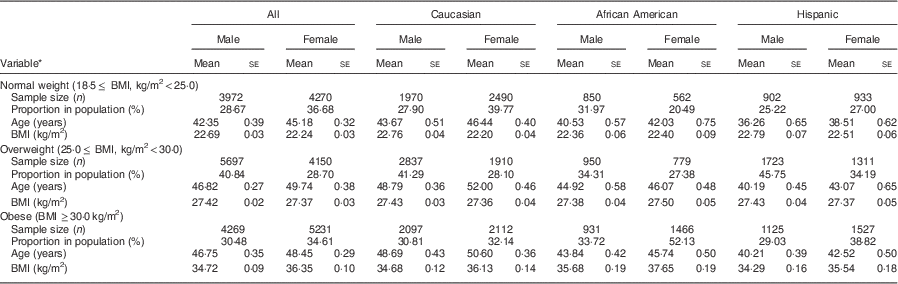
NHANES, National Health and Nutrition Examination Survey.
* NHANES 1999–2010 multiyear complex survey design was incorporated in estimations (except for sample size).
Table 2 reports daily energy intake by sex, race/ethnicity and body weight status for US adults aged 20 years and older. Even after excluding individuals who were on a special diet to lose weight, overweight and obese adults tended to consume less kilojoules on a daily basis compared with their normal-weight counterparts, and this pattern held for all sub-populations stratified by sex and race/ethnicity. Normal-weight men on average consumed 11 183 kJ/d, compared with 10 677 and 10 629 kJ/d among overweight and obese men; and normal-weight women on average consumed 7712 kJ/d, compared with 7372 and 7599 kJ/d among overweight and obese women, respectively. For energy composition, women had a higher proportion of energy intake from carbohydrate (49·9 %, 50·1 % and 49·6 % among normal-weight, overweight and obese females, compared with 48·7 %, 47·8 % and 46·7 % among their male counterparts, respectively) but a lower proportion of energy intake from alcohol (2·6 %, 2·0 % and 1·2 % among normal-weight, overweight and obese females, compared with 4·4 %, 4·1 % and 3·2 % among their male counterparts, respectively). In contrast, the shares of fat and protein intake were similar between men and women.
Daily energy intake by sex, race/ethnicity and body weight status: US adults aged 20 years and older (n 27 589), NHANES 1999–2010

NHANES, National Health and Nutrition Examination Survey.
* NHANES 1999–2010 multiyear complex survey design was incorporated in estimations.
Differential energy intake patterns were present across race/ethnicity. Compared with their African-American and Hispanic counterparts, Caucasian men consumed more kilojoules across different body weight status (11 452, 10 898 and 10 779 kJ/d among normal-weight, overweight and obese Caucasian men, respectively). Among the normal-weight and overweight female population, African Americans (7940 and 7571 kJ/d, respectively) tended to have higher energy intake than their Caucasian and Hispanic counterparts, whereas in the obese category, Caucasians (7702 kJ/d) ranked the top. For energy composition, across sex and body weight status, Hispanics had a noticeably larger proportion of energy intake from carbohydrate and a smaller proportion from fat compared with their Caucasian and African-American counterparts. Energy from carbohydrate accounted for 50·4 % and 52·4 % of daily total energy intake among overweight Hispanic men and women, respectively, compared with 47·1 % and 49·4 % among overweight Caucasian men and women. In contrast, energy from fat accounted for 29·7 % and 30·7 % of daily total energy intake among overweight Hispanic men and women, respectively, compared with 33·2 % and 33·1 % among their Caucasian counterparts. Among the female population, Hispanics had the lowest proportion of energy intake from alcohol (1·9 %, 1·1 %, and 0·7 % among normal-weight, overweight and obese Hispanic women).
Table 3 reports the estimated change in daily total energy intake associated with a 1 % pairwise substitution in composition between carbohydrate, fat and protein intake. Across all population subgroups stratified by sex, race/ethnicity and body weight status, substituting protein or carbohydrate for fat and substituting protein for carbohydrate were associated with decreased daily energy intake, with the largest effect resulting from substituting protein for fat. A 1 % increase in the percentage of energy from protein substituted for a 1 % decrease in the percentage of energy from fat was associated with a decrease in daily total energy intake of 268·2 (95 % CI 169·0, 367·4) kJ, 289·5 (95 % CI 215·9, 363·2) kJ and 293·7 (95 % CI 210·0, 377·4) kJ among normal-weight, overweight and obese men, and 177·4 (95 % CI 130·5, 224·3) kJ, 188·7 (95 % CI 139·3, 238·1) kJ and 204·2 (95 % CI 158·2, 250·2) kJ among normal-weight, overweight and obese women, respectively. A 1 % increase in the percentage of energy from protein substituted for a 1 % decrease in the percentage of energy from carbohydrate was associated with a decrease in daily total energy intake of 159·0 (95 % CI 59·8, 258·2) kJ, 183·3 (95 % CI 110·5, 256·1) kJ and 199·6 (95 % CI 115·9, 283·3) kJ among normal-weight, overweight and obese men, and 117·2 (95 % CI 70·3, 164·0) kJ, 128·9 (95 % CI 79·5, 178·2) kJ and 134·3 (95 % CI 88·3, 180·3) kJ among normal-weight, overweight and obese women, respectively. A 1 % increase in the percentage of energy from carbohydrate substituted for a 1 % decrease in the percentage of energy from fat was associated with a decrease in daily total energy intake of 115·1 (95 % CI 15·9, 214·2) kJ, 110·5 (95 % CI 36·8, 184·1) kJ and 94·6 (95 % CI 10·9, 178·2) kJ among normal-weight, overweight and obese men, and 59·0 (95 % CI 12·1, 105·9) kJ, 63·2 (95 % CI 13·0, 113·4) kJ and 71·5 (95 % CI 25·5, 117·6) kJ among normal-weight, overweight and obese women, respectively. In contrast, substituting fat or carbohydrate for protein and substituting fat for carbohydrate were associated with elevated daily total energy intake.
Estimated changes in daily total energy intake associated with a 1 % pairwise substitution in composition between carbohydrate, fat and protein intake by sex, race/ethnicity and body weight status: US adults aged 20 years and older (n 27 589), NHANES 1999–2010
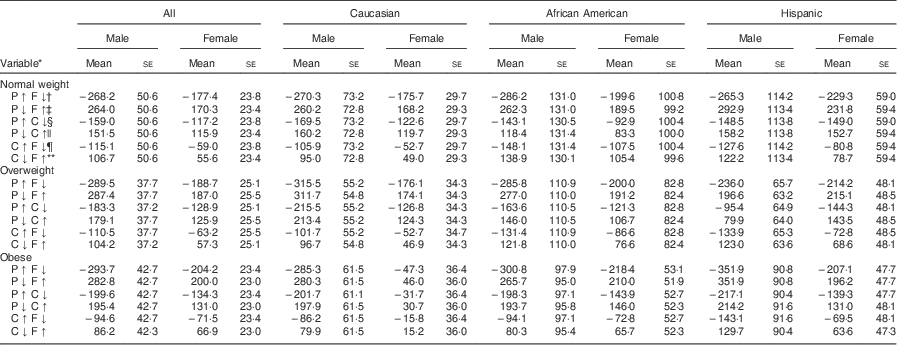
NHANES, National Health and Nutrition Examination Survey.
* Changes in daily total energy intake were estimated using Scheffé linear mixture models, accounting for NHANES 1999–2010 multiyear complex survey design.
† P ↑ F ↓ denotes a 1 % increase in the percentage of energy from protein substituted for a 1 % decrease in the percentage of energy from fat.
‡ P ↓ F ↑ denotes a 1 % decrease in the percentage of energy from protein substituted for a 1 % increase in the percentage of energy from fat.
§ P ↑ C ↓ denotes a 1 % increase in the percentage of energy from protein substituted for a 1 % decrease in the percentage of energy from carbohsydrate.
|| P ↓ C ↑ denotes a 1 % decrease in the percentage of energy from protein substituted for a 1 % increase in the percentage of energy from carbohydrate.
¶ C ↑ F ↓ denotes a 1 % increase in the percentage of energy from carbohydrate substituted for a 1 % decrease in the percentage of energy from fat.
** C ↓ F ↑ denotes a 1 % decrease in the percentage of energy from carbohydrate substituted for a 1 % increase in the percentage of energy from fat.
The relationship between macronutrient composition and daily total energy intake varied substantially across sex, race/ethnicity and body weight status. Among the male population, daily total energy intake among obese Hispanics appeared to decrease the most following a 1 % increase in the percentage of energy from protein substituted for a 1 % decrease in the percentage of energy from fat (351·9; 95 % CI 174·1, 111·3 kJ) or from carbohydrate (217·1; 95 % CI 40·2, 394·1 kJ), whereas daily total energy intake among normal-weight African Americans tended to decrease the most following a 1 % increase in the percentage of energy from carbohydrate substituted for a 1 % decrease in the percentage of energy from fat (148·1; 95 % CI −109·2, 405·4 kJ). Among the female population, daily total energy intake of normal-weight Hispanics tended to decrease the most following a 1 % increase in the percentage of energy from protein substituted for a 1 % decrease in the percentage of energy from fat (229·3; 95 % CI 113·8, 344·8 kJ) or from carbohydrate (149·0; 95 % CI33·5, 264·4 kJ), whereas daily total energy intake among normal-weight African Americans seemed to decrease the most following a 1 % increase in the percentage of energy from carbohydrate substituted for a 1 % decrease in the percentage of energy from fat (107·5; 95 % CI 89·1, 304·2 kJ).
To understand the clinical importance of a substantial compositional modification in diet, we calculated the change in daily total energy intake resulting from a 10 % increase in the percentage of energy from protein at the expense of a 10 % decrease in the percentage of energy from fat (or carbohydrate), and from a 10 % increase in the percentage of energy from carbohydrate at the expense of a 10 % decrease in the percentage of energy from fat (data not shown). A 10 % increase in the percentage of energy from protein substituted for a 10 % decrease in the percentage of energy from fat was associated with a decrease in daily total energy intake of 2892·8 (95 % CI 2791·1, 2994·1) kJ, 2992·8 (95 % CI 2919·6, 3066·0) kJ and 3404·9 (95 % CI 3316·2, 3493·6) kJ among normal-weight, overweight and obese men, and 2086·6 (95 % CI 2035·5, 2137·6) kJ, 1962·3 (95 % CI 1912·9, 2012·5) kJ and 2237·6 (95 % CI 2188·7, 2286·6) kJ among normal-weight, overweight and obese women, respectively. A 10 % increase in the percentage of energy from protein substituted for a 10 % decrease in the percentage of energy from carbohydrate was associated with a decrease in daily total energy intake of 1935·1 (95 % CI 1835·5, 2034·7) kJ, 2028·4 (95 % CI 1955·6, 2101·2) kJ and 2170·7 (95 % CI 2087, 2254·3) kJ among normal-weight, overweight and obese men, and 1242·2 (95 % CI 1195·0, 1289·1) kJ, 1406·7 (95 % CI 1358·5, 1454·4) kJ and 1482·0 (95 % CI 1433·4, 1530·5) kJ among normal-weight, overweight and obese women, respectively. A 10 % increase in the percentage of energy from carbohydrate substituted for a 10 % decrease in the percentage of energy from fat was associated with a decrease in daily total energy intake of 1559·8 (95 % CI 1456·0, 1664·0) kJ, 1381·1 (95 % CI 1304·2, 1457·7) kJ and 1320·1 (95 % CI 1231·8, 1408·3) kJ among normal-weight, overweight and obese men, and 755·6 (95 % CI 706·3, 805·4) kJ, 910·4 (95 % CI 856·9, 964·4) kJ and 913·4 (95 % CI 864·8, 961·5) kJ among normal-weight, overweight and obese women, respectively.
Discussion
The widespread presence of overweight/obesity, combined with the growing proportion of adults attempting weight loss, underlines the need to identify effective intervention strategies to support metabolic health and long-term weight control in the US adult population. Findings from the current population-level study confirmed the relationship between dietary macronutrient composition and daily total energy intake that has been reported in randomized experiments( Reference Paddon-Jones, Westman and Mattes 12 , Reference Halton and Hu 29 ). In particular, substituting protein for fat tends to be most effective in reducing total energy intake across all sub-populations by sex, race/ethnicity and body weight status, although the exact effect size differs. The consumption of protein is an established dietary practice for improved appetite control and satiety when compared with the ingestion of an isoenergetic amount of carbohydrate or fat( Reference Yancy, Olsen and Guyton 30 – Reference Westman, Yancy and Edman 33 ). As such, a diet that includes a modestly elevated protein intake at the expense of the other macronutrients may lead to weight loss through reduced daily energy consumption( Reference Tannous dit, Khoury, Obeid and Azar 34 ). Moreover, dietary protein intake provides the amino acid substrates needed for maintenance, repair and synthesis of muscle proteins( Reference Burd, Tang and Moore 35 ). The maintenance of skeletal muscle mass, and the associated preservation of BMR, are necessary for long-term weight stability as well as to minimize the likelihood of weight gain( Reference Lejeune, Kovacs and Westerterp-Plantenga 7 , Reference Westerterp-Plantenga, Lejeune and Nijs 36 , Reference Layman, Boileau and Erickson 37 ).
Simulation results indicate that a 10 % pairwise substitution in macronutrient composition has a substantial impact on daily total energy intake, and in general the effect size increases with weight category. Especially, a 10 % increase in the percentage of energy from protein substituted for a 10 % decrease in the percentage of energy from fat was estimated to be associated with a decrease in daily total energy intake of 25·9 %, 28·0 % and 32·0 % among normal-weight, overweight and obese men, and 27·1 %, 26·6 % and 29·4 % among normal-weight, overweight and obese women, respectively. The average percentage of energy from protein was 15·4 % in the US adult population during 1999–2010, and thus a 10 % increase would be arguably quite large (a relative increase by 64·9 % from baseline rate). However, this percentage is within the acceptable macronutrient distribution range for dietary protein, which is 10 % to 35 % of energy from protein for adults( 38 ). In fact, evidence suggests that the current protein reference daily intake (RDA), which is essentially represented by the lower distribution range of the acceptable macronutrient distribution range, is insufficient to cover the daily needs for protein with ageing( Reference Pennings, Groen and de Lange 39 , Reference Campbell, Trappe and Wolfe 40 ), programmes of exercise training( Reference Tarnopolsky 41 ) and/or during periods of reduced dietary energy intake( Reference Weinheimer, Sands and Campbell 42 , Reference Krieger, Sitren and Daniels 43 ). A systematic review cautioned against excessive protein intake greater than two times of the protein RDA (~130 g for adult men and women) for potential urinary Ca loss and bone loss, especially among those with diabetes mellitus or predisposed to nephrolithiasis or kidney disease( Reference Eisenstein, Roberts and Dallal 44 ). However, evidence regarding the potential detrimental impact of dietary protein on bone or renal health is sparse( Reference Massini, Han and Seifter 45 – Reference Fenton, Tough and Lyon 47 ). In contrast, the consumption of high(er) protein diets is more commonly associated with positive health outcomes (e.g. improved bone health and/or reduced risk for CVD)( Reference Josse, Atkinson and Tarnopolsky 48 , Reference Santesso, Akl and Bianchi 49 ), unless already at risk for the development of kidney failure( Reference Kovesdy, Kopple and Kalantar-Zadeh 50 ). Given the much lower actual daily protein intake among US adults (82·6 g) relative to the recommended level, a 10 % increase in the percentage of energy from protein is unlikely to result in severe adverse health outcomes in the healthy, US adult population.
The present work confirmed findings from previous studies on the heterogeneous energy intake patterns across sex and race/ethnicity( Reference Leblanc, Bégin and Corneau 16 – Reference Wang and Chen 22 ). Moreover, the relationship linking macronutrient composition to daily total energy intake appeared to differ between population subgroups stratified by sex, race/ethnicity and body weight status. Admittedly the concurrent evidence is rather preliminary and the differences are often statistically non-significant, which warrants future research and result replication. Nevertheless, it is the very first attempt to estimate sex-, racial/ethnic- and weight-specific impact of macronutrient composition on daily energy consumption, indicating the importance of considering population heterogeneity in designing dietary guidelines and providing nutrient intake recommendations.
The beneficial health effect of protein products has been highlighted in the 2010 Dietary Guidelines for Americans( 51 ). Moreover, caveats are given on choosing among animal-based foods: ‘…some protein products, particularly some animal-based sources, are high in saturated fat, so non-fat, low-fat, or lean choices should be selected’. A possibly less emphasized point is the importance of substitution between macronutrients (protein or carbohydrate for fat, protein for carbohydrate) because fundamentally it is the total energy intake, rather than energy intake from any macronutrient alone, that impacts body weight. If increased consumption of protein products is not accompanied by a proportional reduction in fat intake, daily total energy consumption would only increase, so that the modification in dietary profile is unlikely to translate to healthier weight status.
Several limitations of the present study should be noted. Dietary intake data in NHANES are subject to under-reporting and the discrepancy between estimated and self-reported energy intake appears largest among the obese respondents( Reference Archer, Hand and Blair 25 ). Sensitivity analyses indicate that this under-reporting is likely to result in underestimation of the change in daily total energy intake associated with compositional variations in carbohydrate, fat and protein intake. Body weight status is based on BMI, a function of weight and height, rather than on body fatness. Although BMI has been found to be closely associated with percentage body fat measured by dual-energy X-ray absorptiometry in the NHANES, these two measures are fundamentally different and their levels of agreement could be a function of sex, age and race/ethnicity( Reference Flegal, Shepherd and Looker 52 , Reference Fernandez, Heo and Heymsfield 53 ). Despite the large overall sample size, multilevel stratifications by sex, race/ethnicity and body weight status compromised the statistical precision of estimation for some subgroups. The current study is observational in design, so that the estimated relationship between daily total energy intake and macronutrient composition should be interpreted as association rather than causation. Within-individual variability was not considered in the estimation due to the cross-sectional study design of NHANES. NHANES is a probability sample of the US non-institutionalized population and the dietary intakes within patients in penal/mental facilities, institutionalized older adults and/or military personnel on active duty were not captured.
Conclusion
In conclusion, the present study estimated the change in daily total energy intake associated with compositional variations in carbohydrate, fat and protein intake among US adults using multiple years of data from a large nationally representative survey. For all sub-populations by sex, race/ethnicity and body weight status, substituting protein or carbohydrate for fat and substituting protein for carbohydrate contributed to decreased daily energy intake, with the largest effect resulting from substituting protein for fat. The relationship between macronutrient composition and daily energy intake appeared heterogeneous across population subgroups. Policies promoting higher daily protein intake at the expense of lower fat intake could be effective in reducing total energy intake in the US adult population.
Acknowledgements
Financial support: This research received no specific grant from any funding agency in the public, commercial or not-for-profit sectors. Conflict of interest: None. Authorship: R.A. designed the study, conducted the statistical analysis and wrote the manuscript. N.A.B. contributed to modelling result interpretation and manuscript drafting. Ethics of human subject participation: This study used de-identified public-use data and thus was exempt from human subjects review.



