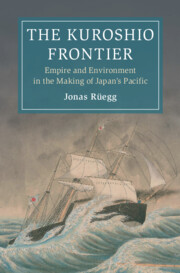


Born a people of the sea
Born to be true men
We once stood in awe
Of the vast Pacific’s Kuroshio
The day has come on which
Our blood boiling with ambition
We celebrate its crossing
Maybe it was by pure chance that John Bravo ended up in the Bonin Islands. Born to Cape Verdean farmers, John signed on to a British whaling vessel at age eighteen like many others in search of a better life, and could not know that he would die, many decades later, a subject of the “tycoon” of Japan. John’s ship entered the Pacific in 1831 and steered into the warm Kuroshio current, the most prolific whaling ground at that time. While cruising the coasts of Japan – then a “double bolted land” for the whalers, to borrow Herman Melville’s phrase – John was seized by a disease that may have been scurvy, a form of vitamin deficiency common among whaling crews.Footnote 1 His captain abandoned him at next landfall, for it was believed that extended absence from land, rather than malnutrition, debilitated able-bodied sailors.Footnote 2 In the Bonin Islands, also known by the Japanese name “Ogasawara” today, a group of settlers made a living by catering to the frequently approaching foreign vessels. These migrants and the traffic they enabled were at the forefront of an industrial transformation that contracted the vast Pacific into a contested political environment.
Located in the very heart of a prolific offshore zone then called the “Japan Ground,” the islands had become an important piece of infrastructure since the whaling boom of the 1820s. The migrants – sailors, farmers, and laborers who, since 1830, had immigrated from Hawaiʻi, other Pacific islands, and Western countries – grew bananas, sugar, taro, and yams, turning the islands into an offshore entrepôt in the rising tide of Pacific traffic. Far beyond the reach of effective governmental control, the islands became a transit hub of people, goods, and introduced species. Despite the business opportunities that sea traffic had brought to the region, life was harsh for John. Having survived his disease, he started farming together with a woman who, it must be assumed, had been brought from her native Hawaiʻi in 1832 by one of the traffickers that moved Native labor around the Pacific.Footnote 3 Mice infested the harvest; tropical storms, tsunamis, and pirates posed ongoing threats. Since the number of American vessels alone had exceeded 700 by the mid-1840s, carrying some 20,000 sailors and their portmanteau biota across the seas at any given time, this region in the vast ocean experienced rapid transformations both ashore and under the surface.Footnote 4
These changes were noticed in Japan as well. The presence of Western whalers all around the archipelago discomfited Japanese leaders and caused controversy among scholars and officials. Where the astronomer Nishikawa Joken (1648–1724) once stated confidently that Japan was “surrounded by an impregnable sea,”Footnote 5 by the close of the eighteenth century, geographers and strategists had remapped Japan as embedded in an archipelagic world. Russian incursions from the north and a violent encounter with a British frigate in Nagasaki in 1808 had laid bare the growing pressure on the Japanese system of foreign policy, a cornerstone of Tokugawa rule (1600–1867).Footnote 6 Increasingly frequent observations of foreign vessels, and the discovery of offshore mingling between Japanese fisherfolk and foreign seafarers provoked anxious reactions and stepped-up seclusion policies, deepening the shogunate’s conservative attitudes toward the rapidly transforming Pacific world. In the vernacular discourse, on the other hand, reports of returning castaways and rumors of barbarians cruising off Japanese coasts inspired fantasies of adventure and exploration, colonial riches, and violent subjugation of foreign peoples. By the time the shogunate decided to join the scramble for naval influence in the Pacific in the 1850s, it had become clear that taming the ocean required appropriating know-how and technologies from those whalers and seafarers who had come from half a globe away to turn the formerly “empty” sea into a churning frontier.
This book begins with the observation that Japan’s turbulent nineteenth century – with its modern revolutions, rapid industrialization, and imperial expansion – unfolded in intimate connection with developments in the oceanic world we now call “the Pacific.” Looking at the archipelago from the sea, it appears strange indeed that “Japan,” a major colonial power in Oceania throughout the first half of the twentieth century, is hardly ever considered as a part of the Pacific world itself. Tongan anthropologist Epeli Hau‘ofa famously criticized the terracentric biases that belittle Pacific islands as small and isolated, instead introducing the idea of Oceania as a “sea of islands” to account for the region’s connectedness and expanse.Footnote 7 Likewise, it is important to notice that Japan is by no means an island limited to a confined terrestrial world, but rather an archipelago with a terraqueous economy. Awash in the greater Pacific, currents surge across the archipelago, nourishing fishing grounds, regulating the climate and dictating the direction of drift and travel.Footnote 8 Despite the introversive policies codified in maritime prohibitions since the 1630s, the ocean never ceased to figure as the chief base of existence for a large part of Japan’s coastal population. Networks of trade in marine produce spanned the entire archipelago and beyond, enmeshing even the most remote farming villages with the marine origins of their herring fertilizers and whale sinew tools.Footnote 9 With growing awareness of foreign traffic off Japan’s eastern shores in the early nineteenth century, accounts of sub-elite maritime encounters far from the centers of political power shaped a new vernacular imaginary of the Pacific as a defined body of water with inhabitants, travelers, and looming empires along its rims.Footnote 10
Many of these encounters at sea were key moments in the modern history of Northeast Asia. Unlike its conventional representation on land-centric maps as a structure-less, light blue anywhere, the western North Pacific is a space with a specific, though fluctuating, geography of winds, currents, and migrating animals. This fluid seascape has attracted human interest at different moments in time. Its three-dimensional geography is essentially shaped by maritime currents, such as the cold Oyashio and the warm Kuroshio currents, and the seasonal winds of the East Asian Monsoon system. A close focus on the history of ocean and islands along the path of the Kuroshio Current – a region I call the Kuroshio Frontier, given its unending history of resource extraction and its lasting meaning in Japanese identity – reveals seemingly marginal places, agents, and events as deeply implicated in the making of modern Northeast Asia. The radical reshuffling of state institutions during the Meiji reforms and the empire’s military emergence in wars fought on the Korean peninsula all appear in a different light if contextualized with the incorporation of the archipelago’s insular outskirts since the mid nineteenth century. The shogunate’s pivot to the Pacific, involving costly naval projects and a colonial venture to the Bonin Islands, set the stage for the expansionist thrust that would fuel the quest for a sprawling, archipelagic empire. Before century’s end, Japan had in fact gained control over a vast maritime territory, studded by minute colonies on formerly uninhabitable isles.
I argue that developments in a rapidly contracting Pacific over the course of the nineteenth century influenced how Japanese intellectuals redrew the map of their islands, and that nineteenth-century Japan, conversely, has been an important agent in the making of the modern Pacific. The country’s radical geopolitical reorientation and its reinvention as an archipelagic empire over the course of the nineteenth century were ushered in at sea. This observation stands in stark contrast to exceptionalist narratives of insular seclusion that still pervade popular narratives and feed nationalist myths of Japanese uniqueness. Likewise, embedding Japan’s early modern period in its oceanic context challenges celebrations of miraculous economic growth amid alleged resource scarcity. Throughout the early modern period, the archipelago remained ecologically and intellectually embedded in an ambiguous oceanic environment. What, then, if we were to reconsider Japan’s modern transformations as immersed in the greater currents of Pacific history?
Oceanic Japan
This book is about Japan, at the same time that it challenges the nation state as the cardinal framework for the East Asian past. It also is a book about people and places on the periphery of the “Asia-Pacific” region and aboard voyaging vessels: drifters, castaways, and marine animals whose lives are intimately tied to political developments on shore. Revisiting the country’s modern emergence as embedded in its oceanic context has several implications on the way Japanese history is framed temporally, spatially, and with regards to the actors that shaped its course. The arguments I make emerge from eco-critical analyses of material conditions and intellectual discourses, and they speak to Japan’s national historiography as much as they address Pacific and global historical questions.
In Japan and abroad, Japanese historiography is characterized by a rigid division of scholarly communities into modernists and early modernists, separated by the watershed moment of the Meiji Reform (1868). Intellectual and institution-centered histories of Japan tend to reproduce this caesura of the Tokugawa shogunate’s (1600–1867) downfall and the founding of the “modern” empire. Disparate archives, languages, and administrative styles complicate attempts at the division’s unmaking. The history of the Kuroshio Frontier, by contrast, encompasses the nineteenth century in its entirety, beyond the political disruptions in the century’s second half. This is not to say that the radical social reforms of the Meiji period (1868–1912) were unimportant. Neither does it mean that the commercial and proto-industrial developments under the Tokugawa shogunate programmed the rapid, fossil-fueled industrialization of the late nineteenth century, or the empire’s colonial expansion over subsequent decades.Footnote 11 Rather, my choice of a temporal scope that ranges from late seventeenth-century Pacific explorations to the archipelagic empire’s collapse in the Pacific War should enable a longue durée perspective on the social and ideological contexts from which new actors emerged, such as the petty tycoons and labor migrants who populated the Kuroshio Frontier by the turn of the twentieth century.
Drawing attention to the ocean is also an argument about geography. We will see that some of the most consequential developments in Japan’s modern revolutions began in places such as the shoals off Ryukyu’s Yaeyama islands, in the Bonin Islands’ bay of Port Lloyd, or on the offshore whaling and tuna grounds in the Kuroshio extension east of Honshu. Accordingly, the so-called “opening of Japan” becomes less of an epic culmination and more of a gradual erosion, an involvement from the periphery, the political consequences of offshore industrialization. Calling these places a frontier is, moreover, an argument about actors. By foregrounding places that are conventionally omitted from the narrative arc of grand histories, I point a spotlight at local experiences and subaltern individuals whose lives may come to us through fragmentary records of hastily compiled population indexes, or merely through layers upon layers of outsider reports. While destinies on the ground contrast with the more visible decisions of investors, naval commanders, and government officials pertaining to the periphery, these more conventional actors remain in the picture as ideologues and propagators of scientific visions that bundled self-interested individuals into national, commercial, or subversive actor groups.
Attention to the oceanic resource base of the Japanese economy challenges assumptions about its growth in alleged resource scarcity. As a source of protein, cash commodities, and ideological orientation, “Japan’s Pacific” was never limited to the empire’s formal boundaries but expanded along currents and migration routes to remote ecosystems, driven by technological change, industrial policy, and ideological momentum. The observation that the ocean represented not just a direct source of foodstuffs but also a supplier of commercial fertilizers for the metropole’s increasingly intensive agriculture raises questions about the geography of growth in the archipelago since the early modern period. In his work on the history of fertilizers, Toshihiro Higuchi finds that “Japan’s nitrogen cycle … describes an open system in which its agricultural core managed to avoid a biogeochemical crisis by sucking up nitrogen and other soil nutrients from outside.”Footnote 12 A gradual enlargement of the archipelago’s marine catchment area since the seventeenth century in fact anticipated the “pelagic empire” of Japanese industrial fisheries in the 1930s that William Tsutsui identifies as stretching “from the Bering Sea to the Antarctic and along the coastlines of virtually every Asian country, from the pearl beds off of Darwin, Australia, to the trawling grounds of the Gulf of California.”Footnote 13 Transcending both the downfall of the Tokugawa shogunate and the collapse of Japan’s modern empire, the nation’s endless quest for formal and informal influence over a vaguely defined maritime sphere of extraction expanded the archipelago’s ecological resource base steadily over the course of two centuries.Footnote 14
The focus of “oceanic history” is directed at human–environmental co-transformation at and beyond the verges of the human habitat, but the word “oceanic” can also be understood as “relating to Oceania” in a broad anthropological sense.Footnote 15 Oceania is a large, though often neglected and critically endangered, pool of human experience. Fragmented by “colonial boundaries that confined ocean peoples to tiny spaces,”Footnote 16 as Hau‘ofa once critiqued, the region has inspired transferable theoretical approaches to the history of silenced and underrepresented communities. Cross-regional conversations around theoretical exchange bear great potential for Japan. Understandably, postcolonial scholarship on Oceania tends to shield the island Pacific from the rim and its empires, though such reactions to continental hegemony risk drawing up ahistorical divisions.Footnote 17 Bringing Asia back into the history of Oceania is necessary, since the rims and their ideologies continue to impose themselves on the region, as centers of consumption and capitalist power that force their imprint on Pacific landscapes. However, expanding “Oceania” as an analytical framework in the process, to encompass communities along Pacific rims, can be tantamount to an inversion of epistemic hierarchies. It helps overcome the limitations of rigid national categories in Asia and connect shared experiences of colonization, commercial expansion, and environmental change along border-crossing networks and ecosystems.Footnote 18 Japan, this archipelago-turned-continental-empire, holds a key position in this history of Pacific–rim interaction.
The fact per se that Asian and Pacific histories are linked is hardly a new discovery. Within the Japanese scholarly discourse, maritime historiography bears the enduring imprint of Yanagita Kunio’s (1875−1962) quest for the origin of the Japanese people along the upper reaches of the Kuroshio, as outlined in his seminal work The Maritime Path, which was published in 1952.Footnote 19 In the 1970s and 1980s, Amino Yoshihiko paired the ethnographically oriented school of minshūshi, or “Popular History,” with Braudelian ideas, reframing Japan’s coasts as embedded in regional networks of maritime exchange.Footnote 20 At the turn of the twenty-first century, these ideas were further developed by François Gipouloux, Oka Mihoko, and Haneda Masashi, who have sought to explain the Asia-Pacific region as an “East Asian Mediterranean,” with seasonal rhythms that dominate traffic between the commercial and political centers.Footnote 21 In a similar vein, Hamashita Takeshi argues that East Asian harbor towns, nodes in a chain of “interlinked” trading networks, connected distant commercial partners through a multitude of entrepôts, reaching from the Sea of Okhotsk to the Japan and East China Seas, from the Yellow to the South China Seas and on to the Sea of Java and the Bay of Bengal.Footnote 22 What connects all of these works is their exclusive interest in encounters across the seas west of the East Asian archipelago, mostly commercial and military in nature, while the archipelago’s southern and eastern boundaries continue to figure as the limit of the known world.
These seas are in fact vastly different from the Mediterranean bathtub. Geophysical processes like rapid currents and violent summer typhoons, as well as seasonally shifting wind patterns, make it necessary to reexamine regionalities as environmental categories. This also offers ways to challenge the worn-out dualism of East and West. For example, it is widely accepted among climatologists that the constant southeasterly summer winds that pump moisture from the Pacific onto the Asian continent, and the strong northerly winter winds that create a dry climate in these regions during the winter months, are part of the Australasian monsoon. Climatic events in the ocean, such as the interannual El Niño-Southern Oscillation (ENSO) or the decadal “Large Meander” of the Kuroshio, as well as seasonal typhoons, illustrate the limitations of the “East Asian Mediterranean” model and suggest historically relevant similarities between the East Asian seas and the Indian Ocean’s monsoon zone, for example. Attention to the transregional dimension of these processes enables comparative or teleconnected histories that challenge Eurocentric assumptions about the environmental context of East Asian capitalisms.
The study of oceans requires a methodology that pays close attention to the workings of the ocean as an ecosystem – distinct from grasslands, forests, or deserts – that is nevertheless affected by the same ideological precepts that inform human actions. Indeed, romantic analogies to the land-borne frontier pervaded the discursive subjection and territorial incorporation of the “ocean wilderness” since the emergence of pelagic whaling.Footnote 23 The concepts we use to define claims to the ocean have, time and again, been coined by bureaucratic governance, management principles, and geopolitical interests, creating ideas such as the Maximal Sustainable Yield that, as Carmel Finley shows, are part of the problem rather than the solution in the unfolding marine life crisis.Footnote 24 In Europe as much as in Asia, the ocean existed “outside of time,” even though falling catch rates have begun to evidence the regional decline of marine fauna centuries ago.Footnote 25 To write the living ocean into the history of Japan thus means looking beyond anthropocentric categories and embracing a terraqueous understanding of the archipelago’s economy.
This approach may contribute to the oceanic history Ryan Tucker Jones proclaimed as “attuned to the specificities of discrete locations in the ocean, both across horizontal space and through the water column.”Footnote 26 Beyond purely ecological transformations, Jones is interested in the “ways in which marine animal and marine human communities are structured, how they change, and how they change each other.”Footnote 27 Ecology today pervades all aspects of human history as a web of distributed agencies that contribute to a chaotic whole that appears, in its totality, utterly unpredictable. Prasenjit Duara takes oceans as a “paradigm to illumine the temporal processes of human and other natural activities,”Footnote 28 underlining that the figurative “drift” in the meanders of historical currents can be described but not determined or reproduced. Maritime currents are hard to grasp, for though they follow certain patterns, their fluid dynamics evade terrestrial allegories of rivers, branches, or “maritime paths.” Inverting the terrestrial bias and subjecting land-borne history to hydrological cycles is therefore a challenge to technocratic progressivism and an exercise in questioning the epistemic hierarchies that inform how humans interact with their environment.
The history of Japan’s oceanic expansion bridges the conventional divides of early modern and modern, shogunal and imperial, insular and global. Writing the ocean into Japanese history blurs the archipelago’s geographical boundaries, as well as the very idea of Japanese nationality. As a shift of focus, oceanic history brings once marginalized locations and subaltern agents to the fore. In the early nineteenth century, castaways acted as transmitters of crucial information about international affairs, while petty fishermen undermined the shogunal monopoly on international exchange by peddling with foreigners offshore, thereby eliciting anxious responses among the top tiers of shogunal bureaucracy. Migrants to the frontier, such as the settlers of the Bonin Islands, revealed themselves as agents of knowledge production in the 1860s, when they were hired at lavish salaries to instruct Japanese crews in the methods of pelagic whaling. In the early years of the Meiji Period, this community of islanders was among the first to choose naturalization and become legally Japanese. Migrants heading out from Japan’s maritime outliers, again, went on to form migrant networks that in the twentieth-century sprawled across the Pacific in search of opportunities and still abundant fishing grounds. In short, revisiting Japan’s modern revolutions from the archipelago’s Pacific fringes challenges the metropole’s bureaucratic gaze and brings marginalized agents and processes to the fore.
The Kuroshio Frontier
The Kuroshio or “Black Tide,” named after its dark color, flows as a cohesive mass of water that differs from its surroundings in temperature, density, and salinity. The warm current – a Western boundary current like the Gulf Stream in the Atlantic – meanders northwards between the Philippines, Taiwan, and Japan. Given its strong influence on navigation all along the southern rims of the Japanese archipelago, the current is also known as the “Japan Current” (Figure I.1).Footnote 29 From the zone where its flow is deflected north by the shore of Luzon, the current acts like an enormous pipeline or “nutrient stream” that transports energy in the form of warm and salty water rich in phosphate and nitrate to northerly climes. The nutrients are consumed by plankton and attract fishes of all kinds wherever the current climbs over underwater ridges or onto the continental shelf into the photic zone, within reach of solar rays.Footnote 30 On its meandering path, the current creates a fluid geography of prolific upwellings, seasonal fluctuations, and navigable routes. At times fluctuating over hundreds of kilometers within a span of weeks, the current exerts a vast impact upon coastal and pelagic fisheries. If the Kuroshio’s bent path represented the boundary of the navigable realm for early modern Japan, with the emergence of pelagic sailing and steam shipping, the worlds beyond it became the Kuroshio Frontier.
Bathymetric map of the Kuroshio Frontier, oriented with south at the top, showing major currents in their usual patterns. The warm and nutrient-rich Kuroshio current creates prolific environments as it climbs over underwater ridges and on the continental shelf within the reach of sunlight. The current can shift its path over hundreds of kilometers within a few weeks, affecting the local climate and reshuffling the geography of fishing grounds (dotted line).

Figure I.1 Long description
The map further displays features of maritime topography such as bioproductive regions and the underwater topography. Leaving landmasses blank, it graphically emphasizes the specificity of oceanic geography.
I use the term “frontier” as a strictly analytical tool here, as the Japanese language does not know an exact correspondent for the concept in its historical dimension. Although the word henkyō or kyōiki for “periphery” or “borderland” were used as Chinese loanwords, the frontier as a process of historical incorporation is merely known in transliteration today, as furontia.Footnote 31 Likewise, the clearing of agrarian land or kaitaku was used to describe the opening of domestic and overseas lands in Japanese. It was not until the colonization of Taiwan that the modern word shokuminchi, or “colony,” was used to describe land appropriation by Japan. A neologism introduced by Shizuki Tadao (1760–1806) in 1801 to describe Western colonialism, shokuminchi uses the characters for “cultivating,” “population,” and “place,” indicating its reference to early modern settler colonialism. A frontier, however, is different from a colony. The concept chiefly serves my purpose as an ecological category that helps analyze the material connections between sites of extraction and centers of consumption. This is, of course, not a “natural” state of affairs, but one created by (early) modern power imbalances. At the same time, the frontier constitutes an actor category, though one that produces clearly distinct actions on shore and at sea, as will be explained. The frontier’s fluidity – as much in terms of its physical fluidity as in terms of the resulting mobility of people, animals, and resources – is crucial to understanding the way migrants, governments, and corporations understood and engineered the frontier’s ecosystems. As a state of mind, the frontier legitimized the willful rejection of ecological responsibility and the subordination of environmentally embedded economies to the paradigm of unlimited accumulation. Thinking of the ocean as a frontier in Japanese history ultimately helps understand visions and ideological biases that inform collective decisions pertaining to the Pacific down to the present.
Originating in scholarship of the American West, the frontier concept has come a long way since it came about at the close of the nineteenth century. Though it is applied liberally to various historical settings today, some historians (mainly Americanists) caution against the teleological pitfalls and ethnocentric biases at the heart of the original concept. There is no denying that Frederick Jackson Turner (1861–1932), by theorizing the frontier as a “record of social evolution” that “begins with the Indian and the hunter; goes on to tell of the disintegration of savagery by entrance of the trader, the path-finder of civilization; … and finally [of] the manufacturing organization with city and factory system,” affirmed ideologies of cultural hierarchy.Footnote 32 More recent applications, however, have revealed the frontier as an analytical tool to critique and dismantle the very hegemony of metropoles.
Postcolonial adaptations of the frontier have flourished, especially among scholars interested in non-Western empires. Most notably so for representatives of the “New Qing History” movement, for whom the very existence of imperial frontiers with frontier migrants, ethnic tensions, and large-scale environmental alterations undermine the appearance of Han-Chinese dominance and globalize questions pertaining to the emergence of early modern state institutions.Footnote 33 In particular, the concept enables macroscopic perspectives on the subversive activities of Native populations in liminal spaces of ambiguous state power. Ways of life and patterns of agency gain importance that, though based on autonomous decisions, grew up in the long shadow of metropolitan power structures.Footnote 34 Essentially, the question is whether it is possible to read the frontier without internalizing the perspective of those for whom it was not home. Contemporary frontier studies are indeed interested in centering this anti-metropole by bridging ethnic and socio-economic categories. James Scott, who studied the Southeast Asian uplands, observed that “the existence of an open frontier operated like an automatic brake on what the state could extract,” as “mobility allowed farmers to escape the impositions of states and their wars.”Footnote 35 As a sociological concept as much as in environmental history, the borderless frontier is characterized by its hierarchical social and metabolic relationship with one or multiple distant metropoles.
The people of the Kuroshio Frontier – sailors, farmers, and laborers from Hawaiʻi, various Pacific islands, Western countries, and, ultimately, Japan – who traveled and settled across the region made self-interested choices that affected the appearance of the empire which would soon encompass them. Many immigrants to the Bonin Islands had followed opportunities created by the advent of the whaling industry, and they readily offered their know-how in pelagic whaling to the Japanese. These subjects were co-opted at varying degrees of coercion, and they often found themselves on the receiving end of bureaucratic centralization. By the close of the nineteenth century, the frontier had become the scene of a pervasive commercial resource extraction that encompassed Japanese migrant labor beyond direct state control in rudimentary settlements on Torishima, Marcus Island, and even the Midway atoll.Footnote 36 In many of these places, the extension of commercial activities at the hands of entrepreneurs such as Mori Koben (1869–1945) in Micronesia ultimately paved the way for a Japanese takeover during World War I.Footnote 37
The cost of modern life in Japan cannot be mapped exclusively within Japan. Neither can the Japanese economy be understood as separate from the far-flung sources of the fuel, fertilizers, or foodstuff that power it. Focusing on extractive relationships between a vaguely defined, borderless resource frontier and a consuming metropole has proven especially useful for analyzing environmental transformations beyond the borders of formal empire.Footnote 38 In this sense, the frontier is comparable to an ecological footprint or a catchment area that expands along commercial power lines and beyond political borders, powered by technological innovation, changing business practices, and consumptive behavior in the metropole. To critically analyze the commercial mechanisms that demand an ecological toll beyond view of the metropole, it is crucial to overcome the framework of national economies and account for the oceanic spaces at and beyond the boundaries of the human habitat, in its fluid, volumetric capacity.
Seen as a three-dimensional landscape of currents, catchment areas, and migrating animals, the ocean’s dynamism and depth complicate territorial notions of sovereignty, empire, and historical change. As the arrival and disappearance of Atlantic whalers in the “Japan Ground” in the 1830s, or the later mushrooming of short-lived bird hunting colonies on desolate isles show, resource extraction operates in a spatially layered manner. Since the emergence of industrial practices, these layers have been worked through one by one as a result of destructive practices offshore that rely on continued expansion and technological innovation. Like the “bomb-lance” whale gun brought to the frontier around 1860, new technologies have rarely enhanced sustainability, but mainly, they delayed the extractive industry’s collapse by enhancing the efficiency of extraction.
Oceanic frontiers across time generally evade closure, remaining geographically and historically open-ended.Footnote 39 Accordingly, the Kuroshio Frontier is not simply a “Japanese lake,” but rather, the object of an ongoing inter-imperial competition with a greater ideological significance. The Atlantic whalers who plied the frontier in the early nineteenth century caused clashes over frontier islands, and the data they collected at sea trained the imperial gaze on the resources and waterways of the Pacific as a natural extension of the continental frontier.Footnote 40 In a related sense, to establish and enforce its claims to the frontier was an act of symbolic significance for the Tokugawa shogunate – just as today, staking claims to the now-uninhabited Senkaku or Diaoyu Islands off Taiwan and the rich fossil deposits underneath them has become a symbolic battle for China, Japan’s chief regional competitor. In contrast to Jason Moore’s definition of “commodity frontiers,” which takes frontier incorporation as a product of metropolitan consumerism and expansion, most islands of the Kuroshio Frontier experienced no thorough incorporation.Footnote 41 Rather, enterprises emerged within the frontier and created new forms of capitalist management based on unsustainable, and therefore spatially shifting, resource extraction. Exploited resource by resource and affected heavily by invasive species, many of these islands now lie abandoned.
The discrepancy between territorial legislation, extended 200 nautical miles into the sea by the 1982 UN Convention on the Law of the Seas (UNCLOS) in the form of Exclusive Economic Zones (EEZ), and the fluid connectedness of the ocean keep confounding the attempts of bureaucratic states to pin down and inventory people, animals, and resources. As Carmel Finley argues, international attempts to tackle the “tragedy of the oceanic commons” in a territorial manner have been obstructed by national governments, chiefly the USA, Japan, and, most recently, China, which subsidize fisheries beyond their EEZ for naval strategy and as negotiating tokens.Footnote 42 John G. Butcher equates the depletion of fish stocks in Southeast Asia to a frontier closure.Footnote 43 If, however, we regard frontiers as networks of entangled and increasingly complex industries, as in Jason Moore’s description of commodity frontiers, the Kuroshio Frontier is an ongoing process that transcends the decline of the whaling industry, the near-extinction of sea birds, or the depletion of guano mines. Depletion continues to necessitate shifts to new resources, essentially powered by technological innovation and spatial expansion to more remote resources. In this sense, the vertical expansion toward ever-deeper deposits of inanimate resources in the twenty-first century represents an open-ended sequence of short-lived frontier stages.Footnote 44
Meanwhile, Japan’s unending frontier, to borrow John Richards’ expression, continues to expand beneath the surface toward deposits of methane ice, petroleum, and rare earth minerals expected to become exploitable in the near future.Footnote 45 With fish and other living resources reduced to a fraction of pre-industrial levels, the imperial competition over maritime space has largely shifted to a focus on deep sea resources and naval access. In a materialist sense, the “fluid and ‘inclusive’ intercultural frontiers”Footnote 46 Adelman and Aron take as characteristic, have not given way to fenced-off borderlands at sea. To be sure, maritime border solidification is as real in the perception of human travelers as it can be for the law-based exploitation of fish and mineral resources. But much of the world’s oceans remains a lawless frontier beyond view of the public eye.
Structure of the Book
This book proceeds by-and-large in a chronological manner. I begin with a macroscopic picture of the geophysical processes that dominate ocean and atmosphere in Northeast Asia and ask how phenomena such as the East Asian Monsoon, tropical typhoons, and, most importantly, maritime currents, have affected the terraqueous metabolism of the Japanese archipelago historically. Subsequent chapters reevaluate historical processes foregrounding local experiences and their impact on greater political transformations. The conclusion, with an epilogue that runs into the twenty-first century, reflects on the theoretical implications of the source base at the heart of this project in the context of shifting disciplinary boundaries in the age of climate change.
Chapter 1 argues that the geophysical processes that dominate the ocean and the atmosphere in the western North Pacific create a maritime environment that is less comparable to the oft-referenced Mediterranean – the classical cradle of early modern capitalism – than it is to the monsoon zone in the Indian Ocean. This has implications for the framing of economic history in the region. Winds and currents that are hard to navigate created a dynamic topography within which the Japanese developed commercial conventions and maritime policies. Strategies of risk distribution and avoidance mattered for maritime businesses, since some of the archipelago’s most important whaling grounds and cargo routes led sailors into turbulent waters. The marine industries that had been growing since the seventeenth century gradually expanded the archipelago’s resource base, supplying both foodstuff and fertilizers to the land-borne economy. Over the course of the early modern period, increasingly commercialized extraction of marine resources relocated nitrates, phosphates, and potassium from the archipelago’s maritime outskirts to Japan’s intensely farmed core lands, fueling demographic and commercial growth – and enabling the emergence of Edo, the largest city of the early modern world.
Chapter 2 foregrounds local perspectives on this dynamic topography from the island of Hachijō, situated 200 kilometers southeast of Honshu. It discusses the locally specific meaning attributed to ocean dynamics in the perception of this distant outpost of the Tokugawa world. A penal colony subjected to a seasonal rhythm of navigation, the island had a special relationship with its oceanic environment. Though its isolation was politically reenforced, Hachijō remained connected to Honshu’s early modern transformations. As Japan’s political epicenter shifted to the Kantō region, the recovery of flotsam and artifacts from the Kuroshio, and the increasingly frequent interaction with castaways, shaped the island’s identity and economy. Repair and repatriation fees, as well as cargo confiscation, became a legally sanctioned source of income for the islanders. Informal encounters with castaways from Western Japan and continental Asia, meanwhile, connected the island ever more to a virtual geography structured by the Kuroshio’s flow from its presumed origins in India to its apparent destination in North America.
Chapter 3 contrasts these experience-based, vernacular geographies against the academic big picture, drawn up by explorers and metropolitan intellectuals. It follows the maps created by Shimaya Ichizaemon’s 1675 expedition to the Bonin Islands, as they circulated across Japanese and foreign representations of the western North Pacific. Their reproduction, adaptation, and repeated translation illustrate how geographical intelligence gained by Japanese expeditions to Ezo, the Amur Delta, and the island Pacific remained sought-after in the West until the mid nineteenth century. Despite censorship and restrictions on travel, Japanese cartographers followed international debates as they drew up their own, Japanocentric picture of the Pacific. Since the late eighteenth century, this picture was informed by geopolitical anxieties and questions about Japan’s position amidst an increasingly contested maritime environment. At the same time, the archipelago was comprised in an intellectual emancipation from the continent best represented by the emergence of kokugaku nativism. Emerging Japanocentric models of regional geography brought the ocean and its islands onto the map. The archipelago’s reorientation also invited expansionist plans: if Honda Toshiaki (1744–1821) dreamed of a maritime empire stretching north to Kamchatka, Satō Nobuhiro’s (1769–1850) Plan for Unification of 1823 envisioned colonialism in the Pacific as a first step toward continental power.Footnote 47 The concomitant emergence of a global metageography structured in continents and oceans inscribed Japanese perspectives on a “South Sea” or “Pacific” ocean, the product of a global geographical conversation.
Chapter 4 discusses the convergence of Japanese and foreign whaling frontiers in the Kuroshio region and assesses the impact of subsequent geopolitical transformations on Japan’s domestic and foreign policies. Though tied to coastal bases, Japanese whalers had expanded their frontier over the early modern period. Whaling businesses had grown in scale and number over the seventeenth century, perfecting their catch methods and migrating toward more resilient whaling grounds.Footnote 48 When whalers sailing out of Atlantic harbors reached the abundant Kuroshio in the 1820s, the pressure on whale stocks increased significantly, a fact reflected in declining catch rates throughout Japan. While American whalers chiefly sailed to the “Japan Ground” east of Honshu around 1820, their activities had expanded to the Bonin Islands over the subsequent decade, and by the late 1840s, American vessels were sailing all around the Japanese archipelago. Often, they were cruising within view of the land (see Figure 4.1, Chapter 4). This elicited a reflex-like tightening of seclusion policies that, over the long run, delayed institutional reforms and resulted in inadequate preparedness for the foreign naval incursions of the 1850s and 60s.
Chapter 5 argues that the so-called “opening” of Japan began with informal and accidental encounters on the periphery. Strict seclusion policies kept Western approaches off the Japanese heartlands, but trans-Pacific traffic unstoppably enmeshed the insular outskirts. The Robert Bowne incident of 1852, in which a mutiny aboard a coolie ship confronted the local authorities of the Yaeyama Islands with a clash between Chinese, British, and American authorities, illustrates how offshore power materialized on shore. When Commodore M. C. Perry’s squadron of Black Ships entered the harbor of Uraga the following year, it had long been clear that traffic between America and its new treaty ports in China would instigate maritime conflict. Japanese domains had tackled infrastructural and defense technology projects years before, but political fragmentation left the domains competing, weakening the shogunate’s ability to act promptly. The resources invested subsequently into naval modernization – based on pirated naval technology, powered by creative craftsmen, and funded by state and private actors – underline the open-ended nature of this decentralized process. The “opening” of Japan, if there ever was such a thing, was an erosion from the periphery rather than a singular, epic arrival.
Chapter 6 shows how, within less than a decade from the encounter with Perry’s black ships, the shogunate was ready to effectuate a veritable pivot to the Pacific, culminating with a colonial expedition of symbolic significance. Amidst the turbulences of foreign pressure, unequal treaties, and major socio-economic shifts, the shogunate dispatched an expedition to the Bonin Islands in early 1861. Mapping and inventorying this first overseas colony with its plants, animals, and foreign settlers, marked a flagship project at a foundational time for Japan’s reemergence in international politics. The entry to the bay of Port Lloyd of the salvo-firing steamboat Kanrin-maru, flying the flag of the rising sun and darkening the sky with black smoke, reenacted the arrival of the black ships under different auspices. The expedition marked the shogunate’s ambitions in the technocentric hierarchy of civilization. Although the shogunal scramble for the Pacific was upended by domestic unrest in the summer of 1863, it set in motion the spatial, ethnic, and legal definitions of “Japan.”
Chapter 7 reflects on the emergence of non-state agents in the frontier after the downfall of the Tokugawa shogunate in 1867 and on the strategies the new Meiji government employed for island incorporation. At a time when Japan was yet to define its notions of sovereignty, citizenship, and economic regulation, the pirate Benjamin Pease, who controlled the Bonin Islands in the early 1870s, inspired the option of a purchase or contractual annexation. However, the rogue ruler’s own lynch law upended these plans prematurely. The unilateral proclamation of Japanese rule over the islands in 1875 mobilized a new set of legal, discursive, and scientific strategies – including the first systematic naturalization of foreign citizens – to incorporate the ethnic melting pot of the Bonin Islands as part of a cosmopolitan empire. The state developed the island colony with experimental plantations, growing exotic fruits and “useful” species from abroad such as coffee and cinchona bark, experiments that showcased colonial ambitions at international scientific conferences.
Chapter 8 follows a new type of petty frontier tycoon that emerged from breakneck businesses in a liminal space of limited state control. Many of these entrepreneurs were politicized in the People’s Rights Movement of the 1870s but, disillusioned by the state’s hesitance about political participation and expansionist ambition, they tried their own luck in the frontier.Footnote 49 By the close of the century, company settlements mushroomed throughout the frontier on remote isles such as Torishima, Minami no Torishima, or the Senkaku Islands. The government hardly interfered with these frontier colonies, and some developed their autonomy to the point of issuing their own currencies.Footnote 50 This special relationship between business and state formed in the Kuroshio Frontier created ideologies, networks, and corporate infrastructure that informed the Japanese empire’s later mode of expansion. One daredevil tradesman, Mori Koben, who had set himself up in the Caroline Islands in 1892, prominently embodied this subversive expansionism. Inspired by adventure novels that romanticized “South Sea” adventures in his youth, Mori became himself a protagonist of the Japanese “South Sea” craze. Novels and polemic debates propagated romantic conceptions of destiny, discovery, wilderness, and conquest, picking up on exoticizing fantasies about southern island paradises and commercial success.Footnote 51 Operating first under Spanish, then under German rule, Mori became a model character of popular fiction as he facilitated the Japanese takeover of Micronesia in World War I.
Japan’s Pacific was constructed over centuries, and it continues to inform a distinctive way of connecting the ocean, the continent, and Japan’s archipelagic in-between. With Shiga Shigetaka’s (1863–1927) Recent Developments in the South Sea, published in the aftermath of a government-sponsored expedition to the South Pacific in 1887, the widespread fascination with southern islands had been mapped onto a greater geographical entity called “Nan’yō” (lit. “South Sea”), an archipelagic conception of a connected ocean spanning from Hawaiʻi to Southeast Asia, and as far south as Tasmania.Footnote 52 “Our Japan,” Shiga wrote, “is towering above the Pacific, as it overlooks the islands of the South Sea on its sunny side.”Footnote 53 The parallel use of “Pacific” (Taiheiyō) and “South Sea” (Nan’yō) in the late nineteenth century expresses the unraveling of two diverging conceptions of the ocean as either a void space rimmed by terrestrial empires, or as a sea of islands in-between, an extension of archipelagic Japan.
The experiences of migrants – free, unfree, or indentured – and the clash of interests in the Kuroshio Frontier enmeshed Japan in the rogue Pacific world of the nineteenth century. Subsequent ventures of sailors, officers, and ruthless businessmen to the frontier prefigured the empire’s later mode of expansion. For decades to follow, their failure and success informed the management of industrial fisheries and scientific agriculture for the empire’s major colonies. The corporate colony on Daitō island near Okinawa, for example, outlived the collapse of its bird hunting industry and the exhaustion of its guano mines as a plantation of the Dai Nippon Seitō sugar corporation. In 1934, the company stressed the value of its perfectly administered island empire as a laboratory for the state’s management of larger colonies: “Not only does the government wisely refrain from the slightest interference, but it provides favorable conditions in many ways … This remarkable situation will yield the most valuable insights for colonial administration.”Footnote 54 In this way, the frontier, opened by sailors and migrants a century before, had become the spatial and temporal nexus between the metropole and its pelagic empire.


 Open access