




Non-technical Summary
A revised taxonomy of a shape-changing fossil bivalve with confused species descriptions is presented to continue the documentation of severely underreported molluscan components of late Paleozoic biotas. Species of genus Monopteria have novel characters that provided adaptation to live in a previously undocumented zone of late Paleozoic marine environments.
Introduction
Bivalve species in the genus Monopteria are a distinctive component of the mid- to late-Pennsylvanian biota of North America, but they have poor documentation because of confused taxonomy related to incomplete species descriptions. Large shells can grow to up to 5 cm anterior–posterior length and to 2.0–2.5 cm dorsal–ventral height and have moderate to well-inflated valves. Arcuate shell growth elongated the shell in a posteroventral direction during juvenile and early mature growth, changing to entirely posterior elongation during adult growth (Fig. 1). At maturity, the shell has an arcuate, curved shape along the ventral margin, a pointed posterior termination, and a prong-like posterior auricle that is separated from the elongate, inflated shell body by a wide posterior sinus. The posterior auricle and wide sinus separating it from the inflated shell body are not inflated and remain pressed close together with little interior space for soft tissue between valves. Another distinctive feature is the presence of a depressed, sunken anterior margin: the anterior depression (new term). The development of the anterior depression coincides with the growth of small lobes of shell along the edge of the hinge plate that interrupted ligament growth during the larval–nepioconch growth stages. Characters common to all species of the genus are the arcuate growth trajectory of the shell, an elongate posterior prong on the hinge line, great posterior elongation of the shell, presence of an anterior depression, and a clinovincular ligament (new term; definition given in section on Ligament). A raised umbonal ridge is usually present on mature shells. Most species have inflated valves, although the degree of inflation varies between species and was influenced by environment.
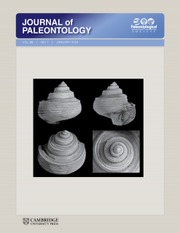
Right valve of the neotype of Monopteria alata. Note the presence of a blunt posterior prong on the hinge line, wide posterior sinus between it and the inflated shell body, alatoform outline of the shell, and smooth surface covered with bundles of concentric fine growth lines. The rounded cap on the beak is the prodissoconch, and the straight shell margin in the upper right shows the edge of the anterior depression, not visible in this orientation. KUMIP 58220, Drum Limestone, Kansas City Group, Turner District, Kansas City, Wyandotte County, Kansas, USA.

Monopteria shell growth included major changes in shape and shell outline as rates of shell growth changed on the anterior, the posterior, and the ventral margins of the shell. It is an unusual shape changer, making identification of species difficult without knowledge of their ontogeny. These changes have led to new species names being proposed for immature specimens of different growth stages of the same species. The anterior end of the shell is sunk into a depression that surrounds a byssal notch and encloses twisted, thickened shell rims on the anterior end of the opposing hinge-plate surfaces (Fig. 2). Other distinctive characters include presence of a rimmed umbonal ridge on elongate shells, a thick shell wall originally composed of aragonite covered with a very thin outer calcite shell layer (0.05 mm or less), a clinovincular ligament (Fig. 3), and a smooth shell surface with bundled fine growth lines. The changes in shell form that occurred during ontogeny are undocumented in previous descriptions or diagnoses of species, resulting in an unstable and confused taxonomy. This problem is addressed by description of well-preserved specimens that reveal the characters needed for useful species description.
View of anterior depression of Monopteria, containing twisted, bent rims of hinge plates and wide byssal notch. Note the irregular, crowded wrinkling of shell growth lines within the anterior depression. Paratype Monopteria magna n. sp., NPL 90465, Gonzales Creek Shale, Graham Formation, Cisco Group, La Casa, Stephens County, Texas, USA.

View of the clinovincular ligament of Monopteria, with all ligament grooves inclined at a low angle to the posterior on paratype Monopteria magna n. sp., NPL 90469, Gonzales Creek Shale, Graham Formation, Cisco Group, La Casa, Stephens County, Texas, USA.

Monopteria has irregular distribution in Carboniferous strata. It is present in midcontinent United States and the western states of New Mexico and Arizona, along with one reported occurrence in the Appalachian basin (Heilprin, Reference Heilprin1886). It is common at a few locations but is sparse at others and occurs mostly in shallow-water, mollusk-rich biotas. This contrasts with the common occurrences of myalinids and astartellids and other thick-walled bivalves with dominantly aragonite shell that are present in most shallow marine biotas. The sparse record of Monopteria, with common occurrences in only a few formations, makes it probable that it was adapted to a narrow range of environmental conditions, similar to the Pseudocolpomya fauna of the Ordovician (see Frey, Reference Frey, Johnston and Haggart1998). An unusual feature of Monopteria shells with high inflation is the development of ventral surface curvature that becomes shaped like a boat hull, providing a means to keep shells from sinking into fluid mud and remain positioned at the sediment–water surface.
The best examples of the genus are bivalved specimens that weather free of matrix, such as specimens from the early Virgilian Gonzales Creek Shale (a lateral equivalent of the Finis Shale) of north-central Texas and the Naco Formation of Arizona (White, Reference White and Wheeler1874). Most specimens at these localities occur in a calcareous mudstone matrix. When the matrix is removed, species-specific characters make useful species descriptions possible.
Growth stages and major shell characters of Monopteria
Monopteriid growth can be divided into three stages: a larval–nepioconch stage ending when the prodissoconch valves are rotated and spread apart by high growth rate on the anterior margin of the nepioconch shell, a juvenile growth stage when great change in shell outline occurs, and an adult growth stage dominated with growth of the posterior elongation of the inflated shell body and the posterior prong. The nepioconch shell consists of a D-shaped shell produced around the ovoid prodissoconch, and for Monopteria this growth stage is probably associated with continuing metamorphosis of soft-tissue organs (Malchus and Sartori, Reference Malchus and Sartori2013). In Monopteria, this change corresponds with development of a deep depression on the anterior portion of the shell. These changes are best shown on M. magna n. sp., the largest and best-preserved species.
Larval and nepioconch shell
The first growth stage is associated with the prodissoconch shell and subsequent D-shaped shell that produced the first phase of post-larval ligament. On M. magna n. sp., the larval shell consists of a nearly round 0.4 mm diameter P1 prodissoconch and a 1 mm wide ovoid P2 shell (Fig. 4) that changed to a D-shaped shell. This growth stage produced a short, simple ligament (L1 on Fig. 4) that extends almost 1 mm posterior of the prodissoconch. Concurrent with ligament extension, lobes of calcareous shell (lobe on Fig. 4) grew out from the anterior edge of the prodissoconch. These lobes extended along the growth margin of the first-formed ligament in a wedge-shaped shell mass that grew outward against a companion lobe on the opposing valve. This insertion of shell onto the hinge plate forced the prodissoconch–nepioconch shell valves to spread apart by rotation along an axis on the posterior margin of the D-shaped shell. The axis of rotation is within the plane of commissure but nearly perpendicular to the hinge line. The prodissoconch and D-shaped shell were rotated laterally away from the larval shell hinge line by about 40°–45°. Insertion of shell was brief, and ligament growth resumed along the outer edge of the wedge-shaped shell lobes. There was no further disruption to ligament formation, which continued growing into the clinovincular ligament characteristic of the adult.
(1, 2) Oblique view of articulated specimen showing prodissoconchs, ligament sections, shell lobes, anterior flaps, byssal notch, and anterior depression on holotype of Monopteria magna n. sp., NPL 90461, Gonzales Creek Shale, Graham Formation, Cisco Group, La Casa, Stephens County, Texas, USA. The hinge axis is parallel to the bottom of (2) photo.
B = byssal notch; D = D-shaped post-larval shell (nepioconch); L1 = first-formed post-larval ligament; L2 = later-formed clinovincular ligament; lobe = lobate outgrowth of calcareous shell inserted below L1 ligament; P1 = P1 portion of prodissoconch shell; P2 = P2 portion of prodissoconch shell; R = thickened rim of anterior edge of hinge plate; Rl = thickened rim of anterior edge of hinge plate surface on left valve; Rr = thickened rim of anterior edge of hinge plate surface on right valve.

During the rotation event, the anterior shell margin grew rapidly to maintain shell closure by growing inward, directly toward the plane of commissure. The result is a tight bend of the anterior shell and generation of a depressed anterior shell surface with rough, irregular growth (Figs. 2, 4). This became the anterior depression typical of the genus. Shell growth on the anterior depression remained semi-irregular throughout life, producing a shell surface that is notably rough compared with other portions of the shell. In contrast to the major change in growth on the anterior shell margin, shell growth along the posterior and ventral shell margins was little affected (Fig. 5), with no interruption of the normal smooth curvature of those parts of the shell. There is no significant groove or shell geniculation produced on the shell as the hinge line is reoriented.
Juvenile growth stage of the right valve of holotype of Monopteria magna n. sp., NPL 90461, Gonzales Creek Shale, Graham Formation, Cisco Group, La Casa, Stephens County, Texas, USA. Hinge plate surface is visible along top of photo.

Juvenile shell
After insertion of the calcareous lobe into the edge of the hinge plate, ligament growth resumed along the outer edge of the calcareous shell lobes. It grew mostly to the posterior but also anteriorly into a position beneath the prodissoconch. Continued growth during the adult growth stage extended the anterior end of the ligament slightly anterior of the prodissoconch, but it does not extend beyond the anteroventral bend of the shell. The anterior edge of the hinge plate is thickened into a stout, contorted rim (r on Fig. 4) located dorsal to a large byssal notch in the shell. The rim margin of the hinge plate flares beyond the prodissoconch and is bent outward from the plane of the posterior ligament and inclined downward toward the ventral margin. On the shell illustrated in Fig. 4.1, the rim flap is bent toward the left valve, and the companion rim of the right valve is bent in the same direction. However, on another specimen, the rim flap is bent toward the right valve, indicating that growth of the flaps was determined partly by environmental influences. Like other characters within the anterior depression, shell growth of the bent hinge-plate flaps is irregular and produces a rough shell surface.
Juvenile growth occurred with shell size increasing primarily on the posterodorsal and posteroventral margins of the shell (Fig. 5). The shell outline then changed to an irregular squared outline with a short posterior prong. During this growth stage, the juvenile shell took on an irregular squared shape outline as anteroventral shell growth matched posterior and posteroventral growth. A high growth rate on the posterior hinge line resulted in formation of the prong-like posterior auricle that for a short interval became the maximum extension of the posterior margin. On M. magna n. sp., the juvenile shell phase ends at ~0.7–0.8 cm shell length, when a high growth rate posteroventrally curved the inflated shell body toward the posterior and greatly elongated the shell.
Adult shell
Following the juvenile growth stage, shell growth extended the shell primarily in a posterior direction, with less growth on the ventral margin and very little growth of the anterior margin. The highest growth rate occurred on the posteroventral margin, but high growth rate also occurred along the posterior hinge line, producing a posterior prong auricle along the hinge line. Between the posterior prong and the curved posteroventral inflated shell body there was a lower rate of shell growth on the middle portion of the posterior margin, producing the distinctive deep mid-posterior sinus of the adult shell. The development of posterior prong, posterior sinus, and elongation of the curved inflated shell body mark the end of the juvenile growth stage and transition to alatoform adult growth outline. The inflated shell body grew in an arcuate path, giving it a wide, curved ventral margin. During this mature growth stage, curvature decreased, resulting in a mature growth direction that extended the shell nearly parallel to the hinge line. On mature specimens, the posterior tip may be angled up toward the dorsal margin.
Umbonal ridge
The change to adult growth stage coincides with development of an umbonal ridge on the shell (Fig. 6) that contains a tight bend in growth lines on the posterior extremity of the shell. The umbonal ridge is thick and is a strong part of the shell. On very elongate shells, the umbonal ridge is rimmed and raised above the surrounding shell. The umbonal ridge has a smooth, rounded top during early development before growing into a raised ridge. The smooth, rounded top condition may persist on shells with anterior–posterior length not much longer than shell height, as on M. gibbosa Meek and Worthen, Reference Meek and Worthen1866 and some M. alata Beede, Reference Beede1898. On more elongate shells (M. magna n. sp. and M. marian White, Reference White and Wheeler1874), the high-standing ridge became raised above adjacent shell (Fig. 6.1). Adjacent to the umbonal ridge, growth lines are linear and aligned at a low angle to the crest of the ridge (Fig. 6.2), contrasting with the curved growth lines within the umbonal ridge. On shells with a narrow, pointed posterior extremity, the ridge top has a flattened crest that encloses a nearly 180° bend of rounded, tightly curved growth lines. On these sharp-bounded umbonal ridges, the shell is thickened (to 1 mm), double the thickness of adjacent shell (Fig. 6.1), providing greater strength for the narrow posterior tip of the shell. The raised rim crest of these umbonal ridges resembles the balustrade of a staircase railing and consists of a band 1.5–2.0 mm wide.
(1, 2) Umbonal ridge on holotype of Monopteria magna n. sp., NPL 90461: (1) cross-section view showing thickening and flat top of the umbonal crest; (2) lateral view of umbonal crest with tight curvature of growth lines within the crest and linear, low-angle inclination of growth lines on both sides of the crest. NPL 90461, Gonzales Creek Shale, Graham Formation, Cisco Group, La Casa, Stephens County, Texas, USA.

Posterior auricle
The posterior auricle has nearly parallel dorsal and ventral margins about 3 mm apart and a smooth, broad rounded end (Fig. 1). Shell of the posterior auricle is thinner than shell of the inflated shell body and is structurally weak, usually broken from specimens during preservation and showing more repair damage than other parts of the shell.
Anterior depression
The anterior margin of Monopteria is a most unusual shell feature, consisting of a well-defined depression centered on a byssal notch and the thickened rim on the anterior end of the hinge plates (Figs. 2, 4). It spreads across both valves, appeared during juvenile growth stage, and persisted into maturity. The anterior depression is labeled as lunule in previous descriptions of monopteriid species, because of its location, but it has no similarity to lunules.
The anterior end of the ligament extended at a very low growth rate, and the margin of the hinge plate thickened into a stout, contorted rim of shell (Fig. 2). This contorted bent flap structure was identified as a tooth by Newell (Reference Newell and Moore1969). The bent flaps serve to keep valves in position and can function to keep the valves in place when subject to twisting forces on the shell, but they are not teeth or denticles. On some specimens, the flaps resemble small anterior auricles like those that present on leiopteriid bivalves, but they did not originate as an auricle and the occasional resemblance to an auricle is accidental. Folding of flaps on the anterior portion of the shell is the result of distorted shell growth within the anterior depression.
Ligament
The clinovincular ligament of Monopteria has been described as duplivincular in previous publications, but it has the configuration of multiple pairs of lamellar and fibrous ligament all inclined posteriorly at a low angle to the hinge axis during post-larval growth. This configuration is typical of late Paleozoic bivalves such as the myalinids. During growth, the ligament attachment surface widens most on the anterior end by adding pairs of lamellar and fibrous ligament sheets at that position, all inclined in the same direction to the hinge axis. The previously inserted ligament pairs extend and their posterior end shifts to the posterior with continuing growth of the ligament plate. This results in new-formed ligament growing continuously at multiple locations along the hinge axis. This ligament configuration occurs entirely on the posterior side of the prodissoconch at all post-larval growth stages of Monopteria (Fig. 4).
Definition of clinovincular ligament
Ligament area consisting of multiple pairs of lamellar and fibrous ligament sheets inclined at a low angle to the hinge axis and sloping toward the posterior, with new pairs of lamellar and fibrous ligament sheets inserting at or near the beak during growth. During growth, the functional part of each ligament pair migrates toward the posterior while previously formed portions of a ligament pair are broken and no longer connect the valves.
Newell and Boyd (Reference Newell and Boyd1987) used the term “opisthodetic-duplivincular” for this type of ligament, and Carter et al. (Reference Carter, Harries, Malchus, Sartori and Anderson2012) used the name “monovincular-D2” for it, a name that infers it is derived from monovincular ancestors. The term “monovincular” is the name for a wide ligament surface without ridges and grooves typical of the multi-sheet duplivincular ligament (Johnston and Collom, Reference Johnston and Collom1999). Carter et al. (Reference Carter, Harries, Malchus, Sartori and Anderson2012, p. 104) presented an illustration that shows the monovincular ligament consisted of multiple fibrous ligament sheets without lamellar layers. Because changes in ligament configuration can occur on individuals during post-larval growth (T. Yancey, personal observation on species of Monopteria and other late Paleozoic genera, 2024), better and more descriptive terms are needed to identify ligament configurations on bivalves. A clinovincular ligament is characteristic of several genera of thick-shelled late Paleozoic pteriomorphians.
The clinovincular ligament contrasts with the model of sharp, inverted-V chevron-shaped alignment used to characterize the general duplivincular ligament configuration (Malchus, Reference Malchus2004; Carter et al., Reference Carter, Harries, Malchus, Sartori and Anderson2012). Waterhouse (Reference Waterhouse2008) proposed the term “chevron-duplivincular” for that ligament configuration, having an equilateral inverted-V chevron shape. Use of the term “duplivincular” or “chevron-duplivincular” is best reserved for the alignment of that ligament present on arcoid bivalves.
Ecophenotypic variation
Specimens in samples of Monopteria vary in shape because of ontogenetic change in growth rates of the blunt posterior auricle and inflated shell body. However, in some samples there are differences in shape that exceed those expected from ontogeny and reflect environmental control on Monopteria shells. The typical shell form is one with moderate shell inflation and regular arcuate shell curvature of the inflated shell body (Figs. 1, 7, 8) like that of the genotype species, but some samples contain specimens with a more elongate, inflated shell body (Figs. 9, 10). The less-inflated morphology usually has shell height/length ratio of 1:1 to 1:2 whereas the more-inflated morphology reaches height/length ratios of 1:4 at maturity and height/width (H/W) ratio of nearly 1:1. More-elongate shells sometimes grew with a subdued wavy ventral margin instead of an evenly curved ventral margin outline (Fig. 9.8). Taken separately, these forms would seem to indicate different species, but the variants occur within the same sample. Specimens of M. marian from the same locality all possess similar species-defining characters of a heel bulge at the base of the anterior depression and an anterior depression margin inclined at about 30°–40° to the hinge line. It is not practical to consider them as separate species with available samples.
Specimens of the more-elongate and more-inflated shells occur in fine-grained silty mudstone sediment and are often preserved as bivalved specimens. Valves of less-inflated shells occur primarily in bioclastic carbonate sediment or in sandstone and tend to be preserved as single valves. This correspondence of morphologic difference with differences in enclosing sediment suggests an ecophenotypic response to environment.
Species definition in Monopteria
Species of Monopteria show much variation in shape during growth, which makes species definition more difficult than for other bivalve genera. Species definition needs to include documentation of the juvenile and adult growth stages and to provide details of how shell shape changes during growth. Some species can be defined on the presence of a distinctive single character, such as the bulbous, inflated shell of M. gibbosa or the presence of a heel and raised ridge on the margin of the anterior depression on M. marian, but species without a distinctive single character can be identified using a combination of characters. Species known only from a single specimen or based on small juveniles have an incomplete species definition and need to be revised with data from a larger sample containing multiple specimens.
Materials and methods
This study is centered on work with multi-specimen samples of four species: a sample of 12 matrix-free specimens from the Gonzales Creek Shale of north-central Texas, a sample of 30+ specimens from Missourian-stage strata of the Kansas–Missouri area present in the Biodiversity collections of the Natural History Museum of the University of Kansas, a sample of 22 specimens from Fort Apache, Arizona, and nine specimens from Lincoln National Forest land, Alamogordo, New Mexico. Matrix was removed from specimens preserved with original shell to examine features of hinge-plate surface, growth lines, anterior surface, and shell shape. Ontogenetic change in shell outline of species was determined by examination of growth lines on mature shells.
Repositories and institutional abbreviations
Specimens studied are deposited in collections of the Prairie Research Institute of the Illinois Natural History Survey (ISM), the Field Museum (FMNH UC), and the Biodiversity collections of the University of Kansas (KUMIP), the University of Texas Non-Vertebrate Paleontology Laboratory (NPL), and the Smithsonian Institution National Museum of Natural History (USNM PAL).
Systematic paleontology
Order Myalinida Newell, Reference Newell1965
Family Monopteriidae Newell, Reference Newell and Moore1969
Diagnosis (revised)
Equivalved pteriomorphian bivalves with curved shell growth to the posterior, an elongate prong-like posterior auricle, and a depressed anterior margin on the shell containing twisted anterior terminations of the hinge plates.
Remarks
The anterior depression that is centered around twisted anterior terminations of the hinge plate is a defining feature of the family. Newell (Reference Newell and Moore1969) provided a useful discussion of the family and genus, except for the corrections that there is no dentition, and the anterior depression of the shell is not a lunule as found on other bivalves, but is an area of growth suppression surrounding a byssal notch and includes twisted anterior terminations of the hinge-plate surfaces.
No superfamily assignment is given for this family because the growth shape, ligament, and lack of dentition are different from other families in superfamily Ambonychioidea. More descriptive work on late Carboniferous and Permian pteriomorphians is needed to determine superfamily relationship.
Genus Monopteria Meek and Worthen, Reference Meek and Worthen1866
Type species
Monopteria longispina Cox, Reference Cox1857 by original designation, from the Pennsylvanian of Kentucky, USA.
Diagnosis (revised)
Same as for family.
Occurrence
United States, Pennsylvanian, Desmoinesian (Moscovian) to Virgilian (Gzhelian) stages.
Remarks
Species of the genus are characterized by arcuate shell growth that extends in a posteroventral direction and then changes to posterior elongation. They have a depressed anterior surface and an elongate, prong-like posterior auricle. Species that lived on mud substrate have a boat-like shell design. The prong-like posterior auricle is usually broken and incomplete on specimens.
Monopteria longispina Cox, Reference Cox1857
*Reference Cox1857 Gervillia longispina Cox, p. 568, pl. 8, fig. 6.
Types
Neotype (here designated) FMNH UC 14544, Carbondale Formation, McLeansboro Group, Major’s Mill, near Fairmount, Vermillion County, Illinois, USA. A neotype is needed for this species to stabilize the species concept because all samples from the type locality have been lost and available documentation consists of a line drawing showing only shape characters with some inaccuracies and lacking details needed for accurate species determination.
Diagnosis
Shell with an arcuate growth pattern, a posterior auricle of about half the total shell length, a wide posterior sinus, a well-rounded ventral margin, and moderate to strong development of umbonal ridge on the adult shell.
Occurrence and specimens examined
Neotype (here designated) and two other specimens of the upper Carbondale Formation below the coal #10 (Worthen, Reference Worthen1882, p. 513), late Desmoinesian (Moscovian) stage, from Major’s Mill on Salt Fork River, near Fairmount, Vermillion County, Illinois, USA; line drawing illustration of Cox (Reference Cox1857) for a specimen from the Providence Limestone, Shelburn Formation, McLeansboro Group, late Desmoinesian (Moscovian) stage; from Providence, Hopkins County, Kentucky, USA.
Description (revised)
Shell length about 50% longer than height on adult shell; shell elongation curves from venteroposterior to posterior; posterior prong-like auricle of about half the length of shell; deep, wide posterior sinus between posterior prong and inflated shell body; partly raised umbonal ridge on shell; growth lines well marked on ventral and posterior margins; anterior and ventral margins form a long smooth curve; anterior depression and ligament present but not exposed for documentation. Dimensions of neotype: H (dorsal–ventral) = 2.4 cm, L = 3.6 cm, W (one valve) = 0.5 cm, and length of posterior prong = 0.6 cm.
Remarks
Specimens of M. longispina examined by Cox (Reference Cox1857) are lost, and the collection site in the Providence Formation is no longer exposed at the ground surface after reclamation of coal mines (S. Greb, personal communication, 2023). Two specimens from nearly age-equivalent strata in Illinois, probably collected in the late 1800s and originally held in University of Chicago collections, then transferred to the Field Museum, provide material to make a description and select a neotype. The characters used to characterize genus Monopteria are centered on characters of the type species M. longispina, so stabilizing the species by selecting a fossil specimen as a neotype is needed to stabilize the genus and the family.
Important corrections to the Cox (Reference Cox1857) illustration are that the Illinois specimens show the typical Monopteria growth line configuration along the ventral and anterior shell margins, and the juvenile shell has greater height than length. Most other components of the Cox illustration are supported by the specimens. The Cox illustration has a dotted line extension to show an inferred maximum length of the auricle greater than present on the specimen used for illustration (not included here in the reproduction of Cox’s illustration shown in Fig. 7.1), but that greater length of posterior auricle is improbable and not supported. The posterior auricle prong is functional for holding the valves in position for stable opening and closing of its valves but is a weak structure. Therefore, a short posterior auricle is more functional than a long, slender one.
Monopteria-bearing strata from the Major’s Mill site occur below the #10 coal of the Illinois basin (see Worthen, Reference Worthen1882). That correlates to a stratigraphic level a little below the Providence Limestone of Kentucky, and the specimens match the Cox illustration very well. At both locations, Monopteria is reported to be a typical component of the fossil assemblage.
Monopteria longispina differs from M. gibbosa by its greater elongation of the shell and from M. alata by its greater ventral margin curvature and lesser elongation of the adult shell. It is much less elongate than younger species of Virgilian (Gzhelian) age.
Monopteria gibbosa Meek and Worthen, Reference Meek and Worthen1866
*Reference Meek and Worthen1866 Pterinea (Monopteria) gibbosa Meek and Worthen, p. 20.
Reference Meek and Worthen1867 Monopteria gibbosa; Meek and Worthen, p. 340, pl. 27, fig. 11–11b.
(1) Cox (Reference Cox1857) illustration of Monopteria longispina, with dashed line omitted that was supposed to show further extension of the posterior prong; Providence Limestone, Shelburn Formation, McLeansboro Group, Providence, Hopkins County, Kentucky, USA. (2) Left valve view of Monopteria longispina, neotype FMNH UC 14544, Carbondale Formation, McLeansboro Group, Major’s Mill, near Fairmount, Vermillion County, Illinois USA. (3) Right valve view of Monopteria longispina, paratype FMNH UC 14544-a, Carbondale Formation, McLeansboro Group, Major’s Mill, near Fairmount, Vermillion County, Illinois USA. (4) Left valve view of Monopteria longispina, paratype FMNH UC 14543, Carbondale Formation, McLeansboro Group, Major’s Mill, near Fairmount, Vermillion County, Illinois USA. (5) Right valve view of juvenile misidentified as Monopteria alata, USNM PAL 35313, Scotch Creek, Dolores County, Colorado, USA. (6) Close-up view of clinovincular ligament on Monopteria gibbosa, dorsal margin of left valve in foreground, syntype ISM 10913B. (7) Left valve view, Monopteria gibbosa, syntype ISM 10913A. (8) Right valve view, Monopteria gibbosa, syntype ISM 10913B; Carbondale Formation, Saline River, Gallatin County, Illinois, USA.

Types
Syntypes ISM 10913A and ISM 10913B from the Carbondale Formation, Saline River, Gallatin County, Illinois, USA.
Diagnosis
The well-inflated valves and highly rounded ventral margin and bulbous shape distinguish this species from other species in the genus.
Occurrence and specimens examined
Two syntypes from Carbondale Formation; Desmoinesian (Moscovian) stage; Saline River, Gallatin County, Illinois, USA.
Remarks
M. gibbosa has rounded anterior and ventral margins and a blunt posterior prong separated from the inflated shell body by a shallow posterior sinus. In addition to species characters reported by Meek and Worthen (Reference Meek and Worthen1866), M. gibbosa has a narrow ligament attachment surface (Fig. 7.6) consisting of two grooves for ligament attachment. When viewed from the side, the edge of the anterior depression is located on the anterodorsal corner and inclined upward toward the posterior, enhancing the rounded outline appearance of the shell. The valves have high inflation and a bulbous form that presents a very rounded outline appearance for the shell. The posterior sinus is shallow, ~ 5 mm. The posterior prong has a height of about 3 mm and has nearly the same posterior extension as the curved, inflated shell body, but it is short: only 6 mm long from the back of the posterior sinus to the posterior tip on the mature shell. An umbonal ridge is present on the mature portion of the shell as a broad but weakly developed feature that is slightly elevated above adjacent shell.
The valves of M. gibbosa are very inflated (gibbose) and have a shape that is very rounded and nearly bulbous. This contrasts with other species in the genus and is a distinguishing character for identification. However, M. gibbosa has been found only at the type locality and is known only from the two syntype specimens used to describe the species by Meek and Worthen (Reference Meek and Worthen1866). The ventral margin is more rounded than the ventral margin of the nearly age-equivalent species M. longispina and younger Monopteria species. M. gibbosa is the oldest known species of the genus and could be a transitional form between ancestors and the alate form of younger species typified by M. longispina.
Monopteria alata Beede, Reference Beede1898
(1) Right valve view of neotype of Monopteria alata, KUMIP 58220, Drum Limestone, Kansas City Group, Kansas City, Wyandotte County, Kansas, USA. (2) Right valve view of juvenile Monopteria alata, KUMIP 263866, Lawrence Formation, Lawrence, Douglas County, Kansas, USA. (3) Right valve view of Monopteria alata, KUMIP 58218, Drum Limestone, Kansas City Group, Kansas City, Wyandotte County, Kansas, USA. (4) Right valve view of Monopteria alata, KUMIP 58219, Drum Limestone, Kansas City Group, Kansas City, Wyandotte County, Kansas, USA. (5) Right valve view of Monopteria alata, KUMIP 213966, Oread Limestone, Plattsmouth Formation, Lapeer, Douglas County, Kansas, USA. (6) Right valve view of juvenile Monopteria alata with most of posterior prong broken, FMNH UC 1370, from Drum Limestone, Kansas City Group, Kansas City, Wyandotte County, Kansas, USA.

Major shell dimensions of Monopteria alata. Plus sign (+) indicates the measurement is a minimum length on an incomplete shell

Reference Keyes1894 Monopteria gibbosa; Keyes, p. 114, pl. 43, fig. 2a, b.
Reference Keyes1894 Monopteria longispina; Keyes, p. 114, pl. 43, fig. 1.
*Reference Beede1898 Monopteria gibbosa alata Beede, p. 189, pl. 5, fig. 5.
Reference Beede and Rogers1899 Monopteria subalata Beede and Rogers, p. 133, pl.34, fig. 3a, b.
Reference Beede1900 Limopteria alata; Beede, p.130, pl. 16, fig. 5–5c.
Reference Beede1900 Limopteria gibbosa; Beede, p. 129, pl. 16, fig. 9.
Reference Beede1900 Limopteria longispina; Beede, p.127, pl. 16, fig. 6.
Reference Beede1900 Limopteria subalata; Beede, p.131, pl. 21, figs. 3a, b.
nonReference Girty1903 Monopteria alata; Girty, p. 431, pl. 9, fig. 3.
Reference Sayre1930 Monopteria marian; Sayre, p. 111, pl. 9, figs. 18, 19a.
Reference Sayre1930 Monopteria longispina; Sayre, p. 112, pl. 9, figs. 8–9.
Types
Neotype (here designated) KUMIP 58220, Corbin City Member, Drum Limestone, Kansas City Group, Kansas City, Wyandotte County, Kansas, USA. A neotype is needed for this species to stabilize the species concept due to loss of sample used to define the species, a vague description, and an inaccurate illustration showing only shape characters of a juvenile specimen. Inadequate description has resulted in great confusion about the species and chaotic taxonomy for the genus.
Diagnosis
Shell averaging a length/height ratio of 3:2 at maturity on a height of 2.0–2.5 cm; a juvenile shell shape with posterior auricle extending beyond the inflated shell body by as much as 4–7 mm, changing to an adult shell with maximum shell length on the arcuate main body of the shell instead of the posterior auricle.
Occurrence and specimens examined
Five specimens (KUMIP 58217–58221) from the Drum Formation, Kansas City, Kansas, USA; one specimen (FMNH UC 1370) from the Drum Formation, Kansas City, Kansas, USA; four specimens (KUMIP 161635, 209656, 213867, 263866) from the Haskell Formation, Lawrence, Kansas, USA; one specimen (KUMIP 261005) from Lawrence Formation, Lawrence, Kansas, USA, late Pennsylvanian, Missourian (Kasimovian) age; one specimen (KUMIP 213966) from Oread Limestone, Plattsmouth Formation, Lapeer, Douglas County, Kansas, USA, late Pennsylvanian, Virgilian (Gzhelian) stage; and one specimen (USNM PAL 35313) excluded from the species, from Scotch Creek, Dolores County, Colorado, USA, late Pennsylvanian, Virgilian (Gzhelian) stage.
This species is present in several formations of the middle and late Missourian (Kasimovian) stage and basal Virgilian (Gzhelian) stage in the region around Kansas City in midcontinent North America (Keyes, Reference Keyes1894; Beede, Reference Beede1898; Sayre, Reference Sayre1930). It is usually found in oolitic sediment on the tops of limestone beds or in sandstone beds.
Description (revised)
Beak at anterior end of hinge line; P2 prodissoconch 0.7–0.8 mm wide; narrow hinge with clinovincular ligament; a wedge-shaped shell lobe that inserts along the base of the narrow nepioconch ligament and was subsequently overgrown by ligament; a posterior prong auricle with wide rounded posterior termination and shallow (0.5–0.8 cm) posterior sinus below; blunt, rounded posterior termination of inflated shell body extending beyond posterior auricle at maturity; ventral shell margin with long, open curvature; wide anterior depression with smooth, rounded boundary margins, enclosing twisted, irregular shell flap ends of the hinge plates; moderately raised umbonal ridge lacking raised margins; umbonal ridge most distinct on mid portion of shell and fading to indistinct on posterior end of mature shell; posterior auricle extends beyond posterior end of inflated shell body on juvenile growth stage, then is shorter than posterior end of inflated shell body during maturity; shell surface with fine growth lines grouped into six to seven increments with distinct boundaries; posterior end of the inflated shell body may become pinched at a late growth stage, producing another shape variant; ventral shell margin may acquire a wavy configuration; byssal notch present within anterior depression.
Remarks
This is a characteristic example of Monopteria. It has an adult shell with dorsal–ventral height of about 60% of anterior–posterior length and inflation of paired valves about 40% of shell height; proportions similar to many other bivalves. A distinctive character is the 4–7 mm projection of the posterior auricle beyond the posterior end of the inflated shell body during juvenile growth stage. That reversed during the adult growth stage when the inflated shell body extended and became the posterior end of the shell. Shell proportions varied during growth, and there is variation from the average design among individuals within a sample. The observation of a wedge-shaped shell lobe inserting into the hinge plate on KUMIP 209656 confirms the presence of that character on M. alata.
The species name M. alata Beede, Reference Beede1898 is the first available name for this monopteriid species common in the Kansas City region of Kansas and Missouri. It was named for a juvenile specimen with a shape atypical of mature shells in the species. The juvenile form illustrated by Beede (Reference Beede1898) can be seen to be a growth stage of mature specimens that were illustrated by Sayre (Reference Sayre1930) for samples from Turner District, Kansas City, Kansas. As reported by Beede (Reference Beede1898, Reference Beede1900), specimens are most common in the Corbin City oolite bed of the Drum Formation of the Turner District, Kansas City, and the Haskell Formation of Lawrence, Kansas.
The species name was proposed for a juvenile shell before well-preserved mature specimens were available to show that the shape shown by Beede (Reference Beede1898) is a juvenile growth of the species. Beede (Reference Beede1898) did not designate a type specimen for M. alata and provided a line drawing that exaggerates the length of the posterior auricle. That specimen is lost; examination of all specimens of Monopteria held in the University of Kansas collections failed to locate the specimen used to produce the Beede (Reference Beede1898) drawing or any specimens that could be attributed to Beede at the time of publication. The Beede (Reference Beede1898) illustration fails to show enough characters to identify the species and has created great confusion about species identity. A neotype (KUMIP 58220; Fig. 8.1) is designated here for the species, using a mature shell (collected by Sayre, Reference Sayre1930) showing growth lines revealing both the juvenile and mature growth stages that comes from the Turner District, Kansas City locality and stratigraphic level cited by Beede (Reference Beede1898). This corrective action greatly stabilizes knowledge of M. alata.
Beede’s (Reference Beede1900) statement that M. alata is a miniature species and full grown is not accurate. The shape of the illustrated specimen can be seen as juvenile on well-preserved adult shells. Specimens collected and illustrated by Sayre (Reference Sayre1930) provide data on the juvenile to adult growth stages, although photographs in that publication are not good enough to see growth lines showing the great changes in shell form that occur during ontogeny. The specimens illustrated by Sayre (Reference Sayre1930) were examined to document ontogeny and establish synonymy of different names proposed for juvenile and adult specimens.
Reversal of the maximum posterior shell length from the posterior auricle on the juvenile to the arcuate main body of the shell on the adult is the primary character distinguishing Monopteria alata from other species in the genus. M. alata is similar to M. longispina but differs in its greater elongation, resulting in a more open curvature of the ventral margin and lacking the raised ridge bounding the anterior depression of M. marian. It also tends to develop a narrower posterior termination of the inflated shell body and a greater height of the posterior sinus.
Girty (Reference Girty1903) illustrated a juvenile shell (Fig. 7.5) similar but not identical to juvenile Monopteria. The Colorado specimen has a posterior prong and flattened anterior and ventral shell margins and an umbonal ridge that is nearly linear, not curving toward the posterior in the manner of juvenile M. alata. Although there is considerable variation in Monopteria species, the differences noted for this specimen preclude assigning it to Monopteria. Girty (Reference Girty1903, p. 430) also notes similarity of this shell to Anthracoptera polita White, Reference White1880, a taxon here excluded from Monopteria.
Monopteria marian White, Reference White and Wheeler1874
(1–9) Monopteria marian, Naco Group, Camp Apache, Navajo County, Arizona, USA (note that the posterior prong is broken off all elongate specimens): (1) left valve view, paralectotype, USNM PAL 794497; (2) dorsal view, paralectotype, USNM PAL 794497; (3) right valve view, paralectotype, USNM PAL 794497; (4) ventral view, paralectotype, USNM PAL 794497; (5) anterior view, paralectotype, USNM PAL 794496; (6) right valve view of lectotype, USNM PAL 794495; (7) dorsal view, paralectotype, USNM PAL 794496; (8) right valve view, paralectotype, USNM PAL 794496; (9) left valve view, paralectotype, USNM PAL 794495.

Major shell dimensions of Monopteria marian. Plus sign (+) indicates the measurement is a minimum length on an incomplete shell

*Reference White and Wheeler1874 Monopteria marian White, p. 22.
Reference White1877 Monopteria marian; White, p. 151, pl. 11, fig. 4–4b.
nonReference Beede1900 Limopteria marian; Beede, p. 128, pl. 16, fig. 5–5c.
?Reference Girty1903 Monopteria longispina; Girty, p. 430.
Types
Lectotype (here designated) USNM PAL 15595, Naco Group, Camp Apache, Navajo County, Arizona, USA.
Diagnosis
M. marian is distinguished from other species by the presence of a raised ridge on the margin of the anterior depression, an anterior outline inclined at an angle of 30°–40° relative to the hinge line, and the presence of a small protruding heel bulge on the margin of the shell where the ventral margin joins the anterior margin at the base of the anterior depression.
Occurrence and specimens examined
Lectotype USNM PAL 15595 and 21 paralectotypes, USNM PAL 794495–794515, Naco Group, Camp Apache, Navajo County, Arizona, USA; Virgilian (Gzhelian) stage. Age determined by Brew (Reference Brew, Beus and Rawson1979, fig. 106).
Description (revised)
Beak at anterior end of hinge line; hinge with clinovincular ligament; adult shell elongate with L/H ratio of 3:1 to 4:1; adult shell has a short posterior prong with rounded termination and shallow (0.5–0.6 cm) posterior sinus below; posterior extremity of adult inflated shell body extended beyond the posterior prong; ventral shell margin arcuate with long radius of curvature and may have wavy margin instead of smooth curvature; narrow umbonal ridge with small, thin, raised margins present near midline of valves; cross section of mature shell often diamond shaped with valves bent at nearly 90° angle at position of umbonal ridge; shell band between umbonal ridge and dorsal shell margin is flat and narrower than shell band below umbonal ridge; anterior depression has a raised ridge on margins; ventral margin frequently has projecting bulge (heel) at its junction with the margin of the anterior depression (Fig. 9.6); the edge of anterior depression inclined about 30°–40° toward posterior, not close to vertical as in other species; small byssal notch in anterior depression (Fig. 9.5); shell surface marked with many fine, close-spaced growth lines gathered into six or more increments bounded by growth interruptions.
Remarks
This is a small species, but bivalved shells are very elongate compared with height. On mature portions of the inflated shell body, the shell width in cross section is about the same as shell height. Most specimens have a shell height less than 2 cm, and many are 1.0–1.3 cm high. Specimens in the type locality sample of M. marian have a broad range of form, with larger ones having about a 3:2 L/H size ratio and lower valve inflation and smaller ones having about a 3:1 L/H size ratio and greater valve inflation. Specimens of both morphologies share the distinctive characters of having a heel on the anteroventral edge of the shell and an anterior edge inclined about 30°–40° to the hinge line and therefore are considered to be the same species.
More than three-fourths of the M. marian sample are small bivalved specimens that retain very little posterior auricle. Preservation in chalky matrix allowed dissolution of the aragonitic shell layer, removing support for the thin calcite outer shell layer and loss of most posterior auricle. The loss of aragonite shell results in sediment compaction deformation of some specimens of this species. Well-preserved outer shell has very fine growth lines enclosed in bands of 1.0–1.5 mm wide marked by stronger growth lines. These bands are much narrower than bundled growth line bands of other species of Monopteria, suggesting an environment with limited food supply and stunted growth. Specimens have a small but deep anterior depression, with small contorted bent flaps of the hinge plates showing in the depression (Fig. 9.5). The umbonal ridge is robust compared with the rest of the shell.
Monopteria magna new species
(1–7) Monopteria magna n. sp., Gonzales Creek Shale, Graham Formation, Cisco Group, La Casa, Stephens County, Texas, USA (note that the posterior prong is broken off on most specimens): (1) left valve view, holotype, NPL 90461; (2) dorsal view showing broken base of dorsal prong and diamond-shaped cross section of paired valves, holotype, NPL 90461; (3) right valve view, holotype, NPL 90461; (4) left valve view, paratype, NPL 90464; (5) ventral view of paired valves showing a ventral shape similar to a boat hull, paratype, NPL 90463; (6) right valve view, paratype, NPL 90467; (7) left valve view showing raised umbonal ridge, paratype, NPL 90462.

Major shell dimensions of Monopteria magna n. sp. Plus sign (+) indicates the measurement is a minimum length on an incomplete shell

Types
Holotype NPL 90461, paratypes NPL 90462–NPL 90472, Gonzales Creek Shale, Finis cycle, Graham Formation, Cisco Group, La Casa, Stephens County, Texas, USA.
Diagnosis
Large (to 5.5+ cm length), thick-walled shells with ~5:2 L/H ratio (reconstructed); posterior auricle about half of shell length at maturity; deep anterior depression; large byssal notch in anterior depression; twisted anterior margins on hinge plates; broad hinge plate.
Occurrence and specimens examined
Twelve specimens from Gonzales Creek Shale, Finis cycle, Graham Formation, Cisco Group, La Casa, Stephens County, Texas, USA; one specimen (NPL 90473) from basal sandstone bed of Finis Shale, Graham Formation, Cisco Group, Jacksboro, Jack County, Texas, USA, late Pennsylvanian, basal Virgilian (Gzhelian) stage.
Description
Large, thick-walled shell with beak at anterior end of hinge line; hinge with clinovincular ligament on a broad hinge plate; teeth lacking; large anterior depression present surrounding a large byssal notch; anterior end of hinge plates project as small twisted flaps formed by thickened rims of shell; anterior hinge-plate flaps usually bent out of plane of commissure of the inflated shell body (Fig. 4); surface of anterior depression covered with crowded, irregular fine growth lines; posterior prong auricle extending about half the length of inflated shell body at maturity; deep sinus (7 mm high) on shell present between posterior auricle and inflated shell body; inflated shell body has arcuate, curved shell growth in posteroventral direction that turns to completely posterior growth with very narrow, rounded posterior termination (Fig. 10.6); a raised umbonal ridge appears on adult shell surface and at ~2 cm shell length acquires narrow rims that raise it above surrounding shell surface; cross section of mature shell often diamond shaped (Fig. 10.2); shell of valves bent at nearly 90° angle at position of umbonal ridge on mature shell; shell band above (dorsal to) umbonal ridge is flat and narrower than shell band below umbonal ridge; ventral shell surface rounded, often with boat-like shape (Fig. 10.5); outline of shell shape changes from ovoid prodissoconch to irregularly squared juvenile with posterior auricle extending farther than the inflated shell body for a brief growth stage; adult shell with inflated shell body extending to posterior far beyond posterior auricle; shell ~1 mm thick with layer of very thin (<0.05 mm) columnar prismatic calcite on the outer surface; shell has wide growth increments (usually six) bounding fine growth lines.
Etymology
Named for the large size and preservation quality of specimens examined.
Remarks
This is the largest species in the genus, with details of the hinge structure and anterior depression well developed and exposed. Growth of the early juvenile shell is associated with rotation of the prodissoconch shell relative to the adult hinge line and emergence of the anterior depression. After prodissoconch shell rotation, the shell shape changed from ovoid to a roughly squared outline (Fig. 5) as the ventral margin straightened and the posterodorsal (hinge) and posteroventral margins extended. A posterior auricle appeared on the juvenile shell and grew out to become the most posterior part of the shell for a millimeter or two of growth. At a hinge-line length of 7–10 mm, the fast-growing inflated shell body extended beyond the posterior auricle and became the longest part of the shell, with a deep sinus developing between the inflated shell body and posterior auricle. The change to adult inflated shell form corresponds with appearance of a raised umbonal ridge present on the valve that generally occurs on shells of 7 mm or 8 mm height and length. During juvenile growth, the posterior hinge line extended beyond the inflated shell body only 1–2 mm before growth of the inflated shell body became the posterior terminus of the shell. This is less than that on M. alata and more than that on M. marian.
The adult shell is elongated, and the umbonal ridge is a zone of greatest shell strength. On the adult shell, the shell height on the plane of commissure is nearly the same as shell inflation of the paired valves, and the shell bend at the umbonal ridge produces a nearly diamond-shaped cross section (Figs. 6.1, 10.2). Specimens tend to have a ventral shell cross section like that of a boat, with the umbonal ridges in the same position as the edge of a hull. The surface of the shell is smooth and evenly rounded in most places. The shell surface is covered by many very fine growth lines in 0.5 cm wide bands produced by shell growth interruptions. The bands are probably annual growth increments. The shell is composed of aragonite recrystallized to calcite with a very thin outer layer of columnar prismatic calcite. In most areas, the columnar prismatic calcite layer recrystallized along with the aragonite and is obscure or visible only as a thin darker layer on the surface of the shell.
The collection of specimens used to describe M. magna n. sp. was obtained from mudstone strata overlain by a bed of rugose corals in the regressive portion of a cyclothem capped with a winnowed sandstone deposit. The coral zone is correlated to the Jacksboro Limestone exposed in the vicinity of Jacksboro, Texas, placing the zone containing M. magna in a deeper-water environment than the carbonate-rich zone in the Finis cycle.
The large size, broad hinge plate, and thick shell distinguish it from other species.
Monopteria heaneyi new species
(1–6) Monopteria heaneyi n. sp., Holder Formation, Magdalena Group, Sacramento Mountains of central New Mexico, USA: (1) left valve view of holotype, NPL 90454; (2) left valve view of juvenile specimen, paratype, NPL 90459; (3) right valve view of paratype, NPL 90455; (4) right valve view of partial specimen, paratype, NPL 90458; (5) right valve view of juvenile specimen, paratype, NPL 90457.001; (6) right valve view of specimen with broken posterior prong, paratype, NPL 90456.

Major shell dimensions of Monopteria heaneyi n. sp. Plus sign (+) indicates the measurement is a minimum length on an incomplete shell

Types
Holotype NPL 90454, paratypes NPL 90455–NPL 90460.2, Holder Formation, Magdalena Group, Sacramento Mountains of central New Mexico, USA.
Diagnosis
Elongate shells with ventral margin of low curvature; shallow posterior sinus; posterior prong auricle projecting 5 mm or less from inner edge of posterior sinus.
Occurrence and specimens examined
Nine specimens from Holder Formation, Magdalena Group, Sacramento Mountains of central New Mexico, USA, early middle Virgilian (Gzhelian) stage; age determination by Lucas et al. (Reference Lucas, DiMichele, Krainer, Barrick, Vachard, Donovan, Looy, Kerp and Chaney2021, p. 63).
Description
Elongate thin-walled shell; beak at anterior end of shell, raised 1 mm above hinge line; hinge with clinovincular ligament on a narrow hinge plate; teeth lacking; margins of anterior depression aligned perpendicular to hinge line; ventral margin of shell has a shallow, long-radius curve; posterior termination of shell blunt; shallow posterior sinus; posterior prong short, extending 5 mm or less beyond inner edge of posterior sinus; umbonal ridge of 2 mm width without rimmed margins, raised highest on mid-reach of shell; valve inflation low, 6–8 mm maximum; ventral margins of valves meet with a V-shaped angle, not rounded; shell wall thin; surface of shell with fine to coarse growth lines; details of anterior depression not known.
Etymology
Named for Michael J. Heaney, III, collector of the specimens described.
Remarks
This species has a height/length ratio of about 1:2 and a less-arcuate curvature of growth than other species. It has a distinct but irregular umbonal ridge, raised highest on the mid portion of the shell. Shell valves are less inflated than in similarly elongate species M. marian and M. magna. It has a short, brevispined posterior prong and accompanying shallow posterior sinus. Although having a narrow hinge plate and thin shell, it has the characteristic univincular ligament.
The sample containing this species was collected from sediment capping the top of a bioherm in the upper Holder Formation near Alamogordo, New Mexico, USA. Shells in the deposit are primarily single valves deposited parallel to sediment bedding plane, indicative of winnowing and shell bed accumulation during deposition. One specimen is preserved in bivalved condition. Both juvenile and mature M. heaneyi specimens are present in the sample and are a common component of the shell bed. Some specimens have pre-deposition shell breakage, and some breakage occurred during deposition (Fig. 11.5). Specimens are from a fine-grained micaceous, quartzose sandstone, a coarser grained and less calcareous sediment than associated with occurrences of other Monopteria species. The fossil assemblage containing this species consists mostly of bivalves (pectinoids, permophorids, grammysiids, myalinids), a bivalve-rich assemblage seldom sampled in fossil studies.
The short posterior auricle and the elongated, narrow, low-inflated posterior end of valves distinguish this from other species.
Species excluded from Monopteria
Gervillia auricula Stevens, Reference Stevens1858
*Reference Stevens1858 Gervilla (sic) auricula Stevens, p. 265.
Remarks
This species was listed as belonging with Monopteria by Weller (Reference Weller1898) in his summary of North American Carboniferous invertebrates. Other workers have not included it in the genus and ignored the species because it has little description, and no illustration was provided. That specimen is lost, and consequently this has remained an unidentifiable species. Because no type was designated or illustrated and the name has not been used in a taxonomic treatment of bivalves since its proposal, this name is abandoned.
Anthracoptera polita White, Reference White1880
*Reference White1880 Anthracoptera polita White, p. 166, pl. 42, fig. 5a, b.
Reference Girty1903 Monopteria polita; Girty, p. 430.
Reference Hoare1961 Limopteria subalata; Hoare, p. 114, pl. 14, fig. 12.
Reference Hoare, Sturgeon and Kindt1979 ?Monopteria subalata; Hoare, Sturgeon, and Kindt, p. 35, pl. 6, fig. 1.
Remarks
Girty (Reference Girty1903) discussed this species with the statement that it is very similar to the juvenile shell of M. alata. He believed they were the same but hesitated to make a synonymy. A. polita has a short hinge line and shell growth extending in a posteroventral direction, but with little curvature of the shell and with little or no development of a posterior auricle on the hinge line (see White, Reference White1880, fig. 5a, b). In illustration, the type specimen of A. polita has a height of 2 cm, which corresponds with an adult shell height of a posterior prong-bearing M. alata. When size differences are considered, the shell of A. polita does not match comparably sized shells of M. alata. Although juvenile shells of A. polita with height or length of about 1 cm have an outline shape somewhat similar to juveniles of Monopteria, larger specimens lack the arcuate curvature that is the primary character of Monopteria growth and do not belong in genus Monopteria. Hoare (Reference Hoare1961) identified a specimen like this as M. subalata, but the Hoare specimen is much larger than the type specimen of M. subalata, which is a young juvenile of M. alata. The genus assignment for A. polita remains unknown and is probably not a pterioid.
The genus name Anthracoptera is an objective junior synonym of Naiadites Dawson, Reference Dawson1860, proposed by Salter (Reference Salter1863) for the same fossils described by Dawson. Dawson had not designated a type species for his genus, a lapse that was corrected by Hind (Reference Hind1894) when he discussed the validity of genus Naiadites and the unnecessary proposal of the name Anthracoptera. This conclusion was subsequently verified by Newell (Reference Newell1940) in his detailed comparison of genera Myalina and Naiadites.
Use of genus name Limopteria
Soon after the first report of a monopteriid fossil (as Gervillia longispina Cox, Reference Cox1857) was published, the genus name Monopteria (Meek and Worthen, Reference Meek and Worthen1866) was introduced for this distinctive fossil. When species names Monopteria gibbosa alata Beede (Reference Beede1898) and Monopteria? subalata (Beede and Rogers, Reference Beede and Rogers1899) were introduced for small specimens believed to be adults, their assignment to Monopteria was used with question. The following year, Beede (Reference Beede1900) placed all known species of Monopteria into genus Limopteria (of Beede, Reference Beede1900). Sayre (Reference Sayre1930) used Monopteria for the genus name in his report, but Hoare (Reference Hoare1961) used Limopteria for a species identified as L. subalata, accepting the authority of Beede (Reference Beede1900). After Hoare (Reference Hoare1961), the Limopteria genus name is not used in descriptive paleontology reports and is present only in synonymy lists.
The use of Limopteria in place of Monopteria by Beede (Reference Beede1900) was an error. The Limopteria name has never been introduced as a valid genus. Beede (Reference Beede1900) attributed genus Limopteria to Meek and Worthen (Reference Meek and Worthen1866, p. 29), but the citation presented in Beede (Reference Beede1900) is erroneous and there is no mention of the name Limopteria in Meek and Worthen (Reference Meek and Worthen1866). There is a genus Limoptera Hall, Reference Hall1883 based on Devonian bivalves, but species of the Hall genus do not have narrow auricle wings and have radial ribbing instead of a smooth shell surface. It was a mistake to use a non-existent genus name for the accepted and valid name Monopteria.
The name Limopteria has been abandoned in current systematic bivalve study, but the name persists in compilations of previous taxonomic work. This type of data compilation is indiscriminate and does not distinguish between valid and invalid taxa, perpetuating errors. The name Limopteria is currently included as a bivalve genus name in all modern databases compiling fossil and molluscan generic taxa without noting its invalid status. The name is sometimes used as a misspelling for Devonian species of Limoptera, but Limopteria continues to be an invalid name.
Discussion
Monopteria differs from other bivalves in several ways, having an arcuate growth pattern combined with production of an elongate prong on the hinge line separated from the inflated shell body by a wide posterior sinus and having great change in growth form during ontogeny. Species have a large depressed area of shell on the anterior with an irregular growth surface. During the juvenile growth stage, lobes of shell grew over most of the ligament and temporarily interrupted ligament formation. This is dissimilar to examples of unusual shell growth onto shell margins of inoceramids, recorded by Johnston and Collom (Reference Johnston, Collom, Johnston and Haggart1998). In Monopteria, ligament growth interruption is part of the general growth plan of species in the genus.
Species occur in shallow marine cyclothem deposits. Although present in some units in moderate abundance, they are infrequently preserved as fossils, possibly because of adaptation to a limited range of environmental conditions with limited potential for preservation. They were clearly not generalists of the Carboniferous oceans but should occur over a wider geographic range than presently recorded in North America. Species of Monopteria are documented only in Middle–Late Pennsylvanian (Moscovian–Gzhelian) cyclothem deposits of North America. A citation of the presence of the genus in mid Permian strata of Tunisia by Termier and Termier (Reference Termier and Termier1959) is shown by Newell and Boyd (Reference Newell and Boyd1979) to be a misidentification. Monopteria is probably endemic to Euramerica and unlikely to be present in the paleoTethyan biogeographic province.
Life habit and functional morphology
There are no in situ observations of bivalved Monopteria within sediments to determine life position, but many specimens of M. magna n. sp. and M. marian are preserved with concretion-filled interiors of the type formed during sediment burial diagenesis that preserves original shell morphology soon after death of the bivalve. Those specimens are equivalved and have inflated valves, including some with cross section of width nearly the same as height (Tables 2, 3). This morphology points to benthic life habit rather than epifaunal habit. The smooth shell and the large byssal opening are consistent with an infaunal life of byssal attachment to maintain a stationary life position, even in fine-grained sediment. For feeding, the shell would need contact with ocean water, pointing to a semi-infaunal life position. The long, curved shell body is a design for allowing the anterior shell to remain buried in sediment for attachment while having the slender posterior extremity to remain exposed in seawater for feeding. Growth curvature of the shell body allows the posterior shell to maintain contact with seawater even under conditions of sediment buildup around anterior portions of the shell. Compression fracture patterns on the dorsal surface of a bivalved concretionary specimen indicate downward-directed forces aligned parallel to a plane of commissure of shells, with the dorsal surface of the shell body being aligned nearly parallel with the sediment surface during life.
A feature pointing to semi-infaunal stationary positioning is the long curved ventral margin and curved cross section of specimens with an inflated shell body. That configuration produces a boat-like surface of the lower shell. This is most evident on M. magna and M. marian, species that have cross sections about as wide as the dorsal–ventral height and long, bowed ventral surfaces. The shape is effective in preventing sinking and maintaining a vertical plane of commissure. In soft mud sediment, that shape would also be effective for floating the shell to keep it at or near the surface. During life, the shell interior would have a density less than surrounding sediment, and displacement of sediment would exert a lifting force on the base of the shell. The ventral surface acted like a boat hull, and the umbonal ridges correspond to the edges of a hull.
The posterior auricle of Monopteria is an unusual character for a well-inflated bivalve that has other characters indicating it lived primarily in an infaunal position. A long posterior auricle would project into water, but it is actually short on most shells. A likely function for the posterior auricle is that it provides a longer hinge line on the shell for ligament attachment, providing protection from twisting forces that might cause valves to slide out of alignment. The rounded end of the posterior auricle contrasts with pointed, wedge-like posterior wings on many pterineid and pteriid species.
A comparison with wing-bearing living pteriid species is not directly useful for Monopteria. Most Monopteria species are larger, have more inflated valves, and have a thicker shell than epifaunal pteriid species. The large byssal opening is similar to the byssal opening of pteriids, but well-preserved Monopteria species are equivalved, in contrast to the common inequivalved condition of pteriid species. Although the posterior wing on living pteriid species is considered to be functional in aligning the shell with prevailing water currents to maintain attachment to substrate and to facilitate feeding (Yonge, Reference Yonge1953; Morton, Reference Morton1995), that is probably a secondary function to the importance of having a long wing to provide longer and stronger valve attachment for species with a posteriorly extended shell body.
Acknowledgments
N. Lopez Carranza of the Biodiversity Institute and Natural History Museum, University of Kansas, P. Mayer of the Field Museum of Naturel History, Chicago, Illinois, S. Heads of the Prairie Research Institute, University of Illinois, and J. Nakano of the U.S. National Museum, Smithsonian, Washington, facilitated obtaining loans to examine type specimens and multi-specimen collections. Specimens from the Gonzales Creek Shale in Texas were collected personally with permission of the landowner in the 1980s; specimens from the Holder Formation were collected by M. Heaney on federal lands. S. Greb and D. Chestnut of the Kentucky Geological Survey provided important information about the Kentucky occurrence of the genotype species. C. Hohman, KGS Publication Resources Curator, confirmed the public domain status of the type illustration of M. longispina (Cox).
This study was done without directed funding, as part of the normal research activities of a university faculty member.
Competing interests
The author has no conflicts of interest.


 Open access

