


1. Introduction
One of the main lessons from the burgeoning political economy literature is that organized special interest groups (Bertrand et al., Reference Bertrand, Bombardini and Trebbi2014) crucially affect how economic policies are designed, agreed upon and implemented. Moreover, the political economy literature stresses the importance of political institutions in shaping the policy making process (Persson and Tabellini, Reference Persson and Tabellini2002). It seems therefore natural to enquire whether special interests can legitimately organize themselves and, in so doing, whether they can overcome other more individual, atomistic and direct methods, such as corruption, to exert influence on government policies. It is important also to understand how this choice depends upon political institutions.
While the economics literature on lobbying is vast, the relationship between lobbying, corruption and political institutions, such as electoral rules, has not been studied extensively. In this paper, we take the view that an important reason may be the lack of a clear-cut distinction between lobbying and corruption, between the general phenomenon of special interests trying to gain influence with parts of the public sector and some of its special manifestations.
There are of course ways other than lobbying and corruption to obtain influence on government policies. Faccio (Reference Faccio2006) shows for example how firms can obtain political influence by having direct relationships with politicians.
The Grossman and Helpman (Reference Grossman and Helpman1994) model is probably the most influential model of lobbying in economics and it conceptualizes lobbying as the provision of resources to a policy maker. Thus, if one interprets these resources not as campaign contributions but as bribes, one could argue that this is not a model of lobbying but a model of corruption. Indeed, Coate and Morris (Reference Coate and Morris1999) or Yalcin and Damania (Reference Yalcin and Damania2005) are but two examples of this interpretation.Footnote 1
The vast majority of the empirical evidence is based on the US experience where exactly what constitutes lobbying is commonly understood, in large part because lobbying is highly regulated. The problem is that such evidence can throw little light on the interaction between lobbying and political institutions, simply because the latter do not vary sufficiently across US states nor over time. This paper tries to address this imbalance by studying the relationship between lobbying, corruption and political institutions, focusing on electoral rules across 26 Central and Eastern European countries.
We build upon the distinction proposed by Harstad and Svensson (Reference Harstad and Svensson2011) where lobbying consists in seeking influence with policy makers while corruption consists in seeking influence with policy enforcers or bureaucrats. Interestingly, discretion is on the side of policy makers, and rules and their enforcement is on the side of bureaucrats. Trying to influence ‘rule enforcers’ is often illegal, while trying to influence ‘rule makers’ is not. Our data allow us to take this distinction seriously in a cross-country context and to link them with a significant literature that studies the relationship between political corruption and electoral rules. A crucial difference between our analysis and the literature on political corruption is that the latter uses country-level measures of corruption that tend to confuse activities aimed at politicians, which we would define as lobbying, with those aimed at bureaucrats which we define as corruption. This is not a semantic difference but a very substantial one.
The main contribution of this paper is to put forward a framework and attendant evidence in which the different roles of corruption and lobbying are studied conditional on a set of political institutions. We focus on the various ways in which elections are organized (‘electoral rules’) as our main political institution of interest.
Electoral rules have received considerable attention from economists (cf. Persson et al. Reference Persson, Tabellini and Trebbi2003 and references therein), which tends to focus on two of its key features, namely the size or magnitude of the electoral districts and the use of open lists of candidates. The magnitude of the electoral district refers to the number of politicians elected in a typical electoral district. One can conjecture that there are greater incentives for firms to be members of lobbying groups when fewer officials are to be elected (or, in other words, the smaller the typical electoral districts are). The open/closed-list feature of an electoral system reflects the extent of the influence that general voters have vis-à-vis party members and officials. Closed lists give general voters less influence, and one can conjecture that under certain conditions discussed in detail in section 2 below, give firms more incentives to be members of lobbying groups.
Our main findings are as follows:
-
(1) Lobbying is significantly more likely, and corruption less likely, when the electoral system features smaller electoral districts and open lists.
-
(2) The interaction between district magnitude and ballot structure is complex as we find lobbying may become more prevalent as district magnitude increases under closed lists.
-
(3) Lobbying is a more effective instrument for political influence than corruption. Our baseline estimate is that the probability of influencing government policy (the marginal effect at the mean) is 16% higher for firms that are members of lobbying groups than for those firms that are not members of lobbying groups.
-
(4) The enterprise-level data set allows us to isolate the role of these political institutions by controlling for firm-level features. We find, in line with previous literature, that older, larger and foreign-owned firms in more democratic countries are more likely to engage in lobbying activities.
The paper is organized as follows. In section 2, we articulate the theoretical underpinnings for our empirical analysis. In section 3, we describe the data and econometric methodology, and discuss our measurement choices (with emphasis on the lobbying membership variable, which is central to this analysis). Section 4 presents and discusses our econometric results. Section 5 concludes.
2. Theoretical underpinnings
The objective of this paper is to identify empirically the impact of different electoral institutions on lobbying activity and to determine whether lobbying activity is indeed effective in influencing government policy decisions. Our contribution is to do this by defining lobbying as influence or activities that are directed at rule makers as opposed to corruption, which is influence aimed at rule enforcers. This is important because it implies a novel way of measuring lobbying and corruption. In particular, our measures of lobbying and corruption are not based on country-level surveys where respondents are asked for the general level of corruption in a country and don't distinguish between lobbying and corruption in the way we do, but on firm-level data where what constitutes lobbying and what constitutes corruption are much more clearly identified.
The danger with country-level surveys is that if these measures fail to distinguish between lobbying and corruption, and if these two phenomena are substitutes (as suggested for instance by Campos and Giovannoni Reference Campos and Giovannoni2007), then any identified relationship between these measures and political institutions is potentially spurious. The confusion is one that is frequently underestimated in the literature: Treisman (Reference Treisman2007) surveys the empirical literature with regard to the relationship between political institutions and corruption and points out that the measures of corruption used (country-level perceptions of corruption indicators) can include both what we define as lobbying and what we define as corruption. For example, both Persson et al. (Reference Persson, Tabellini and Trebbi2003) and Chang and Golden (Reference Chang and Golden2007) study the relationship between different characteristics of electoral rules and corruption in a cross-country setting, but their survey-based measure of corruption captures the two levels and is vulnerable to our critique.Footnote 2 Chang and Golden are aware of these limitations in the data and write:
Available cross-national measures of corruption do not allow us to distinguish political corruption (that is, illegal activities on the part of elected public officials) from other types of corruption, such as corruption by appointed officials or bureaucrats and the increasingly public phenomenon of corporate corruption. (p. 5, 2007)
They also provide an analysis based on Italy where the measure used does capture illegal activity by politicians and addresses our critique, but this is not available at cross-country level and is narrower than our definition of lobbying.
Another potential contribution of our analysis is that this is, to our knowledge, the only study that attempts to link lobbying performance and political institutions to the transition countries of Eastern Europe and former Soviet Union, because they provide something as similar to a natural cross-country experiment as we will ever encounter. All these countries started out in 1989 with similar levels of political and economic development. The variation in the type and intensity of political influence in early 1989 across these countries is minimal and the same can be said of their economic liberalization. Since 1989, they have followed radically different economic and political trajectories, which generate the variation we here also exploit to aid with identification.
Given that the objective of this paper is to undertake an empirical study of the relationship between lobbying and electoral institutions, it is crucial to understand what theory predicts are the relationships between these variables.
A large literature on electoral rules has emphasized the role of elections as a political mechanism for voters or principals to discipline politicians or agents. According to this view, elections are a crucial element in democratic political systems, not just because they help aggregate voters’ preferences but also because they help solve both moral hazard and adverse selections issues that voters face when dealing with politicians. In the context of lobbying, these issues are that voters want to make sure both that candidates who are less amenable to influence from lobbyists be elected (adverse selection) and that, once elected, politicians have as few incentives to make deals with lobbyists as possible (moral hazard).
Moral hazard and adverse selection are conceptually separate issues and while elections are supposed to be able to deal with them simultaneously, the literature has focused on them separately and developed two distinct views of voting: retrospective voting and prospective voting.
In retrospective-voting models, voters determine who to vote for by looking at politicians’ past performance, so that for our purposes, this class of models in particularly apt at capturing the aspect of elections as a mechanism for dealing with the moral hazard problem in lobbying.
In prospective-voting models, on the other hand, voters vote for those politicians who they believe will deliver better outcomes and so these models, for our purposes, are useful for thinking of elections as a way of dealing with the adverse selection problem in lobbying (Persson and Tabellini, Reference Persson and Tabellini2002).
This conceptual distinction between prospective and retrospective views of voting is extremely useful in interpreting the literature that links electoral institutions with lobbying, because how some authors claim certain features of an electoral system will affect the decisions of firms in that country to lobby is more or less explicitly related to whether they emphasize the retrospective or the prospective view of elections. Obviously, these two different interpretations of what voting does in solving agency problems are complementary, not substitutes, and yet the different emphasis leads different authors to theorize sometimes very different consequences in terms of the incentive to lobby for specific electoral rules.Footnote 3
Persson et al. (Reference Persson, Tabellini and Trebbi2003) implicitly emphasize the retrospective-voting aspect of elections, because their key question is whether a certain feature of an electoral rule makes politicians more or less accountable for their actions. Thus, they argue that decreasing district magnitude is associated with more lobbying because as district magnitude decreases, fewer and fewer parties can hope to challenge. This gives voters less choice and makes it harder to hold politicians accountable. They also argue that closed-party lists, where voters don't have a direct choice of candidates and can only vote for a given party, also reduce accountability and make lobbying relatively more effective. The reason is that open-list systems make it easier to punish a politician who is being influenced by lobbyists because voters can still vote for the same party while punishing that specific politician, something that is harder to do with closed lists.
Kunicova and Rose-Ackermann (Reference Kunicova and Rose-Ackerman2005) also focus on accountability and a retrospective-voting interpretation of elections. Indeed, they agree with Persson et al. (Reference Persson, Tabellini and Trebbi2003) on the reasons that should make closed-party lists inherently more amenable to lobbying. They differ on district magnitude, however. Kunicova and Rose-Ackermann (Reference Kunicova and Rose-Ackerman2005) argue that electoral systems where district magnitude is small generate a smaller number of parties and so it is easier to see who is accountable for specific policies, which should lead to fewer incentives for lobbying.
Our view is that this difference in predictions for the relationship between district magnitude and lobbying can be resolved by noting that, while it may very well be that electoral systems leading to a smaller number of parties increase visibility for the policy-making process, it is also true that if voters have few alternatives, then it would be relatively difficult for them to punish politicians who are influenced by lobbyists. Therefore, on balance we believe that in a retrospective view of elections, we should expect lobbying to be associated with closed lists and small district magnitudes.
Chang (Reference Chang2005) and Chang and Golden (Reference Chang and Golden2007) consider the consequences of the ‘personal vote’ theory put forward by Shugart et al. (Reference Shugart, Valdini and Suominen2005).Footnote 4 This is an inherently prospective-voting interpretation of elections because the emphasis is not on whether a certain feature of an electoral system provides more or less accountability but on whether that certain feature increases or decreases competition among candidates and, consequently, whether there is a greater or smaller need for a given candidate to acquire resources that helps him or her compete. According to Chang (Reference Chang2005), in open-list systems, voters can express a preference for specific candidates so that, from an individual candidate's perspective, competition is mostly with members of his or her own party, while in a closed-list system, where the order of preference is fixed by the party, the focus is on the competition across parties. The incentive to compete against candidates of one's own party thus makes candidates in open-list systems more eager to please lobbyists in order to get the resources they need.
Chang and Golden (Reference Chang and Golden2007) refine this theory by linking the degree of openness of party lists with district magnitude. The idea is that in an open-list system the incentive to be receptive to lobbying is stronger as district magnitude increases, because the number of candidates one has to compete against increases. Conversely, in a closed-list system, the incentive to pander to lobbying interests increases as the district magnitude decreases because as the number of candidates decreases each candidate internalizes the direct effect he or she has on the competition between parties. The conclusion is that we should expect open-list systems to be vulnerable to lobbying and the more so as district magnitude increases, while closed-list systems should less vulnerable to lobbying, although this vulnerability should increase as district magnitude decreases.
We summarize our discussion with the following predictions:
-
1. (Retrospective view of elections)
-
a. There are greater incentives to lobby with closed-list systems
-
b. There are greater incentives to lobby when district magnitude is small.
-
-
2. (Prospective view of elections)
-
a. There are greater incentives to lobby in open-list systems.
-
b. In an open-list system, incentives to lobby increase in district magnitude, while in a closed-list system incentives to lobby decrease in district magnitude.
-
Thus, theoretical predictions put forward by Persson et al (Reference Persson, Tabellini and Trebbi2003) on the one hand and Chang (Reference Chang2005) and Chang and Golden (Reference Chang and Golden2007) on the other are, to some extent, incompatible because of the different retrospective- versus prospective-voting interpretations that they impose on what voting does. As mentioned, from a theoretical perspective, both interpretations are valid and complement each other, and it is therefore an empirical matter to decide which of the predicted effects of specific electoral rules on the decision to lobby will prevail.
In our empirical analysis, we consider additional variables both at country and firm levels. At the country level, we would expect that firms in countries that are richer, less unequal and more democratic to rely more on lobbying and less on corruption. At the firm level, we expect that foreign-owned firms would tend to lobby more and to corrupt less than domestic firms. With respect to firm size and age, two possible conjectures emerge. On the one hand, smaller and younger, less established firms should be less likely to rely on lobbying because they don't have the resources or have not had the time to establish connections with the political establishment. On the other hand, one can also conjecture that it is precisely because of these drawbacks that these firms should be more likely to join a lobby group that would compensate for this. Finally, we also consider possible interactions between country-level and firm-level variables that throw light on possible links, for example, small firms having greater influence in more democratic countries or foreign firms having greater influence in smaller countries.
3. Data and methodology
In this section, we describe the main features of the data set and of the econometric methodology we use to test the hypotheses outlined above. Our main data source is the Business Environment and Enterprise Performance Survey (hereafter, BEEPS). This is a survey of firms that was conducted in 2005 by the European Bank for Reconstruction and Development (EBRD) and the World Bank. It covers more than 8,000 firms which were surveyed using identical questionnaires through face-to-face interviews with firm managers and owners.Footnote 5 The 26 East European countries in our sample are Albania, Armenia, Azerbaijan, Belarus, Bosnia, Bulgaria, Croatia, Czech Republic, Estonia, Georgia, Hungary, Kazakhstan, Kyrgyzstan, Latvia, Lithuania, Macedonia, Moldova, Poland, Serbia, Romania, Russia, Slovakia, Slovenia, Tajikistan, Ukraine and Uzbekistan.
In order to ensure representativeness, statistical offices in each country were contacted and the total numbers of firms by industry and of employees were obtained.Footnote 6 Information was also collected from the statistical offices on the share of each industrial sector in gross domestic product (GDP) so that, for each country, the composition of the firms in the sample reflects differences in the relative shares of each sector in GDP as well as their firm size distribution.Footnote 7
Central to our analysis is the question of whether the firm is a member of a lobbying group. It is possible that firms lobby directly in addition to, or as opposed to, lobbying indirectly through a trade association or lobby group. Unfortunately, our data do not contain information on this. Further, the question as phrased does not separate trade associations from pure lobby groups when it is reasonable to expect that their effects may differ as the latter may tend to be more focused. Contrast say an environmental lobby with a trade association that lobbies for a broad range of issues that are of interest to its membership. These issues notwithstanding, ‘membership’ is the standard way of proxying for lobbying in the country-level literature that focuses on the US (Potters and Sloof, Reference Potters and Sloof1996).
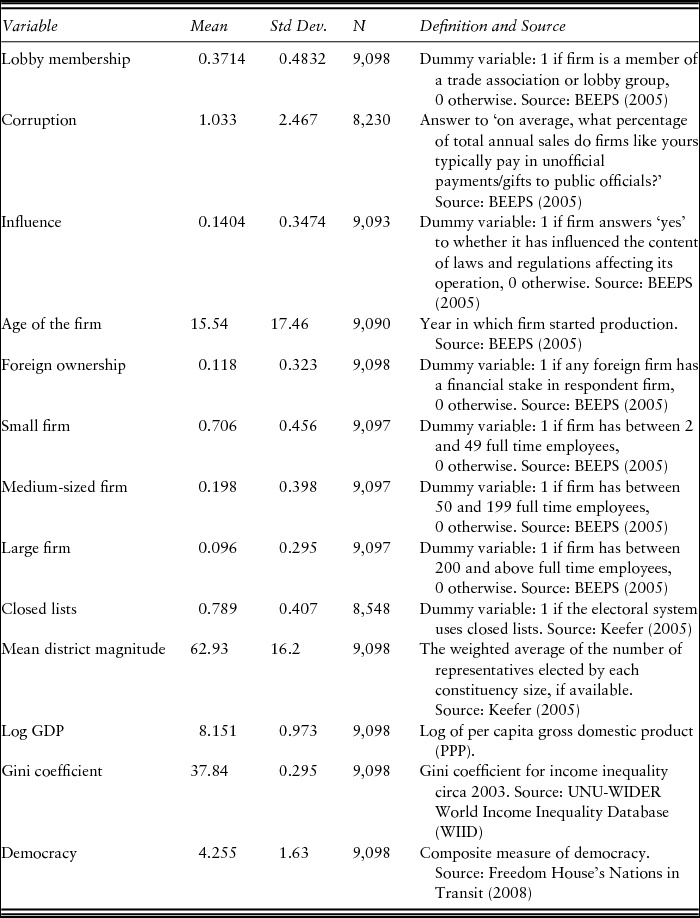
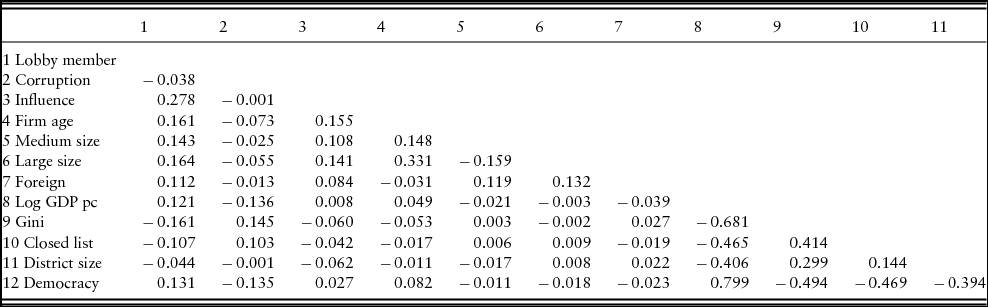
Firms were asked whether or not they were a member of a trade association at the time of the interview. A positive answer was coded 1, while the value of zero was given to a negative answer. Approximately 37% of the firms in our sample said they were members of a lobby group. Table A1 in the Appendix has basic statistics, variable definitions and sources. The relatively large standard deviation indicates that these figures vary across countries. Indeed, they range from a low of 19% of the firms being lobby members in Belarus to 91% of Slovenian firms answering they were members at the time of the interview.Footnote 8 If we correlate lobbying membership with the level of per capita GDP (the source for the latter is the Penn World Tables and the data refer to the log of per capita GDP at purchasing power parity) we can see there is a positive correlation between lobby membership and per capita GDP, but also that this correlation is not particularly high, at around 0.12. Table A2 in the Appendix presents the correlation matrix. It is also worthwhile mentioning that the highest pairwise correlations involve per capita GDP: the highest one is 0.79, between per capita GDP and a measure of democracy.
Note that, using the BEEPS 1999 and 2002 data to compare levels of lobby membership in 2005 to those in 1999 and 2002, one finds it is rising in these economies. Moreover, this is happening while these countries post positive and high GDP growth rates and, as noted by the EBRD (2006), decreasing levels of corruption.
The central hypothesis is that political institutions in general, and electoral rules in particular, are a crucial determinant of a decision to lobby. Following on from the previous section, we collected data on the key relevant political institutions from the World Bank Database of Political Institutions (DPI: Keefer Reference Keefer2005). In particular, the variable ‘closed lists’ reflect whether or not closed lists are used in the electoral system, while ‘mean district magnitude’ reflects the size of electoral districts. Keefer (Reference Keefer2005) defines mean district magnitude as:
the weighted average of the number of representatives elected by each constituency size, if available. If not, we use the number of seats divided by the number of constituencies, if both are known. If the constituencies are the provincial or state divisions, we use the number of states or provinces to make this calculation for as long as we know this number and the number of seats. If the only information we have on the number of constituencies comes from the Inter Parliamentary Union (IPU), and the constituencies are not the states/provinces, then we use IPU's number to calculate the Mean District Magnitude for 1995, and leave all unknowns blank.
How lobbying translates into political influence and how it consequently affects firm performance are important issues. The measure of influence we use reflects firms’ perceptions of whether it has influenced the content of laws and regulations affecting their operation. The source is again the 2005 BEEPS data base. Our measure is a binary variable coded 1 if the firm answered ‘yes’, and zero if it answered ‘no’. We find that 14% of the firms answer yes to this question on influence, with the relatively large standard deviation suggesting large cross-country variation: from 3% in Uzbekistan to 33% in Slovenia. The pairwise correlations between corruption and lobbying, on the one hand, and influence, on the other, are also not high, being around -0.001 for the former and about 0.27 for the latter.
From the BEEPS 20005 data set, we also obtain various auxiliary variables to reflect potentially important characteristics of the firms. These are the year in which the firm started production, the size of the firm (number of full-time employees) and whether or not the largest shareholder is a foreign company. The year in which the average firm started operating is 1989. This is because of a few old firms in the sample, the oldest dating from 1825. As explained above, the majority of the firms sampled are small privately owned enterprises, so it is unsurprising to see that the share of medium-sized firms, classified in the original questionnaire as having more than 50 and less than 249 full-time employees, is around 19% of the total and that of large firms, with more than 250 full-time employees, is about 9%. By the same token, the share of foreign-owned firms is approximately 12%. We have also added an important country-level control that many believe mediates the relationship between political institutions (electoral rules), on the one hand, and lobbying membership and perceived policy influence on the other. That factor is income inequality and here it is measured by the Gini coefficient obtained from the UNU-WIDER World Income Inequality Database (WIID).
The measure of corruption that we favour captures firms’ experience in each country. Our firm-level corruption measure is originally from the BEEPS data base. In our analysis, it is the answer to the following question: ‘On average, what percent[age] of total annual sales do firm's [sic] like yours typically pay in unofficial payments/gifts to public officials?’ A crucial indication that we are indeed capturing something inherently different with our measures of corruption and lobbying is that the simple correlation between these two is very low, at -0.038. Also of interest is that the correlation between corruption and the level of per capita GDP is negative but not particularly high, at -0.13.
Let us now turn to the econometric methodology. There are two main questions of interest: (a) what are the factors that determine the likelihood of a firm being a member of a lobby group? (b) What is the role of lobby membership in explaining the probability of a firm seeing itself as influential vis-à-vis government laws and regulations? As explained above, the dependent variables in (a) and (b) are dichotomous variables. In question (a), it takes the value of 1 if the firm is a lobby member and of zero if not. In question (b) it takes the value of 1 if the firm perceives itself as influential, zero otherwise.
The focus is on which political institutions affect lobbying and how they do so. Thus we estimate the following maximum likelihood probit equation for lobbying:
 $$\begin{eqnarray}
P(Lobb{y_{ic}} = {\rm{ }}1){\rm{ }} &=& \Phi ({\beta _0}{\hbox{\it FS}_{ic}} + {\rm{ }}{\beta _1}{\hbox{\it Age}_{ic}} + {\rm{ }}{\beta _2}{\hbox{\it Ownerpriv}_{ic}} \nonumber\\
&&+\, {\rm{ }}{\beta _3}{\hbox{\it Ownerfor}_{ic}} + {\beta _4}{\hbox{\it GDP}_c} + \delta {P_{ic}} + {\rm{ }}\pi {V_{ic}})
\end{eqnarray}$$
$$\begin{eqnarray}
P(Lobb{y_{ic}} = {\rm{ }}1){\rm{ }} &=& \Phi ({\beta _0}{\hbox{\it FS}_{ic}} + {\rm{ }}{\beta _1}{\hbox{\it Age}_{ic}} + {\rm{ }}{\beta _2}{\hbox{\it Ownerpriv}_{ic}} \nonumber\\
&&+\, {\rm{ }}{\beta _3}{\hbox{\it Ownerfor}_{ic}} + {\beta _4}{\hbox{\it GDP}_c} + \delta {P_{ic}} + {\rm{ }}\pi {V_{ic}})
\end{eqnarray}$$
where Lobbyic is a binary variable indicating whether firm i in country c is a member of a lobbying group; FSic is firm size (measured in numbers of full-time employees); Ageic is the year the firm started to operate; Ownerprivic is whether the firm has private owners; Ownerforic is whether the firm has foreign owners; GDPc is real per capita GDP in the country in which the firm is located; Pic is a vector of political institutions variables (as discussed above, electoral rules); Vic is a vector of auxiliary control variables; and Φ is the cumulative standard normal distribution function. In order to minimize omitted variables concerns, we include sector fixed-effects in all regressions we estimate, with the sector dummies representing a coarse way of dealing with the important issue of asset specificity. Country fixed-effects cannot be included because of their correlation with the political institutions variable we use but standard errors are clustered at the country level, and country-level variables such as the level of per capita income and the Gini coefficient for income inequality are included throughout.
The next model we estimate is for political influence and uses the following probit equation:
 $$\begin{equation}
P({\hbox{\it Influence}_{ic}} = {\rm{ }}1){\rm{ }} = \Phi ({\delta _1}Lobb{y_{ic}} + \eta {W_{ic}})
\end{equation}$$
$$\begin{equation}
P({\hbox{\it Influence}_{ic}} = {\rm{ }}1){\rm{ }} = \Phi ({\delta _1}Lobb{y_{ic}} + \eta {W_{ic}})
\end{equation}$$
where Influence ic is a binary variable indicating whether firm i (in country c) perceives itself as influential vis-à-vis laws and regulations; lobbyic is the binary variable defined above; Wic is a vector of auxiliary control variables (including per capita GDP, firm size and ownership); and Φ is the cumulative standard normal distribution function. In order to minimize omitted variables concerns, we include sector fixed-effects in all regressions we estimated and cluster the standard errors at the country level.
In these latter models on influence, one concern is the potential endogeneity of lobby membership. This refers to the possibility that firms may be more likely to join lobby groups if and when such groups are perceived to be influential. It is therefore important to address this possibility. We do so using an instrumental variables approach by estimating the influence equation (equation 2 above), while treating lobbying as an endogenous variable.
We carry out two different exercises. In the first, we use different instruments to assess the potential endogeneity of lobbying or, in other words, whether the exogenous or unexplained part of the variation we observe in the lobbying decision is a good predictor of policy influence. We use a set of instruments to capture the strength of civil society: a dynamic measure of ethnic fractionalization (Campos and Kuzeyev, Reference Campos and Kuzeyev2007), a measure of natural resources abundance (World Bank, 2005) and the average number of political protests events in 1989 (from Bruszt et al., Reference Bruszt, Campos, Fidrmuc, Roland and Roland2012). We expect that increases in fractionalization and natural resource abundance reduce the likelihood of firms joining lobbying groups and increase the probability of firms using corruption as a preferred means of influencing government policy. By the same token, we expect the number of political protests before 1989 to increase the likelihood that firms will lobby and decrease the probability that they will choose corruption.
The second way we implement instrumental variables in this context is to use our various electoral rules features as instruments for lobbying. This is a particularly interesting exercise because it allows us to further investigate whether the effect of political institutions (electoral rules) on the capacity to influence government policy is mostly direct or mostly indirect, that is, on their own account or through membership in business or trade associations.
4. Econometric results and discussion
In this section, we present and discuss our econometric results. First, we investigate whether electoral institutions do indeed affect lobbying in light of the hypotheses discussed above. Second, we study how lobbying generates political influence and which type of role (direct or indirect) political institutions play.
What are the main factors that determine whether a firm is a member of a lobbying group? Which electoral institutions affect lobbying, and how do they do it? Tables 1–3 report our results. Our results first suggest that firms are less likely to resort to lobbying when district magnitude is larger, a result that is compatible with the retrospective-voting view of elections. On the other hand, our results suggest that firms are also less likely to lobby when based in countries where the electoral system has closed lists and this result is not compatible with a retrospective-voting view of elections, but it is compatible with the prospective view put forward by Chang (Reference Chang2005) and Chang and Golden (Reference Chang and Golden2007). Moreover, considering the interaction between district magnitude and closed lists, we obtain the result predicted by the retrospective view of elections. This is because among closed-list electoral systems, our results suggest it is those with the larger district magnitude that seem to make firms more likely to lobby. On balance, these results suggest to us that only certain aspects of each interpretation of elections can be confirmed, although the retrospective view seems to enjoy slightly stronger support.
The effects of electoral rules on lobbying: probit estimates for a sample of firms in 26 countries, 2005
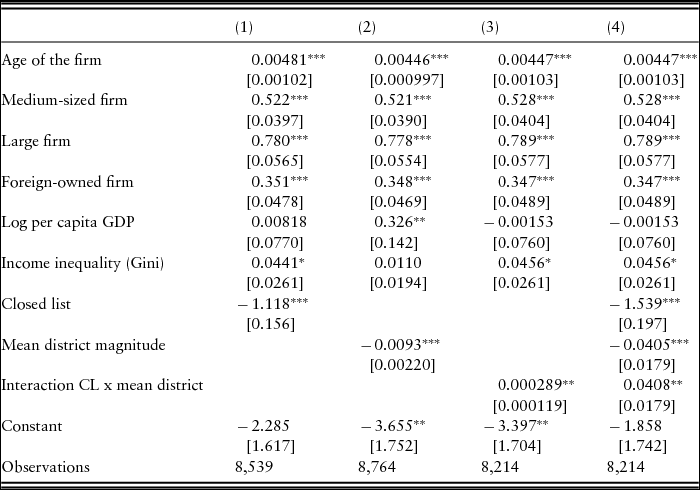
Notes: Robust standard errors in brackets, clustered at country level. ***p < 0.01, **p < 0.05, *p < 0.10. Dependent variable is a dummy for Lobby Membership, with yes equal to 1, zero otherwise. Sectoral fixed-effects are included in all specifications.
The effects of electoral rules on lobbying: probit estimates for a sample of firms in 26 countries, 2005. Interaction between small firms and democracy
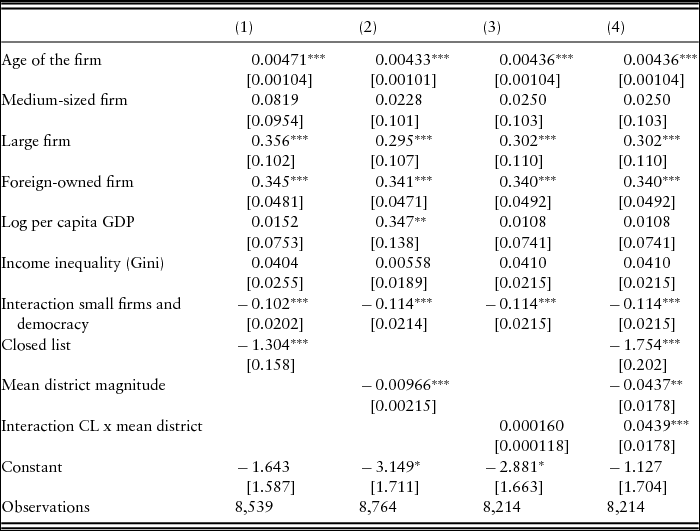
Notes: Robust standard errors in brackets, clustered at country level. ***p < 0.01, **p < 0.05, *p < 0.10. Dependent variable is a dummy for Lobby Membership, with yes equal to 1, zero otherwise. Sectoral fixed-effects are included in all specifications.
The effects of electoral rules on lobbying: probit estimates for a sample of firms in 26 countries, 2005. Interaction between foreign ownership and per capita GDP
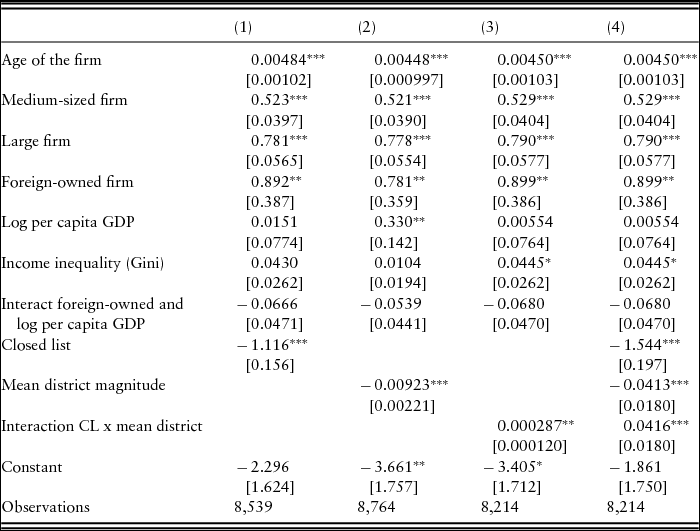
Notes: Robust standard errors in brackets, clustered at country level. ***p < 0.01, **p < 0.05, *p < 0.10. Dependent variable is a dummy for Lobby Membership, with yes equal to 1, zero otherwise. Sectoral fixed-effects are included in all specifications.
One conclusion that can be reached with confidence is that these differences between our results and those in some of the previous literature reaffirm the notion that measuring political corruption with country-level survey variables can provide misleading results and that the study of the relationship between lobbying and corruption requires a clearer distinction between the influencing of rule makers versus rule enforcers. These results also prevent us from drawing a definite conclusion on what role either retrospective or prospective voting in elections play in firms’ decision to lobby. One simple explanation is that since the claims of the proponents of retrospective and prospective voting offer different predictions, ambiguous results simply reflect the fact that voters embark on both retrospective and prospective considerations at the same time, and which of the two dominates may not be strongly dependent on key features of the electoral system.
In Tables 2 and 3 we also check for interactions between country-level and firm-level variables and find evidence that the more democratic a regime is, the more likely it is that small firms will lobby. This is a reassuring result, because among other things it is compatible with the notion that our measure of lobbying captures attempts to influence rule makers through legal means and does not necessarily coincide with political corruption.Footnote 9 There is considerably less evidence that foreign firms are either more or less likely to lobby depending on a country's level of per capita GDP (Table 3).Footnote 10 It is also important to note that accounting for such rich interactions does not substantially change our main conclusions about political institutions and lobbying: firms that are more likely to engage in lobbying are those where the electoral system favours open (not closed) lists and smaller electoral districts.
There are also various interesting findings referring to the controls we use: for example, we find evidence that older, larger and foreign firms are systematically more likely than younger, smaller and domestic firms to be members of a lobbying group. These findings are very much in line with the rest of the literature (Kerr et al. Reference Kerr, Lincoln and Mishra2014). Interestingly, the level of per capita GDP itself also doesn't seem to have an ambiguous effect on incentives to lobby: this again may be because lobbying, as defined here, includes the use of information, campaign contributions and endorsements.Footnote 11 This suggests that future work should be focused on building data that further distinguish between these different lobbying choices.
One natural question that follows is how effective lobbying is. Table 4 examines its importance in terms of the production of political influence. The main finding is that firms in our sample systematically point to lobbying as a very effective way of exerting political influence. As shown in Table 4, the coefficient on corruption is never significant and, in a few cases, even suggests that corrupt firms are less influential, lending some further support to the notion of substitutability between the two. In terms of firm characteristics, the results are also reassuring: we find that older and larger firms tend to see themselves as more influential, while foreigners and those located in richer countries do not necessarily see themselves as more influential.Footnote 12
The effects of lobbying on political influence: probit estimates for a sample of firms in 26 countries, 2005
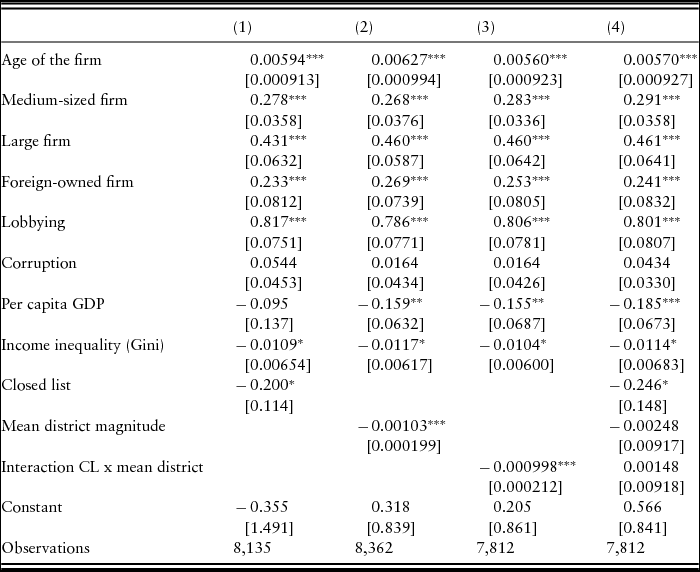
Notes: Robust standard errors in brackets, clustered at country level. ***p < 0.01, **p < 0.05, *p < 0.10. Dependent variable is a dummy for individual firm's influence on government policy, yes equal to 1, zero otherwise. Sectoral fixed-effects are included in all specifications.
For two hypothetical firms with same average characteristics, the predicted probability of influencing government policy (the marginal effect at the mean) is 16% higher for firms that lobby than for those that do not. This effect is remarkably constant across specifications. Even though the coefficient capturing the impact of corruption is never statistically significantly different from zero, the predicted effect of lobbying is always larger than the estimated marginal effect for corruption.
Thanks to the large number of firms in the BEEPS survey we can also carry out an important robustness check in terms of whether these findings differ across sectors. One can conjecture that manufacturing firms would be more likely to choose lobbying over corruption than, for example, firms in the construction sector. In order to assess this possibility, we re-estimate the model in Table 4 for as many sectors as the database allows us to differentiate. Our overall finding is that our main conclusions do not change, that is, for most sectors lobbying membership is a much-preferred method of obtaining political influence, much more so than corruption. Yet there are two noticeable exceptions: wholesale and real estate. For firms in mining, construction, manufacturing, transport, hotels and ‘others’, lobbying is always more important than corruption in generating political influence (the coefficient on lobbying is always statistically significant while the one on corruption never is). Lobbying is also very effective in producing influence for firms in the wholesale and real estate sectors, but now the coefficient on corruption is significant and positive for wholesale and negative for real estate. This is an exciting result because it suggests the possibility that firms use mixed strategies depending on their main area of economic activity.Footnote 13
One major concern regarding the results above is reverse causality: that is, that lobbying and political influence may be jointly determined. It may be the case that lobbying in the influence equation is endogenous because, say, firms are more likely to join lobby groups when they perceive them to be effective (i.e. influential). To try to deal with this concern, we re-estimate the influence equation (equation 2) treating lobbying as an endogenous variable and we do so in two different ways as discussed below.
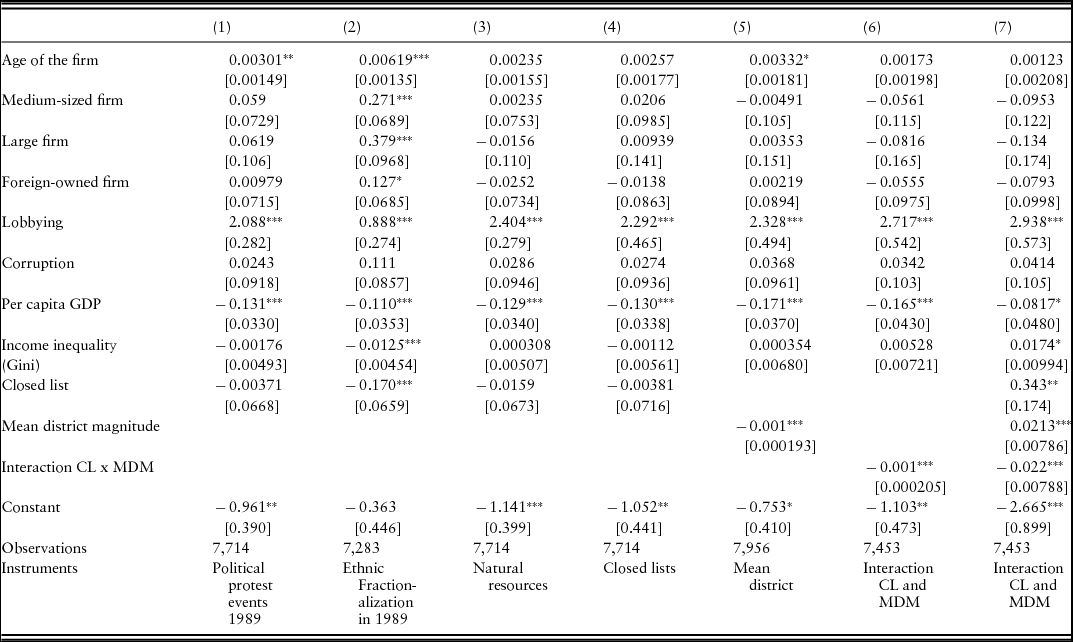
In the first exercise, we use three instruments (Table 5, columns 1 to 3) to check whether the exogenous or unexplained part of the variation we observe in the lobbying decision is a good predictor of policy influence. Our three instruments are ethnic fractionalization in 1989, natural resources abundance and the average number of political protests in 1989. Examining the first-stage regressions we find that natural resource abundance in a country and ethnic fractionalization significantly decrease lobbying (interestingly, these have opposite effects on corruption). The choice of these instruments is also justified in purely statistical terms, specifically from standard Wald exogeneity tests. The main conclusion is that there is little evidence that reverse causality affects our baseline results in important ways.
The effects of lobbying on political influence: instrumental variables probit estimates for a sample of firms in 26 countries, 2005
Notes: Robust standard errors in brackets, clustered at country level. ***p < 0.01, **p < 0.05, *p < 0.10. Dependent variable is a dummy for individual firm's influence on government policy, yes equal to 1, zero otherwise. Sectoral fixed-effects are included in all specifications.
In the second exercise, we use the various measures of political institutions (electoral rules) as instruments for lobbying (columns 4 to 7 in Table 5). This allows us to investigate whether the effect of electoral rules on influence is direct or indirect (through lobbying) as well as whether the exogenous or unexplained part of the variation we observe in the lobbying decision is a good predictor of policy influence.
We can conclude from columns 4 to 7 that electoral rules seem to exert a much more powerful indirect (through lobbying) effect on political influence compared to its direct effect on political influence. Another way of testing this possibility (available from the authors) is to examine the interaction between lobbying and the political institutions. We find these interactions to be significant while the results for lobbying and for corruption remain unchanged, further supporting the idea that the effects of political institutions on influence are mostly indirect, through the firm's choice of membership in lobbying groups.
Both exercises produced strong results that reinforce the finding that lobbying is a more effective way of generating influence on government policies than corruption and that the effect of electoral rules on influence occurs mostly through lobbying, rather than independently or directly.
5. Conclusions
This paper studies how a firm chooses to influence government policies. We differentiate between corruption and lobbying as two main methods of producing influence. In doing so we challenge a commonly held view that these differ mostly in the means used to obtain influence, while we argue that the fundamental difference has to do with where influence is being sought. For us, lobbying includes all the actions taken to obtain influence with rule makers while corruption includes all the actions taken to influence rule enforcers. We note that across the globe the latter is seldom legal, while the former is often legal. We provide a conceptual framework in which we show how this distinction allows us a set of predictions on the relationship between these phenomena and how they are affected by different political institutional set-ups.
Using 2005 survey data for a large number of firms across 26 countries, we show that political institutions play a significant role in explaining the decision to lobby. More specifically, we focus on electoral systems and find that the firms that are more likely to engage in lobbying are those where the electoral system has open lists and smaller districts and that they tend to be older, larger and foreign-owned. Crucially, we find confirmation that lobbying seems to be a much more effective instrument for political influence than corruption and this even in poorer, less developed countries than those normally considered in the literature. Our baseline estimate is that the probability of influencing government policy is 16% higher for firms that are members of lobbying groups compared to those firms that are not with political institutions playing an important role, which is chiefly indirect and magnifies the effect of lobbying. The implications of these results for individual firms are straightforward in supporting lobbying instead of corruption as the preferred method to effectively influence government policy. We also note we obtained evidence that lobbying is a stronger predictor of firms’ sales growth than corruption, which further supports the broad direction of such policy implications.
One main challenge for future research on these issues is that while more precise data at firm level on corruption is beginning to be available, data on lobbying at the firm level are still very sketchy. We believe that a very important issue is, for example, that using existing data one cannot distinguish firms that lobby indirectly (through a trade association or lobby group) from firms that lobby directly; and nor can one separate trade associations from pure lobby groups. Further, we have stressed above the importance of differentiating between lobbying and corruption with respect to their targets rather than the means used. Once this distinction is better appreciated, the question of how different ways of lobbying perform in specific institutional contexts will gain urgency. On this count, further progress at both theoretical and empirical level is still needed and would be extremely valuable.
Acknowledgements
We thank Saul Estrin, Roman Horvath, Iiika Korhonnen, Fabrizio Zilibotti, two anonymous referees and seminar participants at BOFIT (Helsinki), University of Paris-Sorbonne, Universidad Complutense de Madrid, Bristol University, University of Reading and Ausschuss für Entwicklungsländer Conference (Zurich) for valuable comments on previous versions. We also would like to thank Branko Milanovic and Torsten Persson for kindly sharing their data with us. The usual disclaimer applies.
Appendix
Basic statistics, variable definitions and data sources
Correlation matrix


 Open access

