





Introduction
In the field of second language acquisition (SLA), complex dynamic systems theory (CDST) is a theoretical paradigm used to study the complex and dynamic nature of language, language use, and language development (Hulstijn, Reference Hulstijn2020). A complex system is formed out of interactions between multiple internal and external system components. For example, if conceptualizing language development as a complex system, changes in development are dependent on interactions between a learner’s internal resources like working memory, motivation, and personality, as well as external, environmental resources like the teacher, learning materials, and language use (van Geert, Reference van Geert1991). These internal and external resources are interrelated, whereby altering one component could in turn alter other components of the system (de Bot et al., Reference de Bot, Lowie and Verspoor2007). In this way, a complex system is characterized by complete interconnectedness and mutual causality (Larsen-Freeman & Cameron, Reference Larsen-Freeman and Cameron2008). Complex systems are inherently dynamic; systems emerge over time through processes of self-organization and coadaptation between micro- and macro-level system components (Larsen-Freeman, Reference Larsen-Freeman1997). This means that complex systems are soft-assembled, whereby systems are “more than the sum of their parts, reflecting a multiplicative combination of attributes, experiences and situational factors” (American Psychological Association, 2017). CDST researchers in SLA have acknowledged the impossibility of fully “knowing” a system, as complex systems are characterized by unpredictability and nonlinearity, where changes in the system can be disproportionate to the cause (Larsen-Freeman, Reference Larsen-Freeman1997). Although a complex system is, by definition, constantly in flux, the system can also demonstrate periods of temporary stability. This is referred to as an attractor state; a self-sustaining state in which interactions “are actively reproduced over time” (van Geert, Reference van Geert2019, p. 168). An attractor state represents higher-order patterns of self-organization within state space, from which the system moves toward or away from over time (Hiver, Reference Hiver, Dörnyei, MacIntyre and Henry2014). To illustrate, an attractor state could refer to the tendency for learners not to participate in class and remain silent (Hiver, Reference Hiver, Dörnyei, MacIntyre and Henry2014).
With the growing recognition that CDST approximates the reality of language development (Hiver & Al-Hoorie, Reference Hiver and Al-Hoorie2020a), more SLA researchers are adopting this framework. However, there are many methodological considerations for conducting empirical research within a CDST paradigm. Some of these include how to operationalize the system, how to assess the influence of contextual factors on the system, as well as macro- and micro-structure considerations (Hiver & Al-Hoorie, Reference Hiver and Al-Hoorie2016). Given the inherent complexities of analyzing dynamic cause-effect relationships between systems and their components, there has been much discussion about suitable methodologies and suggestions of how to enhance our CDST toolbox (de Bot, Reference De Bot, Verspoor, de Bot and Lowie2011; Hiver & Al-Hoorie, Reference Hiver and Al-Hoorie2016, Reference Hiver and Al-Hoorie2020a; Hiver et al., Reference Hiver, Al-Hoorie and Evans2022).
Hilpert and Marchand (Reference Hilpert and Marchand2018) distinguish between three conceptual perspectives to studying complex systems and their accompanying research designs: time-intensive, relation-intensive, and time-relation intensive approaches. Firstly, time-intensive approaches “are used to make inferences about system behavior using closely spaced observations over time” using longitudinal data (Hilpert & Marchand, Reference Hilpert and Marchand2018, p. 192). The second approach, relation-intensive, focuses on identifying the structure of the relationships among individuals or variables in a system using cross-sectional data. Combining the first two approaches, time-relation intensive approaches “are used to make inferences about system behavior using closely spaced, simultaneously collected observations of both within-element change and changing between element relationships” (Hilpert & Marchand, Reference Hilpert and Marchand2018).
The majority of CDST studies in the field of SLA to date have taken time-intensive approaches, typically consisting of case studies characterized by dense data collection with qualitative and descriptive data analyses (Hiver et al., Reference Hiver, Al-Hoorie and Evans2022). For the last 30 years, CDST researchers have focused on individual variability and the dynamics of processes (van Geert & van Dijk, Reference van Geert and van Dijk2021). This is not surprising, given that CDST is essentially a theory of change, concerned with how one state develops into another state over time. However, as Hilpert and Marchand (Reference Hilpert and Marchand2018) have pointed out, complex systems can be studied from multiple perspectives. Besides analyzing change over time, identifying the structure of a system is also a key aspect of CDST. Expanding our line of inquiry to include relation-intensive approaches could contribute to the development of new dimensions of CDST research and complement time-intensive approaches. While researchers have a diverse selection of methods available for time-intensive approaches, our methodological toolbox for relation-intensive methods is lacking.
In this article, we highlight network analysis as a potential methodology to model complex systems from a relation-intensive perspective. While network analysis can also be used for time- and time-relation intensive approaches, this article is focused on network analysis for relation-intensive approaches only, due to the relative lack of attention that this dimension has received by SLA researchers working within a CDST paradigm. More specifically, we concentrate on psychological networks, as opposed to social networks. SLA researchers have already explored social network analysis as a suitable research methodology for CDST, for example to model relationships between learners in a classroom and teacher networks as complex systems (Hiver & Al-Hoorie, Reference Hiver and Al-Hoorie2016; Hiver & Al-Hoorie, Reference Hiver and Al-Hoorie2020a; Mercer, Reference Mercer, Dörnyei, MacIntyre and Henry2014). SLA researchers have not yet explored the potential of psychological networks to model psychological constructs that influence language learning as complex systems. The network approach to psychopathology has been used to reevaluate theories of mental disorders (Borsboom et al., Reference Borsboom, Fried, Epskamp, Waldorp, van Borkulo, van der Maas and Cramer2017; Borsboom & Cramer, Reference Borsboom and Cramer2013) and constructs such as intelligence and cognitive development from a CDST perspective (Kievit, Reference Kievit2020; van der Maas et al., Reference van der Maas, Dolan, Grasman, Wicherts, Huizenga and Raijmakers2006, Reference van der Maas, Kan, Marsman and Stevenson2017). In this article we discuss how, similarly to psychology research, individual differences in language learning can be modeled as nomological networks, expanding our relation-intensive methods to include the study of phenomenological constructs. We begin with a brief review of CDST research designs used in the field of SLA to date, in relation to the three different conceptual approaches to studying complex systems as described by Hilpert and Marchand (Reference Hilpert and Marchand2018). We then expand discussion on relation-intensive approaches, the least researched dimension in CDST. The remainder of the article discusses potential applications of network analysis. To further aid discussion, we provide two examples of network models that are estimated from publicly available data.
Research designs in CDST
Time-intensive methods
Most CDST research in applied linguistics is time-intensive, with longitudinal data collection of a single variable (or multiple variables for a single case/participant) to observe micro-level changes in the system over time (Hiver et al., Reference Hiver, Al-Hoorie and Evans2022; Hiver & Larsen-Freeman, Reference Hiver, Larsen-Freeman, Al-Hoorie and MacIntyre2019). Time-intensive studies tend to have dense data collection and small sample sizes, with 40% of studies including a sample size of 10 participants or fewer (Hiver et al., Reference Hiver, Al-Hoorie and Evans2022). A particularly researched area is the development of L2 writing over time using measures of complexity, fluency, and accuracy (CAF) (Evans & Larsen-Freeman, Reference Evans and Larsen-Freeman2020; Larsen-Freeman, Reference Larsen-Freeman2006; Lowie et al., Reference Lowie, van Dijk, Chan and Verspoor2017; Lowie & Verspoor, Reference Lowie and Verspoor2019). Some common CDST techniques used in these studies include assessing the degree of variability in developmental trajectories and plotting longitudinal data on min-max graphs for visual inspection. Several studies have used a time-series design based on the view that frequent-enough measurements may be able to capture underlying developmental processes (Van Geert & Steenbeek, Reference van Geert and Steenbeek2005). For example, Waninge et al. (Reference Waninge, Dörnyei and de Bot2014) micro-mapped the motivational dynamics of four students during class time, taking measurements at 5-minute intervals.
Another popular methodology for observing language development is retrodictive modeling (Chan & Zhang, Reference Chang and Zhang2021; Evans & Larsen-Freeman, Reference Evans and Larsen-Freeman2020; Nitta & Baba, Reference Nitta, Baba and Bygate2018), based on the idea that because what we observe has already changed, change can be described retrospectively (Larsen-Freeman & Cameron, Reference Larsen-Freeman and Cameron2008). Retrodictive methods such as process tracing have been used to study the development of language as well as individual differences over time. For example, Papi and Hiver (Reference Papi and Hiver2020) used process tracing of retrospective interviews to examine changes in six learners’ motivational principles and Amerstorfer (Reference Amerstorfer2020) used process tracing with a combination of classroom observations and retrodictive interviews to explore five learners’ strategic L2 development. Some time-intensive CDST studies have also used the “idiodynamic method,” a mixed-methods approach to studying affective and cognitive states (MacIntyre, Reference MacIntyre2012). These time-intensive approaches have provided insights into nonlinear L2 developmental processes and intraindividual variation over time.
Relation-intensive methods
In comparison to the number of studies that have taken a time-intensive approach, far fewer CDST studies have taken a relation-intensive approach, which involves exploring the structure of relationships between people or variables within a system with cross-sectional data. As previously mentioned, SLA researchers have noted how social network analysis is a suitable methodology for CDST, for example to analyze relationships between learners in a classroom, teacher networks, or school networks (Mercer, Reference Mercer, Dörnyei, MacIntyre and Henry2014). However, this discussion has been mostly theoretical, with very few empirical studies using social network analysis from a CDST perspective. For example, although some applied linguistics researchers have used social network analysis to map the distribution of conversational topics of bilinguals in different contexts (Tiv et al., Reference Tiv, Gullifer, Feng and Titone2020) and to assess the impact of social networks in study abroad contexts (Gautier, Reference Gautier and Howard2019; Paradowski et al., Reference Paradowski, Jarynowski, Jelińska and Czopek2021; Zappa-Hollman & Duff, Reference Zappa-Hollman and Duff2014), these studies are not typically informed by CDST.
While relation-intensive approaches can focus on person-to-person interactions, they can also be used to analyze relations among psychological variables (Marchand & Hilpert, Reference Marchand and Hilpert2018). Taking a variable-centered relation-intensive approach necessitates researchers to engage with psychological constructs on a phenomenological level, and to carefully consider whether their methodology can effectively model complex patterns of relationships among variables. Some SLA researchers have discussed how psychological constructs such as “the self” and L2 motivation can be conceptualized as complex systems (Henry, Reference Henry, Dörnyei, MacIntyre and Henry2014, Reference Henry2017; Mercer, Reference Mercer2011a). In one study, Mercer (Reference Mercer2011a) took a relation-intensive approach to explore how the self-construct could be conceived of as a complex system. Using qualitative data of a single case study, Mercer (Reference Mercer2011a) created a three-dimensional network-based model of a student’s self-concepts that she felt to be the most “phenomenologically-real” representation of the data.
Besides this, few SLA researchers have attempted to model psychological constructs as complex systems. There are a handful of CDST studies that are reminiscent of relation-intensive approaches, which used quantitative methodologies often deemed ill-suited for CDST. For example, conceptualizing L2 speech as a complex system, Saito et al. (Reference Saito, Macmillan, Mai, Suzukida, Sun, Magne, Ilkan and Murakami2020) investigated the effects that 30 different internal and external individual differences had on the pronunciation of 110 L2 English speakers. Due to the large number of variables included in their study, Saito et al. (Reference Saito, Macmillan, Mai, Suzukida, Sun, Magne, Ilkan and Murakami2020) first conducted factor analysis and then did regression analysis with the extracted factor scores on speech ratings. In another study, Li et al. (Reference Li, Dewaele and Jiang2020) positioned themselves within a CDST framework to explore the relationships between individual difference constructs including foreign language classroom anxiety, foreign language enjoyment, self-perceived achievement, and actual English achievement. To analyze data, Li et al. (Reference Li, Dewaele and Jiang2020) conducted Pearson correlations to assess relationships between variables and used multiple regression analysis to assess the combined effect of anxiety and enjoyment on language achievement. While these two studies are fine cross-sectional studies in their own right, CDST scholars have argued that methods such as zero-order correlations and linear regression oversimplify the complex realities of how individual differences influence second language development and have questioned the use of cross-sectional datasets in CDST research (Al-Hoorie & Hiver, Reference Al-Hoorie, Hiver, Al-Hoorie and Szabó2022; Hiver, Reference Hiver, Dörnyei, MacIntyre and Henry2014). Overall, very few SLA researchers to date have used relation-intensive approaches within a CDST paradigm. There are also seemingly fewer methodologies available for SLA researchers to explore relation-intensive approaches, with more conceptual discussion than empirical studies.
Time-relation intensive methods
Hilpert and Marchand (Reference Hilpert and Marchand2018, p. 192) describe time-relation intensive research designs as having “closely spaced, simultaneously collected observations of both within-element change and changing between element relationships.” Only a few SLA studies have analyzed interactions between variables and how these interactions change over time. However, these studies cannot be strictly classified as time-relation intensive approaches, as their data collection consisted of only a few time points. For example, Serafini (Reference Serafini2017) conducted longitudinal case studies to explore interactions between cognitive and motivational individual differences at varying proficiency levels. Data was collected twice from 87 university students learning L2 Spanish, at the beginning and end of an academic semester. Serafini used Pearson correlations to analyze associations between individual differences at each time point and created scatterplots with regression and Loess lines to visualize relationships between variables and compare differences across proficiency levels. Results showed that the relationship between cognitive abilities and motivational constructs varied at each time point and across learner proficiency levels, indicating that cognitive and motivational subsystems are interdependent. In another study, Piniel and Csizér (Reference Piniel, Csizér, Dörnyei, MacIntyre and Henry2014) investigated changes in 21 students’ motivation, anxiety, and self-efficacy at six time points throughout an academic writing course. To analyze data, Piniel and Csizér used latent growth curve modeling (LGCM) and cluster analysis to group together learners with similar trajectories. Interactions between variables were also analyzed by comparing Pearson correlations between IDs at each time point. Overall, results indicated that language learning experience, ought-to L2 self, and writing anxiety showed a significant level of nonlinear change over time. There was also a strong interrelationship between motivation and anxiety, whereby more highly motivated learners had lower levels of language learning anxiety.
Pfenninger and colleagues (Kleisch & Pfenninger, Reference Kliesch and Pfenninger2021; Pfenninger, Reference Pfenninger2020) have also recently explored the use of generalized additive mixed modeling (GAMM) for a time-relation intensive approach to SLA microdevelopment. GAMM is a type of analysis used for time-series data that can consider nonlinear development, iterative processes, and interdependency between variables (Pfenninger, Reference Pfenninger2020). Pfenninger (Reference Pfenninger2020) used GAMM to analyze the L2 developmental trajectories of four groups of children (N = 91) on different content and language integrated learning (CLIL) programs. The children completed various language tasks four times a year for up to 8 years. Pfenninger also combined GAMM with qualitative data to help identify what contributed to developmental trajectories. Results showed that children had similar L2 trajectories regardless of their age of onset, and that L2 growth was determined by various different external and internal states across time. In another study, Kliesch and Pfenninger (Reference Kliesch and Pfenninger2021) used GAMM to examine the L2 developmental trajectories of 28 adults (age 64+) on a 7-month beginner’s Spanish course. Data was collected each week over 30–32 weeks, which included seven L2 measures, eight cognitive tasks, and measures of well-being and motivation. GAMM revealed both linear and nonlinear increases in L2 proficiency over time, with considerable between-subject variability. While only a few CDST studies have used time-relation intensive methods, findings indicate a complex interplay between external and internal learner differences, which in turn interact with language development in a nonlinear way over time.
Expanding our research agenda
CDST studies that have incorporated a relation-intensive element to their research design are far less common compared to the number of studies that have taken time-intensive approaches. Despite the fact that “complexity theorists are interested in understanding the relations [emphasis in original] that connect the components of a complex system” (Hiver & Larsen-Freeman, Reference Hiver, Larsen-Freeman, Al-Hoorie and MacIntyre2019, p. 287), to date there have been very few attempts to empirically model these relations. One potential reason behind this is relates to methodological challenges and the view that cross-sectional data, zero-order correlations and linear regression are ill-suited to studying complex systems (Al-Hoorie & Hiver, Reference Al-Hoorie, Hiver, Al-Hoorie and Szabó2022). Another reason relates to the theoretical challenges of conceptualizing abstract psychological constructs as complex systems. A number of individual differences constructs in language learning have been conceptualized as complex systems, such as motivation (Papi & Hiver, Reference Papi and Hiver2020), strategy development (Amerstorfer, Reference Amerstorfer2020), anxiety (Gregersen, Reference Gregersen2020), working memory (Jackson, Reference Jackson2020), and willingness to communicate (MacIntyre, Reference MacIntyre2020). To examine these constructs from a relation-intensive perspective, for example to model L2 motivation as a complex system, we must consider the components that form the system, and how these components align with our measurement instruments. Researchers must also confront “the boundary problem” (Larsen-Freeman, Reference Larsen-Freeman, Ortega and Han2017), accepting the theoretical impossibility of measuring a complex system in its entirety, whereby “the whole is greater than the sum of its parts” (Han, Reference Han and Han2019, p. 156). Consideration should also be given to the phenomenological validity of equating conceptual and theoretical concepts as systems, and the practical implications this has for a chosen methodology (Hiver & Al-Hoorie, Reference Hiver and Al-Hoorie2016). Mercer (Reference Mercer and Mercer2011b, p. 59) discusses these issues in relation her network-based model of the self-concept, acknowledging the theoretical and empirical difficulty of distinguishing the blurred boundaries between different self-constructs. Despite the challenges of exploring psychological constructs related to language learning from a relation-intensive approach, and the inevitable reductionism this entails, focusing on system structures can offer a perspective that is currently missing from CDST research in SLA.
Take the construct of L2 motivation, for example, which has been much discussed in CDST research (e.g., Dörnyei, Reference Dörnyei, Ortega and Han2017, Dörnyei et al., Reference Dörnyei, MacIntyre, Henry, Dörnyei, MacIntyre and Henry2015; Henry, Reference Henry, Dörnyei, MacIntyre and Henry2014, Reference Henry2017; Hiver & Papi, Reference Hiver, Papi, Lamb, Csizér, Henry and Ryan2019; Hiver & Larsen-Freeman, Reference Hiver, Larsen-Freeman, Al-Hoorie and MacIntyre2019; Papi & Hiver, Reference Papi and Hiver2020). Most CDST research on L2 motivation has been time-intensive with a focus on observing micro-level changes in a small number of variables over time. Very few CDST researchers have explored L2 motivation from a relation-intensive perspective, although there has been some theoretical discussion of how to conceptualize the structural relationships between motivational constructs as complex systems (Henry, Reference Henry, Dörnyei, MacIntyre and Henry2014, Reference Henry2017). The L2 Motivational Self System (L2MSS) is a theoretical paradigm that was developed by Dörnyei (Reference Dörnyei2005, Reference Dörnyei, Ellis and Larsen-Freeman2009) that conceptualizes L2 motivation from a self-perspective. The L2MSS is comprised of three phenomenologically constructed concepts, each theorized to be a primary source of motivation to learn an L2: the Ideal L2 Self, the Ought-to L2 Self, and L2 Learning Experience (Dörnyei Reference Dörnyei2005, Reference Dörnyei, Ellis and Larsen-Freeman2009). Although the L2MSS was not originally conceptualized as a complex system, it has been conceptually extended to a CDST paradigm (Henry, Reference Henry, Dörnyei, MacIntyre and Henry2014, Reference Henry2017). For example, Henry (Reference Henry2017, p. 551) has described the self-concept as a multifaced dynamic structure, which can be understood as “the product of constant interactions between different subsystems (such as, e.g., self-efficacy and self-esteem).”
Taking a relation-intensive approach to L2 motivation could provide insight into the structural relationships between components of the L2 motivational system, and if this were expanded to a time-relation intensive approach, could potentially identify attractor states. SLA researchers have speculated about how the L2 self-system, in particular the Ideal L2 self, can manifest as an attractor state (Henry, Reference Henry2017; Hiver, Reference Hiver, Dörnyei, MacIntyre and Henry2014; Waninge et al., Reference Waninge, Dörnyei and de Bot2014), whereby “changes in the vision of the Ideal L2 Self and changes in the distance between it and the actual self, can be conceptualized as changes in attractor state geometries” (Henry, Reference Henry, Dörnyei, MacIntyre and Henry2014, p. 87, emphasis in original). Although longitudinal data is needed to show system self-organization and the emergence of attractor states, cross-sectional data can provide a perspective that is currently missing from CDST research in SLA. As Mercer (Reference Mercer2011a) reflects in relation to her network-based model of the self-concept:
Whilst the model out of necessity can only represent a snapshot of a fragment of an individual’s self-concept network in a specific context at a particular time, the essence of the underlying form can be used to fundamentally understand the structure and nature of self-concept. (p. 66)
Taking a relation-intensive CDST approach to the study of individual differences in SLA can thus be viewed as complimentary of time-intensive approaches. Cross-sectional data can provide insight into the structure of relationships between system components, which, if combined with what we have learned from time-intensive CDST studies, could enrich our understanding of the complex interplay between individual differences and L2 development.
There is currently little guidance on how to analyze and model interactions between system components from a relation-intensive perspective. As previously mentioned, CDST researchers have questioned whether methods such as zero-order correlations and linear regression are suitable for examining dynamic changes and interconnected (Al-Hoorie & Hiver, Reference Al-Hoorie, Hiver, Al-Hoorie and Szabó2022). Although scholars have emphasized the potential of quantitative analyses for CDST research (Al-Hoorie & Hiver, Reference Al-Hoorie, Hiver, Al-Hoorie and Szabó2022) for example to identify network structure or nested phenomena, there appears to be an overall reluctance to use cross-sectional data, with most CDST researchers preferring longitudinal data. Until now, most studies that have taken a relation-intensive approach have analyzed relationships between variables by correlations and multiple regression analysis (Li et al., Reference Li, Dewaele and Jiang2020; Piniel & Csizér, Reference Piniel, Csizér, Dörnyei, MacIntyre and Henry2014; Saito et al., Reference Saito, Macmillan, Mai, Suzukida, Sun, Magne, Ilkan and Murakami2020; Serafini, Reference Serafini2017). However, new advancements in statistics software and data analysis techniques such as GAMM are enriching the CDST toolbox. Other techniques that have been proposed as appropriate methods to study complex systems with a relation-intensive element are latent growth curve modeling (LGCM) and multilevel modeling (MLM) (Hiver & Al-Hoorie, Reference Hiver and Al-Hoorie2020a; MacIntyre et al., Reference MacIntyre, MacKay, Ross, Abel, Ortega and Han2017). To expand our CDST toolbox of relation-intensive approaches, we could also utilize network analysis, an underexplored methodology in SLA research.
Network analysis
Network analysis has become a popular technique for studying complex systems in the field of psychology. Readers should be aware that there are many different types of network models; network analysis can be performed on cross-sectional data from a relation-intensive perspective (Epskamp & Fried, Reference Epskamp and Fried2019; Hevey, Reference Hevey2018), and also on longitudinal time-series data from a time- or time-relation intensive perspective (Bringmann et al., Reference Bringmann, Vissers, Wichers, Geschwind, Kuppens, Peeters and Tuerlinckx2013). Although we outline some other variants of network analysis later in the discussion section, it is beyond the scope of this article to describe each type of network analysis in detail. We have opted to focus on psychological networks with cross-sectional data for relation-intensive approaches, which is an underexplored dimension of CDST research in applied linguistics.
As readers may be more familiar with social network analysis, we would also like to briefly explain some differences between social networks and psychological networks. Social networks show patterns of relationships among individuals or groups, whereas psychological networks show patterns of relationships among variables (at item level or composite level). It is important to note that with social networks, the relationships between variables are known; social networks are created from an adjacency matrix, whereby the relationships between variables are directly observed (O’Malley & Onnela, Reference O’Malley, Onella, Levy, Goring, Gatsonis, Sobolev, van Ginneken and Busse2019). In contrast, with psychological networks, relationships between variables are not known but are estimated. Psychological networks are estimated from a variance-covariance matrix, based on the strength of partial correlations between variables (Epskamp & Fried, Reference Epskamp and Fried2019).
Psychological network analysis has been used to model constructs such as intelligence (van der Maas et al., Reference van der Maas, Dolan, Grasman, Wicherts, Huizenga and Raijmakers2006, Reference van der Maas, Kan, Marsman and Stevenson2017) cognitive development (Kievit, Reference Kievit2020), and mental disorders (Borsboom, Reference Borsboom, Fried, Epskamp, Waldorp, van Borkulo, van der Maas and Cramer2017) from a CDST perspective, and has also been applied to clinical research on psychological disorders such as depression and eating disorders (Elliott et al., Reference Elliott, Jones and Schmidt2020; Lutz et al., Reference Lutz, Schwartz, Hofmann, Fisher, Husen and Rubel2018). In network models, variables (also referred to as components) are represented as circles called nodes. In psychological networks, nodes represent elements of a construct or an entire construct, such as attitudes or symptoms of a mental disorder. Lines between nodes are called edges, which represent the direct association between a pair of nodes. The strength of association between nodes is called the edge weight; the thicker the edge, the stronger the association. Edges in psychological networks are typically undirected, which reflect the hypothesized multicausal relationships between system components. Positive relationships are typically denoted using blue edges, while red edges are used to indicate negative relationships. The layout of the network model can be selected by the researcher. Psychological networks are often plotted (by default) using the Fruchterman-Reingold algorithm (Fruchterman & Reingold, Reference Fruchterman and Reingold1991), which places nodes with stronger connections closer together, and nodes with weaker connections further apart. Besides visual inspection, network models can be analyzed on several different levels, depending on what the research questions are. For example, researchers typically analyze the network density if the overall interest is the network structure or focus on particular nodes and edges (Burger et al., Reference Burger, Isvoranu, Lunansky, Haslbeck, Epskamp, Hoekstra, Fried, Borsboom and Blanken2022).
The most common models used to estimate psychological networks are pairwise Markov random field (PMRF) models. Within PRMF models, Gaussian graphical models (GGM) are used with continuous multivariate data to estimate partial correlations between variables (Epskamp, Reference Epskamp2014). Partial correlation networks are undirected graphs, estimated by analyzing the strength of correlations between variables after controlling for the effect of other measured variables in the network (Hevey, Reference Hevey2018). As such, a psychological network can be viewed as a “nomological net, which functions as a specification of the phenomenological concepts or theoretical constructs of interest in a study, their observable manifestations, and the linkages between them” (Hiver & Al-Hoorie, Reference Hiver and Al-Hoorie2016, p. 747). Psychological networks created using cross-sectional data can therefore be viewed as a snapshot of the system at a given time.
Network analysis and CDST
Network analysis has some advantages over other relation-intensive methods used in CDST research. One advantage is that network analysis is more conceptually aligned with CDST compared to factor-based statistical techniques that are rooted in latent variable theory (Fried, Reference Fried2020). Originally developed by Spearman (Reference Spearman1904), factor models function under the theoretical assumption that a latent construct, such as intelligence or personality, can be measured through observable indicators (e.g., behavioral tests or questionnaire items). This means that there is a hypothesized unidirectional relationship from the latent construct to the observable indicator, whereby answers to questionnaire items or tests are thought to “reflect” the latent construct (Edward & Bagozzi, Reference Edwards and Bagozzi2000). In contrast, from a network perspective, psychological constructs “exist as systems where components mutually influence each other without the need to call on latent variables” (Guyon et al., Reference Guyon, Falissard and Kop2017, p. 2). Statistically, factor models and psychological networks are closely related, as both analyze the covariance between observed variables. The difference between each approach is their competing causal explanations (Fried, Reference Fried2020). As van Bork et al. (Reference van Bork, Rhemtulla, Waldorp, Kruis, Rezvanifar and Borsboom2019, p. 1) explain, “whereas latent variable approaches introduce unobserved common causes to explain the relations among observed variables, network approaches posit direct causal relations between observed variables.”
These two competing causal explanations are reflected in the choice of statistical model selected by the researcher. For example, factor-based techniques such as SEM or LGCM generate directed graphs, with edges from the latent construct to the observed indicators and/or between latent constructs, which are determined by the researcher a priori. Psychological network analysis is a more data-driven approach and produces an undirected graph with edges estimated between all nodes, better reflecting key CDST concepts such as multicausality and interconnectedness. This has already been noted in the field of psychology, where researchers working from a CDST perspective are using network analysis as an exploratory tool to better visualize the complex patterns of relations between variables of interest (Hilpert & Marchand, Reference Hilpert and Marchand2018; Sachisthal et al., Reference Sachisthal, Jansen, Peetsma, Dalege, van der Maas and Raijmakers2019; van der Maas et al., Reference van der Maas, Kan, Marsman and Stevenson2017).
In this article, we explore how network analysis could be used to model psychological constructs that influence language learning from a relation-intensive perspective. We provide two examples of psychological networks created using the datasets of existing studies that are publicly available online in support of Open Science practices. As the nested nature of educational phenomena can be analyzed at multiple levels (Marchand & Hilpert, Reference Marchand and Hilpert2018), our network models illustrate two different levels of analysis; with nodes at item level and composite level. The first example is a network model of L2 motivation made using the dataset from Hiver and Al-Hoorie’s (Reference Hiver and Al-Hoorie2020b) study on the role of vision in L2 motivation. This example explores how an individual difference construct such as L2 motivation can be modeled as a complex system, by analyzing relationships between the L2MSS at the item level. The second example is a network model of individual differences in native language ultimate attainment, made using the dataset from Dąbrowska’s (Reference Dąbrowska2018) study. The second example takes a wider relation-intensive perspective by analyzing interactions between multiple individual difference constructs at the composite level. Note that the authors of the original studies (Dąbrowska, Reference Dąbrowska2018; Hiver & Al-Hoorie, Reference Hiver and Al-Hoorie2020b) did not position their research within a CDST paradigm, and our reanalysis of their data is not a critique on their work.
We performed all statistical analyses using the open-source software R (R Core Team, 2020) and the R-packages qgraph (Epskamp et al., Reference Epskamp, Cramer, Waldorp, Schmittmann and Borsboom2012) and bootnet (Epskamp et al., Reference Epskamp, Borsboom and Fried2018a) in particular. The R code that we used to create these two examples is available in the online Supplementary Materials on our Open Science Framework (OSF) page. This article is not intended to serve as a tutorial in network analysis (for tutorials, we refer readers to Burger et al., Reference Burger, Isvoranu, Lunansky, Haslbeck, Epskamp, Hoekstra, Fried, Borsboom and Blanken2022; Epskamp et al., Reference Epskamp, Borsboom and Fried2018a; and Hevey, Reference Hevey2018). Rather, our overall aim is to raise awareness of this methodology and illustrate how it can be applied to model psychological constructs related to language learning from a relation-intensive CDST perspective. Within each example, we evaluate (a) the extent to which a network analysis of the datasets supports the same conclusions as the original authors and (b) whether network analysis can offer any additional insights to the original analyses.
Example 1
The first example was made using the dataset from Hiver and Al-Hoorie’s (Reference Hiver and Al-Hoorie2020b) study “Reexamining the Role of Cision in Second Language Motivation: A Preregistered Conceptual Replication of You, Dörnyei, and Csizér (Reference You, Dörnyei and Csizér2016).” Both Hiver and Al-Hoorie (Reference Hiver and Al-Hoorie2020b) and You et al. (Reference You, Dörnyei and Csizér2016) used SEM to explore interrelationships between components of the L2 Motivational Self System (L2MSS). The L2MSS is a theoretical paradigm that was developed by Dörnyei (Reference Dörnyei2005, Reference Dörnyei, Ellis and Larsen-Freeman2009) based on Possible Selves Theory (Markus & Nurius, Reference Markus and Nurius1986). The L2MSS is comprised of three components, each theorized to be a primary source of motivation to learn an L2: the Ideal L2 Self, the Ought-to L2 Self, and L2 Learning Experience. The ideal L2 self refers to learners’ internal desires and wishes to learn the L2, while the ought-to L2 self refers to learner’s perceived external duties and social pressures to learn the L2 (Dörnyei & Chan, Reference Dörnyei and Chan2013). L2 experience concerns learners’ attitudes toward learning, based on their experience of the learning process and environment. In addition to these three components, vision and imagery are also considered key aspects of the L2MSS, whereby motivation is viewed as “a function of the language learners’ vision of their desired future language selves” (Dörnyei & Chan, Reference Dörnyei and Chan2013, p. 437). Vision can be considered as a combination of imagery capacity and ideal selves and is typically measured by visual and auditory learning style preferences, and vividness of imagery capacity (You et al., Reference You, Dörnyei and Csizér2016). A number of studies have used SEM to explore the interrelationships between these motivational constructs and the extent to which the L2MSS can predict language learning or intended effort (Dörnyei & Chan, Reference Dörnyei and Chan2013; Hiver & Al-Hoorie, Reference Hiver and Al-Hoorie2020b; You et al., Reference You, Dörnyei and Csizér2016). However, as You et al. (Reference You, Dörnyei and Csizér2016, p. 97) have pointed out, “because the L2 Motivational Self System was originally proposed as a framework with no directional links among the three components, past empirical studies employing SEM have not been uniform in specifying these interrelationships.” For example, whereas some studies have presented a directed pathway from the ideal L2 self to L2 learning experience, other studies have reversed this relationship (for further details see You et al., Reference You, Dörnyei and Csizér2016).
Hiver and Al-Hoorie (Reference Hiver and Al-Hoorie2020b) conducted a conceptual replication and extension of You et al. (Reference You, Dörnyei and Csizér2016) to evaluate the role of vision in L2 motivation and to assess whether intended effort is an outcome or a predictor of motivation. They justified these aims in part due to the fact that You et al. did not test equivalent or competing models, which could be considered a form of confirmation bias. Hiver and Al-Hoorie also stressed the need for more robust research designs, and further replication of research on language motivation. Hiver and Al-Hoorie (Reference Hiver and Al-Hoorie2020b) collected data from 1297 L2 learners of English in secondary schools in South Korea. In addition to the same 10 scales of motivation and vision used by You et al., Hiver and Al-Hoorie also included two measures of L2 proficiency, midterm grades and final exam grades, which were analyzed as one variable called L2 achievement. To determine the number of underlying factors, they submitted the dataset to Mokken scaling analysis, confirmatory factor analysis, exploratory factor analysis, scree plot, optimal coordinates, and parallel analysis (Hiver & Al-Hoorie, Reference Hiver and Al-Hoorie2020b, p. 73). These analyses resulted in only four factors: visual style, ideal L2 self, ought-to L2 self, and intended effort. With these four factors and the measures of L2 achievement, Hiver and Al-Hoorie used SEM to test two competing causal models of vision and L2 motivation, where intended effort was either an antecedent or an outcome of motivation. Contrary to You et al. (Reference You, Dörnyei and Csizér2016), Hiver and Al-Hoorie hypothesized intended effort to be an antecedent of the ideal L2 self and the ought-to L2 self. In both competing models, vision (visual style) was considered a predictor of motivation, which was the same as You et al. (Reference You, Dörnyei and Csizér2016). Results showed that the model with intended effort as a predictor of motivation showed a better overall fit. Although this was contrary to You et al.’s model, Hiver and Al-Hoorie note that as their dataset and analyses differed greatly from the initial study, their model cannot be used to contradict You et al.’s model and call for further replication of research on the L2MSS.
In both studies (Hiver & Al-Hoorie, Reference Hiver and Al-Hoorie2020b; You et al., Reference You, Dörnyei and Csizér2016), the authors were interested in the relationships between the L2MSS, vision, and intended effort. By using SEM, they operationalized motivational constructs as latent variables, depicting hypothesized causal relationships between latent constructs with unidirectional arrows. However, in both studies, the authors note potential issues and limitations of using SEM to model interactions between motivational constructs. One issue relates to the theorized dynamic nature of the L2MSS and the multicausal relationships between motivational constructs. Possible Selves Theory was originally proposed to have dynamic qualities, whereby current and ideal selves are shaped by multiple ongoing processes (Henry, Reference Henry, Dörnyei, MacIntyre and Henry2014; Markus & Nurius, Reference Markus and Nurius1986). For example, Hiver and Al-Hoorie speculate that once an L2 learner puts in the effort and engages in the L2 learning process, “there will be a dynamic interaction between motivation … and task demands, leading to continuous recalibration of that motivational construct” (Reference Hiver and Al-Hoorie2020b, p. 86). One might question the extent to which SEM can effectively model these dynamic interactions, as SEM operationalizes motivational constructs as latent variables with a unidirectional causal relationship. In fact, both studies’ authors acknowledge that a further limitation of SEM is that it requires the researcher to specify the direction of the relationship between latent constructs. SEM can only test the theoretical model that is selected by the researcher, although equivalent or alternative models may likely exist. This issue was illustrated by Hiver and Al-Hoorie’s (Reference Hiver and Al-Hoorie2020b) two competing SEM models. As discussed earlier, there has already been discussion of how the L2MSS could be conceptualized as a complex system (Henry, Reference Henry, Dörnyei, MacIntyre and Henry2014, Reference Henry2017) and manifest as an attractor state (Henry, Reference Henry2017; Hiver, Reference Hiver, Dörnyei, MacIntyre and Henry2014; Waninge et al., Reference Waninge, Dörnyei and de Bot2014). From a CDST perspective, causal relationships between motivational constructs are not unidirectional, but reciprocal. To further investigate the relationship between motivation and intended effort, Hiver and Al-Hoorie (Reference Hiver and Al-Hoorie2020b) have encouraged researchers to consider using nonrecursive models where causality is reciprocal. In this first example, we illustrate how network analysis can be used to model the L2MSS as a complex system, with hypothesized reciprocal causation between motivational constructs with nodes at item level.
Network estimation and visualization
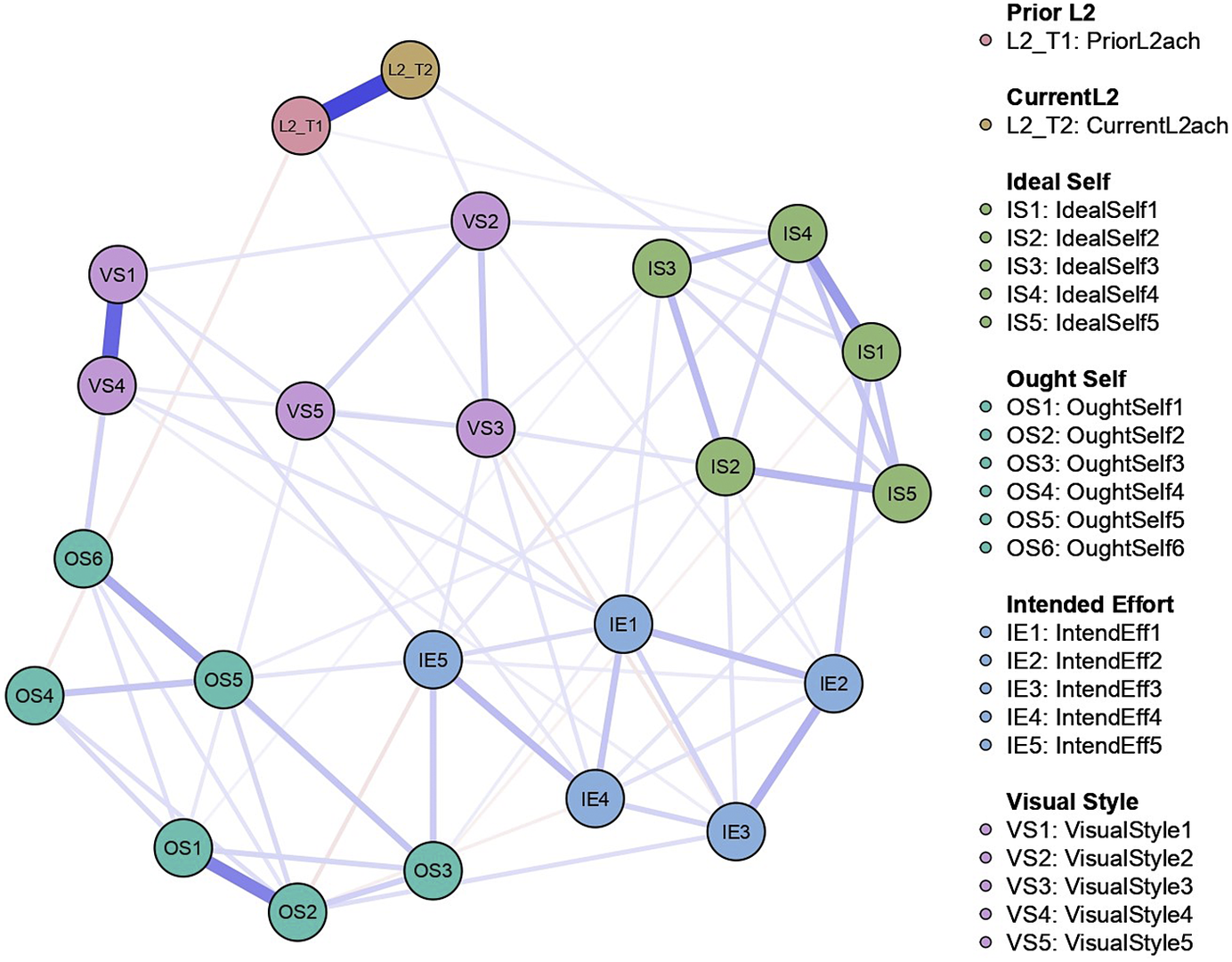
Figure 1 is a GGM of the L2MSS that we made with the dataset from Hiver and Al-Hoorie’s (Reference Hiver and Al-Hoorie2020b) study. In support of open science practices, they made their dataset and analyses publicly available through the OSF website. To allow for ease of comparison, we included the same variables in our network analysis as Hiver and Al-Hoorie’s SEM analyses, with the exception of visual style 2, which we explain in a later section. The network model in Figure 1 has nodes at item level, to better explore the interrelatedness of these motivational constructs, and the questionnaire items used to measure them. Table 1 contains information about which items correspond to each node.
A network model of the L2MSS and L2 achievement.
Note: In this network model of the L2MSS, there are four motivational constructs: the ideal L2 self, the ought-to L2 self, intended effort, and visual style. Each node represents a questionnaire item. Ought-to L2 self has been measured with six questionnaire items, and the other motivational constructs with five questionnaire items. There are also two composite measures of L2 proficiency: L2_T1 (students’ mid-term grades) and L2_T2 (students’ final grades).
Legend of node labels

We chose GGM model selection (ggmModSelect function implemented in the bootnet R-package; Epskamp et al., Reference Epskamp, Borsboom and Fried2018a) as estimation method because of the large size of the dataset. Model search works by setting edges to zero and using a stepwise algorithm to continuously estimate the model until the optimal model is identified (Epskamp, Reference Epskamp2014). This technique uses Bayesian information criterion (BIC) obtained through estimating the maximum likelihood of sparsity.
In their original analyses, Hiver and Al-Hoorie (Reference Hiver and Al-Hoorie2020b) tested for normality and found that their data were not multivariate normal both in skewness and kurtosis. For this reason, the network was estimated using Spearman correlations (Epskamp, Reference Epskamp2014).
After estimating the model, we evaluated the stability of the network structure in terms of edge-weight accuracy using bootstrapping (see Epskamp et al., Reference Epskamp, Borsboom and Fried2018a for an in-depth explanation of bootstrapping in psychological networks). We used 5,000 samples of the nonparametric bootstrap to assess the variability of the edge-weights. This step should always be performed (Epskamp et al., Reference Epskamp, Borsboom and Fried2018a) as any interpretation of the network becomes limited if the network is unstable (Burger et al., Reference Burger, Isvoranu, Lunansky, Haslbeck, Epskamp, Hoekstra, Fried, Borsboom and Blanken2022). The results show a good overlap between the estimated model and the bootstrapped edge-weights, indicating that the network of Figure 1 is stable. The results of the nonparametric bootstrap can be viewed in the supplementary materials.
To assess the stability of the centrality coefficients, we again used bootstrapping. We used the case-dropping bootstrap, specifically developed to this aim (Epskamp et al., Reference Epskamp, Borsboom and Fried2018a). The case-dropping bootstrap assesses the stability of the order of centrality in subsets of the data, that is, after systematically dropping an increasing percentage of participants from the dataset. The centrality stability for “strength” centrality was estimated on a sample of 5,000 bootstraps, which resulted in a correlation stability coefficient (CS-coefficient) of 0.52 for the “strength” centrality. This is above the 0.5 (CS-coefficient) recommendation (Epskamp et al., Reference Epskamp, Borsboom and Fried2018a), which is why we conclude that the stability of node centrality in this network model is good. The results are presented in the supplementary materials.
Based on the centrality indices (see Figure 2), ought-to L2 self 2 is the most central component in the network model in Figure 1 in terms of node strength, followed by intended effort 5. The questionnaire items that correspond to these components are “Studying English is important to me to gain the approval of my peers” and “English would be still important to me in the future even if I failed in my English course.” This suggests that peer approval and perceived future importance of English play important roles in L2 motivation, as they are the strongest direct relationships with other motivational constructs in the system.
Centrality plots for the L2MSS network.
Note: Centrality plots for the network model of the L2MSS. Centrality measures are shown as standardized z-scores. The raw centrality indices can be found in the online Supplementary Materials.
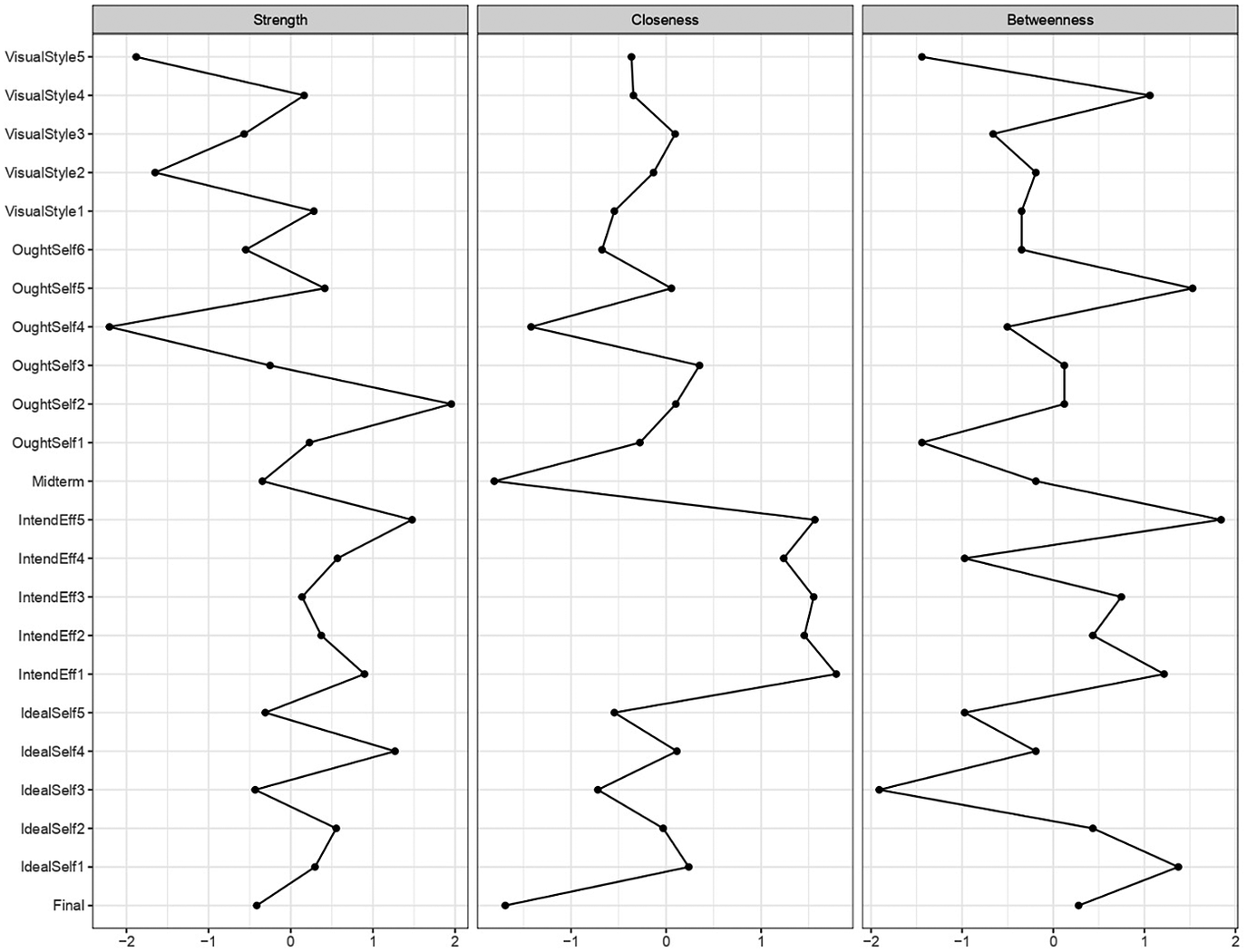
In addition to node strength, we also computed node centrality indices based on closeness and betweenness. The closeness index “indicates a short average distance of a specific node to all other nodes” (Hevey, Reference Hevey2018, p. 311). In the network model, the nodes with the highest closeness are the five intended effort nodes. This is an interesting find and indicates that intended effort may have an integral role in L2 motivation. Although the role of central components is not yet fully understood, it is thought that central nodes with high closeness are the most likely to both effect changes and be affected by changes in the system (Hevey, Reference Hevey2018). The third measure of centrality, betweenness, refers to how well one node connects other nodes together; nodes with high betweenness lie on the shortest path between pairs of nodes. As shown in Figure 2, the node with the highest betweenness is intended effort 5, followed by ought-to L2 self 5 and ideal L2 self 1.
Interpreting the network model
Both You et al. (Reference You, Dörnyei and Csizér2016) and Hiver and Al-Hoorie (Reference Hiver and Al-Hoorie2020b) used SEM to evaluate the relationships between the L2MSS, vision, and intended effort. The network model contains four motivational constructs (ideal L2 self, ought-to L2 self, intended effort, visual style) and the two measures of L2 achievement (midterm grades and final exam grades). We can see the wider interconnectedness of components in the system, with multiple interactions across different motivational constructs.
One of the first things we notice when looking at this network model is that, although the motivational constructs are interrelated, there are only a few weak edges between any of the motivational constructs and the two measures of L2 proficiency. For example, final grades have a weak partial correlation with ideal self 1 (0.10) and midterm grades have a weak negative partial correlation with ought-to self 4 (–0.09). The network analysis results are consistent with Hiver and Al-Hoorie’s (Reference Hiver and Al-Hoorie2020b) study, where the ideal L2 self was only a weak predictor of L2 achievement (accounting for less than 1% of the variance), and the ought-to L2 self had almost no predictive value.
Visual style
The visual style scale consists of five questionnaire items. As can be seen in Figure 1, although each of the five measures of visual style are grouped together, the nodes are not as closely grouped together compared to nodes measuring other constructs. In Hiver and Al-Hoorie’s SEM analyses, they excluded visual style 2 to improve convergent validity, and also note that this scale had the lowest reliability in You et al.’s (Reference You, Dörnyei and Csizér2016) study. Removing items is typical with latent variable approaches, where researchers drop variables that do not load onto factors or if there are cross-loadings (Fried, Reference Fried2020). With network analysis however, Fried (Reference Fried2020, p. 21) has pointed out that “items that load onto two factors simultaneously make for the potentially most interesting items because they may build causal bridges between two communities of items.” Because of this, we decided to include visual style 2 in the network analysis. The network model shows that visual style 2 is linked to three other nodes measuring visual style, and also has a weak partial correlation with one measure of L2 achievement, on measure of the ideal L2 self, and one measure of intended effort. While visual style 2 was left out of the SEM analyses, results of the network analysis tentatively suggest that this questionnaire item may function as a bridge node between other motivational constructs. In both You et al. (Reference You, Dörnyei and Csizér2016) and Hiver and Al-Hoorie’s (Reference Hiver and Al-Hoorie2020b) SEM analyses, they treated visual style as a predictor of the ideal L2 self and the ought-to L2 self. The network model is an undirected graph, so our analyses cannot provide additional insights into whether visual style is a predictor or outcome of motivation. What the network analysis does provide, is a more complex pattern of relationships between visual style and other system components than the original analyses. The nodes that measure visual style are partially correlated with components from all other motivational constructs in the network, as well as one measure of language achievement.
Intended effort
Besides the role of vision, You et al. and Hiver and Al-Hoorie were also interested in the direction of the relationship between intended effort and the L2MSS. Hiver and Al-Hoorie’s analyses of two competing SEM models showed that intended effort was a better predictor of the ideal L2 self and ought-to L2 self than an outcome. Previous research has provided empirical evidence for reciprocal causal relationships between motivation and academic achievement (Vu et al., Reference Vu, Magis-Weinberg, Jansen, van Atteveldt, Janssen, Lee, van der Maas, Raijmakers, Sachisthal and Meeter2021). The network model shows that components of intended effort are related to components of all other subsystems, as well as L2 achievement, indicating a complex pattern of relationships. The results of the centrality indices highlight the overall importance of intended effort in L2 motivation, as the five intended effort variables have the highest closeness index in the network. Overall, intended effort 5 emerges as the most central component of the network. This item refers to the statement “English would be still important to me in the future even if I failed in my English course.” Intended effort 5 also has the highest centrality in terms of betweenness, and the second highest in terms of closeness and strength. The question surrounding the role of central components will be further discussed later in this article.
Example 2
The second example illustrates how network analysis can be used to explore the relationships between multiple individual differences using the dataset from Dąbrowska’s (Reference Dąbrowska2018) study Experience, aptitude and individual differences in native language ultimate attainment. The dataset is publicly available online using the IRIS Database. The network model made from Dąbrowska’s (Reference Dąbrowska2018) dataset presents a different level of analysis from the previous example. In contrast to the network model in example 1, where each node represents a single questionnaire item, each node in the network model in Figure 3 represents a distinct variable measured by aggregated task scores. In the original study, Dąbrowska tested the assumption that adult native speakers tend to converge on the same grammar. She addressed this question by considering two opposing approaches to language acquisition: the usage-based perspective and the modular perspective. From a usage-based perspective, language abilities are thought to emerge out of interactions between general cognitive mechanisms and exposure to linguistic input (Ellis & Wulff, Reference Ellis, Wulff, Miller, Bayram, Rothman and Serratrice2018). From this perspective, “causal mechanisms interact iteratively to produce what appears to be structure” (Bybee & Beckner, Reference Bybee, Beckner, Heine and Narrog2009, p. 23). A usage-based approach is thus aligned with CDST, where linguistic knowledge emerges as a network of interrelated and interacting components. In contrast, from a modular perspective, language abilities are thought to stem from an innate universal grammar, whereby different types of language knowledge rely on autonomous modules within the mind (Tan & Shojamanesh, Reference Tan, Shojamanesh, Lutsenko and Lutsenko2019).
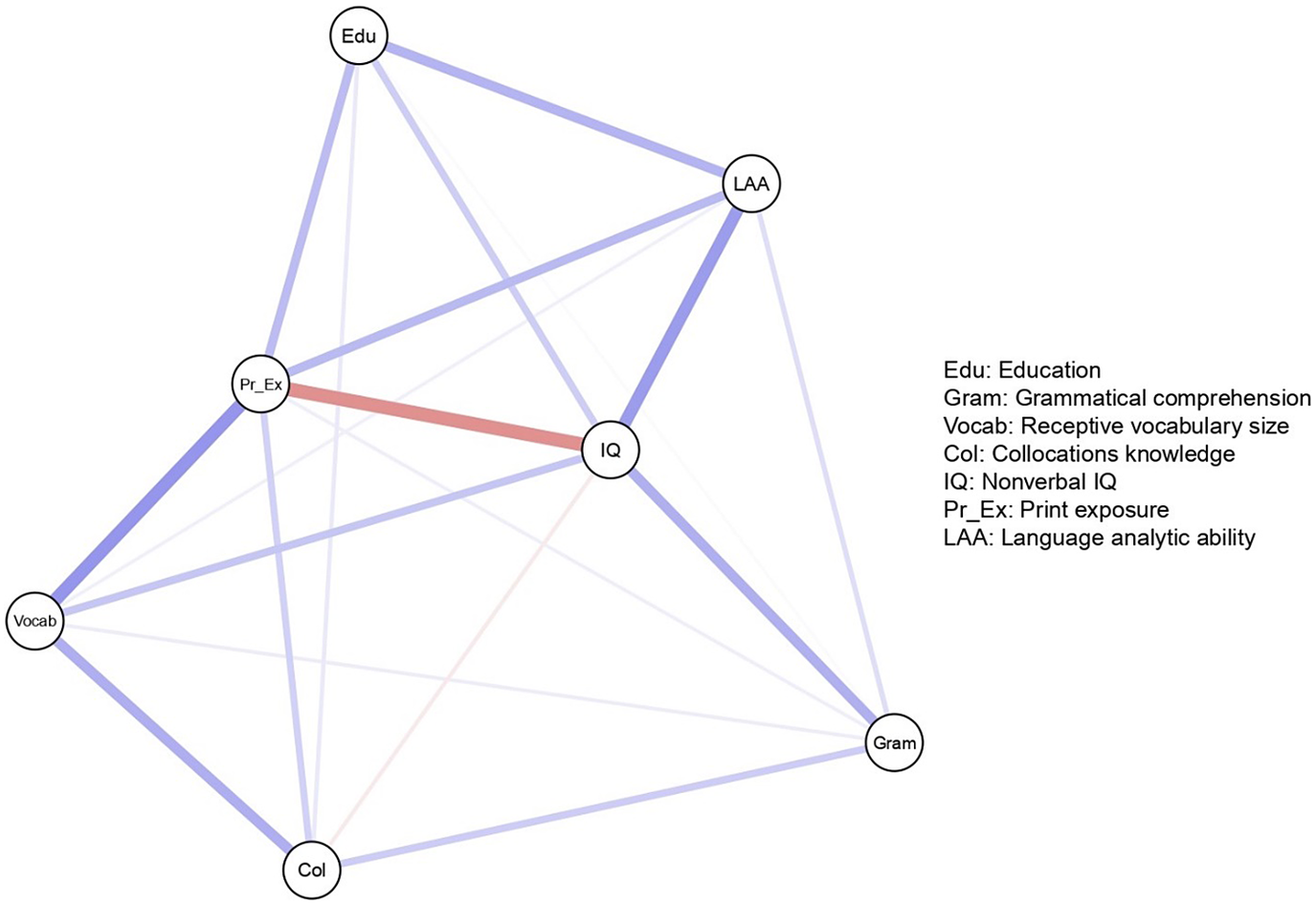
A network model of individual differences in native language ultimate attainment.
Note: The nodes in this network are composite scores representing three measures of language proficiency and four individual differences. The three proficiency measures are receptive vocabulary, collocations, and grammatical comprehension. The four individual differences are nonverbal IQ, print exposure, language analytic ability, and years of education.
Dąbrowska (Reference Dąbrowska2018) discusses the plausibility of these two theories in connection with analyses of a dataset of 90 native English speakers’ performance on different linguistic and nonlinguistic tasks. She first analyzed the amount of individual variation on six tasks that measured grammatical comprehension, receptive vocabulary, collocations, nonverbal IQ, language analytic ability, and print exposure. Full details regarding which tests were used to measure each construct can be found in the original study. Dąbrowska then conducted Pearson correlations to explore interactions between the six aforementioned tasks as well as education (measured by number of years spent in education). This revealed several significant correlations between the measures of language knowledge as well as between other variables. To determine potential causes of individual differences in linguistic knowledge, Dąbrowska then conducted regression analyses with the four predictor variables (nonverbal IQ, language analytic ability, print exposure, and education) on each of the three measures of language knowledge. Overall, results showed that nonverbal IQ was strongly related to grammar and vocabulary, but not to collocations. Language analytic ability was also significantly related to grammar and vocabulary, as well as several other variables. Print exposure contributed more to vocabulary and collocations than to grammar, and education only weakly predicted each measure of language knowledge. Based on the significant correlations between the three measures of language knowledge and the fact that the same nonlinguistic variables predicted different areas of language knowledge, Dąbrowska concluded that these findings support a usage-based approach.
Network estimation and visualization
Figure 3 is a GGM of partial correlations that includes the same seven variables used in Dąbrowska’s analyses. The network model was estimated using the “least absolute shrinkage and selection operator” (LASSO), which is considered an appropriate estimation method for smaller datasets (Epskamp et al., Reference Epskamp, Borsboom and Fried2018a; Hevey, Reference Hevey2018). The LASSO technique results in a sparser network, using only a relatively small number of edges to explain the covariance in structure (Epskamp et al., Reference Epskamp, Waldorp, Mõttus and Borsboom2018b). This makes the estimated model more interpretable and accurate, as very small edges are removed from the estimated network (Epskamp et al., Reference Epskamp, Borsboom and Fried2018a; Hevey, Reference Hevey2018). The LASSO applies a regularization technique that is controlled by a tuning parameter. The tuning parameter was selected by minimizing the Extended Bayesian Information Criterion (EBIC), for which we used the default setting of 0.5.
To assess network stability, we used a nonparametric bootstrap of 5,000 samples. Bootstrapping results can be found in the supplementary materials. The bootstraps show wide 95% confidence intervals, meaning that the estimated network structure is not very stable and the found links should be interpreted with care. As such, our discussion and interpretation of this network model is tentative, and a larger sample size is needed to draw any strong conclusions. We did not compute centrality indices for this dataset because the aim of this network analysis was to explore overall patterns of relationships between variables, and also given the small number of variables in this model.
Interpreting the network model
The network model in Figure 3 illustrates a complex system of interdependent relationships between linguistic and nonlinguistic variables. Each node in the network model in Figure 3 represents a composite variable. For example, the node “collocations” consists of 40 multiple choice items on the Words That Go Together test, and the node “print exposure” consists of 130 items on the Author Recognition Test. From a CDST perspective, the network model in Figure 3 provides a visualization of how different aspects of language knowledge are related to both internal resources (nonverbal IQ and language analytic ability) and external resources (print exposure and education). When comparing to the results of the regression analyses in the original study, the network model reflects the same overall patterns of relationships between individual differences in language knowledge. For example, nonverbal IQ is more strongly associated with grammar and vocabulary than with collocations, and print exposure is more strongly associated with vocabulary and collocations than with grammar. The fact that both analyses reveal the same overall patterns is not surprising because partial correlations and multiple regression coefficients both estimate of the strength of relationships between variables while controlling for the effects of other measured variables (Hevey, Reference Hevey2018). The key difference is that regression analysis imposes unidirectional causal relationships between specific variables selected by the researcher, whereas with network analysis there are no assumptions regarding the direction of the relationships.
There are some subtle differences between the results of the network analyses and Dąbrowska’s analyses. For instance, whereas Dąbrowska found that language analytic ability was significantly related to both grammar and vocabulary, the network analysis shows that language analytic ability is only very weakly associated with vocabulary. In the network model, the relationship between language analytic ability and vocabulary knowledge appears to be altered by print exposure and nonverbal IQ. Similarly, while Dąbrowska’s analyses showed that education weakly predicted each measure of language knowledge, the network analysis shows that the relationship between education and language knowledge becomes weaker after controlling for the effects of print exposure, nonverbal IQ, and language analytic ability. It is also interesting to note that in the network model, the negative relationship between print exposure and nonverbal IQ becomes stronger after controlling for other variables. Another minor difference is that network analysis revealed a negative relationship between nonverbal IQ and print exposure whereas in Dąbrowska’s analyses this relationship was positive. The reason for this difference is that Dąbrowska transformed the raw IQ scores into percentages, while we opted to conduct analyses with the raw IQ scores. To confirm this, we conducted Pearson correlations between print exposure and both the raw and transformed IQ scores that showed that print exposure had a weak negative correlation with raw IQ scores (r(88) = –.03, p = .719) and a weak positive correlation with transformed IQ scores (r(88) = .08, p = .440). However as these are very small differences, they cannot be interpreted as meaningful. These slight differences revealed by the network analysis could be due to the fact that we included all seven variables in the network analysis, whereas Dąbrowska conducted three separate regression analyses for each measure of language knowledge. By taking a more holistic approach including all variables within the same analysis, additional patterns of relationships were revealed. This then raises the question of how many variables should be included when working from a CDST perspective.
Adding age to the network model
To explore this idea, we expanded on the original study by adding the variable “age” to the network model. Participants’ ages were contained within the original dataset that is available online, but Dąbrowska did not include this variable in her analyses. It seemed particularly interesting to include this variable because Dąbrowska used the dataset to evaluate the usage-based approach and the modular approach to language acquisition. Age is an indirect measure of language experience. With first language development, it is logical to assume that the older a person is, the more exposure to linguistic input they have. Thus, from a usage-based perspective, we might hypothesize age to be significantly related to a number of other variables, including measures of language knowledge. The 90 participants in Dąbrowska’s study varied greatly in age, with a range of 17 to 65 and a mean age of 38. The network model in Figure 4 is a GGM of partial correlations between eight variables (the seven variables from the original analyses plus age). The model was made following the same procedures described for the network model in Figure 3. Similarly to the model without age, the bootstraps show wide 95% confidence intervals, meaning that the estimated network structure is also not very stable and the found links should be interpreted with care.
A network model of individual differences in language knowledge, including age.
Note: In addition to the same variables as the network model in Figure 3, this model also has the variable age. Blue edges denote positive partial correlations and red edges denote negative partial correlations.
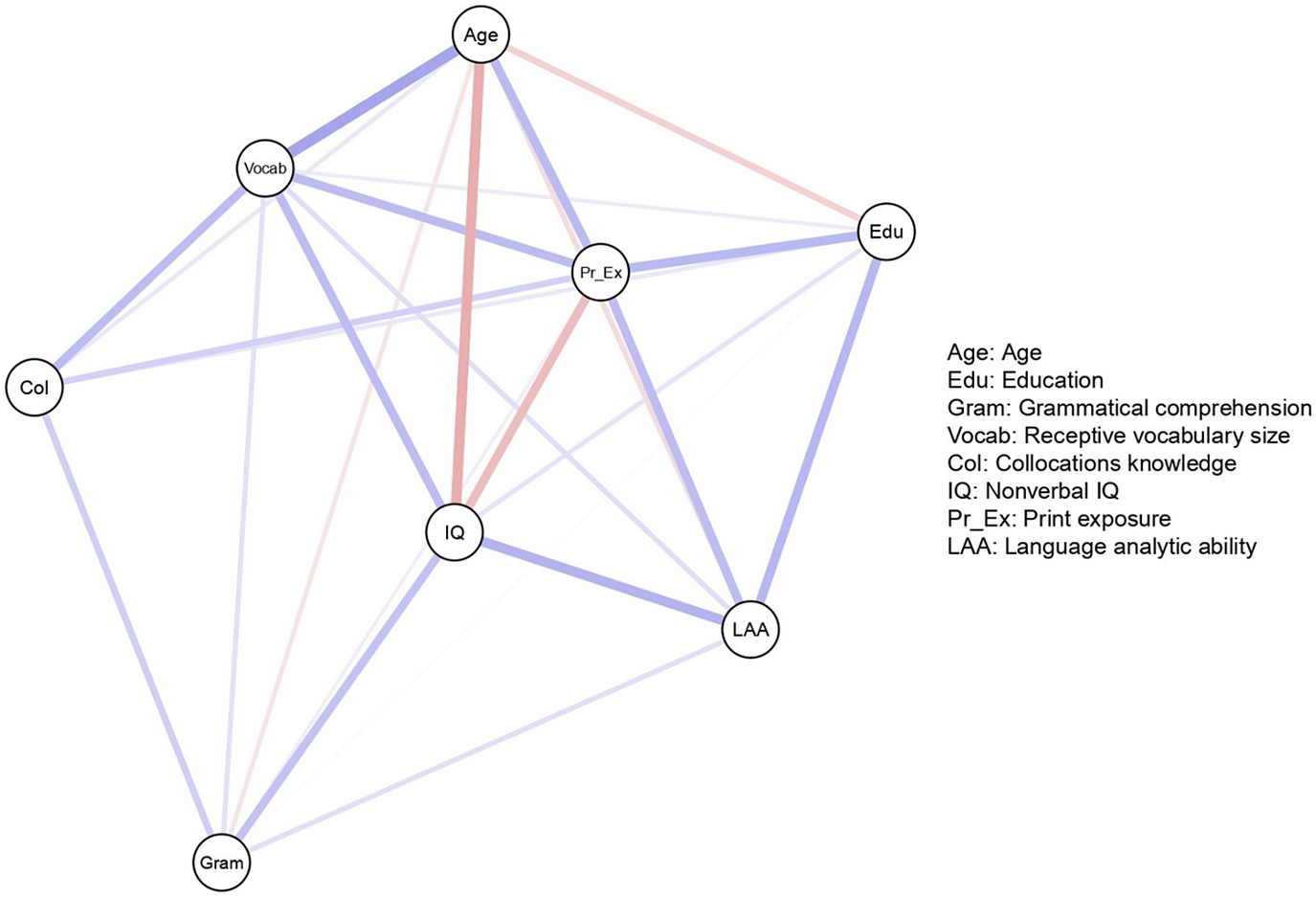
The network model in Figure 4 shows that age is partially correlated with all other variables. Out of the three measures of language knowledge (grammar, vocabulary, and collocations), age is most strongly linked to vocabulary (0.35), which is the strongest positive edge in the network.Footnote 1 This is in line with previous studies which have shown that vocabulary is typically the only aspect of language knowledge that does not tend to decline with age (Reifegerste, Reference Reifegerste2021). As could be expected, age is also related to print exposure. Age has a negative association with nonverbal IQ and language analytic ability, which is consistent with previous research on cognitive decline and aging (Reifegerste, Reference Reifegerste2021). There is also a negative relationship between age and education, which is logical considering that the percentage of university attendance has increased over the years. Overall, the considerable effect that age has on the system provides tentative support for the usage-based approach. Using network analysis, we can visualize individual differences in language abilities as a complex system. While we cannot draw conclusions about emergent processes from cross-sectional data, based on this network model, we could speculate that vocabulary knowledge emerges out of interactions between cognitive abilities (nonverbal IQ) and other language experience (print exposure) throughout the lifespan (age).
In addition, controlling for age alters the partial correlations between other nodes. For example, in the model that includes age, vocabulary knowledge has a weak positive relationship with grammar (0.11) and language analytic ability (0.12), whereas in the model without age, these relationships are weaker (0.06 and 0.05). This indicates that age is a moderating variable. When controlling for age, the edge weight between grammar and language analytic ability is stronger (more positive) because age has negative partial correlations with grammar and language analytic ability. In a similar way, age also moderates the relationship between IQ and print exposure; these variables have an edge weight of –0.43 without age, and –0.26 when age is added to the model. In this case, the edge weight between IQ and print exposure is weaker (less positive) when controlling for age because age has negative partial correlations with IQ and print exposure.
Although the network models estimated in example 2 are not stable, and a larger sample size is necessary to draw any firm conclusions, our examples serve to illustrate how network analysis can be used to model multiple individual differences in language learning from a CDST perspective. The network analyses support the same conclusions as the original study (Dąbrowska, Reference Dąbrowska2018), but rather than analyzing unidirectional relationships between individual difference constructs, the undirected network models in example two depict hypothesized multicausal relationships between variables. By estimating partial correlations between all variables, network analyses also reveal a more complex network of relationships between variables than the original study’s regression analyses, offering additional insights into the data.
Discussion
We have provided two examples of how network analysis can be used to model complex systems from a relation-intensive perspective. These examples serve to illustrate how a network approach can offer new insights into which components form a system and the nature of the relationships between components. Network analysis is conceptually aligned with CDST, enabling us to model hypothesized multicausal relationships between variables. We have shown how network analysis of cross-sectional data can be used to model individual difference constructs as complex systems, viewing the network as a snapshot of (part of) a system in time. We illustrated this in example 1 with nodes at item level, to analyze motivational constructs on a micro level, and in example 2 with node at composite level, to analyze the relationships between individual differences and language knowledge on a more macro level. In both examples, network analysis complements the original analyses by providing a more intricate pattern of relationships between system components, and deeper understanding into the variables of interest.
Besides the examples of psychological network analysis in this article, there are other applications of network analysis that could also be beneficial to SLA researchers, such as the network comparison test and dynamic network analysis. It is also important to acknowledge that psychological network analysis is still a relatively new statistical technique, and there are some unanswered questions regarding how certain aspects of CDST fit with network analysis, for example regarding the question of how many variables to include and the role of central components. In the following section, we discuss some of these questions and highlight additional applications of network analysis that could be applied to SLA research.
The network comparison test
The network comparison test is an application of network analysis that can be used to compare group differences. The network comparison test statistically compares the networks of two (or more) groups, such as in terms of node centrality and global strength (van Borkulo et al., Reference van Borkulo, Boschloo, Kossakowski, Tio, Schoevers, Borsboom and Waldorp2022). Networks can also be compared visually, which is typically done by constraining the layout of the two models for ease of visual comparison. Blanco et al. (Reference Blanco, Contreras, Chaves, Lopez-Gomez, Hervas and Vazquez2020) used a network comparison test to compare the effects of two different interventions on treating depression. One group of patients (n = 45) received a 10-week Positive Psychology Intervention (PPI) while another group (n = 48) received a 10-week Cognitive-Behavioral Therapy (CBT) program. Both groups completed clinical assessments of depression symptoms before and after the intervention treatments. Blanco et al. (Reference Blanco, Contreras, Chaves, Lopez-Gomez, Hervas and Vazquez2020) used this data to create two network models to compare before and after treatment. Results of the network comparison test showed that only the PPI group showed significant changes in several edge weights and global strength after intervention. In SLA research, the network comparison test could be used to statistically compare the networks of learners at different proficiency levels, at different time points, or across learning conditions. Both You et al. (Reference You, Dörnyei and Csizér2016) and Hiver and Al-Hoorie (Reference Hiver and Al-Hoorie2020b) conducted additional analyses to compare the roles of vision and intended effort across male and female L2 learners. This comparison could be also done using a network comparison test. As such, the network comparison test could strengthen CDST inspired research by providing a means for hypothesis testing and generalizations. Comparing networks across groups could also help to ascertain the phenomenological validity of conceptualizing abstract psychological phenomena as complex systems. In addition, the network comparison test could provide insight into how to influence systems’ behavior, as illustrated by Blanco et al. (Reference Blanco, Contreras, Chaves, Lopez-Gomez, Hervas and Vazquez2020), and could a useful tool for SLA researchers considering complex interventions (Hiver et al., Reference Hiver, Al-Hoorie and Evans2022).
Dynamic network analysis
In examples 1 and 2, we took a relation-intensive CDST approach by estimating GGMs of cross-sectional data. The GGM can also be used with time-intensive and time-relation intensive research designs, for single subjects and group data, respectively. Dynamic network analysis requires intensive repeated measurements of variables, such as with a time-series or panel design, typically obtained through Experience Sampling Method (ESM), whereby participants provide self-reports at regular intervals during the day (Bringmann et al., Reference Bringmann, Vissers, Wichers, Geschwind, Kuppens, Peeters and Tuerlinckx2013). With single-subject data, auto regressive (AR) modeling can model time dynamics within an individual by regressing one variable on a previous measurement of the same variable (called a lagged variable). The vector auto regressive (VAR) model is the multivariate extension of the AR model, where “a variable is regressed on all the lagged variables in the dynamic system” (van Bork et al., Reference van Bork, van Borkulo, Waldorp, Cramer, Borsboom and Wixted2018, p. 18). The VAR model has two extensions: graphical VAR and multilevel VAR. For single-subject data, graphical VAR can be used to create both temporal and contemporaneous networks using the GGM (Epskamp et al., 2018). Temporal networks have directed edges and show how the state of variables at one time point influence the state of variables at the next time point. A contemporaneous network model shows how variables predict each other at the same measurement occasion, after accounting for temporal effects (Epskamp et al., Reference Epskamp, Waldorp, Mõttus and Borsboom2018b), similarly to GAMMs and LCGMs. Multilevel VAR modeling can be used to model both within-group and between-group variance over time (Bringmann et al., Reference Bringmann, Vissers, Wichers, Geschwind, Kuppens, Peeters and Tuerlinckx2013). For example, Bringmann et al. (Reference Bringmann, Vissers, Wichers, Geschwind, Kuppens, Peeters and Tuerlinckx2013) combined VAR and multilevel VAR to follow 129 participants’ changes in depressive symptoms during a treatment intervention, modeling time dynamics at the individual and group level.
In the field of clinical psychology, researchers are exploring how dynamic network modeling could provide insight into how people develop disorders over time, with the aim of using this knowledge to target group and/or individual treatment interventions (Bringmann et al., Reference Bringmann, Vissers, Wichers, Geschwind, Kuppens, Peeters and Tuerlinckx2013; David et al., Reference David, Marshall, Evanovich and Mumma2018; van Bork et al., Reference van Bork, van Borkulo, Waldorp, Cramer, Borsboom and Wixted2018). Dynamic network analysis could also prove to be a useful methodology for CDST researchers in applied linguistics, and a few SLA studies have used ESM. For example, Waninge et al. (Reference Waninge, Dörnyei and de Bot2014) micro-mapped the motivational dynamics of four learners during their language lessons. They took measurements at 5-minute intervals throughout lessons, resulting in 10 observations per class. Similarly, Khajavy et al. (Reference Khajavy, MacIntyre, Taherian, Ross, Zarrinabadi and Pawlak2021) used ESM to examine the dynamic relationships between willingness to communicate (WTC), anxiety, and enjoyment of 38 students throughout six language lessons. Students indicated their level of WTC, anxiety, and enjoyment on a scale of 1 to 10 at 5-minute intervals, resulting in 10 observations per class. Gregersen et al. (Reference Gregersen, Mercer, MacIntyre, Talbot and Banga2020) also used ESM to explore the dynamics of language teacher well-being, where teachers used an app to respond to a short survey 10 times a day for 7 days. Although smartphone technology has the potential to use ESM more easily than in the past (Arndt et al., Reference Arndt, Granfeldt and Gullberg2021; Gregersen et al., Reference Gregersen, Mercer, MacIntyre, Talbot and Banga2020), it is still extremely challenging in most applied linguistics research settings to obtain a large enough number of observations to conduct a dynamic network analysis. For example, in the study by Bringmann et al. (Reference Bringmann, Vissers, Wichers, Geschwind, Kuppens, Peeters and Tuerlinckx2013), participants recorded depressive symptoms 10 times a day for 12 days, which resulted in a total of 120 observations per participant.
Nonlinearity
GGMs and VAR models are estimated based on assumptions of multivariate normality that assume linear relationships between variables (Epskamp et al., Reference Epskamp, Waldorp, Mõttus and Borsboom2018b). As such, these models may not present a fully accurate view of the data if the relationships between variables are nonlinear. For cross-sectional data, the Ising model is a nonlinear model used for binary variables (Finnemann et al., Reference Finnemann, Borsboom, Epskamp and van der Maas2021), but nonlinear models for continuous variables have not yet been developed. For longitudinal data, while VAR models fit linear effects, new types of network analysis have been developed that can also capture nonlinear relationships between variables (Haslbeck et al., Reference Haslbeck, Bringmann and Waldorp2021). The findings from several CDST studies with a time element have shown that language development, and its relationship with individual differences, is nonlinear (Fogal, Reference Fogal2022; Pfenninger, Reference Pfenninger2020; Piniel & Czisér, Reference Piniel, Csizér, Dörnyei, MacIntyre and Henry2014). This is why some CDST research designs that include a time element are using techniques such as GAMM instead of LGCM, as GAMM can handle nonlinearity (Pfenninger, Reference Pfenninger2020). Researchers in the field of network psychometrics have recently combined the VAR model with a Generalized Additive Model (GAM) framework, to estimate time-varying VAR models (Haslbeck et al., Reference Haslbeck, Bringmann and Waldorp2021). The field of network psychometrics is developing rapidly and is likely to produce other useful techniques in the future that could further enrich our methodological toolbox.
Latent network analysis
In the first example of the L2MSS, we compared Hiver and Al-Hoorie’s (Reference Hiver and Al-Hoorie2020b) SEM with our network analysis. For the past 100 years, psychological constructs have been studied using latent variable approaches, which assume that observed variables correlate because they reflect the same underlying construct (van Bork et al., Reference van Bork, Rhemtulla, Waldorp, Kruis, Rezvanifar and Borsboom2019). Network analysis has been put forward as an alternative to latent variable approaches. From a network perspective, correlations between observed variables may reflect mutual interaction between psychological processes (van der Maas et al., Reference van der Maas, Dolan, Grasman, Wicherts, Huizenga and Raijmakers2006). Although these two approaches have different competing causal explanations for the covariance between observed variables, both create models for variance-covariance matrices and are thus statistically equivalent (van Bork et al., Reference van Bork, Rhemtulla, Waldorp, Kruis, Rezvanifar and Borsboom2019; van der Maas et al., Reference van der Maas, Dolan, Grasman, Wicherts, Huizenga and Raijmakers2006). Because of this statistical equivalence, researchers have explored the idea that combining these two approaches could be complementary, resulting in latent network analysis (Golino & Epskamp, Reference Golino and Epskamp2017; Guyon et al., Reference Guyon, Falissard and Kop2017). Conceptually, a combined approach assumes that manifestations of psychological attributes have a common cause (latent variables) and that these latent variables interact (as a complex system) (Guyon et al., Reference Guyon, Falissard and Kop2017). For example, Epskamp et al. (Reference Epskamp, Rhemtulla and Borsboom2017) have used latent network modeling to explore the structure of interdependent relationships between latent variables. An advantage of latent network analysis is that due to the incorporation of factor-based statistical techniques, it is possible to test model fit against data, which is a limitation of psychological network analysis (Epskamp et al., Reference Epskamp, Rhemtulla and Borsboom2017; van der Maas et al., Reference van der Maas, Kan, Marsman and Stevenson2017). It can also be considered a useful way of exploring latent variables within a dataset because clusters in the network can tell us about the factor structures present, without having to impose the direction of the relationship like SEM (Golino & Epskamp, Reference Golino and Epskamp2017). Latent network analysis can be used with cross-sectional data as well as time-series and panel data.
The role of central components
In example 1, we computed centrality indices for the network model of the L2MSS, which showed that the intended effort nodes have the highest centrality. Researchers from different fields have questioned whether central components have predictive ability and can be used to target interventions. The role of central components has so far provided insights into the dynamic processes of genetic networks, cortical networks, and ecosystems (for a detailed description see Rodrigues, Reference Rodrigues and Macau2019). In the field of clinical psychology, findings from few studies indicate that central components could be used to target treatment interventions and make predictions about diagnoses. For example, in clinical research on eating disorders, central components have been predictive of treatment dropout (Lutz et al., Reference Lutz, Schwartz, Hofmann, Fisher, Husen and Rubel2018) and treatment outcomes (Elliott et al., Reference Elliott, Jones and Schmidt2020). The idea behind using central nodes to target interventions is that these nodes are more likely to have bigger effects (either directly or indirectly) on the rest of the system compared to targeting a less central node (Rouquette et al., Reference Rouquette, Pingault, Fried, Orri, Falissard, Kossakowski and Borsboom2018). Nodes with high closeness in particular are more likely to be affected by changes in other components of the system and are also more likely to trigger change.
From the first network model example in Figure 1, intended effort had the highest node centrality in terms of closeness, suggesting that intended effort plays a key role in triggering the dynamic processes involved in L2 motivation. This fits with Hiver and Al-Hoorie’s (Reference Hiver and Al-Hoorie2020b, p. 86) idea that putting in the effort to learn a language results in dynamic interaction between motivational constructs and task demands.
However, readers should note that the use of centrality indices in psychological networks is much debated (Bringmann et al., Reference Bringmann, Elmer, Epskamp, Krause, Schoch, Wichers, Wigman and Snippe2019). Centrality indices stem from social network analysis, whereby the relationship between components/nodes is known; the connections between nodes are observable. In comparison, in psychological networks the relationship between nodes is not directly observed, but is estimated, based on the strength of partial correlations between our measurements of psychological constructs. Bringmann and colleagues (Bringmann et al., Reference Bringmann, Elmer, Epskamp, Krause, Schoch, Wichers, Wigman and Snippe2019) have advised researchers to interpret centrality measures with care, especially betweenness and closeness centrality, as they are difficult to interpret and are often unstable.
The number of variables to include
Complex systems are characterized by dynamic interaction between multiple internal and external subsystems (de Bot et al., Reference de Bot, Lowie and Verspoor2007; Larsen-Freeman & Cameron, Reference Larsen-Freeman and Cameron2008). However, given the theoretical and practical impossibilities of analyzing the complete interconnected of a whole system, CDST researchers have to find a balance between oversimplification and undersimplification. Larsen-Freeman et al. (Reference Larsen-Freeman, Schmid, Lowie, Schmid and Lowie2011) have pointed out that a main methodological concern for CDST researchers is drawing boundaries and defining what we conceptualize to be a “functional whole.” Yet, when conducting network analysis, Hevey (Reference Hevey2018, p. 307) has reasoned that it is “critically important to measure such potential confounding variables to ensure that their effects are controlled for.” The network model of Dąbrowska’s (Reference Dąbrowska2018) dataset in example 2 that includes age illustrates Hevey’s reasoning, as age moderates the relationships between other system components. It is highly likely that there are also other confounding variables that have been omitted from the model, such as socioeconomic status, L2 knowledge and experience, gender, and other cognitive abilities. As with other types of modeling, adding further variables to the network model could have both predictable and unpredictable effects on the rest of the system. Yet from a CDST perspective, it is theoretically impossible to measure every component of a system. What network analysis can do, is capture at least part of a system. Thus, while we acknowledge the potential of a network approach to SLA and individual differences, it is important to be mindful of its limitations.
Generalizability
Generalizability is another debated topic in CDST research. Several researchers have pointed out the lack of generalizability of CDST studies and the lack of practical implications that CDST can currently offer to the field of applied linguistics (Hiver et al., Reference Hiver, Al-Hoorie and Evans2022; Palloti, Reference Palloti2022). Generalizability is a complex topic and is related to the distinction between idiographic and nomothetic methodological approaches. Idiographic approaches focus on the individual level with within-subject designs, analyzing intraindividual differences (Hamaker, Reference Hamaker2012). Idiographic approaches use longitudinal data and process-focused analyses. In contrast, nomothetic approaches focus on the group level with between-subject designs, analyzing interindividual differences (Hamaker, Reference Hamaker2012). Nomothetic approaches use cross-sectional data and product-focused analyses.
The majority of CDST studies to date have used idiographic approaches (Hiver et al., Reference Hiver, Al-Hoorie and Evans2022) because it is difficult to generalize from cross-sectional models to individual dynamics. This concept is known as the ergodicity problem: The idea that group statistics cannot be generalized to the individual and vice-versa (Lowie & Verspoor, Reference Lowie and Verspoor2019). As Molenaar (Reference Molenaar2004, p. 225) has pointed out, “only under very strict conditions—which are hardly obtained in real psychological processes—can a generalization be made from a structure of interindividual variation to the analogous structure of intraindividual variation.” However, this does not mean that idiographic and nomothetic approaches are in competition (Salvatore & Valsiner, Reference Salvatore and Valsiner2010). In fact, they can be viewed as complementary, or two sides of the same coin (Grice, Reference Grice2004). When discussing the idiographic-nomothetic debate in relation to research on personality, Grice (Reference Grice2004) argued that:
Establishing the uniqueness of some person’s developmental history, attitudes, thoughts, behaviors etc., would require the negation of nomothetic principles. Conversely, establishing the validity of a nomothetic principle that holds for all people would require the study of individual persons, not simply aggregates of persons. A true study of personality is therefore necessarily idiographic and nomothetic. (p. 205)
Lowie and Verspoor (Reference Lowie and Verspoor2019) have illustrated this point in relation to SLA, by investigating the role of motivation and aptitude in both a group study and in 22 longitudinal case studies. Their analyses showed that while learners showed different intraindividual learning trajectories over time, there were overall similarities between learners in terms of motivation and aptitude.
While some have argued that the idiographic approach undermines generalization (Palloti, Reference Palloti2022; Spencer & Schönen, Reference Spencer and Schöner2003), others have argued that idiography is a way to pursue generalized knowledge (Salvatore & Valsiner, Reference Salvatore and Valsiner2010). As Salvatore and Valsiner (Reference Salvatore and Valsiner2010) have claimed, idiography is “the pursuit of nomothetic knowledge through the singularity of the psychological and social phenomena” [emphasis in original] (p. 820). It is also important to note that nomothetic refers to what can be generalized across a sample population (e.g., from aggregated cross-sectional data), not what can be taken as a general law across all populations (Hamaker, Reference Hamaker2012). Hence, as with any other cross-sectional data analysis, results of network analysis can only tell us about the population from which the data was sampled and cannot be taken as a general law across all populations or all individuals.
That said, a network approach offers a structural perspective that is currently missing from CDST research in the field of SLA and enables us to expand our research agenda beyond idiographic approaches, time-intensive approaches (Hiver et al., Reference Hiver, Al-Hoorie and Evans2022). Taking steps toward generalizable findings, network analysis provides a means to quantitatively analyze the relationships between multiple variables and assess the relative importance of each variable within the system. Compared to other statistical techniques such as SEM, an advantage of network analysis is that it does not require a priori assumptions about unidirectional causal relations, but instead it allows for (hypothesized) bidirectional interactions between variables. As previously mentioned, other applications of network analysis such as the network comparison test make it possible for SLA researchers to test hypotheses and assess the extent to which systems can be generalized across different learner populations. Although network analysis is still relatively new, some researchers in clinical psychology have set out to examine its methodological validity and to determine the most appropriate metrics for assessing similarities between samples (Borsboom et al., Reference Borsboom, Fried, Epskamp, Waldorp, van Borkulo, van der Maas and Cramer2017; Funkhouser et al., Reference Funkhouser, Correa, Gorka, Nelson, Phan and Shankman2020). Researchers have also begun to assess the extent to which network analytic tools can inform the design of intervention studies. For example, Henry et al. (Reference Henry, Robinaugh and Fried2020, p. 2) have developed a statistical testing procedure to assess the efficacy of an intervention, “determining if the dynamical systems of different people have the same optimal intervention studies.”
Conclusion
In this article we provided a brief overview of research methods used by SLA researchers working within a CDST paradigm. We put forward network analysis as a way to model complex systems from a relation-intensive perspective and provided two examples of how to apply network analysis to two different datasets. In the first example we estimated a network model of L2 motivation, which provided a more fine-tuned picture of the potential relationships between motivational constructs compared to the original SEM analyses. In the second example we created a network model of individual differences in native language knowledge, showing how network analysis can model the interconnectedness of individual difference constructs and different aspects of language knowledge.
While CDST researchers have made considerable advances in describing language development and changes in individual differences over time, the potential of relation-intensive approaches has not yet been explored. Through our two examples of network models, we hope to have illustrated that cross-sectional data does have a place in CDST research, and that network analysis is a useful technique to add to the CDST toolbox.
Supplementary Materials
To view supplementary material for this article, please visit http://doi.org/10.1017/S0272263122000407.
Acknowledgments
We would like to thank Han van der Maas, Wander Lowie, and the three anonymous reviewers for their invaluable feedback and suggestions on an earlier draft of this manuscript.
Data Availability Statement
The experiment in this article earned an Open Materials badge for transparent practices. The materials are available at https://osf.io/hjcvz/
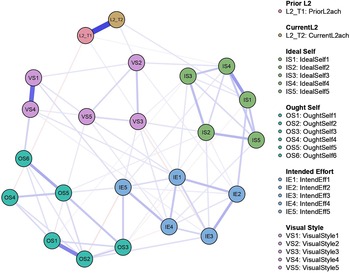


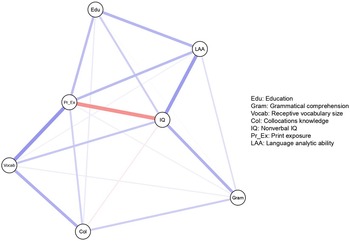
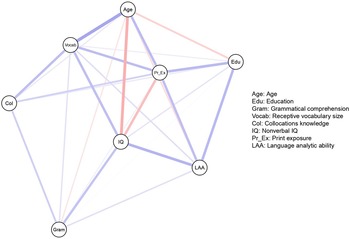


 Open access

