




Introduction
In recent years, increasing attention has been given to the role of language education in promoting environmental literacy (Micalay-Hurtado & Poole, Reference Micalay-Hurtado and Poole2022). Scholars highlight the importance of integrating environmental issues into language teaching so that learners develop the critical understanding required to engage with global sustainability challenges (Davari et al., Reference Davari, Hassani, Iranmehr and Ghorbanpour2025; Zahoor & Janjua, Reference Zahoor and Janjua2020). However, environmental topics in language textbooks are often presented in abstract and depersonalised ways that obscure agency, responsibility and accountability (Curdt-Christiansen, Reference Curdt-Christiansen2021; Srbinovski, Reference Srbinovski2013). Such representations may limit learners’ ability to critically engage with ecological problems and to see themselves as agents of environmental change. These concerns call for closer examination of how environmental meanings are constructed in language education materials.
Critical textbook analysis helps reveal the ideologies and power relations embedded in pedagogical texts while opening space for alternative narratives that foreground sustainability, social justice and ethical responsibility. Although studies have explored environmental representation in language textbooks (Cristovão et al., Reference Cristovão, Sanches and Smart2022; Xiong, Reference Xiong2014), most focus on thematic content rather than the pedagogical tasks through which learners interact with such topics. Consequently, little is known about how routine activities such as reading, writing, listening and speaking tasks serve as sites for constructing environmental knowledge, values and attitudes (Mulyani et al., Reference Mulyani, Widodo, Simbuka, Balisar Panjaitan and Lestariyana2024). Moreover, existing research has largely centred on secondary or tertiary education, leaving primary school contexts underexplored despite their importance in shaping early environmental dispositions. Research examining environmental discourse in internationally published English textbooks used in local contexts also remains limited.
Addressing these gaps, this study conducts a critical micro-semiotic analysis of environmental meanings embedded in language learning tasks in internationally published English textbooks used at the primary school level (Widodo, Reference Widodo, Widodo, Perfecto, Canh and Buripakdi2018). Specifically, it investigates how learning tasks in the Super Minds textbook series used in reputable non-state Indonesian primary schools promote environmental awareness. Drawing on an environmental worldview framework and an environmental literacy taxonomy, the study analyses 52 tasks across six textbooks, focusing on the micro-level linguistic and semiotic features through which environmental perspectives are constructed. By foregrounding learning tasks rather than themes alone, the study demonstrates how pedagogical design mediates young learners’ engagement with environmental issues (Mulyani et al., Reference Mulyani, Widodo, Simbuka, Balisar Panjaitan and Lestariyana2024).
The findings provide implications for textbook writers, curriculum developers and teachers seeking to align English language education with sustainability goals. They highlight the need for learning tasks that move beyond superficial thematic coverage to actively engage learners in interpreting environmental texts, expressing viewpoints, negotiating solutions and reflecting on human-environment relationships while developing linguistic competence (Liu et al., Reference Liu, An and Chen2024; Mercer et al., Reference Mercer, Correia Ibrahim, Bilsborough, Jones and Potzinger2023). More broadly, the study contributes to debates on how English language education can foster environmentally literate and socially responsible learners within globalised curriculum contexts.
Conceptualising environmental discourse from a critical ecological perspective
The escalating urgency of global environmental challenges has prompted educators and researchers to reconsider how nature, sustainability and human-environment relationships are conceptualised in education (Bui et al., Reference Bui, Bui and Pham2024; Shah et al., Reference Shah, Jatoi and Shah2025). From a critical environmental theory perspective, environmental education is not simply the neutral transmission of scientific knowledge about climate change, biodiversity loss, or pollution; rather, it is an ideological practice shaped by power relations, socio-economic structures and dominant worldviews (Stibbe, Reference Stibbe2015; Guerrero & Sjöström, Reference Guerrero and Sjöström2025). Accordingly, recent scholarship calls for a critical ecological perspective that examines how environmental issues are discursively constructed in educational texts and practices and how these constructions influence learners’ understandings of ecological problems and their roles as environmental actors (Cheng & So, Reference Cheng and So2015; Curdt-Christiansen, Reference Curdt-Christiansen2021; Micalay-Hurtado & Poole, Reference Micalay-Hurtado and Poole2022; Shah et al., Reference Shah, Jatoi and Shah2025; Zahoor & Janjua, Reference Zahoor and Janjua2020). This perspective emphasises the importance of analysing metaphors, narratives and ideological assumptions through which environmental meanings are produced and normalised, often privileging particular interests while marginalising alternative viewpoints (Arora & Stirling, Reference Arora and Stirling2023). In this sense, environmental education becomes not only a means of conveying knowledge but also a site for examining how ecological values, responsibilities and identities are socially constructed.
Grounded in critical theory and ecolinguistics, this approach views language as a site of ideological struggle rather than a neutral medium of communication (Widodo, Reference Widodo, Widodo, Perfecto, Canh and Buripakdi2018). It investigates whose voices, values and knowledge systems are legitimised in environmental discourse and whose are marginalised, particularly within institutionalised educational materials such as textbooks. Environmental discourse is therefore understood as socially and politically situated, reflecting broader relations of power, inequality and economic exploitation that underpin many ecological crises (Liebenguth, Reference Liebenguth2022; Shah et al., Reference Shah, Jatoi and Shah2025). Within this framework, Stibbe’s (Reference Stibbe2015) concept of the “stories we live by” provides a powerful lens for examining how texts, including textbooks, media and classroom discourse, can reproduce ecologically harmful ideologies or, alternatively, promote more sustainable and equitable ways of relating to the natural world. Environmental discourse analysis at the micro-semiotic level further reveals how texts construct human-nature relationships through specific linguistic and visual choices (Widodo, Reference Widodo, Widodo, Perfecto, Canh and Buripakdi2018). Research suggests that environmental issues in educational materials are often framed as technical or individualised problems, detached from broader questions of social responsibility or structural inequality (Gugssa et al., Reference Gugssa, Aasetre and Debele2021; Lendo et al., Reference Lendo, Widodo, Fadlilah and Qonnita2023; Shah et al., Reference Shah, Jatoi and Shah2025). Such representations may depoliticise ecological crises and limit learners’ opportunities for critical engagement, whereas critical ecological discourse foregrounds interconnectedness, agency and ethical responsibility, positioning humans as part of complex ecological systems rather than their dominators (Tokay, Reference Tokay2026).
Applying this perspective to language education, particularly through textbook analysis, highlights how English language teaching (ELT) materials function as ideological artefacts that can either support or constrain sustainability-oriented learning (Mulyani et al., Reference Mulyani, Widodo, Simbuka, Balisar Panjaitan and Lestariyana2024; Widodo, Reference Widodo, Widodo, Perfecto, Canh and Buripakdi2018). Traditional ELT approaches have prioritised grammatical accuracy and communicative competence while paying limited attention to the socio-political dimensions of language use (Mulyani et al., Reference Mulyani, Widodo, Simbuka, Balisar Panjaitan and Lestariyana2024; Setyono & Widodo, Reference Setyono and Widodo2019). From a critical standpoint, such a narrow focus risks reproducing dominant ideologies by obscuring the broader social and environmental implications embedded in discourse (Widodo, Reference Widodo, Widodo, Perfecto, Canh and Buripakdi2018). Increasingly, however, ELT scholarship recognises textbooks as influential sites for shaping learners’ environmental awareness, values and civic identities within globalised educational contexts. Importantly, the inclusion of environmental topics alone is insufficient; what matters is how these issues are represented through language, imagery, task design and underlying value systems.
To address these concerns, this study adopts two complementary analytical frameworks: an environmental worldview framework and an environmental literacy taxonomy (Fang, Hassan, & LePage, Reference Fang, Hassan and LePage2023). These two frameworks enable a holistic analysis linking discourse representation with educational outcomes, illustrating how language learning tasks shape learners’ opportunities to engage critically with environmental narratives. By integrating discourse-ideological analysis with environmental literacy perspectives, this study advances a critical and transformative approach to language education that promotes linguistic competence alongside ethical awareness, critical consciousness and social responsibility in addressing contemporary ecological challenges (Shah et al., Reference Shah, Jatoi and Shah2025).
Environmental education in language education
Traditionally, environmental education has been located within science and geography, focusing on topics such as ecosystems, climate change and sustainability (Li et al., Reference Li, Liu, Tripathi and Hashim2025). While these disciplines provide essential knowledge, environmental challenges are increasingly recognised as interdisciplinary issues that should be addressed across the curriculum, including in language education. Language teaching, grounded in communication and meaning-making, offers a valuable platform for learners to engage with global concerns such as environmental crises (Jacobs & Goatly, Reference Jacobs and Goatly2000; Shah et al., Reference Shah, Jatoi and Shah2025). In language classrooms, students can move beyond grammar-focused instruction to explore real-world issues through reading, writing, discussion and reflection on sustainability (Strandberg, Reference Strandberg2025). In this way, language learning can function not only as a space for linguistic development but also as a site for critical engagement and environmental agency (Micalay-Hurtado & Poole, Reference Micalay-Hurtado and Poole2022).
Within environmental pedagogy, it is important to distinguish between several related concepts. Traditional environmental education emphasises knowledge about ecological systems and natural processes, often within science-based contexts (Khosravi Mashizi & Escobedo, Reference Khosravi Mashizi and Escobedo2025). Climate change education focuses more specifically on anthropogenic climate impacts and mitigation strategies (Reid, Reference Reid2019). Education for Sustainable Development (ESD), however, offers a broader framework that integrates cognitive, affective and behavioural dimensions, promoting global citizenship, ethical reasoning and sustainable action (Araneo, Reference Araneo2024; Xiong, Reference Xiong2014). In language classrooms, ESD can foster critical thinking and ethical awareness as learners examine human-nature relationships through activities such as persuasive writing, debates and storytelling (Micalay-Hurtado & Poole, Reference Micalay-Hurtado and Poole2022; Rieckmann, Reference Rieckmann2018).
Despite this potential, environmental themes often remain marginal in language education. Although some textbooks include environmental topics, these are frequently presented in superficial ways that provide limited opportunities for critical reflection or ethical discussion (Zahoor & Janjua, Reference Zahoor and Janjua2020). For instance, vocabulary exercises about recycling rarely encourage learners to consider broader issues such as environmental justice or sustainability ethics. Embedding environmental and sustainability education more systematically within language curricula requires purposeful text selection, carefully designed tasks and dialogic learning that connects linguistic objectives with ecological themes (Micalay-Hurtado & Poole, Reference Micalay-Hurtado and Poole2022). Through such integration, language education can help develop environmentally literate and ethically responsible individuals capable of engaging with sustainability challenges (Jacobs & Goatly, Reference Jacobs and Goatly2000; Shah et al., Reference Shah, Jatoi and Shah2025).
Language textbooks as agents of instilling environmental literacy
Language textbooks are among the most influential educational tools globally, shaping not only learners’ linguistic competence but also their values, ideologies and worldviews (Curdt-Christiansen, Reference Curdt-Christiansen2021). Due to their structured content and wide circulation, textbooks can significantly contribute to environmental literacy when ecological themes are meaningfully embedded into language activities (Zahoor & Janjua, Reference Zahoor and Janjua2020). As Tomlinson (Reference Tomlinson2012) notes, textbooks influence how learners perceive both the target language and the wider world. Integrating topics such as climate change, sustainability and environmental protection enables students to develop language skills while engaging with contemporary global challenges. However, the effectiveness of this integration depends on how deliberately and critically environmental content is incorporated into learning materials and classroom activities.
Environmental literacy extends beyond knowledge of ecological issues to include the development of skills, values and behaviours that promote environmental stewardship (Srbinovski, Reference Srbinovski2013). Scholars emphasise that learners should not only understand environmental concepts but also develop critical thinking and responsible decision-making abilities (Arnon et al., Reference Arnon, Orion and Carmi2015; Cristovão et al., Reference Cristovão, Sanches and Smart2022). Language textbooks can support these goals through activities such as reading tasks, writing prompts, dialogues and debates that encourage reflection and discussion about environmental issues. Nevertheless, studies show that environmental themes in commercially produced English language textbooks are often treated superficially, offering limited opportunities for deeper cognitive or emotional engagement (Xiong, Reference Xiong2014; Zahoor & Janjua, Reference Zahoor and Janjua2020). Recent research in ecolinguistics and environmental education therefore advocates for a more critical and purposeful integration of sustainability issues in language materials (Cristovão et al., Reference Cristovão, Sanches and Smart2022; Gugssa et al., Reference Gugssa, Aasetre and Debele2021). As Stibbe (Reference Stibbe2015) argues, the narratives embedded in language can either reinforce harmful ecological ideologies or promote more sustainable perspectives. When designed with this awareness, textbooks can move beyond language instruction to support transformative learning and help cultivate environmentally responsible global citizens (Cates, Reference Cates2002).
Methods
Critical discourse analysis as methodological and analytical approaches
Critical discourse analysis (CDA) is an analytical framework that examines how language reflects and shapes power relations, ideologies and social practices (Fairclough, Reference Fairclough2013; Lestariyana et al., Reference Lestariyana, Qonnita and Suryati2025; Widodo, Reference Widodo, Widodo, Perfecto, Canh and Buripakdi2018; van Dijk, Reference van Dijk, Wodak and Meyer2015). Grounded in critical theory and social constructivism, CDA views language as a socially situated and ideologically embedded medium rather than a neutral tool of communication (Widodo, Reference Widodo, Widodo, Perfecto, Canh and Buripakdi2018). From this perspective, discourse actively constructs meanings, identities and values, making it a powerful approach for exploring how communication mediates social realities and influences attitudes and actions.
In environmental education contexts, CDA enables researchers to critically examine how ecological issues, sustainability and human–nature relationships are represented in educational texts and classroom practices (Micalay-Hurtado & Poole, Reference Micalay-Hurtado and Poole2022). By analysing linguistic choices and discourse patterns within broader sociocultural contexts, CDA reveals how environmental topics may reinforce or challenge dominant ideologies. This approach aligns with the aims of Education for Sustainable Development, which promotes critical awareness, ethical reasoning and transformative learning (Micalay-Hurtado & Poole, Reference Micalay-Hurtado and Poole2022; Xiong, Reference Xiong2014), and offers a rigorous lens for understanding how language education can foster environmentally literate and socially responsible learners.
Source of data
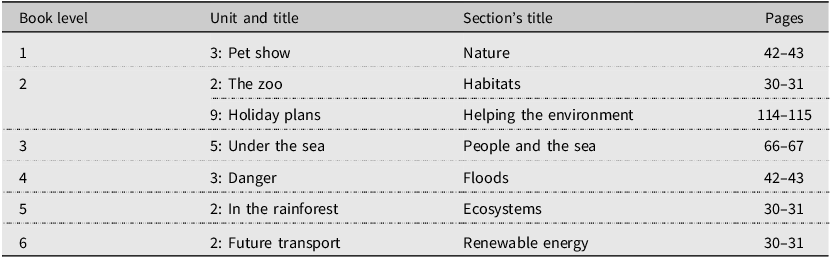
The data for this study were drawn from the Super Minds Student’s Book series (six levels, 2nd edition), published by Cambridge University Press in 2022. These internationally recognized textbooks are widely used in global English classrooms, including non-state primary schools in Indonesia, and cover Years 1 to 6. For this study, units and pages containing explicit or implicit environmental themes were purposively selected to ensure a focused qualitative content analysis. Each textbook includes a unit featuring a section titled “Environmental Studies” or “Environmental Science,” from which the data were collected. These sections provided relevant content for examining how environmental issues are integrated into English language learning materials. A summary of the selected units is presented in the Table 1 below.
Summary of sources of data within the analysed textbooks
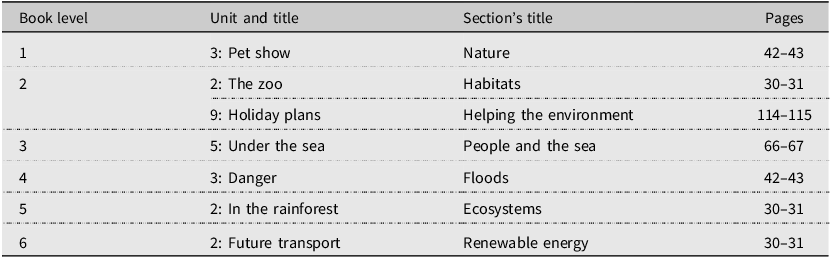
The selected data included reading texts, listening tasks, speaking prompts and writing activities from units focused on environmental content. These materials offered rich linguistic and visual data for analysing how environmental issues are communicated inELT for primary students. Only units with explicit “Environmental Studies” or “Environmental Science” sections were included; others were excluded. Each task was carefully examined to identify the dominant environmental worldview it conveyed and the level of environmental literacy it aimed to promote. This analysis forms the basis for understanding how environmental education is integrated into ELT materials, as discussed in the following section.
Samples
To analyse how language learning tasks promote environmental education, this study applied two key frameworks: Stibbe’s (Reference Stibbe2015) environmental worldviews and Disinger and Roth’s (Reference Disinger and Roth1992) environmental literacy levels. Stibbe’s framework categorises environmental perspectives as anthropocentric (human-centred), biocentric (valuing all living beings) and ecocentric (emphasising ecosystem interdependence). Tasks were first analysed to determine which worldview they promoted, revealing how learners are encouraged to perceive and relate to the environment.
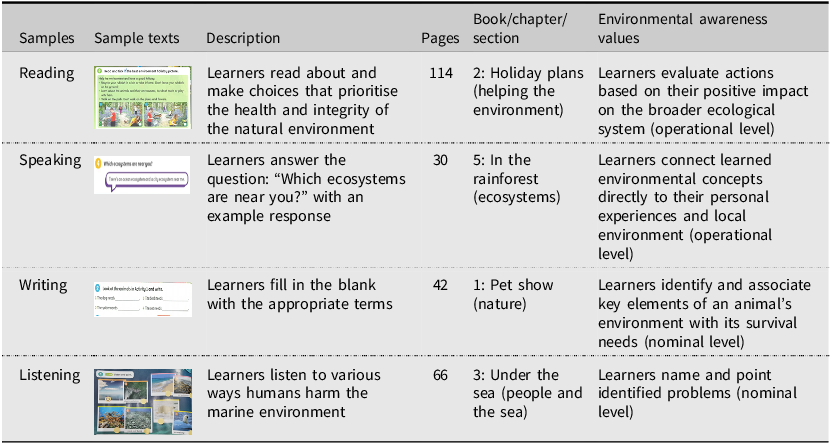
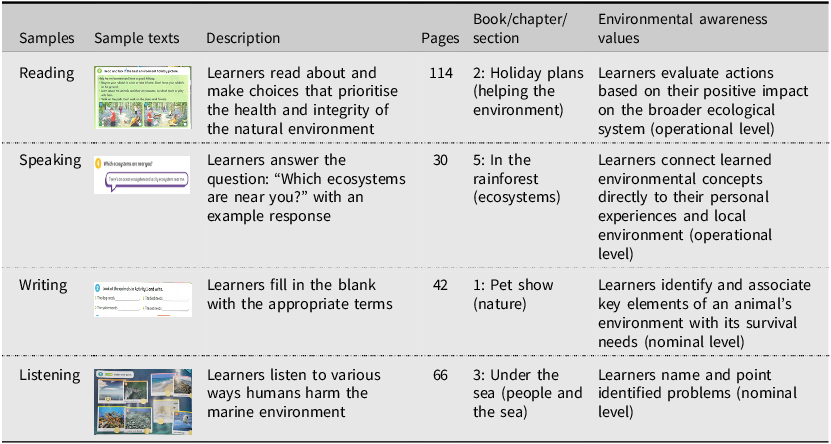
Next, tasks were evaluated using Disinger and Roth’s (Reference Disinger and Roth1992) classification of environmental literacy: nominal (basic awareness), functional (understanding and discussing issues), and operational (action-oriented). This helped assess whether tasks merely introduce environmental vocabulary, foster critical thinking, or actively promote responsible environmental behavior. The analysis also considered whether tasks stimulated student reflection, encouraged engagement with real-world ecological challenges and invited critical thought about human-nature relationships. By integrating both frameworks, the study examined how well the tasks supported both language learning and environmental consciousness. Sample tasks identified through this dual lens are summarised in Table 2.
Sample of linguistic and visual elements regarding environmental awareness in the textbooks
Data analysis
The analysis of environmental learning in EFL textbooks employed CDA to examine how language constructs environmental meanings and values, complemented by quantitative calculations to assess the extent of environmental content integration. CDA, grounded in critical theory, treats language as socially and ideologically situated, emphasising that textual and visual features both reflect and shape power relations, worldviews and social norms (Fairclough, Reference Fairclough2013; van Dijk, Reference van Dijk, Wodak and Meyer2015). In practical terms, CDA guided the systematic coding of textbook tasks by examining lexical choices, grammatical structures, rhetorical strategies and the framing of environmental issues to uncover implicit assumptions and ideologies.
The analysis was structured around two complementary frameworks. First, tasks were categorised according to Stibbe’s (Reference Stibbe2015) environmental worldviews – anthropocentric, biocentric and ecocentric – to evaluate how environmental themes and values were represented. Each task was coded numerically (1 = anthropocentric, 2 = biocentric, 3 = ecocentric) to facilitate quantitative comparison. Second, Disinger and Roth’s (Reference Disinger and Roth1992) environmental literacy model was applied to assess the depth of learning opportunities, classifying tasks as nominal (basic knowledge = 1), functional (understanding and discussion = 2), or operational (action-oriented = 3). Coding sheets were used to record textual features, task type, worldview and literacy level systematically, ensuring transparency and replicability.
CDA was further employed to interpret how environmental messages were constructed, assessing whether tasks promoted critical reflection and transformative engagement or reinforced shallow, anthropocentric narratives. Quantitative calculations of coded categories provided additional insight into the frequency and proportion of tasks representing each worldview and literacy level. Results were presented in tables with descriptive commentary, highlighting patterns, strengths and gaps in promoting environmental awareness and action through language learning. This combined approach allowed the study to link micro-level textual features with broader pedagogical and ideological implications.
Findings
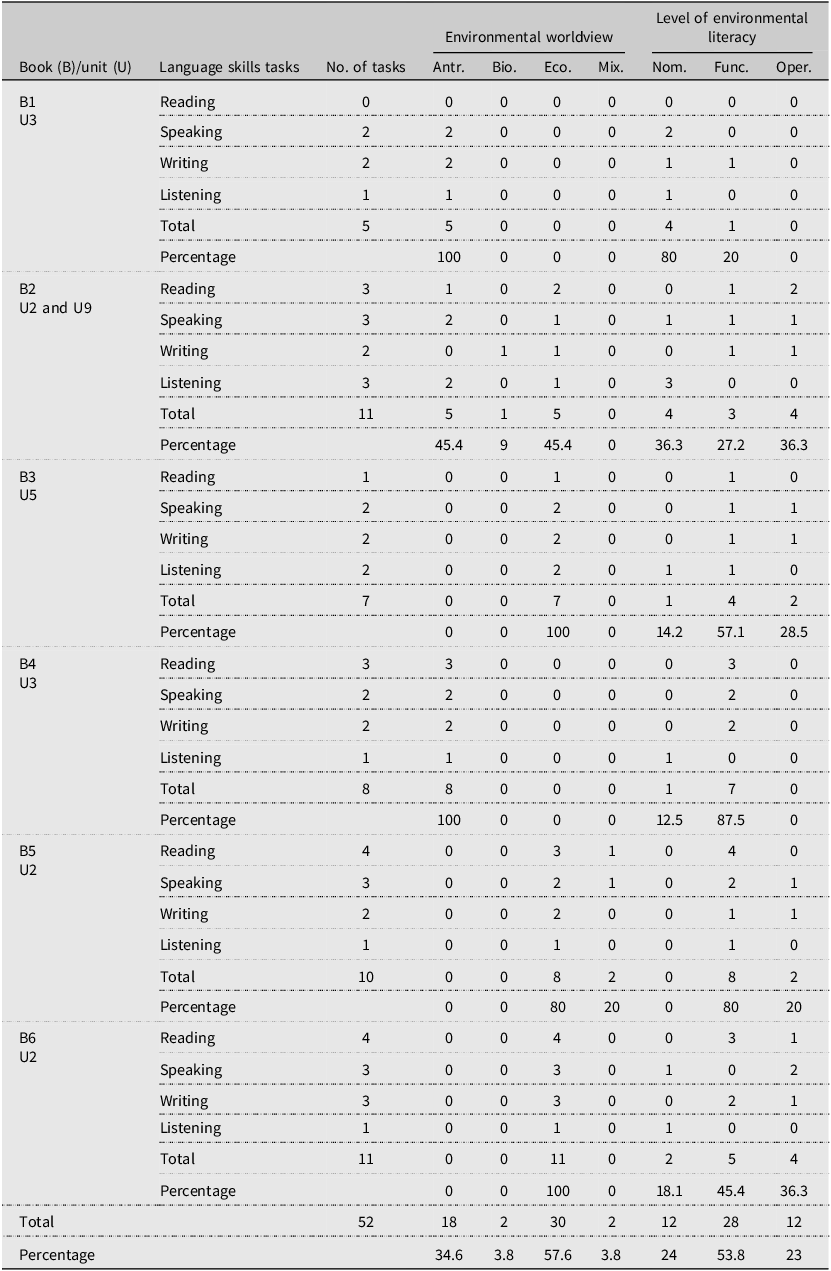
The analysis of 52 language tasks across six Super Minds textbooks demonstrate how environmental themes are integrated into reading, speaking, writing and listening tasks. Table 3 outlines the distribution of these tasks, along with with their associated environmental worldviews and environmental literacy levels. Environmental worldviews are categorised as anthropocentric, biocentric, ecocentric and mixed, whereas environmental literacy is classified into nominal, functional and operational levels. The tasks were drawn from units labelled as Environmental Studies or Environmental Science in the Super Minds textbooks.
Summary of units within the textbooks analysed, language skills tasks, environmental worldviews, and levels of environmental literacy
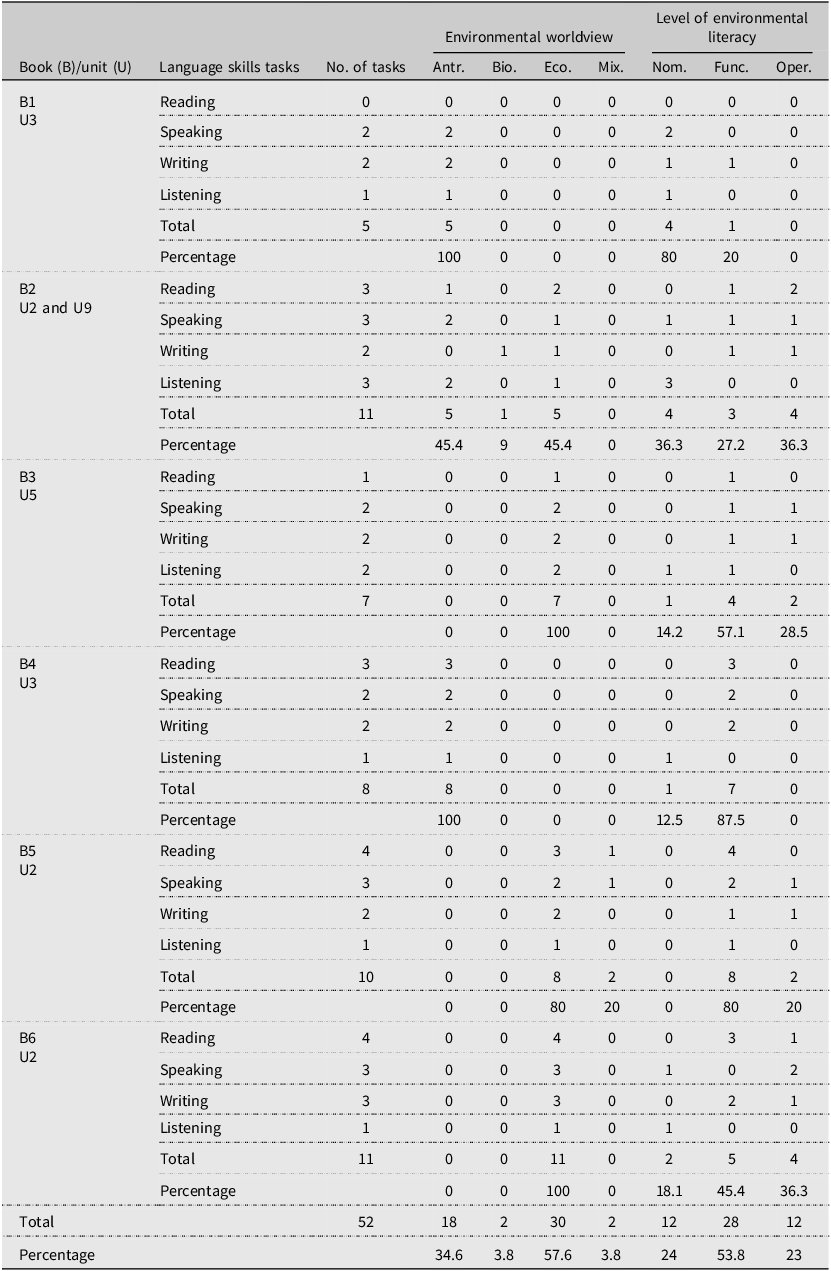
Reading and speaking tasks are the most frequent, with 15 tasks each, followed by writing (13 tasks) and listening (9 tasks). Across the series, ecocentric perspectives appear most frequently, while biocentric and mixed perspectives are relatively rare. In terms of literacy levels, functional literacy predominates, whereas operational literacy occurs less often. These patterns imply that the textbooks tend to introduce environmental topics through comprehension and discussion activities rather than through tasks that motivate learners to apply environmental knowledge in more action-oriented ways. While the presence of multiple perspectives suggests some effort to expose learners to different ecological viewpoints, the uneven distribution of language skills and literacy levels indicates areas where environmental engagement could be strengthened.
Reading tasks
Reading tasks constitute a substantial proportion of the analysed activities, with 15 tasks identified across the six textbooks. These tasks primarily reflect ecocentric (10) and anthropocentric (4) worldviews, with one task representing a mixed perspective and none reflecting a biocentric perspective. The predominance of ecocentric framing suggests that environmental themes are commonly introduced in terms of ecosystem sustainability and environmental protection. For example, in Book 6, Unit 2 (p. 30), students read a short text about renewable energy which states that “Renewable energy doesn’t pollute the environment and we can use it again and again.” The text highlights the environmental advantages of sustainable energy sources and frames energy consumption as an issue with ecological implications. Similarly, Book 2 (p. 114) includes a reading activity encouraging environmentally responsible behaviour during holidays, with instructions such as “Recycle your rubbish” supported by accompanying illustrations. Such tasks prompt learners to consider the environmental consequences of everyday actions.
Anthropocentric reading tasks appear less frequently but remain visible across the textbooks. These tasks typically present environmental topics through a human-centred lens, emphasising factual explanations rather than ethical or ecological reflection. For example, Book 4, Unit 3 (p. 42) includes a text titled Floods, which explains that floods occur when “water from a river or the sea goes over the land.” The accompanying activities ask students to match descriptive sentences with parts of an illustration, reinforcing vocabulary related to natural events but offering limited engagement with wider ecological implications. One reading task reflects a mixed worldview. In Book 5, Unit 2, the text Super Fact! introduces the idea of a “city ecosystem,” presenting urban spaces as environments where humans, animals and plants coexist. This framing acknowledges both human and ecological dimensions, offering a more integrated representation of environmental relationships.
No explicit environmental reading tasks were identified in Book 1, which likely reflects the early stage of language development targeted at this level. Environmental ideas are instead introduced through visuals and interactive activities rather than reading comprehension tasks. In terms of environmental literacy, most reading activities (12 of 15) correspond to functional literacy, requiring learners to understand and discuss environmental issues. For instance, the task Our sick seas in Book 6 asks students to complete a text using environmental vocabulary related to marine pollution. These activities encourage comprehension of environmental problems and their causes. Only three tasks reflect operational literacy, where learners apply environmental knowledge in evaluative ways. One example, found in Book 2 (p. 115), requires students to decide whether behaviours such as recycling rubbish are “good” or “bad” for the environment. While simplified, this task encourages learners to reflect on environmentally responsible actions.
Speaking tasks
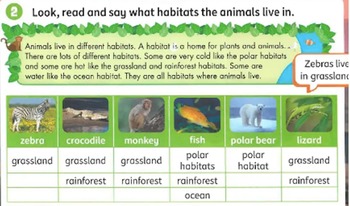
The analysis identified 15 speaking tasks addressing environmental themes across the Super Minds textbooks. These tasks present environmental issues from several perspectives: six adopt an anthropocentric stance, eight reflect an ecocentric orientation and one represents a mixed worldview. In terms of environmental literacy, four tasks correspond to nominal literacy, six to functional literacy and four to operational literacy. This distribution indicates that speaking activities engage learners in environmental topics at varying levels of complexity, from basic identification to more reflective discussion. An example of an anthropocentric speaking task appears in Book 2, Unit 2, where students identify animal habitats based on short descriptions (Figure 1).
Super Minds Student’s Book 2, p. 30.
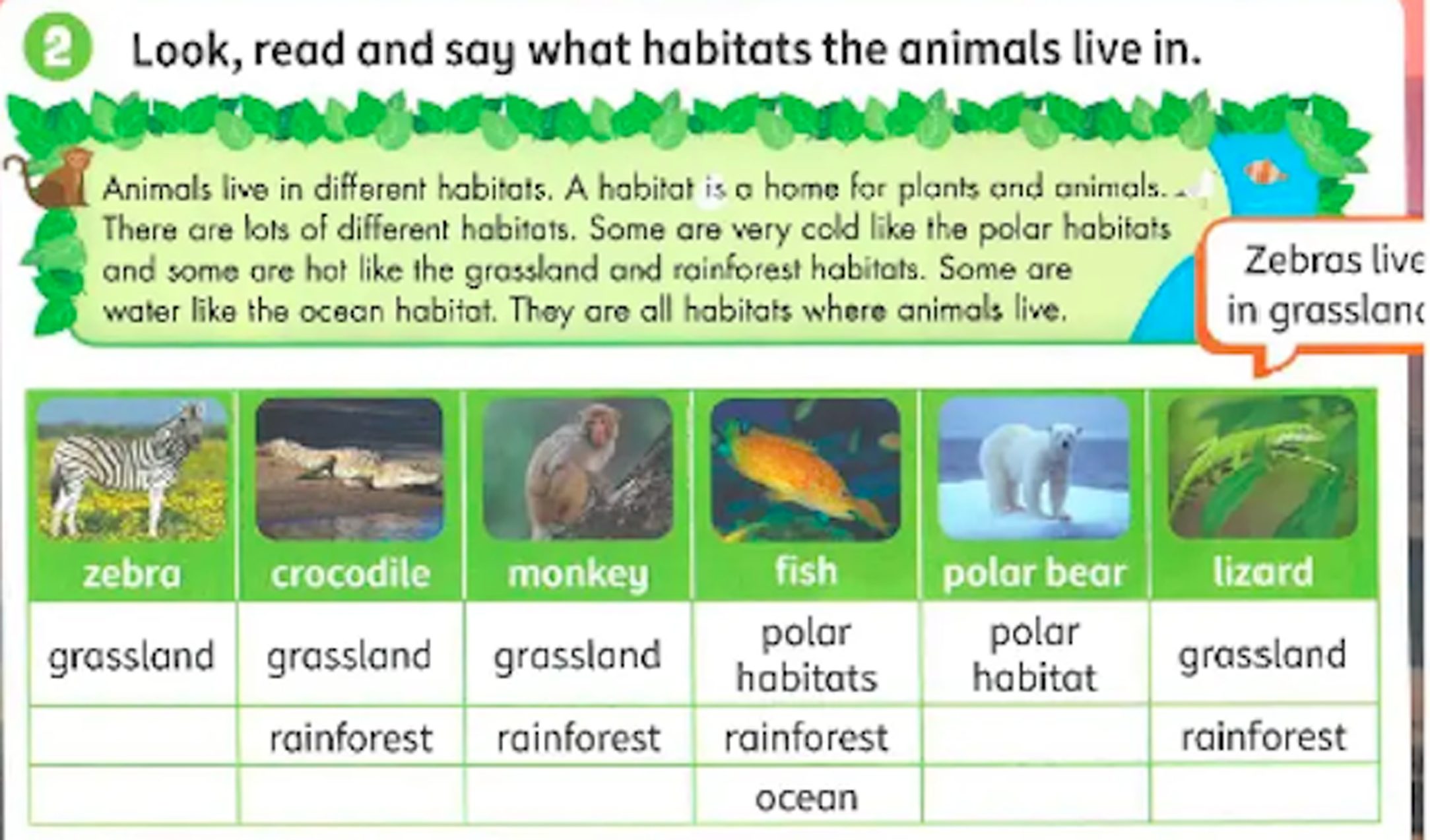
The task asks learners to name where animals live, such as identifying zebras in grasslands or fish in oceans. While the activity supports vocabulary development and oral interaction, animals and habitats are presented mainly as objects of human categorisation rather than as ecological systems with intrinsic value. In contrast, several tasks promote an ecocentric perspective. For example, in Book 6, Unit 2, students discuss environmentally friendly transport options, choosing between a velomobile and an electric scooter and explaining their reasoning. By highlighting features such as solar power and reduced noise, the activity encourages learners to consider the environmental implications of everyday mobility choices. A mixed worldview appears in Book 5, where students are asked, “Which ecosystems are near you?” The activity invites learners to reflect on both natural and human-dominated environments, such as oceans and cities, acknowledging the coexistence of human and ecological systems. This type of task encourages learners to connect environmental ideas with their immediate surroundings.
Across the textbooks, speaking tasks also vary in terms of environmental literacy. Nominal activities focus on basic recognition, such as identifying animals and their habitats. Functional tasks require learners to explain environmental processes, for instance, describing the causes of floods using visual prompts. Operational tasks extend this engagement further by inviting learners to apply environmental ideas to real-life contexts, such as discussing nearby ecosystems or evaluating environmentally responsible choices.
Writing tasks
The analysis identified 13 writing tasks across the Super Minds textbooks that engage learners with environmental themes. In terms of environmental worldviews, most tasks (8) promote an ecocentric perspective that emphasises environmental protection and the sustainability of ecosystems. Four tasks reflect an anthropocentric orientation, while one task adopts a biocentric perspective and none represent a mixed worldview. An example of an ecocentric writing task appears in Book 2 (p. 115), where learners are asked to create a scrapbook page describing a holiday destination. Students respond to questions such as “What habitat is it?” and “How can you help the environment on your holiday?” By encouraging learners to consider how human activities affect natural environments, the task highlights the importance of protecting ecosystems and promotes environmentally responsible behaviour. In contrast, some writing tasks reflect an anthropocentric orientation. For instance, a task in Book 4 (p. 43) asks students to record geographical information about a local river, including where it meets the sea and whether it floods. The activity focuses primarily on the river’s relevance to human settlement rather than its ecological functions or biodiversity.
Writing tasks also demonstrate variation in environmental literacy levels. Eight tasks correspond to functional literacy, four to operational literacy and one to nominal literacy. The nominal task, found in Book 1 (p. 42), Figure 2, asks learners to complete simple sentences using environmental vocabulary, focusing mainly on recognition of basic concepts.
Super Minds Student’s Book 1, p. 42.

Functional literacy tasks require learners to describe and organise environmental information. For example, in Book 2 (p. 31), students draw a habitat and write a short description identifying the animals that live there. By describing relationships between animals and their environment, learners move beyond simple vocabulary use toward a more integrated understanding of ecological contexts. Operational literacy tasks provide opportunities for more action-oriented engagement. One example appears in Book 3 (p. 67), where students create a leaflet responding to the question “What can you do to stop climate change and sea pollution?” Through this activity, learners practise persuasive communication while proposing actions that could contribute to environmental protection. As learners advance through the textbook series, writing tasks increasingly encourage explanation, description and the communication of environmentally responsible behaviours.
Listening tasks
Listening activities are the least frequent among the analysed language tasks, with nine tasks identified across the six textbooks. These tasks represent anthropocentric and ecocentric perspectives and correspond mainly to nominal and functional levels of environmental literacy. No listening tasks were categorised as biocentric, mixed, or operational. One example of an anthropocentric listening task appears in Book 1 (p. 42), where students listen to information about animals’ basic needs such as shelter, food, water and air. Learners are asked to identify these needs based on the audio input. The task focuses on recognising key vocabulary related to animal survival and therefore corresponds to nominal environmental literacy. At this early stage of learning, environmental concepts are introduced through simple recognition activities that help establish foundational knowledge.
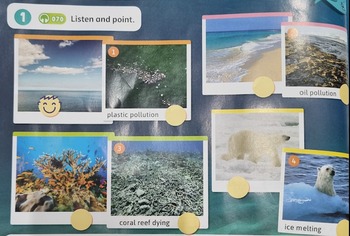
An example reflecting an ecocentric perspective appears in Book 3 (p. 66), where learners listen to information about threats to marine environments (Figure 3).
Super Minds Student’s Book 3, p. 66.
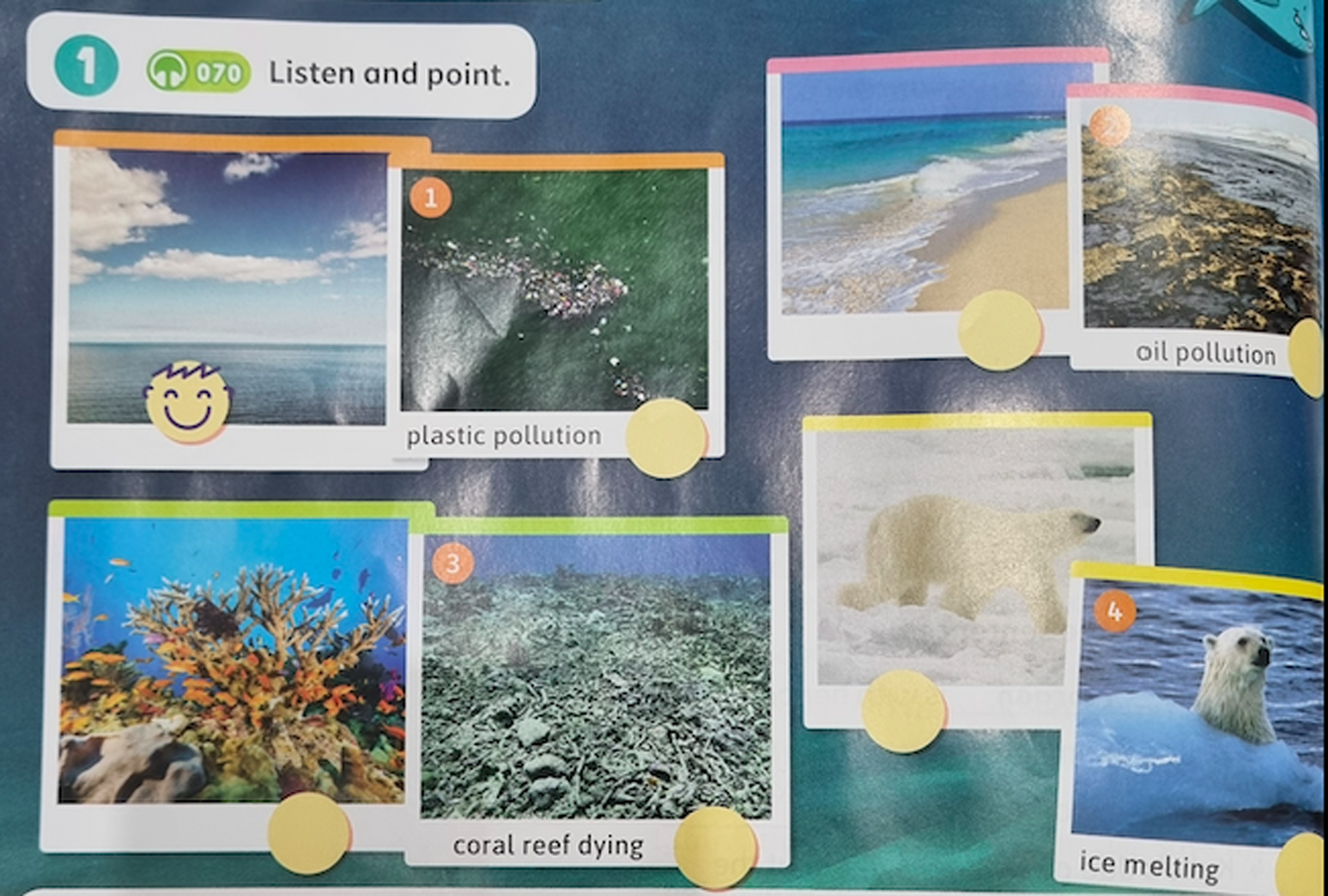
The activity asks students to identify ways in which human actions endanger the sea. Visual and auditory cues illustrate issues such as plastic pollution, oil pollution, coral damage and melting ice. By presenting environmental problems as consequences of human behaviour affecting marine ecosystems, the task encourages learners to recognise ecological impacts. Another listening task in Book 3 (p. 67) reflects functional environmental literacy. Learners listen to environmental information and place vocabulary items in the correct context. This activity requires students to interpret environmental concepts and apply them appropriately within the task, moving beyond simple recognition toward comprehension.
Although limited in number, listening tasks contribute to introducing environmental vocabulary and raising awareness of ecological issues. However, the absence of operational listening activities suggests that learners are rarely encouraged to respond actively to environmental information presented through spoken input. Increasing the number of listening tasks that involve discussion, problem-solving, or decision-making could strengthen the role of listening activities in supporting environmental engagement within language learning.
Discussion
The findings reveal several patterns in how environmental education is incorporated into the Super Minds textbook series. Environmental themes appear across all four language skills, although reading and speaking activities occur more frequently than writing and listening tasks. This distribution suggests that environmental topics are commonly introduced through comprehension and discussion-based activities, enabling learners to process environmental information and articulate ideas verbally. However, the comparatively limited presence of writing and listening tasks may reduce opportunities for learners to engage with environmental issues through a wider range of communicative practices.
In terms of environmental worldviews, ecocentric perspectives dominate the analysed tasks, indicating that environmental issues are frequently framed in relation to ecosystem protection and sustainability. This orientation aligns with calls in ecolinguistic and environmental education research to emphasise interconnected human-nature relationships and ecological responsibility (Stibbe, Reference Stibbe2015). Nevertheless, anthropocentric perspectives remain visible, particularly in earlier learning levels where environmental topics are often introduced through human-centred explanations. While such framing may support the introduction of basic concepts and vocabulary, an overreliance on anthropocentric perspectives risks narrowing learners’ understanding of broader ecological relationships. The limited presence of biocentric and mixed perspectives further suggests that learners encounter relatively few opportunities to explore ecological viewpoints that emphasise the intrinsic value of non-human life or the complexity of ecosystem interconnections (Stibbe, Reference Stibbe2015).
The distribution of environmental literacy levels reveals a strong emphasis on functional literacy, with fewer activities supporting operational engagement. Functional tasks typically require learners to understand and discuss environmental concepts, linking vocabulary and factual knowledge to environmental processes and issues. While these activities contribute to developing environmental awareness, the smaller number of operational tasks indicates limited opportunities for learners to apply environmental knowledge in decision-making or action-oriented contexts. Strengthening operational literacy within language learning materials could therefore help learners move beyond awareness towards environmentally responsible behaviour, a goal emphasised in environmental literacy research (Arnon et al., Reference Arnon, Orion and Carmi2015; Cristovão et al., Reference Cristovão, Sanches and Smart2022).
Examining the four language skills together highlights how environmental themes are pedagogically structured within the textbooks. Reading and speaking activities frequently introduce environmental concepts and encourage discussion of ecological issues, while writing tasks often support more reflective engagement by requiring learners to describe environmental contexts or propose environmentally responsible actions. Listening tasks, by contrast, appear less frequently and tend to focus on recognising environmental vocabulary or basic ecological ideas. As a result, opportunities for learners to respond actively to environmental information delivered through spoken input remain limited.
From a pedagogical perspective, these findings suggest that environmental topics are already integrated into language learning activities, but their potential could be strengthened through greater balance across language skills and literacy levels. Incorporating more tasks that encourage learners to analyse environmental problems, propose solutions and reflect on real-world environmental challenges may support the development of environmental agency within language classrooms (Micalay-Hurtado & Poole, Reference Micalay-Hurtado and Poole2022). In addition, including a wider range of ecological perspectives could help learners develop a more nuanced understanding of human-nature relationships. Overall, the findings highlight the potential of EFL textbooks to contribute to environmental education by embedding ecological themes within language learning tasks. Strengthening the diversity of perspectives and expanding opportunities for operational engagement would further enhance the capacity of language education materials to foster environmentally literate and socially responsible learners (Jacobs & Goatly, Reference Jacobs and Goatly2000; Shah et al., Reference Shah, Jatoi and Shah2025).
Conclusions
This study examines how environmental education is integrated into primary-level EFL textbooks using CDA. Analysis of 52 language tasks across reading, speaking, writing and listening activities revealed a predominance of ecocentric perspectives and functional environmental literacy, particularly in reading and speaking tasks. These findings suggest that the Super Minds textbooks introduce ecological awareness and support learners’ understanding of environmental issues. However, writing and listening tasks were less frequent and operational literacy encouraging action-oriented engagement was underrepresented. Anthropocentric perspectives appeared more frequently in early-level materials, while biocentric and mixed perspectives were relatively rare, limiting opportunities for learners to engage with diverse ecological viewpoints and non-human-centered perspectives.
These findings highlight important pedagogical implications. Textbooks should present a more balanced range of environmental worldviews and integrate operational tasks across all language skills to promote environmental agency. Project-based and interdisciplinary activities combining reading, writing, speaking and listening can support critical reflection, ethical reasoning and real-world application, aligning language learning with Education for Sustainable Development (ESD). Teachers also play a key role in guiding learners from basic recognition of environmental issues toward deeper understanding and responsible action. Although this study focused on a single textbook series and analysed tasks rather than classroom practice, future research could examine multiple EFL textbooks, investigate classroom implementation and explore how environmental discourse influences learners’ attitudes and behaviours over time.
Acknowledgements
I am deeply grateful to Professor Handoyo Puji Widodo for his thorough guidance, enlightening feedback and insightful comments on earlier drafts of this article. My appreciation also goes to the PERIISAI Center for Social Science Research for providing an intensive mentorship program that greatly supported the development of this manuscript.
Ethical statement
Nothing to note.
Financial support
This research received no specific grant from any funding agency, commercial, or not-for-profit sectors.
Author Biography
Abid Abid is an associate professor in the Department of English Language Education at Universitas Negeri Gorontalo, Indonesia. He earned his doctoral degree from Curtin University, Australia. His research focuses on ELT, teacher education and discourse studies in language education.


 Open access

