





Obesity has increased worldwide over the past four to five decades and is now one of the major contributors to the global burden of disease in many countries(Reference Phelps, Singleton and Zhou1). Recent global analyses based on large population-based datasets have confirmed that the prevalence of overweight and obesity has continued to rise across most regions of the world in both adults and children. Despite nearly two decades of recommendations from authoritative national and international organisations, particularly the WHO, the implementation of effective obesity prevention policies has been slow and inconsistent(Reference Dietz and Pryor2). Childhood obesity is of particular concern, as excess weight in early life is strongly associated with adverse long-term cardiometabolic outcomes and tends to track into adulthood(Reference Juonala, Magnussen and Berenson3,Reference Simmonds, Llewellyn and Owen4) . Consequently, prevention has become a central priority for public health systems worldwide.
However, preventing childhood obesity remains challenging. Obesity is a complex condition resulting from interactions between biological, behavioural, environmental and social determinants. Changes in food systems, urbanisation, reduced opportunities for physical activity and the widespread availability of energy-dense foods have contributed to the emergence of so-called obesogenic environments(Reference Swinburn, Sacks and Hall5) that promote unhealthy behaviours and excess energy intake. As a result, strategies focused solely on individual behaviour change(Reference Brownell and Frieden6,Reference Roberto, Swinburn and Hawkes7) have shown limited effectiveness in reducing obesity prevalence at the population level(Reference Rutter, Savona and Glonti8).
In response to the growing burden of childhood obesity, numerous prevention strategies have been developed and evaluated over the past decades. These interventions have targeted different settings, including schools, families, healthcare systems and community environments, and have focused on improving dietary habits, increasing physical activity and reducing sedentary behaviours. Although many interventions have shown modest improvements in health behaviours and body composition, their overall impact on population-level obesity trends has generally been limited(Reference Swinburn, Sacks and Hall5,Reference Brown, Moore and Hooper9) .
More recently, there has been increasing recognition that preventing childhood obesity requires a broader perspective. Obesity does not result from a single cause, but from the interaction of multiple factors, including individual behaviours, family environments, food systems and wider social and policy contexts(Reference Swinburn, Sacks and Hall5). For this reason, researchers and policymakers have begun to advocate for systems-based approaches that consider how these factors interact(Reference Rutter, Savona and Glonti8,Reference Swinburn, Kraak and Allender10) .
It is therefore essential to understand what has been learned from previous prevention interventions and how this knowledge can be translated into effective real-world strategies. This review aims to examine the current evidence on the prevention of childhood and adolescent obesity, critically analyse the results of the interventions that have been implemented so far and discuss the main challenges and opportunities for improving their effectiveness.
Childhood and adolescent obesity: a multifactorial problem
Moving beyond linear explanations: biological, behavioural and social determinants
As described in the introduction, childhood obesity is a complex condition that can be understood as the result of interactions between biological, behavioural and social factors operating at various levels. Contemporary frameworks increasingly conceptualise obesity as an outcome of complex systems, where biological susceptibility interacts with environmental and societal factors(Reference Rutter, Savona and Glonti8,Reference Swinburn, Kraak and Allender10) .
Biological susceptibility plays an important role in the development of obesity. Genetic predisposition, epigenetic mechanisms and early-life exposures, including maternal health, prenatal nutrition and infant feeding practices, can influence metabolic regulation, appetite control and adiposity development(Reference Baxevanis, Iglesia and Seral-Cortes11,Reference Smit, Wade and Hui12) . There is evidence that highlights the importance of the first 1000 days of life, when the physiological systems that regulate energy balance are highly responsive to environmental influences(Reference Woo Baidal, Locks and Cheng13). However, biological vulnerability alone cannot explain the rapid increase in childhood obesity observed worldwide, emphasising the significant impact of environmental and behavioural factors(Reference Swinburn, Kraak and Allender10).
Behavioural factors also play a key role in increasing the risk of obesity. Dietary patterns characterised by the high consumption of energy-dense, ultra-processed foods, combined with low levels of physical activity and increased sedentary behaviour, have been consistently associated with higher adiposity in children, often clustering together during childhood(Reference Miguel-Berges, De Miguel-Etayo and Larruy-García14). For example, a recent study of Spanish children identified several lifestyle-related factors, including screen time, sleep duration and dietary habits, as important determinants of overweight and obesity risk(Reference Miguel-Berges, De Miguel-Etayo and Larruy-García14). These findings reinforce the idea that lifestyle behaviours interact and cluster together, affecting children’s weight through various pathways.
Longitudinal cohort studies further emphasise the importance of early-life lifestyle patterns in shaping body composition trajectories. Data from the CORALS cohort have shown that adherence to healthier lifestyle behaviours is associated with more favourable obesity and cardiometabolic profiles in children(Reference Garcidueñas-Fimbres, Gómez-Martínez and Pascual-Compte15). Similarly, the CORAL study found that greater adherence to the Mediterranean diet was associated with healthier body composition in pre-school children, supporting the importance of dietary quality in the early prevention of obesity(Reference Larruy-García, Miguel-Berges and Torre16).
Importantly, these behaviours are embedded within broader social and environmental contexts. Socio-economic status, parental education, the family environment and neighbourhood characteristics all strongly influence children’s ability to adopt a healthy lifestyle. Those growing up in disadvantaged environments may face structural barriers, such as limited access to healthy foods and reduced opportunities for safe physical activity, as well as increased exposure to marketing of unhealthy products. Therefore, addressing these social inequalities has been identified as a key priority for effective obesity prevention strategies(Reference Ayala-Marín, Iguacel and Miguel-Etayo17).
Understanding childhood obesity therefore requires a shift in perspective, moving beyond simple, linear explanations to embrace systems-based approaches that recognise the dynamic interactions between various factors. Approaches to systems thinking – including tools such as causal loop diagrams – have increasingly been used to visualise these complex networks and identify potential leverage points for intervention(Reference Rutter, Savona and Glonti8).
Viewing childhood obesity as the outcome of a complex adaptive system has significant implications for prevention strategies. Interventions targeting single behaviours are unlikely to achieve a sustained impact at a population level. Instead, effective prevention strategies require coordinated action at multiple levels and across multiple sectors, including families, schools, communities and policy environments, to address the broader systems that shape children’s health behaviours(Reference Phelps, Singleton and Zhou1,Reference Swinburn, Kraak and Allender10) .
Obesogenic environments: structural drivers of childhood obesity
The concept of an ‘obesogenic environment’ refers to settings that encourage excessive calorie consumption and discourage physical activity. Contemporary food systems are characterised by the widespread availability, affordability and marketing of energy-dense, ultra-processed foods, which are having an increasingly significant impact on the dietary habits of children and adolescents. These food environments interact with urban and built environments that often limit opportunities for active living, creating conditions that favour sedentary behaviours and unhealthy dietary patterns. Alongside family and school contexts, these environmental influences contribute to complex feedback processes that reinforce unhealthy behaviours over time.
These environmental drivers interact with behavioural and social factors to influence children’s lifestyle patterns, ultimately impacting their risk of obesity. Evidence from European and Spanish populations indicates that modifiable lifestyle behaviours, such as diet quality, physical activity, sedentary behaviour and sleep patterns, are strongly associated with childhood overweight and obesity(Reference Miguel-Berges, De Miguel-Etayo and Larruy-García14,Reference Miguel-Berges, Mouratidou and Santaliestra-Pasias18) . For instance, studies of Spanish children have revealed that higher screen time, shorter sleep duration and consumption of sugar-sweetened beverages are linked to a higher BMI and a greater risk of obesity, showing how lifestyle-related factors often co-occur during childhood.
Importantly, children’s behaviours are not solely determined by their own choices but are also strongly influenced by their environment. Socio-economic conditions, family environments, school settings and neighbourhood characteristics all influence children’s opportunities to adopt healthy lifestyles. Those living in disadvantaged areas may encounter structural barriers, such as limited access to healthy foods and fewer opportunities for safe physical activity, as well as greater exposure to marketing of unhealthy products. These factors contribute to the well-documented social gradient in childhood obesity observed across many populations, a topic discussed further in the section on future challenges and equity-oriented prevention strategies.
The built environment also plays a crucial role in shaping how children move in their living conditions. Reduced access to safe recreational spaces, an increasing reliance on motorised transport and a growing preference for screen-based leisure activities have all contributed to a decline in physical activity levels among young people. Evidence from European cohort studies further suggests that these environmental influences interact with age and regional contexts, leading to different trajectories of obesity-related behaviours across countries(Reference Schreuder, Börnhorst and Wolters19). Therefore, school environments, food availability in educational settings and community infrastructure can either reinforce or mitigate these influences.
These environmental influences interact with family practices, social norms and policy contexts to reinforce unhealthy behaviours over time. It is essential to understand these interconnected drivers in order to develop more comprehensive approaches to prevent childhood obesity.
Implications for prevention: moving beyond single-component interventions towards systems approaches
The complexity of childhood obesity, as well as the multiple interacting determinants described in previous sections, highlights the limitations of prevention strategies that focus on isolated behaviours. Childhood obesity emerges from the interaction of biological susceptibility, behavioural patterns and environmental influences operating at various levels, such as within families, schools, communities and broader policy environments(Reference Rutter, Savona and Glonti8,Reference Swinburn, Kraak and Allender10) . This complexity suggests that approaches targeting single risk factors are unlikely to generate sustained changes in children’s health behaviours or produce meaningful population-level impact.
Historically, many prevention efforts have focused on modifying individual behaviours, particularly dietary habits and levels of physical activity. While educational and school-based interventions have shown some positive effects, these are often modest and difficult to maintain in the long term. One reason for this is that lifestyle behaviours associated with obesity risk tend to cluster together during childhood and are strongly influenced by environmental and social contexts. Evidence from European populations suggests that factors such as diet quality, sedentary behaviour, sleep patterns and physical activity interact with each other to influence children’s weight status via multiple pathways(Reference Miguel-Berges, De Miguel-Etayo and Larruy-García14,Reference Miguel-Berges, Mouratidou and Santaliestra-Pasias18) . These findings reinforce the need to address multiple determinants simultaneously, rather than targeting behaviours in isolation.
In response to these challenges, there has been an increase in attention given to multicomponent interventions that target several determinants of obesity simultaneously. Such programmes usually combine strategies designed to improve dietary habits, boost physical activity, cut down on sedentary time and encourage the creation of environments that support healthy lifestyles.
Multicomponent approaches may incorporate educational elements, environmental modifications, parental engagement and policy-related actions. As they address multiple pathways influencing children’s behaviours, these interventions are more likely to produce sustained changes than single-component programmes(Reference Brown, Moore and Hooper9). This approach aligns with broader prevention frameworks that recognise obesity as the result of multiple interacting determinants(Reference Rutter, Savona and Glonti8).
Recently, systems-oriented methodologies have been employed to improve our understanding of the intricate relationships between the various factors contributing to obesity and to inform the development of comprehensive prevention strategies. This section introduces systems thinking as a conceptual framework for understanding the complexity of obesity, while the implications for implementation are discussed in later sections of the review. Participatory system dynamics approaches allow researchers and stakeholders to collaboratively map causal pathways and identify leverage points for intervention within complex systems(Reference Luna Pinzon, Waterlander and De Pooter20). These approaches emphasise the need to address environmental, behavioural and social determinants simultaneously.
The recognition of these interdependencies has led to a growing interest in participatory and systems-based approaches to preventing childhood obesity. Participatory Action Research approaches emphasise the involvement of communities and stakeholders in identifying problems and developing context-specific solutions together. In the field of childhood obesity prevention, for example, youth-centred participatory approaches have been employed to engage children and communities in designing interventions that promote healthy dietary behaviours and physical activity(Reference Anselma, Altenburg and Emke21). Frameworks such as Intervention Mapping offer structured methods for developing theory- and evidence-based interventions that address multiple behavioural determinants(Reference Bartholomew Eldredge, Markham and Ruiter22).
Several recent initiatives demonstrate the practical application of these principles. The B-Challenged project, for instance, seeks to encourage active outdoor play and healthy eating habits by creating supportive physical and social environments in collaboration with children and community stakeholders (ClinicalTrials.gov identifier: NCT07136376). Combining child-centred participatory action research with systems dynamics approaches enables the project to identify the key drivers of children’s behaviours and develop systemic actions targeting multiple levels of the local environment(Reference Altenburg, Pawlowski and Ahrens23). Such initiatives show how participatory and systems-oriented strategies can inform the design of context-specific interventions that address the complex determinants of childhood obesity, moving beyond approaches that focus solely on changing individual behaviour.
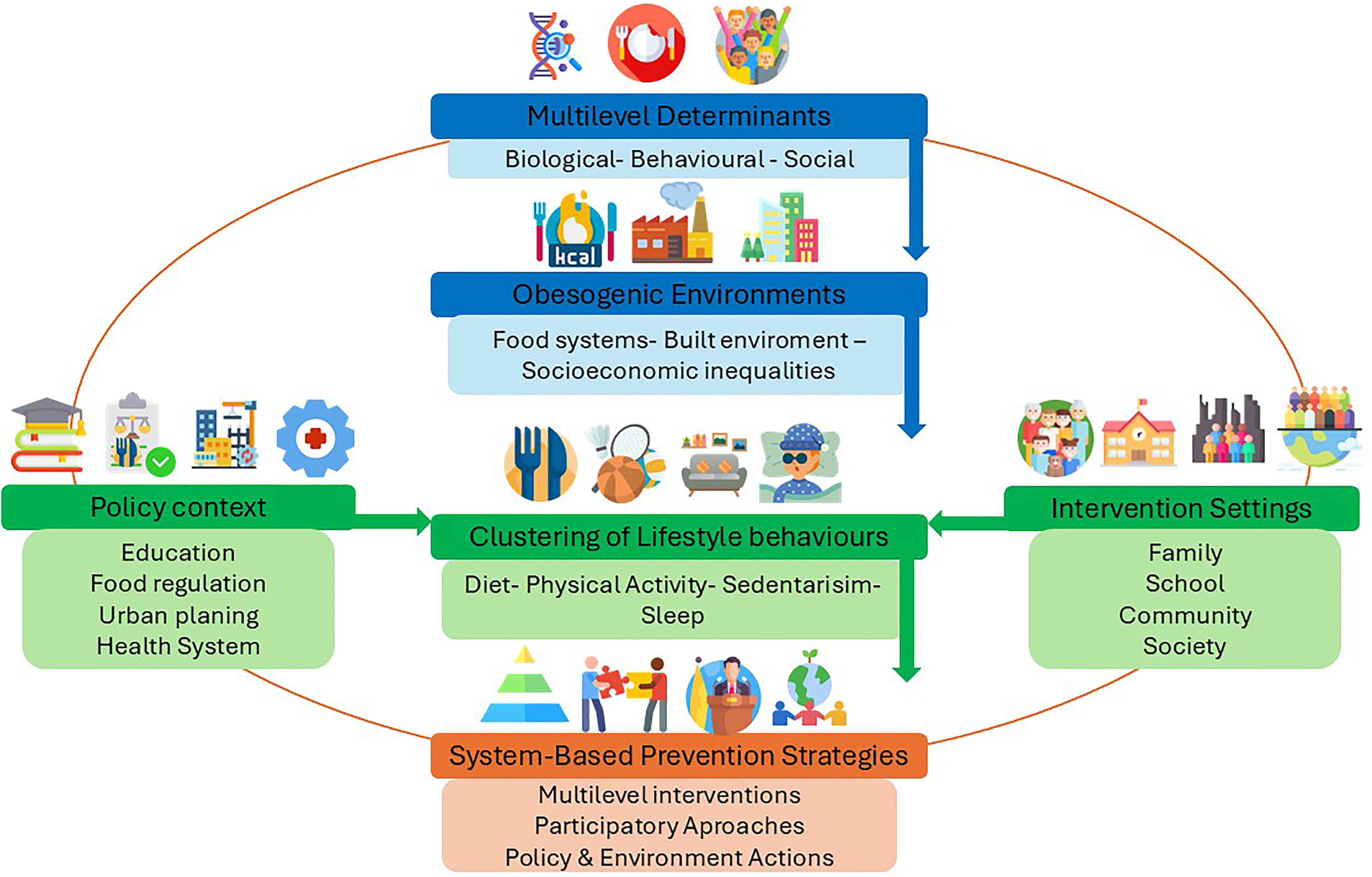
Together, these developments emphasise the importance of prevention strategies that go beyond single-component interventions and adopt an integrated, multilevel approach to address the complex causes of childhood obesity (Fig. 1). However, implementing and evaluating such interventions remains challenging, and effective programmes may require adaptation when implemented in different contexts or populations(Reference Evans, Craig and Hoddinott24). The following section therefore reviews the current evidence on interventions aimed at preventing childhood obesity.
Conceptual framework for childhood obesity prevention.

Figure 1. Long description
A conceptual framework for childhood obesity prevention. The diagram includes multilevel determinants such as biological, behavioral, and social factors. These determinants contribute to obesogenic environments, which include food systems, built environments, and socioeconomic inequalities. The clustering of lifestyle behaviors, including diet, physical activity, sedentarism, and sleep, is influenced by these environments. The policy context, which includes education, food regulation, urban planning, and health systems, interacts with the clustering of lifestyle behaviors. Intervention settings, such as family, school, community, and society, also play a role. System-based prevention strategies, including multilevel interventions, participatory approaches, and policy and environment actions, are aimed at addressing these issues.
What is the evidence about childhood obesity prevention?
Overall evidence from preventive interventions
Over the past few decades, numerous interventions have been implemented to prevent obesity in children and adolescents across different settings and populations. Evidence from systematic reviews and meta-analyses suggests that such interventions can lead to modest improvements in obesity-related behaviours and weight outcomes. The magnitude of these effects is often small and varies across studies(Reference Brown, Moore and Hooper9,Reference Padgett, Stevens and Summerbell25) . Differences in intervention design, intensity, duration and implementation context may partly explain these variations.
Another possible explanation is that many interventions aim to modify individual behaviours, whereas the environmental and social factors that influence these behaviours often remain unchanged. As a result, behavioural improvements achieved during the intervention may be difficult to maintain over time, particularly when children continue to be exposed to environments that favour unhealthy choices. Early prevention programmes mainly targeted dietary habits and physical activity through educational and behavioural strategies. While these approaches have had a positive effect on lifestyle behaviours to some extent, they have often had a limited impact on anthropometric outcomes such as BMI. These findings have emphasised the importance of adopting a more comprehensive approach that considers multiple behavioural and environmental factors simultaneously(Reference Swinburn, Kraak and Allender10).
Interventions in childhood and adolescence: lessons learned
Several important lessons have been generated by evidence from prevention programmes targeting children and adolescents. Firstly, interventions implemented during childhood appear to be more effective when they address behavioural patterns before unhealthy habits become firmly established. Therefore, early prevention offers significant potential to influence long-term health trajectories.
Secondly, interventions that consider the broader social and environmental context in which children live tend to be more successful than those that focus exclusively on changing individual behaviour. Children’s dietary patterns, levels of physical activity and sedentary behaviours are strongly influenced by family dynamics, school environments and community contexts. Furthermore, lifestyle behaviours tend to cluster during childhood, indicating that prevention strategies should address multiple behaviours simultaneously(Reference Miguel-Berges, De Miguel-Etayo and Larruy-García14).
Thirdly, sustainability remains a major challenge. While many interventions show short-term improvements in behaviour or weight, maintaining these changes over time is often difficult. This suggests that short-term programmes alone are unlikely to be sufficient. Lasting effects may require continued support through family, school, community and policy environments that reinforce healthy behaviours beyond the intervention period.
Family and school as key settings for prevention
Family and school environments are two of the most important settings for preventing childhood obesity. Families play a crucial role in shaping children’s dietary habits, physical activity levels and daily routines. Interventions involving parents or caregivers have shown promise in promoting healthier behaviours and reinforcing changes introduced through school-based programmes.
Schools are a particularly relevant setting for prevention initiatives as they provide access to large populations of children and offer structured opportunities to encourage healthy behaviours. Examples of school-based interventions include nutrition education, improvements to school meals, the promotion of physical activity and policies that limit access to unhealthy foods. Recent meta-analyses suggest that such programmes can lead to improvements in dietary behaviours and physical activity, although their effects on BMI and other anthropometric outcomes tend to be modest(Reference McDiarmid, Clinton-McHarg and Wolfenden26). Furthermore, evidence from school-based interventions suggests that the impact of lifestyle education programmes may depend on children’s initial weight status(Reference Miguel-Berges, Larruy-García and De Miguel-Etayo27).
Effects of interventions on body composition
Despite improvements in lifestyle behaviours, anthropometric outcomes remain the most commonly used indicators to evaluate the effectiveness of childhood obesity prevention interventions. Although many prevention programmes successfully improve lifestyle behaviours, their effects on anthropometric outcomes, such as BMI, body fat and waist circumference, are often modest. A Cochrane review concluded that childhood obesity prevention interventions may produce small reductions in BMI z-score, particularly when programmes are sustained over time and include multiple components(Reference Brown, Moore and Hooper9).
Several large-scale European research initiatives have helped us to understand the impact of lifestyle interventions on children’s body composition and obesity-related outcomes. The IDEFICS (Identification and Prevention of Diet- and Lifestyle-induced Health Effects in Children and Infants) study, for example, evaluated the effects of a community-oriented intervention targeting diet, physical activity, sleep and stress across several European countries. While improvements in health-related behaviours were observed, changes in anthropometric indicators were generally modest, emphasising the difficulty of achieving significant changes in body composition at a population level(Reference De Henauw, Huybrechts and De Bourdeaudhuij28). However, further analyses of the IDEFICS intervention showed differential effects according to baseline weight status, with more favourable outcomes observed among children who were overweight at baseline, suggesting that such interventions may be more effective as secondary rather than primary prevention strategies(Reference Lissner, De Bourdeaudhuij and Konstabel29).
Evidence from early-life studies, including intervention programmes, such as the MELIPOP study, further supports the potential of family-based strategies targeting dietary and lifestyle behaviours during early childhood(Reference Larruy-García, De Miguel-Etayo and Gil-Campos30). Overall, these studies suggest that, although prevention interventions may only produce modest changes in anthropometric indicators, they can significantly improve lifestyle behaviours and metabolic health(Reference Brown, Moore and Hooper9). These findings emphasise the importance of evaluating outcomes beyond BMI and highlight both the potential and the limitations of current interventions, particularly given the variability in their effectiveness across different population groups, settings and intervention designs. This heterogeneity underscores the complexity of childhood obesity prevention and the challenges involved in achieving sustained population-level impact. Several factors may contribute to these modest effects, including variability in implementation fidelity, differences in contextual conditions and the difficulty of sustaining behavioural changes over time. These findings also highlight the importance of considering outcomes beyond BMI alone. Improvements in dietary habits, physical activity and other health-related behaviours may still represent meaningful benefits, even when changes in anthropometric measures are relatively small.
A key question that arises is how evidence from controlled studies can be translated into effective, scalable strategies for real-world settings. The following section therefore considers the challenges involved in moving from intervention efficacy to implementation in practice and discusses how evidence-based interventions can be adapted, scaled up and sustained in diverse real-world contexts.
From efficacy to implementation
To reduce the prevalence of obesity at the population level, health promotion programmes should be developed based on the best available scientific evidence. In studies aimed at preventing childhood obesity, it is important to distinguish between efficacy and effectiveness, two related but distinct concepts. Efficacy refers to whether an intervention produces the intended outcomes under ideal and highly controlled conditions, typically in randomised controlled trials with strict eligibility criteria, intensive support and high levels of adherence, thereby addressing whether the intervention can work. In contrast, effectiveness concerns whether the intervention achieves meaningful benefits when implemented in real-world settings, such as schools or community programmes, where resources, implementation fidelity and participant engagement may vary, thus addressing whether the intervention works in routine practice(Reference Hassan, McDonough and Ryu31).
A critical component of studies evaluating childhood obesity prevention interventions is the duration of follow-up, as it allows both the achievement of the intended effects and the assessment of their sustainability over time. Changes in body composition, dietary behaviours and physical activity typically occur gradually. Longer follow-up periods are particularly important in childhood obesity prevention, as they enable the capture of developmental changes and help determine whether early interventions influence longer-term weight trajectories and related health outcomes(Reference McDiarmid, Clinton-McHarg and Wolfenden26).
Considering population-level effects of the obesity prevention programmes, there is an increasing emphasis on the move to real-world implementation and scale-up. Issues of implementation have been neglected; taking into account context and setting (e.g. characteristics of children and school environment) is crucial when making decisions about the best way to improve reach, implementation and adoption of complex, multicomponent interventions(Reference May, Johnson and Finch32).
Combined lifestyle interventions that target multiple behaviours have the potential to prevent cardiometabolic diseases; however, their implementation, reach and effectiveness in routine practice are often limited. A recent review has examined the effectiveness of such interventions both within controlled research settings and when implemented in routine care and has discussed their key effective components as well as the factors that may contribute to reduced effectiveness following real-world implementation. Overall, combined lifestyle interventions can produce clinically meaningful improvements in metabolic health, particularly when supported by favourable environments and policy measures that promote healthy behaviours at the population level. In this context, policies aimed at improving living environments are also essential to support population-wide lifestyle changes and to ensure that the associated health benefits are accessible to everyone(Reference Rutters, Den Braver and Lakerveld33).
Policy implementers play a vital role in the delivery of public policies and are central to addressing challenges that arise during the implementation process. Understanding their experiences of the barriers and facilitators involved in implementation is therefore essential for effective prevention efforts. A study examining the implementation of government-led food policies identified several key facilitators, including strong leadership, effective use of resources, supportive organisational structures and the presence of monitoring and accountability systems. Conversely, weak policy commitment and inadequate governance were identified as major barriers to successful implementation(Reference Ng, Yeatman and Kelly34).
Implementation strategies
When designing, implementing and evaluating interventions, researchers should incorporate stakeholder input by engaging key actors – such as parents, healthcare professionals (including early childhood practitioners and social workers), public health professionals and industry representatives – through participatory approaches. This involvement can help ensure that programmes are better adapted to family needs and more transferable across settings. In addition, implementation and evaluation studies using mixed methods, combining qualitative and quantitative approaches, are needed to understand how and why interventions work in real-world contexts. Such studies should identify barriers and facilitators to successful implementation and scale-up, as well as capture the perspectives of healthcare professionals and parents, thereby supporting the development of interventions that are effective, sustainable and adaptable across different contexts(Reference Schipper, Manshanden and Philippe35).
Early intervention is essential, and healthcare professionals may achieve greater impact by initiating lifestyle interventions as early as possible during pregnancy, or even before conception. Strengthening both initial education and continuing professional development can enhance the capacity of current and future professionals to address childhood obesity early and effectively. In addition, healthcare professionals may benefit from training in communication with families, using engaging approaches that emphasise small, achievable steps towards healthier behaviours(Reference Schipper, Manshanden and Philippe35).
Interventions to prevent childhood obesity should be inclusive and responsive to diverse populations by engaging families from different socio-economic and ethnic backgrounds through culturally sensitive approaches, bilingual professionals and accessible support such as e-health platforms, with home-visiting programmes considered for disadvantaged families(Reference Ayala-Marín, Iguacel and Miguel-Etayo17).
Practice guidelines should also promote collaboration among a wide range of stakeholders, including researchers, healthcare professionals, educational institutions, industry partners, community representatives and parent–child organisations, as multidisciplinary cooperation is essential for effective implementation and evaluation. In addition, prevention efforts should adopt a life-course perspective by integrating opportunities for prevention and intervention across multiple settings – such as routine health contacts, childcare services, preschools, schools and parenting programmes – ensuring that every contact is used to support healthy development(Reference Schipper, Manshanden and Philippe35).
To support the widespread implementation of obesity prevention strategies, health economic evaluations are needed to show their cost-effectiveness in real-world settings. However, the current economic evidence for complex obesity prevention interventions remains limited and inconclusive. This is partly due to methodological challenges, including the difficulty of accurately tracking costs in interventions involving multiple actors and the limited incorporation of broader societal and health benefits into economic evaluations(Reference Sultana, Nichols and Moodie36).
A systematic review found that, compared with usual care, most obesity prevention interventions were considered cost-effective. The cost-effectiveness of these interventions was influenced by participant characteristics, including age, sex and socio-economic status. Notably, interventions with benefits projected beyond childhood – such as bariatric surgery, lower-protein infant formula and home-based general practitioner consultations – were more likely to be cost-effective(Reference Onyimadu, Violato and Astbury37).
Process evaluation
Process evaluation is used to observe and document programme implementation and to better understand the relationship between specific programme components and their outcomes. Several practical frameworks and models are available to guide professionals in developing comprehensive evaluation plans that include process evaluation. These systematic approaches support the assessment of how prevention interventions are implemented and typically examine key indicators such as recruitment, reach, fidelity, dose and participant satisfaction(Reference Griffin and Clarke38).
However, there is currently no consensus on an ideal standard for classifying the key components of implementation studies and it remains difficult to establish a definitive framework among those currently in use. In the absence of process evaluation, it is challenging to distinguish whether outcomes are attributable to poor implementation fidelity or to the limited effectiveness of the intervention itself. When interventions are not delivered as intended, the resulting findings may lead to misleading conclusions regarding effectiveness and may limit the validity and reproducibility of the intervention in future research. This issue is particularly relevant for multicomponent prevention programmes, which are complex interventions designed to operate synergistically. In this context, process evaluation plays an important role in interpreting outcome effects and in understanding how the intervention was implemented and delivered(Reference Durlak and DuPre39).
A systematic review examining the use and impact of process evaluation in childhood obesity prevention studies found that interventions including process evaluation were more likely to report positive effects on BMI or BMI z-score, whereas studies that did not report process evaluation generally showed no significant improvements in BMI or BMI s-score. The review also highlighted that none of the included intervention studies assessed all process evaluation indicators, and that many studies incorporating process evaluation did not provide a complete report of its components according to the guidelines applied in the review(Reference Seral-Cortes, De Miguel-Etayo and Zapata40).
Families experiencing socio-economic disadvantage and those from minority groups are disproportionately affected by childhood obesity and often face the greatest barriers to accessing interventions(Reference Iguacel, Gasch-Gallén and Ayala-Marín41,Reference Iguacel, Ahrens and Bammann42) . This inequity, underscores the need for implementation strategies to address systemic barriers(Reference Ayala-Marín, Iguacel and Miguel-Etayo17). Barriers related to social exclusion and geographical isolation – such as limited use of maternal and child health services, low school attendance, insecure resident status, low levels of health and nutrition literacy and language barriers – should be carefully considered when designing and implementing policies aimed at supporting vulnerable populations(Reference Charles-Rodriguez, Ngwezi and Damag43).
Systems approach and participatory strategies
From an implementation perspective, systems approaches emphasise the need to translate scientific evidence into coordinated, multilevel actions involving schools, families, communities and policymakers. Instead of focusing solely on conceptual complexity, this approach highlights practical mechanisms such as stakeholder engagement, co-creation processes and cross-sector collaboration. Consequently, effective prevention requires coordinated, multilevel strategies that address the broader systems shaping children’s health, including family contexts, schools, communities, food environments and policy frameworks. Systems thinking emphasises interconnections, feedback loops and non-linear effects within these systems, helping to identify leverage points for intervention and to anticipate potential unintended consequences. By integrating cross-sector collaboration, community engagement and systems science methods such as systems mapping and modelling, this approach supports the design of coordinated interventions capable of producing sustainable improvements in child health at the population level(Reference Li, Alharbi and Allender44).
Advocacy constitutes an important component of comprehensive responses to obesity. The meaningful engagement of individuals, communities and families affected by obesity in the design, implementation and monitoring of policies is essential to ensure that interventions are relevant, equitable and responsive to population needs. Such participation can also strengthen advocacy for legislative, regulatory and policy reforms, while promoting the integration of human rights and equity principles within obesity prevention and management strategies. Furthermore, community involvement can contribute to shaping societal demand for appropriate services, including treatment, care and support, and can play a valuable role in informing research priorities, as well as in guiding resource mobilisation and funding allocation(45).
Collaboration with a wide range of stakeholders has been consistently emphasised in the literature as a critical determinant of successful policy and intervention implementation. In particular, effective communication and co-design processes involving policymakers have been identified as key mechanisms for facilitating the translation of research into practice. Conversely, studies reporting unsuccessful implementation frequently attribute these outcomes to limited engagement or commitment from relevant policymakers, as well as to broader political and structural factors, including changes in government priorities and insufficient allocation of funding for prevention initiatives(Reference Seidler, Hunter and Johnson46).
Future research should examine which implementation strategies are most effective in supporting early childhood education providers to sustain healthy nutrition and physical activity environments. In addition, further work is needed to determine how interventions can be optimally designed to support early childhood education settings serving children from low-income households and/or structurally disadvantaged neighbourhoods(Reference Heerman, Kenney and Block47).
Challenges and future directions
Taking action earlier in life
There is increasing evidence highlighting the importance of early-life exposures in shaping growth trajectories and long-term metabolic health. Prenatal conditions, infant feeding practices and early childhood environments may influence behavioural patterns and physiological pathways associated with obesity risk. Therefore, preventive efforts targeting the earliest stages of life represent an important opportunity to influence health trajectories before behaviours and environments that promote obesity become firmly established. In this context, interventions focusing on families, early childcare settings and parental support may be particularly relevant and could contribute to healthier lifestyle choices during childhood(Reference Miguel-Berges, De Miguel-Etayo and Larruy-García14). In particular, parenting practices, including caregivers’ feeding behaviours, have been identified as key modifiable determinants, with recent evidence showing that interventions targeting these practices can lead to improvements in children’s dietary behaviours(Reference Wang, Chang and Wei48).
Addressing social inequalities and high-risk groups
Another major challenge for future prevention strategies is tackling the ongoing social disparities evident in childhood obesity. In many countries, children from socio-economically disadvantaged backgrounds are at a disproportionately higher risk of obesity and related health issues. Based on the environmental factors discussed earlier in the review, prevention policies should prioritise strategies that promote equity and reduce structural barriers to healthy lifestyles.
Barriers such as limited access to healthy foods, fewer opportunities for safe physical activity and greater exposure to environments that promote obesity contribute to these disparities. These inequalities reflect the broader societal and environmental factors that influence health behaviours and outcomes throughout life(Reference Swinburn, Kraak and Allender10). Importantly, evidence from intervention studies suggests that not all programmes are equally effective across socio-economic groups, and some may fail to reduce – or may even widen – existing health inequalities if equity is not explicitly addressed(Reference Venturelli, Ferrari and Broccoli49). Therefore, future prevention strategies should prioritise equity-oriented approaches that address the social determinants of health and ensure interventions reach those most at risk.
Integrating prevention into public policies
Integrating research evidence into public policies is a critical step in preventing childhood obesity. Effective strategies require actions implemented in schools, families and communities to be aligned with those in broader policy environments, including food systems, urban planning and marketing regulations. Collaboration between the health, education, social care and policy sectors is essential in order to create environments that support healthier behaviours among children and adolescents. However, translating research findings into real-world practice remains challenging, and effective interventions often need to be adapted for different contexts or populations(Reference Evans, Craig and Hoddinott24).
Examples of population-level policies that have been implemented in different countries include restrictions on the marketing of unhealthy foods to children and urban planning initiatives that promote active transport and access to safe recreational spaces. Evidence from a recent systematic review and meta-analysis suggests that food marketing can significantly influence dietary behaviours and eating outcomes among children, supporting the importance of regulatory actions in this area(Reference Boyland, Muc and Coates50). Likewise, improvements in the built environment have been associated with higher levels of physical activity and active transport, while also contributing to the reduction of health inequalities(Reference Smith, Hosking and Woodward51). Together, these measures aim to create healthier environments and support lifestyle changes beyond the individual level.
Moving towards systems-based prevention strategies
Looking ahead, future research should explore how systems science methodologies can support the design, evaluation and scaling up of obesity prevention strategies. Advances in participatory modelling, systems mapping and real-world experimentation could help to identify interventions that can be scaled up and produce a sustainable population-level impact. Emerging research has also examined participatory systems approaches to support the development of multilevel strategies that address obesity-related behaviours within communities(Reference Luna Pinzon, Waterlander and De Pooter20). Future research should continue to explore innovative methodologies to improve our understanding of how interventions operate in real-world contexts and identify scalable prevention strategies.
Conclusions
Childhood obesity represents one of the most pressing public health challenges of the 21st century. Its development is driven by complex interactions between biological, behavioural and social determinants operating within obesogenic environments that shape children’s lifestyle behaviours from early life. As highlighted in this review, prevention strategies focusing on single behaviours or isolated settings are unlikely to achieve sustained population-level impact.
Addressing childhood obesity requires a shift towards integrated, multilevel approaches capable of tackling the broader determinants of health behaviours. Interventions that combine actions across families, schools, communities and policy environments are more likely to influence the complex systems that drive obesity risk. In this context, participatory approaches and systems-based frameworks offer promising opportunities to design more relevant, context-sensitive and sustainable prevention strategies.
Moving forward, a central priority for public health should be translating evidence from prevention research into effective, scalable real-world strategies. To achieve this goal, strengthening collaboration between researchers, practitioners and policymakers will be essential. Creating healthier environments for children requires coordinated efforts across sectors and a sustained commitment to policies that support healthy lifestyles from an early age.
Acknowledgements
The authors would like to thank all researchers and collaborators involved in the studies and projects cited throughout this review.
Author contributions
P.D.M.E., M.L.M.B. and L.A.M. contributed to the conception, writing, revision and approval of the final manuscript.
Financial support
None.
Competing interests
The authors declare no conflicts of interest.

 Open access

