

Introduction
The dusty crowd of Arabs declares that learning aids us,
While in olden times things barbaric were in favour.
Among these Arabs, Rhazes, the medical writer, is pre-eminent,
An excellent man because of his service to mankind.
But having been badly translated, his work till now displeased
Our countrymen, while henceforth it will be more esteemed.
This fact, Vesalius, we can attribute to you.
Praise deservedly is yours. Do thou lead. I follow. Footnote 1
Andreas Vesalius (1514–64) started his career as an author in 1537 with a paraphrase of the ninth book of the Almansor, written by the Arab–Persian physician and alchemist Ar-Rāzī, in the Latin world known as Rhazes (854–925). Despite having been reprinted several times,Footnote 2 this early work has never really been regarded as part of Vesalius’ oeuvre. On the contrary, in most studies about Vesalius, the Paraphrasis is mentioned as a mere footnote. Some historians even use derogatives.
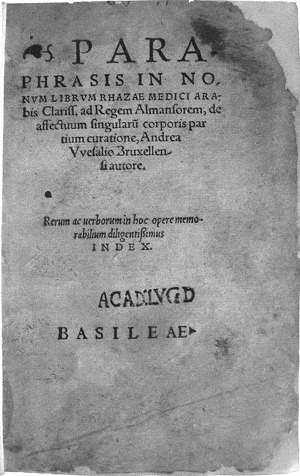
Andreas Vesalius, Paraphrasis in nonum librum Rhazae medici arabis clariss. ad regem Almansorem (Basel: Robert Winter, 1537), title page. Courtesy: Leiden University Library, obj. nr. 607F21.
Moritz Roth (1892), in his five-hundred-page biography of Vesalius, spends only half a page on the Paraphrasis. Vesalius ‘rendered the ninth book of Rhazes’ Almansor… from the barbaric version into a readable translation’.Footnote 3 Singer and Rabin (1946), although devoting a whole study to the Hebrew and Arabic elements in the Tabulae anatomicae sex, call the Paraphrasis ‘unimportant and without originality’.Footnote 4 In 1961, Charles Singer uses further scorn and imagines the Paraphrasis to be a headache Vesalius had left over from the Middle Ages: ‘It is a work of no importance and a mere “hangover” from the scholastic period, though several times reprinted. For us its only significance is that it contains the suggestio falsi that its author understood Arabic. It cannot be a “graduation thesis” but it is not above that level’.Footnote 5
The ‘Bio-bibliography’ of Harvey Cushing (1962)Footnote 6 grants a bit more space to the Paraphrasis, and translates its preface and epilogue. Cushing relates Vesalius’ work on Rhazes to his family tradition of commenting on Arabic authors, but does not offer any further reflections on the position of the Paraphrasis within Vesalius’ oeuvre.
C.D. O’Malley’s Andreas Vesalius of Brussels, 1514–1564 (1964), gives a short summary of the contents of the Paraphrasis. As far as its meaning is concerned, O’Malley admits that ‘it is of interest that Vesalius, so staunch a partisan of the revived Hippocratic and Galenic medicine and therefore a critic of the medieval practices based upon Moslem opinion, should have chosen Rhazes as a subject.’ Nonetheless, O’Malley warns that ‘we need not spend much time on its contents, which had no share in the author’s later fame’. The work is ‘of no more than antiquarian interest today’ because ‘one must not expect, nor does one find, any free enquiry in this treatise.’Footnote 7
After Vesalius’ greater biographers, more recent studies have not spent any time on Rhazes either. The disregard for Vesalius’ work on the Arab author reveals a one-dimensional view of Vesalius’ development as an author. A closer look at the role of Rhazes within Vesalius’ oeuvre gives us an insight into an evolution Vesalius went through as a scholar in his own time. Furthermore, Rhazes is known to have been an author critical of Galen, which makes for an interesting similarity between the two authors. In this paper I hope to offer context to Vesalius’ work on Rhazes, and have made an attempt to establish whether Rhazes could have influenced Vesalius in the latter’s famous critique of Galen in his masterpiece, De humani corporis fabrica.
Rhazes
‘Rhazes’ is the Latinised name of Abū Bakr Muḥammad bin Zakariyā ar-Rāzī. Born in 854 AD in present-day northern Iran, Rhazes studied philosophy, musicology and alchemy, and worked as a poet and advisor to the ruler before studying medicine at a later stage. At Rayy he was charged with managing one of the very first hospitals, and he was asked to co-ordinate the building of a new hospital in Baghdad. Rhazes wrote approximately two hundred books on a diversity of subjects. His most influential medical works are known as the Kitāb al-Ḥāwī fī l-Ṭibb [The Comprehensive Book on Medicine, known as the Liber Continens] and the Kitāb al-Mansūrī [The Book of Mansur], which came to be known in Europe as the Liber ad Almansorem or just briefly as the Almansor.
The Kitāb al-Mansūrī was written as a medical handbook for King Al-Mansūr of Khurasan. Its ten books cover physiology, ‘temperament’, common therapies, general health, skin diseases, prescriptions for travellers, surgery, poisons, therapies ‘from head to toe’, and different kinds of fever.Footnote 8 It was translated into Latin by Gerard of Cremona at the time of the influx of Arabic science into Europe in the twelfth century. The subject of Vesalius’ edition became popular as the ‘Liber Nonus’ and remained part of the university curricula in Europe for many centuries.Footnote 9
The Kitāb al-Ḥāwī fī l-Ṭibb is in fact an enormous collection of notes and comments, posthumously collected by Rhazes’ students. Next to a number of fascinating case descriptions, of which the one on smallpox and measles became the most famous,Footnote 10 it contains thousands of observations and thoughts, with critical discussions of practically all authors available in Rhazes’ time: Arab, but also Greek, Persian and Indian. It was first translated into Latin by the Jewish physician and translator Faraj ibn Sālem (Latin: Farraguth) for King Charles of Anjou (1226–85) and published as ‘Liber Continens’ in Sicily or Naples in 1279. The work was so immense that Meyerhof estimates its translation ‘must have taken nearly the whole lifetime of the translator’.Footnote 11 The Continens was one of the nine books available in the Bibliothèque de Paris in 1395.Footnote 12 It was printed for the first time in Brescia in 1486 and, containing 588 large pages, was ‘the most bulky of all the incunabula’, its two volumes weighing more than twenty pounds.Footnote 13 It was repeatedly reprinted in Venice in the course of the sixteenth century; in 1500, 1506, 1509, 1529 and in 1542.Footnote 14 An edition was published in Paris in 1534 by Simon de Colines.
Perhaps the most distinguishing characteristic of Rhazes is his critical and experimental mind. His uncompromising attitude is illustrated by discussions with the theologian Abū Hātim, in which he appears as a kind of Voltaire, challenging religious dogma and giving preference to a philosophical approach.Footnote 15 Medical authors were also not safe to Rhazes. Rhazes devoted an entire book to a critique of Galen, the Kitāb shukūk ‘alā jālīnūs, (‘The Book of Doubts about Galen’). And in the Continens, all the authors known in Rhazes’ time are commented upon and criticised if deemed necessary. Rhazes’ apology for his critique sounds like the modern catchphrase ‘standing on the shoulders of giants’:
Asked why modern scholars should attach [such critiques] to [the works of] the ancients, I cite several reasons. Among these is that error is inherent in human beings…. Another reason I cite for such critiques is that the sciences continually grow and are refined as time passes. […] If it then be said that this is tantamount to claiming that modern scholars are better than the ancients, I reply that I do not see that this statement is valid except on condition that the moderns improve on that which has been laid down by the ancients.Footnote 16
The Renaissance Attack on Things Arabian
Rhazes was, after Avicenna, foremost among the large number of Arabic authors who had inspired scholarship in Europe since the twelfth century. In the early sixteenth century, the time of Vesalius’ early education, a change in attitude towards the Arab authors came to a climax. Ever since Alvaro made his complaint against the Mozarab youth of Al-Andalus in the ninth century, Christian humanists had desired emancipation from the dominance of Arabic authors in the scientific field.Footnote 17 In the dynamic of the evolving emancipation movement, the classical Greek authors came to be seen as the founders of true science and the Latin and Greek languages as the expression of humanist purity.Footnote 18 But while the Renaissance ideal of a revived classical heritage was thus constructed, Arabic dominance was repelled by a violent attack on its heritage in Europe.
The effects of this attack in the field of medicine have been well documented by Nancy Siraisi in her Avicenna in Renaissance Italy. Footnote 19 From the fourteenth century, when Petrarch condemned medicine itself as ‘Arabian lies’, several themes developed in the rejection of Arabic medical literature. Obvious charges were concerned with the supposedly heretical nature of the religion or philosophy of the authors, Arabic writings were deemed ‘obscure’, erroneous, and a corruption of the ‘pure’ Greek sources. The many Arabic borrowings in botany and pharmacology came to be regarded as impractical, whereas perceived traces of the Arabic language itself were condemned as ‘coarse’ and ‘barbaric’ when compared with the Renaissance ideal of Ciceronian Latin.
Siraisi observes that by 1530, ‘the role of the Arabs was a central issue in debates over the reform of medicine’,Footnote 20 creating ‘an intellectual climate in which hostility to the Arabs had become a shibboleth of modernism in medicine’.Footnote 21 Polemical pamphlets were published in Venice, Paris, Tübingen, Leipzig and Montpellier, sporting titles like the ‘Little Works of the New Florentine Academy against Avicenna and against the Neoteric Physicians Who, Neglecting the Discipline of Galen, Cultivate the Barbarians’.Footnote 22 Hardliners, notably in Paris and Germany, started to talk of the ‘tyranny’ of Avicenna and of Arab ‘occupation of the schools’. Known anti-Arab polemicists include the champions of the humanist movement, such as Nicolò Leoniceno and Giovanni Manardo in Ferrara, Bassiano Landi in Venice, Pierre Brissot and Jacobus Sylvius in Paris, Symphorien Champier in Montpellier, and Leonhart Fuchs in Tübingen. Scholars like Fuchs advocated abolishing Arabian literature entirely, but a more common strategy was to ‘purify, to reinterpret and integrate’ the Arabian literature using the newly found Renaissance rhetoric.
A younger generation of physicians used the polemic against the Arabs to distance themselves from the established order. The Arabs were accused of being merely ‘compilers of books’, whereas the Greeks ‘knew nature first hand’.Footnote 23 The University of Alcalá de Henares stopped teaching Avicenna in 1565. By 1563, the London College of Physicians had decided to examine new candidates on Galenic texts only. The University of Tübingen, perhaps so advised by Leonhart Fuchs, went so far as to discourage, in its statutes, the reading of Arab authors.
However, like the wave of extreme Galenism, the flood of extreme anti-Arabism was in fact short lived, and despite its aggression it did not pervade all levels of the scholarly world. Even at the peak of the antagonism there were writers who defended the Arab authors, as for instance Lorenz Fries, who in 1530 published a Defensio medicorum principis Avicennae ad Germanica medicos. Footnote 24 By the second half of the sixteenth century, Johann Lange (1485–1565), physician to the Elector Palatine, proposed that universities instruct the Arab language, and he decided not to hide the fact that he himself associated with those Arab lands and participated in Arab learning.Footnote 25 In the 1570s, the universities of Ingolstadt and Freiburg, where the curriculum had emphasised the Greeks at the expense of the Arabs, again introduced Avicenna and Rhazes;Footnote 26 and by the 1580s, printing offices, such as that of Plantin in Antwerp, showed a renewed interest in the Arab world and even printed texts in Arabic.Footnote 27
The short period, roughly between the 1490s and 1550s, became decisive for the later European self-image. The classics were sanctified ad absurdum as symbols of the humanist revolution, resulting, for example, in the bizarre defence of Galen’s infallibility.Footnote 28 At the same time, individuals who were perceived as threats to the humanist cause could be severly intimidated. This violent attitude, so comparable to religious extremism, ultimately suffocated scientific advancement, as has been rightly pointed out by Lester King: ‘The humanists who condemned scholastic authority and domination of the church, themselves bowed before an equal tyranny – the authority of the ancients’.Footnote 29
Vesalius’ Paraphrase of the Almansor (1537)
Vesalius studied in Paris from 1533–6, when the anti-Arab campaign was at its height. He studied with Jacobus Sylvius, and became acquainted with the work of other anti-Arab polemicists such as Giovanni Manardo, Pierre Brissot and Leonhart Fuchs.Footnote 30 Back in Louvain in 1537, Vesalius decided, for his bachelor’s thesis,Footnote 31 to paraphrase the popular ninth book of Rhazes’s Almansor, of which he already posessed the commentaries his great-grandfather Everard had composed much earlier.Footnote 32
Vesalius’ Paraphrasis echoes the anti-Arab rhetoric of Vesalius’ teachers in Paris. Vesalius complained that physicians of his day were ‘hopelessly and obstinately fixed in the very footprints, so to speak, of barbarians and Arabians’.Footnote 33 He considered Rhazes ‘the most expert in the art of curing among all the physicians of his people’,Footnote 34 but only because he ‘does not differ, except in a few points, from the writings of the Greeks’.Footnote 35
The most important aim for Vesalius was a stylistic one, to present Rhazes ‘clothed in elegant Latin style’.Footnote 36 Even in this apparent favour to Rhazes, the humanist cleansing rhetoric permeated almost every sentence. To the suggestion that the Almansor was in fact a Greek work attributed to Rhazes – which could have made it easier to be accepted within a humanist frame of mind – Vesalius replied that this was highly unlikely because one could recognise without difficulty ‘the horrid and coarse style of expression in common use among the Arabians and totally different from the fine elegance of the Greeks’.Footnote 37 Vesalius praised other authors who had almost managed to ‘rid the druggist shop of all barbarian words, if I may not say of all false drugs, and to restore them to their pristine integrity’.Footnote 38 Rhazes’ work should reach the hands of its readers ‘cleansed of all barbarian names of medicaments unrecognisable to Latin ears… so that what was heretofore squalid and coarse and too obscure to be intelligible, will now be brightened….’Footnote 39 Vesalius denounced fault-seekers who do not wish to have anything ‘cleansed and purified from its horrid barbarity’.Footnote 40
Wherever the name of Galen is mentioned in the text, it is put into capital letters, so as to stress Vesalius’ support for the humanist cause.Footnote 41 Vesalius vows to subject Rhazes to ‘the stone of the Lydians’,Footnote 42 to correct him wherever he deviated from the Greeks, a ‘procedure which is most often commended by the Parisian physicians to their students’.Footnote 43
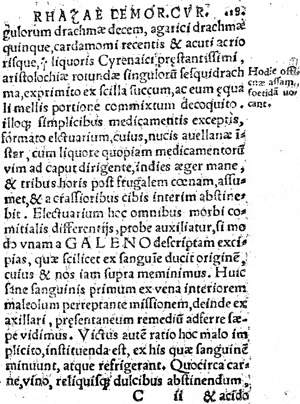
Andreas Vesalius, Paraphrasis … (Louvain: In officina Rutgeri Rescii, 1537). fol 18r. Showing 'Galen' spelled in capital letters. The capitals disappeared in the subsequent Basel edition. Courtesy: Google Books.
Consequently, Vesalius noted in the margins where he saw Rhazes cross the line. The subject of bloodletting had become a sensitive issue just before Vesalius published the Paraphrasis. In 1514, Pierre Brissot had commenced an attack on Arab influences in bloodletting.Footnote 44 During a dissection in Louvain, at the time Vesalius was working on the Paraphrasis, he somehow entered ‘rather fiercely’ into discussion about the proper place of venesection with Jeremias Drivière (Thriverius), an author who still defended the reading of Arab authors. Vesalius probably threw himself into the discussion with the fire of a new convert to the humanist cause. Thriverius answered by ridiculing Vesalius’ teachers as ‘the Lutherans among physicians’. This seems to have humiliated Vesalius, and he referred to it even ten years after the event had taken place.Footnote 45
In the Paraphrasis, Vesalius referred extensively to the subject of bloodletting. When Rhazes prescribed a small venesection by means of cupping the shin, Vesalius corrected him with ‘Galenus arterias intersecat’.Footnote 46 Where Rhazes prescribed a clyster for lethargia, Vesalius commented: ‘Paulus et Alexander in lethargia secant venam’.Footnote 47 He did the same in the chapter about cataract.Footnote 48 Roth, Saunders and O’Malley noted that Vesalius interpolated the word ‘dextra’ whenever Rhazes calls for section of the vena axillaris. Vesalius would later come back to this issue in his Bloodletting Letter of 1539.Footnote 49 In the Paraphrasis, the theme came to a climax in the chapter about pleuritis. Rhazes was of the opinion that one should cut the vein ‘at the affected side, unless because of plethora the body should be full of blood’.Footnote 50 Vesalius, however, comments:
Hippocrates, Galen and almost all the other Greeks divert the urge of the blood stream at the opposite side. So, they cut the vein at the right place from the start, even when the body is plethoric, at a place as close as possible to the side of urge, diverting it directly from the affected side. This in contrast to the Arabians and their followers, whom one could rightfully call haemophobous.Footnote 51
Psychologically, the opposite could also have been true for Vesalius having become a bloodthirsty follower of the cleansing ambitions of his Paris teachers. This, however, would change as Vesalius moved to Padua for the next phase in his career. His Paraphrasis was published by his friend Rutger Rescius in Louvain in February 1537. After taking his bachelor’s degree, Vesalius travelled to Basel where a revised edition was published by Robert Winter, in early 1538.Footnote 52 Robert Winter was one of the two companions of Johann Herbst, later known as Oporinus. Oporinus probably corrected the manuscripts of this second edition.Footnote 53 He must have left an impression on Vesalius, as six years later Vesalius had the precious woodblocks for the Fabrica sent all the way over the Alps to be printed by him.Footnote 54 Perhaps Oporinus’ liberal intellect was a first step to offer some fresh air into Vesalius’ mind, after the extreme Galenism of Paris and Louvain.
Rhazes in Vesalius’ Later Work
In Padua also, the atmosphere seems to have been more mundane, as Vesalius later recalled: ‘Nowhere in the world is Galen held higher in esteem than in Italy, which they have unmistakenly proved by publishing his works. Although they do not reject completely the Arab authors either, who still deserve to be in the hands of those who study medicine.’Footnote 55
In 1538, Vesalius published the Tabulae anatomicae sex, which consisted of six anatomical prints he had made for his students. The prints no longer reflected Vesalius’ earlier ambition to express himself in a pure Ciceronian Latin idiom. The plates are accompanied by an elaborate lexicon of anatomical terms in Latin, Greek, Arabic, and Hebrew. Singer and Rabin showed influences from Rhazes’ Almansor in names such as ‘rostrum porcinum’, offered by Vesalius as a synonym for the Acromion (the ‘crow beak’). Singer and Rabin state that rostrum porcinum is a corruption of ‘rostrum corvinum’ (‘crow beak’), used in Gerard of Cremona’s translation of the Almansor.Footnote 56 The same applies to the Alhosos, used as a synonym for the Os coccygis.Footnote 57
Vesalius sent the Tabulae to the Emperor’s Court, more specifically to his ‘mentor’ Florenas, a friend of his father, to whom he had earlier dedicated his Paraphrasis. In response, Florenas asked him for his opinion about the proper rules for venesection. In his reply, known as the Bloodletting Letter, Vesalius proposed a solution for disagreements among authorities on the subject. He suggested that both Greeks and Arabs used to practice in accordance with an insight he had just rediscovered:
With what objection, I pray, should it be held in less faith that Hippocrates, very studious of brevity, in which the majority of the Greeks and Arabs and all of us today are very remiss, so spoke? For Galen, perpetually explaining himself, Paulus, Aetius, Alexander, Oribasius, Rhazes, Avicenna and others of the Arabian cohorts, frequently urge that the axillary [basilic], common median and humeria [cephalic] must be cut, but do not add right, when nonetheless they unquestionably desire that to be opened. And when they prescribe section of some or other vein on the left, they sometimes add of the left elbow or the left foot.Footnote 58
We no longer see Vesalius attempting to subject the Arabs to the Greeks, instead he rather tried to reconcile the two. By the time his masterpiece De humani corpris fabrica was published in 1543, Vesalius had developed a more balanced view on the merits of both Arab and Greek authors. In the first lines of the preface, Vesalius stated that the nowadays fragmented art of medicine had still been fully intact under ‘the reign of Mansor, king of Persia’. He made reference to Rhazes when stating that under this king ‘flourished those Arabs who are now rightly as familiar to us as are the Greeks’.Footnote 59 Vesalius shows a rather international appreciation of the profession when he argues that Europe left surgery to be performed by ignorant barbers while focusing on medicines, whereas:
[I]n India even kings do not disdain to practice surgery; the Persians hand it on under a law of inheritance to their children just as once the sons of Asclepius handed down the art of medicine as a whole; the Thracians and many other nations pay it the highest honour and reverence, while almost completely neglecting the other branch of the art.Footnote 60
In the letter to his publisher Oporinus, Vesalius denounced the fashionable attack on Arab authors by referring to a plagiarist of his Tabulae as ‘some dunderhead [who] quite undeservedly denigrated Avicenna and the other Arabs’.Footnote 61 Like the Tabulae, the Fabrica contains many words in both Hebrew and Arabic.Footnote 62
Andreas Vesalius, De humani corporis fabrica libri VII (Basel: Joa. Oporinus, 1543). Passage on p. 207 about the teeth with words in Hebrew and Greek type, and references to Arab authors Avicenna and Haly Abbas. Courtesy: Leiden University Library obj. nr. 1402c.

After the publication of the Fabrica, Vesalius was reminded of his roots in Paris, as his former teacher Sylvius threatened him with opposition if he did not retract his criticism of Galen. In the Epistola rationem modumque propinandi radicis Chynae decocti (‘Epistle on the China Root’, 1546), a letter to his friend Joachim Roelants, Vesalius defended his attack on Galen. The letter was written after Vesalius’ departure from his academic career in Padua, and offers interesting insights into his inner thoughts, feelings and convictions. Vesalius described his radical departure from academic ambitions by hurling his books and notes into the fire. In his reflection on whether this loss should be regretted, Vesalius interestingly juxtaposed Galen with Rhazes:
As far as my notes [on Galen] are concerned, which had accumulated into a large volume, they have, together with a complete paraphrase of the ten books of Rhazes’ Almansor, much more accurate than that of the ninth book, which still exists, and the outlines of a book on the preparation of medicines (for which I had gathered much, to my judgment very useful, material) on one single day perished. Along with all the books of Galen, which I had used in the study of anatomy and, in the way these things go, had scribbled all sorts of notes upon. Because when I left Italy to apply myself to the court [of Charles V] and the physicians whom you know, together with some notables, had judged very pessimistically my books and all that is published these days for the promotion of the medical profession, I burned everything, with the intention of restraining myself somewhat in writing.
However I have often regretted the upsurge and have felt sorry for not listening to the advice of my friends, who were present. Although, as far as the notes are concerned, I am very much pleased, because even if they would still be in my possession, I would not feel tempted to publish them, as I can easily foresee that they would make each and every one my enemy. Even the small part of my work which happens to contradict Galen, has already enraged so many, and three years ago already had them gird their loins to protect Galen, before my work had even appeared. They will eventually submit their writings to the students and come forward with a longdrawn letter with slanderings, without explaining themselves fully.
About Galen’s books I feel no pain at all, as they would surely have fallen in the hands of people who are unable to distinguish the good notes from the bad. You do know how often it occurs that, under the supervision of the teacher or after reading for the first time, one makes a note which afterwards appears completely odd and ridiculous. I, for myself, realise this very well, having read Galen’s ‘On Bones’ up to three times before my students, before having the courage to note an error with Galen. Whereas I am now baffled by my own stupidity, that I had hardly understood what was written and that I had deceived my own eyes so badly.
Losing the Paraphrasis however saddens me dearly, as I enjoyed so much its compilation, comparing the Arabs to Galen and the other Greeks with regard to the parts of the profession, treated by Rhazes in each book. Even if it were only for my grandfather Everard, of whom I possess a very learned study on the mentioned books of Rhazes….Footnote 63
This fragment is fascinating because in it so many crucial elements of Vesalius’ life and times come together. The Renaissance polarisation of Arab and Greek authors returns in the contrast pictured between Galen and Rhazes. We learn from this passage that Vesalius, throughout his work on Galen, and even throughout the Fabrica, enjoyed reading Rhazes and comparing his work with that of the Greeks. It is clear, however, that the balance of the comparison had changed decisively since he had published his Paraphrasis in 1537. Where Vesalius had first subjected Rhazes to Galen, he now allowed the moment when his eyes were opened to the ‘stupidity’ of blindly following Galen, be followed by a confession of sympathy for Rhazes.
The close juxtaposition of Galen and Rhazes in this passage could become more significant as Vesalius may have discovered that Rhazes’ empiricism was close to his own attitude towards science.
Criticism of Galen
Vesalius’ Fabrica is considered revolutionary, not only because of the extraordinary combination of writing and visual anatomy, but also because in an era where the classics were considered infallible, Galen is criticised in favour of empirical observation. As has been said, Rhazes is known to have been of critical mind and he did not exclude Galen from his criticism. Having taken notice of Vesalius’ affection for Rhazes, we may ask the question whether Vesalius could have been influenced by Rhazes in the criticism of Galen.
Despite its obvious title, Rhazes’ ‘Book of Doubts about Galen’ is of limited value to us in this regard, as in mediaeval Europe, the work seems not to have been very well known.Footnote 64 About the Almansor we have Vesalius’ own testimony. It is however a practical guide to medicine in which Rhazes comes forward as a clinical and empirical mind,Footnote 65 but which contains no critical discussions of other authors. Galen is mentioned every ten or so pages, but is only referred to and not commented upon. Vesalius included words from the Almansor in his Tabulae, and additional study will probably reveal that words and ideas from the Almansor also reached the Fabrica. On the whole, however, the Almansor will not offer the desired connection either.
This is different for the Liber Continens. As has been mentioned, several editions had been printed in Paris and Venice around the time of Vesalius’ presence there, and at least the Arabic text is known to contain critical discussions of Galen’s work.Footnote 66 The question which occurred to me was whether these critical discussions of Galen were still present in the Latin translations of the Continens available to Vesalius. I gathered that the strong humanist zeal of the early sixteenth century could have resulted in censoring the Continens from its critical passages on Galen, so it remained to be seen whether Vesalius could have actually encountered them.
The Latin Continens has escaped the eye of scholars in the years when Vesalius and Galenism were fervently studied. The Arabic edition was published from 1955, upon which Ahmad Mohammed Mokhtar described the critique of Galen therein, in 1969. Owsei Temkin had just finished his monograph on Galenism in 1973, when he heard of Mokhtar’s thesis. He offers a quote from a Latin edition, but is unable to reflect thoroughly on its implications for the history of Galenism in Europe. The Latin Continens has remained out of sight ever since.Footnote 67
Rhazes, Continens Rasis: quisquis es qui antiquiores…, 2 vols (Venice: Ottiovano Scoto, 1529), Vol. I, title page. Courtesy: Leiden University Library, obj. nr. 631 A 11-1.

I consulted the 1529 edition of the Continens, which was published in Venice only nine years before Vesalius arrived in Padua.Footnote 68 To my happy surprise, the first pages start outright with a discussion of the nervous system, with numerous critical references to Galen:
1. The intestine and the bladder expel their contents by means of a muscle. I noticed that Galen says (‘dico quod Galienus dixit’) in this book [the Affected Parts], that the bladder does not have a contracting muscle and the urine is either expelled naturally or it has muscles in its exit that retain the urine, which he also states. In healthy people, the urine is discharged when the muscle wrapped around the exit of the bladder relaxes and the bladder carries out its function. The function of the bladder occurs naturally, not voluntarily, by a natural expelling force that expels waste. Then at the end of the mentioned book he says similarly that the bladder expels its contents by voluntarily relaxing its muscles and that it [also] contracts around and retains its contents. I say (‘dico ego’) that his words could be seen to be contradictory. But perhaps they are not, because he may mean by his statement ‘by means of a muscle’ expulsion rather than contraction of the bladder and the anus, in the same way as the muscles of the body parts which help them to contract, like the diaphragm and the muscle of the abdomen or the mirach.Footnote 69
2. In the fourth chapter of the summary of the Affected Parts, Galen says: whenever the lesion occurs in the rear interior of the brain, if it affects half of it, it causes haemiplegia, and if it affects the whole, it causes apoplexy. However, the word ‘haemiplegia’ requires some explanation, as the composition of the brain half is affected, but not the nerves and the spinal chord originating from it. Galen confirms this in the fourth chapter of his book; do verify this. But we (‘atque nos’) have seen haemiplegia while the face is healthy without impairment, and these words refute (‘destruunt’) the preceding statements [of Galen] and are surprising.Footnote 70
3. Galen says that someone’s head was drenched by rain and became so severely cold that he lost sense in the skin of his head. The doctors were warming [the skin], but I knew that the skin of the head receives its sense from the four nerves coming from the first vertebra of the spine. I treated these places and he recovered. I say (‘dico’) that this problem was local, not in the origins of the nerves; think about it.Footnote 71
Also further down in the Continens,Footnote 72 the critical references to Galen are still to be found intact, for example:
4. Galen says in the first book of the Affected Parts: […] When the remains of an ulcus are found in the stools, and the pain is in the upper part of the stomach and in the anterior of the thorax, then the ulcus is in the stomach. But when it is in the posterior part, the ulcus is in the oesophagus. And when the pain started after eating mustard or silium the ulcus is in the mouth of the stomach. But when the ulcus is in the pylorus, the pain will be felt all the way up to the thorax. I say: This is mistaken (‘dico hoc est peccatum’); if the ulcus were in the oesophagus, he will have a prickling pain while swallowing, before [the food] arrives further below. But if the ulcus were in the mouth of the stomach, the pain would be felt at the time when [the food] reaches the places near the thorax. And if the ulcus were in the stomach, I state nothing would be felt at all; or only after a long time. But during the course of what is swallowed, nothing would be felt.Footnote 73
5. [Galen says]: For an abcess of the ear, grease is used which is applied to the surface, especially the grease of a duck and of a hen. But I believe (‘sed ego credo’) that even if this method may soften the pain, the end result is not favourable. Therefore grease is not to be used except in case of severe pain after cupping and purgatives. And after these [therapies], poppy seeds and vinegar should be applied.Footnote 74
6. Galen says in the thirteenth chapter of Megategni: When the head of the muscle is wounded, torn or punctured and one expects spasms which medicines against spasm will not cure, the muscle is to be incised in length; this will make the spasm disappear by itself. And he says: Similarly whenever the muscle is wounded or punctured, the indication is to incise it. Especially when the patient is close to going into a spasm. Or when, because of this [spasm], he will suffer mental derangement. Because both afflictions respond with difficulty to treatment. [I say:] One should begin to do everything that was said in the Canon up to this point. By no means incise the muscle, unless other therapies have gone without effect.Footnote 75
In some places the Latin edition differs from the Arabic edition of the Continens as it is now available to us. Some passages make a somewhat obscure impression in the translation, as in quote six, where the distinction between Galen and Rhazes appears to have been lost. On the whole, however, there seems to be no deliberate attempt to ‘cleanse’ Rhazes of his critique on Galen. The Latin Continens offers critical discussions of Galen in which his writings are evaluated secondary to Rhazes’ own observations. The second fragment is rather explicit in claiming to ‘destroy’ Galen’s theory, and the fourth translates the Arabic ‘ghalat’ (mistaken) with the strong ‘peccatum’. In this regard, the Continens certainly corresponds to Vesalius’ critical empiricism in the Fabrica.
A comparison of content between the Continens and the Fabrica requires additional study. At this stage, two other similarities between the works can be noted. The first is a similarity in structure. As a collection of notes, the Continens has a remarkable pattern. Rhazes typically starts his notes with the phrase ‘he says’, or ‘says Galen’, after which he quotes the author. Rhazes then starts his own comment with ‘my opinion is…’ (lī, translated as ‘dico’). As a result, the collected notes acquire a peculiar character when they are read one after the other; much like a sequence of observations and quotes without a beginning or an end. Although the Fabrica has a more defined structure, it offers a similar experience. Like Rhazes, Vesalius structures his text as a sequence of observations with intermitting critical references to Galen and other authors, for example:
1. Galen says that the stomach is located in the centre of the body, and many of the professors of dissection not only borrow this statement from him but also assert that, of all the different positions, it has chosen the one exactly in the middle because it is a common workshop for all the body parts. They have not measured our human proportions carefully enough!Footnote 76
2. [The seven bones of the breast bone] are connected by intervening cartilage, and the connection is sometimes so loose as to differ little from that between vertebrae; it is to be regarded as a symphysis or union, like that of epyphises with their bones, except that in oxen it does not disappear, even in old age. I am therefore surprised that Galen wrote in On Bones that the bones which form the breast bone are joined by synarthrosis….Footnote 77
3. Galen recorded that an extraordinarily large bone was excised from an elephant’s heart by one of his friends, and says that a bone exists in the heart of large animals and cartilage in smaller. In all my researches so far I have not found a pure bone in the human or any other heart; at the point where Galen says this bone occurs I find a cartilaginous substance that, in my opinion, is merely the roots of the large artery and arterial vein as they come from the heart.Footnote 78
4. According to Aristotle, Galen and other physicians and scientists, the breasts were placed higher in humans and lower in other animals because of a lack of the nourishment (they call it the residue) that has to be converted into milk; but I do not think this is entirely correct.Footnote 79
5. I do not understand what Galen means when he claims that the intestines and mesentery receive veins that do not end in the liver and when he says elsewhere that branches spread from the hollow vein to the intestines. This is totally false…Footnote 80
Although Vesalius did not use Rhazes’ typical ‘dico’, the style in which other authors are briefly discussed, next to Vesalius’ own observations, is reminiscent of Rhazes’ notes. The critical discussions are included in the main text, creating a similar pattern of statements, observations and discussion.
A distant similarity between the works that could be noted is size. The Continens has been styled ‘the most bulky of all incunabula’. Each of the two volumes of the 1529 Continens measures forty by twenty-seven centimetres. At the same time, the Fabrica had the largest format that could be printed in those days. It measures forty-two by twenty-eight centimetres. Both works are approximately four centimetres thick.
Conclusions
Vesalius’ biographers have always regarded the start of his academic career with Rhazes a mere curiosity. Little did they take note that Vesalius also ended his career with an affirmation of sympathy for the Arabian author. Rhazes is important in understanding Vesalius for two reasons: the changing appearance of Rhazes in Vesalius’ work offers an interesting perspective on Vesalius’ development in his own age; and Rhazes could have influenced Vesalius in the act of criticising Galen.
Commenting on Rhazes was Vesalius’ family tradition. When he decided to follow his great-grandfather in this practice, he had to do so within the setting of the early sixteenth-century campaign against Arab elements in medicine. In the Paraphrasis, Vesalius cleanses Rhazes in Latin appearance and subordinates him rather violently to a sanctified Galen, following the ideals of his humanist teachers in Paris. As Vesalius matures in his academic career, his vision becomes more inclusive. In subsequent publications, Vesalius treats the Arabs as on a par with the Greeks, and attempts to reconcile their differences. In both the Fabrica and the Letter on the China Root, Vesalius criticises Galen, while expressing sympathy for the Arab authors, Rhazes in particular.
The change in Vesalius’ attitude reflects how anti-Arabian attititudes had pacified a little towards the middle of the sixteenth century. Vesalius’ case, however, is all the more interesting, as this change parallels his own maturing view on science. Vesalius develops an internationalist vision as he approaches the decisive moment when empiricism is allowed to triumph over authority. In the telling fragment in the Letter on the China Root, Vesalius juxtaposes the ‘stupidity’ of blindly following Galen, to a confession of love for Rhazes.
Looking at it from this study, the fragment is symbolic for a possible role for Rhazes in Vesalius’ emancipation from authoritarian Galenism towards empiricism. Although in the Almansor, Rhazes could have already impressed Vesalius as a sharp observer, Renaissance editions of Rhazes’ Continens contained actual discussions of Galen’s texts, which would have offered Vesalius an example for abandoning blind authority.
Unfortunately, Vesalius never mentioned the Continens, and if he did mention the name of Rhazes, it was always in connection with his work on the Almansor. It is, however, quite unlikely that Vesalius was unaware of the work. It had been a publication of great esteem in Europe ever since it had been translated by Farraguth in 1279. An edition was published by Simon de Colines, the printer of Vesalius’ teacher Sylvius, during Vesalius’ study in Paris, and no less than five editions were published in Venice around the period of Vesalius’ stay in Padua. Vesalius said in the Letter on the China Root that he had gathered much useful information for a work on pharmacology.Footnote 81 It is unlikely that he would not have consulted the Continens for this, as it had long been an important work of reference on pharmacology.Footnote 82
Nevertheless, finding hard evidence that Vesalius did know of the Continens would require further investigation. But the assumption he did, could explain aspects of Vesalius’ work, most important of which is the courage to criticise Galen openly.
I do not wish to argue that Vesalius was unable to reach the intellectual maturity to criticise Galen by himself, but the Continens must certainly have resonated with Vesalius’ own ambitions and views in science. Rhazes’ fearless critique of Galen and other authors in the Continens could have offered Vesalius just that final push to dare launch his own critique amidst the humanist taboo to do so. The Continens also offered an editorial structure, a template, to juxtapose critique and empirical observation.
The giant size of both publications could make us speculate that Vesalius desired to compete with the Continens, the size of which was akin to its importance in the medical tradition. Most importantly, the discourse of the Continens could be likened to that of the Fabrica. In this article I have attempted to show that the way Galen is discussed in the Fabrica could be compared to the way Rhazes discussed other authors in the Continens.
If Vesalius did know of the Continens, what could have prevented him from referring to it to legitimise his critique on Galen? The answer I can offer is that during the wave of anti-Arabism, Arab sources could not be cited to support major scientific developments. There are other examples of peculiar silence around Arab sources in important achievements during this period: Copernicus never made mention of the Arabic source of the important astronomical models known as the Tusi-couple and the ‘Urdi Lemma;Footnote 83 Michael Servet, Vesalius’ fellow student in Paris, offered an early description of the pulmonary circulation, but makes no mention of a rare text by Ibn an-Nāfis which was probably his source.Footnote 84 It could thus be said that Vesalius permitted himself to praise Rhazes, while rejecting Galen, but that he could not bring himself to cite him in favour of the revolutionary act of the critique itself.
Here we are left with the catchphrase of scholars of Arab–Latin relations during the Renaissance: ‘Absence of evidence is not evidence of absence’. Whether the critique of Galen contained in the Continens actually influenced Vesalius or not, the fact that these texts were available in Latin editions should make us realise that criticism of Galen was not a new phenomenon in Renaissance publications. The critique by Vesalius was significant, not because Galen had never been criticised, but because Vesalius was a humanist who had earlier on subscribed to the ideals of the humanist movement, including the infallibility of Galen.
The case of Rhazes in the work of Vesalius will serve to better understand the strange dynamic of early sixteenth-century humanism. It corresponds to recent studies which place Renaissance humanism in the broader context of the Arabic–Latin exchange, starting properly with the conquests of Sicily and Toledo in the eleventh century. The early sixteenth century saw the climax of a desire among Christian humanists to emancipate themselves from the Arabic tradition. The violent exclusivity of Renaissance humanism could be compared to religious fundamentalism, in the sense that it sanctified the ‘pure sources’ to a level of absurdity and answered any attempt of compromise with intimidation. Vesalius’ rebellion against Galen could be seen as the liberation of his intellect from such fundamentalist indoctrination.Footnote 85
This liberation towards an international vision of science, I hope, will only add to the charm of the champion of Renaissance anatomy.
Acknowledgements
I wish to thank Professor Eddy Houwaart, Professor Toine Pieters, Dr Hans de Waardt, Professor Manfred Horstmanshoff, Dr Maurits Biesbrouck, Professor Tom Gage and the anonymous reviewers of this magazine for their generous support and advice in writing this article. I am grateful to Ineke Loots and Ibrahim Ikhlaf for their indispensable help in transcribing and translating from the Latin and the Arabic, respectively. Any errors remaining are my own.
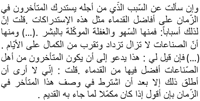 Muhammad ibn Zakariyā Rāzī, Kitāb al-Shukūk 'alā Jālīnūs, Mehdi Mohaghegh (ed. and trans.), (Kuala Lumpur: International Institute of Islamic Thought and Civilisation, 1993), 2–3, and ‘introduction’, 113.



