


Introduction
In food tables, values for digestible or bioavailable amino acids (AA) should be provided on an individual AA basis rather than as digestible protein values( 1 ). The digestible indispensable amino acid score (DIAAS) is recommended to replace the protein digestibility-corrected amino acid score (PDCAAS) for evaluating protein quality( 1 ). The DIAAS is defined as follows: DIAAS (%) = 100 × ((mg of digestible dietary indispensable AA in 1 g of the dietary protein)/(mg of the same dietary indispensable AA in 1 g of the reference protein))( 1 ). Because AA are absorbed only from the small intestine and because hindgut fermentation can affect AA metabolism, ileal digestibility is a more accurate estimate of AA bioavailability than total tract digestibility in both humans and growing pigs( Reference Stein, Seve and Fuller 2 ). The apparent ileal digestibility (AID) of AA is defined as the net disappearance of ingested dietary AA from the digestive tract proximal to the distal ileum. When AID is corrected for the basal endogenous loss in pigs, the resulting value is termed standardised ileal digestibility (SID), which can be used to calculate approximate DIAAS values in humans( 1 , Reference Stein, Seve and Fuller 2 ).
Cereal grains are the major source of energy in most diets consumed by humans, but cereal grains also contribute to the protein requirement of humans. In developed countries, protein contribution from cereal grains is not given substantial importance because of the availability of other sources of protein such as meat and legumes. Thus, crude protein (CP) intake in developed countries is often more than what is recommended( Reference Fulgoni 3 ). However, in underdeveloped or developing countries, cereal grains may be a major source of dietary protein, especially for children( Reference Bwibo and Neumann 4 ). Therefore, the concentrations of CP and AA and the measurement of DIAAS in cereal grains are important for the health and well-being of many children and adults in these countries.
Several cereal grains are available for human consumption, but in most cases, the concentrations of CP and AA in cereal grains are not sufficient to fulfil CP and AA requirements for proper growth and development. Therefore, there is a need to supplement diets with other sources of CP and AA. The pig has been recognised as a good model for estimating CP and AA digestibility in humans( 1 , Reference Rowan, Moughan and Wilson 5 , Reference Deglaire, Bos and Tomé 6 ). Therefore, the objective of the present study was to determine the AID and SID of AA in eight major cereal grains fed to growing pigs.
Materials and methods
The protocol for the experiment was reviewed and approved by the Institutional Animal Care and Use Committee at the University of Illinois. A total of twenty-four growing barrows (initial body weight: 30·7 (sd 3·2) kg) that were the offspring of G-performer boars mated to Fertilium twenty-five females (Génétiporc) were fitted with a T-cannula in the distal ileum as described by Stein et al. ( Reference Stein, Shipley and Easter 7 ). Pigs were allowed to recover after surgery for 10 d, and they were given ad libitum access to water and a maize–soyabean meal diet during the recovery period. Pigs were housed individually in metabolism cages in an environmentally controlled room. Each metabolism cage was equipped with a feeder and a nipple drinker. Pigs were randomly allotted to eight diets that were fed during each of three periods in a completely randomised design. During each period, each diet was fed to three pigs. Therefore, each diet was fed to a total of nine pigs during the experiment, and no pig was given the same diet more than once.
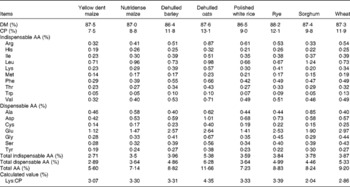
In the experiment, eight cereal grains including yellow dent maize, Nutridense maize, dehulled barley, dehulled oats, polished white rice, rye, sorghum and wheat were used (Table 1). Yellow dent maize and Nutridense maize were procured from ExSeed Genetics LLC. Polished white (Jasmine) rice was purchased from Walmart, and the remaining cereal grains were sourced from Siemer Enterprises, Inc. All grains were ground in a hammer mill using a 1·6 mm screen. A total of eight diets were formulated, and each cereal grain was the only source of CP and AA in each diet (Table 2). Vitamins and minerals were added to all diets to meet or exceed the current requirements for growing pigs, and all diets also contained 0·4 % titanium dioxide (Kronos Titanox) as an indigestible marker.
Determined crude protein (CP) and amino acid (AA) composition of yellow dent maize, Nutridense maize, dehulled barley, dehulled oats, rice, rye, sorghum and wheat (as-fed basis)
Ingredient composition (%) of the experimental diets (as-fed basis)

* The vitamin–micromineral premix provided the following quantities of vitamins and microminerals per kg of complete diet: vitamin A as retinyl acetate, 3·34 mg; vitamin D3 as cholecalciferol, 55·1 μg; vitamin E as dl-α-tocopheryl acetate, 59·4 mg; vitamin K as menadione nicotinamide bisulphite, 1·42 mg; thiamin as thiamin mononitrate, 0·24 mg; riboflavin, 6·58 mg; pyridoxine as pyridoxine hydrochloride, 0·24 mg; vitamin B12, 0·03 mg; d-pantothenic acid as d-calcium pantothenate, 23·5 mg; niacin as nicotinamide and nicotinic acid, 44 mg; folic acid, 1·58 mg; biotin, 0·44 mg; Cu as copper sulphate, 10 mg; Fe as iron sulphate, 125 mg; I as potassium iodate, 1·26 mg; Mn as manganese sulphate, 60 mg; Se as sodium selenite, 0·3 mg; Zn as zinc oxide, 100 mg.
The body weight of each pig was recorded at the start of each period, and the daily feed allotments were calculated as two times the estimated maintenance requirement for energy for each pig (i.e. 443·5 kJ metabolisable energy/kg0·75)( Reference Pedersen, Boersma and Stein 8 ). The daily feed allowance was supplied in two equal meals that were provided at 08.00 and 17.00 hours, except on digesta collection days, when pigs were fed at 06.00 and 18.00 hours. Water was available at all times. Each period lasted 14 d. Ileal digesta were collected on days 13 and 14 for 10 h as described by Pedersen et al. ( Reference Pedersen, Boersma and Stein 9 ).
At the conclusion of the experiment, ileal samples were thawed, mixed within animal and diets, and a subsample was collected for chemical analysis. Samples of each diet and of each cereal grain were also collected. Digesta samples were lyophilised and ground before chemical analysis. Cereal grains, diets and ileal digesta samples were analysed for DM (method 930.15)( 10 ), CP (method 990.03)( 10 ) and AA. AA analyses were carried out on the Hitachi Amino Acid Analyzer (model no. L8800; Hitachi High Technologies America, Inc.) using ninhydrin for post-column derivatisation and norleucine as the internal standard. Before analysis, samples were hydrolysed with 6 m-HCl for 24 h at 110°C (method 982.30 E (a))( 10 ). The concentrations of methionine and cysteine were determined as those of Met sulfone and cysteic acid after cold performic acid oxidation overnight before hydrolysis (method 982.30 E (b))( 10 ). The concentration of tryptophan was determined after NaOH hydrolysis for 22 h at 110°C (method 982.30 E (c))( 10 ). The concentration of Ti in the diets and ileal samples was analysed based on the procedure of Myers et al. ( Reference Myers, Ludden and Nayigihugu 11 ).
The AID of each AA in the cereal grains was calculated using equation 1 ( Reference Stein, Seve and Fuller 2 ):
 $$AID_{AA} = 1 - ((AA_{digesta}/AA_{feed})\times (Ti_{feed}/Ti_{digesta}))\times 100, $$
where AIDAA is the apparent ileal digestibility of AA (%), AAdigesta is the concentration of AA in the ileal digesta DM, AAfeed is the concentration of AA in the feed DM, Tifeed is the concentration of Ti in the feed DM and Tidigesta is the concentration of Ti in the ileal digesta DM.
Values for the basal endogenous loss of AA (ileal endogenous losses of AA; IELAA) used in the present experiment were the average values obtained from growing pigs fed N-free diets summarised from sixteen experiments conducted in our laboratory. The average endogenous loss value of AA obtained from our laboratory was close to previously reported values( Reference De Lange, Sauer and Mosenthin 12 – Reference Yin, Li and Huang 14 ).
The SID of each AA was calculated using equation 2 ( Reference Stein, Seve and Fuller 2 ):
 $$SID_{AA} = AID + (IEL_{AA}/AA_{feed}), $$
where SIDAA is the standardised ileal digestibility of AA. The SID of each AA was multiplied by the concentration of AA (DM basis) in the cereal grain to calculate the concentration of SID AA for each cereal grain. The digestible indispensable AA reference ratio for each indispensable AA was calculated using the following equation:
 $$\begin{eqnarray} Digestible\,indispensable\,AA\,reference\,ratio = (digestible\,indispensable\,AA\,content\,in\,1\hairsp g - protein\,of\,food\,(mg))/(mg\,of\,the\,same\,dietary\,indispensable\,AA\,in\,1\hairsp g\,of\,the\,reference\,protein). \end{eqnarray}$$
The AA scoring pattern from the reference protein was based on the Report of an FAO Expert Consultation( 1 ). The DIAAS was calculated using the following equation:
 $$\begin{eqnarray} DIAAS\,(\%) = 100\times lowest\,value\,of\,the\,digestible\,indispensable\,AA\,reference\,ratio. \end{eqnarray}$$
Statistical analyses
Data were tested for outliers and normal distribution using the UNIVARIATE procedure of SAS (SAS Institute, Inc.). Observations that were more than 3 standard deviations away from the treatment mean were considered outliers. Data of three pigs that did not produce sufficient quantities of ileal digesta were removed from the dataset. ANOVA was conducted using the MIXED procedure of SAS, with diet as the fixed effect and period as the random effect. Means were calculated using the LSMEANS statement of SAS, and the PDIFF option of SAS was used to separate treatment means. The pig was the experimental unit for all analyses, and an α value of 0·05 was used to denote statistical significance among treatment means.
Results
The concentrations of CP among the eight cereal grains ranged from 7·5 to 13·1 %, whereas concentrations of total AA among the eight cereal grains were between 5·60 (yellow dent maize) and 11·66 % (dehulled oats) (Table 1). Compared with other indispensable AA, all cereal grains contained relatively high amounts of leucine and low amounts of tryptophan. Dehulled oats contained 0·57 % of lysine, 0·23 % of methionine, 0·43 % of threonine and 5·38 % of total indispensable AA, whereas the other cereal grains contained between 3 and 4 % of total indispensable AA, except yellow dent maize, which contained only 2·71 % of total indispensable AA.
The AID of CP in dehulled barley, rye and wheat was greater (P< 0·05) than that in yellow dent maize, Nutridense maize and sorghum, but less (P< 0·05) than in rice and dehulled oats (Table 3). The mean AID of indispensable AA was greater in rice (P< 0·05) than in all other cereal grains, except in dehulled oats. The AID of most AA in dehulled oats was not different from that in rice, except that the AID of leucine, methionine, phenylalanine, tryptophan and valine in dehulled oats was less (P< 0·05) than in rice.
Apparent ileal digestibility of crude protein (CP) and amino acids (AA) in yellow dent maize, Nutridense maize, dehulled barley, dehulled oats, rice, rye, sorghum and wheat* (Least-square mean values and pooled standard errors)
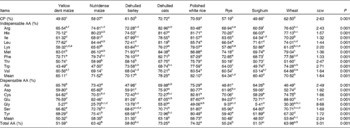
a,b,c,d,e,fMean values within a row with unlike superscript letters were significantly different (P< 0·05). * Data are least squares means of nine observations per treatment except for dehulled barley, dehulled oats, rice and wheat that have eight observations per treatment.
The mean AID of indispensable AA in Nutridense maize was not different from dehulled barley and wheat, but the AID of histidine, leucine, methionine and phenylalanine was greater (P< 0·05) in Nutridense maize than in dehulled barley, and the AID of methionine, threonine and valine was greater (P< 0·05) in Nutridense maize than in wheat. However, the AID of tryptophan was greater (P< 0·05) in wheat and dehulled barley than in Nutridense maize. The mean AID of indispensable AA and the AID of all indispensable AA, except methionine and tryptophan, in yellow dent maize was less (P< 0·05) than in Nutridense maize. The AID of histidine, leucine and methionine in rye was less (P< 0·05) than in yellow dent maize, but the AID of all other indispensable AA and the mean AID of indispensable AA in rye were not different from values obtained for yellow dent maize. The mean AID of indispensable AA in sorghum was lowest (P< 0·05) among the values obtained for all cereal grains, and the AID of all indispensable AA, except isoleucine, leucine, threonine, tryptophan and valine, was lowest (P< 0·05) in sorghum. The mean AID of dispensable AA in rice was greater (P< 0·05) than in all the other cereal grains. For most of the dispensable AA, differences among the cereal grains followed the patterns observed for indispensable AA. The mean AID of all AA in rice was greater (P< 0·05) than in all the other cereal grains, except dehulled oats, whereas the mean AID of all AA in yellow dent maize and sorghum was lowest among the values obtained for all cereal grains (P< 0·05).
The SID of CP in yellow dent maize, Nutridense maize, dehulled barley, rye and wheat was greater (P< 0·05) than in sorghum, but less (P< 0·05) than in dehulled oats and rice (Table 4). The SID of all indispensable AA in rice was greater (P< 0·05) than in all the other cereals, with the exception that the SID of arginine in rice was not different from that in Nutridense maize, dehulled oats and wheat, the SID of histidine in rice was not different from that in Nutridense maize and dehulled oats, and the SID of methionine in rice was not different from that in Nutridense maize. With a few exceptions, the SID of dispensable AA in rice was also greater (P< 0·05) than in the other cereal grains. Similarly, the mean SID of all indispensable AA was greater (P< 0·05) in rice than in the other cereal grains.
Standardised ileal digestibility (SID) of crude protein (CP) and amino acids (AA) in yellow dent maize, Nutridense maize, dehulled barley, dehulled oats, rice, rye, sorghum and wheat* † (Least-square mean values and pooled standard errors)
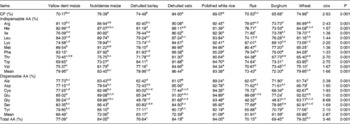
a,b,c,d,e,f,gMean values within a row with unlike superscript letters were significantly different (P< 0·05).
* SID values were calculated by correcting the values for apparent ileal digestibility for the basal endogenous losses. Values used for the basal endogenous losses were as follows (g/kg of DM intake): CP, 17·38; Arg, 0·59; His, 0·19; Ile, 0·37; Leu, 0·57; Lys, 0·43; Met, 0·12; Phe, 0·36; Thr, 0·57; Trp, 0·12; Val, 0·54; Ala, 0·66; Asp, 0·87; Cys, 0·20; Glu, 1·12; Gly, 1·64; Ser, 0·57; Tyr, 0·29.
† Data are least squares means of nine observations per treatment except for dehulled barley, dehulled oats, rice and wheat that have eight observations per treatment.
The SID of most indispensable AA in dehulled oats was less (P< 0·05) than in rice and not different from that in Nutridense maize, but greater (P< 0·05) than in the other grains. The SID of most AA in Nutridense maize was greater (P< 0·05) than in dehulled barley, wheat, yellow dent maize, rye and sorghum. The SID of most indispensable AA in yellow dent maize was not different from that in dehulled barley, except that the SID of leucine and methionine was greater (P< 0·05) in yellow dent maize than in dehulled barley, and the SID of tryptophan in yellow dent maize was less (P< 0·05) than in dehulled barley. There was no difference in the SID of indispensable AA between dehulled barley and wheat, except that the SID of methionine was greater (P< 0·05) in wheat than in dehulled barley, and no differences were observed in the SID of indispensable AA between sorghum and rye, except that the SID of phenylalanine was greater (P< 0·05) in rye than in sorghum. However, the SID of most indispensable AA in sorghum and rye was less (P< 0·05) than in the other cereal grains. Sorghum and rye also had the least (P< 0·05) mean SID of the indispensable AA and mean SID of the dispensable AA among all cereal grains.
The concentrations of SID CP in dehulled barley and wheat were less (P< 0·05) than in dehulled oats, but greater (P< 0·05) than in the other cereal grains, and the concentrations of SID CP in Nutridense maize and sorghum were greater (P< 0·05) than in yellow dent maize, but less (P< 0·05) than in the other cereal grains (Table 5). The concentrations of all SID indispensable AA, all dispensable AA and all AA in dehulled oats were greater (P< 0·05) than in the other cereal grains, and the concentrations of all SID indispensable AA in rye were less (P< 0·05) than in dehulled barley and wheat and greater (P< 0·05) than in yellow dent maize, but not different from those in Nutridense maize and sorghum. The concentrations of total SID indispensable AA in Nutridense maize were also greater (P< 0·05) than in sorghum. The concentrations of SID arginine, histidine, isoleucine, lysine, phenylalanine, threonine and valine in dehulled oats were greater (P< 0·05) than in the other cereal grains, and the concentration of SID methionine was greater (P< 0·05) in dehulled oats and rice than in all other cereal grains. However, sorghum had the greatest (P< 0·05) concentration of SID leucine, and sorghum and wheat contained more (P< 0·05) SID tryptophan than the other cereal grains. Yellow dent maize had the lowest (P< 0·05) concentrations of most SID indispensable AA. The concentrations of all SID dispensable AA and all SID AA in yellow dent maize were also lowest (P< 0·05) among the values obtained for all cereal grains. The DIAAS was 48 for yellow dent maize, 54 for Nutridense maize, 51 for dehulled barley, 77 for dehulled oats, 64 for polished rice, 47 for rye, 29 for sorghum and 43 for wheat (Table 6).
Concentrations (g/kg DM) of standardised ileal digestible crude protein (CP) and amino acids (AA) in yellow dent maize, Nutridense maize, dehulled barley, dehulled oats, rice, rye, sorghum and wheat* (Least-square mean values and pooled standard errors)

a,b,c,d,e,f,gMean values within a row with unlike superscript letters were significantly different (P< 0·05). * Data are least squares means of nine observations per treatment except for dehulled barley, dehulled oats, rice and wheat that have eight observations per treatment.
Digestible indispensable amino acid scores (DIAAS)* for yellow dent maize, Nutridense maize, dehulled barley, dehulled oats, rice, rye, sorghum and wheat

DIAA, digestible indispensable amino acids.
* DIAAS were calculated for older child, adolescent and adult. The indispensable amino acid reference patterns are expressed as mg amino acid/kg protein: His, 16; Ile, 30; Leu, 61; Lys, 48; sulphur amino acids, 23; aromatic amino acids, 41; Thr, 25; Trp, 6·6; Val, 40(1).
Discussion
Cereal grains are grown in large quantities around the world and are responsible for a large proportion of daily intake of energy and protein. This is especially true for rice, wheat and maize, which are responsible for approximately 60 % of the world's food energy intake( 15 ). Rice is a staple food for 1·6 billion people around the world, particularly in Asia, Latin America and parts of Africa, whereas wheat is mostly consumed in central Asia, the Middle East and Africa, and maize is used as a staple food in South America, Central American, Mexico and parts of Africa. Barley, oats and rye are also among the domesticated grains in the world, and they are important staple foods in Europe and Russia( 15 ). For millions of people in the semi-arid tropics of Asia and Africa, sorghum is an important staple food because other grains grow poorly in these regions due to low rainfall or soil salinity( Reference Doggett, Prasada Rao, Smartt and Simmonds 16 ). Therefore, determination of protein quality in cereal grains provides important information on how these grains contribute to a sustainable diet.
The PDCAAS calculated using protein digestibility has been recommended to be used for protein quality evaluation, with the intention of assessing the capacity of foods or diets to meet the protein and essential amino–N requirements( 1 ). However, the PDCAAS method does not adequately take into account the different digestibility of individual AA and does not consider the influence of anti-nutritional factors( Reference Millard, Layman and Tomé 17 – Reference Jonker, Engelen and Deutz 19 ). Therefore, the new DIAAS system is recommended to replace PDCAAS for protein quality evaluation( 1 ). The main differences between PDCAAS and DIAAS systems are that the PDCAAS are truncated and the ileal digestibility value of each AA is used in the DIAAS system, whereas a single faecal CP digestibility value is used in the PDCAAS system( 1 ). For DIAAS calculation, the use of true ileal digestibility or SID value of each AA still awaits official sanctioning from the FAO. The ileal digestibility values of each AA determined in humans are preferred, but if such values are not available, values determined in growing pigs can be used to estimate approximate DIAAS( Reference Stein, Seve and Fuller 2 , Reference Hendriks, van Baal and Bosch 20 ). A number of experiments have been conducted to compare AA digestibility in growing pigs and in human subjects( Reference Rowan, Moughan and Wilson 5 , Reference Deglaire, Bos and Tomé 6 ), and the results of most of these experiments have indicated that pigs are relatively good models for humans. It is, therefore, believed that values for AA digestibility obtained in pigs are also close representatives of values in humans. The SID values of AA obtained in growing castrated male pigs are similar to those in adult female pigs( Reference Stein, Kim and Nielsen 21 ). In the present study, we assumed that values obtained for castrated male pigs are close representatives of SID values of AA in all groups of humans, but future work should be directed at confirming this hypothesis. A consensus method for determining true ileal digestibility or SID in human nutrition has not been agreed upon; therefore, the DIAAS values calculated using the present data are only approximations to DIAAS.
The concentrations of AA in the cereal grains used in the present experiment are within the range of published values( Reference Pedersen, Boersma and Stein 9 , 22 ). AA in cereal grains are mainly stored in the starchy endosperm of the grains in the form of prolamins and legumins( Reference Shewry 23 ). Prolamins are the major storage proteins in maize, sorghum, rye, barley, wheat and most cereal grains( Reference Vasal 24 ). However, unlike in most cereals, prolamins are the minor storage proteins in oats and rice, where most AA are stored in legumins( Reference Shewry 23 , Reference Vasal 24 ). Legumins contain more lysine than prolamins( Reference Shewry 23 ), but in the present experiment, a greater concentration of lysine per unit of CP was observed in dehulled oats, but not in rice, compared with the other cereal grains. However, the AID and SID of AA in rice and dehulled oats were superior to those in the other cereal grains, which indicates that AA in legumins are more digestible than AA in prolamins.
The AID values obtained for all cereal grains except Nutridense maize and rice were less than the values reported by the NRC( 22 ), but close to those for most AA reported from other experiments for barley, wheat, yellow dent maize( Reference Sauer and Ozimek 25 – Reference Li, Yuan and Piao 28 ), rice( Reference Li, Yuan and Piao 28 ), oats( Reference Sauvant, Perez and Tran 29 , Reference Nyachoti, Rigaux and Woyengo 30 ) and sorghum( Reference Pedersen, Boersma and Stein 9 , Reference Mariscal-Landin, Avellaneda and Reis de Souza 31 ). Variation in AID values may be a result of the differences in cereal variety, the growing conditions of the grains( Reference Fuller, Cadenhead and Brown 26 ) and the presence of anti-nutritional factors in the grains( Reference Mariscal-Landin, Avellaneda and Reis de Souza 31 ). The low concentration of each AA in cereal grains may misrepresent the AID of the AA in cereal grains because of the relatively greater contribution of AA of endogenous origin to the ileal output of AA in feed ingredients with a low concentration of AA( Reference Stein, Seve and Fuller 2 ). Therefore, for better protein evaluation, the SID values of AA are calculated to remove the influence of basal endogenous losses of AA on the determined digestibility values( Reference Stein, Seve and Fuller 2 ). The SID values of most indispensable AA obtained in the present experiment were in agreement with those reported for yellow dent maize and Nutridense maize( Reference Pedersen, Boersma and Stein 9 , Reference Stein, Pedersen and Wirt 32 ) and for sorghum( Reference Mariscal-Landin, Avellaneda and Reis de Souza 31 , Reference Rostagno, Albino and Donzele 33 ), barley( Reference Sauvant, Perez and Tran 29 , Reference Fernández-Fígares, García and Ruiz 34 ), wheat( Reference Stein 35 ), rye and oats( 22 , Reference Sauvant, Perez and Tran 29 ), and rice( Reference Yin, Li and Huang 14 ).
Ranking of the cereal grains used in the present experiment based on the mean SID of the indispensable AA led to rice being ranked first followed by dehulled oats and Nutridense maize. Wheat was ranked fourth followed by dehulled barley and yellow dent maize with rye and sorghum being ranked last. However, because the concentration of AA differs among the cereal grains, the concentration of SID AA was calculated. The SIDAA represents the amount of AA in the cereal grain that is assumed to be available for protein synthesis after absorption from the intestinal tract. Dehulled oats contribute more digestible AA per kg DM than any of the other cereal grains with rice ranking second. Wheat and dehulled barley ranked third and fourth in terms of their contribution of total indispensable SID AA, followed by Nutridense maize and rye, sorghum, and yellow dent maize. The low contribution of indispensable SID AA from rye, sorghum and yellow dent maize indicates that greater protein and AA supplementation is needed when these grains are used than when dehulled oats, rice, wheat, dehulled barley or Nutridense maize is being used. The results of the present study, therefore, support the observation made by Bwibo & Neumann( Reference Bwibo and Neumann 4 ) on the need for protein supplementation of diets where sorghum is the major source of energy and protein. The potential for using Nutridense maize for human nutrition has not been explored, but the results of the present experiment support those of other experiments, indicating that Nutridense maize contributes more digestible AA than yellow dent maize( Reference Pedersen, Boersma and Stein 9 ).
Based on the cut-off value for DIAAS from the Report of an FAO Expert Consultation( 1 ), only dehulled oats are considered a good protein source for human consumption because their DIAAS is 77. However, cereal grains and grain co-products for human consumption are usually cooked or processed before being consumed. It is possible that processing may change protein digestibility, but further work is needed to estimate the effects of food preparation or processing on protein quality.
In conclusion, the SID of most AA in rice was greater than in all the other cereal grains, but the concentration of SID AA was greater in dehulled oats than in the other cereal grains. The SID of AA and the concentration of indispensable SID AA in yellow maize, rye and sorghum were lowest among the values obtained for the cereal grains. The results of the experiment indicate that to meet dietary digestible AA requirements, diets based on yellow dent maize, rye and sorghum require more AA supplementation than those based on rice, dehulled oats, dehulled barley, Nutridense maize and wheat.
Acknowledgements
The authors are grateful to BASF Plant Science LLS, Florham Park, NJ, USA, for providing financial support for the present study. BASF Plant Science LLS had no role in the design and analysis of the study or in the writing of this article.
The contributions of the authors are as follows: S. K. C.-P. conducted the pig experiment, carried out the calculations and statistical analyses and wrote most of the manuscript; Y. L. provided valuable inputs for writing the manuscript; H. H. S. supervised the experiment, the data analysis and the writing of the manuscript.
The authors declare no conflicts of interest.



