




1. Introduction
While there has been considerable discussion on the resultative and stative natures of prenominal passive participles (henceforth, participles) in English, less attention has been paid to their eventive nature. Especially how their eventive nature developed from their resultative and stative natures, which is my primary concern in this article, has not been explicated in the literature.
The most effective diagnostic feature of the eventive nature of prenominal participles is that they can be freely modified by certain groups of adverbs. The first group may include temporal adverbs, such as previously, then and once, which normally reject the modification of currently holding result states.Footnote 1


The second group includes adverbs of frequency, such as frequently and often, which normally contribute to composing habitual states but do not modify result states.


The third group includes adverbs of manner such as quickly and noisily, which modify only events and are therefore out in the perfect of result.Footnote 3


The temporal adverb recently is good in the perfect of result, but when it co-occurs with a prenominal participle, it can modify either a result state or a prior event (Sleeman Reference Sleeman2011).Footnote 4 When a prenominal participle is resultative, it should be able to appear after copulas such as remain, seem, look and appear, which normally select state-denoting predicates, as indicated by the following data.

However, unlike carefully opened, which is resultative, recently opened fails to occur after such copulas. As Sleeman (Reference Sleeman2011) notes, this is because recently opened is eventive rather than resultative.

The eventive nature of prenominal participles is further indicated by the following data. Atelic verbs, such as talk about, pay, take, shout, whisper and look after, do not lexically encode a result meaning; therefore, their participles are neither resultatives nor statives but are good in the prenominal position.


However, Old English (OE) did not have eventive participles as prenominal modifiers, which became available in Early Middle English (EME) onwards. The following sections provide detailed discussion on this, with a focus on a formal analysis of the diachrony of the participles. Section 2 clarifies the interpretations and structural characteristics of prenominal resultative participles (section 2.1) and eventive participles (section 2.2). It is argued that the inner aspect head is the locus of stative resultativity and the outer aspect head is the locus of perfect resultativity and various current-relevance properties. Section 3, after presenting three lines of reasoning to show that OE prenominal participles were stative resultatives (section 3.1), elaborates on how the locus shift in resultativity took place in ME (section 3.2) and how it gave rise to the emergence of eventive participles (section 3.3). It is shown that the shift was triggered by the loss of aspectual prefixes and opened the possibility for more dynamic meanings to be expressed by prenominal participles. Section 4 clarifies that the perfect resultative nature developed in participles in the have periphrasis in addition to prenominal participles, thereby demonstrating that the rise of the perfect resultative sense as well as the eventive sense is closely related to aspectual changes the participle underwent on its own. Section 5 concludes this article.
2. Interpretation and structure of prenominal participles
2.1. Resultative participles
A given participle, resultative or eventive, can always find a corresponding full clause with respect to its tense–aspect interpretation. For resultatives, there are two types of clause, becop done and have done. For example, the broken car can have either stative or perfect resultative interpretations because it finds canonical structures corresponding to these interpretations. Note that in (14b), be is the copula be, which normally selects adjectives and nouns, rather than the passive auxiliary, and (14c) exemplifies the have done structure with a perfect-of-result meaning, not with an experiential or universal perfect meaning.

To give a straightforward description in an informal style, for stative resultatives, the result state is foregrounded and the action has faded into the background, and vice versa for perfect resultatives. Put it another way, stative resultatives ‘express a state implying a previous event (action or process) it has resulted from’ (Nedjalkov Reference Nedjalkov, Haspelmath, König, Oesterreicher and Raible2001: 28), and perfect resultatives denote ‘a past action with current relevance’ (Bybee et al. Reference Bybee, Perkins and Pagliuca1994: 61).

Given that stative resultatives are lexically restricted (Bybee et al. Reference Bybee, Perkins and Pagliuca1994: 66–7; Nedjalkov Reference Nedjalkov, Haspelmath, König, Oesterreicher and Raible2001: 930), requiring that the verb encode a result state or affect its (logical) object, it can be argued that stative resultativity is the inner aspectual property of the verb. In contrast, perfect resultatives do not have constraints on the lexical type of the base verb; both change-of-state (COS) and non-COS verbs can serve as input to perfect resultatives, for example, the broken car and already massaged patients. This implies that perfect resultativity is an outer aspectual property. This leads to the conjecture that the loci of the two types of resultativity are aspectual heads, Inner Asp and Outer Asp,Footnote 5 respectively, which are located below and above the verbalizing head v, respectively, as shown below.Footnote 6


A notable difference between these two structures is that in (16), OutAsp is inert with respect to resultativity in that the event associated with the result state is at best implied by the participle but not denoted by it, which is not true of OutAsp in (17).Footnote 7 From this it follows that resultativity arises in InAsp, not OutAsP, in (16) and that stative resultatives are derived adjectives, as opposed to simple adjectives. As such, OutAspP in (16) is selected by the auxiliary be, not have. By contrast, resultativity arises in OutAsp in (17). Alternatively speaking, OutAsp is the locus of resultativity in (17). That is, when interpreted as perfect resultatives, participles are verbs that may be selected by the perfect auxiliary have (in a clause-level context). In this case, OutAsp is also the locus of the temporal-aspectual properties of the participle. Tense is instantiated and morphologically realized when OutAspP is selected by have, while it remains unrealized in prenominal position, without an overt tense marker.
2.2. Eventive participles
According to their temporal-aspectual properties, eventives can be divided into three types. In the following sentences, the event does not necessarily entail a result state holding at the speech time, constituting an experience for the entity denoted by the object. The perfect in such cases is thus characterized as ‘experiential perfect’.


Importantly, the temporal-aspectual interpretations of the participles in the following list correspond to those of the canonical experiential perfects listed above.Footnote 8 Let us call such participles ‘experiential eventives’.


There are participles that qualify neither as resultatives nor as experiential eventives. Instead, they correspond to canonical, simple past passives with respect to their temporal-aspectual properties. Let us call such participles ‘simple-past eventives’.
For example, buy denotes a buying event that is not repetitive with respect to a single entity; it is not appropriate to say that you bought a house many times. Thus, an experiential eventive reading is excluded in (23).Footnote 10 A resultative reading is also excluded in that bought, with or without newly, is completely out in the post-auxiliary position.Footnote 11

Thus, bought in (23) is interpreted as instantiating the simple past, just as in (24), in which the prenominal participles and their canonical counterparts are both simple-past tensed.


For example, without adverbial modification, consider shouted and whispered in (12)–(13), repeated below as (26)–(27). They are not resultatives given that they are out in any post-auxiliary position.


Shouted and whispered in such cases do not instantiate repeatability and do not evaluate the extended-now property, indicating that they do not qualify as experiential eventives either.
The third type is habitual eventive. For habitual eventives, the participle denotes an event-set with the time at which an event occurs, which is left unspecific.Footnote 12 By ‘unspecific’, I mean that the event time is specified neither as past nor as present and nor as future. The unrealized tense is understood as present, subsuming future, by default. But when there is a clear indicator, it can also be past. This situation corresponds to the canonical habitual sentences described below:


As indicated by the adverbs of frequency, the participles, namely, asked and cited, in the following sentences denote events that last (or lasted or have lasted) for an extended period of time or take place (took place or have taken place) repeatedly; they do not denote result states that currently hold or previously held.


Regarding the formation of eventives, the following structure, which is essentially the same as that of perfect resultatives, is assumed.

However, for eventives, OutAsp does not take care of a result state. It instead functions to connect the eventuality to a situation holding at the evaluation time. OutAsp is thus the locus of the extended-now property in the case of experiential eventives. Note that the extended-now property is what connects a past event with a present situation.
In the case of simple-past eventives, OutAsp is the locus of past-shifting that arises with the event denoted by the participle. Consider (13), repeated below as (34).

Looked after here is a simple-past eventive rather than an experiential eventive.Footnote 13 A looked after child is one who is uninterruptedly looked after in the past 24 hours, but not one who has a past experience of being looked after for 24 hours. Note that the perfect has been in the care of their local authority for more than 24 hours instantiates a universal perfect rather than an experiential one. Specifically, looked after denotes an event, durative or not, that is located in the past with respect to the evaluation time,Footnote 14 and there is no interval between the ending point of the event (looking after for 24 hours) and the beginning of the child’s being characterized as ‘looked after’; the ending and beginning points overlap in some sense. Put differently, the child’s becoming a looked after child uninterruptedly follows the preceding event’s ending. Looked after is thus used to characterize a child to whom a looking-after event happened, with the emphasis simply on the pastness of the event but not on the continuative, universal property of it. What is evaluated at the evaluation time is (the pastness of) the event but not its continuative property.
For another example, when a photo was recently taken, the event serves to characterize the photo, hence ‘a recently taken photo’. Thus, ‘recently taken’ is a situation of the photo holding at the evaluation time. This is how a past event is connected to a present situation. We could speak of this property as a past-shifting property. That is, there is a shift from a past event to a present situation. As is the case with the extended-now property, the past-shifting property is essentially a temporal-aspectual but not a lexical semantic property. This said, this property arises in a domain above vP.
Hallmann (Reference Hallmann, Grohmann, Matsuya and Remberger2021) states that past-to-present shifting is a characteristic of resultatives and is restricted to cases in which the base verb is eventive per se. For example, while a repaired motorcycle denotes (‘implies’ in his word) a past repairing event, a well-known problem does not denote (‘imply’ in his word) a past knowing state. Hallmann (Reference Hallmann, Grohmann, Matsuya and Remberger2021) is not concerned with the past-shifting property of eventives, however. But it is not difficult to see that past-shifting occurs exactly in the looked after and recently taken examples, which exemplify the simple-past eventive.
A short note is in order here. Past-shifting does not necessarily involve the speech time, although the speech time is often the evaluation time by default (Hatav Reference Hatav2012: 612). It can also involve a past time if the evaluation of the situation is located prior to the speech time. This means that past-shifting may be specified as past-to-evaluation-time shifting, with the evaluation time being either present or past. Note that a past-to-present situation will become a past situation over time. However, the participle is used to describe an entity whose situation is located at the evaluation time or within a time interval containing the evaluation time. Notably, the evaluation time is present in the looked-after example and past in the shouted and whispered examples.
For habituals, OutAsp is the locus of the habitual aspectual property, which is state-related in the sense that it represents a series of individual events that, as a whole, make up a state stretching back into the past and forward into the future (Leech Reference Leech1971: 5). Scopally, an individual event or a set of individual events are embedded by a habitual situation. Thus, vP and InAspP do not concern a habitual situation but OutAspP does.
Summarizing the above discussion, it is clear that for eventives, OutAsp is a head that takes care of a particular evaluation-time relevant property of the situation denoted by the participle. Broadly speaking, this property is simply current-relevance.Footnote 15 It may be an extended-now property, a past-shifting property, or a habitual aspectual property.
3. From resultatives to eventives
Ritz (Reference Ritz2012: 884) summarizes from Bybee et al. (Reference Bybee, Perkins and Pagliuca1994), Dahl & Hedin (Reference Dahl, Hedin and Dahl2000) and Nicolle (Reference Nicolle2012) that ‘Perfects often take their origins in resultative constructions, with a shift of meaning from current result to current relevance. This shift is characterized by an expansion in the types of verbs used, from exclusively telic verbs in resultative constructions, to both telic and atelic verbs in perfect constructions.’ Lindstedt notes that the resultative usually changes into the perfect (Reference Lindstedt2000: 368), which in turn undergoes a gradual transition from the aspectual to the temporal domain (Reference Lindstedt2000: 369), and historically the experiential meaning derives from the current-relevance meaning of the perfect (Reference Lindstedt2000: 370). In what follows, it is shown that adjectival participles in English followed a similar course of development, given the parallelism of temporal-aspectual properties between prenominal participles and post-auxiliary participles.
3.1. Prenominal participles as stative resultatives in OE
While participles in the post-auxiliary position have been widely discussed, those in the prenominal position have received less attention. In this subsection, it is explicated that prenominal participles are stative resultatives in OE and provide three reasons for this claim as follows:Footnote 16 (i) the obligatoriness of the aspectual prefix, (ii) restriction on adverbial modification and (iii) the relationship between inflections and word order.
It is well documented that past participles in OE are often marked with certain prefixes expressing the perfective aspect (cf. Brinton Reference Brinton1988: 202ff.; Elenbaas Reference Elenbaas2007: ch. 4; McFadden Reference McFadden2015, Reference McFadden2023, etc.), which are listed below.

Elenbaas (Reference Elenbaas2007: 114) states that ‘OE prefixes have a range of meanings, but at the core, they share common semantics. The meanings of the prefixes are invariably abstract, and the prefixes typically denote an end state and express the total affectedness of the object.’ She also states that the core denotation of the prefixes is a COS meaning (Reference Elenbaas2007: 118). Some of them, such as be-, for-, ge- and ut-, have transitivizing effects, he notes (Reference Elenbaas2007: 116–18, 158).
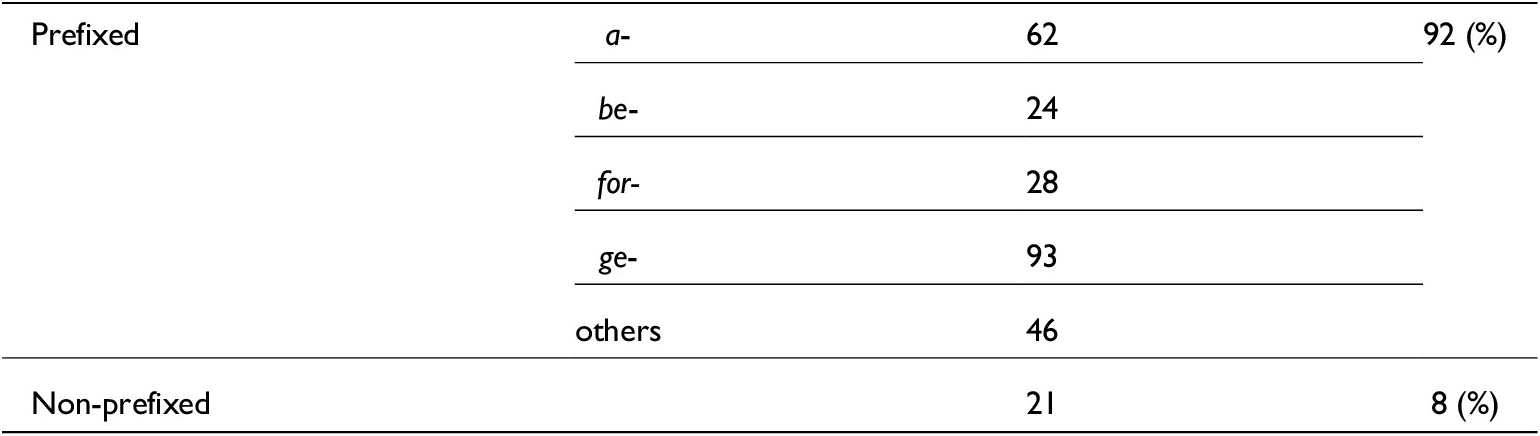
Importantly, most of prenominal participles in OE (94%), according to corpus investigation, were marked with these prefixes in (35), among which, a-, be-, for- and ge- were the most frequently used, as shown in table 1.
Distribution of prefixes of prenominal participles in OEFootnote 17

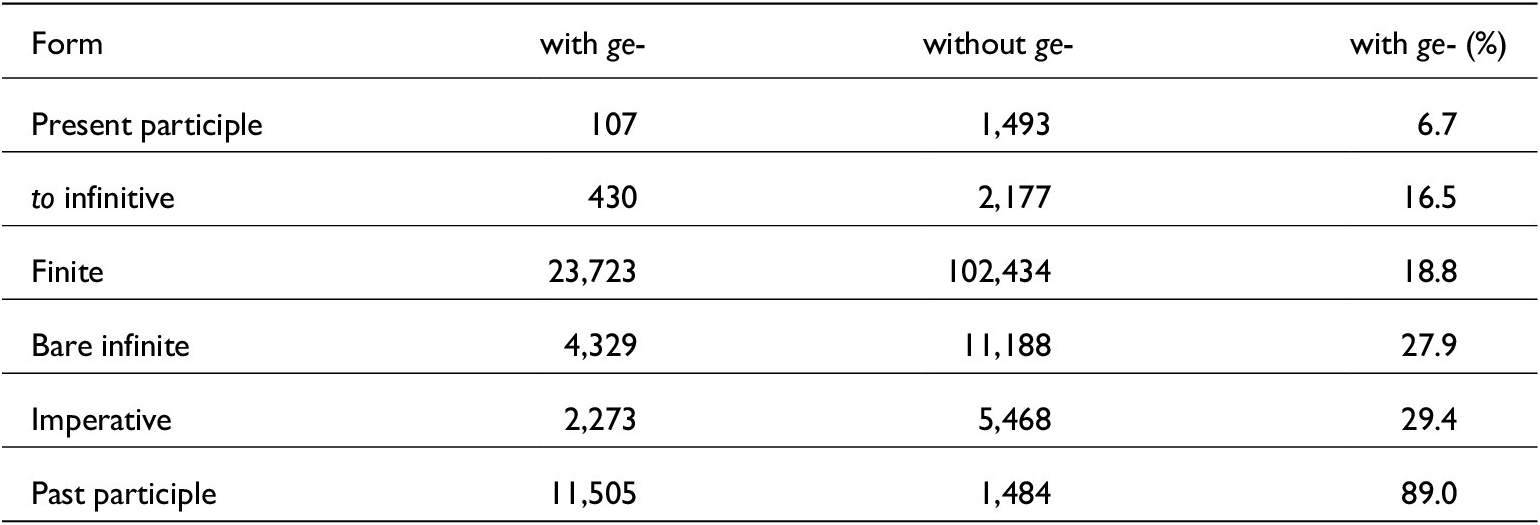
This suffices to show that to be marked with a prefix is a condition for a verb to derive a participle as a prenominal modifier in OE. As shown in the table, the prefix ge- is most frequently used. The same holds true for participles in post-auxiliary position. McFadden (Reference McFadden2015) observes that ge- can appear on any form of the verb, but it was most frequent with past participles (89%), as shown in table 2.
Distribution of ge-participles, according to verb type (McFadden Reference McFadden2015: 22)

Moreover, the frequency of the prefix increases (99% and 97%) when the participle is used with an auxiliary, as shown in table 3.
Distribution of ge-participles, according to auxiliary (adapted from McFadden Reference McFadden2015: 38)

The data in tables 2 and 3 imply that participles with ge- in clauses indeed expressed stative result (his ‘resultative’ as opposed to his ‘perfect’) states, as concluded by McFadden (Reference McFadden2015: 38). Considering the data in table 1 in parallel with this, it is reasonable to conclude that prenominal participles express stative result states in OE. It is suggested here that as far as post-auxiliary participles are stative resultatives, the corresponding prenominal participles are hardly perfect resultatives in principle, in the sense that eventive interpretations are more restricted in prenominal attributive positions than in post-auxiliary positions. Recall that stative resultatives point to the result state while perfect resultatives point to the action itself (cf. Bybee et al. Reference Bybee, Perkins and Pagliuca1994: 64 and §2.1).
Another fact that supports the claim that prenominal participles are stative resultatives in OE is that no prenominal participles were attested on adverbs that are often used to modify events, but not result states, according to my corpus investigation.

Adverbs modifying prenominal participles were mostly degree adverbs or intensifiers (cf. Visser Reference Visser1963–Reference Visser73: 1232). Note that degree adverbs and intensifiers generally have nothing to do with events but with states.

Visser (Reference Visser1963–Reference Visser73: 1235–6) presents a list of prenominal participles modified by a preceding -ly adverb. Among the examples, most of which seem to be manner adverbs, the earliest one was attested around 1400: … with grynly grownden gare ‘a grimly grown gore’. Visser (Reference Visser1963–Reference Visser73: 1233–4) also presents a list of the our dear bought victory type of prenominal participles, where the word preceding the participle is also an adverb. Importantly, however, the earliest example in Visser’s list was attested in c.1205: hæheste iborne mon ‘highest-born man’.
All these facts concerning adverbial modification put us in a position to argue that prenominal participles, lacking the perfect resultative sense, expressed stative result states in OE, and this is why adverbial modification was restricted for them to a certain extent.
Another fact supports the claim that prenominal participles are stative resultatives in OE. Mitchell (Reference Mitchell1985: §710) writes, ‘Caro (Reference Caro1896: 404–6) … gives figures which confirm the reasonable expectation that the object-participle order produces a higher percentage of inflected forms (twenty-seven per cent) than the participle-object order (fifteen per cent).’ Although it has been observed that inflected and uninflected participles can coexist in the same clause (Mitchell Reference Mitchell1985: §711; Traugott Reference Traugott1992: 191), the difference in frequency between inflected and uninflected participles with respect to word order itself suffices to indicate that there must have been a certain relationship between inflection and the function and meaning of the participle.Footnote 18 This can be illustrated as in (38) and (39).


The data in the present investigation, which were obtained from The York–Toronto–Helsinki Parsed Corpus of Old English Prose (YCOE) (Taylor et al. Reference Taylor, Warner, Pintzuk and Beths2003) and The Penn–Helsinki Parsed Corpus of Middle English, second edition (PPCME2) (Kroch & Taylor Reference Kroch and Taylor2000), as summarized in table 3, more clearly show the relationship between the presence/absence of inflections in the participle and word order.Footnote 19 As shown in table 4, clauses with the have-object-participle order and those with the have-participle-object order both existed in OE, while only the latter did in Middle English (ME). Importantly, as shown in table 5, participles were inflected only in clauses with the have-object-participle order in OE.
Distribution of the have periphrasis in OE and MEFootnote 21

Distribution of inflected participles in the have periphrasis in OE

An OE example of an inflected participle with the have-object-participle order is given in (40), an OE example of an uninflected participle with reverse order is given in (41), and an ME example with the have-participle-object order is given in (42). Notably, the examples in (41) and (42), with the uninflected participles, already have a Present-Day English (PDE) order. In contrast, the example in (40) shows that the participle, following the object and being inflected, expresses a stative result state and can be categorized as an adjective in the traditional sense.Footnote 20


Elsness (Reference Elsness1997: 261) notes that inflected participles are found more in the be periphrasis than in the have periphrasis. This is consistent with the data in table 5 in that only the be periphrasis and the have periphrasis with the have-object-participle order allow stative resultative readings. Because the participle therein is interpreted as stative, they are more adjective-like than those in the have periphrasis with the have-participle-object order, in which the participle has a stronger verbal sense.
It then follows that the inflections of the participles must have been related to their stative resultative meaning, which is a stance taken by many authors, including Mitchell (Reference Mitchell1985: §711), Traugott (Reference Traugott1992: 191) and Denison (Reference Denison1993: 341), as opposed to Brinton (Reference Brinton, Stein and van Ostade1994: 140) and Wischer (Reference Wischer, Kay, Hough and Wotherspoon2004: 249).
Given these three lines of reasoning, that is, each concerning (i) the obligatoriness of aspectual prefix, (ii) restriction on adverbial modification and (iii) the relationship between inflections and word order, it can now be concluded that prenominal participles in OE are indeed stative resultatives. In the following subsections, it is shown that prenominal and post-auxiliary participles ceased being restricted to stative resultatives and developed a perfect resultative sense after OE.
3.2. The shift of resultativity locus led to perfect resultativity
As has been well documented in studies including Jespersen (Reference Jespersen1931: 29–31), Visser (Reference Visser1963–Reference Visser73: 2043–4, 2189ff.), Traugott (Reference Traugott1972: 144–6; Reference Traugott1992: 191–3), Mitchell (Reference Mitchell1985: §728–33), Brinton (Reference Brinton1988: 99–102), Parsons (Reference Parsons1990: 242–5), Bybee et al. (Reference Bybee, Perkins and Pagliuca1994: 68ff.), Haspelmath (Reference Haspelmath, Fox and Hopper1994: 161ff.), Carey (Reference Carey1996: 35–40), McFadden & Alexiadou (Reference McFadden, Alexiadou, Baumer, Montero and Scanlon2006, Reference McFadden and Alexiadou2010) and so on, participles in the have periphrasis had a resultative meaning in OE mostly when they had the object–participle order, as illustrated by PDE examples in (43). In contrast, participles with the participle–object order, like those in (44), had only a perfect meaning. Relevant representations are given in (45).


Two points here have been agreed upon by authors. First, the perfect resultative meaning became available or more salient throughout Late OE (LOE) and EME.Footnote 22 Second, the types of verbs selected in perfect resultatives have expanded toward PDE; put differently, the base verb of past participles has become less restricted to certain typesFootnote 23 and more additional meanings, such as experiential and universal as subtypes of the perfect, have become available.Footnote 24
However, most, if not all, of these authors have focused on the ‘have + participle’ constellation, with less attention having been paid to changes the participle underwent on its own. As we will see in what follows, aspectual changes in the participle are more significant for the rise of the perfect resultative sense of prenominal participles.Footnote 25
As discussed in section 2.1, InAsp is responsible for stative resultativity and OutAsp for perfect resultativity. Given that normally only verbs denoting actions that affect the entity (e.g. COS verbs) serve as input to stative resultatives, it is predicted that the affectedness has been overtly marked on the participle in OE, which is a highly inflected language. This prediction is borne out and supported by the fact discussed in the previous subsection that OE participles are always marked with aspectual prefixes, which are derivational rather than inflectional (cf. Visser Reference Visser1963–Reference Visser73: 1223; McFadden Reference McFadden2015: 17, 41). However, this was not true for participles in EME onwards because affixes inflected on adjectival elements began to disappear. Each pattern is represented as follows:


In this sense, the formation of the participles should be like (48a), not like (48b). The prefix is closer to the verb nucleus than to the suffix -en, which is inflectional in nature.

The proposal herein is partly inspired by van Gelderen (Reference Gelderen2011), who takes the aspectual prefix ge- as located in InAsp, where it affects the internal argument (theme, in van Gelderen Reference Gelderen2011: 110).Footnote 27 Verbs that affect their internal argument are often those that denote COS (cf. Tenny Reference Tenny1987: 70). Thus, it is reasonable to assume that OE aspectual prefixes are lexical realizations of InAsp. This is because they typically denote an end-state, express the total affectedness of the internal argument, and assign COS meaning to the verb (Elenbaas Reference Elenbaas2007: 114) so that the participle is able to express stative result states.
Note that the present analysis is compatible with the fact that OE participles do not take unergative verbs as their inputs, as discussed by McFadden & Alexiadou (Reference McFadden and Alexiadou2010: 391, 412) among many others. Unergative verbs are ruled out because they do not generally have an internal argument, so that in participial formation, the aspectual prefix has no way of affecting an argument (cf. Haspelmath Reference Haspelmath, Fox and Hopper1994: 159).Footnote 28 Perfect resultativity, however, is located on OutAsp.
Notably, aspectual prefixes were lost in ME, and the required resultativity no longer had overt morphemes; this means that the inner aspect head was not morphologically realized in ME. Another question arises: how would prenominal participles express the required resultativity now? Before answering this question, it must be noted that the required resultativity of prenominal participles was typically marked by aspectual prefixes. After the aspectual prefixes were lost, something would take over the task from the aspectual prefixes. The resultativity required for the prenominal position would need to be marked by some other overt items. The question then becomes: what served as the marker of resultativity? The answer is that the participle ending -en did. This change is expressed as follows:

Notably, in (49a), resultativity is expressed via ge-, which represents the various aspectual prefixes in OE, and stativity is expressed via -en, which represents the various strong and weak endings of OE participles. In (49b), -en functions to mark resultativity and the completion of events, where a result state is implied but not denoted or marked by -en. Importantly, the resultativity marked by -en is perfect resultativity, not stative resultativity.
The structural position of this new marker -en must now be identified. McFadden (Reference McFadden2015: 40–1) locates this morpheme on the head of AspRP, which is higher than the initiator phrase, initP, which is postulated by Ramchand (Reference Ramchand2008).Footnote 29 McFadden’s AspRP corresponds to OutAspP in (46)–(47). Thus, the morpheme -en is located on OutAsp, as shown below.Footnote 30

This seems plausible at first glance. However, a closer look reveals that the position of the morpheme -en may not be in OutAsP because this morpheme can be the realization of passive participles, that is, it might occupy the voice head, which is not represented in (50), given that prenominal participles in OE are typically formed from transitive verbs (cf. Bai Reference Bai2016). To identify the precise position of the morpheme, we must take a broader view. It is not difficult to see that in participles, especially prenominal ones in OE, voice and aspect cannot be morphologically differentiated. In this respect, Cowper & Hall (Reference Cowper and Hall2012) claimed that in Early English, voice and aspect were bundled on a single head and subsequently split into separate projections, as shown below.

If Cowper & Hall’s (Reference Cowper and Hall2012) claim is correct, it is reasonable to say that -en is located on OutAsP, which is responsible for both the result and passive effects. When voice and aspect were separated sometime after EME, -en came to occupy voice.
Returning to the initial question of what took over the task from OE aspectual prefixes, it could now be concluded that -en, the lexical realization of OutAsp (and of voice as well) took over that task. This amounts to saying that the locus of the required resultativity has shifted from InAsp to OutAsp. The representation is now modified as follows:

The required resultativity is not restricted to stative resultativity after the shift of resultativity locus. Recall that InAsp is responsible for resultativity by virtue of bearing the aspectual prefix in OE. Because aspectual prefixes were lost in EME, nothing could affect the internal argument nor assign COS meaning to the base verb, leading to the fact that any type of verb could be available as input to the participle in principle. In contrast, OutAsp, which was inert with respect to resultativity in OE, became active and open to the required resultativity after OE.Footnote 31 As far as this happened, the perfect resultative sense must have become available because the outer aspect, unlike the inner aspect, is a grammatical functional category rather than a lexical one.
3.3. A consequence: prenominal eventives emerge
The shift of resultativity locus opened the possibility that more dynamic meanings, such as the experiential perfect in addition to perfect-of-result (perfect resultativity here), became possible in prenominal participles. Specifically, in ME onwards, OutAsp was not necessarily a stativizing head; the participle came to also denote an event, where OutAsp, occupied by -en, took care of event completion. The speaker presents an event as a bounded whole, where current relevance arises in two patterns. One pattern is ‘implied result state’ and the other is ‘time span’, commonly called ‘extended-now’. An implied result state is obtained in the case of perfect resultatives and a time interval extends to contain the current time point in the case of experiential perfects. Thus, perfect resultatives and experiential perfects are correlated through the speaker’s viewpoint. For example, in already massaged patients, the speaker views (or presents) the massaging event as a bounded whole with relevance to a current state, and in previously massaged patients, the event is viewed as in existence in a time interval terminating at the current time point. As the speaker’s viewpoint naturally connects perfect resultatives and experiential perfects, some functional head serves to be the anchor to bind them together, speaking from the formal syntactic perspective. That anchor is OutAsp. Note that the speaker’s viewpoint is associated with OutAsp, not with InAsp, since it is a perspective on the temporal-aspectual nature of the event as a whole, but not on its inherent nature. Eventivity is licensed by both perfect resultatives and experiential perfects. However, only perfect resultatives license stativity by means of implicature, not denotation. Experiential perfects license the extended-now property in addition to eventivity. On the other hand, both a result state and the extended-now property are patterns of current relevance, which allows us to say that OutAsp is also a locus of current relevance.Footnote 32
All this said, it is reasonable that once OutAsp gets activated for perfect resultatives, it will call for experiential perfects and give rise to them at a later time, which, I argue, is what happened in the history of prenominal participles. Thus, the eventive nature of eventive participles is a result of the extension of OutAsp’s function, which is preceded by the shift of resultativity locus.
This led to the fact that eventive participles with simple-past semantics and habitual semantics have also become available.

Recall that the temporal-aspectual properties displayed by these three types of participles are all grammatical properties, not lexical ones. Thus, they are all associated with OutAsp,Footnote 33 not with InAsp. Dissociated from InAsp, participles do not restrict the aspectual type of the base verb. Thus, participles of verbs without encoding a COS or result meaning basically do not denote result states but denote completed events.
Note that past-shifting is another pattern of current relevance.Footnote 34 Thus, OutAsp, being the locus of current relevance, extends to take care of the shifting of past events to situations holding at the evaluation time.
For perfect resultatives, experiential eventives and simple-past eventives, -ed is supposed to be the spell out of OutAsp, implying that the event exists in the past and/or is completed. In contrast, habitual eventives do not necessarily express the pastness or completion of the event. They instead express events that occur regularly or repeatedly. Habitual meaning arises from a generic quantification over time intervals. In this sense, -ed spells out (passive) Voice, not OutAsp, as exemplified by frequently asked questions. OutAsp thus takes care of generic quantification, which is a notion associated with the outer aspect.
As regards how to formally identify eventives as associated with OutAsp, adverbial modification is arguably the most effective diagnostic and the most important clue to clarifying when they became available or more salient in the history of English. As discussed in section 3.1, there was a restriction on adverbial modification; only degree adverbs and intensifiers were able to modify prenominal participles in OE. The same is true of prenominal adjectives, as noted by Fischer (Reference Fischer, Fischer and Nanny2001). This implies that the expansion of adverb types may parallel that of verb types in prenominal participles. This is already clear from Visser’s (Reference Visser1963–73: 1234–7) data, as also noted in section 3.1. Visser shows that the occurrence of the most canonical types of adverbs and prenominal participles in PDE is not found until EME.Footnote 35
Thus, the emergence of eventives was a later development in the history of prenominal participles, in parallel with that of canonical passives, although they may not have been exactly simultaneous. In other words, the developmental paths of participles in the two contexts have interacted and have been closely related to each other. Recall that the experiential and universal meanings of the perfect followed the development of its resultative meaning, which took place throughout LME and Early Modern English (EModE). Simple pasts and habituals in a clause-level context, which are distinct from perfects, had a different developmental path, which is beyond the scope of this article.
4. Participles in the have and be periphrases
As mentioned in section 3.2, previous studies have focused on the interaction of participles with the auxiliaries have (and be). However, no particular concern has been raised about what changes the participle has undergone on its own and how the changes have contributed to the development of the constructions. Recently, some authors have attempted to approach related issues from a formal perspective. One familiar study is McFadden & Alexiadou (Reference McFadden and Alexiadou2010), who analyze the development of the perfect construction in connection with the auxiliaries be and have, arguing that have has undergone a change in its semantics and syntax, while be has not. They conclude that ‘the have periphrasis involved a clause-level perfect head denoting anteriority, while the be periphrasis was a copular construction built around a stative resultative participle’ (Reference McFadden and Alexiadou2010: 421), as diagrammed below.


The difference between these two structures lies primarily in the fact that (54) involves a perfect head, which, spelled out by have, is responsible for creating an extended-now interval extending into the past (Reference McFadden and Alexiadou2010: 411), while (55) involves a copula head, spelled out by be, which is nothing more or less than the normal copula that appears in predicate adjectives and nouns (Reference McFadden and Alexiadou2010: 412). McFadden & Alexiadou (Reference McFadden and Alexiadou2010: 409ff.) propose that the have periphrasis in Late Modern English (LModE) onwards contains material at the clausal-tense-aspect level denoting anteriority to the reference time, developing experiential perfect semantics, and have started to spell out the perfect head. In other words, the structure in (54) was not available until LME. According to McFadden & Alexiadou’s (Reference McFadden and Alexiadou2010) analysis, the emergence of a perfect resultative sense for the have periphrasis was primarily due to the rise of the perfect head and a change, if any, in the participle selected by have was less relevant.
However, McFadden & Alexiadou’s (Reference McFadden and Alexiadou2010) analysis faces some difficulties. The first difficulty can be presented by the question: how did various types of verbs, in particular atelic verbs, in addition to COS verbs, which are basically telic, come to be selected in the have periphrasis but not in the be periphrasis? According to McFadden & Alexiadou’s (Reference McFadden and Alexiadou2010) analysis, the answer is that the expansion of verb types is simply due to the semantic change of have. However, it is not clear under this analysis how a semantic change has taken place with have or, to put it another way, what exactly has caused have (or the perfect head) to obtain more dynamic senses, such as experiential perfect. With this question remaining open in this analysis, it necessitates a more in-depth consideration and analysis of the factors that have caused the rise of perfect from stative resultatives in general.
Another difficulty with McFadden & Alexiadou’s (Reference McFadden and Alexiadou2010) analysis is that it ignores to some extent the widely accepted view and long held belief that the participle itself has undergone a change from expressing states to expressing actions or, put another way, a change from functioning as an adjective to functioning as a verb (cf. Mitchell Reference Mitchell1985: §728; Traugott Reference Traugott1992: 191–3, and many others). According to McFadden & Alexiadou (Reference McFadden and Alexiadou2010), the difference between stative and perfect resultatives lies only in the outer aspect head, with inner aspect, traditionally called Aktionsart, being ignored.Footnote 36 In (55), AspR is intended to capture stative resultativity, but it is the head of outer aspect. However, stative resultativity is associated with inner aspect, not outer aspect. It is the head of inner aspect that takes care of resultativity, which primarily arises with COS verbs or verbs with result-state semantics. If AspR as the head of outer aspect takes care of resultativity as suggested by McFadden & Alexiadou (Reference McFadden and Alexiadou2010), then the resultativity it produces should be perfect resultativity, not stative resultativity. Unlike stative resultativity, perfect resultativity is not necessarily brought about by an event involving a change of state, as in The patients have been massaged today and already massaged patients. For perfect resultativity, the lexical aspectual type of the base verb is unrestricted, which is not true for stative resultativity. The be periphrasis, designated for stative resultativity, basically only allows COS verbs, as illustrated in the following comparison: The door is closed; ice cream is melted; The window is broken, etc. vs. *The door is knocked (vs. The door has been knocked); *The car is driven (vs. The car has been driven); *The man is hit (vs. The man has been hit). This asymmetry between COS verbs and others must be attributed to their lexical semantics and associated with the inner aspect. Failing to capture this fact, the structure in (55) in turn dissociates the aspectual prefixes and inflectional status of the participle from the historical changes that have taken place in the meaning and function of the participle. This empirical difficulty exposes the analysis to a theoretical weakness.Footnote 37
I would suggest that considerations should not be restricted to a (certain part of a) certain structure but should take a broader view covering all that may matter in a certain change and development. Thereafter, the changes occurred not only with the selection of heads, which are lexically realized as have and be in the case of clauses, but also with the formation of participles as demonstrated. The emergence of the perfect resultative sense in participles is related to the interaction between the outer and inner aspects, not merely to the outer aspect. Importantly, relevant developments took place with both prenominal and post-auxiliary participles.
5. Conclusion
In this article, we have seen that aspectual change has occurred in the formation of prenominal participles in the history of English. The prenominal participles were stative in OE and perfect in EME onwards. The locus of resultativity shifted from InAsp to OutAsp because of the loss of aspectual prefixes in ME. In particular, this has shifted the need to mark the required resultativity. As OutAsp became active, it brought about the perfect resultative sense as well as other dynamic/eventive meanings. However, stative resultatives have not disappeared because English has had verbs that inherently affect internal arguments without any morphemes.Footnote 38 Such verbs generally encode COS meanings lexically. Interestingly, throughout ME and EModE, numerous ergative verbs, which typically have COS meanings, emerged (see Bai Reference Bai2016).
Finally, if the proposed analysis is correct, it compensates for the weakness of McFadden & Alexiadou’s (Reference McFadden and Alexiadou2010) analysis. Tying the structures in (46)–(47) together with the structures of the have periphrasis and be periphrasis proposed by McFadden & Alexiadou (Reference McFadden and Alexiadou2010), we arrive at the analysis in (57)–(58).Footnote 39


PerfP and CopP are projected above OutAspP in (57)–(58), respectively. For the have periphrasis, (57) is basically the same as in McFadden & Alexiadou’s (Reference McFadden and Alexiadou2010) proposal (54)–(55). What is novel here for post-auxiliary participles (but not canonical simple pasts nor habituals) is the division of loci of resultativity. The locus is OutAsp in (57), which successfully captures the fact that the lexical semantics of the base are less constrained in perfect resultatives than in stative resultatives. The locus is InAsp rather than OutAsp in (58), which captures the fact that, normally, only COS verbs are input to stative resultatives, which are selected by copulas including be and others such as remain and seem. OutAspP, [+V] or [+Adj], is subject to subcategorization by a dominating head, Perf or Cop. It must be noted here that the structure in (58) has survived into PDE; it has not died out because of the loss of aspectual prefixes in EME.
Acknowledgments
This study was funded in part by NSSFC (grant no. 21XYY018). I would like to thank the two anonymous reviewers for their constructive feedback. All remaining errors are my own.




 Open access

