


Impact Statement
This position paper discusses the need for the environmental sciences community to ensure that they are developing and using artificial intelligence (AI) methods in an ethical and responsible manner. This paper is written at a general level, meant for the broad environmental sciences and earth sciences community, as the use of AI methods continues to grow rapidly within this community.
1. Motivation
Artificial intelligence (AI) and machine learning (ML) have recently exploded in popularity for a wide variety of environmental science applications (e.g., McGovern et al., Reference McGovern, Lagerquist, Gagne, Jergensen, Elmore, Homeyer and Smith2019; Reichstein et al., Reference Reichstein, Camps-Valls, Stevens, Jung, Denzler, Carvalhais and Prabhat2019; Gagne et al., Reference Gagne, Christensen, Subramanian and Monahan2020; Gensini et al., Reference Gensini, Walker, Ashley and Taszarek2021; Hill and Schumacher, Reference Hill and Schumacher2021; Lagerquist et al., Reference Lagerquist, Stewart, Ebert-Uphoff and Kumler2021; Schumacher et al., Reference Schumacher, Hill, Klein, Nelson, Erickson, Trojniak and Herman2021). Like other fields, environmental scientists are seeking to use AI/ML to build a linkage from raw data, such as satellite imagery and climate models, to actionable decisions.
While the increase in applications of AI can bring improved predictions, for example, for a variety of high-impact events, it is also possible for AI to unintentionally do more harm than good if it is not developed and applied in an ethical and responsible manner. This has been demonstrated in a number of high-profile cases in the news outside of weather or climate (e.g., O’Neil, Reference O’Neil2016; Benjamin, Reference Benjamin2019; Kantayya, Reference Kantayya2020). We argue that the potential for similar issues exists in environmental science applications and demonstrate how AI/ML methods could go wrong for these application areas.
On the other hand, AI can also be helpful for environmental sustainability. AI is already being applied to enable the automated monitoring of our ecosystems to support accountability for climate justice. Applications include monitoring land cover changes to detect deforestation (Karpatne et al., Reference Karpatne, Jiang, Vatsavai, Shekhar and Kumar2016; Mithal et al., Reference Mithal, Nayak, Khandelwal, Kumar, Nemani and Oza2018), counting populations of endangered species in very-high resolution satellite data (Duporge et al., Reference Duporge, Isupova, Reece, Macdonald and Wang2021), and tracking bird populations in radar data (Chilson et al., Reference Chilson, Avery, McGovern, Bridge, Sheldon and Kelly2019; Lin et al., Reference Lin, Winner, Bernstein, Mittal, Dokter, Horton, Nilsson, Van Doren, Farnsworth, La Sorte and Maji2019). Automated monitoring of retrospective and real-time datasets can help interested parties to monitor environmental trends and respond appropriately.
In our listing of how AI can go wrong for the environmental sciences, we specifically want to address environmental justice and injustice. According to the EPA (EPA, 2022), “environmental justice (EJ) is the fair treatment and meaningful involvement of all people regardless of race, color, national origin, or income with respect to the development, implementation and enforcement of environmental laws, regulations and policies.” In the following sections, many aspects of the ways in which AI can go wrong (and the ways to address it) center around this definition.
There are both instrumental and consequential as well as principled ethical perspectives such as duties and virtues for AI environmental scientists to consider. These are entangled in the biases and pitfalls this paper explores. Debiasing has the potential to address both.
Note, we assume the reader is generally familiar with the concepts of AI and ML and do not focus on any specific AI/ML methods but instead on the applications across environmental sciences. For brevity, we refer to AI/ML as AI throughout the rest of the paper.
2. How AI can Go Wrong for Environmental Sciences
Although Arthur C. Clarke’s famous line “Any sufficiently advanced technology is indistinguishable from magic” was not directed at AI, it may seem that way to many new users of AI. It seems as if one simply has to give an AI method data and use a premade package and an amazing predictive model results. The problem with this approach is that AI is not magic and can be led astray in a number of ways, which we outline here.
Box 1 provides a nonexhaustive list of ways in which AI can go wrong for environmental sciences, and other issues that can arise. We discuss this list in more depth below and provide examples from the environmental sciences to illustrate them.
A nonexhaustive list of issues that can arise though the use of AI for environmental science applications.

2.1. Issues related to training data
AI models follow the well-known computer science adage: Garbage in, garbage out. If the training data are not representative of what we actually want to use the AI model for, then it will produce models that do not accomplish our goals. Because training data are key, issues related to them are particularly common and hard to avoid. First of all, as we demonstrate in the examples below, it is extremely difficult to create a dataset that does not have some kind of bias or other shortcoming, even if it was developed with great care and with the best intentions. Secondly, while the data developers might be aware of many (but usually not all) of the shortcomings, the scientist using the data to train AI models might be completely unaware of them, since there is no standard (yet!) in the community to document these shortcomings and include them with the data. Furthermore, whether a dataset is biased also depends on the application. It might be perfectly fine to use a dataset for one purpose, but not for another. Lastly, there is no established set of tests to check for the most common biases in environmental science datasets.
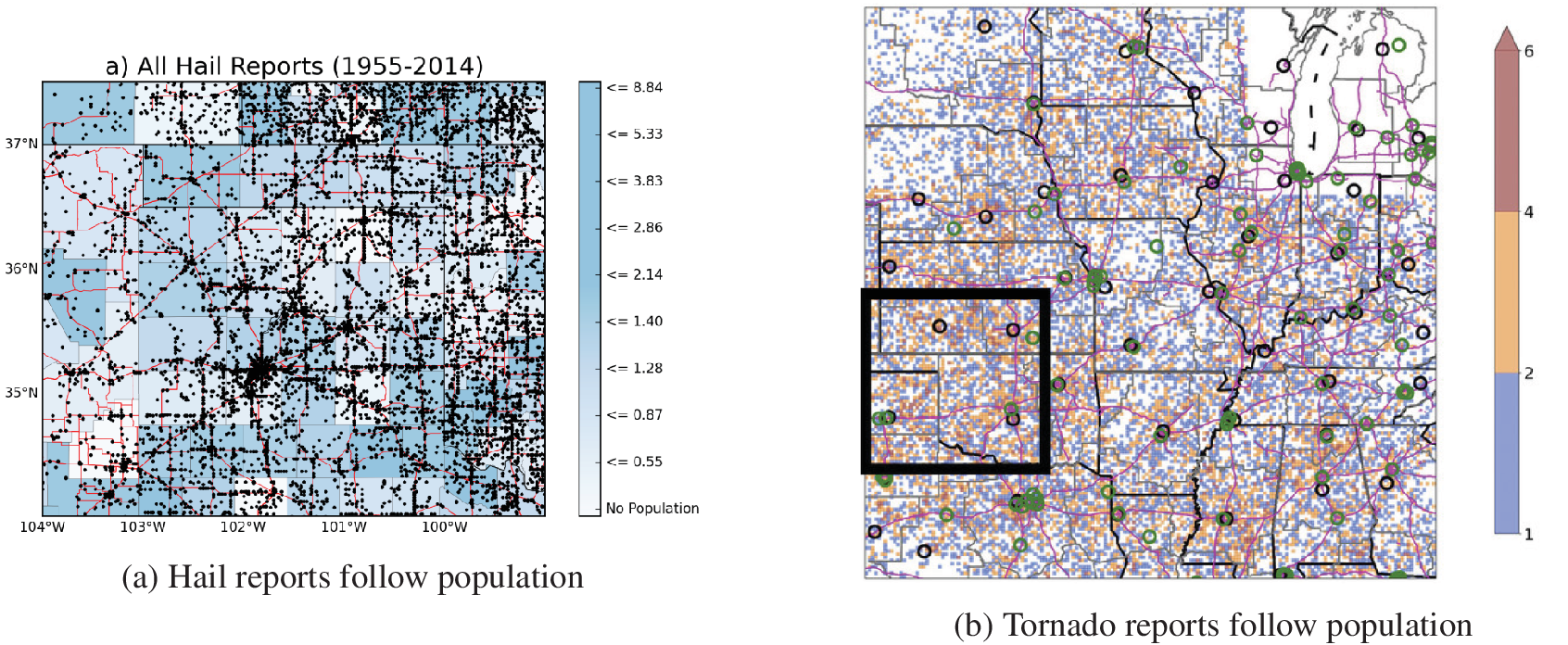
It is important to understand that when AI models are trained on biased data, they inherit those biases. This phenomenon is known as coded bias (O’Neil, Reference O’Neil2016; Kantayya, Reference Kantayya2020) and is easy to understand—if a hail dataset shows hail occurring only in populated areas (see Example 1(a)), the AI system trained on this dataset is likely to also predict hail only in highly populated areas, making the AI model just as biased to population density as the data it was trained on. Since established algorithms are often used in regions or under circumstances other than the origin of the data, such an algorithm can even perpetuate the bias beyond the regions and circumstances it was trained on.
2.1.1. Nonrepresentative training data
Statistical distribution of training, testing, and validation data: If the training data are nonrepresentative statistically, the output is likely to be biased. This could include geographic or population biases (discussed in more detail in Section 2.1.2) but it could also include unintentional temporal biases. For example, if an AI model is trained on data from 1900 to 1970, 1970 to 2000 is used as a validation set, and then 2000 to 2020 is used as a test set, the model may not be properly accounting for climate change. Sensor limitations provide other examples. Many sensors require sunlight for high quality observations, and thus many phenomena are under-observed at night. Similarly, inferring certain surface conditions from satellites using passive sensors tends to be easier for clear sky conditions.
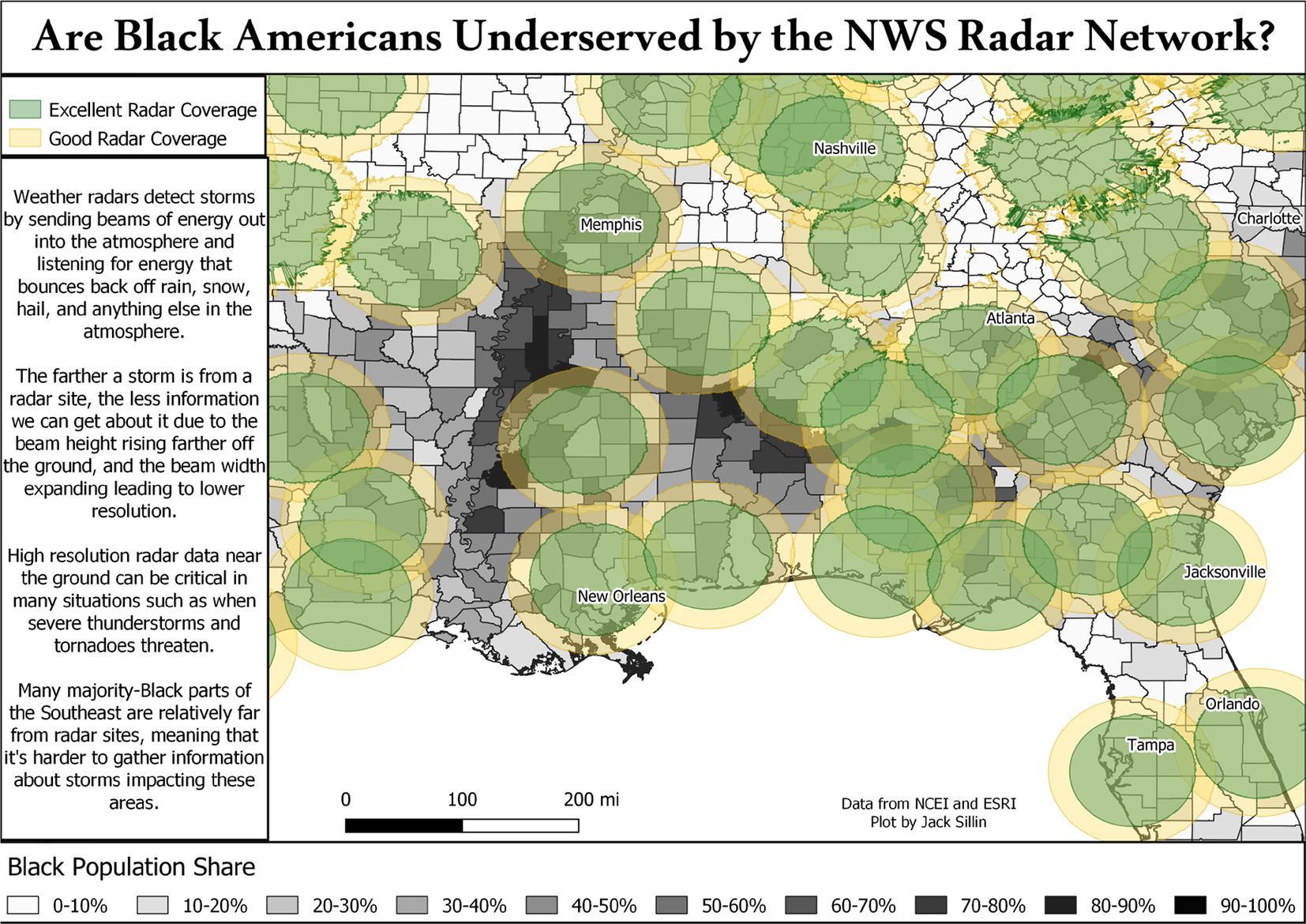
Lack of geo-diversity: In order to enable AI algorithms to facilitate environmental justice we thus need to ensure that different populations are well represented in their training data. This includes ensuring that the data are diverse geographically, including addressing population biases and biases in sensor placements that could affect the ability to obtain a statistically representative training set. For example, the national radar network has coverage gaps which can inadvertently under-represent some populations, as indicated in Figure 1 (Sillin, Reference Sillin2021; Shepherd, Reference Shepherd2021). We should explicitly take population representation into account for the design of future sensor networks and seek to close gaps in existing sensor networks by placing additional sensors in strategic locations. Furthermore, we can put AI to good use by developing AI algorithms to estimate sensor values at the missing locations based on other sensor types, such as generating synthetic radar imagery from geostationary satellite imagery (Hilburn et al., Reference Hilburn, Ebert-Uphoff and Miller2021).
Coverage of the national Doppler weather network (green and yellow circles) overlaid with the black population in the southeast United States, courtesy of Jack Sillin. This is an example of nonrepresentative data (Section 2.1.1).
Lastly, because environmental sciences are characterized by a superposition of various processes at very different temporal and spatial scales, it is challenging to have a dataset fully representative of all potential processes to be analyzed and inferred by AI/ML methods; some processes may be neglected in the process.
2.1.2. Training labels are biased or faulty
Human generated datasets: Obtaining data for environmental science prediction tasks is often quite challenging, both in terms of finding the data and in terms of identifying a complete dataset. For example, if one was to predict hail or tornadoes but only to use human reports, there is a known bias toward areas with higher population (Allen and Tippett, Reference Allen and Tippett2015; Potvin et al., Reference Potvin, Broyles, Skinner, Brooks and Rasmussen2019) as shown in Figure 2. If more people live in an area, there is a higher chance that someone observes and reports a hail or tornado event. This might bias the AI model to over-predict urban hail/tornadoes and under-predict rural hail/tornadoes.
Hail and tornado reports both show a clear population bias with reports occurring more frequently along roads and cities. This can be seen as examples of (i) data being missing in low population areas (Section 2.1.1) and (ii) faulty labels (Section 2.1.2). Panel a is from Allen and Tippett (Reference Allen and Tippett2015) © Allen and Tippett. Reproduced under the terms of the Creative Commons Attribution–NonDerivative License (CC BY-ND) Panel b is from Potvin et al. (Reference Potvin, Broyles, Skinner, Brooks and Rasmussen2019) © American Meteorological Society. Used with permission. Contact copyright holder for further re-use.
A related issue is that even if a diverse geographical area is represented in the dataset, the AI model will focus on patterns that are associated with the most common regimes and areas where the hazard occurs most frequently. It also may ignore patterns that affect a small portion of the dataset since the contribution to the overall training error is relatively small. For example, solar irradiance forecasts from an AI model trained across multiple sites in Oklahoma had higher errors at the sites in the Panhandle compared with central Oklahoma due to limited representation of Panhandle weather in the dataset (Gagne et al., Reference Gagne, McGovern, Haupt and Williams2017).
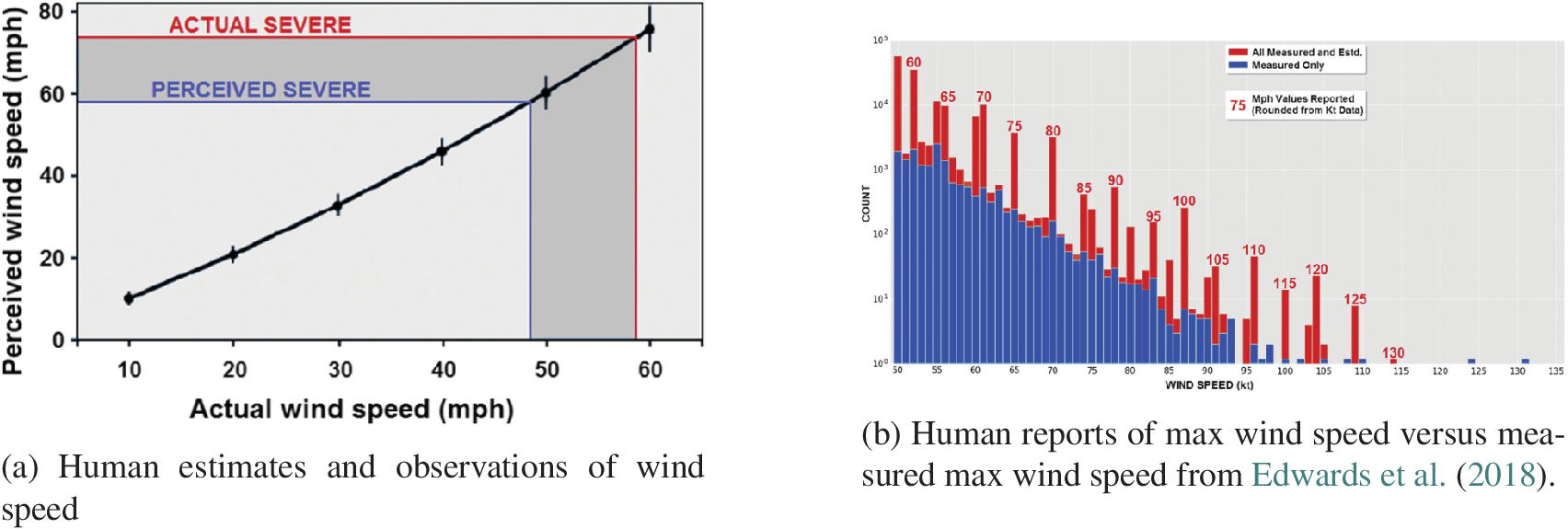
Figure 3 illustrates the typical biases of humans to estimate wind speed due to two effects. Figure 3a shows that humans tend to overestimate wind speed, and thus tend to classify it as severe at levels that are not actually considered severe. Thus, human reported wind speed results in training data with significant bias toward higher wind speeds. Figure 3b illustrates that humans tend to assign wind speeds in discrete increments, with a strong bias toward multiples of five, that id, 60, 65, 70, …, kt. This example also demonstrates how nonrepresentative training data and the biases could result in an AI algorithm that does not predict true wind speed impacts correctly.
Human reports of wind speed show biases in both perception of the speed itself (Panel a) and in the binning of the data (Panel b). Both panels are from Edwards et al. (Reference Edwards, Allen and Carbin2018). This example highlights both non-represenative training data (Section 2.1.1) and biased and faulty labels (Section 2.1.2). Panels 2a and b © American Meteorological Society. Used with permission. Contact copyright holder for further re-use.
Sensor generated datasets: A potential response to these data issue could be to use only sensor-based data, such as radar-derived hail estimates. We often assume that sensors are inherently objective yet that is not guaranteed. First, the data from these sensors must be interpreted to create a full dataset. For radar-derived hail data, there are well-known overprediction biases to the data (e.g., Murillo and Homeyer, Reference Murillo and Homeyer2019). Second, data from sensors may also be incomplete, either due to sensor errors or missing sensors. With many sensors, there are areas which are well represented and areas where data are lacking. Sensor placement often depends on geological features, for example, there might be a lack of sensors at remote mountain tops or in empty fields. Economical reasons can also come into play in the placement of sensors, such as the placement of crowd-sourced sensors where there are more affluent people. Consider for example the deployment of air quality sensors. While the EPA has a network of just over 1,100 air quality sensors that are relatively evenly distributed throughout the United States, this is not the case for the popular new generation of low-cost air quality sensors, called PurpleAir. There are now over 5,500 PurpleAir sensors deployed in the United States, but they are deployed in significantly Whiter, higher income areas than the national average (deSouza and Kinney, Reference Davila, Marquart and Mullings2021). Access to these sensors in less-privileged communities is needed to democratize air pollution data (deSouza and Kinney, Reference deSouza and Kinney2021).
2.1.3. Data are affected by adversaries
Adversarial data are a well-known problem in machine learning (e.g., Diochnos et al., Reference Diochnos, Mahloujifar, Mahmoody, Bengio, Wallach, Larochelle, Grauman, Cesa-Bianchi and Garnett2018; Goodfellow et al., Reference Goodfellow, McDaniel and Papernot2018; Nelson et al., Reference Nelson, Rubinstein, Huang, Joseph and Tygar2010). Adversaries can cause an AI model to either learn a faulty model or to be used incorrectly when applied to real-world data. For example, there are well-known examples of minor changes to speed signs causing a computer vision system to see a 35-mph speed limit as an 85-mph speed limit, something that could be quite dangerous in an autonomous car.
AI applied to environmental science data has to contend with two kinds of adversaries: humans and the environment. One needs to be aware of both types of adversaries when training and applying the AI models to the real-world.
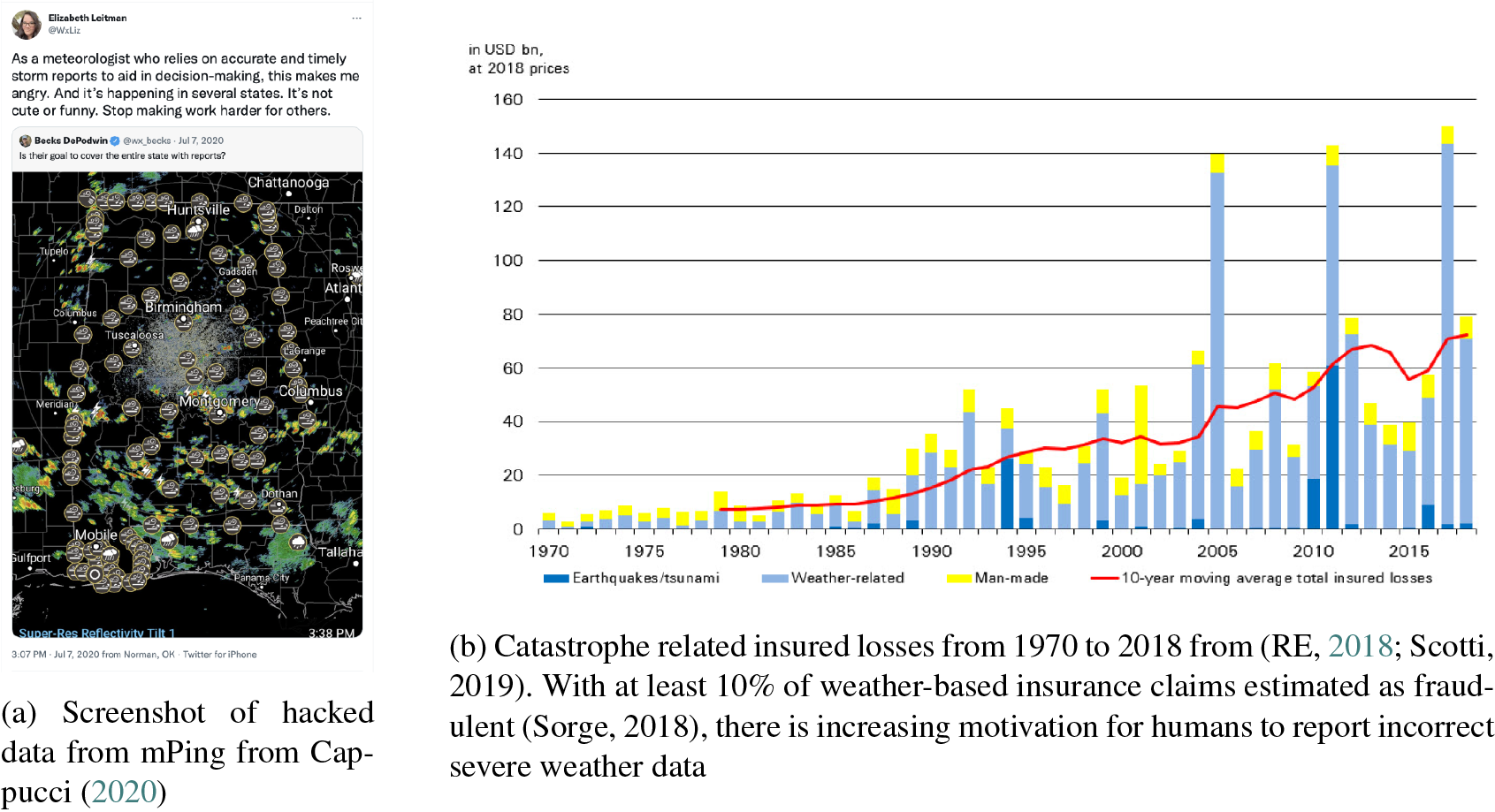
Human adversaries: When using human reported data, there is always the possibility of users intentionally adding bad data. Figure 4 provides two examples. Figure 4a provides the screenshot of wind reported by someone who hacked the crowd-sourced mPing system for the state of Alabama. Note the long line of wind reported outlining the state border which clearly represents an intentional input of incorrect information. Such data would be detrimental to any AI model trained on these data. A second source of human adversarial data are insurance fraud (Davila et al., Reference Davila, Marquart and Mullings2005). As the number of expensive natural disasters are increasing (Figure 4b), the number of fraudulent weather-related insurance claims is increasing, with estimates of fraudulent reports hovering around 10% (Sorge, Reference Sorge2018). Such fraudulent reports can also affect training data for AI by appearing in the databases of severe weather reports.
Humans sometimes create adversarial data, which may be ingested by an artificial intelligence (AI) model (Section 2.1.3). While in example (a) the user intent is to create false inputs, in example, (b) the motivation for the false reports is more for personal financial gain (insurance fraud). Nevertheless, both can cause problems for AI by directly affecting reports databases used by AI models.
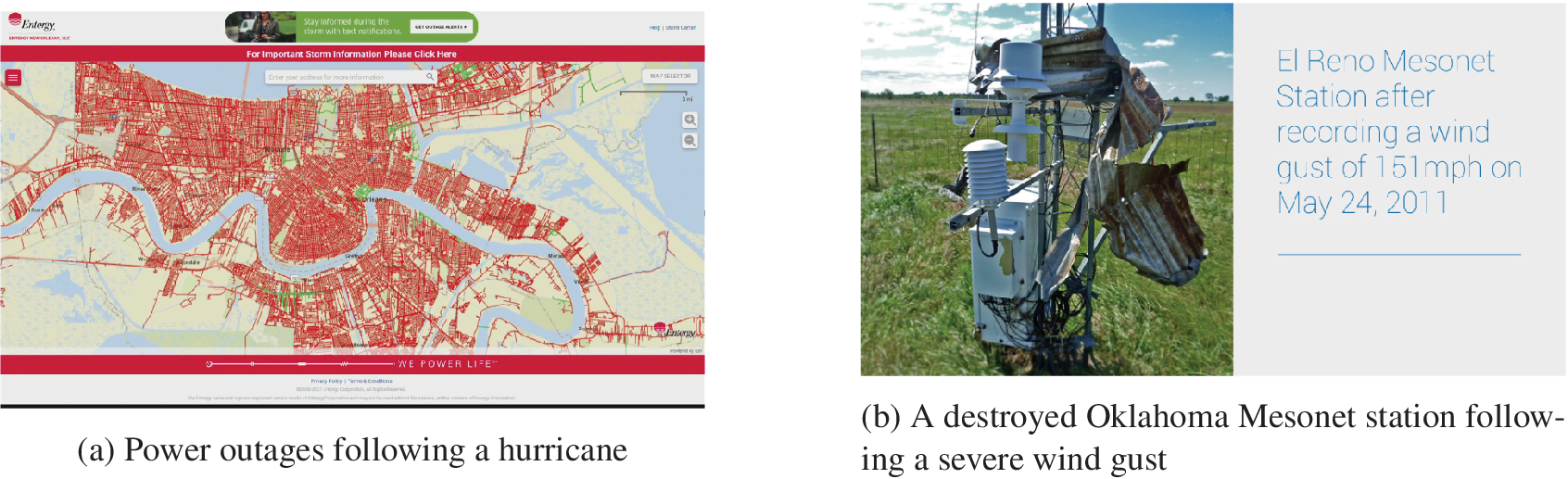
Weather as an adversary: Weather can act as its own adversary, especially when collecting observations for extreme events. For example, when seeking to observe the severity of storms, sensors can fail due to power outages caused by a strong storm (Figure 5a) or a strong storm can even destroy sensors (Figure 5b).
Weather also creates its own adversaries (Section 2.1.3) by creating power outages (a) or destroying sensors (b), especially during major events. Graphics from Mesonet (Reference Mesonet2020) and Staff (Reference Staff2021).
2.2. Issues related to the AI model
In addition to problems caused by bias or other complications in the training data, AI models can also develop issues on their own. Examples are given in this section.
2.2.1. Model training choices
Model training choices will affect every aspect of the AI model. While AI methods are based on mathematical equations and thus often seen as “objective,” there are countless choices that a scientist has to make that greatly affect the results. These choices include: (a) which attributes (e.g., which environmental variables) to include in the model; (b) which data sources to use; (c) how to preprocess the data (e.g., normalizing the data, removing seasonality, and applying dimension reduction methods); (d) which type of AI model to use (e.g., clustering, random forest, neural networks, etc.); and (e) how to choose hyper parameters (e.g., for random forest—how many trees, maximal depth, minimal leaf size, etc). Each of these choices has significant impact and can lead to vastly different results with severe consequences. For example, the choice of spatial resolution for the output of a model can be crucial for environmental justice. Training an AI model to predict urban heat at a low spatial resolution may average out, and thus overlook, extreme values in small neighborhoods, while using a higher spatial resolution could reveal those peaks but potentially introduce noise.
2.2.2. Algorithm learns faulty strategies
AI models are tasked to learn patterns in the data that help them come up with good estimates or classifications. Sometimes, even if the data are not faulty in the traditional sense, they may contain spurious correlations that are not representative of the real world and that the AI model learns to exploit. This issue could be discussed in the section on data-related issues (Section 2.1), but we chose to include it in this section since it is so closely coupled with AI model development, and often only diagnosed once an AI model has been developed.
One approach to identifying when the AI has learned a faulty strategy is to either use interpretable or explainable AI (XAI) (e.g., Ras et al., Reference Ras, van Gerven and Haselager2018; Molnar, Reference Molnar2018; McGovern et al., Reference McGovern, Lagerquist, Gagne, Jergensen, Elmore, Homeyer and Smith2019; Samek et al., Reference Samek, Montavon, Vedaldi, Hansen and Muller2019; Ebert-Uphoff and Hilburn, Reference Ebert-Uphoff and Hilburn2020). In the case of interpretable AI, the models are intended to be understandable by human experts (Rudin, Reference Rudin2019) while explainable AI attempts to peer inside the black box of more complicated models and identify the internal strategies used by the models. Both approaches allow a human expert to examine the model and potentially to identify faulty strategies before deploying a model.
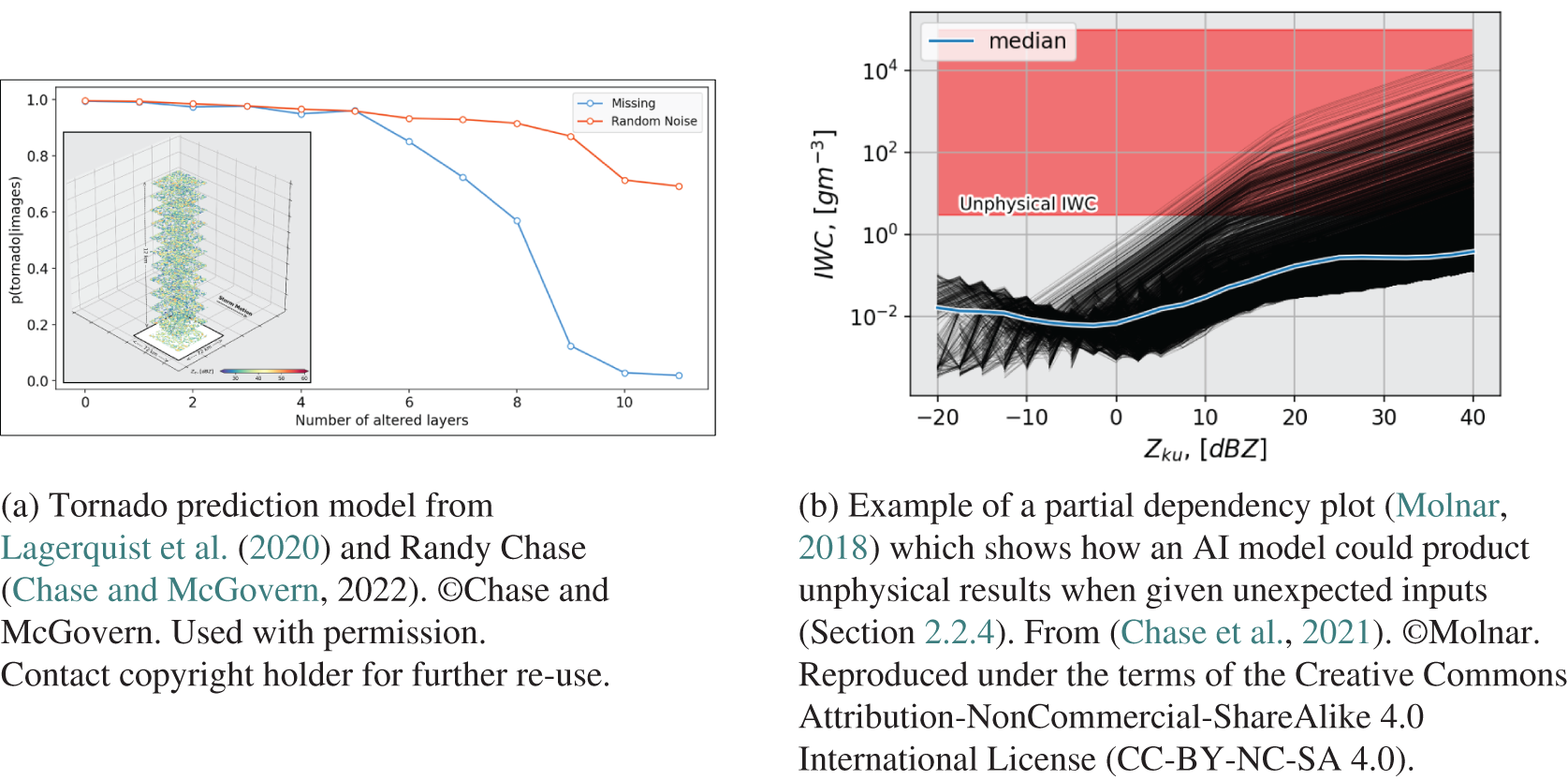
Figure 6a is an example of how an AI model can learn a faulty strategy and how this can be discovered through XAI. In this example, a deep learning model was trained to predict tornadoes (Lagerquist et al., Reference Lagerquist, McGovern, Homeyer and Smith2020) and then examined to identify what the model had learned. Unexpectedly, we discovered that the model was still predicting a high probability of tornadoes even if the reflectivity image contained mostly noise (Chase and McGovern, Reference Chase and McGovern2022).
Examples of an AI learning to fake something plausible (Section 2.2.3) and of a model generating unexpected output when applied to data outside of the range of expected data (Section 2.2.4).
2.2.3. AI learns to fake something plausible
The emergence of an advanced type of AI algorithm, namely the generative adversarial network (GAN) introduced by Goodfellow et al. (Reference Goodfellow, Pouget-Abadie, Mirza, Xu, Warde-Farley, Ozair, Courville and Bengio2014), yields the ability to generate imagery that looks extremely realistic. The result of a GAN can be seen as one possible solution (an ensemble member) which might not be representative of the distribution of possible solutions. An important question is how forecasters would respond to GAN imagery with intricate small scale features that look overwhelmingly realistic, but might not be as accurate as they appear to be. Ravuri et al. (Reference Ravuri, Lenc, Willson, Kangin, Lam, Mirowski, Fitzsimons, Athanassiadou, Kashem, Madge and Prudden2021) conducted a cognitive assessment study with expert meteorologists to evaluate how forecasters respond to GAN imagery of radar for precipitation nowcasting. They concluded that for their application forecasters made deliberate judgements of the predictions by relying on their expertise, rather than being swayed by realistic looking images (Suppl. C.6. of Ravuri et al., Reference Ravuri, Lenc, Willson, Kangin, Lam, Mirowski, Fitzsimons, Athanassiadou, Kashem, Madge and Prudden2021). Nevertheless, the jury is still out whether that is generally the case. Such methods might sometimes trick forecasters into greater trust than is warranted. Similar methods are used to generate deep fake images and videos (Adee, Reference Adee2020) which have successfully fooled people into believing misinformation (Vaccari and Chadwick, Reference Vaccari and Chadwick2020). If similar approaches are used in environmental science, trust in AI models could be lost.
One of the major dangers of generative models used in contexts where they are parameterizing fine scale data (Gagne et al., Reference Gagne, Christensen, Subramanian and Monahan2020) or filling in missing data (Geiss and Hardin, Reference Geiss and Hardin2021) is the lack of guarantees about what data they use to fill in the gaps. If an ML model is trained without any physical constraints, it is possible for the algorithm to insert spurious weather features. If this occurs in otherwise data sparse regions, forecasters may not have any additional data to discredit the false prediction for many hours. More subtle discrepancies would be the most problematic since they are harder for forecasters to catch.
2.2.4. Models used in inappropriate situations
Another model-based issue that can arise is when an AI model is trained for one situation, perhaps a specific weather regime or for a specific geographical area, and then applied to new situations where it is not physically meaningful. In such situations, the AI may predict incorrectly, without giving any warning, which could lead to loss of life and environmental injustice.
For example, Figure 6b shows a partial dependence plot (Molnar, Reference Molnar2018) of the predictions of an AI method predicting total ice water content (i.e., mass of snow in a cloud) from radar data (Chase et al., Reference Chase, Nesbitt and McFarquhar2021). If input given to the model is uncharacteristic of the training dataset, the output may not be physically realistic. This issue also comes up frequently when ML is used to replace numerical weather prediction parameterization schemes. If the ML model is transferred to a different climate or geographic regime or even to the hemisphere opposite where it was trained (where the sign of many common variables are flipped), it often performs quite poorly.
2.2.5. Nontrustworthy models deployed
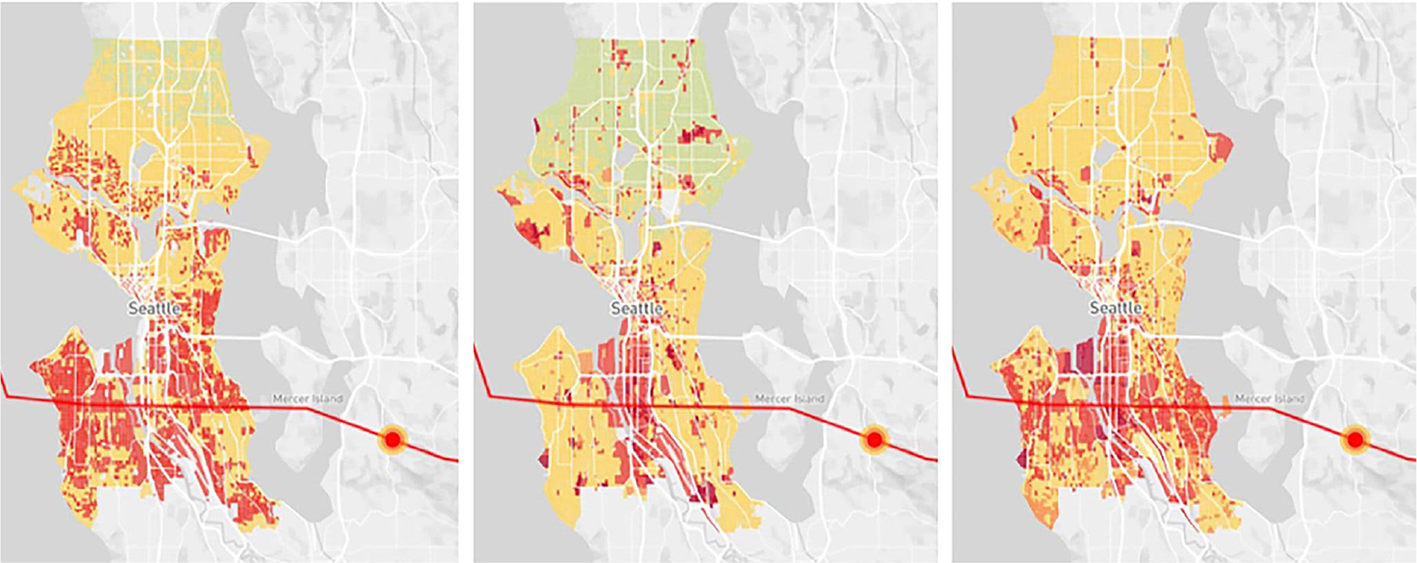
Ensuring that a model is trustworthy is a key part of ethical and responsible AI. Often AI systems are deployed before they are ready, in particular before they have been thoroughly tested and validated by domain experts. Figure 7 shows the results of a commercial AI system predicting damage caused by a hypothetical 7.0-magnitude earthquake in the Seattle area. The three panels show results from three different version of the system delivered to the city of Seattle to assist them to plan where to establish earthquake shelters. The widely differing results in the three panels arose from using different data sources, but also from programming errors (e.g., counting each apartment in a high-rise building as a separate structure). Deploying the model before it was ready for operation forced the city to revamp nearly completed plans for sheltering earthquake-displaced residents that were developed using the original version (Fink, Reference Fink2019). The trust in the AI system was so eroded that the city considered terminating their contract, and only kept it because the company found an external funder and could offer it to Seattle for free.
Three vastly different damage predictions for the same hypothetical 7.0-magnitude Seattle area earthquake delivered by different versions of the same AI system. Figure from Fink (Reference Fink2019), crediting the Seattle Office of Emergency Management.
Typical mistakes to be avoided, illustrated by this example, are developing a system without engaging domain experts or local end-users, deploying a system before it has been rigorously validated, and over-promising the system’s accuracy to the end user without any scientific evidence. For the latter, there are many new methods for uncertainty quantification in machine learning models that we as a community should start utilizing routinely for this purpose (e.g., Barnes et al., Reference Barnes, Barnes and Gordillo2021; Orescanin et al., Reference Orescanin, Petković, Powell, Marsh and Heslin2021).
2.2.6. Lack of robustness
While a lack of robustness could also be categorized under models being inappropriately applied, adversarial data, or even a lack of trust, we separate it into its own category to highlight the need for robustness in ethical and responsible AI. Robust AI for environmental sciences will fail gracefully when outputs are out of range (e.g., Section 2.2.4) and will also constrain the outputs by the laws of physics. For instance, when preparing a workshop tutorial, one of the authors was demonstrating a simple ML method that could predict a local temperature. When presented with an input that was two standard deviations outside of its training data, the method suddenly predicted a temperature hotter than the surface of the sun. Such predictions may contribute to a lack of trust and create environmental injustices. Furthermore, integrating advances in AI methods that enable physics and/or fairness principles (Kearns and Roth, Reference Kearns and Roth2019; Thomas et al., Reference Thomas, da Silva, Barto, Giguere, Brun and Brunskill2019; Mehrabi et al., Reference Mehrabi, Morstatter, Saxena, Lerman and Galstyan2021) into the learning methods could both align with and help advance ethical and responsible AI.
2.3. Other issues related to workforce and society
We have discussed ways that both the training data and the AI model could go wrong. Here, we focus on the broader picture of how AI is applied and developed and how that relates to environmental justice. This aspect also needs to be addressed in developing ethical and responsible AI for environmental sciences.
2.3.1. Globally applicable AI approaches may stymie burgeoning efforts in developing countries
Large organizations developing and deploying AI systems, including government agencies and private companies, generally want their AI systems to be globally applicable. People in countries outside that of the provider organization can benefit from technological advances that may not otherwise be available to them. Provider organizations can benefit from a broader set of customers and stakeholders. These kinds of global activities work best when researchers and companies directly engage with different local populations and incorporate their needs and concerns into the design process. For example, Google’s crisis team has been working with multiple local and government partners in India and Bangladesh to create a hyper-local flood forecasting product (Matias, Reference Matias2021).
However, the relative ease of deploying AI on global datasets can also increase the temptation for organizations to automate deployment without fully monitoring its impact. Without direct engagement with various populations, organizations may not be aware of the unintended consequences of their algorithms. They also may not have access to observations in these areas to validate their performance. They may also undercut local providers who are more aligned with the community but do not have the same resources and economies of scale to compete on price, especially if the service is offered for free or is supported by advertising revenue. Government meteorological centers in both developed and developing countries have dealt with budget cuts and cost-recovery requirements even before the growth of AI and the private weather industry, so further adoption of AI could exacerbate these trends.
For example, mobile weather apps have become the primary source of weather information for younger people (Phan et al., Reference Phan, Montz, Curtis and Rickenbach2018). However, the apps’ uniform presentation of weather information may result in users not being aware of more localized and rare weather hazards. A local government or television meteorologist on the other hand can tailor their communication to highlight these issues.
2.3.2. Lack of input or consent on data collection and model training
As illustrated in the discussion of Figure 7, when collecting local data for training an AI model or when creating an AI model to inform decisions in or about a specific place, it is critical that the people affected and those with local expertise are involved from the beginning (Renn et al., Reference Renn, Webler and Wiedemann1995; Stern and Fineberg, Reference Stern and Fineberg1996; Chilvers, Reference Chilvers2009; Voinov et al., Reference Voinov, Kolagani, McCall, Glynn, Kragt, Ostermann, Pierce and Ramu2016; Pidgeon, Reference Pidgeon2021). This is more typically known in the social sciences but not nearly as common in AI.
The types of data that are collected affect the AI models that can be applied and trained. Understanding that data provide a source of power and that what is not collected cannot be used (D’Ignazio and Klein, Reference D’Ignazio and Klein2020), it is possible to see that AI could too easily be used to perpetuate environmental and climate injustices if data are not collected carefully.
In environmental research it has long been noted that engaging those whose concerns the science is purportedly informing or addressing can improve models and outcomes, is a moral obligation, and is the virtuous course of action (e.g., Lemos and Morehouse, Reference Lemos and Morehouse2005). A core duty in environmental sciences, as in all sciences, is to be honest (e.g., National Academies of Sciences, Engineering, and Medicine (NASEM), 2009; 2019), which respects the dignity and rights of persons (e.g., Keohane et al., Reference Keohane, Lane and Oppenheimer2014). In AI for environmental sciences this requires grappling with how to be transparent (i.e., show your work—D’Ignazio and Klein, Reference D’Ignazio and Klein2020) about methodological biases and uncertainties that are often complex and poorly understood. When scientific conditions such as sensitivity to training conditions or data provenance are not reported, that lack of transparency both disempowers and disrespects those the model may be intended to help, and can make a study irreplicable and even irreproducible (NASEM, Reference Nelson, Rubinstein, Huang, Joseph and Tygar2019).
It is thus critical to keep in mind that many types of data and knowledge already exist outside of the colonial framework in which most AI data have been collected. For example, scientists must work directly with local leaders to incorporate Indigenous knowledge (Hiwasaki et al., Reference Hiwasaki, Luna, Syamsidik and Shaw2014; Cartier, Reference Cartier2019) in an ethical and responsible manner.
2.3.3. Scientists feeling disenfranchised
There are two primary reasons why scientists might feel disenfranchised.
Scientists not fluent in AI might feel disenfranchised: Environmental scientists are absolutely essential for the development of meaningful AI tools for the their domains. Currently, with a lack of education in AI for environmental sciences, leading scientists may feel excluded from advancing state-of-the-art tools. They must either learn about AI themselves or collaborate with AI scientists to be part of major future development in their field. As a consequence they may feel less independent and less appreciated. Clearly, we need more educational resources to help environmental scientists learn the basics of AI in order to empower them to play a leading role in future developments.
Required computational resources might limit research opportunities to privileged groups: While AI methods for many environmental science applications require only modest computational resources, some research now requires access to extensive high performance computing facilities, which limits this kind of research to those research groups privileged enough to have such access. To level the playing field we as a community need to find ways to develop an open science model that provides access to computational resources also for other groups who need them (e.g., Gentemann et al., Reference Gentemann, Holdgraf, Abernathey, Crichton, Colliander, Kearns, Panda and Signell2021).
2.3.4. Increase of CO2 emissions due to computing
It is well known that the increasing computational demands of AI training are responsible for a surprisingly large carbon footprint worldwide (Schwartz et al., Reference Schwartz, Dodge, Smith and Etzioni2020; Xu et al., Reference Xu, Zhou, Fu, Zhou and Li2021). Thus, we need to consider, and limit, the carbon footprint from the computational needs of environmental science. Green deep learning (aka Green AI) is a new research field that appeals to researchers to pay attention to the carbon footprint of their research, and to focus on using lightweight and efficient methods (Xu et al., Reference Xu, Zhou, Fu, Zhou and Li2021). We should fully explore these new developments, including focusing on how to make ML models simpler for environmental science applications, which would have many advantages, including increased transparency and robustness (Rudin, Reference Rudin2019), but also lower computational needs and lower carbon footprints.
3. Discussion and Future Work
The scientific community is still grappling with the many ethical questions raised by the introduction of AI in general (O’Neil, Reference O’Neil2016; Floridi, Reference Floridi2019; Schmidt et al., Reference Schmidt, Work, Catz, Chien, Darby, Ford, Griffiths, Horvitz, Jassy, Mark and Matheny2021) and for Earth science applications in particular (Doorn, Reference Doorn2021; Coeckelbergh, Reference Coeckelbergh2021). The effort presented here represents the beginning of our work on developing a full understanding of the need for ethical, responsible, and trustworthy AI for the environmental sciences and of the interactions between ethical and responsible AI and trustworthy AI within the NSF AI Institute for Research on Trustworthy AI in Weather, Climate, and Coastal Oceanography (AI2ES, ai2es.org). In an upcoming paper, we plan to present guiding principles for ethical, responsible, and trustworthy AI for the environmental sciences.
Ethics Statement
The research meets all ethical guidelines, including adherence to the legal requirements of the study country.
Data Availability Statement
This manuscript does not develop any new data or code.
Author Contributions
Conceptualization: A.M., I.E.-U., D.J.G., and A.B.; Data visualization: A.M. and I.E.; Methodology: A.M., I.E.-U., D.J.G., and A.B.; Writing original draft: A.M. and I.E equally shared the majority of the writing of this paper. All authors contributed to the writing and approved the final submitted draft.
Funding Statement
This material is based upon work supported by the National Science Foundation under Grant No. ICER-2019758 and by the National Center for Atmospheric Research, which is a major facility sponsored by the National Science Foundation under Cooperative Agreement No. 1852977.
Acknowledgments
We are grateful for the graphic on radar coverage in the southeast US contributed by Jack Sillin (Cornell), the graphics contributed by Randy Chase (OU), and references contributed by Amy Burzynski (CSU).
Competing Interests
The authors declare no competing interests exist.


 Open access

