


Currency devaluation—tweaking the exchange rate to gain an edge in export markets—is a contentious strategy. It is valued by exporters, who thus become more competitive in foreign markets, but often frowned upon by citizens, who grumble about their shrinking wallet power, and importers, who find their costs soaring. It is also a frequent trigger of trade disputes. Since the end of the Bretton Woods regime of fixed exchange rates, an appreciation of the United States’ real effective exchange rate—and therefore, reduced export-competitiveness—has regularly triggered anti-dumping action by the United States.Footnote 1 US President Donald Trump has repeatedly charged that China and other trade partners deliberately undervalue their currencies to subsidize exports and raise the price of imports.
Although the accusation may not always be accurate—both Japan and China have at times propped up their currency in the face of outflows, with significant interventions when interest rates have diverged between Japan and the United States—the general point is incontrovertible. The second- and third-largest economies in the world have regularly intervened in the foreign exchange market, virtually always purchasing US dollars and selling local currency. Several important emerging markets—Thailand and Vietnam, for example—continue to do so regularly. The official justification, “to prevent excessive volatility,” can be dismissed because such interventions would on average be symmetrical and neutral in terms of foreign reserves, while the countries in question have accumulated sizable foreign reserve holdings. At the same time, observers conclude that these countries have more than enough reserves to ensure financial stability.Footnote 2 Rather than smoothing out volatility or creating a safety net, their monetary authorities reveal a preference for the depreciation of their currencies.
For several reasons, this policy choice is puzzling. Purposeful devaluation should be unpopular in a democracy unless the currency is severely overvalued.Footnote 3 The growing importance of global value chains tempers the economic benefits of currency undervaluation because it increases the cost of imported inputs.Footnote 4 Sustained undervaluation works best under political and economic conditions, like control over the financial system and suppression of labor,Footnote 5 that are present in China but not in the open economies of Japan, Korea, Taiwan, and Thailand. All these elements make frequent foreign exchange intervention to devalue highly unusual in global comparison.
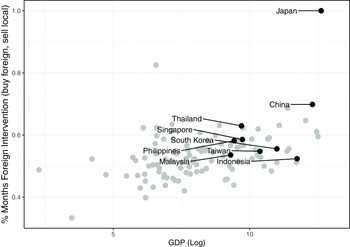
A further anomaly is the regional concentration of countries that frequently intervene. Figure 1 plots the frequency of interventions-to-devalue against (logged) GDP. East and Southeast Asian countries (China, Indonesia, Japan, Malaysia, Philippines, South Korea, Thailand, and Taiwan) clearly stand out.
Frequency of intervention-to-devalue as share of all interventions, 2001–2020
Note: Based on Adler et al. (Reference Adler, Suk Chang, Mano and Shao2021) and authors’ calculations.

These actions are not without consequences: these countries also risk trade disputes with the US, in many cases their most important military ally. Under the Omnibus Trade and Competitiveness Act of 1988 and Section 701 of the 2015 Trade Facilitation and Enforcement Act, the US Treasury puts countries on a monitoring list if they have significant bilateral trade surpluses with the US and material current account surpluses in general, and engage in persistent, one-sided currency intervention.Footnote 6 The countries singled out most frequently in the reports over the last two decades are China, Japan, Korea, Thailand, Malaysia, Singapore, and Vietnam. (On occasion, Mexico and Germany make the list, but neither regularly intervenes in the foreign exchange market.) Again, East Asian countries stand out. What explains their unusual policy choice?
In this research note, we put forth a political-economy explanation centered on the interests of exporting firms. We first highlight how much the fortunes of major firms in East Asian economies depend on the exchange rate. We then focus on the case of Japan to investigate how industry lobbying influences the choice to intervene in the foreign exchange market. With reference to banks, Henning describes such lobbying as “highly confidential and closely guarded.”Footnote 7 This is certainly true in Japan, where lobbying is not “logged” in official registries as it is in the US. We therefore create a proxy measure of industry lobbying of the government to devalue the yen using machine learning to analyze news reports from the leading Japanese financial newspaper, Nihon Keizai Shimbun. Using daily official data on interventions (provided by the Japanese government), we then test whether this variable predicts foreign exchange intervention and find strong evidence in support of our hypothesis.
No other Asian country provides official high-frequency intervention data, and in many of them, a similar proxy measure would be hard to obtain because of an only partly free press. The closest approximation is Korea. We therefore undertake a robustness check, following a similar approach with Korean data using the leading Korean financial news publication, Hankyung, and can predict depreciations successfully based on our proxy measure.
Our study contributes to the growing body of research on the political determinants of exchange rate policy, building on foundational explanations in international and comparative political economy of the domestic politics of exchange rate policy in Europe and Latin America.Footnote 8 Our work sheds light on the under-studied politics of exchange rates in East Asia. Our study also speaks to a long-standing debate in international political economy: do democracies set economic policy with a view to the benefit of citizens in general or at the behest of more narrow special interests?Footnote 9 Its focus on interest groups highlights the role of industry and firms in a democratic context, complementing the more recent emphasis on voter concernsFootnote 10 and the question of exchange rate policy in authoritarian states.Footnote 11
Foreign Exchange Intervention: One Tool, Many Aims
The proximate goal of foreign exchange intervention is to influence the trajectory of the nominal exchange rate. Among G7 countries (with the exception of Japan), where the norm of floating exchange rates prevails, foreign exchange intervention historically sought to prevent large deviations from agreed target levels or to limit the volatility of exchange rates.Footnote 12 The latter implies that intervention should be symmetrical—at times slowing down appreciation, at other times limiting depreciation—and on average neutral, so that the stock of foreign exchange reserves does not grow over time.
For foreign reserves to accumulate, at least one of two policies must be in effect. The first possibility is that the country runs a current account surplus while also applying capital controls, forcing its residents (including firms) to hand over their foreign exchange to the authorities to receive local currency. The second option is for monetary authorities to intervene in the foreign exchange market, more often purchasing foreign currency and selling local currency in the spot market than undertaking the reverse transaction.
Foreign exchange intervention aimed at reducing volatility stimulates trade because it creates predictability. Support by firms for such a policy bears similarity to the backing of a fixed exchange rate regime in the European Communities.Footnote 13 By preventing a deviation of exchange rates from their market equilibrium values, it reduces obvious distributional effects of currency movements and is thus rarely politically contested.
By contrast, intervention to over- or undervalue a currency has pronounced distributional implications within and across countries. Overvaluation favors consumers of imported goods. Undervaluation primarily benefits exporters, limited by the extent to which they rely on imports as input for production. Accordingly, the growing importance of global value chains tends to weaken the case for undervaluation.Footnote 14
The attractiveness of overvaluation for voters as consumers of imported goods helps explain why in Latin America overvaluation has often been sustained until just after an election.Footnote 15 By draining foreign exchange reserves, intervention to maintain an overvalued currency also risks triggering speculative attacks.Footnote 16 The political incentives for intervention therefore depend primarily on how voter sentiment is influenced by exchange rates.
Explaining currency intervention with reference to interest-group pressure faces different challenges. The first is that firms may have collective-action problems, because unlike a targeted subsidy, exchange rate depreciation affects the entire economy—though the same holds for those firms that would oppose depreciation.Footnote 17 The second is that politicians may be reluctant to apply such a broad tool to benefit exporters specifically. Countries with an overvalued exchange rate also face a possible currency denomination mismatch of liabilities and assets if official or private debtors borrow in foreign currency.Footnote 18 In short, there are significant obstacles that may dissuade governments from using exchange rate intervention as a policy tool.
Many of these concerns, however, do not apply to a country that runs a current account surplus and accumulates foreign currency assets. While countries seeking to defend an overvalued exchange rate can run out of foreign exchange reserves, forcing a devaluation, the cost of undervaluation and foreign exchange reserve accumulation is more muted. Besides reducing the purchasing power of consumers, governments incur two further costs.
The first is that foreign exchange reserves are held in US dollars and earn a low total return. If a local currency is undervalued relative to the US dollar, markets will expect a revaluation. Both covered and uncovered interest parity imply that the return on the US dollar reserves must be lower than the local currency return would have been. A government accumulating reserves therefore incurs a “carrying cost” relative to the potential return if invested at home.
The second cost is that once the policy of undervaluation is ended, the existing foreign exchange reserves and all other foreign currency assets will lose value relative to the home currency. Such valuation losses can be significant—in the billions of US dollars for large economies like China, Japan, or Korea. These costs may not be obvious to the general public (except for those who have taken an intermediate macroeconomics class), but they create a stark trade-off for governments.
Why do some governments nonetheless intervene to devalue? First, as a necessary condition, when a country has a sizable export-oriented industrial sector dominated by large firms whose profits are affected by currency movements. These firms cannot import too large a share of their inputs from other countries whose currencies do not depreciate because any local devaluation would make such imports more expensive. We hypothesize that under these conditions, governments will intervene if industry demands devaluation to enhance or maintain competitiveness.
H1 Governments will intervene to depreciate their exchange in reaction to industry pressure.
At the same time, governments face a second potential trade-off: such an intervention undermines the purchasing power of voters, although some may still favor it because they rely on jobs in an export industry sensitive to exchange rate changes. It is also possible that voters support undervaluation out of sociotropic concerns for the economy, as recent research suggests.Footnote 19 Furthermore, any account of currency intervention based on voter concerns confronts the problem that the effect of intervention is transient: it provides a temporary subsidy to exporters, but markets often quickly readjust to equilibrium exchange rates.Footnote 20 Should intervention-to-depreciate be unpopular and a salient issue in the minds of voters, governments might choose to intervene long before or only after an election, but not in the run-up to it. Thus we also hypothesize:
H2 Governments are less likely to intervene to depreciate before elections.
Note that while data availability means that our chosen case is ideal for a test of our first hypothesis, it is less suited to a strict test of the second hypothesis because Japan experienced only two changes of the governing party during our sample period. A null finding should therefore not discourage future studies.
Although these propositions extend earlier theoretical work, they are novel in their focus on forex market intervention. To date, most of the literature has highlighted concerns about preventing depreciation.Footnote 21 Little attention has been paid to the issue of purposeful currency devaluation triggering reactions by competitor countries, although this is well established for the 1930s,Footnote 22 and despite qualitative evidence that exporters in East Asia are concerned about exchange rate depreciation in other countries. For instance, Steinberg notes that Zhu Rhongji “took the lead in formulating China’s response to the Asian crisis, but he ‘consulted widely’ on exchange rate policy … Manufacturing firms and political patrons were among those who gave Zhu policy advice during this period… However, concerns with external competitiveness grew in the first quarter of 1998 when the Japanese yen started depreciating. During the summer of 1998, the manufacturing sector started to demand that the government take a more active response to the crisis. Some even suggested devaluing the exchange rate.”Footnote 23 In the following, we empirically establish the link between our proxy for interest-group pressure for devaluation and intervention by the government in a quantitative case study of Japan.
Case Study: Japan
For our analysis of lobbying pressure to intervene in foreign exchange markets, we focus on Japan. Japan matters because of the historically enormous size of its interventions, in some years approaching 4.5 percent of GDP. Although global forex markets move trillions of dollars every day, no single public entity is known to have taken actions of comparable monetary value. In terms of research, Japan is the only country whose forex interventions can be studied in detail because its government has published its intervention data transparently and at daily frequency (though with some delay) over several decades, providing the date, the amount, the currency pair, and the direction of the transaction in quarterly releases from the Bank of Japan (BOJ).Footnote 24 While Japan may not have recently intervened in the markets to devalue,Footnote 25 other countries continue to do so, and Japanese government officials have repeatedly stated that currency devaluation remains in the arsenal of economic policy even today. The Japanese case therefore promises insight into other cases as well.
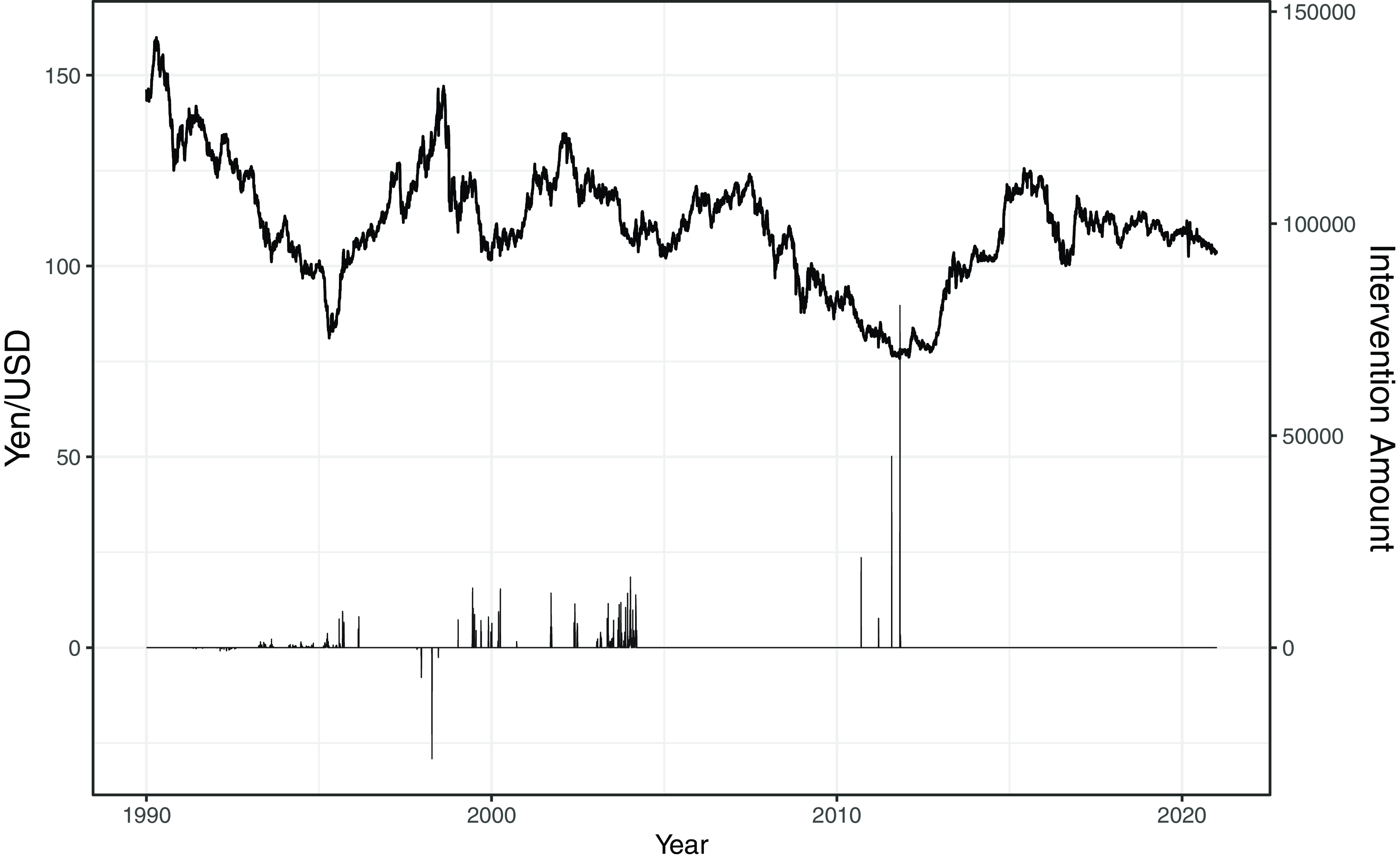
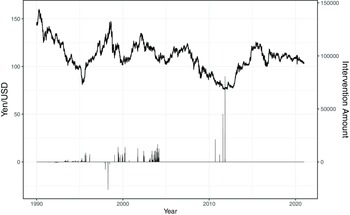
A second rationale is that Japan had an overvalued real exchange rateFootnote 26 for extended periods from at least 1985 to 2015 because of its extremely low inflation rate—so much that Japanese observers even coined a term, endaka, consisting of the characters for “yen” and “expensive,” when the currency was revalued in 1985 as part of the Plaza Accord. This provides a motive for intervention in general, but in the light of considerable fluctuations in the nominal exchange rate (between ¥150/USD and ¥75/USD), prompts the question of when the government will actually intervene. After all, the prices underlying the real exchange rate are very sticky—and extremely so in Japan, where the price of a set lunch and the hourly wage of the server remained unchanged at ¥1,000 (USD 5–10) for two decades between 2000 and 2020. Meanwhile, interventions occurred on and off. Their size (in millions of USD) is shown together with the New York market yen–dollar spot rate in Figure 2.
Yen-to-US-dollar exchange rate and foreign exchange intervention amount in 100 million yen
Note: Based on data from the Bank of Japan and the Federal Reserve Bank of St. Louis.
The Policy and Politics of Exchange Rate Intervention in Japan
In Japan, the decision to intervene in the foreign exchange market is ultimately that of the minister of finance. The chain of authority then goes to the vice-minister for international affairs (a bureaucratic rather than political appointment), the director-general of the International Bureau (known as the International Finance Bureau until 1998), and subsequently the director of the department in charge of intervention and foreign reserves. Importantly, the BOJ itself has no formal authority to decide on interventions,Footnote 27 so when we speak of BOJ intervention, this is just a shorthand. The (legally independent) BOJ does, however, decide how much of an intervention it wants to sterilize through bond issuance, as this decision clearly affects monetary policy.
When intervening, the BOJ acts as the Ministry of Finance’s agent, issuing short-term government securities denominated in yen with a maturity of up to three months that are subsequently listed on the balance sheet of the Special Account of the Foreign Exchange Fund. The acquired dollars (or euros, on occasion) are listed on the asset side of the Special Account. The funds are then managed by the Ministry of Finance, with some profits transferred to the general budget.Footnote 28 The precise mechanics are not publicized by the BOJ, but we can presume that they are no different from those of other central banks. A central bank typically intervenes in some combination of spot and forward market; that is, it purchases the currency, either for immediate delivery or for delivery in the future, and deals with local banks. At times, the BOJ asks other central banks to act on its behalf, typically when interventions are to take place during the opening hours of the New York market but while the Tokyo market is closed.Footnote 29
Data on interventions going back to 1989 were first disclosed by the Ministry of Finance in August 2000, with quarterly updates since. Although not all details are provided—for instance, data are daily but not intra-day, and the actual exchange rate at which the transaction(s) took place is not given—few other central banks have so far provided data of comparable nature.Footnote 30 Sizeable BOJ interventions took place under then-Director-General Sakakibara Eisuke,Footnote 31 and in particular in 2003–04 under his successor, Kuroda Haruhiko, who would go on to become governor of the BOJ.
Anecdotal evidence abounds that the Japanese government is motivated by concerns about the competitiveness of Japanese exporters. Even during periods in which the government does not intervene in the foreign exchange market, politicians and interest-group representatives frequently comment on the strength of the currency. For example, on 7 April 2016, Chief Cabinet Secretary Suga was quoted in the Financial Times as saying, “We [the Japanese government] are watching the foreign exchange market with a sense of tension and we’ll take measures as appropriate.” Mimura Akio, chairman of the Japan Chamber of Commerce, reportedly described “a range of ¥110–115 [as] the comfort zone for small and medium-sized companies.” These statements reflect that Japanese firms export final products to overseas markets as well as parts to overseas factories. For example, during the first nine months of the 2013–14 fiscal year, almost two-thirds of Toyota Motor’s profit rises were due to the weakening of the yen.Footnote 32
More systematic analysis suggests that nominal exchange rates have significant effects on Japan’s export performance.Footnote 33 These are so evident to stock market investors that a 1 percent appreciation of the yen vis-á-vis the US dollar reduces the returns of automotive industry stocks by 0.39 percent and those of auto parts producers by 0.3 percent.Footnote 34 In large part, this reflects that Japanese firms import fewer of their inputs than firms in the similarly export-oriented manufacturing sector of, for example, Germany or Sweden. The latter import at least 70 percent of their inputs, while Japan’s manufacturers on average source less than 50 percent abroadFootnote 35 —small- and medium-sized companies, even less. Although since the Global Financial Crisis, a weaker yen no longer stimulates exports to other Asian countries, it continues to increase the exports of Japanese manufacturers to non-Asian countries, and their profitability.Footnote 36
Finally, and most importantly, we know from first-hand interviews with Ministry of Finance officials that they consider industry views in their decision making on whether and when to intervene and are highly sensitive to criticism both in public and behind closed doors, confirming that the causal chain we propose is reasonable in practice.Footnote 37
We can therefore hypothesize that to the extent that the Japanese government favors the interests of these exporting industries, it will use the tools it has available to depreciate the value of the yen through foreign exchange market intervention. However, this does not mean that the government intervenes frequently. In fact, on any given day on which markets were open between 1989 and 2016, the unconditional probability of BOJ intervention was about 5 percent. In the following, we test the relationship between export firm interest voiced in the financial press and foreign exchange market intervention by the Japanese government.
Empirical Approach
Our independent variable is a proxy measure of lobbying for foreign exchange market intervention. Our assumption is that neither the past or present value of the yen nor its discussion in news media is the “true” cause that motivates action by the Japanese government. Rather, both are proxies: the value of the yen affects the competitiveness of Japanese exporters only indirectly, while the news media reports “refract” what journalists and editors deem worthy of a report. We therefore estimate how strongly reports in the principal financial newspaper favor foreign exchange rate intervention to depreciate or appreciate the yen. To generate these data, we first take a random sample of 6,000 news items from the entire period for which we have Nikkei texts (1987–2014).Footnote 38 We then categorize these texts as (1) news items favoring a weak yen that report either (a) the negative effects of a strong currency on Japanese industry or firms or (b) direct calls for a weaker yen from private-sector representatives; (2) news items favoring a strong yen, in which the opposite is reported; or (3) neutral items. The latter category, overwhelmingly the most common, includes all news items that do not relate to exchange rates at all, plus those simply reporting exchange rate movements in the markets. From these texts, we extract “seed words” that denote the polarity of each text—that is, how much they favor either appreciation or depreciation of the yen. The seed words are listed in the online appendix.
We then use these seed words to scale the remaining texts and estimate their polarity using an approach similar to the “latent semantic scaling” proposed by Watanabe.Footnote 39 We define the measure such that positive values indicate favoring depreciation. Unlike Watanabe, we take advantage of recent developments in machine learning and use a BERT (bidirectional encoder representations from transformers) model for the word embeddings. With the predicted polarity scores in hand, we conduct a validation test by taking a random sample of 100 texts, read these texts, and assign the same labels as in our training data. We then compare these labels with the predicted polarity and find that polarity and label direction coincide in over 90 percent of cases.Footnote 40 The estimated polarity, akin to the predominant sentiment regarding the strength of the yen as reported in the Nikkei on a given day, is our proxy for industry evaluation of the exchange rate.
To be sure, this variable cannot fully reflect the distributive implications of exchange rate movements across different types of firms. Rather, the average polarity on a given day provides an aggregate measure of an industry comprised of firms of different sizes and trade exposure. We provide further information on the scaling approach, along with sample sentences, in the online appendix.
Our dependent variable, intervention, can take on three values: 0 if there is no intervention; +1 if a depreciation-inducing intervention takes place (the BOJ buys foreign currency and sells yen); and –1 if an appreciation-inducing intervention takes place (the BOJ buys yen with foreign currency by drawing down its foreign exchange reserves). Thus we model the relationship with a dynamic ordered probit model estimated via maximum likelihood.Footnote 41 Ito and Yabu clarify why in the absence of intra-day trade data, using a discrete dependent variable is preferable to using the amount of intervention, even if the latter appears to offer additional information: monetary authorities will adjust the amount of successive interventions within the same day depending on the movement of exchange rates, but the data are only available at daily frequency.Footnote 42 Using the intervention amount therefore creates an endogeneity problem that a discrete indicator and daily data help avoid. Following this logic, we assume that the Ministry of Finance observes the reaction of the forex market and subsequently adjusts intervention at the same frequency. While we cannot know for certain what information the monetary authorities take into account in defining the target exchange rate, it is usually assumed to be some weighted average of past exchange rates,Footnote 43 to which we add the proxy measure of lobbying.
At daily frequency, we can turn the information on the nominal market exchange rate into short-, medium-, and long-run exchange rates—that is, the yen/dollar rate on the previous day, the yen/dollar rate in the previous month (21 business days), and the past k-year moving average of that rate. Following Ito and Yabu,Footnote 44 and considering that a year is about 260 business days, the past k-year (for k = 1, 3, 5) moving average is defined as
 $$s_t^{k{\rm{L}}} = {1 \over {260k}}\mathop \sum \nolimits_{i = 0}^{260k - 1} {s_{t - 1}}$$
where ${s_t}$
denotes the log of the yen/dollar exchange rate at the close of the New York market.Footnote
45
The three exchange rates may enter the equation directly in the intervention-reaction function in this way:
${s_t}$
denotes the log of the yen/dollar exchange rate at the close of the New York market.Footnote
45
The three exchange rates may enter the equation directly in the intervention-reaction function in this way:
 $${{\scriptsize {\hbox {INT}}}_t} = \alpha + {\beta _1}{s^{\rm{S}}} + {\beta _2}{s^{\rm{M}}} + {\beta _3}{s^{k{\rm{L}}}} + {\beta _4}{\scriptsize {\hbox {INTERVENTION}}_{t - 1}} + {\beta _5}{\scriptsize {\hbox {POLARITY}}_{t - 1}} \\+ {\beta _6}{\scriptsize {\hbox {PREELECTION}}_{t - 1, \ldots ,20}} + {\beta _7}{\scriptsize {\hbox {POSTELECTION}}_{t + 1, \ldots ,20}} + {\upsilon _t}$$
The terms ${\beta _1}$
,
${\beta _1}$
, ${\beta _2}$
and
${\beta _2}$
and ${\beta _3}$
capture the effect of the short (S), medium (M), and long-run (L) exchange rate;
${\beta _3}$
capture the effect of the short (S), medium (M), and long-run (L) exchange rate; $\alpha $
is a constant term;Footnote
46
and
$\alpha $
is a constant term;Footnote
46
and ${\beta _4}$
captures the persistence of foreign exchange market interventions. Intervening is costly bureaucratically and possibly politically: internal decisions have to made, and the potential negative publicity among trade partners (especially the US) will weigh against depreciation-inducing intervention, while the inherent limits of foreign reserves speak against appreciation-inducing actions. Once this inertia or resistance has been overcome, a first intervention should therefore make subsequent actions more likely.
${\beta _4}$
captures the persistence of foreign exchange market interventions. Intervening is costly bureaucratically and possibly politically: internal decisions have to made, and the potential negative publicity among trade partners (especially the US) will weigh against depreciation-inducing intervention, while the inherent limits of foreign reserves speak against appreciation-inducing actions. Once this inertia or resistance has been overcome, a first intervention should therefore make subsequent actions more likely.
The ${\beta _6}$
and
${\beta _6}$
and ${\beta _7}$
coefficients on the pre- and post-election dummies capture the possible effects of the political business cycle,Footnote
47
while
${\beta _7}$
coefficients on the pre- and post-election dummies capture the possible effects of the political business cycle,Footnote
47
while ${\upsilon _t}$
is a (potentially serially correlated) error term. Based on Equation (1), we let the chosen long-run exchange rate vary with k. The data on daily foreign exchange intervention come directly from the BOJ, while the exchange rate data are from the Federal Reserve Economic Data (FRED). We collect election dates manually from public sources, and treat the Upper House and Lower House elections for Japan’s bicameral parliamentary system as equally important.
${\upsilon _t}$
is a (potentially serially correlated) error term. Based on Equation (1), we let the chosen long-run exchange rate vary with k. The data on daily foreign exchange intervention come directly from the BOJ, while the exchange rate data are from the Federal Reserve Economic Data (FRED). We collect election dates manually from public sources, and treat the Upper House and Lower House elections for Japan’s bicameral parliamentary system as equally important.
The coefficient of interest is ${\beta _5}$
, which estimates the effect of our text-based measure of lobbying pressures, polarity. Polarity is coded such that higher values indicate stronger lobbying pressure for a depreciation-inducing foreign exchange intervention. Hence, we expect
${\beta _5}$
, which estimates the effect of our text-based measure of lobbying pressures, polarity. Polarity is coded such that higher values indicate stronger lobbying pressure for a depreciation-inducing foreign exchange intervention. Hence, we expect ${\beta _5}$
to be positive. As financial markets are open only Monday through Friday, while newspapers run on weekends as well, we assign the average polarity score over the weekend (Friday through Sunday) to the Friday observation.
${\beta _5}$
to be positive. As financial markets are open only Monday through Friday, while newspapers run on weekends as well, we assign the average polarity score over the weekend (Friday through Sunday) to the Friday observation.
Furthermore, rather than focusing on past exchange rates, monetary authorities may be more interested in the difference between yesterday’s exchange rate and its short-, medium-, and long-run rates. Following Ito and Yabu,Footnote 48 we call these quantities the short, medium, and long target exchange rates. We can then write the intervention-reaction function of monetary authorities as
 $${\scriptsize {\hbox {INT}}}_{t} = \alpha + {\beta _1}\left( {{s_{t - 1}} - {s_{t - 2}}} \right) + {\beta _2}\left( {{s_{t - 1}} - {s_{t - 21}}} \right) + {\beta _3}\left( {{s_{t - 1}} - s_t^{k{\rm{L}}}} \right) \\ \,\,\,\,\,\,\,\,\,\,\,\,\,+ {\beta _4}{\scriptsize {{\hbox {INTERVENTION}}_{t - 1}} + {\beta _5}{\scriptsize {\hbox {POLARITY}}}_{t - 1}} + {\beta _6}{\scriptsize {{\hbox{PREELECTION}}}_{t - 1, \ldots ,20}} \\\!\!\!\!\!\!\!\!\!\!\!\!\!\!\!\!\!\!\!\!\!\!\!\!\!\!\!\!\!\!\!\!\!\!\!\!\!\!\!\!\!\!\!\!\!\!\!\!\!\!\!\!\!\!\!\!\!\!\!\!\!\!+ {\beta _7}{\scriptsize {\hbox{POSTELECTION}}_{t + 1, \ldots ,20}} + {\upsilon _t}$$
where the interpretation of the coefficient of interest, ${\beta _5}$
, remains the same.
${\beta _5}$
, remains the same.
Since it is difficult to directly evaluate the coefficients in nonlinear models, we will also show the results in terms of predicted probability, according to these formulas:
 $${\rm{Pr}}({{\scriptsize {\hbox {INT}}}_t} = - 1|{\rm{\;\;}}{x_t}) = {\rm{\Phi }}\left( {{\tau _{ - 1}} - \alpha - \beta {x_t}} \right)$$
 $${\rm{Pr}}({\scriptsize {{\hbox {INT}}}_t} = 0|{\rm{\;\;}}{x_t}) = {\rm{\Phi }}\left( {{\tau _0} - \alpha - \beta {x_t}} \right) - {\rm{\Phi }}\left( {{\tau _{ - 1}} - \alpha - \beta {x_t}} \right)$$
 $${\rm{Pr}}({\scriptsize {{\hbox {INT}}}_t} = 0|{\rm{\;\;}}{x_t}) = 1 - {\rm{\Phi }}\left( {{\tau _0} - \alpha - \beta {x_t}} \right)$$
In (4), ${\rm{\Phi }}$
denotes the cumulative distribution function of the standard normal distribution, and the
${\rm{\Phi }}$
denotes the cumulative distribution function of the standard normal distribution, and the $\tau $
s are the two estimated cut points. The vector of covariates in
$\tau $
s are the two estimated cut points. The vector of covariates in ${x_t}$
is held at each regressor’s mean value for the purpose of estimating the predicted probabilities. To construct the 95 percent error bands, we rely on block-bootstrapped standard errors. This approach is preferable in time series analysis as it lets us resample the data while preserving the temporal dependence in the original data set. We block by year-month and resample the data 500 times. In the online appendix, we show that the results hold when we calculate the error bands with the delta method.
${x_t}$
is held at each regressor’s mean value for the purpose of estimating the predicted probabilities. To construct the 95 percent error bands, we rely on block-bootstrapped standard errors. This approach is preferable in time series analysis as it lets us resample the data while preserving the temporal dependence in the original data set. We block by year-month and resample the data 500 times. In the online appendix, we show that the results hold when we calculate the error bands with the delta method.
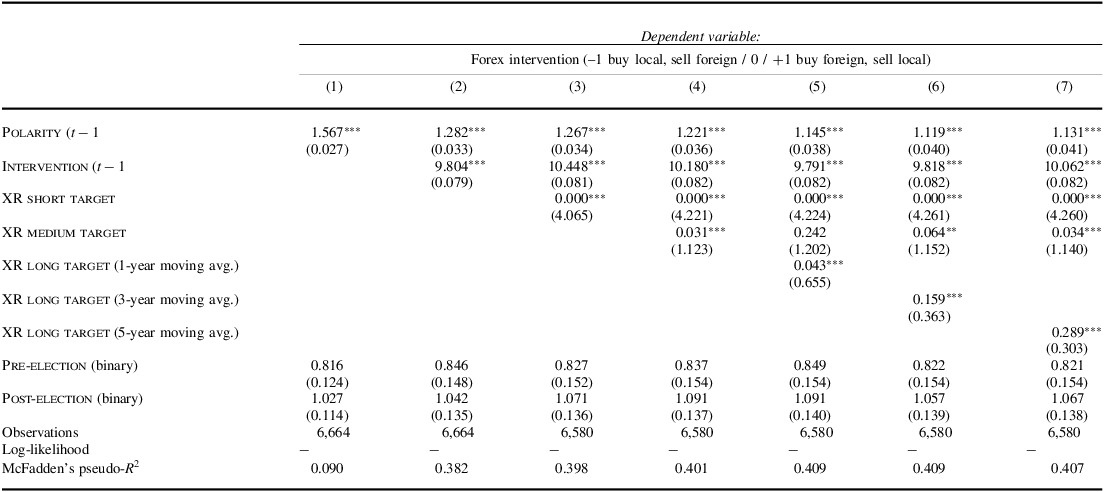
Table 1 shows the regression output for the ordered probit models, with covariates added sequentially to ease concerns about suppression of the main independent variable due to the inclusion of all the control variables simultaneously.Footnote 49 The coefficients are exponentiated and interpreted as odds ratios. Based on model 5, a one-unit increase in polarity is associated with a 14.5 percent increase in the odds of a depreciation-inducing intervention, compared to either an appreciation-inducing or no intervention.
Dynamic ordered probit regression

Notes: Coefficients exponentiated. Standard errors in parentheses. ** $p \lt $
.01; ***
$p \lt $
.01; *** $p \lt $
.001.
$p \lt $
.001.
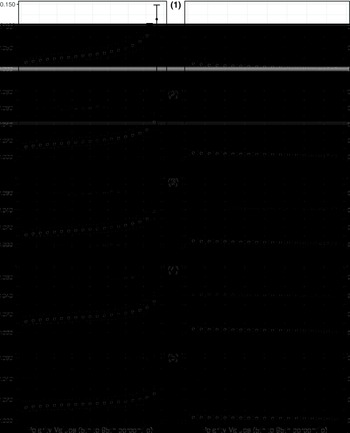
In Figure 3, we show the predicted probabilities of depreciation- and appreciation-inducing intervention across vigintiles from the 5th to the 95th percentile of our polarity measure for models 1 to 5. Across all models, an increase in the polarity of the Nikkei news articles of the day—that is, more articles that more strongly note the challenges a strong yen creates for Japanese industry or that directly call for depreciation—increases the probability of depreciation-inducing intervention and decreases the probability of appreciation-inducing intervention. In short, we find strong evidence that expressions of concern about the yen’s valuation are associated with a greater probability of intervention to depreciate, supporting H1.
Predicted probability of depreciation-inducing (left column) and appreciation-inducing (right column) foreign exchange intervention

We do not, however, find much evidence to reject the null hypothesis (no effect of elections) in favor of H2. There is no suggestion that a government that is facing an upcoming election or has just been elected is less (or more) likely to intervene. It is of course difficult to answer this question in a single case study, especially since Japanese national elections have only rarely been competitive and the Liberal Democratic Party has been in power most of the time, either alone or with a coalition partner, since 1955. Moreover, Japan had a modestly overvalued exchange rate throughout our period of study, which (given sufficiently strong sociotropic effects on voter perception) might have made the government indifferent to the timing of interventions relative to elections.
Robustness Checks
In the online supplement, we probe the robustness of the results in several steps. We show the predicted probability graphs after calculating the 95 percent error bars via the delta method. Next, we replace the “target” exchange rate with the raw exchange rate, relying on the simpler model in Equation (2), augmented with our polarity score. None of the substantive conclusions change. We also test the proportionality assumptionFootnote 50 of the ordered probit model. We find some local (short and long target exchange rates) as well as global (in models 5 and 6) violations of the assumption. We then proceed in three ways.
First, for the models containing only one local violation, we drop the offending variable, rerun the Brant test, and refit a simpler model that satisfies the proportional-odds assumption. The results are similar to the original models and provided in our replication code.
Second, we relax the proportionality assumption by estimating a set of stratified binomial models. In other words, we recode the dependent variable as two binary indicators that capture the two events of interest (depreciation-inducing and appreciation-inducing intervention) and rerun dynamic probit models on each newly coded dependent variable. Operationalizing the dependent variable this way, we would expect our polarity measure to be positively related to depreciation-inducing intervention and negatively related to appreciation-inducing intervention. This is what we find.
Third, we refit the main specifications in a multinomial regression framework, which does not require the parallel-regression assumption. This choice comes at a cost in terms of efficiency, as we are discarding all the information regarding the order of the dependent variable. The results confirm the original analysis.
We further investigate the extent to which our polarity variable matters relative to the other covariates in the model. First, we rely on stepwise ordinal probit regression, a data-driven variable selection process where predictors are added or removed from the initial model (the three full models) based on minimizing the Akaike information criterion. Importantly, the stepwise algorithm always keeps our polarity measure in the model, underscoring its importance. Second, we perform an extreme bounds analysis. After fitting 127 different specifications starting from the full model (model 5), we find that our polarity score is robust across all models.
Furthermore, we show the marginal effects of polarity on each outcome variable (appreciation-inducing, depreciation-inducing, and no intervention), holding all other variables at their means. We repeat the analysis, allowing the target-exchange-rate variables and the election dummies to affect the variance of the error term. The corresponding marginal effects from the heteroskedastic dynamic ordered probit model are comparable to the marginal effects derived from the homoskedastic version. We also use the intervention amount as the dependent variable. Although this introduces an endogeneity problem, it preserves more information than our three-category dependent variable. As an intermediate solution, we repeat the analysis after recoding the total amount into a more fine-grained seven-category ordered categorical variable. In both cases, our results remain robust.
We verify that our results hold when controlling for real effective exchange rate changes instead of nominal changes. We also examine the role of exchange market pressure and explore the extent to which Japanese monetary authorities might target interest rates rather than the exchange rate in response to industry pressure. Again the conclusions are unchanged.
Finally, we extend our analysis to the effect of our polarity measure on the exchange rate itself. Doing so allows us to estimate a similar model for Korea using polarity data estimated on news reports in the Hankyung financial newspaper, but for which there are no official data on foreign exchange intervention. We estimate a set of vector autoregression (VAR) models and derive the impulse response functions to show how shocks to our polarity measure propagate dynamically to influence exchange rate movements. We find similar patterns for both countries, offering further evidence that industry pressure can trigger foreign exchange market intervention.
Conclusion
The frequent use of foreign exchange market intervention by East Asian countries to devalue their currencies is a persistent anomaly in the international economy. While many countries deviate from the economic prescription of floating exchange rates, very few intervene repeatedly over long periods of time to depreciate their currencies. In this research note, we offer a political-economy explanation for this unusual behavior. Our case study of Japan provides robust support for the hypothesis that government interventions in the forex market are significantly influenced by industry pressure. Meanwhile, we find only very limited evidence that electoral cycles influence the timing of interventions in Japan, suggesting that at least in this case, voter concerns are secondary to interest-group lobbying. When interest groups are influential in nondemocracies—albeit unlikely to voice their concerns to the public—our argument may travel to these countries as well.
In a robustness check (detailed in the online supplement), we extend our approach to Korea and try a direct comparison using exchange rate depreciation rather than intervention as dependent variable. We find additional support for our hypotheses. Our findings suggest that at least in East Asia, interest groups have more influence on exchange rate policy than often assumed, lending credence to arguments based on sectoral interests.Footnote 51 Our argument is also likely to be applicable to other countries in the region whose exports are dominated by manufactured goods, often with similar products. Conversely, deliberate currency undervaluation is less common among countries with different economic profiles, such as agricultural exporters, and is ruled out if countries have joined a currency union. Moreover, at other times, interest rate differences that lead to a relative weakening of a currency may obviate the need for direct currency intervention. Overall, despite the blunt nature and broad economic effects of currency intervention, special interests retain considerable influence on exchange rate policy, even in democracies.
Given the economic heft of these interventions, at times approaching several percent of GDP, further investigation would be desirable, but it is severely constrained by data availability. Using the only available officially published high-frequency data series, we focused on Japan. Other studies rely on estimatesFootnote 52 or draw on reports in newspapersFootnote 53 aggregated to monthly frequency, allowing an analysis of economic effects, but are less useful for testing political-economy propositions in the light of the endogeneity of subsequent interventions to the effectiveness of the first in a series.
Supporting one’s own export industries through currency devaluation is bound to lead to trade tensions but appears to provide sufficient economic rewards for East Asian countries to engage in it. This phenomenon goes beyond our cases of Japan and Korea: currencies in East Asia co-move with stock markets; as one falls the other rises.Footnote 54 Much like competitive devaluations in the interwar period,Footnote 55 currency intervention may have a dimension of strategic interaction that research in international political economy has yet to explore.
Data Availability Statement
Replication files for this research note may be found at <https://doi.org/10.7910/DVN/1TACQD>.
Supplementary Material
Supplementary material for this research note is available at <https://doi.org/10.1017/S0020818325100751>.
Acknowledgments
The authors thank Oliver Proksch, Jonathan Slapin, Arthur Spirling, David Steinberg, Sebastián Vallejo Vera, and seminar participants at PIPC 2019, MapleMeth 2024, and Oxford University for their valuable comments and suggestions. Chaerin Song, Haruka Takagi, and Leo Watson provided outstanding research assistance.
Funding
This study was partially funded by Insight Grant no. 435140487 of the Social Sciences and Humanities Research Council of Canada.



 Open access

