


Introduction
The risk of species extinction refers to the likelihood that a species will disappear from the wild soon, whether locally, regionally or globally (IUCN, 2024a). Although extinction is a natural process, current risk is predominantly driven by anthropogenic factors such as habitat loss, climate change and overexploitation, all of which compromise the survival and reproduction of populations (Helm et al., Reference Helm, Oja, Saar, Takkis, Talve and Pärtel2009). Thus, understanding, estimating and quantifying the risk of species extinction is of paramount importance for the protection of biodiversity, as it is the starting point for conservation efforts. Such an approach identifies which taxa are threatened, guiding and informing actions to help prevent extinctions (IUCN, 2024a).
Plants are not exempt from the accelerated extinction trend driven by anthropogenic impacts (Brummitt et al., Reference Brummitt, Bachman, Griffiths-Lee, Lutz, Moat and Farjon2015), yet they often receive less attention than other groups, in particular non-charismatic groups such as bryophytes (Amorim et al., Reference Amorim, Peralta, Bonrdin and Câmara2023). Bryophytes, the second largest group of terrestrial plants after angiosperms (Mishler & Kelch, Reference Mishler and Kelch2009), play an important role in most biomes but are frequently overlooked. Antarctica is unique in many respects, one of which is that it is the only biome where bryophytes dominate the flora (Ochyra et al., Reference Ochyra, Smith and Bednarek-Ochyra2008). The continent’s flora currently comprises 116 species of mosses (Bryophyta), 24 species of liverworts (Marchantiophyta) and two native angiosperms: Deschampsia antarctica Desv. in the family Poaceae and Colobanthus quitensis (Kunth) Bartl. in the Caryophyllaceae (Ochyra et al., Reference Ochyra, Smith and Bednarek-Ochyra2008; Ellis et al., Reference Ellis, Asthana, Gupta, Nath, Sahu and Bednarek-Ochyra2013a,Reference Ellis, Bednarek-Ochyra, Ochyra, Benjumea, Saïs and Caparrosb; Sollman, Reference Sollman2015; Câmara et al., Reference Câmara, Valente, Amorim, Henriques, Carvalho-Silva, Convey and Stech2019; Bednarek-Ochyra et al., Reference Bednarek-Ochyra, Vana, Ochyra and Smith2000). An examination of the IUCN Red List suggests that only two plant species reported from Antarctica have been assessed for extinction risk (IUCN, 2024a): Poa annua L. and Elaphoglossum hybridum (Bory) Brack. Both species have been globally assessed as Least Concern. However, neither occurs naturally in the region. Poa annua is considered an invasive alien species on the continent (Molina-Montenegro et al., Reference Molina-Montenegro, Carrasco-Urra, Acuña-Rodríguez, Oses, Torres-Díaz and Chwedorzewska2014), and E. hybridum was identified from propagules that were cultivated from mineral sediments found in cryoconite holes on the ice cap of Signy Island, South Orkney Islands (Smith, Reference Smith2014). This emphasizes the urgent need for accurate assessments of the extinction risks facing Antarctica’s native terrestrial biodiversity.
The Global Strategy for Plant Conservation (Sharrock, Reference Sharrock2012) aims to implement the objectives of the United Nations Convention on Biological Diversity (CBD), one of which is to assess the extinction risk of all known plant species (Sharrock et al., Reference Sharrock, Hoft and Dias2018). This includes the lesser-known bryophytes, posing a significant challenge, especially in the as yet poorly explored and inhospitable continent of Antarctica. Since 1961, Antarctica has been governed under the Antarctic Treaty, which currently has 57 member nations (Parties), of which 29 are Consultative Parties (i.e. have decision-making status). Under the Antarctic Treaty, the area of Treaty governance (all land, ice and ocean south of 60°S latitude) is a non-sovereign space, one consequence of which is that the terms of the CBD do not apply to it. Despite the Treaty’s existence, actions regarding biodiversity conservation in Antarctica remain decentralized (Câmara et al., Reference Câmara, Giannattasio and Quaglio2022), leading to varied and inadequate approaches to the protection of Antarctic terrestrial biodiversity, including the flora (Chown et al., Reference Chown, Brooks, Terauds, Le Bohec, van Klaveren-Impagliazzo and Whittington2017; Coetzee et al., Reference Coetzee, Convey and Chown2017). Although the continent is considered less affected by human activities than other continents, anthropogenic impacts from research and tourism activities are frequently reported (Tin et al., Reference Tin, Fleming, Hughes, Ainley, Convey and Moreno2009; Tejedo et al., Reference Tejedo, Benayas, Cajiao, Leung, De Filippo and Liggett2022). Threatened species lists have been used to inform and influence conservation policies and legislation, stimulate research and monitoring programmes for species and/or habitats, monitor biodiversity status, regulate the development and exploitation of natural resources, guide the selection of geographical areas for conservation planning, raise public awareness about human impacts on biodiversity and help prioritize the allocation of conservation resources (Miller et al., Reference Miller, Rodríguez, Aniskiewicz-Fowler, Bambaradeniya, Boles and Eaton2007).
Roaldia revoluta (Mitt.) P.E.A.S. Câmara & Carv.-Silva (Pylaisiaceae), formerly known as Hypnum revolutum Mitt., occurs in both the Arctic and Antarctic (Ochyra et al., Reference Ochyra, Smith and Bednarek-Ochyra2008; Câmara et al., Reference Câmara, Carvalho-Silva, Valente, Henriques, De Amorim and Fava2023), and also at lower latitudes. In the Northern Hemisphere, R. revoluta has a wide Arctic-boreal distribution, with a southernmost record in the high mountains of Cuchumatanes, Guatemala (Câmara et al., Reference Câmara, Valente, Amorim, Henriques, Carvalho-Silva, Convey and Stech2019). In the Southern Hemisphere, records are mostly restricted to Maritime Antarctica (i.e. the coastal regions and islands), including the Antarctic Peninsula region and the South Shetland Islands, mostly from sea level to 515 m, with its southernmost limit on Alexander Island (Ochyra et al., Reference Ochyra, Smith and Bednarek-Ochyra2008). There are also a few records in Patagonia (Ando & Matteri Reference Ando and Matteri1982; Matteri Reference Matteri1985; Câmara et al., Reference Câmara, Carvalho-Silva, Valente, Henriques, De Amorim and Fava2023).
Roaldia revoluta has been assessed to varying degrees across Europe. It is considered Near Threatened in Romania and Critically Endangered in both the Czech Republic and the UK (Hodgetts, Reference Hodgetts2015; Callaghan, Reference Callaghan2022). These national assessments suggest the species faces significant local pressures and habitat limitations in parts of its range (Callaghan, Reference Callaghan2022). However, when assessed at a continental scale, it has been categorized as Least Concern in Europe as a whole (Sabovljevic, Reference Sabovljevic2019), indicating that, despite regional declines, the species does not currently face a high risk of global extinction.
Given that R. revoluta, despite its wide distribution, is already regarded as threatened in some regions, and that the extinction risk of no Antarctic plant species has been assessed using the IUCN Red List criteria, we here investigate the extinction risk of this species in Antarctica. The urgency of this task is emphasized by the rapid climatic changes that have occurred in the relatively restricted area of occurrence of this species in Antarctica since the mid 20th century (Turner et al., Reference Turner, Bindschadler, Convey, di Prisco, Fahrbach and Gutt2009; Siegert et al., Reference Siegert, Atkinson, Banwell, Brandon, Convey and Davies2019).
Methods
Firstly we compiled a list of all known Antarctic records of R. revoluta by consulting herbarium collections globally, of which those containing specimens included the University of Brasilia Herbarium (UB) and the British Antarctic Survey Herbarium (AAS). Additionally, we consulted the Global Biodiversity Information Facility (GBIF, 2024) and relevant literature, especially Ochyra et al. (Reference Ochyra, Smith and Bednarek-Ochyra2008) and Câmara et al. (Reference Câmara, Valente, Amorim, Henriques, Carvalho-Silva, Convey and Stech2019); specimens cited are all deposited at UB or AAS. Material obtained in field expeditions by our team in Maritime Antarctica between December 2014 and February 2024 is deposited at UB. In total, we located 173 records, which we georeferenced and then used to generate a map of the species’ Antarctic distribution.
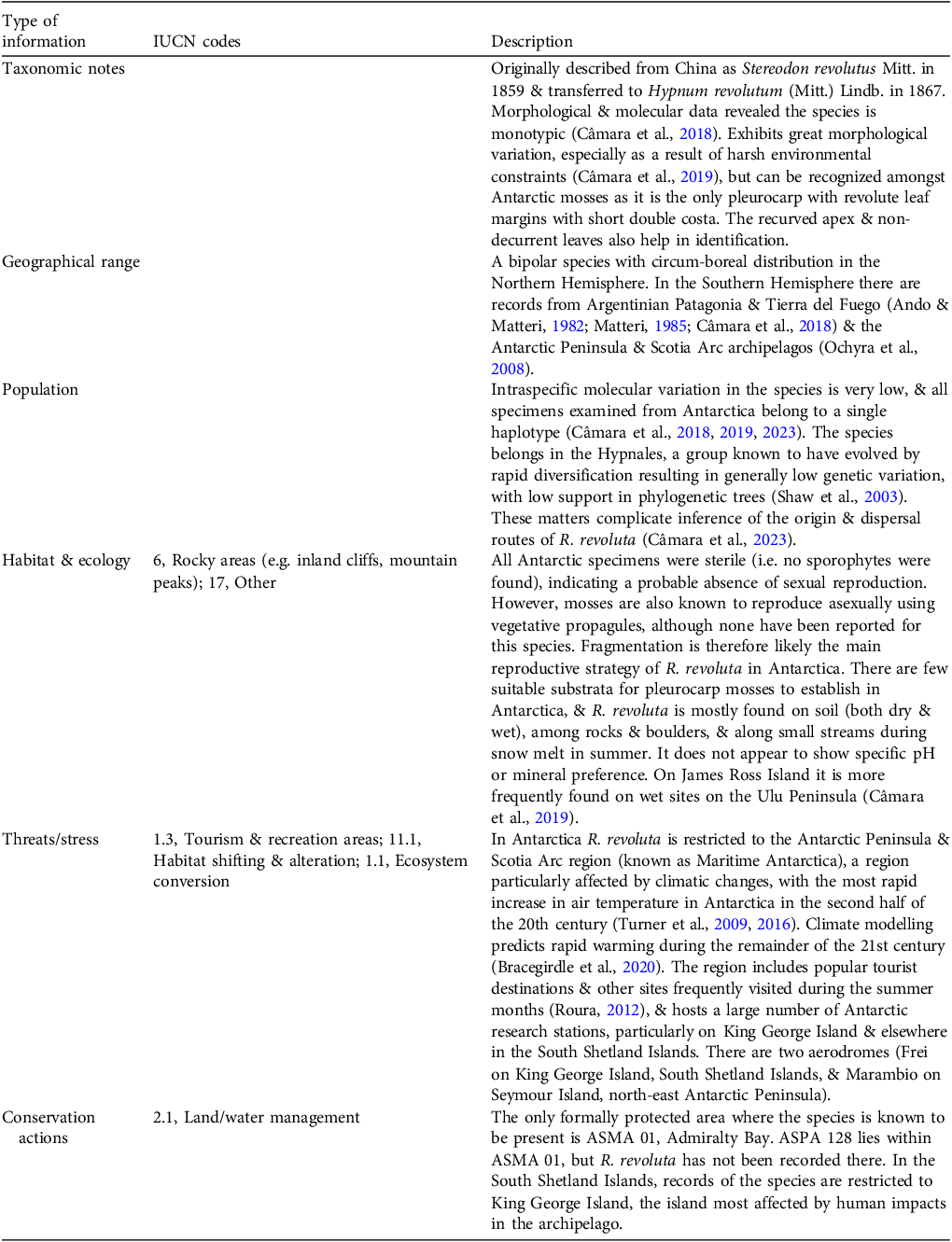
Following the protocol for extinction risk assessment (IUCN, 2024b), relevant data for R. revoluta were collated from various sources, including information on ecology, habitat availability, conservation actions and potential threats (Ando & Matteri, Reference Ando and Matteri1982; Câmara et al., Reference Câmara, Carvalho-Silva, Henriques, Poveda, Gallego and Stech2018, Reference Câmara, Valente, Amorim, Henriques, Carvalho-Silva, Convey and Stech2019, Reference Câmara, Carvalho-Silva, Valente, Henriques, De Amorim and Fava2023; Kučera et al., Reference Kučera, Kuznetsova, Manukjanová and Ignatov2019), and our own observations. The species was assessed for the five IUCN criteria (IUCN, 2024b), where relevant data were available: A, population size reduction; B, geographical range; C, small population size and decline; D, very small or restricted population; E, quantitative analyses. However, in practice some of these criteria are difficult to apply for bryophytes. The parameters of geographical range (EOO, extent of occurrence; AOO, area of occupancy in a grid of 4 km2 cells) were calculated using GeoCat (Bachman et al., Reference Bachman, Moat, Hill, De La Torre and Scott2011). Threats were assessed indirectly through a literature review of relevant variables (Table 1). This approach facilitates the inference of continuing declines in EOO, AOO, area, extent and/or quality of habitat, number of locations affected by threats or containing subpopulations, and the number of mature individuals (IUCN, 2024b). As R. revoluta is not restricted to Antarctica, the Guidelines for Application of IUCN Red List Criteria at Regional Levels (IUCN, 2012) were followed.
Information gathered to assess the extinction risk of the moss Roaldia revoluta in Antarctica. Type of information refers to the data requirements for an extinction risk assessment, as recommended by IUCN (2013), along with the designated codes for the relevant Red List Classification Schemes. Description provides the details required to support a risk assessment.

To determine the number of mature individuals, we followed the recommendations of Bergamini et al. (Reference Bergamini, Bisang, Hodgetts, Lockhart, van Rooy and Hallingbäck2019): for terricolous taxa growing on the ground, individual-equivalents within an area of 1 m² should be considered, regardless of whether the taxon occurs as a single branch or as a dense carpet of many ramets covering most of the surface (Plate 1). Occurrence points were plotted in the WGS 1984 Antarctic Polar Stereographic coordinate system using ArcGIS Pro 3.0.1 (Esri, USA). Subsequently, we removed duplicate records and calculated the distance from each occurrence to its nearest neighbouring occurrence, resulting in 81 unique spatial records. Next, a quadrangular 1 m2 buffer was generated around each occurrence using the buffer tool in ArcGIS, to visualize the overlap of the 1 × 1 m squares. Records with overlapping 1 × 1 m buffers were considered a single mature individual.
(a) A carpet of moss comprising various species, including Roaldia revoluta, exhibiting contamination by fungi and the formation of so-called fairy rings. (b) A moss carpet. (c,d) Close-up views of small leaves of R. revoluta under light microscopy (scale bar = 100 µm).

Results
Occurrences of R. revoluta confirm its distribution throughout Maritime Antarctica, with concentrations of records on King George Island (South Shetland Islands) and James Ross Island. Signy Island (South Orkney Islands) was the species’ northernmost Antarctic occurrence (with three records, RILS 354, 1450 and 5067) and Alexander Island its southernmost (with 30 records; Fig. 1). The recorded altitudes were 1.8–420.1 m. The occurrence data are presented in Supplementary Table 1.
All recorded occurrences of Roaldia revoluta in Antarctica. The 2 × 2 km grid on the left illustrates the calculation of the area of occupancy (AOO). The 1 × 1 m buffer cells on the right illustrate the method used to estimate population size; the 1 × 1 m buffers overlapped for only two records, which were 0.748 m apart.

Extent of occurrence was 519,760 km², which is above the threshold for the Vulnerable category. However, AOO was 252 km², which is above the threshold for the Critically Endangered category but below the threshold for the Endangered category. Our population data analysis indicated 80 individual-equivalents across its Antarctic distribution, with only two records having overlapping 1 × 1 m buffer squares, separated by 0.748 m (Fig. 1). Records of R. revoluta were identified from four Antarctic Conservation Biogeographic Regions (Terauds & Lee, Reference Terauds and Lee2016): South Orkney Islands, North-east Antarctic Peninsula, North-west Antarctic Peninsula and Central South Antarctic Peninsula.
The values for geographical range and population size allow the application of Red List criteria B and D, respectively. As the species does not produce sporophytes in Antarctica, it relies exclusively on asexual reproduction (vegetative propagules or ramet fragmentation), which limits its long-distance dispersal capacity. Thus, the distribution is considered severely fragmented, allowing the application of condition 2a for criterion B. Indirect impacts on the species are identified and summarized in Table 1 for the localities where the species was recorded. Notable threats include human impact and climate change. Human impact is a potential threat particularly for areas such as the South Shetland Islands that host multiple research stations and sites as well as many popular and frequently visited tourist destinations; King George Island, part of the South Shetland archipelago, is the location of most research stations, including an airfield. Ongoing climate change is leading to increases in temperature and other changes such as expansion of non-native species. Because of these ongoing threats, we can infer possible continuing decline of habitat quality and/or extent, allowing the application of condition 2b(iii) for criterion B. The recording of a total of 80 mature individuals supports the application of criterion D. On this basis, we assess R. revoluta as Endangered under criteria B2ab(iii); D.
Discussion
The taxonomy and bipolar distribution of R. revoluta have been the subject of extensive research, but the species’ extinction risk in Antarctica has not previously been assessed. It appears to have a regionally patchy distribution, split between areas with few or single collections and others where it is relatively common. Its two main centres of abundance are King George Island and James Ross Island (Câmara et al., Reference Câmara, Carvalho-Silva, Henriques, Poveda, Gallego and Stech2018, Reference Câmara, Valente, Amorim, Henriques, Carvalho-Silva, Convey and Stech2019), with 42 and 43 records, respectively. Areas with few occurrences include Rugged Island (near Livingston Island) in the South Shetlands, with a single record, and Wilkins Coast on the Antarctic Peninsula, with only one collection. Both islands have relatively mild temperatures compared to much of Antarctica (Turner et al., Reference Turner, Marshall, Clem, Colwell, Phillips and Lu2020) and offer suitable areas for plant colonization, especially mosses (Rydin, Reference Rydin2009; Glime & Bisang, Reference Glime and Bisang2017). However, the long-term presence of multiple research stations and active research sites in these areas can also contribute to what has been called a museum effect (Ponder et al., Reference Ponder, Carter, Flemons and Chapman2001), whereby the greater number of research facilities and activity correlates with increased species richness and a higher number of records (Amorim et al., Reference Amorim, Neto and Luizi-Ponzo2021). Conversely, the existence of scattered, smaller subpopulations that, in many cases, have not been visited by botanists for several decades reflects both logistical challenges, as many are in remote areas (e.g. Exasperation Island, Foyn Coast, Wilkins Coast, Vega Island), and the scarcity of appropriately trained taxonomists. Consequently, there is no recent confirmation of the continued existence or status of these subpopulations. Although large-scale extinctions of terrestrial biota in Antarctica have been reported during Miocene to Pleistocene glacial periods (Convey et al., Reference Convey, Gibson, Hillenbrand, Hodgson, Pugh, Smellie and Stevens2008), no local extinctions, even of subpopulations, have been confirmed in the more recent period of human contact with Antarctica (although there is an almost complete lack of biological monitoring for such changes in terrestrial Antarctica; Convey, Reference Convey2011).
Roaldia revoluta is categorized as Least Concern on the European Red List (Sabovljevic, Reference Sabovljevic2019) as it is widespread, has a stable population trend and its geographical range exceeds the thresholds for inclusion in a threat category under criterion B. However, despite there being no known major threats to the species in Europe, regional climate change could pose a future threat (Sabovljevic, Reference Sabovljevic2019). Widely distributed plants tend to have a lower overall risk of extinction (Lima et al., Reference Lima, Dauby, de Gasper, Fernandez, Vibrans, Oliveira and Ter Steege2024), generally exceeding the thresholds for use of criteria B, C and D (IUCN, 2024b). However, R. revoluta is categorized as Critically Endangered in the UK (Callaghan, Reference Callaghan2022), also using the 1 m² grid method, with a maximum population of < 50 mature individuals (criterion D). However, no potential for continuous declines was identified for the UK. Assessments at smaller regional scales are more likely to be influenced by region-specific threats, consistent with the extinction risk identified here for Antarctica.
The absence of sporophytes in specimens of R. revoluta from Antarctica (Smith & Convey, Reference Smith and Convey2002; Ochyra et al., Reference Ochyra, Smith and Bednarek-Ochyra2008; Câmara et al., Reference Câmara, Valente and Sancho2020, Reference Câmara, Carvalho-Silva, Valente, Henriques, De Amorim and Fava2023) infers that the species does not undergo sexual reproduction in the region. In bryophytes, asexual reproduction, through gemmae or fragmentation, results in more limited dispersal compared to sexual reproduction via spores (Laaka-Lindberg et al., Reference Laaka-Lindberg, Korpelainen and Pohjamo2003; Glime & Bisang, Reference Glime and Bisang2017). Whereas spores are microscopic and can be transported over long distances by wind, asexual propagules are larger and rely on more restricted dispersal mechanisms, such as water movement or direct contact with animals (Shaw, Reference Shaw1986; Glime et al., Reference Glime, Nissila, Trynoski and Fornwall1979; Hedenäs, Reference Hedenäs2014). This limitation reduces the species’ ability to recolonize distant areas, making predominantly asexual species more susceptible to the effects of habitat fragmentation (Löbel et al., Reference Löbel, Snäll and Rydin2009). Muñoz et al. (Reference Munoz, Felicisimo, Cabezas, Burgaz and Martinez2004) demonstrated the importance of wind for bryophyte dispersal by showing that, in the Southern Hemisphere, floristic similarities between areas were more strongly associated with maximum wind connectivity than with their geographical proximity. However, because vegetative propagules are generally much heavier than spores, they are not expected to be wind-dispersed over long distances. Supporting this limitation, Câmara et al. (Reference Câmara, Carvalho-Silva, Valente, Henriques, De Amorim and Fava2023) analysed 95 samples of R. revoluta from various regions of the world and found that all Antarctic specimens belong to the same haplotype, indicating that individuals in the region are genetically identical, i.e. clones (see also Hedenäs, Reference Hedenäs2012; Hebel et al., Reference Hebel, Dacasa Rüdinger, Jaña and Bastias2018). These data indicate extremely low genetic variability in the Antarctic populations. These findings are consistent with the IUCN concept of severe fragmentation (IUCN, 2024b), which applies when most individuals occur in small, isolated subpopulations with a low probability of recolonization in the event of local extinction. Given the extremely limited dispersal capacity, the absence of sexual reproduction, and the clonal structure of the Antarctic populations, R. revoluta can be considered severely fragmented in the region.
There are no studies of threats to R. revoluta, and information of their impact on the broader local biota remains scarce. However, in a study evaluating the spatial distribution of cumulative impacts on the terrestrial ecosystems of the Fildes Peninsula (King George Island; Gao et al., Reference Gao, Li, Gao, Hou, Jin, Ye and Na2021), more than half of the land area (57.3%) was assessed as very low impact or low impact, mostly located in the north and southern interior parts of the peninsula where there is much less human activity. Areas with very high impact (4.8%) were mainly in the central eastern part of the peninsula, near Ardley Bay, around Great Wall Station, and north-east of Ardley Island. High-impact areas were primarily associated with frequent human activities. Additionally, of the five threats considered in that study, three have direct impacts on the terrestrial environment: pollutants (including accidental oil spills), tourism and research station operations. The South Shetland Islands and north-west Antarctic Peninsula have the highest concentration of tourism activities and the greatest concentration of research stations on Antarctica (Tejedo et al., Reference Tejedo, Benayas, Cajiao, Leung, De Filippo and Liggett2022), with considerable cumulative impacts (Convey, Reference Convey2020). King George Island is one of the most impacted parts of this region as a result of human activities, with the presence of scientific stations from nine countries (Argentina, Brazil, Chile, China, Peru, Poland, Russia, South Korea and Uruguay). The USA and Ecuador also maintain smaller facilities (summer field stations and refugia) on the island, with the region’s logistic accessibility from southern South America reflected in the intensity of research and tourism activity, including an airport operated on King George Island by Chile. The cumulative impacts of these activities have received insufficient attention or control, and comprehensive, long-term monitoring programmes are not in place (Convey, Reference Convey2020; Tejedo et al., Reference Tejedo, Benayas, Cajiao, Leung, De Filippo and Liggett2022). However, human presence, activities and their various consequences are generally accepted to be threats to the continent’s biodiversity (Convey & Peck, Reference Convey and Peck2019; Lee et al., Reference Lee, Terauds, Carwardine, Shaw, Fuller and Possingham2022; Siegert et al., Reference Siegert, Atkinson, Banwell, Brandon, Convey and Davies2019, Reference Siegert, Bentley, Atkinson, Bracegirdle, Convey and Davies2023). This supports the application of the concept of continuous decline in habitat quality and extent (IUCN, 2024b).
The impact of invasive alien species on Antarctica is a growing concern for the region’s biodiversity. Invasive species may eventually outcompete native species for resources, alter habitat structure, and introduce diseases to which native species have no resistance (Molina-Montenegro et al., Reference Molina-Montenegro, Carrasco-Urra, Acuña-Rodríguez, Oses, Torres-Díaz and Chwedorzewska2014; Hughes et al., Reference Hughes, Pertierra, Molina-Montenegro and Convey2015, Reference Hughes, Convey and Lee2025). For instance, the invasive grass P. annua has a positive correlation between its abundance and the level of soil disturbance: disturbed conditions increased germination rate for P. annua, but the germination of native species in experimentally disturbed soil remained unchanged or even reduced compared to undisturbed soil (Molina-Montenegro et al., Reference Molina-Montenegro, Carrasco-Urra, Acuña-Rodríguez, Oses, Torres-Díaz and Chwedorzewska2014). This indicates that human activities modifying the abiotic characteristics of soil can significantly influence the abundance of this invasive species. Atala et al. (Reference Atala, Pertierra, Aragón, Carrasco-Urra, Lavín and Gallardo-Cerda2019), in an experimental study investigating the potential for interactions between native and non-native vascular plant species in Antarctica, found that the native D. antarctica facilitated the establishment of the invasive P. annua, with this facilitation effect stronger under more stressful conditions. Management and prevention strategies are critical for mitigating the impact of invasive species. Measures include stringent biosecurity protocols to prevent the introduction of non-native species, monitoring programmes to detect and respond to new invasions, and public awareness campaigns to educate visitors and researchers about the risks and responsibilities associated with human activities in Antarctica (Malfasi et al., Reference Malfasi, Convey, Zaccara and Cannone2020). To date, the direct effects of invasive species on Antarctic bryophyte communities have not been studied. However, cold-tolerant invasive plant species, particularly those prevalent in the sub-Antarctic islands, pose a threat to Antarctica because of climate warming (Bokhorst et al., Reference Bokhorst, Convey, Casanova-Katny and Aerts2021; Sindel et al., Reference Sindel, Wilson, Wilson, Hawking, Zahid and Iqbal2022). The spread of such species needs to be prevented through effective control and eradication actions. The threats posed by invasive species also support the inference of declining habitat quality.
Climate change is a further exacerbating threat to Antarctic biodiversity. In a study of the extinction risk of European bryophytes predicted by bioclimatic variables and related to functional traits (van Zuijlen et al., Reference van Zuijlen, Bisang, Nobis and Bergamini2024), the proportion of threatened species decreased with increasing plant size, and species that produce sporophytes were less likely to be threatened. Generalized predictions about performance changes for bryophytes are difficult to make as there is a lack of basic knowledge about species growth (Lee et al., Reference Lee, Terauds, Carwardine, Shaw, Fuller and Possingham2022). Warmer conditions and greater water availability may lead to increased growth and sexual reproduction (Glime & Bisang, Reference Glime and Bisang2017). An example is provided by recent observations of abundantly fruiting Sanionia uncinata on King George Island (Vargas et al., Reference Vargas, Goulart, de Andrade, Lemos, de Albuquerque and Peixoto2024), a species not previously noted to commonly produce sporophytes in Antarctica (Smith & Convey, Reference Smith and Convey2002). The expansion of certain types of vegetation cover in Maritime Antarctica, particularly with the two native flowering plants D. antarctica and C. quitensis and bank-forming mosses, has been documented (Cannone et al., Reference Cannone, Dalle Fratte, Convey, Worland and Guglielmin2017, Reference Cannone, Malfasi, Favero-Longo, Convey and Guglielmin2022). However, recent reports of biologically implausible large increases in the extent of moss-dominated ecosystems in this region (Roland et al., Reference Roland, Bartlett, Charman, Anderson, Hodgson, Amesbury and Maclean2024) are based on erroneous assumptions and misinterpretations of satellite data, combined with the absence of ground-truthing (Bokhorst et al., Reference Bokhorst, Huisman, de Jonge, Janssen, Cornelissen, Hughes and Convey2024; Colesie et al., 2024). Although detailed studies are lacking, climate change is expected to increase water availability in some areas of the Maritime Antarctic, which may facilitate the expansion of more competitive plant species (Cannone et al., Reference Cannone, Malfasi, Favero-Longo, Convey and Guglielmin2022). This process could lead to increased competition for space and resources, supporting the inference of a continuous decline in the extent and quality of the habitat of R. revoluta. Although such projections are based on other areas or species, they are considered an indirect measure and are acceptable for making inferences (IUCN, 2024b), as applied here for R. revoluta in Antarctica.
Regarding conservation actions for R. revoluta in Antarctica, the available records indicate the species occurs only within one Antarctic Specially Managed Area (ASMA-1, Admiralty Bay, King George Island), with no records of its presence within any Antarctic Specially Protected Areas. Under the terms of the Antarctic Treaty, Antarctic Specially Protected Areas (Bonner and Smith, Reference Bonner and Smith1985; Hughes et al., Reference Hughes, Pertierra and Walton2013) are designated to protect specified values (i.e. environmental, scientific, historical, aesthetic or wilderness values), whereas Antarctic Specially Managed Areas are designated to assist in the planning and coordination of activities, with less emphasis on actions for biodiversity protection, and also include areas that can be visited by tourists. Most of the 74 Antarctic Specially Protected Areas have been designated primarily to protect major colonies of marine birds or mammals, with none designated primarily for protecting the habitat of a plant species (Hughes et al., Reference Hughes, Convey and Turner2021). The flora of the Antarctic continent is insufficiently protected (Hughes et al., Reference Hughes, Ireland, Convey and Fleming2016), emphasizing the need for the Antarctic Treaty Consultative Parties, the governing body of the continent, to support the designation of further Antarctic Specially Protected Areas specifically for the protection of plant communities. Although Antarctic Specially Protected Areas currently cover < 2% of the continent’s ice-free areas, 44% of plant species are known to be present within at least one protected area (Wauchope et al., Reference Wauchope, Shaw and Terauds2019). Our study highlights how knowledge of the extinction risk of species such as R. revoluta can provide the first step towards designating future Antarctic Specially Protected Areas that include the presence of threatened plants.
Supplementary material
The supplementary material for this article is available at doi.org/10.1017/S0030605325102135
Author contributions
Assessing extinction risk, population estimates: ETA, GLC; sampling, specimen identification: PEASC; compiling occurrence data: BLEN; map design: GLC; writing: all authors.
Acknowledgements
We thank the curators of the herbaria mentioned. Antarctic logistical support was provided by PROANTAR. We acknowledge the Brazilian Navy, Air Force, Secretaria Interministerial para Recursos do Mar, and Conselho Nacional de Desenvolvimento Cientifico e Tecnologico. Funds were provided by Conselho Nacional de Desenvolvimento Cientifico e Tecnologico. PC is supported by NERC core funding to the British Antarctic Survey’s Biodiversity, Evolution and Adaptation team.
Conflicts of interest
None.
Ethical standards
No specific approval was required, and this research abided by the Oryx guidelines on ethical standards.
Data availability
The occurrences are available in Supplementary Table 1.


 Open access

