


Introduction
Rare diseases affect nearly 30 million Americans and present a significant physical, financial, and emotional impact on patients which is further compounded by lack of research and public awareness (Griggs et al., Reference Griggs, Batshaw, Dunkle, Kaye, Krischer, Nguyen, Paulus and Merkel2009). Unfortunately, the psychological effect of having a rare disease often plays an equally large role in co-occurring feelings of despair, lack of therapeutic hope, social isolation, and discrimination (von der Lippe et al., Reference von der Lippe, Diesen and Feragen2017). Thus, increasing public awareness may have a significant impact on the overall health of persons with rare diseases.
One study analyzed the effects of season releases of a popular streaming show including a main actor having cleidocranial dysplasia, a disorder affecting roughly 1 per million people, on public awareness and found a 94% increase in Google searches following the episode’s release (Johnson et al., Reference Johnson, Torgerson, Cooper, Khojasteh and Vassar2020). This suggests actors may play a role in educating the public on rare diseases. On 1 May 2017, Jimmy Kimmel Live! aired an episode in which Kimmel explained that his son, William Kimmel, was born with tetralogy of Fallot - a rare disorder of the heart classically defined as the combination of pulmonary stenosis, ventricular septal defect, overriding aorta, and right ventricular hypertrophy. Our study objective was to analyze the increases in search volume and Tweets after the episode was released to investigate the effects of the entertainment industry on public awareness of tetralogy of Fallot.
Methods
We performed a cross-sectional study of Google Trends (GoogleTrends.com) and Twitter using Sprout Social (SproutSocial.com) — the two most frequently used platforms for health and information, from March 1 through June 1, 2017, for “tetralogy of Fallot.” The time frame was selected to limit confounding variables. Google Trends utilizes relative search volume which is scaled from 0–100 with 100 representing the highest peak volume within the timeframe. To analyze expected search and Tweet volume had Kimmel not publicly discussed tetralogy of Fallot, we constructed forecasting models (Hyndman & Khandakar, Reference Hyndman and Khandakar2008) using autoregressive integrated moving average (ARIMA) algorithms in R (version 3.6.1) with parameters p, d, and q determined by the auto.arima function in the Forecast package using Akaike information criterion (AICc) adjusted for small samples. For the Google Trends data, these parameters were set as 0, 0, and 0 which inherently predicts the historical mean. These parameters were set at 0, 0, and 1 for the Twitter data.
Results
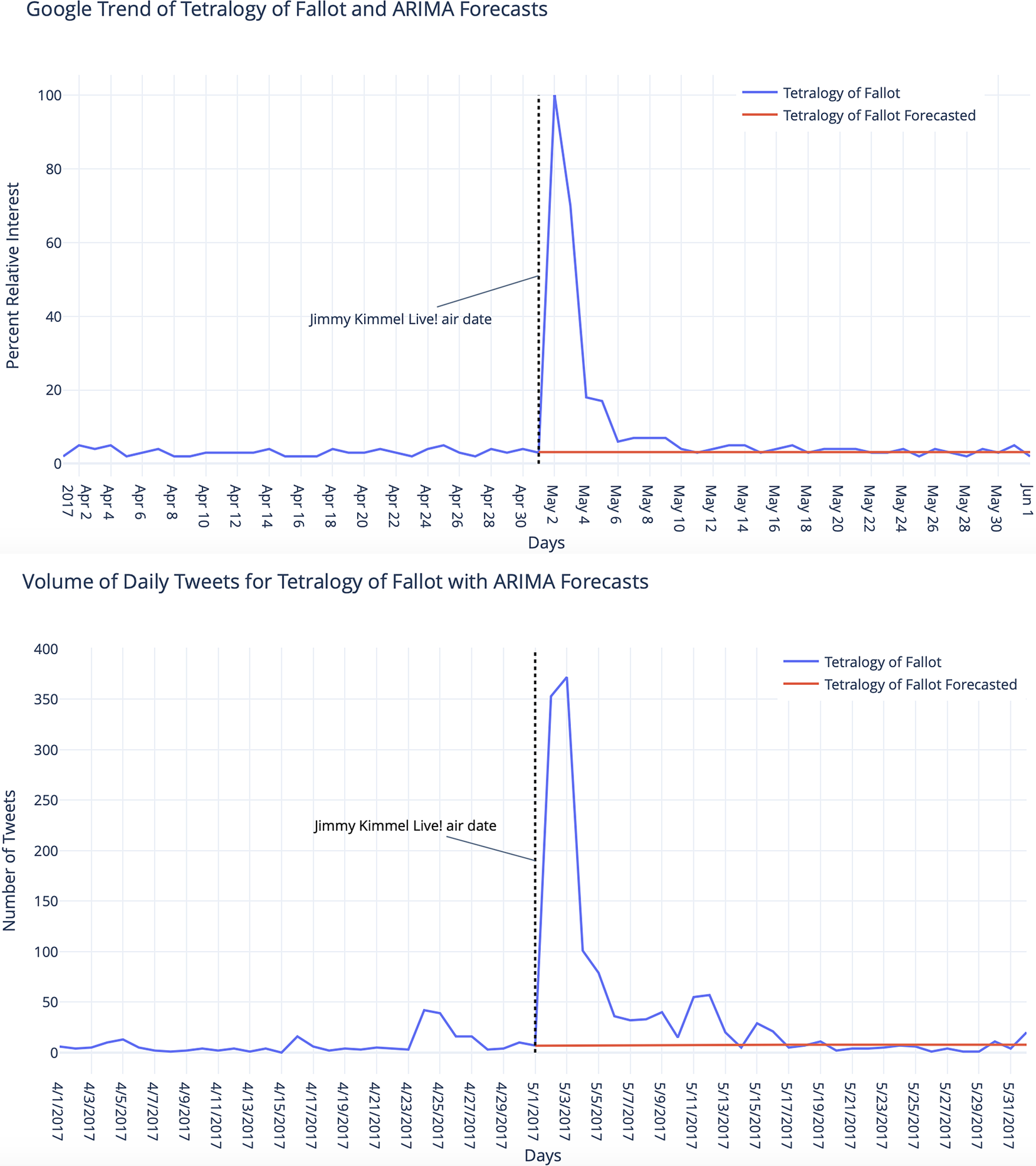
Following the episode of Jimmy Kimmel Live!, there were significant increases in Google searches and Tweets. The day after the episode aired (May 2, 2017), relative search interest from Google Trends for “Tetralogy of Fallot” peaked 96.84 (95% CI 94.94 - 98.74) points above the forecasted value (3.16; 95% CI 1.26 - 5.06); an increase of 3063.27% (Figure 1). The number of tweets mentioning “Tetralogy of Fallot” peaked on May 3, 2017 with a total of 364.21 (95% CI 345.03 - 383.38) tweets above the forecasted value (7.79; 95% CI -11.38 - 26.97); an increase of 4672.62%.
Figure 1 shows the relative search interest, number of Tweets, and the forecasted trends for "Tetralogy of Fallot" by month. Jimmy Kimmel Live air date is indicated by the vertical dashed line.
Discussion
This study found a significant increase in public awareness of tetralogy of Fallot following an episode of Jimmy Kimmel Live! in which the host discusses his son’s rare birth condition. Studies have found increases in public awareness following actors’ heightened media attention and their respective conditions (Johnson et al., Reference Johnson, Torgerson, Cooper, Khojasteh and Vassar2020). However, this study is the first, to our knowledge, to analyze the effect of talk shows on increasing public awareness of health conditions. Furthermore, one of the authors (JC) has been diagnosed with tetralogy of Fallot and notes an anecdotal increase in awareness, support, and curiosity of this condition from lay people who frequently cite the airing of Jimmy Kimmel announcing his son’s diagnosis. In light of these findings, as well as current evidence, it can be suggested that increasing awareness of rare diseases may improve peer support, reduce symptom to diagnosis time, increase research funding, and expand treatment options (von der Lippe et al., Reference von der Lippe, Diesen and Feragen2017).
Our study is not without limitations. First, our current study is unable to gauge retention of awareness of tetralogy of Fallot. Second, although Google and Twitter are the most widely used platforms for lay person health information retrieval (Antheunis et al., Reference Antheunis, Tates and Nieboer2013), they may not accurately represent public interest in tetralogy of Fallot which may have skewed our results. Additionally, though our study demonstrated increased interest, we were unable to determine if this interest was translated into true knowledge and understanding of tetralogy of Fallot. However, it is the author’s feeling that these findings may represent a novel method to decrease stigma and increase public awareness of tetralogy of Fallot and other rare diseases. Therefore, we recommend physicians and those with the appropriate platforms consider the use or support of talk shows (or other media) to aid in the dissemination of knowledge regarding rare diseases.
Data suppository statement.
The data that support the findings of this study are openly available from GoogleTrends.com and SproutSocial.com.
Financial support
This research received no specific grant from any funding agency, commercial or not-for-profit sectors.
Conflicts of interest
None.
Author contributions
BG and MH carried out the experiment. BG wrote the manuscript with support from AL, JC, and MH. BG, AL, JC, and MH analyzed the data. BG and MH performed statistical analyses. MH helped supervise the project. BG and MH conceived the original idea.
Role of Funding Source.
This study was not funded.
Conflict of Interest
We declare no conflicts of interest.
Supplementary Materials
To view supplementary material for this article, please visit http://dx.doi.org/10.1017/exp.2020.34.


 Open access


Comments
Comments to the Author: This is a somewhat minimal but original study. The question and conclusion are clear, the methods appear to be sound (although I cannot comment on the statistical methods) and the limitations have been discussed.1. More than just two sources (Google Trends and Twitter) should be considered for the study.2. Change "with" to "within" in "[…] highest peak volume with timeframe"?3. Split "Studies have found […]" into two sentences: "Studies have found […] conditions. However, this study […]".4. Reference 3 is incomplete.5. Revise spelling of "TheforecastPackage forR" in reference 5.6. A figure legend has to be provided7. Figure panels should be labeled "A" and "B".