



Irritable bowel syndrome
Functional bowel disorders are characterised by chronic lower gastrointestinal (GI) symptoms in the absence of alarm features that suggest presence of other disease( Reference Longstreth, Thompson and Chey 1 , Reference Gunnarsson and Simren 2 ). The criteria for irritable bowel syndrome (IBS), one of the most common functional bowel disorders, requires the presence of abdominal pain or discomfort together with an alteration in stool output( Reference Longstreth, Thompson and Chey 1 ). IBS is a common condition worldwide, contributes up to 30 % of gastroenterology consultations in the UK( Reference Harvey, Salih and Read 3 ), affects more females than males and is more prevalent in those under 40 years of age( Reference Lovell and Ford 4 ). A pooled prevalence of IBS in 14 % of females and 9 % of males has been reported in a large systematic review and meta-analysis of fifty-five studies conducted across America, Asia, Europe and Africa( Reference Lovell and Ford 4 ).
Four different IBS subtypes exist based on predominant stool form, and each may differ in their aetiology. Patients with diarrhoea-predominant IBS (IBS-D) and constipation-predominant subtypes, are characterised by the extremes of stool form. Mixed subtype patients have both diarrhoea and constipation, and unsubtyped IBS patients generally pass normal stools( Reference Longstreth, Thompson and Chey 1 ). IBS-D is often the most common subtype reported, with a prevalence of 40–60 % of all IBS( Reference Yao, Yang and Cui 5 , Reference Engsbro, Simren and Bytzer 6 ). Identification of diagnostic biomarkers in IBS has been of recent interest, and may present a future opportunity for rapid diagnosis of the condition, but currently symptom-based diagnosis is routine in clinical practice.
Despite the utility of distinct classifications, symptomatology in patients is often heterogeneous and unstable( Reference Engsbro, Simren and Bytzer 6 , Reference Mearin, Baro and Roset 7 ). Altered stool form and abdominal pain or discomfort are the hallmark features of IBS; however, other symptoms frequently co-exist, including lower GI symptoms such as bloating, flatulence, urgency and defecation difficulties, as well as upper GI symptoms, chronic pain syndromes (e.g. fibromyalgia), psychiatric conditions, somatisation and lethargy( Reference Ladabaum, Boyd and Zhao 8 , Reference Whitehead, Palsson and Levy 9 ). The higher incidence of GI and extra-intestinal conditions in IBS compared with healthy individuals may be due to hypervigilance and a lower threshold for medical consultation, and contributes to a negative impact on quality of life, which may be lower than patients with diabetes or end stage renal disease( Reference Gralnek, Hays and Kilbourne 10 ). The chronic nature of IBS, its high prevalence and its associated comorbidities contribute to a considerable economic burden on healthcare.
The complex pathophysiology, symptom heterogeneity of presenting patients, and instability of symptoms in IBS raises treatment challenges. Treatment is largely empirical and after lifestyle considerations (stress reduction, exercise, diet, etc.) have been addressed, medical treatment is targeted towards the predominant symptom with antispasmodics, anti-diarrhoeals or over-the-counter non-gas producing laxatives (osmotic, bulking-forming or stool softeners)( 11 ). Low-dose antidepressants (tricyclic antidepressants or selective serotonin reuptake inhibitors) are effective in some patients and psychological and behavioural interventions are of benefit( Reference Ford, Moayyedi and Lacy 12 ); however, access to these services may be limited.
Many patients believe that their IBS symptoms are related to diet. There is generally a lack of evidence regarding the underlying mechanisms by which food provokes symptoms in IBS, which has limited the development of validated diagnostic tests to identify specific food triggers. Furthermore, evidence for the effect of dietary intervention on IBS symptoms has historically been scarce. Data regarding manipulation of dietary fibre intake in IBS are inconsistent( Reference Eswaran, Muir and Chey 13 ), and although associations between IBS symptoms and intake of caffeine, alcohol and fat have been reported in cross-sectional studies, no randomised control trial (RCT) investigating the effect of their restriction have been performed. Nevertheless, interest in the dietary management of IBS continues to grow among clinicians and patients.
Pathogenesis of irritable bowel syndrome
The pathogenesis of IBS is incompletely understood but is known to be multifactorial and complex in nature. Peripheral factors such as abnormal GI motility, low-grade inflammation, increased epithelial permeability and visceral hypersensitivity are recognised as important factors, as are psychosocial aspects.
Abnormal motility has historically been considered an important factor in IBS pathogenesis. Exaggerated motility response in the small intestine and the colon to stimuli such as food and stress has been demonstrated( Reference Gunnarsson and Simren 14 ), which may contribute to urgency, diarrhoea and pain symptoms. Altered mucosal secretion and/or uptake of serotonin into enterocytes are likely to be important in motility abnormalities in IBS( Reference Spiller 15 ), and recent evidence confirms the key role of the microbiota in modulating colonic motility, at least in animal models( Reference Kashyap, Marcobal and Ursell 16 ).
There is growing evidence for the presence of low-grade inflammation in some patients with IBS. Factors supporting this theory include the increased risk of IBS following GI infection (post-infectious IBS)( Reference Marshall, Thabane, Garg and Clark 17 ), and persistent increases in a range of mucosal inflammatory markers( Reference Ohman and Simren 18 ). Increased blood concentrations of some (IL-6 and IL-8) but not all (activated T cells e.g. CD4+) inflammatory mediators, has been demonstrated compared with healthy individuals( Reference Matricon, Meleine and Gelot 19 ). The most consistent finding in this area is enhanced colonic infiltration of mucosal mast cells( Reference Matricon, Meleine and Gelot 19 ), cells important for pathogen defence and that may directly influence enteric sensory nerves( Reference Barbara, Stanghellini and De Giorgio 20 ). Indeed, higher colorectal mucosal mast cell infiltration has been reported in IBS-D compared with healthy controls, levels that were comparable with samples of patients with ulcerative colitis in remission( Reference Ahn, Lee and Choi 21 ). It is proposed that increased intestinal permeability (i.e. increased permeability of the epithelial layer) and alterations in tight junction protein expression may be the underlying reason for local GI dysfunction, uptake of pathogenic bacteria and these inflammatory changes. However, many studies do not adjust for confounders such as stress and depression, which are independently associated with inflammatory changes( Reference Piche, Saint-Paul and Dainese 22 ). Nevertheless, it appears likely that epithelial permeability abnormality and immune activation may be important in a select subgroup of patients with IBS, however their relationship with symptoms, and whether they are a primary or secondary phenomenon is unclear.
One key pathophysiological feature of IBS is visceral hypersensitivity, or the intensification of signals from the GI tract to the brain, which leads to augmentation of symptom response in the IBS patient. Visceral afferent responses are induced by luminal, mechanical (e.g. distension) and chemical stimuli in the GI tract. Visceral hypersensitivity measured via rectal balloon distension has revealed that at least 50 % of IBS patients have enhanced visceroperception on balloon inflation compared to only 6 % of controls( Reference Ritchie 23 ). The GI microbiota and psychological distress have been theorised as mediators of this enhanced sensitivity( Reference Hungin, Becher and Cayley 24 ).
Central nervous system alterations have been proposed to contribute to the pathophysiology of IBS, especially in patients with severe symptoms( Reference Drossman, Chang and Bellamy 25 ). Abnormalities in afferent processing and the activation of emotional arousal networks that modulate the afferent signals have been identified. Along with these central alterations, accumulating evidence suggests that psychological stressors may have a direct role in the pathogenesis of IBS. For example, the presence of anxiety or depression increases the risk of post-infectious IBS( Reference Marshall, Thabane, Garg and Clark 17 ) and patients with IBS report a higher prevalence of early life trauma (e.g. physical, emotional or sexual abuse) than healthy controls, especially among females( Reference Bradford, Shih and Videlock 26 ). The 2-fold higher prevalence of anxiety and depression in patients with IBS compared with healthy controls( Reference Ladabaum, Boyd and Zhao 8 ) confirms the strong association between psychological comorbidity and IBS, although a clear cause–effect relationship is yet to be established.
Finally, there is dysregulation of the microbiome–brain–gut axis, the relationship between the microbiome (the collective genomic material of the host microbiota) and the central nervous system. Dysbiosis and altered production of fermentation byproducts have also recently been implicated as major contributors to the pathogenesis of IBS.
The gastrointestinal microbiota
The GI tract harbours 1014 bacteria, ten times more than the total number of cells in the human body and 150 times more genes than of the human genome. Lower pH and fast transit inhibit growth of bacteria in the upper GI tract and bacterial density and diversity increases distally to the stomach with a final microbial concentration of approximately 1011 cells/ml in the colon( Reference Walter and Ley 27 ). The microbiota is a highly diverse, metabolically active community that exerts important influences on health and disease, and the host–microbiota relationship has been described as a mutualistic ecosystem, as both benefit from the relationship( Reference Backhed, Ley and Sonnenburg 28 ). Two distinct GI microbiota populations exist: that within the colonic lumen and that within the mucosa overlying the epithelium( Reference Zoetendal, von Wright and Vilpponen-Salmela 29 ). The luminal microbiota is easily accessible via sampling of the stool, and is likely a combination of non-adherent luminal bacteria with a mix of shed mucosal bacteria. There is significant variability in the composition of the luminal microbiota composition along the GI tract( Reference Walter and Ley 27 ), suggesting that diet and environmental conditions have a powerful impact on this compartment. Conversely, the microbiota composition in the mucosa is highly stable within an individual( Reference Lepage, Seksik and Sutren 30 ), suggesting a stronger host influence than the influence from environmental factors. Importantly, the mucosal microbiota are involved in the ‘crosstalk’ between the lumen and the underlying tissue at the mucosal border, where immune and enteroendocrine cells interact( Reference Ohman, Tornblom and Simren 31 ).
The composition of the microbiota has emerged as an important focus of research over recent decades in response to an increased understanding of its contribution to heath and disease. The two major phyla, Firmicutes and Bateroidetes, make up at least 90 % of the known bacteria in the GI tract, and Actinobacteria contributes less than 10 %. Human individuals harbour about 160 bacterial species in total in the GI tract, seventy-five of which are found in up to 50 % of individuals, indicating the presence of a core group of microbiota within the human GI tract. Therefore, despite the existence of a common core microbiota, large inter-individual variability in microbiota composition, including in the abundance of these core species, is possible( Reference Qin, Li, Raes and Arumugam 32 ). It has been suggested that healthy individuals harbour one of three types of microbiota clusters, termed enterotypes, driven by species composition (i.e. dominated by Bacteroides, Prevotella or Ruminococcus). It had been postulated that each state may be prognostically and diagnostically predictive( Reference Arumugam, Raes and Pelletier 33 ), however the existence, and the number of distinct enterotype classifications has recently been questioned( Reference Knights, Ward and McKinlay 34 ).
The GI microbiota fulfils a number of diverse beneficial physiological functions. One key function is the breakdown of otherwise indigestible carbohydrates, leading to the production of SCFA, which contribute to reduced colonic pH and inhibition of pathogen growth. Butyrate, one of the SCFA, has a number of important functions including provision of energy substrate to enterocytes and some bacterial species, increasing expression of some epithelial tight junction proteins, and other immunomodulatory functions( Reference Kannampalli, Shaker and Sengupta 35 ). The GI microbiota also impacts on bile acid metabolism, synthesises a number of B vitamins and vitamin K, produces antimicrobial bacteriocins and is responsible for numerous other metabolic and immune functions.
Host factors such as gender, age( Reference Claesson, Jeffery and Conde 36 ), ethnicity( Reference Yatsunenko, Rey and Manary 37 ) and bodyweight( Reference Ley, Turnbaugh and Klein 38 ) impact on the composition of the microbiota, some of which may also be impacted by differences in comorbidity, diet or drug exposure. The community is self-shaping as organisms ‘assemble themselves according to available niches’( Reference Walter and Ley 27 ) and compete for their position within the community, determined largely by the adaptability of the organism phenotype, the physical environmental condition of the GI tract (e.g. gastric acid, motility and GI secretions)( Reference Jalanka-Tuovinen, Salonen and Nikkila 39 ), genetic factors and colonisation history( Reference Walter and Ley 27 ). There is an overall resilience of the healthy microbiome, which enables the system to return to an equilibrium after minor shifts, with only some temporal variability( Reference Relman 40 ).
Existing research supports the role of long-term dietary intake as a key factor mediating the composition of the GI microbiota. A number of comparative studies using high-throughout metagenomic sequencing techniques have demonstrated a marked distinction in luminal microbiota composition between individuals from rural v. Western communities. Comparative studies of African Americans v. rural African adults( Reference Schnorr, Candela and Rampelli 41 ), African children v. Italian children( Reference De Filippo, Cavalieri and Di Paola 42 ), and Venezuelan v. US v. Malawi communities( Reference Yatsunenko, Rey and Manary 37 ) have revealed these differences, which are attributed to substantial differences in habitual dietary intake. Other studies established that divergence in microbiota composition in community-dwelling elderly individuals v. those in long-term care( Reference Claesson, Jeffery and Conde 36 ) and athletes v. bodyweight-matched controls( Reference Clarke, Murphy and O'Sullivan 43 ) is due to differences in habitual dietary intake. Two studies thus far have directly measured dietary intake and associated long-term exposure to certain dietary components with microbiota composition( Reference David, Maurice and Carmody 44 , Reference Wu, Chen and Hoffmann 45 ). The most consistent findings so far include enrichment of the genus Prevotella in individuals with higher fibre diets( Reference Schnorr, Candela and Rampelli 41 , Reference De Filippo, Cavalieri and Di Paola 42 , Reference David, Maurice and Carmody 44 , Reference Wu, Chen and Hoffmann 45 ) and a higher diversity and richness of the microbiota in agrarian v. Western style communities( Reference Yatsunenko, Rey and Manary 37 , Reference Schnorr, Candela and Rampelli 41 , Reference De Filippo, Cavalieri and Di Paola 42 ). Importantly, this is accompanied by alterations in microbiota byproducts in some studies (e.g. SCFA)( Reference Schnorr, Candela and Rampelli 41 , Reference De Filippo, Cavalieri and Di Paola 42 ), indicating diet may not just shape the microbiota community but also its functionality. There is little acknowledgement and/or agreement on the role played by host-specific and environmental factors (e.g. genotype, morbidity and sanitation) in influencing host physiology in these types of comparative studies.
The GI microbiota may contribute to overall human health and disease. For example, one study demonstrated greater richness and diversity of the luminal microbiota in an elderly cohort (n 178) was correlated with better nutritional status and health( Reference Claesson, Jeffery and Conde 36 ), and studies in children suggest that a less diverse microbiota is associated with higher risk of allergic disease( Reference Storro, Avershina and Rudi 46 ). Furthermore, some disease states (e.g. inflammatory bowel disease, IBS and Clostridium difficile-associated disease) are characterised by low bacterial diversity( Reference Lozupone, Stombaugh and Gordon 47 ), and a low gene count (reduced ‘bacterial richness’) is associated with a phenotype characterised by greater overall adiposity and insulin resistance( Reference Le Chatelier, Nielsen and Qin 48 ). Cause–effect relationships are not yet clear here, but data from animal microbiota transplantation models suggest some of these changes are not merely a consequence of the disease( Reference Turnbaugh, Ley and Mahowald 49 ).
Together with the overall composition of the microbiota, specific bacteria are individually recognised for their health-promoting effects, some of which have been termed ‘keystone species’( Reference Scott, Antoine and Midtvedt 50 ). For example, Faecalibacterium prausnitzii, a member of the phylum Firmicutes, is one of the major commensal butyrate producers. It has been labelled as a biomarker of intestinal health in adults( Reference Miquel, Martin and Rossi 51 ) and is associated with maintenance of remission in inflammatory bowel disease. Bifidobacteria, a genus within the phylum Actinobacteria, has established beneficial effects on health. As well as fermenting carbohydrates and producing SCFA (acetate) and lactic acid, this group is immunomodulatory, may reduce induced colonic carcinogenesis in animals and has numerous other systemic effects, including on blood cholesterol( Reference Russell, Ross and Fitzgerald 52 ). Conversely, a phylogenetic pattern of decreased F. prausnitzii, Bifidobacteria and Akkermansia and increased Bacteroides is evident in low gene count individuals with an inflammatory phenotype( Reference Le Chatelier, Nielsen and Qin 48 ), further supporting the potential importance of specific bacteria in disease pathogenesis. The contribution of habitual dietary intake in mediating these alterations in disease is largely unknown.
Irritable bowel syndrome and the gastrointestinal microbiota
There is evidence from both animal and human studies to support the key role of the GI microbiota in the development and persistence of IBS. Firstly, germfree mice models provide direct evidence that the GI microbiota can induce local GI dysfunction with transplantation of dysbiotic stool from individuals with IBS leading to altered microbiota along with features of IBS such as visceral hypersensitivity in the mice at 4 weeks( Reference Crouzet, Gaultier and Del'Homme 53 ). Behavioural changes have also been identified in transplanted mice, suggesting dysbiosis might be responsible for behavioural symptoms as well as colonic motor dysfunction in IBS( Reference Collins 54 ). However, in the absence of definitive animal models of IBS, a direct cause–effect relationship cannot be definitively proven.
The second line of evidence relates to post infectious IBS (PI-IBS), a reproducible human model of IBS pathogenesis. There is clear epidemiological evidence that GI bacterial infection leads to an increased likelihood of persistent functional GI symptoms despite clearance of the pathogen. This has been demonstrated at 8 years following the acute infection, with prior psychological morbidity, female gender, and the severity of the initial infection identified as predisposing factors leading to persisting PI-IBS( Reference Marshall, Thabane, Garg and Clark 17 ). This is strong evidence that the microbiota have a primary role in the onset of IBS in a subset of patients. Mechanisms underlying this process are unclear but may be via transient alteration of the microbiota composition post infection, and ongoing dysbiosis in the presence of low grade mucosal inflammation( Reference Collins 54 ).
Thirdly, a growing evidence base for dysbiosis in IBS suggests this might have a role in its pathogenesis. Differences in the luminal and mucosal GI microbiota of patients with IBS compared with controls have been reported at all levels of bacterial taxonomy using a range of qualitative and quantitative microbiological methods (Table 1).
Examples of observational studies assessing luminal and mucosal microbiota composition in irritable bowel syndrome (IBS)

FISH, fluorescence in situ hybridisation; qPCR, quantitative PCR.
With regard to luminal microbiota, decreases in Bifidobacteria, Bacteroidetes, and F. Prausnitzii, and increases in Firmicutes, and the ratio of Firmicutes to Bacteroidetes are commonly reported, and two of the three studies assessing the mucosally-associated microbiota demonstrate reduced Bifidobacteria compared with controls( Reference Kerckhoffs, Samsom and van der Rest 55 , Reference Parkes, Rayment and Hudspith 56 ). As well as alterations in specific microbial taxa, reduced diversity, richness and temporal instability are reported in IBS patients v. controls( Reference Jeffery, O'Toole and Ohman 57 – Reference Matto, Maunuksela and Kajander 60 ), as well as a greater instability in response to dietary change( Reference Manichanh, Eck and Varela 61 ).
There is divergence in luminal microbiota composition depending on IBS phenotypes. For example, one study has shown higher abundance of luminal Lactobacilli in IBS-D patients compared with constipation-predominant subtype patients( Reference Malinen, Rinttila and Kajander 62 ). Furthermore, the microbiota of patients with PI-IBS has been reported to resemble IBS-D( Reference Jalanka-Tuovinen, Salojarvi and Salonen 63 ), or, conversely, is distinct from non-PI-IBS( Reference Sundin, Rangel and Fuentes 58 ). Intriguingly, not all patients with IBS have an altered microbiota, with some having a dysbiotic or a ‘normal-like’ microbiota composition depending on the presence of more adverse psychological traits( Reference Jeffery, O'Toole and Ohman 57 ).
Moreover, evidence for the importance of the microbiota on IBS symptoms comes from a number of recent studies. A negative relationship between luminal Bifidobacteria concentration( Reference Jalanka-Tuovinen, Salonen and Nikkila 39 , Reference Rajilic-Stojanovic, Biagi and Heilig 64 ) or mucosal Bifidobacteria concentration( Reference Parkes, Rayment and Hudspith 56 ) and pain scores has most frequently been identified. Other findings include a positive relationship between abundance of Ruminoccocus torques-like organisms( Reference Jalanka-Tuovinen, Salojarvi and Salonen 63 ) and negative relationship between abundance of Proteobacteria ( Reference Jeffery, O'Toole and Ohman 57 ) with measures of pain, and a lower abundance of mucosal Bifidobacteria has been associated with greater stool frequency( Reference Parkes, Rayment and Hudspith 56 ). Specific alterations in microbiota composition in IBS have also been associated with depression. Specifically, a lower luminal Firmicutes: Bacteroidetes ratio( Reference Jeffery, O'Toole and Ohman 57 ) and higher abundance of mucosal E. coli ( Reference Parkes, Rayment and Hudspith 56 ) is evident in those with higher anxiety and depression scores with IBS. The nature of the relationship and whether dysbiosis is a primary or secondary phenomenon is still unclear. The association between dysbiosis and IBS symptoms is not consistent across studies; this may be due variation in the IBS subtypes studied, differences in microbiota quantification techniques used, or the degree of control over pre-study environmental factors that might influence the microbiota (e.g. antibiotics and diet). Precision of patient characterisation also varies significantly between studies, and given the heterogeneous nature of IBS, is an important consideration for future work investigating the microbiota in IBS.
A fourth line of evidence that supports the role of the microbiota in IBS pathogenesis relates to evidence of low grade immune activation in some patients. Dysbiosis in IBS has been in part attributed to findings such as enhanced expression of some toll-like receptors, degradation of epithelial tight junction proteins and increased intraepithelial permeability, and this is reviewed in detail elsehwere( Reference Ohman, Tornblom and Simren 31 ). There is still much to understand about these observations in IBS, and in particular whether their role is aetiological or merely an epiphenomenon. Further studies that access mucosal samples are required to enhance our understanding of the microbiota neuroimmune ‘crosstalk’ at the mucosal border in IBS( Reference Ohman, Tornblom and Simren 31 ).
The fifth potential body of evidence regarding the microbiota in the pathogenesis of IBS relates to the role of microbiota by-products in inducing symptoms. The SCFA butyrate induces dose-dependent visceral hypersensitivity in mice( Reference Bourdu, Dapoigny and Chapuy 65 ) and indeed faecal acetic and propionic acid concentrations are higher in those with IBS and have been associated with higher symptom scores( Reference Tana, Umesaki and Imaoka 66 ). In contrast, butyrate has also been shown to dose dependently improve visceral hypersensitivity in healthy individuals( Reference Vanhoutvin, Troost and Kilkens 67 ), and therefore the clinical effects of SCFA requires further clarification in studies using physiologically relevant doses in IBS.
Fermentative breakdown of food substrates by the microbiota also generates hydrogen, carbon dioxide, methane and hydrogen sulphide gas, which are of significance in IBS. Intestinal hydrogen production from fermentation is the only source of hydrogen generation in human individuals, rendering it a useful proxy for fermentation capacity. Diet-controlled( Reference King, Elia and Hunter 68 ) and diet-uncontrolled( Reference Tana, Umesaki and Imaoka 66 ) human studies suggest that individuals with IBS do not produce more hydrogen than controls although the rate of hydrogen production may be altered and may be influenced by diet( Reference King, Elia and Hunter 68 ), and also leads to a lower total gas production compared with a standard diet( Reference Dear, Elia and Hunter 69 ). This suggests that patients with IBS might be more responsive to modification of dietary substrates. Impaired gas clearance from the proximal colon has also been demonstrated in IBS compared with controls, which is accompanied by exacerbation of GI symptoms( Reference Hernando-Harder, Serra and Azpiroz 70 ). Intestinal gas homeostasis in IBS is complex and not completely understood, but is likely the product of many independent factors, including the gas disposal pathways and microbiota composition. Dietary substrate availability is clearly important and presents an opportunity for mediating symptom provocation.
Intentional dietary manipulation of the gastrointestinal microbiota in irritable bowel syndrome
Having examined the role of the microbiota in the pathogenesis of IBS, it is apparent that therapeutic dietary interventions that modify the GI microbiota may be effective for improving IBS symptoms. These interventions may act directly by altering dietary substrate availability for fermentation, but also indirectly through effects on transit time, pH or other parameters. The most well studied dietary methods of modulating the microbiota in IBS are through probiotic and prebiotic supplementation.
Probiotics
Probiotics are live microorganisms that, when administered in adequate amounts, confer a health benefit on the host( Reference Hill, Guarner and Reid 71 ). Probiotic products are widely available over-the-counter in capsule, liquid or powdered form, or as additions to food, such as yoghurt or fermented milk drinks. The most common probiotic organisms are Bifidobacteria, Lactobacilli or Saccharomyces boulardii. Large numbers of probiotic products exist within the UK and mainland Europe, but viability through the GI tract and their potential for clinical effectiveness in IBS is established for only a small proportion of these.
One plausible method by which probiotics might improve IBS symptoms is via direct augmentation or alteration of the commensal microbiota, which is abnormal in a subset of patients with IBS. In effect, probiotic bacteria might either replace a ‘missing part’ of the commensal microbiota, either in the small and/or large intestine, or stimulate a component of the existing commensal population( Reference Scott, Antoine and Midtvedt 50 ). In doing so, functionality of the microbiota might be restored, at least in part, leading to improvement of symptoms. This might occur through a variety of local pathways, such as competitive exclusion of other bacteria, the production of antibacterial bacteriocins or alteration in the fermentation capacity of the microbiota. Studies also demonstrate probiotics might alter motility( Reference Miller and Ouwehand 72 ), reduce intestinal permeability( Reference Dai, Guandalini and Zhao 73 , Reference Zeng, Li and Zuo 74 ), normalise inflammatory profile (IL-10:IL-12)( Reference O'Mahony, McCarthy and Kelly 75 ), reduce visceral hypersensivity( Reference Dai, Guandalini and Zhao 73 , Reference Agostini, Goubern and Tondereau 76 ), attenuate anxiety behaviours( Reference Bravo, Forsythe and Chew 77 – Reference Messaoudi, Lalonde and Violle 79 ) and modulate brain activity( Reference Tillisch, Labus and Kilpatrick 80 ) in IBS. Most probiotic supplementation studies in IBS do not assess the luminal or mucosal microbiota composition in order to provide plausible evidence that colonisation of the microorganism(s) and modification of the microbiota are in part responsible for any clinical improvement. Nevertheless, it is likely that any effect probably extends further than modification of the commensal microbiota, as functional alterations identified using new genomic and metabolomic techniques have been reported in the absence of changes to the microbiota composition( Reference Scott, Antoine and Midtvedt 50 ).
Much of the evidence for the mechanisms underlying probiotic effects in IBS stem from animal models and have not yet been extrapolated to human individuals in clinical trials. Complexity of the microbiota, dietary factors, stress response and coping mechanisms in human individuals are obviously distinct from animal models and may contribute to the disparity in animal v. human data, emphasising the need for continuing research in human subjects. However, the abundance of studies investigating mechanisms underlying the action of probiotics in animal models of IBS is matched by a multitude of trials investigating the clinical effectiveness of probiotics in human subjects.
Eight systematic reviews and meta-analyses of probiotics in IBS have been published in the last 7 years. The most recent rigorous systematic review demonstrated a marginal benefit for probiotic therapy in IBS compared with placebo. For the global dichotomous outcome analysis, a reported number needed to treat for all probiotics was seven( Reference Ford, Quigley and Lacy 81 ), which is similar to the treatment benefit attributed to soluble fibre supplementation( Reference Moayyedi, Quigley and Lacy 82 ). This review was also the first to subanalyse the effect of individual probiotic products on IBS symptoms, reporting benefit for L. plantarum DSM 9843, Escherichia and Streptococcus faecium but not Bifidobacteria-containing products, although there was only a small number of trials for the subgroup analyses. Other reviews cite evidence for probiotics improving overall symptoms and abdominal pain and bloating in IBS patients, but a lack of evidence for flatulence( Reference Hungin, Mulligan and Pot 83 ), and weak evidence for specific products in defined patient subgroups, i.e. Bifidobacterium lactis DN 173010 in constipation-predominant subtype patients, VSL#3 in IBS patients with bloating( Reference McKenzie, Alder and Anderson 84 ).
Systematic reviews and meta-analyses are generally supportive of the use of probiotics in IBS. The integration of data via meta-analysis in order to estimate overall treatment effect is vital for the development of clinical guidelines, however debate exists as to whether meta-analyses are appropriate for probiotics in IBS( Reference Whelan 85 ). Pooling data from studies that investigate varying probiotic organisms may obscure effects of certain strains or species. In fact, very few studies overlap with regard to specific probiotic composition, with the largest most recent review including thirty-five RCT that examined a total of thirty-one probiotic preparations( Reference Ford, Quigley and Lacy 81 ). Furthermore, significant heterogeneity exists between studies in relation to probiotic form (i.e. tablet or sachet), carrier product (e.g. fermented milk, juice or rose hip drink), IBS subtype and study population (e.g. community, primary or tertiary care) and duration of treatment (4 weeks to 6 months). Control of concomitant IBS treatment and dietary intake, and measurement or reporting of adherence can vary widely( Reference Ford, Quigley and Lacy 81 , Reference Didari, Mozaffari and Nikfar 86 ). Finally and critically, studies can vary markedly in responder definition. For example, many trials define response as symptom relief at a minimum of 50 % of time points, whereas others measure response based on the IBS severity scoring system (IBS-SSS), a validated symptom questionnaire, and others use non-validated scales.
Moreover, since the most recent meta-analysis described here, RCT publication continues at a rapid rate. At least eleven have been published in the last year, with a predominance of multispecies probiotics under investigation, and approximately half of these studies showing a benefit for probiotic over placebo in IBS. There is fairly compelling data for a range of mechanisms in which probiotics impact on GI function via the microbiota, but this is accompanied by moderate evidence for their clinical use in IBS. Probiotic selection should be based on the symptom profile of the patient should be trialled for a period of 4 weeks. Robust RCT investigating individual probiotic products in defined patient groups are needed to clarify their impact on specific GI symptoms in IBS.
Prebiotics
A prebiotic is a selectively fermented ingredient that results in specific changes in the composition and/or activity of the GI microbiota, thus conferring benefit(s) upon host health( Reference Gibson, Scott and Rastall 87 ). The compounds identified as having the most evidence for prebiotic effects are the inulin-type fructans (fructo-oligosaccharides, inulin, oligofructose) and galacto-oligosaccharides (GOS), many of which are widely distributed throughout the diet predominantly in grains, vegetables and pulses( Reference van Loo, Coussement and De Leenheer 88 , Reference Dunn, Datta and Kallis 89 ). Total daily dietary intake of inulin and oligofructose in the UK and Europe in healthy individuals is 4 and 10 g/d, respectively( Reference van Loo, Coussement and De Leenheer 88 – Reference Staudacher, Lomer and Anderson 90 ). Due to their indigestibility in the human small intestine, prebiotics become available for colonic bacterial fermentation. Prebiotic carbohydrates with a smaller degree of polymerisation produce fermentation byproducts (SCFA, gas) at a higher rate than those with a larger degree of polymerisation( Reference Hernot, Boileau and Bauer 91 ). The bifidogenic effect (the extent to which growth of Bifidobacteria is stimulated) of inulin and oligofructose is inversely associated with baseline Bifidobacteria concentration in vivo ( Reference Rao 92 ) and therefore, prebiotic supplementation may be a prime therapeutic option for IBS, where reduced luminal and mucosal Bifidobacteria concentration is a common feature.
Prebiotic supplementation studies usually supplement background dietary prebiotic intake with an additional 5–20 g/d, essentially at least doubling prebiotic intake in most individuals. There are at least four RCT investigating supplementation of prebiotics in adults with IBS or functional bowel disorders. Two studies have found no effect of prebiotic supplementation of 6 g/d oligofructose for 2 weeks( Reference Hunter, Tuffnell and Lee 93 ) or 20 g/d fructo-oligosaccharides for 12 weeks( Reference Olesen and Gudmand-Hoyer 94 ) in IBS compared with placebo. In fact, symptoms were worse compared with placebo at 4 weeks in the latter study. In the third and largest study, 106 patients with new-onset, minor, functional bowel symptoms were randomised either to receive 5 g/d oligofructose or placebo for 6 weeks( Reference Paineau, Payen and Panserieu 95 ). Intensity and frequency of symptoms was reduced compared with placebo; however, a major limitation of this study was the absence of an intention-to-treat analysis, which is significant as approximately half of the recruited sample were poorly compliant and excluded from the analysis.
The most recent RCT of prebiotics in IBS recruited sixty patients to assess the effect of a β-GOS on symptoms. It was the only study to assess the impact on the microbiota, confirming a bifidogenic effect in patients receiving either 3·5 g or 7 g/d for 4 weeks (Table 2). The low dose group demonstrated improvement in a number of symptoms compared with baseline and placebo, and the high dose group also reported improvement in global score, although there was also a significant increase in bloating. This study is also limited due to the absence of intention-to-treat analysis, without accounting for the sixteen patients who withdrew from the trial( Reference Silk, Davis and Vulevic 96 ).
Overall there is minimal evidence for the effectiveness of prebiotic supplementation for the management of IBS symptoms. A withdrawal rate of 25–50 % in the most recent studies might lead one to question treatment acceptability of prebiotic therapy in IBS. At what dose luminal distension from increased fermentative gas production might worsen symptoms needs evaluating. Furthermore, work is required to clarify whether there is a role for prebiotics in a subset of patients with IBS, and in particular whether there is a role for prebiotic carbohydrates that modulate the microbiota without leading to substantial colonic gas production.
Unintentional dietary manipulation of the gastrointestinal microbiota in irritable bowel syndrome
It is clear habitual diet can shape the microbiota, but evidence suggests acute dietary interventions, and in particular carbohydrate and/or fibre modification, have a profound effect on the GI microbiota. Modifying fibre or fat intake in a highly controlled setting can rapidly alter the luminal microbiota, even within 24 h( Reference Wu, Chen and Hoffmann 45 ). Furthermore, dietary modification required for treatment of disease may have unintentional and potentially deleterious effect on the microbiota, such as the gluten free diet for coeliac disease reducing luminal Bifidobacteria and Lactobacillus concentration( Reference De Palma, Nadal and Collado 97 ). This is also supported by data from carbohydrate restriction interventions in obesity and metabolic disease where decreased abundance of Bifidobacteria and the phylum Firmicutes, known to include many organisms capable of metabolising dietary plant polysaccharides are consistently demonstrated( Reference Duncan, Belenguer and Holtrop 98 – Reference Brinkworth, Noakes and Clifton 100 ).
The low FODMAP diet
Restriction of individual carbohydrates (e.g. lactose and fructose) has been regarded as a potential therapeutic option for managing symptoms of IBS for many years. Recently, broader restriction of several short-chain fermentable carbohydrates has been of clinical and research interest. This collective group of carbohydrates is termed fermentable oligosaccharides, disaccharides, monosaccharides and polyols, or FODMAP. Restriction of these carbohydrates, namely inulin-type fructans, GOS, fructose, lactose and polyols, in IBS is based on the premise that a majority enter the colon due to a lack of hydrolysis (in the case of fructans or GOS), incomplete hydrolysis (in the case of lactose) or incomplete absorption (in the case of fructose and polyols) and exacerbate symptoms. Total daily intake of FODMAP in habitual diet of patients with IBS ranges from 15–30 g/d which is reduced to 5–18 g/d in patients following low FODMAP dietary advice( Reference Staudacher, Lomer and Anderson 90 , Reference Bohn, Storsrud and Liljebo 101 ).
There are a number of physiological effects of FODMAP in the GI tract that are associated with symptom induction in IBS. Firstly some FODMAP increased small intestinal water volume, which in the context of visceral hypersensitivity in IBS might provoke abdominal pain and bloating( Reference Barrett, Gearry and Muir 102 – Reference Major, Pritchard and Murray 105 ). Secondly, FODMAP increase colonic hydrogen and methane production ( Reference Murray, Wilkinson-Smith and Hoad 104 , Reference Ong, Mitchell and Barrett 106 ) which increases luminal distension. Importantly, these effects have been correlated with GI symptom response in breath testing( Reference Zhu, Zheng and Cong 107 ) and MRI imaging studies( Reference Major, Pritchard and Murray 105 ). There is also some preliminary evidence that altering FODMAP intake might have other physiological effects on the GI tract, including effects on intestinal transit time( Reference Madsen, Linnet and Rumessen 108 ) and alterations in colonic volume( Reference Major, Krishnasamy and Mulvenna 109 ).
Thus short-chain fermentable carbohydrates increase small intestinal water volume, small intestinal motility and colonic gas production. It is plausible, therefore, that dietary restriction might be effective in managing IBS symptoms. Limiting luminal distension through reducing gas production and water would reduce sensory afferent input from the enteric system. Furthermore, the dose-dependent and additive effect of these carbohydrates( Reference Shepherd, Parker and Muir 110 ) would suggest that collective restriction may improve symptoms more than restriction of one or two individual carbohydrates.
Clinical effectiveness of the low FODMAP diet
There are a growing number of clinical studies reporting the effect of low FODMAP intervention on symptoms in IBS( Reference Staudacher, Irving and Lomer 111 ). Publication of two recent systematic reviews confirms the growing research interest in the area( Reference Rao, Yu and Fedewa 112 , Reference Marsh, Eslick and Eslick 113 ).
In the first study that compared dietitian-led low FODMAP dietary advice with alternative treatment, we showed most patients (76 %) reported satisfaction with their symptoms compared with general dietary advice (54 %) after 2–6 months (P < 0·05)( Reference Staudacher, Whelan and Irving 114 ). We then performed the first RCT of low FODMAP dietary advice in forty-one patients and, using the gold standard for assessing clinical effectiveness in IBS, demonstrated that 68 % of patients reported adequate relief of symptoms on a low FODMAP diet compared with 23 % of controls (P < 0·01) after 4 weeks( Reference Staudacher, Lomer and Anderson 90 ). Other blinded( Reference Bohn, Storsrud and Liljebo 101 , Reference Halmos, Power and Shepherd 115 ) and unblinded RCT( Reference Staudacher, Lomer and Anderson 90 , Reference Pedersen, Andersen and Vegh 116 ) have since been undertaken in a variety of IBS subtypes and, together with uncontrolled trials, a global symptom response rate in the region of 70 % and/or improvements in specific symptoms of abdominal pain, bloating and stool output is consistently demonstrated.
In line with these overall findings, national guidelines for the dietary management of IBS in the UK now advise consideration of a low FODMAP diet if basic diet and lifestyle measures have been unsuccessful in managing symptoms( 11 ). Clinical implementation involves a 4–8 week restriction of FODMAP, followed by graded reintroduction to determine tolerance. These stages are completed under dietetic supervision to ensure compliance and appropriate substitution of excluded foods with suitable alternatives.
The low FODMAP diet and the gastrointestinal microbiota
Despite the beneficial effects of a low FODMAP diet on symptoms in IBS, some potentially unfavourable consequences may result. In particular, the low FODMAP diet reduces intake of prebiotic fructans and GOS from the diet by up to 50 %( Reference Staudacher, Lomer and Anderson 90 , Reference Bohn, Storsrud and Liljebo 101 ). This represents a considerable reduction in total carbohydrate substrate available for colonic fermentation. Three studies have investigated the repercussions of the low FODMAP diet on the composition and functioning of the GI microbiota (Table 2).
Modulation of the microbiota through modifying prebiotic intake in irritable bowel syndrome (IBS)
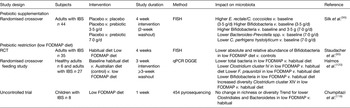
FODMAP, fermentable oligosaccharides, disaccharides, monosaccharides and polyols;
FISH, fluorescence in situ hybridisation; qPCR, quantitative PCR; DGGE, denaturing gradient gel electrophoresis RCT, randomised controlled trial.
The first study investigated the effect of a 4-week low FODMAP diet on the luminal microbiota in IBS patients with bloating or diarrhoea using fluorescence in situ hybridisation( Reference Staudacher, Lomer and Anderson 90 ). A reduction in total FODMAP intake of 50 % led to a marked 6-fold shift in the relative abundance of Bifidobacteria compared with controls that followed their habitual diet and maintained FODMAP, macronutrient and fibre intake. This alteration was inversely associated with baseline Bifidobacteria concentration, such that those with higher baseline concentration exhibited a greater reduction in abundance. This was a novel finding, and the reverse of that demonstrated in prebiotic supplementation studies( Reference Whelan, Judd and Preedy 117 ). There were no differences in total bacteria or other bacteria such as Lactobacillus or F. prausnitzii or fermentation by-products such as stool SCFA concentrations or stool pH between groups.
The second study investigated the effect of a low FODMAP diet using quantitative PCR technique and supported the previous study's findings of a reduction in absolute Bifidobacteria concentration after a 3-week low FODMAP diet. This was accompanied by substantial reduction in total bacterial load of 47 % compared with habitual diet, as well as reduction in absolute abundances of Bifidobacteria and other bacterial groups. Diversity of Clostridium cluster XIV was higher after low FODMAP intervention compared with habitual diet, which may be related to species adaptation to varying substrate availability. This was a crossover study, and therefore there is potential of carryover effects. Furthermore, microbiota data from the patients with IBS was pooled with a group of healthy controls (n 6), potentially concealing differences between the groups in terms of microbiota response to the dietary intervention.
Two studies have recently investigated the effect of a low FODMAP diet on the GI microbiota in the paediatric population. One uncontrolled study found no effect of a 1-week low FODMAP diet on overall diversity or of abundance of specific bacterial groups based on 454 pyrosequencing( Reference Chumpitazi, Hollister and Oezguen 118 ). Another specifically assessed whether symptomatic response to the low FODMAP diet, based on pain frequency, was predicted by microbiota at baseline or diet-induced changes to the microbiota( Reference Chumpitazi, Cope and Hollister 119 ). This was a crossover feeding study, and symptom response occurred in only 24 % of patients. However, increased baseline abundance of taxa such as Bacteroides, Ruminococcaceae and F. prausnizii, were associated with response, suggesting patients with that have a higher abundance of microbiota with saccharolytic potential may benefit the most from a reduction in dietary fermentable substrates. No such association has been demonstrated in adult patients( Reference Halmos, Christophersen and Bird 120 ), and more data is required in longer duration parallel-arm trials that avoid the risk of carryover effects.
Clearly, there is still much to know regarding the impact of the low FODMAP diet on the luminal GI microbiota. Whether the mucosal compartment is affected, if there is a critical time point at which microbiota alterations might have functional consequences, and the effect of reintroduction is unknown. Strategies aimed at preventing low FODMAP diet-induced changes to the microbiota require exploration, particularly if microbiota alterations in patients following the diet are long lasting. Based on the evidence thus far, there is a risk of moderate doses of some prebiotics worsening symptoms of IBS, although whether this occurs in the context of a low background dietary intake of fermentable substrates has not been investigated. Concurrent probiotic supplementation with a low FODMAP may help to maintain Bifidobacteria abundance and may be a promising alternative, especially considering the inverse correlation of Bifidobacteria with IBS symptoms.
Conclusion
Individuals with IBS and other functional bowel disorders have historically been difficult to treat by both medical and dietary means. Recent widespread progress in the dietary management of IBS has been of major interest and has helped to successfully manage symptoms in patients. However, further work is needed both to confirm the role of probiotics, prebiotics, the low FODMAP diet or combinations of these treatments in a variety of clinical subgroups and to fully characterise the effect of each on the GI microbiota and the colonic environment. Whether the alterations in the luminal microbiota in response to a low FODMAP diet are clinically relevant, preventable, or long lasting, needs to be investigated.
Acknowledgements
The authors thank Dr Peter Irving and Dr Miranda Lomer for contributing to research that informed this review.
Financial Support
H. S. is a Clinical Doctoral Research Fellow funded by the National Institute for Health Research. The NIHR had no role in the design analysis or writing of this paper.
Conflicts of Interest
K. W. has received research funding, speaker's honoraria or consulting fees from a range of research and charitable bodies, including Core, Broad Medical Research Program, Crohn's and Colitis UK, National Institute of Health Research, as well as industry bodies including Clasado, Danone, Nestle, Yakult and the Californian Dried Plum Board.
Authorship
H. S. conceived the design of the paper and drafted the manuscript. K. W. contributed to the design of the paper and revised the manuscript for intellectual content.



