


Introduction
Supporting the strengthening of ‘weak’ social ties in community settings as a means of combating loneliness in older adults is a developing area of research. Existing studies on talking to strangers show that micro conversations with strangers can help improve individuals’ wellbeing, alleviate feelings of loneliness and reduce social isolation (Sandstrom and Dunn Reference Sandstrom and Dunn2014). They can also help expose individuals to diverse perspectives, fostering empathy and broadening understanding, leading to new opportunities, discoveries and experiences (Sandstrom et al. Reference Sandstrom, Boothby and Cooney2022). When people overcome their psychological barriers and start talking to strangers, they often benefit from these conversations (Atir et al. Reference Atir, Wald and Epley2022; Sandstrom and Boothby Reference Sandstrom and Boothby2021; Sandstrom et al. Reference Sandstrom, Boothby and Cooney2022). Consequently, campaigns have been developed in an attempt to address loneliness by encouraging people to start talking more with others in their communities. For example, in the UK, the Jo Cox Foundation leads the Great Get Together campaign, started in 2017, which encourages people to gather together and connect with each other. In Sweden, the Say Hi campaign was launched in winter 2023 to promote micro conversations among people (Bryant Reference Bryant2023).
Nevertheless, there is little research attention focused on older people’s experience in talking to strangers. Existing studies tend to conduct only short-term experiments with young participants (often university students), testing whether treating strangers as weak ties makes them happier or discussing the psychological barriers that prevent people from talking to strangers (Sandstrom and Dunn Reference Sandstrom and Dunn2014; Sandstrom et al. Reference Sandstrom, Boothby and Cooney2022). None of the existing works have actually explored older people’s opinions or experiences regarding talking to strangers and the benefit of strengthening ‘weak’ social ties. In particular, none of the works have discussed how older people may employ micro conversations with strangers as part of their daily healthy ageing practice, to satisfy their needs for connection and social inclusion (Yen et al. Reference Yen, Cohen, Wei and Asaad2022).
This highlights a serious research gap, as older adults are vulnerable to poor social health, including loneliness, social isolation and disconnection (National Academies of Sciences, Engineering and Medicine 2020). The World Health Organization (2021) estimated that one in four older people experience social isolation, which has a serious impact on physical and mental health, quality of life and longevity. Social isolation may also lead to feelings of loneliness when it is involuntary or occurs as a result of a sudden change in social networks (Holt-Lunstad et al. Reference Holt-Lunstad, Smith, Baker, Harris and Stephenson2015). The reasons for older adults’ social isolation are complex and include individual-level factors, such as shrinking social networks because of bereavement and frailty of themselves, family or friends, alongside community-level and broader factors, such as post-Covid social anxiety, poor transport links and limited opportunities to socialise in public spaces (Jones et al. Reference Jones, Jopling and Kharicha2021). While micro conversations with strangers have been proven to improve individual’s wellbeing while reducing social isolation, based on data collected from younger people, it is critical to consider how older people could also benefit from adoption of the practice.
To address this evidence gap, this study aims to understand how older people experience talking to strangers in their everyday lives, rather than in a lab setting or a one-off field experiment. We invited 19 older people to participate in our study by giving them a badge that states ‘Happy to Chat’ and encouraging them to wear the badge and try talking to strangers over a three-month period. Using semi-structured interviews, our findings reveal that older people’s experiences of micro conversations with strangers vary by age, gender and self-efficacy. We shed new light on the understanding of micro conversations with strangers by showing that, for older adults, one of the most critical factors to consider in their behaviour adoption is their capability to navigate the potential risks that may occur when talking to strangers.
Talking to strangers
Existing literature on talking to strangers tends to focus on discussing how the act of treating strangers as weak ties benefits individuals, such as by increasing wellbeing and happiness and reducing feelings of loneliness or social isolation (Schroeder et al. Reference Schroeder, Lyons and Epley2022). Using field experiments with London commuters, Schroeder et al. (Reference Schroeder, Lyons and Epley2022) showed that when commuters engaged in conversations with fellow train passengers, they tended to report feeling happier and having a more enjoyable commute than those who avoided engaging in such conversations. Interestingly, the enjoyment derived from talking to strangers did not drop after the first few minutes but remained stable. Also, study participants reported that they felt much less anxious or bored during their conversations with strangers than they had initially anticipated (Kardas et al. Reference Kardas, Schroeder and O’Brien2022).
Improving and refining communication skills is another benefit associated with talking to strangers. Yeomans et al. (Reference Yeomans, Brooks, Huang, Minson and Gino2019) explain that initiating conversation with strangers helps refine individuals’ ability to listen, ask questions and sustain a conversation with someone who has different opinions, leading to broadening of one’s own perspective. Social media echo chambers prevent people from engaging with others from different backgrounds or being exposed to opposing views. In contrast, micro conversations with strangers provide an opportunity to learn, acknowledge different points of view and encounter new information, including job opportunities (Atir et al. Reference Atir, Wald and Epley2022). Interacting with others from different backgrounds helps reduce one’s own prejudice and stereotyping while increasing empathy, which often enables people to develop a stronger sense of social connection and belonging to their communities (Keohane Reference Keohane2021).
However, despite all the benefits, studies also show that people tend to shy away from talking to strangers for several reasons. These include a lack of personal motivation, underestimation of one’s own conversation competence, fear of not enjoying the conversation and a shortage of opportunities and accessibility (Sandstrom and Boothby Reference Sandstrom and Boothby2021). A lack of motivation often stems from people’s underestimation of the value that conversations with strangers can bring (Atir et al. 2023). Existing literature shows that people systematically undervalue what they might learn in conversations with strangers, anticipating that they will learn less and not enjoy the conversation as much as they actually do (Atir et al. Reference Atir, Wald and Epley2022). As people hold inaccurate estimates of costs and benefits, they underestimate the learning opportunities and positive emotions they can gain from talking to strangers. Atir et al. (Reference Atir, Wald and Epley2022) conducted several experiments with park visitors in Chicago by randomly assigning pairs of strangers to talk to each other. Their findings reveal that people consistently expected to learn significantly less from the conversation than they actually did, regardless of whether they had conversation prompts or a specific goal to learn. As people place low expectations on the information value during their conversations with strangers, this creates a potential barrier, impeding their motivation to learn and engage in conversations with strangers. However, it should be noted that Atir et al.’s (Reference Atir, Wald and Epley2022) samples (mean age ranges from 21.15 to 39.31) did not include a substantial number of older people, which limits the generalisability of their findings to this demographic.
In addition, people undervalue the enjoyability of their conversations with strangers Kardas et al. (Reference Kardas, Schroeder and O’Brien2022). For example, Sandstrom and Dunn’s (Reference Sandstrom and Dunn2014) study with Starbucks drinkers in Canada (with the majority aged 34 and younger) shows that those who engaged in a micro conversation with their barista experienced more positive affect than those who simply ordered their coffee as efficiently as possible. Although they did not expect it, interacting with their baristas through smiles, eye contact and brief conversations actually made those participants feel happier and created a sense of belonging. Schroeder et al. (Reference Schroeder, Lyons and Epley2022) revealed similar findings. It seems that people generally undervalue the enjoyment of talking to strangers and how positive this experience can be (Keohane Reference Keohane2021).
Competency is a key factor that explains people’s reluctance in talking to strangers, which to a degree reflects their own self efficacy, determined by individual past experiences, vicarious experiences, verbal persuasion and individual psychological and emotional states (Bandura Reference Bandura1977). The more strongly an individual believes in their abilities to act, the more likely they are to take actions and persist (Lee and Kotler Reference Lee and Kotler2011). On the contrary, when self-efficacy is low, despite their intention or motivation to talk to strangers, people may still feel worried about their incompetence, likability or disclosing their own vulnerabilities (Atir et al. Reference Atir, Zhao and Echelbarger2023). Self-efficacy refers to people’s beliefs about their own capabilities to produce designated levels of performance and exercise influence over events in life (Bandura Reference Bandura1977; Bandura Reference Bandura1994; Lee et al. Reference Lee, Arthur and Avis2008). In the context of talking to strangers, self-efficacy can be manifested in various ways, from conversation initiation, responding to social cues, perseverance in conversation, having more meaningful conversations and positive reflection on the experience.
Indeed, some aspects of conversation can be challenging, for example what to say, how to sustain a conversation, as well as how and when to end a conversation (Mastroianni et al. Reference Mastroianni, Gilbert, Cooney and Wilson2021). Many people have the tendency to pessimistically evaluate their own ability in informal conversation (Welker et al. Reference Welker, Walker, Boothby and Gilovich2023); they tend to feel more anxious talking to strangers, when compared to talking with close friends and family. Sandstrom and Boothby (Reference Sandstrom and Boothby2021) summarised this anxiety into six types of fear, where three are related to oneself: the fear of not enjoying the conversation, that of not liking the conversation partner and that of lacking conversation skills. The other three concerns relate to their conversation partners: people worry that strangers might not enjoy the conversation, might not like them or might lack adequate conversational skills.
However, people’s fears are often overblown, as research shows that conversations with strangers tend to be more enjoyable than expected. In reality, most people are overly critical of their ability to appear likeable or interesting in conversations with strangers (Hirschi et al. Reference Hirschi, Wilson and Gilbert2023). This explains why sources of efficacy, such as performance accomplishments, vicarious learning, verbal encouragement, and affective and physiological states, can influence individuals’ belief in their own ability to perform a task (Lee et al. Reference Lee, Arthur and Avis2008). Performance accomplishment is related to the individual’s experience of their performance, assuming that a sense of self-efficacy is enhanced through successful experiences, while it is destabilised by negative ones (Warner et al. Reference Warner, Schüz, Knittle, Ziegelmann and Wurm2011). For instance, Sandstrom and Boothby (Reference Sandstrom and Boothby2021) show that people tend to hold a much more positive attitude about future conversations with strangers immediately after having experienced a pleasant episode of talking to strangers.
In addition to people’s in-built worries about talking to strangers, there are other barriers to the promotion of social interactions. A lack of shared physical space is often discussed as the key environmental barrier that prevents conversations with strangers (Atir et al. Reference Atir, Zhao and Echelbarger2023). This explains why existing chatty schemes, such as chatty benches, chatty train carriages and chatty cafés, focus on creating a space where people can share their presence socially, increasing opportunities for conversation with fellow strangers (Kaźmierczak Reference Kaźmierczak2013). However, while chatty benches have received much media interest and support for tackling loneliness, the #Tube_chat movement that focused on promoting micro conversations among London commuters was greeted with public horror (Grierson Reference Grierson2016). Some put it down to geo-demographic characteristics – Londoners always scored the highest (37 per cent) in the country on feeling uncomfortable about talking to strangers (McCarthy Reference McCarthy2016). However, the lack of personal space available on the Tube, especially during rush hour, could plausibly be a factor that contributed to the failure of the Tube chat movement. In contrast, semi-private spaces such as buffer zones, green belts and local facilities are recommended as more suitable spaces for chatting to strangers (Sandstrom and Boothby Reference Sandstrom and Boothby2021). Similar debate is also made in relation to the growth of high-density urban centres. While high density allows spatial proximity between people that encourages social interaction, a study of residential areas in Jakarta found that overly dense environments lead to weaker trust and less involvement in community activities (Muzayanah et al. Reference Muzayanah, Nazara, Mahi and Hartono2020). This is because extreme social encounters and exposures may cause social overload that is beyond people’s cognitive abilities to handle, leading to social withdrawal.
While the benefits and barriers associated with talking to strangers have been explored, none of the studies have specifically examined the experiences of older adults (aged 50+) in this context. In fact, all existing research on talking to strangers is based on data collected from younger adults rather than older ones in the West. Most studies in the East tend to advocate interventions that focus on enhancing resilience through meaningful social connections, that is, ‘strong ties’ for older adults, such as frequent and high-quality interactions with family and relatives (Park et al. Reference Park, Kim and Eom2021), rather than with strangers or unrelated acquaintances in the community (Lee and Ko Reference Lee and Ko2018). Although a recent study in China by Pan and Chee (Reference Pan and Chee2020) promoted that, for older people, participating in weekly or irregular social activities – such as playing Mah-jong, chess or cards, going to a community or sports club, or helping family outside the household – is significantly associated with better mental status and memory, it is important to note that talking to strangers was not included in this discussion.
Additionally, most of the evidence supporting talking to strangers is derived from controlled experiments (eg Atir et al. Reference Atir, Wald and Epley2022; Sandstrom and Boothby Reference Sandstrom and Boothby2021; Sandstrom and Dunn Reference Sandstrom and Dunn2014; Sandstrom et al. Reference Sandstrom, Boothby and Cooney2022). Such designs offer limited insights into whether and how such behaviour can be integrated into everyday practice. This highlights a critical knowledge gap that requires further research. Potentially the motivations, competences, barriers and opportunities for older adults engaging in micro conversations with strangers are likely to differ from those of younger adults. These differences arise owing to age-related factors, varying social and cultural contexts and personal wellbeing considerations. Moreover, self-efficacy beliefs may play a crucial role in determining how the behaviour of talking to strangers can be adopted as a daily practice (Andreasen Reference Andreasen2006), by triggering the ‘right’ motivations, such as information, incentives and environmental modifications. To address this important knowledge gap, this study seeks to explore how older adults engage in conversations with strangers as part of their everyday practice, as opposed to in a controlled lab environment or during a single field experiment. Therefore, our research question asks: How do older adults engage in micro conversations with strangers as part of their daily social interactions, and how does this practice influence their overall wellbeing and social connectedness?
Research methods
Recruitment of participants and data collection
This article emerges from a larger study investigating the experience of talking to strangers by a group of participants who voluntarily agreed to wear a ‘Happy to Chat’ badge and initiate conversations with strangers in their daily lives for a three-month period. After having obtained ethical approval from the lead author’s university (see ‘Ethical standards’ for details), the recruitment process started with the support of a university’s older people research reference group and two West London–based charities supporting community members’ health and wellbeing, allowing us to advertise our research to their members via email. We invited them to attend our study launch event in January 2023, where we discussed the research project, its ethical implications and its benefits. In all, 48 participants were recruited; each participant was given a badge that stated ‘Happy to Chat’, which acted as a nudge to remind them of their involvement in our study over the three-month period (Thaler and Sunstein Reference Thaler and Sunstein2021). Nevertheless, it is important to note that out of the 48, only 36 were aged 50 and above. Some of the volunteers recruited through the charities were actually younger than 50 years old, hence their data were not included in this article.
While the message ‘Happy to Chat’ on the badge indicated an individual’s willingness to have a conversation, participants were encouraged to try out and wear the ‘Happy to Chat’ badges to embrace and experiment with the act of talking to strangers. During the launch event, participants were also reminded of the risks of talking to strangers and to remain vigilant and safe, for example talking to strangers only in places and at times when they felt safe. When discussing suitable places for wearing the badge and talking to strangers, locations such as shopping malls, high streets, parks and bus stops were mentioned by the participants as suitable venues. Participants were also informed about the ethical procedures of the project, including their voluntary participation and guaranteed anonymity and confidentiality.
To ensure that the participants remained engaged with the project, monthly emails were sent to remind them of their participation. In April 2023, we contacted the 48 participants to arrange follow-up interviews. Of the 36 older participants, 19 (aged 50 to 88) responded and returned their consent forms before participating in our semi-structured interviews to share their experiences of talking to strangers. The remaining 17 did not participate in the follow-up interviews, often citing that they had forgotten to wear the badge or to engage in conversations with strangers.
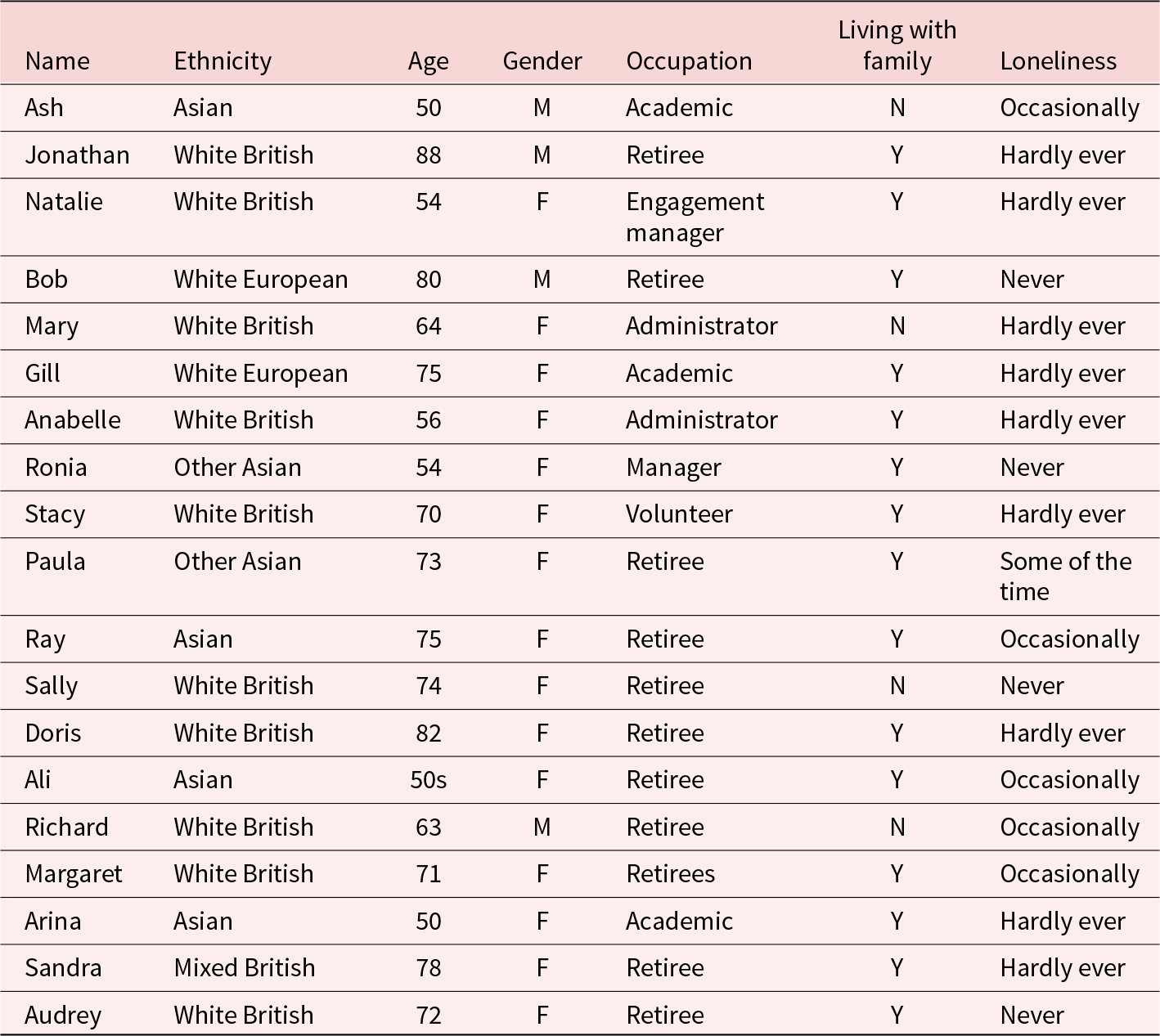
The 19 who participated included 15 females and 4 males, with ages ranging from 50 to 88 (see Table 1). A brief questionnaire was developed to characterise the key demographic information and the Office for National Statistics (ONS) loneliness question asked how often they felt lonely. Such information was collected to help us gain a good understanding of our participant profiles. The majority of the participants lived with family and did not experience loneliness, which may be attributed to their active involvement in supporting various organisations and charities as volunteers. Owing to the geographical locations of the charities involved, most of our participants came from a West London borough known for its ethnic diversity, linguistic variety and vibrant cultural heterogeneity, characterised by a pronounced multi-age structure.
Participant profiles

Note: All participant names are pseudonyms.
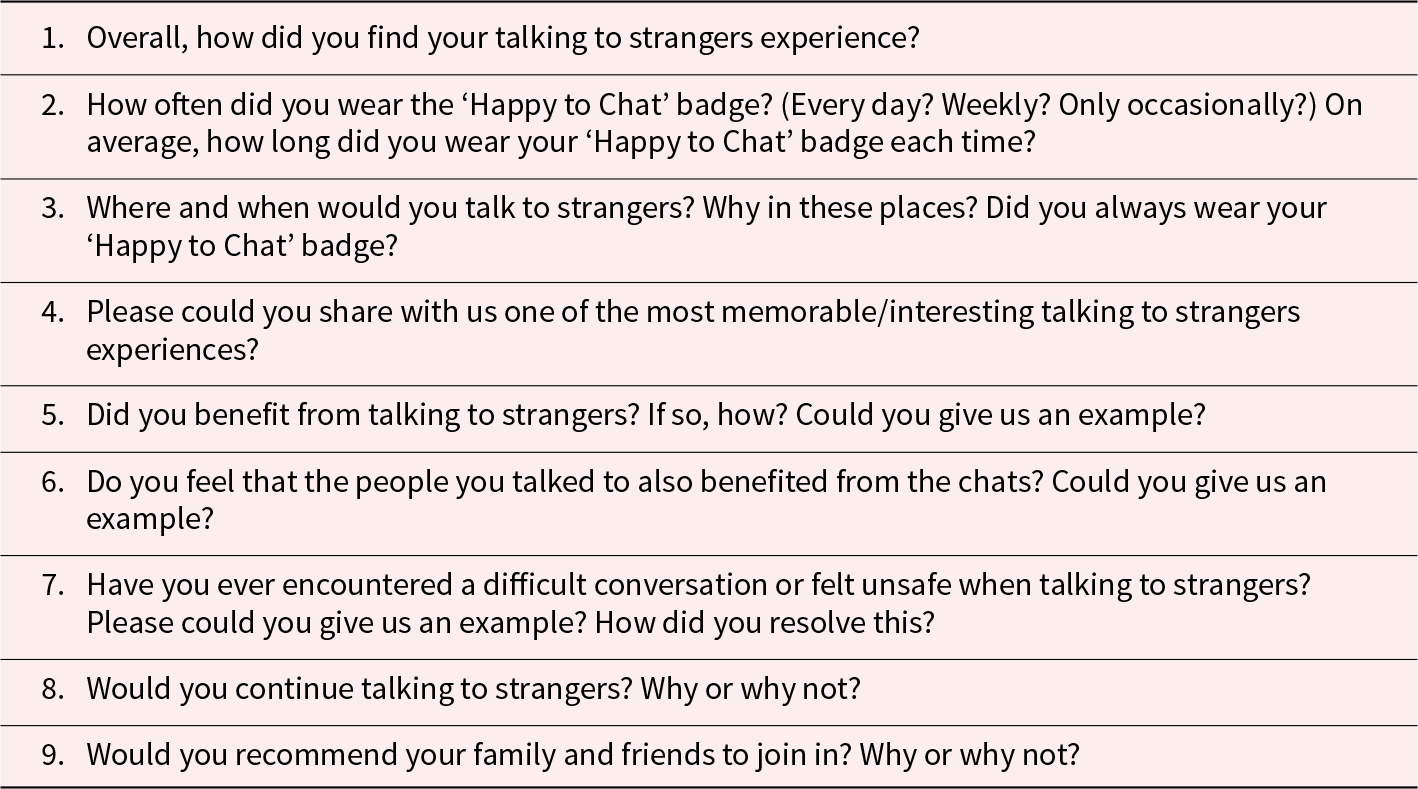
All of the interviews were conducted face-to-face, either at a university office or in a café. All interviews were recorded with participants’ permission and then transcribed verbatim. The interviews began with general questions about personal background and wellbeing, then progressed to prompt participants’ reflections on their experiences of wearing the badge and engaging in conversations with strangers (see Table 2 for the list of exploratory questions). Each interview lasted between 25 minutes and 95 minutes; collectively, the interviews resulted in 151 pages of transcript, totalling 56,055 words.
Talking to strangers interview questions

Data analysis
Two members of the research team analysed the transcripts, following Braun and Clarke’s (Reference Braun and Clarke2006) process of thematic analysis (familiarising with the data, creating codes, searching for themes, reviewing themes, defining and naming themes and writing up). The first three phases were carried out by two researchers independently. They both coded the interviews manually following an open coding approach. The search for themes started by aggregating codes and creating themes and sub-themes. This process was also conducted independently and both authors paid particular attention to barriers and experiences of talking to strangers. The fourth phase (review of potential themes) was conducted by the two authors together; they discussed their independently created themes and agreed on a structure of common themes and sub-themes. Themes were reviewed considering the aforementioned literature on talking to strangers and self-efficacy. The fifth phase (defining and naming themes) was conducted by the two authors who together undertook a continuous interaction between data and literature as a crucial part of the hermeneutical process of understanding participants’ experiences of talking to strangers.
Findings
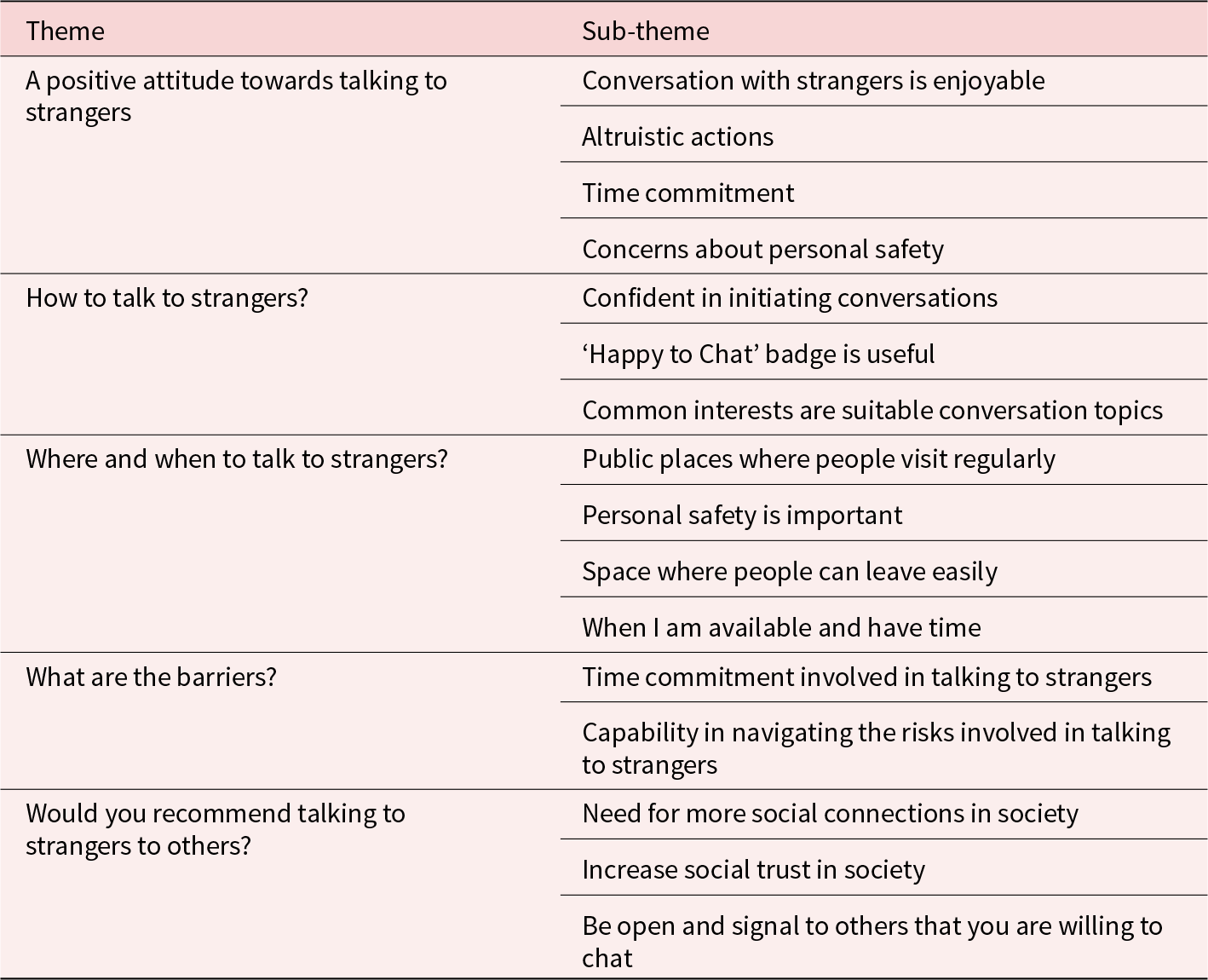
Participants’ experiences in talking to strangers were discussed – starting from their general attitude towards talking to strangers, how conversations were initiated, where and when they talked to strangers, the barriers and recommendations (see Table 3).
Analysis themes

A positive attitude towards talking to strangers
Participants evaluated their experiences in positive ways: they all mentioned that talking to strangers was surprisingly rewarding and enjoyable. This echoes previous findings based on data collected from younger adults, showing that people tend to underestimate the positive effects of talking to strangers (Atir et al. Reference Atir, Wald and Epley2022; Sandstrom and Dunn Reference Sandstrom and Dunn2014). Bob, a retired football referee, shared his positive experience of talking to strangers: ‘I’ve not had any bad experiences. You know, it’s always been positive, whenever I spoke to people. You can’t obviously expect that people agree with everything you say, but then that’s the world anyway. We all have opinions!’ (Bob, M, 80).
Bob’s account aligns with existing literature, which shows that talking to strangers helps people recognise that others may hold different opinions (Keohane Reference Keohane2021) and it broadens perspectives while reducing prejudice and stereotypes (Atir et al. Reference Atir, Wald and Epley2022). Acknowledging that everyone has their own opinion, Bob is confident in embracing the differences. Specifically, in evaluating the overall experience of wearing a badge to start a conversation, participants’ age was a factor affecting their responses. Middle-aged participants (aged 50 to 64) like Ali recognise the benefits of the micro conversations for themselves, but she also explained how talking to strangers can be particularly positive for older people.
Today’s society youngsters are working a whole lot and the older people are left at home on their own wondering what time the children are going to come home, if they are living together. If they are not living together, then the older people are living alone and the only interactions they will get is when they go out shopping … So I wear the badge everywhere that I have been; I didn’t feel uncomfortable. I personally think it’s similar to a befriending service in the sense that you’re talking to a complete stranger. You’re being a friend indirectly and I think that’s a good thing because sometimes that person may not be having a good day and the fact that you spoke to them [may mean] they feel better. And they may go away feeling someone spoke to them and that they were not invisible. It’s been positive for me, even [for] my own loneliness. (Ali, F, 50s)
Ali’s illustration confirms that conversations with strangers can help people open up on sensitive topics that are often avoided with friends and relatives (Wang Reference Wang2013). Interestingly, Ali and the other middle-aged participants (aged 50 to 64) see the benefits of the initiative for the others (strangers) more than themselves. For example, Mary, an admin manager, shared: ‘I am happy doing this [wearing a “Happy to Chat” badge and talking to strangers] because it was just nice to feel that I’ve made somebody else’s time fun, you know. If somebody is feeling a bit lonely or low. You know, needs a conversation. Then I’d be happy to be that person’ (Mary, F, 64).
Being able to help others and making someone else less lonely are strong motivational factors that prompt talking to strangers among these middle-aged participants. Mary described knowing that her conversations supported other older people as a ‘positive self-esteem boost’ for herself. This is an interesting and novel finding that has not been fully explored in previous studies. Engaging in conversations with strangers is perceived as an act of kindness towards others, which in turn boosts participants’ self-esteem and promotes feelings of happiness and contentment (Brown et al. Reference Brown, Hoye and Nicholson2012; Curry et al. Reference Curry, Rowland, Van Lissa, Zlotowitz, McAlaney and Whitehouse2018). Viewing talking to strangers as an altruistic practice to support others, middle-aged participants see themselves more as confident and capable facilitators than lonely individuals in need of social connections. It is perhaps owing to this perception of their role that this group admits to not wearing the badge as often, citing a busy lifestyle as the main barrier. For example, Arina justifies her reduced commitment in this way:
I really support the idea because I had a very good friend who passed away a few years back. She was very lonely and I used to go and meet her as much as I could … still not enough for her … I signed up to participate but don’t find wearing the badge going around talking to strangers very suitable with my lifestyle at the moment because I’m really, really, really busy … I have a young boy, I have to look after him plus I’m working full-time … It’s not working for me to go around to everywhere to chat to strangers. (Arina, F, 50)
Seeing talking to strangers as an activity that is time-consuming and requires effort, Arina and other middle-aged participants (aged 50 to 64) admit scheduling time and space for it, rather than integrating it into their current lifestyle. A similar finding was shared by many of the other participants who also have a busy lifestyle. Although they support the initiative in principle, they do not see it as a priority in their daily life; they see it mainly as beneficial for others. Their lack of motivation explains that, despite seeing talking to strangers as a valuable initiative, the members of the middle-aged group are not fully committed because it does not benefit them as much as it benefits others. In contrast, older participants (aged from 65 to 88) seemed to embrace this practice more and had stronger personal motivation. For instance, Jonathan, an active retiree involved in many volunteering schemes, mentioned:
I find it easier to talk to people because I’m interested in other people and always worked on the premise that all people are nice until they prove otherwise. So, I say good morning to people and I talk to people in the shops that I’ve never met before as a norm. So ‘Happy to Chat’ is giving me a great start to chat! (Jonathan, M, 88)
Besides the age differences, participants’ experiences in talking to strangers also differ by gender. Although both male and female participants were generally positive with their experiences in talking to strangers, some females admitted some hesitancy as they are more concerned with their personal safety. As such, they did not talk to strangers as often as the men did. Anabelle explained: ‘I have to confess, I haven’t worn the badge or talked to strangers as much as I should have. I’ve worn it only a bit. The times I’ve worn it, I’ve probably worn it for a reason, mostly when I am in a reasonably safe space’ (Anabelle, F, 56).
Echoing previous studies (Schroeder et al. Reference Schroeder, Lyons and Epley2022), safety emerged as a barrier that was particularly strong among our female participants. Considering the age of our participants, safety is a matter of physical capabilities but also participants’ own circumstances, which are seen as additional vulnerabilities not to be disclosed (see Atir et al. Reference Atir, Zhao and Echelbarger2023). Having the confidence that they are able to enjoy the experience of talking to strangers, while navigating the potential risks that may occur, indicates self-efficacy (Bandura Reference Bandura1977; Lee et al. Reference Lee, Arthur and Avis2008). This explains why some female participants were more hesitant and careful in selecting when to embrace the act of talking to strangers. Sally commented:
I think I signed up to take part in this because it sounded interesting … I was quite happy to come on campus and wore the badge on campus and walked on campus. I’ve done that before and it’s in quite a secure environment to walk around … But I live in another place and I live by myself; I don’t feel comfortable wearing it and talking to strangers in my neighbourhood … I thought about this: if my husband was still alive I could have done it, but I’m not putting myself at risk. You have to be sensible. (Sally, F, 75)
Sally’s comment about her own neighbourhood being unsafe highlights the importance of including community safety in the discussion of older people’s talking to strangers, since perceived neighbourhood safety can impact older people’s willingness to take part and embrace the act of talking to strangers in the community (Choi and Matz-Costa Reference Choi and Matz-Costa2018). This is especially important for older women, since better sense of neighbourhood was associated with ‘better physical and mental health, lower stress, better social support and being physically active’ (Young et al. Reference Young, Russell and Powers2004: 2627).
How to talk to strangers
An interesting result from this study is that initiating a conversation is not seen as a barrier in talking to strangers. While previous work mentioned conversation competency as one of the major barriers (Atir et al. Reference Atir, Zhao and Echelbarger2023), our participants expressed full confidence in starting conversations with strangers. Although some of the participants admitted to only reponding to a conversation rather than starting a new one, participants pointed out that they can confidently use ‘safe’ topics, including weather and food, which are considered not too intrusive (see Mastroianni et al. Reference Mastroianni, Gilbert, Cooney and Wilson2021). ‘Happy to Chat’ badges worn by participants also served as good conversation starters; they thought the badge was ‘cheeky, funny and engaging’ (Gill, F, 75). For example, Ash shared his experience of how the badge served as a conversation starter: ‘I tried wearing it on Oxford Street (the busiest shopping area in London). Although I did not get many conversations, I do remember an older lady was curious about it. She asked me what this is for and who is responsible for this. We talked about this and she was clearly interested in learning more about it!’ (Ash, M, 50).
When asked about the topics of conversation, participants recalled mostly pleasant conversations about common hobbies and leisure activities, public transport, sport, child care and grandchildren. Conversations were also facilitated by looking at pictures of pets, travels and recipes on participants’ phones. None of our participants reported being challenged or confronted by someone with different opinions (Yeomans et al. Reference Yeomans, Brooks, Huang, Minson and Gino2019) or having entangled in difficult conversations, although this might have been owing to their careful attitude in avoiding any sensitive or confrontational topics.
Where and when to talk to strangers?
Our findings show that the most common places where participants tended to have conversations with strangers were during their shopping trips and park walks, at work and on public transport, which they all described as public places where many people are around, offering public scrutiny. In comparison, older participants seemed to talk to strangers in a wider range of places, varying from garden centres, community social gatherings, shops and while on public transport. Some of them started their own initiative with the ‘Happy to Chat’ badges, trying to experiment and see how they could be used to facilitate conversations with strangers in places where they felt comfortable. For instance, Mary said:
I put the ‘Happy to Chat’ badge on when I feel comfortable, like [in the] garden centre or on the bus. Once I went to the garden centre, sat in the café. I carried it around in my bag and was having a coffee. I was on my own and I thought I’ll pop the badge on and see what happens. And yeah, we started chatting. They admired the badge first of all and then I explained that I was wearing it as part of a research project … Then we got talking about gardens and plants and then we started talking about craft as well because that led on to a different conversation. (Mary, F, 64)
We believe that the proactive attitude displayed by Mary and other participants was driven by the self-interest that motivated their participation in this study. Acknowledging that talking to strangers is enjoyable and beneficial for their own wellbeing, the older participants are keener to use the badge in a wider range of places. The middle-aged participants revealed that they are most likely to talk to strangers at work because friendly chats make the workplace nicer for everyone, whether working in charities, universities or out and about dealing, selling or serving clients. This difference is reflective of the motivation for engaging in the Happy to Chat initiative (self-interest for the older participants versus altruism for the middle-aged) and the consequent time that was dedicated to wearing the badges. Considering talking to strangers an altruistic gesture, the middle-aged participants mentioned lack of time and busy lifestyle preventing them to help others as much as they would like.
In addition to time commitment, our findings revealed the importance of space in facilitating conversations with strangers. Open places that allow easy exit are deemed to be more appropriate spaces for social recognition and micro conversations (Kaźmierczak Reference Kaźmierczak2013) because people can easily finish their conversations and move on with other tasks in life. Anabelle articulated her concern about some spaces and explained why she is careful in choosing when and where she talks to strangers: ‘I’d be careful about talking to strangers on public transport … If you are on the train, bus or Tube and you feel uncomfortable and don’t want to continue the conversation, then you are kind of just trapped … I’m not sure if you’d be able to easily escape’ (Anabelle, F, 56).
Anabelle’s point offers a reason why Tube chats failed in London and received serious backfire from Tube commuters who were afraid of losing their personal space, with nowhere to escape when a conversation went badly (Grierson Reference Grierson2016; McCarthy Reference McCarthy2016).
Barriers to talking to strangers
While previous studies have discussed lack of personal motivation, worries about conversation competence, fears of not enjoying the conversation and a shortage of opportunities and accessibility as key barriers that prevent people from talking to strangers (Atir et al. Reference Atir, Zhao and Echelbarger2023), our study revealed very different findings, which have not been fully discussed before. First, since our participants were all self-selected, willing volunteers regarding talking to strangers and trying on the ‘Happy to Chat’ badges, it was not surprising that they were all confident in initiating conversations, as their motivation for talking to strangers was high. Nevertheless, despite this motivation, taking up the act of talking to strangers required a time commitment in their everyday lives. This finding is new, as time commitment has not been discussed previously as a key barrier. Extant research tends to collect data using one-off experiments or studies where university students are given module credits and time to take part and time was controlled in their research design (Sandstrom and Dunn Reference Sandstrom and Dunn2014; Schroeder et al. Reference Schroeder, Lyons and Epley2022).
While others apologetically explained how they would like to participate more if they had more time, Natalie described how she could engage in talking to strangers only when she knew she had a bit of time: ‘I would put on the badge when I’m going somewhere sort of where I know I’ve got a bit of time and I know that if somebody wants to talk, then I’ll have the space to actually engage in a conversation’ (Natalie, F, 52).
Natalie’s effort to prepare and set aside time to engage in conversations highlights her commitment to enjoying these interactions with strangers. Time is precious, which explains why our retired participants tend to spend more time talking to strangers than others.
There is also observed gender difference in how confident participants navigate the risk involved in talking to strangers. Female participants’ choice to wear the badge was heavily dependent on whether they felt safe (see also Schroeder et al. Reference Schroeder, Lyons and Epley2022). While Sally discussed her decision to try talking to strangers only on campus and not in her own neighbourhood, Mary mentioned that she would experiment with the ‘Happy to Chat’ badge only in places and at times when she felt comfortable and safe, such as at a garden centre or on the bus. In contrast, safety was less of a concern for the male participants, who rarely mentioned it as a barrier. For example, an active retiree, Jonathan, shared his experience:
Every day I go out, it’s in my mind to try and engage somebody in conversation. Some days that might be three or four people of no particular interest. It might be short, but every now and again you meet somebody that is interested, and you realise that they want to talk because they’re lonely or live on their own. Not necessarily lonely in the full sense, but missing conversations. I try and wear the badge when I can, when I intend to, like if I’m going to a large shopping centre, that’s the ideal place and I talk to people in Tescos or whatever it is and that’s easy. (Jonathan, M, 88)
While Jonathan embraces the badge and uses it as a tool to support his conversations to strangers with full confidence, Sally was much more cautious. Having spent the past two to three years indoors because of the Covid-19 pandemic and having had to care for her husband, who was very ill then passed away, Sally explained her loss of confidence and why she did not feel all that comfortable wearing the ‘Happy to Chat’ badge. In particular, she was concerned about getting entangled in talking to strangers that she did not feel entirely comfortable talking to and did not perceive her neighbourhood as being very safe. Sally commented:
I was already chatty, I talked to people all the time … In the past, when my husband was still alive, I would have worn the badge on the train, because I like talking to people. However, in recent times, I have been on a train and found people there that I wouldn’t particular want to talk to. I like to be in control with whom I am talking to. I don’t want to wear a ‘Happy to Chat’ badge everywhere because I don’t want to advertise myself and have anybody who I consider could cause me a problem to come up and talk to me … I cannot cope. Maybe it would be different if I still had my husband with me. (Sally, F, 75)
Sally’s concern about the risk of engaging in conversations with strangers she dislikes aligns with the findings of Sandstrom and Boothby (Reference Sandstrom and Boothby2021), who identified various fears, such as not enjoying the conversation, not liking the conversation partner and lacking conversational skills. However, for Sally, who had recently lost her husband, the ability to choose whom she talked to carried deeper significance. It was not just about disliking a particular stranger more than others; it was about managing her personal safety, minimising the risk of unpleasant interactions and ensuring that she could cope with and exit such conversations if necessary in a neighbourhood that she had evaluated as not so safe. Sally’s subjective view of her own physiological and emotional responses revealed a temporary drop of self-efficacy, highlighting her vulnerability and lack of confidence in managing these interactions, which could have been a result of her recent loss of her husband. Unfortunately, this was compounded by her evaluation of the neighbourhood as being not so safe, which had much higher impact for older women’s wellbeing, especially those living alone (Young et al. Reference Young, Russell and Powers2004). This may also explain why, when Doris mentioned her participation in this research to her family and friends, they reminded her to ‘please be careful and stay safe’ (Doris, F, 82). While these reminders were given with good intentions, they unfortunately underscored the disadvantaged position that older females often face in society, reflecting the broader issue of women’s self-protection abilities being underestimated. This tendency is heightened in hostile environments, where women’s efficacy is often unfairly questioned (Hausknecht et al. Reference Hausknecht, Low, O’Loughlin, McNab and Clemson2020), despite the blame lying with external factors rather than the women themselves.
Would you recommend talking to strangers to others?
While participants expressed an overall positive experience about talking to strangers, many said that they would recommend talking to strangers to others, since they recognised that there is a need for more conversations in society. Stacy commented:
I think people benefited from having more conversations. Even before when I was not wearing the badge, I’ve had people who are in their 80s telling me that they’d go out everyday and they enjoy talking to people because they are at home isolated otherwise. So, I know it is a good idea … People just chat the usual, the weather, the government, the fares going up, the prices rising … Nothing major, but at least they are not isolated. (Stacy, F, 70)
However, to create a societal culture where talking to strangers is welcomed requires significant adoption and uptake from people in both communities and societies. Ash referred to his experience on Oxford Street: ‘Once I was wearing my badge the entire day while I was on Oxford Street. Not a single person approached me, though. Maybe because they do not understand what “Happy to Chat” means, that I am actually happy to talk to people … Maybe it is also to do with the lack of social trust’ (Ash, M, 50).
While Ash expressed a small frustration about the lack of chats, Ronia, a female volunteer at a charity that focuses on facilitating wellbeing and mental health in the community, shared her tips about how to signal to others that you are indeed happy to talk to strangers, which encourages others to talk to you:
It’s like you are put[ting] out to the world that you are willing to talk, if that makes sense? So being a bit more open with body language, making a bit more of an effort to sort of smile or look around, just being a bit more considerate of others, I suppose, rather than just sort of rushing to and from wherever I’m going. (Ronia, F, 54)
Discussions and implications
Our findings reveal that this group of older people who volunteered to participate in this study generally had positive experiences in their micro conversations with strangers. For them, the ‘Happy to Chat’ badge was regarded as a suitable aid that sparks conversations, leading to talks around topics of various common interests. Bright public places with easy exits were discussed as suitable places for conversations with strangers, for example shopping centres, garden centres, community social gatherings, a university campus and while waiting for public transport. Nevertheless, findings also highlight people’s time commitment and lack of self-efficacy as potential barriers in the adoption of talking to strangers as a daily practice.
Specifically, our findings show that retired older participants (aged 65 to 88) tend to have more time to spare and are more actively involved in micro conversations with strangers. Some of them even took it as a mission to reach out to people who seemed lonely in the community. In comparison, middle-aged participants who are still at work or who are carers tend to have less time to take up talking to strangers. For them, talking to strangers is an interruption to existing routines and time has to be made; it has to be pre-planned as a practice on its own. They are not unwilling to engage in conversations with strangers; rather, time has to be managed, as some of them pointed out that they could talk to strangers when they knew they had a bit more time, whether during lunch hours, shopping trips or while having a coffee break. This is a novel finding, as our unique research design gives us an opportunity to explore and understand how talking to strangers is actually experienced and practised by older adults in their daily lives, hence highlighting the issue of time, which is often limited in modern society (Sandstrom and Dunn Reference Sandstrom and Dunn2014; Sandstrom et al. Reference Sandstrom, Boothby and Cooney2022; Schroeder et al. Reference Schroeder, Lyons and Epley2022).
In addition to time, self-efficacy is discussed as a key factor that prevents people from talking to strangers. In our study, participants with high self-efficacy knew that they had the capabilities to enjoy conversations with strangers, while staying safe and unharmed. This extends previous understanding of talking to strangers. For older adults, being able to confidently navigate the potential risks involved in talking to strangers is a critical factor to consider in adoption of this practice. Unfortunately, not everyone holds the same level of self-efficacy, and our findings revealed a potential gender difference in self-efficacy. Older females are more concerned with the perceived risks associated with talking to strangers, from personal safety to mental wellbeing regarding being able to cope with unpleasant or uncomfortable conversations encountered with strangers. This highlights the importance of including neighbourhood safety in the discussion of talking to strangers. Neighbourhood safety has a strong relation with older adults’ health and wellbeing (Choi and Matz-Costa Reference Choi and Matz-Costa2018). This is especially important for older women; when they feel that they belong and are safe in their communities, it encourages their social interactions with others, including acquaintances and strangers (Young et al. Reference Young, Russell and Powers2004; Walker and Hiller Reference Walker and Hiller2007). Nevertheless, our participants’ concerns reflected the fear associated with stranger danger, which unfortunately has become an embodiment of our culture and a way of thinking, leading to ‘a world where each of us is fearful and suspicious of the others’ (Patterson Reference Patterson2023: 44). Yet, research has not proven that strangers are more dangerous than familiar people; it all depends on the specific circumstances and the individuals involved.
The findings reveal clear implications for future campaigns that aim to promote social inclusion in communities and neighbourhoods (Dahlberg Reference Dahlberg2020). Firstly, while our findings show that many older people hold a positive attitude towards micro conversations with strangers, their participation experience should be considered in discussing new initiatives that aim to promote micro conversations with strangers. Retired older people, owing to having more spare time, could get more actively involved in micro conversations with strangers. This creates opportunities for volunteerism and community outreach, empowering older adults to embrace the practice of talking to strangers. Secondly, the ‘Happy to Chat’ badge could be adopted as a suitable aid that facilitates conversations with strangers. As evidenced in participants’ feedback, the badge triggered the desired enquiries and served as an ice-breaker on many occasions.
Thirdly, well-lit public places with easy exits could be designated as safe locations for micro conversations with strangers. In addition to cafés, shopping malls and garden centres, potential locations might include airports, train stations, libraries and even hospital waiting rooms. Fourthly, policy makers are encouraged to focus on enhancing neighbourhood safety and fostering community trust. Recognising the gender disparity in self-efficacy regarding navigating the risks involved in talking to strangers, providing ‘safety talks and training’ can help address the unique concerns and challenges faced by older females. Nevertheless, these should not be the sole focus. Policy makers and local authorities must continue their efforts to create safe neighbourhoods that support community development and the wellbeing of older adults. Lastly, interventions aimed at promoting social engagement and micro conversations for older adults should include strategies that encourage their participation and enjoyment. For instance, providing education and guidance on risk assessment and coping mechanisms for managing uncomfortable situations can help support people’s confidence and involvement.
Limitations and future research suggestions
While our findings illustrate how older people in the UK experience talking to strangers, our research does have some clear limitations. Firstly, the data we collected are only qualitative and specific to a group of older people living in the West London area. They are generally healthy and not suffering from loneliness, and as such their participation in this talking to strangers study is mostly driven by altruism rather than individual needs. Their views cannot be generalised to reflect all older people’s views or experiences. More studies are required to gain a better understanding of how older people, across different ethnicities, locations, and social classes, engage in talking to strangers. In addition, it is important to explore whether the practice of talking to strangers could be adopted by those who are currently suffering from loneliness.
While common belief suggests that people living in the countryside are friendlier and more willing to talk to strangers, it is important for future research to consider the geographical location effect when researching talking to strangers. Additionally, we suggest that future research should compare participants’ attitudes towards talking to strangers before and after their participation in similar chatty studies over time. This will help us understand whether talking to strangers more will change the level of perceived risk and increase their self-efficacy in talking to strangers. Finally, future studies are also advised to revisit the same group of participants to find out whether they are still continuing the act of talking to strangers, with the aim of developing effective interventions that facilitate people’s adoption of talking to strangers as part of their healthy ageing practices.
Acknowledgements
The authors would like to express their sincere gratitude to all the participants who contributed their time and insights to this research. We also extend our thanks to Brunel University London’s Institute of Health, Medicine and Environments and the Institute of Communities and Societies for their generous funding support, which made this study possible.
Competing interests
The authors declare no competing interests.
Ethical standards
This research has been conducted in compliance with ethical standards. It received ethical approval from Brunel University London, with the approval reference number 35740-A-Dec/2022-42533-2.

 Open access

