





No CrossRef data available.
Article contents
Existence of Bolgiano–Obukhov scaling in the bottom ocean?
Published online by Cambridge University Press: 25 November 2024
Abstract
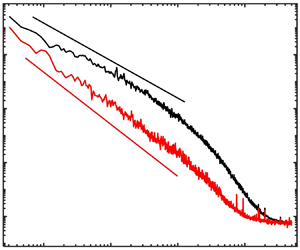
The seminal Bolgiano–Obukhov (BO) theory established the fundamental framework for turbulent mixing and energy transfer in stably stratified fluids. However, the presence of BO scalings remains debatable despite their being observed in stably stratified atmospheric layers and convective turbulence. In this study, we performed precise temperature measurements with 51 high-resolution loggers above the seafloor for 46 h on the continental shelf of the northern South China Sea. The temperature observation exhibits three layers with increasing distance from the seafloor: the bottom mixed layer (BML), the mixing zone and the internal wave zone. A BO-like scaling  $\alpha =-1.34\pm 0.10$ is observed in the temperature spectrum when the BML is in a weakly stable stratified ( $N\sim 0.0018$ rad s $^{-1}$) and strongly sheared ( $Ri\sim 0.0027$) condition, whereas in the unstably stratified convective turbulence of the BML, the scaling $\alpha =-1.76\pm 0.10$ clearly deviated from the BO theory but approached the classical $-$5/3 scaling in isotropic turbulence. This suggests that the convective turbulence is not the promise of BO scaling. In the mixing zone, where internal waves alternately interact with the BML, the scaling follows the Kolmogorov scaling. In the internal wave zone, the scaling $\alpha =-2.12 \pm 0.15$ is observed in the turbulence range and possible mechanisms are provided.
Information
- Type
- JFM Papers
- Information
- Copyright
- © The Author(s), 2024. Published by Cambridge University Press
References
Agrawal, R. & Chandy, A.J. 2021 Large eddy simulations of forced and stably stratified turbulence: evolution, spectra, scaling, structures and shear. Intl J. Heat Fluid Flow 89, 108778.CrossRefGoogle Scholar
Ahlers, G., Grossmann, S. & Lohse, D. 2009 Heat transfer and large scale dynamics in turbulent Rayleigh–Bénard convection. Rev. Mod. Phys. 81, 503.CrossRefGoogle Scholar
Alam, S., Guha, A. & Verma, M.K. 2019 Revisiting Bolgiano–Obukhov scaling for moderately stably stratified turbulence. J. Fluid Mech. 875, 961–973.CrossRefGoogle Scholar
Alexakis, A. & Biferale, L. 2018 Cascades and transitions in turbulent flows. Phys. Rep. 767, 1–101.CrossRefGoogle Scholar
Alford, M.H. et al. 2015 The formation and fate of internal waves in the south China sea. Nature 521 (7550), 65–69.CrossRefGoogle ScholarPubMed
Basu, A. & Bhattacharjee, J.K. 2019 Kolmogorov or Bolgiano-Obukhov scaling: universal energy spectra in stably stratified turbulent fluids. Phys. Rev. E 100 (3), 033117.CrossRefGoogle ScholarPubMed
Becherer, J. & Moum, J.N. 2017 An efficient scheme for onboard reduction of moored  $\chi$pod data. J. Atmos. Ocean. Technol. 34 (11), 2533–2546.CrossRefGoogle Scholar $\chi$pod data. J. Atmos. Ocean. Technol. 34 (11), 2533–2546.CrossRefGoogle Scholar
Bolgiano, R., Jr. 1959 Turbulent spectra in a stably stratified atmosphere. J. Geophys. Res. 64 (12), 2226–2229.CrossRefGoogle Scholar
Calzavarini, E., Toschi, F. & Tripiccione, R. 2002 Evidences of Bolgiano-Obhukhov scaling in three-dimensional Rayleigh–Benard convection. Phys. Rev. E 66, 016304.CrossRefGoogle ScholarPubMed
Chiba, O. 1989 Buoyant subrange observed in the stably stratified atmospheric surface layer. J. Appl. Meteorol. Climatol. 28 (11), 1236–1243.2.0.CO;2>CrossRefGoogle Scholar
Ching, E.S.C. 2014 Statistics and Scaling in Turbulent Rayleigh–Benard Convection. Springer.CrossRefGoogle Scholar
Chriss, T.M.C. & Caldwell, D.R. 1984 Turbulence spectra from the viscous sublayer and buffer layer at the ocean floor. J. Fluid Mech. 142, 39–55.Google Scholar
Cot, C. & Barat, J. 1989 Spectral analysis of high resolution temperature profiles in the stratosphere. Geophys. Res. Lett. 16 (10), 1165–1168.CrossRefGoogle Scholar
Ewart, T.E. 1976 Observations from straightline isobaric runs of SPURV. In Proc. IAPSO/IAMAP PSII, Edinburgh, UK, pp. 1–18. Joint Oceanographic Assembly.Google Scholar
Frehlich, R. & Sharman, R. 2010 Climatology of velocity and temperature turbulence statistics determined from rawinsonde and ACARS/AMDAR data. J. Appl. Meteorol. Climatol. 49 (6), 1149–1169.CrossRefGoogle Scholar
Frisch, U. 1995 Turbulence: The Legacy of A.N. Kolmogorov. Cambridge University Press.CrossRefGoogle Scholar
Gage, K.S. 1985 A climatology of atmospheric wavenumber spectra of wind and temperature observed by commercial aircraft. J. Atmos. Sci. 42, 950–960.Google Scholar
Ganachaud, A. & Wunsch, C. 2000 Improved estimates of global ocean circulation, heat transport and mixing from hydrographic data. Nature 408 (6811), 453–457.CrossRefGoogle ScholarPubMed
Gargett, A.E., Hendricks, P.J., Sanford, T.B., Osborn, T.R. & Williams, A.J. 1981 A composite spectrum of vertical shear in the upper ocean. J. Phys. Oceanogr. 11 (9), 1258–1271.2.0.CO;2>CrossRefGoogle Scholar
Gargett, A.E., Osborn, T.R. & Nasmyth, P.W. 1984 Local isotropy and the decay of turbulence in a stratified fluid. J. Fluid Mech. 144, 231–280.CrossRefGoogle Scholar
Garrett, C. & Munk, W. 1972 Space-time scales of internal waves. Geophys. Astrophys. Fluid Dyn. 3 (1), 225–264.CrossRefGoogle Scholar
Gregg, M.C. 1977 Variations in the intensity of small-scale mixing in the main thermocline. J. Phys. Oceanogr. 7, 436–454.2.0.CO;2>CrossRefGoogle Scholar
Gross, T.F. & Nowell, A.R.M. 1985 Spectral scaling in a tidal boundary layer. J. Phys. Oceanogr. 15 (5), 496–508.2.0.CO;2>CrossRefGoogle Scholar
van Haren, H. 2022 KMT, kilometer-long mooring of high-resolution temperature measurements results overview. Dyn. Atmos. Oceans 100, 101336.CrossRefGoogle Scholar
van Haren, H. 2023 Convection and intermittency noise in water temperature near a deep Mediterranean seafloor. Phys. Fluids 35 (2), 026604.CrossRefGoogle Scholar
van Haren, H. & Bosveld, F. 2022 Internal wave and turbulence observations with very high-resolution temperature sensors along the Cabauw mast. J. Atmos. Ocean. Technol. 39, 1149–1165.CrossRefGoogle Scholar
van Haren, H. & Dijkstra, H.A. 2021 Convection under internal waves in an alpine lake. Environ. Fluid Mech. 21, 305–316.CrossRefGoogle Scholar
van Haren, H. & Gostiaux, L. 2009 High-resolution open-ocean temperature spectra. J. Geophys. Res. 114 (C5), C05005.Google Scholar
van Haren, H., Voet, G., Alford, M.H., Fernández-Castro, B., Naveira Garabato, A.C., Wynne-Cattanach, B.L., Mercier, H. & Messias, M.-J. 2024 Near-slope turbulence in a Rockall canyon. Deep-Sea Res. I 206, 104277.CrossRefGoogle Scholar
Hieronymus, M., Nycander, J., Nilsson, J., Döös, K. & Hallberg, R. 2019 Oceanic overturning and heat transport: the role of background diffusivity. J. Clim. 32 (3), 701–716.CrossRefGoogle Scholar
Holbrook, W.S. & Fer, I. 2005 Ocean internal wave spectra inferred from seismic reflection transects. Geophys. Res. Lett. 32 (15), L15604.CrossRefGoogle Scholar
Huang, P.-Q., Cen, X.-R., Guo, S.-X., Lu, Y.-Z., Zhou, S.-Q., Qiu, X.-L., Zhang, J.-Z., Wu, Z.-L. & Han, G.-H. 2021 Variance of bottom water temperature at the continental margin of the northern south China sea. J. Geophys. Res. 126 (2), e2020JC015843.CrossRefGoogle Scholar
Huang, P.-Q., Cen, X.-R., Lu, Y.-Z., Guo, S.-X. & Zhou, S.-Q. 2019 Global distribution of the oceanic bottom mixed layer thickness. Geophys. Res. Lett. 46 (3), 1547–1554.CrossRefGoogle Scholar
Kerr, R.M. 1996 Rayleigh number scaling in numerical convection. J. Fluid Mech. 310, 139–179.CrossRefGoogle Scholar
Klymak, J.M. & Moum, J.N. 2007 Oceanic isopycnal slope spectra. Part 2. Turbulence. J. Phys. Oceanogr. 37 (5), 1232–1245.CrossRefGoogle Scholar
Kolmogorov, A.N. 1941 The local structure of turbulence in incompressible viscous fluid for very large Reynolds number. Dokl. Akad. Nauk SSSR 30, 301–303.Google Scholar
Kumar, A., Chatterjee, A.G. & Verma, M.K. 2014 Energy spectrum of buoyancy-driven turbulence. Phys. Rev. E 90 (2), 023016.CrossRefGoogle ScholarPubMed
Kunnen, R., Clercx, H., Geurts, B., Bokhoven, L. & Akkermans, R.A.D. 2008 Numerical and experimental investigation of structure-function scaling in turbulent Rayleigh–Benard convection. Phys. Rev. E 77, 016302.CrossRefGoogle ScholarPubMed
Lazarev, A., Schertzer, D., Lovejoy, S. & Chigirinskaya, Y. 1994 Unified multifractal atmospheric dynamics tested in the tropics. Part 2. Vertical scaling and generalized scale invariance. Nonlinear Process. Geophys. 1 (2/3), 115–123.CrossRefGoogle Scholar
Lien, R.-C. & Sanford, T.B. 2004 Turbulence spectra and local similarity scaling in a strongly stratified oceanic bottom boundary layer. Cont. Shelf Res. 24 (3), 375–392.CrossRefGoogle Scholar
Lohse, D. & Xia, K.-Q. 2010 Small-scale properties of turbulent Rayleigh–Bénard convection. Annu. Rev. Fluid Mech. 42, 335–364.CrossRefGoogle Scholar
Lumley, J.L. 1964 The spectrum of nearly inertial turbulence in a stably stratified fluid. J. Atmos. Sci. 21 (1), 99–102.2.0.CO;2>CrossRefGoogle Scholar
Meredith, M. & Garabato, A.N. 2021 Ocean Mixing: Drivers, Mechanisms and Impacts. Elsevier.Google Scholar
Monin, A.S. 1962 On the turbulence spectrum in a thermally stratified atmosphere. Bull. Acad. Sci. USSR Ser. Geophys. 3, 266–271.Google Scholar
Moum, J.N. 2015 Ocean speed and turbulence measurements using pitot-static tubes on moorings. J. Atmos. Ocean. Technol. 32 (7), 1400–1413.CrossRefGoogle Scholar
Myrup, L.O. 1969 Turbulence spectra in stable and convective layers in the free atmosphere. Tellus 21 (3), 341–354.CrossRefGoogle Scholar
Obukhov, A. 1959 Effect of archimedean forces on the structure of the temperature field in a turbulent flow. Dokl. Akad. Nauk SSSR 125, 1246–1248.Google Scholar
Okamoto, M. & Webb, E.K. 1970 The temperature fluctuations in stable stratification. Q. J. R. Meteorol. Soc. 96 (410), 591–600.CrossRefGoogle Scholar
Osborn, T.R. 1980 Estimates of the local rate of vertical diffusion from dissipation measurements. J. Phys. Oceanogr. 10 (1), 83–89.2.0.CO;2>CrossRefGoogle Scholar
Phillips, O.M. 1971 On spectra measured in an undulating layered medium. J. Phys. Oceanogr. 1 (1), 1–6.2.0.CO;2>CrossRefGoogle Scholar
Polzin, K., Wang, B., Wang, Z., Thwaites, F. & Williams, A. 2021 Moored flux and dissipation estimates from the northern deepwater gulf of Mexico. Fluids 6, 237.CrossRefGoogle Scholar
Qu, L. et al. 2021 Temporal variability in bottom water structures of the continental slope in the northern South China Sea. J. Geophys. Res. 126 (7), e2021JC017177.CrossRefGoogle Scholar
Schnelle, K.B. & Dey, P.R. 1999 Atmospheric Dispersion Modeling Compliance Guide. McGraw-Hill.Google Scholar
Schuster, H.G. & Just, W. 2006 Deterministic Chaos: An Introduction. John Wiley & Sons.Google Scholar
Shestakov, A.V., Stepanov, R.A. & Frick, P.G. 2017 On cascade energy transfer in convective turbulence. J. Appl. Mech. Tech. Phys. 58, 1171–1180.CrossRefGoogle Scholar
Shimizu, K. 2010 An analytical model of capped turbulent oscillatory bottom boundary layers. J. Geophys. Res. 115 (C3), C03011.Google Scholar
St. Laurent, L., Simmons, H., Tang, T.Y. & Wang, Y. 2011 Turbulent properties of internal waves in the South China Sea. Oceanography 24 (4), 78–87.CrossRefGoogle Scholar
Tian, J., Yang, Q. & Zhao, W. 2009 Enhanced diapycnal mixing in the South China Sea. J. Phys. Oceanogr. 39 (12), 3191–3203.CrossRefGoogle Scholar
Trowbridge, J.H. & Lentz, S.J. 2018 The bottom boundary layer. Annu. Rev. Mar. Sci. 10 (1), 397–420.CrossRefGoogle ScholarPubMed
Verma, M.K., Kumar, A. & Pandey, A. 2017 Phenomenology of buoyancy-driven turbulence: recent results. New J. Phys. 19 (2), 025012.CrossRefGoogle Scholar
Weatherly, G.L. & Martin, P.J. 1978 On the structure and dynamics of the oceanic bottom boundary layer. J. Phys. Oceanogr. 8 (4), 557–570.2.0.CO;2>CrossRefGoogle Scholar
Werne, J. & Fritts, D.C. 2000 Structure functions in stratified shear turbulence. In 10th DoD HPC User Group Conference, Albuquerque, NM. Department of Defense, USA.Google Scholar
Wroblewski, D.E., Cote, O.R., Hacker, J.M. & Dobosy, R.J. 2010 Velocity and temperature structure functions in the upper troposphere and lower stratosphere from high-resolution aircraft measurements. J. Atmos. Sci. 67, 1157–1170.CrossRefGoogle Scholar
Wroblewski, D.E., Cote, O.R., Hacker, J.M. & Dobosy, R.J. 2007 Cliff–ramp patterns and Kelvin–Helmholtz billows in stably stratified shear flow in the upper troposphere: analysis of aircraft measurements. J. Atmos. Sci. 64 (7), 2521–2539.CrossRefGoogle Scholar
Wu, X.Z., Kadanoff, L., Libchaber, A. & Sano, M. 1990 Frequency power spectrum of temperature fluctuations in free convection. Phys. Rev. Lett. 64, 2140.CrossRefGoogle ScholarPubMed
Wunsch, C. & Ferrari, R. 2004 Vertical mixing, energy, and the general circulation of the ocean. Annu. Rev. Fluid Mech. 36, 281–314.CrossRefGoogle Scholar
Yakhot, V. 1992 4/5 Kolmogorov law for statistically stationary turbulence: application to high Rayleigh number Bénard convection. Phys. Rev. Lett. 69, 769.CrossRefGoogle ScholarPubMed
Yang, Q., Zhao, W., Liang, X. & Tian, J. 2016 Three-dimensional distribution of turbulent mixing in the South China Sea. J. Phys. Oceanogr. 46 (3), 769–788.CrossRefGoogle Scholar
Zhao, Z. 2014 Internal tide radiation from the Luzon Strait. J. Geophys. Res. 119 (8), 5434–5448.CrossRefGoogle Scholar
Zhou, S.-Q., Sun, C. & Xia, K.-Q. 2007 Measured oscillations of the velocity and temperature fields in turbulent Rayleigh–Bénard convection in a rectangular cell. Phys. Rev. E 76, 036301.CrossRefGoogle Scholar
Zhou, S.-Q. & Xia, K.-Q. 2001 Scaling properties of the temperature field in convective turbulence. Phys. Rev. Lett. 87, 064501.CrossRefGoogle ScholarPubMed