




1 Introduction
Throughout this paper, all groups are assumed to be countable and discrete. For a group G, let $\mathrm {Sub}(G)$
denote the set of subgroups of G. The product topology on
$\mathrm {Sub}(G)$
denote the set of subgroups of G. The product topology on $2^G$
induces the structure of a compact Polish space on
$2^G$
induces the structure of a compact Polish space on $\mathrm {Sub}(G)$
and the rule
$\mathrm {Sub}(G)$
and the rule
 $$ \begin{align*} H\mapsto gHg^{-1}\quad \text{for all } g\in G,\ \text{for all } H\leqslant G, \end{align*} $$
defines an action of the group G on $\mathrm {Sub}(G)$
by homeomorphisms. Our main goal is to study the mixing properties of this action for groups acting on hyperbolic spaces. Our work is partially motivated by model-theoretic applications discussed in the forthcoming paper [Reference Hull, Minasyan and OsinHMO]. We begin by recalling the necessary definitions from topological dynamics.
$\mathrm {Sub}(G)$
by homeomorphisms. Our main goal is to study the mixing properties of this action for groups acting on hyperbolic spaces. Our work is partially motivated by model-theoretic applications discussed in the forthcoming paper [Reference Hull, Minasyan and OsinHMO]. We begin by recalling the necessary definitions from topological dynamics.
1.1 Topological transitivity and $\mu $
-mixing
$\mu $
-mixing

Let G be a group acting continuously on a topological space X. For any subsets U and V of X, we define
 $$ \begin{align} N(U,V)=\{ g\in G\mid g(U)\cap V\ne \emptyset\}. \end{align} $$
The action $G\curvearrowright X$
is said to be topologically transitive if
$G\curvearrowright X$
is said to be topologically transitive if $N(U,V)\ne \emptyset $
for any non-empty open sets
$N(U,V)\ne \emptyset $
for any non-empty open sets $U,V\subseteq X$
.
$U,V\subseteq X$
.
In this paper, we introduce a class of actions satisfying a stronger condition. More precisely, let $\operatorname {\mathrm {Prob}}(G)$
denote the set of all (countably additive) probability measures on a group G. For
$\operatorname {\mathrm {Prob}}(G)$
denote the set of all (countably additive) probability measures on a group G. For $\mu \in \operatorname {\mathrm {Prob}}(G)$
, we denote by
$\mu \in \operatorname {\mathrm {Prob}}(G)$
, we denote by $\mu ^{\ast n}$
the n-fold convolution of
$\mu ^{\ast n}$
the n-fold convolution of $\mu $
with itself.
$\mu $
with itself.
Definition 1.1. We say that an action of a group G on a topological space X is topologically $\mu $
-mixing for some
$\mu $
-mixing for some $\mu \in \operatorname {\mathrm {Prob}}(G)$
if
$\mu \in \operatorname {\mathrm {Prob}}(G)$
if
 $$ \begin{align*}\lim _{n\to \infty} \mu^{\ast n}(N(U,V))=1\end{align*} $$
for any non-empty open subsets U and V of X.
In other words, the action of a group G on a topological space X is topologically $\mu $
-mixing if the n-step random walk on G generated by
$\mu $
-mixing if the n-step random walk on G generated by $\mu $
and starting at
$\mu $
and starting at $1$
produces an element of
$1$
produces an element of $N(U,V)$
almost surely as
$N(U,V)$
almost surely as $n\to \infty $
. Clearly, every such action is topologically transitive. Our interest in topological
$n\to \infty $
. Clearly, every such action is topologically transitive. Our interest in topological $\mu $
-mixing is partly driven by the observation that it implies a much stronger condition. Recall that an action of a group G on a topological space X is highly topologically transitive if the diagonal action of G on
$\mu $
-mixing is partly driven by the observation that it implies a much stronger condition. Recall that an action of a group G on a topological space X is highly topologically transitive if the diagonal action of G on $X^k$
is topologically transitive for all
$X^k$
is topologically transitive for all $k\in \mathbb {N}$
. The following elementary fact is proved in §3.
$k\in \mathbb {N}$
. The following elementary fact is proved in §3.
Proposition 1.2. Let G be a group. For any $\mu \in \operatorname {\mathrm {Prob}}(G)$
, every topologically
$\mu \in \operatorname {\mathrm {Prob}}(G)$
, every topologically $\mu $
-mixing action of G on a topological space is highly topologically transitive.
$\mu $
-mixing action of G on a topological space is highly topologically transitive.
Clearly, a highly topologically transitive action of a group G on a topological space X does not need to be $\mu $
-mixing in general. Indeed, if X contains two disjoint non-empty open sets, no G-action on X is
$\mu $
-mixing in general. Indeed, if X contains two disjoint non-empty open sets, no G-action on X is $\mu $
-mixing with respect to the Dirac measure
$\mu $
-mixing with respect to the Dirac measure $\mu =\delta _1$
concentrated at
$\mu =\delta _1$
concentrated at $1$
. Furthermore, in Proposition 3.4, we give an example of a group G, generated by a finite symmetric set A, and a highly topologically transitive action of G on a Cantor space that is not
$1$
. Furthermore, in Proposition 3.4, we give an example of a group G, generated by a finite symmetric set A, and a highly topologically transitive action of G on a Cantor space that is not $\mu $
-mixing for the uniform measure
$\mu $
-mixing for the uniform measure $\mu $
supported on A (as usual, we say that a subset A of a group G is symmetric if
$\mu $
supported on A (as usual, we say that a subset A of a group G is symmetric if $A^{-1}=A$
.) Thus,
$A^{-1}=A$
.) Thus, $\mu $
-mixing is a stronger property than high topological transitivity even for well-behaved measures.
$\mu $
-mixing is a stronger property than high topological transitivity even for well-behaved measures.
Generally, the conjugation action of a group G on $\mathrm {Sub} (G)$
is not topologically transitive. One obstacle is that if G is finitely generated, then every finite index subgroup is an isolated point of
$\mathrm {Sub} (G)$
is not topologically transitive. One obstacle is that if G is finitely generated, then every finite index subgroup is an isolated point of $\mathrm {Sub} (G)$
. However, even if we restrict to the subspace
$\mathrm {Sub} (G)$
. However, even if we restrict to the subspace
 $$ \begin{align*} \mathrm{Sub}_\infty (G)=\{ H\leqslant G \mid |G:H|=\infty\}, \end{align*} $$
topological transitivity remains a rare phenomenon. For example, we show that the action of an infinite virtually solvable group G on $\mathrm {Sub}_{\infty } (G)$
by conjugation is topologically transitive if and only if
$\mathrm {Sub}_{\infty } (G)$
by conjugation is topologically transitive if and only if $G\cong \mathbb {Z}$
(see Corollary 3.14).
$G\cong \mathbb {Z}$
(see Corollary 3.14).
However, it is not difficult to prove that the action of the free group $F_n$
of rank
$F_n$
of rank $n\ge 1$
on
$n\ge 1$
on $\mathrm {Sub}_{\infty }(F_n)$
is topologically transitive. In this paper, we generalize and strengthen the latter observation in two directions. First, we replace the free group with a wide class of groups acting on hyperbolic spaces. Second, we prove that the action of such groups on a natural analog of
$\mathrm {Sub}_{\infty }(F_n)$
is topologically transitive. In this paper, we generalize and strengthen the latter observation in two directions. First, we replace the free group with a wide class of groups acting on hyperbolic spaces. Second, we prove that the action of such groups on a natural analog of $\mathrm {Sub}_{\infty }(F_n)$
is topologically
$\mathrm {Sub}_{\infty }(F_n)$
is topologically $\mu $
-mixing (and, in particular, highly topologically transitive). To formulate our main result, we need to review additional terminology.
$\mu $
-mixing (and, in particular, highly topologically transitive). To formulate our main result, we need to review additional terminology.
1.2 Groups acting on hyperbolic spaces
All group actions on hyperbolic metric spaces considered in this paper are assumed to be by isometries, unless specified otherwise. Let G be a group acting on a hyperbolic geodesic metric space S.
An element $g\in G$
is called loxodromic if the map
$g\in G$
is called loxodromic if the map $\mathbb {Z}\to S$
,
$\mathbb {Z}\to S$
, $n\mapsto g^n(s)$
, is a quasi-isometric embedding. We will say that the action of G on S is partially WPD if G contains at least one loxodromic WPD element. Here, ‘WPD’ stands for the weak proper discontinuity condition introduced by Bestvina and Fujiwara in [Reference Bestvina and FujiwaraBF] (see § 2 for a definition). Note that a (non-virtually cyclic) group G admits a partially WPD action on a hyperbolic metric space if and only if G is acylindrically hyperbolic, see [Reference OsinOsi16]. In particular, every acylindrical action on a hyperbolic space with unbounded orbits will be partially WPD. Let us list some examples of partially WPD group actions on hyperbolic spaces. These examples can be found, among other places, in [Reference OsinOsi18, §2.3].
$n\mapsto g^n(s)$
, is a quasi-isometric embedding. We will say that the action of G on S is partially WPD if G contains at least one loxodromic WPD element. Here, ‘WPD’ stands for the weak proper discontinuity condition introduced by Bestvina and Fujiwara in [Reference Bestvina and FujiwaraBF] (see § 2 for a definition). Note that a (non-virtually cyclic) group G admits a partially WPD action on a hyperbolic metric space if and only if G is acylindrically hyperbolic, see [Reference OsinOsi16]. In particular, every acylindrical action on a hyperbolic space with unbounded orbits will be partially WPD. Let us list some examples of partially WPD group actions on hyperbolic spaces. These examples can be found, among other places, in [Reference OsinOsi18, §2.3].
-
(1) The natural action of an infinite hyperbolic group G on its Cayley graph with respect to a finite generating set.
-
(2) The action of any amalgamated free product
$G=A\ast _C B$
(respectively, an HNN extension
$G=A\ast _{C^t=D}$
) on the associated Bass–Serre tree provided
$A\ne C\ne B$
(respectively,
$C\ne A\ne D$
) and there exists
$g\in G$
such that (
${|g^{-1}Cg \cap C|<\infty }$
). This class of examples includes the action of the fundamental group of a non-geometric closed
$3$
-manifold on the Bass–Serre tree associated with the JSJ decomposition. -
(3) The action of the mapping class group of a closed surface of genus
$g\ge 2$
on the curve complex. -
(4) The action of
$Out(F_n)$
on the free factor complex. -
(5) The action of a right angled Artin group on its extension graph.








Every (non-virtually cyclic) group G admitting a partially WPD action on a hyperbolic space has a maximal finite normal subgroup $E(G)$
called the finite radical of G (see [Reference Dahmani, Guirardel and OsinDGO, Theorems 6.14 and 6.8]).
$E(G)$
called the finite radical of G (see [Reference Dahmani, Guirardel and OsinDGO, Theorems 6.14 and 6.8]).
A subgroup $H\leqslant G$
is said to be convex cocompact (with respect to an action
$H\leqslant G$
is said to be convex cocompact (with respect to an action $G \curvearrowright S$
) if H acts on S properly with quasi-convex orbits. In the case when G is a hyperbolic group acting properly and coboundedly on S, a subgroup of G is convex-cocompact if and only if it is quasi-convex in G. By
$G \curvearrowright S$
) if H acts on S properly with quasi-convex orbits. In the case when G is a hyperbolic group acting properly and coboundedly on S, a subgroup of G is convex-cocompact if and only if it is quasi-convex in G. By $\mathrm {Sub}_{\infty }^{cc}(G\curvearrowright S)$
, we denote the set of all convex cocompact subgroups of infinite index in G. Note that this set is non-empty if G is not virtually cyclic and contains at least one loxodromic element g, as in this case,
$\mathrm {Sub}_{\infty }^{cc}(G\curvearrowright S)$
, we denote the set of all convex cocompact subgroups of infinite index in G. Note that this set is non-empty if G is not virtually cyclic and contains at least one loxodromic element g, as in this case, $\langle g \rangle \in \mathrm {Sub}_{\infty }^{cc}(G\curvearrowright S)$
. It is easy to see that a conjugate of a convex cocompact subgroup is again convex cocompact (see Lemma 2.8); thus, G acts on
$\langle g \rangle \in \mathrm {Sub}_{\infty }^{cc}(G\curvearrowright S)$
. It is easy to see that a conjugate of a convex cocompact subgroup is again convex cocompact (see Lemma 2.8); thus, G acts on $\mathrm {Sub}_{\infty }^{cc}(G\curvearrowright S)$
by conjugation.
$\mathrm {Sub}_{\infty }^{cc}(G\curvearrowright S)$
by conjugation.
We are now ready to state our first main result. As usual, for a set A in a topological space, we denote by $\overline {A}$
its closure.
$\overline {A}$
its closure.
Theorem 1.3. Let G be a non-virtually cyclic group acting on a hyperbolic space S. Suppose that the action is partially WPD and G has trivial finite radical. Then, the action of G on $\overline {\mathrm {Sub}_{\infty }^{cc}(G\curvearrowright S)}$
by conjugation is topologically
$\overline {\mathrm {Sub}_{\infty }^{cc}(G\curvearrowright S)}$
by conjugation is topologically $\mu $
-mixing for every probability measure
$\mu $
-mixing for every probability measure $\mu \in \operatorname {\mathrm {Prob}}(G)$
whose support is finite, symmetric, and generates G.
$\mu \in \operatorname {\mathrm {Prob}}(G)$
whose support is finite, symmetric, and generates G.
This theorem is a special case of Theorem 6.9, which is stated for a more general class of measures (see Definition 2.9) and for groups which are not necessarily finitely generated.
Recall that a hyperbolic group G is locally quasi-convex if every finitely generated subgroup is quasi-convex. In this case, the closure of the space of quasi-convex subgroups of G coincides with $\mathrm {Sub}_\infty (G)$
. Known examples of locally quasi-convex hyperbolic groups are free groups, surface groups, certain one-relator groups [Reference McCammond and WiseMW], and fundamental groups of finite graphs of free groups with cyclic edge groups that do not contain any Baumslag–Solitar subgroups, e.g., amalgamated products of two free groups over a cyclic subgroup which is maximal in one of the factors [Reference Bigdely and WiseBW, Theorem 3.6]. However, Agol’s virtual fibering theorem implies that closed hyperbolic
$\mathrm {Sub}_\infty (G)$
. Known examples of locally quasi-convex hyperbolic groups are free groups, surface groups, certain one-relator groups [Reference McCammond and WiseMW], and fundamental groups of finite graphs of free groups with cyclic edge groups that do not contain any Baumslag–Solitar subgroups, e.g., amalgamated products of two free groups over a cyclic subgroup which is maximal in one of the factors [Reference Bigdely and WiseBW, Theorem 3.6]. However, Agol’s virtual fibering theorem implies that closed hyperbolic $3$
-manifold groups are not locally quasi-convex. Theorem 1.3 immediately gives the following corollary.
$3$
-manifold groups are not locally quasi-convex. Theorem 1.3 immediately gives the following corollary.
Corollary 1.4. Suppose that G is a locally quasi-convex hyperbolic group that is not virtually cyclic and has trivial finite radical. Then, the action of G on the space $\mathrm {Sub}_\infty (G)$
by conjugation is topologically
$\mathrm {Sub}_\infty (G)$
by conjugation is topologically $\mu $
-mixing for every probability measure
$\mu $
-mixing for every probability measure $\mu \in \operatorname {\mathrm {Prob}}(G)$
, whose support is finite, symmetric, and generates G.
$\mu \in \operatorname {\mathrm {Prob}}(G)$
, whose support is finite, symmetric, and generates G.
For relatively hyperbolic groups, the following analog of Theorem 1.3 can be proven in much the same way. Recall that a relatively hyperbolic group G is said to be elementary if it is virtually cyclic or one of the peripheral subgroups coincides with G.
Theorem 1.5. Suppose that G is a non-elementary relatively hyperbolic group with trivial finite radical. Then, the action of G on the closure of the space of infinite index relatively quasi-convex subgroups in $\mathrm {Sub}(G)$
by conjugation is topologically
$\mathrm {Sub}(G)$
by conjugation is topologically $\mu $
-mixing for every probability measure
$\mu $
-mixing for every probability measure $\mu \in \operatorname {\mathrm {Prob}}(G)$
whose support is finite, symmetric, and generates G.
$\mu \in \operatorname {\mathrm {Prob}}(G)$
whose support is finite, symmetric, and generates G.
Note that relatively quasi-convex subgroups of a relatively hyperbolic group G need not always be finitely generated, even when G itself is finitely generated.
Using relative hyperbolicity of finitely generated groups with infinitely many ends, we obtain the following corollary.
Corollary 1.6. Let G be a finitely generated group with infinitely many ends that has no non-trivial finite normal subgroups. Then, the action of G on the space $\mathrm {Sub}_\infty (G)$
is topologically
$\mathrm {Sub}_\infty (G)$
is topologically $\mu $
-mixing for every measure
$\mu $
-mixing for every measure $\mu \in \operatorname {\mathrm {Prob}}(G)$
, whose support is finite, symmetric, and generates G.
$\mu \in \operatorname {\mathrm {Prob}}(G)$
, whose support is finite, symmetric, and generates G.
More generally, the statement of Corollary 1.6 applies to all non-elementary finitely generated relatively hyperbolic groups that are locally quasi-convex (that is, every finitely generated subgroup is relatively quasi-convex). Examples of such groups include limit groups [Reference DahmaniDah] and many fundamental groups of finite graphs of locally quasi-convex relatively hyperbolic groups with Noetherian edge groups (e.g., fundamental groups of graphs of free groups with cyclic edge groups, where at least one vertex is non-abelian) [Reference Bigdely and WiseBW].
Two remarks are in order. First, we note that the assumption that the finite radical of G is trivial cannot be omitted in both theorems. Second, the local quasi-convexity assumption cannot be omitted in Corollary 1.4 (see Example 3.12 for details).
Combining Theorems 1.3, 1.5 and Corollaries 1.4, 1.6 with Proposition 1.2, we obtain that the corresponding actions are highly topologically transitive. At the final stage of our work, we learned that this result was independently obtained by Azuelos and Gaboriau [Reference Azuelos and GaboriauAG] in certain particular cases including hyperbolic groups and groups with infinitely many ends. Their proof is different from ours and does not seem to imply the stronger topological $\mu $
-mixing property.
$\mu $
-mixing property.
1.3 Random walks
Our proofs of Theorems 1.3 and 1.5 make use of the results obtained in [Reference Abbott and HullAH], where Abbott and the first author studied the interactions between random walks and a fixed convex cocompact subgroup H of a group G with a partially WPD action on a hyperbolic space. To apply these results, we need to verify that H satisfies an additional technical hypothesis, namely the existence of a transverse element (see Definition 5.1). In [Reference Abbott and HullAH], this additional condition was verified in many particular cases of interest. In this paper, we prove the existence of transverse elements in general settings. This is crucial for the proofs of our main theorems and also allows us to strengthen the main result of [Reference Abbott and HullAH] as follows (see §6 for details).
Theorem 1.7. Let G be a (non-virtually cyclic) group admitting a partially WPD action on a hyperbolic space S. Suppose that G has trivial finite radical and let H be a convex cocompact subgroup of G. Then, for any probability measure $\mu \in \operatorname {\mathrm {Prob}}(G)$
, whose support is finite, symmetric, and generates G, we have
$\mu \in \operatorname {\mathrm {Prob}}(G)$
, whose support is finite, symmetric, and generates G, we have
 $$ \begin{align*} \lim _{n\to \infty} \mu^{\ast n} \begin{pmatrix} \begin{Bmatrix} g\in G\; \left| \begin{array}{c} g \mathrm{\; is \; loxodromic,}\\ \langle H, g\rangle\cong H\ast \langle g\rangle, \; \mathrm{and}\\ \langle H, g \rangle\; \mathrm{is\; convex\; cocompact} \end{array} \right.\!\! \end{Bmatrix} \end{pmatrix}=1. \end{align*} $$
Note that even the existence of an element $g\in G$
such that
$g\in G$
such that $\langle H, g\rangle \cong H\ast \langle g\rangle $
is a new result in this level of generality, though it was previously known in many particular cases [Reference ArzhantsevaArz, Reference MinasyanMin06, Reference Arzhantseva and MinasyanAM, Reference Abbott and DahmaniAD, Reference Antolín and CumplidoAC, Reference Abbott and HullAH]. In addition, applying Theorem 1.7 to right angled Artin groups and hierarchically hyperbolic groups allows us to confirm [Reference Abbott and HullAH, Conjecture 6.14] and [Reference Abbott and HullAH, Conjecture 6.15], respectively, see §6. There is also an analog of Theorem 1.7 for relatively quasi-convex subgroups of relatively hyperbolic groups, but this can already be found in [Reference Abbott and HullAH, Theorem 6.3].
$\langle H, g\rangle \cong H\ast \langle g\rangle $
is a new result in this level of generality, though it was previously known in many particular cases [Reference ArzhantsevaArz, Reference MinasyanMin06, Reference Arzhantseva and MinasyanAM, Reference Abbott and DahmaniAD, Reference Antolín and CumplidoAC, Reference Abbott and HullAH]. In addition, applying Theorem 1.7 to right angled Artin groups and hierarchically hyperbolic groups allows us to confirm [Reference Abbott and HullAH, Conjecture 6.14] and [Reference Abbott and HullAH, Conjecture 6.15], respectively, see §6. There is also an analog of Theorem 1.7 for relatively quasi-convex subgroups of relatively hyperbolic groups, but this can already be found in [Reference Abbott and HullAH, Theorem 6.3].
1.4 Organization of the paper
In §2, we give some background on $\delta $
: hyperbolic spaces, random walks, and topological dynamics. In §§4 and 5, we establish the existence of transverse loxodromic elements for convex cocompact subgroups. The existence of transverse elements is used in §6 to strengthen the main results of [Reference Abbott and HullAH] and to prove Theorem 1.3. Finally, Theorem 1.5 and Corollary 1.6 are proved in §7.
$\delta $
: hyperbolic spaces, random walks, and topological dynamics. In §§4 and 5, we establish the existence of transverse loxodromic elements for convex cocompact subgroups. The existence of transverse elements is used in §6 to strengthen the main results of [Reference Abbott and HullAH] and to prove Theorem 1.3. Finally, Theorem 1.5 and Corollary 1.6 are proved in §7.
2 Background
2.1
$\delta $
-Hyperbolic geometry

Let $(S, d)$
be a geodesic metric space. For
$(S, d)$
be a geodesic metric space. For $x, y\in S$
, we use
$x, y\in S$
, we use $[x, y]$
to denote a geodesic from x to y in S. If p is a path in S, we denote the initial point and the terminal point of p by
$[x, y]$
to denote a geodesic from x to y in S. If p is a path in S, we denote the initial point and the terminal point of p by $p_-$
and
$p_-$
and $p_+$
, respectively, and we denote the length of p by
$p_+$
, respectively, and we denote the length of p by $\|p\|$
. A rectifiable path p is
$\|p\|$
. A rectifiable path p is $(\unicode{x3bb} , c)$
-quasi-geodesic for some constants
$(\unicode{x3bb} , c)$
-quasi-geodesic for some constants $\unicode{x3bb} \ge 1$
and
$\unicode{x3bb} \ge 1$
and $c \ge 0$
if for any subpath q of p, we have
$c \ge 0$
if for any subpath q of p, we have $\|q\| \le \unicode{x3bb} \mathrm {d}(q_-, q_+)+c$
.
$\|q\| \le \unicode{x3bb} \mathrm {d}(q_-, q_+)+c$
.
Given a metric space $(S,\mathrm {d})$
, a point
$(S,\mathrm {d})$
, a point $x \in S$
, a subset
$x \in S$
, a subset $Y \subseteq S$
, and a number
$Y \subseteq S$
, and a number $C \ge 0$
, by a C-neighborhood of Y in S,
$C \ge 0$
, by a C-neighborhood of Y in S, $\mathcal {N}_C(Y)$
, we always mean the closed neighborhood of the form
$\mathcal {N}_C(Y)$
, we always mean the closed neighborhood of the form $\{s \in S \mid \text { there exists }\, y \in Y \text { such that } \mathrm {d}(s,y)\le C\}$
. We also write
$\{s \in S \mid \text { there exists }\, y \in Y \text { such that } \mathrm {d}(s,y)\le C\}$
. We also write $\mathrm {d}(x,Y) \le C$
to say that
$\mathrm {d}(x,Y) \le C$
to say that $x \in \mathcal {N}_C(Y)$
, that is, that
$x \in \mathcal {N}_C(Y)$
, that is, that $\mathrm {d}(x,y) \le C$
for some
$\mathrm {d}(x,y) \le C$
for some $y \in Y$
.
$y \in Y$
.
A geodesic triangle $\Delta $
in S is said to be
$\Delta $
in S is said to be $\delta $
-slim for some
$\delta $
-slim for some $\delta \ge 0$
if every side of
$\delta \ge 0$
if every side of $\Delta $
is contained in the closed
$\Delta $
is contained in the closed $\delta $
-neighborhood of the union of its two other sides. A geodesic metric space
$\delta $
-neighborhood of the union of its two other sides. A geodesic metric space $(S,\mathrm {d})$
is
$(S,\mathrm {d})$
is $\delta $
-hyperbolic if every geodesic triangle in S is
$\delta $
-hyperbolic if every geodesic triangle in S is $\delta $
-slim for some fixed
$\delta $
-slim for some fixed $\delta \ge 0$
(see [Reference Alonso, Brady, Cooper, Ferlini, Lustig, Mihalik, Shapiro, Short and ShortABC, Ch. 1] for equivalent definitions and more background on
$\delta \ge 0$
(see [Reference Alonso, Brady, Cooper, Ferlini, Lustig, Mihalik, Shapiro, Short and ShortABC, Ch. 1] for equivalent definitions and more background on $\delta $
-hyperbolicity). We say that S is hyperbolic if it is
$\delta $
-hyperbolicity). We say that S is hyperbolic if it is $\delta $
-hyperbolic for some
$\delta $
-hyperbolic for some $\delta \ge 0$
.
$\delta \ge 0$
.
For the remainder of this subsection, $(S,\mathrm {d})$
is a
$(S,\mathrm {d})$
is a $\delta $
-hyperbolic geodesic metric space. The next well-known property is sometimes called the stability of quasi-geodesics in a hyperbolic space (cf. [Reference Bridson and HaefligerBH, Theorem 1.7 in Ch. III.H]).
$\delta $
-hyperbolic geodesic metric space. The next well-known property is sometimes called the stability of quasi-geodesics in a hyperbolic space (cf. [Reference Bridson and HaefligerBH, Theorem 1.7 in Ch. III.H]).
Lemma 2.1. For any $\unicode{x3bb} \ge 1$
and
$\unicode{x3bb} \ge 1$
and $c \ge 0$
, there exists a constant
$c \ge 0$
, there exists a constant $\varkappa \ge 0$
such that the following holds. If p and q are paths in S joining the same two points
$\varkappa \ge 0$
such that the following holds. If p and q are paths in S joining the same two points $p_-=q_-$
and
$p_-=q_-$
and $p_+=q_+$
, where p is geodesic and q is
$p_+=q_+$
, where p is geodesic and q is $(\unicode{x3bb} ,c)$
-quasi-geodesic, then p is contained in the
$(\unicode{x3bb} ,c)$
-quasi-geodesic, then p is contained in the $\varkappa $
-neighborhood of q and q is contained in the
$\varkappa $
-neighborhood of q and q is contained in the $\varkappa $
-neighborhood of p in S.
$\varkappa $
-neighborhood of p in S.
Given three points $x,y,s \in S$
, the Gromov product of x and y with respect to s is defined by the formula
$x,y,s \in S$
, the Gromov product of x and y with respect to s is defined by the formula
 $$ \begin{align} (x\mid y)_s=\tfrac12 (\mathrm{d}(x,s)+\mathrm{d}(y,s)-\mathrm{d}(x,y)). \end{align} $$
The next lemma was proved in [Reference OlshanskiiOls, Lemma 21]. The constants involving $\delta $
are different from the constants in the original statement of [Reference OlshanskiiOls, Lemma 21] since we are using a different definition of
$\delta $
are different from the constants in the original statement of [Reference OlshanskiiOls, Lemma 21] since we are using a different definition of $\delta $
-hyperbolicity (our definition, in terms of
$\delta $
-hyperbolicity (our definition, in terms of $\delta $
-slim triangles, implies the
$\delta $
-slim triangles, implies the $12\delta $
-hyperbolicity of Gromov products, used in [Reference OlshanskiiOls]; see [Reference Alonso, Brady, Cooper, Ferlini, Lustig, Mihalik, Shapiro, Short and ShortABC, Ch. 2, Proposition 2.1]).
$12\delta $
-hyperbolicity of Gromov products, used in [Reference OlshanskiiOls]; see [Reference Alonso, Brady, Cooper, Ferlini, Lustig, Mihalik, Shapiro, Short and ShortABC, Ch. 2, Proposition 2.1]).
Lemma 2.2. Let S be a $\delta $
-hyperbolic geodesic metric space for some
$\delta $
-hyperbolic geodesic metric space for some $\delta \ge 0$
. Suppose that
$\delta \ge 0$
. Suppose that $C_0 \ge 168\delta $
and
$C_0 \ge 168\delta $
and $C_1> 12(C_0+12\delta )$
are some constants. If
$C_1> 12(C_0+12\delta )$
are some constants. If $x_0,x_1,\ldots ,x_m$
are points of S satisfying
$x_0,x_1,\ldots ,x_m$
are points of S satisfying $\mathrm {d}(x_{i-1},x_{i}) \ge C_1$
for
$\mathrm {d}(x_{i-1},x_{i}) \ge C_1$
for $i=1,\ldots ,m$
, and
$i=1,\ldots ,m$
, and $(x_{i-1}\mid x_{i+1})_{x_i} \le C_0$
for
$(x_{i-1}\mid x_{i+1})_{x_i} \le C_0$
for ${i=1,\ldots ,m-1}$
, and q is any geodesic segment joining
${i=1,\ldots ,m-1}$
, and q is any geodesic segment joining $x_0$
with
$x_0$
with $x_m$
, then
$x_m$
, then $\mathrm {d}(x_i,q) \le 2C_0$
for all
$\mathrm {d}(x_i,q) \le 2C_0$
for all $i=1,\ldots ,m$
.
$i=1,\ldots ,m$
.
For a constant $\eta \geq 0$
, a subset
$\eta \geq 0$
, a subset $Y \subseteq S$
is
$Y \subseteq S$
is $\eta $
-quasi-convex (or simply quasi-convex) if, whenever p is a geodesic with endpoints in Y,
$\eta $
-quasi-convex (or simply quasi-convex) if, whenever p is a geodesic with endpoints in Y, $p\subseteq \mathcal {N}_\eta (Y)$
.
$p\subseteq \mathcal {N}_\eta (Y)$
.
Suppose now that G is a group acting by isometries on S. This action is (metrically) proper if for every $s \in S$
and each
$s \in S$
and each $R>0$
, the subset
$R>0$
, the subset $\{g \in G \mid \mathrm {d}(s,g(s)) \le R\}$
is finite.
$\{g \in G \mid \mathrm {d}(s,g(s)) \le R\}$
is finite.
We are often interested in subgroups or subsets of G which have quasi-convex orbits, that is, $H\subseteq G$
such that for some
$H\subseteq G$
such that for some $s\in S$
, the orbit
$s\in S$
, the orbit $H(s)$
is a quasi-convex subset of S. Note that this is independent of the basepoint s.
$H(s)$
is a quasi-convex subset of S. Note that this is independent of the basepoint s.
Lemma 2.3. [Reference Antolín, Minasyan and SistoAMS, Remark 2.1]
Let $H\subseteq G$
such that
$H\subseteq G$
such that $H(s)$
is
$H(s)$
is $\eta $
-quasi-convex in S. Then, for any
$\eta $
-quasi-convex in S. Then, for any $t\in S$
,
$t\in S$
, $H(t)$
is
$H(t)$
is $\eta '$
-quasi-convex for
$\eta '$
-quasi-convex for $\eta '=2\delta +\eta +2\mathrm {d}(s,t) \ge 0$
.
$\eta '=2\delta +\eta +2\mathrm {d}(s,t) \ge 0$
.
The next lemma easily follows from the standard fact that the union of quasi-convex subsets in a hyperbolic metric space is again quasi-convex (see [Reference MinasyanMin04, Lemma 2.1]).
Lemma 2.4. Suppose that $H,K \leqslant G$
and
$H,K \leqslant G$
and $s \in S$
are such that the orbits
$s \in S$
are such that the orbits $H(s)$
and
$H(s)$
and $K(s)$
are quasi-convex. Then, for
$K(s)$
are quasi-convex. Then, for $Y=(H \cup K) \setminus \{1\}$
, the orbit
$Y=(H \cup K) \setminus \{1\}$
, the orbit $Y(s)$
is also quasi-convex in S.
$Y(s)$
is also quasi-convex in S.
Lemma 2.5. Suppose that $s \in S$
and
$s \in S$
and $H\leqslant G$
is a subgroup such that the H-orbit
$H\leqslant G$
is a subgroup such that the H-orbit $ H(s)$
is
$ H(s)$
is $\eta $
-quasi-convex for some
$\eta $
-quasi-convex for some $\eta \ge 0$
. Assume that we are given
$\eta \ge 0$
. Assume that we are given $\unicode{x3bb} \ge 1$
and
$\unicode{x3bb} \ge 1$
and $c \ge 0$
, and let
$c \ge 0$
, and let $\varkappa =\varkappa (\unicode{x3bb} ,c)$
be the constant provided by Lemma 2.1. If q is a
$\varkappa =\varkappa (\unicode{x3bb} ,c)$
be the constant provided by Lemma 2.1. If q is a $(\unicode{x3bb} ,c)$
-quasi-geodesic path in S with
$(\unicode{x3bb} ,c)$
-quasi-geodesic path in S with $\mathrm {d}(q_-, H(s)) \le \varepsilon $
,
$\mathrm {d}(q_-, H(s)) \le \varepsilon $
, $\mathrm {d}(q_+, H(s)) \le \varepsilon $
for some
$\mathrm {d}(q_+, H(s)) \le \varepsilon $
for some $\varepsilon \ge 0$
, and
$\varepsilon \ge 0$
, and $x\in q$
is any point, then
$x\in q$
is any point, then $\mathrm {d}(x, H(s)) \le \varkappa +2\delta +\varepsilon +\eta $
. Moreover, if in addition x satisfies
$\mathrm {d}(x, H(s)) \le \varkappa +2\delta +\varepsilon +\eta $
. Moreover, if in addition x satisfies $\mathrm {d}(q_-,x)>\varepsilon +\varkappa +2\delta $
and
$\mathrm {d}(q_-,x)>\varepsilon +\varkappa +2\delta $
and $\mathrm {d}(x,q_+)>\varepsilon +\varkappa +2\delta $
, then
$\mathrm {d}(x,q_+)>\varepsilon +\varkappa +2\delta $
, then $\mathrm {d}(x, H(s)) \le \varkappa +2\delta +\eta $
.
$\mathrm {d}(x, H(s)) \le \varkappa +2\delta +\eta $
.
Proof. Take $h_1,h_2 \in H$
so that
$h_1,h_2 \in H$
so that $\mathrm {d}(q_-,h_1(s)) \le \varepsilon $
and
$\mathrm {d}(q_-,h_1(s)) \le \varepsilon $
and $\mathrm {d}(q_+,h_2(s)) \le \varepsilon $
, and consider a geodesic quadrangle Q in S with vertices
$\mathrm {d}(q_+,h_2(s)) \le \varepsilon $
, and consider a geodesic quadrangle Q in S with vertices $h_1 (s)$
,
$h_1 (s)$
, $q_-$
,
$q_-$
, $q_+$
, and
$q_+$
, and $h_2(s)$
. If
$h_2(s)$
. If $a,b$
are adjacent vertices of Q, we use
$a,b$
are adjacent vertices of Q, we use $[a,b]$
to denote the side of Q joining a to b. Then, according to Lemma 2.1, there is
$[a,b]$
to denote the side of Q joining a to b. Then, according to Lemma 2.1, there is $y \in [q_-,q_+]$
such that
$y \in [q_-,q_+]$
such that $\mathrm {d}(x,y) \le \varkappa $
. Observe that y belongs to the
$\mathrm {d}(x,y) \le \varkappa $
. Observe that y belongs to the $(2\delta +\varepsilon )$
-neighborhood of
$(2\delta +\varepsilon )$
-neighborhood of $[h_1(s),h_2(s)]$
(because Q is
$[h_1(s),h_2(s)]$
(because Q is $2\delta $
-slim) and the latter segment lies in the
$2\delta $
-slim) and the latter segment lies in the $\eta $
-neighborhood of
$\eta $
-neighborhood of $ H(s)$
. Therefore,
$ H(s)$
. Therefore, $\mathrm {d}(x, H(s)) \le \mathrm {d}(x,y)+\mathrm {d}(y, H(s)) \le \, \varkappa +2\delta +\varepsilon +\eta $
.
$\mathrm {d}(x, H(s)) \le \mathrm {d}(x,y)+\mathrm {d}(y, H(s)) \le \, \varkappa +2\delta +\varepsilon +\eta $
.
To prove the second claim of the lemma, assume that $\mathrm {d}(q_-,x)>\varepsilon +\varkappa +2\delta $
and
$\mathrm {d}(q_-,x)>\varepsilon +\varkappa +2\delta $
and $\mathrm {d}(x,q_+)>\varepsilon +\varkappa +2\delta $
. Then, the triangle inequality implies that
$\mathrm {d}(x,q_+)>\varepsilon +\varkappa +2\delta $
. Then, the triangle inequality implies that
 $$ \begin{align*} \mathrm{d}(q_-,y) \ge \mathrm{d}(q_-,x)-\mathrm{d}(x,y)> \varepsilon +2\delta \!\quad\text{and}\quad\! \mathrm{d}(y,q_+) \ge \mathrm{d}(x,q_+)-\mathrm{d}(x,y) \kern-1.2pt{>}\kern-1.2pt \varepsilon \kern-1.2pt{+}\kern-1.2pt 2\delta. \end{align*} $$
Therefore, $\mathrm {d}(y,[h_1(s),q_-]) \ge \mathrm {d}(y,q_-)-\|[h_1(s),q_-]\|> \varepsilon +2\delta -\varepsilon =2\delta $
and, similarly,
$\mathrm {d}(y,[h_1(s),q_-]) \ge \mathrm {d}(y,q_-)-\|[h_1(s),q_-]\|> \varepsilon +2\delta -\varepsilon =2\delta $
and, similarly, $\mathrm {d}(y,[q_+,h_2(s)])>2\delta $
. However, since Q is
$\mathrm {d}(y,[q_+,h_2(s)])>2\delta $
. However, since Q is $2\delta $
-slim, the latter shows that y must belong to the
$2\delta $
-slim, the latter shows that y must belong to the $2\delta $
-neighborhood of the side
$2\delta $
-neighborhood of the side $[h_1(s),h_2(s)]$
. Alternatively, by
$[h_1(s),h_2(s)]$
. Alternatively, by $\eta $
-quasi-convexity of
$\eta $
-quasi-convexity of $ H(s)$
, this side is contained in the
$ H(s)$
, this side is contained in the $\eta $
-neighborhood of
$\eta $
-neighborhood of $ H(s)$
. Thus,
$ H(s)$
. Thus, $\mathrm {d}(y, H(s)) \le 2\delta +\eta $
, which implies that
$\mathrm {d}(y, H(s)) \le 2\delta +\eta $
, which implies that $\mathrm {d}(x, H(s)) \le \varkappa +2\delta +\eta $
, as claimed.
$\mathrm {d}(x, H(s)) \le \varkappa +2\delta +\eta $
, as claimed.
Recall that given $s\in S$
, an element
$s\in S$
, an element $g \in G$
is called loxodromic if the map
$g \in G$
is called loxodromic if the map $\mathbb {Z}\to S$
,
$\mathbb {Z}\to S$
, $n\to g^n(s)$
, is a quasi-isometric embedding. Note that up to changing constants, this is again independent of the choice of the basepoint
$n\to g^n(s)$
, is a quasi-isometric embedding. Note that up to changing constants, this is again independent of the choice of the basepoint $s\in S$
. Now, we fix a geodesic
$s\in S$
. Now, we fix a geodesic $[s, g(s)]$
and form a path by concatenating the geodesics
$[s, g(s)]$
and form a path by concatenating the geodesics $g^n([s, g(s)])$
for all
$g^n([s, g(s)])$
for all $n\in \mathbb {Z}$
. This bi-infinite path is called a quasi-geodesic axis for g based at s and it is a g-invariant quasi-geodesic on which g acts as a non-trivial translation.
$n\in \mathbb {Z}$
. This bi-infinite path is called a quasi-geodesic axis for g based at s and it is a g-invariant quasi-geodesic on which g acts as a non-trivial translation.
If $g \in G$
is loxodromic and
$g \in G$
is loxodromic and $x,y$
are two points on some quasi-geodesic axis
$x,y$
are two points on some quasi-geodesic axis $\ell $
of g, we write
$\ell $
of g, we write $\ell _{[x,y]}$
to denote the segment of
$\ell _{[x,y]}$
to denote the segment of $\ell $
(or of
$\ell $
(or of $\ell ^{-1}$
) from x to y.
$\ell ^{-1}$
) from x to y.
Associated to each loxodromic element g are two points $g^{+\infty }, g^{-\infty }$
in the Gromov boundary
$g^{+\infty }, g^{-\infty }$
in the Gromov boundary $ \partial S$
of S, defined by
$ \partial S$
of S, defined by $g^{+ \infty }=\lim _{n\to +\infty } g^n(s)$
and
$g^{+ \infty }=\lim _{n\to +\infty } g^n(s)$
and $g^{- \infty }=\lim _{n\to -\infty } g^n(s)$
for some (equivalently, any)
$g^{- \infty }=\lim _{n\to -\infty } g^n(s)$
for some (equivalently, any) $s\in S$
. Loxodromic elements
$s\in S$
. Loxodromic elements $g,h \in G$
are called independent if
$g,h \in G$
are called independent if $\{g^{+\infty }, g^{-\infty }\}\cap \{h^{+\infty }, h^{-\infty }\}=\emptyset $
. The action of G on S is called non-elementary if G contains at least two independent loxodromic elements. In this case, G will necessarily contain an infinite collection of pairwise independent loxodromic elements, see [Reference OsinOsi16, §3].
$\{g^{+\infty }, g^{-\infty }\}\cap \{h^{+\infty }, h^{-\infty }\}=\emptyset $
. The action of G on S is called non-elementary if G contains at least two independent loxodromic elements. In this case, G will necessarily contain an infinite collection of pairwise independent loxodromic elements, see [Reference OsinOsi16, §3].
Definition 2.6. A loxodromic element $g\in G$
is called a WPD element if for all
$g\in G$
is called a WPD element if for all $s\in S$
and
$s\in S$
and $\varepsilon \geq 0$
, there exists
$\varepsilon \geq 0$
, there exists $N\in \mathbb {N}$
such that
$N\in \mathbb {N}$
such that
 $$ \begin{align*} |\{u\in G\mid \mathrm{d}(u(s),s)\leq \varepsilon , \mathrm{d}(ug^N(s),g^N(s))\leq \varepsilon \}|<\infty. \end{align*} $$
The action of G on S is called WPD if every loxodromic element is a WPD element and the action is called partially WPD if G contains at least one loxodromic WPD element.
Recall that a group is said to be elementary if it has a cyclic subgroup of finite index.
Lemma 2.7. [Reference Dahmani, Guirardel and OsinDGO, Lemma 6.5, Corollary 6.6]
Every loxodromic WPD element $g \in G$
is contained in a unique maximal elementary subgroup
$g \in G$
is contained in a unique maximal elementary subgroup $E_G(g) \leqslant G$
, which can be defined by
$E_G(g) \leqslant G$
, which can be defined by
 $$ \begin{align} E_G(g)= \{x \in G \mid \text{ there exists } m,n\in \mathbb{Z}\setminus \{ 0\} \text{ such that } x^{-1}g^mx=g^n\}. \end{align} $$
A subgroup $H\leqslant G$
that acts properly on S and has quasi-convex orbits is called S-convex compact, or simply convex cocompact when the space S is understood. Equivalently, H is finitely generated and, for every
$H\leqslant G$
that acts properly on S and has quasi-convex orbits is called S-convex compact, or simply convex cocompact when the space S is understood. Equivalently, H is finitely generated and, for every $s \in S$
, the orbit map
$s \in S$
, the orbit map $h \mapsto h(s)$
is a quasi-isometric embedding of H (with the word metric from a finite generating set) into S (see, for example, [Reference Antolín, Minasyan and SistoAMS, Lemma 2.5]). It follows that every convex cocompact subgroup is a hyperbolic group in the sense of Gromov. Note that a cyclic subgroup
$h \mapsto h(s)$
is a quasi-isometric embedding of H (with the word metric from a finite generating set) into S (see, for example, [Reference Antolín, Minasyan and SistoAMS, Lemma 2.5]). It follows that every convex cocompact subgroup is a hyperbolic group in the sense of Gromov. Note that a cyclic subgroup $\langle g\rangle $
is S-convex cocompact if and only if g is loxodromic with respect to the action on S.
$\langle g\rangle $
is S-convex cocompact if and only if g is loxodromic with respect to the action on S.
Lemma 2.8. Let G be a group acting by isometries on a hyperbolic geodesic metric space S. If $H \leqslant G$
is convex cocompact with respect to this action, then so is
$H \leqslant G$
is convex cocompact with respect to this action, then so is $gHg^{-1}$
for every
$gHg^{-1}$
for every $g \in G$
.
$g \in G$
.
Proof. Assume that H is convex cocompact and take any $g \in G$
. For any
$g \in G$
. For any $s \in S$
, set
$s \in S$
, set $s'=g^{-1}(s) \in S$
and observe that
$s'=g^{-1}(s) \in S$
and observe that
 $$ \begin{align*}\mathrm{d}(ghg^{-1}(s),s)=\mathrm{d}(h(s'),s') \quad\text{ for all } h \in H,\end{align*} $$
whence properness of the action of H on S implies properness of the action of $gHg^{-1}$
on S.
$gHg^{-1}$
on S.
The orbit $gHg^{-1}(s)$
is the g-translate of the orbit
$gHg^{-1}(s)$
is the g-translate of the orbit $H(s')$
. Since
$H(s')$
. Since $H(s')$
is quasi-convex in S, the same holds for
$H(s')$
is quasi-convex in S, the same holds for $gHg^{-1}(s)$
. Therefore,
$gHg^{-1}(s)$
. Therefore, $gHg^{-1}$
is also convex cocompact.
$gHg^{-1}$
is also convex cocompact.
2.2 Permissible measures and random walks
Let G be a countable group that has a non-elementary action on a hyperbolic metric space S and let $\mu \colon 2^G\to \mathbb {R}_{\geq 0}$
be a probability measure on G. Let
$\mu \colon 2^G\to \mathbb {R}_{\geq 0}$
be a probability measure on G. Let $\mathrm {Supp}(\mu )$
denote the support of
$\mathrm {Supp}(\mu )$
denote the support of $\mu $
, that is,
$\mu $
, that is, $\mathrm {Supp}(\mu )=\{g \in G \mid \mu (g)>0\}$
, and let
$\mathrm {Supp}(\mu )=\{g \in G \mid \mu (g)>0\}$
, and let $\Gamma _\mu $
denote the subsemigroup of G generated by
$\Gamma _\mu $
denote the subsemigroup of G generated by $\mathrm {Supp}(\mu )$
. We say that
$\mathrm {Supp}(\mu )$
. We say that $\mu $
is bounded if
$\mu $
is bounded if $\mathrm {Supp}(\mu )(s)$
is bounded for any (equivalently, all)
$\mathrm {Supp}(\mu )(s)$
is bounded for any (equivalently, all) $s \in S$
. The measure
$s \in S$
. The measure $\mu $
is reversible if
$\mu $
is reversible if $\Gamma _\mu $
is a subgroup of G, non-elementary if
$\Gamma _\mu $
is a subgroup of G, non-elementary if $\Gamma _\mu $
contains at least two independent loxodromic elements, and WPD if
$\Gamma _\mu $
contains at least two independent loxodromic elements, and WPD if $\Gamma _\mu $
has at least one loxodromic WPD element (with respect to the induced action on S). When
$\Gamma _\mu $
has at least one loxodromic WPD element (with respect to the induced action on S). When $\mu $
is reversible, non-elementary, and WPD, there is a unique maximal finite subgroup of G normalized by
$\mu $
is reversible, non-elementary, and WPD, there is a unique maximal finite subgroup of G normalized by $\Gamma _\mu $
that we denote by
$\Gamma _\mu $
that we denote by $E(\mu )$
(this follows from a combination of [Reference OsinOsi16, Theorem 1.4] with [Reference HullHul, Lemma 5.5] or with [Reference Antolín, Minasyan and SistoAMS, Lemma 5.6]). Finally, we say that
$E(\mu )$
(this follows from a combination of [Reference OsinOsi16, Theorem 1.4] with [Reference HullHul, Lemma 5.5] or with [Reference Antolín, Minasyan and SistoAMS, Lemma 5.6]). Finally, we say that $\mu $
is symmetric if
$\mu $
is symmetric if $\mu (g^{-1})=\mu (g)$
for all
$\mu (g^{-1})=\mu (g)$
for all $g \in G$
, and
$g \in G$
, and $\mu $
has generating support if
$\mu $
has generating support if $\Gamma _\mu =G$
.
$\Gamma _\mu =G$
.
Definition 2.9. [Reference Abbott and HullAH, Definition 2.8]
Let G be a group with a non-elementary, partially WPD action on a hyperbolic metric space S. Then, a probability measure $\mu $
on G is called permissible if
$\mu $
on G is called permissible if $\mu $
is bounded, reversible, non-elementary, WPD, and
$\mu $
is bounded, reversible, non-elementary, WPD, and $E(\mu )=E(G)$
.
$E(\mu )=E(G)$
.
Note that when G is finitely generated, any probability measure whose support is a finite, symmetric generating set of G will be permissible. For example, the uniform measure on a finite symmetric generating set will be a permissible measure on G in this case. In general, whenever G has a non-elementary partially WPD action on a hyperbolic metric space S, G has a finitely generated subgroup F such that F contains loxodromic WPD elements, the action of F on S is non-elementary, and the maximal finite subgroup of G normalized by F is equal to $E(G)$
(this follows from [Reference OsinOsi16, Theorem 1.4] and [Reference Dahmani, Guirardel and OsinDGO, Lemma 6.17]). In this case, any probability measure whose support is a finite symmetric generating set of F, for example, the uniform measure on this set will be permissible. In particular, permissible probability measures exist for any such action. Moreover, if A is any finite symmetric subset of G such that
$E(G)$
(this follows from [Reference OsinOsi16, Theorem 1.4] and [Reference Dahmani, Guirardel and OsinDGO, Lemma 6.17]). In this case, any probability measure whose support is a finite symmetric generating set of F, for example, the uniform measure on this set will be permissible. In particular, permissible probability measures exist for any such action. Moreover, if A is any finite symmetric subset of G such that $F\leqslant \langle A\rangle $
, then any measure
$F\leqslant \langle A\rangle $
, then any measure $\mu $
with
$\mu $
with $\mathrm {Supp}(\mu )=A$
is permissible. Thus, any finite subset of G is contained in the support of some permissible measure.
$\mathrm {Supp}(\mu )=A$
is permissible. Thus, any finite subset of G is contained in the support of some permissible measure.
Let $\mu $
be a probability measure on a group G. A random walk of length n with respect to
$\mu $
be a probability measure on a group G. A random walk of length n with respect to $\mu $
means a random element
$\mu $
means a random element $w_n=g_1 \cdots g_n$
, where each
$w_n=g_1 \cdots g_n$
, where each $g_i$
is chosen independently according to the measure
$g_i$
is chosen independently according to the measure $\mu $
. In other words,
$\mu $
. In other words, $w_n$
is a random element of G chosen with respect to the probability measure
$w_n$
is a random element of G chosen with respect to the probability measure $\mu ^{\ast n}$
, the n-fold convolution of
$\mu ^{\ast n}$
, the n-fold convolution of $\mu $
with itself. We say that
$\mu $
with itself. We say that $w_n$
satisfies some property P with probability
$w_n$
satisfies some property P with probability $\alpha $
if
$\alpha $
if $\mu ^{\ast n}(\{g\in G\mid g \text { satisfies } P\})=\alpha $
. If
$\mu ^{\ast n}(\{g\in G\mid g \text { satisfies } P\})=\alpha $
. If $(P_n)$
is a sequence of such properties, we say that
$(P_n)$
is a sequence of such properties, we say that $w_n$
satisfies
$w_n$
satisfies $P_n$
asymptotically almost surely if the probability that
$P_n$
asymptotically almost surely if the probability that $w_n$
satisfies
$w_n$
satisfies $P_n$
tends to
$P_n$
tends to $1$
as n goes to infinity, that is,
$1$
as n goes to infinity, that is,
 $$ \begin{align*} \lim_{n\to\infty}\mu^{\ast n}(\{g\in G\mid g \text{ satisfies } P_n\})=1. \end{align*} $$
For example, if G is a countable group with a non-elementary action on a hyperbolic metric space and $\mu $
is a non-elementary probability measure on G, then Maher and Tiozzo showed that a random walk
$\mu $
is a non-elementary probability measure on G, then Maher and Tiozzo showed that a random walk $w_n$
with respect to
$w_n$
with respect to $\mu $
will be loxodromic asymptotically almost surely [Reference Maher and TiozzoMT, Theorem 1.4]. Moreover, they also show the following theorem.
$\mu $
will be loxodromic asymptotically almost surely [Reference Maher and TiozzoMT, Theorem 1.4]. Moreover, they also show the following theorem.
Theorem 2.10. [Reference Maher and TiozzoMT, Theorem 1.2]
Let G be a group with a non-elementary, partially WPD action on a hyperbolic metric space S, let $\mu $
be a permissible probability measure on G, and let
$\mu $
be a permissible probability measure on G, and let $w_n$
be a random walk with respect to
$w_n$
be a random walk with respect to $\mu $
. Then, for all
$\mu $
. Then, for all $s\in S$
, there exists a constant
$s\in S$
, there exists a constant $D>0$
such that for all
$D>0$
such that for all $\varepsilon>0$
,
$\varepsilon>0$
,
 $$ \begin{align*} (1-\varepsilon )Dn\leq d(s, w_n(s))\leq (1+\varepsilon )Dn \end{align*} $$
asymptotically almost surely.
With this terminology, we can also rephrase the definition of a topologically $\mu $
-mixing action (see Definition 1.1) in terms of random walks. That is, the action of G on a topological space X is topologically
$\mu $
-mixing action (see Definition 1.1) in terms of random walks. That is, the action of G on a topological space X is topologically $\mu $
-mixing if and only if for any non-empty open subsets U and V of X, we have
$\mu $
-mixing if and only if for any non-empty open subsets U and V of X, we have $w_n(U)\cap V\neq \emptyset $
asymptotically almost surely.
$w_n(U)\cap V\neq \emptyset $
asymptotically almost surely.
Now, suppose we have a sequence $(\mu _i)$
of permissible probability measures on G. For a fixed
$(\mu _i)$
of permissible probability measures on G. For a fixed $n, k\in \mathbb {N}$
, we consider the product measure
$n, k\in \mathbb {N}$
, we consider the product measure $\mu _1^{\ast n}\times \cdots \times \mu _k^{\ast n}$
on
$\mu _1^{\ast n}\times \cdots \times \mu _k^{\ast n}$
on $G^k$
and let
$G^k$
and let $\mu _{n, k}$
denote the push-forward of this product measure to
$\mu _{n, k}$
denote the push-forward of this product measure to $\mathrm {Sub}(G)$
under the map
$\mathrm {Sub}(G)$
under the map $G^k\to \mathrm {Sub}(G)$
which sends
$G^k\to \mathrm {Sub}(G)$
which sends $(g_1,\ldots ,g_k)\to \langle g_1,\ldots ,g_k\rangle $
. A random element with respect to
$(g_1,\ldots ,g_k)\to \langle g_1,\ldots ,g_k\rangle $
. A random element with respect to $\mu _{n, k}$
can be thought of as a subgroup of the form
$\mu _{n, k}$
can be thought of as a subgroup of the form $\langle w_{n, 1},\ldots , w_{n, k}\rangle $
, where each
$\langle w_{n, 1},\ldots , w_{n, k}\rangle $
, where each $w_{n, i}$
is a random walk of length n with respect to
$w_{n, i}$
is a random walk of length n with respect to $\mu _i$
. We will say that this subgroup
$\mu _i$
. We will say that this subgroup $\langle w_{n, 1},\ldots , w_{n, k}\rangle $
satisfies some property P with probability
$\langle w_{n, 1},\ldots , w_{n, k}\rangle $
satisfies some property P with probability $\alpha $
if
$\alpha $
if $\mu _{n, k}(\{H\in \mathrm {Sub}(G)\mid H \text { satisfies } P\}=\alpha $
. For a sequence of properties
$\mu _{n, k}(\{H\in \mathrm {Sub}(G)\mid H \text { satisfies } P\}=\alpha $
. For a sequence of properties $P_n$
of subgroups, we say that a random k-generated subgroup with respect to the sequence
$P_n$
of subgroups, we say that a random k-generated subgroup with respect to the sequence $(\mu _i)$
satisfies
$(\mu _i)$
satisfies $P_n$
asymptotically almost surely if
$P_n$
asymptotically almost surely if
 $$ \begin{align*} \lim_{n\to\infty}\mu_{n, k}(\{H\in \mathrm{Sub}(G)\mid H \text{ satisfies } P_n\})=1. \end{align*} $$
For example, if G is a countable group with a non-elementary action on a hyperbolic metric space and $\mu $
is a non-elementary measure on G, then random k-generated subgroups with respect to the constant sequence
$\mu $
is a non-elementary measure on G, then random k-generated subgroups with respect to the constant sequence $(\mu )$
are convex cocompact and isomorphic to free groups of rank k asymptotically almost surely [Reference Taylor and TiozzoTT, Theorem 1.2].
$(\mu )$
are convex cocompact and isomorphic to free groups of rank k asymptotically almost surely [Reference Taylor and TiozzoTT, Theorem 1.2].
3 Topological dynamics
3.1 Topological transitivity and
$\mu $
-mixing

Recall that a topological space X is called Polish if X is separable and completely metrizable.
Suppose that G acts by homeomorphisms on a topological space X. This action is said to be topologically k-transitive for some $k\in \mathbb {N}$
if for any non-empty open sets
$k\in \mathbb {N}$
if for any non-empty open sets $U_1,\ldots ,U_k, V_1,\ldots ,V_k$
in X, there exist
$U_1,\ldots ,U_k, V_1,\ldots ,V_k$
in X, there exist $g\in G$
such that
$g\in G$
such that $g(U_i)\cap V_i\neq \emptyset $
for all
$g(U_i)\cap V_i\neq \emptyset $
for all $1\leq i\leq k$
. Thus, topological
$1\leq i\leq k$
. Thus, topological $1$
-transitivity is the same as topological transitivity, and an action is highly topologically transitive if and only if it is topologically k-transitive for all
$1$
-transitivity is the same as topological transitivity, and an action is highly topologically transitive if and only if it is topologically k-transitive for all $k\in \mathbb {N}$
.
$k\in \mathbb {N}$
.
We refer to [Reference Cairns, Kolganova and NielsenCKN] for a comparison of these transitivity conditions and other notions from topological dynamics in various settings. In particular, the following standard consequence of the Baire category theorem can be found there.
Lemma 3.1. [Reference Cairns, Kolganova and NielsenCKN, Proposition 1]
Suppose G has a topologically transitive action on a Polish space X. Then, there exists $x\in X$
such that the orbit
$x\in X$
such that the orbit $G(x)$
is dense in X.
$G(x)$
is dense in X.
We begin by discussing an elementary example showing that topological $\mu $
-mixing defined in §1 is strictly stronger than topological transitivity and weaker than topological mixing.
$\mu $
-mixing defined in §1 is strictly stronger than topological transitivity and weaker than topological mixing.
Example 3.2. Consider the action of $G=\mathbb {Z}$
on
$G=\mathbb {Z}$
on $\mathbb {S}^1=\mathbb {R}/\mathbb {Z}$
by irrational rotation. It is well known and easy to prove that this action is topologically transitive. However, let U, V, and W be open arcs in
$\mathbb {S}^1=\mathbb {R}/\mathbb {Z}$
by irrational rotation. It is well known and easy to prove that this action is topologically transitive. However, let U, V, and W be open arcs in $\mathbb {S}^1$
. If these arcs are small and far from each other, the sets
$\mathbb {S}^1$
. If these arcs are small and far from each other, the sets $N(U,V)$
and
$N(U,V)$
and $N(U,W)$
will be disjoint as the action of G on
$N(U,W)$
will be disjoint as the action of G on $\mathbb {S}^1$
is isometric. It follows that these sets cannot simultaneously have ‘hitting probability
$\mathbb {S}^1$
is isometric. It follows that these sets cannot simultaneously have ‘hitting probability $1$
’ with respect to any random walk on G; that is, the action of G on
$1$
’ with respect to any random walk on G; that is, the action of G on $\mathbb {S}^1$
is not topologically
$\mathbb {S}^1$
is not topologically $\mu $
-mixing with respect to any
$\mu $
-mixing with respect to any $\mu \in \operatorname {\mathrm {Prob}}(G)$
.
$\mu \in \operatorname {\mathrm {Prob}}(G)$
.
Let us now relate topological $\mu $
-mixing to high topological transitivity.
$\mu $
-mixing to high topological transitivity.
Proof of Proposition 1.2.
Let G be a group G, $\mu \in \operatorname {\mathrm {Prob}}(G)$
. Suppose that G acts on a topological space X and the action is topologically
$\mu \in \operatorname {\mathrm {Prob}}(G)$
. Suppose that G acts on a topological space X and the action is topologically $\mu $
-mixing. For any
$\mu $
-mixing. For any $k\in \mathbb {N}$
and any non-empty open sets
$k\in \mathbb {N}$
and any non-empty open sets $U_1,\ldots ,U_k, V_1,\ldots ,V_k\subseteq X$
, we have
$U_1,\ldots ,U_k, V_1,\ldots ,V_k\subseteq X$
, we have
 $$ \begin{align*} \begin{aligned} \lim _{n\to\infty} \mu^{\ast n} \bigg(\!\bigcap_{i=1}^k N(U_i, V_i)\bigg) & = \lim _{n\to\infty} \mu^{\ast n} \bigg(G\setminus \bigcup_{i=1}^k (G\setminus N(U_i, V_i))\bigg) \\& \quad \ge 1- \lim _{n\to\infty} \sum_{i=1}^k \mu^{\ast n} (G\setminus N(U_i, V_i)) \\& \quad = 1 - \sum_{i=1}^k \Big(1- \lim _{n\to\infty} \mu^{\ast n} (N(U_i, V_i))\Big)= 1. \end{aligned} \end{align*} $$
In particular, $\bigcap _{i=1}^k N(U_i, V_i)\ne \emptyset $
and the proposition follows.
$\bigcap _{i=1}^k N(U_i, V_i)\ne \emptyset $
and the proposition follows.
It is easy to show that, in general, high topological transitivity does not imply $\mu $
-mixing.
$\mu $
-mixing.
Example 3.3. Let G be a group acting highly topologically transitively on a space X and let $H\leqslant G$
be a subgroup such that the induced action of H on X is not highly topologically transitive (e.g., we can take
$H\leqslant G$
be a subgroup such that the induced action of H on X is not highly topologically transitive (e.g., we can take $H=\{ 1\}$
). For any
$H=\{ 1\}$
). For any $\mu \in \mathrm {Prob}(G)$
supported on H, the action of G is not topologically
$\mu \in \mathrm {Prob}(G)$
supported on H, the action of G is not topologically $\mu $
-mixing by Proposition 1.2.
$\mu $
-mixing by Proposition 1.2.
However, in the above example, the support of the measure $\mu $
does not generate G. Our next goal is to demonstrate that topological
$\mu $
does not generate G. Our next goal is to demonstrate that topological $\mu $
-mixing is strictly stronger than high topological transitivity even in the case when the measure has generating support. The construction below is inspired by the action of Thompson’s group V on the Cantor set
$\mu $
-mixing is strictly stronger than high topological transitivity even in the case when the measure has generating support. The construction below is inspired by the action of Thompson’s group V on the Cantor set $\{0,1\}^{\mathbb {N}}$
, and, more specifically, by the discussion of this action in the work of Bleak and Quick [Reference Bleak and QuickBQ].
$\{0,1\}^{\mathbb {N}}$
, and, more specifically, by the discussion of this action in the work of Bleak and Quick [Reference Bleak and QuickBQ].
Proposition 3.4. There exist a group G generated by a finite symmetric set A, a compact Polish space X, and an action of G on X by homeomorphisms that is highly topologically transitive but not $\mu $
-mixing for the uniform measure
$\mu $
-mixing for the uniform measure $\mu $
supported on A.
$\mu $
supported on A.
Proof. Denote by $F_3=F(x,y,z)$
the free group on the set
$F_3=F(x,y,z)$
the free group on the set $\{x,y,z\}$
and let
$\{x,y,z\}$
and let $F_2=F(x,y)$
be its subgroup generated by
$F_2=F(x,y)$
be its subgroup generated by $\{x,y\}$
. Take
$\{x,y\}$
. Take $G=F_2*S_{18}$
, where
$G=F_2*S_{18}$
, where $S_{18}$
is the symmetric group on
$S_{18}$
is the symmetric group on $18$
letters.
$18$
letters.
Let T be the Cayley graph of $F_3$
with respect to
$F_3$
with respect to $\{x,y,z\}$
. We think of T as a rooted tree, where the vertices correspond to reduced words over
$\{x,y,z\}$
. We think of T as a rooted tree, where the vertices correspond to reduced words over $\{x,y,z\}^{\pm 1}$
, with the root at the empty word (the identity element of
$\{x,y,z\}^{\pm 1}$
, with the root at the empty word (the identity element of $F_3$
). We let X be the visual (Gromov) boundary of T, which is simply the set of all infinite reduced words over
$F_3$
). We let X be the visual (Gromov) boundary of T, which is simply the set of all infinite reduced words over $\{x,y,z\}^{\pm 1}$
. The topology on X is the standard one: two such infinite words are close if they share a long common prefix. Thus, a basic open set in X consists of all infinite words that start with a given reduced word
$\{x,y,z\}^{\pm 1}$
. The topology on X is the standard one: two such infinite words are close if they share a long common prefix. Thus, a basic open set in X consists of all infinite words that start with a given reduced word $w \in F_3$
; we call this open set the cone of w, denoted
$w \in F_3$
; we call this open set the cone of w, denoted $\mathrm {Cone}(w)$
. Clearly, X is a perfect closed subset of the Cantor space
$\mathrm {Cone}(w)$
. Clearly, X is a perfect closed subset of the Cantor space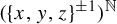 $(\{x,y,z\}^{\pm 1})^{\mathbb {N}}$
and, hence, X is itself (homeomorphic to) a Cantor space. For every non-empty reduced word
$(\{x,y,z\}^{\pm 1})^{\mathbb {N}}$
and, hence, X is itself (homeomorphic to) a Cantor space. For every non-empty reduced word $w \in F_3$
and every
$w \in F_3$
and every $n \in \mathbb {N}\cup \{0\}$
, we denote by
$n \in \mathbb {N}\cup \{0\}$
, we denote by $\mathrm {Cone}_n(w)$
the set of all finite reduced words
$\mathrm {Cone}_n(w)$
the set of all finite reduced words $u \in F_3$
of length
$u \in F_3$
of length $\|u\|=\|w\|+n$
starting with w.
$\|u\|=\|w\|+n$
starting with w.
The linear order $x<x^{-1}<y<y^{-1}<z<z^{-1}$
on
$x<x^{-1}<y<y^{-1}<z<z^{-1}$
on $\{x,y,z\}^{\pm 1}$
induces a lexicographic (total) order on any collection of reduced words in
$\{x,y,z\}^{\pm 1}$
induces a lexicographic (total) order on any collection of reduced words in $F_3$
of length m for each
$F_3$
of length m for each $m \in \mathbb {N}$
. It also gives rise to a total order on X. Given any two non-empty reduced words
$m \in \mathbb {N}$
. It also gives rise to a total order on X. Given any two non-empty reduced words $u,v \in F_3$
and arbitrary
$u,v \in F_3$
and arbitrary $n \in \mathbb {N}\cup \{0\}$
, there is a unique order-preserving bijection from
$n \in \mathbb {N}\cup \{0\}$
, there is a unique order-preserving bijection from $\mathrm {Cone}_n(u)$
to
$\mathrm {Cone}_n(u)$
to $\mathrm {Cone}_n(v)$
; when
$\mathrm {Cone}_n(v)$
; when $n \to \infty $
, these bijections induce an order-preserving bijection
$n \to \infty $
, these bijections induce an order-preserving bijection
 $$ \begin{align*} \xi_{u,v}\colon \mathrm{Cone}(u) \to \mathrm{Cone}(v). \end{align*} $$
Let $\Sigma \subseteq F_3$
be the set of all reduced words of length
$\Sigma \subseteq F_3$
be the set of all reduced words of length $2$
in
$2$
in $F_3$
, and let
$F_3$
, and let $\Omega =\Sigma \setminus F_2$
so that
$\Omega =\Sigma \setminus F_2$
so that $|\Sigma |=30$
and
$|\Sigma |=30$
and $|\Omega |=18$
. We treat
$|\Omega |=18$
. We treat $S_{18} \cong \mathrm {Sym}(\Omega )$
as the subgroup of the full symmetric group
$S_{18} \cong \mathrm {Sym}(\Omega )$
as the subgroup of the full symmetric group $\mathrm {Sym}(\Sigma )$
that permutes elements of
$\mathrm {Sym}(\Sigma )$
that permutes elements of $\Omega $
and fixes pointwise all words in
$\Omega $
and fixes pointwise all words in $\Sigma \setminus \Omega =\Sigma \cap F_2$
. Thus,
$\Sigma \setminus \Omega =\Sigma \cap F_2$
. Thus, $S_{18}$
naturally acts on
$S_{18}$
naturally acts on $\Sigma $
by permutations (on the left). This action induces an action of
$\Sigma $
by permutations (on the left). This action induces an action of $S_{18}$
on X as follows: for every
$S_{18}$
on X as follows: for every $u\in \Sigma $
, every
$u\in \Sigma $
, every $w\in \mathrm {Cone}(u)$
, and every
$w\in \mathrm {Cone}(u)$
, and every $\sigma \in S_{18}$
, we let
$\sigma \in S_{18}$
, we let
 $$ \begin{align*} \sigma(w)=\xi_{u,\sigma(u)}(w). \end{align*} $$
Since $X=\bigsqcup _{u \in \Sigma } \mathrm {Cone}(u)$
, this gives an action of
$X=\bigsqcup _{u \in \Sigma } \mathrm {Cone}(u)$
, this gives an action of $S_{18}$
on X by homeomorphisms, which permutes the cones of words of length
$S_{18}$
on X by homeomorphisms, which permutes the cones of words of length $2$
in
$2$
in $F_3 \setminus F_2$
and fixes pointwise all infinite reduced words whose prefixes of length
$F_3 \setminus F_2$
and fixes pointwise all infinite reduced words whose prefixes of length $2$
belong to
$2$
belong to $F_2$
. Further, the group
$F_2$
. Further, the group $F_2$
acts naturally on X by left multiplication. Therefore, we can combine these two actions to obtain a left action of the free product
$F_2$
acts naturally on X by left multiplication. Therefore, we can combine these two actions to obtain a left action of the free product $G=F_2*S_{18}$
on X by homeomorphisms.
$G=F_2*S_{18}$
on X by homeomorphisms.
Given two non-empty reduced words $u,v \in F_3$
and
$u,v \in F_3$
and $g \in G$
, we say that g sends
$g \in G$
, we say that g sends $\mathrm {Cone}(u)$
to
$\mathrm {Cone}(u)$
to $\mathrm {Cone}(v)$
, writing
$\mathrm {Cone}(v)$
, writing $g[\mathrm {Cone}(u)]=\mathrm {Cone}(v)$
if g induces an order-preserving bijection between
$g[\mathrm {Cone}(u)]=\mathrm {Cone}(v)$
if g induces an order-preserving bijection between $\mathrm {Cone}(u)$
and
$\mathrm {Cone}(u)$
and $\mathrm {Cone}(v)$
; in other words, we have
$\mathrm {Cone}(v)$
; in other words, we have
 $$ \begin{align*}g\vert_{\mathrm{Cone}(u)}=\xi_{u,v}.\end{align*} $$
The definitions immediately imply that
 $$ \begin{align*} \sigma[\mathrm{Cone}(w)]=\mathrm{Cone}(\sigma(w)) \quad\text{for all } \sigma \in S_{18} \ \text{and all } w \in \Sigma, \end{align*} $$
and
 $$ \begin{align*} a[\mathrm{Cone}(u)]=\mathrm{Cone}(au)\quad \text{for every } a \in \{x,y\}^{\pm 1} \text{ and all } u \in F_3, \text{ with } \|u\|\ge 2. \end{align*} $$
Given an element $g\in G$
and a subset
$g\in G$
and a subset $A\subseteq X$
, we denote by
$A\subseteq X$
, we denote by $g\vert _A$
the restriction of g to A.
$g\vert _A$
the restriction of g to A.
Claim 3.5. For every integer $n \ge 2$
and any reduced word
$n \ge 2$
and any reduced word $u \in F_3 \setminus (F_2 \cup \{z^{-n}\})$
, of length n, there is an element
$u \in F_3 \setminus (F_2 \cup \{z^{-n}\})$
, of length n, there is an element $f \in G$
such that
$f \in G$
such that
 $$ \begin{align} f[\mathrm{Cone}(u)]=\mathrm{Cone}(z^2) \quad \text{and}\quad f[\mathrm{Cone}(z^{-n})]=\mathrm{Cone}(z^{-2}). \end{align} $$
Proof of Claim 3.5.
If $n=2$
, then an element of
$n=2$
, then an element of $S_{18}$
does the required job. Thus, we can assume that
$S_{18}$
does the required job. Thus, we can assume that $n>2$
.
$n>2$
.
Let $u_2$
be the prefix of u of length
$u_2$
be the prefix of u of length $2$
. We first choose elements
$2$
. We first choose elements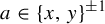 $a \in \{x,y\}^{\pm 1}$
and
$a \in \{x,y\}^{\pm 1}$
and $\sigma \in S_{18}$
as follows.
$\sigma \in S_{18}$
as follows.
-
(1) If
$u_2 \in \Sigma \setminus \Omega $
starts with a letter
$a \in \{x,y\}^{\pm 1}$
, then let
$\sigma \in S_{18}$
be a permutation fixing
$\mathrm {Cone}(u_2)$
and sending
$\mathrm {Cone}(z^{-2})$
to
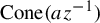
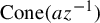
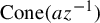
$\mathrm {Cone}(a z^{-1})$
. -
(2) If
$u_2=z^{-2}$
, then take
$a=x$
and let
$\sigma \in S_{18}$
be any permutation sending
$\mathrm {Cone}(z^{-2})$
to
$\mathrm {Cone}(a z^{-1})$
. -
(3) Otherwise (if
$u_2 \in \Omega $
and
$u_2 \neq z^{-2}$
), set
$a=x$
and let
$\sigma \in S_{18}$
be any permutation sending
$\mathrm {Cone}(u_2)$
to
$\mathrm {Cone}(az)$
and
$\mathrm {Cone}(z^{-2})$
to
$\mathrm {Cone}(az^{-1})$
.

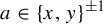






Now, we have arranged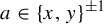 $a \in \{x,y\}^{\pm 1}$
and
$a \in \{x,y\}^{\pm 1}$
and $\sigma \in S_{18}$
in such a way that
$\sigma \in S_{18}$
in such a way that $a^{-1}\sigma [\mathrm {Cone}(u)]=\mathrm {Cone} (u')$
, where
$a^{-1}\sigma [\mathrm {Cone}(u)]=\mathrm {Cone} (u')$
, where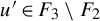 $u' {\kern-1pt}\in{\kern-1pt} F_3 \setminus F_2$
has length
$u' {\kern-1pt}\in{\kern-1pt} F_3 \setminus F_2$
has length $n-1 {\kern-1pt}\ge{\kern-1pt} 2$
, and
$n-1 {\kern-1pt}\ge{\kern-1pt} 2$
, and $a^{-1}\sigma [\mathrm {Cone}(z^{-n})]=\mathrm {Cone}(z^{-n+1})$
(note that in the last equality, we used the fact that
$a^{-1}\sigma [\mathrm {Cone}(z^{-n})]=\mathrm {Cone}(z^{-n+1})$
(note that in the last equality, we used the fact that $\sigma [\mathrm {Cone}(z^{-n})]=\mathrm {Cone}(a z^{-n+1})$
, which holds because
$\sigma [\mathrm {Cone}(z^{-n})]=\mathrm {Cone}(a z^{-n+1})$
, which holds because $\sigma $
induces the unique order-preserving bijection between
$\sigma $
induces the unique order-preserving bijection between $\mathrm {Cone}_{n-2}(z^{-2})$
and
$\mathrm {Cone}_{n-2}(z^{-2})$
and $\mathrm {Cone}_{n-2}(az^{-1})$
). By induction on n, there is
$\mathrm {Cone}_{n-2}(az^{-1})$
). By induction on n, there is $h \in G$
such that
$h \in G$
such that $h[\mathrm {Cone}(u')]=\mathrm {Cone}(z^2)$
and
$h[\mathrm {Cone}(u')]=\mathrm {Cone}(z^2)$
and $h[\mathrm {Cone}(z^{-n+1})]=\mathrm {Cone}(z^{-2})$
. Hence, the element
$h[\mathrm {Cone}(z^{-n+1})]=\mathrm {Cone}(z^{-2})$
. Hence, the element $f=h a^{-1} \sigma \in G$
satisfies (4).
$f=h a^{-1} \sigma \in G$
satisfies (4).
Claim 3.6. If u is a reduced word in $F_3 \setminus F_2$
of length
$F_3 \setminus F_2$
of length $n \ge 2$
, then there is an element
$n \ge 2$
, then there is an element $g \in G$
such that g interchanges
$g \in G$
such that g interchanges $\mathrm {Cone}(u)$
with
$\mathrm {Cone}(u)$
with $\mathrm {Cone}(z^{-n})$
and fixes all points in
$\mathrm {Cone}(z^{-n})$
and fixes all points in $\mathrm {Cone}(w)$
for every other reduced word
$\mathrm {Cone}(w)$
for every other reduced word $w \in F_3$
of length n.
$w \in F_3$
of length n.
Proof of Claim 3.6.
If $u=z^{-n}$
, we can take
$u=z^{-n}$
, we can take $g=1$
, so assume that
$g=1$
, so assume that $u \neq z^{-n}$
. Choose the element
$u \neq z^{-n}$
. Choose the element $f \in G$
according to Claim 3.5 and let
$f \in G$
according to Claim 3.5 and let $\tau \in S_{18}$
be the transposition interchanging
$\tau \in S_{18}$
be the transposition interchanging $\mathrm {Cone}(z^2)$
with
$\mathrm {Cone}(z^2)$
with $\mathrm {Cone}(z^{-2})$
. Then, the element
$\mathrm {Cone}(z^{-2})$
. Then, the element $g=f^{-1} \tau f \in G$
will interchange
$g=f^{-1} \tau f \in G$
will interchange $\mathrm {Cone}(u)$
with
$\mathrm {Cone}(u)$
with $\mathrm {Cone}(z^{-n})$
. It remains to check that g fixes all points in
$\mathrm {Cone}(z^{-n})$
. It remains to check that g fixes all points in $\mathrm {Cone}(w)$
for a reduced word w of length n, such that
$\mathrm {Cone}(w)$
for a reduced word w of length n, such that $w \neq u$
and
$w \neq u$
and $w \neq z^{-n}$
. This is true because G acts by bijections on X and
$w \neq z^{-n}$
. This is true because G acts by bijections on X and $\tau $
only moves points in
$\tau $
only moves points in $\mathrm {Cone}(z^2) \cup \mathrm {Cone}(z^{-2})$
. Indeed, if
$\mathrm {Cone}(z^2) \cup \mathrm {Cone}(z^{-2})$
. Indeed, if $x \in \mathrm {Cone}(w)$
, then
$x \in \mathrm {Cone}(w)$
, then $x \in X \setminus (\mathrm {Cone}(u) \cup \mathrm {Cone}(z^{-n}))$
, so
$x \in X \setminus (\mathrm {Cone}(u) \cup \mathrm {Cone}(z^{-n}))$
, so $f(x) \in X \setminus (\mathrm {Cone}(z^2) \cup \mathrm {Cone}(z^{-2}))$
. It follows that
$f(x) \in X \setminus (\mathrm {Cone}(z^2) \cup \mathrm {Cone}(z^{-2}))$
. It follows that $\tau (f(x))=f(x)$
and, hence,
$\tau (f(x))=f(x)$
and, hence, $g(x)=x$
.
$g(x)=x$
.
Claim 3.7. The action of G on X is highly topologically transitive.
Proof of Claim 3.7.
Suppose that $k \in \mathbb {N}$
and
$k \in \mathbb {N}$
and $U_1,\ldots ,U_k,V_1,\ldots ,V_k$
are non-empty open subsets in X. Choose
$U_1,\ldots ,U_k,V_1,\ldots ,V_k$
are non-empty open subsets in X. Choose $n \ge 2$
so that the following is satisfied: there exist reduced words
$n \ge 2$
so that the following is satisfied: there exist reduced words $u_i,v_i \in F_3\setminus F_2$
of length n such that:
$u_i,v_i \in F_3\setminus F_2$
of length n such that:
-
• the words
$u_{1},\ldots ,u_{k}$
are pairwise distinct and the words
$v_{1},\ldots ,v_{k}$
are pairwise distinct; -
•
$\mathrm {Cone}(u_i) \subseteq U_i$
and
$\mathrm {Cone}(v_i) \subseteq V_i$
for all
$i=1,\ldots ,k$
.





Such a choice is possible because every non-empty open set in X contains a basic open subset of the form $\mathrm {Cone}(w)$
for some
$\mathrm {Cone}(w)$
for some $w \in F_3\setminus F_2$
, and
$w \in F_3\setminus F_2$
, and $\mathrm {Cone}(w)$
contains
$\mathrm {Cone}(w)$
contains $\mathrm {Cone}(u)$
for every word u such that w is a prefix of u.
$\mathrm {Cone}(u)$
for every word u such that w is a prefix of u.
Recall that for every $m \ge 2$
, the symmetric group
$m \ge 2$
, the symmetric group $S_m$
, on the set
$S_m$
, on the set $\{1,\ldots ,m\}$
, is generated by all transpositions of the form
$\{1,\ldots ,m\}$
, is generated by all transpositions of the form $(j,m)$
, where
$(j,m)$
, where $j=1,\ldots ,m-1$
. Combining this fact with Claim 3.6, we can conclude that there exists
$j=1,\ldots ,m-1$
. Combining this fact with Claim 3.6, we can conclude that there exists $g \in G$
such that
$g \in G$
such that $g(\mathrm {Cone}(u_i))=\mathrm {Cone}(v_i)$
for every
$g(\mathrm {Cone}(u_i))=\mathrm {Cone}(v_i)$
for every $i=1\ldots ,k$
. It follows that
$i=1\ldots ,k$
. It follows that $v_i \in g(U_i) \cap V_i \neq \emptyset $
for all
$v_i \in g(U_i) \cap V_i \neq \emptyset $
for all $i=1,\ldots ,k$
, as required.
$i=1,\ldots ,k$
, as required.
Let $A = S_{18}\cup \{x,y\}^{\pm 1} \subseteq G$
and let
$A = S_{18}\cup \{x,y\}^{\pm 1} \subseteq G$
and let $\mu $
be the uniform measure supported on A. That is, we have
$\mu $
be the uniform measure supported on A. That is, we have $\mu (a)=1/|A|=1/(18!+4) $
for each
$\mu (a)=1/|A|=1/(18!+4) $
for each $a\in A$
.
$a\in A$
.
Claim 3.8. The action of G on X is not topologically $\mu $
-mixing.
$\mu $
-mixing.
Proof of Claim 3.8.
Consider the probability measure $\nu $
on
$\nu $
on $F_2=F(x,y)$
, given by
$F_2=F(x,y)$
, given by $\nu (a)=1/|A|$
, for each
$\nu (a)=1/|A|$
, for each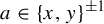 $a \in \{x,y\}^{\pm 1}$
, and
$a \in \{x,y\}^{\pm 1}$
, and $\nu (1)=1-4/|A|$
. Denote by
$\nu (1)=1-4/|A|$
. Denote by $\varphi :G \to F_2$
the natural retraction, whose kernel is the normal closure of
$\varphi :G \to F_2$
the natural retraction, whose kernel is the normal closure of $S_{18}$
in G.
$S_{18}$
in G.
Let $(w_n)$
be a random walk on G starting at
$(w_n)$
be a random walk on G starting at $1$
and corresponding to
$1$
and corresponding to $\mu $
. Then,
$\mu $
. Then, $t_n=\varphi (w_n)$
is a random walk on
$t_n=\varphi (w_n)$
is a random walk on $F_2$
starting at
$F_2$
starting at $1$
and corresponding to
$1$
and corresponding to $\nu $
. Observe that, as long as
$\nu $
. Observe that, as long as $t_m^{-1} \neq x^{-1}$
, for all
$t_m^{-1} \neq x^{-1}$
, for all $m=1,\ldots ,n$
, we have
$m=1,\ldots ,n$
, we have
 $$ \begin{align*} w_n^{-1}(\mathrm{Cone}(x^2))=t_n^{-1}(\mathrm{Cone}(x^2)) \subseteq \mathrm{Cone}(x) \cup \mathrm{Cone}(x^{-1}) \cup \mathrm{Cone}(y) \cup \mathrm{Cone}(y^{-1}). \end{align*} $$
Indeed, this is true because, by construction, every $\sigma \in S_{18}$
fixes all points in
$\sigma \in S_{18}$
fixes all points in $\mathrm {Cone}(w)$
for every word
$\mathrm {Cone}(w)$
for every word $w \in F_2$
of length at least
$w \in F_2$
of length at least $2$
. Therefore, the probability
$2$
. Therefore, the probability $q_n$
that
$q_n$
that $w_n(\mathrm {Cone}(z)) \cap \mathrm {Cone}(x^2) \neq \emptyset $
(which can be re-written as
$w_n(\mathrm {Cone}(z)) \cap \mathrm {Cone}(x^2) \neq \emptyset $
(which can be re-written as $w_n^{-1}(\mathrm {Cone}(x^2)) \cap \mathrm {Cone}(z) \neq \emptyset $
) does not exceed the probability that
$w_n^{-1}(\mathrm {Cone}(x^2)) \cap \mathrm {Cone}(z) \neq \emptyset $
) does not exceed the probability that $t_m$
hits x for some
$t_m$
hits x for some $m \in \{1,\ldots ,n\}$
. The latter probability is bounded above by the probability r, of the event
$m \in \{1,\ldots ,n\}$
. The latter probability is bounded above by the probability r, of the event $\{\text {there exists } n \in \mathbb {N}\cup \{0\} \mid t_n=x\}$
, that the random walk
$\{\text {there exists } n \in \mathbb {N}\cup \{0\} \mid t_n=x\}$
, that the random walk $(t_n)$
hits x eventually. Note that the random walk
$(t_n)$
hits x eventually. Note that the random walk $(t_n)$
is transient on
$(t_n)$
is transient on $F_2$
by [Reference WoessWoe, Theorem 1.16], as the function
$F_2$
by [Reference WoessWoe, Theorem 1.16], as the function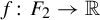 $f\colon F_2 \to \mathbb {R}$
, defined by
$f\colon F_2 \to \mathbb {R}$
, defined by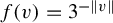 $f(v)=3^{-\|v\|}$
(where
$f(v)=3^{-\|v\|}$
(where $\|v\|$
denotes the word length of v in
$\|v\|$
denotes the word length of v in $F_2$
), is positive,
$F_2$
), is positive, $\nu $
-superharmonic, and non-constant (see [Reference WoessWoe, §I.B]). Therefore,
$\nu $
-superharmonic, and non-constant (see [Reference WoessWoe, §I.B]). Therefore, $r<1$
, and since
$r<1$
, and since $q_n \le r$
, for all
$q_n \le r$
, for all $n \in \mathbb {N}$
, we see that
$n \in \mathbb {N}$
, we see that $q_n$
cannot tend to
$q_n$
cannot tend to $1$
as
$1$
as $n \to \infty $
. This shows that the action of G on X is not topologically
$n \to \infty $
. This shows that the action of G on X is not topologically $\mu $
-mixing.
$\mu $
-mixing.
One may observe that the action of the group G on the space X in Proposition 3.4 is not faithful. Indeed, let $\sigma \in S_{18}$
be the product of five independent transpositions, induced by the order-preserving bijection between
$\sigma \in S_{18}$
be the product of five independent transpositions, induced by the order-preserving bijection between $\mathrm {Cone}(z)$
and
$\mathrm {Cone}(z)$
and $\mathrm {Cone}(z^{-1})$
, and let
$\mathrm {Cone}(z^{-1})$
, and let $\tau \in S_{18}$
be the transposition interchanging
$\tau \in S_{18}$
be the transposition interchanging $\mathrm {Cone} (xz)$
with
$\mathrm {Cone} (xz)$
with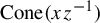 $\mathrm {Cone}(xz^{-1})$
. Then,
$\mathrm {Cone}(xz^{-1})$
. Then, $x^{-1} \tau x$
represents the same element of
$x^{-1} \tau x$
represents the same element of $\mathrm {Homeo}(X)$
as
$\mathrm {Homeo}(X)$
as $\sigma $
, but, of course,
$\sigma $
, but, of course, $x^{-1} \tau x \neq \sigma $
in
$x^{-1} \tau x \neq \sigma $
in $G=F_2*S_{18}$
.
$G=F_2*S_{18}$
.
The image $\overline {G}$
, of G in
$\overline {G}$
, of G in $\mathrm {Homeo}(X)$
, may be of independent interest, so let us say a few words about it. Let
$\mathrm {Homeo}(X)$
, may be of independent interest, so let us say a few words about it. Let $\overline {F}_2$
and
$\overline {F}_2$
and $\overline {S}_{18}$
denote the images of
$\overline {S}_{18}$
denote the images of $F_2$
and
$F_2$
and $S_{18}$
in
$S_{18}$
in $\mathrm {Homeo}(X)$
, respectively. Since
$\mathrm {Homeo}(X)$
, respectively. Since $F_2$
and
$F_2$
and $S_{18}$
act on X faithfully, we have
$S_{18}$
act on X faithfully, we have $\overline {F}_2 \cong F_2$
and
$\overline {F}_2 \cong F_2$
and $\overline {S}_{18} \cong S_{18}$
. Let
$\overline {S}_{18} \cong S_{18}$
. Let $Y \subseteq X$
be the limit set of
$Y \subseteq X$
be the limit set of $F_2$
in X, in other words, Y consists of all infinite reduced words over
$F_2$
in X, in other words, Y consists of all infinite reduced words over $\{x,y\}^{\pm 1}$
. Note that Y is invariant under the actions of
$\{x,y\}^{\pm 1}$
. Note that Y is invariant under the actions of $F_2$
and
$F_2$
and $S_{18}$
, by construction, so it is invariant under the action of G on X. Since
$S_{18}$
, by construction, so it is invariant under the action of G on X. Since $S_{18}$
acts trivially on Y, by definition, the normal closure H, of
$S_{18}$
acts trivially on Y, by definition, the normal closure H, of $\overline {S}_{18}$
in
$\overline {S}_{18}$
in $\overline {G}$
, also acts trivially on Y. However,
$\overline {G}$
, also acts trivially on Y. However, $F_2$
acts on Y faithfully and, hence, we can conclude that
$F_2$
acts on Y faithfully and, hence, we can conclude that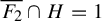 $\overline {F_2} \cap H={1}$
in
$\overline {F_2} \cap H={1}$
in $\overline {G}$
. Thus,
$\overline {G}$
. Thus, $\overline {G}$
is a semidirect product
$\overline {G}$
is a semidirect product $H \rtimes \overline {F_2}$
, in particular, it is not simple and
$H \rtimes \overline {F_2}$
, in particular, it is not simple and $\overline {G}/H \cong F_2$
.
$\overline {G}/H \cong F_2$
.
It is not difficult to check that the action of $\overline {G}$
on X satisfies all the conditions from a criterion of Caprace, Reid, and Willis [Reference Caprace, Reid and WillisCRW, Proposition I], which implies that
$\overline {G}$
on X satisfies all the conditions from a criterion of Caprace, Reid, and Willis [Reference Caprace, Reid and WillisCRW, Proposition I], which implies that $\overline {G}$
is monolithic, that is, there is a non-trivial normal subgroup
$\overline {G}$
is monolithic, that is, there is a non-trivial normal subgroup $M \lhd \overline {G}$
that is contained in every non-trivial normal subgroup of
$M \lhd \overline {G}$
that is contained in every non-trivial normal subgroup of $\overline {G}$
. It follows that
$\overline {G}$
. It follows that $\overline {G}$
cannot be acylindrically hyperbolic (indeed, by [Reference Dahmani, Guirardel and OsinDGO, Theorem 8.1], every acylindrically hyperbolic group P contains a non-trivial free normal subgroup, so the monolith of P must be free, but every non-trivial free group has a proper non-trivial characteristic subgroup, whence P cannot be monolithic). In fact, using a more recent criterion of Garrido and Reid [Reference Garrido and ReidGR, Corollary 1.7], the authors have verified that the monolith of
$\overline {G}$
cannot be acylindrically hyperbolic (indeed, by [Reference Dahmani, Guirardel and OsinDGO, Theorem 8.1], every acylindrically hyperbolic group P contains a non-trivial free normal subgroup, so the monolith of P must be free, but every non-trivial free group has a proper non-trivial characteristic subgroup, whence P cannot be monolithic). In fact, using a more recent criterion of Garrido and Reid [Reference Garrido and ReidGR, Corollary 1.7], the authors have verified that the monolith of $\overline {G}$
is
$\overline {G}$
is $[H,H]$
, the derived subgroup of H, and
$[H,H]$
, the derived subgroup of H, and $[H,H]$
is an infinite simple group. We record these observations in the following statement.
$[H,H]$
is an infinite simple group. We record these observations in the following statement.
Proposition 3.9. Working under the notation from the proof of Proposition 3.4, denote by $\psi :G \to \mathrm {Homeo}(X)$
the homomorphism arising from the action of G on X, and let
$\psi :G \to \mathrm {Homeo}(X)$
the homomorphism arising from the action of G on X, and let $\overline {G}=\psi (G)$
,
$\overline {G}=\psi (G)$
,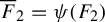 $\overline {F}_2=\psi (F_2)$
,
$\overline {F}_2=\psi (F_2)$
, $\overline {S}_{18}=\psi (S_{18})$
, and
$\overline {S}_{18}=\psi (S_{18})$
, and $H=\langle \hspace {-.7mm}\langle \overline {S}_{18} \rangle \hspace {-.7mm}\rangle ^{\overline {G}} \lhd \overline {G}$
. Then,
$H=\langle \hspace {-.7mm}\langle \overline {S}_{18} \rangle \hspace {-.7mm}\rangle ^{\overline {G}} \lhd \overline {G}$
. Then, $\overline {F_2} \cong F_2$
,
$\overline {F_2} \cong F_2$
, $\overline {S}_{18} \cong S_{18}$
and
$\overline {S}_{18} \cong S_{18}$
and $\overline {G} \cong H \rtimes \overline {F}_2$
. Moreover,
$\overline {G} \cong H \rtimes \overline {F}_2$
. Moreover, $[H,H]$
is an infinite simple group and it is the monolith of
$[H,H]$
is an infinite simple group and it is the monolith of $\overline {G}$
. In particular,
$\overline {G}$
. In particular, $\overline {G}$
is not acylindrically hyperbolic.
$\overline {G}$
is not acylindrically hyperbolic.
It is, therefore, reasonable to ask the following question.
Question 3.10. Does there exist a finitely generated acylindrically hyperbolic group G, a highly topologically transitive faithful action of G on a compact Polish space X, and a symmetric measure $\mu \in \operatorname {\mathrm {Prob}}(G)$
with generating support, such that the action of G on X is not topologically
$\mu \in \operatorname {\mathrm {Prob}}(G)$
with generating support, such that the action of G on X is not topologically $\mu $
-mixing?
$\mu $
-mixing?
3.2 Topologically transitive actions on subgroups
We now turn to the case where $X=\mathrm {Sub}_\infty (G)$
. Recall that all groups under consideration are supposed to be countable and discrete.
$X=\mathrm {Sub}_\infty (G)$
. Recall that all groups under consideration are supposed to be countable and discrete.
Lemma 3.11. Suppose that N is a finitely generated non-trivial normal subgroup of infinite index in G. Then, the action of G on $\mathrm {Sub}_\infty (G)$
is not topologically transitive.
$\mathrm {Sub}_\infty (G)$
is not topologically transitive.
Proof. Since N is finitely generated, there is an open set U in $\mathrm {Sub}_\infty (G)$
consisting of all infinite index subgroups that contain N. By normality of N, for all
$\mathrm {Sub}_\infty (G)$
consisting of all infinite index subgroups that contain N. By normality of N, for all $g\in G$
, every element of
$g\in G$
, every element of $g(U)$
will also contain N as a subgroup. Let V be the open set of all infinite index subgroups that do not contain a fixed non-trivial element of N. Then, no element of V can contain N as a subgroup and, hence,
$g(U)$
will also contain N as a subgroup. Let V be the open set of all infinite index subgroups that do not contain a fixed non-trivial element of N. Then, no element of V can contain N as a subgroup and, hence, $g(U)\cap V=\emptyset $
for all
$g(U)\cap V=\emptyset $
for all $g\in G$
. Note that U and V are non-empty since
$g\in G$
. Note that U and V are non-empty since $N\in U$
and
$N\in U$
and $\{1\}\in V$
.
$\{1\}\in V$
.
Example 3.12. The action of an infinite hyperbolic group G on $\mathrm {Sub}_{\infty }(G)$
may not be topologically transitive for two reasons. First, G may contain a non-trivial finite normal subgroup. Second, even if we require G to be torsion-free, infinite index non-trivial normal subgroups of G can be finitely generated. Indeed, for every finitely presented group Q, there exists a short exact sequence
$\mathrm {Sub}_{\infty }(G)$
may not be topologically transitive for two reasons. First, G may contain a non-trivial finite normal subgroup. Second, even if we require G to be torsion-free, infinite index non-trivial normal subgroups of G can be finitely generated. Indeed, for every finitely presented group Q, there exists a short exact sequence $\{1\}\to N\to G\to Q\to \{1\}$
, where G is torsion-free hyperbolic and N is finitely generated, by a well-known construction of Rips [Reference RipsRip].
$\{1\}\to N\to G\to Q\to \{1\}$
, where G is torsion-free hyperbolic and N is finitely generated, by a well-known construction of Rips [Reference RipsRip].
Recall that a group G is invariably generated if there exists a subset $S\subseteq G$
such that for every function
$S\subseteq G$
such that for every function $f\colon S\to G$
, G is generated by the subset
$f\colon S\to G$
, G is generated by the subset $\{f(s)^{-1}sf(s) \mid s\in S\}$
. That is, S is a generating set of G which will still generate G if each element of S is replaced by a conjugate.
$\{f(s)^{-1}sf(s) \mid s\in S\}$
. That is, S is a generating set of G which will still generate G if each element of S is replaced by a conjugate.
Proposition 3.13. Let G be an infinite invariably generated group. Then, the action $G\curvearrowright \mathrm {Sub}_\infty (G)$
is topologically transitive if and only if
$G\curvearrowright \mathrm {Sub}_\infty (G)$
is topologically transitive if and only if $G\cong \mathbb {Z}$
.
$G\cong \mathbb {Z}$
.
Proof. The sufficiency is obvious, so assume that G acts topologically transitively on $\mathrm {Sub}_\infty (G)$
. First, suppose that G is virtually cyclic. Then, there is a finite normal subgroup
$\mathrm {Sub}_\infty (G)$
. First, suppose that G is virtually cyclic. Then, there is a finite normal subgroup $N \lhd G$
such that
$N \lhd G$
such that $G/N$
is either infinite cyclic or infinite dihedral (see [Reference Farrell and JonesFJ, Lemma 2.5]). By Lemma 3.11, N must be trivial, so either
$G/N$
is either infinite cyclic or infinite dihedral (see [Reference Farrell and JonesFJ, Lemma 2.5]). By Lemma 3.11, N must be trivial, so either $G \cong \mathbb {Z}$
or
$G \cong \mathbb {Z}$
or $G \cong D_\infty $
is infinite dihedral. To rule out the latter case, note that every non-trivial infinite index subgroup of
$G \cong D_\infty $
is infinite dihedral. To rule out the latter case, note that every non-trivial infinite index subgroup of $D_\infty $
is cyclic of order
$D_\infty $
is cyclic of order $2$
; hence, any such subgroup is an isolated point of
$2$
; hence, any such subgroup is an isolated point of $\mathrm {Sub}_\infty (D_\infty )$
. Now let
$\mathrm {Sub}_\infty (D_\infty )$
. Now let $a,b \in D_\infty $
be the involutions generating this group (so that
$a,b \in D_\infty $
be the involutions generating this group (so that $D_\infty \cong \langle a\rangle *\langle b \rangle $
). Then,
$D_\infty \cong \langle a\rangle *\langle b \rangle $
). Then, $\{\langle a \rangle \}$
,
$\{\langle a \rangle \}$
, $\{\langle b \rangle \}$
are open in
$\{\langle b \rangle \}$
are open in $\mathrm {Sub}_\infty (D_\infty )$
but not conjugate in
$\mathrm {Sub}_\infty (D_\infty )$
but not conjugate in $D_\infty $
; therefore, the action
$D_\infty $
; therefore, the action $D_\infty \curvearrowright \mathrm {Sub}_\infty (D_\infty )$
is not topologically transitive.
$D_\infty \curvearrowright \mathrm {Sub}_\infty (D_\infty )$
is not topologically transitive.
Suppose now that G is not virtually cyclic and the action of G on $\mathrm {Sub}_\infty (G)$
is topologically transitive. Lemma 3.1 implies that there exists
$\mathrm {Sub}_\infty (G)$
is topologically transitive. Lemma 3.1 implies that there exists $H\in \mathrm {Sub}_\infty (G)$
whose orbit is dense in
$H\in \mathrm {Sub}_\infty (G)$
whose orbit is dense in $\mathrm {Sub}_\infty (G)$
. For any
$\mathrm {Sub}_\infty (G)$
. For any $x\in G$
,
$x\in G$
, $\langle x\rangle \in \mathrm {Sub}_\infty (G)$
since G is not virtually cyclic. Let U be an open subset of
$\langle x\rangle \in \mathrm {Sub}_\infty (G)$
since G is not virtually cyclic. Let U be an open subset of $\mathrm {Sub}_\infty (G)$
consisting of infinite index subgroups containing x. By topological transitivity, there exists
$\mathrm {Sub}_\infty (G)$
consisting of infinite index subgroups containing x. By topological transitivity, there exists $g\in G$
such that
$g\in G$
such that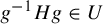 $g^{-1}Hg\in U$
, and so H contains a conjugate of x (namely
$g^{-1}Hg\in U$
, and so H contains a conjugate of x (namely $gxg^{-1}$
).
$gxg^{-1}$
).
Now, if S is any subset G, then every element of S has a conjugate which belongs to H. In particular, if we replace each element of S by such a conjugate, we will get a subset of H; hence, this subset cannot generate all of G. Therefore, G is not invariably generated.
Since virtually solvable groups are invariably generated by [Reference WiegoldWie], we obtain the following corollary.
Corollary 3.14. Let G be a virtually solvable group. Then, the action $G\curvearrowright \mathrm {Sub}_\infty (G)$
is topologically transitive if and only if
$G\curvearrowright \mathrm {Sub}_\infty (G)$
is topologically transitive if and only if $G\cong \mathbb {Z}$
.
$G\cong \mathbb {Z}$
.
4 Apt elements
Throughout this section, we assume that G is a group acting by isometries on a $\delta $
-hyperbolic geodesic metric space
$\delta $
-hyperbolic geodesic metric space $(S,\mathrm {d})$
for some
$(S,\mathrm {d})$
for some $\delta \ge 0$
. Our first goal is to show the existence of loxodromic elements
$\delta \ge 0$
. Our first goal is to show the existence of loxodromic elements $f\in G$
that are transverse to a given subgroup
$f\in G$
that are transverse to a given subgroup $H\leqslant G$
. Loosely speaking, this means that any quasi-geodesic axis of f spends a bounded amount of time inside any neighborhood of the orbit of any coset of H (see Definition 5.1). The existence of these elements will allow us to apply random walk techniques developed in [Reference Abbott and HullAH]. We start by studying an auxiliary notion of H-apt elements which are used to construct transverse elements in the next section.
$H\leqslant G$
. Loosely speaking, this means that any quasi-geodesic axis of f spends a bounded amount of time inside any neighborhood of the orbit of any coset of H (see Definition 5.1). The existence of these elements will allow us to apply random walk techniques developed in [Reference Abbott and HullAH]. We start by studying an auxiliary notion of H-apt elements which are used to construct transverse elements in the next section.
Definition 4.1. Let $H \leqslant G$
be a subgroup and let
$H \leqslant G$
be a subgroup and let $g \in G$
be an element. We say that g is H-apt if for each
$g \in G$
be an element. We say that g is H-apt if for each $s \in S$
and every
$s \in S$
and every $C \ge 0$
, there exist
$C \ge 0$
, there exist $N=N(s, C) \in \mathbb {N}$
and a finite subset
$N=N(s, C) \in \mathbb {N}$
and a finite subset $U=U(s, C) \subseteq G$
such that
$U=U(s, C) \subseteq G$
such that
 $$ \begin{align}\{u \in G \mid\mathrm{d}(u (s),s)\le C, \mathrm{d}(ug^N (s),H(s))\le C \}\subseteq H U. \end{align} $$
Remark 4.2. It is easy to see that (5) is equivalent to
 $$ \begin{align}\{u \in G \mid\mathrm{d}(u (s), H(s))\le C, \mathrm{d}(ug^N (s),H(s))\le C \}\subseteq H U. \end{align} $$
It follows that a loxodromic element $g \in G$
is H-apt if and only if for every
$g \in G$
is H-apt if and only if for every $s \in S$
and each
$s \in S$
and each $C \ge 0$
, there are only finitely many right H-cosets of elements
$C \ge 0$
, there are only finitely many right H-cosets of elements $u \in G$
that move a sufficiently long segment of a quasi-geodesic axis of g, based at s, at most C-away from the orbit
$u \in G$
that move a sufficiently long segment of a quasi-geodesic axis of g, based at s, at most C-away from the orbit $H(s)$
.
$H(s)$
.
Remark 4.3. The universal quantifier on $s \in S$
in Definition 4.1 can be replaced with the existence quantifier. More precisely, if
$s \in S$
in Definition 4.1 can be replaced with the existence quantifier. More precisely, if $H \leqslant G$
and
$H \leqslant G$
and $g \in G$
, then g is H-apt if and only if there exists
$g \in G$
, then g is H-apt if and only if there exists $s \in S$
such that for every
$s \in S$
such that for every $C \ge 0$
, there are
$C \ge 0$
, there are $N=N(C) \in \mathbb {N}$
and a finite subset
$N=N(C) \in \mathbb {N}$
and a finite subset $U=U(C) \subseteq G$
such that (5) holds.
$U=U(C) \subseteq G$
such that (5) holds.
Indeed, this follows from the triangle inequality, implying that if $s' \in S$
, then for all
$s' \in S$
, then for all $a,b \in G$
, we have
$a,b \in G$
, we have $\mathrm {d}(a(s),b(s)) \le \mathrm {d}(a(s'),b(s'))+2\mathrm {d}(s,s')$
.
$\mathrm {d}(a(s),b(s)) \le \mathrm {d}(a(s'),b(s'))+2\mathrm {d}(s,s')$
.
If H is a finite subgroup of G, then every loxodromic element of G will be H-apt, because in this case, the left-hand side of (5) will be empty for large enough N. When H is convex cocompact, we show that every loxodromic WPD element of G is H-apt (see Proposition 4.6). In addition, if G is hyperbolic relative to a finite family of peripheral subgroups, S is the corresponding relative Cayley graph, and $H \leqslant G$
is relatively quasi-convex, then we show that g is H-apt for every loxodromic
$H \leqslant G$
is relatively quasi-convex, then we show that g is H-apt for every loxodromic $g \in G$
(see Proposition 7.7).
$g \in G$
(see Proposition 7.7).
Next, we record some basic properties and useful characterizations of H-apt elements.
Lemma 4.4. Let $H \leqslant G$
and
$H \leqslant G$
and $g \in G$
be an H-apt element. Then,
$g \in G$
be an H-apt element. Then, $g^{-1}$
is also H-apt.
$g^{-1}$
is also H-apt.
Proof. Indeed, given any $s \in S$
and
$s \in S$
and $C\ge 0$
, let
$C\ge 0$
, let $N=N(s,C) \in \mathbb {N}$
and
$N=N(s,C) \in \mathbb {N}$
and $U=U(s,C) \subseteq G$
be provided by Definition 4.1.
$U=U(s,C) \subseteq G$
be provided by Definition 4.1.
Define $U'=Ug^N \subseteq G$
, so that
$U'=Ug^N \subseteq G$
, so that $|U'|=|U|<\infty $
, and suppose that
$|U'|=|U|<\infty $
, and suppose that $u \in G$
satisfies
$u \in G$
satisfies $\mathrm {d}(s,u(s)) \le C$
and
$\mathrm {d}(s,u(s)) \le C$
and $\mathrm {d}(ug^{-N}(s),h(s)) \le C$
for some
$\mathrm {d}(ug^{-N}(s),h(s)) \le C$
for some $h \in H$
. Then, by letting
$h \in H$
. Then, by letting $v=h^{-1}ug^{-N} \in G$
, we obtain
$v=h^{-1}ug^{-N} \in G$
, we obtain
 $$ \begin{align*}\mathrm{d}(v(s),s) =\mathrm{d}(h^{-1}ug^{-N}(s),s)=\mathrm{d}(ug^{-N}(s),h(s)) \le C , \end{align*} $$
and
 $$ \begin{align*}\mathrm{d}(vg^N(s), H(s)) \le \mathrm{d}(h^{-1}u(s),h^{-1}(s))=\mathrm{d}(u(s),s) \le C. \end{align*} $$
It follows that $v \in HU$
and, thus,
$v \in HU$
and, thus, $u=hvg^N \in HU'$
. Therefore, the element
$u=hvg^N \in HU'$
. Therefore, the element $g^{-1}$
is also H-apt, as required.
$g^{-1}$
is also H-apt, as required.
Lemma 4.5. Suppose that the induced action of $H \leqslant G$
on S has quasi-convex orbits and
$H \leqslant G$
on S has quasi-convex orbits and $g \in G$
is a loxodromic element. Then, g is H-apt if and only if for all
$g \in G$
is a loxodromic element. Then, g is H-apt if and only if for all $s \in S$
and
$s \in S$
and $C\ge 0$
, there are
$C\ge 0$
, there are $N=N(s, C) \in \mathbb {N}$
and a finite subset
$N=N(s, C) \in \mathbb {N}$
and a finite subset $U=U(s, C) \subseteq G$
such that
$U=U(s, C) \subseteq G$
such that
 $$ \begin{align} \{u \in G \mid \text{ there exists } n \ge N \text{ such that }\mathrm{d}(u(s), H(s))\le C, \mathrm{d}(ug^n(s), H(s))\le C \}\subseteq H U. \end{align} $$
Proof. Clearly, (7) implies (5), so the sufficiency in the lemma holds. To prove the necessity, suppose that g is H-apt, and consider arbitrary $s \in S$
and
$s \in S$
and $C \ge 0$
.
$C \ge 0$
.
By the assumptions, the H-orbit $ H(s)$
is
$ H(s)$
is $\eta $
-quasi-convex for some
$\eta $
-quasi-convex for some $\eta \ge 0$
. Let
$\eta \ge 0$
. Let $\ell $
be a
$\ell $
be a $(\unicode{x3bb} ,c)$
-quasi-geodesic axis of g based at s, where
$(\unicode{x3bb} ,c)$
-quasi-geodesic axis of g based at s, where $\unicode{x3bb} \ge 1$
,
$\unicode{x3bb} \ge 1$
, $c \ge 0$
, and let
$c \ge 0$
, and let $\varkappa =\varkappa (\unicode{x3bb} ,c)\ge 0$
be the constant provided by Lemma 2.1. Set
$\varkappa =\varkappa (\unicode{x3bb} ,c)\ge 0$
be the constant provided by Lemma 2.1. Set $C'=C+\varkappa +2\delta +\eta>0$
, and choose
$C'=C+\varkappa +2\delta +\eta>0$
, and choose $N=N(s,C') \in \mathbb N$
and a finite subset
$N=N(s,C') \in \mathbb N$
and a finite subset $U=U(s,C')\subseteq G$
according to Definition 4.1.
$U=U(s,C')\subseteq G$
according to Definition 4.1.
Suppose that an element $u \in G$
satisfies
$u \in G$
satisfies
 $$ \begin{align*} \mathrm{d}(u(s),f(s))\le C \quad \text{and}\quad\mathrm{d}(ug^n(s), H(s))\le C \quad \text{for some } f \in H \ \text{and some } n \ge N. \end{align*} $$
Note that, without loss of generality, we can replace u by $f^{-1}u$
, because
$f^{-1}u$
, because $f^{-1} H= H$
and
$f^{-1} H= H$
and $fHU=HU$
. Hence, we can further assume that
$fHU=HU$
. Hence, we can further assume that
 $$ \begin{align} \mathrm{d}(u(s),s)\le C\quad\text{and}\quad\mathrm{d}(ug^n(s),h(s))\le C \quad\text{for some } h \in H \ \text{and some } n \ge N. \end{align} $$
Let $p=u(\ell _{[s,g^n(s)]})$
. Note that p is
$p=u(\ell _{[s,g^n(s)]})$
. Note that p is $(\unicode{x3bb} ,c)$
-quasi-geodesic,
$(\unicode{x3bb} ,c)$
-quasi-geodesic, $p_-=u(s)$
,
$p_-=u(s)$
, $p_+=ug^n(s)$
, and
$p_+=ug^n(s)$
, and $ug^N(s) \in p$
. Therefore, by Lemma 2.5,
$ug^N(s) \in p$
. Therefore, by Lemma 2.5, $\mathrm {d}(ug^N(s), H(s)) \le \varkappa +2\delta +C+\eta =C'$
. Since we also have that
$\mathrm {d}(ug^N(s), H(s)) \le \varkappa +2\delta +C+\eta =C'$
. Since we also have that $\mathrm {d}(s,u(s))\le C'$
, we see that u belongs to the set
$\mathrm {d}(s,u(s))\le C'$
, we see that u belongs to the set $\{u \in G \mid \mathrm {d}(s,u(s))\le C', \mathrm {d}(ug^N(s), H(s))\le C' \}$
, which is contained in
$\{u \in G \mid \mathrm {d}(s,u(s))\le C', \mathrm {d}(ug^N(s), H(s))\le C' \}$
, which is contained in $HU$
by the definition of N and U. Hence, (7) holds and the proof is finished.
$HU$
by the definition of N and U. Hence, (7) holds and the proof is finished.
Proposition 4.6. Let H be a convex cocompact subgroup of G and let $g\in G$
be a loxodromic WPD element. Then, for all
$g\in G$
be a loxodromic WPD element. Then, for all $s\in S$
and
$s\in S$
and $C\ge 0$
, there exists
$C\ge 0$
, there exists $N\in \mathbb N$
satisfying
$N\in \mathbb N$
satisfying
 $$ \begin{align} |\{u \in G \mid \text{ there exists } n \ge N \text{ such that }\mathrm{d}(u(s),s)\le C, \mathrm{d}(ug^n(s), H(s))\le C \}|<\infty. \end{align} $$
In particular, every loxodromic WPD element $g \in G$
is H-apt.
$g \in G$
is H-apt.
Proof. Choose any $s \in S$
, any
$s \in S$
, any $C\ge 0$
, and assume that
$C\ge 0$
, and assume that $ H(s)$
is
$ H(s)$
is $\eta $
-quasi-convex in S for some
$\eta $
-quasi-convex in S for some $\eta \ge 0$
. Let
$\eta \ge 0$
. Let $\ell $
be a
$\ell $
be a $(\unicode{x3bb} ,c)$
-quasi-geodesic axis of g based at s, and let
$(\unicode{x3bb} ,c)$
-quasi-geodesic axis of g based at s, and let $\varkappa =\varkappa (\unicode{x3bb} ,c)\ge 0$
be the constant given by Lemma 2.1.
$\varkappa =\varkappa (\unicode{x3bb} ,c)\ge 0$
be the constant given by Lemma 2.1.
Now, set $\varepsilon =2\varkappa +4\delta + 2C+2\eta $
and choose
$\varepsilon =2\varkappa +4\delta + 2C+2\eta $
and choose $N=N(s,\varepsilon )$
according to the definition of the WPD property for g (Definition 2.6). Arguing by contradiction, assume that there exists an infinite sequence of pairwise distinct elements
$N=N(s,\varepsilon )$
according to the definition of the WPD property for g (Definition 2.6). Arguing by contradiction, assume that there exists an infinite sequence of pairwise distinct elements ${u_1,u_2,\ldots } \in G$
such that for each
${u_1,u_2,\ldots } \in G$
such that for each $i \in \mathbb N$
, there are
$i \in \mathbb N$
, there are $h_i \in H$
and
$h_i \in H$
and $n_i \in \mathbb N$
satisfying
$n_i \in \mathbb N$
satisfying $n_i \ge N$
and
$n_i \ge N$
and $\mathrm {d}(u_i(s),s)\le C$
,
$\mathrm {d}(u_i(s),s)\le C$
, $\mathrm {d}(u_ig^{n_i}(s),\, h_i(s))\le C$
.
$\mathrm {d}(u_ig^{n_i}(s),\, h_i(s))\le C$
.
For each $i \in \mathbb N$
, we can consider geodesic paths
$i \in \mathbb N$
, we can consider geodesic paths $q_{1i}$
and
$q_{1i}$
and $q_{2i}$
in S joining
$q_{2i}$
in S joining $u_i(s)$
with
$u_i(s)$
with $u_ig^{n_i}(s)$
, and s with
$u_ig^{n_i}(s)$
, and s with $h_i(s)$
, respectively. Let
$h_i(s)$
, respectively. Let $\ell _i$
be the segment of
$\ell _i$
be the segment of $\ell $
from s to
$\ell $
from s to $g^{n_i}(s)$
. Then,
$g^{n_i}(s)$
. Then, $u_i(\ell _i)$
is a
$u_i(\ell _i)$
is a $(\unicode{x3bb} ,c)$
-quasi-geodesic with same endpoints as the geodesic side
$(\unicode{x3bb} ,c)$
-quasi-geodesic with same endpoints as the geodesic side $q_{1i}$
. Thus, by Lemma 2.5, there is
$q_{1i}$
. Thus, by Lemma 2.5, there is $f_i \in H$
such that
$f_i \in H$
such that
 $$ \begin{align} \mathrm{d}(u_ig^N(s), f_i(s)) \le \varkappa+2\delta+C+\eta. \end{align} $$
Observe that for every $i \in \mathbb N$
, we can estimate
$i \in \mathbb N$
, we can estimate
 $$ \begin{align*} \mathrm{d}(s,f_i(s)) &\le \mathrm{d}(s,u_i(s))+\mathrm{d}(u_i(s),u_ig^N(s))+\mathrm{d}(u_ig^N(s), f_i(s))\\ &\le \varkappa+2\delta+2C+\eta+\mathrm{d}(s,g^N(s)), \end{align*} $$
where the right-hand side is independent of i. Consequently, recalling the assumption that H is convex cocompact, we can conclude that $\{f_i \mid i \in \mathbb N\}$
is a finite subset of H. Therefore, there must exist
$\{f_i \mid i \in \mathbb N\}$
is a finite subset of H. Therefore, there must exist $f \in H$
and an infinite subsequence of indices
$f \in H$
and an infinite subsequence of indices $(i_j)_{j\in \mathbb N}$
such that
$(i_j)_{j\in \mathbb N}$
such that $f_{i_j}=f$
for all
$f_{i_j}=f$
for all $j\in \mathbb N$
.
$j\in \mathbb N$
.
Hence, in view of (10), for all $j \ge 2$
, we have
$j \ge 2$
, we have
 $$ \begin{align*} \mathrm{d}(u_{i_1}(s),u_{i_j}(s)) \le \mathrm{d}(u_{i_1}(s),s)+\mathrm{d}(s,u_{i_j}(s))\le 2C \le \varepsilon \end{align*} $$
and
 $$ \begin{align*} \mathrm{d}(u_{i_1}g^N(s),u_{i_j}g^N(s))&\le \mathrm{d}(u_{i_1}g^N(s),f(s))+\mathrm{d}(f(s),u_{i_j}g^N(s))\\ &\le 2(\varkappa+2\delta+C+\eta)= \varepsilon. \end{align*} $$
Thus, $\mathrm {d}(u_{i_1}^{-1}u_{i_j}(s),s) \le \varepsilon $
and
$\mathrm {d}(u_{i_1}^{-1}u_{i_j}(s),s) \le \varepsilon $
and $\mathrm {d}(u_{i_1}^{-1}u_{i_j}g^N(s),g^N(s))\le \varepsilon $
, so, according to the WPD property of g and the choice of N, the subset
$\mathrm {d}(u_{i_1}^{-1}u_{i_j}g^N(s),g^N(s))\le \varepsilon $
, so, according to the WPD property of g and the choice of N, the subset $\{u_{i_1}^{-1}u_{i_j} \mid j \in \mathbb N, j \ge 2\} \subseteq G$
must be finite. Obviously, the latter gives a contradiction with the assumption that the elements
$\{u_{i_1}^{-1}u_{i_j} \mid j \in \mathbb N, j \ge 2\} \subseteq G$
must be finite. Obviously, the latter gives a contradiction with the assumption that the elements $u_{i_1},u_{i_2},\ldots $
are pairwise distinct.
$u_{i_1},u_{i_2},\ldots $
are pairwise distinct.
Remark 4.7. In fact, for a convex cocompact subgroup H, (9) is equivalent to g being H-apt.
Indeed, if g is H-apt and H-orbits are quasi-convex in S, according to Lemma 4.5, for all $C \ge 0 $
and
$C \ge 0 $
and $s \in S$
, there is
$s \in S$
, there is $N \in \mathbb N$
and a finite subset
$N \in \mathbb N$
and a finite subset $U \subseteq G$
such that
$U \subseteq G$
such that
 $$ \begin{align*}V=\{u \in G \mid \text{there exists }~n \ge N \text{ such that }\mathrm{d}(u(s),s)\le C, \mathrm{d}(ug^n(s), H(s))\le C \}\subseteq HU.\end{align*} $$
However, from convex cocompactness of H, we know that for each $u \in G$
, there are only finitely many
$u \in G$
, there are only finitely many $h \in H$
such that
$h \in H$
such that $\mathrm {d}(hu(s),s)\le C$
. Therefore,
$\mathrm {d}(hu(s),s)\le C$
. Therefore, $|V \cap Hu|<\infty $
for every
$|V \cap Hu|<\infty $
for every $u \in U$
and, hence,
$u \in U$
and, hence, $|V|<\infty $
, that is, (9) holds.
$|V|<\infty $
, that is, (9) holds.
Now that we have established the existence of H-apt elements when H is convex cocompact, our next goal is to use H-apt elements to construct elements that are transverse to H (see Definition 5.1). The next few lemmas lay the groundwork for showing transversality.
Lemma 4.8. Let H be a subgroup of G with quasi-convex orbits and let $g\in G$
be an H-apt loxodromic element. Then, there is a finite subset
$g\in G$
be an H-apt loxodromic element. Then, there is a finite subset $U_0 \subseteq G$
such that for any
$U_0 \subseteq G$
such that for any $u \in G$
, if
$u \in G$
, if $u^{-1}Hu \cap \langle g \rangle \neq \{1\}$
, then
$u^{-1}Hu \cap \langle g \rangle \neq \{1\}$
, then $u \in HU_0$
. In particular, only finitely many distinct conjugates of H can intersect
$u \in HU_0$
. In particular, only finitely many distinct conjugates of H can intersect $\langle g \rangle $
non-trivially.
$\langle g \rangle $
non-trivially.
Proof. Fix any $s \in S$
and suppose that the orbit
$s \in S$
and suppose that the orbit $ H(s)$
is
$ H(s)$
is $\eta $
-quasi-convex in S for some
$\eta $
-quasi-convex in S for some $\eta \ge 0$
. Let
$\eta \ge 0$
. Let $\ell $
be a
$\ell $
be a $(\unicode{x3bb} ,c)$
-quasi-geodesic axis of g based at s and let
$(\unicode{x3bb} ,c)$
-quasi-geodesic axis of g based at s and let $\varkappa =\varkappa (\unicode{x3bb} ,c)$
be the constant from the claim of Lemma 2.1. Finally, we set
$\varkappa =\varkappa (\unicode{x3bb} ,c)$
be the constant from the claim of Lemma 2.1. Finally, we set $C=\varkappa +2\delta +\eta $
, and let
$C=\varkappa +2\delta +\eta $
, and let $N=N(s,C) \in \mathbb N$
be the number and
$N=N(s,C) \in \mathbb N$
be the number and $U_0=U(s,C) \subseteq G$
be the finite subset given by Definition 4.1.
$U_0=U(s,C) \subseteq G$
be the finite subset given by Definition 4.1.
Consider any element $u \in G$
such that
$u \in G$
such that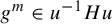 $g^m \in u^{-1}Hu$
for some
$g^m \in u^{-1}Hu$
for some $m \in \mathbb N$
, and let
$m \in \mathbb N$
, and let $\varepsilon =\mathrm {d}(u(s),s)$
and
$\varepsilon =\mathrm {d}(u(s),s)$
and $\varepsilon '=\varepsilon +\varkappa +2\delta $
.
$\varepsilon '=\varepsilon +\varkappa +2\delta $
.
Since g is loxodromic, there is $L \in \mathbb N$
such that
$L \in \mathbb N$
such that $mL \ge N$
and
$mL \ge N$
and
 $$ \begin{align} \begin{gathered} \mathrm{d}(g^{mL}(s),g^{2mL}(s))=\mathrm{d}(s,g^{mL}(s))>\varepsilon ',\quad \mathrm{d}(s,g^{mL+N}(s))>\varepsilon ', \\ \mathrm{d}(g^{mL+N}(s),g^{2mL}(s))=\mathrm{d}(g^N(s),g^{mL}(s))>\varepsilon '. \end{gathered} \end{align} $$
Let $q=u(\ell _{[s,g^{2mL}(s)]})$
be the translate of the segment of
$q=u(\ell _{[s,g^{2mL}(s)]})$
be the translate of the segment of $\ell $
from s to
$\ell $
from s to $g^{2mL}(s)$
. Then, q is
$g^{2mL}(s)$
. Then, q is $(\unicode{x3bb} ,c)$
-quasi-geodesic and
$(\unicode{x3bb} ,c)$
-quasi-geodesic and $ug^{mL}(s), ug^{mL+N}(s) \in q$
. Moreover,
$ug^{mL}(s), ug^{mL+N}(s) \in q$
. Moreover, $\mathrm {d}(q_-,s)=\varepsilon $
and, since
$\mathrm {d}(q_-,s)=\varepsilon $
and, since $h=ug^{2mL}u^{-1} \in H$
, we see that
$h=ug^{2mL}u^{-1} \in H$
, we see that
 $$ \begin{align*}\mathrm{d}(q_+, H(s)) = \mathrm{d}(ug^{2mL}(s), H(s))=\mathrm{d}(hu(s), H(s))=\mathrm{d}(u(s), H(s)) \le \mathrm{d}(u(s),s)= \varepsilon .\end{align*} $$
Evidently, (11) shows that both $ug^{mL}(s)$
and
$ug^{mL}(s)$
and $ug^{mL+N}(s)$
are situated on q more than
$ug^{mL+N}(s)$
are situated on q more than $\varepsilon '$
away from its endpoints; hence, we can apply Lemma 2.5 to find
$\varepsilon '$
away from its endpoints; hence, we can apply Lemma 2.5 to find $h_1,h_2 \in H$
such that
$h_1,h_2 \in H$
such that $\mathrm {d}(ug^{mL}(s),h_1(s)) \le C$
and
$\mathrm {d}(ug^{mL}(s),h_1(s)) \le C$
and $\mathrm {d}(ug^{mL+N}(s),h_2(s)) \le C$
.
$\mathrm {d}(ug^{mL+N}(s),h_2(s)) \le C$
.
Therefore, for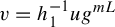 $v=h_1^{-1}ug^{mL}$
, we have
$v=h_1^{-1}ug^{mL}$
, we have $\mathrm {d}(v(s),s) \le C$
and
$\mathrm {d}(v(s),s) \le C$
and $\mathrm {d}(vg^N(s), H(s)) \le C$
. Hence,
$\mathrm {d}(vg^N(s), H(s)) \le C$
. Hence, $v \in HU_0$
, according to our choice of N and
$v \in HU_0$
, according to our choice of N and $U_0$
. It remains to observe that
$U_0$
. It remains to observe that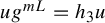 $ug^{mL}=h_3u$
for some
$ug^{mL}=h_3u$
for some $h_3 \in H$
, as
$h_3 \in H$
, as $ug^{mL}u^{-1} \in H$
. Thus,
$ug^{mL}u^{-1} \in H$
. Thus, $u=h_3^{-1}h_1v \in HU_0$
and the lemma is proved.
$u=h_3^{-1}h_1v \in HU_0$
and the lemma is proved.
Lemma 4.9. Let H be a subgroup of G with quasi-convex orbits and let $g\in G$
be an H-apt loxodromic element. Then, for all
$g\in G$
be an H-apt loxodromic element. Then, for all $s \in S$
and
$s \in S$
and $D>0$
, there exists a constant
$D>0$
, there exists a constant $M \in \mathbb N$
such that the following holds. If
$M \in \mathbb N$
such that the following holds. If $u \in G$
and
$u \in G$
and $n \in \mathbb Z$
satisfy
$n \in \mathbb Z$
satisfy $\mathrm {d}(u(s), H(s)) \le D$
,
$\mathrm {d}(u(s), H(s)) \le D$
, $\mathrm {d}(ug^n(s), H(s))\le D$
, and
$\mathrm {d}(ug^n(s), H(s))\le D$
, and $|n| \ge M$
, then
$|n| \ge M$
, then $u^{-1}Hu \cap \langle g \rangle \neq \{1\}$
. In particular,
$u^{-1}Hu \cap \langle g \rangle \neq \{1\}$
. In particular, $u \in HU_0$
, where
$u \in HU_0$
, where $U_0$
is the finite subset of G given by Lemma 4.8.
$U_0$
is the finite subset of G given by Lemma 4.8.
Proof. Fix any $s \in S$
and
$s \in S$
and $D>0$
. Let the orbit
$D>0$
. Let the orbit $ H(s)$
be
$ H(s)$
be $\eta $
-quasi-convex in S for some
$\eta $
-quasi-convex in S for some $\eta \ge 0$
, let
$\eta \ge 0$
, let $\ell $
be a
$\ell $
be a $(\unicode{x3bb} ,c)$
-quasi-geodesic axis of g based at s,
$(\unicode{x3bb} ,c)$
-quasi-geodesic axis of g based at s, $\unicode{x3bb} \ge 1$
,
$\unicode{x3bb} \ge 1$
, $c \ge 0$
, and let
$c \ge 0$
, and let $\varkappa =\varkappa (\unicode{x3bb} ,c)\ge 0$
be the constant given by Lemma 2.1. Set
$\varkappa =\varkappa (\unicode{x3bb} ,c)\ge 0$
be the constant given by Lemma 2.1. Set $C=\varkappa +2\delta +D+\eta $
, and let
$C=\varkappa +2\delta +D+\eta $
, and let $N=N(s,C)\in \mathbb N$
and the finite subset
$N=N(s,C)\in \mathbb N$
and the finite subset $U=U(s,C) \subseteq G$
be provided by Lemma 4.5. Choose
$U=U(s,C) \subseteq G$
be provided by Lemma 4.5. Choose $M=N+|U| \in \mathbb N$
and suppose that
$M=N+|U| \in \mathbb N$
and suppose that $\mathrm {d}(u(s), H(s)) \le D$
,
$\mathrm {d}(u(s), H(s)) \le D$
, $\mathrm {d}(ug^n(s), H(s))\le D$
, for some
$\mathrm {d}(ug^n(s), H(s))\le D$
, for some $u \in G$
and
$u \in G$
and $n \in \mathbb Z$
with
$n \in \mathbb Z$
with $|n| \ge M$
.
$|n| \ge M$
.
Note that if $n <0$
, then for
$n <0$
, then for $u'=ug^n$
, we have
$u'=ug^n$
, we have $\mathrm {d}(u'(s), H(s)) \le D$
,
$\mathrm {d}(u'(s), H(s)) \le D$
,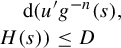 $\mathrm {d}(u'g^{-n}(s), H(s))\le D$
, and
$\mathrm {d}(u'g^{-n}(s), H(s))\le D$
, and $-n \ge M$
, and the conclusion
$-n \ge M$
, and the conclusion $u^{\prime -1} H u' \cap \langle g \rangle \neq \{1\}$
would immediately yield
$u^{\prime -1} H u' \cap \langle g \rangle \neq \{1\}$
would immediately yield $u^{-1}Hu \cap \langle g \rangle \neq \{1\}$
, as
$u^{-1}Hu \cap \langle g \rangle \neq \{1\}$
, as $g^n\langle g \rangle g^{-n}=\langle g \rangle $
. Therefore, we can further assume that
$g^n\langle g \rangle g^{-n}=\langle g \rangle $
. Therefore, we can further assume that
 $$ \begin{align} \mathrm{d}(u(s), H(s)) \le D\quad \text{and}\quad \mathrm{d}(ug^n(s), H(s))\le D \quad\text{for some } u \in G \ \text{and } n \ge M. \end{align} $$
Let $q=u(\ell [s,g^n(s)])$
be the translate of a segment of
$q=u(\ell [s,g^n(s)])$
be the translate of a segment of $\ell $
, so that
$\ell $
, so that $q_-=u(s)$
and
$q_-=u(s)$
and $q_+=ug^n(s)$
. For each
$q_+=ug^n(s)$
. For each $i=0,1,\ldots ,|U|$
, let
$i=0,1,\ldots ,|U|$
, let $u_i=ug^i \in G$
. Then,
$u_i=ug^i \in G$
. Then, $u_i(s) \in q$
, so
$u_i(s) \in q$
, so $\mathrm {d}(u_i(s), H(s)) \le \varkappa +2\delta +D+\eta =C$
, by Lemma 2.5. However,
$\mathrm {d}(u_i(s), H(s)) \le \varkappa +2\delta +D+\eta =C$
, by Lemma 2.5. However, $\mathrm {d}(u_ig^{n-i}(s), H(s)) \le D \le C$
by (12), where
$\mathrm {d}(u_ig^{n-i}(s), H(s)) \le D \le C$
by (12), where $n-i \ge M-i \ge N$
. Thus, according to Lemma 4.5,
$n-i \ge M-i \ge N$
. Thus, according to Lemma 4.5, $u_i \in HU$
for each
$u_i \in HU$
for each $i=0,1,\ldots ,|U|$
. It follows that there exist indices
$i=0,1,\ldots ,|U|$
. It follows that there exist indices $i,j$
,
$i,j$
, $0\le i<j\le |U|$
, such that
$0\le i<j\le |U|$
, such that $u_j \in Hu_i$
. After recalling that
$u_j \in Hu_i$
. After recalling that $u_i=ug^i$
and
$u_i=ug^i$
and $u_j=ug^j$
, we get
$u_j=ug^j$
, we get $ug^{j-i}u^{-1}=u_ju_i^{-1} \in H$
. Since
$ug^{j-i}u^{-1}=u_ju_i^{-1} \in H$
. Since $j-i>0$
and g has infinite order, we can conclude that
$j-i>0$
and g has infinite order, we can conclude that $\langle g \rangle \cap u^{-1}Hu \neq \{1\}$
, as required.
$\langle g \rangle \cap u^{-1}Hu \neq \{1\}$
, as required.
The last claim of the lemma is an immediate consequence of Lemma 4.8.
Lemma 4.10. Let H be a subgroup of G with quasi-convex orbits and let $g\in G$
be an H-apt loxodromic element satisfying
$g\in G$
be an H-apt loxodromic element satisfying $ H \cap \langle g \rangle =\{1\}$
. Then, for each
$ H \cap \langle g \rangle =\{1\}$
. Then, for each $s \in S$
, there is a constant
$s \in S$
, there is a constant $A \ge 0$
such that
$A \ge 0$
such that $(g^k(s) \mid h(s) )_s\le A$
for all
$(g^k(s) \mid h(s) )_s\le A$
for all $k \in \mathbb Z$
and
$k \in \mathbb Z$
and $h \in H$
.
$h \in H$
.
Proof. Suppose, in contrast, that $\sup \, \{(g^k(s) \mid h(s) )_s \mid k \in \mathbb Z, h \in H\}=\infty $
for some
$\sup \, \{(g^k(s) \mid h(s) )_s \mid k \in \mathbb Z, h \in H\}=\infty $
for some $s \in S$
. Then, after replacing g with
$s \in S$
. Then, after replacing g with $g^{-1}$
if necessary (which can be done by Lemma 4.4), we can assume that
$g^{-1}$
if necessary (which can be done by Lemma 4.4), we can assume that
 $$ \begin{align} \sup\{(g^k(s) \mid h(s))_s \mid k \in \mathbb N, h \in H\}=\infty. \end{align} $$
By the assumptions, the H-orbit $ H(s)$
is
$ H(s)$
is $\eta $
-quasi-convex for some
$\eta $
-quasi-convex for some $\eta \ge 0$
, and g has a
$\eta \ge 0$
, and g has a $(\unicode{x3bb} ,c)$
-quasi-geodesic axis
$(\unicode{x3bb} ,c)$
-quasi-geodesic axis $\ell $
, based at s, for some
$\ell $
, based at s, for some $\unicode{x3bb} \ge 1$
and
$\unicode{x3bb} \ge 1$
and $c \ge 0$
. Let
$c \ge 0$
. Let $\varkappa =\varkappa (\unicode{x3bb} ,c)$
be the constant given by Lemma 2.1.
$\varkappa =\varkappa (\unicode{x3bb} ,c)$
be the constant given by Lemma 2.1.
Take any $i \in \mathbb N$
. The hypothesis (13) implies that there are
$i \in \mathbb N$
. The hypothesis (13) implies that there are $k \in \mathbb N$
and
$k \in \mathbb N$
and $h\in H$
such that
$h\in H$
such that $k \ge i$
and
$k \ge i$
and $(g^k(s)|h(s))_s \ge \mathrm {d}(s,g^i(s))+\varkappa $
. Let
$(g^k(s)|h(s))_s \ge \mathrm {d}(s,g^i(s))+\varkappa $
. Let $q_1$
and
$q_1$
and $q_2$
be some geodesics from s to
$q_2$
be some geodesics from s to $g^k(s)$
and from s to
$g^k(s)$
and from s to $h(s)$
in S, respectively. Since
$h(s)$
in S, respectively. Since $g^i(s)$
belongs to the
$g^i(s)$
belongs to the $(\unicode{x3bb} ,c)$
-quasi-geodesic path
$(\unicode{x3bb} ,c)$
-quasi-geodesic path $\ell _{[s,g^k(s)]}$
, which has the same endpoints as
$\ell _{[s,g^k(s)]}$
, which has the same endpoints as $q_1$
, we know that
$q_1$
, we know that $\mathrm {d}(g^i(s),x) \le \varkappa $
for some
$\mathrm {d}(g^i(s),x) \le \varkappa $
for some $x \in q_1$
. Therefore,
$x \in q_1$
. Therefore,
 $$ \begin{align*} \mathrm{d}(s,x) \le \mathrm{d}(s,g^i(s))+\mathrm{d}(g^i(s),x)\le (g^k(s)\mid h(s))_s. \end{align*} $$
It follows that $\mathrm {d}(x,q_2) \le 6\delta $
, because any geodesic triangle with vertices s,
$\mathrm {d}(x,q_2) \le 6\delta $
, because any geodesic triangle with vertices s, $g^k(s)$
, and
$g^k(s)$
, and $h(s)$
is
$h(s)$
is $6\delta $
-thin in S (see the proof of the implication (1)
$6\delta $
-thin in S (see the proof of the implication (1) $\Rightarrow $
(2) in [Reference Alonso, Brady, Cooper, Ferlini, Lustig, Mihalik, Shapiro, Short and ShortABC, Proposition 2.1]). After recalling that
$\Rightarrow $
(2) in [Reference Alonso, Brady, Cooper, Ferlini, Lustig, Mihalik, Shapiro, Short and ShortABC, Proposition 2.1]). After recalling that $q_2$
is contained in the
$q_2$
is contained in the $\eta $
-neighborhood of
$\eta $
-neighborhood of $ H(s)$
, we can conclude that
$ H(s)$
, we can conclude that
 $$ \begin{align*} \mathrm{d}(g^i(s), H(s)) \le D \quad\text{for all } i \in \mathbb N, \quad\text{where } D=\varkappa+6\delta+\eta. \end{align*} $$
Therefore, we can apply Lemma 4.9 (in the case $u=1$
) to deduce that
$u=1$
) to deduce that $H \cap \langle g \rangle \neq \{1\}$
, which contradicts our assumption. Thus,
$H \cap \langle g \rangle \neq \{1\}$
, which contradicts our assumption. Thus, $\sup \, \{(g^k(s) \mid h(s) )_s \mid k \in \mathbb Z, h \in H\}<\infty $
and the lemma is proved.
$\sup \, \{(g^k(s) \mid h(s) )_s \mid k \in \mathbb Z, h \in H\}<\infty $
and the lemma is proved.
Lemma 4.11. Let $g \in G$
be a loxodromic WPD element,
$g \in G$
be a loxodromic WPD element, $a \in G \setminus E_G(g)$
and
$a \in G \setminus E_G(g)$
and $s \in S$
. Then, there is a constant
$s \in S$
. Then, there is a constant $B \ge 0$
such that
$B \ge 0$
such that $(a^{-1}g^{-n}(s) \mid g^n a(s))_s\le B$
for all
$(a^{-1}g^{-n}(s) \mid g^n a(s))_s\le B$
for all $n \in \mathbb Z$
.
$n \in \mathbb Z$
.
Proof. Since g is loxodromic, the same is true for the element $a^{-1}ga \in G$
. It follows that the subgroup
$a^{-1}ga \in G$
. It follows that the subgroup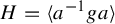 $H=\langle a^{-1}ga \rangle $
is convex cocompact and so the element g is H-apt by Proposition 4.6.
$H=\langle a^{-1}ga \rangle $
is convex cocompact and so the element g is H-apt by Proposition 4.6.
Since $a \notin E_G(g)$
, the definition of
$a \notin E_G(g)$
, the definition of $E_G(g)$
given in (3) implies that
$E_G(g)$
given in (3) implies that $H \cap \langle g \rangle =\{1\}$
. Therefore, we can use Lemma 4.10 to find
$H \cap \langle g \rangle =\{1\}$
. Therefore, we can use Lemma 4.10 to find $A \ge 0$
such that
$A \ge 0$
such that
 $$ \begin{align} (g^k(s)\mid a^{-1}g^l a(s) )_s\le A \quad\text{ for all }k,l \in \mathbb{Z}. \end{align} $$
Recall that, according to (2), for any $n \in \mathbb Z$
, we have
$n \in \mathbb Z$
, we have
 $$ \begin{align} (a^{-1}g^{-n}(s)\mid g^n a(s))_s=\tfrac12 (\mathrm{d}(a^{-1}g^{-n}(s),s)+\mathrm{d}(g^n a(s),s)-\mathrm{d}(a^{-1}g^{-n}(s),g^n a(s)) ). \end{align} $$
We let $C=\mathrm {d}(s,a(s))$
and apply the triangle inequality to obtain the following estimate:
$C=\mathrm {d}(s,a(s))$
and apply the triangle inequality to obtain the following estimate:
 $$ \begin{align*} \mathrm{d}(a^{-1}g^{-n}(s),s) & \le \mathrm{d}(a^{-1}g^{-n}(s),a^{-1}g^{-n}a(s))+\mathrm{d}(a^{-1}g^{-n}a(s),s)\\ & =\mathrm{d}(a^{-1}g^{-n}a(s),s)+C. \end{align*} $$
Similarly, we deduce that $\mathrm {d}(g^n a(s),s)\le \mathrm {d}(g^n (s),s)+C$
and
$\mathrm {d}(g^n a(s),s)\le \mathrm {d}(g^n (s),s)+C$
and $\mathrm {d}(a^{-1}g^{-n}(s),g^n a(s)) \ge \mathrm {d}(a^{-1}g^{-n}a(s),g^n (s))-2C$
. Combining these inequalities with (15) and (14), we get
$\mathrm {d}(a^{-1}g^{-n}(s),g^n a(s)) \ge \mathrm {d}(a^{-1}g^{-n}a(s),g^n (s))-2C$
. Combining these inequalities with (15) and (14), we get
 $$ \begin{align*} & (a^{-1}g^{-n}(s)\mid g^n a(s))_s \\ & \quad\le\tfrac12 (\mathrm{d}(a^{-1}g^{-n}a(s),s)+\mathrm{d}(g^n(s),s)-\mathrm{d}(a^{-1}g^{-n}a(s),g^n (s))+4C )\\ & \quad =(g^{n}(s)\mid a^{-1}g^{-n}a(s))_s +2C \le A+2C. \end{align*} $$
Since the above is true for every $n \in \mathbb Z$
, the claim of the lemma holds for
$n \in \mathbb Z$
, the claim of the lemma holds for $B=A+2C$
.
$B=A+2C$
.
5 Transverse elements
Definition 5.1. Let G be a group acting on a metric space $(S,\mathrm {d})$
and let
$(S,\mathrm {d})$
and let $s \in S$
be any point. We say that an element
$s \in S$
be any point. We say that an element $f \in G$
is transverse to a subset
$f \in G$
is transverse to a subset $Y\subseteq G$
(with respect to the given action) if for every
$Y\subseteq G$
(with respect to the given action) if for every $E \ge 0$
, there exists
$E \ge 0$
, there exists $K\in \mathbb N$
such that for all
$K\in \mathbb N$
such that for all $v \in G$
, we have
$v \in G$
, we have
 $$ \begin{align} |\{m \in \mathbb Z \mid \mathrm{d}(f^m(s),v Y(s)) \le E\} |\leq K. \end{align} $$
It is easy to see that the above definition does not depend on the choice of $s \in S$
. We always apply this definition in the setting where S is a hyperbolic metric space, f is a loxodromic element, and Y has quasi-convex orbits. In this situation, the following lemma shows that Definition 5.1 is equivalent to [Reference Abbott and HullAH, Definition 2.7].
$s \in S$
. We always apply this definition in the setting where S is a hyperbolic metric space, f is a loxodromic element, and Y has quasi-convex orbits. In this situation, the following lemma shows that Definition 5.1 is equivalent to [Reference Abbott and HullAH, Definition 2.7].
Lemma 5.2. Let G be a group acting on a hyperbolic metric space $(S,\mathrm {d})$
, let
$(S,\mathrm {d})$
, let $Y\subseteq G$
, and let
$Y\subseteq G$
, and let $s \in S$
. Let
$s \in S$
. Let $f\in G$
be a loxodromic element and let
$f\in G$
be a loxodromic element and let $\ell $
be a quasi-geodesic axis for f based at s. Suppose that
$\ell $
be a quasi-geodesic axis for f based at s. Suppose that $Y(s)$
is quasi-convex in S. Then, f is transverse to Y if and only if for all
$Y(s)$
is quasi-convex in S. Then, f is transverse to Y if and only if for all $E\geq 0$
, there exists
$E\geq 0$
, there exists $M\geq 0$
such that for every
$M\geq 0$
such that for every $v\in G$
,
$v\in G$
,
 $$ \begin{align} \mathrm{Diam}(\{x\in \ell \mid \mathrm{d}(x, v Y(s)) \le E\})\leq M. \end{align} $$
Proof. Fix constants $\delta $
,
$\delta $
, $\unicode{x3bb} $
, c, and
$\unicode{x3bb} $
, c, and $\eta $
such that S is
$\eta $
such that S is $\delta $
-hyperbolic,
$\delta $
-hyperbolic, $\ell $
is a
$\ell $
is a $(\unicode{x3bb} , c)$
quasi-geodesic,
$(\unicode{x3bb} , c)$
quasi-geodesic, $Y(s)$
is
$Y(s)$
is $\eta $
-quasi-convex, and set
$\eta $
-quasi-convex, and set $L=\mathrm {d}(s, f(s))>0$
.
$L=\mathrm {d}(s, f(s))>0$
.
Suppose that f is transverse to Y in the sense of Definition 5.1. Let $E\geq 0$
,
$E\geq 0$
, $v\in G$
, and suppose that x and y are points on
$v\in G$
, and suppose that x and y are points on $\ell $
such that
$\ell $
such that $\mathrm {d}(x, v Y(s)) \le E$
and
$\mathrm {d}(x, v Y(s)) \le E$
and $\mathrm {d}(y, v Y(s)) \le E$
. Then, for some integers m and n,
$\mathrm {d}(y, v Y(s)) \le E$
. Then, for some integers m and n, $\mathrm {d}(x, f^m(s))\leq L$
and
$\mathrm {d}(x, f^m(s))\leq L$
and $\mathrm {d}(y, f^n(s))\leq L$
. Hence, we have that
$\mathrm {d}(y, f^n(s))\leq L$
. Hence, we have that $\mathrm {d}(f^m(s), v Y(s))\leq L+E$
and
$\mathrm {d}(f^m(s), v Y(s))\leq L+E$
and $\mathrm {d}(f^n(s), v Y(s))\leq L+E$
. Let p be a geodesic connecting
$\mathrm {d}(f^n(s), v Y(s))\leq L+E$
. Let p be a geodesic connecting $f^m(s)$
with
$f^m(s)$
with $f^n(s)$
in S. If i is any integer between m and n, then
$f^n(s)$
in S. If i is any integer between m and n, then $\mathrm {d}(f^i(s),p) \le \varkappa $
, where
$\mathrm {d}(f^i(s),p) \le \varkappa $
, where $\varkappa \ge 0$
is the constant from Lemma 2.1. Since
$\varkappa \ge 0$
is the constant from Lemma 2.1. Since $v Y(s)$
is
$v Y(s)$
is $\eta $
-quasi-convex and geodesic quadrilaterals in S are
$\eta $
-quasi-convex and geodesic quadrilaterals in S are $2\delta $
-slim, p is contained in the
$2\delta $
-slim, p is contained in the $(\eta +2\delta +L+E)$
-neighborhood of
$(\eta +2\delta +L+E)$
-neighborhood of $vY(s)$
. Therefore,
$vY(s)$
. Therefore, $\mathrm {d}(f^i(s), v Y(s))\leq E'$
, where
$\mathrm {d}(f^i(s), v Y(s))\leq E'$
, where $E'=\eta +2\delta +L+E+\varkappa $
. By Definition 5.1, there is a constant
$E'=\eta +2\delta +L+E+\varkappa $
. By Definition 5.1, there is a constant $K'$
such that
$K'$
such that
 $$ \begin{align*} |\{i \in \mathbb Z \mid \mathrm{d}(f^i(s),v Y(s)) \le E'\} |\leq K', \end{align*} $$
which implies that $|m-n| <K'$
. This means that
$|m-n| <K'$
. This means that $\mathrm {d}(f^n(s), f^m(s))\leq LK'$
and, hence,
$\mathrm {d}(f^n(s), f^m(s))\leq LK'$
and, hence, $\mathrm {d}(x, y)\leq LK'+2L$
.
$\mathrm {d}(x, y)\leq LK'+2L$
.
This completes one direction of the proof. For the other direction, we note that if $|\{m \in \mathbb Z \mid \mathrm {d}(f^m(s),v Y(s)) \le E\} |\ge K$
, then there are integers m and n with
$|\{m \in \mathbb Z \mid \mathrm {d}(f^m(s),v Y(s)) \le E\} |\ge K$
, then there are integers m and n with $\mathrm {d}(f^m(s),v Y(s)) \le E$
,
$\mathrm {d}(f^m(s),v Y(s)) \le E$
, $\mathrm {d}(f^n(s),v Y(s)) \le E$
, and
$\mathrm {d}(f^n(s),v Y(s)) \le E$
, and $|m-n|\ge K-1$
. This implies that
$|m-n|\ge K-1$
. This implies that $\mathrm {d}(f^n(s), f^m(s))\geq {1}/{\unicode{x3bb} }(L(K-1)-c)$
and, hence,
$\mathrm {d}(f^n(s), f^m(s))\geq {1}/{\unicode{x3bb} }(L(K-1)-c)$
and, hence,
 $$ \begin{align*} \begin{aligned} \mathrm{Diam}(\{x\in \ell \mid \mathrm{d}(x, v Y(s)) \le E\})\geq \dfrac{1}{\unicode{x3bb}}(L(K-1)-c). \end{aligned} \\[-37pt] \end{align*} $$
Here are a few basic properties of this notion of transversality.
Lemma 5.3. Let G be a group acting on a metric space $(S,\mathrm {d})$
, let
$(S,\mathrm {d})$
, let $f, g \in G$
, and let
$f, g \in G$
, and let $Y_1, Y_2$
be subsets of G. If f is transverse to
$Y_1, Y_2$
be subsets of G. If f is transverse to $Y_1$
and
$Y_1$
and $Y_2$
, then f is transverse to
$Y_2$
, then f is transverse to $Y_1\cup Y_2$
.
$Y_1\cup Y_2$
.
Proof. Let $E>0$
and let K be a constant such that for all
$E>0$
and let K be a constant such that for all $\nu \in G$
,
$\nu \in G$
,
 $$ \begin{align*} |\{m \in \mathbb Z \mid \mathrm{d}(f^m(s),v Y_1(s)) \le E\} |\leq K \end{align*} $$
and
 $$ \begin{align*} |\{m \in \mathbb Z \mid \mathrm{d}(f^m(s),v Y_2(s)) \le E\} |\leq K. \end{align*} $$
Now, fix $\nu \in G$
, and observe that if
$\nu \in G$
, and observe that if $\mathrm {d}(f^m(s), v(Y_1\cup Y_2)(s)) \le E$
, then either
$\mathrm {d}(f^m(s), v(Y_1\cup Y_2)(s)) \le E$
, then either $\mathrm {d}(f^m(s),v Y_1(s)) \le E$
or
$\mathrm {d}(f^m(s),v Y_1(s)) \le E$
or $\mathrm {d}(f^m(s),v Y_2(s)) \le E$
. Hence,
$\mathrm {d}(f^m(s),v Y_2(s)) \le E$
. Hence,
 $$ \begin{align*} |\{m \in \mathbb Z \mid \mathrm{d}(f^m(s),v(Y_1\cup Y_2)(s)) \le E\} |\leq 2K. \end{align*} $$
Therefore, f is transverse to $Y_1\cup Y_2$
.
$Y_1\cup Y_2$
.
For the remainder of this section, we assume that $(S,\mathrm {d})$
is a
$(S,\mathrm {d})$
is a $\delta $
-hyperbolic geodesic metric space for some
$\delta $
-hyperbolic geodesic metric space for some $\delta \ge 0$
, and G is a group acting on S by isometries. The following observation is a consequence of Lemma 4.9.
$\delta \ge 0$
, and G is a group acting on S by isometries. The following observation is a consequence of Lemma 4.9.
Lemma 5.4. Let H be a subgroup of G with quasi-convex orbits and let $f\in G$
be an H-apt loxodromic element. Then, f is transverse to H if and only if
$f\in G$
be an H-apt loxodromic element. Then, f is transverse to H if and only if $v H v^{-1} \cap \langle f \rangle =\{1\}$
for all
$v H v^{-1} \cap \langle f \rangle =\{1\}$
for all $v \in G$
.
$v \in G$
.
Proof. Fix any $s \in S$
. Arguing by the contrapositive, assume, first, that
$s \in S$
. Arguing by the contrapositive, assume, first, that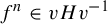 $f^n \in v H v^{-1}$
for some
$f^n \in v H v^{-1}$
for some $n \in \mathbb N$
and some
$n \in \mathbb N$
and some $v \in G$
. Then, for all
$v \in G$
. Then, for all $i \in \mathbb Z$
, we have
$i \in \mathbb Z$
, we have
 $$ \begin{align*} \mathrm{d}(f^{ni}(s), v H(s)) \le \mathrm{d}(f^{ni}(s),vHv^{-1}(s))+\mathrm{d}(s,v^{-1}(s))=E,\end{align*} $$
where $E=\mathrm {d}(s,v^{-1}(s))$
. Hence, f cannot be transverse to H.
$E=\mathrm {d}(s,v^{-1}(s))$
. Hence, f cannot be transverse to H.
Conversely, suppose that f is not transverse to H. Then, there exist $E \ge 0$
such that for every
$E \ge 0$
such that for every $M \in \mathbb N$
, there is
$M \in \mathbb N$
, there is $v\in G$
and there are integers
$v\in G$
and there are integers $k,l \in \mathbb Z$
, with
$k,l \in \mathbb Z$
, with $l-k \ge M$
and
$l-k \ge M$
and $\mathrm {d}(f^k(s),vH(s))\le E$
,
$\mathrm {d}(f^k(s),vH(s))\le E$
, $\mathrm {d}(f^l(s),v H(s))\le E$
. It follows that for
$\mathrm {d}(f^l(s),v H(s))\le E$
. It follows that for $u=v^{-1}f^k \in G$
, we have
$u=v^{-1}f^k \in G$
, we have $\mathrm {d}(u(s), H(s)) \le E$
and
$\mathrm {d}(u(s), H(s)) \le E$
and $\mathrm {d}(uf^{l-k}(s), H(s)) \le E$
. Since M was arbitrary, Lemma 4.9 implies that
$\mathrm {d}(uf^{l-k}(s), H(s)) \le E$
. Since M was arbitrary, Lemma 4.9 implies that $u^{-1}Hu \cap \langle f \rangle \neq \{1\}$
, which yields that
$u^{-1}Hu \cap \langle f \rangle \neq \{1\}$
, which yields that $v H v^{-1} \cap \langle f \rangle \neq \{1\}$
, as required.
$v H v^{-1} \cap \langle f \rangle \neq \{1\}$
, as required.
Lemma 5.5. Suppose that $g \in G$
is a loxodromic WPD element. Then, for every
$g \in G$
is a loxodromic WPD element. Then, for every $a \in G\setminus E_G(g)$
, there exists
$a \in G\setminus E_G(g)$
, there exists $N \in \mathbb {N}$
such that
$N \in \mathbb {N}$
such that $g^n a$
is loxodromic WPD for any
$g^n a$
is loxodromic WPD for any $n \in \mathbb Z$
with
$n \in \mathbb Z$
with $|n| \ge N$
.
$|n| \ge N$
.
Proof. By [Reference Balasubramanya, Fournier-Facio and GenevoisBFGS, Proposition A.1 and Corollary A.2], there exists a hyperbolic geodesic metric space T with a cobounded G-action and a G-equivariant coarsely Lipschitz map $\pi :S \to T$
, such that g acts as a loxodromic WPD isometry of T. Note that
$\pi :S \to T$
, such that g acts as a loxodromic WPD isometry of T. Note that $E_G(g)$
is independent of the choice of S by Lemma 2.7; hence, we can apply [Reference Antolín, Minasyan and SistoAMS, Lemma 5.4] to find
$E_G(g)$
is independent of the choice of S by Lemma 2.7; hence, we can apply [Reference Antolín, Minasyan and SistoAMS, Lemma 5.4] to find $N \in \mathbb N$
such that
$N \in \mathbb N$
such that $g^n a$
is a loxodromic WPD element for the G-action on T, provided
$g^n a$
is a loxodromic WPD element for the G-action on T, provided $|n|\ge N$
. Since
$|n|\ge N$
. Since $\pi : S \to T$
is a G-equivariant coarsely Lipschitz map, it is easy to see that
$\pi : S \to T$
is a G-equivariant coarsely Lipschitz map, it is easy to see that $g^n a$
will also be a loxodromic WPD element with respect to the action of G on S.
$g^n a$
will also be a loxodromic WPD element with respect to the action of G on S.
Proposition 5.6. Let H be a subgroup of G with quasi-convex orbits and let $g\in G$
be an H-apt loxodromic WPD element. Let
$g\in G$
be an H-apt loxodromic WPD element. Let $U_0 \subseteq G$
be the subset provided by Lemma 4.8 and let
$U_0 \subseteq G$
be the subset provided by Lemma 4.8 and let $a \in G\setminus (U_0^{-1} H U_0 \cup E_G(g))$
. Then, the element
$a \in G\setminus (U_0^{-1} H U_0 \cup E_G(g))$
. Then, the element $f=g^n a$
is loxodromic WPD and transverse to H for all sufficiently large
$f=g^n a$
is loxodromic WPD and transverse to H for all sufficiently large $n \in \mathbb N$
.
$n \in \mathbb N$
.
Proof. Let $s \in S$
be any point and let the orbit
$s \in S$
be any point and let the orbit $ H(s)$
be
$ H(s)$
be $\eta $
-quasi-convex for some
$\eta $
-quasi-convex for some $\eta \ge 0$
. Let
$\eta \ge 0$
. Let $B\ge 0$
be given by Lemma 4.11; choose
$B\ge 0$
be given by Lemma 4.11; choose $C_0=\max \{B, 168\delta \}$
and
$C_0=\max \{B, 168\delta \}$
and $C_1>12(C_0+12\delta )$
, as in Lemma 2.2. Denote
$C_1>12(C_0+12\delta )$
, as in Lemma 2.2. Denote $C_2=\mathrm {d}(s,a(s))$
,
$C_2=\mathrm {d}(s,a(s))$
, $D=2\delta +\eta +2C_0+C_2$
, and let
$D=2\delta +\eta +2C_0+C_2$
, and let $M=M(s,D) \in \mathbb N$
be the constant provided by Lemma 4.9.
$M=M(s,D) \in \mathbb N$
be the constant provided by Lemma 4.9.
Since the element $g \in G$
is loxodromic, there exists
$g \in G$
is loxodromic, there exists $N_1 \in \mathbb N$
such that for every
$N_1 \in \mathbb N$
such that for every $n \in \mathbb N$
, with
$n \in \mathbb N$
, with $n \ge N_1$
, we have
$n \ge N_1$
, we have
 $$ \begin{align} \mathrm{d}(s,g^n a(s))\ge \mathrm{d}(s,g^n(s))-\mathrm{d}(g^n(s),g^na(s)) = \mathrm{d}(s, g^{n}(s))-C_2 \ge C_1. \end{align} $$
However, since $a \notin E_G(g)$
, by Lemma 5.5, there exists
$a \notin E_G(g)$
, by Lemma 5.5, there exists $N_2 \in \mathbb N$
such that the element
$N_2 \in \mathbb N$
such that the element $g^na$
is loxodromic and WPD for all
$g^na$
is loxodromic and WPD for all $n \in \mathbb N$
,
$n \in \mathbb N$
, $n \ge N_2$
.
$n \ge N_2$
.
Let us now fix any $n \in \mathbb N$
such that
$n \in \mathbb N$
such that $n \ge \max \{M,N_1,N_2\}$
. To finish the proof, it remains to show that the element
$n \ge \max \{M,N_1,N_2\}$
. To finish the proof, it remains to show that the element $f=g^na$
is transverse to H. Arguing by contradiction, suppose that there exist
$f=g^na$
is transverse to H. Arguing by contradiction, suppose that there exist $E \ge 0$
such that for all
$E \ge 0$
such that for all $R\in \mathbb N$
, there is
$R\in \mathbb N$
, there is $v \in G$
such that
$v \in G$
such that $|\{m \in \mathbb Z \mid \mathrm {d}(f^m(s),v H(s)) \le E\}|\geq R+1$
. Then, for
$|\{m \in \mathbb Z \mid \mathrm {d}(f^m(s),v H(s)) \le E\}|\geq R+1$
. Then, for $u=v^{-1} \in G$
, there must exist integers
$u=v^{-1} \in G$
, there must exist integers $k<l$
and elements
$k<l$
and elements $h_k,h_l \in H$
such that
$h_k,h_l \in H$
such that $\mathrm {d}(uf^k(s),h_k(s))\le E$
,
$\mathrm {d}(uf^k(s),h_k(s))\le E$
, $\mathrm {d}(uf^l(s),h_l(s))\le E$
, and
$\mathrm {d}(uf^l(s),h_l(s))\le E$
, and $l-k\geq R$
. Since f is loxodromic, by choosing R sufficiently large, we can ensure that there is
$l-k\geq R$
. Since f is loxodromic, by choosing R sufficiently large, we can ensure that there is $j \in \mathbb Z$
,
$j \in \mathbb Z$
, $k<j<l$
such that for any
$k<j<l$
such that for any $\epsilon \in \{-1,0,1\}$
, we have
$\epsilon \in \{-1,0,1\}$
, we have
 $$ \begin{align} \mathrm{d}(f^k(s), f^{j+\epsilon}(s))>E+2\delta+2C_0 \quad\text{and}\quad \mathrm{d}(f^{j+\epsilon}(s),f^l(s))>E+2\delta+2C_0. \end{align} $$
Observe that, in view of (18), we have $\mathrm {d}(uf^{i-1}(s),uf^i(s))=\mathrm {d}(s,g^na(s))\ge C_1$
for all
$\mathrm {d}(uf^{i-1}(s),uf^i(s))=\mathrm {d}(s,g^na(s))\ge C_1$
for all $i \in \mathbb Z$
, and
$i \in \mathbb Z$
, and
 $$ \begin{align*} (uf^{i-1}(s) \mid uf^{i+1}(s))_{uf^i(s)}= (f^{-1}(s) \mid f(s))_s \le B \le C_0, \end{align*} $$
by Lemma 4.11, for all $i \in \mathbb Z$
. Therefore, we can apply Lemma 2.2 to conclude that
$i \in \mathbb Z$
. Therefore, we can apply Lemma 2.2 to conclude that $\mathrm {d}(uf^i(s),q) \le 2C_0$
for every
$\mathrm {d}(uf^i(s),q) \le 2C_0$
for every $i \in \mathbb Z$
, with
$i \in \mathbb Z$
, with $k \le i \le l$
, where q is a geodesic in S joining
$k \le i \le l$
, where q is a geodesic in S joining $uf^k(s)$
with
$uf^k(s)$
with $uf^l(s)$
.
$uf^l(s)$
.
Let x be a point of q satisfying $d(uf^j(s),x) \le 2C_0$
. Then, (19) implies that
$d(uf^j(s),x) \le 2C_0$
. Then, (19) implies that $\mathrm {d}(x,q_-)=\mathrm {d}(x,uf^k(s))>E+2\delta $
and
$\mathrm {d}(x,q_-)=\mathrm {d}(x,uf^k(s))>E+2\delta $
and $\mathrm {d}(x,q_+)=\mathrm {d}(x,uf^l(s))>E+2\delta $
. It follows that the distances from x to
$\mathrm {d}(x,q_+)=\mathrm {d}(x,uf^l(s))>E+2\delta $
. It follows that the distances from x to $[h_k(s),q_-]$
and to
$[h_k(s),q_-]$
and to $[q_+,h_l(s)]$
are greater than
$[q_+,h_l(s)]$
are greater than $2\delta $
(see Figure 1). Consequently, since geodesic quadrangles in S are
$2\delta $
(see Figure 1). Consequently, since geodesic quadrangles in S are $2\delta $
-slim, x must be at most
$2\delta $
-slim, x must be at most $2\delta $
away from
$2\delta $
away from $[h_k(s),h_l(s)]$
. Hence,
$[h_k(s),h_l(s)]$
. Hence, $\mathrm {d}(x, H(s)) \le 2\delta +\eta $
and, thus,
$\mathrm {d}(x, H(s)) \le 2\delta +\eta $
and, thus, $\mathrm {d}(uf^j(s), H(s)) \le 2\delta +\eta +2C_0$
. Similarly,
$\mathrm {d}(uf^j(s), H(s)) \le 2\delta +\eta +2C_0$
. Similarly, $\mathrm {d}(uf^{j-1}(s), H(s)) \le 2\delta +\eta +2C_0$
and
$\mathrm {d}(uf^{j-1}(s), H(s)) \le 2\delta +\eta +2C_0$
and $\mathrm {d}(uf^{j+1}(s), H(s)) \le 2\delta +\eta +2C_0$
.
$\mathrm {d}(uf^{j+1}(s), H(s)) \le 2\delta +\eta +2C_0$
.
Illustration of the proof of Proposition 5.6.

Denote $u_1=uf^j \in G$
and
$u_1=uf^j \in G$
and $u_2=uf^ja^{-1}=u_1a^{-1} \in G$
. Note that
$u_2=uf^ja^{-1}=u_1a^{-1} \in G$
. Note that $\mathrm {d}(u_1(s), H(s)) \le D$
, where D is the constant defined at the beginning of the proof, and
$\mathrm {d}(u_1(s), H(s)) \le D$
, where D is the constant defined at the beginning of the proof, and
 $$ \begin{align*} \mathrm{d}(u_1g^n(s), H(s)) &\le \mathrm{d}(u_1g^na(s), H(s))+\mathrm{d}(u_1g^n(s),u_1g^na(s))\\ &=\mathrm{d}(u_1f(s), H(s))+\mathrm{d}(s,a(s)) = \mathrm{d}(uf^{j+1}(s), H(s))+C_2 \le D. \end{align*} $$
At the same time, we have $\mathrm {d}(u_2(s), H(s))\le \mathrm {d}(uf^j(s), H(s))+\mathrm {d}(s,a(s))\le D$
, and
$\mathrm {d}(u_2(s), H(s))\le \mathrm {d}(uf^j(s), H(s))+\mathrm {d}(s,a(s))\le D$
, and
 $$ \begin{align*} \mathrm{d}(u_2g^{-n}(s), H(s))=\mathrm{d}(uf^ja^{-1}g^{-n}(s), H(s)) =\mathrm{d}(uf^{j-1}(s), H(s)) \le D. \end{align*} $$
Since $n=|-n| \ge M$
, we can apply Lemma 4.9 to deduce that
$n=|-n| \ge M$
, we can apply Lemma 4.9 to deduce that $u_1,u_2 \in HU_0$
. This yields that
$u_1,u_2 \in HU_0$
. This yields that $a=u_2^{-1}u_1 \in U_0^{-1}HU_0$
, which contradicts the choice of a.
$a=u_2^{-1}u_1 \in U_0^{-1}HU_0$
, which contradicts the choice of a.
Corollary 5.7. Suppose that $H_1,\ldots ,H_k$
are subgroups of G with quasi-convex orbits and
$H_1,\ldots ,H_k$
are subgroups of G with quasi-convex orbits and $F \leqslant G$
contains a loxodromic WPD element g which is
$F \leqslant G$
contains a loxodromic WPD element g which is $H_i$
-apt for every
$H_i$
-apt for every $i=1,\ldots ,k$
. If
$i=1,\ldots ,k$
. If $|F:(F \cap vH_iv^{-1})|=\infty $
for all
$|F:(F \cap vH_iv^{-1})|=\infty $
for all $v \in G$
and
$v \in G$
and $i =1,\ldots ,k$
, then F contains a loxodromic WPD element f that is transverse to
$i =1,\ldots ,k$
, then F contains a loxodromic WPD element f that is transverse to $H_i$
for each
$H_i$
for each $i=1,\ldots ,k$
.
$i=1,\ldots ,k$
.
Proof. If F is virtually cyclic, then $|F:\langle g\rangle |<\infty $
, so the assumptions imply that
$|F:\langle g\rangle |<\infty $
, so the assumptions imply that $\langle g \rangle \cap vH_iv^{-1}=\{1\}$
for all
$\langle g \rangle \cap vH_iv^{-1}=\{1\}$
for all $v \in G$
and
$v \in G$
and $i =1,\ldots ,k$
. Therefore, g is transverse to
$i =1,\ldots ,k$
. Therefore, g is transverse to $H_i$
for every
$H_i$
for every $i =1,\ldots ,k$
, by Lemma 5.4. Hence, we can take
$i =1,\ldots ,k$
, by Lemma 5.4. Hence, we can take $f=g$
.
$f=g$
.
Thus, we can further suppose that F is not virtually cyclic; in particular, $|F:F\cap E_G(g)|=\infty $
. Let
$|F:F\cap E_G(g)|=\infty $
. Let $U_{0,i} \subseteq G$
be the finite subset provided by Lemma 4.8 for
$U_{0,i} \subseteq G$
be the finite subset provided by Lemma 4.8 for $H_i$
. Let us show that
$H_i$
. Let us show that $F \setminus (\bigcup _{i =1}^k U_{0,i}^{-1} H_i U_0 \cup E_G(g))$
is non-empty. Indeed, otherwise, F would be covered by finitely many right cosets modulo the subgroups
$F \setminus (\bigcup _{i =1}^k U_{0,i}^{-1} H_i U_0 \cup E_G(g))$
is non-empty. Indeed, otherwise, F would be covered by finitely many right cosets modulo the subgroups $u^{-1} H_iu$
,
$u^{-1} H_iu$
, $u \in U_{0,i}$
,
$u \in U_{0,i}$
, $i=1,\ldots ,k$
, and
$i=1,\ldots ,k$
, and $E_G(g)$
, which, by a well-known result of Neumann [Reference NeumannNeu, Lemma 4.2] (see also [Reference MinasyanMin05, Proposition 7.3]), would imply that one of these subgroups intersects F in a subgroup of finite index, which contradicts our assumptions.
$E_G(g)$
, which, by a well-known result of Neumann [Reference NeumannNeu, Lemma 4.2] (see also [Reference MinasyanMin05, Proposition 7.3]), would imply that one of these subgroups intersects F in a subgroup of finite index, which contradicts our assumptions.
Thus, there must exist at least one element $a \in F$
,
$a \in F$
, $a \notin \bigcup _{i =1}^k U_{0,i}^{-1} H_i U_{0,i} \cup E_G(g)$
. This allows us to apply Proposition 5.6 to conclude that for all large enough
$a \notin \bigcup _{i =1}^k U_{0,i}^{-1} H_i U_{0,i} \cup E_G(g)$
. This allows us to apply Proposition 5.6 to conclude that for all large enough $n \in \mathbb N$
,
$n \in \mathbb N$
, $f=g^n a \in F$
is a loxodromic WPD element that is transverse to
$f=g^n a \in F$
is a loxodromic WPD element that is transverse to $H_i$
for each
$H_i$
for each $i=1,\ldots ,k$
.
$i=1,\ldots ,k$
.
In the case when each $H_i$
is convex cocompact, Corollary 5.7 can be combined with Proposition 4.6 to achieve the following corollary.
$H_i$
is convex cocompact, Corollary 5.7 can be combined with Proposition 4.6 to achieve the following corollary.
Corollary 5.8. Suppose that $H_1,\ldots ,H_k$
are convex cocompact subgroups of G and
$H_1,\ldots ,H_k$
are convex cocompact subgroups of G and $F \leqslant G$
contains a loxodromic WPD element. If
$F \leqslant G$
contains a loxodromic WPD element. If $|F:(F \cap vH_iv^{-1})|=\infty $
for all
$|F:(F \cap vH_iv^{-1})|=\infty $
for all $v \in G$
and
$v \in G$
and $i =1,\ldots ,k$
, then F contains a loxodromic WPD element f that is transverse to
$i =1,\ldots ,k$
, then F contains a loxodromic WPD element f that is transverse to $H_i$
for each
$H_i$
for each $i=1,\ldots ,k$
.
$i=1,\ldots ,k$
.
Corollary 5.9. Suppose that $H_1,\ldots , H_k$
are infinite index convex cocompact subgroups of G and G has at least one loxodromic WPD element. Then, G contains a loxodromic WPD element f that is transverse to
$H_1,\ldots , H_k$
are infinite index convex cocompact subgroups of G and G has at least one loxodromic WPD element. Then, G contains a loxodromic WPD element f that is transverse to $H_i$
for each
$H_i$
for each $i=1,\ldots ,k$
.
$i=1,\ldots ,k$
.
Note that if G is not a hyperbolic group, then convex cocompact subgroups are automatically of infinite index.
6 Random walks and
$\mu $
-mixing actions

In this section, we use random walks to prove Theorem 6.9, a more general version of Theorem 1.3. Along the way, we state an extension of some results from [Reference Abbott and HullAH], which follow from Corollary 5.8.
6.1 Free products with random subgroups
We first state one of the main results of [Reference Abbott and HullAH]. We also include in the statement a result of Taylor and Tiozzo that, under the assumptions of this theorem, a random k-generated subgroup is isomorphic to the free group of rank k asymptotically almost surely [Reference Taylor and TiozzoTT, Theorem 1.2].
Theorem 6.1. [Reference Abbott and HullAH, Theorem 1.1]
Let G be a group with a non-elementary, partially WPD action on a hyperbolic metric space S with $E(G)=1$
. Let
$E(G)=1$
. Let $(\mu _i)$
be a sequence of permissible probability measures on G and let H be a subgroup of G. Suppose H has quasi-convex orbits in S and there exists a loxodromic WPD element
$(\mu _i)$
be a sequence of permissible probability measures on G and let H be a subgroup of G. Suppose H has quasi-convex orbits in S and there exists a loxodromic WPD element $f\in \bigcap _i \Gamma _{\mu _i}$
transverse to H. Then, for every
$f\in \bigcap _i \Gamma _{\mu _i}$
transverse to H. Then, for every $k \in \mathbb N$
, asymptotically almost surely, a random k-generated subgroup R in G will be free of rank k, will satisfy
$k \in \mathbb N$
, asymptotically almost surely, a random k-generated subgroup R in G will be free of rank k, will satisfy $\langle H, R\rangle \cong H\ast R$
, and
$\langle H, R\rangle \cong H\ast R$
, and $\langle H, R\rangle $
will have quasi-convex orbits in S. Moreover, if H is quasi-isometrically embedded in S, then
$\langle H, R\rangle $
will have quasi-convex orbits in S. Moreover, if H is quasi-isometrically embedded in S, then $\langle H, R\rangle $
is quasi-isometrically embedded in S.
$\langle H, R\rangle $
is quasi-isometrically embedded in S.
By the definition given in [Reference Abbott and HullAH, §2.2], a subgroup H is quasi-isometrically embedded in S if and only if H is convex compact in the sense of §2.1. If we assume that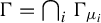 $\Gamma =\bigcap _i \Gamma _{\mu _i}$
contains a loxodromic WPD element and that for all
$\Gamma =\bigcap _i \Gamma _{\mu _i}$
contains a loxodromic WPD element and that for all $v\in G$
,
$v\in G$
, $|\Gamma : (\Gamma \cap vHv^{-1})|=\infty $
, then Corollary 5.8 implies that
$|\Gamma : (\Gamma \cap vHv^{-1})|=\infty $
, then Corollary 5.8 implies that $\Gamma $
contains a loxodromic WPD element that is transverse to H. Hence, combining Theorem 6.1 and Corollary 5.8 gives the following theorem.
$\Gamma $
contains a loxodromic WPD element that is transverse to H. Hence, combining Theorem 6.1 and Corollary 5.8 gives the following theorem.
Theorem 6.2. Suppose that G is a group with a non-elementary, partially WPD action on a hyperbolic metric space S, and $E(G)=1$
. Let
$E(G)=1$
. Let $(\mu _i)$
be a sequence of permissible probability measures on G and let
$(\mu _i)$
be a sequence of permissible probability measures on G and let $H \in \mathrm {Sub}_{\infty }^{cc}(G\curvearrowright S)$
. Suppose there exists a loxodromic WPD element
$H \in \mathrm {Sub}_{\infty }^{cc}(G\curvearrowright S)$
. Suppose there exists a loxodromic WPD element $f\in \Gamma =\bigcap _i \Gamma _{\mu _i}$
and that for all
$f\in \Gamma =\bigcap _i \Gamma _{\mu _i}$
and that for all $v\in G$
,
$v\in G$
, $|\Gamma : (\Gamma \cap vHv^{-1})|=\infty $
. Then, for all
$|\Gamma : (\Gamma \cap vHv^{-1})|=\infty $
. Then, for all $k\geq 1$
, a random k-generated subgroup R in G will be free of rank k, and will satisfy
$k\geq 1$
, a random k-generated subgroup R in G will be free of rank k, and will satisfy $\langle H, R\rangle \cong H\ast R$
and
$\langle H, R\rangle \cong H\ast R$
and $\langle H, R\rangle \in \mathrm {Sub}_{\infty }^{cc}(G\curvearrowright S)$
asymptotically almost surely.
$\langle H, R\rangle \in \mathrm {Sub}_{\infty }^{cc}(G\curvearrowright S)$
asymptotically almost surely.
We can simplify the statement of the previous theorem by adding the assumption that each $\mu _i$
has generating support.
$\mu _i$
has generating support.
Corollary 6.3. Suppose that G is a group with a non-elementary, partially WPD action on a hyperbolic metric space S, and $E(G)=1$
. Let
$E(G)=1$
. Let $(\mu _i)$
be a sequence of permissible probability measures with generating support on G, and let
$(\mu _i)$
be a sequence of permissible probability measures with generating support on G, and let $H \in \mathrm {Sub}_{\infty }^{cc}(G\curvearrowright S)$
. Then, for all
$H \in \mathrm {Sub}_{\infty }^{cc}(G\curvearrowright S)$
. Then, for all $k\geq 1$
, a random k-generated subgroup R in G will be free of rank k, and will satisfy
$k\geq 1$
, a random k-generated subgroup R in G will be free of rank k, and will satisfy $\langle H, R\rangle \cong H\ast R$
and
$\langle H, R\rangle \cong H\ast R$
and $\langle H, R\rangle \in \mathrm {Sub}_{\infty }^{cc}(G\curvearrowright S)$
asymptotically almost surely.
$\langle H, R\rangle \in \mathrm {Sub}_{\infty }^{cc}(G\curvearrowright S)$
asymptotically almost surely.
Remark 6.4. As in [Reference Abbott and HullAH, Theorem 3.3], if the action of G on S is cobounded, then the condition $E(G)=\{1\}$
can be removed from the previous theorems at the cost of replacing the isomorphism
$E(G)=\{1\}$
can be removed from the previous theorems at the cost of replacing the isomorphism $\langle H, R\rangle \cong H\ast R$
with
$\langle H, R\rangle \cong H\ast R$
with $\langle H, R, E(G)\rangle \cong HE(G)\ast _{E(G)} RE(G)$
. However, in this case, if
$\langle H, R, E(G)\rangle \cong HE(G)\ast _{E(G)} RE(G)$
. However, in this case, if $H\cap E(G)=1$
, then it follows that we again have
$H\cap E(G)=1$
, then it follows that we again have $\langle H, R\rangle \cong H\ast R$
.
$\langle H, R\rangle \cong H\ast R$
.
Note that Theorem 1.7 is a special case of Corollary 6.3 obtained by adding the assumptions that $(\mu _i)$
is a constant sequence with each
$(\mu _i)$
is a constant sequence with each $\mu _i=\mu $
and
$\mu _i=\mu $
and $\mathrm {Supp}(\mu )$
is a finite, symmetric generating set of G, and then applying the conclusion of Corollary 6.3 with
$\mathrm {Supp}(\mu )$
is a finite, symmetric generating set of G, and then applying the conclusion of Corollary 6.3 with $k=1$
. The condition that
$k=1$
. The condition that $w_n$
is a loxodromic element asymptotically almost surely is given by [Reference Maher and TiozzoMT, Theorem 1.4].
$w_n$
is a loxodromic element asymptotically almost surely is given by [Reference Maher and TiozzoMT, Theorem 1.4].
The notion of a stable subgroup of a finitely generated group was introduced by Durham and Taylor in [Reference Durham and TaylorDT] as a generalization of the notion of a quasi-convex subgroup of a hyperbolic group. In right-angled Artin groups and, more generally, hierarchically hyperbolic groups, a subgroup is stable if and only if it is convex cocompact with respect to an appropriate acylindrical (hence, partially WPD) action on a hyperbolic metric space [Reference Koberda, Mangahas and TaylorKMT, Reference Abbott, Behrstock and DurhamABD]. In particular, the following corollary is an immediate consequence of Theorem 6.2. This essentially resolves [Reference Abbott and HullAH, Conjectures 6.14 and 6.15], though we have added a few additional and necessary hypotheses.
Corollary 6.5. Let G be a right-angled Artin group or, more generally, a hierarchically hyperbolic group. Suppose G is acylindrically hyperbolic and H is an infinite index stable subgroup of G such that $H\cap E(G)=\{1\}$
. Let
$H\cap E(G)=\{1\}$
. Let $(\mu _i)$
be a sequence of permissible probability measures on G with generating supports. Then, a random k-generated subgroup R of G is free of rank k, satisfies
$(\mu _i)$
be a sequence of permissible probability measures on G with generating supports. Then, a random k-generated subgroup R of G is free of rank k, satisfies $\langle H, R\rangle \cong H\ast R$
, and
$\langle H, R\rangle \cong H\ast R$
, and $\langle H, R\rangle $
is stable in G asymptotically almost surely.
$\langle H, R\rangle $
is stable in G asymptotically almost surely.
6.2
$\mu $
-mixing actions

We now discuss one of the main technical results from [Reference Abbott and HullAH] that we will use in the proof of Theorem 6.9. We first recall some notation from [Reference Abbott and HullAH]. Let G be a group acting by isometries on a metric space $(S,\mathrm {d})$
. If
$(S,\mathrm {d})$
. If $Y\subseteq G$
, by a word in the alphabet Y, we mean a product of elements of Y,
$Y\subseteq G$
, by a word in the alphabet Y, we mean a product of elements of Y, $g_1\cdots g_n$
, where each
$g_1\cdots g_n$
, where each $g_i\in Y$
. In particular, such words contain only elements of Y and not their inverses. However, in most cases we consider, the set Y will be symmetric.
$g_i\in Y$
. In particular, such words contain only elements of Y and not their inverses. However, in most cases we consider, the set Y will be symmetric.
Now, let $W=g_1\cdots g_n$
be a word in the elements of G. We say that W represents the element
$W=g_1\cdots g_n$
be a word in the elements of G. We say that W represents the element $g=g_1\cdots g_n\in G$
and W is reduced if
$g=g_1\cdots g_n\in G$
and W is reduced if $g_i\neq g_{i+1}^{-1}$
for
$g_i\neq g_{i+1}^{-1}$
for $i=1,\ldots ,n-1$
. Given
$i=1,\ldots ,n-1$
. Given $s \in S$
, a path labeled by W and based at s in S is a path from s to
$s \in S$
, a path labeled by W and based at s in S is a path from s to $g(s)$
, which is a concatenation of geodesics of the form
$g(s)$
, which is a concatenation of geodesics of the form
 $$ \begin{align*} [s, g_1(s)]\,[g_1(s), g_1g_2(s)]\ldots[g_1\cdots g_{n-1}(s), g_1\cdots g_n(s)]. \end{align*} $$
We will refer to $g_i$
as the label of the subpath
$g_i$
as the label of the subpath $[g_1\cdots g_{i-1}(s), g_1\cdots g_i(s)]$
; subpaths labeled by subwords of W are defined similarly. Note that since G is acting by isometries, the length of
$[g_1\cdots g_{i-1}(s), g_1\cdots g_i(s)]$
; subpaths labeled by subwords of W are defined similarly. Note that since G is acting by isometries, the length of $[g_1\cdots g_{i-1}(s), g_1 \cdots g_i(s)]$
is equal to
$[g_1\cdots g_{i-1}(s), g_1 \cdots g_i(s)]$
is equal to $\mathrm {d}(s, g_i(s))$
.
$\mathrm {d}(s, g_i(s))$
.
The following is a slight simplification of [Reference Abbott and HullAH, Theorem 3.2]. Note that, in the terminology of [Reference Abbott and HullAH], a word in the alphabet Y is allowed to include inverses of elements of Y. In our terminology, this is equivalent to a word in $Y^{\pm 1}$
.
$Y^{\pm 1}$
.
Theorem 6.6. Let G be a group with a non-elementary partially WPD action on a hyperbolic metric space S. Suppose $E(G)=\{1\}$
and
$E(G)=\{1\}$
and $\mu $
is a permissible probability measure on G. Let
$\mu $
is a permissible probability measure on G. Let $s\in S$
and Y be a subset of
$s\in S$
and Y be a subset of $G\setminus \{1\}$
with the orbit
$G\setminus \{1\}$
with the orbit $Y(s)\, \sigma $
-quasi-convex. Suppose also that there exists a loxodromic WPD element
$Y(s)\, \sigma $
-quasi-convex. Suppose also that there exists a loxodromic WPD element $f\in \Gamma _\mu $
, which is transverse to Y. Let
$f\in \Gamma _\mu $
, which is transverse to Y. Let $w_n$
and
$w_n$
and $u_n$
be independent random walks with respect to
$u_n$
be independent random walks with respect to $\mu $
. Then, there is a sequence of constants
$\mu $
. Then, there is a sequence of constants $(c_n)$
such that the following holds asymptotically almost surely. Given any reduced non-trivial word W in the alphabet
$(c_n)$
such that the following holds asymptotically almost surely. Given any reduced non-trivial word W in the alphabet $Y\cup \{w_n^{\pm 1}\}\cup \{u_n^{\pm 1}\}$
with no two consecutive letters belonging to Y, the path in S based at s and labeled by W is a
$Y\cup \{w_n^{\pm 1}\}\cup \{u_n^{\pm 1}\}$
with no two consecutive letters belonging to Y, the path in S based at s and labeled by W is a $(8, c_n)$
-quasi-geodesic.
$(8, c_n)$
-quasi-geodesic.
In the next lemma, we keep the assumptions and notation used in Theorem 6.6. The argument is essentially contained in the proof of [Reference Abbott and HullAH, Theorem 3.2], but we include it here as well.
Lemma 6.7. Let W be a reduced word in the alphabet $Y\cup \{w_n^{\pm 1}\}\cup \{u_n^{\pm 1}\}$
with no two consecutive letters belonging to Y. Suppose W contains at least one letter belonging to
$Y\cup \{w_n^{\pm 1}\}\cup \{u_n^{\pm 1}\}$
with no two consecutive letters belonging to Y. Suppose W contains at least one letter belonging to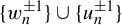 $\{w_n^{\pm 1}\}\cup \{u_n^{\pm 1}\}$
and W represents
$\{w_n^{\pm 1}\}\cup \{u_n^{\pm 1}\}$
and W represents $g_n\in G$
. Then, for all
$g_n\in G$
. Then, for all $N\geq 0$
,
$N\geq 0$
, $\mathrm {d}(s, g_n(s))\geq N$
asymptotically almost surely. In particular,
$\mathrm {d}(s, g_n(s))\geq N$
asymptotically almost surely. In particular, $g_n\neq _G 1$
asymptotically almost surely.
$g_n\neq _G 1$
asymptotically almost surely.
Proof. Let p be a path in S based at s and labeled by W. Let D be the constant given by Theorem 2.10 and $c_n$
the constants given by Theorem 6.6. By the ‘moreover’ part of [Reference Abbott and HullAH, Theorem 3.2], the constants
$c_n$
the constants given by Theorem 6.6. By the ‘moreover’ part of [Reference Abbott and HullAH, Theorem 3.2], the constants $c_n$
can be chosen so that
$c_n$
can be chosen so that ${c_n}/{n}\to 0$
as
${c_n}/{n}\to 0$
as $n\to \infty $
. Hence, we can choose
$n\to \infty $
. Hence, we can choose $\varepsilon>0$
such that for all sufficiently large n,
$\varepsilon>0$
such that for all sufficiently large n, $D-\varepsilon D-{c_n}/{n}>0$
.
$D-\varepsilon D-{c_n}/{n}>0$
.
By assumption, p contains a subpath labeled by an element of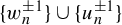 $\{w_n^{\pm 1}\}\cup \{u_n^{\pm 1}\}$
. Without loss of generality, suppose this subpath is labeled by
$\{w_n^{\pm 1}\}\cup \{u_n^{\pm 1}\}$
. Without loss of generality, suppose this subpath is labeled by $w_n$
. Since this subpath has length
$w_n$
. Since this subpath has length $\mathrm {d}(s, w_n(s))$
, by Theorem 2.10, we have
$\mathrm {d}(s, w_n(s))$
, by Theorem 2.10, we have
 $$ \begin{align*} \|p\|\geq \mathrm{d}(s, w_n(s))\geq (1-\varepsilon )Dn, \end{align*} $$
asymptotically almost surely. In addition, as p is an $(8, c_n)$
quasi-geodesic (which happens asymptotically almost surely), we have
$(8, c_n)$
quasi-geodesic (which happens asymptotically almost surely), we have
 $$ \begin{align*} \|p\|\leq 8\mathrm{d}(s, g_n(s))+c_n. \end{align*} $$
Combining these inequalities, we obtain
 $$ \begin{align*} \mathrm{d}(s, g_n(s))\geq \dfrac{1}{8}((1-\varepsilon )Dn-c_n)=\dfrac{1}{8}\bigg(D-\varepsilon D-\frac{c_n}{n}\bigg)n, \end{align*} $$
asymptotically almost surely. By our choice of $\varepsilon $
,
$\varepsilon $
, $\tfrac 18(D-\varepsilon D-{c_n}/{n} )>0$
for all sufficiently large n. Hence, for any fixed
$\tfrac 18(D-\varepsilon D-{c_n}/{n} )>0$
for all sufficiently large n. Hence, for any fixed $N\geq 0$
,
$N\geq 0$
, $\tfrac 18(D-\varepsilon D-\varepsilon B )n\geq N$
for all but finitely many values of n. Therefore,
$\tfrac 18(D-\varepsilon D-\varepsilon B )n\geq N$
for all but finitely many values of n. Therefore, $\mathrm {d}(s, g_n(s))\geq N$
asymptotically almost surely.
$\mathrm {d}(s, g_n(s))\geq N$
asymptotically almost surely.
We are now ready to prove the following, which is the main ingredient in the proof of Theorem 6.9.
Proposition 6.8. Let G be a group with a non-elementary, partially WPD action on a hyperbolic space S and $E(G)=\{1\}$
. Let H and K be infinite index convex cocompact subgroups of G and let
$E(G)=\{1\}$
. Let H and K be infinite index convex cocompact subgroups of G and let $\mathcal {F}$
be a finite subset of G. Let
$\mathcal {F}$
be a finite subset of G. Let $\mu $
be a permissible probability measure on G with generating support and let
$\mu $
be a permissible probability measure on G with generating support and let $w_n$
be a random walk with respect to
$w_n$
be a random walk with respect to $\mu $
. Then, the subgroup
$\mu $
. Then, the subgroup $L_{n}=\langle w_n^{-1}Hw_n, K\rangle $
will satisfy the following conditions asymptotically almost surely:
$L_{n}=\langle w_n^{-1}Hw_n, K\rangle $
will satisfy the following conditions asymptotically almost surely:
-
(a)
$L_{n}$
is convex cocompact; -
(b)
$L_{n}\cap \mathcal F=K\cap \mathcal F$
and
$w_nL_{n}w_n^{-1}\cap \mathcal F=H\cap \mathcal F$
; -
(c)
$L_n$
has infinite index in G.




Proof. Fix a basepoint $s\in S$
. By Corollary 5.9, there exists a loxodromic WPD element
$s\in S$
. By Corollary 5.9, there exists a loxodromic WPD element $h \in G$
that is transverse to H and K. Choose
$h \in G$
that is transverse to H and K. Choose $Y=(H\cup K)\setminus \{1\}$
and note that
$Y=(H\cup K)\setminus \{1\}$
and note that $Y(s)$
is quasi-convex in S, by Lemma 2.4, and h is transverse to Y, by Lemma 5.3. By Theorem 6.6, we can assume that if W is a word in the alphabet
$Y(s)$
is quasi-convex in S, by Lemma 2.4, and h is transverse to Y, by Lemma 5.3. By Theorem 6.6, we can assume that if W is a word in the alphabet $Y\cup \{w_n^{\pm 1}\}$
with no consecutive letters belonging to Y, then the path in S based at s and labeled by W is an
$Y\cup \{w_n^{\pm 1}\}$
with no consecutive letters belonging to Y, then the path in S based at s and labeled by W is an $(8, c_n)$
-quasi-geodesic.
$(8, c_n)$
-quasi-geodesic.
(a) Let us first show that the induced action of $L_{n}=\langle w_n^{-1}Hw_n, K\rangle \leqslant G$
on S is metrically proper. Choose any
$L_{n}=\langle w_n^{-1}Hw_n, K\rangle \leqslant G$
on S is metrically proper. Choose any $R>0$
and suppose that
$R>0$
and suppose that $g \in L_n$
satisfies
$g \in L_n$
satisfies $\mathrm {d}(s,g(s))\le R$
. The element g can be represented by a word
$\mathrm {d}(s,g(s))\le R$
. The element g can be represented by a word
 $$ \begin{align} W=k_0 w_n^{-1} h_1 {w_n} k_1 \cdots w_n^{-1} h_m {w_n}k_{m}, \end{align} $$
with $m\in \mathbb N\cup \{0\}$
,
$m\in \mathbb N\cup \{0\}$
, $h_1,\ldots ,h_m \in H\setminus \{1\}$
,
$h_1,\ldots ,h_m \in H\setminus \{1\}$
, $k_0,k_m \in K$
, and
$k_0,k_m \in K$
, and $k_1,\ldots ,k_{m-1} \in K\setminus \{1\}$
. If we consider W as a reduced word over the alphabet
$k_1,\ldots ,k_{m-1} \in K\setminus \{1\}$
. If we consider W as a reduced word over the alphabet $Y \cup \{w_n^{\pm 1}\}$
, then, by Theorem 6.6, the path q in S, based at s and labeled by W, is
$Y \cup \{w_n^{\pm 1}\}$
, then, by Theorem 6.6, the path q in S, based at s and labeled by W, is $(8, c_n)$
-quasi-geodesic. It follows that
$(8, c_n)$
-quasi-geodesic. It follows that
 $$ \begin{align*}\|q\| \le 8\, \mathrm{d}(s,g(s))+c_n \le 8R+c_n.\end{align*} $$
Recall that by the definition of q, $\mathrm {d}(s,k_i(s)) \le \|q\|$
for
$\mathrm {d}(s,k_i(s)) \le \|q\|$
for $i=0,\ldots ,m$
, and
$i=0,\ldots ,m$
, and $\mathrm {d}(s,h_j(s)) \le \|q\|$
for
$\mathrm {d}(s,h_j(s)) \le \|q\|$
for $j=1,\ldots ,m$
. Hence,
$j=1,\ldots ,m$
. Hence, $\mathrm {d}(s,k_i(s)) \le 8R+c_n$
for each
$\mathrm {d}(s,k_i(s)) \le 8R+c_n$
for each $i=0,\ldots ,m$
, and there are only finitely many such elements
$i=0,\ldots ,m$
, and there are only finitely many such elements $k_i \in K$
because the action of K on S is proper. Similarly, there are only finitely many possibilities for
$k_i \in K$
because the action of K on S is proper. Similarly, there are only finitely many possibilities for $h_j \in H$
,
$h_j \in H$
, $j=1,\ldots ,m$
. Therefore, the element
$j=1,\ldots ,m$
. Therefore, the element $g \in L_n$
can take only finitely many values, so the action of
$g \in L_n$
can take only finitely many values, so the action of $L_n$
on S is proper.
$L_n$
on S is proper.
Now, assume that the orbits $H(s)$
and
$H(s)$
and $K(s)$
are
$K(s)$
are $\eta $
-quasi-convex in S for some
$\eta $
-quasi-convex in S for some $\eta \ge 0$
. Let us show that the orbit
$\eta \ge 0$
. Let us show that the orbit $L_n(s)$
is also quasi-convex (it would follow that every orbit of
$L_n(s)$
is also quasi-convex (it would follow that every orbit of $L_n$
is quasi-convex, see Lemma 2.3). Let p be a geodesic path in S joining two points of this orbit. After applying the translation by an element of
$L_n$
is quasi-convex, see Lemma 2.3). Let p be a geodesic path in S joining two points of this orbit. After applying the translation by an element of $L_n$
, we can assume that p starts at s and terminates at
$L_n$
, we can assume that p starts at s and terminates at $g(s)$
for some
$g(s)$
for some $g \in L_n$
. Let W be a word as in (20), representing g in G and considered as a reduced word over the alphabet
$g \in L_n$
. Let W be a word as in (20), representing g in G and considered as a reduced word over the alphabet $Y \cup \{w_n^{\pm 1}\}$
. Let q be the path in S based at s and labeled by W. Then, q is
$Y \cup \{w_n^{\pm 1}\}$
. Let q be the path in S based at s and labeled by W. Then, q is $(8, c_n)$
-quasi-geodesic, so for every point x of p, there is a point y of q such that
$(8, c_n)$
-quasi-geodesic, so for every point x of p, there is a point y of q such that $\mathrm {d}(x,y) \le \varkappa _n$
, where
$\mathrm {d}(x,y) \le \varkappa _n$
, where $\varkappa _n \ge 0$
is the constant provided by Lemma 2.1. By construction, the path q is a concatenation of geodesic subpaths labeled by
$\varkappa _n \ge 0$
is the constant provided by Lemma 2.1. By construction, the path q is a concatenation of geodesic subpaths labeled by $w_n^{\pm 1}$
,
$w_n^{\pm 1}$
, $k_i$
, or
$k_i$
, or $h_j$
, and y must belong to one of them.
$h_j$
, and y must belong to one of them.
Suppose first that y lies on a subpath r, of q, labeled by $k_i$
for some
$k_i$
for some $i=0,\ldots ,m$
:
$i=0,\ldots ,m$
:
 $$ \begin{align*} r=[k_0 w_n^{-1} h_1 {w_n} k_1 \cdots w_n^{-1} h_i {w_n}(s),k_0 w_n^{-1} h_1 {w_n} k_1 \cdots w_n^{-1} h_i {w_n}k_{i}(s)]=u([s,k_i(s)]), \end{align*} $$
where $u=k_0 w_n^{-1} h_1 {w_n} k_1 \cdots w_n^{-1} h_i {w_n} \in L_n$
. Since the orbit
$u=k_0 w_n^{-1} h_1 {w_n} k_1 \cdots w_n^{-1} h_i {w_n} \in L_n$
. Since the orbit $K(s)$
is
$K(s)$
is $\eta $
-quasi-convex, we have
$\eta $
-quasi-convex, we have $[s,k_i(s)] \subseteq \mathcal {N}_\eta (K(s))$
, whence
$[s,k_i(s)] \subseteq \mathcal {N}_\eta (K(s))$
, whence
 $$ \begin{align*}y \in r \subseteq \mathcal{N}_\eta(uK(s)) \subseteq \mathcal{N}_\eta(L_n(s)).\end{align*} $$
If y lies on a subpath labeled by $w_n$
, then it is within
$w_n$
, then it is within $d_n=\mathrm {d}(s,w_n(s))$
-distance from an element of the form
$d_n=\mathrm {d}(s,w_n(s))$
-distance from an element of the form $k_0 w_n^{-1} h_1 {w_n} k_1\cdots w_n^{-1} h_i {w_n} \in L_n$
for some
$k_0 w_n^{-1} h_1 {w_n} k_1\cdots w_n^{-1} h_i {w_n} \in L_n$
for some $i=0,\ldots ,m$
. Similarly,
$i=0,\ldots ,m$
. Similarly, $y \in \mathcal {N}_{d_n}(L_n)$
when y belongs to a subpath of q labeled by
$y \in \mathcal {N}_{d_n}(L_n)$
when y belongs to a subpath of q labeled by $w_n^{-1}$
. The final possibility is that y belongs to a geodesic subpath r, of q, labeled by
$w_n^{-1}$
. The final possibility is that y belongs to a geodesic subpath r, of q, labeled by $h_j$
for some
$h_j$
for some $j=1,\ldots ,m$
, so that
$j=1,\ldots ,m$
, so that
 $$ \begin{align*}r=v([s,h_j(s)]) \quad \text{where } v=k_0 w_n^{-1} h_1 {w_n} k_1\cdots k_{j-1}w_n^{-1}.\end{align*} $$
Since $[s,h_j(s)] \subseteq \mathcal {N}_\eta (H(s))$
, we have
$[s,h_j(s)] \subseteq \mathcal {N}_\eta (H(s))$
, we have
 $$ \begin{align*}y \in \mathcal{N}_\eta(vH(s)) \subseteq \mathcal{N}_{\eta+d_n}(vHw_n(s)) \subseteq \mathcal{N}_{\eta+d_n}(L_n(s)),\end{align*} $$
because $vHw_n=k_0 w_n^{-1} h_1 {w_n} k_1\cdots k_{j-1}w_n^{-1}Hw_n \subseteq L_n$
.
$vHw_n=k_0 w_n^{-1} h_1 {w_n} k_1\cdots k_{j-1}w_n^{-1}Hw_n \subseteq L_n$
.
Thus, we conclude that $x \in \mathcal {N}_{\varkappa _n+\eta +d_n}(L_n(s))$
, that is,
$x \in \mathcal {N}_{\varkappa _n+\eta +d_n}(L_n(s))$
, that is, $L_n(s)$
is
$L_n(s)$
is $(\varkappa _n+\eta +d_n)$
- quasi-convex.
$(\varkappa _n+\eta +d_n)$
- quasi-convex.
(b) Let $N=\max \{\mathrm {d}(s, f(s))\mid f\in \mathcal F\}+1$
. If
$N=\max \{\mathrm {d}(s, f(s))\mid f\in \mathcal F\}+1$
. If $g \in L_n \setminus K$
is any element, then any reduced word W over the alphabet
$g \in L_n \setminus K$
is any element, then any reduced word W over the alphabet $Y \cup \{w_n^{\pm 1}\}$
(as in (20)), representing g, must contain at least one instance of
$Y \cup \{w_n^{\pm 1}\}$
(as in (20)), representing g, must contain at least one instance of $w_n$
. By Lemma 6.7, the latter implies that
$w_n$
. By Lemma 6.7, the latter implies that $\mathrm {d}(s, g(s))\ge N$
, so that
$\mathrm {d}(s, g(s))\ge N$
, so that $g\notin \mathcal F$
asymptotically almost surely. Thus,
$g\notin \mathcal F$
asymptotically almost surely. Thus, $L_n \cap \mathcal {F}=K \cap \mathcal {F}$
. The second equality in part (b) can be proved similarly.
$L_n \cap \mathcal {F}=K \cap \mathcal {F}$
. The second equality in part (b) can be proved similarly.
(c) It remains to show that $L_{n}$
has infinite index in G. If
$L_{n}$
has infinite index in G. If $L_n$
is trivial, this is obvious because G contains an element of infinite order, so assume that
$L_n$
is trivial, this is obvious because G contains an element of infinite order, so assume that $L_n \neq \{1\}$
. Let
$L_n \neq \{1\}$
. Let $u_n$
be another independent random walk with respect to
$u_n$
be another independent random walk with respect to $\mu $
and consider the subgroup
$\mu $
and consider the subgroup $\langle L_{n}, u_n\rangle $
. By Lemma 6.7, if W is a reduced word in
$\langle L_{n}, u_n\rangle $
. By Lemma 6.7, if W is a reduced word in $Y\cup \{w_n^{\pm 1}\}\cup \{u_n^{\pm 1}\}$
, with no two consecutive letters belonging to Y and containing at least one occurrence of
$Y\cup \{w_n^{\pm 1}\}\cup \{u_n^{\pm 1}\}$
, with no two consecutive letters belonging to Y and containing at least one occurrence of $u_n^{\pm 1}$
, then W represents a non-trivial element of G, in particular,
$u_n^{\pm 1}$
, then W represents a non-trivial element of G, in particular, $u_n \neq 1$
. This implies that
$u_n \neq 1$
. This implies that $\langle L_{n}, u_n\rangle \cong L_{n}\ast \langle u_n\rangle $
in G. Since
$\langle L_{n}, u_n\rangle \cong L_{n}\ast \langle u_n\rangle $
in G. Since $L_{n}$
is non-trivial, it must have infinite index in this free product; hence,
$L_{n}$
is non-trivial, it must have infinite index in this free product; hence, $|G:L_n|=\infty $
.
$|G:L_n|=\infty $
.
Theorem 6.9. Let G be a group with a non-elementary partially WPD action on a hyperbolic metric space S and suppose that G has no non-trivial finite normal subgroups. Let $\mu $
be a permissible measure on G with generating support. Then, the action of G on the closure of
$\mu $
be a permissible measure on G with generating support. Then, the action of G on the closure of $\mathrm {Sub}_\infty ^{cc}(G\curvearrowright S)$
in
$\mathrm {Sub}_\infty ^{cc}(G\curvearrowright S)$
in $\mathrm {Sub}(G)$
is topologically
$\mathrm {Sub}(G)$
is topologically $\mu $
-mixing.
$\mu $
-mixing.
Proof. Suppose U, V are open subsets of the closure of $\mathrm {Sub}_\infty ^{cc}(G \curvearrowright S)$
and
$\mathrm {Sub}_\infty ^{cc}(G \curvearrowright S)$
and $K\in U\cap \mathrm {Sub}_\infty ^{cc}(G \curvearrowright S)$
,
$K\in U\cap \mathrm {Sub}_\infty ^{cc}(G \curvearrowright S)$
, $H\in V\cap \mathrm {Sub}_\infty ^{cc}(G \curvearrowright S)$
. By the definition of the topology on
$H\in V\cap \mathrm {Sub}_\infty ^{cc}(G \curvearrowright S)$
. By the definition of the topology on $\mathrm {Sub}_\infty ^{cc}(G \curvearrowright S)$
, there exists a finite subset
$\mathrm {Sub}_\infty ^{cc}(G \curvearrowright S)$
, there exists a finite subset $\mathcal F\subset G$
such that for any subgroup J, if
$\mathcal F\subset G$
such that for any subgroup J, if $J\cap \mathcal F=K\cap \mathcal F$
, then
$J\cap \mathcal F=K\cap \mathcal F$
, then $J\in U$
and if
$J\in U$
and if $J\cap \mathcal F=H\cap \mathcal F$
, then
$J\cap \mathcal F=H\cap \mathcal F$
, then $J\in V$
. Now, let
$J\in V$
. Now, let $w_n$
be a random walk with respect to
$w_n$
be a random walk with respect to $\mu $
and let
$\mu $
and let $L_{n}$
be given by Proposition 6.8. Then, asymptotically almost surely,
$L_{n}$
be given by Proposition 6.8. Then, asymptotically almost surely, $L_{n}$
belongs to
$L_{n}$
belongs to $\mathrm {Sub}_\infty ^{cc}(G \curvearrowright S)$
,
$\mathrm {Sub}_\infty ^{cc}(G \curvearrowright S)$
, $L_{n}\in U$
, and
$L_{n}\in U$
, and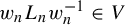 $w_nL_nw_n^{-1}\in V$
. This means that
$w_nL_nw_n^{-1}\in V$
. This means that $w_n(U)\cap V\neq \emptyset $
asymptotically almost surely. Thus, the action of G on the closure of
$w_n(U)\cap V\neq \emptyset $
asymptotically almost surely. Thus, the action of G on the closure of $\mathrm {Sub}_\infty ^{cc}(G \curvearrowright S)$
in
$\mathrm {Sub}_\infty ^{cc}(G \curvearrowright S)$
in $\mathrm {Sub}(G)$
is topologically
$\mathrm {Sub}(G)$
is topologically $\mu $
-mixing.
$\mu $
-mixing.
7 Relatively quasi-convex subgroups of relatively hyperbolic groups
Here, we explain the proof of Theorem 1.5, that is, we show that the action of a relatively hyperbolic group on the closure of its space of infinite index relatively quasi-convex subgroups in $\mathrm {Sub} (G)$
is topologically
$\mathrm {Sub} (G)$
is topologically $\mu $
-mixing. In the setting of a relatively hyperbolic group acting on its relative Cayley graph, our notion of a convex cocompact subgroup is equivalent to the notion of a strongly relatively quasi-convex subgroup by [Reference OsinOsi06, Theorem 4.13]. However, there may also be relatively quasi-convex subgroups which are not convex cocompact, for example, any infinite peripheral subgroup will be like this. Hence, Theorem 1.5 does not follow directly from Theorem 1.3, though the proofs of these two results are quite similar in spirit.
$\mu $
-mixing. In the setting of a relatively hyperbolic group acting on its relative Cayley graph, our notion of a convex cocompact subgroup is equivalent to the notion of a strongly relatively quasi-convex subgroup by [Reference OsinOsi06, Theorem 4.13]. However, there may also be relatively quasi-convex subgroups which are not convex cocompact, for example, any infinite peripheral subgroup will be like this. Hence, Theorem 1.5 does not follow directly from Theorem 1.3, though the proofs of these two results are quite similar in spirit.
After establishing some definitions and notation, we show the existence of a loxodromic, WPD element transverse to any finite collection of infinite index relatively quasi-convex subgroups (Corollary 7.8). For a single infinite index relatively quasi-convex subgroup, such an element was shown to exist in [Reference Abbott and HullAH, Proposition 6.4].
The following definition of relative hyperbolicity is due to Bowditch [Reference BowditchBow]. Here, a graph is called fine if for all n, the graph contains finitely many circuits of length n, where a circuit is a cycle without self-intersection.
Definition 7.1. A group G is hyperbolic relative to the family of subgroups $\{H_\unicode{x3bb} \}_{\unicode{x3bb} \in \Lambda }$
if G acts on a fine, hyperbolic graph K with finite edge stabilizers, finitely many orbits of edges, and each vertex stabilizers is either finite or is conjugate to exactly one element of
$\{H_\unicode{x3bb} \}_{\unicode{x3bb} \in \Lambda }$
if G acts on a fine, hyperbolic graph K with finite edge stabilizers, finitely many orbits of edges, and each vertex stabilizers is either finite or is conjugate to exactly one element of $\{H_\unicode{x3bb} \}_{\unicode{x3bb} \in \Lambda }$
.
$\{H_\unicode{x3bb} \}_{\unicode{x3bb} \in \Lambda }$
.
For countable groups, this definition is equivalent to several others in the literature, see [Reference HruskaHru]. In particular, it is equivalent to the definitions used by Osin in [Reference OsinOsi06, Reference OsinOsi16], which prove the following results.
Let G be a group and let $\{H_\unicode{x3bb} \}_{\unicode{x3bb} \in \Lambda }$
be a family of subgroups of G. Assume that there exists a finite subset
$\{H_\unicode{x3bb} \}_{\unicode{x3bb} \in \Lambda }$
be a family of subgroups of G. Assume that there exists a finite subset $X \subseteq G$
such that G is generated by
$X \subseteq G$
such that G is generated by $X \cup \bigcup _{\unicode{x3bb} \in \Lambda } H_\unicode{x3bb} $
. In this case, X is called a relative generating set of G and the Cayley graph
$X \cup \bigcup _{\unicode{x3bb} \in \Lambda } H_\unicode{x3bb} $
. In this case, X is called a relative generating set of G and the Cayley graph $\Gamma (G,X\cup \mathcal {H})$
, where
$\Gamma (G,X\cup \mathcal {H})$
, where $\mathcal {H}=\sqcup _{\unicode{x3bb} \in \Lambda } H_\unicode{x3bb} \setminus \{1\}$
, is called a relative Cayley graph of G.
$\mathcal {H}=\sqcup _{\unicode{x3bb} \in \Lambda } H_\unicode{x3bb} \setminus \{1\}$
, is called a relative Cayley graph of G.
Theorem 7.2. [Reference OsinOsi06, Corollary 2.54]
Suppose that a group G is hyperbolic relative to a collection of subgroups $\{H_\unicode{x3bb} \}_{\unicode{x3bb} \in \Lambda }$
and X is a finite relative generating set of G. Then, the relative Cayley graph
$\{H_\unicode{x3bb} \}_{\unicode{x3bb} \in \Lambda }$
and X is a finite relative generating set of G. Then, the relative Cayley graph $\Gamma (G,X\cup \mathcal {H})$
, equipped with the standard edge-path metric
$\Gamma (G,X\cup \mathcal {H})$
, equipped with the standard edge-path metric $\mathrm {d}$
, is a hyperbolic metric space.
$\mathrm {d}$
, is a hyperbolic metric space.
Theorem 7.3. [Reference OsinOsi16, Proposition 5.2]
Suppose that a group G is hyperbolic relative to a collection of subgroups $\{H_\unicode{x3bb} \}_{\unicode{x3bb} \in \Lambda }$
and X is a finite relative generating set of G. Then, the action of G on the relative Cayley graph
$\{H_\unicode{x3bb} \}_{\unicode{x3bb} \in \Lambda }$
and X is a finite relative generating set of G. Then, the action of G on the relative Cayley graph $\Gamma (G,X\cup \mathcal {H})$
is acylindrical.
$\Gamma (G,X\cup \mathcal {H})$
is acylindrical.
For the rest of this section, we fix a group G that is hyperbolic relative to a collection of subgroups $\{H_\unicode{x3bb} \}_{\unicode{x3bb} \in \Lambda }$
and let X be a finite relative generating set of G. We also assume that G is a non-elementary relatively hyperbolic group, which means that G is not virtually cyclic and each
$\{H_\unicode{x3bb} \}_{\unicode{x3bb} \in \Lambda }$
and let X be a finite relative generating set of G. We also assume that G is a non-elementary relatively hyperbolic group, which means that G is not virtually cyclic and each $H_\unicode{x3bb} $
is a proper subgroup of G. Let
$H_\unicode{x3bb} $
is a proper subgroup of G. Let $S=\Gamma (G,X\cup \mathcal {H})$
be the corresponding relative Cayley graph of G. We identify G with the set of vertices of S and always use
$S=\Gamma (G,X\cup \mathcal {H})$
be the corresponding relative Cayley graph of G. We identify G with the set of vertices of S and always use $1 \in G$
as the basepoint. By the previous two results, S is a hyperbolic metric space and the action of G on S is acylindrical; hence, all loxodromic elements of G are WPD elements. We also note that an element
$1 \in G$
as the basepoint. By the previous two results, S is a hyperbolic metric space and the action of G on S is acylindrical; hence, all loxodromic elements of G are WPD elements. We also note that an element $g\in G$
is loxodromic if and only if g has infinite order and is not conjugate to an element of
$g\in G$
is loxodromic if and only if g has infinite order and is not conjugate to an element of $H_\unicode{x3bb} $
for any
$H_\unicode{x3bb} $
for any $\unicode{x3bb} \in \Lambda $
, by [Reference OsinOsi06, Corollary 4.20].
$\unicode{x3bb} \in \Lambda $
, by [Reference OsinOsi06, Corollary 4.20].
Any subset $Y \subseteq G$
gives rise to the extended word metric
$Y \subseteq G$
gives rise to the extended word metric $\mathrm {d}_Y:G \times G \to \mathbb R\cup \{\infty \}$
, where
$\mathrm {d}_Y:G \times G \to \mathbb R\cup \{\infty \}$
, where $\mathrm {d}_Y(g,h)$
is the length of a shortest word over
$\mathrm {d}_Y(g,h)$
is the length of a shortest word over $Y^{\pm 1}$
, representing the element
$Y^{\pm 1}$
, representing the element $g^{-1}h$
in G if
$g^{-1}h$
in G if $g^{-1}h \in \langle Y \rangle $
, or
$g^{-1}h \in \langle Y \rangle $
, or $\mathrm {d}_Y(g,h)=\infty $
if
$\mathrm {d}_Y(g,h)=\infty $
if $g^{-1}h \notin \langle Y \rangle $
in G.
$g^{-1}h \notin \langle Y \rangle $
in G.
Consider a path p in S. Then, the edges of p are labeled by elements from $X \sqcup \mathcal {H}$
. We will say that p is tame if the following condition holds. Suppose that
$X \sqcup \mathcal {H}$
. We will say that p is tame if the following condition holds. Suppose that $e_1$
and
$e_1$
and $e_2$
are two distinct edges of p starting at vertices
$e_2$
are two distinct edges of p starting at vertices $g_1,g_2 \in G$
, and labeled by elements from
$g_1,g_2 \in G$
, and labeled by elements from $H_\unicode{x3bb} $
for some
$H_\unicode{x3bb} $
for some $\unicode{x3bb} \in \Lambda $
. Then,
$\unicode{x3bb} \in \Lambda $
. Then, $g_1$
,
$g_1$
, $g_2$
belong to different left cosets of
$g_2$
belong to different left cosets of $H_\unicode{x3bb} $
in G, that is,
$H_\unicode{x3bb} $
in G, that is, $g_2 \notin g_1 H_\unicode{x3bb} $
.
$g_2 \notin g_1 H_\unicode{x3bb} $
.
Since any two vertices in the same $H_\unicode{x3bb} $
-coset are at distance at most
$H_\unicode{x3bb} $
-coset are at distance at most $1$
in S, we see that any geodesic path in S is automatically tame. It is also obvious that any path labeled by a word in X is tame.
$1$
in S, we see that any geodesic path in S is automatically tame. It is also obvious that any path labeled by a word in X is tame.
Lemma 7.4. Using the above notation, there exists a finite subset $Y \subseteq G$
such that the following are true for the extended word metric
$Y \subseteq G$
such that the following are true for the extended word metric $\mathrm {d}_Y(\cdot ,\cdot )$
on G.
$\mathrm {d}_Y(\cdot ,\cdot )$
on G.
-
(i) For any
$\unicode{x3bb} \ge 1$
and
$c \ge 0$
, there exists
$\xi \ge 0$
such that if p and q are
$(\unicode{x3bb} ,c)$
-quasi-geodesics in S, p is tame, and
$p_-=q_-$
,
$p_+=q_+$
, then for any vertex x of p, there is a vertex y of q satisfying
$\mathrm {d}_Y(x,y)\le \xi $
. -
(ii) There is a constant
$\nu \ge 0$
such that given any geodesic triangle in S with sides p, q, r, for any vertex
$y \in p$
, there is a vertex
$z \in q \cup r$
satisfying
$\mathrm {d}_Y(y,z) \le \nu $
.






Proof. When G is finitely generated, part (ii) is given by [Reference OsinOsi06, Theorem 3.26]. The same proof works in general (cf. [Reference OsinOsi16, Lemma 5.3]).
Similarly, when G is finitely generated, part (i) is given by [Reference OsinOsi06, Proposition 3.15]. Again, the proof of [Reference OsinOsi06, Proposition 3.15] works in the general case without any significant changes.
Remark 7.5. Claim (ii) of Lemma 7.4 implies that if Q is a geodesic quadrangle in S and q is a side of Q, then any vertex of q is contained in the $2\nu $
-neighborhood of the union of the other sides of Q with respect to the extended word metric
$2\nu $
-neighborhood of the union of the other sides of Q with respect to the extended word metric $\mathrm {d}_Y(\cdot ,\cdot )$
.
$\mathrm {d}_Y(\cdot ,\cdot )$
.
There are several equivalent definitions of relatively quasi-convex subgroups, see [Reference HruskaHru]. We use the definition from [Reference HruskaHru, Definition 6.10].
Definition 7.6. We say that a subgroup $H \leqslant G$
is relatively quasi-convex if there exists a finite subset
$H \leqslant G$
is relatively quasi-convex if there exists a finite subset $Z \subseteq G$
and a constant
$Z \subseteq G$
and a constant $\eta \ge 0$
such that the following is satisfied. If r is a geodesic segment in
$\eta \ge 0$
such that the following is satisfied. If r is a geodesic segment in $S=\Gamma (G,X\cup \mathcal {H})$
with
$S=\Gamma (G,X\cup \mathcal {H})$
with $r_-,r_+ \in H$
, then for any vertex z of r, there is
$r_-,r_+ \in H$
, then for any vertex z of r, there is $h \in H$
such that
$h \in H$
such that $\mathrm {d}_Z(z,h) \le \eta $
.
$\mathrm {d}_Z(z,h) \le \eta $
.
Proposition 7.7. Let $H \leqslant G$
be a relatively quasi-convex subgroup. Then, every loxodromic element
$H \leqslant G$
be a relatively quasi-convex subgroup. Then, every loxodromic element $g \in G$
is H-apt (with respect to the natural action of G on
$g \in G$
is H-apt (with respect to the natural action of G on $\Gamma (G,X\cup \mathcal {H})$
).
$\Gamma (G,X\cup \mathcal {H})$
).
Proof. Let $g \in G$
be a loxodromic element with respect to the natural action of G on
$g \in G$
be a loxodromic element with respect to the natural action of G on $S=\Gamma (G,X\cup \mathcal {H})$
. Let
$S=\Gamma (G,X\cup \mathcal {H})$
. Let $\mathrm {d}(\cdot ,\cdot )$
denote that standard path metric on S. Suppose that
$\mathrm {d}(\cdot ,\cdot )$
denote that standard path metric on S. Suppose that $Z \subseteq G$
and
$Z \subseteq G$
and $\eta \ge 0$
are the finite subset and the constant from Definition 7.6, and
$\eta \ge 0$
are the finite subset and the constant from Definition 7.6, and $Y \subseteq G$
is the finite subset provided by Lemma 7.4. Without loss of generality, we can further assume that
$Y \subseteq G$
is the finite subset provided by Lemma 7.4. Without loss of generality, we can further assume that $g \in X$
and
$g \in X$
and $Y,Z \subseteq X$
, as relative hyperbolicity of G is independent of the choice of a finite relative generating set (see [Reference OsinOsi06, Theorem 2.34]).
$Y,Z \subseteq X$
, as relative hyperbolicity of G is independent of the choice of a finite relative generating set (see [Reference OsinOsi06, Theorem 2.34]).
In view of Remark 4.3, it is enough to check that the statement of Definition 4.1 holds for $s=1 \in S$
. Since the element
$s=1 \in S$
. Since the element $g \in X$
is loxodromic, there exist
$g \in X$
is loxodromic, there exist $\unicode{x3bb} \ge 1$
and
$\unicode{x3bb} \ge 1$
and $c \ge 0$
such that any path labeled by a power of g in S is
$c \ge 0$
such that any path labeled by a power of g in S is $(\unicode{x3bb} ,c)$
-quasi-geodesic. Let
$(\unicode{x3bb} ,c)$
-quasi-geodesic. Let $\xi ,\nu \ge 0$
be the constants given by Lemma 7.4.
$\xi ,\nu \ge 0$
be the constants given by Lemma 7.4.
For any given $C \ge 0$
, we can choose
$C \ge 0$
, we can choose $L \in \mathbb N$
so that
$L \in \mathbb N$
so that $\mathrm {d}(1,g^L)> \xi +2\nu +C$
, and suppose that
$\mathrm {d}(1,g^L)> \xi +2\nu +C$
, and suppose that $u \in G$
satisfies
$u \in G$
satisfies $\mathrm {d}(1,u) \le C$
and
$\mathrm {d}(1,u) \le C$
and $\mathrm {d}(ug^{2L},h) \le C$
for some
$\mathrm {d}(ug^{2L},h) \le C$
for some $h \in H$
.
$h \in H$
.
Let Q be a geodesic quadrangle in S with vertices $1$
, u,
$1$
, u, $ug^{2L}$
, and h, and let p be the
$ug^{2L}$
, and h, and let p be the $(\unicode{x3bb} ,c)$
-quasi-geodesic path in S starting at u and labeled by
$(\unicode{x3bb} ,c)$
-quasi-geodesic path in S starting at u and labeled by $g^{2L}$
. Then, p is tame and
$g^{2L}$
. Then, p is tame and $x=ug^L$
is a vertex of p, and so, by Lemma 7.4(i),
$x=ug^L$
is a vertex of p, and so, by Lemma 7.4(i), $\mathrm {d}_Y(x,y) \le \xi $
for some vertex y on the side
$\mathrm {d}_Y(x,y) \le \xi $
for some vertex y on the side $[u,ug^{2L}]$
of Q.
$[u,ug^{2L}]$
of Q.
Since $Y \subseteq X$
, it follows that
$Y \subseteq X$
, it follows that $\mathrm {d}(x,y) \le \mathrm {d}_X(x,y) \le \mathrm {d}_Y(x,y) \le \xi $
, and so
$\mathrm {d}(x,y) \le \mathrm {d}_X(x,y) \le \mathrm {d}_Y(x,y) \le \xi $
, and so
 $$ \begin{align*}\mathrm{d}(y,u) \ge \mathrm{d}(u,x)-\mathrm{d}(y,x)\ge \mathrm{d}(u,ug^L)-\xi=\mathrm{d}(1,g^L)- \xi>2\nu+C. \end{align*} $$
Similarly, $\mathrm {d}(y,ug^{2L})> 2\nu +C$
. Therefore, y cannot be contained within
$\mathrm {d}(y,ug^{2L})> 2\nu +C$
. Therefore, y cannot be contained within $2\nu $
-neighborhoods of the sides
$2\nu $
-neighborhoods of the sides $[1,u]$
and
$[1,u]$
and $[ug^{2L},h]$
, of Q in S, so, in view of Remark 7.5 and the fact that
$[ug^{2L},h]$
, of Q in S, so, in view of Remark 7.5 and the fact that $Y \subseteq X$
, we can conclude that there must exist a vertex z on the side
$Y \subseteq X$
, we can conclude that there must exist a vertex z on the side $[1,h]$
such that
$[1,h]$
such that $\mathrm {d}_Y(y,z) \le 2\nu $
.
$\mathrm {d}_Y(y,z) \le 2\nu $
.
Finally, by the relative quasi-convexity of H, we know that $\mathrm {d}_Z(z,h_1) \le \eta $
for some
$\mathrm {d}_Z(z,h_1) \le \eta $
for some $h_1 \in H$
. Recalling that
$h_1 \in H$
. Recalling that $Y\cup Z\subseteq X$
, we deduce that
$Y\cup Z\subseteq X$
, we deduce that
 $$ \begin{align} \mathrm{d}_X(x,h_1)\le \mathrm{d}_X(x,z)+\mathrm{d}_X(z,h_1)\le \mathrm{d}_Y(x,z)+\mathrm{d}_Z(z,h_1)\le \xi+2\nu+\eta. \end{align} $$
Let $U=\{f \in G \mid \mathrm {d}_X(1,f) \le \xi +2\nu +\eta \}$
. Then, U is a finite subset of G, because
$U=\{f \in G \mid \mathrm {d}_X(1,f) \le \xi +2\nu +\eta \}$
. Then, U is a finite subset of G, because $X \subseteq G$
is finite, and (21) implies that
$X \subseteq G$
is finite, and (21) implies that $h_1^{-1}x=h_1^{-1}ug^L \in U$
. Thus,
$h_1^{-1}x=h_1^{-1}ug^L \in U$
. Thus, $u \in h_1Ug^{-L} \subseteq HU'$
, where
$u \in h_1Ug^{-L} \subseteq HU'$
, where $U'$
is the finite subset of G defined by
$U'$
is the finite subset of G defined by $U'=Ug^{-L}$
. Therefore,
$U'=Ug^{-L}$
. Therefore,
 $$ \begin{align*}\{u \in G \mid \mathrm{d}(1,u) \le C, \mathrm{d}(ug^{2L},H) \le C\} \subseteq HU',\end{align*} $$
that is, g is H-apt. Thus, the proposition is proved.
Combining Proposition 7.7 and Corollary 5.7, we obtain the following corollary.
Corollary 7.8. Suppose that $H_1,\ldots ,H_k$
are relatively quasi-convex subgroups of G and
$H_1,\ldots ,H_k$
are relatively quasi-convex subgroups of G and $F \leqslant G$
contains a loxodromic element. If
$F \leqslant G$
contains a loxodromic element. If $|F:(F \cap vH_iv^{-1})|=\infty $
for all
$|F:(F \cap vH_iv^{-1})|=\infty $
for all $v \in G$
and
$v \in G$
and $i =1,\ldots ,k$
, then F contains a loxodromic element f that is transverse to
$i =1,\ldots ,k$
, then F contains a loxodromic element f that is transverse to $H_i$
for each
$H_i$
for each $i=1,\ldots ,k$
. In particular, if each
$i=1,\ldots ,k$
. In particular, if each $H_i$
has infinite index in G, then G contains a loxodromic element f that is transverse to
$H_i$
has infinite index in G, then G contains a loxodromic element f that is transverse to $H_i$
for each
$H_i$
for each $i=1,\ldots ,k$
.
$i=1,\ldots ,k$
.
Next, we show that an analog of Proposition 6.8 holds in the relatively quasi-convex setting. The argument is very similar to the proof of Proposition 6.8; the only difference is that we have to deal with relative quasi-convexity.
Proposition 7.9. Let G be a non-elementary relatively hyperbolic group with $E(G)=\{1\}$
. Let H and K be infinite index relatively quasi-convex subgroups of G and let
$E(G)=\{1\}$
. Let H and K be infinite index relatively quasi-convex subgroups of G and let $\mathcal {F}$
be a finite subset of G. Suppose that
$\mathcal {F}$
be a finite subset of G. Suppose that $\mu $
is a permissible probability measure on G with generating support and let
$\mu $
is a permissible probability measure on G with generating support and let $w_n$
be a random walk with respect to
$w_n$
be a random walk with respect to $\mu $
. Then, the subgroup
$\mu $
. Then, the subgroup $L_n=\langle w_n^{-1}Hw_n, K\rangle $
will satisfy the following conditions asymptotically almost surely:
$L_n=\langle w_n^{-1}Hw_n, K\rangle $
will satisfy the following conditions asymptotically almost surely:
-
(a)
$L_n$
is relatively quasi-convex in G; -
(b)
$L_n\cap \mathcal F=K\cap \mathcal F$
and
$w_nL_nw_n^{-1}\cap \mathcal F=H\cap \mathcal F$
; -
(c)
$L_n$
has infinite index in G.




Proof. According to Definition 7.6, there exist finite subsets $Z_H$
and
$Z_H$
and $Z_K$
of G, and a constant
$Z_K$
of G, and a constant $\eta \geq 0$
such that the following holds. If r is a geodesic segment in S with
$\eta \geq 0$
such that the following holds. If r is a geodesic segment in S with $r_-,r_+ \in H$
, then for any vertex z of r, there is
$r_-,r_+ \in H$
, then for any vertex z of r, there is $h \in H$
such that
$h \in H$
such that $\mathrm {d}_{Z_H}(z,h) \le \eta $
. In addition, if r is a geodesic segment in S with
$\mathrm {d}_{Z_H}(z,h) \le \eta $
. In addition, if r is a geodesic segment in S with $r_-,r_+ \in K$
, then for any vertex z of r, there is
$r_-,r_+ \in K$
, then for any vertex z of r, there is $k \in K$
such that
$k \in K$
such that $\mathrm {d}_{Z_K}(z,k) \le \eta $
. Let Y be the finite subset of G given by Lemma 7.4. Fix geodesics
$\mathrm {d}_{Z_K}(z,k) \le \eta $
. Let Y be the finite subset of G given by Lemma 7.4. Fix geodesics $[1, w_n]$
and
$[1, w_n]$
and $[1, w_n^{-1}]$
in S, and whenever we have a path labeled by
$[1, w_n^{-1}]$
in S, and whenever we have a path labeled by $w_n^{\pm 1}$
, we use the appropriate translate of one of those fixed geodesics. Let
$w_n^{\pm 1}$
, we use the appropriate translate of one of those fixed geodesics. Let $Z_n=Z_H\cup Z_K\cup Y\cup \{v^{-1}w_n\mid v\text { is a vertex on } [1, w_n]\}\cup \{v\mid v \text { is a vertex on } [1, w_n^{-1}]\} $
; we show that
$Z_n=Z_H\cup Z_K\cup Y\cup \{v^{-1}w_n\mid v\text { is a vertex on } [1, w_n]\}\cup \{v\mid v \text { is a vertex on } [1, w_n^{-1}]\} $
; we show that $L_n$
satisfies the definition of relative quasi-convexity with respect to the finite subset
$L_n$
satisfies the definition of relative quasi-convexity with respect to the finite subset $Z_n$
asymptotically almost surely.
$Z_n$
asymptotically almost surely.
By Corollary 7.8, there exists a loxodromic element $h \in G$
that is transverse to H and K. Set
$h \in G$
that is transverse to H and K. Set $V=(H\cup K)\setminus \{1\}$
; note that V is quasi-convex in S, by Lemma 2.4, and h is transverse to V, by Lemma 5.3. According to Theorem 7.3, h is a WPD element since the action of G on S is acylindrical. By Theorem 6.6, we can assume that if W is a word in the alphabet
$V=(H\cup K)\setminus \{1\}$
; note that V is quasi-convex in S, by Lemma 2.4, and h is transverse to V, by Lemma 5.3. According to Theorem 7.3, h is a WPD element since the action of G on S is acylindrical. By Theorem 6.6, we can assume that if W is a word in the alphabet $V\cup \{w_n^{\pm 1}\}$
with no consecutive letters belonging to V, then any path in S labeled by W is an
$V\cup \{w_n^{\pm 1}\}$
with no consecutive letters belonging to V, then any path in S labeled by W is an $(8, c_n)$
-quasi-geodesic.
$(8, c_n)$
-quasi-geodesic.
Let p be a geodesic path in S with $p_-, p_+\in L_n$
. Applying a translation by an element of
$p_-, p_+\in L_n$
. Applying a translation by an element of $L_n$
, we can assume that p starts at
$L_n$
, we can assume that p starts at $1$
and terminates at some
$1$
and terminates at some $g \in L_n$
. Let W be a word as in (20), representing g in G and considered as a reduced word over the alphabet
$g \in L_n$
. Let W be a word as in (20), representing g in G and considered as a reduced word over the alphabet $V \cup \{w_n^{\pm 1}\}$
. Let q be the path in S from
$V \cup \{w_n^{\pm 1}\}$
. Let q be the path in S from $1$
to g that is labeled by W. Then, q is
$1$
to g that is labeled by W. Then, q is $(8, c_n)$
-quasi-geodesic, so, by Lemma 7.4, there is a constant
$(8, c_n)$
-quasi-geodesic, so, by Lemma 7.4, there is a constant $\varkappa _n \ge 0$
such that for every point x of p, there is a point y of q such that
$\varkappa _n \ge 0$
such that for every point x of p, there is a point y of q such that $\mathrm {d}_{Z_n}(x, y)\le \mathrm {d}_Y(x,y) \le \varkappa _n$
. By construction, the path q is a concatenation of geodesic subpaths labeled by
$\mathrm {d}_{Z_n}(x, y)\le \mathrm {d}_Y(x,y) \le \varkappa _n$
. By construction, the path q is a concatenation of geodesic subpaths labeled by $w_n^{\pm 1}$
,
$w_n^{\pm 1}$
, $k_i$
, or
$k_i$
, or $h_j$
, and y must belong to one of them.
$h_j$
, and y must belong to one of them.
Suppose first that y lies on a subpath r, of q, labeled by $k_i$
, for some
$k_i$
, for some $i=0,\ldots ,m$
:
$i=0,\ldots ,m$
:
 $$ \begin{align*}r=[k_0 w_n^{-1} h_1 {w_n} k_1 \cdots w_n^{-1} h_i {w_n}, k_0 w_n^{-1} h_1 {w_n} k_1 \cdots w_n^{-1} h_i {w_n}k_{i}]=u([1,k_i]),\end{align*} $$
where $u=k_0 w_n^{-1} h_1 {w_n} k_1 \cdots w_n^{-1} h_i {w_n} \in L_n$
. Then,
$u=k_0 w_n^{-1} h_1 {w_n} k_1 \cdots w_n^{-1} h_i {w_n} \in L_n$
. Then,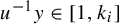 $u^{-1}y\in [1,k_i]$
, so by the relative quasi-convexity of K, we have that
$u^{-1}y\in [1,k_i]$
, so by the relative quasi-convexity of K, we have that $\mathrm {d}_{Z_n}(u^{-1}y, K)\le \mathrm {d}_{Z_K}(u^{-1}y, K)\le \eta $
. Hence,
$\mathrm {d}_{Z_n}(u^{-1}y, K)\le \mathrm {d}_{Z_K}(u^{-1}y, K)\le \eta $
. Hence,
 $$ \begin{align*}\mathrm{d}_{Z_n}(y, L_n)\le \mathrm{d}_{Z_n}(y, uK)=\mathrm{d}_{Z_n}(u^{-1}y, K)\le \eta.\end{align*} $$
If y lies on a subpath labeled by $w_n$
, then
$w_n$
, then $y=uv$
, where v is a vertex on
$y=uv$
, where v is a vertex on $[1, w_n]$
and u is an element of the form
$[1, w_n]$
and u is an element of the form $k_0 w_n^{-1} h_1 {w_n} k_1\cdots w_n^{-1} h_i$
. In this case,
$k_0 w_n^{-1} h_1 {w_n} k_1\cdots w_n^{-1} h_i$
. In this case, $yv^{-1}w_n=uw_n\in L_n$
and
$yv^{-1}w_n=uw_n\in L_n$
and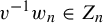 $v^{-1}w_n\in Z_n$
, by the definition of
$v^{-1}w_n\in Z_n$
, by the definition of $Z_n$
, so
$Z_n$
, so
 $$ \begin{align*} \mathrm{d}_{Z_n}(y, L_n)\leq \mathrm{d}_{Z_n}(y, yv^{-1}w_n)\le 1. \end{align*} $$
If y belongs to a subpath of q labeled by $w_n^{-1}$
, then
$w_n^{-1}$
, then $y=uv$
, where v is a vertex on
$y=uv$
, where v is a vertex on $[1, w_n^{-1}]$
and u is an element of the form
$[1, w_n^{-1}]$
and u is an element of the form $k_0 w_n^{-1} h_1 {w_n} k_1\cdots w_n^{-1} h_iw_nk_i$
. Then,
$k_0 w_n^{-1} h_1 {w_n} k_1\cdots w_n^{-1} h_iw_nk_i$
. Then, $u\in L_n$
and
$u\in L_n$
and $v\in Z_n$
, so
$v\in Z_n$
, so
 $$ \begin{align*} \mathrm{d}_{Z_n}(y, L_n)\leq \mathrm{d}_{Z_n}(y, u)=\mathrm{d}_{Z_n}(uv, u)\le 1. \end{align*} $$
The final possibility is that y belongs to a geodesic subpath r, of q, labeled by $h_j$
, for some
$h_j$
, for some $j=1,\ldots ,m$
, so that
$j=1,\ldots ,m$
, so that
 $$ \begin{align*} r=u([1,h_j]), \quad \text{where } u=k_0 w_n^{-1} h_1 {w_n} k_1\cdots k_{j-1}w_n^{-1}. \end{align*} $$
Then,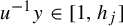 $u^{-1}y\in [1,h_j]$
, so
$u^{-1}y\in [1,h_j]$
, so $\mathrm {d}_{Z_n}(u^{-1}y, H)\le \mathrm {d}_{Z_H}(u^{-1}y, H)\le \eta $
, by the relative quasi-convexity of H. Note that
$\mathrm {d}_{Z_n}(u^{-1}y, H)\le \mathrm {d}_{Z_H}(u^{-1}y, H)\le \eta $
, by the relative quasi-convexity of H. Note that $w_n\in Z_n$
by construction, so for all
$w_n\in Z_n$
by construction, so for all $h\in H$
,
$h\in H$
, $\mathrm {d}_{Z_n}(h, hw_n)\le 1$
. Hence, we have
$\mathrm {d}_{Z_n}(h, hw_n)\le 1$
. Hence, we have
 $$ \begin{align*} \mathrm{d}_{Z_n}(y, L_n)\le \mathrm{d}_{Z_n}(y, uHw_n)=\mathrm{d}_{Z_n}(u^{-1}y, Hw_n)\le \eta+1. \end{align*} $$
Thus, we can conclude that $\mathrm {d}_{Z_n}(x, L_n)\le \varkappa _n+\eta +1$
, which implies that
$\mathrm {d}_{Z_n}(x, L_n)\le \varkappa _n+\eta +1$
, which implies that $L_n$
is relatively quasi-convex.
$L_n$
is relatively quasi-convex.
The proofs of parts (b) and (c) are identical to the proofs of the corresponding parts of Proposition 6.8.
Theorem 1.5 from §1 follows from the following statement, whose proof is identical to the proof of Theorem 6.9, with Proposition 6.8 replaced by Proposition 7.9.
Theorem 7.10. Let G be a non-elementary relatively hyperbolic group with $E(G)=\{1\}$
. Let
$E(G)=\{1\}$
. Let $\mu \in \operatorname {\mathrm {Prob}}(G)$
be a permissible probability measure on G with generating support. Then, the action of G on the closure of the space of infinite index relatively quasi-convex subgroups in
$\mu \in \operatorname {\mathrm {Prob}}(G)$
be a permissible probability measure on G with generating support. Then, the action of G on the closure of the space of infinite index relatively quasi-convex subgroups in $\mathrm {Sub}(G)$
is topologically
$\mathrm {Sub}(G)$
is topologically $\mu $
-mixing.
$\mu $
-mixing.
Corollary 1.5 from §1 follows from Theorem 7.10 and the following fact.
Lemma 7.11. Let G be a finitely generated group with infinitely many ends. Then, G is non-elementary relatively hyperbolic and every finitely generated subgroup of G is relatively quasi-convex.
Proof. By a famous result of Stallings [Reference StallingsSta], G decomposes either as a non-trivial amalgamated free product $A*_C B$
, where
$A*_C B$
, where $A,B \leqslant G$
and
$A,B \leqslant G$
and $C=A \cap B$
is finite, or as an HNN extension
$C=A \cap B$
is finite, or as an HNN extension $A*_{C^t=D}$
, where
$A*_{C^t=D}$
, where $A \leqslant G$
and
$A \leqslant G$
and $C, D$
are isomorphic finite subgroups of A. Let T be the Bass–Serre tree corresponding to this splitting of G. Then, G acts on T by isometries, without edge inversions, with finite edge stabilizers, and with finitely many orbits of vertices and edges.
$C, D$
are isomorphic finite subgroups of A. Let T be the Bass–Serre tree corresponding to this splitting of G. Then, G acts on T by isometries, without edge inversions, with finite edge stabilizers, and with finitely many orbits of vertices and edges.
Evidently, T is a fine hyperbolic graph. Therefore, G is hyperbolic relative to any collection of representatives of vertex stabilizers (e.g., $\{A,B\}$
in the case when
$\{A,B\}$
in the case when $G \cong A*_C B$
or
$G \cong A*_C B$
or $\{A\}$
in the case when
$\{A\}$
in the case when $G \cong A*_{C^t=B}$
) by Definition 7.1. Note that G is non-elementary, as it is not virtually cyclic and the vertex stabilizers are proper subgroups of G.
$G \cong A*_{C^t=B}$
) by Definition 7.1. Note that G is non-elementary, as it is not virtually cyclic and the vertex stabilizers are proper subgroups of G.
Let H be a finitely generated subgroup of G. Then, there is a convex subtree $T_1$
of T that is H-invariant and on which H acts cocompactly (see [Reference Dicks and DunwoodyDD, Proposition I.4.13]). It now follows from the work of Martínez-Pedroza and Wise [Reference Martínez-Pedroza and WiseMPW] that H is relatively quasi-convex in G.
$T_1$
of T that is H-invariant and on which H acts cocompactly (see [Reference Dicks and DunwoodyDD, Proposition I.4.13]). It now follows from the work of Martínez-Pedroza and Wise [Reference Martínez-Pedroza and WiseMPW] that H is relatively quasi-convex in G.
Acknowledgements
The work of the third author has been supported by the NSF grants DMS-1612473, DMS-1853989, and DMS-2405032.


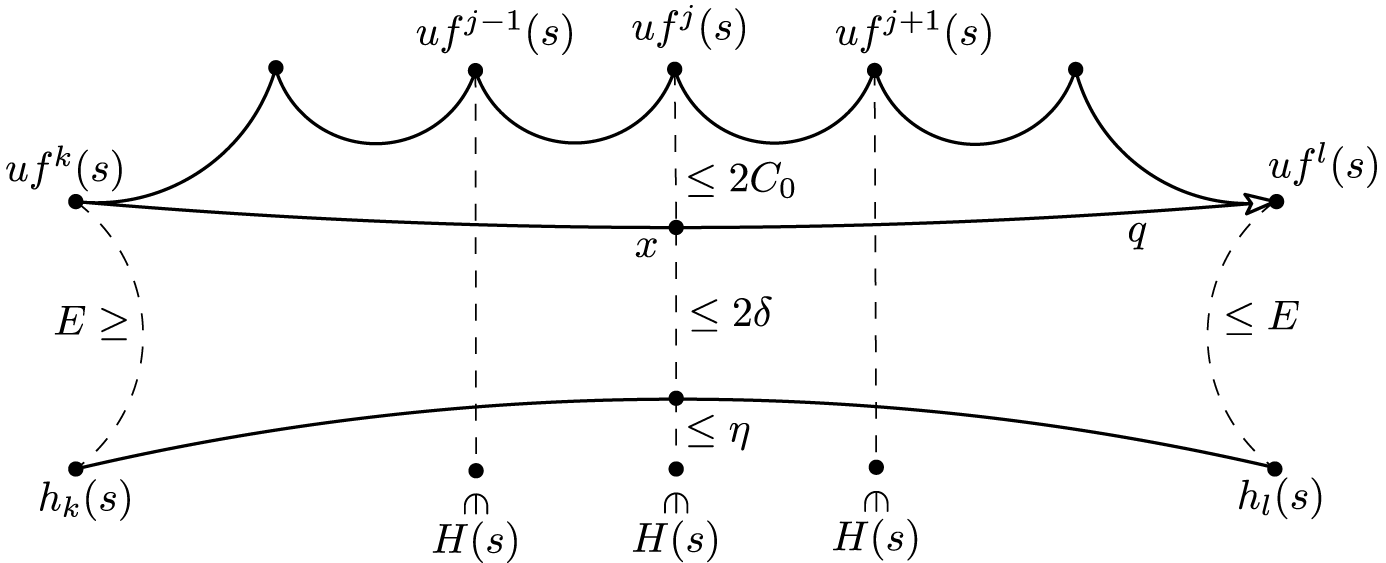

 Open access

