




In Karl Marx's famous chapter in Capital on the origins of capitalism and waged labor, he described a process of “primitive or original accumulation” in which peasants and artisans were dispossessed of land and tools and left with nothing “to sell except their own skins”. Violence was the ever-present enforcer: branding, whipping, mutilation, and execution accompanied the enclosure of land and commons. The process of dispossession in England, which first began in the sixteenth century, took over three centuries as families were systematically driven off the land to labor as “free” waged workers. In Marx's famous phrase, the process of expropriation was written, “in letters of blood and fire”. Marx took England as the classic example of primitive accumulation, but he noted that similar processes would occur successively in other countries.Footnote 1 “Letters of blood and fire” would come to serve as both metaphor and descriptor of an ongoing global transformation characterized by dispossession, expropriation, and violence in the transition to waged labor. Yet, Marx also theorized the lineaments of a new system – socialism – that posed a powerful alternative. In his vision, which captured the imagination of people around the world, workers would at last control and benefit from the wealth they produced in a system free from class exploitation and the boom–bust cycles of capitalism.
In October 1917, soviets of workers, soldiers, and peasants, supported by the Bolsheviks, took power with the aim of creating the world's first socialist society. After a painful Civil War, the new Soviet government sought to repair relations with the peasantry, rebuild the ruined infrastructure, and develop a modern industrial economy. Party leaders believed that a planned socialist transition to waged labor, large-scale agriculture, and industrialization would avoid the violence and dispossession of capitalism. Indeed, Evgeny Preobrazhensky, a leading party theorist and member of the left opposition, proposed a concept he termed primitive socialist accumulation as the first stage in building a socialist economy. Eschewing violence, the process would rely on pricing and planning to transfer surplus from both the free market and state sectors to invest in development.Footnote 2 In the 1930s, while millions of jobless workers in the West stood in breadlines, Soviet leaders eliminated unemployment. Launching the first of a series of five-year plans, they compressed processes that had taken centuries in the West into a mere decade. After World War II, they exported this model of planned development, with its emphasis on heavy industry and collectivized agriculture, to Eastern Europe, Latin America, China, Cuba, and Africa, inspiring a new generation of revolutionaries committed to independence from colonial domination.
In contrast to the triumphalist narrative of Soviet industrialization celebrated within and outside the Soviet Union, more troubling accounts began emerging from oppositionists in exile and emigration, and later, from historians and memoirists. These accounts, initially assembled painstakingly from smuggled documents, personal experience, and published sources, revealed a process that bore many of the same features as its capitalist counterpart.Footnote 3 Their descriptions of chaos, poverty, dispossession, and repression were corroborated after the opening of the Soviet archives in the 1990s. The bitter splits within the Communist Party in the 1920s between the left and right oppositions (in which Preobrazhensky played a leading role) centered on these issues of accumulation, coercion, and democracy. By the 1930s, “the great break or turning point” (velikii perelom) of rapid industrialization and forced collectivization had spawned in rapid succession peasant rebellion, a sharp drop in living standards, the purge of former oppositionists, and mass repression of alleged class and national enemies. The state assumed the main role of appropriating and distributing surplus and entered a long, protracted struggle with both peasants and workers over production and consumption, a struggle that Marx never envisioned under socialism. Although this surplus was never privatized, neither peasants nor workers fully acquiesced to the sacrifices the rapid tempo of development required.Footnote 4 Indeed, the “Great Terror” and the mass repressions of 1936–1939 can be understood as a direct consequence of a socialist variant of the process of primitive accumulation first named and theorized by Marx.
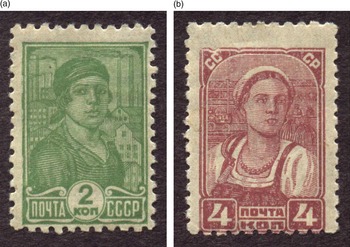
In contrast to the more widely known explanations of Stalinism – Bolshevik ideological authoritarianism or Stalin's drive for power – this article examines the relationship between repression and the state's need to accumulate capital. Linking political and economic events that are often considered separately – the splits within the Party, the grain crisis, collectivization, industrialization, passportization, women's entrance into the waged labor force, and repression – it argues that Marx's concept of primitive accumulation is central to understanding the rise of that most undemocratic form of socialism known as “Stalinism”. It focuses on the 1920s, when the Party was riven by debate over economic development, and the 1930s, when the triumphant Stalinist majority eliminated the mir and household production in the villages and launched a massive campaign for industrialization. By 1939, a new system had emerged based on the development of heavy industry, collectivized agriculture, waged labor, women's workforce participation, and state control of rural migration. The paroxysm of violence – dispossession of the “kulaks as a class”, purge of former oppositionists, and mass arrests of the “socially marginal” and other suspect groups – which accompanied the birth of this new system, was over. Although violence against various national, collaborationist, and other groups continued until Stalin's death, the basic system of production forged by the end of the 1930s remained until the collapse of the Soviet Union. Primitive socialist accumulation, first conceptualized by Preobrazhensky in the 1920s, sought an alternative to the brutal capitalist variant. Yet, the Stalinist variant imposed its own sacrifices on the three laboring groups – peasants, workers, and women – who served as the main sources of capital for state appropriation (Figure 1).
Postage stamps of a woman worker and woman peasant, issued as regular (non-commemorative) stamps, reflecting the importance the state attached to women's labor.
Courtesy of philatelist Nathaniel Rattner.

The Civil War Inheritance
With end of the Civil War, the victorious Soviet state inherited a ruined economy. Large areas, occupied successively by Red and White armies, were devastated by battles, pogroms, and campaigns of retribution. Money had become useless; there was nothing to buy. Starving workers stripped their factories of parts to exchange for food and returned to the villages. Proletarian revolution had triumphed, but the already small proletariat was decimated by flight, losses in battle, starvation, and typhus. The new Soviet government, resorting to grain requisitioning to feed the Red Army and the cities, faced growing peasant resistance. And its hopes that support would come from successful revolutions in Europe were fading fast.Footnote 5
In 1921, the Bolsheviks adopted the New Economic Policy (NEP) to address these problems. A combination of free market and socialist forms, NEP aimed to repair relations with the peasants and restore the economy. The state took control of large-scale industry or the “commanding heights”, but allowed small business to flourish. Peasants were permitted to sell on the free market whatever grain they retained after payment of taxes and mandated sales to the state. NEP proved greatly successful. The state received enough grain to provide low-cost food to the cities, and peasants assiduously increased sowing and marketing. By 1926, the country had restored industry to its prewar level and revived agricultural production in the countryside.
In 1919, Preobrazhensky and Nikolai Bukharin, who later came to represent the opposing positions of the left and right oppositions, collaborated on a book called The ABC of Communism, which laid out how the new socialist society would function. They noted that the future belonged to large-scale agriculture, but contrasted the violent dispossession and proletarianization of smallholders under capitalism with peasant cooperatives that would share land, machinery, and marketing under socialism. In their view, the benefits of scale and efficiency would attract peasants gradually and voluntarily to the new cooperative movement.Footnote 6 At the time, no party leaders considered forcing peasant households into an involuntary consolidation of holdings. This position, captured by the idea of a smychka, or cooperative alliance between workers and peasants, was endorsed by Lenin, Trotsky, Stalin, and, more broadly, within the Party as a whole.Footnote 7 It remained official state policy until 1929.
Problems of NEP
Despite NEP's economic success, it did not provide equal benefits to all social groups, and debates over its impact began almost immediately. Women's activists mounted a vigorous critique. With the shift to cost accounting, many enterprises and social services were forced to close, leaving large numbers of workers, and women in particular, unemployed. Workers were angered by fluctuations in food prices, persisting unemployment, and the slow pace of industrial expansion. One critic claimed that NEP could easily become the “New Exploitation of the Proletariat” by favoring officials, small businessmen, and kulaks (wealthier peasants) at the expense of workers.Footnote 8 Many party leaders, too, found NEP increasingly constraining. Grain collections varied from year to year, affecting the state's ability to provision the towns and to plan export and investment. Workers’ unrest in 1923 pushed the government to decrease the prices of consumer goods in the hope of encouraging peasants to bring more food to market. The state tried to manage the conflict between town and country by fiddling with the relative pricing of industrial (consumer) and agricultural goods, the two blades of what Trotsky deemed “the scissor's crisis”. Yet, no amount of price fiddling could solve the fundamental problem: the overall dearth of consumer goods due to antiquated machinery, high production costs, and the small industrial base. If supply was to increase, more capital investment was needed in industry. Yet, investment rested on increases in grain export, which was determined by peasant sowing and marketing, which, in turn, was subject to the availability of consumer goods. The economy appeared to be caught in a vicious circle.
Throughout the 1920s, successive oppositions within the Party articulated conflicting solutions to this dilemma. Beginning in 1923, the left opposition, led by Trotsky, proposed a program based on more comprehensive planning and faster development of heavy industry. It argued in favor of heavier taxation and increased appropriation from the market and state sectors respectively. Advocates acknowledged that a brief period of higher prices and restricted consumption would be necessary, but would soon be overcome by higher productivity of labor, increased mechanization, and reduced prices for consumer goods. Preobrazhensky coined the term “primitive socialist accumulation” or “non-equivalent exchange” to describe the accumulation of surplus for the state's accumulation fund. The policy of the left opposition was controversial among those party members who continued to support NEP. Yet, Preobrazhensky never viewed the socialist variant of primitive accumulation as synonymous with the violent process of capitalism described by Marx. Like other supporters of the left opposition, he considered democracy fundamental to all aspects of socialist development.Footnote 9
Throughout the 1920s, the majority of Party leaders, and later, the so-called right deviation led by Bukharin, advocated the continuation of NEP. They promoted the opposite approach: a slower tempo of development, investment in light rather than heavy industry, lower prices for consumer goods, and higher procurement prices for grain. Their aim was to encourage peasant households to increase sowing and marketing, which meant favoring wealthier households that produced a surplus over their own needs. Bukharin spoke of “riding into socialism on a peasant nag”.Footnote 10 The country would slowly build up its capital reserves, and only then switch to investment in heavy industry. Bukharin became the main theorist of NEP and Preobrazhensky, his leading opponent. The two men, who had collaborated so closely in 1919, now diverged in their thinking. After a period of fierce debate and organizational tumult, the Party vanquished the left opposition in 1927 and expelled Trotsky, Preobrazhensky, and thousands of their supporters from membership. It appeared that NEP's defenders had won the debate.
Crisis with Grain Procurement
No sooner was the left opposition eliminated than the Party faced a serious crisis. The harvest of 1927 was smaller than the previous year, and state collection agencies were able to buy only half as much grain. The more prosperous peasants, able to delay marketing, withheld grain to realize the higher prices of spring. The shortfalls in grain procurement resulted in urban riots and protests among workers. Preobrazhensky's earlier warnings about a “goods famine” linked to the country's limited productive capacity now appeared deeply prescient. Urban protests placed heavy pressure on party leaders to resolve the marketing impasse with the peasantry. Party leaders, vacillating between incentives and coercion, split over how to respond. They diverted more consumer goods to the rural areas to encourage the peasants to sell, but also began confiscating grain from wealthier peasants they accused of “hoarding”.Footnote 11
Two positions had emerged by spring 1928. Bukharin urged the Party to continue NEP and take every possible measure, including importing consumer goods, to placate the peasantry. Stalin and his supporters, now inclining toward the left, urged more rapid industrialization. Bukharin's group charged Stalin with following a “Trotskyist program”; Stalin's supporters branded the Bukharinists “right deviationists”. Preobrazhensky wrote to Trotsky, now in exile, to propose that left oppositionists who were expelled earlier now return to the Party to participate in Stalin's industrial policy.Footnote 12 Many oppositionists, heartened by the Party's turn, applied for readmission.
At the Central Committee Plenum in July 1928, Stalin articulated the same strategy Preobrazhensky had advocated earlier: to pay the peasants less for their grain and to have them “overpay in the relatively high prices for manufactured goods”. He explained,
You know that for hundreds of years Britain collected capital from all her colonies and from all parts of the world, and was able in this way to make additional investments in her industry. […] One respect in which our country differs from the capitalist countries is that it cannot and must not engage in colonial robbery, or the plundering of other countries in general. That way, therefore, is closed to us.
Instead, a “super tax” or “tribute” would be levied on the peasants for a short period to accelerate the “present rate of industrial development”. Stalin was honest about the social costs: “It is an unpalatable business there is no denying. But we should not be Bolsheviks if we slurred over it and closed our eyes to the fact that, unfortunately, our industry and our country cannot at present dispense with this additional tax on the peasantry.” To continue with NEP “would be to retard the industrialization of the country, including the industrialization of agriculture, to undermine our young industry, which is not yet firmly on its feet, and thus to strike at our entire national economy”. In time, the state would be able to lower prices for manufactured consumer goods and improve agricultural techniques. The cost of producing grain would decrease, and then, within a number of years, the state would “do away completely with this additional tax on the peasantry”.Footnote 13 If this was to be the policy, Stalin, like Preobrazhensky, expected to rely on pricing and taxation, not forced collectivization or violence.
The Reckless Rush to Collectivize
In fall 1928, the economic situation grew worse. Harvest collections fell again, and the price of food and grain on the free market shot up. Workers’ riots intensified, and peasants, spooked by earlier confiscations, reduced their sown area. In early 1929, V.M. Molotov and Stalin visited the Urals and Siberia to oversee grain collections, impose delivery quotas on kulak households, and arrest hoarders. These “extraordinary measures”, extended throughout the country, allowed the state to meet its procurement and export targets.Footnote 14 That summer, an emboldened Party mobilized 25,000 workers to go into the villages to organize collective farms. The hasty decision, made under pressure of urban strikes and rural disturbances, produced a cascade of unanticipated consequences. Neither Party leaders nor worker activists were prepared for the intensity of resistance. Rumors swept the countryside. Angry, frightened peasants slaughtered rather than collectivize their livestock, and village priests warned that the Apocalypse was at hand.Footnote 15
In an effort to suppress the rebellions, the Party made a second precipitous decision at the end of 1929 to “liquidate kulaks as a class”, arrest incendiary priests, and establish extra judicial sentencing. About 1.7 million people were exiled, including a significant percentage who were not kulaks but victims of overzealous activists. “Kulak” became a term of general opprobrium, applied not only to prosperous peasants but to anyone who resisted collectivization or opposed Soviet power. Entire families were deported and dumped in “special settlements” in forests and wastelands to perish from starvation, illness, and cold.Footnote 16 Thousands escaped, and like the dispossessed who took to the roads in England in the eighteenth century, these itinerant, embittered, and hunted people crisscrossed the country, “masking” or concealing their former kulak identities in a search of work and housing.Footnote 17
The initial consequences of collectivization were profound. In 1932–1933, the country experienced a terrible famine resulting from drought, overzealous requisitioning, and the failures of collectivization. Although the state attempted to mitigate the disaster by its lowering procurement targets in 1932 from 23.5 to 19.6 million tons and sending food to the most affected regions, both urban and rural death rates increased sharply, with estimates of 5.7 million deaths.Footnote 18 The impact of the famine was everywhere. The Petrovskii iron and steel plant in Ukraine was flooded with starving peasants, desperate for work. By day, they waited near the factory for unskilled work, and at night, they broke into the factory to sleep on floors and tables. Homeless, hungry, and poorly clad, the plant's doctor noted that they gradually “became exhausted and fell into the hospital” where many died. Workers, local officials, and rank and file party members also suffered from malnutrition.Footnote 19
If the Party had expected collectivization to produce high agricultural yields for greater export and domestic consumption, it resulted instead in an unprecedented crisis. Over time, the collective farms mechanized and raised yields. The state procured grain and other commercial crops at low state-mandated prices. Peasant families split the labor of their members between work on the farm and their private plots. Peasants sold produce from their private plots on the free market, and these earnings became an indispensable supplement to the inadequate payments they received for collective farm work. The household, however, was eliminated as the predominant unit of production in agriculture.
Controlling Labor
In tandem with collectivization, the Party launched a mass industrialization drive. After heated debate over production tempos and investment targets to be set by the first Five-Year Plan (1929–1932), planners adopted the maximum variant favoring heavy industry. As critics warned, the unrealistic goals created wild imbalances, bottlenecks, and shortages. Massive construction projects demanded workers, but housing could not keep pace. Living conditions in the cities and new industrial towns were horrific.Footnote 20 The Petrovskii plant, for example, employed 28,500 workers, forty per cent of whom had worked there for less than a year. In one nearby settlement of 30,000 people, the outdoor toilets were broken and boarded up. People relieved themselves outside on the ground, creating vast “Egyptian pyramids” of waste. The dormitories had no kitchens, and the canteens where most workers ate were vastly overburdened. One canteen, equipped to serve 150 people, routinely served 4,000. Meals were hours late, and lines of up to 300 people stretched out the door. Factory canteens everywhere were short of cutlery, plates, and cooking utensils. Tools, building materials, spare parts, and basic consumer items were impossible to procure.Footnote 21
Between 1929 and 1932, about 10.8 million people entered the waged labor force. The number of workers almost doubled from 11.9 million in 1929 to 22.6 million in 1933.Footnote 22 Huge waves of peasant migrants entered and left the cities in search of jobs and housing. In 1932, in an attempt to control the flood of migrants and stabilize the labor force, the state established mandatory internal passports for all urban inhabitants. Every person, sixteen years and older, residing in a town or engaged in waged labor had to register for a passport, which was then required in order to take a job and receive housing. Anyone who moved to a new location had to register their passport with the militia, and if found without a passport was liable to criminal prosecution. Peasants did not receive passports, and they could not move to a town without one. The law fixed the rural population in place and enabled the state to track and control movement.Footnote 23 The parallels with capitalist primitive accumulation were striking. In Russia, Peter the Great introduced internal passports in 1724 to stop peasant flight from his vast building projects. Passports were widely established throughout Europe by the late nineteenth century, and employed by the police to track revolutionaries. Despised by socialists everywhere, they were promptly abolished by the Bolsheviks in 1918. Their reintroduction in 1932 was a reversal of all previous revolutionary programs.
The Soviet state quickly found the passport system a useful means of control and discipline. It slowed the influx of peasants to the cities, reduced labor turnover, and helped purge the towns of dispossessed kulaks, private traders, people deprived of voting rights, criminals, and vagabonds. Factory directors were encouraged to comb their personnel records to ensure that outcast groups were not “masquerading” as workers.Footnote 24 For those who successfully concealed their blighted social origins, a passport became a ticket to a new life. Yet, it also ensured their silence. Any worker who participated in a protest immediately ran the risk of a background check.Footnote 25 After passportization, the entrance of peasant migrants into the overcrowded, overstrained towns slowed. Women became the primary source of new labor during the second Five-Year Plan.Footnote 26
Women, Workers, and the State: The Struggle over Accumulation
State and party leaders anticipated that collectivization would raise output and allow greater control of grain marketing. They expected the increase in food production to raise the standard of living, make more grain available for export, and swell the funds for investment in industry. Collectivization proved these expectations wrong. The peasant slaughter of livestock in 1929–1930 and the resulting loss of draft animals and fertilizer reduced the size of subsequent harvests as well as meat and dairy deliveries to the cities. Urban food supplies plummeted, and despite the adoption of rationing, spiraling prices created a sharp drop in living standards. Real wages decreased about fifty percent among industrial workers during the first Five-Year Plan, fell steadily until 1934, and attained only sixty-six percent of their 1928 level in 1937. According to one historian, living standards could not have dropped any further without causing “a complete disintegration of economic life”.Footnote 27 Workers rather than peasants financed the largest share of industrialization, about two thirds of the cost according to economist Mark Harrison.Footnote 28
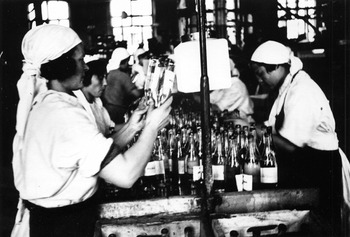
Women played a significant role in this burden assumed by workers. The unplanned fall in real wages pushed urban women into the labor force, another unintended consequence of the state's poorly planned rush toward forced collectivization. A single wage earner could no longer support a family, and the addition of women's wages allowed the family to preserve a basic standard of living. Between 1929 and 1935, women constituted a significant and unprecedented source of waged labor: thirty-seven percent of all newly hired waged workers and fifty percent of those entering industry.Footnote 29 Women's entrance into the labor force helped to offset losses in the standard of living and defuse workers’ protests, both significant benefits for the state. The employment of women already living in the towns also afforded the state considerable savings on the construction of new housing and municipal services. Most important, inflation and the fall in real wages allowed the state to employ two workers for the price of one. If a man's wages once covered the costs of rearing a family, beginning in 1929, most families required at least two wage earners to maintain themselves. The state realized the output of two workers for the price of one, plowing “profit” or surplus back into industrialization (Figure 2). Planners did not intentionally create inflation, but from the state's perspective, a better strategy could scarcely have been designed to cushion the fall in real wages, attract women into the work force, and squeeze desperately needed capital from the labor of the working class.
Women Workers in Likernovodochnyi (Spirits and Vodka) Factory, 1937. Women played a critical role in the industrialization drive of the 1930s.
Courtesy of Rossiiskii Gosudarstvennyi Arkhiv Kinofotodokumentov (RGAKFD).

Marx argued that under socialism, workers would appropriate and manage what they produced. The essential contradiction (and injustice) of capitalism – between socialized production and private appropriation – would be resolved. Under Soviet socialism, however, the state needed capital for an industrial transformation that was yet to occur. What the workers would control was still to be built. One Moscow textile worker angrily described the dilemma: “They are building socialism backwards. First they steal from the workers. But we cannot work without eating.”Footnote 30 As Stalin had frankly noted in 1928, in the absence of foreign loans and colonies, industrial investment required the main producing sectors of society to provide surplus to the state. And while this surplus was not appropriated by a class of private owners, nor were planning, investment, and distribution democratically controlled. Indeed, had living standards been subject to a national referendum in the early 1930s, it was doubtful the high level of extraction would have been endorsed. Although many workers proudly defended the sacrifices rapid industrialization demanded, others disagreed. The majority of peasants opposed policies that pumped grain out of the countryside for little foreseeable return. Through the 1930s and the subsequent postwar years, the state wrangled with workers over wages, hours, state loans, speed up, safety, and norms, and with peasants over remuneration, private plots, requisitions, and taxes. In short, the state remained at odds with both social groups over how much surplus it would appropriate from their labor.Footnote 31
During the first Five-Year Plan, the difficulties of workers were especially acute. In one textile factory in Ivanovo province, a woman worker burst into tears in front of her foreman, explaining that she had stood in line for bread for three days and received nothing. “I live in a dormitory,” she explained, “[a]nd my children run out into the corridor when someone walks by, and they snatch the bread from their hands. I am ashamed, but I can do nothing. They are starving”.Footnote 32 Nor was hunger confined to textile workers. In 1932, Mikhail Panin, a Red Army veteran and miner, complained that miners’ families were beginning to swell from malnutrition. “We have reached a point now,” he wrote, “where workers, out of starvation, are eating the old, discarded horses from the mines”. The horses, too, were dropping from hunger, the haulage lines were disrupted, and the miners were hauling coal by hand. He asked, “Is it really possible that we workers have striven for this: to eke out such an existence and to pilfer the fallen and discarded horses from the stables, who die of hunger and are themselves nothing more than deliberately uncollected forage?”Footnote 33
Many new workers from the countryside had bitter feelings about collectivization and famine. They retained close ties with their native villages, returned regularly, and observed the poverty of their relatives on the new collective farms. The news they brought back from the villages contradicted the glowing accounts of agricultural success in the newspapers. In the dormitory of Factory No. 45, about forty workers became involved in a heated discussion about collectivization. A worker lying on his bed sarcastically asked a young, recent migrant, “Tell me Vania, did you have to leave the countryside because of famine or because of your prosperous life?” “Of course, because of famine”, Vania replied. “And tell me please,” the worker continued, “Where is the grain of the muzhik?” “Taken away by the state”, Vania said. “And where are the cattle, the cows, and the horses?” “They took the cows”, Vania answered simply. “The horses died of hunger because there was nothing to feed them.” A cleaning woman, overhearing the conversation, countered that Soviet power had freed her family from poverty. The worker sneered, “Only to you they gave a life.”Footnote 34 The Party, monitoring these “unhealthy moods” in the factories, was aware of the faltering support of its base.
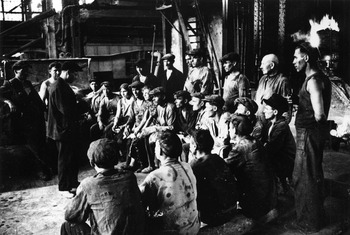
As the unions were purged of “rightists” and reoriented toward production, workers lost the collective bargaining power they wielded earlier. Throughout 1932 and 1933, they turned to short wildcat strikes to protest new increases in production norms, cuts in rations or wages, disruption of food deliveries, and wage arrears. Many workers strongly supported socialism, but felt they were being asked to sacrifice too much. Their daily needs fundamentally conflicted with the rapid tempo of accumulation, investment in heavy industry, and high production targets, the very cornerstones of party policy.Footnote 35 Their economic difficulties influenced the views of local party activists, who were torn between defending the Party's policies and redressing the plight of their fellow workers (Figure 3). One party member in a textile factory noted at a meeting, “[t]he Party is split now, it is not listening to the voice of the people. They only feed the officials. We have endured enough”.Footnote 36 Party disaffection, however, found little organized expression. In 1932, M. N. Riutin, a former “rightist”, organized a small group around a 194-page manifesto known as the “Riutin Platform” that circulated through various cities. The “Riutin group”, appalled by the brutality of collectivization and hunger in the cities, was soon isolated, expelled, and arrested. The Trotskyists still had some support among workers, yet they hesitated to capitalize on the bitter “anti-Soviet” even anti-socialist sentiments of the new peasant migrants.Footnote 37 By 1934, no active, organized opposition to Stalin's policies from either left or right remained. Although former oppositionists continued to meet informally to discuss politics, public debate ceased. Party and state organizations were filled with discontented critics, harping on Stalin's mistakes.Footnote 38 Some critics held leading posts, others worked in the factories; some had rejoined the Party, others had refused. These comrades shared long revolutionary histories and deep reservations about Stalin's policies, and they formed a distinct presence in many institutions and work places.
Meeting of workers in Serp i Molot (Hammer and Sickle) factory's open hearth furnace, 1936.
Courtesy of Rossiiskii Gosudarstvennyi Arkhiv Kinofotodokumentov (RGAKFD).

Terror and Mass Repression
Against this broad background of social upheaval, instability, and political discontent, only a small trigger was needed to ignite the fears of party leaders. On 1 December 1934, L.V. Nikolaev, a disturbed former party member, assassinated S.M. Kirov, the head of the Leningrad party organization. Within twenty-four hours, the state passed emergency measures abrogating civil rights and establishing extrajudicial trials for those suspected of “terrorism”. Nikolaev and a small group of associates were tried immediately and shot. By 1938, an initial targeted campaign against “terrorism” had broadened into a full scale “terror”. The investigation of Nikolaev widened to encompass former leftists and rightists; those with associational or familial ties to those arrested; party and military leaders; industrial managers; and cultural figures. In the summer of 1937, the Party launched the “mass and national operations”, secret orders for the arrest of former kulaks, priests, criminals, as well as various Soviet nationalities suspected of spying for hostile countries on the borders. Many arrests were accompanied by interrogations and confessions, which, in turn, led to more arrests. Associational ties within families and work places created many new victims.Footnote 39 The repression reached its zenith in 1937–1938, when the NKVD arrested 1,605,259 people, of whom 1,372,382 were charged with counterrevolutionary offenses. Out of the total number arrested, 1,344,923 were convicted, and about 683,000 executed.Footnote 40 The “Great Terror”, as it later came to be known in the West, cut a wide swathe through Soviet society.
Most historians have focused on the Terror as a political phenomenon disconnected from the social crisis of industrialization.Footnote 41 Yet, with fascism ascendant, Stalin and his supporters responded so strongly to the Kirov murder precisely because they feared the collusion of former oppositionists with those groups most discontented by industrialization and collectivization. In the absence of this pervading fear, the Kirov murder would in all likelihood have resulted in a brief period of national mourning, a limited investigation, and the conviction of Nikolaev. Instead, investigations widened to include ever more groups as party leaders grew increasingly certain that the murder was part of a much larger, hidden conspiracy of former oppositionists and “masked enemies”. By 1936, the leadership linked the former oppositionists to the fascist threat, adopting the narrative that supporters of Trotsky and G.E. Zinoviev had formed a “united center” aimed at assassination, sabotage, and the seizure of power in event of war.Footnote 42 Investigations led to arrests in the Comintern, and many German communists, who had earlier escaped Hitler and settled in the Soviet Union, were accused of terrorism and spying on behalf of the Gestapo.Footnote 43 In 1936, in the first Moscow show trial, the state charged a group of well-known leaders of the October revolution, including Zinoviev and L.B. Kamenev, with Kirov's murder, the attempted murders of Stalin and other Party leaders, foreign espionage, fascist contacts, and terrorist conspiracies.Footnote 44 Throughout the trial, both A. Ia. Vyshinskii, the prosecutor, and the defendants referred repeatedly to the social discontent created by the first Five-Year Plan, hidden oppositionists, and the foreign threat.Footnote 45 The confessions, stripped of their falsified activities, contained hard truths: the Party had barely survived the economic crisis of the early 1930s, peasants and workers were embittered by collectivization and the drop in living standards, and many former oppositionists retained strong misgivings about Stalin and his policies. The defendants were shot the day after the trial ended. The Party officially admitted in 1991 that the confessions, extracted under torture and duress, were false.Footnote 46
The trial, however, did not put an end to the hunt for enemies. Several months later, after a deadly explosion in a coalmine in Kemerovo, the NKVD arrested a group of engineers, managers, and former Trotskyists. The group was tried and found guilty of industrial wrecking and the attempted assassination of Soviet leaders. NKVD investigations shifted to industry. The widely publicized Kemerovo trial served as a dress rehearsal for a second Moscow show trial in January 1937, which accused prominent party leaders of wrecking in the Kemerovo mines, the chemical industry, and on the railroads. Both trials encouraged the public, and workers in particular, to couch complaints about work conditions, housing, and food shortages in the new language of “wrecking”.Footnote 47 The shocking and highly publicized confessions of the defendants in the Kemerovo and the Moscow show trials, coupled with the growing threat of war, convinced many Soviet citizens that their country was besieged by foreign and domestic enemies.Footnote 48 The Terror spread as allegations of wrecking convulsed every industrial and agricultural enterprise, offering a handy excuse for any breakdown, shortage, or accident.Footnote 49
The popularization of “enemy hunting” accelerated further with new policies adopted by the Central Committee Plenum on 22 February–7 March 1937, which paired repression with a striking new emphasis on “democracy”.Footnote 50 Party leaders introduced a mass campaign for secret ballot, multi-candidate elections in the unions, the soviets, and the Party itself, and encouraged rank and file party members and workers to criticize their leaders.Footnote 51 This improbable pairing of terror and democracy was a conscious strategy from above. By inviting “little people” to purge officialdom, central party leaders hoped to expose former oppositionists who were protected by higher officials, to shift blame for social and economic problems from central party leaders to mid-level officials and managers, and to gain support from below. Democracy and terror, far from being contradictory, went hand in hand.Footnote 52
A new, recently adopted Soviet Constitution extended voting rights to all citizens, including former nobles, white guards, kulaks, priests, and other groups previously excluded from the political process (lishentsy.) Urban votes would no longer be weighted more heavily than rural; all would be counted equally. Elections were to be genuine contests between individual candidates rather than rote endorsement of lists, and voting was to occur by secret rather than open ballot.Footnote 53 Regional party leaders at the Plenum offered a grim view of the country in the wake of collectivization and industrialization. They doubted the support of new workers, former kulaks, white-collar employees, exiles, small craftsmen, collective farmers, workers in smaller factories, and the urban and rural poor. Despite the Party's pride at the Plenum in its agricultural and industrial successes, the anxieties produced by the upheaval of Stalinist socialist primitive accumulation was evident in the speeches of central and regional leaders. R. I. Eikhe, head of the Siberian and Western Siberian regional committees and the Novosibirsk city committee, referred to the “unkempt desolate villages and similar areas in the towns” inhabited by embittered peasants, impoverished “former people”, criminals, prostitutes, bezprizorniki (homeless children), and other desperate castoffs of industrialization, who “would slander and provoke during the elections”.Footnote 54 These qualms proved too dangerous to test. Secret ballot, multi-candidate elections were held for union and party posts, but not for the soviets. When citizens went to the polls in December 1937, their only choice was to endorse a list of candidates chosen by the Party.Footnote 55
The most far-reaching and horrific consequence of the democracy campaign, however, was not the retreat from an expanded franchise and multi-candidate, secret ballot elections. After the Plenum, regional leaders successfully lobbied the Politburo to initiate limited arrests of those very groups they considered a threat to Soviet security. The subsequent orders – the mass and national operations – were patterned on the mass arrests in the villages during collectivization and in the cities after the passport decree. Once again, regional NKVD departments were instructed to make large-scale arrests of targeted groups, which were then subject to extrajudicial sentencing. In contrast to earlier sweeps, however, quotas were set for every region, and the sentences included not only arrest and exile, but also execution. In July 1937, the Politburo issued “Order 00447”, which set target numbers for arrests of recidivist criminals, village clergy, religious activists, former kulaks, those deprived of voting rights, and other “hostile elements”. This was followed by other orders targeting foreign nationals and ethnic Soviet citizens from Poland, Germany, Romania, Finland, Latvia, and other countries suspected of spying, and wives of men convicted of counterrevolutionary crimes. Many of the victims of the national operations were party members and left-wing refugees from fascist regimes.Footnote 56 By 1938, the targets of repression had come to include not only former oppositionists who once proposed alternatives to Stalin's violent policies, but also the social groups dispossessed and embittered by these policies. Indeed, terror and mass repression can be viewed as a vast pre-emptive sweep, launched by a frightened leadership in the face of war, to eliminate the political and social opposition created by a profoundly destabilizing process of violent socialist primitive accumulation. The huge paroxysm of violence finally ended in 1939 as Hitler was marching east. The country had built an industrial economy in record speed at immense social cost. The Nazis would put it to the test.
Conclusion
By the end of the 1930s, the former oppositionists, who had engaged the dilemma of accumulation, had been eliminated in a purge that targeted both leftists and rightists. The Party found its solution instead in a violent, chaotic, and hastily conceived process that demanded great sacrifice from workers, peasants, and women. It also built a modern industrialized economy that defeated the fascist invasion and the greatest military force ever concentrated in a single theater of war. The features that characterized the process that Preobrazhensky first termed primitive socialist accumulation – peasant rebellion, political disaffection, fall in living standards, state control of itineracy, and mass repression – bore an uncomfortable similarity to its capitalist counterpart. Indeed, the tumultuous events of the two decades after the October Revolution can be fruitfully understood as a socialist variant of the process first described by Marx in his study of capitalism. In the Soviet case, the transition was preceded by economic and theoretical debates over Soviet development among revolutionaries who were deeply influenced by Marx's work. Yet, when these great debates began, neither Preobrazhensky, Bukharin, Trotsky, nor any other participants could have imagined that primitive socialist accumulation would assume such a violent form, that it would prove fatal to socialist democracy, or that they, and millions of others, would become its victims. Whatever their differences, the oppositionists met the same fate, encapsulated in Bukharin's final tragic words: “Know, comrades, that on that banner, which you will be carrying in the victorious march to communism, is also my drop of blood.”Footnote 57

 Open access

