




1. Introduction
1.1 Objectives
This paper investigates a selection of seven Finnish verbs of ability (VoAs). They can be seen as belonging to the category of the so-called semilexical or semimodal verbs in that they serve as both (modal) auxiliaries and (lexical) main verbs (see e.g. Dixon Reference Dixon2010, Depraetere & Langford Reference Depraetere and Langford2020). In this paper, we highlight their shared semantic capacity of encoding the modal meaning of dynamic possibility, namely ability (see e.g. Palmer Reference Palmer2001) and conveying additionally a specific lexical layer that determines in terms of what the subject referent is able to do something. We suggest that due to this twofold semantic structure, rather than being halfway between two categories (modal and lexical), these verbs can help us to deepen our insight into the embodied roots of the meaning construction of ability.
The paper aims to provide a grammatical description of each verb and explore their mutual interfaces. Their modal meaning is analysed in terms of conceptual force dynamics (Talmy Reference Talmy2000). To account for the internal organisation of the modal field of ability and the dynamics of the Finnish VoAs within it, we metaphorically employ the term ecology. We also speak of the niche of each verb when describing the processes of semantic–functional specialisation and cohabitation in the realm of ability (for a previous use of the terms ecology and niche within a cognitive linguistic framework, see Taylor Reference Taylor, Radden and Panther2004). The study is strongly corpus-driven. This allows us to track the most frequent patterns for each verb on several different levels (grammatical, lexical semantic, force-dynamic) and observe how these map onto each other. The data include standard and colloquial (mostly dialectal) language use, extracted from both written and oral language datasets.
The selected verbs can all enter a transitive construction with a so-called A-infinitive complement. The A-infinitive can be considered as the basic form of the Finnish verb. The selected seven verbs are presented in Table 1 (examples 1a–g).Footnote 1 We illustrate their semantics and use with the utterance presented in (1), meaning ‘Liisa cannot eat in Helsinki restaurants’. Each of the studied ability verbs can occupy the position of the modal marker (‘can’). Because of the negative auxiliary ei, they take the connegative form, as seen in column A (VoA.cng). The infinitive form for each verb is presented in column B, associated with a code in subscript that links the infinitive to its meaning, shown in a simplified form in column C.Footnote 2 All the verbs encode ability, but they account for the event described in (1) differently. To make manifest the lexical semantic contribution of each verb to the propositional content in (1) an additional explanation is added in column D.
The studied VoAs
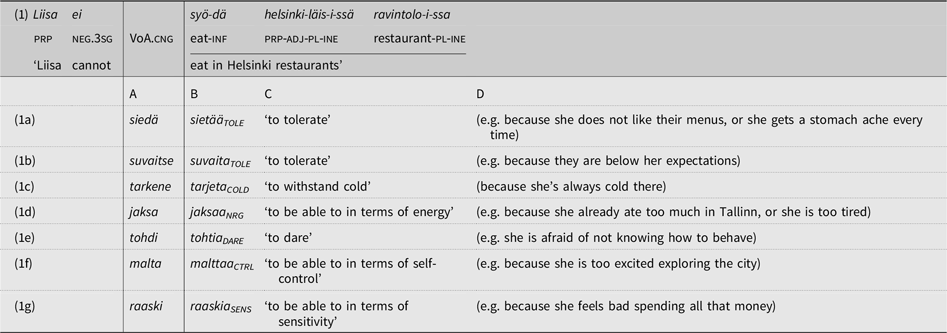
These fabricated examples offer a first glimpse of the differences in use and in the lexical meaning displayed by the selected verbs. The first three verbs, sietää TOLE, suvaita TOLE and tarjeta COLD, express different types of tolerance. Tarjeta COLD encodes specifically tolerance to a cold temperature. The meaning of jaksaa NRG has to do with energy and effort. The remaining three verbs, tohtia DARE, malttaa CTRL and raaskia SENS, highlight the emotional roots of ability in different ways.
Other types of complements are possible, e.g. an NP complement in (1h), along with intransitive uses (1i). These patterns appear to be verb-specific. Example (1j) illustrates that tarjeta COLD does not take an NP complement.
(1)
h.
Liisa
ei
siedä
helsinki-läis-i-ä
ravintolo-i-ta.
prp
neg.3sg
sietää.cng
prp-adj-pl-part
restaurant-pl-part
‘Liisa does not tolerate Helsinki restaurants.’
i.
Liisa
ei
tarkene
ulkona.
prp
neg.3sg
tarjeta.cng
outside
‘Liisa does not withstand cold outside.’
> ‘Liisa cannot be outside because she is too cold.’
j.
*Liisa
ei
tarkene
helsinki-läis-i-ä
ravintolo-i-ta.
prp
neg.3sg
tarjeta.cng
prp-adj-pl-part
restaurant-pl-part
‘Liisa does not tolerate Helsinki restaurants because she is cold there.’
The most extensive study focusing specifically on VoAs in Finnish, to our knowledge, is Flint (Reference Flint1980). Flint identifies 45 ‘verbs of possibility and sufficiency’ that display similarities in their meaning construction. For example, they exhibit negative affinity (see Kiuru Reference Kiuru1977). According to Flint (Reference Flint1980:59–60), the verbs form an open-ended semantic system which is internally organised around twelve different gradually overlapping dimensions. One of these is ability. Yet, in Flint’s model, none of the verbs studied here belongs to this dimension. In this paper, we apply a broad definition of ability. We consider that in addition to the prototypical ability verbs (e.g. voida, pystyä, kyetä ‘can, to be able to’), the selected VoAs, too, encode the possibility for the subject to (not to) do something because of participant-internal or -external circumstances. This causative semantics can be accounted for within the theoretical framework of force dynamics (Talmy Reference Talmy2000). It is a model for describing embodied interactions between competing conceptual forces. Each VoA adds to the force-dynamic pattern a specific lexical component specifying the nature of the resisting force. Three types of force-dynamic interaction are distinguished: physical, mental, and interpersonal.
The paper proceeds as follows. We first present the theoretical and conceptual foundations of the study (Section 1.2). After this (Section 1.3), we provide an overview of the (very few) previous studies concerning the Finnish VoAs, mainly Flint (Reference Flint1980) and Kiuru (Reference Kiuru1977) (see also Cai Reference Cai2025), account for the selection of the studied set of verbs, describe their syntactical properties (complementation, zero person) and negative affinity, and briefly place the Finnish system in the context of the VoAs in other languages. The following two sections present our research questions and hypotheses (Section 1.4.), as well as the data and methods of analysis (Section 1.5). We then move on to exposing the results. We start by comparing the studied VoAs on three grammatical points, including complementation, negation, and person marking (Section 2.1). Based on this corpus analysis, we then zoom into the particular uses of each verb, detecting the specific types of conceptual forces that are mapped onto the underlying force-dynamic pattern (Section 2.2). After this, we highlight the specific niche each verb occupies within the ecology of Finnish verbs and the modal realm of ability (Section 2.3). The outcome of the study is then discussed in view of its implications to the Finnish system of VoAs and, more generally, to the meaning of ability (Section 3), before the conclusion of the paper (Section 4).
1.2 Theoretical and conceptual framework
As expressions of dynamic modality, the studied VoAs can be paraphrased by ‘it is possible for X to p’, as opposed to epistemic modals conveying the meaning ‘it is possible that p’ (compare examples 2 and 3) (e.g. Perkins Reference Perkins1983, Palmer Reference Palmer2001, Collins Reference Collins2009).
(2)
Jaksa-n
nosta-a
tuo-n
kive-n.
jaksaa-1sg
lift-inf
dem-gen
rock-gen
‘I can (i.e. I have the strength to) lift that rock’
> ‘It is possible for me to lift that rock.’
(3)
Tuo
kivi
saatta-a
pudo-ta.
dem
rock
may-3sg
fall-inf
‘That rock may fall.’
> ‘It is possible that the rock falls.’
Ability has been defined as ‘the physical, intellectual, and perceptual capacity to do something’ (see Leclercq & Depraetere Reference Leclercq and Depraetere2022). The meaning of ability implies a potential obstacle, the effect of which on p is cancelled. The utterance presented in (2) entails that what could prevent the subject referent from lifting the rock (e.g. insufficient muscular strength with regard to the rock’s weight) is neutralised. Due to their causative semantics, VoAs thus specify that the reason why p is not cancelled is because the subject referent has sufficient resources at their disposal to overcome the challenge (Flint Reference Flint1980:60–62; see also Nadathur Reference Nadathur2016, Johansson & Nordrum Reference Johansson and Nordrum2018).
It should be noted that ability entails not only the capacity to act (see the verb to do in the above definition) but also the capacity of resisting a change (‘not doing’) (see Figure 1(b)) and, when expressed with a nominal object complement or an intransitive construction, the capacity of overcoming unspecified effects that the interlocutor is expected to identify. For example, ‘(not) tolerating Helsinki restaurants’ entails that the subject referent is (not) able to overcome the unnamed negative effects of Helsinki restaurants. On the other hand, Malta! ‘malttaaCTRL.imp.2sg’ > ‘Hold on!’ calls for the subject referent to resist some implied opposing force that is liable to make them act (see also examples 1h and 1i). Including in the analysis different types of constructions expressing ability allows us to contribute to research endeavouring to link the force-dynamic framework to the analysis of structurally diverse constructions (Hilpert Reference Hilpert2025).
Sensitivity, self-control, daring, tolerance, and regulating one’s energy encoded by the studied VoAs involve embodied properties characteristic of living beings (cf. ‘intellectual and perceptual capacity’ in the above definition of ability). The prototypical subject referent of these verbs is thus expected to be animate (see also Kiuru Reference Kiuru1977, Gregersen Reference Gregersen, Jensen and Schack2024:103). In this paper, VoAs are approached as expressions of different types of embodied interactions between the subject referent and their environment. We analyse the causative meaning construction of VoAs within the framework of Talmy’s (Reference Talmy1988, Reference Talmy2000) theory of force dynamics. It is a model for describing interactions between competing conceptual forces that stem from our perception of the interplay between physical forces in our environment. This framework makes it possible to link the conceptual core of modal meaning structure with the embodied experience of living beings within their environment (Hilpert Reference Hilpert2025:2). The experience of ability emerges from these interactions.
In the basic schemas, the central force called Agonist is challenged by an opposing Antagonist force. When the Agonist shows tendency to action, the Antagonist tends towards rest, and the other way around. Figure 1 exposes the modal meaning of ability represented by two force-dynamic schemas underlying the meaning structures in utterances I can lift that rock (Figure 1(a)) and The satellite is able to stay in an orbit around Earth (Figure 1(b)). The Agonist is represented by a circle; the Antagonist is indicated by a concave figure. The arrowhead marks an intrinsic force tendency to action (including movement or change of state), whereas the black dot represents tendency to rest (non-movement or lack of change of state). A plus is placed on the stronger entity, and the line below the Agonist shows the resultant.
(a) I can lift that rock. (b) The satellite is able to stay in an orbit around Earth.
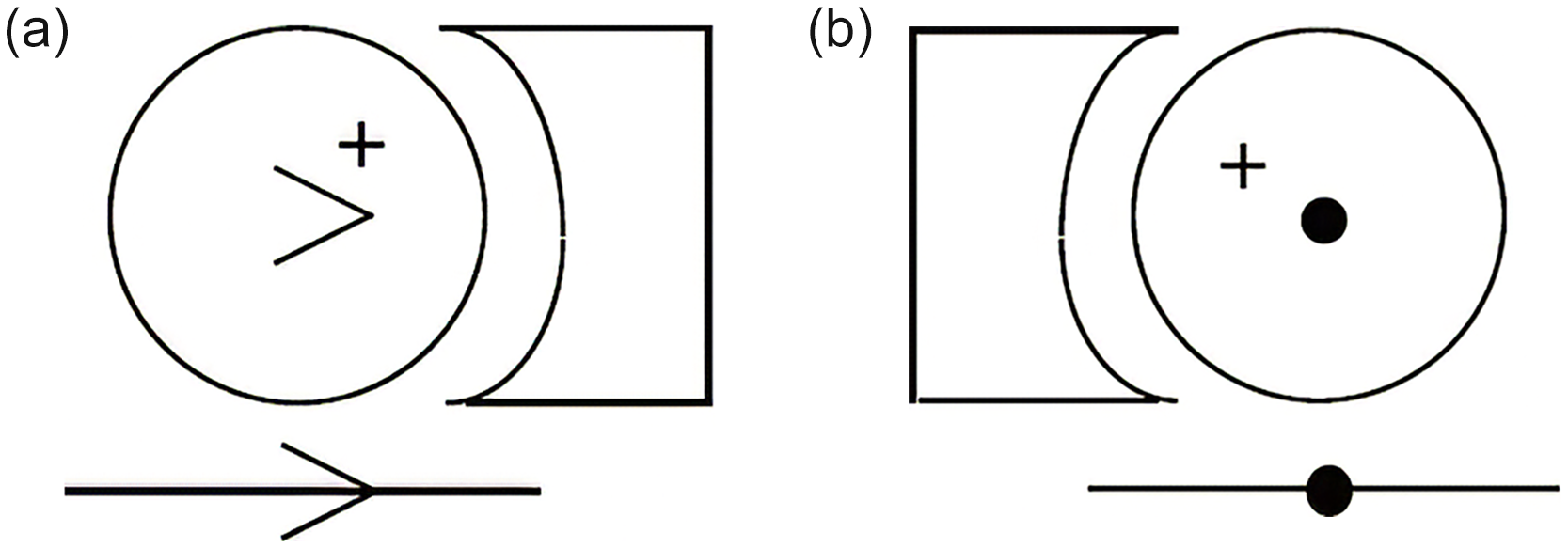
Figure 1 Long description
Figure 1(a) - The icon features a circle with a greater than symbol (>) and a plus sign (+) inside. The greater than symbol typically indicates a comparison or a positive condition, while the plus sign often signifies addition or a positive attribute. This combination suggests a positive or greater than condition, often used in contexts related to comparisons, evaluations, or positive outcomes. Figure 1(b) - The icon features a circle with a plus sign (+) and a dot (•) inside. The dot indicates an intrinsic force tendency to rest, while the plus sign signifies the stronger entity in a force-dynamic relationship. The icon also features a concave form. It symbolizes the opposing force that resists the tendency to rest. Below the circle and the concave form, there is a horizontal line with a dot in the middle. This signifies that the tendency to rest overcomes.
In Figure 1(a), the Agonist force tends towards action, the Antagonist resists, but the Agonist overcomes, and the resultant is action. The subject referent’s physical forces are sufficient with regard to the weight of the rock. The inverse configuration is also possible. In Figure 1(b), the Agonist tends towards rest, while the Antagonist is inclined towards action. The Agonist overcomes, and the resultant is rest. Earth’s gravity is not strong enough to move the satellite from its orbit. The aspectual semantics of the complement (lift vs. stay) encodes the tendency towards action or rest of the subject referent.
In the negative form, the force relationship is reversed. For utterances presented in Figure 1, this entails that the Antagonist force overcomes and the resultant is contrary to the Agonist’s intrinsic tendency. The altered configurations are shown in Figure 2.
(a) I cannot lift that rock. (b) The satellite is not able to stay in an orbit around Earth.
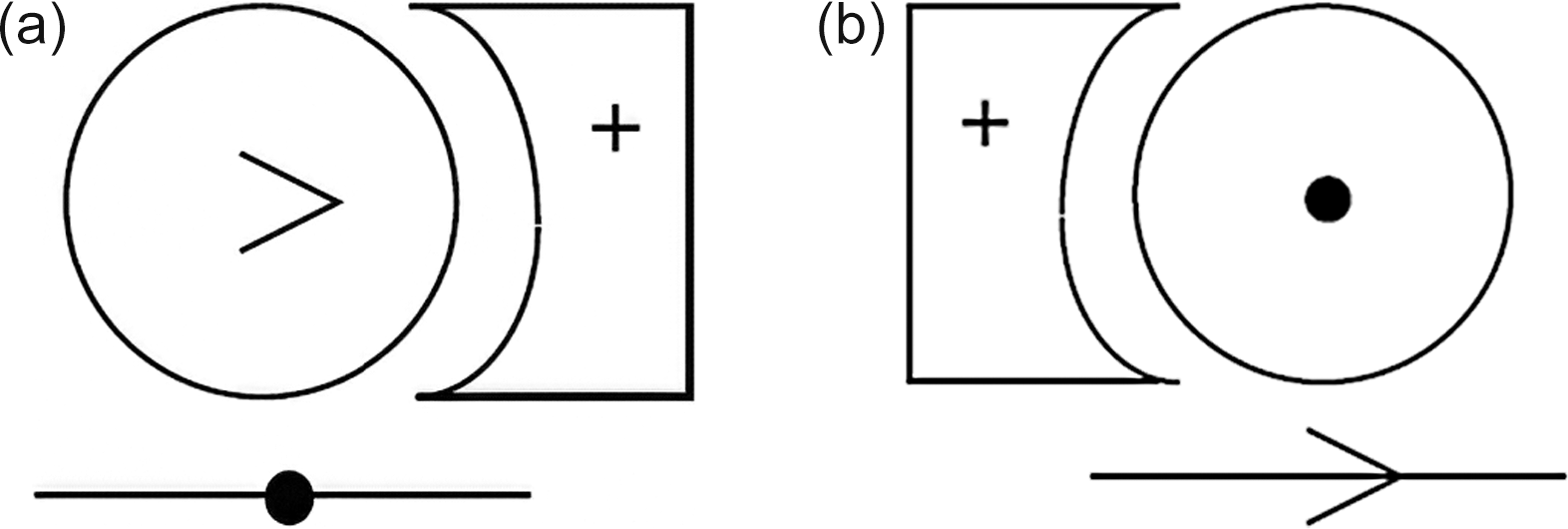
Figure 2 Long description
Figure 2(a) - The icon features a circle with a greater-than symbol (>) inside. The greater-than symbol indicates an intrinsic force tendency to action. The icon also features a concave form with a plus sign (+) inside. The plus sign signifies the stronger entity in a force-dynamic relationship. Below the circle and the concave form, there is a horizontal line with a dot in the middle. This signifies that the tendency to rest overcomes. Figure 2(b) - The icon features a circle with a dot (•) inside. The dot indicates an intrinsic force tendency to rest. The icon also features a concave form with a plus sign (+) inside. The plus sign signifies the stronger entity in a force-dynamic relationship. Below the circle and the concave form, there is a horizontal line with a greater-than symbol in the middle. This signifies that the tendency to action overcomes.
Following Talmy’s model, the original schema describing interaction between an entity and an external force can offer a ground for describing forces of different conceptual levels, also those internal to the focal entity (Talmy Reference Talmy2000:413–414). In this vein, each VoA adds a specific lexical component to the force-dynamic pattern specifying the nature of the competing forces and thus the type of the interaction: physical, mental, or interpersonal. The two last mentioned force interactions correspond to what Talmy (Reference Talmy2000) identifies as psychosocial dynamics. They generalise physical notions to mental and interpersonal domains by metaphoric extension (see also Gibbs Reference Gibbs2005:160–161). Physical force dynamics concerns the subject referent’s bodily abilities to act or to resist, with regard to spatio-temporal circumstances. Mental forces are internal to the subject referent: intentions, preferences, emotions. These patterns represent an internalised dialogue between the subject’s desires (the Agonist force with an inherent tendency to either change of state or rest) and social values (the Antagonist force blocking or spurring the Agonist) (Talmy Reference Talmy2000:431–433). Interpersonal force dynamics occurs in situations of interaction between the subject referent and other animate participants. An analogy is thus created between physical force relationships and interactional pressures resulting from social norms and disalignment in expectations and intentions (Talmy Reference Talmy2000:438–440).
By observing the interaction between forces of a different nature, we aim to gain an in-depth understanding of the embodied roots of the meaning construction of ability as well as the distinctive features of this modal domain. Johnson (Reference Johnson, Newen, Bruin and Gallagher2018:626–627) describes meaning as emerging from the interaction between an embodied organism and its environment, depending on the specific bodily properties of the living being and the patterns for perception and action provided by the particular situation (in Gibson’s [Reference Gibson1979] terms, affordances). Linguistic meaning is rooted in ‘this much deeper and broader embodied process of meaning-making’ (Johnson Reference Johnson, Newen, Bruin and Gallagher2018:626). Lexically rich expressions of ability, such as the Finnish VoAs, convey a subtle description of the interplay between the bodily properties of a living entity and the situational affordances. By looking at the grammatical and lexical profiles of these verbs, we aim to cast light on the different layers in the meaning construction of ability.
To capture the internal dynamics of ability and the ways in which the Finnish VoAs cover it, we use the metaphor of ecology. In doing so, we aim to describe a specific semantic meaning structure (here, ability) as an ever-moving assemblage constituted by entities (here, different types of abilities) that shape each other and that are shaped by the assemblage and by what is external to it (on the origins of the theory of assemblages, see Deleuze & Guattari Reference Deleuze and Guattari1980), rather than as a category with a predetermined, fixed structure. The multilayered modal domain is metaphorically represented as a landscape on which the linguistic items (here, the Finnish VoAs) cohabit. The aim is to account for the plurality of conceptualised subject–environment interactions constituting the meaning of ability and motivating the relatively high number of ability verbs in Finnish. Approached from another angle, with a focus on the semantic interrelations between the verbs, the assemblage drafted here could certainly be mapped onto an underlying network of force-dynamic scenarios (see Hilpert Reference Hilpert2025; on the usage-based network models of language, see Diessel Reference Diessel2019). We borrow the terms ecology and niche from Taylor (Reference Taylor, Radden and Panther2004), although the focus here is on the semantic layers constituting the modal realm of ability and the location of a set of linguistic items within these, instead of constructional relations.
1.3 Finnish VoAs: State of the art
The lexical meaning of each VoA emerges from the speaker’s perception and experience of the environment and entities within it, but also from the gap between what the speaker thinks the reality is and what it actually turns out to be:
Quite frequently, their function is to allow for the fact that our performance or the reality around us may fall short of our expectation. With these verbs, we calibrate the reserves available to us against the requirement or challenges before us. (Flint Reference Flint1980:62)
Flint (Reference Flint1980:59–60) enlists 45 verbs of this type in Finnish, forming a system with 12 dimensions, as shown in Table 2.Footnote 3 We have marked the verbs selected for our study in bold letters.
The system of verbs of possibility and sufficiency according to Flint (Reference Flint1980)
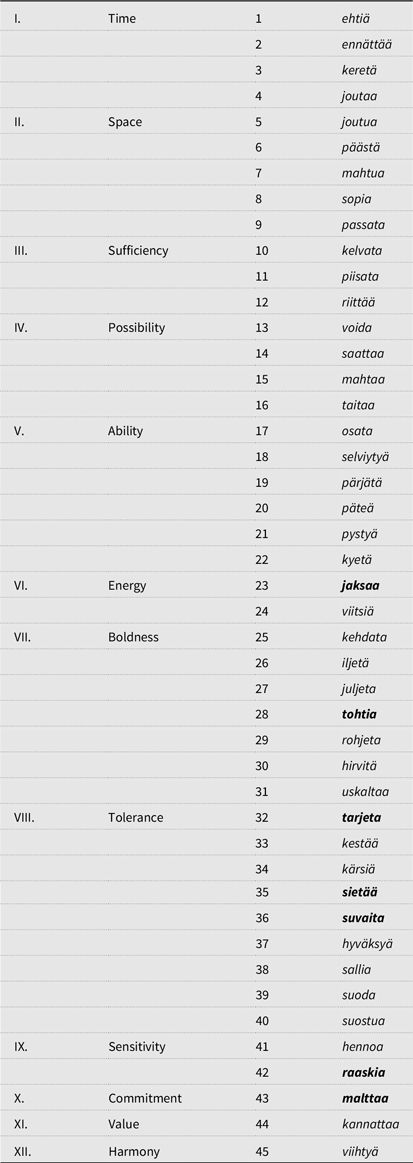
In this system, each dimension is internally structured in relationships of adjacency. Sometimes adjacent verbs accumulate into clusters and display varying values with regard to the core attribute of the dimension. For example, within the tolerance dimension, hyväksyä ‘to approve’ and suvaita ‘to tolerate’ display a higher degree of ‘tolerance’ than kestää, kärsiä, and sietää ‘to withstand, to tolerate’. This is liable to stem from the much less specific lexical meaning of these latter three verbs. The different dimensions, in their turn, are related to each other through transitions of varying sharpness: from overlapping (e.g. viitsiä (no. 24 in Table 2) and kehdata (no. 25) which both encode the ability to do something in terms of social norms or personal investment, cf. ‘to dare’, ‘to bother’) to only tangential adjacency (e.g. uskaltaa (no. 31) ‘to dare’ vs. tarjeta (no. 32) ‘to be able to [despite the cold]’).
The dimensions form a conceptually heterogeneous series. The first attributes (I, II) relate to spatio-temporal circumstances, whereas the last ones (IX–XII) stem from the subject referent’s appreciation. In between them, the dimensions III–V are identified with attributes that could be used for describing all the verbs. Indeed, the entire category of 45 verbs is called verbs of possibility and sufficiency in Flint’s study. In our paper, we also consider all these verbs as carrying the modal meaning of ability. One could say that the groups III–V foreground sufficiency, possibility, and ability, respectively, whereas the other verbs combine these with other physical, mental, or intersubjective attributes. The subsequent dimensions VI and VII arise from the subject referent’s strength of different orders. Finally, the meaning of the verbs gathered within the dimension VIII is founded on the presence of an entity exerting some kind of harmful or otherwise unwanted influence on the subject referent (see Godet Reference Godet2023).
In this study, we have selected verbs that are located in the latter half of the series, in other words not highlighting the spatio-temporal circumstances nor the all-encompassing attributes of sufficiency, possibility, and ability. In doing so, we aim to gain insight into VoAs with the most specific lexical meanings involving particular physical conditions (e.g. strength, in jaksaa NRG, no. 23 in Table 2), emotions (e.g. fear, in tohtia DARE, no. 28), or environmental settings (e.g. cold, in tarjeta COLD, no. 32). By choosing to study sietää TOLE (no. 35) and suvaita TOLE (no. 36), we can observe the interface between adjacent verbs within a dimension. Looking into the meaning structure and the uses of raaskia SENS (no. 42) and malttaa CTRL (no. 43) allows us to investigate a zone that in Flint’s model marks a transition from one dimension to another.
When used with an A-infinitive complement and the past tense, these verbs are implicative, in that they convey an entailment concerning an implied proposition, namely whether or not the event described in the complement took place (Karttunen Reference Karttunen1971, Salminen Reference Salminen2024). This entailment can be inferred from the lexical semantics of the infinitive complement and the modifiers of the finite VoA (TAM, negation, temporal and locative adverbials, causal subordinate clauses) (Karttunen Reference Karttunen1971). For example, the sentence presented in (1k) (modified from example 1) entails that ‘Liisa ate in Helsinki restaurants’. This makes implicative verbs different from non-implicative verbs (1l) and non-factive verbs (1m). The sentences (1l, 1m) do not generate this entailment: it could be that in the end Liisa never ate in Helsinki restaurants, although she had decided or wished to do so. When the finite VoA takes a past tense, as in (1k), the implied proposition is understood as taking place in the past as well (on the role of the past tense in the implicative reading, see Salminen Reference Salminen2024:575–576). When the VoA is in the present tense, it conveys minimal grounding for the process described by the infinitive form, which in itself lacks personal and temporal marking (1n). The implied event is therefore conceptualised as an entailed theoretical possibility (Leech Reference Leech2004:115–118, Visapää Reference Visapää2022). Whether it took place or not remains less determined than in the case of past-time reference (Salminen Reference Salminen2024). When the VoA is under the scope of the negative auxiliary (see 1e in Table 1, ‘Liisa does not dare to eat in Helsinki restaurants’), the underlying proposition is negated too: ‘Liisa does not eat in Helsinki restaurants’. This distinguishes implicative verbs from complement-taking factive verbs. The sentence in (1o) does not imply ‘Liisa did not eat in Helsinki restaurants’.
(1)
k.
Liisa
tohti
syödä
helsinki-läis-i-ssä
ravintolo-i-ssa.
prp
tohtia.prt.3sg
eat.inf
prp-adj-pl-ine
restaurant-pl-ine
‘Liisa dared to eat in Helsinki restaurants.’
l.
Liisa
päätt-i
syödä
helsinki-läis-i-ssä
ravintolo-i-ssa.
prp
decide-prt.3sg
eat.inf
prp-adj-pl-ine
restaurant-pl-ine
‘Liisa decided to eat in Helsinki restaurants.’
m.
Liisa
uneksi,
että
hän
sö-i
prp
dream.prt.3sg
comp
3sg
eat-prt.3sg
helsinki-läis-i-ssä
ravintolo-i-ssa.
prp-adj-pl-ine
restaurant-pl-ine
‘Liisa dreamt that she ate in Helsinki restaurants.’
n.
Liisa
tohti-i
syödä
helsinki-läis-i-ssä
ravintolo-i-ssa.
prp
tohtia.prs-3sg
eat.inf
prp-adj-pl-ine
restaurant-pl-ine
‘Liisa dares to eat in Helsinki restaurants.’
o.
Liisa
ei
muista,
että
hän
sö-i
prp
neg.3sg
remember.cng
comp
3sg
eat-prt.3sg
helsinki-läis-i-ssä
ravintolo-i-ssa.
prp-adj-pl-ine
restaurant-pl-ine
‘Liisa does not remember that she ate in Helsinki restaurants.’
Given the variation in the complement constructions of the Finnish VoAs, namely the possibility of NP object complements and intransitive uses, which are not analysable in terms of implicativeness (Salminen Reference Salminen2024:585), and what we know of the complexity of the so-called implicative signatures of verbs expressing ability, courage, and effort (see Karttunen Reference Karttunen2012), a closer analysis of this dimension in the selected VoAs goes beyond the scope of the present paper and would deserve a separate treatment.
The studied VoAs belong to those Finnish verbs that have been observed to favour negative contexts (Kiuru Reference Kiuru1977:41–59). In previous studies, this affinity for negation has been accounted for on pragmatic grounds. Kiuru (Reference Kiuru1977:52) notes that verbs of negative affinity are used when explaining and presenting excuses for things not done. Flint (Reference Flint1980:ch. 5) examines a range of types of social situations where these verbs are used in negative answers to invitations and requests, for hedging and explaining politely. Cai (Reference Cai2025) investigates the uses of päästä ‘to be able to go, to access’ (no. 6 in Table 2) with an infinitive complement in spoken everyday conversations showing that the meaning of obstacle is present in the different interactional tasks of the verb. Our study focuses on the embodied semantic roots of the VoA discourse functions, including the motivation behind a possible negative affinity.
Furthermore, according to Flint (Reference Flint1980:16), VoAs are liable to take a zero subject. In these cases, the VoA is in the third-person singular form, but the subject position is left empty. This is a syntactic construction known to be favoured by modal verbs and other types of experience-based verbs (Laitinen Reference Laitinen1995, Reference Laitinen, Helasvuo and Campbell2006). Zero person conveys a non-specific person reference allowing the speaker to present the experience as something that can be shared by anyone in a similar position (ibid.), as in (4) and (5).
(4)
Suome-ssa
ø
joutu-u
sauna-an.
Finland-ine
zero
have.to-3sg
sauna-ill
‘In Finland, one has to go to the sauna.’
(Laitinen 2006: 209)
(5)
Täällä=hän
ø
jääty-y.
here=clt
zero
freeze-3sg
‘One freezes here.’
(Hakulinen et al. Reference Hakulinen, Vilkuna, Korhonen, Koivisto, Heinonen and Alho2004:§1350)
Karttunen (Reference Karttunen1971:341) mentions malttaa CTRL, joutua ‘to have to (go to somewhere)’ and suvaita TOLE as a part of a language-specific inventory of implicative verbs in Finnish. The existence of a range of verbs of possibility and sufficiency with rather specific lexical semantics appears to be a feature that Finnish shares with Scandinavian languages, at least to a certain extent (Johansson & Nordrum Reference Johansson and Nordrum2018:158). Verbs expressing the sufficiency of time (‘to have time to do sth.’, Flint’s dimension II) have been studied in Swedish (hinna) and Norwegian (rekke) (Johansson & Nordrum Reference Johansson and Nordrum2016, Reference Johansson, Nordrum, Čermakova, Egan, Hasselgard and Rorvik2021). Gregersen (Reference Gregersen, Jensen and Schack2024) analyses uses of the Danish verb gide that are related to the sufficiency of energy and thus come close to some of those displayed by the Finnish jaksaa NRG. The Swedish orka is part of this group as well (Johansson & Nordrum Reference Johansson and Nordrum2018).
In non-standard Finnish, many of the selected VoAs present phonological and semantic variation.Footnote 4 This is also the case for their equivalents in other Finno-Ugric languages. The tolerance reading of sietää TOLE is widely present in Finnish dialects. Comparable forms are found in the closely related Balto-Finnic languages Ingrian and Karelian. The verb possibly stems from the Germanic lexical base *stē- (cf. e.g. the Scandinavian stå) (SES 2024). Sietää TOLE can also be used for expressing necessity, e.g. si-tä sietä-ä toista-a ‘dem-part sietää-3sg repeat-inf’ > ‘it ought to be repeated’. In our study, we have included these uses in the tolerance category, considering the necessity reading as secondary (< ‘it bears to be repeated’). In addition to tolerance, suvaita TOLE and its equivalents are used for describing different types of preference in Finnish dialects and in many Finno-Ugric languages (‘to like, to love’). The form is considered to be of ancient Indo-European origin (*suH-é), as with the permissive verb suoda ‘to allow’ (SES 2024). As for tarjeta COLD, apart from describing the experience of temperature, it is also reported to express coping with other types of difficulties (related to another person, e.g. at work, in a fight), as well as daring (SES 2024). The Karelian tareta also covers a variety of meanings: ‘to not be cold’, ‘to dare’, ‘to have the heart to do sth.’ (KKS 2024). Variation is observed in the equivalent forms in Estonian and also in the Sami languages (SES 2024). The etymology of the verb is uncertain. One possible origin is shared with the adjective tarkka which in standard Finnish means ‘precise’ but in dialects also ‘sensitive, tender’ (ibid. s.v. tarkka). Jaksaa NRG is widely present in non-standard Finnish, with a rich array of ability readings (SMS 2024). In a reduced number of dialects, it is used as a communication verb describing fervent, tireless speaking (ibid.). Meanings of the type ‘to take off, to rob’ are also reported in certain regions, as well as in other Finno-Ugric languages. No etymology is provided. Tohtia DARE displays less semantic variation. The meaning of daring or being brave appears to be present even in its assumed Indo-European origin (*dhers-) (SES 2024). Malttaa CTRL conveys the meaning ‘to notice, to understand’ in Finnish dialects. This is, of course, related to the meaning of ‘ability to control one’s attention’, presented in example (1f) in Table 1, or that of ‘commitment’, as termed by Flint (Reference Flint1980). An equivalent of malttaa CTRL is reportedly found in certain Russian dialects due to their contact with Karelian, Ludic, and Veps languages (SES 2024). Inversely, raaskia SENS is of Slavic origin. It is related to the Russian verb račít´ ‘to want to, to be ready to do sth.’ (ibid.). Raaskia SENS presents less semantic variation than malttaa CTRL, although the meaning ‘to dare’ is found in Karelian, alongside with the usual ‘to have the heart to do sth.’.
From a historical and cross-linguistic perspective, the semantic background of the selected VoAs is thus rich in overlaps and vagueness. The present study does not aim to track the evolutionary paths of these verbs. It observes the meaning and the use of the VoAs in a heterogeneous dataset, highlighting the functional niche occupied by each VoA unit. A niche is made available by the rest of the units. ‘Each unit has pointers to other units and can therefore be “filed” under a number of different “addresses”’ (Taylor Reference Taylor, Radden and Panther2004:10). These mutual relationships shape the ecology of language units.
By investigating the somewhat heterogeneous constellation of VoAs in Finnish, we can furthermore enquire into the properties of ability as a conceptual unit. The fact that the Finnish lexicon manifests such subtle distinctions between types of abilities and how they stem from different interactions between sentient beings and what surrounds them sheds new light on the internal structure of what has been considered as a semantic category in the linguistic literature on modality (e.g. van der Auwera & Plungian Reference van der Auwera and Plungian1998, Palmer Reference Palmer2001). The Finnish VoAs raise the question of how we should deal with these elements in view of modal classification. We particularly draw attention to the traditional position of this type of items as halfway in the middle of two categories (semi-lexical or semi-modal) (Dixon Reference Dixon2010, Depraetere & Langford Reference Depraetere and Langford2020) and suggest a model allowing them to enter the modal system as fully fledged members.
1.4 Research questions and hypotheses
The paper addresses the following questions.
-
1. All VoAs have been described as taking an A-infinitive complement and displaying negative affinity (Kiuru Reference Kiuru1977, Flint Reference Flint1980). As expressions of experience, they form a favourable environment for zero subject (see Laitinen Reference Laitinen1995, Reference Laitinen, Helasvuo and Campbell2006). Do the selected VoAs occur in similar patterns, when it comes to complementation, negation, and person marking, or are there deviating tendencies?
-
2. The meaning of ability can be visualised with two different schematic models, in terms of force dynamics, underlying the ability to do something, on the one hand, and the ability to resist a change, on the other (Talmy Reference Talmy2000). The forces can be of physical, mental, or interpersonal type. Do the selected VoAs display preferences with regard to one of the force-dynamic schemas and force types? Do the results of the grammatical analysis (see Question 1) map onto these preferences?
-
3. The chain-like linear representation of the category of VoAs (see Flint Reference Flint1980) has the advantage of exposing in clear terms the particularities in lexical meaning proper to different dimensions of ‘possibility’ and ‘sufficiency’. However, the internal structure of these dimensions and the interfaces between them are rather heterogeneous. Furthermore, the linear form may not allow some of the semantic links between verbs to surface. All of this suggests a more dynamic and complex constellation. Is it possible to describe the coalescence among VoAs through the metaphor of ecology, rather than a linear form? What kind of implications does this have on the semantic category of ability?
Based on the literature presented above, we can draw up the following hypotheses.
-
1. The selected VoAs do not occur in similar patterns, when it comes to complementation, negation, and person marking. Although the VoAs have all been reported to occur in transitive constructions with an A-infinitive complement and showing a special affinity for negative contexts and zero subject, we can expect them to favour different grammatical patterns due to their different lexical components. They encode different kinds of interactions between an entity and its surroundings. This is liable to be reflected, for example, in verb-specific preferences in complementation.
-
2. The selected VoAs display different preferences with regard to the force-dynamic schemas and force types, because they conceptualise different kinds of interactions between the subject referent and their environment.
-
3. The metaphor of ecology allows us to highlight the coalescence among VoAs in multiple ways without the limitations of a chain-like configuration. It also helps us to understand the connections between linguistic forms and the embodied experiences and interactions within which they emerge. Furthermore, this alters the overall view on the semantic realm of ability, which now appears as a complex multilayered assemblage based on the conceptualisation of these multiple subject–environment interactions.
1.5 Data and methods
The data sources are presented in Table 3. The written language dataset includes literary texts from the late nineteenth century to the 1950s (LITER), as well as news texts from the turn of the millennium (PRESS). Spoken language data are extracted from dialect interviews conducted from the 1950s to the 1980s (DIAL) and from a smaller contemporary conversational dataset (CONV). By choosing such a large array of data, including non-standard language use and covering a relatively long time span, we aim to gain visibility over the variation and overlaps in the uses of these semantically complex verbs. Modal constructions are known to have undergone recategorisation during the construction of the present-day standard Finnish, in the second half of the nineteenth century, creating a gap between colloquial language use and the norm (see e.g. Laitinen Reference Laitinen, Cheshire and Stein1997).
Data sources
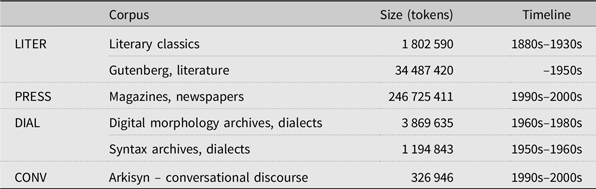
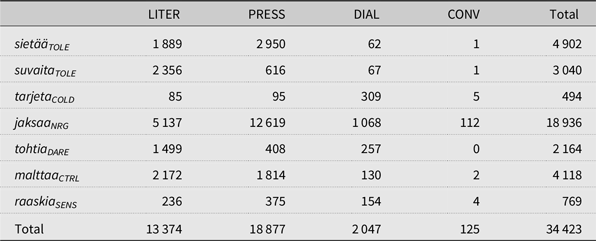
Table 4 shows the total number of occurrences of the selected verbs, per corpus type. We can observe that jaksaa NRG is by far the most frequent of the selected VoAs, covering more than a half of all the occurrences, whereas tarjeta COLD and raaskia SENS display the lowest frequency. The verbs are distributed unevenly when it comes to corpus types. Jaksaa NRG and sietää TOLE are particularly well represented in the news text corpora, whereas suvaita TOLE is mostly used in literary texts. The uses of tarjeta COLD mainly come from the dialect data. Explaining this variation is beyond the scope of this paper, but we can assume that it results from several intersecting factors, e.g. the situations typically described in each type of oral and written texts, language register, the status of the language users.
The total number of occurrences of the selected VoAs
This overall dataset is dominated by written language use, which is reflected in the total number of occurrences per corpus type. For this reason, and for the needs of the manual annotation, we have reduced the amount of written data for some of the verbs. Table 5 presents the data that we used for the analysis for each lexeme.
The number of VoA occurrences selected for the analysis
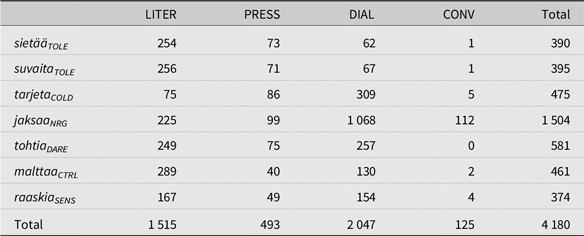
The aim of this operation was, first, to respect a balance between written and spoken data. In the reduced dataset, 2008 occurrences were extracted from written data, 2172 occurrences from spoken data. Second, this limitation was necessary in view of the in-depth grammatical analysis, which was partly conducted manually. The omitted occurrences were selected using a random search in the written dataset. We expect that the results obtained from this reduced dataset are representative of tendencies present in the larger corpus.
The two authors performed manual annotation with double verification in the selected dataset. All occurrences were entered into an Excel spreadsheet. For each collected occurrence, the authors recorded the following variables.
-
• Syntactic construction: transitive/intransitive, the type of complement in transitive constructions.
-
• Negation, identified through the negative auxiliary, a connegative form of the main verb, negative polarity items (e.g. pronouns, particles), and syntactic cues (e.g. partitive case in certain complements).
-
• Modality: mood, modal verbs, modal particles and adverbs, interrogative, directive, and exclamative constructions.
-
• Person marking, including the zero person and the passive.
-
• The type of conceptual force: physical, mental, intersubjective, identified through the lexical semantics of the A-infinitive complement, the degree of animacy of the NP complement, and the meaning of other grammatical and lexical items in the immediate context.
2. Results
2.1. The grammar of VoAs
In this section, we analyse the grammatical properties of the selected verbs VoAs: the variation in complementation patterns, the most frequent lexical verbs in A-infinitive constructions, the distribution of negative and affirmative utterances, as well as person marking.
As shown in examples (1a–g) in Table 1, all studied VoAs can take an A-infinitive complement. However, this is not the only syntactic pattern found. The analysis showed that for some of the verbs the auxiliary use is not the most frequent one. Table 6 presents the distribution of the types of constructions where the selected VoAs are introduced in the dataset, in terms of transitivity and the nature of the object complement. The category intrans covers mainly intransitive uses. However, some of the constructions included in this group could potentially be elliptical; the difference is sometimes difficult to determine. Obvious elliptical constructions are included in the N/A category, with different types of unclear cases. The category Others covers constructions with a relatively low frequency: non-finite verb complements other than A-infinitive (the so-called MA-infinitive and VA-participle), as well as finite propositional complements. The dominant patterns for each verb are indicated in bold type.
Complementation patterns of the studied VoAs (n/%) (p < .001)

The three tolerance verbs are distinct from the rest in that the A-infinitive complement construction is not the dominant pattern for them. Sietää TOLE and suvaita TOLE are both mostly used with an NP complement encoding the object of tolerance (examples 6, 7).
(6)
Hän tiesi hyvin, että
‘She knew very well that’
Edvard
joskus
ei
voi-nut Footnote 5
hän-tä
sietä-ä.
prp
sometimes
neg.3sg
can-ptcp.pst
3sg-part
sietää-inf
‘She knew very well that Edvard sometimes could not stand her.’
(LITER, Järnefelt, 1905)
(7)
[mies on] semmonen yksineläjä
‘[The man is] such a solitary person’
ett-ei
se
tahos
suva-tak
ketään.
comp-neg.3sg
3sg
tend.cng
suvaita-inf
anyone.part
‘[The man is] such a solitary person that he doesn’t tolerate anyone.’
(DIAL, Himanka)
Tarjeta COLD is, by far, the most frequently used verb in intransitive constructions (see example 1i above; see also Kiuru Reference Kiuru1977:19).
For malttaa CTRL, NP complements are not as marginal as for most other verbs because of the fixed expression malttaa mielensä ‘malttaa mind-3.poss’ > ‘to control one’s mind’, i.e. ‘to be patient’. Other NPs are very rare. The intransitive uses of malttaa CTRL are mostly directive clauses where the verb appears in the imperative form and conveys the meaning ‘wait, hold on’, as in example (8). Imperative forms are marginal or close to inexistent for all others, with the exception of suvaita TOLE (see below).
(8)
Sainpas – viimeinkin. – Oletpa sinä koko mestari juoksemaan.
‘I got you – at last. – You are quite a runner.’
Mutta
malta=han
nyt
on
minu-n
vuoro-ni.
but
malttaa.imp.2sg=clt
now
be.3sg
1sg-gen
turn-1sg.poss
‘I got you – at last. – You are quite a runner. But wait, now it’s my turn.’
(LITER, Canth, 1893)
The emotion verbs tohtia DARE and raaskia SENS are the most auxiliary-like. They are mainly used with an A-infinitive complement (see examples 1e and 1g in Table 1).
Table 7 presents the ten most frequent lexical verbs occurring in the A-infinitive complement. This gives insight into the types of events that are modified by the meaning of each VoA.
The most frequent lexical verbs in the A-infinitive complement
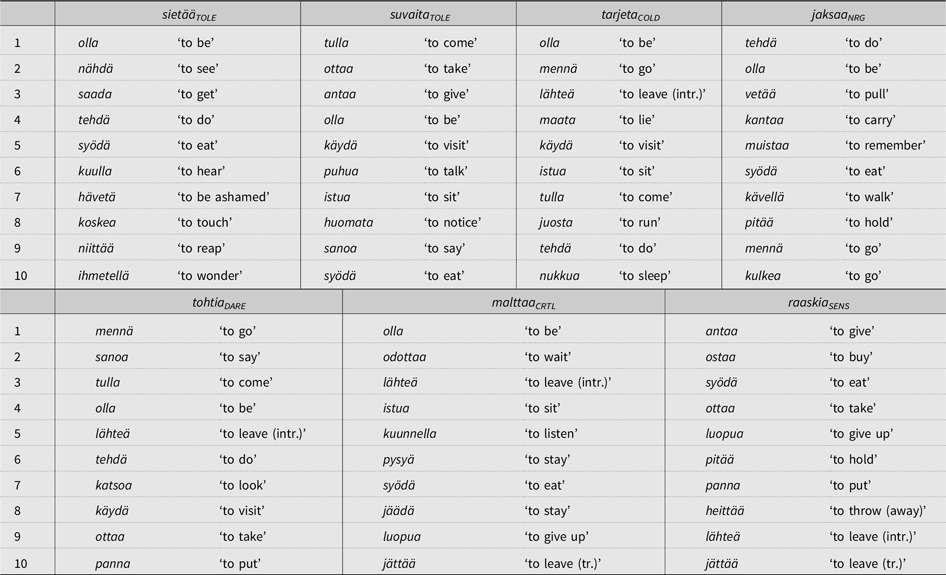
Although the three tolerance VoAs take an A-infinitive complement less often than the others, they display some interesting tendencies in the selection of these lexical verbs. Perception verbs are well represented on the sietää TOLE list, whereas suvaita TOLE co-occurs with verbs highlighting an interpersonal contact, such as communication verbs and the verbs of giving and taking. Tarjeta COLD mostly occurs with verbs expressing physical movements and states. Among the complements of jaksaa NRG, we can observe basic physical activity verbs, such as vetää ‘to drag’ and kantaa ‘to carry’. Interestingly, the mental verb muistaa ‘to remember’ ranks high on the jaksaa NRG list. Like suvaita TOLE, tohtia DARE also favours the communication verb sanoa ‘to say’ and the verb ottaa ‘to take’. In addition to these verbs entailing interpersonal contact, basic verbs of physical movement rank high on the tohtia DARE list. In quite the opposite vein, malttaa CTRL exhibits inclination towards verbs expressing non-movement in its complement: odottaa ‘to wait’, pysyä ‘to stay’, jäädä ‘to stay’ (on the verbs of staying in Finnish, see Dubois Reference Dubois2023). Malttaa CTRL and even more so raaskia SENS occur with verbs the meaning of which stems from the conceptual schema of splitting (see Johnson Reference Johnson1987:126): luopua ‘to give up’, heittää ‘to throw (often in the sense throw away)’, and jättää ‘to abandon’. These verbs describe a situation where the subject referent separates from someone or something. A separation is also present in the meaning of verbs expressing consumption, syödä ‘to eat’ and ostaa ‘to buy (i.e. to consume money)’.
The results confirm that all studied VoAs favour negative contexts (see Kiuru Reference Kiuru1977, Flint Reference Flint1980).Footnote 6 Hakulinen et al. (Reference Hakulinen, Karlsson and Vilkuna1980) observed in their Finnish text corpus that approximately 10% of the utterances were in the negative form (see also Kiuru Reference Kiuru1977:243).Footnote 7 All the selected VoAs are above this rate. This can be accounted for by looking at the underlying force-dynamic configurations. VoAs encode the ability to (not) to do something despite a competing force (see Figure 1). Their meaning is thus founded on a concessive relation where an implied causal inference is invalidated.Footnote 8 For example, the meaning of tarjeta COLD includes an implication that cold entails inability with regard to something situationally determined. In this sense, VoAs express unexpected states of affairs: an expected causal relation is cancelled (on the relationship between concession and negation, see Verhagen Reference Verhagen, Couper-Kuhlen and Kortmann2000), e.g. the subject referent is able to swim despite the cold. The negative form of a VoA therefore entails a situation where an expression of negated causality (‘despite’) is associated with an overt negation, as shown in (9) where the speaker describes the effect of air-conditioning:
(9)
Sisällä
ol-i
niin
kylmä,
inside
be-pst.3sg
so
cold
ett-ei
ø
kesäasu-ssa
tarjen-nut.
comp-neg.3sg
zero
summer.clothing-ine
tarjeta-ptcp.pst
‘It was so freezing inside that one was cold in summer clothes.’
(PRESS, 2005)
When the VoA, here tarjeta COLD, is under the scope of negation, the implied causal chain is re-established: the cold entails its expected effects.
There are, however, important differences between the studied verbs, as to the degree of negative affinity. Figure 3 shows that the three emotion VoAs rank highest in this respect, whereas the three tolerance verbs display a lesser degree of negative affinity than the others, tarjeta COLD exhibiting the weakest tendency towards negation.Footnote 9
Distribution of affirmative vs. negative utterances (p < .001).
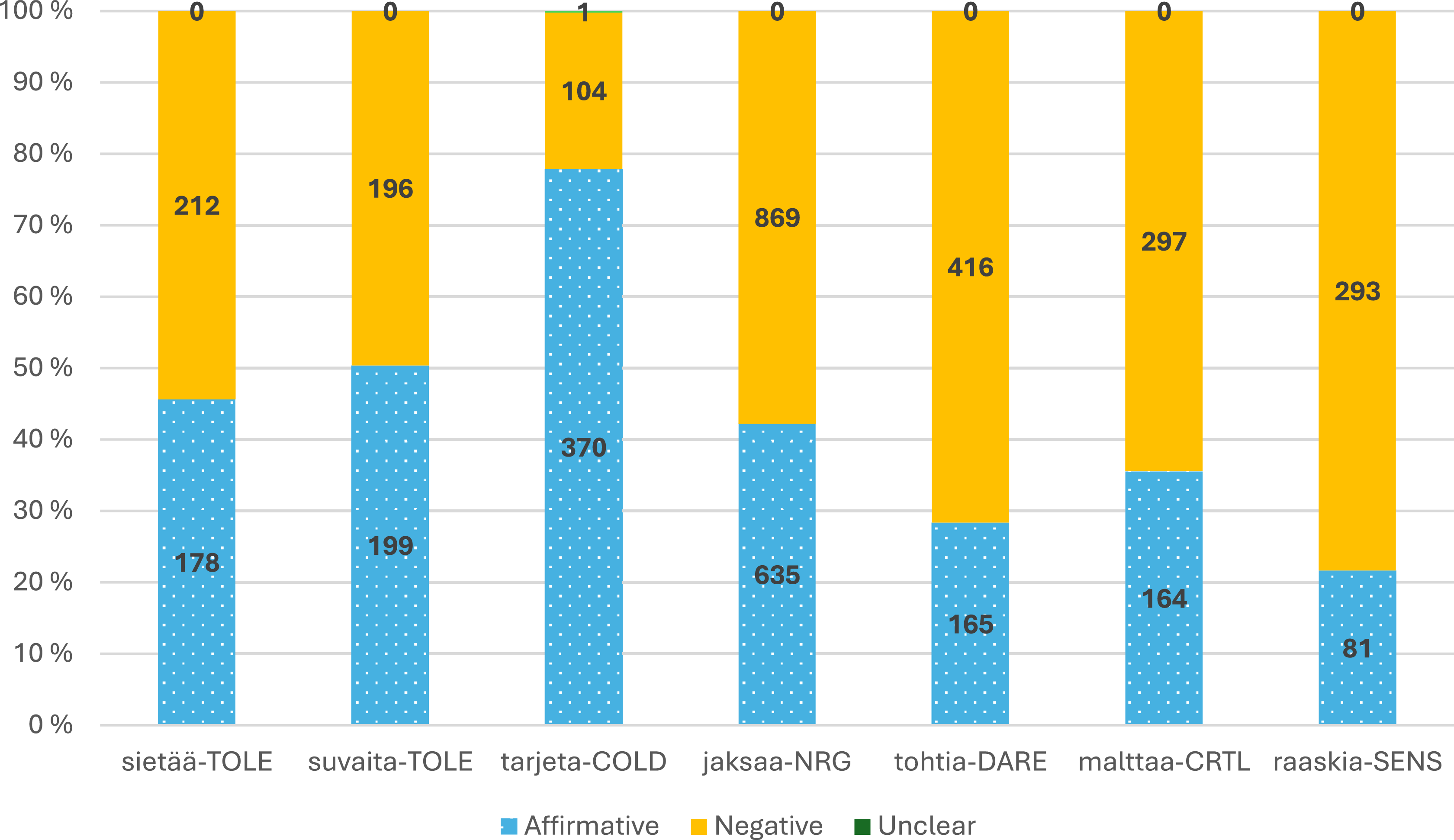
Figure 3 Long description
The bar graph compares the distribution of affirmative, negative, and unclear utterances for seven Finnish verbs of ability. The x-axis lists the verbs: sietää-TOLE, suvaita-TOLE, tarjeta-COLD, jaksaa-NRG, tohtia-DARE, malttaa-CRTL, and raaskia-SENS. The y-axis represents the percentage of utterances, ranging from 0% to 100%. Each verb has a stacked bar divided into three sections: blue for affirmative, yellow for negative, and green for unclear utterances. The values for each section are labeled within the bars. For example, sietää-TOLE has 178 affirmative, 212 negative, and 0 unclear utterances. The graph shows variations in the distribution of utterances across different verbs. All values are approximated.
Concerning malttaa CTRL and raaskia SENS, the strong negative affinity can at least partly be accounted for in terms of the underlying schema of splitting (see Dubois Reference Dubois2023:317). Conceptually, ‘separation’, as encoded by constructions including these mental verbs, is not symmetrical but founded on a division between a more central component (the subject referent) and a more peripherical part (the entity given up, thrown away, abandoned or consumed) (see Talmy Reference Talmy2000:432–433). This latter entity is thus removed or erased so that the subject referent can no longer access it.
When cross-referencing the distribution of affirmative and negative utterances with construction types, we observe that a higher degree of negative affinity correlates with auxiliary-likeness (p < .001). In 70.8% of all negative utterances collected, the VoA is used with an A-infinitive complement. The results suggest that the lexical components provide the VoAs with different kinds of syntactic potential. The tolerance verbs occur more often than others as main verbs and in affirmative form, whereas the emotion regulation verbs are mostly used for modifying an event expressed by another verb in negative utterances. The tolerance verbs thus carry a more specific lexical meaning with an event structure of its own. They can therefore be used for describing ‘how things are’. This is most obvious in tarjeta COLD, the lexical meaning of which goes as far as determining the cause of the encoded experience (‘cold’). The semantics of the emotion regulation verbs, on the other hand, is of a more schematic nature. These verbs convey information on the subject referent’s emotional experience concerning what is described by another verb. Our results thus confirm the patterns of co-occurrence between negation and mental verbs, reported in English by Biber et al. (Reference Biber, Johansson, Leech, Conrad and Finegan2021:177).
Table 8 presents the distribution of person reference in the studied VoAs. The most salient types of person marking for each VoA are indicated in bold type. The category Others/unclear includes occurrences of low-frequency constructions such as independent infinitives, as well as unclear cases.
Distribution of person marking for each studied VoA (p < .001)
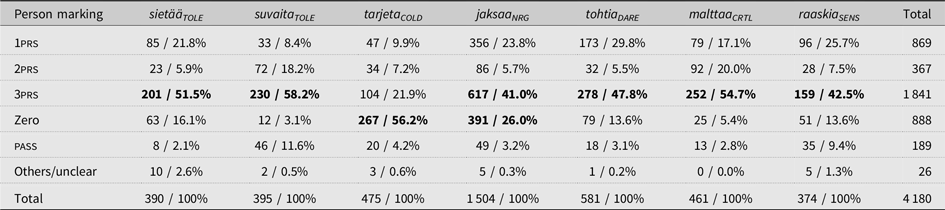
Once again tarjeta COLD distinguishes itself from the others in that it is used particularly often with a zero subject. It thus foregrounds the role of the subject referent as experiencer. The verb jaksaa NRG also occurs with a zero subject relatively often.
Malttaa CTRL and suvaita TOLE are only marginally used with a zero subject. These two occur more often than the others with second- and third-person reference. This difference can be considered with regard to the observation that malttaa CTRL and suvaita TOLE are more liable than the others to be used in the imperative form (see example 8). For suvaita TOLE, this is manifest in archaic politeness formulas, as illustrated in (10).
(10)
Suvait-kaa
minu-n
esittä-ä
tei-lle
ystävä-ni.
suvaita-imp.2pl
1sg-gen
introduce-inf
2pl-all
friend-1sg.poss
‘Allow me to introduce you my friend.’
(LITER, Pakkala, 1902)
Considering the uses in the imperative form, malttaa CTRL and suvaita TOLE display the highest degree of agency among the studied VoAs. When it comes to suvaita TOLE, this is also observable in contemporary uses where it occurs in a complement of a volitional verb (example 11).
(11)
Turkki
ei
halun-nut
alistu-a
menetyks-i-i-nsä
prp
neg.3sg
want-ptcp.pst
submit-inf
loss-pl-ill-3.poss
ei=kä
suvai-ta
tsaarivaltakunna-n
paisumis-ta.
neg.3sg=clt
suvaita-inf
tsarist.empire-gen
expansion-part
‘Turkey did not want to accept its losses and tolerate the expansion of the Tsarist Empire.’
(PRESS, 2001)
The distribution of person reference suggests that the selected VoAs are positioned differently on the scales of agency and experience.
In what follows, we zoom into the functions of each verb or group of verbs, detecting the types of conceptual forces that are mapped onto the underlying force-dynamic pattern.
2.2. The interplay between force dynamics and lexical meaning
As presented above (Section 1.2), the types of interactions identified in our study are of physical, mental, and interpersonal type. The physical force dynamics is defined as any type of interaction between a subject referent and its surrounding physical environment. Mental force dynamics corresponds to processes internal to the subject referent, while interpersonal force dynamics is defined as an interaction between the subject referent and another animate referent. The analysis of the distribution of conceptual force types was carried out by observing the lexical semantics of the A-infinitive form (see examples 12, 13), as well as the degree of animacy of the NP complements (examples 14, 15). For constructions without a complement, the relevant lexical and grammatical items in the context were taken into account (example 16).
(12)
em
muista
ennää
jaksam
muista-as
si-tä,
neg.1sg
remember.cng
anymore
jaksaa.cng
remember-inf
dem-part
vuoslukua on täst kauvan
‘year it’s been so long’
‘I don’t remember anymore just cannot remember that year, it’s been so long’
(DIAL, Luumäki)
(13)
Vartijoille saat minun puolestani luvata niin paljon kultaa
‘As far as I am concerned, you may promise the guards as much gold’
kuin
he
vaatte-i-ssa-an
jaksa-vat
kanta-a.
as
3pl
cloth-pl-ine-poss.3
jaksaa-3pl
carry-inf
‘As far as I am concerned, you may promise the guards as much gold as they can carry in their clothes.’
(LITER, Sienkiewicz, 1921)
(14)
Se on Hannaa kohtaan niin väärin, kuin suinkin olla voi.
‘It is as wrong towards Hanna as it could ever be.’
Sinä
e-t
ole
voi-nut
koskaan
hän-tä
sietä-ä.
2sg
neg-2sg
aux.cng
can-ptcp.pst
ever
3sg-part
sietää-inf
‘It is as wrong towards Hanna as it could ever be. You have never been able to tolerate her.’
(LITER, Aho, 1907)
(15)
Vaikka
hän
sietä-ä
eläinpöly-ä,
although
3sg
sietää-3sg
animal.dander-part
tietyt hajusteet ärsyttävät.
‘certain perfumes cause irritation.’
‘Although she tolerates animal dander, certain perfumes cause irritation.’
(PRESS, 2014)
(16)
ku mul on, hirvittävän vaikee joskus kirjottaa
‘because it’s, really difficult for me to write sometimes’
ja
e-n
niinkun,
meina-a
millään
jaksa-a,
and
neg-1sg
ptcl
be.about.to-cng
by.any.means
jaksaa-inf
tai siis sattuu käteen ku, joutuu pitkään pitää kynää kädes
‘I mean like my hand hurts when, I have to hold a pen for a long time’
‘because it’s, really difficult for me to write sometimes and I’m really like, struggling to keep going, I mean like my hand hurts when, I have to hold a pen for a long time’
(CONV)
In (12), the infinitive complement muistaa ‘to remember’ describes a cognitive process. The force dynamics is thus of mental type. In (13), the A-infinitive kantaa ‘to carry’ describes a bodily effort, and the force-dynamic interaction is therefore physical. The extract presented in (14) is an example of interpersonal force dynamics, since the NP complement refers to an animate entity. Conversely, when the NP complement refers to an inanimate entity, as in (15), the interaction of the competing forces is of physical type: it concerns the bodily ability of the subject referent. In (16), the physical force-dynamic reading stems from a wider context. The verbs kirjottaa ‘to write’ and sattuu ‘to hurt’ display bodily actions and experiences, and jaksaa NRG is therefore understood as describing a physical ability as well.
When looking at the data in general, physical force interaction is the most frequent type of force-dynamic pattern (41.2% of all utterances), followed by mental (33.3%) and interpersonal force type (19.7%). The studied VoAs display different tendencies in this respect, as shown in Figure 4.
The types of conceptual forces (n, %) (p < .001).
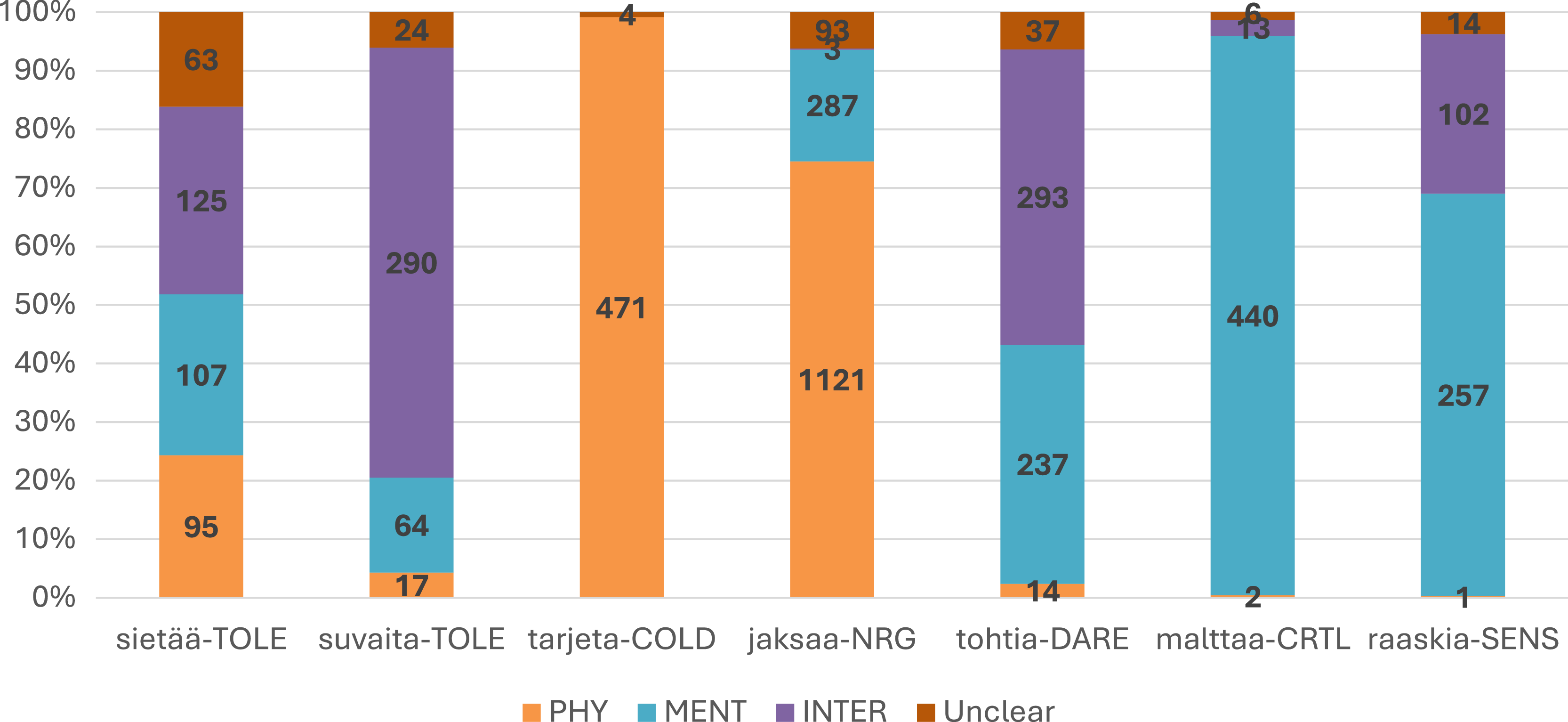
Figure 4 Long description
The bar graph compares the percentage distribution of different conceptual forces across seven verbs in Finnish. The x-axis lists the verbs: sietää-TOLE, suvaita-TOLE, tarjeta-COLD, jaksaa-NRG, tohtia-DARE, malttaa-CTRL, and raaskia-SENS. The y-axis represents the percentage from 0 to 100. The graph is a stacked bar chart with four colors representing different categories: PHY (orange), MENT (blue), INTER (purple), and Unclear (brown). Each bar is divided into segments showing the proportion of each category for the corresponding verb. For sietää-TOLE, the distribution is approximately 95 PHY, 107 MENT, 125 INTER, and 63 Unclear. For suvaita-TOLE, it is approximately 17 PHY, 64 MENT, 290 INTER, and 24 Unclear. For tarjeta-COLD, it is approximately 471 PHY and 4 Unclear. For jaksaa-NRG, it is approximately 1121 PHY, 287 MENT, 93 INTER, and 3 Unclear. For tohtia-DARE, it is approximately 14 PHY, 237 MENT, 293 INTER, and 37 Unclear. For malttaa-CTRL, it is approximately 2 PHY, 440 MENT, and 13 INTER. For raaskia-SENS, it is approximately 1 PHY, 257 MENT, 102 INTER, and 14 Unclear. All values are approximated.
Tarjeta COLD and jaksaa NRG exhibit a clear preference for physical force interaction, whereas suvaita TOLE and tohtia DARE most often occur in contexts involving interpersonal interaction. The mental type is almost as frequent for tohtia DARE, however. Malttaa CTRL shows a very strong inclination towards mental force interaction. Raaskia SENS also favours interaction between mental forces, although it can be used to describe interpersonal force dynamics as well. Sietää TOLE displays no clear preference for any of the three types. Its lexical semantics appears to be particularly polyvalent.
When cross-referencing the distribution of person reference with the types of conceptual forces, a strong tendency connecting expressions of physical force interaction and the zero-person reference is observed. The data include a total of 888 utterances where a VoA occurs with a zero subject. Most of these forms describe physical abilities (584 utterances, 65.7%, p < .001). Our analysis thus offers quantitative support for Laitinen’s (Reference Laitinen1995:340) observation concerning physical constraints as one of the typical contexts of use for zero person. In our data, these co-occurrences of zero-person reference and expressions of physical force dynamics mostly include tarjeta COLD. When mapping the data on conceptual force types onto the distribution between auxiliary and non-auxiliary uses, we can detect a strong tendency for non-auxiliary uses in the descriptions of physical force interactions: 49.8% of all non-auxiliary uses are of the type PHY, vs. 23.2% of the MENT type and 19.1% of the INTER type (7.9% N/A). Expressions of mental force interaction, on the other hand, give the most prominent position to auxiliary uses: 39.9% of all auxiliary uses are of the type MENT, vs. 35.7% of the PHY and 20.2% of the INTER type (4.1% N/A). Overall, we can thus observe a junction between physical force interaction, non-auxiliary uses, lesser degree of negative affinity, and zero-person reference, on the one hand, and between mental force interaction, auxiliary uses, and strong negative affinity, on the other. Tarjeta COLD can be located at the centre of the first junction, whereas malttaa CTRL and raaskia SENS exhibit most clearly the latter properties.
In what follows, we present closer observations on the typical uses of each VoA, providing insight into the grammatical variation exposed in Section 2.1. The studied VoAs are here dealt with in two sections. Sietää TOLE, suvaita TOLE, and tarjeta COLD form a coherent subgroup, since they all encode tolerance. For practical reasons, jaksaa NRG, describing ability in terms of energy, is included in the same section with them (2.2.1). Tohtia DARE, malttaa CTRL and raaskia SENS share the semantics of emotion regulation (Section 2.2.2).
2.2.1 Verbs of tolerance and jaksaaNRG
In tolerance verbs, the Agonist overcomes a potential negative effect of the Antagonist’s force that could prevent the Agonist from action (see Figure 1). The verb sietää TOLE forms the cornerstone of the tolerance group, in the sense that it is productively used for expressing force interactions of three different types, as shown in examples (17)–(19):
(17)
ø
ei
sietä-nyk
käsi-n
koski-a,
zero
neg.3sg
sietää-ptcp.pst
hand-ins
touch-inf
se [jalka]
ol-i
niin
kipiä
dem
be-prt.3sg
so
painful
‘one couldn’t bear to touch with a hand, it [the foot] was so painful’
(DIAL, Paavola)
(18)
He
pyrki-vät
sietä-mä-än
epäonnistumis-i-a
ja
pettymyks-i-ä (…).
3pl
try-3pl
sietää-inf-ill
failure-pl-part
and
disappointment-pl-part
‘They try to tolerate failures and disappointments (…).’
(PRESS, 2015)
(19)
Hän tiesi hyvin, että
‘She knew very well that’
Edvard
joskus
ei
voi-nut
hän-tä
sietä-ä.
prp
sometimes
neg.3sg
can-ptcp.pst
3sg-part
sietää-inf
‘She knew very well that Edvard sometimes couldn’t stand her.’
(LITER, Järnefelt, 1905)
Example (17) displays interaction between physical forces. In (18), the complements denote abstract entities, and the resisting force to overcome is of mental type, since both Agonist and Antagonist forces are internal to the experiencer. In (19), already presented above in example (6), the force dynamics of tolerance is of interpersonal type.
Two properties distinguish suvaita TOLE from sietää TOLE. First, suvaita TOLE is a relatively agentive verb, as shown above, whereas sietää TOLE highlights the experience of tolerance. Second, suvaita TOLE tends very strongly to be the verb devoted to interpersonal tolerance (73.5%, see Figure 4), as illustrated in (20), already presented above in (7).
(20)
[mies on] semmonen yksineläjä
‘[The man is] such a solitary person’
ett-ei
se
tahos
suva-tak
ketään.
comp-neg.3sg
3sg
tend.cng
suvaita-inf
anyone.part
‘[The man is] such a solitary person that he doesn’t tolerate anyone.’
(DIAL, Himanka)
Suvaita TOLE is only marginally observed to denote physical tolerance. In our data, these archaic uses come from one single southeastern parish of the dialect corpus (see example 21) and from two Gutenberg project’s literary sources (from 1908 and 1916).
(21)
e=hä Footnote 10
sorme-t
suvaiv
veäntä-mis-tä
neg.3=clt
finger-pl
suvaita.cng
twist-nmlz-part
‘because fingers don’t bear to be twisted’
(DIAL, Savitaipale)
In our dataset, the verb tarjeta COLD always conceptualises concurrent physical forces, entailing bodily tolerance of cold temperature, as in (22) and (23). In Section 2.1 it was observed that, as opposed to all other studied VoAs, tarjeta COLD mainly occurs in intransitive constructions, affirmative utterances, and combined with a zero subject. This typical grammatical environment is illustrated in example (22). Example (23) shows an alternative use, with a specific subject and an A-infinitive complement. The action ‘to swim’ is described as made possible by the ability of the subject referent to endure cold.
(22)
ø
sai
vaate-t
tällä-t
yllen
niim
paljo
zero
get.prt.3sg
cloth-part
put-inf
on
as
much
et
ø
tarken-i.
comp
zero
tarjeta-prt.3sg
‘one had to put on so much clothes to withstand the cold.’
(DIAL, Pöytyä)
(23)
Peloton
Gösta
tarkene-e
ui-da
ulko-alta-i-ssa=kin.
fearless
prp
tarjeta-3sg
swim-inf
outdoor-pool-pl-ine=clt
‘Fearless Gösta can even swim in outdoor pools [although it is cold there]’
(PRESS, 2016)
The grammatical peculiarity of tarjeta COLD can be accounted for in terms of its complex lexical semantics. First, tarjeta COLD does not accept any NP complement in its argument structure because the stimulus of the experience (‘cold’) is already included in its lexical meaning. For this reason, tarjeta COLD can by itself describe a state without necessarily modifying an event denoted by an infinitive complement (see example 23). Since the lexical component of tarjeta COLD is inherently bound to a physical experience, the semantics of the possible infinitival complement cannot affect the type of force configuration.
As stated above, the amount of zero subject reference is correlated with the potential of the VoA to describe interaction between physical forces. For tarjeta COLD, which is used only for this type of tolerance, zero subject is the most frequent person reference type.
In the semantic structure of jaksaa NRG, the subject referent confronts an external challenge but prevails over it, thanks to their energy and efforts. For jaksaa NRG, too, the force-dynamic pattern is of the type illustrated in Figure 1. The Agonist force tends towards action, the Antagonist resists, but the Agonist overcomes, and the resultant is action. Jaksaa NRG is mostly used for describing competing physical forces, as in (24), but a cognitive process can also be treated as demanding energy, as shown in (25), already presented above in example (12). In dialect data and older literature, jaksaa NRG is used for encoding the subject referent’s capacity to pay, as in (26).
(24)
kumma
että
ne [kulkukauppiaat]
amazing
comp
3pl
jakso
semmos-i-a
t[a]akko-j-a
kanta-a.
jaksaa.prt.3
such-pl-part
load-pl-part
carry-inf
‘it’s amazing that they [hawkers] could carry such heavy loads.’
(DIAL, Kalvola)
(25)
em
muista
ennää
jaksam
muista-as
si-tä,
neg.1sg
remember.cng
anymore
jaksaa.cng
remember-inf
dem-part
vuoslukua on täst kauvan
‘year it’s been so long’
‘I don’t remember anymore just cannot remember that, year it’s been so long’
(DIAL, Luumäki)
(26)
ja sitte ol matto peittee(nä),
‘and then they covered themselves with a carpet,’
jotka
ei
jaksa-nna
täkki-ä
saa-(ha)
rel.pl
neg.3
jaksaa-ptcp.pst
quilt-part
get-inf
‘and then they covered themselves with a carpet, those who could not afford a quilt’
(DIAL, Siilinjärvi)
When the object complement of jaksaa NRG denotes an entity that cannot be understood as requiring energy, as in (27), jaksaa NRG interestingly receives a tolerance reading.
(27)
mä
e-n
jaksa
si-tä
ranna-lla
löhöö-mis-tä
1sg
neg-1sg
jaksaa.cng
det-part
beach-ade
lie-nmlz-part
‘I can’t stand just lying on the beach.’
(CONV)
No occurrences of jaksaa NRG with an animate NP object complement were found in the data. Yet, based on the authors’ intuition, this construction is used in contemporary colloquial Finnish. An additional search in the Language Bank’s Suomi24 corpus of online discussions confirmed this, as seen in (28).
(28)
E-n
vaan
jaksa
si-tä
tyyppi-ä
enää.
neg-1sg
ptcl
jaksaa.cng
dem-part
guy-part
anymore
‘I just can’t stand that guy anymore.’
(Online discussion, Suomi24, 2006)
In these uses of jaksaa NRG, being able to employ physical or mental efforts to overcome an opposing force is reanalysed as an ability to bear the negative effect of something unpleasant (cf. the energy-related and tolerance meanings of the English verb to bear ‘to carry the weight of’, ‘to manage to tolerate’). It may be that the tolerance use of jaksaa NRG results from a rather recent evolution. This should, however, be tested on more adequate historical data.
2.2.2 VoAs encoding emotion
Three of the selected VoAs describe different kinds of emotional forces. In the force-dynamic structure of tohtia DARE, the Antagonist position is occupied by the subject referent’s feeling of hesitation or fear. The Agonist overcomes the Antagonist, and the resultant is action, despite the resisting emotional force (see Figure 1). As with the tolerance verb suvaita TOLE, tohtia DARE mostly occurs in contexts where the concurring forces appear as interpersonal. As opposed to suvaita TOLE, it cannot be construed with an animate NP complement referring to the stimulus of the experience. However, the infinitive complement can describe events entailing social interaction. The feared unpleasant consequences of these events are of an interpersonal nature. As seen in Section 2.1 (Table 7), the communication verb sanoa ‘to say’ figures frequently in the infinitive complement of tohtia DARE. In (29), the verb julkistaa ‘to make public’ denotes an event involving the relationship between an individual and the community.
(29)
Häpeä tai halu välttää häpeää tuotti puhumattomuutta,
‘A feeling of shame or the desire to avoid shame resulted in silence,’
jolloin
raskaut-ta
ei
tohdi-ttu
julkista-a (…).
rel.temp
pregnancy-part
neg.3
tohtia-pass.ptcp.pst
make.public-inf
‘A feeling of shame or the desire to avoid shame resulted in silence, and then people did not dare to make the pregnancy public.’
(PRESS, 2010)
In the oldest part of our dataset, especially in dialect interviews from the Western dialects (more specifically from Ostrobothnia and Northern Finland), tohtia DARE can also describe the dynamics between physical (30) and mental (31) forces:
(30)
[tiile-t]
kestä-ä
jähty-äk
kaks
viikku-a
brick-pl
take-3
cool-inf
two
week-part
ennen
ku
ø
tohti-i
koski-a
before
conj
zero
tohtia-3sg
touch-inf
‘it takes two weeks [for the bricks] to cool off before one can touch them’
(DIAL, Pattijoki)
(31)
kun ne toimitti jotta kun
‘because they were saying like’
ei
he
tohorim
men-nä
neg.3
3pl.log
tohtia.cng
go-inf
[e]ttä kun, siäl or rumis ollus siälä riihes ja
‘because like there has been a corpse in the barn and’
ja (sitten) pelekääväp pimiää,
‘and (then) they are afraid of the dark’
[et]t-ei
he
tohorij
jotta
se
pian
tulo-o
ptcl-neg.3
3pl.log
tohtia.cng
ptcl
3sg
ptcl
come-3sg
‘because they were saying like they do not have the courage to go because like there has been a corpse in the barn and and (then) they are afraid of the dark like they do not have the courage like it [i.e. the corpse] may return’
(DIAL, Kauhava)
In (30) the consequence to be avoided involves physical pain (burning one’s hands). In (31), the cause of the fear is not directly related to interpersonal relationships, either, although it can be accounted for in socio-cultural terms (i.e. fear of death).
The uses of the last two verbs malttaa CTRL and raaskia SENS are partly overlapping in our data. They both modify the event denoted by the infinitive complement so that it is construed as being dispreferred by the subject referent, in comparison to an alternative event. This is what deploys the force-dynamic tension within the semantics of these verbs. In malttaa CTRL and raaskia SENS, the schema of splitting interferes in the lexical semantic component, as illustrated by the following examples (32)–(36), describing different types of separation:
(32)
ei
Tyyne
malta
anta-a
eres
vanho-j-a
vaattee-ta,
neg.3sg
prp
malttaa.cng
give-inf
even
old-pl-part
cloth.pl-part
on niin nuuka
‘she is so parsimonious’
‘Tyyne cannot give away even her old clothes she is so parsimonious’
(DIAL, Kurikka)
(33)
e-m
minä
raski
nu-i-ta
ainuv-i-a
neg-1sg
1sg
raaskia.cng
dem-pl-part
only-pl-part
villahousu-j-a
pitä-ä
wool.pants-pl-part
wear-inf
‘I can’t wear those wool pants, they are the only ones I have.’
(DIAL, Salla)
(34)
Kuka
tietä-ä,
milloin
he
ol-isi-vat
q
know-3sg
when
3pl
aux-cond-3pl
maltta-neet
pois
tul-la,
malttaa-ptcp.pst.pl
away
come-inf
ellei ruvennut jo vähäisen vilustamaan
‘if it hadn’t started to get a bit chilly.’
‘Who knows when they might have returned, if it hadn’t started to get a bit chilly.’
(LITER, Canth, 1886)
(35)
E-n
raask-isi
laitta-a
Elisa-a
vielä=kään
päiväkoti-in,
neg-1sg
raaskia-cond.cng
put-inf
prp-part
still=clt
day.care-ill
nyt vuoden vanhan tytön äiti pohtii.
‘says the mother of the now one-year-old girl.’
‘I still wouldn’t have the heart to put Elisa in daycare, says the mother of the now one-year-old girl.’
(PRESS, 2008)
(36)
Hänen isänsä ja naapurin Maija kyllä tiesivät kaikki muut asiat, paitsi Martin pois-ajoa,
‘Her father and Maija from the neighbouring house knew well all other issues, besides Martti being chased from the house,’
vaan
ei-vät
he
raski-neet
Aina-lle
totuut-ta
tunnusta-a,
but
neg-3pl
3pl
raaskia-ptcp.pst.pl
prp-all
truth-part
tell-inf
sillä hänellä oli surua ja sydämen kipua ilman niittäkin tiedoitta.
‘because she had enough grief and heartache without all of it.’
‘Her father and Maija from the neighbouring house knew well all other issues, besides Martti being chased from the house, but they didn’t have the heart to tell Aina the truth because she had enough grief and heartache without all of it.’
(LITER, Päivärinta, 1882)
In (32) and (33), the hindering mental force arises from a sense of material value: the subject referent does not want to be separated from something, through giving away or consuming. The two verbs can both also describe force dynamics in terms of time and subject referent’s attention, although this appears to be more common to malttaa CTRL. In (34), the subject referents do not want to return (and in doing so, separate themselves from an ongoing preferred action), most likely because they are having a good time, but they are described as returning anyway, because of temporal constraints (see milloin ‘when’, jo ‘already’). Raaskia SENS typically highlights the emotional roots of ability, namely affection (mental) or empathy (interpersonal force interaction). In (35), the subject referent (‘mother’) is attached to the other participant (Elisa) and is therefore emotionally affected by the projected separation. In (36), the subject referents are described as being aware of the change of state (i.e. separation from the previous, less painful mental state) that their action (‘telling the truth’) would cause in the other participant (Aina).
Both malttaa CTRL and raaskia SENS can take verbs denoting movement or a change of state in their infinitive complement. The underlying force dynamics is then of the type schematised in Figure 1. The Agonist force tending towards action overcomes the resisting Antagonist, and the resultant is action. However, malttaa CTRL more often occurs with verbs describing non-movement, such as uottoa ∼ odottaa ‘to wait’ in (37) (see Table 7).
(37)
se ku män se Toivo sitä kätilyvä hakemoa,
‘and Toivo went to fetch the midwife’
Toivo
ei
maltta-nt
uotto-a
prp
neg.3sg
malttaa-ptcp.pst
wait-inf
‘and Toivo went to fetch the midwife Toivo couldn’t wait’
(DIAL, Lemi)
In these cases, the force-dynamic model is as presented in Figure 2. The Agonist tends towards rest, whereas the Antagonist tending towards action resists. The Agonist overcomes, and the resultant is rest (e.g. ‘to wait’). In (37), the force-dynamic pattern is inversed because of the negation (see Figure 2(b)). This pattern is dominant for malttaa CTRL in our data, whereas it is very rare for raaskia SENS. In other words, the subject referent of malttaa CTRL tends to prefer movement or other type of change in the ongoing situation. Malttaa CTRL describes the control of this preference. The subject referent of raaskia SENS, inversely, displays preference for continuity and non-movement. Raaskia SENS profiles that the subject referent overcomes their own emotional resistance and takes on the action anyway.
2.3 The ecology of ability
Based on the force-dynamic analysis, Figure 5 presents a tentative ecology of Finnish ability verbs for the selected lexemes. Its complexity aims to illustrate the overlaps and the differences in the lexical components that each of the verbs carry alongside the modal meaning. It also makes apparent the overall multilayered nature of the modal assemblage of ability.
The ecology of the studied VoAs.
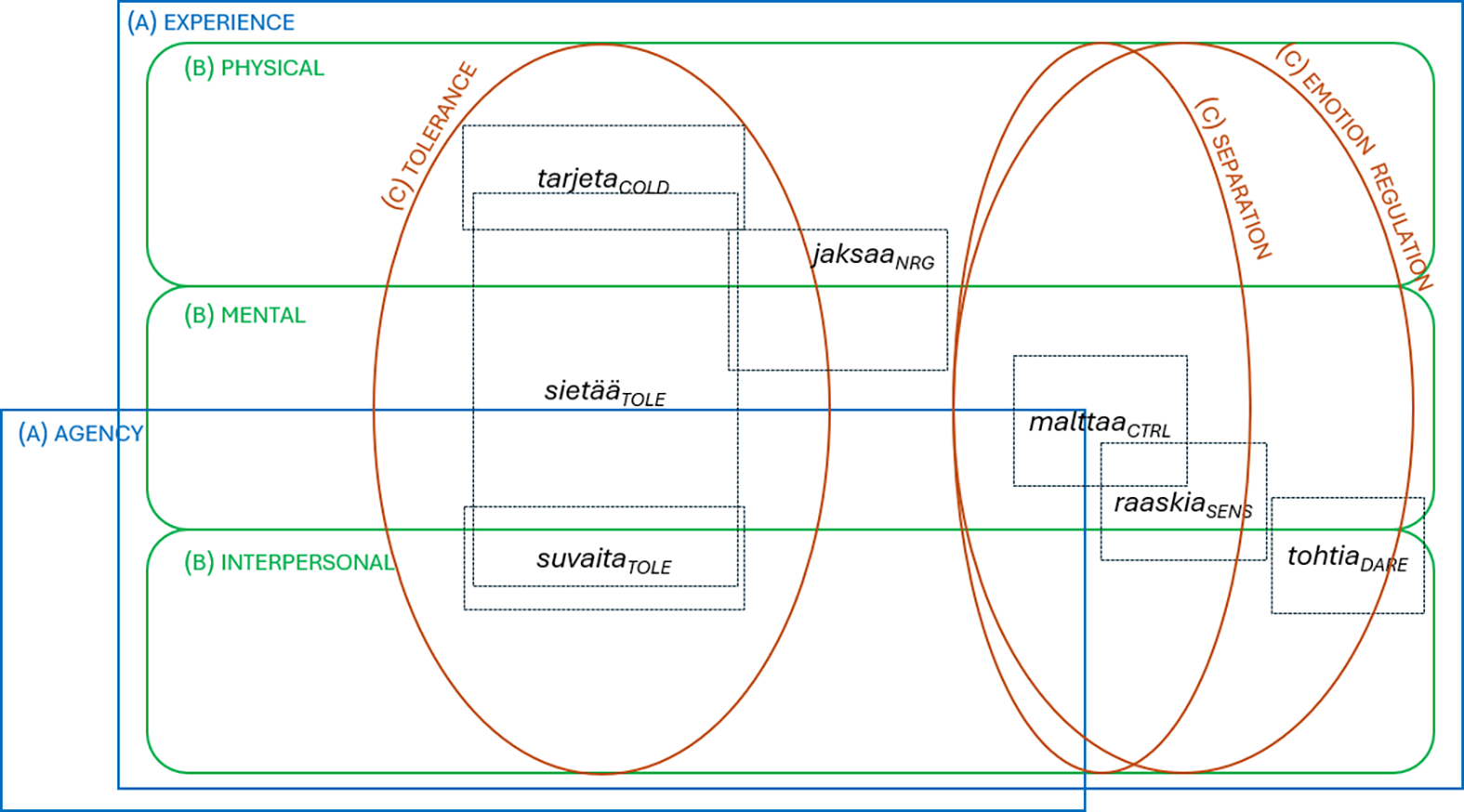
Figure 5 Long description
A Venn diagram illustrating the ecology of studied VoAs in Finnish. The diagram consists of two large overlapping circles, each divided into smaller sections. The diagram is first divided into Agency and Experience categories. The diagram is further divided into physical, mental, and interpersonal categories. The third division distinguishes the tolerance, separation, and emotion regulation categories. The overlapping sections indicate interactions between these categories. Specific Finnish verbs related to ability, such as tarjeta, jaksaa, sietää, suvaita, malttaa, raaskia, and tohtia, are placed within these sections to show their semantic relationships. The diagram aims to capture the dynamic and interconnected nature of ability concepts in Finnish.
The first layer (A) includes the distinction between more controlled, agentive ability and the experience of ability. The next (B) draws a difference between the types of conceptual forces, while the last (C) highlights the more specific semantic groups that were identified as gathering more than one of the investigated VoAs. The codes in subscript further indicate that each verb has developed its own niche where different parameters stemming from the embodied interaction between the subject referent and their environment come together in various ways. The figure thus shows that although some of the verbs can be used in similar functions (e.g. sietää TOLE and suvaita TOLE on the one hand, malttaaCTRL and raaskia SENS on the other), each of them comes from a different horizon. None can therefore be considered as a synonym of another.
Concerning the grammar of VoAs, the analysed features are distributed differently on this landscape. All studied VoAs display negative affinity, but the strongest tendency is found on the right side of the realm. Affirmation is more present on the left side, with a focus on the tarjeta COLD niche. The uses of zero subject concentrate on the physical experience realm, also close to the tarjeta COLD niche. The intransitive construction shares this same location, whereas the transitive [V + NP] construction is arranged across the three force types onto the sietää TOLE and suvaita TOLE niches. The uses of the transitive [V + A-infinitive] construction cluster on the lower right corner of the ability realm, with the highest concentration on the tohtia DARE and raaskia SENS niches.
3. Discussion
Our first aim in this study was to analyse the grammatical patterns in which a set of Finnish verbs of ability occur: the types of complements, the distribution between negative and affirmative utterances, and tendencies in person marking. We then approached these VoAs within Talmy’s force-dynamic framework, which makes manifest the embodied physical roots of such abstract meaning structures as dynamic modality (see Johnson Reference Johnson, Newen, Bruin and Gallagher2018; also Hilpert Reference Hilpert2025). The objective was to find out whether the analysed VoAs display preferences with regard to a certain force-dynamic schema and force type and to examine if the results of the grammatical analysis could map onto these preferences. These lexemes have previously been identified as forming a linear system (Flint Reference Flint1980). We observed in depth the meaning structure and uses of each verb, drawing parallels despite their mutual distance on the linear axis. We proposed to apply the concept of ecology in the description of the interplay between these verbs and the modal realm of ability. We tested three hypotheses.
Hypothesis 1, The selected VoAs do not occur in similar patterns, when it comes to complementation, negation, and person marking, was confirmed. The VoAs displayed differing tendencies as to their typical grammatical environment. Although the studied VoAs share the capacity of entering a transitive construction with an A-infinitive complement, some of them, namely the tolerance verbs, favoured NP complements (sietää TOLE and suvaita TOLE) or intransitive constructions (tarjeta COLD). The tolerance verbs stood out from the rest also when it came to the distribution between negative and affirmative utterances. While the other VoAs displayed strong negative affinity, sietää TOLE and suvaita TOLE showed equal inclination towards negative and affirmative contexts. Tarjeta COLD was significantly more frequent in the affirmative form (although when compared to the overall frequency of negative utterances in Finnish, it is marked by a certain negative affinity as well). Tarjeta COLD was different from the rest also in person reference. It mostly occurred with a zero subject. Due to unspecific reference, the physical experience of cold temperature (or the lack of it) is construed as identifiable to anyone in the described situation (see Laitinen Reference Laitinen, Helasvuo and Campbell2006). The zero subject is well represented also in other VoAs profiling the role of the subject referent as an experiencer, especially when it comes to physical experiences. Suvaita TOLE and malttaa CTRL, on the other hand, turned out to be the most agentive verbs among the studied VoAs, as they occur in imperative form.
Hypothesis 2, The selected VoAs display different preferences with regard to the force-dynamic schemas and force types, was partly confirmed. The force dynamics of ability underlies the semantic structure of all studied VoAs. The typical aspectual pattern (shown in Figure 1, in Section 1.2) involved an Agonist force tending towards action and the Antagonist resisting. In this schema, the Agonist overcomes, and the resultant is action. The subject referent is able to do something despite the resisting force. The inverse configuration (shown in Figure 2) was however also possible, and for malttaa CTRL it was dominant. The Agonist tending towards rest confronts an Antagonist force tending towards action. The Agonist overcomes, and the resultant is rest. The meaning of ability is not only about the possibility of doing something but also the capacity of not acting although this presents the dispreferred option.
The resisting conceptual force manifests itself in different forms among the studied VoAs, according to the lexical component inherent to their semantic structure. This generates diverging and converging tendencies as to the type of force interaction involved: physical, mental, or interpersonal. In tolerance verbs, the subject referent overcomes the potential negative effects (e.g. pain, feeling of disappointment or disapproval) of the physical circumstances (e.g. temperature), of the gap between their own preference and the way the situation turns out to evolve, as well as of the actions and properties of other persons. Tarjeta COLD only encodes physical force interactions, while suvaita TOLE is dominantly used for expressing interpersonal tolerance. Sietää TOLE covers all three domains. Dimension-internal patterns of specialisation can thus be observed in Flint’s (Reference Flint1980) model. One specific outcome of the study was that it shed more light on the rich array of meanings that can be ranged under the concept of ‘tolerance’ (see also the discussion on jaksaa NRG below).
Tohtia DARE, malttaa CTRL and raaskia SENS describe force interactions involving emotions and social norms. In the semantic structure of tohtia DARE, the subject referent is faced with an opposing force that causes fear. In our data, this was predominantly of a social nature, i.e. fear of losing face, but in dialect interviews, physical and mental causes of fear were observed as well. Malttaa CTRL typically describes the subject referent as having to control and resist their own preference for a given action, because of time, social norms, or other external constraints that orient their attention to another, dispreferred action or state. The lexical meaning component of raaskia SENS is founded on a comparable force-dynamic tension, except that it is more strongly inclined towards emotional constraints: affective attachment to other beings or objects. In an interpersonal setting, raaskia SENS tends to describe the feeling of empathy. The meaning structures of both malttaa CTRL and raaskia SENS are founded on an underlying schema of splitting, giving rise to a meaning of separation. Most uses of malttaa CTRL and raaskia SENS therefore overlap, which suggests that the transition between dimensions IX and X in Flint’s (Reference Flint1980) model is gradual.
The verb jaksaa NRG was by far the most frequent in all types of data. Its prevailing use is to describe physical force interactions, as the subject referent’s energy, efforts, and endurance are confronted with the physical forces of the environment. However, it turned out in the jaksaa NRG data that mental processes and interpersonal relationships can also be construed as demanding efforts. In these cases, jaksaa NRG comes close to tolerance verbs. Because of the involvement of the speaker’s own efforts (of a mental or interpersonal nature) in these situations, the tolerance is understood, not so much as an expression of attitude towards something or someone (as with the more prototypical tolerance verbs sietää TOLE and suvaita TOLE), but rather as profiling the potential of the tolerated entity to overcome the subject referent’s resilience. The case of jaksaa NRG shows that a VoA can extend its semantics and uses in the direction of a non-neighbouring dimension on Flint’s (Reference Flint1980) continuum.
We could also observe aligning patterns of specialisation in VoAs that are distant on the continuum of dimensions. For example, suvaita TOLE and tohtia DARE displayed an inclination for interpersonal interaction. For many verbs, the dialect corpus and the older literary texts contained possible signs of a vague modal meaning (see Geeraerts Reference Geeraerts1993), also attested in the ancient regional variation and in equivalent forms in other Finno-Ugric languages. Tracking the grammaticalisation paths of these verbs was not the aim of this study, and the dataset was not designed for this type of investigation. However, for the benefit of future research, we have gathered in Table 9 the observations we made concerning the uses that could potentially display traces of regional variation and the diachronic pathways of the studied VoAs. The last column indicates the example where the observation was made.
Uses to be tested in view of regional variation and grammaticalisation paths
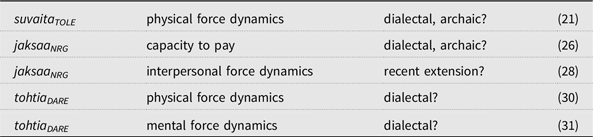
It is possible that in contemporary Finnish, language standardisation, shaping the lexical and grammatical system for a more formal usage, has pushed these verbs towards clearer mutual distinction and more fixed and impermeably limited meaning potential. There are signs of these processes in other semantically vague modal verb forms in Swedish, Finnish, and Danish (see Viberg Reference Viberg2012:1427, Peltola Reference Peltola2016:710, Gregersen Reference Gregersen, Jensen and Schack2024).
Hypothesis 3, The metaphor of ecology allows us to highlight the coalescence among VoAs in multiple ways without the limitations of a chain-like configuration, was confirmed. While a linear representation offers the benefit of exposing efficiently the different lexical twists of ‘possibility’ and ‘sufficiency’, the ecology model brings to the surface the interfaces between linearly non-neighbouring categories, parallel patterns between verbs with distinct specialisations, as well as dynamics internal to verb groups and on the interfaces of categories.
It should be noted that the aim of the ecology model is not to provide a tool for detecting the links and mutual order between constructions, as with the network models (e.g. Diessel Reference Diessel2019, Hilpert Reference Hilpert2025:30). It represents the cohabitation between linguistic units of a given language form within a semantic landscape and makes manifest the multiple kinds of conceptualised interactions between living entities and their environment that shape the particular niche of each linguistic item and that hold together this constellation.
Approaching VoAs as forming a whole where the conceptual force dynamics of ability is combined with a lexical component that specifies the type of force interaction suggests that these verbs are hardly semi-lexical or semi-modal from a semantic perspective. They are full expressions of ability with an additional semantic layer allowing them to generate fine-grained distinctions describing the rich array of interactions between living beings and their surroundings. We therefore propose that the semantic notion of ability is best described as a complex assemblage of related meanings underlain by the more general ground of dynamic modality (elsewhere giving rise also to necessive meanings such as physical, mental, or social needs), rather than a category at the periphery of which items such as VoAs are to be located. Ability verbs carrying a rich lexical meaning layer in their semantic structure allow us to better comprehend the embodied roots of the modal meaning of ability than the more generic modal verbs and constructions (‘can’, ‘be able to’). Cross-linguistically, it is interesting that in languages such as Finnish, this complex meaning is lexicalised with such subtle variations.
4. Conclusion
In this paper, we have aimed to provide a grammatical description of a selection of verbs of ability in Finnish, highlighting the embodied, force-dynamic origins of their meaning structure, as well as their cohabitation within the modal realm of ability. We first compared complementation patterns, person marking, and negative affinity in these VoAs. We then observed the lexical semantic component and the uses of each verb, in terms of the specific types of conceptual forces that are mapped onto the underlying force-dynamic pattern. We draw connections between the grammatical differences we had detected and the overall force-dynamic analysis of the modal meaning of ability. We observed correlations between experience-based ability, non-specific person marking, and physical force dynamics, as well as negative affinity, auxiliary-likeness, and mental force dynamics with an underlying conceptual schema of splitting. These tendencies were related to the different degrees of specificity in the lexical meaning of the studied verbs. We suggest that this complexity and dynamicity within the system of Finnish ability verbs is best illustrated through the metaphor of ecology, which also highlights the embodied roots and the multilayered nature inherent to the modal meaning of ability.
Acknowledgements
The authors are grateful to the three anonymous NJL reviewers for their careful reading and insightful suggestions. A previous version of the paper was presented at the workshop on The concept of possibility and its morphological, syntactic and pragmatic realisations in natural language organised by Patrick Duffley and Olivier Duplâtre at the 57th Annual Meeting of the Societas Linguistica Europaea, in Helsinki, in August 2024. We would like to thank the workshop organisers and participants for their valuable feedback. The research was funded by the University of Caen International Partner Laboratory Living Semantics – La sémantique du vivant.
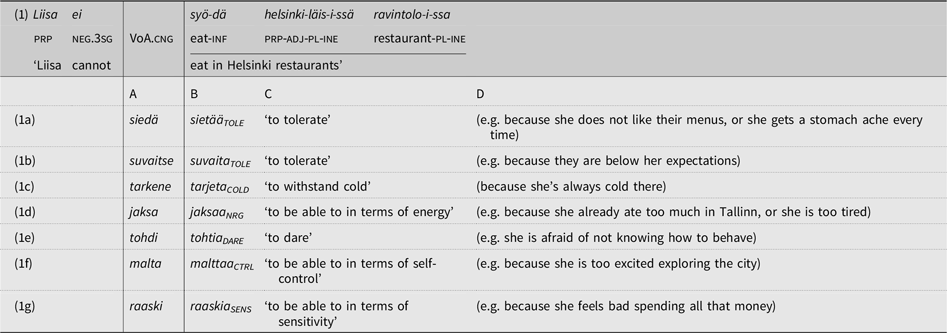
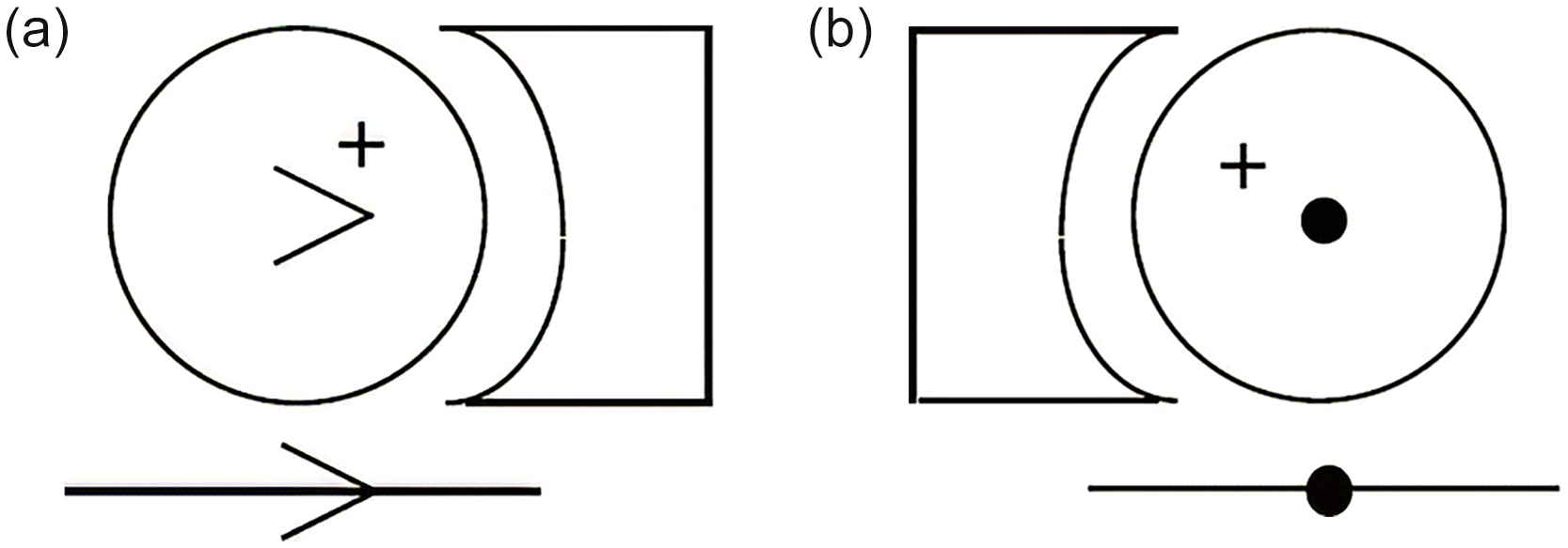
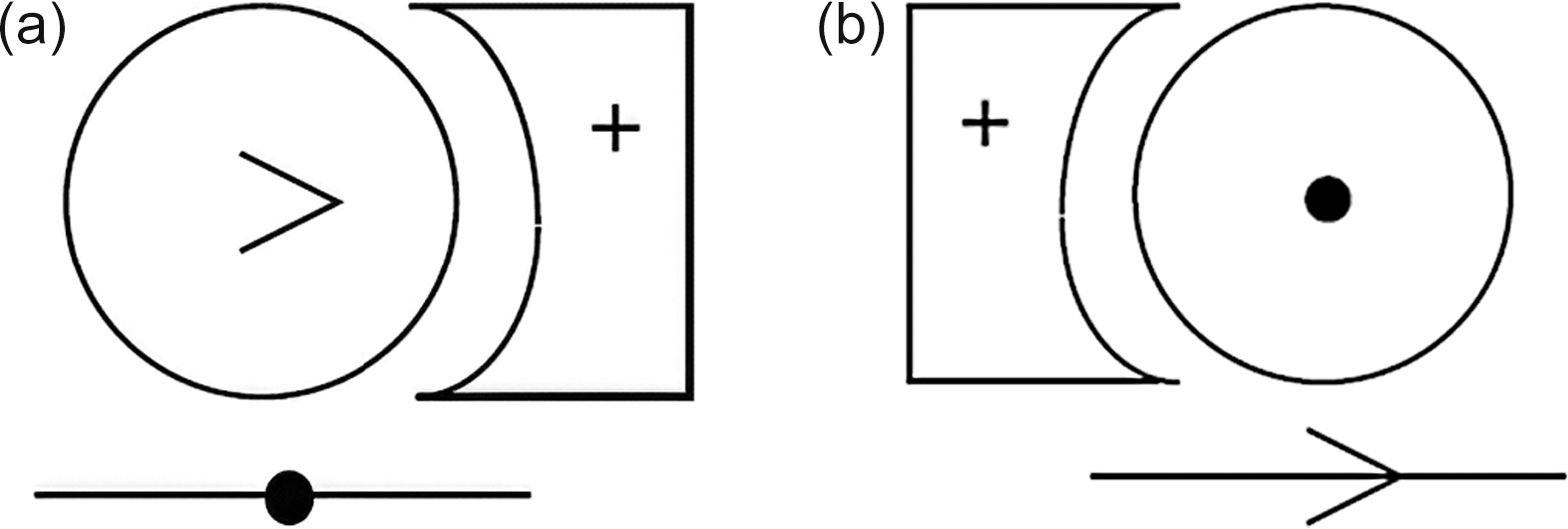
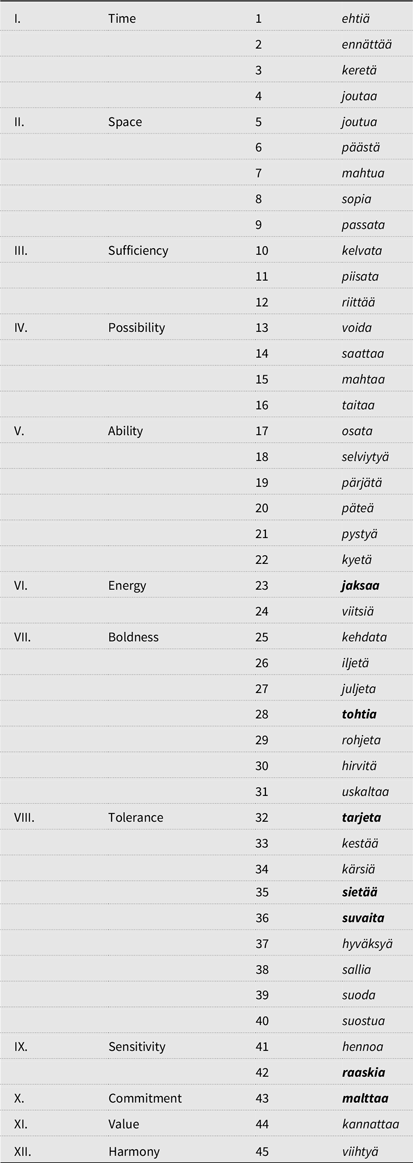
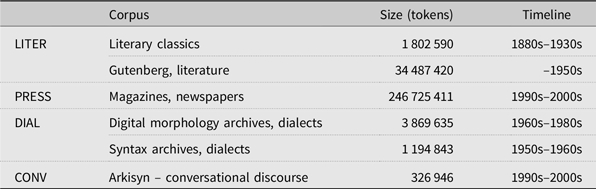
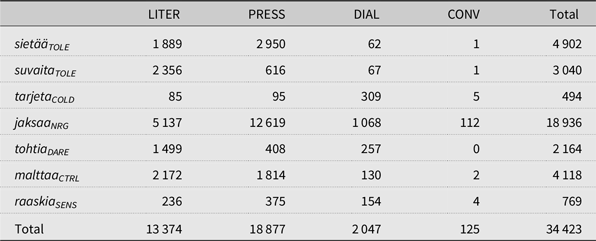
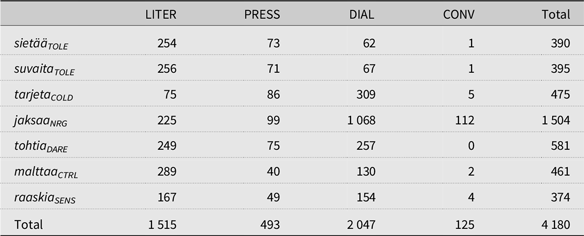

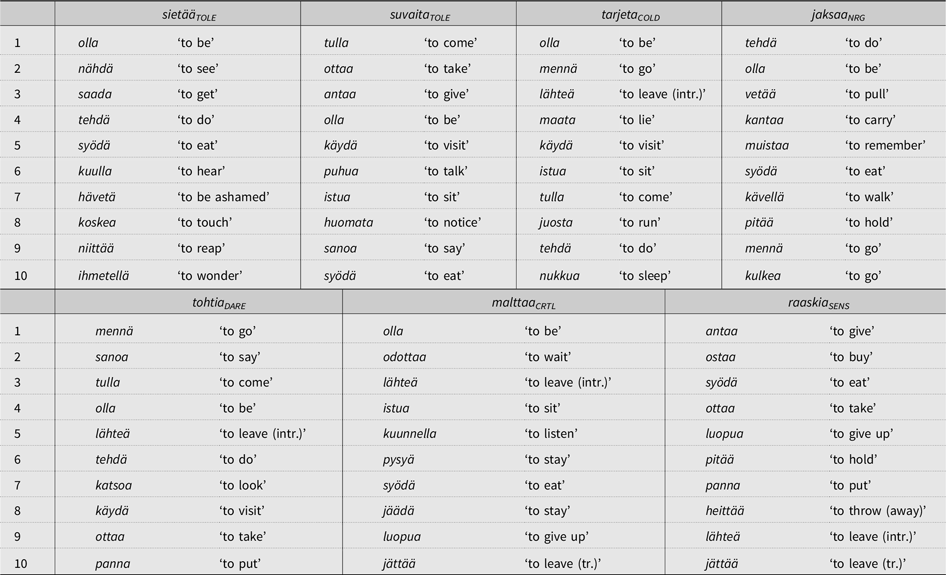
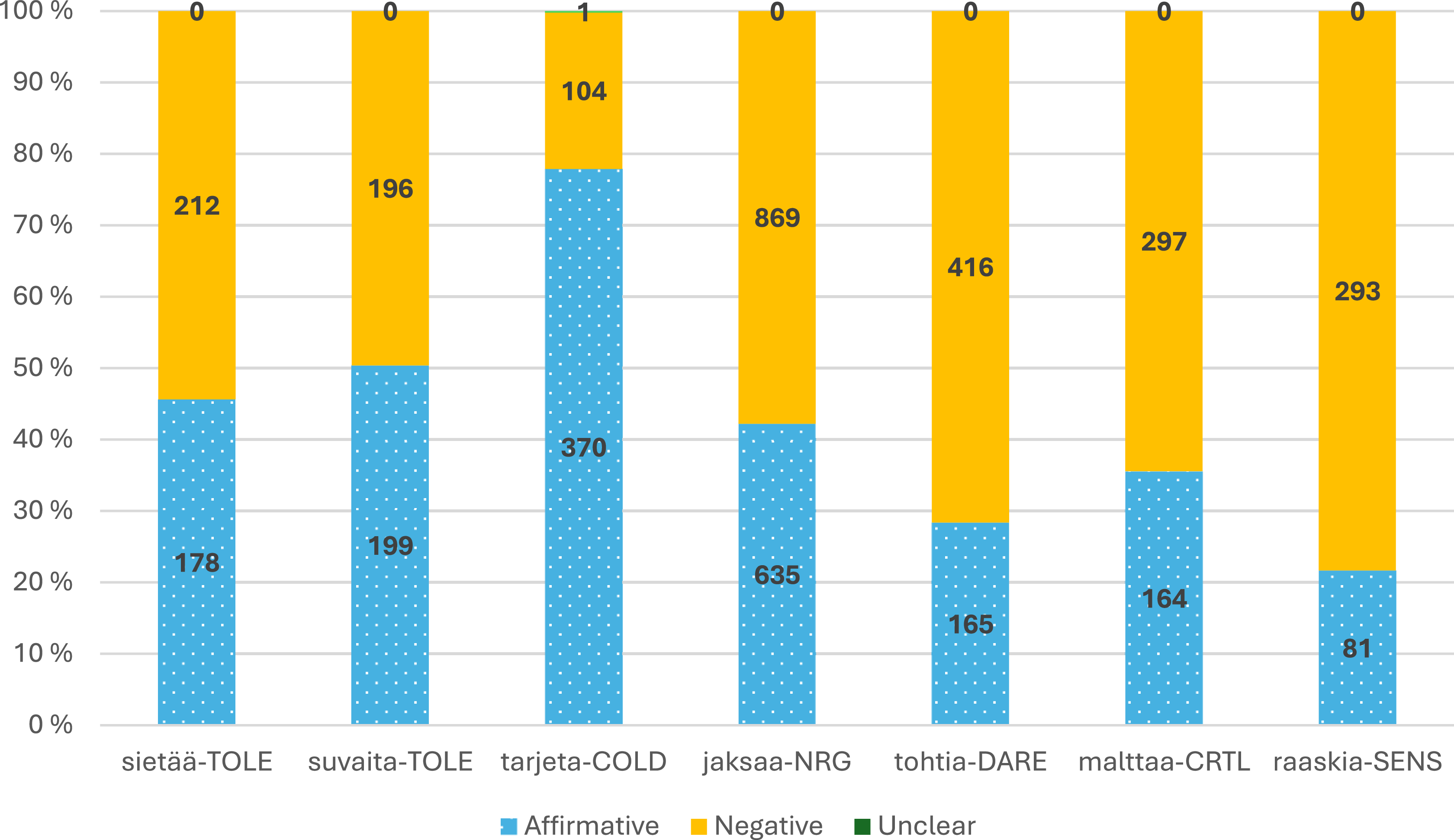
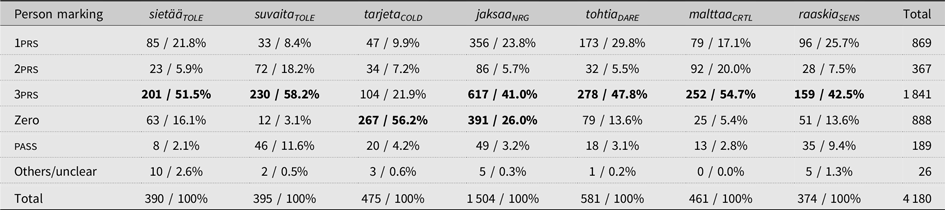
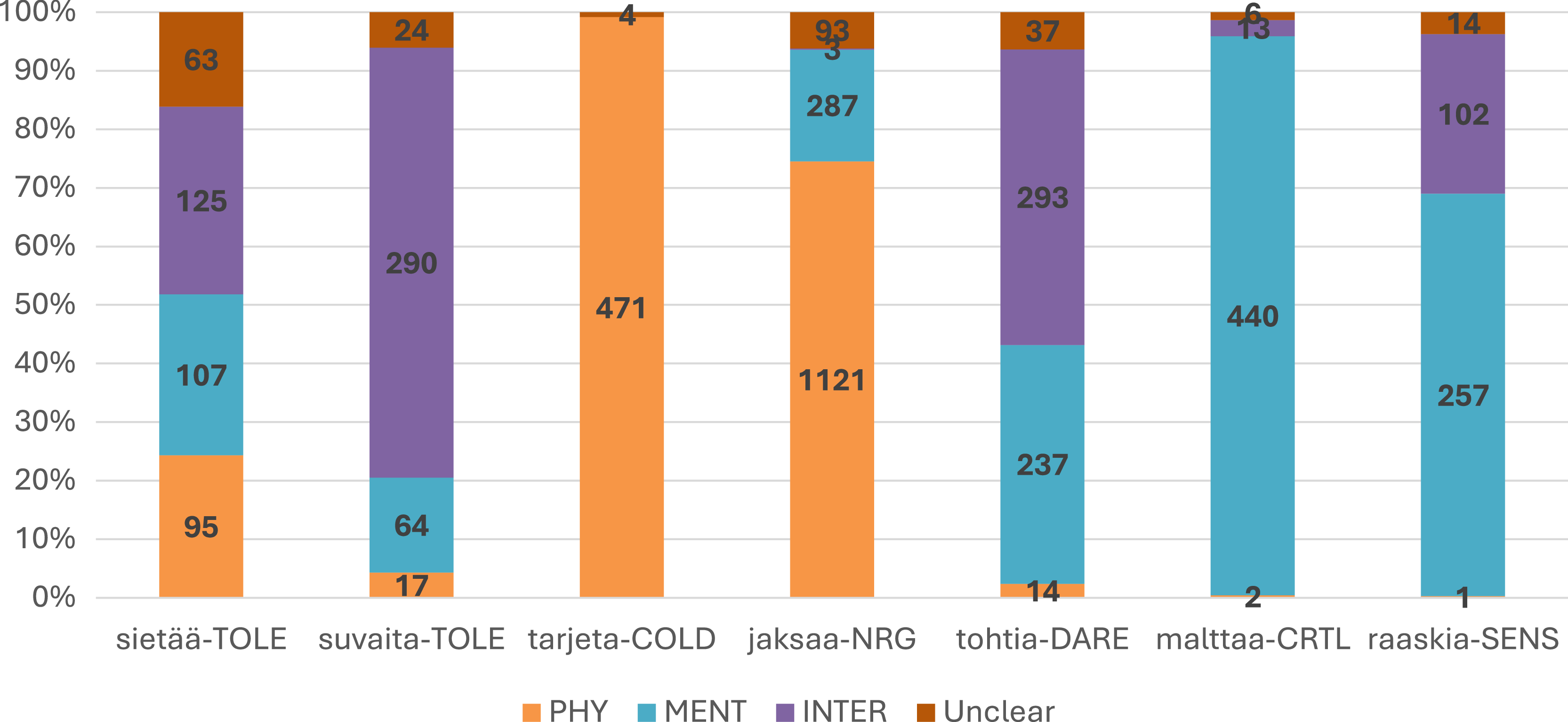
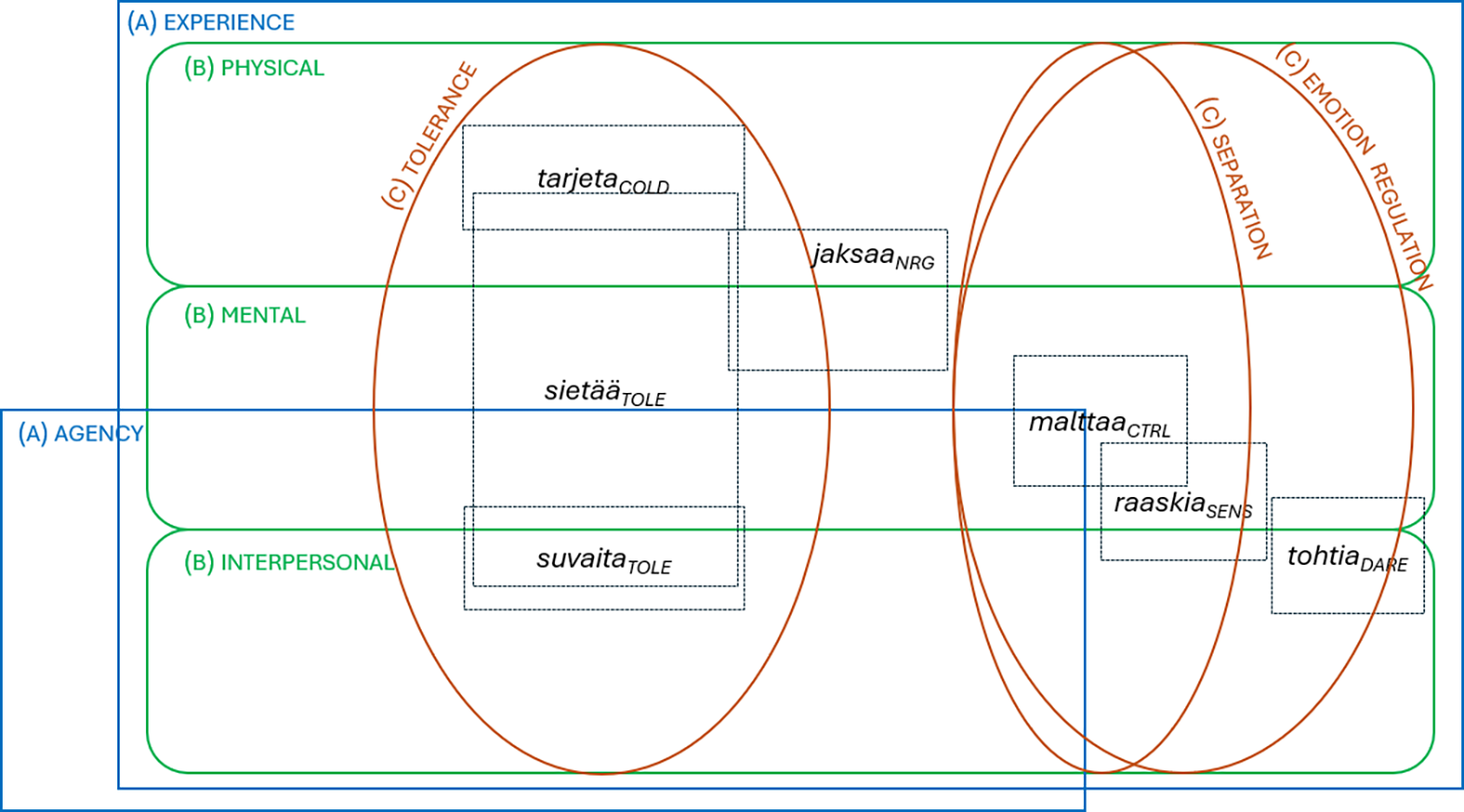
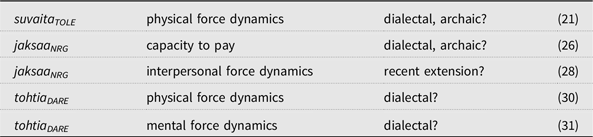

 Open access

