




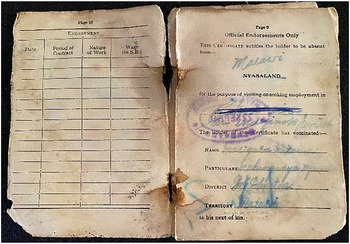
On 6 July 1964, Alabi Mitawa transformed from a British colonial subject into a Malawian citizen with political rights. Four weeks later, he approached his new government’s bureaucrats to solicit a small, life-changing booklet.Footnote 1 Twenty-year-old Mitawa had convinced his new bride to overcome her fears and bless his enrolment in a labour migration programme that would send him to do dangerous work in the mines of South Africa for two years. To enrol, he followed the same procedure as he would have under British rule. First, he secured the permission of his local ‘Native Authority’, Mponda, whose role in colonial ‘indirect rule’—the British system of delegating some authority to local headmen—continued into post-colonial times.Footnote 2 Mponda certified that Mitawa’s wife and child would be provided for, and, most importantly, that he had no outstanding tax obligations. Permission in hand, Mitawa set out for the government’s district office in Fort Johnston to acquire his official identification certificate, which gave him legal permission to sign a boilerplate contract facilitated by the Witwatersrand Native Labour Association (WNLA), the recruitment arm of South Africa’s Chamber of Mines. For the first few years of independence, the identification booklets still had ‘Nyasaland’ printed on their front covers; officials crossed the colony’s name out with a pen to replace it with ‘Malawi’ (see Figure 1).Footnote 3
Alabi Mitawa’s 1966 identity booklet. Matchona, accessed 3 May 2026, https://www.matchona.org/items/mitawa_001.html.

Mitawa’s navigation of these procedures was not unique to his immediately post-colonial context. Concurrently in the 1960s, a Spanish day labourer from the Valencian town of Sueca also needed local permission to enrol in an official labour migration programme governed by a bilateral agreement. Rather than mine gold, he signed up to plant, cultivate, and harvest rice in southern France. Yet Sueca’s local authority over such matters, a man named Flores, displayed no regard for fairness or communal obligations and used French labour contracts to further entrench the Franco regime’s power, breaking up established work crews and replacing individual workers with others as a political favour.Footnote 4 The anger that Sueca’s would-be migrants felt towards Flores was shared across the Atlantic in Luís Moya, a village in the Mexican state of Zacatecas. Workers from the village protested to Mexico’s president in 1960 that their municipal mayor was enriching himself personally by selling local permission for participation in the Mexico–US labour migration programme, known as the Bracero Programme.Footnote 5
The Malawian, Spanish, and Mexican men would never meet. Yet, this article places them in a single narrative to make two interrelated arguments about ‘temporary’ labour recruitment programmes—which would eventually be called ‘guest worker’ programmes—in the twentieth century.Footnote 6 First, I utilize sources generated by state, industry, and other institutional actors to show that the bilateral labour migration agreements that changed the lives of these men and their families in the 1960s emerged not just from common economic conditions but also a common, multi-directional policy conversation. As a result, they led to convergences in key aspects of how recruitment actually worked—but also important differences between industry-led models inherited from colonial contexts and state-led models developed between nation-states.
Second, I show how the nation-state model’s reliance on the unwritten principle of migrant citizenship—the idea that national governments had both a sovereign right to further national priorities by exercising control over their migrant citizens’ recruitment, and a natural inclination to protect those citizens’ labour and well-being—led to migrants’ disillusionment and frustration with their states.Footnote 7 This article does not seek to determine which programme structures generated objectively ‘better’ outcomes for migrants. I do, however, look to migrant-generated sources to show how, from their subjective perspectives, the more steps in the process their own states (as opposed to recruiting states or industries) controlled, the more they came to perceive their own national governments as the most significant barriers to their own progress, dignity, and autonomy.Footnote 8
This approach, connecting historical processes across borders and oceans but also scales of the personal, the community, the national or colonial, and the international, offers one response to essays and fora in which scholars have called upon global history to move beyond the focus on ‘structure at the expense of agency’ and the sublimation of individual stories to grand narratives.Footnote 9 Demonstrating how a ‘marriage’ of global and local scales can be implemented in practice, the first sections of this article depict an entangled history in which policy conversations among nation-states, colonies, indigenous polities, and international institutions shaped approaches to managing labour migration via processes of multi-directional influence.Footnote 10 The latter sections then assemble individual and community experiences across continents, as read in migrant-generated sources, to construct a new narrative about the relationship between migration and sending-state citizenship under the aegis of bilateral migration agreements.
This methodology both builds upon and innovates from existing global labour and migration histories. To date, such histories have offered a global structural analysis of phenomena such as labour organization and class formation.Footnote 11 Within migration history, this has included global histories of ‘guest workers’.Footnote 12 Others have showed the ricochet of policy concepts such as border governance, the passport, and the ‘refugee’ among empires and nations.Footnote 13 ‘Reflexive’ migration studies, which critically interrogates state-created terminology such as ‘refugee’ and ‘guest worker’, contributes to this line of work and to my own approach.Footnote 14 Finally, scholars connecting migrant experiences across continents have organized their studies around a single industry such as gold mining, or a diaspora such as Italians or Chinese.Footnote 15
This article explores a shared genre of migrant experience shaped by a specific, globalized instrument of migration policy: the bilateral labour migration agreement. The analysis ‘marries’ multiple scales of analysis via close examination of three case studies—one from each of the continental regions (North America, Western Europe, and southern Africa) where recruited migrants of the post-war ‘thirty glorious years’ included not just colonial subjects but national citizens. While the continent best known for such programmes today is Asia, post-colonial labour export did not commence there until the late 1970s.Footnote 16
The three cases—migration from Spain to France, Mexico to the United States, and Nyasaland/Malawi to South Africa, together permit an examination of the human experience of bilateral agreement structures in some of the most significant cases on their respective continents and across a range of political circumstances. They juxtapose a conservative dictatorship (Spain); a worker-friendly corporatist regime with broad popular support but profound vulnerabilities (Mexico); and, in the years of this article’s focus, a new African nation (Malawi) incorporating explicitly colonial practices into its post-colonial state. France was the first country in industrialized Europe to negotiate bilateral labour migration treaties, and its leaders did so with countries on Europe’s periphery—particularly Italy, Spain, Portugal, and Poland. Among them, Spain was by far France’s most significant single supplier of seasonal and temporary workers over the ‘thirty glorious years’, following the liberal Spanish Republic’s bilateral labour migration agreement with France in 1932 and the conservative Franco dictatorship’s revival of intergovernmental cooperation in the 1950s and signing of a new agreement in 1961.Footnote 17 In North America, the Mexico–US Bracero Programme’s 4.6 million labour contracts from 1942 to 1964 made it the premier US recruitment effort of its era notwithstanding parallel programmes bringing workers from the Caribbean.Footnote 18 And in southern Africa, Malawi became—after its independence in 1964—the only case in sub-Saharan Africa, and the most numerically significant case globally, of a colonial labour recruitment programme (first started in 1936) seamlessly continuing and even expanding immediately following decolonization.Footnote 19 The case of post-colonial Malawi thus allows us see to where migrant experiences converged or diverged in programmes designed on colonial versus nation-state models.
To be sure, these three cases do not present a full typology of migrant citizens recruited as temporary workers during the mid-twentieth century. Nonetheless, focusing in-depth on one case study per continental region enables me to adopt a multi-scalar approach that a larger number of case studies would have precluded. In addition to sources generated by states and international institutions, my close focus on three cases enables me to analyse migrant-generated sources, notably oral histories as well as archived letters and petitions. The oral history interviews from which I draw evidence were conducted between twenty and fifty years after the migrations in question. While their emotional registers are surely coloured by the intervening decades, the prevalence of a particular set of narratives in each group of interviews sheds critical light on the ways that post-war migrant labourers came to interpret their experiences, both individually and communally.Footnote 20 Meanwhile, migrants’ letters to state officials articulated the rights they believed themselves entitled to claim, and the responsibilities they believed their states had to them.Footnote 21 Taken together, the simultaneous reading of institutional and migrant-generated sources allows us to trace how globalizing ideas as implemented by diverse states and elites generated resonant individual and communal experiences of citizenship across continents.
In the pages that follow, I begin by offering a deeper history of the bilateral labour migration agreement as a tool of governance in continental Europe and colonized Africa, exploring the multiple strands of population theory, abolitionism, and industrialization that led to its nineteenth-century development. I then show how both the International Labour Organization (ILO) and the government of Italy seized on the idea in the interwar years, turning it into a model practice that Mexican actors imported to North America. Now zooming in to the three cases in question, I show how agreements signed between nation-states from 1930s to 1950s left the migrants’ home states in charge of significant portions of the formal recruitment process, while colonial Nyasaland’s agreement—the template for its post-colonial version—rested on an ILO-approved model of industry-led recruitment with a long list of specific standards. The final three sections of the article read migrant-generated sources to interrogate the implications of these systems for migrants’ perceptions of their relationship to their own states. They focus on the first three steps in the process, which occurred within those states’ sovereign territory: local permission for migration; health screening; and transportation to the border.
Labour recruitment and bilateral agreements at the dawn of industrialization
Bilateral labour migration agreements first emerged in the nineteenth century, with roots in the economic conditions of industrialization and colonialism as well as shifting ideas about population, mobility, and freedom. Through the early 1800s, the mercantilist credo of French writer Jean Bodin, ‘there is no strength or riches like that of men’, held sway around the European-influenced world as governments of all stripes sought to stop would-be emigrants from leaving. The indigenous polities they encountered in Africa, also faced with populations insufficient to meet labour needs, incorporated enslaved and other forms of compulsory labour into systems of war, tribute, and protection; they, too, restricted their subjects’ ability to leave.Footnote 22
By the late nineteenth century, both sets of rulers would face pressures to reconsider their restrictionist positions. Unequal industrialization dramatically increased demands for labour in specific locations on every inhabited continent including Africa. In the age of abolition, Europeans recruiting labourers in Africa and China sought to do so in ways recognizable as ‘free’ rather than ‘unfree’. And within Europe, dramatic population growth and Malthusian ideas about the limitations of food supply opened some rulers to the possibility of their citizens’ recruitment for labour elsewhere.Footnote 23
The earliest record of modern bilateral labour migration agreements is in Africa, as European colonial governments sought to reconcile their labour needs with evolving abolitionist norms while African leaders sought to benefit from their cooperation with recruitment. Beginning in the early 1800s, European authorities seeking to develop colonial industries and infrastructures negotiated with African political leaders to recruit labourers who would receive a wage from their employers but who, in practice, were enslaved by their African rulers; the latter received monetary compensation for their cooperation. The practice grew slowly during the nineteenth century and evolved as abolitionist ideas expanded to condemn not just formal slavery, but slave-like conditions. These ideas, which influenced recruitment practices from both Africa and China, held that the ‘voluntariness’ that could distinguish legitimate labour recruitment from slavery would not be defined by the migrant himself, but rather, by a set of regulations ideally guaranteed by a state. In 1879, France signed a new labour treaty with the Wolof state of Kajoor that, for the first time, incorporated broad guarantees for workers—not just a high minimum wage, but also fresh water and food rations—two decades before any such guarantee appeared in European migration treaties.Footnote 24
As European colonialism expanded in Africa at the end of the nineteenth century, now colonial governments, rather than African rulers, negotiated treaties to control labour emigration. French, British, and Belgian colonial authorities signed bilateral agreements to recruit each other’s subjects while guaranteeing wages and other minimum conditions such as repatriation at the end of the work contract and medical care while on the job.Footnote 25 These treaties responded to the dual imperatives of protecting one’s own labour supply while, for those who did the recruiting, ensuring that the practice would not bear the stink of slave labour.
The very first labour migration agreement between the colonial governments that would later become Malawi and South Africa was signed in this context. Immediately after the British bested the Afrikaner Boer Republics to take control over the southern African Transvaal in 1902, its Chamber of Mines negotiated a bilateral labour recruitment agreement with the government of British Central Africa (BCA), an earlier name for Nyasaland. BCA’s was one of just two positive responses to enquiries for labour that the Chamber of Mines initiated to ten colonies in addition to Ethiopia.Footnote 26 In the stronger bargaining position, BCA demanded for its subjects a long list of rights and conditions that, in theory, far exceeded those of the vast majority of manual labourers worldwide at the time. The agreement bound the mines to pay for workers’ transportation, health care, and clothing, and to conduct medical inspections to ensure their fitness for the work. It guaranteed a minimum wage of 30 shillings a month—about eight times the typical manual labour wage they could expect closer to home—and specified maximum work hours and even Sundays off.Footnote 27 BCA authorities benefited too: mine owners agreed to pay the colony itself a fee for each man, pay the men’s ‘hut taxes’ on their behalf, and withhold three-quarters of their wages to be forwarded to workers upon their return, where they would spend it in the colonial economy.Footnote 28
These abundant written protections meant little in practice, and the agreement did not last long. More than 10 per cent of the initial group of 380 miners died of disease or accidents, and twice as many returned home with permanent disabilities.Footnote 29 In 1913, South African legislators concerned about high mine labour death rates from ‘Tropical Areas’—a term coined to deflect blame from the mines’ conditions to the men themselves—banned official recruitment north of 22 degrees latitude, including northern Mozambique and all of the colony now called Nyasaland.Footnote 30
Even as European colonial governments sought to control transborder labour recruitment in nineteenth-century Africa, they affirmed a laissez-faire approach on their own continent.Footnote 31 In the early twentieth century, Belgians, Spaniards, Poles, and Italians crossed nearby borders without government intervention to jobs in agriculture, factories, metallurgy, and mining in France, Switzerland, and Prussia/Germany.Footnote 32 Employers mostly recruited through the social networks of the immigrants themselves, or else through private agents.Footnote 33 Occasional deportation campaigns placated nativists, and the Prussians instituted a tightly regulated system of identity cards for Polish temporary workers.Footnote 34 But overall, labour-hungry European recruiting states generally remained at the sidelines during the nineteenth century.Footnote 35
Italy led the way as the first European nation-state in the twentieth century to allow recruitment within its borders only under negotiated conditions—as Chinese, indigenous African, and European colonial governments had already done over the previous decades. In 1901, Italy’s government created a new office charged with regulating foreign worker recruitment and stopping it altogether if recruiting countries did not offer Italians decent conditions.Footnote 36 Using this increased control over out-migration as leverage, in 1904 Italian officials pushed their French counterparts to sign a bilateral migration control agreement—the first between two modern nation-states.Footnote 37
France and Italy’s agreements responded both to internal political motivations and to the decade’s logic of bringing migration matters into the emerging regime of international law; the principles underlying the agreements therefore differed from the African colonial and abolitionist model.Footnote 38 Italy drove the process initially, but the French hoped that Italian cooperation would make recruiting more prolific. Rather than concrete guarantees of specific wage rates, medical care or transportation conditions, as the African agreements specified, French labour unions fearing unfair competition insisted that the treaties give migrant workers simple, blanket guarantees of ‘equality of treatment’ with domestic workers for wages, conditions, and/or social insurance. Meanwhile, Italy demanded a leading role in facilitating recruitment and defending its migrant citizens’ rights. First World War labour demand pushed France to sign an even more robust agreement with Poland on a similar template, followed by Czechoslovakia.Footnote 39
Meanwhile, no such concept yet appeared in North America, where the uproar against Chinese migration had led to laws against ‘contracted’ labour immigration. The Mexico–US borderlands were sparsely populated when the United States conquered and integrated half of Mexico’s territory in 1848. Mexican migration to US jobs began in the late nineteenth century and continued into the early decades of the twentieth even as Asian, and later, southern and eastern European immigration became banned or restricted. The image of Mexicans as ‘birds of passage’ who would naturally return home left their migrations minimally regulated.Footnote 40 During the First World War, farmers pressured the US government to simply suspend normal immigration law in the face of wartime labour demands. The agency issued a circular requiring employers to register their workers with the government and pay for their transportation, but most did not comply.Footnote 41 And while the Mexican federal government nominally attempted to cooperate with US authorities in 1917–18, the two governments never negotiated nor signed a bilateral agreement.Footnote 42
From the Wolof West African states to Italy, from the British empire to post-revolutionary Mexico, societies facing labour recruitment in an era of economic growth and industrialization did not want to lose their populace. Yet seeing that they did not have the ability to prevent recruitment, some pushed instead for bilateral agreements. For their part, industrialized Europe and its administrators in Africa acceded to these demands in an effort to smooth international relations, grease the wheels of recruitment, and conform to abolitionist norms. Within a few years of the First World War, European governments in both Europe and Africa, as well as indigenous African rulers, had experimented with or committed to the bilateral agreement as a promising form of labour migration control.
Italy, the International Labour Organization, and the spread of the bilateral labour migration agreement during the interwar years
In the interwar years, these policy norms and conversations became entangled, then diffused across the Atlantic via two competing venues: the ILO, and a series of high-profile migration policy conferences sponsored by Italy’s Benito Mussolini.Footnote 43 Both Italy and the ILO had limited success creating binding international legal frameworks for transborder recruitment practices in the interwar years.Footnote 44 Yet in the fertile contexts of Progressive reform, unequal industrialization, population growth, and the solidification of the nation-state as Europe’s foremost political unit, Italy and the ILO’s efforts led to a new wave of bilateral labour migration agreements, effectively creating a new European policy common sense with growing influence in North America.Footnote 45 At the same time, prescriptions for colonial contexts continued to rely on abolitionist principles while those for nation-states foregrounded the protections of migrants’ citizenship in their home states alongside equality of treatment between foreign and citizen workers at their work sites.
Pressured by labour unions, the League of Nations created the ILO at the Treaty of Versailles in 1919 and charged it with establishing labour standards for all workers, including those working outside of their own country or colony.Footnote 46 In the 1920s, it created an International Emigration Commission tasked with improving conditions for European migrant workers, alongside a separate group, the Committee of Experts on Native Labour, to examine and improve the situation of ‘native’ (Asian and African) workers. Yet due to British fears that the European standards would end up limiting their action in colonial contexts too, British authorities stymied the ILO’s work.Footnote 47
Frustrated with the ILO’s lack of progress, Italy convened its own global conferences on ‘immigration and emigration’ in Rome in 1924 and Havana in 1928. The Rome conference received delegations from more than fifty countries; Mexican delegates were the most active non-European participants. As Mexican migration to the United States increased during the 1920s, post-revolutionary Mexican politicians and intellectuals from Mexico City to San Antonio to Paris ‘discovered’ Italian migration control policies, via the Italian-sponsored conferences and other channels, and proposed that Mexico emulate them. From 1927 onward, they even began to propose the specific form of the France–Italy bilateral migration agreement as a model Mexico and the United States should follow. Yet the United States remained aloof from both the ILO and Italian-sponsored efforts, and Mexico did not push the issue in the 1920s.Footnote 48
Under pressure from Italy and other labour-exporting European countries, in the face of migrants’ vulnerability during the Depression, and in pursuit of its mission to safeguard European standards for ‘free’ labour, the ILO spent the 1930s debating a series of conventions to establish international standards for transborder migrant labour recruitment on parallel colonial and nation-state tracks.Footnote 49 Signatories to these conventions would commit to regulating and supervising labour migration accordingly; in practice, this would occur via bilateral agreements. In 1930, ILO delegates approved a convention that tried to eliminate colonial forced labour, and in 1935 they began to debate one that would govern the ‘recruiting of labour in colonies and in other territories with analogous labour conditions’ more broadly. Attempts by an Indian delegate to apply some of the nation-state principles to colonial contexts failed, and the two efforts remained formally discrete, despite being discussed by the same delegates at the same meetings.Footnote 50
Just one day after the 1935 ILO delegates finished debating the ‘recruiting of labour in colonies’, they began discussing conventions that would protect ‘migrant’ labourers, understood to be Europeans, via the articulation of ‘equality of treatment’ at work sites and the assumption of the value of workers’ citizenship when under the sovereignty of their home countries. This work would culminate in 1939 with a broad convention on ‘Migration for Employment’, Convention 66. Unlike colonial rulers, migrants’ home governments were presumed capable and interested in applying reasonable standards to the steps of the process they controlled; then, once across the border, migrants would benefit from the recruiting country’s entire suite of labour standards. As a result, Convention 66 remained brief, with few specific guarantees.
On the separate colonial track, the ILO passed Convention 50 in 1936 and Convention 64 in 1939 creating a long list of standards—but no guarantees of equality—for the recruitment of ‘Indigenous Workers’.Footnote 51 First, they banned the long-standing practice of African chiefs operating as labour recruiters for colonial enterprises and presumed that employers and their associations, operating under licences from migrants’ colonies, would take their place.Footnote 52 These capitalists, in turn, would follow delineated procedures that included bureaucratic supervision to ensure that labourers entered into contracts freely; multiple medical examinations to be sure workers were healthy enough for the journey and the job; specific conditions for transportation; and much more.Footnote 53 These long and detailed lists sought to protect workers from exploitation by their employers even as guarantees of equality were deliberately avoided.
The interwar ILO discussions, alongside those at the Italian-sponsored conferences, yielded few legal accomplishments yet served as critical sites for the development of international conversations about the regulation of labour migration—with concrete effects in the subsequent proliferation of bilateral agreements. The United Kingdom was the only European colonial power to ratify Conventions 50 and 64, while the start of the Second World War meant that Convention 66 was never ratified at all.Footnote 54 Yet while the United States displayed total indifference to Convention 66, Mexico’s future Secretary of State served on its steering committee—one of many ways the country’s postrevolutionary government participated eagerly in interwar European conversations about labour migration regulation.Footnote 55 In response to the Italian conferences and ILO conventions, the practice of signing bilateral labour migration agreements to commit to specific recruitment and employment principles expanded between South Africa and its neighbours, and also amongst more European governments including, for the first time in 1923, Germany (with Lithuania, then Poland, Czechoslovakia, and Italy).Footnote 56
Thus, by the start of the Second World War, the bilateral labour migration agreement creating principles for the orderly recruitment, transportation, and employment of workers across borders had emerged in Africa and Europe as a standard tool of modern governance—and one investigated and admired by Mexico’s political class. Building on nineteenth-century abolitionist roots, models for colonial contexts presumed that industry would undertake the work of recruiting, beholden to carefully delineated standards and licensed by the colonies whose workers were being recruited. Building on twentieth-century Italian and French practices, models for nation-states relied on migrants’ status as citizens of sovereign states alongside guarantees of equality of treatment at their worksites. Despite key differences, the two separate sets of official conventions and informal policy conversations promoted a common vision that intergovernmental cooperation and shared control between labour-exporting and labour-importing governments would benefit a variety of stakeholders, including migrant workers themselves.
A transatlantic idea put into practice
The bilateral labour migration agreements signed in the 1930s to the 1960s between Spain and France, Nyasaland and South Africa, and Mexico and the United States participated in this global vision; so, too, did newly independent Malawi in 1965 when it made the decision, unique among post-colonial African nations, to renew and expand its labour migration agreement with apartheid South Africa. The agreements first signed between independent nation-states—Spain and France, and Mexico and the United States—each had a mix of responsibilities for the states involved, with comparatively little control directly ceded to the recruiting industries. In contrast, the colonial Nyasaland agreement with South Africa left South Africa’s Chamber of Mines in charge of most of the process, including within British colonial territory. When independent Malawi signed its own new agreements with WNLA and South Africa, its leaders kept that structure largely in place.
Mussolini’s 1924 Rome conference led to Spain’s first attempt, under conservative dictator Primo de Rivera, to negotiate a bilateral labour migration treaty with France, but the agreement was never completed.Footnote 57 Shortly after Rivera’s fall, the leaders of the Spanish Republic seized the opportunity to sign an agreement with France’s socialist Minister of Foreign Affairs in 1932. The agreement, like others France had begun to sign and that were touted in international fora, left the first layer of worker selection under full control of ‘the responsible administrative office in the country where it takes place’, in this case Spain, with final acceptance in the hands of French employers. Spanish workers were assured ‘equality of treatment’ with French workers for matters of salary, working conditions, healthcare, and accident and unemployment insurance.Footnote 58 A gushing Madrid newspaper editor described the abysmal state in which Spaniards in France had suffered in ‘legal no-man’s-land’ lacking protection from a bilateral agreement that other immigrants enjoyed. ‘Starting today’, he wrote, ‘these evils of labour migration are resolved in some cases completely, and in others at least dramatically reduced’—thus demonstrating the success of the Republic’s ‘modern’ governing style.Footnote 59
Meanwhile in South Africa, government bureaucrats studied the ILO’s work on ‘indigenous’ labour recruitment as their desperation for workers increased in the 1930s. Their mine labour woes were impervious to the global Depression; as the value of global currencies plummeted, investors decamped their wealth from banks and placed it instead in gold, leading to a surge in demand for South Africa’s main export.Footnote 60 The mining industry began to demand the right to reopen labour recruitment in the ‘tropical areas’, including Nyasaland, where recruitment had been prohibited since 1913.Footnote 61
Though the South African government did not ratify the relevant ILO conventions, its Chamber of Mines nonetheless paid careful attention to the ILO’s work when crafting its 1936 agreement with Nyasaland, claiming that ‘natives are engaged under conditions of employment conforming to ILO requirements’.Footnote 62 The programme’s structure indeed echoed ILO expectations. Nyasaland officially permitted WNLA to recruit within its borders, then placed requirements upon it: to perform medical inspections, advance workers a new set of clothing and a blanket for the journey (deducted from their future pay), inoculate them against pneumonia, and guarantee them food for the journey to South Africa.Footnote 63 If Spanish workers would have the benefit of citizenship in a nation-state to protect them in the recruitment process, Nyasa subjects would have instead a list of specific rules that industry recruiters must follow.
Five years later, the United States’ entry into the Second World War supercharged its growers’ demands for greater access to Mexican workers. Initially, growers sought a minimally regulated labour migration arrangement similar to what happened during the First World War.Footnote 64 Yet, aware of developments in Europe and at the ILO, some US government officials insisted on a bilateral agreement with rights and protections as the proper way to acquire labour while maintaining Good Neighbour relations with Mexico.Footnote 65 In May 1942, the US government put forward a proposal for a bilateral agreement, and Mexican President Manuel Avila Camacho convened a committee of government officials to consider the terms.
The Mexican officials who received the request moved in a political milieu that had spent two decades examining Italy’s emigration policies and bilateral agreements with France and participating in ILO negotiations over Convention 66, which set standards for labour migration among European nation-states. Notwithstanding their concerns about the exploitation of Mexican workers in the United States, they agreed to negotiate. The original US proposal to Mexico echoed the structure of emerging international norms for colonial contexts, with recruitment within Mexico to be conducted by licensed private recruiters held to specific standards.Footnote 66 But Mexican negotiators demanded and received instead the Convention 66 intra-European model: migrant citizenship before border crossing and equality of treatment afterwards. The Mexican government itself would implement the recruitment process, as well as transportation to the border at the employer’s expense.Footnote 67 Once in the United States, Mexicans’ wages and conditions would then be ‘the same as those paid for similar work’ to other workers in the same area.Footnote 68 The WNLA–Nyasaland agreement of 1936 and the Bracero agreement of 1942 created mechanisms for migration control that endured, even as they evolved, through the post-war expansion.
Meanwhile in Europe, Spain’s Civil War and then the Second World War disrupted the efforts at migration management that Spain and France had initiated with a bilateral agreement in 1932. France, desperate for workers to rebuild post-war, established the new Office National d’Immigration (ONI) in 1945 to recruit immigrant workers—under strict state auspices. Hoping to avoid dependence on labourers from France’s colonies, ONI quickly set about negotiating a new bilateral labour migration agreement with Italy—nearly a decade before its main competitor for labour, Germany, would begin to do the same.Footnote 69 Though ONI was eager to recruit Spanish workers too, Francisco Franco resisted the idea at first. Emigration was anathema to his isolationist nationalism; ‘all physical and intellectual strength’ was needed to build a new, more prosperous Spain. Yet by the 1950s, a new crop of technocratic economic advisers pushed him to consider the benefits of migrant remittances and the reduction in domestic unemployment that their exodus could accomplish.Footnote 70
Over the course of the early 1950s, Franco turned to cooperation with France—and, as with Mexico’s leaders, Italian practices provided what seemed like a workable model.Footnote 71 In 1956, Franco established the Instituto Español de Emigración (IEE), which would report directly to the President’s office, though it was later passed to the Ministry of Labour. Like the post-revolutionary Mexican political elites who took a risk on the Bracero Programme, the conservative Spanish intellectual who first proposed IEE had been inspired by Italy’s work maximizing the economic benefits of emigration.Footnote 72 IEE commenced administrative cooperation for labour recruitment with ONI later in 1956, and Spain and France signed a formal bilateral agreement in 1961. The agreement used the liberal Spanish Republic’s 1932 predecessor as its legal base to guarantee equality of treatment between immigrant and domestic workers but oversaw a far more sophisticated and centrally controlled recruitment structure than had been in place before the civil war.Footnote 73 Like that earlier version and similar to the Bracero agreement, it established Spanish control, rather than specific standards, as the guarantor of migrants’ rights in the phases of the process that took place within their own country.
Soon, independent Malawi would follow suit, but with results reflecting its distinct history. A year after its 1964 independence under the leadership of President Hastings Kumuzu Banda—himself a former migrant worker in South Africa—the new Minister of Labour signed an agreement with WNLA that retained the same structure as its colonial predecessor. While carefully avoiding the colonial term ‘recruitment’, Malawi permitted WNLA to ‘engage’ any Malawian man who ‘voluntarily’ presented himself at a Malawi government office to express his interest in a South African labour contract. The agreement contained a series of specific, ILO-conforming promises about WNLA’s obligation to transport, medically examine, feed, and house workers at its own expense.Footnote 74 Unlike Mexico and Spain’s insistence that their own officials were best positioned to supervise their citizens’ recruitment processes, Malawi followed its colonial precedent, continuing to permit private industry to conduct most pre-border processing. Yet other changes that came with independence—notably the establishment of one-party political rule and the nationalization of what had been a private railway system—would soon align key aspects of post-colonial recruitment with patterns visible in Mexico and Spain.
In all, the ‘thirty glorious years’ of post-war economic growth led not just to increased transborder labour recruitment, but based on interwar policy developments, increased intervention in the process on the part of both migrants’ and businesses’ states. The bilateral migration agreements signed on three different continents reflected this common logic of dual state control. Yet given their distinct roots, there were also significant differences in the content of the agreements: Malawi extended a regulation-heavy approach developed in an abolitionist framework for colonies, while Spain and Mexico built upon models for European nation-states that relied on migrant citizenship and equality of treatment. Still, common intellectual currents, political imperatives, and economic pressures generated some significant confluences in the actual experiences of recruited migrants on the three continents. While these distinct and common experiences occurred throughout the process of migration, labour, and return, the remainder of this article will utilize oral history and other migrant-generated sources to analyse three key dimensions where Spanish, Mexican, and post-colonial Malawian migrant citizens remained within the borders of their home states: emigration permission, migrant screening, and transportation to and across borders.Footnote 75
An entangled social history: Departing migrants
Bilateral agreements and ILO models for nation-states assigned migrants’ home governments to actually implement selection procedures. Those for colonies, in contrast, gave those governments the power to license private recruiters and hold them to specific standards. Minor clauses in both types of agreements noted too that these governments would provide migrants with basic identity documents. Yet both versions left it to migrants’ home governments to determine exactly who would implement the control they were afforded.Footnote 76 As rapidly growing population and expanding capitalism unevenly shifted long-held ideas about emigration globally, nationalist ideas about economic development conflicted with the lived local reality of workers’ mobility, exacerbating existing tensions between national and local authorities during decades when the former attempted to consolidate power.
In each of the three contexts, local officials initially resented emigration. In response, the Spanish, Mexican, and Nyasaland governments, continued by the Malawian after independence in 1964, each pursued a similar plan that appeared in none of their formal agreements: they would secure local officials’ support for migration programmes by delegating substantial authority to them in deciding who could or could not receive a contract. In all three places, the practice of delegating authority to local officials created an opening for corruption, political patronage, and/or extraction of money from migrants.
In Mexico, bribery of local officials to secure needed documents or a prized spot on lists of approved braceros was a near-ubiquitous experience both for those who succeeded in securing a contract and those that did not. A Mexico City newspaper reported in 1957 that up to 80 per cent of braceros had bribed somebody along the way to securing their contract, though this figure was certainly imprecise.Footnote 77 Héctor Solís Fuentes, for example, hailed from the small Mexican town of Estación de Apulco, Hidalgo. But his 1953 letter of local endorsement for the Bracero Programme came from the mayor of a nearby municipality, Acatlán. ‘We knew him, and so he did the letters for us’—in exchange for 600 pesos, Solís Fuentes recalled years later.Footnote 78 The mayor was able to charge a tidy sum for the contract because he alone controlled bracero recruitment in his town. Heleodoro Martínez Solís had irregularities in his required proof of military service, so he paid a bribe in 1951 to a nearby town’s official to fix the problem and arrange his local permission. ‘And he gave me the [fraudulent] letter, that I wasn’t abandoning any land, blah blah’, Martínez Solís recalled matter-of-factly in an interview.Footnote 79
While Mexican local officials in earlier decades often opposed emigration as a drain on local agricultural production and labour pools, now they quickly saw how being ‘the Bracero Programme’s ultimate power brokers within Mexico’, in the words of one historian, could boost their own political and economic fortunes.Footnote 80 Local officials enriched themselves through bribes, encouraged the political opposition to migrate to the United States, and secured loyalty. Gonzálo García and several other residents of the town of Luís Moya in the state of Zacatecas wrote directly to Mexico’s president in 1960 to protest this state of affairs. Describing themselves as ‘humble people’, they decried an ‘injustice’: the municipal mayor was selling the town’s limited allotment of contracts to men from faraway towns, while desperately poor locals like themselves lost out on opportunities they wanted and deserved.Footnote 81 If García and his compatriots chose to pursue migration on their own as a result, they were in good company.Footnote 82
In fascist Spain, the implementation of local control over labour migration was a means of consolidating the ruling Falange party’s political control—and enhancing the authority of local officials. Before Franco agreed to cooperate more actively with French labour recruitment efforts in 1956, local men in the Valencian town of Sueca organized their own work crews, received their labour contracts in the mail directly from bosses in France, and legalized their migrations via the closest French consulate. Aside from securing a passport, they had no need to interact with their own government along the way. They relished the ability to cross borders untouched by Franco’s foot soldiers.Footnote 83
With the establishment of the IEE in 1956 and the signing of a bilateral agreement with France in 1961, Franco gave local officials complete power to hand-select migrants—a setup that enabled abuse. The agreement between Spain and France stated that IEE would determine which provinces were priorities for labour recruitment, then gave Spain’s only legal labour union the authority to conduct an initial screening before presenting approved candidates to French officials.Footnote 84 In Sueca this meant that a local man named Flores gained personal control over recruitment. ‘He had his deals’, remembered one worker. ‘He had to stay in good stead with certain people.’ Under the wet, exhausting conditions of rice cultivation in France’s Camargue region, solidarity within work crews had been a critical source of comfort and enjoyment, but Flores replaced workers out of favour with those who had better demonstrated loyalty to the regime.
For Spanish men who aspired to work in the rice industry of southern France, Flores’s role came to represent all that was wrong with the Franco regime: a total grip on power that enabled the worst of corruption. More than a decade after their last labour contracts to France, Spanish men recalled how passionately they hated Flores. His assumption of control over the futures of Sueca’s migrant families marked the moment, for many, when a labour programme that somehow represented freedom became subsumed into the omnipresent weight of Franco’s authoritarianism.Footnote 85
Like their counterparts in Mexico and Spain, colonial Nyasaland’s governors came to appreciate the cash influx that labour migration could bring; like municipal officials in those countries, though, local chiefs found much to dislike. Labour recruitment unsettled their communities, introduced unwelcome South African wives, and turned ordinary men into comparatively wealthy show-offs who threatened chiefs’ authority. So, in 1950 in the context of global demands for decolonization, Nyasaland’s rulers utilized one of the few roles they had retained for themselves in the migration programme—that of issuing identity documents to aspiring migrants—to placate village headmen and designated ‘Native Authorities’, amid other reforms meant to offer more power to loyal Africans. Village headmen were now charged with verifying that the aspiring migrant did not have a criminal record and had arranged for his family to be cared for; bearing this endorsement, the man would proceed to the region’s officially designated African ‘Native Authority’ to affirm that his taxes were paid-up; then, the local colonial District Commissioner would weigh him and, provided his weight was acceptable, issue the coveted identity booklet. This procedure continued unchanged after independence, structuring the interactions of migrant citizens like Alabi Mitawa with their state.Footnote 86
In the new African nation, local control functioned primarily as a way to force men to pay their taxes. ‘First, he [the Traditional Authority] checked if you had paid full government taxes; if you did then he had no reason to refuse you’, recalled Mitawa in an oral history interview.Footnote 87 Nineteen-year-old Modify Mlelemba, however, did not have the money. ‘I ask you to explain to me in detail how I can travel to South Africa by Wenela’, Mlelemba wrote in English to his District Commissioner’s Labour office in Salima in 1967. ‘For others say I ought to pay tax first, for I am having no money to pay for. Please! I kindly ask you to help a poor young-boy aged 19 yrs as I. I only possess 1/6 for the District Councils tax! May I just pay the 1/6 only?’ Mlelemba hoped to earn a prized WNLA contract by demonstrating a good-faith effort to help fund his newly independent national government. But he received a negative response: without taxes paid up, there would be no identity booklet and hence, no contract.Footnote 88 Outright corruption was less prominent in colonial and post-colonial Malawi than in Mexico, yet the process still served to extract money from would-be migrants.Footnote 89
Officials facing transborder recruitment of their citizens and subjects had signed bilateral labour migration agreements in an attempt to exert some control over migration streams that had begun without their blessing. Ostensibly, their efforts would ensure that the loss of workforce would not cause undue harm to the nation. Yet in programmes with national and colonial origins alike, the common strategy of administering the first steps of the recruitment process at the local level—even if just to issue identity documents—gave local officials, mayors, and chiefs nearly unfettered power to demand bribes, political loyalty, and taxes from migrants. This infuriated many of those who sought autonomy and economic progress through migration.
Screening migrants
Once they had received the necessary paperwork from local officials, the timing of migrants’ transition from processes organized by their home state to those conducted by the recruiting government or industry reflected distinct histories. Mexico, Spain, and post-colonial Malawi all wanted control, but did not want to spend money. Mexico’s post-revolutionary nationalists claimed sovereign control over a complex centralized screening process occurring within their borders, while Spain’s fascist government deferred all medical screening to France. Malawi’s government, adhering largely to the colonial model even in the post-colonial years, left mining industry arm WNLA in charge. The three cases under consideration show that the more control migrants’ governments exerted over screening processes, the more their citizens came to resent them. Indeed, among the three cases under consideration, it was post-colonial Malawi’s minimal engagement that did the least to damage migrants’ relationship with their states—and Mexico’s nationalistic insistence on a larger role that left its migrant citizens most outraged.
Spain and Malawi’s models were essentially free to their respective governments. In Spain, official union representatives like Flores doled out migration contracts as part of their regular jobs; migrants’ main screening would occur at Spanish border towns with French personnel. And in Malawi, like its colonial predecessor, after local district offices granted identity booklets, they passed migrants directly into WNLA’s hands (and balance sheets) for a major screening deep within their sovereign country’s borders. Harry Ngumbalo, for example, recalled that ‘they used to keep us in that tall house’, the large WNLA depot in Mapanga, not far from the airport, where he—just like those who underwent the process earlier as British subjects—underwent humiliating medical examinations. ‘They were even touching us, our private parts, without respect’, he recalled bitterly. Yet at Mapanga, WNLA furnished his meals as well as a bed alongside other recruits in a cavernous dormitory.Footnote 90 Alabi Mitawa’s identity documents show that he completed the process there and was off to South Africa a mere fifteen days after he first got permission for WNLA recruitment from the local district office near his home.Footnote 91 Following independence, Malawian officials put themselves in charge of administering a parallel recruitment programme for non-WNLA employers, echoing the more robust state-centred practices of fellow nation-states like Mexico. But their screenings still depended on WNLA’s infrastructure, taking place alongside them at Mapanga.Footnote 92 In sum, Spain left medical screening to France rather than invest their own resources in it, and independent Malawi’s involvement expanded only minimally from the colonial, industry-led model.
The Mexican government, in contrast, oversaw centralized screening and selection—all while spending as little money as possible. The results were disastrous. In Malawi, profit-hungry WNLA invested in the Mapanga dormitory and workers’ meals to stay in good stead with ‘ILO standards’ and to keep its recruits—themselves an investment—healthy for the jobs ahead. In contrast, Mexican officials created a bare-bones infrastructure near existing train depots for screening, but not housing or feeding workers.
Braceros’ memories of Mexican processing centres regard the experience as a weeks-long hellscape. Liborio Santiago recounted in an interview the desperation he experienced when he joined thousands of braceros who spent weeks sleeping on the streets near the Empalme, Sonora bracero processing centre as he tried to edge his way into the programme.Footnote 93 ‘You slept like a dog next to a bench, a tree’, Santiago recalled. The intense desert heat of northern Mexico in late summer was the worst part of his experience.Footnote 94 Agustín González Flores, on the other hand, ‘shivered and shivered’ from cold and hunger as he slept on the streets of Chihuahua City awaiting his turn at the centre there. ‘It was sad and we suffered’, he remembered, adding, ‘you nearly died of anxiety’.Footnote 95
Once the screening process began for a particular man, agents of the Mexican state presented as extractive, invasive, and callous. The Mexican government’s stated goal for the centralized processing centres was to ensure that braceros hailed from regions and occupations that would further rather than undermine national goals for robust domestic industrial and agricultural production, and to screen out those with communicable diseases or who were otherwise too weak to proceed. In practice, however, contracts became, effectively, for sale.Footnote 96 Mexican officials inspected braceros’ hands for callouses to be sure they were truly agricultural workers, examined their teeth and mouths as well as their half-naked bodies, injected vaccinations, took fingerprints, snapped ID photos, and examined paperwork.Footnote 97 ‘If you had a hernia, you couldn’t pass’, recalled José Félix Prieto, a bracero who successfully passed his screening in 1959 before being sent to work in California. ‘Those people cried and cried.’Footnote 98 Required medical inspections cut against one of workers’ principal motivations for migration—autonomy. Migrants in all three contexts resented them bitterly. But only in Mexico did they endure them at the hands of their own government and in a state of homelessness.
Either way, while there is some evidence that success in the screening process became a point of pride and recognition for many braceros, oral history interviews reveal the Mexican processing centres as sites of disappointment, corruption, and humiliation.Footnote 99 The bilateral agreement between Mexico and the United States lacked specific regulations for this step of the process, relying instead on the faulty assumption that Mexican citizens would receive decent treatment at the hands of their own government. In contrast, their counterparts in Malawi recalled their experiences at the processing centre in more measured terms, directing anger about humiliating medical inspections not towards their own government, but rather, WNLA.
Moving migrants
After passing through screening processes that differed among the three locales, workers were transported to and across borders to their assigned jobs. While employers paid the bill for transportation in all three cases, Spain and Mexico’s claims to sovereignty within their borders handed them an irresistible opportunity: to bolster the finances of their national railways. Mexican and Spanish workers’ memories of the train journey are filled with emotions of shame, disgust, and anger. In contrast, colonial Nyasaland’s administrators had little stake in their colony’s expensive private railways, so after 1955 allowed WNLA to transport workers by air. Malawian memories of the air route feature feelings of pride and prestige at the opportunity to soar far above the earth. Independence would lead the three experiences to converge once President Banda nationalized his country’s railways—a vivid illustration that migrant citizenship could sometimes be worth very little to those who possessed it.
Across the board, recruiting employers and governments foot the bill for the migrants’ transportation even before they reached the international border—a practical convergence notwithstanding differences in expectations set by the ILO. Conventions on recruitment of ‘indigenous’ labour specified that employers would pay all transportation expenses, and listed expectations: ‘good sanitary condition’; ‘not overcrowded’; ‘rest camps or rest houses’.Footnote 100 In contrast, conventions that set norms for recruitment among European nation-states, including the post-war Convention 97 that was finally ratified by several European governments in the early 1950s, remained silent on the transportation question given their reliance on broader principles of migrant citizenship and equality of treatment.Footnote 101 In practice, all three bilateral agreements under consideration here obligated employers and their governments to pay—but offered no minimum standards.
Free of specific requirements and funded by the recruiting employers and governments, Mexican and Spanish authorities minimized expenditures to the benefit of state-owned railways. In Mexico, the lack of functioning bathrooms on the trains led men to urinate in tin cans or out the side of the train; occasionally one attempting to do so would fall out onto the tracks.Footnote 102 One US Department of Labour official lamented in 1957 that ‘something needs to be done’ about abject bracero transportation conditions in Mexico, yet ‘the matter is taken out of our hands’ given Mexican sovereignty over the matter.Footnote 103 Spanish national railroad train cars that transported workers from regional capitals to the French border often lacked water, electricity, and even seats despite the fact that journeys could last up to two days. Further, their unreliability could cause workers to miss their connection to employer pick-ups on the other side, sometimes even causing men to lose the jobs for which they had contracted in the first place.Footnote 104 US and French employers’ desire to receive healthy workers on an efficient timeline was apparently insufficient incentive for Mexico and Spain to ensure safe and comfortable transportation conditions; rather, they economized by transporting their citizens in railroad cars and conditions that had not been intended for human passengers.
In oral history interviews, Mexican and Spanish men recalled their hungry, crowded train rides with anger, distress, and the language of dehumanization. In the second century of railroad travel’s existence, scholars have considered how trains could expand passengers’ sense of space as they watched the world pass by at a new velocity and manner, or contract it by confining them to, in the words of one Africanist historian, ‘mobile incarceration’.Footnote 105 While Malawians actually travelled in locked train cars, it was Spanish and Mexican migrants who described experiences of painful constriction and violation on the journey. One Spanish rice worker recalled when 1,200 men packed into seven train cars caused a melee at a train switch in Barcelona. Spanish guards threatened them with the butts of their guns, taking them off the train like ‘livestock’ in a scene reminiscent of ‘those concentration camps you see on TV’.Footnote 106 And while braceros, unlike Malawian mineworkers, did not travel in locked cars, González Flores referred to the journey as being in a ‘cage’. Like many braceros, his group received no food on the half-day trip, which was marked by the nauseating smell of cow manure left behind from the boxcar’s previous cargo.Footnote 107 For these workers, treatment as criminals and animals by their own governments—the exact opposite of what their status as citizens should have garnered—generated feelings of shame and disgust.
In contrast, WNLA’s pursuit of speedy and reasonably well-fed migrant journeys not only allowed it to claim conformity with the ILO’s expectations for colonial contexts, but also became a key ‘symbiosis’ between the interests of migrant labourers and those of capital.Footnote 108 In Nyasaland, workers had long passed from the colonial government’s control into industry hands by the time they embarked on their journey to South Africa. Malawi and South Africa do not share a border and in the 1930s and 1940s the train trip took about a week, but did include planned stops for food and rest as prescribed by the ILO.Footnote 109 Nonetheless, the journey was uncomfortable and plagued with delays.
Yet mining industry arm WNLA, unlike the Mexican and Spanish governments, was not beholden to nationalized railways in the colonial years. Nyasaland’s railway was privately owned and expensive, so colonial bureaucrats offered no resistance when, in the early 1950s, WNLA officials began building airstrips in Nyasaland at their own expense.Footnote 110 Rather than depend on multiple railway systems to transport workers across southern Africa, WNLA alone controlled the air route, which delivered them workers faster, more reliably, and with less risk of men ‘skipping’ out to try their luck independently in Johannesburg.Footnote 111 By 1955, all of WNLA’s recruits in Nyasaland flew first from the colony to Francistown, Botswana, a central depot for WNLA’s recruitment throughout the region.Footnote 112 From Botswana they boarded locked and guarded trains for the twenty-four-hour ride to Johannesburg; they were given bread and one full meal along the way.Footnote 113
The air route not only served WNLA’s interest in transporting their workers efficiently, but it was also less onerous for recruited workers and delivered them substantial affective rewards by expanding their sense of personal mobility and status.Footnote 114 One worker back in Nyasaland wrote to his South African mine manager in 1953 that, ‘I was given four small airplane models when I arrived [home] at Mzimba. So many people asked me about travelling in the air, and I, without hesitation, told them that the only way of Nyasalanders to travel by air was to join the WNLA … Women are also urging their husbands to join up Wenela [WNLA] because every man who travelled by “Ndege” [airplane] was given these small airplane models, and their wives stick them on their dresses.’Footnote 115 Migrants’ experiences with their first plane flights resulted from WNLA’s capitalist incentives and was enabled by a colonial government. Yet it produced a set of journey narratives structured by excitement and opportunity, not constriction and dehumanization as for Mexicans and Spaniards.
After 1964, however, Malawian independence would once again consign newly minted migrant citizens to the slow train. President Banda nationalized Malawi’s railways and now required the migration programme to use them.Footnote 116 WNLA was displeased, inserting a clause into the 1967 bilateral agreement that ‘all migrant labour shall be transported by the direct air route as soon as the Government of Malawi finds it to be practicable’.Footnote 117 That time was, apparently, not to arrive. ‘Yes, straight by coal train slowly, hahaha’, recalled Macdonald Chiwaya of his journey in 1972. ‘Seven days to Joburg.’Footnote 118 Malawians valued their hard-won national independence in innumerable ways. But when it came to the details of the migration programme, their newfound citizenship made their journeys less comfortable and deprived them and their families of the social status they had once acquired via the plane journey to South Africa.
Conclusion: Entangled histories from above and below
As these examples show, workers moving within the structures of bilateral labour migration agreements in the post-war years experienced these programmes in ways that converged due to the underlying political and economic conditions of the post-war years, yet at times also diverged in ways structured by differences in the agreements’ origins and content. A methodology highlighting historical entanglement of migration policies on three continents shows how the agreements their governments had signed in the 1930s to the 1960s had all been shaped by shifting theories of population, nineteenth-century histories of colonialism and abolitionism, and twentieth-century transatlantic conversations facilitated by the government of Italy and the ILO. The resultant norms for bilateral labour migration agreements between European nation-states, later translated into the North American context by the Mexican negotiators of the Bracero Programme, relied on sending-state sovereignty as sufficient to protect migrant citizens in the early steps of the recruitment process and equality of treatment with domestic workers to protect them on the job. Colonial models, key aspects of which Malawi extended into the post-colonial period, relinquished sovereignty to the recruiting industry while applying to it a long list of specific standards.
Turning to archival and oral history evidence of worker experiences and narratives via case studies from Malawi, Mexico, and Spain, we can then see how the presumption that migrants’ citizenship in a nation-state would be sufficient protection of their interests while under their own countries’ sovereignty proved woefully unfounded. On the contrary, the more control those governments maintained over the programmes’ implementation, the more their citizens came to resent them. The migrants sought autonomy, decent jobs, and high wages. Their home governments wanted them to earn well too, yet repeatedly prioritized the extraction of resources for themselves—nationally, individually, or both. This could be seen in the use of migration contracts as political spoils by the Franco regime and a cudgel to force tax payments in Malawi; the lack of housing for braceros awaiting their turn for weeks or months at the Mexican processing centres; the animal-like transportation conditions on the Spanish and Mexican national railway systems; and nationalist leader Banda’s decision to force WNLA to transport his citizens to South Africa by train rather than plane.
This global history at multiple scales—considering individual and communal experiences alongside international discourses and national policies—explains the converges and divergences among migrants’ experiences. The devolution of control over initial permission paperwork to local officials generated similar experiences in response to common structural and political pressures unforeseen by the texts of international conventions and bilateral agreements. On the other hand, differences in the models meant that sending-state sovereignty over medical screening centres in Mexico generated greater material hardship and subjective resentment than its industry-run counterpart in Malawi. And finally, an examination of migrants’ transportation shows how the acquisition of citizenship status by newly minted Malawians actually subjected them to materially and affectively inferior journeys to South Africa. Temporary labour migration agreements had emerged from multiple strands of capitalism, progressive social policy, and nationalism. Yet before long, many migrants came to see their own governments’ interventions not as protecting them from extreme exploitation by capital, but rather as visible and sometimes outrageous barriers to their own personal mobility, dignity, and progress.
Acknowledgements
I am grateful to the following people whose feedback helped improve the manuscript: Henry Dee, Alberto García, Christoph Rass, Reuben Zahler, and three anonymous peer reviewers.
Financial support
Research for this manuscript has been supported by Fulbright France, the Gerda Henkel Foundation, the Council of American Overseas Research Centres, the Institute for Migration and Intercultural Studies at the University of Osnabrück, the American Philosophical Society, and the University of Oregon (Trustee Excellence Grant, Center for the Study of Women in Society, Oregon Humanities Centre, Wayne Morse Centre on Law and Politics, Global Studies Institute, Department of History, and Vice President for Research and Innovation).
Competing interests
The author declares none.
Julie M. Weise is Associate Professor of History at the University of Oregon. She is the author of Corazón de Dixie: Mexicanos in the U.S. South since 1910 (University of North Carolina Press, 2015), which garnered an Organization of American Historians book award among others. Weise’s current project (under contract with UNC Press) explores the histories of transborder labour migrants in twentieth-century France, the United States, and South Africa. Her 2024 article co-authored with Christoph Rass on the transatlantic origins of the Bracero Programme in the American Historical Review won the award from the Latin American Studies Association—Mexico Section for best article in the social sciences. With Rass, she also co-edited a special forum in History and Theory on ‘Migration, Translation, Narrative’ (2025).

 Open access

