





Highlights
-
• Variables accounting for reading comprehension in L1 and L2 are different.
-
• In L1, vocabulary and morphosyntactic skills contribute to reading comprehension.
-
• In L2, reading comprehension relates to vocabulary, not morphosyntactic skills.
-
• In L1, reading speed and accuracy contribute to reading comprehension.
-
• In L2 children, only reading speed relates to linguistic skills.
1. Introduction
Adequate reading comprehension skills are crucial for formal education, self-achievement, and active participation in society. It is a complex process that starts with perceiving and decoding each word in the text. This is followed by accessing meaning and generating inferences based on pre-existing knowledge and information within the text (Verhoeven & Perfetti, Reference Verhoeven and Perfetti2008). As the ability to decode words becomes automatized, cognitive resources are freed up to focus on extracting meaning from the text (e.g., Koda, Reference Koda2007), making reading an effective tool for acquiring new information and knowledge (Perfetti, Reference Perfetti, Reitsma and Verhoeven1998).
This study aims to understand how cognitive factors contribute to successful reading comprehension in young heritage speakers who are bilingual and are learning a majority language (L2) with a transparent orthography.
1.1. Literacy acquisition in bilingual learners
Children with consecutive bilingualism speak their mother language (L1, the so-called minority language, which is a language other than the official language of the country and spoken only by a minority of the population) at home, while the majority language spoken in the community (L2) is used for instruction in schools. These children are exposed to L2 not only at school (as is the case for children who learn a foreign language at school) but also through interactions in their living environment. As L2 is in the acquisition phase for them, their language proficiency is often weaker (Bedore & Pena, Reference Bedore and Pena2008). They have smaller L2 vocabulary compared to L1 learners (Verhoeven, Reference Verhoeven2000), fewer associative links between words (Vermeer, Reference Vermeer2001), limited sensitivity to syntactic structures (Goldman, Reference Goldman2003), and weaker representations of sublexical characteristics, such as morphological features (e.g., roots, suffixes; Chen et al., Reference Chen, Ramirez, Luo, Geva and Ku2012). Their limited oral proficiency can impede the development of reading comprehension (see Genesee et al., Reference Genesee, Lindholm-Leary, Saunders and Christian2006), even after five years of formal schooling in L2 (e.g., Babayiğit, Reference Babayiğit2014). Regarding written language skills, the gap generally tends to diminish with increasing schooling (Verhoeven & Van Leeuwe, Reference Verhoeven and van Leeuwe2012). However, some children still experience significant reading difficulties and delayed L2 word decoding at the end of primary school (Verhoeven, Reference Verhoeven, McGill-Franzen and Allington2010).
Our understanding of literacy acquisition in bilingual learners is still inconclusive. Most models rest on evidence from monolingual readers, and it is unclear whether they can be generalized to bilingual children. Additionally, most of the research on bilingualism focuses on children learning English as their L2 (English language learners, ELL; for a recent meta-analysis, see Lee et al., Reference Lee, Jung and Lee2022), with fewer studies on children acquiring consistent languages as their L2 (Florit & Cain, Reference Florit and Cain2011). Differences in the development of decoding and comprehension skills, as well as different predictors involved in literacy acquisition, have been found between monolingual and bilingual children speaking Italian, the language object of this study (Bellocchi et al., Reference Bellocchi, Tobia and Bonifacci2017; Bonifacci & Tobia, Reference Bonifacci and Tobia2017).
1.2. The simple view of reading
The simple view of reading (SVR; Hoover & Gough, Reference Hoover and Gough1990) is a compelling model for accounting for the processes underlying text comprehension and can also be a helpful working model for bilingual children. According to the SVR, reading comprehension depends on the product of decoding and oral language skills (Hoover & Gough, Reference Hoover and Gough1990). Decoding is typically operationalized through measures of pseudoword decoding and phonemic awareness; listening comprehension as vocabulary and text comprehension (for a more recent discussion in foreign language readers, see Sparks, Reference Sparks2021). Findings indicate that morphological knowledge (Gottardo et al., Reference Gottardo, Mirza, Koh, Ferreira and Javier2018) and vocabulary (Kim, Reference Kim2020) contribute to both decoding and linguistic skills.
Gough and Tunmer (Reference Gough and Tunmer1986) distinguish four kinds of readers: good readers (good decoding and oral language comprehension), mixed readers (poor decoding and oral language comprehension), hyperlexic readers (good decoding but poor oral language comprehension), and dyslexic readers (good oral language comprehension but poor decoding). This taxonomy has usually been applied to children learning a foreign language (e.g., Sparks, Reference Sparks2021): almost all children (78%–96%) fit the hyperlexic reader type due to their poor acquisition of L2 vocabulary despite adequate decoding; a minority of children are mixed readers (4%–22%); dyslexic readers and good readers are never present.
Decoding and listening comprehension are both essential components of reading, and neither is sufficient by itself (for a meta-analysis on L1 studies, see Quinn & Wagner, Reference Quinn and Wagner2018; for studies on L2: e.g., Proctor et al., Reference Proctor, Carlo, August and Snow2005). Some differences in the relative weight of these abilities emerge as a function of the level of expertise of the readers. Decoding explains more variance than language comprehension in the early stages of acquisition. However, reading comprehension becomes more influenced by oral language skills in older children after achieving proficiency in word reading (for a meta-analysis of 110 studies, see García & Cain, Reference García and Cain2014). Both L1 and L2 studies indicate that the predictive power of decoding for reading comprehension decreases over time, while the predictive power of language comprehension and vocabulary increases in later grades (e.g., Verhoeven & Van Leeuwe, Reference Verhoeven and van Leeuwe2012). Additionally, the balance between decoding and oral language skills in supporting reading comprehension may be affected by the orthographic consistency of the language (Florit & Cain, Reference Florit and Cain2011). Studies on L1 have reported that oral language skills contribute more strongly to reading comprehension in early grades in transparent orthographies than in opaque orthographies such as English (see Florit & Cain, Reference Florit and Cain2011 for a meta-analysis).
1.3. How the type of orthography might affect SVR prediction
Orthographic consistency modulates literacy acquisition, leading to differences not only in the ease of learning (Seymour et al., Reference Seymour, Aro and Erskine2003) but also in the strategies employed (Marinelli et al., Reference Marinelli, Romani, Burani, McGowan, Giustizieri and Zoccolotti2023a). In inconsistent orthography such as English, the learning of the basic rules of grapheme-to-phoneme mapping proves difficult; moreover, there is a substantial number of words that cannot be read based on these rules but that require lexical processing (Schmalz et al., Reference Schmalz, Marinus, Coltheart and Castles2015). For these reasons, English children rely on a global analysis of written words rather than attempting to translate graphemes into phonemes. They try to remember individual words or large sub-word parts, such as rhymes or endings (Ziegler & Goswami, Reference Ziegler and Goswami2005) because English is less unpredictable when considering larger units of analysis. A cross-linguistic study comparing literacy in English and very consistent orthography, such as Italian (the object of this study), found a greater reliance on lexical processing in the former in both reading (Marinelli et al., Reference Marinelli, Romani, Burani, McGowan and Zoccolotti2016) and spelling (Marinelli et al., Reference Marinelli, Romani, Burani and Zoccolotti2015), as well as better skills in acquiring lexical representations (Marinelli et al., Reference Marinelli, Zoccolotti and Romani2020). The increased reliance on lexical processing also results in faster reading speeds than Italian readers (Marinelli et al., Reference Marinelli, Horne, McGeown, Zoccolotti and Martelli2014, Reference Marinelli, Romani, Burani, McGowan and Zoccolotti2016, Reference Marinelli, Martelli, Pizzicannella and Zoccolotti2023b).
Additionally, the reading error profile highlights a predominance of errors characterized by a slow and progressive approach to the target through multiple attempts in Italian children and a prevalence of word substitutions and lexicalizations in English-speaking children (Marinelli et al., Reference Marinelli, Romani, Burani, McGowan, Giustizieri and Zoccolotti2023a). Moreover, English adult readers exhibited a lower (more lenient) criterion in judging the lexicality of orthographic strings compared to Italian readers. By contrast, they were not different in judging pictorial stimuli (Mauti et al., Reference Mauti, Marinelli, O’Connor, Zoccolotti and Martelli2023). However, not all children can effectively rely on such global processing, and some fail to perform adequately, leading to significant individual differences among English subjects (Marinelli et al., Reference Marinelli, Horne, McGeown, Zoccolotti and Martelli2014, Reference Marinelli, Romani, Burani, McGowan and Zoccolotti2016; Mauti et al., Reference Mauti, Marinelli, O’Connor, Zoccolotti and Martelli2023).
These qualitative differences across languages can also impact the SVR predictions. Cross-linguistic differences in reading speed might affect the relative impact of reading speed and accuracy in explaining reading comprehension. Moreover, the greater accuracy of children speaking a transparent orthography in decoding (with nearly ceiling performance from the early stages of learning) could lessen the effectiveness of accuracy as a predictor for reading comprehension. Additionally, cross-linguistic disparities in lexical processing, orthographic learning, and the criteria used can influence the weighting of the predictors of reading comprehension, with a greater emphasis on reading speed in English compared to languages with less reliance on lexical processing. Moreover, reading comprehension might also be affected by the different patterns of errors exhibited by readers of consistent and inconsistent orthographies. Therefore, it is relevant to test the SVR in transparent orthographies, especially in bilingual populations where both reading and language skills are still being developed.
1.4. Linguistic skills in L2 learners
L2 learners exhibit a smaller-sized and lower-quality L2 vocabulary (e.g., Bernhardt, Reference Bernhardt2005) and poorer semantic networks than L1 readers (Vermeer, Reference Vermeer2001). These characteristics negatively impact L2 reading comprehension (Geva, Reference Geva2000). Lervåg and Aukrust (Reference Lervåg and Aukrust2010) found that while L2 decoding and vocabulary predicted reading comprehension in the initial acquisition phases, only vocabulary predicted growth over time. Proctor et al. (Reference Proctor, Carlo, August and Snow2005) found that L2 listening comprehension made a unique, independent contribution to L2 reading comprehension, while L2 vocabulary influenced L2 reading comprehension both directly and indirectly through listening comprehension. In Sparks and Patton’s study (Sparks & Patton, Reference Sparks and Patton2016), vocabulary accounted for a significant unique variance in predicting Spanish reading comprehension, even after considering the variance explained by decoding and language comprehension. Overall, evidence indicates that vocabulary not only affects language comprehension but also plays a critical role in predicting reading comprehension. A restricted expansion of L2 vocabulary hampers the acquisition of L2 reading comprehension (e.g., Droop & Verhoeven, Reference Droop and Verhoeven2003; Lervåg & Aukrust, Reference Lervåg and Aukrust2010).
Furthermore, other linguistic abilities may contribute to good reading comprehension over and above reading skills and vocabulary. Understanding written sentences requires not only grasping the meaning of the words, but also morphosyntactic skills. These skills encompass syntactic understanding (i.e., the arrangement of linguistic elements and the ability to use various syntactic structures to convey meaning) and morphological processing skills (i.e., the internal structure of linguistic elements; Mokhtari & Thompson, Reference Mokhtari and Thompson2006).
Morphosyntactic skills, along with vocabulary, may enhance word recognition (Angelelli et al., Reference Angelelli, Marinelli and Burani2014, Reference Angelelli, Marinelli, De Salvatore and Burani2017), thus indirectly supporting reading comprehension. Improved text comprehension, in turn, may facilitate the acquisition of new vocabulary and morphosyntactic knowledge: Reading itself becomes one of the primary methods for acquiring new vocabulary (for reviews, see McGregor, Reference McGregor, Stone, Silliman, Ehren and Wallach2004).
Finally, another critical issue in understanding literacy acquisition in bilingual children is that the pattern of relationships between the various abilities of oral language and reading comprehension may vary between the L1 and L2 groups. For instance, in Hutchinson et al.’s (Reference Hutchinson, Whiteley, Smith and Connors2003) study, expressive vocabulary was a distinct predictor of L2 but not L1 reading comprehension. In Babayiǧit’s study (Babayiğit, Reference Babayiğit2014) on L2 English learners, vocabulary and morphosyntactic skills were associated with text comprehension (with a greater tendency in L2 than L1), and both accounted for unique variance in reading comprehension.
Overall, few studies have concurrently investigated the influence of decoding and various oral language abilities on the reading comprehension of bilingual children acquiring a transparent language.
1.5. SVR in Italian children
The SVR has been investigated in both monolingual Italian children (Angelelli et al., Reference Angelelli, Romano, Marinelli, Macchitella and Zoccolotti2021; Florit et al., Reference Florit, Levorato and Roch2008, Reference Florit, Cain and Mason2020, Reference Florit, Roch, Dicataldo and Levorato2022; Tobia & Bonifacci, Reference Tobia and Bonifacci2015; Zamperlin & Carretti, Reference Zamperlin and Carretti2010) and bilingual (Bellocchi et al., Reference Bellocchi, Tobia and Bonifacci2017; Bonifacci & Tobia, Reference Bonifacci and Tobia2017; Orsolini et al., Reference Orsolini, Federico, Vecchione, Pinna, Capobianco and Melogno2022) children learning Italian as L2. Concerning bilingual children, Bonifacci and Tobia (Reference Bonifacci and Tobia2017) found that, for L2 learners, listening comprehension was the most influential predictor of reading comprehension performance and was a stronger predictor compared to other studies. However, they did not investigate which language component accounted for this finding. Additionally, reading accuracy had a limited impact in the first 2 years of primary school but not for the older group (3rd–5th grades). Despite its correlation with reading accuracy, reading speed did not emerge as a significant predictor for younger or older children. The results were replicated by Orsolini et al. (Reference Orsolini, Federico, Vecchione, Pinna, Capobianco and Melogno2022), who also jointly examined the role of memory. They found that both reading accuracy and listening comprehension influenced reading comprehension. Memory indirectly influenced reading comprehension, but only for monolingual, not bilingual, children. In monolingual children, phonological working memory indirectly influenced reading comprehension through word reading accuracy, while the episodic buffer (immediate narrative memory) indirectly influenced it through listening comprehension. However, both studies did not investigate which aspect of oral comprehension was more strongly associated with reading comprehension. Listening comprehension is closely related to lexical and syntactic skills (Babayiğit & Shapiro, Reference Babayiğit and Shapiro2020; Kim, Reference Kim2015), and it is relevant to examine the independent contributions of these components to reading comprehension. Bellocchi et al. (Reference Bellocchi, Tobia and Bonifacci2017) addressed this issue longitudinally by studying the role of linguistic predictors at the beginning of 1st grade on reading comprehension skills at the end of 2nd grade. They found that L2 morphosyntactic (grammar) comprehension predicted reading comprehension in bilingual children, while vocabulary predicted reading comprehension in monolingual children. Nevertheless, being children in the early stages of literacy, they did not evaluate the impact of linguistic abilities in combination with decoding proficiency, but only letter knowledge (a predictor of reading ability, Torppa et al., Reference Torppa, Lyytinen, Erskine, Eklund and Lyytinen2010). Additionally, the young age of the participants (at a very early stage of literacy acquisition) and the small sample size (N = 30) leave the question unanswered.
2. This study
We examined the applicability of the SVR in L2 children with consecutive bilingualism learning a highly consistent orthography, such as Italian, and attending later stages of primary school (3rd–5th grade). By this age, children have largely acquired instrumental decoding rules, and lexical reading is evident, even in a highly transparent orthography (Marinelli et al., Reference Marinelli, Angelelli, Notarnicola and Luzzatti2009).
We aimed to investigate the contributions of morphosyntactic comprehension, vocabulary skills, and decoding ability (reading speed and accuracy) to the reading comprehension of bilingual children learning to read in Italian, with monolingual children as a control group (Figure 1). The SVR model predicts that decoding and language comprehension have independent roles in reading comprehension.
Cognitive skills tested in the model. Decoding (accuracy and fluency, i.e., number of syllables for second) was tested with the reading-aloud passage of the MT reading tests (Cornoldi & Colpo, Reference Cornoldi and Colpo2011). Vocabulary and Morphosyntactic skills were measured respectively with the picture naming test and the oral grammatical comprehension test of the BVL battery (BVL_4-12; Marini et al., Reference Marini, Marotta, Bulgheroni and Fabbro2014). Reading comprehension was assessed using the text reading comprehension test of the MT reading tests (Cornoldi & Colpo, Reference Cornoldi and Colpo2011).

To test this prediction, we employed network analysis (NA), a suitable statistical method for analyzing the complex sets of interrelated variables and processes involved in text comprehension, including nonverbal intelligence. This analysis enables us to estimate the unique contributions of each variable while accounting for the influence of all other interconnected elements simultaneously and eliminating nonunique associations. NA is a family of methods that estimate conditional dependences between variables (Borsboom et al., Reference Borsboom, Deserno, Rhemtulla, Epskamp, Fried, McNally and Waldorp2021). Gaussian graphical models (GGMs), the specific NA method adopted in this study, employ regularized partial correlations as estimators of the variable relationships. GGM and structural equation models (SEMs) serve complementary roles in statistical analysis. GGMs are best known for capturing conditional dependencies among variables using sparse graph structures, making them particularly valuable in network studies (Epskamp et al., Reference Epskamp, Borsboom and Fried2018a). Their strength lies in computational efficiency and exploratory applications, which do not assume causality: NA does not assume a given direction of the relationships between the critical variables, and one should be aware that these relationships are bidirectional and not necessarily causal. Moreover, they are data-driven methods that do not assume the existence of latent variables. The associations emerge from the data and are not theoretically imposed. SEMs, by contrast, focus on modeling explicit causal relationships and incorporating latent variables; they are strongly theoretically driven (Bollen, Reference Bollen1989). GGM offers a more exploratory approach, particularly valuable for our study. NA has found application in various fields, including psychology, where it has been used to investigate personality structures, psychopathology, and attitudes and neuropsychological performance (e.g., Zoccolotti et al., Reference Zoccolotti, Angelelli, Marinelli and Romano2021). In previous studies, we have also employed NA to explore the SVR model (Angelelli et al., Reference Angelelli, Romano, Marinelli, Macchitella and Zoccolotti2021).
We believe that such a study holds theoretical, educational, and clinical implications. Understanding the structure of L2 reading comprehension skills is crucial for implementing effective interventions to address reading comprehension difficulties in L2 learners (e.g., Proctor et al., Reference Proctor, Carlo, August and Snow2005).
3. Materials and methods
3.1. Participants
The participants were 160 monolingual Italian children and 177 bilingual children recruited through screening at school in the 3rd, 4th, and 5th grades (see Table 1). The bilingual children were language-minority students exposed to Italian as the instructional language at an average age of 3.03 years (SD = 3.13) and living in Italy for an average of 7.9 (SD = 3.2) years. The sample did not include children in Italy for less than a year.
Sociodemographic characteristics of participants

All participants performed within the normal range on a nonverbal intelligence test (Coloured Progressive Matrices of Raven; Pruneti, Reference Pruneti1996). There were no statistically significant differences between the groups in terms of age, nonverbal intelligence (ps > .35), and gender (χ2 = 3.12; p = .08).
Parents received information about the research activities and consented to their child’s participation by signing the appropriate informed consent form. The study was approved by the school authorities and the Ethics Committee of Psychological Research of the Department of Human and Social Studies at the University of Salento (Protocol number 101-06, 29th July 2020). The authors assert that all procedures contributing to this work comply with the ethical standards of the relevant national and institutional committees on human experimentation and with the Helsinki Declaration of 1975, as revised in 2008.
3.2. Types of bilingualism
The bilingualism type was assessed with the QUBil (Linguistic history questionnaire; Contento et al., Reference Contento, Bellocchi and Bonifacci2013). 54% of the sample initially learned to speak exclusively in L1. 98.8% of children attended nursery school, and 79.3% of them in Italy. The children in the sample spoke about 25 different languages, the most common being Albanian, Romanian, English, Arabic, Chinese, and Filipino. L1 is mainly used with family members, while L2 is used in free time (not in the company of family) to read books and newspapers and to watch television and videos. The children estimated their parents’ proficiency in L2 to be around 64.9%. Both parents perceived themselves as more efficient in L1 than L2, with more difficulties in reading and especially writing in L2.
Among the bilingual participants, 106 were early bilinguals (exposed to Italian before age 3), and 71 were late bilinguals (exposed to Italian after age 3). Late bilinguals showed lower performance compared to early bilinguals in reading comprehension (Welch’s t-test = 3.18, p < .01), reading speed (Welch’s t-test = 3.29, p < .001) and vocabulary (Welch’s t-test = 3.14, p < .01), while in reading accuracy, grammatical comprehension and Raven performance no significant differences emerged between groups (see Supplementary Materials for more detailed results C).
A subgroup of bilingual children (54.5%) could read, and 37.6% could also spell, in their native language (L1). A comparison between bilinguals able to read and/or spell in both L1 and L2 and bilinguals alphabetized only in L2 shows a significant difference only in vocabulary (Welch’s t-test = 2.75, p < .01): children alphabetized in both languages were probably late bilinguals and for this reason have a less rich L2 vocabulary. Any other skills were different between the two bilingual subgroups (see Supplementary Materials D for more details).
Most bilingual participants had a low (57.5%) or medium-low (32.5%) socioeconomic status (SES, according to the procedure described in Hollingshead, Reference Hollingshead1975), while only 6.3% and 3.7% of bilingual participants had a medium or high SES, respectively. The SES was not examined for monolingual participants.
For 13.9% of bilingual children, parents reported a delay in language development (50.0% for L2, 37.5% for L1, and 12.5% for both languages). However, no previous diagnoses of certified language disorder or results of objective language tests were available. The children’s oral linguistic skills were considered fair by parents and teachers (mean rating: 4.5 and 4.2, respectively, on a 5-point Likert scale with 0 = scarce and 5 = good) while they were considered less efficient in written language (with a rating of 3.7 and 3.8 for parents and teachers, respectively). No detectable differences emerged between the judgment of parents and teachers on children’s linguistic abilities.
3.3. Materials
Reading, text comprehension, grammatical comprehension, and vocabulary were assessed with standardized tests. Raw data were transformed in z-scores according to Italian normative data (with L1 Italian children as reference groups).
3.3.1. Text reading
Text reading was assessed with the MT reading test (Cornoldi & Colpo, Reference Cornoldi and Colpo2011), a standard reading achievement test that independently evaluates two reading parameters: reading accuracy and reading speed. The test examines the performance in reading words in the context of a meaningful text. This test is ecological as it reproduces the functional reading children use at school and in daily life. The test consists of meaningful texts of increasing length corresponding to different grade levels (1–5). Participants must read a single text appropriate for their grade. The texts were printed on black and white paper. Participants had a 4-minute time limit to read the text aloud. The dependent measures for the assessment were reading speed (number of syllables read per second) and accuracy (number of errors, adjusted for the amount of text read). Each word read with elision, substitution, insertion, or inversion of letters is scored as one error; changes in stress assignment, hesitations, spontaneous self-corrections, errors that do not change the meaning of the text, and repetitions of the same errors are given a 1/2 score. Performances were recorded to check reading errors with an offline correction. Three psychologists who specialized in learning disabilities performed the scoring of the protocols.
The standardization used a sample of 321 3rd-grade children, 292 4th-grade children, and 642 5th-grade children (including bilingual and monolingual children) across the Italian territory (Cornoldi & Colpo, Reference Cornoldi and Colpo2011). The reliability for the correctness test is .90. Good agreement indices are present for parallel versions of the test (correctness: r = .81; speed: r = .96; Cornoldi & Colpo, Reference Cornoldi and Colpo2011).
3.3.2. Text comprehension
Text comprehension was assessed using the MT reading test (Cornoldi & Colpo, Reference Cornoldi and Colpo2011). The task involves reading texts of varying lengths, with length increasing with each school level. Participants read a single text (distinct from the one used to evaluate decoding skills) based on their grade and school year. They were instructed to read the text silently at their own pace and then read aloud and answer 12 multiple-choice questions with four possible responses (by placing a cross on the correct answer). There was no time limit, and participants could reread the text as needed. The final score is the number of correct responses.
The standardization used a sample of 628 3rd-grade children, 522 4th-grade children, and 602 5th-grade children (including bilingual and monolingual children) across the Italian territory (Cornoldi & Colpo, Reference Cornoldi and Colpo2011). The test has good reliability (correlation between item odd–even: r = .59; correlation between parallel versions of the test: r = .64; Cronbach’s alpha = .73; Cornoldi & Colpo, Reference Cornoldi and Colpo2011).
3.3.3. Grammatical comprehension
The oral grammatical comprehension test (Battery for the Evaluation of Language 4–12, BVL_4–12; Marini et al., Reference Marini, Marotta, Bulgheroni and Fabbro2014) assesses the child’s receptive grammatical system, i.e., the ability to understand the meaning of phrases with various syntactic structures and including morphological constituents. The examiner reads a sentence, and the child must select the corresponding figure from a page with four alternatives. The distractors include options (1) unrelated to the target, (2) modified by changing an element of inflectional morphology, and (3) altered by modifying the syntactic phrasal organization. The test consists of 40 items, the same for participants in different grades. The number of correct responses is recorded. If the child takes more than 10 seconds to respond, the item is considered incorrect. As for the standard administration procedure, the test is interrupted after five consecutive errors, and the remaining items are marked errors.
The standardization used a sample of 225 3rd-grade children, 212 4th-grade children, and 214 5th-grade children across the Italian territory; on average, 87.4% of subjects were monolingual (Marini et al., Reference Marini, Marotta, Bulgheroni and Fabbro2014). The test has good internal consistency (alfa di Cronbach = .82) and test–retest reliability (r = .94; Marini et al., Reference Marini, Marotta, Bulgheroni and Fabbro2014).
3.3.4. Vocabulary
The picture naming test (BVL_4–12; Marini et al., Reference Marini, Marotta, Bulgheroni and Fabbro2014) assesses the child’s ability to retrieve target words by presenting 67 drawings of commonly used objects, such as clothing, transportation, animals, fruit, colors, and actions. The child is given 10 seconds to name each target figure. The test is stopped after five consecutive incorrect or unanswered responses. Each correctly named target figure earns 1 point, while incorrect or missing responses receive 0 points. The final score is the sum of the correct responses, with a maximum possible score of 67. A low score on this test indicates potential difficulties in lexical selection or accessing information in the mental lexicon.
The standardization used a sample of 225 3rd-grade children, 212 4th-grade children, and 214 5th-grade children across the Italian territory; on average, 87.4% of subjects were monolingual (Marini et al., Reference Marini, Marotta, Bulgheroni and Fabbro2014). The test has good internal consistency (Cronbach’s alpha = .82) and test–retest reliability (r = .86; Marini et al., Reference Marini, Marotta, Bulgheroni and Fabbro2014).
3.3.5. Nonverbal intelligence
The Raven’s Coloured Progressive Matrices (CPM; Pruneti, Reference Pruneti1996) assess nonverbal intelligence. The test consists of 36 items, each presenting a pattern problem with one part missing. Six picture inserts are provided, and participants must select the insert that completes the target figure. There is no time limit for completing the task. Correct responses were recorded and scored.
3.4. Procedure
Participants were individually tested in a quiet room at school. The tests were administered in a random sequence across the participants.
3.5. Network analysis
NA is a family of analyses characterized by the presence of a set of elements called nodes (i.e., the variables) and their connections referred to as edges (i.e., the relationships). In this study, we used a GGM (Epskamp et al., Reference Epskamp, Waldorp, Mõttus and Borsboom2018b), a specific form of NA commonly employed to estimate the edges in psychological phenomena. The GGM estimates the edges as regularized partial correlations. The graphical “least absolute shrinkage and selection operator” (LASSO; Tibshirani, Reference Tibshirani1996) algorithm is employed to select the regularization parameter (Friedman et al., Reference Friedman, Hastie and Tibshirani2008). The LASSO is determined by tuning the Extended Bayesian Information Criterion (eBIC) to select the best model based on the available data. In this study, we set the parameter γ of the eBIC to .25, following the standard practice (Epskamp, Reference Epskamp2016). The use of regularized partial correlations forces small connections to zero (Epskamp & Fried, Reference Epskamp and Fried2018). The regularization parameter helps limit false positive results (i.e., high specificity); however, it reduces sensitivity, so a few omissions could be expected (i.e., not all true edges are detected; Epskamp et al., Reference Epskamp, Borsboom and Fried2018a).
The resulting reliability can be checked via a bootstrapping procedure. Bootstrapping allows calculating the confidence intervals (CIs) of each edge. We calculated CI on a bootstrap of 1000 resamples. The edges that do not include 0 in the CI are very likely to be replicated. These represent the most reliable results. The edges estimated as different from 0, but including 0 in the CI, highlight those associations that may pass undetected in different samples (e.g., in a replication). A researcher may consider these edges carefully when expecting future replications of these edges. Edges that cross the zero should be considered likely to be 0.
Finally, we estimated the Networks a second time utilizing a Fused Graphical LASSO method (Costantini et al., Reference Costantini, Epskamp, Borsboom, Perugini, Mõttus, Waldorp and Cramer2015). This method adds a second regularization parameter, as compared to the GGM method used to tune the similarity of the network estimations. This second approach maximizes the similarities between the two networks so that the remaining differences result in particular consistency in surpassing two rounds of regularization (see Supplementary Material B).
Additionally, we compared the networks of the two groups adopting a network comparison test (NCT) approach (van Borkulo et al., Reference Van Borkulo, van Bork, Boschloo, Kossakowski, Tio, Schoevers, Borsboom and Waldorp2023). This test uses a permutation-based approach to check for significant differences in specific edge differences.
The analyses were performed using JASP (JASP Team, 2020), a software that grounds the network module on the bootnet and qgraph (Epskamp et al., Reference Epskamp, Cramer, Waldorp, Schmittmann and Borsboom2012) packages of the R statistical software (R Core Team, 2020).
4. Results
4.1. Descriptive analysis
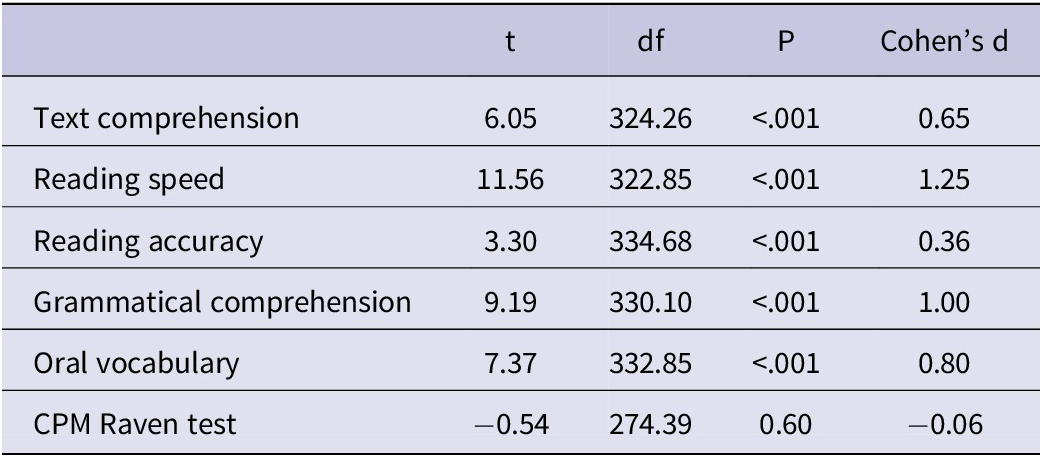
The data were transformed into z-scores based on normative values to control for grade-related differences. Means, standard deviations, and ranges for the variables of interest are reported in Table 2 (see also Supplementary Materials A for basic distribution plots). Table 3 presents the group comparisons of performance on each test using independent sample Welch’s t-tests.
Means and standard deviations for each test in bilingual and monolingual groups

Note: Values refer to z-score data according to Italian normative data.
Group differences on each test (Welch’s t-test)

Welch’s t-tests showed that bilingual children were worse than monolingual children in each examined test, except for the Raven CPM test. Among the bilingual sample, 12 children (6.8% of the bilingual sample) had an impaired performance (<1.65 standard deviations) only in oral language skills (i.e., they were hyperlexic, according to the Gough & Tunmer, Reference Gough and Tunmer1986 classification), two children (1.2% of the bilingual sample) had an impaired performance only in reading (i.e., dyslexic type), one child (0.5%) in both reading and language skills (i.e., mixed type) and the rest had good reading and linguistic skills (i.e., good type).
4.2. Network analysis
Raw test scores were standardized within each group and for each grade level to obtain values with a similar scale between the groups and to collapse the age effect. These normalized scores were then entered into the NA. Figure 2 displays the best networks estimated from the data, with the network for monolingual children shown in the left panel and that for bilingual children in the right panel. Table 4 provides the exact values of the edge weights (lower triangle) and the basic Pearson’s correlations (upper triangle). The Bootstrap results are presented in Figure 3.
Networks for bilingual (A) and monolingual (B) children. Blue lines indicate positive associations and red lines represent negative regularized partial correlation associations. The thickness and saturation of edges are proportional to the edge strength. TC = text comprehension; RS = Reading speed; RA = Reading accuracy; GC = Grammatical comprehension; OV = Oral Vocabulary; CPM = Raven CPM test for nonverbal intelligence.

Weight and correlation matrices

Note: The upper triangles report Pearson’s r correlation, the lower triangles report regularized partial correlation coefficients.
Abbreviations: TC = text comprehension; RS = Reading speed; RA = Reading accuracy; GC = Grammatical comprehension; OV = Oral Vocabulary; CPM = Raven CPM test for nonverbal intelligence.
Bootstrap results for bilingual (left) and monolingual (right) children. TC = text comprehension; RS = Reading speed; RA = Reading accuracy; GC = Grammatical comprehension; OV = Oral Vocabulary; CPM = Raven CPM test for nonverbal intelligence.
Note: Red dots are the estimated edges; black dots are the average edge values over 1000 bootstrap resamples; gray shadows represent the 95% confidence intervals over the 1000 bootstrap resamples.

Figure 2 reports for each sample the independent association of any skill with other abilities, net of the covariance shared with other network variables. The lines are thicker where the association between the variables is stronger. An inspection of the figure highlights a different pattern of results between monolingual and bilingual children, with distinct language and reading measures involved in explaining reading comprehension. While every edge is worth considering based on the reader’s interest, we would like to highlight a few important results that emerge from the inspection of the networks and bootstrap CIs:
-
1) The general structure of the two groups is different (Sparsity: Monolinguals = 0.07; Bilinguals = 0.33). The bilingual sample displays a segregated situation with few associations. In contrast, the monolingual sample exhibits a more integrated network, where each variable has multiple specific connections. The inspection of the 95% CIs confirms the overall reliability of the estimated networks. Both groups demonstrate a good overlap of the average bootstrapped edges and the estimated network.
-
2) The structure of the monolingual sample is like the one we found in Italian monolinguals in the study by Angelelli et al. (Reference Angelelli, Romano, Marinelli, Macchitella and Zoccolotti2021). One noticeable difference is the direct connection between nonverbal intelligence and text comprehension. However, considering that the bootstrapping CI for this edge crosses 0 (Figure 2), one should interpret this association cautiously.
-
3) Bilingual children show that only oral vocabulary (OV) is associated with reading comprehension (TC), whereas morphosyntactic skills (GC) are not. By contrast, linguistic abilities, such as oral vocabulary (OV) and grammatical comprehension (GC), are linked to reading comprehension (TC) in monolingual individuals (see also Table 4 for NCT results and fused graphical LASSO results in Supplementary Materials B).
-
4) The networks reveal variations across groups in how reading (RS and RA) and linguistic (OV and GC) skills are related. In bilingual children, only reading speed exhibits a connection with linguistic skills, whereas reading accuracy does not display any association with linguistic abilities. On the other hand, in monolingual individuals, reading speed and accuracy demonstrate associations with vocabulary and morphosyntactic knowledge, albeit with relatively weak connections (see also Table 4 for NCT results and fused graphical LASSO results in Supplementary Materials B).
-
5) In the bilingual sample, there is a notable difference in the role of decoding parameters compared to the monolingual sample. While in the bilingual sample, text comprehension is more related to reading accuracy, in monolingual children, the opposite holds, with text comprehension being more related to reading speed than accuracy.
The networks of the two groups are compared in Table 5 (see also Supplementary Materials B for a Fused Graphical LASSO method). As it is possible to see from Table 5, reading comprehension was associated with reading accuracy more strongly in bilinguals than in monolingual children. Differences between the two samples are also found concerning the association that the grammatical comprehension ability has with the other variables examined. Grammatical comprehension and text comprehension are associated in monolingual children but not in bilingual readers. Moreover, grammatical comprehension was associated with reading speed more strongly in bilinguals than monolinguals. On the contrary, the association between grammatical comprehension and reading accuracy was stronger among monolinguals than bilinguals.
Network comparison test: Edge Invariance test results

Note: Nodes A and B identify the nodes connected by the edge under test. The p-values report the probability that the observed difference between the edges is 0 in the population.
In bold are reported p values below .10.
5. Discussion
This study explored the unique contributions of reading accuracy and fluency, vocabulary, and oral morphosyntactic comprehension in explaining reading comprehension in monolingual and bilingual 3rd-to-5th graders. The SVR is a helpful model for examining factors influencing reading comprehension in bilinguals. However, this study reveals the importance of looking beyond the SVR, by evaluating, for example, vocabulary breadth and morphosyntactic knowledge, as well as the different components of reading performance separately. Several factors, including reading decoding and linguistic processes, accounted for the ability to comprehend a written text in monolingual and bilingual children learning regular orthography. This complex framework of interrelated variables impacts text comprehension skills independently and jointly. Therefore, it is relevant to examine the independent contributions of these variables in explaining reading comprehension, using statistical techniques (such as NA) appropriate for this purpose. While the SVR might also be applied to L2, bilingual children learning Italian as L2 showed a partially different pattern of predictors than monolinguals: reading accuracy (rather than speed) and vocabulary (but not morphosyntactic skills) were more closely related to reading comprehension. However, this different pattern might also be due to the role of confounding variables, such as SES, which was not controlled in this study. Further studies will be necessary for this goal.
Bilingual children exhibited lower performance in all measures of decoding, linguistic skills, and reading comprehension, except for reasoning skills. Note that the effect was large in all measures except for reading accuracy. This finding is in line with previous findings in the literature regarding reading comprehension (e.g., Horiba, Reference Horiba1996), vocabulary (e.g., August et al., Reference August, Carlo, Dressler and Snow2005), and morphosyntactic skills (e.g., Droop & Verhoeven, Reference Droop and Verhoeven1998). It is worth noting that some studies examining reading skills in bilingual and monolingual children have reported no significant differences between the two groups (e.g., Hutchinson et al., Reference Hutchinson, Whiteley, Smith and Connors2003), while others (Kieffer & Vukovic, Reference Kieffer and Vukovic2012) found lower decoding skills but similar rates of growth in L2 students compared to their monolingual peers, or difficulties only in some conditions (Verhoeven, Reference Verhoeven2000). In any case, language is a more challenging skill to acquire than reading for a sizeable proportion of children.
Despite bilingual children scoring less than monolinguals in all linguistic and reading tests, most of them are in the range of normality. Almost all of them might be classified as good readers (i.e., good decoding and linguistic skills) according to Gough and Tunmer’s (Reference Gough and Tunmer1986) taxonomy, and only 6.8% were hyperlexic. This finding reveals profound differences from the acquisition of a foreign language in a non-immersive context (Sparks, Reference Sparks2021), for which 78%–96% of cases are hyperlexic and no child was identified as a good reader. This difference might depend on the immersive L2 exposition or the consistency of Italian orthography that allows them to be classified as good readers (despite their performances being poorer than monolinguals).
5.1. Role of decoding skills
According to the SVR, decoding skills are involved in predicting reading comprehension. Usually, decoding has been examined with pseudoword reading fluency, a test of sublexical reading. We wanted to specifically evaluate which aspects of reading performance affect reading comprehension in monolingual and bilingual children, examining jointly the role of reading accuracy and speed and not exclusively focusing on sublexical processing. We have used text reading accuracy and speed as measures of decoding, a more ecologically sensitive and appropriate measure in the SVR framework, especially in consistent orthographies (for a review, see Florit & Cain, Reference Florit and Cain2011) because the text comprehension might rely on both lexical and sublexical reading.
The present findings highlight that both reading speed and accuracy impact reading comprehension not only in monolingual but also in bilingual children. These two decoding measures independently contribute to reading comprehension, as demonstrated by the NA. Fluency in decoding is crucial for supporting reading comprehension (Sparks & Patton, Reference Sparks and Patton2016). The present findings indicate that this relationship is especially prominent in L1 learners, at least in a consistent orthography such as Italian. This finding aligns with some previous Italian studies (Angelelli et al., Reference Angelelli, Romano, Marinelli, Macchitella and Zoccolotti2021; Florit et al., Reference Florit, Levorato and Roch2008, Reference Florit, Cain and Mason2020, Reference Florit, Roch, Dicataldo and Levorato2022), while it is inconsistent with another (Tobia & Bonifacci, Reference Tobia and Bonifacci2015).
For L2 learners, accurate decoding plays a more significant role than reading speed, consistent with Bonifacci and Tobia (Reference Bonifacci and Tobia2017). L2 learners exhibit a similar pattern to that observed in young and inexperienced readers (e.g., Florit & Cain, Reference Florit and Cain2011). Errors in reading may lead to a misunderstanding of the text’s meaning. In regular orthographies like Italian, the high grapheme-phoneme mapping allows typically developing Italian monolingual children to achieve adequate accuracy in reading by the end of primary school (Marinelli et al., Reference Marinelli, Romani, Burani, McGowan and Zoccolotti2016). As a result, reading errors are low for monolingual children (Marinelli et al., Reference Marinelli, Romani, Burani, McGowan and Zoccolotti2016; Orsolini et al., Reference Orsolini, Federico, Vecchione, Pinna, Capobianco and Melogno2022), except for hesitations and sounding-out behaviors (Trenta et al., Reference Trenta, Benassi, Di Filippo, Pontillo and Zoccolotti2013; Marinelli et al., Reference Marinelli, Romani, Burani, McGowan, Giustizieri and Zoccolotti2023a). Bilingual individuals, like inexperienced readers, tend to make more errors than monolingual readers (e.g., Verhoeven, Reference Verhoeven1990). Consequently, accuracy may be a measure more sensitive for assessing L2 than L1 learners. In this context, group differences in reading comprehension may arise from the differential sensitivity of speed and accuracy measures in capturing their impact.
Alternatively, the differential impact of the two reading parameters on text comprehension for L1 and L2 children may depend on the reliance on different reading strategies. At the age range examined in this study, typically developing Italian monolingual children predominantly rely on lexical processing to ensure fluent reading (Angelelli et al., Reference Angelelli, Marinelli and Zoccolotti2010; Marinelli et al., Reference Marinelli, Angelelli, Notarnicola and Luzzatti2009, Reference Marinelli, Cellini, Zoccolotti and Angelelli2017). Consequently, reading speed may play a more prominent role in explaining reading comprehension in L1 learners, at least at the developmental stage investigated in this study. On the other hand, bilingual children may exhibit a greater reliance on the sublexical procedure, with a smaller impact of the speed parameter on comprehension.
Regarding monolingual Italian children, studies based on the SVR report conflicting results on the contribution of reading parameters. Some studies found that reading speed/fluency significantly contributed to reading comprehension (Angelelli et al., Reference Angelelli, Romano, Marinelli, Macchitella and Zoccolotti2021; Florit et al., Reference Florit, Levorato and Roch2008, Reference Florit, Cain and Mason2020, Reference Florit, Roch, Dicataldo and Levorato2022), while others failed to detect any predictive role of reading fluency (Tobia & Bonifacci, Reference Tobia and Bonifacci2015). This study highlights that both reading measures were involved in reading comprehension, with reading speed exerting a greater influence. However, note that reading speed and accuracy were strongly intercorrelated. This association may have contributed to the inconsistent results observed in the literature. Most studies did not use techniques that allowed examining the independent contribution of the two reading parameters (such as NA), which covary with each other. Since the common variance is typically attributed to the variable that enters the model first, one may underestimate the role of the reading variable that enters later in the model (for which only the unique contribution was considered). This may result in unstable and inconsistent results across studies.
5.2. Role of linguistic skills
Reading comprehension was also associated with linguistic skills, as expected by the SVR model. Unlike monolingual children, reading comprehension in bilingual children was primarily associated with vocabulary. By contrast, morphosyntactic skills did not exert a relevant and independent contribution in explaining reading comprehension, at least at the age investigated. Several studies have consistently shown that vocabulary significantly predicts reading comprehension, particularly in bilingual readers (Lervåg & Aukrust, Reference Lervåg and Aukrust2010; Verhoeven, Reference Verhoeven2000). When readers encounter too many unfamiliar words, their comprehension tends to deteriorate (Carver, Reference Carver1994). Furthermore, reading inaccuracy, along with the direct influence of a limited vocabulary (which may also indirectly affect the reading accuracy of unfamiliar words; Bellocchi et al., Reference Bellocchi, Bonifacci and Burani2016), pose challenges for bilinguals’ reading comprehension.
The limited role of morphosyntactic skills in reading comprehension observed in this study is inconsistent with some longitudinal studies conducted on L2 children at an early stage of literacy acquisition (2nd grades, Verhoeven, Reference Verhoeven1990; Bellocchi et al., Reference Bellocchi, Tobia and Bonifacci2017). The present results focused on children in the final years of primary school align with those of a longitudinal study in Dutch L2 learners up to 4th grade (Droop & Verhoeven, Reference Droop and Verhoeven2003), finding a stronger impact of vocabulary on reading comprehension in L2 and a separate impact of morphosyntactic skills in L1.
Another explanation is that, due to the rich morphosyntactic system of Italian languages, inexpert L2 readers may initially rely on shallow processing, extracting only semantic information from words and ignoring the morphosyntactic cues present in the meaningful text. A further explanation could be the covariance of morphosyntactic ability with other examined skills. Reading comprehension was assessed with a passage reading test, which involved words arranged in syntactically complex sentences, diminishing (as compared to single-word reading) the relative importance of morphosyntactic skills as the unique predictor of reading comprehension (Geva & Farnia, Reference Geva and Farnia2012).
Moreover, vocabulary and morphosyntactic skills also covariate between them and morphology indirectly predicts reading comprehension through its influence on vocabulary (Goodwin et al., Reference Goodwin, Huggins, Carlo, August and Calderon2013). Therefore, the simultaneous evaluation of both linguistic skills, using an analysis that allows for the estimation of the unique contribution of morphosyntactic abilities independent from vocabulary, may have made this effect undetectable for L2 readers. It is important to remember that the NA allows us to conclude that we have no evidence of a unique relationship between morphosyntactic skills and reading comprehension among L2 readers, not that they are unrelated.
Oral language was associated with reading comprehension in monolingual participants, confirming previous studies conducted on Italian children (Angelelli et al., Reference Angelelli, Romano, Marinelli, Macchitella and Zoccolotti2021; Florit et al., Reference Florit, Levorato and Roch2008, Reference Florit, Cain and Mason2020, Reference Florit, Roch, Dicataldo and Levorato2022; Tobia & Bonifacci, Reference Tobia and Bonifacci2015; Zamperlin & Carretti, Reference Zamperlin and Carretti2010). While previous studies on L1 readers have shown the significant contributions of vocabulary (Florit et al., Reference Florit, Roch, Dicataldo and Levorato2022) and morphosyntactic comprehension (Angelelli et al., Reference Angelelli, Romano, Marinelli, Macchitella and Zoccolotti2021), the predictive contribution of both skills has been examined jointly only in a longitudinal study assessing predictors of reading accuracy and speed (but not of reading comprehension; Bellocchi et al., Reference Bellocchi, Tobia and Bonifacci2017). This study highlights both vocabulary and morphosyntactic oral comprehension being independently linked to the success of reading comprehension in monolinguals.
Studies developed in the SVR domain often consider reading comprehension as the product of language and decoding skills. However, this study has highlighted that there is no directionality (because reading comprehension might improve vocabulary expansion and decoding efficiency) and that linguistic and decoding skills were related and impacted each other’s development. Undeveloped grammatical and vocabulary knowledge in bilinguals harms efficient and fluent word recognition skills and, in turn, reading comprehension (Trapman et al., Reference Trapman, Van Gelderen, Van Steensel, Van Schooten and Hulstijn2014). On the other hand, vocabulary knowledge supports word reading, particularly when decoding skills are insufficient (Verhoeven et al., Reference Verhoeven, Voeten and Vermeer2018).
The present findings reveal differences between bilinguals and monolinguals in the relationship between reading and linguistic skills beyond the influence of other cognitive skills considered in the analysis. In monolinguals, reading speed and accuracy are associated with vocabulary and morphosyntactic knowledge. However, only L2 reading speed was related to linguistic skills in bilingual children, while reading accuracy did not show an association. The ability to access word meaning and understand the morphosyntactic relations between words contributes to faster text reading in L2, although it does not necessarily improve decoding accuracy. Note that we used a text reading test, in which bilingual readers often exhibit challenges in both speed and accuracy due to the involvement of both lexical and syntactical knowledge (Bonifacci & Tobia, Reference Bonifacci and Tobia2016). Using a text-reading test for assessing decoding may contribute to the strong relationship observed between language and reading abilities: Vocabulary and morphosyntactic skills may have a greater impact on reading when using word measures arranged in a meaningful text. Having knowledge of word meanings in the text and understanding the morphosyntactic relationships between words can assist readers in comprehending the context and, consequently, predicting subsequent words, leading to improved reading speed and accuracy (see Marinelli et al., Reference Marinelli, Benassi, Trenta, Burani and Zoccolottiin preparation; Trenta et al., Reference Trenta, Benassi, Di Filippo, Pontillo and Zoccolotti2013). Bilingual children may benefit from linguistic cues, such as semantic and syntactic hints, to anticipate upcoming words in a text. This could potentially result in an overestimation of the role of syntactic and vocabulary skills. However, the present results did not support this possibility, as only vocabulary but not morphosyntax contributed uniquely to bilingual text comprehension.
5.3. Beyond the SVR
According to the lexical quality hypothesis (Perfetti, Reference Perfetti2007), the presence of high-quality representations encompassing lexical, sublexical, grammatical, morphological, and semantic features is crucial for efficient word recognition and the integration of words into a coherent textual context. Ultimately, these processes contribute to overall textual comprehension (Perfetti & Stafura, Reference Perfetti and Stafura2014) for both beginning monolinguals (Perfetti, Reference Perfetti2007) and bilinguals (Droop & Verhoeven, Reference Droop and Verhoeven2003).
Regarding semantics, in the previous section, we have seen that knowledge of word meanings (i.e., vocabulary) is critical for adequate word decoding and reading comprehension and explains large individual differences across both L1 and L2 learners (Vermeer, Reference Vermeer2001). However, reading is supported not only by the number of words in the mental lexicon but also by the precision of the phonological and morphological information stored in the mental lexicon. Phonological knowledge depends on speech distinctions and fully specified sound structure of words in the mental lexicon; this ability is fundamental in the emergence of literacy in L1 learners (Elbro, Reference Elbro1996) and especially L2 learners (Janssen et al., Reference Janssen, Segers, McQueen and Verhoeven2017). The quality of morphological knowledge (information on word roots, syntactic inflexions, and derivational affixes) stored in the mental lexicon influences reading comprehension both directly (Deacon et al., Reference Deacon, Kieffer and Laroche2014) and indirectly via word decoding (see Reichle & Perfetti, Reference Reichle and Perfetti2003).
According to this perspective, not only learning to read but also reading comprehension depends highly on the quality of children’s mental lexicons (Verhoeven & Van Leeuwe, Reference Verhoeven and van Leeuwe2012). The explanatory power of the SVR could be expanded if measures of early lexical quality were also examined. For example, a longitudinal study by Verhoeven et al. (Reference Verhoeven, Voeten and Vermeer2018) found that the quality of the mental lexicon in kindergarten adds substantially to the prediction of beginning reading comprehension for both the L1 and L2 learners: phonological distinctions in speech decoding, morphological knowledge, and vocabulary in kindergarten predict word decoding and listening comprehension (in grade 1), and later reading comprehension (in grade 2). A model combining measures from the SVR with measures of lexical quality shows that not only the number of lexical entries but also the detail of the phonological and morphological information represented in these entries contributes to the success of children’s word decoding and reading comprehension.
Going beyond the SVR, this study also found that the quality of children’s lexical knowledge significantly affects reading comprehension. We found that semantic and morphological measures (i.e., measured with vocabulary and morphosyntactic comprehension tests) affect both decoding and reading comprehension, although to a different degree in L1 and L2. The role of phonological skills is not investigated and might be the object of future studies. Moreover, the lexical quality hypothesis suggests that lexical quality affects reading comprehension directly and indirectly through reading skills. In this study, the NA confirms that vocabulary, morpho-grammatical skills, and reading are interrelated but also exert an independent contribution to explain reading comprehension.
Recently, several studies have gone beyond SVR, examining the role of other cognitive skills in explaining reading comprehension, such as executive functions, working memory, metacognitive skills (inference-making), background knowledge, motivation, and text characteristics (see Oakhill & Cain, Reference Oakhill, Cain and McNamara2007; Peng et al., Reference Peng, Barnes, Wang, Wang, Li, Swanson, Dardick and Tao2018). Future studies may explore the contribution of these factors to L2 text comprehension. We examined only the role of reasoning skills in explaining reading comprehension, and we found that these skills were significantly associated among monolingual children but not among bilingual children. This finding is consistent with a recent meta-analysis by Quinn and Wagner (Reference Quinn and Wagner2018), which revealed that cognition, including reasoning skills, did not make a unique contribution to reading comprehension in L2 learners beyond the effects of decoding and language comprehension.
5.4. Limitations and possible developments
One of the main limitations of this study is the lack of examination of monolingual children’s SES, which is known to influence literacy skills (Bonifacci et al., Reference Bonifacci, Lombardo, Pedrinazzi, Terracina and Palladino2020). Notably, 90% of the bilingual children in our study came from low to medium-low SES backgrounds, which is a common occurrence in the Italian context (Rapporto statistico MIUR, 2022). Unfortunately, due to this limited SES diversity in our sample, we could not investigate the impact of socioeconomic status on the observed findings in bilinguals. Moreover, the absence of SES information in monolinguals did not allow us to control whether differences between monolingual and bilingual groups were authentic or at least partly due to differences in SES. This is an important aspect to consider in future studies.
Another limitation is the lack of examination of bilingual children’s L1 proficiency and characteristics. Unfortunately, given the significant heterogeneity in the migration backgrounds of Italian bilinguals (Rapporto statistico MIUR, 2022), it was not feasible to examine the proficiency levels and specific characteristics of their L1. However, using a large sample may have minimized its heterogeneity relative to the L1 characteristics. In our study, children alphabetized in both languages have a less rich L2 vocabulary, probably because they are late bilinguals. Literature reports that the alphabetization in L1 influences the development of L2 literacy. Children who are already literate in L1 often use their knowledge in L1 as support to learn to read L2 (August & Shanahan, Reference August and Shanahan2006), to understand the meaning of unfamiliar words, and to monitor text comprehension (Riches & Genesee, Reference Riches, Genesee, Genesee, Lindholm-Leary, Saunders and Christian2006), and to fill the gaps in L2 (Genesee et al., Reference Genesee, Lindholm-Leary, Saunders and Christian2006). L2 overlap with L1 phonology (Lopez & Greenfield, Reference Lopez and Greenfield2004) and orthography (Deacon et al., Reference Deacon, Chen, Luo and Ramirez2011) also promote L2 word decoding skills. At the same time, being literate in L1 can be unfavorable for L2 reading and writing: some errors in L2 are the result of the influence of L1-negative transfer (Cronnell, Reference Cronnell1985) and are not an indication of a learning deficit (Paradis, Reference Paradis2011). Unfortunately, in the current study, we could not examine the SVR predictions as a function of L1 alphabetization to avoid decreasing the reliability of results (NA needs substantial sample sizes to provide stable and reliable results, especially for the application of NCTs) and to keep possible the comparison with monolinguals (for whom this variable could not be included in the model). Therefore, subsequent studies will be necessary to evaluate this aspect.
Furthermore, the age of exposure to the second language is another relevant factor potentially affecting reading outcomes in bilingual children. We found lower performance in late bilinguals compared to early bilinguals in reading comprehension, text reading speed, and vocabulary (coherently with Bonifacci & Tobia’s, Reference Bonifacci and Tobia2016 study except for the difference in passage reading speed). However, the requirement of large sample sizes for the NA does not allow the examination of the SVR predictions separately for early and late bilinguals. Moreover, a note of caution is necessary regarding the presence, in the L2 sample, of emergent bilinguals who were in Italy for more than 1 year.
Overall, these limitations highlight areas for future research to further enhance our understanding of the multiple factors influencing reading outcomes in bilingual children.
6. Conclusions and educational implications
A deeper understanding of the processes involved in L2 reading comprehension can guide teachers in selecting appropriate, effective, and efficient instructional practices to enhance L2 reading comprehension skills (e.g., Proctor et al., Reference Proctor, Carlo, August and Snow2005), and in turn to promote school achievement, socio-emotional well-being, and economic success for this large population of students. The present findings emphasize the detrimental impact of a limited vocabulary on text reading and reading comprehension in L2 learners. Therefore, it is crucial to assess vocabulary skills in L2 children to identify early signs of vocabulary challenges and to intervene early, promoting successful literacy. The positive effects of vocabulary training on reading comprehension are well known (Elleman et al., Reference Elleman, Lindo, Morphy and Compton2009; Wright & Cervetti, Reference Wright and Cervetti2017), also in L2 learners (Carlo et al., Reference Carlo, August, McLaughlin, Snow, Dressler, Lippman, Lively and White2004). Vocabulary training incorporating both word forms and meanings within a rich contextual environment is effective. Additionally, presenting words in a text provides additional contextual information that activates prior knowledge and facilitates the inference of unknown word meanings. Simultaneously, it is relevant to strengthen reading comprehension skills through shared reading activities that focus on integrating lexical information with personal and collective knowledge within the text. Increased exposure to written and spoken language, along with proficiency in text comprehension, promotes the acquisition of new vocabulary and morphosyntactic knowledge (McGregor, Reference McGregor, Stone, Silliman, Ehren and Wallach2004). Additionally, inference generation favors vocabulary learning (Verhoeven & Van Leeuwe, Reference Verhoeven and van Leeuwe2008). This training may promote vocabulary development and enhance reading comprehension skills, ultimately supporting the school achievements of L2 children.
Successful reading comprehension can also be facilitated by the effective use of comprehension strategies (e.g., Frid & Friesen, Reference Frid and Friesen2020), such as generating inferences, making predictions, asking questions, visualizing, and summarizing. Additionally, readers benefit from monitoring their comprehension of a text to determine when to employ a specific strategy and relying on their knowledge of text structure to create a scaffold for incorporating relevant information. Reading comprehension training for bilinguals should aim to reinforce not only language knowledge but also the use of effective reading strategies. The most skilled bilinguals tend to use top-down strategies such as employing metacognitive/global approaches, integrating information, using text structure and contextual cues, and connecting the text to their background knowledge, compared to weaker L2 comprehends (Brantmeier, Reference Brantmeier2002). These strategies help bilingual readers to effectively comprehend text using their linguistic and metacognitive resources. They also allocate more time to post-reading activities aimed at consolidating information, such as summarizing the text, posing questions, paraphrasing, and seeking additional resources (Nordin et al., Reference Nordin, Rashid, Zubir and Sadjirin2013), consistently with more efficient monolingual readers (Duke & Pearson, Reference Duke and Pearson2009). In contrast, less successful L2 readers tend to rely more on bottom-up strategies, such as rereading, looking up unknown words, and focusing on lexical problems (Brantmeier, Reference Brantmeier2002). Moreover, less proficient L2 readers tend to emphasize the surface form of the text, including word meanings and syntactic relationships, rather than focusing on the overall text meaning or extracting the main idea (Friesen & Jared, Reference Friesen and Jared2007). Friesen and Frid (Reference Friesen and Frid2021) demonstrated that when L2 readers engage in text analysis, extract meaning, and create cohesion/integration, they achieve greater reading comprehension success, even when accounting for individual vocabulary performance. L2 learners can benefit from systematic instruction in comprehension strategies, as it is one of the most effective ways to support text comprehension skills (Edmonds et al., Reference Edmonds, Vaughn, Wexler, Reutebuch, Cable, Tackett and Schnakenberg2009). Instruction for children should focus on identifying the main ideas in a text, understanding the relevant relationships between different text components, and improving the use of top-down strategies (Dickson et al., Reference Dickson, Simmons and Kameenui1995).
In conclusion, this study highlights the need for educators to improve reading accuracy and vocabulary to enhance reading comprehension in bilingual minority students. When teaching bilingual children, it is essential to focus on strategies that increase their exposure to both written and spoken language. Additionally, presenting words in meaningful contexts and encouraging the use of top-down strategies can further support their learning.
Supplementary material
The supplementary material for this article can be found at http://doi.org/10.1017/S1366728925000318.
Data availability statement
The data that support the findings of this study are available upon request to the authors.
Funding statement
This research was funded by the Italian Ministry of University and Research PRIN 2022 (CODE -CUP) to Chiara Valeria Marinelli.
Competing interests
The authors declare none.




 Open access

