


Introduction
Weed scientists’ efforts to educate and inform farmers, advisers, and others about the need to diversify weed management and adopt best management practices (BMPs) to combat herbicide-resistance evolution have produced mixed results. We do not know or understand the reasons farmers do not implement these BMPs or the challenges they have had in adopting them. To change this, we felt it was important to understand the grassroots concerns and challenges, plus successful and unsuccessful approaches to herbicide-resistance management (HRM) implemented by farmers and others who are dealing directly with herbicide resistance. As a first attempt to gather this kind of information on a national scale, the Herbicide Resistance Education Committee (HREC) of the Weed Science Society of America (WSSA), with the help of local weed scientists and professional facilitators, conducted seven regional listening sessions around the United States. The objective was to connect with stakeholders and hear their challenges and recommendations for addressing herbicide resistance. This paper details the methods and processes used to conduct these regional listening sessions and provides an assessment of the strengths and limitations of those processes. The companion paper “Innovative Approaches to Manage Wicked Herbicide Resistance: Lessons from the Field” describes and discusses the key outcomes from the listening sessions (Schroeder et al. Reference Norsworthy, Ward, Shaw, Llewellyn, Nichols, Webster, Bradley, Frisvold, Powles, Burgos, Witt and Barrett2018).
Methods
Process to Develop Listening-Session Timeline, Goals, and Agenda
A three-member coordinating team, the HREC chair and two members, led the planning and work process throughout the project. They communicated regularly by phone and email and coordinated with the professional facilitators hired to lead the sessions to ensure progress was being made. Strategic Conservation Solutions, LLC, was the group contracted for facilitation services. The HREC invited and received the endorsement of the U.S. regional weed science society presidents as well as their suggestions for leaders within the identified listening-session regions to coordinate the sessions. The HREC solicited financial support for the listening sessions from the U.S. Department of Agriculture Animal Plant Health Inspection Service (USDA-APHIS), the United Soybean Board (USB), and the WSSA. The HREC then reached out to selected leading academic weed scientists within each identified region, all of whom agreed to serve as coordinators for their sessions (Table 1).
Regions and regional coordinators for the herbicide-resistance listening sessions.

a The Mid-South meeting was held in conjunction with the Mid-South Row Crop Short Course; the Northwest meeting was held in conjunction with the Far West Agribusiness Association meeting; the Southwest meeting was held in conjunction with the World Ag Expo; the Great Plains meeting was held in conjunction with the Farming Evolution 2017 conference; and the Midwest meeting was held in conjunction with the Commodity Classic, which was located outside the region in Texas.
b D. M. Dodds, Mississippi State University; L. E. Steckel, University of Tennessee; W. S. Curran, Penn State University; M. J. VanGessel, University of Delaware; A. E. Klodd, Penn State University; I. Burke, Washington State University; D. W. Morishita, University of Idaho; B. D. Hanson, University of California, Davis; B. J. Schutte, New Mexico State University; P. W. Stahlman, Kansas State University; T. A. Gaines, Colorado State University; A. R. Kniss, University of Wyoming; C. F. Creech, University of Nebraska–Lincoln; P. Jha, Montana State University; S. McDonald, Mountain West PEST; C. L. Sprague, Michigan State University; J. L. Gunsolus, University of Minnesota; R. G. Leon, North Carolina State University (formerly University of Florida); S. Culpepper, University of Georgia.
Initial Planning Meeting
The HREC and regional coordinators conducted conference calls and email exchanges in preparation for a 1-day planning meeting in August 2016. Before the meeting, the regional coordinators were asked to provide input into the goals for the listening sessions, the stakeholders who should be involved, the listening-session topics, and their definition of success. The regional coordinators from the Northeast, Great Plains, Midwest, and Southwest were able to respond and provided perspectives that formed the basis for a rich discussion at the planning meeting (Table 2).
Responses from four of seven regions on regional goals, stakeholders, and meeting objectives before the planning meeting August 2016.
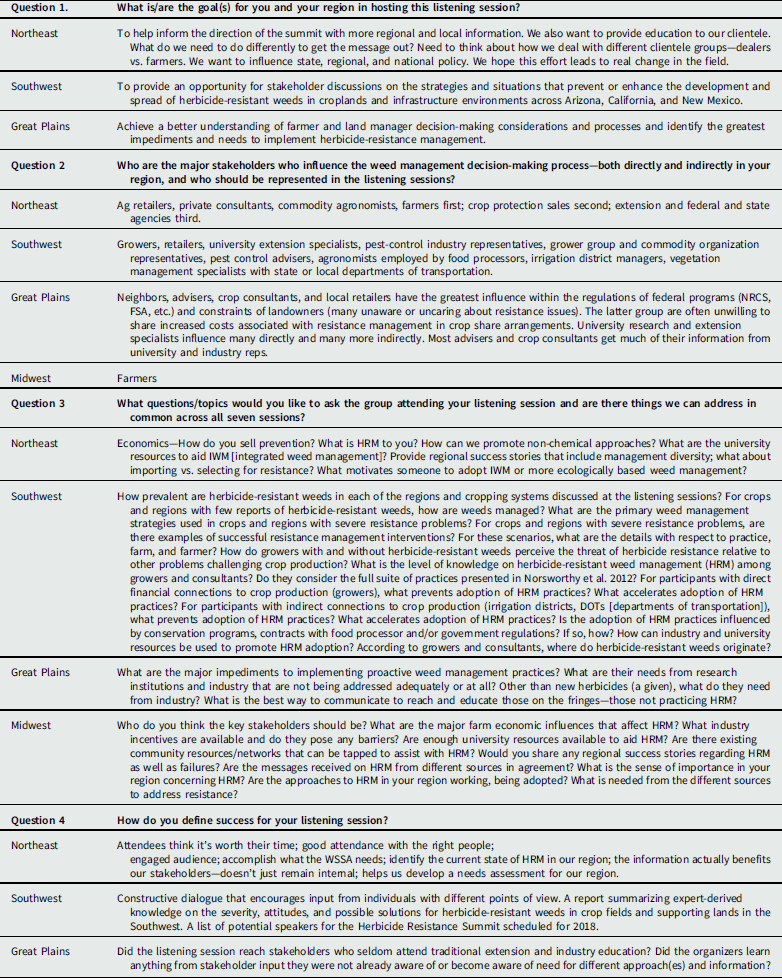
Representatives of the HREC, one regional coordinator per region, and representatives from the USB, the USDA-APHIS, the USDA Office of Pest Management Policy, and the U.S. Environmental Protection Agency Office of Pesticide Programs attended the August planning meeting. The objectives of the planning meeting were to determine the desired outcomes of the listening sessions; to delineate the roles and responsibilities of the facilitators, the HREC, and the regional coordinators; to develop an agenda framework for the listening sessions; to discuss the target audience; and to set a timeline for preparing for the sessions. Strategic Conservation Solutions, LLC, facilitated the planning meeting, and the planning group reviewed the desired outcomes submitted by the Northeast, Great Plains, Midwest, and Southwest regions (Table 2) and agreed on three goals for the listening sessions. These were: (1) to gain an understanding of the stakeholders and their goals and concerns related to HRM; (2) to gain an understanding of regional differences in herbicide-resistance issues and solutions, including successes and failures as well as challenges and needs; and (3) to identify decision-maker needs for addressing barriers and how key stakeholder groups can assist in meeting those needs.
Roles and Responsibilities—Regional Coordinators
The key roles of the regional coordinators were to work with the facilitators to select the locations and dates for their listening sessions, develop the participant lists, issue invitations, and organize and host the meetings (Table 1). After much discussion about the range of stakeholders who could either contribute to or learn from the listening sessions, the planning committee decided that the coordinators were in the best position to determine the participant lists, because key stakeholders could differ between regions. The approaches taken by each region for identifying individuals to invite are described in Table 3.
Regional descriptions of their approach to identifying invitees.

Roles and Responsibilities—HREC
The HREC, led by the coordinating team, was responsible for communication with the full planning committee, weed science societies, and funders. In addition, the HREC developed a template of an invitation letter for the regional coordinators to use. HREC members would attend each session to represent WSSA, arrange for audio recording and transcription of recordings, take notes of the discussion, collect and summarize session reports and evaluations, and draft the final report covering all sessions. The HREC worked with the facilitators to draft the materials used at each listening session. Social scientists Raymond A. Jussaume and David Ervin volunteered that one of them would attend each of the listening sessions to provide an evaluation from a social science perspective. The rest of attending committee members provided assistance where needed. The role of the social scientists and HREC members was to listen to the conversations of invited participants, not to participate themselves. Individual HREC members volunteered to have the table notes summarized, to have the session evaluations summarized, and to have the recordings of group discussions transcribed for all the sessions. One WSSA volunteer took photographs of flip charts generated at each session and shared them with the core writing committee.
Roles and Responsibilities—Facilitators
Strategic Conservation Solutions, LLC, facilitated the development of the agenda by the HREC and the regional coordinators, developed instruction guides and session materials in coordination with the planning committee, led pre-session planning calls for each region, and facilitated each regional listening session. The materials prepared for the regional listening-session coordinators are included in Appendixes A–K in the Supplementary Material. The materials include instructions to the coordinators and HREC participants, agendas, worksheets, and forms—basically a step-by-step approach for each listening session. The planning committee agreed after considerable discussion that all regions should use the same agenda for their listening sessions to allow comparisons across regions (Table 4).
The template for the agenda for regional listening sessions.

Process over the Course of the Listening Sessions
The HREC chair organized a debriefing call for the planning committee after the first listening session in the Mid-South. As a result of the call and the assessment of the Mid-South coordinators, portions of the agenda were revised. The “Sharing our Voices” session was initially conceived as simply asking stakeholders to share any new perspectives they had gained during the day. After the Mid-South listening session, this activity became a conversation about new perspectives on weed management between three or four representative stakeholders who were attending the listening session and were identified by HREC observers and the facilitator, Bruce Knight, during the session. The final section, “A New Approach: Sharing Linkages, Connections and Recommendations,” was initially designed as a quick “popcorn” style sharing of ideas among the group. The Mid-South coordinators recommended adopting a different approach or dropping this section entirely. The final section was revised so that the participants were asked to make recommendations to universities, industry, government, and other groups regarding what is needed to address herbicide resistance. Other adjustments made after the Mid-South listening session included slight changes to the report-out sessions in which participants were asked to “vote” on their top three challenges and barriers and their top three wants and needs using colored dots.
The coordinating team arranged for an individual debriefing call or discussion with the other session coordinators after each listening session to learn their assessment of the listening session they coordinated. The HREC coordinating team also identified a core writing team who then discussed by phone the report format, issues of concern, and responsibilities before writing the final report draft. The core writing team (seven persons from the HREC) met in April 2017 to outline the first draft of the report. Once the draft was complete, the draft report was sent to the full planning committee (regional coordinators and the HREC) for review. The core writing team met again in August 2017 to discuss the reviews and begin the revision process. A second draft was sent to the planning committee in November 2017 for review before finalizing the document and drafting an executive summary for public distribution.
Discussion and Evaluation
Assessment of the Invitation Process
The regional coordinators were asked to provide information about the process used to identify potential participants in their sessions (Table 3). In addition, they were asked to provide their assessments of how well their processes worked and who they might have missed as a result of their approaches (Table 5). The regional coordinators were limited, in many cases, by their relationships with potential participants and their spheres of influence when developing their invitation lists. It was a challenge to get assistance from a wider variety of groups for a number of reasons, including privacy issues around sharing mailing lists and a lack of urgency about herbicide resistance in external groups approached for help. Participant diversity was limited at some listening sessions based on the location of the session and the size of the region, cropping system, farm size, connection with organizers, or other reasons. The coordinators indicated that the participant populations in the regions also may have been biased toward those with experience or knowledge of herbicide resistance. Finally, some regions do not have an “off-season,” so it was difficult to get the desired diversity due to ongoing field work and obligations.
Regional input on invitation process: assessment of the approach and who was missed by the coordinators.

Discussions at the sessions revealed that some stakeholder groups who impact HRM were not at the sessions. These groups may not even be aware of the issues, even if they significantly impact evolution and spread of resistant weed species. Some of the groups missing from some or all of the sessions include absentee landowners, non-crop managers, state departments of transportation and rights-of-way managers, lenders, state departments of agriculture and other governmental agencies, farmers who normally do not attend meetings or who are not impacted by herbicide resistance, organic farmers, other farmer organizations, equipment dealers, custom pesticide applicators, policy makers, government officials, members of the general public, “nontraditional” farm owners (women, minorities, small-scale), and farm laborers.
Regional Format of the Meetings
The regional meetings brought out viewpoints about herbicide resistance and weed management from crops besides corn (Zea mays L.), soybean [Glycine max (L.) Merr.], and cotton (Gossypium hirsutum L.). Participants generally appreciated talking to individuals from other parts of the region/sectors. The fact that the regions were large and/or listening sessions were often held in remote locations meant that participant diversity was limited for some sessions due to the time required to travel to a location. Funding was available to reimburse some participants for their travel to attend the sessions; however, travel distance and time limitations still prevented broader participation for some of the regions. For example, at the Midwest meeting held in conjunction with the Commodity Classic (San Antonio, TX), participation was limited to individuals who were already attending the Classic and who had the money and time available on their schedule to travel to and participate in the Classic. For the Southwest meeting held in Tulare, CA, farmers from New Mexico were invited, but the distance to the session was more than 1000 miles. The meeting was held during a busy time of year for New Mexican agriculture. Some coordinators reported that finding locations and venues for the listening sessions was challenging. We do not know what the relative impacts are of tying a listening session to another venue versus hosting it as a stand-alone meeting. In addition, lodging availability was a challenge for some of the sessions held in conjunction with another large event.
Perspectives of Members of the HREC and Regional Coordinators
Approvals for the Meeting
One important oversight was not to secure approval for the listening sessions from an Institutional Review Board (IRB) from one committee member’s academic institution. IRB approval was needed because the listening sessions included human “subjects,” and IRB review is necessary when people are used as research subjects. For example, the University of Kentucky IRB requires review of a research protocol in which any activity “meets either (a) the Department of Health and Human Services (DHHS) definition of both ‘research’ and ‘human subjects’ or (b) the Food and Drug Administration (FDA).” The primary purpose of the IRB is to protect the rights and welfare of human (research) subjects. In line with IRB approval, the participants were informed that their involvement was voluntary, and their identity and responses were confidential if included in any publication. These assurances may also affect the nature of responses given at the meetings. Failure to apply for IRB approval means that any information from listening-session participants cannot be published as research, although the information could be used for internal guidance to WSSA, such as determining the next initiatives for the HREC. Advanced review is required if there is “interpersonal communication between the investigator and subject through surveys, interviews, administration of educational tests, or other forms of interaction.” Any effort similar to the listening sessions should secure IRB approval at its outset. Generally, an IRB will not approve a project post facto. In our case, after consultation and review of information regarding the listening sessions, the University of Kentucky IRB Committee determined the listening sessions did not require IRB review and approval. This allowed us to proceed with publication of the findings from the listening sessions after consultation and review of information regarding the listening session.
Meeting Format
This was an interesting exercise for most of the weed scientists involved; it turned our typical notion of a grower meeting, that of “experts” giving information to clientele, on its head. Instead, we were listening to the audience and did not participate beyond assisting with logistics and taking notes to ensure that the views of the participants were heard and documented. While the approach was more familiar to the social scientists involved and has some similarities to the focus group interviews that industry uses, it was new to most of the weed scientists on the planning team. Most of the invited participants enjoyed being able to share their thoughts and ideas. Participation and engagement was very good in all the listening sessions, and participants asked for more meetings using the “listening” format. The few negative comments from participants suggested some of them did not realize the meeting was intended to solicit concerns and suggestions to help formulate a path forward and would not include presentation of management solutions.
The coordinators were generally pleased with the meeting format. Several said they would consider doing similar meetings as part of their ongoing programs and that they had gained ideas for extension programming from the regional listening sessions. At the same time, some coordinators also commented that this type of meeting took much more work and preparation than a typical extension meeting and they would be cautious about, if not adverse to, doing something similar in the future. Some coordinators reported that they would have developed different agendas for their sessions, although they did not elaborate on what they would have done differently. The coordinators did a great job and the planning group worked well together and with the facilitators to develop the listening sessions and to adapt as we learned from each session. Regional coordinators worked hard to get good participation, and their influence and personal invitations were key to attracting participants.
The sessions benefited from having professional facilitation and from having HREC members present to observe, take notes, and assist as needed. Having a common agenda and holding the “same” meeting at each location, with the same facilitators, allowed for regional comparisons that would have been difficult if each region had developed its own agenda. However, some flexibility was lost because of the uniform agenda across all sessions; the facilitators held closely to the agenda, so some spontaneity and ability to adjust to the unique character of each regional group was lost. Because each listening session covered a large geographic region and because of funding limits, coupled with time constraints for the members of the planning committee, the meetings could not be organized in a way that would allow us to specifically address targeted social science research questions. In addition, the social scientists suggested that revisions were needed to improve the “think and ink” surveys (Appendixes F–I, Supplementary Material) that participants filled out at the beginning of the first table discussion about personal perspectives and defining the issues.
Final Thoughts
A major insight we gained from the listening sessions was the fact that many of the participants felt they needed one or more new herbicides with unique mechanisms of action to address their weed management needs. The core writing team spent a great deal of time during one of our meetings discussing this response and wondering where the thinking originated. This was a concern in light of the fact that no new herbicide with a unique mechanism of action has been registered for over 20 years, and none are on the horizon according to industry experts. We asked ourselves whether the organizers and facilitators should have done more to take the hope for new chemistry off the table for discussion. However, this was information that was important to hear—farmers and dealers are still looking for a simple and familiar solution to the problem of herbicide resistance.
The concept and structure of this project was new to everyone involved; we had never attempted to hold listening sessions across the country. The HREC members and the regional coordinators agreed that the project was much more involved and time-consuming than we anticipated when we agreed to implement the project. That being said, most felt that the effort was worthwhile and that we have gained a new perspective and valuable information from these sessions. We are most grateful to the participants who took time out of their very busy schedules to attend and contribute their perspectives to the discussion.
Supplementary material
To view supplementary material for this article, please visit https://doi.org/10.1017/wet.2018.53
Acknowledgments
Funds to support the regional listening sessions were provided by the USDA-APHIS (agreement no. 16-2000-0077GR), the USB, and the WSSA. The views expressed in this report do not necessarily represent the views of the USDA or the U.S. government. The contributions of Bruce Knight and Julie Knight, Strategic Conservation Solutions, LLC, to the success of this effort are gratefully acknowledged. No conflicts of interest have been declared.


 Open access

