





Introduction
On 20 August 1945, five days after hearing the news of Japan’s surrender in the Asia-Pacific War, one Japanese man died in a small island called Polle in the Chuuk Islands (then known as Truk), part of today’s Federated States of Micronesia.Footnote 1 The deceased man’s name was Mori Koben, one of the four earliest Japanese migrants to Truk. Koben moved there in 1892, and since then spent his entire life in Truk except for a few short returns home. Existing scholarship on Japanese imperialism refers to Koben as one of the trail-blazers of the nation’s expansion into the Pacific that started in the late nineteenth century. Emanuel Mori, president of Micronesia from 2007 to 2015, was one of his great-grandsons.Footnote 2
Truk, part of the Caroline Islands and consisting of around 290 islets of various sizes scattered around one of the largest coral lagoons in the world, was a trans-imperial place. It was a Spanish colony until 1899, when Germany bought it following the Spanish retreat from the Pacific after the Spanish-American War. The German rule lasted for fifteen years until the outbreak of the First World War, at which point Japan occupied it and subsequently ruled it under the League of Nations mandate and built it as one of the key naval strongholds in the Pacific.
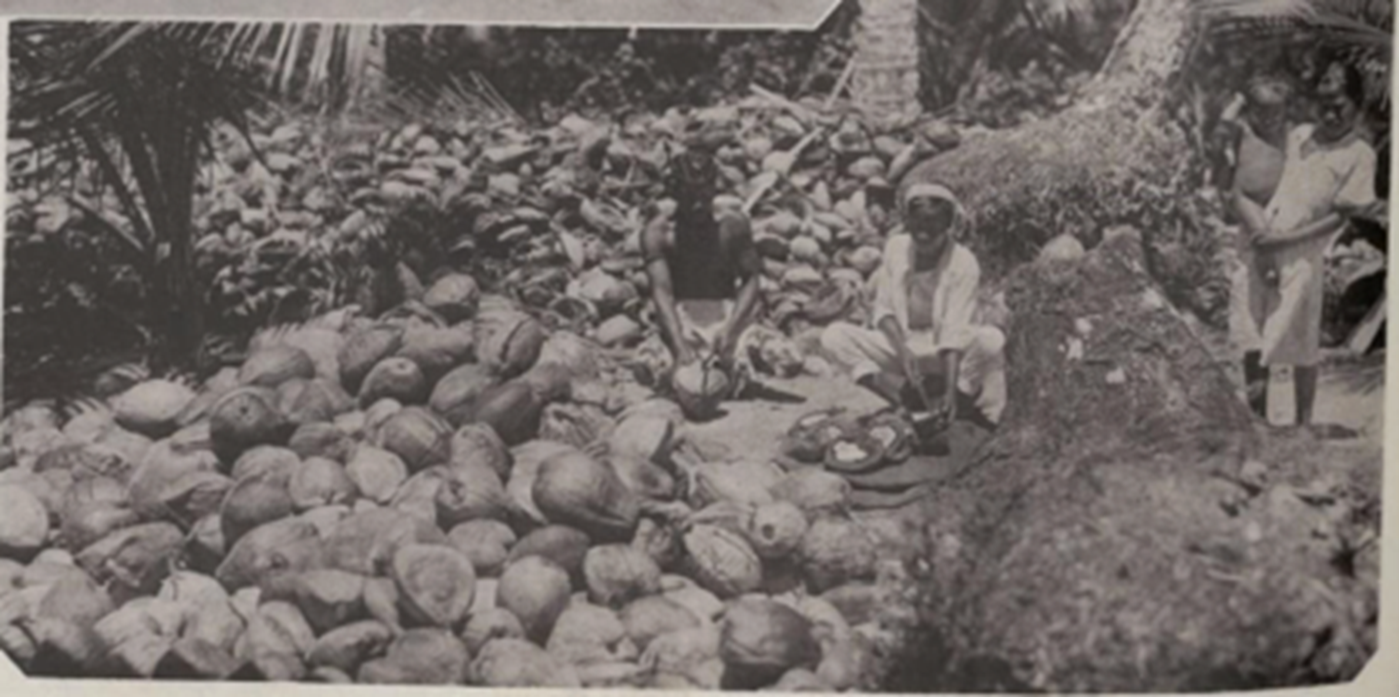
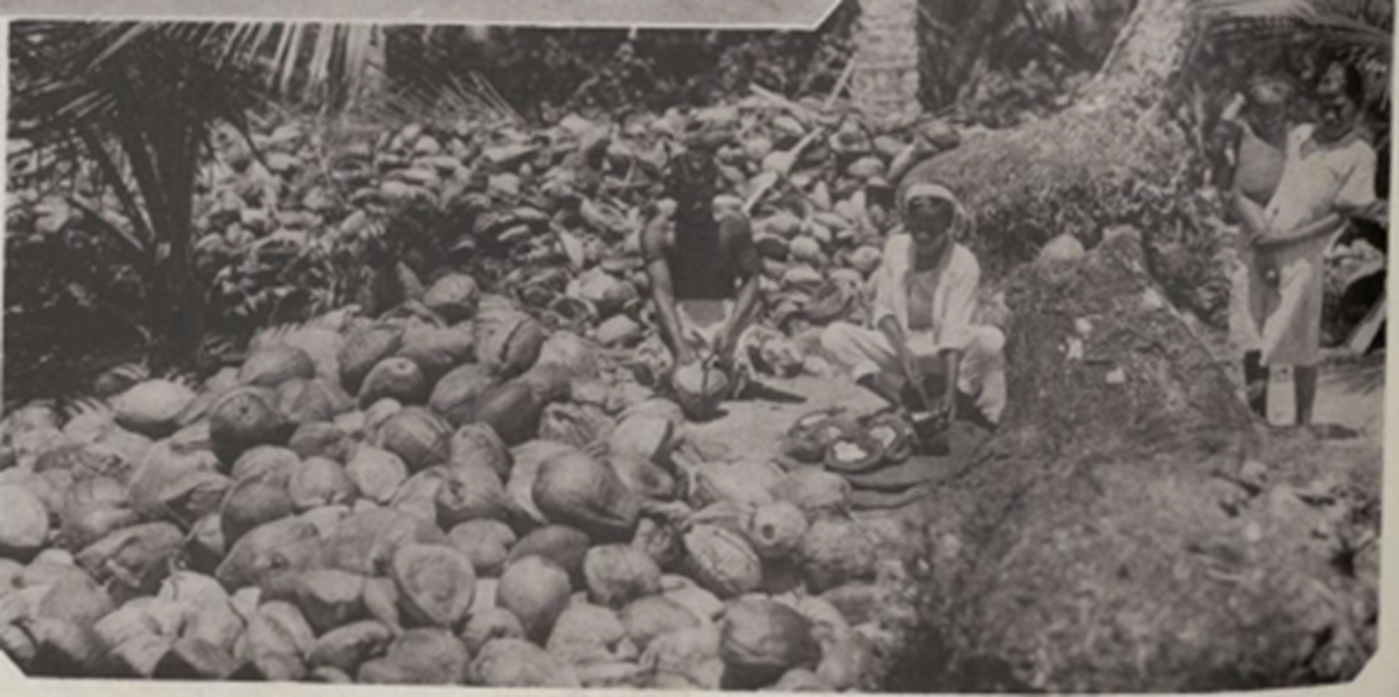
The focus of this paper is the period preceding the Japanese rule. When the Japanese navy landed in Truk in October 1914, the officers encountered twelve Japanese residents (one of which was Mori).Footnote 3 Not more than a few dozen would have settled here between 1891 and 1914. It was a tiny fraction of the Japanese overseas migrants in these years—by 1914 around 350,000 Japanese lived outside the Japanese mainland and coloniesFootnote 4 —but a study into them offers an insight into how entrepreneurship worked in the context of trans-Pacific human mobility. Although Japanese settler colonialism sent hundreds of thousands of people from the mainland into the South Seas, including Truk, in the 1920s and the 1930s, those who arrived before 1914 belonged to a specific demographic: single young men who worked for a trading company and possessed no noteworthy technical skills or knowledge that they could put to use immediately upon arrival in a tropical island. In contrast to migration to nearby regions like Korea and Taiwan which were dominated by individually funded opportunity seekers—peddlers, labourers, prostitutes—or office workers serving to run the colonial bureaucracy, Truk was a destination that required some financial capital in order for an individual to migrate and start a business. It had some resemblance to bird islands such as the Marcus Islands or the Rasa Islands where guano and feathers provided a lucrative opportunity for export.Footnote 5 In the 1890s, the earliest migrants discovered copra (sun-dried, white meat of coconut; figure 1) to be in abundant supply partly due to the colonial plantation that had already been in place. As a result, how to extract the maximum amount of copra became the question for the early Japanese settler entrepreneurs.
Production of Copra in Truk. Source: Nanyō kyōkai nanyō guntō shibu, ed., Nanyō Guntō Shashinchō Saihan (Nanyō kyōkai nanyō guntō shibu, 1925), 187.

Mori, who also arrived in Truk as a trading firm’s agent, left an outsized impact on the historiography of the Japanese Empire in the South Seas because he ended up being the longest-living Japanese settler in Truk. In the 1930s Japanese media referred to him as the “king of the South Seas,” noting the symbolic status he held among the local population.Footnote 6 When he arrived in 1892, however, he had faced utmost uncertainty even about his own survival. There were four people including Mori who arrived between 1891 and 1892, comprising the first generation of Japanese settlers there: Shirai Magohei, Akayama Shirosaburō, Tanaka Morihiko, and Mori.Footnote 7 By the end of the nineteenth century, the number of Japanese residents in Truk grew to fourteen, but Shirai, Akayama, Tanaka, and Mori – whom the rest of the paper will call the “first four” – are indicative of the kind of economic relations that Japan came to have with the South Seas.Footnote 8
The key entrepreneurial activity of the earliest Japanese settlers that will be investigated below involved buying the copra that the island produced abundantly and selling dynamite, rifles, and other firearms. We could call these Japanese settlers in the South Seas “entrepreneurs” as they do not fit the conventional image of artisans or skilled workers, though sources suggest they had some crude knowledge of manufacturing bombs from gunpowder. What they brought to Truk, instead, was access to hitherto scarce material that had a potential for application to warfare. The local availability of copra gave the Japanese settlers a sufficiently compelling reason to continue providing weapons to Trukese islanders.
This paper thus traces the activities of the four settlers in Truk and examines the factors that conditioned their form of entrepreneurship. The biggest part of the narrative focuses on Mori, because sources about him are the most abundant. How did the Japanese come to this trade scheme, and how did this reflect the socio-economic conditions in Japan and Truk? Though the export of copra itself was common across colonial plantations in the surrounding regions, such as the Dutch East Indies, British Malaya, and the Philippines, the Japanese migrant traders in Truk were in a unique position of being able to sell firearms without worrying about fuelling potential revolt against their own empire. As will be discussed, the copra-dynamite exchange arose from a combination of exogenous factors that drove a particular segment of the Japanese society to the South Seas in the 1890s, and the position that the Japanese migrants occupied within Truk in relation to the colonial authorities and local islanders.
Recent studies on Japanese overseas settlement have seen several works that focused on non-colonial contacts between Japanese and local residents. There, the story is one of non-hierarchical “brotherly cooperation” between Japanese and locals, where the Japanese brought in ideas of equality and did not aim for territorial conquest or economic domination.Footnote 9 Scholars explain that it was something other than imperialism or colonial boosterism that motivated Japanese to settle in hitherto unfamiliar place overseas: a search for a transnational network of people that countered or sidestepped imperialist governments including Japan. As Manimporok Dotulong noted, local islanders and Japanese settler labourers at times forged an amicable relationship and sense of solidarity that functioned independently of intergovernmental relations.Footnote 10 The story in Truk is similar but not completely the same. As discussed later, the kinship relations between Trukese and Japanese and other European settlers provided a unique condition for the development of entrepreneurship in Truk.
The early form of Japanese entrepreneurship in Truk was a product of external factors rather than the traders’ personal traits, knowledge, or expertise. By describing the economic, social, and political conditions that led them to their migration, the paper tries to shed light on one form of migrant entrepreneurship that operated in late-nineteenth-century Pacific. It contributes to our understanding of the history of entrepreneurship and technology transfer in the world of competing imperialisms.
The rest of the paper will be divided into three sections and a conclusion. The first section examines the backgrounds of the first four Japanese migrants to Truk, exploring how their political defeat and social marginalization in post–Meiji Revolution Japan led them to seek entrepreneurial opportunities in the South Seas. The second section analyses the introduction of dynamite to Truk by these settlers, revealing how this technology impacted local conflicts and created a lucrative trade scheme for the Japanese traders. Finally, the third section investigates the copra export that emerged from this exchange, examining how these entrepreneurs operated within colonial structures, the statistical cover-up by the Japanese government, and the unique kinship networks they established to ensure their survival and business success in Truk.
The First Four: Exile Migration and Accidental Entrepreneurship
The four earliest migrants from Japan were entrepreneurs who enabled each side of the exchange across the Pacific to access hitherto unfamiliar goods: copra for the Japanese and dynamite for the Trukese. Copra allowed the Japanese to produce butter, soap, oil, and so on; dynamite intensified intercommunal conflicts among the Trukese islanders.
The profile of the first four are only sparsely recorded in the available sources, but some basic information can be discerned. Shirai Magohei was born into a family of samurai in Niigata in north-eastern Japan. As an affiliate of the then-ruling Tokugawa shogunate, he had fought the civil war alongside Enomoto Takeaki, a prominent Tokugawa royalist, until the final siege of the Hakodate castle in southern Hokkaido in the early summer of 1869. Later, Shirai worked in the Ogasawara Island, some 1,500 km south of Tokyo, and then moved further south to Truk.
Akayama Shirosaburō came to Truk due to the acquaintance he gained with Shirai in Ogasawara, where he worked as a police officer. He then went back to the Japanese mainland and worked at the customs office in Yokohama, and there he reunited with Shirai and his old patron Enomoto. According to a biography of Akayama written in the 1930s, it was shortly after this meeting that Shirai and Akayama moved to Truk.Footnote 11 Enomoto, who, despite his affiliation with the Tokugawa shogunate, got reinstated after the civil war and held several ministerial posts under the Meiji government, was a prominent voice in Japanese expansion into the Pacific and was acutely aware of the difficulty faced by his former allies in a post-revolutionary era. Thus it is possible that, if the aforementioned meeting indeed had taken place, Akayama and Shirai agreed upon the plan of moving to Truk then.
Mori’s route to Truk was similarly influenced by the ex-samurai activists’ desire to find a new role in the Meiji society. He arrived to Truk as an agent of Ichiya Shōkai, a trading firm that aimed at opening a trade with the South Seas. The firm operated a ship, Tenyū Maru, which its founders purchased by putting together their compensation money from the government that followed the dissolution of their stipends in 1876.
Finally, Tanaka Morihiko was also a protégé of Enomoto Takeaki, though any further details cannot be found in the available sources. Tanaka notes that he was influenced by “vagabonds” who gathered around Enomoto and left Japan in the summer of 1890 to the Ogasawara Islands to work in a settlement farm. By the end of the year, he joined the trading firm Kōshinsha, another ex-samurai enterprise aiming for South Seas trade, and settled in Truk, allegedly the first Japanese to do so. The four men formed the Japanese resident association of Truk and appointed Tanaka as the president.Footnote 12 The Spanish and later German colonial authorities that ruled Truk exhibited little willingness or capability to regulate the arrival of Japanese settlers.
Apart from the political and social background at home, the four shared a survival strategy in Truk, which was rife with inter-communal conflicts.Footnote 13 Mori recalled that being able to provide guns and ammunition helped them establish a relationship with the Trukese.Footnote 14 It needs to be remembered that they lived in a hostile environment completely outnumbered by the Trukese Islanders. Whilst they managed to establish business relations in the early 1890s, their sense of insecurity never went away. One of them, Akayama, was murdered in 1896 as a result of a dispute over the sale of his rifle. It must have served to the other three earliest Japanese migrants as a reminder of precarious position they occupied within Truk.
Shirai and Mori, in response, married a sister and a daughter of a local chief on the island.Footnote 15 The newly forged kinship ties, they hoped, would serve as a protection in a space where, as Komatsu Kazuhiko has noted, Trukese Islanders could have easily killed them if they so wished.Footnote 16 Mori himself told a visitor to the islands in the early 1930s that the marriage was driven by the desire for safety, rather than for its formal status.Footnote 17 This narrative aligns with the fact that Mori registered his marriage with his wife Isabelle in Japan only in 1917—after Truk was occupied by the Japanese navy.Footnote 18 Prior to that, the migrants lived with little protection or oversight from the Japanese government. When Akayama was murdered in 1896, Tanaka, the president of the Japanese resident association, managed to get the Japanese and Spanish government officials to visit the island for investigation, but nothing substantial followed to enhance their security.Footnote 19
The fact that Shirai and Mori tried to assimilate into the Trukese kinship relations may seem to agree with the existing scholarship that argues for the value of private cross-cultural partnerships for the success of global entrepreneurship.Footnote 20 Yet in this case, the motivation in doing so was not so much the diversification of business risks as the guarantee of their physical survival. Unlike the cases of diaspora entrepreneurs observed in early modern Atlantic, Shirai and Mori never reached out to their family members in Japan to facilitate their business, as far as the available sources go. In the case of Mori, little trace survives in the archive that indicates a constant communication between him and his family members in Japan. While the twentieth century saw diaspora Japanese family networks grow across the Pacific, as observed most recently by Jun Uchida’s study of Ōmi merchants, early Japanese migrants to Truk did not fit this trend.Footnote 21 They were oddballs within their family members that remained within the national boundaries.
Looking at their trajectory from the point prior to the migration to Truk, the first four were pushed into becoming entrepreneurs by the political and social changes that swayed their lives. At least three out of four were from the samurai background (Shirai, Akayama, and Mori), and their family lived off stipends until the collapse of the Tokugawa shogunate. The search for a new profession began after the Meiji revolution, as was the case with hundreds of thousands of other former samurai across the country. There were several possibilities, the most common of which was to take up a job within the bureaucracy of the Meiji state as teachers, clerks, soldiers, or police officers. In the beginning of the 1880s, 5.3 per cent of the total population consisted of ex-samurai and their family members, but they took up 40.7 per cent of official posts.Footnote 22 One study estimates that 23 per cent of ex-samurai families supported themselves by holding official jobs.Footnote 23 Most of these jobs, however, went to those from the winning side of the civil war. Some of the declassed samurai without white-collar jobs began farming, the best-known example of which was tea farms in Shizuoka, a land of the now-ousted (but extant) Tokugawa family and its affiliates in a post-revolution society. Tea became Shizuoka’s key agricultural product for export, gaining popularity in the US market by the end of the nineteenth century as it competed with Chinese tea.Footnote 24 Still others emigrated, and the first four discussed here ostensibly fall into this group. But they chose a type of migration distinct from other migrant traders and labourers, as discussed in more detail below.Footnote 25
The inability to find easy transition into the post-revolution society in Japan meant that these ex-samurai were a potential source of social unrest, and that is what Mori initially put himself into. By the 1880s the main place of political dissent against Japan’s Meiji government moved from armed uprising to a demand for the opening of a parliament, and this resulted in the creation of several influential political parties. Across the country, organisations took a radical approach and tried to stir revolutionary spirit by political terrorism. In the Ōsaka Incident of 1885, one of the biggest plots of the kind ending with over 130 arrests, the perpetrators sought to travel to Korea and start a coup to place a leader of their liking, thereby satisfying their political motivation and economic needs.Footnote 26 Mori was among the arrested, though his role was minor. It was shortly after his release from a brief stint in prison that Mori decided to try his luck in the southward Pacific voyage, at the end of 1891.
All in all, the first four arrived in Truk after some form of political defeat, social marginalization, and what probably seemed a career dead end. None of them had experience in commerce, let alone international trade. The stories of their migration to Truk are told by later generations in a light of patriotism and trail-blazing, but available sources suggest that it was not a choice that each of the first four made proactively. Their discontent brought them to the South Seas because it offered them a chance to be someone else.
The four migrants all had a different ending in Truk. The most violent ending fell upon Akayama, who was murdered in February 1896 by a Trukese business counterpart who wanted to obtain his firearm. Tanaka went back to Japan in 1897 and does not seem to have returned to Truk. Judging from the fact that he published a detailed historical account of the Kobe harbour in 1905, he may well found a job working there shortly after his departure from Truk.Footnote 27 Shirai disappeared in the middle of a trans-Pacific voyage in 1914 on a cargo ship, somewhere between Yokohama and Truk.Footnote 28 An article about his wife Sakuko and his son Senri (from Shirai’s previous marriage with a Trukese chief’s daughter) appeared in the Honolulu-based Japanese language newspaper Nippu Jiji.Footnote 29 Mori stayed in Truk until 1945 and lived until he saw the Japanese surrender to the United States in the Pacific War. His marriage with Isabelle led to eleven children, and their offspring became an important part of postwar society in Truk (Chuuk).
The first four, directly or indirectly, experienced political defeat and social marginalization in the wake of the Meiji revolution. Unable to find easy transition to a new role in an industrializing society, they turned to a risky enterprise of establishing trade in the South Seas. They were different from many other Japanese migrants who had to start with what little they had; benefiting from the legacy social capital, the first four were able to work on a project that required some capital to start and, if it went well, promised a large return. The kind of relations they ended up having in Truk will be discussed below, but in order to do so, we have to start with the history of the material they brought in: dynamite.
Dynamite as the Weapon of the Not-So-Weak
The previous scholarship downplays the aspect of the earliest Japanese migrants in Truk as arms dealers and notes that Mori and others were trading copra with daily utensils such as clothes and plates.Footnote 30 Yet the impact of their introduction of dynamite to local Trukese society was paramount. Spanish colonial officials, who nominally ruled the island until 1899, noted that the Japanese traders brought in dynamite, guns, and gunpowder in large quantities to obtain copra, and that this contributed to the escalation of inter-communal violence in Truk. In 1896, Spanish reports noted six cartridges of dynamite were traded for anywhere between 450 and 1,000 coconuts.Footnote 31 In 1903, a German-language press based in Australia complained that Japanese damping of dynamite suppressed the copra price and made them question the value of this colonial possession.Footnote 32 Mori himself admits bringing in dynamite, in spite of the German ban, but he defends his and his peers’ decision to do so by asserting that German traders in Truk were doing the same. In the Walla Island in Truk, Mori wrote, two German traders were importing guns, ammunition, and dynamite and selling them to islanders in one village in large quantity. Armed with this modern weaponry, the village “pillaged” others, which led Japanese traders to sell ammunition in the same manner.Footnote 33
Dynamite was a new weapon that quickly proved consequential on many fronts. First patented in 1867 by Swedish chemist Alfred Nobel, its commercial use in civil engineering and mining projects spread far beyond European states and their colonies. It was a global product from the beginning: major factories were located in western Europe, but they relied on nitrate mined in Chile, Bolivia, and elsewhere. By the time of Nobel’s death in 1896, his factories around the world produced 66,500 tonnes of dynamite and related products every year.Footnote 34
The import of dynamite to Japan began in 1878. Newspaper advertisements suggest that it had become commercially available by 1880. But due to the nature of the product, access to dynamite was tightly regulated. The government built a designated warehouse in treaty ports and required anyone wishing to obtain dynamite to seek official permission. The regulation on the treatment of ammunition (kayaku torishimari kisoku) in December 1884 prohibited private manufacturing of dynamite.Footnote 35 Domestic production within Japan did not take place until 1905 – at least officially – at the army’s ammunition factory in Tokyo.Footnote 36
Despite such restrictions, however, dynamite was used and acknowledged widely by the Japanese. By the end of the 1880s, government warehouses stored over two thousand dynamite boxes at any point.Footnote 37 In a country in the midst of various civil engineering projects such as railway construction and urbanization, it was only rational that industrialists took keen interest in importing dynamite.
It was around this time that this explosive became a favoured means of violence for political terrorists across the world. Acts of assassination and attacks on public spaces using dynamite terrorised the civilized world in the 1880s, from France to Russia to the United States to Japan, relying on its visual impact to convey the political message.Footnote 38 Dynamite found a connection with global anarchist movements against the economic inequalities caused by industrialization. In Chicago in 1886, protesting workers threw a dynamite bomb at mob-crushing police; one year previously, a German anarchist extolled dynamite as “a genuine boon for the disinherited.”Footnote 39 The Japanese public was keenly aware, too. In the 1880s there existed a popular discourse that asserted dynamite to be a poison (gekiyaku) that, rather than facilitating industrial development, instigated political change.Footnote 40
One incident in November 1885 in Japan amply illustrates the discourse around dynamite and the implication access to it had. Baba Tatsui and Ōishi Masami, both key members of the Liberal Party that opposed the government and demanded political participation, visited Morrison & Co., a Scottish merchant in Yokohama that worked as Nobel’s agent, and had a conversation about dynamite.Footnote 41 In 1884 the government regulation on explosives had prohibited use of explosives for the hindrance of public safety and others’ body or property. Reflecting the sensitive political situation of the time, even showing the intention to purchase dynamite as a non-industrial customer was deemed as a criminal offence. But when Baba and Ōishi were indicted for potentially plotting a political terrorism by acquiring dynamite, the owner of the trading firm, James Pender Morrison, testified in court that the two men only made an inquiry and never placed a purchasing order, leading the court to acquit the two. The arrest gathered public attention because it occurred shortly after the arrest of Ōi Kentarō, the man behind the Ōsaka Incident that did have a plot of causing terror using dynamite.Footnote 42 It was later shown that Baba and Ōishi’s visit to Morrison had no direct link with the Ōsaka Incident, but that speculation contributed to the media hype. It was a common knowledge in the 1880s Japan that political opposition were drawn to dynamite as a means of carrying out radical actions.
Using dynamite as a political tool was an expensive option. In 1887, one Osaka-based merchant sold dynamites for 31 yen per box, which would have been equal to three to four months’ salary of a carpenter in Tokyo at the time.Footnote 43 The dynamite that Mori and others brought to Truk in the 1890s and the early 1900s were all imported products, mostly from Britain and Germany, according to the official statistics.Footnote 44 It was not a weapon readily available to the poorest and the most marginalized in society. In other words, the fact that the first four brought dynamite, rifles, and other firearms to Truk to exchange for copra is highly indicative of their socio-political background. That is, the traders were not impoverished peddlers or manual labourers, who would have found other destinations if they were to try their chance overseas in Korea, Hawai‘i, the United States, and so forth.Footnote 45 However, their commercial endeavour followed the failure of political opposition in mainland Japan as opposed to abject poverty. It is possible that they had access to this expensive material precisely because they were connected with political parties that had attempted to use dynamite for political purposes.
The first four engaged in this business by taking a series of major, often uninsurable risks. The transportation between Truk and Japan was far from safe, and Shirai Magohei became a victim of its vicissitudes in 1914 when his ship disappeared, never to be found. Nippu Jiji’s article noted he left behind a Japanese wife Sakuko from his second marriage and a Trukese-Japanese son Chisato from his first marriage.Footnote 46 Another risk for the Japanese was the relations with the local islanders, which led Mori and Shirai to forge kinship relations in search of security. The relationship with the European colonial authority was a fraught one as well. Germany expelled Japanese traders from Truk between 1901 and 1906 because of their sale of firearms. The German authorities only allowed Mori to stay on, because he worked for the Jaluit Gesellschaft, the German firm on the islands.Footnote 47 Finally, the firearms themselves posed physical risk to the traders. Mori suffered from it when, in 1896, he accidentally blew up his right hand while handling gunpowder (of an unspecified kind) and was forced to make a rare return to his hometown to receive a medical treatment.Footnote 48 The destructive effect of dynamite was not lost to the German colonial officers, one of whose reports in 1901 noted that in the preceding eight years, “four Japanese and ten natives suffered the loss of their eyes and hands.”Footnote 49 Mori would have argued that it was the German traders on the island who started it.
Thus, the widespread use of dynamite in the Caroline Islands for military purposes impacted its society. It fuelled inter-communal violence and contributed to the extension of economic power on the part of settler traders. Now the next section looks at the other side of the exchange, the export of copra.
Exporting Copra and a Statistical Cover-Up
Sources suggest that the first four migrants had little idea what their business might look like once they establish themselves in Truk. But once they reached Truk and interacted with the islanders, it became clear to them that copra was the best product for them to export, and local islanders were eager to purchase firearms in return.
Being able to provide local islanders with dynamite and guns clearly increased the Japanese newcomers’ symbolic capital; the islanders recognised the value in dealing with them as the latter were willing to give weapons at a cheaper price than European merchants they had dealt with.Footnote 50 Seen from the Japanese migrants’ perspective, the copra trade was worth the risk because of its lucrative nature. For instance in 1899, Japan imported 1,489,553 cattyFootnote 51(around 669 tonnes) of copra from the South Seas for a total price of 44,666.83 yen. In the same year, 571,884 catty (around 257 tonnes) of dynamite was imported for a price of 244,303.45 yen.Footnote 52 If a Japanese trader could buy one box of dynamite for 31 yen, containing 50 cartridges, that would be enough for him to obtain around 4,166 copra seeds. If one copra seed weighs one kilogram on average, by paying 31 yen for dynamite box one could gain 4.166 tonnes, or around 9,257 catty of copra. This would sell in Japan for 278 yen. This is a crude and speculative calculation that needs to take into account other factors such as transportation costs, but it indicates that the copra-dynamite trade had a potential of bringing major profits to the Japanese handlers.
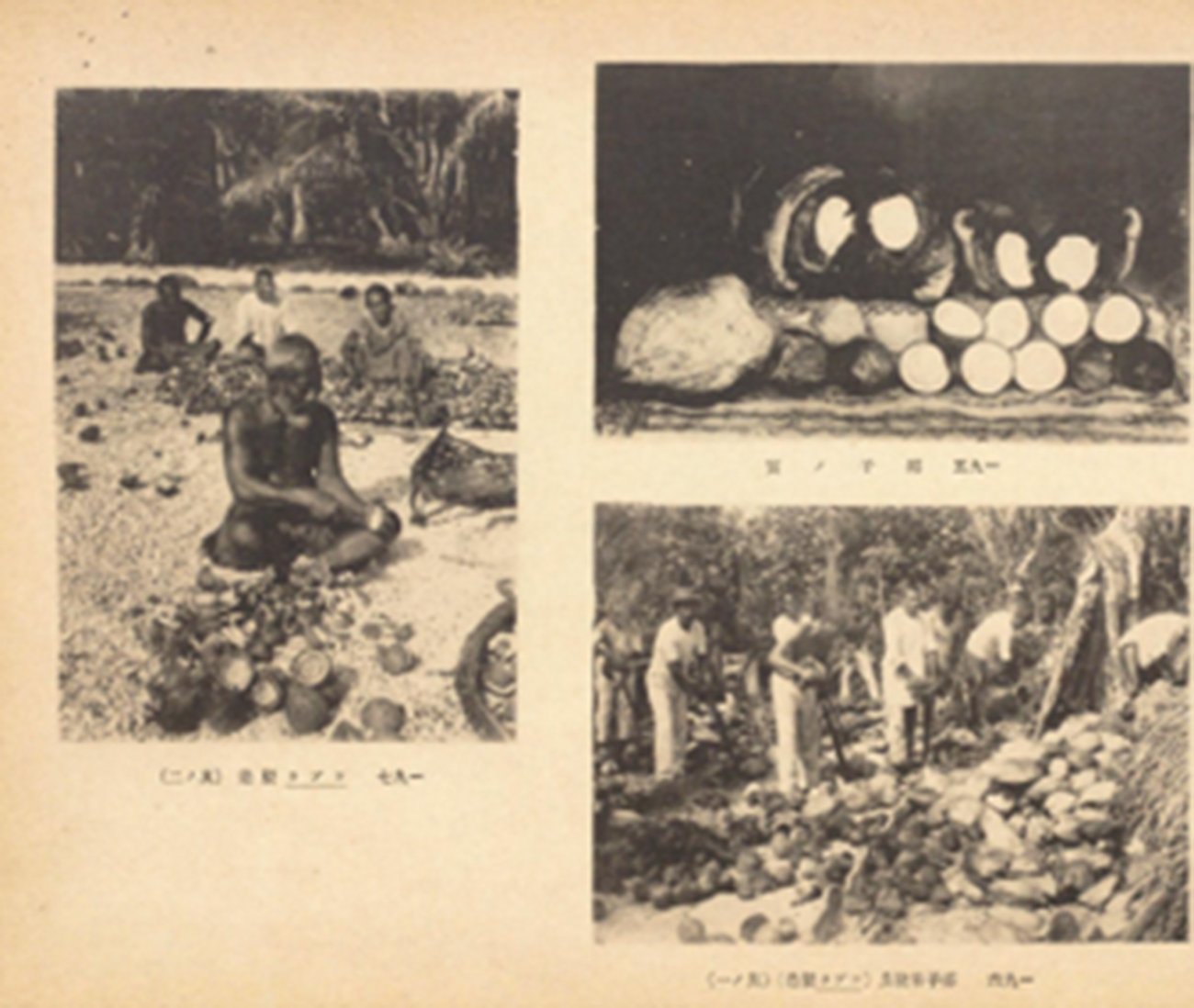
Part of the reason why the copra trade was lucrative for the Japanese settler entrepreneurs was that they were able to exploit indigenous labour. The production of copra in Truk depended entirely on manual labour: cutting coconut seeds in half (up to a thousand per day), peeling off the fibre-rich outer skin, and then leaving the white meat of the fruit under the sun to dry were all done by human hands with knives (figure 2).Footnote 53 All of this was possible because of the labour supplied by indigenous men and women. It was a task that did not require specialist knowledge or extensive training, but it did require an enormous amount of labour.
Harvesting copra in Truk. Source: Torakku Kyōiku shikai, ed., Torakku Tō Shashinchō (Torakku Kyoiku Shikai, 1931), frame 123.
Japan was not alone in doing this type of plantation-based production in the Pacific Islands. Japanese firms took advantage of former colonizers’ plantations, since coconut trees take several years to mature and begin to produce seeds. When the Japanese navy occupied the islands in 1914 and expelled the Germans, therefore, the Japanese were also taking control of the coconut plantations, some of which the Germans never managed to harvest from.
Thus we can identify at least two elements exogenous to the Japanese entrepreneurs that enabled the technology transfer to Truk in the form of firearms: the effort of Germany’s state-backed enterprise, Jaluit Gesellschaft, to optimize copra production under the constraints of land availability; and their inability to clamp down completely on the Japanese smuggling of firearms, at least for initial years of the Japanese migration. By the time the Japanese imperial navy occupied the Caroline Islands, around six hundred tonnes of copra were exported from these islands every year. Jaluit Gesellschaft took the lion’s share of the enterprise, but, importantly, the scale of the Japanese businesses reached about a third of the size of the German colonial authority.Footnote 54
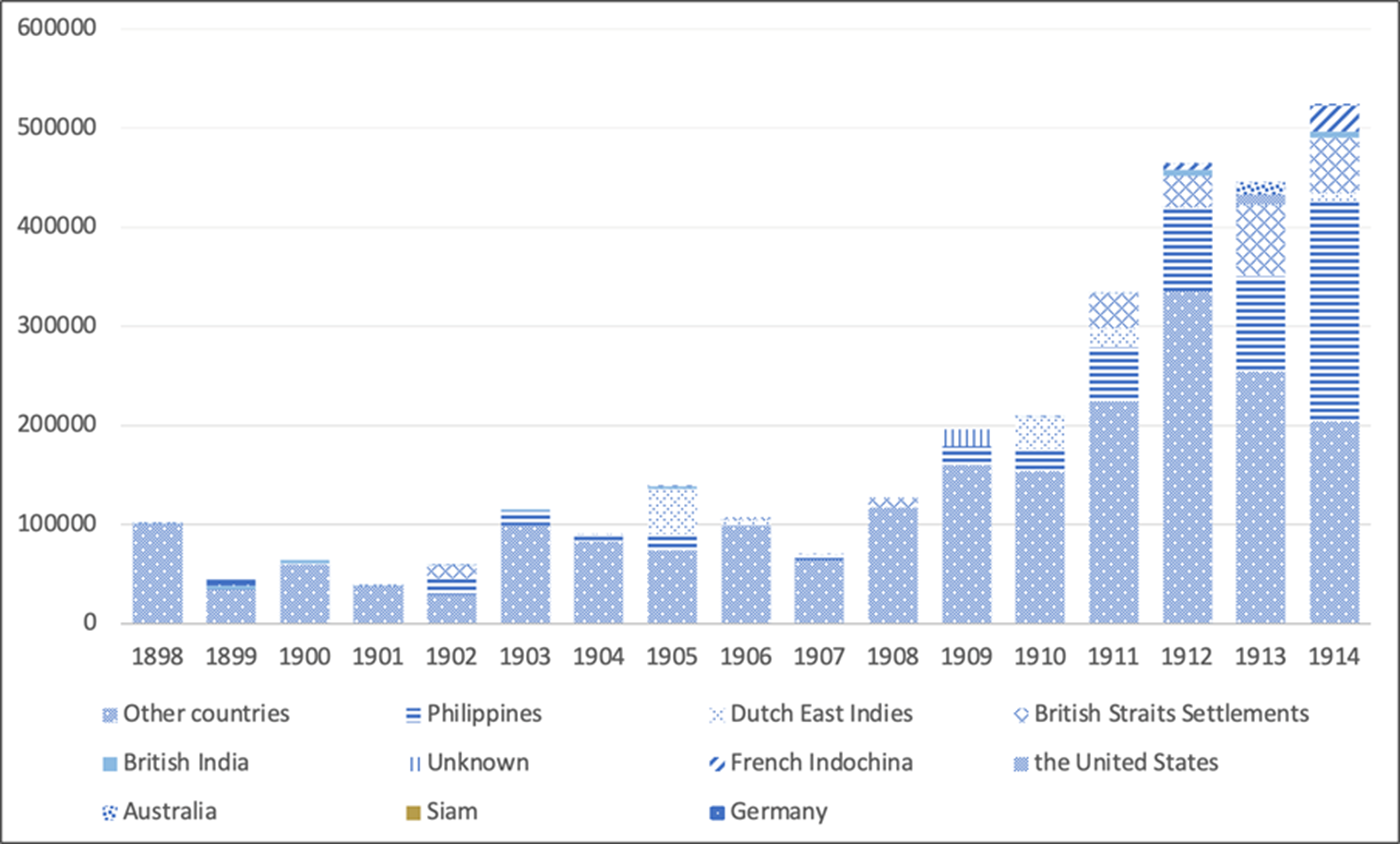
Although the Japanese settlers operated without the state’s active promotion and protection, the officials in Tokyo were willing to provide some indirect and subtle support in the realm of the official statistics. Copra import to Japan was somewhere around 100,000 yen per year until 1908, and then began to grow around four- to fivefold (figure 3).
Copra import to Japan by countries, 1899–1914 (in yen). Source: Ōkurashō, ed., Dainihon gaikoku bōeki tōkei nenpyō (Ōkurashō, various years).

As the statistics show, most of the source countries or regions are European or American colonies in the Pacific. However, there is no mention of Truk or the Caroline Islands, where copra was surely being produced and exported to Japan, through the work of the first four and others. I argue that the reason for the non-appearance of the Caroline Islands is because of its illegality under the Spanish and then German colonial rule. As noted before, the Japanese settler entrepreneurs in Truk were exporting copra to Japan in exchange for guns, dynamite, and alcohol to the Caroline Islanders, in a clear violation of the German government’s prohibition. The German government were naturally critical about this, but their frustration arose not necessarily from a moral viewpoint but from an economic one: the Japanese were seen as dumping the copra price and harming the business of the German enterprise of copra export run by Jaluit Gesellschaft. If the Japanese government were to record part of the copra import honestly and say that they were from the Caroline Islands, that was sure to garner a reprimand from the German government. The statistics show that the Japanese government opted to cover up the illegality of the trade by labelling the copra import from Truk or other parts of German Micronesia as coming from “other countries.”
I have two reasons to support the argument that the Japanese government co-opted its settler entrepreneurs in Truk and endorsed their smuggling. The first is the fact that in the first year of the German rule in the Caroline Islands, 1899, the copra import was indeed recorded as coming from Germany (slightly over 200,000 catty were recorded to have arrived in Japan), and from 1900 onwards there is no import from Germany.Footnote 55 Since it is extremely unlikely that Japan imported copra from the German metropole (or any other parts of the German colonies for that matter) just that year, it is natural to assume that the trade was labelled differently from the year 1900 onwards, having realized the problem of doing so. Second, and more conclusively, the origin category named “the South Seas” appeared in the official statistic in 1919, the year that the Japanese occupation of the Caroline Islands was formalized with the conclusion of the First World War. In this 1919 data, the import figures for 1917 and 1918 from “other countries” were retrospectively re-labelled as those from the South Seas.Footnote 56
Without more direct backing from the state, the Japanese entrepreneurs who engaged in the copra-dynamite trade relied on locally grounded kinship networks to protect themselves and their business. As mentioned before, Shirai and Mori used marriage with a daughter of a local chief as a security guarantee. This is different from a common pattern of settler colonialism, where a single male migrants’ initial move is followed by the arrival of their family members, or family migration is encouraged from the beginning, thus creating a new demographic layer.Footnote 57 Elsewhere in the destinations of the Japanese migrants across the Pacific, settler communities typically distanced themselves from locals, but in Truk, intermingling with local islanders was the norm among the earliest settlers.
Moreover, the kinship relations in Truk involved Western settlers as well. Shirai Magohei and his wife Sakuko had a son, Senri, before Shirai’s ship disappeared during a voyage in 1914; and he married Mori’s first daughter, Osame. Senri, however, had a half-brother, Kiyoshi, whose parents were Magohei and a Trukese woman. Kiyoshi worked at Mori’s shop and married a French woman named Ellen Pierre, the second daughter of Nedelic Pierre.Footnote 58 Nedelic Pierre was a former whaler from France who had deserted his ship on the Jaluit Island.Footnote 59 Another example is Mori’s seventh child, Kozue, who married Arthur Irons, a son of British trader-settler in Truk named Charles Irons.Footnote 60 Further, Mori’s first son, Tarō, married a woman named Jini, who was a daughter of a certain Peter, a Western settler in Uman Island in Truk.Footnote 61 Mori, Shirai, Irons, and Peter formed a family and had children with the Trukese Islanders, but their next generation married each other instead of marrying the Trukese, “creating what is almost like an aristocratic society,” in the words of a Japanese diplomat Shigemitsu Aoi, who investigated Truk in 1921.Footnote 62 There seems to have been no taboo in interracial marriage, and yet the pattern of marriage was not completely random. There was a sense that outsiders were different, and they preferred to remain that way.
The intermarriage of the first generation and then the creation of a transnational social class of second-generation settlers in Truk makes a contrast to other sites of Japanese overseas migration. Although Mori maintained a pro-imperial discourse in his writings (almost all of which are from the period after the Japanese military occupation of Truk) and continued to operate under the assumption that the Trukese islanders needed civilizational uplift, that did not prevent him from having a family with a Trukese woman.Footnote 63 Then, the second generation intermarried with children of the settlers from Japan or Europe, suggesting that the racial hierarchy between whites and non-whites and a sense of “racial purity” were absent from the settler community in Truk.
Such an approach to kinship network building did not meet all-out endorsement from the Japanese colonial authority or public opinion. In 1936, at a roundtable discussion in Tokyo, Hayashi Toshio, the director of the Nanyōchō (South Seas Bureau, Japan’s colonial administration), acknowledged the existence of opposition among the Japanese to marriages between Japanese and South Seas islanders, and lamented that mixed-race children are treated as outsiders by both parent communities. Tadano Yasumasa, a veteran Japanese bureaucrat in the South Seas who oversaw the Truk branch of the Nanyōchō from 1924 to 1929, bluntly claimed, “In the [South Seas] islands too, if the Japanese were to plant seeds and improve, I think good things will come out of it.”Footnote 64 Yokota Takeshi, the chief editor of the magazine Nanyō guntō (South Seas archipelago) and the host of this roundtable, referred to Mori Koben as someone who “married a Trukese and his whole family married islanders on the Tol Island, creating something like a Mori kingdom. So, if migrants are prepared to settle there permanently, I think it would be acceptable for them to have islanders as their family members and marry them.”Footnote 65 While their expressed views were ambivalent, they hint at the uneasiness among Japanese political elites towards the consequences of interracial marriage. The case of the Mori family is referred to as an anomaly where the migrants showed an exceptional degree to which they embedded themselves in the kinship network of the host society.
Did Mori Koben’s children all actually marry islanders, as Yokota stated? In his personal papers, we can find a family tree created by his descendants. The names of three of his children’s spouses are unknown, but of the remaining eight, except for Shirai Senri (who married Koben’s eldest daughter and has a Trukese mother), the spouses’ names do not seem to be Japanese, so the expression “almost all of the family married islanders” is probably not an exaggeration.Footnote 66 However, it is not clear how many of these spouses were descendants of settlers (as the aforementioned Shigemitsu report suggests) or Trukese islanders.
What does this all mean in terms of technology transfer and entrepreneurship? First, Japanese entrepreneurs came up with unique survival tactics of marrying Trukese Islanders and European settlers’ children to create a favourable business environment. Second, the existence of competition between them and German traders accelerated the introduction of dynamite to Truk, despite the temporary expulsion of the Japanese between 1901 and 1906, during which the import of copra into Japan from “other countries” never stopped. Until 1919, the Japanese government indirectly supported these traders by obfuscating the origins of the imported copra on the trade statistics. Japanese traders operated as private enterprise, and their influence on Japanese sovereignty claims or military deployment was limited. Thus the forming of a transnational settler entrepreneur class, even though it did not lead to strong official support before the First World War, helped the copra-dynamite exchange to continue. The case shows entrepreneurs’ ingenuity while probably showing their rejection of reliance on the state against which they had once had a fallout. The result was the emergence of a settler colonialism that was driven by a combination of desire for independence from state authority, a condescending view of the Trukese culture, and yet a liberal attitude towards forming kinship networks with non-Japanese residents, including those of European descent.
Conclusion
The copra-dynamite trade in Truk was done by people with access to capital as well as to maritime transportation. The first four, as far as the available sources go, came from a background of non-farmers whose privilege was abolished in the early 1870s due to the anti-feudal reform of the Meiji government. Some of their peers were quicker in finding a career transition, but they were left in the margins of modernizing Japan.Footnote 67 Having lost the political struggle to what they saw as a cliquey government dominated by the winners of the civil war, their position in the society was one of disenfranchisement. Part of the capital that funded Pacific-bound commercial ventures were the compensation funds given by the Meiji state to the declassed samurai. By selling dynamite to the islanders, the Japanese entrepreneurs in Truk were fighting the war they could not win at home. Maxine Berg has argued for the utility of analysing how local circumstances and networks converged to shape global histories.Footnote 68 The way in which the first four transformed the lives of the Trukese as well as themselves through their migration to Truk and their formation of kinship network, as discussed above, can be seen as an example of such an approach to connect the local and the global that was unique to Truk. Using individual, micro-historical examples does not have to limit itself to the analysis of the subjects’ motivations, preferences, and intentions; individual actions are helpful in understanding global dynamics, and the opposite is just as true.
The export of copra to Japan grew by eighteen times between 1907–11 and 1918–22. Around 60 percent originated in the Pacific, such as the Caroline Islands, the Philippines, Malaya, Indochina, and East Indies.Footnote 69 Japanese occupation of the German Pacific would have contributed to this increase. But as Tanaka Morihiko remembered in 1921, their settlement in Truk at the end of the nineteenth century had no contribution to the Japanese navy’s takeover in 1914.Footnote 70 The project of the first four had taken place largely outside the state’s purview. Their entrepreneurship, though very much contrived, could explain the beginning of the Japanese import of the South Seas copra, but not its peak.
For the Japanese who settled in Truk in the end of the nineteenth century, entrepreneurship was not a preferred mode of economic activity. They were denied other, easier options to make a living in a post-revolution society due to the fact that many of them were declassed samurai, often on the losing side. Not everybody fit this bill perfectly, but the key members such as Shirai, Akayama, and Mori came quite close to this profile. They were marginalized in the society, which nudged them to take risks. In the sense that they hailed from a warrior background, they are similar to what Lucassen and Smit has termed “organizational migrants,” but their migration took place after their demobilization.Footnote 71
In the sense that the first four exploited indigenous labour in extracting copra, becoming entrepreneurs in Truk meant putting what Franz Fanon called the “white mask” vis-à-vis the Trukese Islanders.Footnote 72 Yet one could also say that their mask had a more complex colour, as they forged a kinship network that included both the indigenous islanders as well as settlers from Europe and Japan. The copra that arrived at Japanese ports from Truk as a fruit of their entrepreneurship was a metamorphization of dynamite bombs that the Meiji state opponents had once failed to use at home. By the end of the nineteenth century, that dynamite exploded elsewhere, far away from the Japanese mainland, turning the former opponents to the state into its enablers, blast by blast.
Acknowledgements
I would like to express my gratitude to the anonymous peer reviewers for their constructive feedback, as well as to the participants of the Workshop “Migration and Entrepreneurship in Early Modern Technology Transfers” (September 2023, Northumbria University, UK) for their insightful comments and suggestions, on an earlier version of this article.

 Open access

