INTRODUCTION
In the popular 1997 movie Con Air, starring Nicholas Cage and
John Malkovich, a wrongly accused convict on board a prisoner transport
flight (“Con Air”) witnesses a highly racialized attack(West 1997):
Even though the ethnic identity of the unnamed character isn't
spelled out for the audience, it is clear that he is an American Indian
(Native American). Curiously, it is not he himself who projects this
identity, but rather the commentary and actions of Parker, an African
American character, that unambiguously define this character as Indian. In
doing so, Parker draws on a body of preexisting “Hollywood
Indian” racial characterizations that are a part of “white
public space” (Hill 1998).1
I use the terms “Hollywood Indian,”
“Hollywood Injun” or “White man's Indian”
when referring to stereotyped images of the indigenous peoples of the
Americas, and “Native American,” “American
Indian,” or “Indian” when referring to indigenous
peoples themselves in order to reinforce the distinction between
“American Indian English,” which refers to a variety of
English dialects, and “Hollywood Injun English,” which I
define as a stereotypic non-Native fictional representation of American
Indian speech.
For instance, the lexical items
Cochise, How!,
Wounded Knee, chief, Last Mohican, and
YMCA metonymically
allude or refer to all Native Americans. Pinball's greeting,
How!, is complemented by a hand-raising gesture and a deepening
of his voice. The unnamed character's lack of expression, eye
contact, and verbal response conform with popular conceptions of Native
American stoical behavior. Finally, the victim's immolation alludes
to stake-burning imagery often associated with Indians.
Such racialized representations in film and other media have been the
object of extensive analysis. Some of the most frequent representations
portray American Indians as timeless, silent, savage Plains warriors
(Churchill 1998; see also Berkhofer 1978, 1988), as in the
allusions in Pinball's monologue above. Most linguistic research on
American Indian representation has focused on the language used to
describe Indians and not on their imagined speech.2
With the growing concern for transforming, altering, or
eradicating homogeneous Indian representations, many researchers have
begun to focus on the deconstruction and reconstruction of these images.
This research has gone in three directions: pejorative images in literary
and historical accounts (Cassuto 1997, Churchill 1998, Deloria
1998, Dilworth 1992, Lewis 1988, Macaruso 1984,
Mieder 1993, Sawaya
1991); racially loaded terminology (Forbes
1995, Krishnamurthy 1996, Yellow Bird 1999; see also Bataille
2001); and analyses of the objectification of the
“Indian” in public and popular domains, such as the media
(Berkhofer 1978, 1988;
Churchill et al. 1978; Churchill 1998; Ewers 1965;
Green 1988a, 1988b;
Kilpatrick 1999; King
1998; Mihesuah 1996; Nason 2000; Purdy 2001;
Reed 2001; Rollins &
O'Connor 1998; Stern & Stern
1993; Strong 1996, 1998; Sturm 2000; see also
Bataille 2001). Throughout this literature, two
dominant themes surface: the distinction between the “good”
and the “bad” Indian, and the distinction between the
“white” and the “nonwhite.” The relationship
between these two themes predictably relates the “good” Indian
with “whiteness” and the “bad” Indian with
“Otherness.”
When the fictional utterances of Indians
have been commented on, such terms as “whooping,”
“grunting,” and “primitive” have been used to
describe them, as well as phrases like “a weird sort of pidgin
English” (
Churchill 1998:184; see also
Kilpatrick 1999,
Stedman
1982,
Strickland 1997). Silence has also
figured prominently, to the point where an off-screen white narrator or
character speaks for the Indian character(s) (
Churchill
1998:185–86). Another established feature of these fictional
portrayals is the sprinkling of nature metaphors throughout a
character's dialogue. The nineteenth-century novelist James Fenimore
Cooper employed the same nature metaphors to represent the speech of his
Indian characters as he did to describe them (
Sawaya
1991:131). Finally, the slow, ponderous delivery of lines has been
a common practice in actors' performances of Indian characters,
something Kilpatrick has described as “a translation into voice of
the stoic, stone-faced ‘blood-thirsty’ redskin” (
1999:37).
This article contributes to the work that critically assesses images
of indigenous peoples produced by a dominant majority, expanding on
previous research by focusing on language and, more precisely, on
fictional representations of speech, and asking the following questions:
How has Native American speech been imagined and represented in white
public space? What linguistic features are highlighted and reproduced in
this fictional dialogue? And in what ways do these fictive linguistic
portrayals racialize and denigrate contemporary Native Americans? To
answer these questions, I analyze the performed speech of Indian
characters in eight films, three television episodes from two popular
shows, and two contemporary greeting cards – a small sample, but
illustrative of the limited repertoire Indian characters have to draw
from. Emerging from this analysis is a description of a style of speech
that I call “Hollywood Injun English” (henceforth HIE), a
composite of grammatical “abnormalities” that marks the way
Indians speak and differentiates their speech from Standard American
English (SAE).
The first section grammatically analyzes Hollywood Injun English. It
shows the ways in which HIE deviates from some standard variety of
American English. The second section compares HIE with varieties of
“real-life” American Indian English (AIE). Beginning with
early pidgin varieties described by authors, adventurers, and captives and
moving through the analysis of contemporary styles of AIE as described by
linguists, we see that white public space offers a limited set of tokens
to serve as indexes of “Indianness.” After having identified
the grammatical structure of HIE and to some extent its origins, the third
section analyzes two scenes from two different films to show how this
linguistic template articulates with the images being portrayed in these
films. However, while the HIE style can index many specific pejorative or
demeaning characteristics, a full analysis of these is more than can be
accomplished here. The fourth section discusses the ways in which this HIE
style covertly perpetuates a racialized and racist image of Native North
Americans.
Whether or not Indian characters are still being written as simple
noble savages, subtler stereotypical attributes are still being referenced
by actors attempting to sound like “authentic” (Hollywood)
Indians. As they perform, they draw on and reproduce a static, monolithic
imagery of Native voices. Thus, HIE is a good example of what Judith
Irvine and Susan Gal have called “linguistic images,”
“images in which the linguistic behaviors of others are simplified
and seen as if deriving from those persons' essences rather than from
historical accident” (2000:39). These
“linguistic images” are also part of a larger national U.S.
imaginary that routinely portrays minority (and immigrant) speech styles
in a dysfluent, “Othered” fashion. And because these
racialized styles of speech are an extremely salient and naturalized part
of cultural representations, they can be readily performed by both
children and adults in the United States (Andersen
1992), suggesting that we are socialized early on to practice
linguistic segregation. These linguistic images contribute to the
construction of the dominant white public as being indigenous because it
is linguistically unmarked and “correct,” thus serving to
erase Native North American diversity, primacy, and contemporary
presence.3
Throughout the rest of this film,
the only other scene that the Indian character is visible in is when,
having survived Pinball's fire, he is killed by the DEA
officials.
HOW! WHITE MAN: THE GRAMMAR OF HOLLYWOOD
INJUN ENGLISH
Linguistic anthropologists and other linguists often talk about styles
of speech, speech registers, or ways of speaking. In such cases they are
usually referring to nonconventionalized forms of speech used in everyday
conversation, not “abnormal types of speech” (for an exception
see Sapir 1958 [1915] on Nootka; see
also Basso 1979). Here, however, the focus is on
just such a speech style, one that underscores and reinforces certain
aspects of a generic Indian image.4
Following
Mendoza-Denton 1999 (see also Bell 1984, Eckert & Rickford
2002, Irvine 1985), I would argue that
HIE is a style of speech (as opposed to a register, dialect, genre, etc.)
because it is deviant, mutable, self-consciously constructed, and
extremely concerned with connecting to the audience and the
audience's imagination of Indians (as opposed to invoking a
particular situation or context, it elicits a particular memory or
romanticized idea of Indianness).
Most Americans can readily
produce such phrases as “Me smoke-um peacepipe” and
“How!” accompanied by a raised hand, or more figurative
phrases such as “many moons” and “happy hunting
ground.” This indicates that HIE is a linguistic form present in the
language repertoires of many non-AIE (as well as AIE) speakers.
5 With respect to Native American speakers'
perceptions of other community members' speech, some people find that
these public representations are exactly what they hear – a
substandard form of English – and these people are critical of those
who use any AIE variety. However, these critics themselves have chosen not
to speak any AIE variety and tend to be proud of the fact that they speak
a standard English dialect.
Through a grammatical analysis of
this fictional Native American speech from a diverse sample of media and
genres, a surprisingly homogeneous style surfaces – not the
explosion of speech varieties one might expect if the speech styles were
tailored to suit each individual performance or representation.
6 Berkhofer 1978, 1988 makes a similar observation with respect to the
themes or images surrounding the “white man's Indian.” He
notes that “along with the persistence of the dual image of the good
and bad and general deficiency went a curious timelessness in the defining
of the Indian as other” (1988:528). So,
throughout the various transformations Indian images underwent, particular
dualities and contrasts remained. The same can be said of the linguistic
side of the imagery.
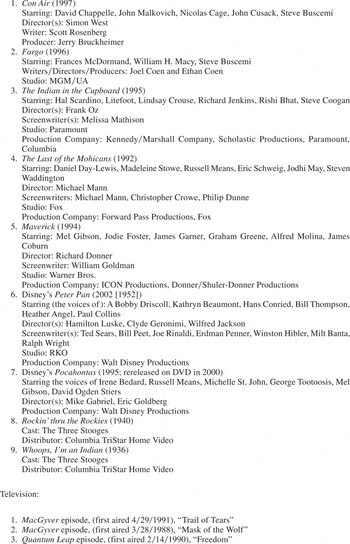
The data gathered come from movies,
television shows, and greeting cards, all of which are readily available
(see Appendix A for a list of sources and dates of films and television
shows). The actual production dates for the films and shows range from
1936 to 1997; however, most of them appeared within the years 1986 to
2002. These sources were chosen for several reasons: they all have Indian
characters; they cover a range of media (television, film, greeting cards)
and genres (western, children's, action-adventure, drama, science
fiction; animated, live; historical, contemporary; full-length feature,
short feature); and the Indian characters have at least one or two lines
of dialogue (as opposed to grunts or silence).
As we will see, the grammatical structure of HIE parallels quite
closely that of “foreigner talk” as discussed by Ferguson
(1996 [1971]). What marks the speech
as HIE, however, is the deployment of certain phrases and lexical items
found only in HIE and derived from various Native American languages and
historical speeches and treaties performed by American Indian individuals
(Berkhofer 1978:88, 220–21; Marsden & Nachbar 1988:608). This, coupled with
other features, transforms the generic foreigner talk into the more
specific Hollywood Injun talk. These are some of the resources actors draw
on to enhance the portrayal of Indianness.
The distorted representations of American English that serve to mimic
Native American speech (linguistic structures that non-AIE speakers can
easily produce) have distinct patterns in prosody, morphosyntax, and
lexicon (referring in particular to lexical borrowings and figurative
phrases). Phonologically, Hollywood Injun English sounds like standard
American English. There are only four utterances in the data that
distinctly differ from some Standard American English pronunciation.7
None of the four variations were
consistent across the transcriptions. Thus, sound variation is not a
central component of HIE in the data analyzed.
8 Changes in voice quality can sometimes be used to identify IE,
as in an Indian chief speaking in a deeper, throatier voice or Pinball
Parker's shift in voice quality in the opening example. This is true
for all cases of IE, though. This is also a primary difference between IE
and Mock Spanish, where phonological alterations play an integral part in
this mimicked representation (see Hill 1993a,
1993b, 1995), perhaps
because people hear different dialects of Spanish spoken whereas few
people have heard or are even aware of the fact that there are many
dialects of American Indian English.
Prosodically, both
intonation and use of pauses are distinct from SAE usage. Pauses are
longer in HIE, lasting one to two seconds generally. Also distinctive are
the frequency of pauses in a performed line and their nonstandard
placement. Examples are given in (2), with pause length noted in
parentheses:
9 The abbreviations for the
sources are the following:
All the examples in (2) show extensive use of pauses, as well as
pausal lengthening. They also reveal that the pause can be placed almost
anywhere, either at a phrasal boundary or at a word edge. For example, in
(2b), the pauses break up the phrase to humiliate him, with
pauses at both edges of the word humiliate. The atypical use of
pauses has a leveling effect on intonational contours, which creates a
ponderous, monotonic pace suggestive of a lack of fluency (or a type of
ungrammaticality), especially in those cases where the pause is not placed
at a phrasal or syntactically defined constituent boundary.
Though often used to indicate a nonnative, incompetent speaker of
English, in other instances this ponderous style may be used to represent
an eloquent speaker performing oratory. Sometimes this oratorical style
occurs within dialogue. In these cases, the style of speech is usually
executed by an elderly (contemporary) Indian character or a historical
figure of some social importance. For example, when Pocahontas's
father, Chief Powhatan (voiced by Russell Means), speaks in the Disney
film Pocahontas (1995), his style is
slow, careful, and articulate, eloquent in both conversation and speech
making. Consider the following two excerpts (the length of time in seconds
is provided in brackets at the end of each utterance, and the rate of
articulation tabulated dividing the number of words in each utterance by
the length of time) (Gabriel et al. 2000
[1995]):
In this example, both individuals' rates of articulation are
fairly similar. Chief Powhatan's pacing for lines 1 and 2 has a rate
of 1.75 and 1.6, respectively.When in dialogue with Kekata, shown in lines
3, 4 and 5, the rates of articulation are fairly comparable: 2.5, 2.6, and
2.5, respectively. In the next example, a difference emerges between the
speaking rates of Chief Powhatan and Pocahontas (Gabriel et al. 2000 [1995]).
Taken in pairs, the rates for lines 1 and 2 are 3.5 and 2.7; for lines
3 and 4, 3 and 2.3; for lines 5 and 6, 4 and 3; and for lines 7 and 8, 4
and 2.3. In each pair, the rate of articulation for Pocahontas is
approximately 1 word per second faster than that for Chief Powhatan. These
differences in the rates of articulation across these characters suggest
that there is a correspondence between the pacing of dialogue and the
character's (and possibly the actor's) age. This pattern links
oratory with aging and elders, depicting it as a practice associated with
old age, authority, and past knowledge. By contrast, the younger Indian
characters appear to have not yet acquired either the style of speech or
the social right to perform it. Interestingly, the fact that this style of
oratory is performed primarily, if not exclusively, by elderly Indian
characters parallels the heritage language distribution of many Native
communities. Most remaining speakers of indigenous languages are elders,
while most young people do not, or cannot, speak their ancestral language
at all.
Morphosyntactically, the four grammatical markers used in HIE are lack
of tense, deletion (of various grammatical elements), substitution, and
lack of contraction. Lack of morphological tense is the most consistent
and predominant pattern throughout all the dialogue transcribed and
applies only to verb forms (tense may still be indicated adverbially).
Deletion affects subject pronouns, determiners, and auxiliary or modal
verbs. Substitution affects subject pronouns, replacing them with either a
full noun or the corresponding object pronoun. Lack of contraction affects
the merging of be or have verbs (non-modal auxiliaries
and copulas) with the preceding subject pronouns and the merging of the
negation marker, not, with the preceding verb.10
This would probably affect modal auxiliaries as well,
predicting that we should not find forms such as I'll or
He'd, but only I will and He would (when,
of course, the modal is not deleted as in 4c below).
The pattern
for HIE, then, is that contraction is not a linguistic option; it is
“ungrammatical” for HIE.
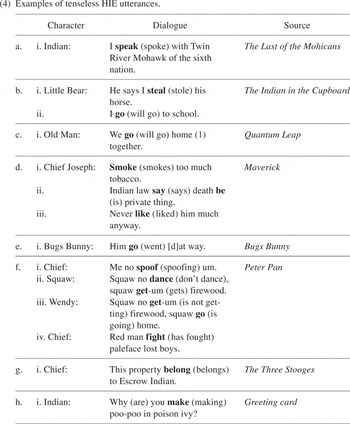
Lack of tense marking is the most prevalent marker. The productivity
of this pattern is partially due to the available deletion of the
auxiliary or modal verbs. Since auxiliaries or modals are typically
inflected for tense and number agreement, the deletion of such an element
would result in the deletion of tense marking. Examples of tense
modification are given in (4). Next to each example is the probable
standard American English version:
All of these examples display verbs without tense marking, which
identifies the speech as nonfluent, indexing the speakers'
unfamiliarity with English and hence their foreignness. Similarly, these
forms also suggest that these characters, who are unfamiliar with English,
are in some way linguistically underdeveloped or lacking in grammatical
competence. Child language studies have shown that children often omit
tense or any other morphological marking in early speech production, with
mastery of this emerging later in their development (Brown 1973; see also Bloom
1972). The use of such a simplified tense system by an Indian
character would then open the door for an interpretation of the character
as being childlike as well as foreign.
A lack of tense in HIE forms could also be an allusion to differences
in the grammaticization and conceptualization of time between Native
American languages (and peoples) and standard European languages (and
peoples). The popularized yet distorted version of this difference is that
many Native Americans are not able to understand the Western concept of
time because their linguistically structured perceptions of time are
different. Therefore, Native people are often late to appointments and so
forth because they're on “Indian time.” This then
suggests that they would exclude tense marking from their English
utterances because of their lack of understanding of how time is marked in
“civilized” modern spheres. However, omission of tense marking
doesn't just represent Indians as childlike; it can also be a means
to represent their cultural difference as one of timelessness or
primitiveness, as nonmodern.11
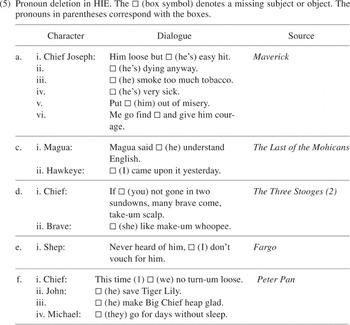
The second pattern is deletion. Subject pronouns, object pronouns,
auxiliary verbs, and noun determiners delete. These patterns, however, are
not as consistent as the tense-marking pattern illustrated above. The
inconsistency of pronoun deletion may be due in part to the fact that
whenever the subject (or object) is unclear, a referent is needed. In the
cases where the referent can be inferred, we would predict deletion. In
much of the dialogue this generalization holds. Consider the following
examples:
As these examples illustrate, pronouns can be removed, especially when
they can be inferred from the context of the conversation. Another element
that can undergo deletion is the determiner (and/or the English plural
morpheme, when no determiner is required). Some examples of this are given
in (6):
The final case of deletion is the deletion of the auxiliary verb. This
pattern appears quite frequently across the samples of dialogue:
This is similar to the pattern noted by Ferguson (1996 [1971]) in his discussion of how copula
deletion can be used to mark “foreigner talk” and “baby
talk.” Note that auxiliary deletion is also linked with the
tense-marking pattern. If the auxiliary is deleted, then no tense will be
marked. Overall, the deletion of these linguistic elements presents Native
American speech as ungrammatical and/or substandard, and the speakers
as incompetent and unable to use SAE “correctly.” Depending on
the context of the performance, this incompetence can be accounted for in
several ways, such as in relation to a character's limited cognitive
abilities or unfamiliarity with English.
The third morphosyntactic pattern is substitution. In these cases, the
subject pronoun is replaced by either an object pronoun or a full noun.
This pattern is not as prevalent as those above, but it appears frequently
enough to provide the following examples12
Interestingly, all of these examples come from productions
first released before 1960. This pattern is also noted in the early AI(P)E
descriptions from Leechman & Hall 1955 and
Miller 1967.
:
In all of these cases, the subject pronoun is replaced with the object
pronoun. Again, this is a common pattern found in both foreigner talk and
baby talk, as well as being a salient construction in actual early child
language. One potential conceptualization that this pattern can trigger is
the image of the Indian speaker as essentially incapable of acquiring the
correct pronominal pattern for AE, resulting in a childlike, foreign style
of speech that overgeneralizes the object pronoun.
The final morphosyntactic pattern appearing across all the HIE
representations is the lack of contraction. In this case, neither the
auxiliary verb nor the negation marker merges with the preceding elements,
as is common in SAE. In the data, there are only four representations of
Indian speech that do not conform to this pattern. All other
representations have no contracted elements. Display (9) presents cases of
non-contraction where one could expect contraction in SAE speech. Note
also that this feature lengthens and slows the utterance, thereby
contributing to the ponderous speech style mostly achieved through
prosodic modifications13
In a
children's program I watched with my daughter recently, a character,
whose first language was said to be Polish, visited and spoke in a very
slow style with no contractions, perhaps indirectly indexing her
foreignness.
:
The pattern, then, is that there is no contracting of the auxiliary or
merging of the negation marker with the auxiliary verb (when an auxiliary
is present). For HIE in general, the auxiliary verb is either represented
in its entirety (not contracted), or it undergoes deletion. Unlike the
earlier patterns that could be interpreted as foreign-sounding or
childlike, this pattern more readily lends itself to an image of archaic
eloquence (similar to a popularized Shakespearean form of English that
does not use contractions; see Montgomery 1998).
To reflect a historical setting or sentiment, or to locate their
characters in the past, performers can rely on this grammatical feature.
Whether individual actors intentionally use this feature or not, the
actual preponderance of no contraction across performances neatly
corresponds with the historical essence of Indian imagery.
All of these morphosyntactic patterns are variations on standard AE
patterns. They form a template from which different styles of speech can
be developed, styles that are markedly different from a supposedly
standard, and “white,” style of speech. For Indian characters,
this style of speech underscores dimensions of foreignness that have been
used to represent Indianness as Other (Berkhofer
1988:528). HIE, like most other Indian representations (Berkhofer 1978), is imagined in juxtaposition to some
kind of Standard American English (most likely the speech variety of the
author, performer, and audience). Within this fictional world, the
ungrammatical forms of HIE stand out (as do their dark-toned
“proximate” speakers; see Chafe
1993, Du Bois 1986) against the
ever-present rumble of grammatical SAE utterances (and their light-toned
“proximate” yet “prime” speakers). Remaining is
the question of how this deficient style becomes marked as HIE and not
some other racialized style of speech.
The most obvious answer is context. But for HIE, there is also another
source: certain specialized vocabulary words and lexical imagery used in
the dialogue of Indian characters, some of which are taken from actual
American Indian languages and historical speeches. These words and
phrases, as indexes of Indianness, mark a character's speech as HIE.
Besides “chief,” several other terms are common to the
dialogue of Indian characters in these television shows and films.
While some of these terms derive from Native American languages
(“squaw,” “tepee”; see below), other terms appear
first in early American literature. Cutler (1994:132) traces the phrase “happy hunting
ground” to James Fenimore Cooper and Washington Irving. He also
credits Irving, along with Mark Twain, for the introduction of
“heap” and its association with Indian speech. As for the word
“brave,” Cutler (1994:131, 255),
citing Mathews 1951, attributes this term to Henry Rowe Schoolcraft. And
finally, the expression “paleface” “may be a white
coinage,” one of its earliest citations being G. A. McCall's
Letters from the Frontier in 1822 (Cutler
1994:132).
Additionally, we see that a particular type of phrase construction is
characteristic of, though not exclusive to, HIE. Here I am referring to
forms that parallel the syntactic structure of Romance language noun
phrases. As Miller (1967:144) notes, Indians
were frequently depicted as speaking “in fluent and … courtly
English.” This is achieved by exploiting English's flexible
syntax. Consider the French phrase les esprits de la montagne.
English offers two possibilities for a corollary: “the spirits of
the mountain” and “the mountain's spirits.” A more
formal sense is attributed to the construction that parallels the
Continental pattern. This is due to the long historical interconnections
between English and French nobility and the complex sociolinguistic
associations that resulted (see Baugh & Cable
1978). What this means for an Indian character is multivalent. As
with rate of articulation, the more formal phrase construction in HIE can
either be considered dysfluent, and therefore indexical of incompetence,
or it can work to index nobility (and the noble savage; see below). Lines
b.i, c.i–iv, and d.iii below all exemplify parallelism with Romance
possessive phrases, framing the speech as “noble”:
To complete the noble savage motif, we need only add the element of
nature, of the primeval (precivilized, hence savage by default). This is
provided by figurative language employing nature metaphors. For instance,
Indian characters typically portray time through reference to heavenly
bodies (“for many moons,” “in two sun downs”), or
allude to timeless epochs like “before the white man,” which
underscores the image of American Indians as existing in some nonmodern,
primitive state before contact with Indo-Europeans14
Again this reference to time along with its implicit
conceptualization suggests that time began when we Indians first
encountered white people. Before that, we were unaware of time, like
children and animals. The white man taught us how to measure and keep
track of time.
:
The example below illustrates contextually how “courtly”
speech, marked by the use of French-like noun phrases, pauses, and
noncontracted forms, can evoke the “noble savage” image. In
this episode of MacGyver, entitled
“Trail of Tears,” a Lakota tribe is trying to keep
power lines from being strung through a sacred area on their reservation.
The Indian character, Mr. White Cloud, has just represented the tribe in
the court proceedings and lost the case. He is in the bathroom as the
scene opens, splashing water on his face. As he dries his face and raises
his head from the sink, an older man with a feather in his long, graying
hair appears behind him. This older man is wearing a flannel shirt and a
pendant of leather and shell, in contrast to Mr. White Cloud's suit
and neat ponytail. The two men begin by exchanging greetings:
In this scene alone, several themes are juxtaposed through the bodies
and expressions of these two characters: traditional versus modern, old
versus young, religious versus secular, Indian versus white.
Linguistically, these contrasts are encoded in the styles of speech
deployed by these two performers. Mr. White Cloud, the younger, modern
character, speaks a standard variety of English. He uses contractions
(lines 12, 17), his cadence is not remarkable (no lengthened pauses), and
he speaks plainly, without metaphorical flourishes. Mr. Standing Wolf, on
the other hand, has no contractions in his speech (cf. lines 4, 6, 9, 16,
18), his cadence is sprinkled with pauses (lines 2, 6, 9, 10), and he has
a flair for metaphorical and adage-like statements (lines 6–7, 9,
10–11). Lines 9–11 also illustrate the way in which the formal
possessive phrases lengthen the overall contour of his utterance and
produce a more oratorical, formal style in contradistinction to Mr. White
Cloud's colloquialisms (lines 5, 8). As this example shows,
figurative expressions are another way in which the linguistic image of
HIE emerges distinct from some standard AE variety, fluidly absorbed into
an eloquent style of speech that can easily find correspondence with the
noble savage image. The continued use of these expressions in contemporary
representations of American Indian speech reinvests current Indian imagery
with the same primeval essence of past representations.
Along with movies and television, this HIE style can also be found in
written form, for example in greeting cards. One humorous Thanksgiving
card shows a Pilgrim squatting in some bushes while an Indian asks
“Why you make poo-poo in poison ivy?” Aside from being a
rather odd Thanksgiving greeting, this card plays on a number of features
analyzed above.15
This card also portrays
white men as ignorant of basic facts of nature.
First, the
statement conforms to the tense pattern of HIE illustrated above; there is
no tense marking on the verb. Second, the auxiliary verb
are is
deleted. Third, this expression uses a modified lexical item,
poo-poo, to talk about bowel movements. Not only is this term
commonly found in American English baby talk (and not something one adult
would typically say to another), but in this example it is reduplicated, a
common phonological practice in baby talk (
Ferguson
1996 [1964]:107). A second card addresses the reader with
the statement, “a message from Princess Running Big Mouth,” an
apparent play on common translations of Indian names. The message inside
the card uses a range of metaphorical and specialized terms indicative of
HIE, such as “wind in her pants,” “too many
moons,” and the threat, “great buffalo chips from the sky will
fall upon your wig-wam if you don't come out and play with
me.”
16 This is true of Mock Spanish
representations in greeting cards as well (see Hill
1995).
The greeting card examples differ from those found in the movie and
television dialogues by conspicuously linking negative, demeaning imagery
with Indian characters.17
The film and television representations presented
here do not always directly promote such an interpretation. Nevertheless,
HIE tangibly marks American Indians as different, even foreign. But are
these racialized representations really different from
“real-life” American Indian English? The next section compares
HIE with historical descriptions of American Indian Pidgin English (AIPE)
and contemporary varieties of American Indian English (AIE). These
comparisons reveal that “real-life” AIE varieties are not the
basis for this style, and that earlier descriptions of AIPE have several
grammatical and lexical correspondences with HIE, suggesting it may be one
of the original sources for HIE.
FROM REAL LIFE TO HOLLYWOOD: COMPARING AIE
WITH HIE
The first grammatical descriptions of American Indian English and
American Indian Pidgin English used as their data depictions of American
Indian speech found in romanticized travelogues and works of fiction
written between 1823 and 1955 (Craig 1991, Leechman & Hall 1955, Miller
1967). The data were not elicited utterances from actual speakers.
To justify these fictional representations as “authentic,” one
researcher noted that “language structure cannot be manufactured at
the whim of the author” (Miller 1967:144).
Whether this is true or not, what is most appealing about these
grammatical descriptions is that some of the elements they describe are
still found in the speech of today's Hollywood Indians.
Craig (1991:39) identifies a number of
American Indian (Pidgin) English linguistic features found in these
written sources. Four of her features correspond with HIE features noted
above. These similarities are shown in (14):
Though this is unsurprising, there are several differences between
Craig's AI(P)E grammar and HIE. First, Craig includes a phonological
description (though recall that she is extracting her phonological
patterns from written texts) including sound patterns that are not found
in film and television performances. Second, missing from the list in (14)
is the lack of contraction found in HIE. Third, film and television forms
include the third person object pronoun as a replacement for the subject
pronoun (14a), perhaps generalizing beyond the initial first person
pronominal pattern. Fourth, pause length is not mentioned, though
potentially representable in written form as a series of periods between
words or phrases. Finally, the analyses by Craig
1991, Leechman & Hall 1955, and Miller 1967 again identify grammatical features based
on nonnative speaker representations of American Indian speech, suggesting
perhaps that the linguistic forms initially used to identify its
grammatical structure were more imagined than real.
In recent decades linguists have begun documenting many of the
varieties of English spoken by American Indians. They have shown that
different American Indian communities use different English dialects
(Bartelt 1991, 2001;
Bartelt et al. 1982; Craig
1991; Leap 1993, 1976; Penfield 1976). The
language structures of these varieties are patterned and complex varieties
of English; they are acquired grammatical systems. They conform to
linguistic universal structures and also display influences from each
particular community's ancestral language (Leap
1993). This means that AIE varieties are distinct from one
community to another; there is no homogeneous AIE language that all
American Indians speak.
By contrast, HIE is neither systematically heterogeneous nor acquired.
It is neither a dialect nor a language. However, at first glance, HIE does
appear to bear some resemblance to real AIE varieties. For example, some
varieties have pronoun deletion. Consider the case of Ute English as
described by Leap 1993. Leap notes that
“subject pronouns are by far the most frequently deleted items
within this category, while object pronouns are almost never
deleted.” To explain the pronoun deletion pattern found in Ute
English, Leap posits three constraints, all relating to auxiliary verb
marking and auxiliary verb deletion, and notes that “Ute English
speakers use pronoun deletion only after … (these) constraints have
been satisfied” (1993:61). For Ute
English, the pronoun must be before an AUX-main verb sequence, the AUX
must serve an aspectual function, and the AUX must be able to contract or
delete. In (5) above (repeated below as (5′)), there are four
instances of subject pronoun deletion and two examples of object pronoun
deletion. The HIE forms in (5′) do not conform to these constraints,
with the exception of line 2, (he) (is) dying anyway.
In (5′) it appears that any pronoun can undergo deletion at any
time. In line 2, the pronoun deletes along with the auxiliary verb; in
line 3, only the subject pronoun is deleted; in line 4, the subject
pronoun and copula are deleted, and in line 5, either the phrase is a
command (‘Put [him] out of misery’) with only the
object deleted or both the subject (either ‘you’ or
‘we’) and object pronouns (‘him’) are omitted. To
account for the deletion pattern, the rule might be: Delete any pronoun
when the referent is the same as in the preceding phrase. Generally
speaking, contextual inference can account for the HIE pattern. Unlike Ute
English, the HIE account is extremely general and constrained not by
underlying grammatical phenomena but by the processing of information at a
discourse level. What about other varieties of AIE?
Another variety of AIE discussed by Leap has pronoun deletion but
patterns according to different grammatical constraints. Mohave English
pronoun deletion is constrained by case-marking, in contrast to Ute
English pronoun deletion, which is constrained by the auxiliary (Leap
1993:60–62). Again, the deletion is
grammatical and not discursive. The overgeneralized deletion of pronouns
in HIE means that the application of deletion is at the surface; it is not
a grammatically governed phenomenon like those found in AIE. Since the use
of deletion in HIE is discursive, whereas pronoun deletion in AIE
varieties is grammatical, HIE pronoun deletion is not the result of a
direct borrowing from any spoken variety of American Indian English known
today.
Although I do not have space to show this here, I would posit that the
other grammatical elements of HIE are only allusive to, and not borrowed
from, real varieties. The borrowed elements are lexical. A few token words
and phrases have been borrowed from specific American Indian heritage
languages and documented American Indian oratory. Berkhofer (1978:88) and Marsden & Nachbar (1988:608) both point out the role of treaties in the
emergence of an American Indian drama and rhetoric. Berkhofer (1978:88) in particular notes that “early
American men of letters” described
their (Indians') language … (as) filled with
picturesque allusion and metaphor and their legends equaled the tales of
Old World folk,” [and that] “Indian rhetoric
… existed as a kind of literature in the form of treaty proceedings
… (to the point where) Jefferson's version of Logan's
famed speech was memorized … by schoolchildren of the nineteenth
century.
Similarly, Edna Sorber examines several non-Indian descriptions of
American Indian oratory, including Henry Rowe Schoolcraft's (see also
Bauman 1995, Bauman &
Briggs 2003), and points to the authors' use of evaluative
terms such as “beautiful metaphors and rich imagery” and
“polished orators” (Sorber
1972:232). She also identifies this expressive tradition as a means
through which the image of the noble savage was and is maintained. This is
in contrast to the ignoble savage, who is either silent or reduced to
grunting. Sorber also argues that the fictional depiction of American
Indian oratory as eloquent transported the image of the noble savage into
the twentieth century.
Along with picturesque and metaphorical phrasing as an index of Indian
speech (and now HIE), several Indian heritage language terms have been
adopted into the English language and recycled as signs for denoting
Indian speech. Some examples from (9) above are the following, along with
their etymological origins:
In unimaginative attempts to distinguish an Indian character's
speech from non-Indian characters' speech, authors have incorporated
Indian-related or American Indian heritage language words into their
characters' speech. Words such as these, which have been borrowed
from American Indian languages and incorporated into mainstream American
English, can be readily identified and reduced to indexes of Indianness.
Given these linguistic modifications, the next section examines the ways
in which these linguistic features articulate with other meaningful
dimensions and become racialized.
HIE SPEECH AND THE “WHITE MAN'S
INDIAN”
As discussed above, a number of grammatical features that appear in
HIE, such as verb deletion, object pronoun substitutions for subject
pronouns, and a limited lexicon, also appear in other imagined linguistic
representations and stylized, caricature-defining ways of speaking (Ferguson 1996; Hill 1993a,
1993b, 1995; see also
Lippi-Green 1997).18
This movie is based on a “subversive”
comedy-western television series that aired from 1957 to 1962, starring
James Garner as Bret Maverick, a wisecracking gambler, and Jack Kelly as
his brother Bart. It was created by Roy Huggins, who attempted to parody
other television westerns at the time (http://www.museum.tv/archives/etv/M/htmlM/maverick/maverick.htm).
The movie itself continues in this vein, with Chief Joseph as a parody of
the “traditional” Indian character in Hollywood westerns (an
Indian actor “playing Indian”).
The practice of using
some linguistic feature (accent) or set of features (languages, dialects)
to identify a people is not a unique one. Language maps notoriously
situate languages within political boundaries that mark the territory of a
particular nation-state and the speakers therein (
Irvine & Gal 2000). American children are often
socialized to make this same interpretation, or more generally, to
stereotype certain “national origin groups” (
Lippi-Green 1997:100), “knowing” that
people from France speak French and people from China speak Chinese. The
ability of consumers of movies and other media to equate one style of
speech with an entire ethnic group (and erase all political, cultural, and
linguistic diversity within the group) then reflects the socializing
effects of the consumers' experiences. HIE reflects and perpetuates
this ideological habit, using accent to evoke, reinforce, and naturalize a
Hollywood style of Indianness. Emerging from such practices is a
linguistic image that depicts HIE as an essential aspect of being
Indian.
Part of this linguistic imagery corresponds with “playing
Indian” (Deloria 1998; Green 1988a, 1988b), a practice of
non-Indians in which they dress up or masquerade as Indians. Examples of
this range from the Boston Tea Party to contemporary boys' and
girls' clubs like Indian Princesses and Indian Guides, and the
phenomenon known as “Indian hobbyism” (Powers 1988, Taylor 1988).
In boutique toy catalogs, parents continue to be encouraged to purchase
Indian outfits and tepees for their children. In films as well, moments of
playing Indian emerge. It is at these moments, when characters are playing
Indian, that the most elaborate performances of HIE are found. This
linguistic image indexes features equated with both the noble and the
not-so-noble savage.
To illustrate the process through which language (HIE) facilitates or
contributes to the image of Indians as other, I will examine two scenes
from different movies, one contrasting foreigner talk with HIE, and the
other, children's talk with HIE. The goal is twofold: to show how HIE
differs from other stylized forms of fictional speech, and to show how HIE
articulates with various imagined Indian characteristics. The first
example comes from the movie Maverick (1994).19
However, in
Chief Joseph's interaction with Bret Maverick (played by Mel Gibson),
Graham Green's character speaks a standard American English variety,
as does Gibson's character.
In this scene, Chief Joseph,
played by the noted Indian actor Graham Green, is bargaining with a
wealthy Russian trader (
Donner 1994).
Note that Chief Joseph begins by speaking French to the Russian
trader, then shifts to HIE – not AE – when his use of French
doesn't align with the trader's expectations.20
This Disney movie is adapted from James A. Barrie's
children's story Peter Pan. The story was first produced for
the stage in 1904, eventually appearing as a children's book in 1911.
Its various other reincarnations, including Disney's, were as a play
with music (1950), as a musical comedy (1954, revived in 1979) that was
also performed on television, as a silent film (1924) and as a
feature-length animated cartoon (1952).
The switch from French to
HIE marks the transition into playing Indian. By using a Russian character
here, the film's authors displace the responsibility for the
demeaning representation away from themselves and the consumers of the
image and onto the foreign character, suggesting that he, the Russian
character, is the perpetrator of these racialized representations, not us.
This same phenomenon is found in the interaction between Pinball Parker
and the Indian character in
Con Air. These linguistic
performances nuance the emergent characteristics of the portrayals, at
first marking each character as foreign and then distinguishing Russian
foreignness (and savagery) from Indian foreignness (and savagery). For
instance, neither character uses contraction. In Chief Joseph's case,
this is because the conditions for contraction are not met (due to the
deletion of the subject or the auxiliary verb). For the Russian trader,
this practice is more salient because there are several phrases that could
undergo contraction but do not (lines 11, 20, 21), including the following
line that occurs later,
I do not want to lose the light. Clearly
this pattern of no contraction is an index of foreignness more generally,
whether uttered by the eloquent Indian Chief in
Pocahontas, or by
Chief Joseph or the Russian trader.
The differences between the speech styles of the two characters in
Maverick are lexical and grammatical. Lexically, the Russian
trader only uses two specialized terms, and each only once: noble
savage (line 4) and injun (line 13). Chief Joseph, however,
uses a variety of marked expressions: How (once, line 3),
white man (twice, line 3 and later), injun (four times,
as in line 12), wampum (line 16), and happy hunting
ground (later in the scene). Furthermore, while both characters are
multilingual, Chief Joseph's English speech is littered with
different types of deletion: pronominal, verbal, and determiner (lines 8,
16, 22–24, 26, and later), all grammatical elements of HIE. The
Russian trader's speech has only one example of deletion (line 11),
What is (the) greatest Western thrill?, produced when exactly
repeating the phrase uttered by Chief Joseph (line 8). The greater number
of specialized terms and the use of deletion in Chief Joseph's speech
produce a less fluent style of English, indexing his position as savage,
in keeping with the Russian's expectations (recall that Chief Joseph
is playing Indian here).
The second example comes from Disney's Peter Pan,
released in 1952.21 The story is about three children (Wendy,
John, and Michael Darling) from a middle-class English family living in
London who revel in the adventures of Peter Pan. In scene (16) below, John
and Michael, after having flown with Peter Pan, Tinkerbell, and Wendy to
Neverland, are caught and bound by the Indians along with the other Lost
Boys. From the text, we understand that this is usually a routine form of
play. However, this time the Indians aren't playing because Tiger
Lily, the “Indian Princess,” is missing and the Lost Boys now
stand accused. The boys are tied to a pole with firewood beneath them in
the middle of an encampment of tepees (Luske et al.
2002 [1952]).
The Indian Chief in this animated movie resembles a heavy Chief Wahoo
(mascot of the Cleveland Indians) with a giant proboscis, a stout
physique, and scarlet skin tones. He sports a feathered headdress, black
hair, and leather buckskins. His voice is deep and gravelly and his pace
slow, ending with a very slow, and low, burn-um at stake. His
style of speech is both paragon and parody of Hollywood Injun English.
Several HIE elements filter through the Chief's speech. First,
the lack of tense and aspectual marking on verbs is pervasive (lines 7,
17, 19, 20, 27). Second, several grammatical forms are deleted, from
auxiliary verbs to pronouns (lines 17, 19, 20, 27). There is also one
example of pronoun substitution, me replacing I (line
19), and several HIE-indexical lexical items, including liberal use of
-um (lines 5, 7, 17, 19, 26, 27). Additionally, contractions are
missing from the Chief's pronouncements (one exception to this is the
song “What makes the red man red?” sung by the Indians and the
Chief). In contrast, the Lost Boys' speech has contractions (lines
16.1–4, 22), as does the speech of the Darling children (lines 16.1,
23; 17.1–3, 7) (Luske et al. 2002
[1952]).
The foreignness of style is further emphasized when John switches from
speaking his standard English variety to an HIE style when translating the
Chief's signed oration (lines 4–6). Included in the translation
is an extensive use of pauses, omission of morphology (no tense marked on
save or make), deletion of verb copula (line 4; see also
the Chief's line 9) and subject pronouns (lines 5, 6), and the
appearance of the specialized term heap (line 6; see also 7). Of
equal interest is the fact that John is able to translate this signed
oration, suggesting that this mode of communication is more primordial
than spoken language. The Chief never switches styles (spoken or signed)
in relation to his interlocutor; he only speaks HIE. The one other Indian
character who speaks also only uses HIE, doing so when addressing Wendy
(Squaw get-um firewood). While the English-speaking children are
able to switch styles, and some are even able to understand new codes, the
Indian characters do not participate in this linguistic precocity. This
might be because of their age/status differences, but, given the
remedial and primordial nature of their linguistic styles, it is more
likely indexical of some cognitive difference, suggesting on the one hand
that these adult Indians are even less sophisticated and developed than
European children, and on the other that they cannot shift codes because
their speech emanates from their essential nature as Indians.
The excerpts from these two movies also exemplify the connection
between speaking HIE and playing Indian. In Peter Pan, the Lost
Boys only use HIE in two of their interactions with the Chief, the
greeting, How! and the expression ugh. John, Michael,
Peter Pan, and Wendy, on the other hand, switch between speaking HIE and
their standard English styles more frequently, when interacting with the
Indian characters, translating (see ex. 16), and playing Indian. When
Wendy responds to an Indian character's directive to get firewood,
she uses HIE, saying Squaw no get-um firewood. Squaw go home.
While dancing around the Indian encampment, Michael says Squaw take-um
papoose, directing Wendy to hold his teddy bear. Also, upon returning
to the Lost Boys' hideout and still in Indian character, Peter Pan
tells Wendy, Michael, and John, No go home, stay many moons, have heap
big time. In these cases, HIE serves as a second-degree index of
their pretend identities as Indians.
In Maverick, Chief Joseph's playing Indian is clearly
marked by his switch to HIE. A similar observation can be made about the
“Princess Running Mouth” greeting card above. The use of HIE
becomes licit (and more frequent) when characters are playing Indian, and
it reifies the sociocultural differences being assumed by these
representations. Thus, HIE, along with other fictional pidgin-like ways of
speaking, encodes social difference, manufacturing and accentuating
cultural divides through the use of contrastive speech styles in popular
media. However, unlike “foreigner talk,” “baby
talk” and Mock Spanish, HIE has a historical dimension that emerges
as part of and continues to reproduce the timeless, primordial dimension
of American Indian representations. Even contemporary films, such as
The Indian in the Cupboard (see Strong 1996, 1998 for a critical
analysis), explicitly represent their Indian characters in a historicized
fashion. This perpetuates the ever-present popular fiction that Native
peoples for the most part have vanished, that there is no longer any
person or group that is “authentically” Indian, but only those
that “play Indian.” By creating a style of speech that is
markedly different from some standard variety of spoken English, mapping
this style onto an Indian character, and then locating this character in
the past, writers transform the modern American Indian into a historical
mirage. Paradoxically, the overall linguistic image itself is ahistorical,
or timeless, since HIE never existed as a real language, dialect, or way
of speaking. Rather than maintaining historical accuracy, then, this
linguistic image accentuates the foreignness of Indian characters, serving
as both index and icon of the conventionalized characteristics associated
with American Indians.
While the aberrant grammatical elements of HIE become suffused with
indexical significance through their association with the racialized, and
often pejorative, images of American Indians, these elements also
contribute to the racialization of these images by underscoring certain
characteristics of which language is assumed to be indexical
(intelligence, stages of development, ethnicity, foreignness, social
difference). Several “degrees of indexicality,” to borrow
Michael Silverstein's phrase (2003), are at
play here. For example, the Chief's slow, ponderous delivery is a
first-degree index of oratorical style, which then is a secondary index of
this character's specialized (elevated) social position. However,
because the Chief speaks in the aberrant HIE style, a first-degree index
of difference, his style of speech becomes a second-degree index of
foreignness as savagery, as suggested by his clothing and
“barbaric” practices. In conjunction, these indexical links
have a third degree of referentiality evoking the “noble
savage” image. In this semiotic way, these linguistic images become
racialized and racializing aspects of representation that contribute to
the reproduction and transformation of ideologies about languages and
peoples.
HOLLYWOOD INJUN ENGLISH, RACISM AND THE
OBJECTIFICATION OF NATIVE AMERICANS
Most studies elucidating these covert racist images have focused on
how individuals discursively represent different minority groups (van Dijk
1993, 1996; Caldas-Coulthard & Coulthard 1996) or how these
representations emerge and are then used in public arenas, in white public
spaces such as newspapers, literature, and television (for examples see
Morrison 1992 for representations of African
Americans; Cassuto 1997 for representations of
African Americans and Native Americans; Butler
1997 for representations of African Americans and women; Quiroga 1997; Urciuoli 1998;
2003 for representations of Hispanic Americans;
Chun 2004, Palumbo
1994 for representations of Asian Americans). For Indian imagery,
such research has often critically analyzed these representations in
relation to the development of U.S. nationalism. Predictably, the
conventionalized imagery depicts Indians as wild, savage, heathen, silent,
noble, childlike, uncivilized, premodern, immature, ignorant,
bloodthirsty, and historical or timeless, all in juxtaposition to the
white civilized, mature, modern, (usually) Christian American man.
According to Stern & Stern 1993, the two
portrayals of Native Americans that most often entertain us at the movies
are the “faceless savage on horseback … pursuing white people
for no other reason than an insatiable lust for scalps … [and
the] noble culture that embodies nature's harmony and is
victimized by settlement” (47–48). Whether fiend or victim,
much of the imagery has presented American Indians as unsocialized
(childlike) and uncivilized (alien).
This essay in turn has drawn on these critical studies, but it directs
our focus toward linguistic images. I have examined here the template of
grammatical features used to denote Native American speech and how these
generic linguistic features link with overt pejorative representations
(commodified and fetishized aspects of Indianness) as characters display,
perform, or play Indian. In short, to inhabit an Indian identity, you only
need to declare “How!”
One of the most enlightening studies to date on the indexical
construction of racism in Standard AE is Hill's work on Mock Spanish
(Hill 1993a, 1993b,
1995, 1998). She
argues that Mock Spanish is an example of the dominant group's
“incorporation” or expropriation of a desirable resource
(language) from a subordinate group (Spanish-speaking minorities). Through
incorporation, Mock Spanish becomes a site for racializing the groups that
speak Spanish. This is achieved indirectly through the distortion of
Spanish pronunciation and the association of Spanish expressions with
negative images. That is, humorous and pejorative representations of
Spanish indirectly index negative images that members of the dominant
group associate with Spanish-speaking populations. This results in the
perpetuation of a conceptual lowering of the status of Spanish and its
speakers.
This covert conceptual subordination is the factor that maintains
racism. However, in the case here, it is not the actual native or heritage
language of a group that is the target of expropriation, denigration, and
mockery (with lexical exceptions); the target is ideologically more
distant and detached from the actual community of speakers than in the
case of Mock Spanish. That is, representations of Native American speech
are based on authors' imagined realities, reflective of ideological
assumptions, and not on everyday interaction.
One of the ways in which these images are evoked and reproduced is
through what I have called HIE, a simplified, “corrupted” form
of English composed of “disorders of language” (Hill 1995) that iconically represents Native American
speech. Through this iconicization, HIE fluidly indexes various perduring,
naturalized characteristics historically linked to the images of American
Indians. HIE forms contribute to and strengthen the saliency and
accessibility of these cartoonish and nostalgic (romantic) Indian images,
a U.S. imaginary of Indianness and the continued domination or
disempowerment of American Indians. By speaking Hollywood Injun English
(when pretending to be Indian), the performer does not mock any American
Indian language, but rather imbues his Indian character with a weak mind
and a childlike persona, and locates this character as subordinate to a
dominant white public.
Furthermore, representing the speech of Native Americans as
substandard and foreign portrays Native American speakers as foreign, as
not native. This need to imagine Native Americans as outside the
national boundary, as not native but foreign, has been crucial to the
development of the U.S. nation and manufacture of a national U.S.
identity. As Deloria 1998 has pointed out, this
continual dialectic between the inclusion and exclusion of a Native
American Other, a practice integral to the ideological construction of a
U.S. nationhood, or “national subjectivity” (Rosenberg, cited
in Deloria 1998:7; see also Strong & Van Winkle 1993), is present throughout
historical U.S. nation-building narratives and appears over and over in
films, books, cartoons, and so forth, where non-Indians (and Indians) are
playing Indian, performing Indianness in dress and in speech.
Interestingly with regard to speech, Indian characters have a voice only
when they are either from the past, remembering the past, or situated in
the past. The archaic linguistic forms reinforce this chronology, this
historicized placement.
Part of this dialectic, then, animates the Indian character or role,
but only in historic contexts. The other half of the dialectic
dis-animates or silences the same character. Given that the U.S. nation
has a distinctive monolingual, Standard American English bias that equates
a particular variety of the English language with nationality (Milroy
2000:82; Silverstein
1996; see also Lippi-Green 1997; Silverstein 2000), the practice of representing
American Indian speech as nonstandard or foreign further silences the
already vanishing Indian in an attempt to extinguish him once and for all
from a national landscape that has historically and economically lauded an
American Indian presence for its own self-promotion and consumption. The
fact that linguistic representations further instantiate this dialectic is
not surprising, then. In fact, they can be more effective than other
mediations by virtue of their being more subliminal, more covert.
Finally, particular language features, often described as
“accents” or as “incorrect” and
“ungrammatical” utterances, easily become indexical markers
for invoking a particular ideology, theme, or cognitive model (Holland & Quinn 1987, Irvine
& Gal 2000, Lippi-Green 1997). It is
in this way that language in all of its subconscious, habitual,
unreflective glory can be a prime site for the perpetuation of negative,
racist and racializing sentiments – even when people intend to act
otherwise. When American Indians are assigned dialogue in an
unconventional, inarticulate form of English, they continue to be
intellectually and economically marginalized in the imagination of public
viewers.
In sum, I have shown that popular depictions of Native American speech
in white public space are covertly racist. I have shown how the structure
of AE has been modified in order to depict a fictional Hollywood Injun
English form. I have discussed the ways in which these forms deviate from
actual American Indian English varieties, but share some features with
historical descriptions of American Indian Pidgin English. I then argued
that this “abnormal” linguistic style is an iconic
representation of real-life American Indian speech that indexes an image
of Indians as foreign victims, eloquent yet unsocialized. Additionally,
these linguistic images perpetuate the historical placement of Native
Americans as characters who exist only in a national past and not in a
modern present. While an Indian presence is acknowledged in a
reconstructed U.S. history and commodified in everyday tourist
attractions, as contemporaries American Indians continue to be imagined
outside this national landscape, linguistically and otherwise.
The next step is to explore how and to what extent the ideologies
indexed by these representations are acquired. Given that people are
socialized into and through language (Ochs 1990;
Schieffelin & Ochs 1986a, 1986b; Garrett &
Baquedano-López 2002), and through socialization learn to
equate certain styles of speech with particular situations, events,
and/or actors, it seems reasonable to assume that people as culture
consumers will understand new experiences in relation to the ways in which
they have been socialized. In relation to this study, what is most
interesting about language socialization is the ways in which consumers in
white public space are socialized into mapping particular linguistic
features onto representations of difference, subtly reinforcing or
transforming the representation. Here HIE speech not only indexes a
character's Indianness (and nonwhiteness) but can also manipulate the
representational force of an image, from that of an eloquent enemy to that
of an incompetent foreigner.
APPENDIX
List of films and television shows used in the analysis