


Recent studies conducted both in vitro and epidemiologically have indicated that boron (B) exposure may make significant contributions to human healthReference Barranco and Eckhert1–Reference Yazbeck, Kloppmann, Cottier, Sahuquillo, Debotte and Huel3. Humans are naturally exposed to B via food and drinking waterReference Rainey, Nyquist, Christensen, Strong, Culver and Coughlin4. B is absorbed almost completely by the gastrointestinal and respiratory system if exposure occurs, and is mostly present in body tissues and fluids as boric acid, B(OH)3, and in lesser amounts as B(OH)4− anionReference Hunt5. Studies indicate that B homeostasis is basically maintained by urinary excretionReference Sutherland, Leslie, Woodhouse and Janet6.
B was defined as a trace element in 19807. In spite of the lack of epidemiological data, the WHO reported that boron may provide a physiological benefit for human health8. Safe and/or beneficial B levels have not been determined for humans, though animal studies have defined deleterious and beneficial B levels for animalsReference Devirian and Volpe9.
In a study by PenlandReference Penland10, it was outlined that B improves brain function and psychomotor response. It increases steroid hormone concentrations and has antioxidant properties in post-menopausal womenReference Devirian and Volpe9, Reference Hunt, Herbel and Nielsen11. There is also evidence that B plays a role in healthy bones and jointsReference Chapin, Ku, Kenney, McCoy, Gladen, Wine, Wilson and Elwell12, Reference Newnham13. Additionally, in recent years there have also been some promising results concerning the treatment of certain malignanciesReference Barranco and Eckhert14, Reference Korkmaz, Uzgoren, Bakırdere, Aydın and Ataman15.
Toxicological effects have also been reported in animals at higher doses, e.g in mice, rats and rabbits skeletal malformations and cardiovascular defects have been observedReference Heindel, Price, Field, Marr, Myers, Morrissey and Schwetz16, Reference Price, Marr, Myeos, Seely, Heindel and Schwetz17. Although not confirmed, it was claimed that B had a deleterious effect in humans, the target organ being the testis. Atrophy and eventual degeneration of the organ in several animal species at high doses have been shownReference Ku, Chapin, Wine and Gladen18, Reference Weir and Fisher19. Initially, reproduction toxicology studies were based upon data obtained from animal studies and adapted to human risk evaluationsReference Moore20. It was reported in several field studies that B does not affect human reproductive systems or the sexual capabilities of people exposed to daily high levelsReference Şaylı, Tüccar and Elhan21–Reference Tüccar, Elhan, Yavuz and Şaylı25. Although these aforementioned field studies were performed in B-rich areas, the average daily B exposure in the field was not determined at that time. In order to define the average daily B level of exposure in this area further, this elaboration study was designed.
The purpose of this study is to establish the daily B exposure for a group of subjects who have been exposed to B for extended periods at relatively high levels with no reported specific health problems. The results may be useful in determining a reference value for the safe upper limit of B exposure.
Materials and methods
Geographic locations and sampling
The city of Balıkesir is in northwestern Turkey, bordering the Aegean and Marmara Seas. It is located about 180 m above the sea level, with a flat and wide topography, and has been known as a B-rich area since 1815. The studied B mining region and the nearby residential area are about 50 km from the city centre of Balıkesir, namely Osmanca and İskele villages. Colemanite, a calcium borate, and ulexite, a sodium calcium borate, are the main minerals at this location.
The study subjects were selected among residents who were born in these villages where the water supply for drinking and daily use is rich in B. Previous studies have shown that the fountain and tap water in this area contain 2 mg/l or higher levels of BReference Korkmaz, Uzgoren, Bakırdere, Aydın and Ataman15, Reference Şaylı, Tüccar and Elhan21. The levels of B exposure of these subjects were compared with those of controls selected among the residents of Balıkesir and Ankara city centres. From both city centres, water samples were analysed prior to selection of the control regions; the B concentrations in tap water from the Balıkesir and Ankara control areas were found to be < 0·20 mg/l. Ankara, the capital of Turkey, is about 550 km away from the region; levels here reflect the contribution from the whole country. On the other hand, a certain region in Balıkesir was used as the control group because it did not have a B mining area. These two selected control groups were used to reflect the areas without B both in a nearby region and in the whole country.
The study group was selected through the records of the İskele Community Health Center; this population is labelled as group I. In the region, there were 583 males older than 20 years; approximately 10 % of this population was targeted. For preparation of the sample list, every eleventh person listed in the İskele Community Health Center's records was chosen. Some of the candidates were disqualified for reasons such as (1) being unable to provide samples in the required period; and (2) having irregular creatinine clearance values, outside the range of 80–125 ml/min. In such cases, new subjects were added using the same sampling technique. As a result, 66 males with the required qualifications constituted group I.
Group II consisted of 57 males from Balıkesir and Ankara as controls. The subjects were randomly selected among male healthy students and workers. The exclusion criteria were the same as mentioned above for group I. Some of the data regarding the characteristics of subjects in both groups are given in Table 1.
Results of descriptive statistics for all characteristics in group I and group II

Mean values within a column with unlike superscript letters were significantly different (P < 0·05).
Method used to determine the level of daily boron exposure
Urine sampling for determination of daily boron exposure
Studies on B metabolism have clearly demonstrated that the B level in urine reflects the level of exposureReference Sutherland, Leslie, Woodhouse and Janet6, Reference Hunt, Herbel and Nielsen11, Reference Beattie and Peace26. In contrast to urine values, the concentrations of B in plasma are very low, at μg/l levels, and not very stable; therefore, 24-hour urine samples are commonly used to estimate B exposureReference Pahl, Culver, Strong, Murray and Vaziri27.
For estimation of the daily B exposure, 24-hour urine samples were collected from individuals who had healthy kidney filtering functions represented by creatinine clearance levels within the range of 80–125 ml/min. Blood and urine creatinine values were used to calculate the creatinine clearance levels. It has been reported that the B excreted in the urine represented 85 % of the daily B exposureReference Sutherland, Leslie, Woodhouse and Janet6. Taking this as an underlying consideration, the daily B exposure level was computed from the urine B values by multiplying these results by 100/85. The urine B level was calculated by the inductively coupled plasma optical emission spectrometry (ICP-OES) method.
For B exposure and health assessment, each subject was interviewed, and standardised questionnaires (prepared before visits) were filled out. The interviews were based on asking whether the subjects has any health problems and, in the case of any reported problem, the details of the disease as well as any treatment (surgery, medications, etc.) were recorded.
The daily B exposure level was based on the results of urine analysis and normalising these values from assumed value of 85 % to 100 % by computation.
For 24-hour urine sample collection, 5·0 l plastic containers all of the same kind and colour were used. All the plastic containers were selected in Ankara, away from the mining site. These containers were checked randomly for any blank values regarding any possible B contamination; no related problems were observed. All the containers were kept in plastic bags before and after sampling. The subjects had been educated prior to sample collection regarding any contamination from hands and clothes; samples were taken accordingly. Although a large fraction of the subjects were not mine workers, samplings took place during weekends so that the possibility of contamination was minimised. The subjects were asked to collect their 24-hour urine in the containers starting after their second urination of the day; the first urination of the second day was included. The subjects were asked to provide one 24-hour urine sample. However, in the case of any time disorder in sample collection, the subject was excluded from the analysis. From each container, a portion of 5·0 ml was taken for urine creatinine levels; these were sent to Balıkesir Güven Tıp and Ankara A-Clinic Medical Center Laboratories as determined by the locations of the study groups. Two separate locations for creatinine clearance determination were used; these were near the sample collection sites. Therefore, rapid elimination of subjects was possible in cases where the results were negative.
The remainder of the urine sample was used for B determination using ICP-OES in Ankara, Middle East Technical University. For sampling, holidays and weekends were suggested in order not to disrupt the normal daily working activities of the subjects. For determination of the blood creatinine level, 2·0 ml blood samples were obtained from the left arm of the participants.
As a prerequisite to being involved in this study the subjects should have normal physiological renal functions, as determined by creatinine clearance values within the range of 80–125 ml/min. Ethical permission for this research was granted by Türkiye Ministry of Health, Balıkesir Provincial Health Director (December 30, 2004 and numbered 21 761/21 588). Verbal consent from all participants was obtained before sampling.
Determination of boron in urine
A 5·0 ml sample of urine was mixed with 5·0 ml of concentrated HNO3; the resulting mixture was dissolved and digested using a microwave oven (Milestone Ethos PLUS microwave dissolution system, Shelton, CT, USA). The mixtures were brought from ambient temperature to 100°C in 3·0 min; held at 100°C for 5·0 min; brought to 150°C in 3·0 min; held at 150°C for 5·0 min; brought to 180°C in 3·0 min; and held at 180°C for 5·0 min. Finally, the oven was ventilated for 5·0 min for cooling. After cooling, all the samples were spiked with indium as internal standard to produce a final concentration of 10·0 mg/l after dilution to 25·0 ml using distilled water. An inductively coupled plasma optical emission spectrometer (ICP-OES; Leeman Model DRE, Leeman Labs Inc., Hudson, NH, USA) was used to measure the B concentration at a wavelength of 249·733 nm. Indium, the internal standard, was measured at 230·606 nm.
Creatinine clearance studies
Blood samples were analysed for creatinine levels in two different laboratories which are under the control of the BIO-RAD External Quality Assurance Services and the College of American Pathologists Surveys programs. A 2·0 ml sample of blood was centrifuged, and the serum fraction was collected. Samples of 1·0 ml of serum and 1·0 ml of urine were tested for creatinine content using a Roche-Cobas Integra 400 Plus instrument (Cat. No. 20764345, System-ID:07 6434 5; Roche Diagnostics Turkey/Swiss). Creatinine clearances were calculated according to blood and urine creatinine levels as well as the total amount in 24-hour urine.
Statistical analysis
Sample size was determined using the following equation:
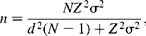
where n is the sample size, N is the population size (Z = 1·96), σ2 is the assumed population variance, and d 2 is the error valueReference Yamane28.
One-way ANOVA was used to compare the groups. Pearson correlation and regression analysis were chosen for linear estimation in both groups. For calculations, MINITAB (for Windows; version 14, Minitab Inc., USA) statistical package programs were used.
Results
Subjects
In this study, none of the subjects in group I had reported any health problems which may be linked to high B exposure. No subjects from either group reported use of any mineral supplements in their diet. The ages, number of years of residence and other relevant data are given in Table 1. Although there was a significant difference between the average age and number of years of residence for both groups (F 1,115 4·47, P < 0·05 and F 1,115 34·64, P < 0·01), for height, body weight, BMI and creatinine clearance levels there was no statistically significant difference between the study and control groups.
Estimated daily boron exposure values
Table 1 indicates the significant differences between the daily B exposure levels (F 1,115 37·83, P < 0·01 and F 1,115 37·23, P < 0·01) in the study and control groups. In group I, the average daily B exposure level was 6·768 (se 0·473) mg/d with an average weight of 73·98 (se 1·64) kg. In controls, these values averaged 1·256 (se 0·104) mg/d and 74·60 (se 1·56) kg, respectively. In groups I and II, the daily level of exposure to B per kg of body weight was 0·093 (se 0·006) and 0·017 (se 0·001) mg, respectively.
Relationship between the estimated daily boron exposure and other traits
When each group was analysed independently, in group I no statistically significant correlation between the daily B exposure values (both mg/d and mg/kg) and other traits such as age, number of years of residence, height, weight and creatinine clearance was found, and in group II a significant correlation was only observed between the daily B exposure and age, with no relationship to number of years of residence, height, weight or creatinine clearance.
The decrease of B exposure with increasing age in group II is a result of the regression analysis which can be expressed as the equation: daily boron exposure (mg/d) = 2·073–0·028 age.
Therefore, a unit increase in age results in a decrease of 0·028 mg/d (R 2 0·15 t − 3·051, P < 0·01) in mean daily B exposure (Table 2). When the same calculations are considered for each kg of body weight, daily B exposure (mg/kg per d) and age regression analysis is calculated as: daily boron exposure mg/kg = 0·028 – 0·00419 age. According to statistical findings, as the age of a person increases, daily B exposure decreases by 0·000419 mg/year (R 2 0·16 t − 3·19, P < 0·01).
Pearson correlation coefficients among some traits for each group

**P < 0·01.
Discussion
The nutritional requirement for B has not been firmly established, because of the lack of epidemiological data. A study conducted in the USA revealed that the average daily exposure to B is around 1 mg in that countryReference Meacham and Hunt29. In another study reporting the results from four countries for adult males over 19 years of age, the daily B exposure values were reported as 1·04–1·11, 1·61–1·79, 1·89–2·36 and 1·94–2·03 mg/d for the USA, Germany, Mexico and Kenya, respectivelyReference Rainey and Nyquist30. It might be suggested that the variations observed for the different countries probably reflect the differences in diet traditions.
In the present study, a daily B exposure level of 6·77 (se 0·47) mg/d was found for males living in İskele and Osmanlı villages of Bigadiç County in the province of Balıkesir. Şaylı et al. Reference Şaylı, Tüccar and Elhan21 called these towns ‘natural human boron laboratories’ as they are situated on large colemanite and ulexite deposits. In group II (controls), the daily B exposure was found to be 1·26 (se 0·10) mg/d, and per kg of body weight it was calculated as 0·017 (se 0·001) mg/d. When these values are considered, it can be concluded that group I subjects have been exposed to B by a factor larger than 5 (6·77/1·26) compared with controls. Therefore, this clearly demonstrates that subjects living in a B-rich mining area for almost all their lives (considering the ages and number of years of residence) are under chronic long-term B exposure. As there were no reported health problems of subjects in group I, as well as no accumulations of death due to certain diseases or a specific cause which may be linked to high B exposure, these values may be considered as safe levels for humans. NielsenReference Nielsen31 concluded that – despite the lack of biochemical data – 1–13 mg B/d might be considered as a safe level for both humans and animals.
The main sources of B are drinking water and consumption of locally grown agricultural productsReference Korkmaz, Uzgoren, Bakırdere, Aydın and Ataman15, Reference Şaylı, Tüccar and Elhan21. In fact, determination of B in agricultural products from this area gave relatively high concentrationsReference Şimşek, Velioğlu, Coşkun and Şaylı32. Additionally, since B mines are on the surface and open, exposure through inhalation is also highly possible.
The relevant figure for the control group II in Turkey is reasonable compared with the values given in the aforementioned countries, lying somewhere in between the numbers in the USA and Germany. Since some of our subjects in control group II are from Ankara – the capital, where there is a high rate of population mobility from all other regions – it would not be unreasonable to suggest that the value found for this group, 1·256 (se 0·104) mg/d, may be a representative figure for the whole country.
B homeostasis is regulated by the urinary system and, regarding the B exposure studies based on urinary sampling, a range of 0·35–10·0 mg B/d is considered as a good functional level for the kidneys, and no correlation between B and calcium clearance has been reportedReference Sutherland, Leslie, Woodhouse and Janet6.
Previous studies have reported that B is not accumulated in soft tissues but only a small fraction is found in bonesReference Murray33. In our study, no correlation has been found between daily B exposure and the number of years of residence in group I. Considering that the male subjects were all adults over the age of 20, it can be proposed that any accumulation of B in bones would be at a negligible level when compared with adolescent subjects. Therefore, the impression obtained from our results is that B accumulation in soft tissues is negligible for the levels reported here; this is in agreement with the results of MurrayReference Murray33.
A correlation has been found between the daily exposure level, 1·256 (se 0·104) mg/d, and age for the control group II as given in Table 2. This finding demonstrates that subjects living elsewhere other than B mining region are not under continuous and significant B exposure, and their B exposure decreases with age.
In conclusion, for the male subjects living in B-rich area, a daily exposure level of 6·768 (se 0·473) mg/d, and per kg of body weight of 0·093 (se 0·006) mg/d was calculated for İskele and Osmanlı villages in Turkey. In the controls, these figures were 1·256 (se 0·104) and 0·017 (se 0·001) mg/d. The results of this study are expected to contribute to creating a reference value for a safe daily B exposure.
Acknowledgements
This project was funded by Eti Mine Works General Management (2004.C.11.0010). We appreciate the contributions of Professor Dr Bekir Sıtkı Şaylı, who died shortly after beginning this research, and Professor Dr B. Dwight Culver of the University of California for his contributions to this work.



