

Introduction
Settler colonialism has been associated with adverse health outcomes of Indigenous people across the world (Wispelwey et al. Reference Wispelwey, Tanous, Asi, Hammoudeh and Mills2023; Nielsen and Jarratt-Snider Reference Nielsen and Jarratt-Snider2024). Inferior health conditions create potential disadvantages for Indigenous people when facing the social and physical transition of the ageing process (Quigley et al. Reference Quigley, Russell, Larkins, Taylor, Sagigi, Strivens and Redman-MacLaren2022). Indigenous communities may face greater societal challenges and increased needs for adequate health care and interventions amid population ageing. Internationally, Indigenous older adults experience greater disparities in health outcomes (Whetung and Gonzales Reference Whetung and Gonzales2025), economic resources (Jain et al. Reference Jain, Brocchini, Radhakrishan and Sall2025) and social engagement due to structural inequities that exist across the lifecourse (MacGuire Reference MacGuire2020). However, whether public intervention effectively alleviates health disparities among Indigenous older adults is often debated, particularly regarding the ‘incommensurability’ (Fortier and Wong Reference Fortier and Wong2019) between the bureaucratic professionalism of the contemporary social service system and the goal of decolonization for Indigenous health and wellbeing (Haley Reference Haley2020).
This article presents a case study in Taiwan to investigate the tensions between long-term care (LTC) services and decolonization in the post-colonial ageing society. With a rapidly growing ageing population, the Taiwan government implemented universal LTC in the early 2000s to create a public service system that provides long-term daily instrumental living, social engagement, and medical nursing services to individuals. This policy aimed to alleviate burdens associated with intrafamilial care-giving and to provide community-based care. The Long-Term Care Service Act of 2016 marked a major reform by strengthening the legal framework and transforming LTC into a state-supported welfare programme. The implementation of public LTC services is especially crucial to support the care-giving resources for Indigenous older adults. Indigenous Taiwanese people face pronounced health inequality due to adverse structural factors, including unequal distribution of health-care resources (Liao et al. Reference Liao, Kean and Haycock-Stuart2024), persistent stigma and discrimination (Lai and Teyra Reference Lai and Teyra2023) and the dominance of Western approaches in health-care practice (Subeq and Lin Reference Subeq and Lin2022). These structural disparities have made Indigenous older adults one of the most vulnerable groups in Taiwan with growing needs for community-based care-giving (Hou and Kuo Reference Hou and Kuo2019; Kuo et al. Reference Kuo, Lin and Lai2022; Tai et al. Reference Tai, Ya-lie and Cheng2023; Tien et al. Reference Tien, Hou and Yang2022). Among the various service models, adult foster care (AFC) shows great potential in helping Indigenous older adults achieve the goal of ageing in place (Li Reference Li2014), as it emphasizes a home-like environment and relies on strong community networks (Zheng and Zhuang Reference Zheng and Zhuang2010).
While LTC services were developed with the goal of building a localized care-giving support system accessible to residents, tensions between service delivery and Indigenous cultural values are causing growing concern among practitioners, activists and community members (Wang Reference Wang2019) and public sectors (Lin and Huang Reference Lin and Huang2021). Scholars have warned that top-down bureaucratic service provision may conflict with people’s cultural beliefs about care, including the Confucian tradition of filial piety in Han-Chinese society (Tsou and Kuo Reference Tsou and Kuo2017; Chen 2019; Yeh Reference Yeh2020) and the traditional parliamentary senior council system found in Indigenous communities (Raranges Reference Raranges2008), where older adults are honoured and consulted in decision-making processes. The introduction of formal LTC services represents a paradigmatic shift from traditional, kinship-based care models (Ru Reference Ru2018), potentially challenging existing cultural norms around filial piety and intergenerational responsibility (Hou Reference Hou2024).
Thus, this study investigated experiences of AFCs in Indigenous rural communities in Taiwan. This research seeks to understand the persistence of these challenges for Indigenous care staff and practitioners. This study addresses the following research question: Why do implementation challenges persist for LTC for Indigenous older adults in rural Taiwan? The article begins with a review of demographic transitions in Taiwan’s ageing population and the history of its LTC policy, followed by a description of the case study methodology and data collection process, before presenting the study’s findings. Finally, this article reflects on the challenges and possibilities in shaping public service policy for Indigenous people and suggests implications for future research.
Research background
Ageing for Indigenous Taiwanese
Historically, Indigenous Taiwanese have been plagued by lower life expectancy (Executive Yuan 2023), a higher prevalence of chronic diseases (Lin et al. Reference Lin, Hung, Chung, Huang, Wu and Chen2021), stroke in younger age (Liao et al. Reference Liao, Kean and Haycock-Stuart2024), mental depression (Yang Reference Yang2021), social isolation (Kuo et al. Reference Kuo, Lin and Lai2022) and lower awareness of dementia (Chen et al. Reference Chen, Huang, Chiu, Yip, Wu, Hsu, Wang, Huang and Shyu2020). These adverse outcomes mean that Indigenous older adults are more likely to face mental and physical disability as they age. Moreover, the urbanization and migration of the labour population have led to insufficient care-giving and companionship from intrafamilial resources for isolated Indigenous older adults (Lin and Huang Reference Lin and Huang2021). These challenges are surging as Taiwan’s older population has experienced rapid growth over the last two decades. According to a survey by the National Development Council of Taiwan, the proportion of people over 65 years old grew from 7.1 per cent in 1993 to 14.6 per cent in 2018, and exceeded 20.0 per cent in 2025, which makes Taiwan one of the ‘super-aged countries’ (National Development Council 2026). This demographic shift has raised new social issues for Taiwan, including economic security (Goh et al. Reference Goh, Wong, McNown and Chen2023), environmental accessibility (Kuo and Liao Reference Kuo and Liao2024) and services for older adults with physical and mental disabilities (Tsou and Kuo Reference Tsou and Kuo2017; Chen 2019). Amidst this demographic transition, Indigenous Taiwanese older adults may have higher needs for public LTC services due to structural adverse health conditions.
Yet some scholars have warned that public services may not be fully compatible with Indigenous cultural values and hardly enhance their wellbeing, which has been attributed, in part, to a lack of engagement in decision-making and to a legacy of colonization (Zhuang Reference Zhuang, Xiaoxia2009). Looking back at the history of Taiwan, several controversial social service programmes with colonial purposes were imposed on Indigenous people, including prohibiting traditional language in the name of universal education (Mao and Chui Reference Mao and Chui2025), forced relocation in the form of government-funded public housing (Wang Reference Wang and Lu2011) and civil surveillance behind the nutrition supply programme (Lo Reference Lo2019). These programmes shared a similar goal – to ‘civilize’ their living standard by compulsory reformation of lifestyles (Wang Reference Wang2019) – negating Indigenous cosmology regarding health and wellbeing (Ming-Cheng Reference Ming-Cheng2003), excluding Indigenous people’s engagement in programme design (Ru Reference Ru2018) and eroding their rights for self-determination and culture preservation (Ming-Cheng Reference Ming-Cheng2003; Wang Reference Wang and Lu2011). The epistemological gaps and fundamental goals between state ageing policies and Indigenous people have been raised as a crucial issue among practitioners, activists, community members, public sectors and experts (Ming-Cheng Reference Ming-Cheng2003; Wang Reference Wang and Lu2011).
This concern isn’t unfounded as the dual role of ‘helping’ and ‘monitoring’ in social services has prompted fierce criticism from a decolonizing perspective of Indigenous communities around the world. For example, Fortier and Wong (Reference Fortier and Wong2019) reviewed the consolidation of the social work profession in Canada and argued that contemporary social work and social service provision remain circumscribed by the logics of conquest, extraction, apprehension, management and pacification that serve settlers’ colonial projects, which are fundamentally incommensurable with the goal of decolonization. Similarly, Haley (Reference Haley2020) applied an intersectionality health equity lens to understand differences in health and found that respectability politics reinforce settler colonialism in the US and provide a foundation for neo-liberal, sociopolitical economic policy that monitors, controls and shapes the lives of multiple marginalized and colonized communities. Regarding services for Indigenous older adults, Jamieson and colleagues (Reference Jamieson, Haag, Schuch, Kapellas, Arantes and Thomson2020) also noticed that racism and intersectional barriers are jeopardizing wellbeing in ageing for Australian Aboriginal people. Thus, whether new governmental care-giving services in contemporary Taiwan’s ageing society support or create further challenges for Indigenous people is a timely concern in the context of post-colonial ageing Taiwan.
Long-term care services in Taiwan
Before the 1990s, care for older adults had been considered part of intrafamilial duties instead of public affairs in the familism culture of Taiwan (Yeh Reference Yeh2020). Most public care facilities before the 1990s were operated based on a residual model of welfare designed for the poor or veterans (Lin Reference Lin2005). However, the Senior Citizens Welfare Act Amendment of 1997 reshaped the concept of care-giving and turned it into a universal service (Wang Reference Wang2005). Several reasons led to this paradigmatic shift in care policy in Taiwan. First, the ageing population has experienced rapid expansion. This growing ageing society has raised new social needs for LTC services for older adults with physical and mental disabilities (Jian Reference Jian2019). Second, the democratization in the 1990s indirectly expanded welfare programmes in Taiwan, shifting from limited benefits to universal programmes (Lin Reference Lin2005). Institutional reform empowers older adults to mobilize social groups and influence political decisions through participation (Wong Reference Wong2025).
The Executive Yuan (the highest administrative department in Taiwan) formed the LTC task team and the LTC Committee in 2000 and executed the experimental Home Care Subsidies programme in 2002 (Wang and Cheng Reference Wang and Cheng2012), which could be seen as the first universal LTC service at state level in Taiwan. From 2003 to 2007, several experimental pilot programmes were implemented, including Care Provider Training, Home Care for Dementia, Community Care Station, and LTC Management Centre (Yang Reference Yang2021). The Ten-Year LTC Plan 2.0 in 2016, initiated by the Ministry of Health and Welfare (MOHW), served as a milestone for expanding service coverage and increasing financial sources (Ministry of Health and Welfare 2017). The LTC Plan 2.0 aims to improve service quality, emphasize ageing in place, expand preventive care and integrate local resources to localized service systems (Chen and Fu Reference Chen and Fu2020). This reform has made several achievements for developing a state welfare policy: expanding service coverage, building local networks via government contracts, adjusting fees to attract labour supply, incentivizing marginalized regions, supporting family care-givers, increasing dementia centres and promoting community preventive services (MOHW 2017; Chen and Fu Reference Chen and Fu2020). According to the estimation by MOHW, the service coverage of the estimated population reached 80.19 per cent in 2023 (Ministry of Health and Welfare 2025).
Alleviating disparities in care resources and building public care networks for Indigenous communities was a key goal for the government in the 2016 reform. The LTC Plan 2.0 agenda acknowledged that there are substantive obstacles in building the LTC delivery system for the several officially recognized rural Indigenous regions where the majority of residents are Indigenous. The obstacles include logistical disadvantages due to geographical barriers, insufficient medical infrastructure, lack of social service resources, mobility of medical professionals, lack of familial care-givers, lower economic status and cultural and language barriers (Ministry of Health and Welfare 2017; Kasirisir Reference Kasirisir2020). Several programmes have been implemented to incentivize local personnel and organizations in the Indigenous region to participate in LTC, including providing beneficial funding for smaller day-care facilities, supplementing the service fee for rural care-givers and incorporating cultural competence and sensitivity into personnel training (Kasirisir Reference Kasirisir2020; Ru Reference Ru2018; Wang Reference Wang2019).
Yet, the effectiveness of these implementations has been unsatisfactory to many local residents and activists (Hou Reference Hou2024). Scholars have identified several challenges for LTC services for Indigenous older adults, including that the care delivery system is not aligned with Indigenous care-giver practices (Chang Reference Chang2018), logistical barriers are difficult to overcome (e.g. infrastructure building requirements) (Lin Reference Lin2018) and cultural competency requirements are performative rather than embedded in the epistemology of Indigenous people (Rovaniyaw Reference Rovaniyaw2022). Moreover, bigger challenges lie in the contention between the design of LTC as a bureaucratic administration and the epistemological foundation of the leaders/teachers/respectfulness role of older adults in Indigenous society (Wang and Tsai Reference Wang and Tsai2019). For example, the service initiation requires specialist authorization, creating unequal power dynamics between providers and older adults due to information asymmetry (Yang Reference Yang2021); the subsidized services are comprehensively fixed to the legal codes, limiting flexibility and choice for recipients (Ru Reference Ru2018; Yeh Reference Yeh2020); and the standardized needs assessment without cultural humility may overlook the unique needs of Indigenous communities, compromise cultural safety and neglect the social connectedness embedded in these communities (Hou and Kuo Reference Hou and Kuo2019).
Alternatively, scholars and activists have advocated for incorporating culturally responsive care into LTC to avoid the compromise between cultural values and service implementation. Culturally responsive care emphasizes understanding diverse health practices, beliefs and values to deliver meaningful health services within recipients’ cultural contexts (Moloney et al. Reference Moloney, Stuart, Chen and Lin2023). For Indigenous communities, this means recognizing social contexts and power inequities to ensure cultural safety (Ru Reference Ru2018) and reframing care beyond colonial state discourses by centring Indigenous worldviews in daily practice (Wang Reference Wang2019).
Adult foster care in Indigenous villages
Among several models of service funded by the LTC programme, AFC stands out as the most unique model that attempts to strike a balance between institutionalizing care-giving and localizing public services (Chen Reference Chen2011). The AFC model of service provides care in a care-giver’s home, assisting disabled older adults with daily activities such as bathing, dressing and preparing meals (Ministry of Health and Welfare 2017). It was first introduced to Taiwan in the LTC pilot programme of 2000 to provide alternative choices from typical home services and day care (Wu et al. Reference Wu, Dai, Chuang, Chang, Lu, Tsao, Wang and Chen2004). In the 2008 amendment to the Senior Citizens Welfare Act, AFC was defined as ‘daily care for disabled older adults’, explicitly prohibiting medical services or treatment within AFC facilities. This law also established building standards that designated which facilities could qualify as AFCs (fire resistance, evacuation routes, accessibility, etc.) (Senior Citizens Welfare Act 2008).
The AFC model comprises benefits of home-like settings (Zheng and Zhuang Reference Zheng and Zhuang2010); community environments; lower administrative burdens (Chen Reference Chen2011); humanized, de-institutionalized service (Tseng Reference Tseng2014); and compatibility with local culture (Li Reference Li2014). Because of their adaptability and emphasis on home-based care, AFC services may be better suited to Indigenous villages than large-scale adult day-care centres, given local resources and cultural traditions (Kasirisir Reference Kasirisir2021a). However, scholars in Taiwan have argued that LTC regulations may undermine these advantages of AFCs through institutional management of facilities and providers (Kasirsir Reference Kasirisir2021a; Chen Reference Chen2011) and standardized, inflexible service delivery (Li Reference Li2014).
The AFC model presents an ideal entry point for understanding tensions between the ageing Indigenous community and public LTC services. On the one hand, AFC arises from reforms decentralizing care, aiming to de-institutionalize, humanize and localize care to promote ageing in place. On the other hand, increasing regulations imposed on AFC and LTC to ensure accountability and standardization may conflict with user autonomy and undermine community involvement. Moreover, as the number of AFC models increases in rural Indigenous areas, it becomes essential for both policy makers and local communities to better understand the unique challenges that AFC may face.
Methodology and method
This study aimed to answer the research question: Why do implementation challenges persist for LTC for Indigenous older adults in rural Taiwan? Specifically, it explores the public LTC service through a decolonizing perspective, emphasizing the knowledge and epistemology of care within Indigenous communities when encountering population ageing. As care is socially organized by power relations, post-colonial government-led care services could reflect the cultural values and social norms of privileged colonizers’ social groups, which control the majority of political power (Wang Reference Wang2019). To interrogate tensions between service delivery and Indigenous communities, research from a decolonizing perspective, beyond policy-analysis metrics such as service prevalence or enrolment numbers, grounded in the worldview of people involved in the process of care, may provide deeper insights into this epistemological gap and guide future policy.
Grounded in a decolonizing perspective, this study employed a multi-method case study conducted at five AFC facilities across five rural villages to collect empirical data on the experiences of care providers and recipients through participant observation, supplemental interviews and content analysis of LTC policy in Taiwan. Case-based qualitative methods allow researchers to analyse how and why complex processes unfold over time (Yin Reference Yin2017) and to conduct in-depth explorations of intricate phenomena within specific contexts (Chowdhury and Shil Reference Chowdhury and Shil2021). This approach provides rich, detailed data that might not be as apparent or accessible through other methods (Renjith et al. Reference Renjith, Yesodharan, Noronha, Ladd and George2021). Qualitative research uses iterative approaches to generate in-depth knowledge about a specific problem, condition or state of being within contexts (Perone and Saunders Reference Perone and Saunders2023; de Medeiros Reference de Medeiros2024).
Adult foster care selection sites
The purposive sample included five AFCs in County X. Purposive sampling facilitates the identification and selection of information-rich cases related to the phenomenon of interest, thus improving the rigour and trustworthiness of the data and results (Palinkas et al. Reference Palinkas, Horwitz, Green, Wisdom, Duan and Hoagwood2015; Perone Reference Perone2024). The care-giving resources in the Indigenous region of County X show two explicit characteristics: there is an absence of large-scale institutional care-giving facilities due to the small, unconcentrated population; and most of the existing care-giving units lack advanced infrastructure to provide care to older adults with severe disability. These characteristics make AFC the most and often the only care-giving unit accessible for disabled Indigenous older adults.
The researcher recruited AFC sites through their established relationships based on professional experience and participation on an advisory committee on AFC. Rural villages were selected because they often reflect distinct cultural contexts, which provide specific ways of thinking, reasoning and understanding (Susen Reference Susen2024). Studying these communities can provide researchers with unique insights into how locality influences human behaviour and social organization (Humphris and Pemberton Reference Humphris and Pemberton2016). Moreover, considering the regional disparities of health resources, implementation could be most impactful to the care practice in rural villages that need public interventions (Hsieh Reference Hsieh2023).
In addition to AFC sites, this study also recruited four practitioners among these sites to conduct supplementary interviews. These four individuals were selected using purposive sampling because each participant, as a care provider or social worker at a different site, offered unique insights into the relationship between regulations aimed at improving care and accountability and the localization of care services. Although the sample size of four interviewees is small, the entire population of care-givers and social workers is 15 across all five sites; this sample thus reflects a reasonable sample size for this population (e.g. Stone Reference Stone2024), especially given the purpose to help triangulate data. Combining field notes and interviews provides researchers with an in-depth understanding of the issues through textual interpretation (Sutton and Austin Reference Sutton and Austin2015; Dunwoodie et al. Reference Dunwoodie, Macaulay and Newman2023).
Data collection
Participant observation
Ethnographic participant observations occurred at five sites in this study. An ethnographic approach seeks an intimate interpretive understanding of a particular culture, life, people or social setting (Adhikari Reference Adhikari2023), which benefits in revealing Indigenous practitioners’ voice and aligning with the goal of decolonizing knowledge production. Participant observation was carried out with the permission of AFC providers. The researcher visited the five AFC sites multiple times from 2020 to 2021 as a volunteer, spending approximately 500 hours conducting participant observation of six care workers. The researcher participated in the full range of activities at the AFC; this included attending physical exercise, meals, recreational activities, monthly birthday celebrations, inspection preparation and administration tasks. The researcher introduced himself as a graduate student raised in a similar rural village while contributing personal reflections in conversations to build rapport. Balancing researcher and participant roles facilitated rapport with participants and in-depth field data (Fabbre Reference Fabbre2015). The researcher wrote field notes, documenting instances of conflict experienced by providers, often stemming from discord between AFC regulations and their own perspectives.
Supplemental interviews
Four supplementary in-depth interviews were conducted to triangulate the observed data and enhance its rigour and trustworthiness (Carter et al. Reference Carter, Bryant-Lukosius, DiCenso, Blythe and Neville2014). These interviews provide in-depth subjective narratives of characters presented in observation (Grenier Reference Grenier2023), further exploring the perspectives of care providers and social workers regarding specific issues in AFC services and community-based care. The researcher first shared observations from field notes with the participants (i.e. AFC care workers/social workers). He subsequently identified a smaller sample of key individuals who provided care-giving at AFC sites for interviews to understand their subjective interpretations and perceptions. Interviews were conducted at the AFC facilities during the providers’ and social workers’ break times. Each of these four interviews lasted approximately 60 minutes and were all conducted by the researcher in Chinese Mandarin and audio recorded. The researcher transcribed the interviews then shared the transcripts with the interviewees to verify their accuracy.
Archival review
The researcher collected archival records of governmental public information about the regulations of LTC, including the Long-Term Care 2.0 Project Book (2016), the Long-Term Care Act (2021), the Long-Term Care Executive Codes (2019), the Long-Term Care Personnel Credentialing and Continued Training Codes (2017), the Long-Term Care Facilities Standards (2017) and the Long-Term Care Service Fee Table (2017). The researcher also examined the materialistic objects and documents such as service contracts, care-giving licenses and service permits with participants’ permission. Examining materialistic objects allows the researcher to explore interrelations between materials in practice and choreographed routines that order bodies and materials (Buse et al. Reference Buse, Martin and Nettleton2018; Cleeve et al. Reference Cleeve, Borell and Rosenberg2020). These materials are crucial for understanding how laws and regulations have been actualized in care practice, given what they can reveal about the authorization and eligibility of providing care in the LTC system.
Considering the relatively small geographical region of Taiwan (9 cities and 13 counties) and the small number of AFCs in County X (35), particularly given the focus on Indigenous communities, the demographic information of selected sites and staff (age, Indigenous tribe, languages, etc.) could be used to identify participating AFC sites easily. Thus, information on participants’ characteristics is intentionally omitted in the final outputs in order to protect participants’ anonymity. This study obtained approval from the Institutional Review Board of National Chengchi University and the University of California, Berkeley.
Data analysis
A qualitative convergent approach (Finfgeld-Connett Reference Finfgeld-Connett2008; Wakibi et al. Reference Wakibi, Ferguson, Berry, Leidl and Belton2021) was used to integrate data collected through three different methods: participant observation, supplemental interviews and archival analysis. Convergent design provides a comprehensive or corroborative understanding of a research problem by leveraging the strengths and offsetting the weaknesses of different methods (Creswell and Clark Reference Creswell and Clark2017). Following Creswell and Clark’s (Reference Creswell and Clark2017) convergent parallel design, data from each source were initially analysed separately, then integrated through a systematic comparison across data sources for each identified theme. The researcher developed a thematic integration matrix with: (1) emerging themes, (2) field note evidence, (3) regulatory document support, (4) interview confirmation and (5) material artefact validation. When data sources conflicted, such as regulatory documents emphasizing safety while field notes revealed staff viewing regulations as barriers, the researcher documented these conflicts as meaningful tensions requiring deeper analysis rather than data problems to resolve.
The researcher employed a manual coding process using electronic transcripts, document photocopies and handwritten field notes. The researcher first familiarized himself with the data by re-reading all the field notes and transcripts after data collection, along with related legal documents. During this re-reading, the researcher identified key themes across different regulations connecting to emerging patterns of experience in the AFC sites (Archer Reference Archer, Kramer, Laher, Fynn and Janse van Vuuren2018). These themes became the foundation for synthesizing and organizing the data of the AFC sites’ operation (Brailas et al. Reference Brailas, Tragou and Papachristopoulos2023; Naeem et al. Reference Naeem, Ozuem, Howell and Ranfagni2023). Finally, the researcher used data from interviews to triangulate the accuracy of recognized patterns and gain a deeper understanding of each of them.
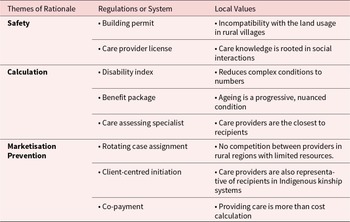
For example, a group of field notes documented experiences of the staff trying to look for a building for opening AFC, which revealed that the requirements for buildings are not easy to meet for these care-givers. This prompted the researcher to review the relevant rules and regulations around the building codes relating to LTC and the reasons for setting these regulations, subsequently provoking conversation on the idea of building and safety between researchers and participants. This process highlighted how similar concepts had very different meanings as written in LTC policy versus the implementation of LTC services for Indigenous older adults in rural AFC facilities. A theme around safety, for example, then emerged through integration of field notes documenting the search for compliant buildings (observational data), Building Act regulations specifying land use requirements (archival data), interview quotes explaining staff frustrations with building requirements (interview data), and service permits and licenses showing actual compliance documentation (material artefacts). See Table 1 for a summary of themes.
Themes of rationale for the government to impose regulations or systems, and contrasting local values

Table 1 Long description
The table groups government rationales for imposing rules into three themes and pairs each with example regulations and contrasting local values. Under Safety, building permits are contrasted with rural village land-use incompatibilities, and care provider licensing is contrasted with care knowledge grounded in social relationships. Under Calculation, a disability index is seen as reducing complex conditions to numbers, benefit packages are contrasted with ageing as progressive and nuanced, and specialist assessors are contrasted with the view that providers are closest to recipients. Under Marketisation Prevention, rotating case assignment is contrasted with the lack of competition in resource-limited rural regions, client-centred initiation is contrasted with providers also representing recipients within Indigenous kinship systems, and co-payments are contrasted with care as more than cost. Across themes, the pattern is that standardized, administrative mechanisms are presented as misaligned with place-based practices and relational understandings of care. The table lists examples rather than frequencies, so it indicates types of tensions rather than how common they are.
The process of data analysis was iterative (Morgan and Nica Reference Morgan and Nica2020). The researcher enhanced the rigour of this process by discussing themes with his research advisor, colleagues from National Chengchi University, LTC advocacy organizations and providers and social workers engaged in this study. The researcher revised and refined the analysis based on the feedback and comments gained from these groups, remained in touch with the participants and had ongoing discussions about these findings, reflecting their collaborative working experience.
Reflexivity
Finally, the researcher incorporated the reflexivity of his role throughout the study. Reflexivity involves a self-conscious evaluation of the researcher’s subjectivity throughout the research process, which enhances rigour, integrity and quality (Olmos-Vega et al. Reference Olmos-Vega, Stalmeijer, Varpio and Kahlke2023; Rogers and Allen Reference Rogers and Allen2024). The researcher firstly acknowledged his own identity as an Indigenous Taiwanese who grew up in a rural village and shared a sense of historical oppression with the communities participating in this study. Instead of being a weakness to threaten the impartiality of the research, Indigenous identity can benefit researchers examining issues in Indigenous communities as it helps them to build rapport and understand the nuances of the knowledge of Indigenous care-givers and the broader structural and cultural factors that are often overlooked by governmental administration or outside researchers (Naidu et al. Reference Naidu, Paolucci (Muran‐iwaidja), Luta (Kaurareg) and Hughes (Wagadagam)2024). The researcher’s Indigenous identity facilitated a decolonizing analysis that helped challenge dominant paradigms around Indigenous knowledge production (Smith Reference Smith1999). Still, the researcher consistently reflected throughout the study on his positionality as a privileged graduate student from a prestigious university whose understanding of care for older adults was mostly obtained from formal training in graduate school, how that could produce an unequal power relationship with the care providers and social workers, and how that could impact the data interpretation’s trustworthiness and rigour. To reduce these challenges, the researcher shared preliminary findings with the AFC providers and social workers to ensure coherence and consistency between the researcher’s interpretations and the participants’ experiences. Moreover, transparent data analysis helped to build a sense of shared ownership of the research outcomes among Indigenous participants, which emphasizes the networking, democratizing and sharing of the Indigenous knowledge and research (Smith Reference Smith1999; Yua et al. Reference Yua, Raymond-Yakoubian, Daniel and Behe2022).
Findings
Data collection concluded with five AFC sites in five different villages of County X. Two villages were composed of people from the A tribe, and the other three were villages of the B tribe. Although the language, religion and culture of these two tribes were distinctly different, most households shared the traditional family-centred community-oriented care-giving culture. Ethnographic research included participant observation with nine Indigenous care staff and two social workers providing care to Indigenous older adults in these five rural villages. For four supplementary interviews, three of the participants were female care providers, around 30 to 40 years old and self-identified as Indigenous people; one was a male mid-30s social worker, self-identified as Han-Chinese.
Through analysis, the researcher identified three underlying reasons why implementation challenges persist for LTC services for Indigenous older adults in rural Taiwan, particularly through the lens of an AFC case study. In summary, Taiwan’s LTC policies and regulations embody three logics that contradict Indigenous cultural values by concretizing safety through licensure and professionalism, calculating care through scientific assessment and service standardization, and preventing excessive market competition.
Concretizing safety: licensure and professionalism
Concretizing safety is the process for the administration to objectify the concept of safety through regulations. Administration ensures safety by requiring things like building permits for AFC facilities and staff credentialing. These policies show how LTC systems use licensing and professional standards to monitor and ensure service safety. However, they also create practical challenges for Indigenous AFC.
In Y village, AFC L is located in a corner of a small neighbourhood on a hill. The building of AFC L is an old flat house covered by a metal roof with a large concrete front yard, where older adults will gather round for activities like singing, playing games or sometimes just resting in wheelchairs. At first glance, this building is not distinctly different from any other building in the village, but the worker/manager Sa (pseudonym), an Indigenous woman, was so happy when she told me how she found this place. Like many AFC staff, she first encountered challenges with the LTC regulations regarding finding legally compliant buildings in which to operate AFC. To her surprise, her own home doesn’t meet the requirements of LTC regulation on AFC facilities. This meant that Sa had to rent a building that meets all the requirements, which is rare in the village. This is not an outstanding situation across the Indigenous AFC. Four out of five sites in this study were operated in a rental house; the only site in a care worker’s own house was a new building specifically designed for meeting the requirements of AFC.
The building regulations play a huge part in these struggles. The Land Act and the Building Act of Taiwan heavily regulate architecture and building usage, designating specific building types for particular areas. Building usage must comply with ad hoc standards (Land Act, 2024; Building Act, 2022). The Non-urban Land Management Rules, 2024, regulate that LTC facilities must be built on Category A Architectural Land. Moreover, the LTC Act and associated regulations require AFC services to obtain care facility usage permits from local land management departments (Long-Term Care Services Act, 2021). All of this information is written on a permit, which must be hung on the wall of the AFC facility.
However, the building and land regulations often do not align with the typical usage patterns in rural Indigenous villages. Most architectures in rural villages are ‘illegal buildings’ that do not meet the criteria of the Building Act and are unable to apply for a usage permit. According to Sa:
(Sa, participant observation) We don’t really feel the urge to apply for that … I mean, the whole point is to build a place for people to live in, I don’t know anything about the Building Act or regulation. Most buildings here are old, so there is no way people knew about all this stuff when they first built it, even before the new government (KMT) came.
Architectural land is scarce and restricted in Indigenous villages; most land is designated for farming or forestry rather than residential construction. Even if residents obtain permits to build homes, they often cannot meet the stricter criteria required for AFC facilities. Supervising social worker Cai (pseudonym) explained this difficulty:
(Cai, interview) It’s very challenging to find the right land and house to meet the criteria of regulations on LTC and AFC in rural areas; those permits and categories are very hard to find. Most potential care providers were turned down due to these regulations on the building, or they had to rent other places instead of using their own homes. But if you look into their own buildings, they are quite strong and safe, even if they were built on the ‘wrong land’ that can only be used to grow crops or feed chickens, according to the government.
Ironically, while AFC aims to build a familiar, home-like environment by using care-givers’ homes as facilities, building and land regulations often prevent providers from using their own homes for this purpose.
Su (pseudonym) is an experienced care worker. She started her early career in health care at a residential care facility adjacent to a city hospital. About ten years ago, she decided to go home and start her own AFC in Village C, a rural village about 40 minutes away from the closest town. Su used to pick up Grandpa Tia (pseudonym) on her way to work, a common practice for those who lack transportation options. An inspector noticed this ‘favour ride’ and prohibited it, telling her that she is not allowed to give Tia a ride because ‘driving is not part of the skills care providers receive in their training programmes’ and should be provided by a professional driver subsidized by the LTC. However, Su found that finding a reliable taxi driver in rural villages is difficult for Tia. Similarly, only one out of five AFC sites in this study has a contracted taxi driver. Moreover, to Su, these informal rides offer more than just transportation; they uphold social connections and community bonds between older adults and care-givers. Su shared:
(Su, participant observation) I think this is more than picking up someone and dropping them off. Sometimes, you have to be sharp and cautious about the surroundings of their home to know their living environment, the interactions between their families, and how to communicate with people with dementia; this all takes time and effort to do … it takes the competence of care.
For Su, care knowledge is rooted in social interactions and shared experiences within the community she belongs to. Localized care extends beyond regulated categories or competencies recognized by credentials and licences. Rather than viewing the practice as a breach of professional boundaries that threatens safety, Su sees refusing to pick up older adults on the way to work as contradicting the local understanding of what constitutes a caring relationship.
Calculating care: scientific assessment and service standardization
Calculating care is an important concept in LTC. It means turning care activities into numbers so that they can be measured and analysed mathematically. This process involves dividing the complex needs of older adults into basic levels and converting detailed care tasks into standardized service items with set prices. Through this process, needs and care can be quantitatively described, measured and monitored, which is essential for managing costs and ensuring the financial sustainability of LTC. Yet, this may not align with Indigenous values towards care.
The procedure for case intake is relatively simple for AFC workers. Before the cases are assigned to their AFCs, a care specialist, an officer in local LTC management centres, has already arranged the categories of service in the care plan. Ideally, the workers only have to follow the instructions on the care plan and provide the corresponding service to fulfil their responsibility.
Yet, the realistic situation in AFC can be much more complicated. Staff Ma (pseudonym), an Indigenous middle-aged woman, was caught ‘unauthorizedly’ helping one of her older adults take a shower by the supervisor; the number of showers did not match the number arranged in the care plan. She explained:
(Ma, interview) He came in this morning with an unpleasant stench. I can tell that he is very uncomfortable, and this is not suitable for other people as well, so I have to help him shower. I’m aware of all the procedures of re-evaluation and even the legal issue of the care plan, but seriously, I have no time for that, and it would be terrible if I didn’t do that when I notice someone needs help and I’m the carer, even if some of [that is] not part of the contract.
Ma’s dilemma is related to the resource distribution system: LTC uses a disabilities index and standardized benefits packages to scientifically evaluate the needs of older adults (Long-Term Care Services Act, 2021). The disabilities index is mainly built on two established scales by physicians: the Activities of Daily Living Scale (ADLs), also known as the Barthel Index, and the Instrumental Activities of Daily Living Scale (IADLs). The combined scores from these scales generate a specific index, ranking recipients’ disability levels from 1 (mildest) to 8 (most severe). Based on the level, the government provides monthly subsidies ranging from 10,020 TWD to 36,180 TWD (approximately US$310 to $1,180) to help recipients pay for LTC services. They can buy different services from local care providers, but these must be approved by a regional care specialist using a personal care plan. Every six months, the specialist checks on the older adults’ needs and, if anything changes, updates the subsidy and service approval.
While the disabilities index is useful for assessing recipients’ needs, it also limits a deeper understanding of their individual circumstances. Sa once shared her perspective on assessment:
(Sa, interview) I don’t know; I always feel suspicious about that tablet [the digital assessment tablet used by care specialists]. It feels like you ask questions and put some numbers into it, and after 30 minutes you can decide one’s condition and the money given to someone. It feels like something is missing here. Like, how is the social connection? How does one feel about life and culture?
This has made staff tend to see the care plan as a ‘reference’ instead of ‘instructions’ for their care work. To them, the knowledge and understanding of care-giving were generated based on the daily interaction between them and the older adults, in which they are simultaneously observers and providers.
Moreover, the needs assessment and service planning process implies a division of labour within the LTC system. By unifying planning with care specialists, the service is simplified for providers, who only need to practise plans developed by specialists. While AFC providers are the primary workers with recipients, they lack the authority to authorize benefits. This has caused tensions between workers and specialists. Staff Ma complains about the authority of the care specialist over her care work:
(Ma, interview) I understand that the system is like this … the specialist arranges, I do my work. This is pushing back my work sometimes, there is something I believe they need, but I will be hesitant to do … I think sometimes the specialist should respect our opinion, especially [as] we are the closest people to these grandpas and grandmas every day … we are Indigenous peoples and members of this community.
The staff believe they have more information than the specialist to determine and decide what kind of care task should be provided. The division of labour is causing conflicts between different roles in the delivery network.
Prevention of market competition
Prevention of market competition refers to mechanisms that regulate the supply of and demand for care services. These include restricted pathways for service initiation and compulsory co-payment. Together, these measures create a regulated market for LTC to avoid negative competition. However, many regulations are different from the community-based care of Indigenous villages.
To prevent excessive competition and support smaller local organizations, LTC services adopt a case assignment procedure where regional case managers assign recipients to care providers based on feasibility and impartiality (Long-Term Care Services Act, 2021). However, it may not go smoothly in the practical settings.
Grandpa Gu (pseudonym) was a new case at Ma’s AFC. He lives by himself with dementia and hearing issues. His family was never around, and AFC seemed to be the only place for him to stay every day. Ma was the one to introduce AFC to Gu, and she has been very active in addressing accessible LTC services to other community members, as she believes that it is her duty in the village. However, the process for Grandpa Gu to successfully get into the AFC wasn’t smooth: Ma wasn’t able to find Gu’s family to initiate the case intake process, including assessment and plan arrangement by the care specialist. Gu’s family is the only one that is able to initiate the case for him in the client-centred intake system of LTC. Ma shared that she got ‘notes’ from the advisor for being too motivated to help someone become her case:
(Ma, interview) I felt like I should help him, so I called the case manager, but she told me that he or his family had to contact her by themselves so she could reach out to the care specialist to initiate the whole process of assessment, planning and assignment. But, honestly, he cannot do that by himself, and I cannot find his family to help him. I’m aware of the rules about recruiting, but I don’t think that it’s fine to leave him like this, either. I was even going to find the headman for help.
Ma saw herself as an advocate for the person, even though she did not meet the LTC’s definition of a family member. The cultural background of this gap is important to note. The kinship system of Indigenous Taiwanese differs from Han-Chinese culture and the modern nuclear family; it is a generational kinship system distinguishing individuals primarily by gender and generation. Members of a generation share a common identity and collectively fulfil duties towards other generations. This is reflected in the way individuals of the same gender within the same generation are called by the same term. In the daily interaction of community members of the two tribes recruited in this study, the generational shared duties model has been articulated in anthropological research (Liu Reference Liu2024). As noted by kinship anthropologist Lewis Morgan, this generational kinship system is prevalent in Polynesia (Gardner Reference Gardner2008), which is connected to the Austronesian origins of Indigenous Taiwanese. In essence, the relationship between the older adult and the provider is close because her generational identity has instilled in her a sense of responsibility for his wellbeing. This cultural context contrasts sharply with the LTC system’s emphasis on client self-determination and the neutral assignment of cases.
When purchasing services, in addition to paying for the service through the benefits package given by the government, recipients are also required to pay the co-payment of the service. Co-payment is utilized to (1) prevent the overuse of resources by attributing part of the cost to recipients; and (2) ensure a healthy relationship between care providers and recipients in service transactions. Usually, there is a 16 per cent fixed co-payment for general users; people in poverty who pass the asset-based means test could lower the rate to 0 to 5 per cent (Long-Term Care Services Act, 2021). However, there are some exceptions in AFC whereby the providers may not really charge the co-payment due to practical circumstances. Sa lamented her dilemma of charging a co-payment:
(Sa, interview) Some of them are just poor; they really do not have any money to pay for this. There is one man who was able to get the lower rate for co-payment, but one day, his family did his tax, and he is not eligible anymore. I don’t think that is right; it’s problematic … and no, I’m not asking them to leave because of this; they are part of this community, and this is not right.
This situation highlights the conflict between charging co-payment and the community’s strong sense of belonging and social responsibility. In this context, the value of care contradicts the obligation of trading. Instead, it is rooted in deep connections of kinship ties and belonging, which define the appropriate care relationship between providers and recipients.
Discussion
The findings present a deeper understanding of AFC in Indigenous rural communities and the reasons for persistent tensions between the operation of the government-led LTC programme and Indigenous cultural values towards care for older adults. Three underlying patterns of regulation emerged from the care dilemmas experienced by Indigenous practitioners: ensuring the safety of service via an inspection system based on licensure and professionalism; calculating the cost and production of care tasks with scientific assessment; and case intake procedures that emphasize the impartiality of public services. Although each of them serves certain goals in establishing the public LTC service system, these regulatory implementations present epistemological gaps between LTC and Indigenous people.
Regarding licensure and professionalism, safety is a key factor in upholding the quality of public services. One common approach to minimize errors is establishing specific procedures and standardized settings (Grout Reference Grout2006; Niv and Tal Reference Niv, Tal, Niv and Tal2023). However, strict adherence to licensure and professionalism can conflict with local realities. The findings underscore how land and building regulations often fail to align with existing knowledge of land use in rural communities. This restricts the strength of the home setting of AFC because providers’ houses are not compatible. This incompatibility can be traced back to the military invasion and colonial management of Indigenous land by Japanese colonialists, which forced much of the land usage in rural villages, especially Indigenous villages, into an ambiguous legal status (Lin Reference Lin2018). The administration also sought to improve service quality and safety by credentialing care providers. The LTC Act and personnel codes require care providers to complete training and pass a licensing exam to join the LTC system (Long-Term Care Services Act, 2021). However, credentialing has professionalized care-giving and creates a divide between professional expert knowledge and the everyday experiences of care-givers. The credentialing also failed to grapple with the holistic view of care-giving built on social interactions and living experiences among community members.
In terms of calculating care, modern public services require scientific assessment and standardization to ensure quality and effectiveness. Performance-based accountability is essential in the semi-privatized LTC system because it helps prove the legitimacy of social services under political scrutiny. Therefore, LTC uses scientific assessment and standardization to measure recipients’ needs and care processes, enabling systematic calculation and monitoring. Nevertheless, it inevitably transforms care from a socially connected activity into a reductionist and simplified construct. It reduces older adults’ complex conditions to a limited number of levels to determine the appropriate allocation of public resources. The disabilities index cannot capture older adults’ cultural values and interpersonal connectedness. Its standardized service constrains care providers from responding to the progressive and changing needs of older adults.
In addition, division of labour also serves as an important design to improve calculation and simplify tasks for care providers, resonating with the goal of cost-effectiveness. This division improves service quality by creating routines and also lowers the skill requirements for care providers, making it easier to hire more workers. The division of labour mirrors Fordist mass production principles, aiming to create technological and managerial efficiency (Watson Reference Watson2019). Nevertheless, it also ignores the nuanced situation in care practice and underestimates providers’ knowledge in the community, even causing conflicts between local members and governmental officers.
In relation to preventing market competition, over the past two decades, increased funding for LTC has encouraged many local organizations to join the service system. However, competition among providers can sometimes undermine the neutrality and universality of public services. To address this, case assignment procedures and the co-payment system are designed to enhance both feasibility and fairness. In addition, client-initiated services strengthen self-determination and client-centred planning, improving care quality by fostering a more balanced relationship between recipients and providers. However, because AFC is often the only kind of care facility in rural villages, this competition-prevention mechanism can create obstacles for community members. The assignment procedure limits outreach to potential recipients and their families, making it more challenging to deliver services. Moreover, in the Indigenous communities where the cultural kinship system works based on generational boundaries, the narrow definition of recipient’s families becomes incompatible. Staff are members of the community who are organized in an interwoven relationship with complicated social connections based on kinship, belonging and solidarity.
These contradictions between the government-led LTC programme and Indigenous cultural values regarding care for older adults echo scholars’ argument of inherent incommensurability that exists in post-colonial governmental service. The LTC regulations reflect the efficiency and effectiveness of neo-liberal models for population management, created by the scientific knowledge system of measurement that homogenizes marginalized participants (Haley Reference Haley2020). This model replicates health inequity for Indigenous people through its intentional outcomes of dehistoricization, institutionalization and professionalization of care provision, antagonizing the Indigenous knowledge grounded in a holistic cosmology that centres on cultural embeddedness, kinship and interpersonal relationships. As Indigenous knowledge and values have been negated in and excluded from the implementations, the wellbeing of Indigenous adults remains unaddressed, regardless of any increase in health-care resources or monetary aid to the communities.
Implications
Rethinking the trajectory of LTC development in Taiwan from a decolonizing perspective
The findings of this study have led to a need to reassess the trajectory of care policy making through reviewing LTC development in relatively late democratized Taiwan politics. The democratization in the 1990s indirectly caused the expansion of welfare in Taiwan. Under bipartisan consensus, civil advocacy groups, and with support from the administration, the Legislative Yuan (parliament of Taiwan), amended the obsolete Senior Citizens Welfare Act in 1997 (Wang Reference Wang2005). The amendment transformed the residual programme into a vast, universal welfare policy to improve social security and wellbeing for the older population. Including LTC, several crucial policies targeting wellbeing for older adults were initiated under this wave of welfare expansion, motivated by the universal suffrage (Chiu and Chen Reference Chiu and Chen S-C2006).
However, the experience of Indigenous care-givers in AFC presents tensions that highlight a fundamental contradiction in modern democratic social policies: While the system promises people’s representation in policy making, policy outcomes are somehow disconnected from people’s, especially marginalized communities’, lived experiences. Despite civil liberation enabling people to have a chance to propose for their interests through the newly opened political sphere, participation by Indigenous community members/public was generally absent or limited in the implementation of LTC. The establishment of the governmental expert task team, legislation by parliament and the administration of specialized departments all underscored how the process of creating LTC (and paradigms of care) emerged from the aristocracy of knowledge rather than through public participation. The principle of equal representation in elections may inevitably marginalize the interests and opinions of lower socio-economic groups (Cunningham Reference Cunningham2002), including rural Indigenous communities. The findings from this research illustrate how structural exclusion of Indigenous care workers and recipients from policy making results in extension of colonialism in the form of public service (Fortier and Wong Reference Fortier and Wong2019).
These tensions may exacerbate as the LTC policy aims to expand the coverage to broader aspects of care-giving for Indigenous older adults. An enhanced programme, the ‘LTC 3.0 Plan’, is expected to be promulgated by the Executive Yuan of Taiwan in 2026; it will incorporate more agencies into the service network, including health-care facilities, immigrant care workers and in-home medical service. One of the goals in this enhanced programme is to incentivize the institutional care facilities in rural villages, which could be a crucial care-giving service for Indigenous older adults. Yet, whether these services comply with the culture and values of Indigenous people and effectively address the care demand remains questionable, as the 3.0 Plan was mainly designed by the elite executives, and community members still lack the chance to participate in the programme-making process.
Culturally responsive care and communal participatory
Despite these challenges and struggles, these care staff still attempt to decolonize LTC, through practices grounded in Indigenous cultural values and norms. Implementation of LTC in Indigenous AFC could be improved through incorporating culturally responsive care. Culturally responsive care emphasizes centring cultural context and addressing power imbalance when working with Indigenous people. Centring cultural context and knowledge in the community is one crucial solution to prevent the incompatibilities and hegemony in services towards Indigenous people. This includes emphasizing understanding of diverse health–illness practices, beliefs and values, to provide effective care (Ru Reference Ru2018) and immersion into local epistemologies and social networks of Indigenous communities (Chang, Reference Chang2019). Moreover, addressing power imbalances rooted in colonization and challenging biases, stereotypes and institutional structures that affect care quality is crucial for ensuring the cultural safety of services (Brascoupé and Waters Reference Brascoupé and Waters2009). It calls on both providers and organizations to reduce bias, promote equity, ensure transparency and support equal positionality in health-care settings (Ru Reference Ru2018; Curtis et al. Reference Curtis, Jones, Tipene-Leach, Walker, Loring, Paine and Reid2019). This is where a decolonized AFC may be a more appropriate model, specifically with its capacity for localization and flexibility.
Some grassroots campaigns and local resistance movements against LTC may have demonstrated the potential of self-governance in decolonizing community-based care. For example, the care workers of Sakul, an Indigenous village of Sakizaya people, transformed the communal Cultural Health Station (a state-funded programme) into a space to reconcile the generational disjuncture between Indigenous older adults and youth due to the history of colonization and modernization. They reject the fixed roles of care-givers and recipients, instead viewing care as a reciprocal exchange within the community (Wang and Wang Reference Wang, Wang and Huang2021). Similarly, Macaqu Indigenous Long-Term Care Labour Cooperatives, a tribal organization in Taiwan, provides LTC services via the collective labour of the local care workers. The labour cooperatives involved in LTC seek to promote collective and mutually beneficial social and economic activities, which enhance services localization and support the development of local organisations (Kasirisir Reference Kasirisir2021b).
Strengths and limitations
This article presents the strength of utilizing a reflexive, decolonizing perspective when studying the challenge to Indigenous people when facing dominant paradigms and argues for culturally responsive care and Indigenous self-determination in public services design. The findings also highlight the nuance and liveliness of the daily interactions among Indigenous staff, which inform a culture-embedded perspective on care work. Yet, there are several limitations in this study and implications for further research. First, while the ethnographic study of rural villages investigates the disconnect between administrative rationales and local care practices, it does not fully explore the knowledge and skills that care providers use to bridge the gap between regulations and community context. Further research on the experiences of these ‘dual-role’ providers could reveal how individuals translate administrative norms into practical, culturally sensitive knowledge. The hybridization (Latour Reference Latour1993) between institutional regulations and the humanized practices of LTC providers remains under-explored. Second, this study was unable to collect the perspectives of Indigenous older adults on ageing and services. The ageing experience of Indigenous older adults could reveal nuances relating to intersections of colonialism, ageism and resource disparities, which is a crucial yet understudied area when examining ageing for Indigenous Taiwanese people. Future research on Indigenous care-givers in the public LTC system, Indigenous older adults’ ageing experience and Indigenous community-based ethnography could strengthen this body of literature and expand understandings of present challenges and opportunities to improve LTC policy and practice in Taiwan.
Conclusion
This article takes a decolonizing perspective to explore tensions between Taiwan’s LTC policy and the experiences of LTC by Indigenous communities in rural villages. Through participant observation, interviews and policy analysis from the case of AFC, the article finds that policies often undermine effective, culturally embedded care. Major tensions persist between government regulations centred on safety, standardized assessment and market competition, and Indigenous cultural values such as kinship, belonging and informal care-giving. Thus, this article proposes centring community context and Indigenous knowledge as essential to ensuring better care outcomes for Indigenous older adults.
Acknowledgements
I am deeply indebted to all the participants of this study, whose kindness and hospitality always warmed me. I am also grateful to Professor Frank Tseng-Yung Wang for his guidance on the research proposal and data collection, and the invaluable feedback and suggestions on initial findings from Professor Daya Kuan, Dr Hung-Yu Ru Umin Itei, Yabung Haning, Yuri Yuko and friends from the Taiwan Indigenous Long-Term Care League. I’m grateful for Dr Angie Perone’s supervision on manuscript preparation and the productive comments from my wonderful colleagues in the UC Berkeley Social Welfare doctoral colloquium. I appreciate the detailed and constructive feedback from two anonymous reviewers and the editor throughout the revision process for this manuscript.
Financial support
This research was granted by the National Science and Technology Council of Taiwan (#MOST109-2420-H004-015).
Competing interests
No known competing interests are to be declared.
Ethical standards
This research obtained approval from the Institutional Review Board of National Chengchi University (NCCU-REC-201,811-1080) and the Committee for Protection of Human Subjects of the University of California, Berkeley (2025-09-18,888).

 Open access

