


Introduction
Vietnam has <0.5% of the global population of the Asian elephant Elephas maximus (Tuoc, Reference Tuoc1991; Khoi & Tuoc, Reference Khoi and Tuoc1992; Dawson, Reference Dawson1996), categorized as Endangered on the IUCN Red List (IUCN, 2007), and with only a few elephant groups, each comprising from one to c. 30 individuals at most, the elephants of Vietnam are approaching extinction (Duckworth & Hedges, Reference Duckworth and Hedges1998; Heffernan & Cuong, Reference Heffernan and Cuong2004). Elephants in Vietnam suffered heavily during the second half of the 20th century when c. 50% of the country's forests were lost as a result of war, logging and conversion to agricultural land, resulting in habitat fragmentation and exposure of the elephants to hunters (Khoi & Tuoc, Reference Khoi and Tuoc1992; Duckworth & Hedges, Reference Duckworth and Hedges1998).
The number of elephants in Vietnam was estimated to be 1,500-2,000 in 1984 and 300-600 in 1997 (see Duckworth & Hedges, Reference Duckworth and Hedges1998, for various estimates). However, these are probably overestimates, and there may have been only 70-150 elephants remaining by c. 1998 (J. Walston, quoted in Duckworth & Hedges, Reference Duckworth and Hedges1998). The most recent estimates are even lower, at only 59-81 elephants for the whole country (Heffernan & Cuong, Reference Heffernan and Cuong2004).
In southern Vietnam two small elephant groups were believed to exist in Cat Tien National Park and adjoining areas (Polet & Khanh, Reference Polet, Khanh, Osborn and Vinton1999). The survey reported here therefore aimed to assess the status of elephants in this area and to examine their ecology so as to provide data for a management plan (further details are provided in Sukumar et al., Reference Sukumar, Varma, Dang and Thanh2002). Specifically, we aimed to (1) determine the distribution of elephants in Cat Tien National Park and adjacent areas, (2) estimate the number of individuals and determine their sex and age if possible, (3) study feeding preferences and conflict with people, and (4) identify threats to the population and make conservation recommendations.
Study area
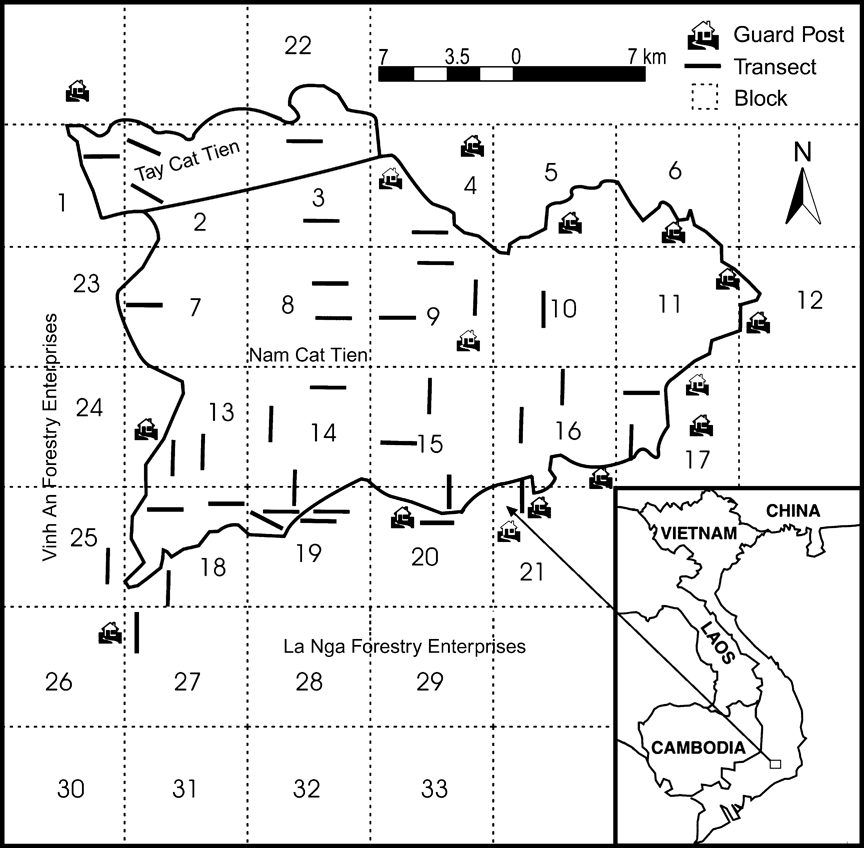
Cat Tien National Park (declared in 1992) is located in southern Vietnam, c. 130 km north-east of Ho Chi Minh City (Fig. 1; for descriptions of the Park see Polet & Ling, Reference Polet and Ling2004). The Park consists of three sectors, Nam Cat Tien (383 km2) in Dong Nai province, Tay Cat Tien (54 km2) in Binh Phuoc Province, and Cat Loc (306 km2) in Lam Dong province. Cat Loc is separated geographically from the Nam Cat Tien and Tay Cat Tien sectors. Elephants only occur in the Nam Cat Tien sector. The Dong Nai River forms the natural boundary of Nam Cat Tien in the east and south-east. Two blocks of forest adjoining the Park are relevant to the elephants of this region (Fig. 1): La Nga State Forestry Enterprises (c. 200 km2) to the south of Nam Cat Tien, and Vinh An State Forestry Enterprises (c. 200 km2) to the west.
Cat Tien National Park and surrounding areas, with the location of guard posts, transects and numbered survey blocks. The inset shows the location of the Park in Vietnam.
A dry season prevails from December to April and a wet season from May to November, with average annual rainfall of c. 2,300 mm. Topography is both hilly and flat over altitudes of 200-600 m. The Park has one of the few remaining tracts of tropical lowland evergreen forest in Vietnam. Elsewhere in the Park deciduous forest (c. 70% of the Park) dominated by Lagerstroemia angustifolia and secondary forest with bamboo and rattan are characteristic (Wolf, Reference Wolf1998). The evergreen forest (c. 10%) is characterized by a dominance of Dipterocarpaceae, especially Dipterocarpus costatus. Gallery forest occurs as narrow strips along rivers but these are degraded (Wolf, Reference Wolf1998).
The forests of this region suffered from defoliants sprayed during the Vietnam War (Stellman et al., Reference Stellman, Stellman, Christian, Weber and Tomasallo2003) and by subsequent logging and uncontrolled immigration of people needing land for cultivation (Tuoc, Reference Tuoc1991; Dawson, Reference Dawson1996). This resulted in rapid transformation of the natural vegetation into lowland rice fields and into other agriculture on sloping terrain.
Methods
As visibility in the forest is poor because of dense undergrowth and elephant sightings are rare given their low numbers, indirect survey methods were used (Varman et al., Reference Varman, Ramakrishnan, Sukumar, Daniel and Datye1995). Surveys were carried out during the dry (February-April 2001) and wet (May-December 2001) seasons.
Dry season survey
Based on a latitude-longitude grid, 33 blocks, each of c. 6 km2, were identified in Cat Tien National Park and adjoining areas (Fig. 1). Two or three c. 1-km transects were laid in a generally north-south or east-west direction within each of 19 blocks (a total of 36 transects with a combined length of 35 km; Fig. 1), using existing trails for the starting points. Each transect required an average of 50 man-hours to lay. Locations of starting and ending points of transects were recorded with a global positioning system (GPS). Within 2 m either side of the transect we collected information on habitat type, and on elephant signs such as footprints, feeding evidence and dung. The blocks were also surveyed beyond the transects, and locations of elephant signs, including dung, tracks and feeding were recorded with a GPS (Fig. 2). For tracks, we measured the circumference of the front foot, and width and length, and for dung the circumference of the boli (for approximate size of the animal).
Signs of elephant presence in and around Cat Tien National Park (Fig. 1), and areas of core and medium activity by elephants (see text for details).

Eighty visits to villages (including multiple visits to some villages) within and outside Cat Tien National Park and the Forestry Enterprises were made during both the dry and wet seasons, and the occurrence of elephants was investigated with a questionnaire survey. Information on elephant visits to villages was supplemented with data on crop and household damage, human injury and death, and elephant deaths. Patrolling staff at 16 guard posts (Fig. 1), mostly located along the boundaries of the Park (with the exception of Bau Sau, located within), were interviewed for information on past and current elephant numbers and their movements. Specimens of plants with feeding signs of elephants were collected. The composition of both fresh and dry elephant dung piles was examined, and samples were collected for study of plant content. The samples were washed to remove the fine contents and the coarser remains were dried and examined under a microscope for identification of plant species and parts.
Wet season survey
The time and manpower required for laying transects during the dry season were high but the returns low as this method did not provide any information on either elephant density or habitat use. The line transect method was therefore abandoned during the wet season and we examined blocks along the south-west boundary as well as in La Nga State Forestry Enterprises (the dry season survey and local information suggested that the elephants were largely restricted to this area). Using vehicles the villages were surveyed rapidly; on a given day a number of villages and smaller settlements located in the Forestry Enterprises were visited and information on recent visits of elephants recorded. The expectation was that the number of different elephant groups visiting these villages within a short time period of a week may reflect the total number of elephants using the Park.
Results
Line transect and block survey
Neither dung piles nor any other signs of elephant were found along any of the transects. Based on signs such as dung, tracks and feeding, surveys beyond the transects indicated that elephants do not use large areas to the north and east but use the western and south-western areas of the Park as well as La Nga State and Vinh An State Forestry Enterprises. During the dry season the elephants appeared to be largely confined to the proximity of cashew Anacardium occidentale plantations (primarily in block 19) along the Park boundary, although they also utilized blocks 7, 9, 13, 14, 18, 21 and 25-27. During the wet season they not only utilized these blocks but also 8, 16, 24 and 28, indicating wider movement.
Dung size, track size and elephant numbers
A total of 58 dung piles was encountered in the two seasons combined. Dung piles were mainly found in blocks 19 (68%) and 20 (22%). The range of sizes of the 46 dung piles measured (15-49 cm circumference) suggested they came from at least seven elephants, assuming one elephant for every 3 cm size difference (allowing for variation in boli size for an individual elephant as well as measurement error; Table 1). The most frequently encountered size class was 34-36 cm (20% of piles).
Number of dung piles found during the dry and wet seasons, and overall, by dung circumference. In all cases, except 0, the assumed minimum number of elephants was one.

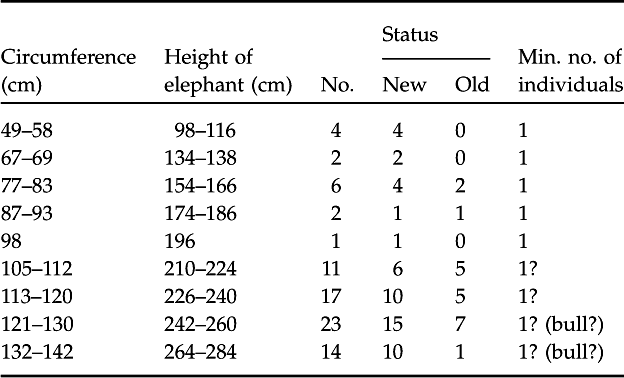
Fresh tracks were found in blocks 7, 8, 16, 19-21 and 28, in both dry and wet seasons except for block 19, where they were found only in the dry season. A total of 80 tracks encountered during the two seasons measured 49-142 cm in circumference (Table 2). Although it is difficult to differentiate individuals on the basis of track measurements it is reasonable to interpret the overall range as representing at least nine distinct elephants, assuming one elephant for every 7-10 cm size range.
Measurements of elephant footprints and estimated height of elephants encountered in Cat Tien National Park and the State Forest Enterprises areas, for dry and wet seasons combined.
Village surveys
Villagers informed us that elephants visiting during 1999-2001 ranged from solitary individuals to a group of seven animals. A solitary male seemed to be the most frequent visitor. There were two distinct periods of elephant visits to villages, February-May and June-December (Fig. 3), with a peak in November (30% of visits). During a 4-day visit to villages in La Nga State Forest Enterprises we encountered, on the first day of our visit (11 December 2001), an adult male elephant that had come to Ta Lai village (in the south-west of the Park). The same day a village 7 km from Ta Lai reported a group of 4-5 elephants without a young calf. None of the other villages visited by the team reported any elephants. To this can be added an adult female and her calf that had been sighted by villagers near the boundary of the Park, the signs of which we located. Thus, a minimum of 7-8 elephants was estimated for this region.
Elephant visits to villages from January to December for 1999-2001 combined. The values refer to the percentage of total visits during the year in all surveyed villages.

Guard station survey
The guard station surveys also indicated that elephants mostly use the south-west of the Park (up to Ta Lai village) and the Forestry Enterprises. There were reports of direct sightings during February and March 2001, and in 2000 a group of nine elephants was reported. Towards the south only a solitary male has been sighted, near the Nui Tuong forest guard station and the Park headquarters during 1999. There were elephant tracks reported in March 2001 from Da Bong Kua in the north-west and Bau Sau in the central region.
Elephant food plants
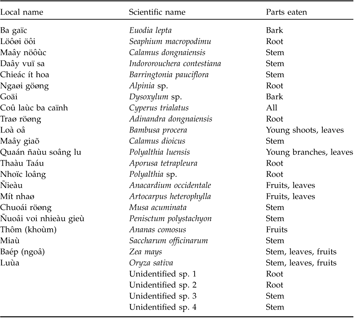
Elephants fed on at least 26 species of plants, both wild and cultivated (Appendix). Of these, stems of 11 species, roots of seven, fruits of four, and bark of two were eaten. The elephants did not exclusively consume the leaves of any plant species but these were consumed along with the stem, shoots or fruits. Grass dominated (57.7%) the diet, followed by cashew fruits (32.3%), rattan (5.8%) and bamboo (4.1%). Bamboo and rattan were found in all the dung samples collected (Table 3). Hardly any woody plant species were found in the dung, indicating that many of these plants are probably unpalatable because of the presence of plant secondary compounds. The cashew plantation in the south-west of the Park is a major attraction for elephants during the dry season. Each dung pile contained an average of 15.4 ± SD 26.1 (n = 34) cashew seeds (20 piles out of 34 piles sampled had seeds; range 6-117 seeds in those piles that contained seeds). We estimated that 6-7.5 kg of fruit may be consumed per individual per day by the 5-6 elephants visiting this plantation.
Percentage plant composition of elephant dung (n = 20).
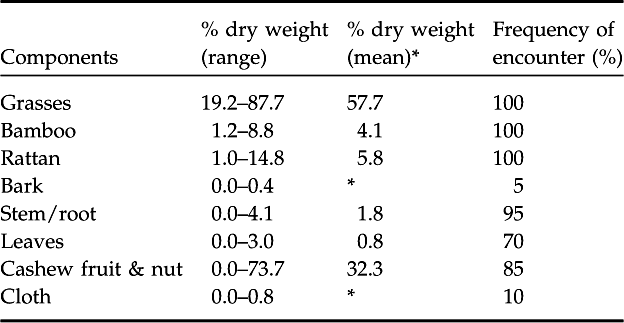
* negligible contribution
Discussion
Status and population structure
It is clear that the elephant population in Cat Tien National Park and adjoining areas declined during the 1990s. Elephants now occur only in the southern section of the Park (Nam Cat Tien), having been hunted to extinction in the northern section (Cat Loc) during the 1970s and 1980s (G. Polet, pers. comm., based on discussions with farmers/hunters). Tan Phu State Forest Enterprises in Dong Nai province also had a herd of c. 12 elephants during 1997 (Giao et al., Reference Giao, Dang and Walston1997). This was a remnant of a larger population of elephants that had been in severe conflict with people and had been reduced through capture, initiated in 1993. These elephants were all captured finally in 2001.
Our surveys show, from our sightings and the indirect evidence, and from sightings by cashew collectors, that there are presently at least two adult or subadult males. From the size of tracks and dung boli two more elephants in the Park are juveniles, and others are subadult or adult females. There was also a reliable sighting of an adult female and her newborn calf in April 2001 near the cashew plantation and it is possible that this mother-calf pair may be part of the larger herd. From this evidence we therefore estimate a minimum of 9-11 elephants in the Park, comprising two adult or subadult bulls plus a herd of eight comprising 3-4 adult females, 2-3 subadults/juvenile, one juvenile (age 2 years in February 2001) and a young calf (born April 2001). DNA analysis of dung samples from the Park and La Nga State Forestry Enterprises suggest that 17 samples resolved into 11 unique individuals, on the basis of 6 microsatellite loci, and 3 different mitochondrial DNA haplotypes, the latter being high for such a small population (Vidya et al., Reference Vidya, Varma, Dang, Thanh and Sukumar2007; see also Vidya et al., Reference Vidya, Roshan Kumar, Arivazhagan and Sukumar2003 for details of the molecular methods). As our sample size of dung for the molecular analyses is small, it is possible that we could have missed collecting samples of further individuals, although we have no other evidence for this.
Such a small population has low viability and a high probability of extinction (Sukumar, Reference Sukumar, Daniel and Datye1995). However, the population does have breeding males and females, thus offering some hope for recovery. Our estimate of 11 elephants is below the carrying capacity, which would be at least 40 elephants if we assume that 0.1 elephant km−2 is the minimum density that can be supported in this forest type considering the estimates of 0.1-0.3 elephant km−2 in several other tropical moist forests (e.g. Dawson, Reference Dawson1992; Sukumar et al., Reference Sukumar, Venkataraman, Cheeran, Mujumdar, Baskaran, Dharmarajan, Roy, Suresh and Narendran2003). The carrying capacity of the larger area used by the elephants would be higher; the state Forest Enterprises could support higher densities because of the secondary nature of the forest and the availability of grasses (Sukumar, Reference Sukumar2003).
Distribution
The high density of indirect signs in blocks 19 and 20 indicate that these constitute the core area of the range (Fig. 2). During the dry months (February-May) the elephants frequent the cashew plantations, just south of the Park boundary. At this time elephants also depend substantially on grasses found in and around the plantation. While the herd members seem to be largely confined to the plantation and the secondary vegetation in the Park, at least one bull makes longer forays south through La Nga State Forestry Enterprises to enter agricultural areas. The elephants also occasionally use the western and central part of the Park, as indicated by a few old signs in some of the blocks. It is surprising that elephants rarely visit the large lake area at Bau Sau (block 9), where a guard post is located, although old signs in the block indicate occasional use of the adjacent grassland.
During the wet season (June-November) blocks 19 and 20 still remain the core area but the elephants, both the herd and the bulls, appear to use La Nga State Forestry Enterprises more intensively, possibly because of the growth of grasses in the plantation areas and the added attraction of agricultural fields with maize and rice to the south. The southern forested blocks of La Nga State Forestry Enterprises (27, 28 & 29) will therefore have to be more carefully surveyed for elephant usage. To the west of the Park elephants also move into the secondary forests of Vinh An State Forestry Enterprises. Signs of elephants there indicate sporadic usage but this requires a more detailed survey. Elephants do not appear to move to the northern boundary of the Park and have not been recorded in recent years in the north-east, which has primary evergreen forest.
Elephant-human conflict
Conflict over the cashew plantations is not serious. Farmers lose only 2% of the total harvest per day (estimated at 2,000 kg harvested per day) from feeding by elephants; at the same time the farmers also collect cashew seeds from the dung piles. This is a good example of conflict avoidance over this resource because farmers retrieve at least part of their crop. Most of the villages (91%) visited reported visits by elephants, mostly a solitary adult male. It also appears that males cover large distances to raid crops whereas the family groups restrict themselves to a few villages. Elephants visit villages for stored and cultivated rice, salt, maize, sugar cane, cashew, banana, tapioca, bean and other crops, and in the process damage houses. Adult males even enter houses in search of stored food. Although there is damage to crop and huts, the elephant-human conflict is not severe compared to that in the nearby Tan Phu forest. The elephants have not killed anybody, and only primitive methods of mitigating the problem are currently in use. However, developing a strategy to mitigate the conflict is of crucial importance, as any human death as the result of elephant attack would result in antagonism towards conservation. If a reproductive bull is killed this could virtually seal the demographic fate of this population.
Recommendations for conservation
The dense vegetation and low elephant density in Cat Tien National Park preclude the use of line transects for monitoring. The most practical monitoring in this situation is to question villagers, in November, and examine fresh evidence such as track and dung in localized areas such as the cashew plantation, during February. Two other methods would be feasible for this small population with a restricted range. Molecular genetic (DNA) analyses of dung for sexing as well as individual identification are now feasible (Vidya et al., Reference Vidya, Roshan Kumar, Arivazhagan and Sukumar2003, Reference Vidya, Varma, Dang, Thanh and Sukumar2007), and the cashew plantation would be a good location for camera trapping of elephants.
This small population of 11+ elephants has low demographic viability. Population viability analyses for Asian elephants (Sukumar, Reference Sukumar, Daniel and Datye1995) show that such a population may have a 70% probability of extinction from chance alone (if the deterministic population growth rate is zero). The presence of breeding males and females, and the availability of sufficient habitat area and resources, however, offer some hope for recovery. This will only be possible if the elephants are strictly protected from poaching or conflict with humans. The short-term (2-5 years) goal of management should be to stabilize the elephant population at present levels. The medium-term (20-25 years) goal should be to increase the population to 25-30, if necessary through supplementing the population with animals from elsewhere, and the longer-term (75-100 years) goal to further increase it to c. 100+ elephants. These goals could be achieved in a number of ways, from habitat manipulation to consolidation of habitat and strict protection of the elephant population.
The habitat of the Nam Cat Tien sector of the Park could be manipulated in a selective manner to make it more attractive for elephants, with the objective of gradually luring the elephants away from the villages in La Nga State Forestry Enterprises. This could include the development of salt licks, a water reservoir, and perhaps a small area under grassland in block 14 and/or 15. The planting of cashew trees could be tried on an experimental basis. It would also be prudent to carry out any initial manipulation at sites no more than 1-3 km to the north of the southern boundary of the Park, as otherwise the elephants may never actually venture into these areas.
Consolidating the habitat area available to elephants is essential to maintaining a larger and more viable elephant population; the forests of the two State Forestry Enterprises are crucial in this respect. While the southern parts of La Nga State Forestry Enterprises already have many settlements and plantations, the northern part (>100 km2) is still intact and has the potential to support elephants. Similarly, Vinh An State Forestry Enterprises, together with Ma Da and Hieu Liem Forest Enterprises to the west of the Park provide an ideal buffer, with c. 200 km2 of secondary vegetation. A proposal to designate Vinh An State Forestry Enterprises as a nature reserve should be encouraged, as it will contribute to the long-term planning for the conservation of elephants in the greater Cat Tien region.
A track (no. 323) is currently being enlarged into a road along the south-western boundary of the Park, extending the existing road from Doi Dat Do to the Sa Mach forest guard post. When completed the road has the potential to encourage the influx of a large number of people along the Park boundary and increase vehicular traffic. This could cut off the movement of elephants between La Nga State Forestry Enterprises and Nam Cat Tien. The existing road between Sa Mach and Ta Lai, through the La Nga State Forestry Enterprises, could be strengthened for the general use of the public as an alternative to enlarging track 323. This would also discourage elephants from moving across the Sa Mach–Ta Lai road, which would be a desirable goal.
Elephant-human conflict is not intense at present, mainly because the elephants have not killed anybody. The feasibility of putting up a high-voltage electric fence along the forest-cultivation boundary of La Nga State Forestry Enterprises, from Sa Mach to Ta Lai, should be explored. This fence would keep elephants away from the dense settlements and from maize and paddy fields in the lowlands but allow them the use of c. 100 km2 of secondary forest area and cashew plantations in La Nga State Forestry Enterprises (within blocks 18, 19, 20, 27-29). Community outreach programmes to assist people to deal with elephant-human conflict should be undertaken. At the same time, strengthening the protection of the Park and adjoining areas through mobile units with responsibility for monitoring elephants and elephant-human conflict is highly desirable.
Since our field work in 2001 there have been no reports of any death or birth of elephants in the Park, although the possibility of some breeding cannot be ruled out. The Vietnamese Government has, however, enlarged the area under protection by gazetting the 40,000 ha Vinh An Nature Reserve that adjoins Cat Tien National Park to the west. In addition, the Government has approved an Action Plan for Urgent Conservation Areas in Vietnam that calls for establishing three elephant conservation areas in the country, of which Cat Tien National Park is one.
Acknowledgements
We thank Tran Van Mui (Director of Cat Tien National Park), Gert Polet (Chief Technical Advisor of WWF/Cat Tien National Park Conservation Project) and Bui Huu Manh (GIS Specialist, Cat Tien National Park), for their support of this survey. Nguyen Tien Dung carried out the plant analysis, and Dr T.N.C. Vidya performed the molecular analysis of dung samples. The project was funded by the US Fish and Wildlife Service/Asian Elephant Conservation Fund through WWF-Vietnam.
Appendix
Elephant food plants recorded during the dry season survey.
Biographical sketches
Surendra Varma has been involved in several studies and surveys of large mammals, especially Asian elephants, in India and South-east Asia. Nguyen Xuan Dang is a biodiversity specialist who has been studying various taxa and their conservation in Vietnam. Tran Van Thanh is a forester involved in protection, law enforcement and management of Cat Tien National Park. Raman Sukumar has been involved in the study and the conservation of Asian elephants since 1980. His research interests also extend to tropical forest ecology and climate change.



